

- Market Size (2026)
- USD 317.6 Mn
- Forecast (2036)
- USD 772.9 Mn
- CAGR (2026 to 2036)
- 9.3%
How big is the Metabolic Surgery Long-Term Nutrition Market in 2026?
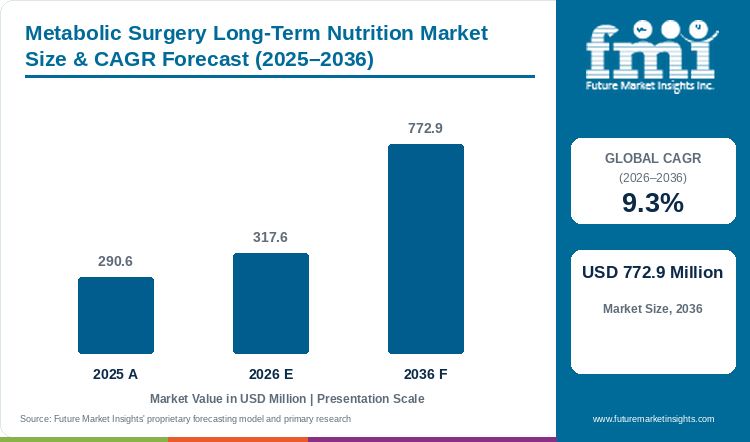
USD 317.6 Million in 2026 and USD 772.9 Million by 2036 at a 9.3% CAGR.
The metabolic surgery long-term nutrition market stands at USD 317.6 Million in 2026 and is projected to reach USD 772.9 Million by 2036, growing at a 9.3% CAGR. The metabolic surgery long-term nutrition market is estimated at USD 290.6 million in 2025. Unlike many healthcare markets driven by one-time purchases, revenue here is anchored by a recurring, cumulative need. The ASMBS estimated 270,089 metabolic and bariatric procedures in the United States alone. Each treated cohort adds years of vitamin, mineral, and protein purchasing when clinical follow-up remains active. That expanding, cumulative patient base is the critical bridge between annual procedure activity and sustained nutrition spending.[1]
Operating conditions differ sharply by country, creating vastly different refill and specification patterns. South Korean insurance coverage materially expanded bariatric procedure access after 2019, while UK guidance mandates at least annual nutritional monitoring after specialist discharge. Japan added insurance coverage for sleeve gastrectomy with bypass in June 2024. These divergent pathways mean that demand only becomes realized revenue when long-term monitoring is actively linked to a tolerable regimen, clear product guidance, and a reliable replenishment channel that patients can sustain for years.[4][7][8][10]
Market Size and Forecast
Table 1: Market Size and Forecast for the Metabolic Surgery Long-Term Nutrition Market (USD Million), 2025 to 2036
| Metric | Value |
|---|---|
| Estimated Market Size in 2025 | USD 290.6 Million |
| Estimated Market Size in 2026 | USD 317.6 Million |
| Projected Market Size by 2036 | USD 772.9 Million |
| CAGR, 2026 to 2036 | 9.3% |
Key Takeaways
- Lifelong monitoring and supplementation create recurring revenue from the cumulative post-surgery population, even when annual procedure volumes fluctuate. The market is fundamentally a retention business, not an acquisition business.
- Bariatric Multivitamin Systems lead Product Type with a 48.3% share in 2026 because a well-designed core regimen can consolidate many required micronutrients into fewer daily doses, directly addressing the pill-burden problem that undermines long-term adherence.
- Sleeve Gastrectomy leads Surgery Type with a 48.4% share in 2026 because it is the most commonly performed metabolic surgery across several large treatment systems, forming the largest and most consistent new user pool for maintenance products.
- Year 1 leads Time Since Surgery with a 49.4% share in 2026 because early follow-up concentrates diet progression, protein targets, laboratory surveillance, and intensive regimen adjustment into a single, high-engagement period.
- Long-term adherence can weaken significantly when patients face high pill counts, taste or texture problems, gastrointestinal intolerance, recurring refill costs, or a loss of specialist follow-up after discharge.
Profiled companies: Bariatric Advantage, Celebrate Vitamins, ProCare Health, Bariatric Fusion, Unjury (ProSynthesis Labs), Abbott, Nestle Health Science, and Medtrition.
Analyst Perspective
Realized revenue depends far less on the act of surgery itself than on whether patients remain connected to active monitoring and a refill pathway that stays manageable years later. Suppliers that successfully reduce regimen burden without weakening procedure-specific nutrient coverage are significantly better positioned to retain long-term demand and defend against churn.
- Anurag Sharma, Future Market Insights
How is the metabolic surgery long-term nutrition market segmented?
The market is segmented by Product Type, Surgery Type, Time Since Surgery, Form and Sales Channel.
Product Type includes Bariatric Multivitamin Systems, Calcium Citrate + D3 Products, Iron & B12 Maintenance, High-Protein Maintenance Products, and Others. Surgery Type includes Sleeve Gastrectomy, Gastric Bypass (RYGB), and Duodenal Switch & Others. Time Since Surgery includes Year 1, Years 2-5, and 5+ Years. Form includes Chewables & Gummies, Capsules / Tablets, Powders & RTD, and Others. Sales Channel includes Online / DTC, Retail Pharmacy, Supermarkets & Hypermarkets, Specialty & Health Stores, and Others.
Why do Bariatric Multivitamin Systems anchor the Product Type mix?
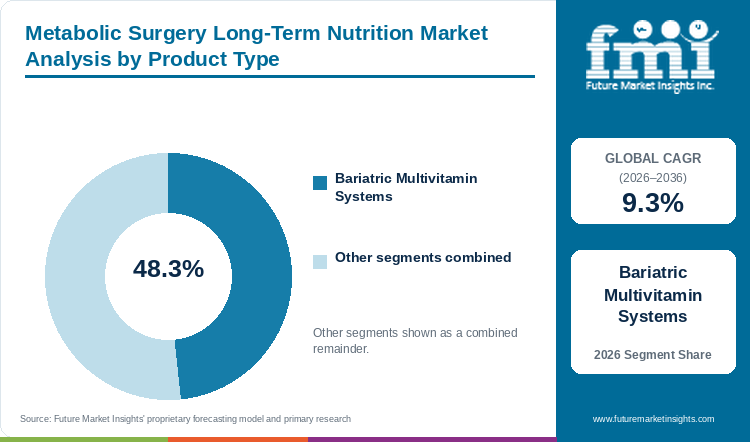
Bariatric Multivitamin Systems hold 48.3% of Product Type in 2026.
Bariatric surgery fundamentally reduces nutrient intake and alters absorption pathways, making a broad multivitamin the logical foundation of any long-term regimen. Calcium and iron products fill targeted gaps identified through laboratory monitoring, while B12 and protein products address additional procedure-specific or clinically driven needs. Suppliers can also meaningfully reduce pill burden through once-daily or condensed formulas, which is critical for adherence over years of use. This combination makes the multivitamin system the natural first purchase for most patients and gives specialist brands a powerful platform for cross-category replenishment. Bariatric Multivitamin Systems hold 48.3% of Product Type revenue in 2026 because they cover the widest recurring micronutrient requirement in a single foundational product.[3][12][16][17][18][19]
- Bariatric Multivitamin Systems account for 48.3% of Product Type in 2026.
- Consolidation of Complex Nutrient Requirements: The ASMBS micronutrient guidance addresses postoperative screening and supplementation across thiamin, B12, folate, iron, calcium, fat-soluble vitamins, zinc, and copper. This extraordinary breadth strongly favors a well-formulated core multivitamin over a cumbersome sequence of isolated single-nutrient products.[3]
- Platform for Cross-Category Replenishment: The multivitamin serves as the anchor around which patients build their broader supplement routine, creating natural opportunities for suppliers to extend into calcium, iron, B12, and protein products through trusted brand relationships and simplified ordering.
What keeps Sleeve Gastrectomy central to Surgery Type demand?
Sleeve Gastrectomy holds 48.4% of Surgery Type in 2026.
Surgery Type demand follows the size and persistence of each postoperative cohort, and sleeve gastrectomy has become the dominant procedure in several countries because it is widely performed and does not require an intestinal bypass. However, it still creates significant long-term micronutrient and protein needs that require ongoing supplementation. This combination produces a large addressable pool for maintenance products, while RYGB and duodenal-switch pathways can require even more intensive procedure-specific supplementation. Sleeve Gastrectomy accounts for 48.4% of Surgery Type revenue in 2026 because its high procedure volume creates the broadest recurring user base.[1][3][7][8]
- Sleeve Gastrectomy accounts for 48.4% of Surgery Type in 2026.
- Procedure Volume Drives User Base Scale: The ASMBS estimated 157,254 sleeve procedures in the United States in 2023 compared with 63,132 RYGB procedures. This procedure mix directly supports a substantially larger inflow of sleeve patients into long-term nutrition programs each year.[1]
- Distinct but Manageable Nutrient Needs: While sleeve patients may face fewer malabsorption challenges than bypass patients, they still require lifelong supplementation, making them ideal candidates for standardized multivitamin systems with optional targeted additions based on individual lab results.[3]
What are the drivers, restraints and opportunities in the metabolic surgery long-term nutrition market?
Demand is driven by lifelong monitoring and deficiency prevention, while adherence burden and recurring cost restrain repeat purchasing, and procedure-specific low-burden formats create an opportunity for more durable revenue.
- Driver: A growing cumulative population of post-surgery patients requires recurring micronutrient and protein management for the rest of their lives.
- Restraint: Pill burden, taste fatigue, gastrointestinal intolerance, follow-up attrition, and recurring out-of-pocket cost can actively interrupt long-term adherence and refill continuity.
- Opportunity: Tailored formulas, simpler dosing regimens, and robust refill support can convert annual monitoring into targeted, predictable repeat purchases.
The strongest driver is the persistence of nutritional risk long after the procedure itself. A 2024 meta-analysis covering 54 studies with five to 17 years of follow-up found significant long-term deficiencies in vitamin D, vitamin E, vitamin A, vitamin K, and vitamin B12, with the exact pattern varying by procedure and region. This evidence firmly supports a recurring maintenance model rather than a short recovery market. Suppliers benefit most when clinicians actively translate monitoring results into procedure-appropriate products that patients can realistically keep using for years.[6]
The restraint appears squarely at the point of sustained adherence. ProCare Health documented in October 2022 that common patient complaints included supplement size and daily dose frequency, with taste, texture, and cost also frequently cited. These issues can turn a clinically necessary regimen into inconsistent, sporadic purchasing. Procedure inflow can also vary unpredictably. The ASMBS reported in May 2026 that U.S. metabolic and bariatric procedures fell below 200,000 in 2024 based on ACS-MBSAQIP records. Suppliers therefore cannot rely solely on new surgeries. Retention and refill continuity matter just as much, if not more.[2][16]
The clearest opportunity is to connect monitoring directly with individualized maintenance. NICE guidance calls for annual nutritional monitoring and appropriate supplementation after discharge from bariatric services. That recurring clinical review creates a natural decision point for iron and B12 adjustments, and it can also trigger changes to calcium, vitamin D, or protein intake. Suppliers can capture significantly more of that demand through procedure-specific formulas, lower pill counts, and channels that support automatic refills. The opportunity becomes durable revenue only when formulation simplicity is matched by credible nutrient coverage and clear clinical justification.[4]
Which country CAGRs are profiled in the metabolic surgery long-term nutrition market?
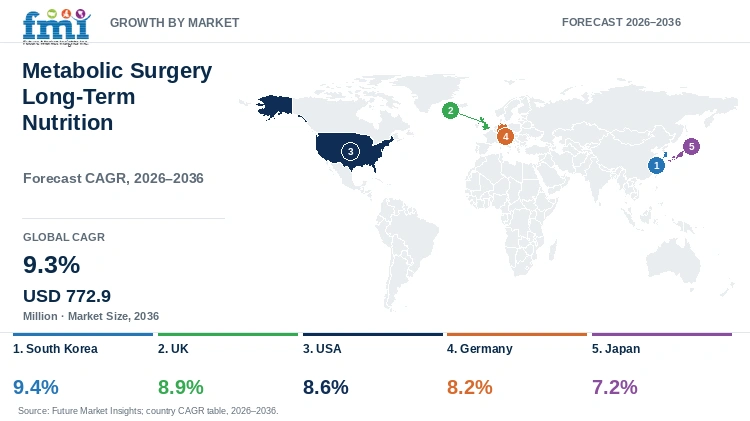
The following country CAGRs cover 2026 to 2036.
Table 2: Country CAGRs for the Metabolic Surgery Long-Term Nutrition Market (CAGR, %), 2026 to 2036
| Country | CAGR |
|---|---|
| South Korea | 9.4% |
| UK | 8.9% |
| USA | 8.6% |
| Germany | 8.2% |
| Japan | 7.2% |
Country-wise Analysis
- South Korea: South Korea carries the fastest profiled rate at a 9.4% CAGR from 2026 to 2036. A nationwide cohort study published online in January 2025 found that annual bariatric procedures rose from approximately 500 before insurance coverage to around 2,000 after coverage was implemented. Sleeve gastrectomy accounted for 69.8% of procedures in the 2019-2021 cohort, and a Korean registry report similarly identified sleeve procedures as the dominant primary operation during 2019-2022. For nutrition suppliers, the commercial effect is a rapidly expanding stream of new patients entering long-duration supplementation programs. However, growth still depends heavily on follow-up continuity and product adherence after the early surgical period, as the initial procedural surge must translate into years of consistent refill behavior.[7][8]
- UK: The UK is profiled at an 8.9% CAGR from 2026 to 2036. NICE guidance published in January 2025 requires a minimum two-year follow-up package within the bariatric service and at least annual nutritional monitoring after discharge, creating a clear and enforceable clinical framework for ongoing supplementation. England also reported adult obesity prevalence of 26.5% in 2023-2024 in the May 2025 obesity profile, supporting a robust treatment pipeline. However, the nutrition market depends on actual surgery and long-term care pathways rather than prevalence alone. Suppliers must fit shared-care practice, community purchasing behavior, and recurring patient budgets rather than assuming specialist prescribing continues indefinitely after discharge.[4][5]
- USA: The USA is profiled at an 8.6% CAGR from 2026 to 2036, benefiting from a large, established bariatric procedure base and a highly mature specialist direct-to-consumer channel. The ASMBS estimated 270,089 metabolic and bariatric procedures in 2023, with sleeve gastrectomy the largest procedure category. However, a separate ASMBS release in May 2026 reported a sharp fall in procedures during 2024 based on ACS-MBSAQIP data. This volatility can slow new-patient additions without eliminating the massive cumulative need from prior cohorts. Specialist brands can defend repeat revenue through subscriptions, extensive product variety, and lower-burden regimens that make lifelong supplementation genuinely easier to sustain across years of use.[1][2][15][17][18][19]
- Germany: Germany carries an 8.2% CAGR from 2026 to 2036, with competitive demand developing inside a highly structured center and guideline environment. The DGAV announced that revised requirements for first certification and re-certification of obesity-therapy and metabolic-surgery centers took effect on January 1, 2026, with criteria aligned to current guidelines and health-policy conditions. This environment strengthens the role of specialist clinical teams in nutrition specification and long-term follow-up, but it also raises the importance of thorough documentation and professional acceptance for suppliers. Revenue growth therefore depends on fitting established clinical workflows and supplementation practices rather than relying on broad consumer wellness positioning.[9]
- Japan: Japan is profiled at a 7.2% CAGR from 2026 to 2036, the lowest rate among the five country profiles. A 2026 nationwide endoscopic-surgery survey reported 5,273 bariatric procedures from 2002 through 2023, with 645 procedures performed in 2023 alone. Sleeve gastrectomy represented 76.0% of the cumulative procedure count. Japan also added insurance coverage for laparoscopic sleeve gastrectomy with bypass in June 2024, widening clinical access and creating new maintenance needs. However, the procedure base remains comparatively limited. Suppliers need focused clinical partnerships and procedure-specific products because broad retail exposure alone is unlikely to translate into sustained post-surgery purchasing in this market.[10][11]
Who are the notable companies in the metabolic surgery long-term nutrition market?
Bariatric Advantage, Celebrate Vitamins, ProCare Health, Bariatric Fusion, Unjury (ProSynthesis Labs), Abbott, Nestle Health Science, and Medtrition are the notable companies profiled in this market.
Competition is distinctly split between bariatric-specific micronutrient specialists, brands that combine bariatric vitamins with protein support, and broad clinical nutrition companies. Bariatric Advantage, Celebrate Vitamins, and ProCare Health emphasize procedure-specific multivitamins alongside calcium and targeted micronutrients. Bariatric Fusion and Unjury (ProSynthesis Labs) sit closer to an integrated vitamin-and-protein model under common Blueroot Health ownership. Abbott, Nestle Health Science, and Medtrition bring broader oral nutrition or concentrated protein capabilities, and their participation is most relevant to High-Protein Maintenance Products rather than to bariatric-specific micronutrient replacement. Buyer choice therefore turns on nutrient coverage and format burden, with professional fit and replenishment access mattering far more than brand scale alone.[12][15][16][17][18][19][20][22][24][25]
- Bariatric-specific micronutrient platforms: Bariatric Advantage, Celebrate Vitamins, and ProCare Health offer procedure-oriented multivitamins alongside calcium and targeted deficiency support, building their entire product architecture around the unique needs of post-surgery patients.[12][15][16][17]
- Integrated bariatric vitamin and protein platforms: Bariatric Fusion and Unjury (ProSynthesis Labs) combine long-term micronutrient support with protein products and direct-to-consumer access, creating a more consolidated offering for patients who want fewer purchasing relationships.[18][19][20]
- Broad clinical nutrition and protein suppliers: Abbott, Nestle Health Science, and Medtrition contribute high-protein oral nutrition formats with wider medical or adult-nutrition applications, serving the maintenance protein segment rather than the bariatric-specific micronutrient core.[22][24][25]
Competitive Benchmarking: Metabolic Surgery Long-Term Nutrition Market
Table 3: Competitive Benchmarking for the Metabolic Surgery Long-Term Nutrition Market
| Company | Bariatric-Specific Micronutrient Breadth | Adherence-Oriented Format Breadth | High-Protein Maintenance Capability | Geographic Reach |
|---|---|---|---|---|
| Bariatric Advantage | High | High | High | United States and Canada, with documented European e-commerce availability |
| Celebrate Vitamins | High | High | High | United States DTC, with international ordering support documented by the company |
| ProCare Health | High | High | Medium | United States DTC, with international customers routed through a third-party channel |
| Bariatric Fusion | High | High | High | Primarily United States |
| Unjury (ProSynthesis Labs) | Medium | High | High | United States, with a worldwide customer following reported in transaction materials |
| Abbott | Not specified | Medium | High | Global healthcare footprint across more than 160 countries |
| Nestle Health Science | Not specified | Medium | High | Multi-country medical nutrition availability across North America, Europe, and Asia-Pacific |
| Medtrition | Not specified | Medium | High | United States and more than 50 countries according to company material |
Scoring basis: Bariatric-Specific Micronutrient Breadth measures documented procedure-oriented multivitamin and calcium coverage plus iron, B12, and related nutrients. Adherence-Oriented Format Breadth measures documented chewables and capsules plus soft chews, powders, melts, and ready-to-drink options. High-Protein Maintenance Capability measures documented protein products that can support oral maintenance intake. High indicates broad or deep documented capability, Medium indicates credible but narrower capability, and Low indicates a documented limitation.
Key Developments in the Metabolic Surgery Long-Term Nutrition Market
- In February 2024, Unjury (ProSynthesis Labs) was acquired by Blueroot Health. SC&H Capital reported that Unjury would join Bariatric Fusion within the same brand group, bringing a protein-led bariatric brand and a bariatric vitamin platform under common ownership. This created significant scope for shared channel strategy and cross-category product planning.[20]
- In March 2025, Medtrition launched the ProSource Cup and ProSource Cup Plant portfolio, with each cup providing 20 grams of complete protein in a low-volume liquid format. Scheduled for national-account availability from April 2025, the products are not bariatric-specific but demonstrate continued investment in concentrated oral protein formats highly relevant to maintenance use cases.[25]
- In October 2025, Celebrate Vitamins highlighted 2025 launches that included Bubble Gum Calcium Soft Chews and new Watermelon and Orange flavors of CLR Protein Water, with the protein water providing 20 grams of protein per 12-ounce bottle. These releases directly target daily calcium acceptance and easier protein intake after surgery.[15]
Key Players in the Metabolic Surgery Long-Term Nutrition Market
- Bariatric-Specific Micronutrient Platforms
- Bariatric Advantage
- Celebrate Vitamins
- ProCare Health
- Integrated Bariatric Vitamin and Protein Platforms
- Bariatric Fusion
- Unjury (ProSynthesis Labs)
- Broad Clinical Nutrition and Protein Suppliers
- Abbott
- Nestle Health Science
- Medtrition
Metabolic Surgery Long-Term Nutrition Market - Report Scope
Table 4: Report scope for the Metabolic Surgery Long-Term Nutrition Market (USD Million), 2026 to 2036
| Coverage field | Report scope |
|---|---|
| Market breakdown | Product Type; Surgery Type; Time Since Surgery; Form; Sales Channel |
| Quantitative Units | USD Million |
| Market Definition | Revenue covers in-scope long-term nutrition products sold for use after metabolic surgery within the stated segmentation taxonomy. It includes bariatric multivitamins, Calcium Citrate + D3 Products, Iron & B12 Maintenance, and High-Protein Maintenance Products. It excludes surgery, pharmaceuticals, diagnostics, dietetic services, general weight-management nutrition, adjacent substitutes, and downstream finished-product revenue. |
| Regions Covered | North America; Latin America; Western Europe; Eastern Europe; East Asia; South Asia and Pacific; Middle East and Africa |
| Countries Covered | USA; UK; Germany; Japan; South Korea |
| Key Companies Profiled | Bariatric Advantage; Celebrate Vitamins; ProCare Health; Bariatric Fusion; Unjury (ProSynthesis Labs); Abbott; Nestle Health Science; Medtrition |
| Forecast Period | 2026 to 2036 |
| Approach | Primary and secondary research with market triangulation. |
Metabolic Surgery Long-Term Nutrition Market - Research Methodology
Table 5: Research methodology for the Metabolic Surgery Long-Term Nutrition Market (USD Million), 2026 to 2036
| Method | Approach |
|---|---|
| Primary Research | FMI analysts gathered input from manufacturers, service providers, technology developers, distributors, end users, procurement teams and subject-matter experts. Interviews examined purchasing decisions, product evaluation, adoption barriers, approval requirements, pricing considerations and expectations for technical or commercial support. |
| Desk Research | Desk research covered government statistics, regulatory publications, trade data, industry associations, technical literature, standards, company filings, product information and official corporate announcements. Claims relating to performance, applications, approvals, capacity, investment and commercial activity were retained only when supported by credible public evidence. |
| Market Sizing and Forecasting | The market model combined the baseline value with historical performance, segment structure, pricing and volume indicators, adoption levels, company participation and country-level demand conditions. Forecast assumptions considered economic activity, investment trends, regulatory developments, technology adoption, purchasing cycles, supply availability and barriers to wider market use. |
| Data Validation | Estimates were checked against multiple independent indicators, including public data, company activity, trade patterns, industry developments and findings from primary interviews. Adjacent categories, unsupported claims, overlapping revenues and activities without direct market relevance were excluded to reduce double counting. |
Metabolic Surgery Long-Term Nutrition Market by Segments
Metabolic Surgery Long-Term Nutrition Market segmented by Product Type:
- Bariatric Multivitamin Systems
- Calcium Citrate + D3 Products
- Iron & B12 Maintenance
- High-Protein Maintenance Products
- Others
Metabolic Surgery Long-Term Nutrition Market segmented by Surgery Type:
- Sleeve Gastrectomy
- Gastric Bypass (RYGB)
- Duodenal Switch & Others
Metabolic Surgery Long-Term Nutrition Market segmented by Time Since Surgery:
- Year 1
- Years 2-5
- 5+ Years
Metabolic Surgery Long-Term Nutrition Market segmented by Form:
- Chewables & Gummies
- Capsules / Tablets
- Powders & RTD
- Others
Metabolic Surgery Long-Term Nutrition Market segmented by Sales Channel:
- Online / DTC
- Retail Pharmacy
- Supermarkets & Hypermarkets
- Specialty & Health Stores
- Others
Metabolic Surgery Long-Term Nutrition Market by Region:
- North America
- United States
- Canada
- Latin America
- Brazil
- Mexico
- Argentina
- Chile
- Western Europe
- Germany
- France
- United Kingdom
- Italy
- Spain
- Benelux
- Nordics
- Eastern Europe
- Poland
- Czech Republic
- Romania
- Hungary
- East Asia
- China
- Japan
- South Korea
- South Asia and Pacific
- India
- ASEAN
- Australia and New Zealand
- Middle East and Africa
- GCC Countries
- South Africa
- Türkiye
- Israel
Research Sources and Bibliography
- [1] American Society for Metabolic and Bariatric Surgery (2025, April). Estimate of Bariatric Surgery Numbers, 2011-2023.
- [2] American Society for Metabolic and Bariatric Surgery (2026, May 5). Bariatric Surgery Procedures Fall Below 200,000, First Time Since 2020, New Research Finds. https://asmbs.org/news_releases/bariatric-surgery-procedures-fall-below-200000-first-time-since-2020-new-research-finds/
- [3] American Society for Metabolic and Bariatric Surgery (2017). ASMBS Integrated Health Nutritional Guidelines for the Surgical Weight Loss Patient 2016 Update: Micronutrients.
- [4] National Institute for Health and Care Excellence (2025, January 14). Overweight and obesity management: Medicines and surgery. https://www.nice.org.uk/guidance/ng246
- [5] Office for Health Improvement and Disparities (2025, May 7). Obesity profile: short statistical commentary, May 2025.
- [6] Chen et al. (2024, July 20). Long-term prevalence of vitamin deficiencies after bariatric surgery: a meta-analysis.
- [7] Choi et al. (2025, January 4). Outcomes of Bariatric Surgery Following Insurance Coverage Adoption: A Nationwide Cohort Study.
- [8] Korean Society for Metabolic and Bariatric Surgery (2024, June 18). A Nationwide Report on Metabolic and Bariatric Surgery in 2019-2022.
- [9] German Society for General and Visceral Surgery (2026, January 21). Neue Zertifizierungsanforderungen an Zentren für Adipositastherapie & Metabolische Chirurgie ab 01.01.2026.
- [10] Japan Society for the Treatment of Obesity (n.d.). Guideline for introduction of laparoscopic sleeve gastrectomy with bypass.
- [11] Japan Society for Endoscopic Surgery (2026). Multidisciplinary Trends in Endoscopic Surgery in Japan: Insights From the 17th Nationwide Survey.
- [12] Bariatric Advantage (n.d.). Product Finder.
- [13] Bariatric Advantage Europe (n.d.). Bariatric Advantage Europe.
- [14] Bariatric Advantage Canada (2010, August 19). Metagenics Announces Acquisition of Bariatric Advantage.
- [15] Celebrate Vitamins (2025, October 28). Black Friday Bariatric Supplement Sale.
- [16] ProCare Health (2022, October 12). Science Before Our Products.
- [17] ProCare Health (n.d.). Core-18 Bariatric Multivitamin Chewable Tablet.
- [18] Bariatric Fusion (n.d.). One Per Day Chewable Multivitamin with 45mg Iron.
- [19] Bariatric Fusion (n.d.). Bariatric Multivitamins.
- [20] SC&H Capital (2024, February 7). SC&H Capital Advises Unjury in Sale to Blueroot Health. https://www.schgroup.com/press-releases/unjury-sale-to-blueroot-health-advised-by-sch-capital/
- [21] Unjury (2024, May 8). Minimum Advertised Price Policy.
- [22] Abbott Nutrition (n.d.). Ensure Max Protein.
- [23] Abbott (2026, May 13). Abbott launches Ensure Strength Pro in India.
- [24] Nestle Health Science (n.d.). Resource 2.0.
- [25] Medtrition (2025, March 25). Medtrition, Inc. launches the ProSource Cup portfolio. https://www.medtrition.com/wp-content/uploads/2025/03/ProSource-Cup-Press-Release-March-2025.pdf
This Report Answers
- How large is the Metabolic Surgery Long-Term Nutrition Market in 2026 and what value is forecast for 2036?
- Which clinical and operating pressures support recurring demand for long-term post-surgery nutrition?
- Why do Bariatric Multivitamin Systems lead the Product Type category?
- Why does Sleeve Gastrectomy lead the Surgery Type category?
- How do the profiled country growth rates differ from 2026 to 2036?
- Which profiled companies supply bariatric-specific micronutrients, protein products, or broader clinical nutrition options?
- What limits long-term adherence, repeat purchasing, and supplier switching?
- What should buyers evaluate before selecting a long-term metabolic-surgery nutrition product?
Frequently Asked Questions
How big is the Metabolic Surgery Long-Term Nutrition Market in 2026, and what is forecast for 2036?
The market is valued at USD 317.6 Million in 2026 and is forecast to reach USD 772.9 Million by 2036. The forecast reflects recurring nutrition demand building across successive post-surgery cohorts over time.
What is the CAGR of the Metabolic Surgery Long-Term Nutrition Market from 2026 to 2036?
The market is forecast to expand at a 9.3% CAGR from 2026 to 2036. Growth is tied to long-duration supplementation, active monitoring, and consistent refill behavior rather than to procedure volume alone.
Which Product Type leads the Metabolic Surgery Long-Term Nutrition Market?
Bariatric Multivitamin Systems lead Product Type with a 48.3% share in 2026. They function as the foundational daily regimen for a wide set of micronutrient requirements that persist indefinitely after surgery.
Which Surgery Type leads the Metabolic Surgery Long-Term Nutrition Market?
Sleeve Gastrectomy leads Surgery Type with a 48.4% share in 2026. Its high procedure frequency creates the largest inflow of new patients requiring long-term nutritional maintenance each year.
Which profiled countries have the highest growth rates?
South Korea has the highest profiled CAGR at 9.4%, followed by the UK at 8.9% and the USA at 8.6% from 2026 to 2036.
Which companies are active in the Metabolic Surgery Long-Term Nutrition Market?
Profiled companies include Bariatric Advantage, Celebrate Vitamins, ProCare Health, Bariatric Fusion, Unjury (ProSynthesis Labs), Abbott, Nestle Health Science, and Medtrition. Their roles range from bariatric-specific micronutrient systems to protein-led and broader clinical nutrition portfolios.
Preview the report firsthand - request a free sample
Get SampleGet the brochure for pricing and purchase details.
Get PDFTable of Content
- Key Takeaways
- Market Size and CAGR
- Top Growth Driver
- Fastest Growing Segment
- Leading Region
- Key Companies
- Emerging Opportunities
- Executive Summary
- Global Market Outlook
- Demand-side Trends
- Supply-side Trends
- Technology Roadmap Analysis
- Analysis and Recommendations
- Analyst Perspective (What is happening? Why now? What should investors know?)
- Key Questions Answered
- How large is the market?
- What is the CAGR?
- What are key trends?
- Which region dominates?
- Who are the leaders?
- Market Overview
- Market Coverage / Taxonomy
- Market Definition / Scope / Limitations
- Research Methodology
- Chapter Orientation
- Analytical Lens and Working Hypotheses
- Market Structure, Signals, and Trend Drivers
- Benchmarking and Cross-market Comparability
- Market Sizing, Forecasting, and Opportunity Mapping
- Research Design and Evidence Framework
- Desk Research Programme (Secondary Evidence)
- Expert Input and Fieldwork (Primary Evidence)
- Tooling, Models, and Reference Databases
- Data Engineering and Model Build
- Quality Assurance and Audit Trail
- Market Background
- Market Dynamics (Drivers, Restraints, Opportunity, Trends)
- Scenario Forecast (Optimistic, Likely, Conservative)
- Impact Analysis
- AI Impact
- Sustainability Impact
- Regulatory Impact
- Technology Impact
- Consumer / Buyer Analysis
- Purchase Drivers
- Adoption Barriers
- Buyer Journey
- Opportunity Map Analysis
- Product Life Cycle Analysis
- Supply Chain Analysis
- Investment Feasibility Matrix
- Value Chain Analysis
- PESTLE and Porter's Analysis
- Regulatory Landscape
- Regional Parent Market Outlook
- Production and Consumption Statistics
- Import and Export Statistics
- Global Market Analysis and Forecast, 2021 to 2036
- Historical Market Size Value (USD Million) Analysis, 2021 to 2025
- Current and Future Market Size Value (USD Million) Projections, 2026 to 2036
- Y-o-Y Growth Trend Analysis
- Absolute $ Opportunity Analysis
- Global Market Pricing Analysis, 2021 to 2036
- Global Market Analysis and Forecast, By Product Type, 2021 to 2036
- Introduction / Key Findings
- Historical Market Size Value (USD Million) Analysis By Product Type, 2021 to 2025
- Current and Future Market Size Value (USD Million) Analysis and Forecast By Product Type, 2026 to 2036
- Bariatric Multivitamin Systems
- Calcium Citrate + D3 Products
- Iron & B12 Maintenance
- High-Protein Maintenance Products
- Others
- Y-o-Y Growth Trend Analysis By Product Type, 2021 to 2025
- Absolute $ Opportunity Analysis By Product Type, 2026 to 2036
- Global Market Analysis and Forecast, By Surgery Type, 2021 to 2036
- Introduction / Key Findings
- Historical Market Size Value (USD Million) Analysis By Surgery Type, 2021 to 2025
- Current and Future Market Size Value (USD Million) Analysis and Forecast By Surgery Type, 2026 to 2036
- Sleeve Gastrectomy
- Gastric Bypass (RYGB)
- Duodenal Switch & Others
- Y-o-Y Growth Trend Analysis By Surgery Type, 2021 to 2025
- Absolute $ Opportunity Analysis By Surgery Type, 2026 to 2036
- Global Market Analysis and Forecast, By Time Since Surgery, 2021 to 2036
- Introduction / Key Findings
- Historical Market Size Value (USD Million) Analysis By Time Since Surgery, 2021 to 2025
- Current and Future Market Size Value (USD Million) Analysis and Forecast By Time Since Surgery, 2026 to 2036
- Year 1
- Years 2-5
- 5+ Years
- Y-o-Y Growth Trend Analysis By Time Since Surgery, 2021 to 2025
- Absolute $ Opportunity Analysis By Time Since Surgery, 2026 to 2036
- Global Market Analysis and Forecast, By Form, 2021 to 2036
- Introduction / Key Findings
- Historical Market Size Value (USD Million) Analysis By Form, 2021 to 2025
- Current and Future Market Size Value (USD Million) Analysis and Forecast By Form, 2026 to 2036
- Chewables & Gummies
- Capsules / Tablets
- Powders & RTD
- Others
- Y-o-Y Growth Trend Analysis By Form, 2021 to 2025
- Absolute $ Opportunity Analysis By Form, 2026 to 2036
- Global Market Analysis and Forecast, By Sales Channel, 2021 to 2036
- Introduction / Key Findings
- Historical Market Size Value (USD Million) Analysis By Sales Channel, 2021 to 2025
- Current and Future Market Size Value (USD Million) Analysis and Forecast By Sales Channel, 2026 to 2036
- Online / DTC
- Retail Pharmacy
- Supermarkets & Hypermarkets
- Specialty & Health Stores
- Others
- Y-o-Y Growth Trend Analysis By Sales Channel, 2021 to 2025
- Absolute $ Opportunity Analysis By Sales Channel, 2026 to 2036
- Global Market Analysis and Forecast, By Region, 2021 to 2036
- Introduction
- Historical Market Size Value (USD Million) Analysis By Region, 2021 to 2025
- Current Market Size Value (USD Million) Analysis and Forecast By Region, 2026 to 2036
- North America
- Latin America
- Western Europe
- Eastern Europe
- East Asia
- South Asia and Pacific
- Middle East and Africa
- Market Attractiveness Analysis By Region
- North America Market Analysis and Forecast, By Country, 2021 to 2036
- Historical Market Size Value (USD Million) Trend Analysis By Market Taxonomy, 2021 to 2025
- Market Size Value (USD Million) Forecast By Market Taxonomy, 2026 to 2036
- By Country
- United States
- Canada
- By Product Type
- By Surgery Type
- By Time Since Surgery
- By Form
- By Sales Channel
- By Country
- Market Attractiveness Analysis
- By Country
- By Product Type
- By Surgery Type
- By Time Since Surgery
- By Form
- By Sales Channel
- Key Takeaways
- Latin America Market Analysis and Forecast, By Country
- Historical Market Size Value (USD Million) Trend Analysis By Market Taxonomy, 2021 to 2025
- Market Size Value (USD Million) Forecast By Market Taxonomy, 2026 to 2036
- By Country
- Brazil
- Mexico
- Argentina
- Chile
- By Product Type
- By Surgery Type
- By Time Since Surgery
- By Form
- By Sales Channel
- By Country
- Market Attractiveness Analysis
- By Country
- By Product Type
- By Surgery Type
- By Time Since Surgery
- By Form
- By Sales Channel
- Key Takeaways
- Western Europe Market Analysis and Forecast, By Country
- Historical Market Size Value (USD Million) Trend Analysis By Market Taxonomy, 2021 to 2025
- Market Size Value (USD Million) Forecast By Market Taxonomy, 2026 to 2036
- By Country
- Germany
- France
- United Kingdom
- Italy
- Spain
- Benelux
- Nordics
- By Product Type
- By Surgery Type
- By Time Since Surgery
- By Form
- By Sales Channel
- By Country
- Market Attractiveness Analysis
- By Country
- By Product Type
- By Surgery Type
- By Time Since Surgery
- By Form
- By Sales Channel
- Key Takeaways
- Eastern Europe Market Analysis and Forecast, By Country
- Historical Market Size Value (USD Million) Trend Analysis By Market Taxonomy, 2021 to 2025
- Market Size Value (USD Million) Forecast By Market Taxonomy, 2026 to 2036
- By Country
- Poland
- Czech Republic
- Romania
- Hungary
- By Product Type
- By Surgery Type
- By Time Since Surgery
- By Form
- By Sales Channel
- By Country
- Market Attractiveness Analysis
- By Country
- By Product Type
- By Surgery Type
- By Time Since Surgery
- By Form
- By Sales Channel
- Key Takeaways
- East Asia Market Analysis and Forecast, By Country
- Historical Market Size Value (USD Million) Trend Analysis By Market Taxonomy, 2021 to 2025
- Market Size Value (USD Million) Forecast By Market Taxonomy, 2026 to 2036
- By Country
- China
- Japan
- South Korea
- By Product Type
- By Surgery Type
- By Time Since Surgery
- By Form
- By Sales Channel
- By Country
- Market Attractiveness Analysis
- By Country
- By Product Type
- By Surgery Type
- By Time Since Surgery
- By Form
- By Sales Channel
- Key Takeaways
- South Asia and Pacific Market Analysis and Forecast, By Country
- Historical Market Size Value (USD Million) Trend Analysis By Market Taxonomy, 2021 to 2025
- Market Size Value (USD Million) Forecast By Market Taxonomy, 2026 to 2036
- By Country
- India
- ASEAN
- Australia and New Zealand
- By Product Type
- By Surgery Type
- By Time Since Surgery
- By Form
- By Sales Channel
- By Country
- Market Attractiveness Analysis
- By Country
- By Product Type
- By Surgery Type
- By Time Since Surgery
- By Form
- By Sales Channel
- Key Takeaways
- Middle East and Africa Market Analysis and Forecast, By Country
- Historical Market Size Value (USD Million) Trend Analysis By Market Taxonomy, 2021 to 2025
- Market Size Value (USD Million) Forecast By Market Taxonomy, 2026 to 2036
- By Country
- GCC Countries
- South Africa
- Türkiye
- Israel
- By Product Type
- By Surgery Type
- By Time Since Surgery
- By Form
- By Sales Channel
- By Country
- Market Attractiveness Analysis
- By Country
- By Product Type
- By Surgery Type
- By Time Since Surgery
- By Form
- By Sales Channel
- Key Takeaways
- Key Countries Market Analysis
- United States
- Pricing Analysis
- Market Share Analysis, 2025
- By Product Type
- By Surgery Type
- By Time Since Surgery
- By Form
- By Sales Channel
- Canada
- Pricing Analysis
- Market Share Analysis, 2025
- By Product Type
- By Surgery Type
- By Time Since Surgery
- By Form
- By Sales Channel
- Mexico
- Pricing Analysis
- Market Share Analysis, 2025
- By Product Type
- By Surgery Type
- By Time Since Surgery
- By Form
- By Sales Channel
- Brazil
- Pricing Analysis
- Market Share Analysis, 2025
- By Product Type
- By Surgery Type
- By Time Since Surgery
- By Form
- By Sales Channel
- Chile
- Pricing Analysis
- Market Share Analysis, 2025
- By Product Type
- By Surgery Type
- By Time Since Surgery
- By Form
- By Sales Channel
- Germany
- Pricing Analysis
- Market Share Analysis, 2025
- By Product Type
- By Surgery Type
- By Time Since Surgery
- By Form
- By Sales Channel
- United Kingdom
- Pricing Analysis
- Market Share Analysis, 2025
- By Product Type
- By Surgery Type
- By Time Since Surgery
- By Form
- By Sales Channel
- Italy
- Pricing Analysis
- Market Share Analysis, 2025
- By Product Type
- By Surgery Type
- By Time Since Surgery
- By Form
- By Sales Channel
- Spain
- Pricing Analysis
- Market Share Analysis, 2025
- By Product Type
- By Surgery Type
- By Time Since Surgery
- By Form
- By Sales Channel
- France
- Pricing Analysis
- Market Share Analysis, 2025
- By Product Type
- By Surgery Type
- By Time Since Surgery
- By Form
- By Sales Channel
- India
- Pricing Analysis
- Market Share Analysis, 2025
- By Product Type
- By Surgery Type
- By Time Since Surgery
- By Form
- By Sales Channel
- ASEAN
- Pricing Analysis
- Market Share Analysis, 2025
- By Product Type
- By Surgery Type
- By Time Since Surgery
- By Form
- By Sales Channel
- Australia and New Zealand
- Pricing Analysis
- Market Share Analysis, 2025
- By Product Type
- By Surgery Type
- By Time Since Surgery
- By Form
- By Sales Channel
- China
- Pricing Analysis
- Market Share Analysis, 2025
- By Product Type
- By Surgery Type
- By Time Since Surgery
- By Form
- By Sales Channel
- Japan
- Pricing Analysis
- Market Share Analysis, 2025
- By Product Type
- By Surgery Type
- By Time Since Surgery
- By Form
- By Sales Channel
- South Korea
- Pricing Analysis
- Market Share Analysis, 2025
- By Product Type
- By Surgery Type
- By Time Since Surgery
- By Form
- By Sales Channel
- Poland
- Pricing Analysis
- Market Share Analysis, 2025
- By Product Type
- By Surgery Type
- By Time Since Surgery
- By Form
- By Sales Channel
- Hungary
- Pricing Analysis
- Market Share Analysis, 2025
- By Product Type
- By Surgery Type
- By Time Since Surgery
- By Form
- By Sales Channel
- Türkiye
- Pricing Analysis
- Market Share Analysis, 2025
- By Product Type
- By Surgery Type
- By Time Since Surgery
- By Form
- By Sales Channel
- South Africa
- Pricing Analysis
- Market Share Analysis, 2025
- By Product Type
- By Surgery Type
- By Time Since Surgery
- By Form
- By Sales Channel
- United States
- Market Structure Analysis
- Competition Dashboard
- Competition Benchmarking
- Market Share Analysis of Top Players
- By Regional
- By Product Type
- By Surgery Type
- By Time Since Surgery
- By Form
- By Sales Channel
- Emerging Startups
- Innovation Benchmarking
- Competition Analysis
- Competition Deep Dive
- Bariatric Advantage
- Overview
- Product Portfolio
- Profitability by Market Segments
- Sales Footprint
- Strategy Overview
- Marketing Strategy
- Product Strategy
- Channel Strategy
- Celebrate Vitamins
- ProCare Health
- Bariatric Fusion
- Unjury (ProSynthesis Labs)
- Abbott
- Nestle Health Science
- Medtrition
- Bariatric-Specific Micronutrient Platforms
- Integrated Bariatric Vitamin and Protein Platforms
- Broad Clinical Nutrition and Protein Suppliers
- Bariatric Advantage
- Case Studies
- Success Stories
- Recent Developments
- Competition Deep Dive
- Assumptions & Acronyms Used


