

- Market Size (2026)
- USD 1086.2 Mn
- Forecast (2036)
- USD 3029.0 Mn
- CAGR (2026 to 2036)
- 10.8%
How big is Metabolic Health Meal Replacement Market in 2026?
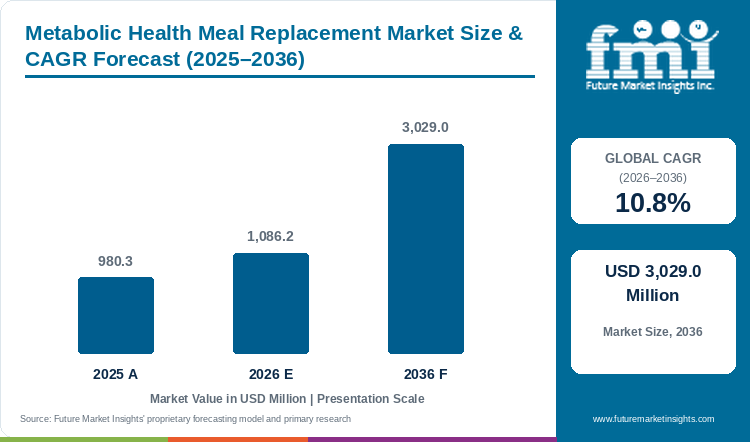
Demand for metabolic health meal replacement is projected to expand at 10.8% CAGR between 2026 and 2036. Industry value grows from USD 980.3 million in 2025 to USD 1,086.2 million in 2026 and is projected to reach USD 3,029.0 million by 2036.
Demand in metabolic health meal replacement market is estimated to rise at 10.8% CAGR through 2036. Market value grows from USD 980.3 million in 2025 to USD 1,086.2 million in 2026, reaching USD 3,029.0 million by 2036. WHO reported in December 2025 that obesity affects more than 1 billion people worldwide.[1] As per FMI, this large treatment pool is widening use beyond intensive diet programs. Shakes, bars, and portioned meals now serve clinical plans, partial replacement routines, and GLP-1-related eating patterns, alongside the wider meal replacement products category. Products with higher protein density and complete micronutrient delivery receive greater attention when smaller meals replace ordinary food.
Regional demand patterns diverge across key markets, as South Korea expands at 11.3% CAGR while the USA advances at 10.4%. Korea Disease Control and Prevention Agency reported in November 2025 that one in three Korean adults had obesity following a 30.8% increase over the past decade.[2] OECD Health at a Glance 2025 data indicates that combined adult overweight and obesity in the United States exceeds 70% of the population.[3] Korean buyers can move quickly through digital wellness channels, while American demand is split among providers, pharmacies, grocery stores, and subscriptions. In both markets, nutrition quality creates interest, but clear meal-replacement labeling and documented program fit remain the final commercial filter.
Key Takeaways
- Structured calorie delivery supports demand because buyers can compare each serving with a defined daily plan.
- Based on program type, clinically supervised VLCD / LCD is projected to account for 41.8% in 2026 owing to screening and monitoring needs.
- By product type, shakes are estimated to hold 49.3% in 2026 because fixed servings reduce preparation and portion variation.
- In 2026, VLCD programs are expected to lead caloric level with 49.0% share due to their use in intensive supervised pathways.
- South Korea is projected at 11.3% CAGR, whereas the USA is forecast at 10.4% as digital access and mixed care routes support separate outlooks.
- Notable companies include Nestle Health Science, Medifast, Abbott, Herbalife, Robard, HLTH Code, Supergut, and SlimFast.
Analyst Perspective
“I expect smaller complete meals to gain use beside drug-assisted weight care. Brands that explain the meal role clearly will retain buyer trust.”
- Nandini Roy Choudhury, Principal Consultant, Future Market Insights.
How is the metabolic health meal replacement market segmented?
Metabolic Health Meal Replacement Market is segmented by five primary commercial axes and region: program type, product type, caloric level, end user, sales channel, and region. Clinically supervised VLCD / LCD, shakes, and VLCD programs are projected at 41.8%, 49.3%, and 49.0% in 2026.
By program type: clinically supervised VLCD / LCD, partial meal replacement plans, metabolic-reset DTC programs, and others.
By product type: shakes, soups and meals, bars, and others.
By caloric level: VLCD programs below 800 kcal/day, LCD programs at 800-1,200 kcal/day, and moderate-calorie programs.
By end user: self-directed consumers, clinic and physician-supervised users, and others.
By sales channel: online / DTC, retail pharmacy, supermarkets and hypermarkets, specialty and health stores, and others.
By region: North America, Latin America, Western Europe, Eastern Europe, East Asia, South Asia and Pacific, and Middle East and Africa.
Why does clinically supervised VLCD / LCD hold notable program demand?
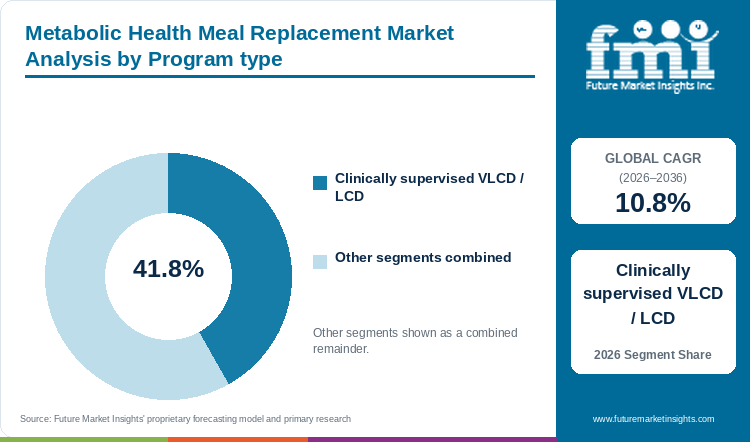
Based on program type, clinically supervised VLCD / LCD is projected to account for 41.8% in 2026, driven by monitoring needs.
Intensive calorie restriction requires screening before a buyer begins. NICE places diets below 800 kilocalories per day inside specialist services for selected adults. Standardized portions let clinicians control energy intake while keeping the nutrient plan visible, consistent with broader medical nutrition practice.
- Clinically supervised VLCD / LCD is projected at 41.8% because medical review narrows uncertainty around intensive calorie restriction.
- NICE guidance issued in January 2025 limits very-low-energy diets to supported services and defined use periods.[4]
What supports shakes as a preferred product type choice?
By product type, shakes are estimated to hold 49.3% in 2026, owing to fixed servings and low preparation.
Shakes convert a nutrition plan into a measured serving that can be prepared quickly. Powder and ready-to-drink formats also move between supervised programs and self-directed routines. FMI research on meal replacement shakes indicates that the same portion logic supports both full replacement and one-meal use.
- Shakes are estimated at 49.3% because buyers receive a repeatable calorie and protein amount in one serving.
- In July 2026, Medifast introduced newly formulated meal replacements within its Trilivy metabolic health system.[5]
How do VLCD programs meet intensive caloric-level requirements?
In 2026, VLCD programs are expected to lead caloric level with 49.0% share, supported by specialist use.
VLCD programs concentrate product use during an active loss phase with a prescribed energy limit. A 2026 Singapore consensus reported that only one-quarter of primary-care patients reached clinical targets with food-first nutrition therapy. Diabetes-specific meal replacement was identified as an evidence-based escalation when ordinary meal planning did not deliver the required result, reinforcing the role of oral clinical nutrition.
- VLCD programs are expected at 49.0% because a defined daily intake gives intensive services a controlled nutrition route.
- The May 2026 Singapore consensus connects diabetes-specific meal replacement with structured escalation after food-first therapy.[6]
Why are self-directed consumers relevant within the end-user category?
Self-directed consumers are likely to capture 49.4% share in 2026, aided by broad retail and online access.
Self-directed buyers can begin with one replaced meal without entering a complete clinical program. NIDDK reported in 2025 that self-directed weight management benefits from structured portion control and defined nutrient intake. A broad retail pool includes protein supplements, but the label must still distinguish a complete meal from a protein drink.
- Self-directed consumers are projected at 49.4% because trial and repeat purchase do not require a clinical appointment.
- NIDDK analysis published in 2025 confirms that pre-packaged portion control aids sustained self-directed dietary modification.[7]
What keeps online / DTC relevant within the sales-channel mix?
Online / DTC is set to lead sales channel demand with 40.1% share in 2026, enabled by repeat ordering.
Online channels combine replenishment, flavor selection, and program guidance without a store visit. In October 2025, Supergut moved its GLP-1 Daily Support and fiber blends into Walmart stores nationwide. The expansion shows how digitally explained metabolic products, including dietary supplements, can add physical retail after buyers understand their intended use.
- Online / DTC is forecast at 40.1% because replenishment and digital guidance sit inside the same purchase route.
- The October 2025 Walmart launch placed Supergut fiber products in a nationwide store network after DTC market development.[8]
What are the drivers, restraints, and opportunities in the metabolic health meal replacement market?
In the metabolic health meal replacement market, the key driver is structured weight care, the key restraint is adherence, and the key opportunity is GLP-1-linked nutrition.
- Driver: Clinical pathways give controlled meal replacement a defined place in obesity and diabetes management.
- Restraint: Intensive low-calorie plans require screening, support, and sustained routine that can limit completion.
- Opportunity: Smaller high-protein and fiber-rich meals can support users whose appetite changes during GLP-1 treatment.
Clinical Pathways Define Product Use
Structured treatment creates a clear place for measured daily nutrition. In January 2025, the FDA issued updated draft guidance for obesity and overweight drug development.[9] The document keeps long-term weight reduction and maintenance in focus, which makes supporting nutrition more relevant beside obesity management. Products gain a clearer role when calories, protein, and micronutrients can be matched with a monitored plan.
Adherence Limits Intensive Programs
Adherence becomes harder after intensive restriction begins. VA/DoD clinical practice guidelines published in 2025 emphasize that intensive dietary programs experience high attrition unless sustained behavioral support is provided.[10] Taste fatigue and routine disruption can still end use before maintenance, even when clinical nutrition support is available. The commercial limit is therefore the number of users who continue, not the number who show initial interest.
GLP-1 Use Changes Meal Design
Smaller eating occasions create a product opening during pharmacotherapy. In January 2025, Medifast introduced OPTAVIA ASCEND with high-protein meal replacements designed specifically for GLP-1 users.[11] FMI data suggests that compact meals with visible protein and fiber can fill a practical gap, as reflected in GLP-1 meal replacement demand, without claiming to replace prescribed treatment.
Which country CAGRs are profiled in the metabolic health meal replacement market?
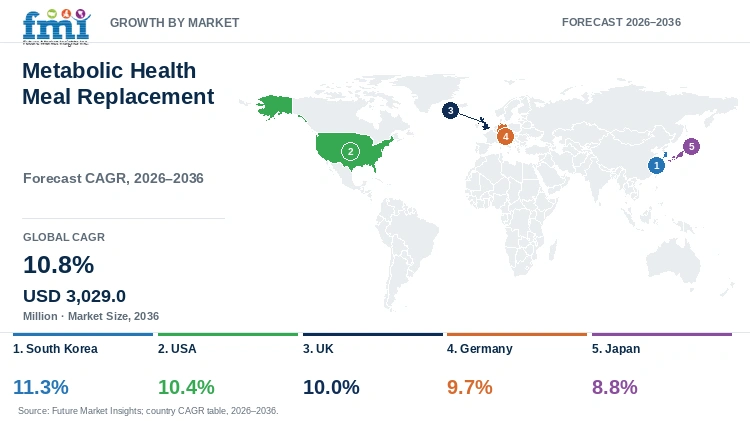
| Country | CAGR |
|---|---|
| South Korea | 11.3% |
| USA | 10.4% |
| UK | 10.0% |
| Germany | 9.7% |
| Japan | 8.8% |
How does the country outlook differ?
South Korea shows a digitally supported expansion path, while the USA combines broad retail access with clinical weight care. UK and Germany rely more on guided use and controlled claims. Japan develops through health screening, counseling, and products adapted to established meal patterns.
- South Korea links high digital access with measurable national weight-control activity.
- USA demand moves through clinical programs, pharmacies, mass retail, and subscriptions.
- UK demand has a visible public-care route for structured low-energy diets.
- Germany places greater weight on evidence, claim discipline, and food-based guidance.
- Japan uses insurer-led checks and guidance as the main metabolic-risk contact point.
Full report country CAGRs cover: North America; Latin America; Western Europe; Eastern Europe; East Asia; South Asia and Pacific; Middle East and Africa.
Country-wise Analysis
- South Korea is estimated to post 11.3% CAGR over the forecast period, supported by digital purchasing and active weight-control behavior. The Korean Society for the Study of Obesity reported in 2026 that adult obesity reached 39.2% in 2024.[12] Obesity among adult men reached 51.1%, while abdominal obesity among men rose to 32.4%. These national figures place metabolic risk inside a large working-age consumer group. Digital ordering makes initial trial easier for shakes and portioned meals. Buyers still need clear differences between complete meals, protein supplements, and fiber products. Korea therefore offers room for convenient formats that state calories, protein, fiber, and intended meal use without borrowing treatment claims.
- Demand for metabolic health meal replacement in the USA is forecast to rise at 10.4% CAGR over the forecast period, owing to mixed clinical and retail access. The CDC reported in February 2026 that 40.3% of adults had obesity and 9.7% had severe obesity, while another 31.7% were classified as overweight.[13] This national treatment pool can enter weight care through providers, pharmacies, grocery stores, digital programs, or self-directed diets. The same channel breadth creates heavy comparison with protein shakes and obesity medicines. Products need to show whether they replace a meal, support a structured program, or provide supplemental nutrition. That distinction determines where the product sits and who is expected to guide its use.
- The UK metabolic health meal replacement sector is projected to record 10.0% CAGR during the assessment period, underpinned by structured service rules. NHS England reported in January 2026 that 30% of adults had obesity during 2024, while 66% were overweight or living with obesity.[14] The same survey found 70% had waist-to-height ratios above the recommended level. This broad metabolic-risk base supports both guided total diet replacement and simpler partial replacement products. Clinical routes remain controlled because very-low-energy diets require specialist support. Retail buyers face a different decision and usually need a clear calorie level, complete nutrient profile, and defined daily role. UK demand therefore separates supervised protocols from ordinary consumer weight-control formats.
- Metabolic health meal replacement demand in Germany is forecast to rise at 9.7% CAGR over the forecast period, influenced by careful claims and food-based guidance. The Robert Koch Institute reported in July 2026 that 46.6% of women and 60.5% of men were overweight, including obesity, while nearly 19% of adults had obesity.[15] The figures keep weight management visible, although formula products still compete with conventional meal planning. Buyers compare ingredients, serving instructions, energy limits, and the evidence behind each claim. Pharmacy and specialist routes can explain intensive use, while online channels support partial replacement. Growth is more credible where products state a limited daily role and avoid presenting meal replacement as complete obesity care.
- Between 2026 and 2036, the Japan market is expected to progress at 8.8% CAGR, aided by insurer-led metabolic-risk identification. The Ministry of Health, Labour and Welfare published fiscal 2024 implementation results for Specific Health Checkups and Specific Health Guidance in July 2026.[16] The national program moves adults from screening into dietary guidance when metabolic risk is identified. Counseling does not automatically create product demand because ordinary meals remain the main reference point. Replacement portions must fit local flavors, meal timing, and expectations for professional guidance. An FMI analyst notes that growth will follow specific routines introduced during counseling rather than broad retail substitution. That route favors products with measured calories and a clearly explained place in the daily diet.
Who are the notable companies in the metabolic health meal replacement market?
Notable companies include Nestle Health Science, Medifast, Abbott, Herbalife, Robard, HLTH Code, Supergut, and SlimFast.
Competition is moderately fragmented because clinical programs, coached plans, healthcare nutrition, and consumer DTC products use different sales routes. Nestle Health Science and Robard connect products with supervised protocols. Abbott brings condition-specific nutrition and broad healthcare distribution. Medifast and Herbalife attach meal products to supported routines, while HLTH Code and Supergut rely on direct product education. SlimFast remains a recognized consumer format under changed ownership. Competition turns on program fit, formulation clarity, repeat ordering, and the ability to explain what the product replaces.
- Clinical and healthcare nutrition: Nestle Health Science, Abbott, and Robard connect products with monitored or condition-specific use.
- Coach-guided and consumer programs: Medifast, Herbalife, and SlimFast sell repeated routines through established consumer channels.
- Metabolic-first DTC specialists: HLTH Code and Supergut use formulation detail and direct education to support trial.
Competitive Benchmarking: Metabolic Health Meal Replacement Market
| Company | Program integration | Metabolic formulation | Format breadth | Geographic reach |
|---|---|---|---|---|
| Nestle Health Science | High | High | High | High |
| Medifast | High | High | High | Medium |
| Abbott | Medium | High | Medium | High |
| Herbalife | Medium | Medium | Medium | High |
| Robard | High | High | Medium | Low |
| HLTH Code | Low | High | Low | Low |
| Supergut | Low | High | Medium | Low |
| SlimFast | Low | Medium | High | Medium |
High indicates broad evidence of current breadth and activity. Medium indicates established but narrower evidence. Low indicates limited public breadth for the stated aspect. Ratings describe documented capability and reach, not product quality or market share.
Key Developments in the Metabolic Health Meal Replacement Market
- In July 2026, Medifast introduced Trilivy with newly formulated meal replacements and a three-phase metabolic health system.
- In February 2026, Abbott filed its 2025 annual report, confirming continued global nutrition operations and product investment.
- In February 2026, Herbalife filed its 2025 annual report, documenting operations across 95 markets and a distributor-led nutrition model.
- In September 2025, Glanbia agreed to sell SlimFast US and other jurisdictions to Heartland Food Products Group.
Key Players in the Metabolic Health Meal Replacement Market
Clinician-Integrated Metabolic Nutrition
- Nestle Health Science
- Abbott
- Robard
Coach-Guided Consumer Weight Management
- Medifast
- Herbalife
- SlimFast
Metabolic-First Direct-to-Consumer Specialists
- HLTH Code
- Supergut
Metabolic Health Meal Replacement Market - Report Scope
| Coverage field | Report scope |
|---|---|
| Market breakdown | Program type, product type, caloric level, end user, sales channel, and region |
| Quantitative units | USD million |
| Market definition | Revenue generated from shakes, soups and meals, bars and related formats sold for defined meal replacement. Drugs, ordinary foods, stand-alone supplements and separate service fees are not included. |
| Regions covered | North America; Latin America; Western Europe; Eastern Europe; East Asia; South Asia and Pacific; Middle East and Africa |
| Countries covered | South Korea, USA, UK, Germany, Japan, and additional countries in the full report |
| Key companies profiled | Nestle Health Science, Medifast, Abbott, Herbalife, Robard, HLTH Code, Supergut, SlimFast |
| Forecast period | 2026 to 2036 |
| Approach | The Future Market Insights report defines program, product, calorie, user, channel, and country demand inside one revenue boundary. |
Metabolic Health Meal Replacement Market - Research Methodology
| Method | Approach |
|---|---|
| Primary Research | Primary research includes discussions with manufacturers, distributors, service providers, procurement teams, end users and subject-matter experts. These discussions are used for understanding buying decisions, product selection, adoption barriers, pricing and the support required before and after purchase. |
| Desk Research | Desk research includes government statistics, regulatory publications, trade data, industry associations, technical literature, company filings, product information and official announcements. Every source is checked for its publication date, geographic coverage and direct relevance with the defined market boundary. |
| Market Sizing and Forecasting | Market sizing is carried out by combining the baseline value with historical performance, segment structure, pricing, volume indicators, adoption levels, company participation and country demand. Forecast assumptions also consider treatment pathways, purchase cycles, supply availability and factors restricting wider adoption. |
| Data Validation | The estimates are checked with independent public indicators, company activities and country conditions. Products and revenues are also examined before inclusion in the market boundary. Adjacent categories, overlapping revenue and claims without enough supporting evidence are excluded from the final estimates. |
Metabolic Health Meal Replacement Market by Segments
Program type
- Clinically supervised VLCD / LCD
- Partial meal replacement plans
- Metabolic-reset DTC programs
- Others
Product type
- Shakes
- Soups and meals
- Bars
- Others
Caloric level
- VLCD programs below 800 kcal/day
- LCD programs at 800-1,200 kcal/day
- Moderate-calorie
End user
- Self-directed consumers
- Clinic and physician-supervised
- Others
Sales channel
- Online / DTC
- Retail pharmacy
- Supermarkets and hypermarkets
- Specialty and health stores
- Others
Metabolic Health Meal Replacement Market by Region
- North America
- United States
- Canada
- Latin America
- Brazil
- Mexico
- Argentina
- Chile
- Western Europe
- Germany
- France
- United Kingdom
- Italy
- Spain
- Benelux
- Nordics
- Eastern Europe
- Poland
- Czech Republic
- Romania
- Hungary
- East Asia
- Japan
- South Korea
- South Asia and Pacific
- ASEAN
- Australia and New Zealand
- Middle East and Africa
- GCC Countries
- South Africa
- Turkiye
- Israel
Research Sources and Bibliography
- [1] World Health Organization. (2025, December 1). WHO issues global guideline on the use of GLP-1 medicines in treating obesity.
- [2] Korea Disease Control and Prevention Agency. (2025, November 25). One in three Korean adults is obese, a 30.8% increase over the past decade.
- [3] Organisation for Economic Co-operation and Development. (2025). Overweight and obesity: Health at a Glance 2025.
- [4] National Institute for Health and Care Excellence. (2025, January 14). Overweight and obesity management: Physical activity and diet.
- [5] Medifast, Inc. (2026, July 17). Medifast enters a new era: Introducing Trilivy, a science-backed metabolic health system.
- [6] Khoo, C. M., et al. (2026, May 13). Diabetes-specific formula as meal replacement for individuals with type 2 diabetes mellitus and overweight or obesity: A Singapore expert consensus.
- [7] National Institute of Diabetes and Digestive and Kidney Diseases. (2025). Recent advances and emerging opportunities: Obesity.
- [8] Supergut. (2025, October 27). Supergut launches at Walmart nationwide.
- [9] U.S. Food and Drug Administration. (2025, January). Obesity and overweight: Developing drugs and biological products for weight reduction.
- [10] VA/DoD Clinical Practice Guidelines. (2025). Management of adult overweight and obesity.
- [11] Medifast, Inc. (2025, January 7). Medifast introduces OPTAVIA ASCEND for GLP-1 users and those looking for help to keep weight off.
- [12] Korean Society for the Study of Obesity. (2026). Obesity Fact Sheet 2026.
- [13] Centers for Disease Control and Prevention, National Center for Health Statistics. (2026, February 25). NCHS releases updates to obesity estimates.
- [14] NHS England Digital. (2026, January 27). Adults overweight and obesity: Health Survey for England 2024.
- [15] Robert Koch Institute. (2026, July 15). Overweight and obesity.
- [16] Ministry of Health, Labour and Welfare, Japan. (2026, July 30). FY2024 implementation status of Specific Health Checkups and Specific Health Guidance.
This bibliography is provided for reader reference. The full report contains the complete reference list and detailed citations.
This Report Answers
- What is Metabolic Health Meal Replacement Market worth during 2026?
- What value is Metabolic Health Meal Replacement Market projected by 2036?
- Which program type holds notable market share during 2026?
- Which product type holds notable market share during 2026?
- Which countries have notable market growth through the forecast period?
- Which companies are notable in Metabolic Health Meal Replacement Market today?
Frequently Asked Questions
How large is the Metabolic Health Meal Replacement Market in 2026?
Future Market Insights estimates that the market will be valued at USD 1,086.2 million in 2026. The market is projected to reach USD 3,029.0 million by 2036.
What CAGR is projected for the market through 2036?
As per FMI, the market is projected to grow at 10.8% CAGR from 2026 to 2036. Growth is supported by structured nutrition in clinical and self-directed weight care.
Which program type leads the market in 2026?
Clinically supervised VLCD / LCD is projected to hold 41.8% of program type demand in 2026. The segment benefits from screening and monitoring during intensive calorie restriction.
Which product type holds a leading share during 2026?
Shakes are estimated to account for 49.3% of product type demand in 2026. Demand is supported by fixed portions and low preparation requirements.
Which country has a notable growth outlook through 2036?
South Korea is projected to register 11.3% CAGR from 2026 to 2036. Growth is supported by digital purchasing and widespread weight-control activity.
Who are the key companies in the market?
Key participants include Nestle Health Science, Medifast, Abbott, Herbalife, Robard, HLTH Code, Supergut, and SlimFast. These companies use clinical programs, guided routines, retail distribution, and direct product education.
Preview the report firsthand - request a free sample
Get SampleGet the brochure for pricing and purchase details.
Get PDFTable of Content
- Key Takeaways
- Market Size and CAGR
- Top Growth Driver
- Fastest Growing Segment
- Leading Region
- Key Companies
- Emerging Opportunities
- Executive Summary
- Global Market Outlook
- Demand-side Trends
- Supply-side Trends
- Technology Roadmap Analysis
- Analysis and Recommendations
- Analyst Perspective (What is happening? Why now? What should investors know?)
- Key Questions Answered
- How large is the market?
- What is the CAGR?
- What are key trends?
- Which region dominates?
- Who are the leaders?
- Market Overview
- Market Coverage / Taxonomy
- Market Definition / Scope / Limitations
- Research Methodology
- Chapter Orientation
- Analytical Lens and Working Hypotheses
- Market Structure, Signals, and Trend Drivers
- Benchmarking and Cross-market Comparability
- Market Sizing, Forecasting, and Opportunity Mapping
- Research Design and Evidence Framework
- Desk Research Programme (Secondary Evidence)
- Expert Input and Fieldwork (Primary Evidence)
- Tooling, Models, and Reference Databases
- Data Engineering and Model Build
- Quality Assurance and Audit Trail
- Market Background
- Market Dynamics (Drivers, Restraints, Opportunity, Trends)
- Scenario Forecast (Optimistic, Likely, Conservative)
- Impact Analysis
- AI Impact
- Sustainability Impact
- Regulatory Impact
- Technology Impact
- Consumer / Buyer Analysis
- Purchase Drivers
- Adoption Barriers
- Buyer Journey
- Opportunity Map Analysis
- Product Life Cycle Analysis
- Supply Chain Analysis
- Investment Feasibility Matrix
- Value Chain Analysis
- PESTLE and Porter's Analysis
- Regulatory Landscape
- Regional Parent Market Outlook
- Production and Consumption Statistics
- Import and Export Statistics
- Global Market Analysis and Forecast, 2021 to 2036
- Historical Market Size Value (USD Million) Analysis, 2021 to 2025
- Current and Future Market Size Value (USD Million) Projections, 2026 to 2036
- Y-o-Y Growth Trend Analysis
- Absolute $ Opportunity Analysis
- Global Market Pricing Analysis, 2021 to 2036
- Global Market Analysis and Forecast, By Program type, 2021 to 2036
- Introduction / Key Findings
- Historical Market Size Value (USD Million) Analysis By Program type, 2021 to 2025
- Current and Future Market Size Value (USD Million) Analysis and Forecast By Program type, 2026 to 2036
- Clinically supervised VLCD / LCD
- Partial meal replacement plans
- Metabolic-reset DTC programs
- Others
- Y-o-Y Growth Trend Analysis By Program type, 2021 to 2025
- Absolute $ Opportunity Analysis By Program type, 2026 to 2036
- Global Market Analysis and Forecast, By Product type, 2021 to 2036
- Introduction / Key Findings
- Historical Market Size Value (USD Million) Analysis By Product type, 2021 to 2025
- Current and Future Market Size Value (USD Million) Analysis and Forecast By Product type, 2026 to 2036
- Shakes
- Soups and meals
- Bars
- Others
- Y-o-Y Growth Trend Analysis By Product type, 2021 to 2025
- Absolute $ Opportunity Analysis By Product type, 2026 to 2036
- Global Market Analysis and Forecast, By Caloric level, 2021 to 2036
- Introduction / Key Findings
- Historical Market Size Value (USD Million) Analysis By Caloric level, 2021 to 2025
- Current and Future Market Size Value (USD Million) Analysis and Forecast By Caloric level, 2026 to 2036
- VLCD programs below 800 kcal/day
- LCD programs at 800-1,200 kcal/day
- Moderate-calorie
- Y-o-Y Growth Trend Analysis By Caloric level, 2021 to 2025
- Absolute $ Opportunity Analysis By Caloric level, 2026 to 2036
- Global Market Analysis and Forecast, By End user, 2021 to 2036
- Introduction / Key Findings
- Historical Market Size Value (USD Million) Analysis By End user, 2021 to 2025
- Current and Future Market Size Value (USD Million) Analysis and Forecast By End user, 2026 to 2036
- Self-directed consumers
- Clinic and physician-supervised
- Others
- Y-o-Y Growth Trend Analysis By End user, 2021 to 2025
- Absolute $ Opportunity Analysis By End user, 2026 to 2036
- Global Market Analysis and Forecast, By Sales channel, 2021 to 2036
- Introduction / Key Findings
- Historical Market Size Value (USD Million) Analysis By Sales channel, 2021 to 2025
- Current and Future Market Size Value (USD Million) Analysis and Forecast By Sales channel, 2026 to 2036
- Online / DTC
- Retail pharmacy
- Supermarkets and hypermarkets
- Specialty and health stores
- Others
- Y-o-Y Growth Trend Analysis By Sales channel, 2021 to 2025
- Absolute $ Opportunity Analysis By Sales channel, 2026 to 2036
- Global Market Analysis and Forecast, By Region, 2021 to 2036
- Introduction
- Historical Market Size Value (USD Million) Analysis By Region, 2021 to 2025
- Current Market Size Value (USD Million) Analysis and Forecast By Region, 2026 to 2036
- North America
- Latin America
- Western Europe
- Eastern Europe
- East Asia
- South Asia and Pacific
- Middle East and Africa
- Market Attractiveness Analysis By Region
- North America Market Analysis and Forecast, By Country, 2021 to 2036
- Historical Market Size Value (USD Million) Trend Analysis By Market Taxonomy, 2021 to 2025
- Market Size Value (USD Million) Forecast By Market Taxonomy, 2026 to 2036
- By Country
- United States
- Canada
- By Program type
- By Product type
- By Caloric level
- By End user
- By Sales channel
- By Country
- Market Attractiveness Analysis
- By Country
- By Program type
- By Product type
- By Caloric level
- By End user
- By Sales channel
- Key Takeaways
- Latin America Market Analysis and Forecast, By Country
- Historical Market Size Value (USD Million) Trend Analysis By Market Taxonomy, 2021 to 2025
- Market Size Value (USD Million) Forecast By Market Taxonomy, 2026 to 2036
- By Country
- Brazil
- Mexico
- Argentina
- Chile
- By Program type
- By Product type
- By Caloric level
- By End user
- By Sales channel
- By Country
- Market Attractiveness Analysis
- By Country
- By Program type
- By Product type
- By Caloric level
- By End user
- By Sales channel
- Key Takeaways
- Western Europe Market Analysis and Forecast, By Country
- Historical Market Size Value (USD Million) Trend Analysis By Market Taxonomy, 2021 to 2025
- Market Size Value (USD Million) Forecast By Market Taxonomy, 2026 to 2036
- By Country
- Germany
- France
- United Kingdom
- Italy
- Spain
- Benelux
- Nordics
- By Program type
- By Product type
- By Caloric level
- By End user
- By Sales channel
- By Country
- Market Attractiveness Analysis
- By Country
- By Program type
- By Product type
- By Caloric level
- By End user
- By Sales channel
- Key Takeaways
- Eastern Europe Market Analysis and Forecast, By Country
- Historical Market Size Value (USD Million) Trend Analysis By Market Taxonomy, 2021 to 2025
- Market Size Value (USD Million) Forecast By Market Taxonomy, 2026 to 2036
- By Country
- Poland
- Czech Republic
- Romania
- Hungary
- By Program type
- By Product type
- By Caloric level
- By End user
- By Sales channel
- By Country
- Market Attractiveness Analysis
- By Country
- By Program type
- By Product type
- By Caloric level
- By End user
- By Sales channel
- Key Takeaways
- East Asia Market Analysis and Forecast, By Country
- Historical Market Size Value (USD Million) Trend Analysis By Market Taxonomy, 2021 to 2025
- Market Size Value (USD Million) Forecast By Market Taxonomy, 2026 to 2036
- By Country
- Japan
- South Korea
- By Program type
- By Product type
- By Caloric level
- By End user
- By Sales channel
- By Country
- Market Attractiveness Analysis
- By Country
- By Program type
- By Product type
- By Caloric level
- By End user
- By Sales channel
- Key Takeaways
- South Asia and Pacific Market Analysis and Forecast, By Country
- Historical Market Size Value (USD Million) Trend Analysis By Market Taxonomy, 2021 to 2025
- Market Size Value (USD Million) Forecast By Market Taxonomy, 2026 to 2036
- By Country
- ASEAN
- Australia and New Zealand
- By Program type
- By Product type
- By Caloric level
- By End user
- By Sales channel
- By Country
- Market Attractiveness Analysis
- By Country
- By Program type
- By Product type
- By Caloric level
- By End user
- By Sales channel
- Key Takeaways
- Middle East and Africa Market Analysis and Forecast, By Country
- Historical Market Size Value (USD Million) Trend Analysis By Market Taxonomy, 2021 to 2025
- Market Size Value (USD Million) Forecast By Market Taxonomy, 2026 to 2036
- By Country
- GCC Countries
- South Africa
- Turkiye
- Israel
- By Program type
- By Product type
- By Caloric level
- By End user
- By Sales channel
- By Country
- Market Attractiveness Analysis
- By Country
- By Program type
- By Product type
- By Caloric level
- By End user
- By Sales channel
- Key Takeaways
- Key Countries Market Analysis
- United States
- Pricing Analysis
- Market Share Analysis, 2025
- By Program type
- By Product type
- By Caloric level
- By End user
- By Sales channel
- Canada
- Pricing Analysis
- Market Share Analysis, 2025
- By Program type
- By Product type
- By Caloric level
- By End user
- By Sales channel
- Mexico
- Pricing Analysis
- Market Share Analysis, 2025
- By Program type
- By Product type
- By Caloric level
- By End user
- By Sales channel
- Brazil
- Pricing Analysis
- Market Share Analysis, 2025
- By Program type
- By Product type
- By Caloric level
- By End user
- By Sales channel
- Chile
- Pricing Analysis
- Market Share Analysis, 2025
- By Program type
- By Product type
- By Caloric level
- By End user
- By Sales channel
- Germany
- Pricing Analysis
- Market Share Analysis, 2025
- By Program type
- By Product type
- By Caloric level
- By End user
- By Sales channel
- United Kingdom
- Pricing Analysis
- Market Share Analysis, 2025
- By Program type
- By Product type
- By Caloric level
- By End user
- By Sales channel
- Italy
- Pricing Analysis
- Market Share Analysis, 2025
- By Program type
- By Product type
- By Caloric level
- By End user
- By Sales channel
- Spain
- Pricing Analysis
- Market Share Analysis, 2025
- By Program type
- By Product type
- By Caloric level
- By End user
- By Sales channel
- France
- Pricing Analysis
- Market Share Analysis, 2025
- By Program type
- By Product type
- By Caloric level
- By End user
- By Sales channel
- ASEAN
- Pricing Analysis
- Market Share Analysis, 2025
- By Program type
- By Product type
- By Caloric level
- By End user
- By Sales channel
- Australia and New Zealand
- Pricing Analysis
- Market Share Analysis, 2025
- By Program type
- By Product type
- By Caloric level
- By End user
- By Sales channel
- Japan
- Pricing Analysis
- Market Share Analysis, 2025
- By Program type
- By Product type
- By Caloric level
- By End user
- By Sales channel
- South Korea
- Pricing Analysis
- Market Share Analysis, 2025
- By Program type
- By Product type
- By Caloric level
- By End user
- By Sales channel
- Poland
- Pricing Analysis
- Market Share Analysis, 2025
- By Program type
- By Product type
- By Caloric level
- By End user
- By Sales channel
- Hungary
- Pricing Analysis
- Market Share Analysis, 2025
- By Program type
- By Product type
- By Caloric level
- By End user
- By Sales channel
- South Africa
- Pricing Analysis
- Market Share Analysis, 2025
- By Program type
- By Product type
- By Caloric level
- By End user
- By Sales channel
- United States
- Market Structure Analysis
- Competition Dashboard
- Competition Benchmarking
- Market Share Analysis of Top Players
- By Regional
- By Program type
- By Product type
- By Caloric level
- By End user
- By Sales channel
- Emerging Startups
- Innovation Benchmarking
- Competition Analysis
- Competition Deep Dive
- Nestle Health Science
- Overview
- Product Portfolio
- Profitability by Market Segments
- Sales Footprint
- Strategy Overview
- Marketing Strategy
- Product Strategy
- Channel Strategy
- Medifast
- Abbott
- Herbalife
- Robard
- HLTH Code
- Supergut
- SlimFast
- Nestle Health Science
- Case Studies
- Success Stories
- Recent Developments
- Competition Deep Dive
- Assumptions & Acronyms Used


