

- Market Size (2026)
- USD 284.4 Mn
- Forecast (2036)
- USD 698.5 Mn
- CAGR (2026 to 2036)
- 9.4%
How big is Metabolic Cookies Market in 2026?
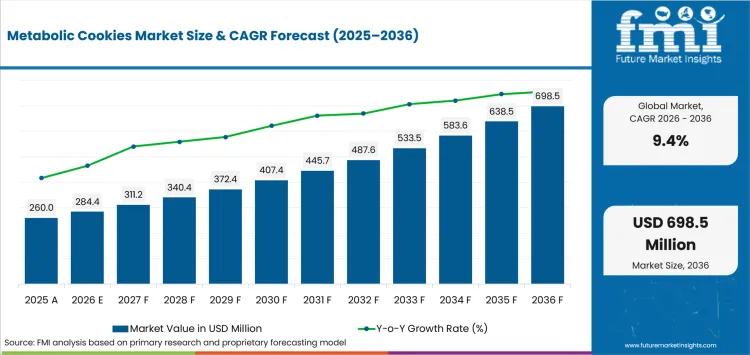
USD 284.4 million in 2026 and USD 698.5 million by 2036 at a 9.4% CAGR.
Demand for metabolic cookies is projected to expand at 9.4% CAGR between 2026 and 2036, increasing market value from USD 284.4 million in 2026 to USD 698.5 million by 2036. Growth depends on whether brands can translate lower sugar or added functional nutrition into a cookie that earns repeat purchase at mainstream snack prices.
Consumer attention to carbohydrate quality gives lower-sugar cookies a clear comparison point rather than a therapeutic role. The USA Centers for Disease Control and Prevention reported in January 2026 that 40.1 million people had diabetes in 2023 and 115.2 million adults had prediabetes. The USA Food and Drug Administration lists a Daily Value of 50 g for added sugars and 28 g for dietary fiber, making both measures visible on the Nutrition Facts label.
Key Takeaways ofMetabolic Cookies Market
- Metabolic positioning gains commercial value when a familiar cookie delivers a nutrition difference shopper can understand from the pack.
- Fiber Blends are projected at 34.9% share in 2026 because fiber can support both nutrition density and cookie structure.
- Crunchy is estimated at 35.0% of Product Type demand in 2026 as crisp formats fit routine packaged-snack use.
- Blood-Sugar Friendly is forecast at 34.0% of Claim demand in 2026 because it expresses the purchase intent without requiring one diet identity.
- Single-Serve is projected at 40.5% of Packaging demand, while Supermarkets & Hypermarkets account for 30.8% of Sales Channel demand in 2026.
- Catalina Crunch, Quest Nutrition, HighKey, Lenny & Larry's, , Simple Mills, Emmy's Organics and Nunbelievable are companies connected to the category through current or documented cookie participation.
Analyst Perspective
"A metabolic cookie earns repeat purchase when the nutrition difference is visible on-pack and the eating experience still feels familiar. Teams should test sugar reduction against texture, then confirm that pack size and claim wording can survive mainstream retail economics."
- Nandini Roy Choudhury, Principal Consultant, Future Market Insights
How is the Metabolic Cookies Market segmented?
The metabolic cookies market is segmented by Functional Ingredient, Product Type, Claim, Packaging, Sales Channel and Region.
The category is organized around five commercial decisions. Functional Ingredient identifies the formulation system behind the proposition. Product Type captures the eating format, while Claim records the shopper-facing reason to consider the product. Packaging governs trial and portion economics. Sales Channel determines where discovery happens and where the product must compete against conventional cookies or functional snacks.
Why do supermarkets & hypermarkets account for 30.8% of sales channel demand?
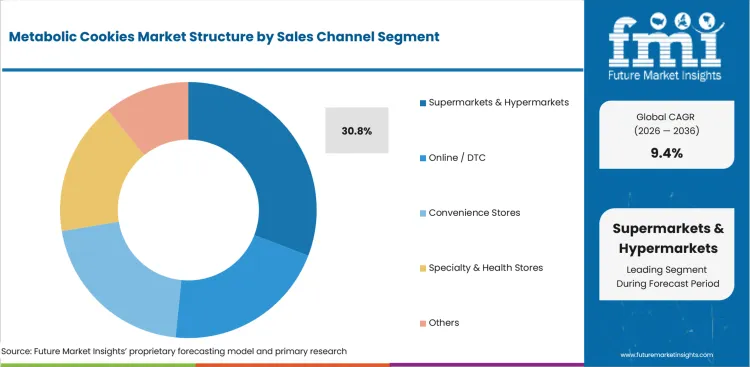
Supermarkets & Hypermarkets place metabolic cookies inside the same trip where shoppers compare mainstream cookies with better-for-you snacks. That exposure broadens discovery, but it also makes price and taste comparisons harder to avoid. Retail scale adds another test: case-pack economics and replenishment have to work consistently before an online success can become a grocery proposition.
- Supermarkets & Hypermarkets account for 30.8% share in 2026 because they combine household reach with direct comparison against conventional cookie alternatives.
- Catalina Snacks launched a national advertising campaign in May 2025 alongside distribution through mass retailers plus club and grocery chains. The move reflects the channel work required when a better-for-you snack brand seeks routine purchase within the wider Healthy Snacks Market.
Why do fiber blends account for 34.9% of functional ingredient demand?
Within the Functional Foods Market, Fiber Blends combine a visible nutrition cue with practical formulation utility. Fiber can add solids and structure while helping a cookie move toward a more functional nutrition profile. It can also sit beside protein or alternative sweetening systems. The commercial constraint is sensory: too much fiber can dry the crumb or change flavor release, so formulation quality has to be judged through repeat eating rather than the nutrition panel alone.
- Fiber Blends account for 34.9% share in 2026, reflecting their role in nutrition density and cookie structure.
- Quest Nutrition currently sells protein cookies with 15 g of protein per cookie, and its peanut butter variant lists 11 g of dietary fiber. The product shows how a fiber system can work alongside protein in a familiar soft-baked format.
Why does crunchy account for 35.0% of product type demand?
Crunchy cookies fit the shelf architecture of packaged snacks and work well in resealable bags or multipacks. Crisp textures also accommodate nut-based or seed-based flour systems that can reinforce a better-for-you proposition. Sugar reduction changes browning and snap, however, so manufacturers still have to protect the sensory cues shoppers expect from a conventional cookie.
- Crunchy accounts for 35.0% share in 2026 because shelf-stable crisp formats support routine purchase across grocery and specialty channels.
- Simple Mills sells crunchy chocolate chip cookies made with an almond-flour blend. Flowers Foods completed its acquisition of Simple Mills in February 2025 and identified cookies as one of the brand categories it planned to support through wider distribution and innovation.
Why does blood-sugar friendly account for 34.0% of claim demand?
Blood-Sugar Friendly describes the consumer decision more directly than a single diet label. The positioning can be supported by lower sugar, controlled carbohydrate design or added fiber, but the wording creates a higher substantiation burden. In the European Union, nutrition and health claims must fit defined legal conditions, so product development and claim review have to move together rather than treating marketing language as a final-stage decision.
- Blood-Sugar Friendly accounts for 34.0% share in 2026 as shoppers look for familiar snacks that make sugar exposure easier to judge.
- The commercial logic also overlaps with the Sugar-Free Cookies Market, where the front-of-pack proposition has to be supported by a nutrition panel that is easy to compare with conventional alternatives.
Why does single-serve account for 40.5% of packaging demand?
Single-serve packs reduce commitment at first purchase and create a clear portion boundary. That matters when a metabolic cookie carries a price premium over conventional products. The format also works in convenience-led occasions where shoppers want one snack rather than a pantry box. Its cost penalty comes from additional packaging and a tougher price-per-ounce comparison, so brands still need larger formats once trial converts into routine demand.
- Single-Serve accounts for 40.5% share in 2026 because portability and low-commitment trial fit the category purchase mission.
- Lenny & Larry's launched The Complete Cremes nationwide in January 2022 with a 3 oz convenience pack alongside a larger box, showing how pack size can recruit on-the-go buyers before they move to repeat formats.
What are the drivers, restraints and opportunities in the Metabolic Cookies Market?
Lower-sugar snack substitution supports demand, while sensory trade-offs and claim rules restrain repeat purchase as single-serve formats create a route to mainstream trial.
- Driver: Shoppers can compare added sugar with fiber or protein when choosing a familiar sweet snack.
- Restraint: Sugar reduction can weaken the expected cookie texture while claim language remains subject to local rules.
- Opportunity: Single-serve packs give brands a lower-friction route into supermarket and convenience-store trial.
Nutrition-label visibility turns reformulation into a direct shelf comparison. CDC estimated 40.1 million people in the USA had diabetes in 2023, while FDA requires added sugars to appear on the Nutrition Facts label and sets a 50 g Daily Value. Those facts do not make a cookie a treatment product. They do make lower-sugar formulation easier for shoppers to inspect during a routine snack decision.
The harder restraint appears after the first trial. Sugar affects sweetness and browning as well as cookie spread, so reducing it can require fibers or other sweetening systems that change cost and sensory performance. Regulation adds a second gate. Under Regulation (EC) No 1924/2006, a low-sugars claim for solid food requires no more than 5 g of sugars per 100 g, and broader health language faces separate substantiation rules.
Single-serve packaging creates a practical expansion route because it limits first-purchase risk. A shopper can judge flavor and texture before buying a larger box, while the pack gives retailers a format suitable for checkout or convenience occasions. Lenny & Larry's used this architecture when it introduced a 3 oz Complete Cremes pack during its nationwide 2022 rollout.
What are the country-level CAGRs in the Metabolic Cookies Market?
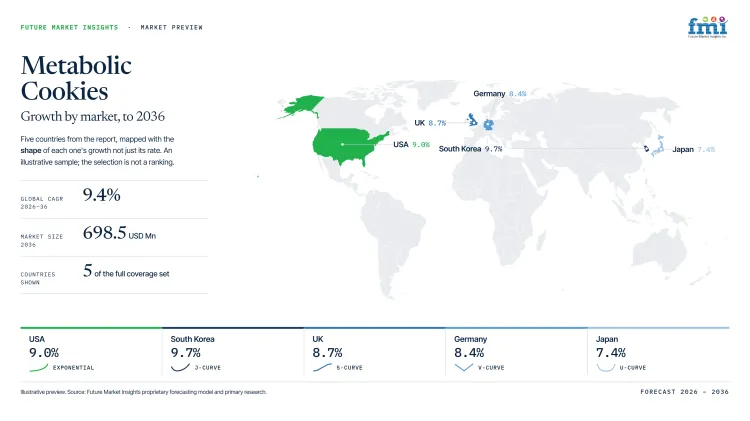
| Country | CAGR |
|---|---|
| USA | 9.0% |
| UK | 8.7% |
| Germany | 8.4% |
| Japan | 7.4% |
| South Korea | 9.7% |
How do country-level CAGRs compare in the Metabolic Cookies Market?
The five country CAGRs span 2.3 percentage points, from 7.4% in Japan to 9.7% in South Korea. The gap describes expected expansion speed rather than market size. Commercial planning therefore needs to read each rate beside local label rules and retailer economics instead of using CAGR as a stand-alone measure of attractiveness.
- USA is forecast at 9.0% CAGR. Nutrition-label familiarity gives lower-sugar or higher-fiber propositions a direct shelf comparison, but repeat purchase still depends on a familiar cookie experience.
- UK is projected at 8.7% CAGR. Advertising restrictions for less-healthy food add a media-planning consequence to formulation choices when cookies meet the nutrient-profile test.
- Germany is estimated at 8.4% CAGR. Voluntary Nutri-Score use increases front-of-pack comparability alongside EU nutrition-claim rules.
- Japan is forecast at 7.4% CAGR. Japanese-language labeling and governed functional communication raise the localization burden for imported propositions.
- South Korea is projected at 9.7% CAGR. Public attention to sugar reduction supports the category, while local labeling and taste expectations still govern repeat purchase.
Comparable growth rates can still produce different routes to market. A country with tighter advertising or claim controls may require more reformulation before a campaign scales, while a market with broad grocery access can demand stronger supply economics. The full report therefore combines country growth with segment and regional analysis.
Country-wise Analysis
- USA. Demand for Metabolic Cookies in the USA is forecast to expand at 9.0% CAGR from 2026 to 2036. FDA labeling makes added sugar and dietary fiber directly visible, while CDC reported 40.1 million people with diabetes in 2023 and 115.2 million adults with prediabetes. The commercial test remains ordinary snack behavior: the nutrition advantage has to coexist with flavor acceptance and a price that works beside premium conventional cookies.
- UK. Sales of Metabolic Cookies in the UK are forecast to expand at 8.7% CAGR from 2026 to 2036. UK government guidance places sweet biscuits and cookies within the scope of less-healthy food advertising restrictions when the nutrient-profile test is met, with the restrictions in force from January 5, 2026. Suppliers therefore need to consider formulation before media planning because the same product profile can influence both pack claims and advertising flexibility.
- Germany. Demand for Metabolic Cookies in Germany is forecast to expand at 8.4% CAGR from 2026 to 2036. Voluntary Nutri-Score gives packaged-food brands an additional front-of-pack comparison tool, while EU nutrition and health claim rules apply to the wording used around sugar or other functional benefits. Commercial entry therefore depends on disciplined reformulation and labels that remain clear without relying on disease-oriented language.
- Japan. Adoption of Metabolic Cookies in Japan is forecast to expand at 7.4% CAGR from 2026 to 2036. The Consumer Affairs Agency states that food sold in Japan must be labeled in Japanese and maintains separate systems for nutrient declarations and Foods with Function Claims. Brands therefore need localized labels and conservative functional communication before using metabolic positioning as a central selling point.
- South Korea. Sales of Metabolic Cookies in South Korea are forecast to expand at 9.7% CAGR from 2026 to 2036. The Ministry of Food and Drug Safety continued public communication around lower-sodium and lower-sugar eating in July 2026 through its healthy recipe initiative. The growth case still depends on Korean-market taste and compliant labeling, so imported formulations need local testing rather than simple pack translation.
Who are the notable companies in the Metabolic Cookies Market?
Catalina Crunch, Quest Nutrition, HighKey, Lenny & Larry's, , Simple Mills, Emmy's Organics and Nunbelievable are notable companies connected to the metabolic cookies market.
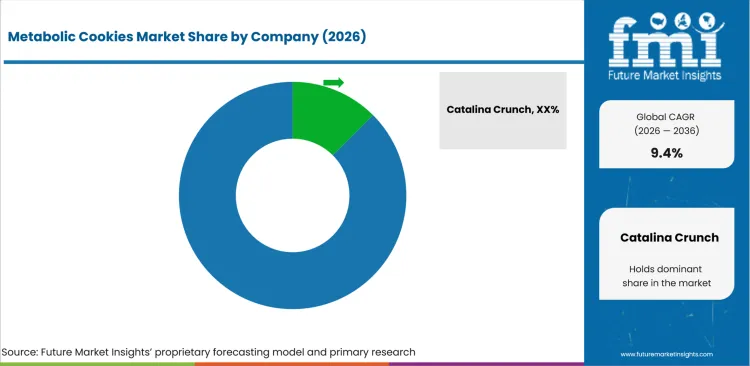
Competition separates by the nutrition cue used to justify a cookie purchase and by the channel in which the product is expected to repeat. Catalina Crunch and HighKey lean toward lower-sugar positioning. Quest Nutrition and Lenny & Larry's bring protein-led cookie formats. Simple Mills and Emmy's Organics use ingredient-forward recipes, while Nunbelievable combines low-carb products with a mission-led brand. remains relevant as a documented former protein-cookie participant, but its official site states that the Protein Cookies were discontinued and its current portfolio is centered on bars.
- Low-sugar and keto positioning: Catalina Crunch, HighKey and Nunbelievable use reduced-sugar or low-carb cues across familiar sweet-snack formats.
- Protein-led cookie positioning: Quest Nutrition and Lenny & Larry's maintain documented cookie formats, while contributes historical cookie participation and current adjacent protein-snack experience.
- Ingredient-forward cookies: Simple Mills and Emmy's Organics compete through recognizable flour or coconut systems with better-for-you shelf cues.
Competitive Benchmarking: Metabolic Cookies Market
| Company | Metabolic Formulation Depth | Cookie Format Breadth | Mainstream Channel Activation | Geographic Reach |
|---|---|---|---|---|
| Catalina Crunch | High | Medium | High | United States retail and online |
| Quest Nutrition | High | Medium | High | United States retail and online; international brand channels |
| HighKey | High | High | Medium | United States online and selected retail |
| Lenny & Larry's | High | High | High | United States retail and online |
| Medium | Not current | Medium | United States retail and online | |
| Simple Mills | Medium | High | High | United States grocery and online |
| Emmy's Organics | Medium | Medium | Medium | United States specialty, retail and online |
| Nunbelievable | High | Medium | Medium | United States online and selected retail |
Key Developments in the Metabolic Cookies Market
- In May 2025, Catalina Snacks launched its first national advertising campaign for Catalina Crunch and paired the campaign with broad USA retail availability. The action shows the level of consumer activation needed when a better-for-you snack platform moves from digital discovery toward routine grocery purchase.
- In February 2025, Flowers Foods completed its acquisition of Simple Mills. Flowers identified cookies among the acquired brand categories and said it intended to broaden distribution and support innovation, giving the ingredient-forward cookie platform a wider packaged-food operating base.
Key Players in the Metabolic Cookies Market
Low-Sugar and Keto Formulation Specialists
- Catalina Crunch
- HighKey
- Nunbelievable
Protein-Led Cookie and Adjacent Snack Platforms
- Quest Nutrition
- Lenny & Larry's
Ingredient-Forward Natural Cookie Brands
- Simple Mills
- Emmy's Organics
Metabolic Cookies Market - Report Scope
| Coverage field | Report scope |
|---|---|
| Market breakdown | By Functional Ingredient, Product Type, Claim, Packaging, Sales Channel and Region. |
| Quantitative Units | Revenue USD million and CAGR in % |
| Market Definition | Ready-to-eat cookies sold with a metabolic-positioning proposition inside the stated segmentation universe. Generic cookies without that positioning and adjacent substitutes such as bars or crackers are excluded. |
| Regions Covered | North America, Latin America, Western Europe, Eastern Europe, East Asia, South Asia and Pacific, and Middle East and Africa. |
| Countries Covered | USA, UK, Germany, Japan, South Korea and additional countries included in the full report. |
| Companies Covered | Catalina Crunch, Quest Nutrition, HighKey, Lenny & Larry's, , Simple Mills, Emmy's Organics and Nunbelievable. |
| Forecast Period | 2026 to 2036. |
| Approach | Primary and secondary research with market triangulation. |
Metabolic Cookies Market - Research Methodology
| Method | Approach |
|---|---|
| Primary Research | FMI analysts gathered input from brand owners, manufacturers, ingredient suppliers, distributors and retailers. Interviews examined purchase criteria and formulation trade-offs, then considered channel economics and claim-related frictions that affect trial or repeat ordering. |
| Desk Research | Desk research covered public-health statistics, food-labeling rules, nutrition-claim regulations, company filings, official releases and product documentation. Sources were reviewed for relevance to the defined cookie boundary and current commercial activity. |
| Market Sizing and Forecasting | The market model combined the 2026 baseline with historical performance, segment structure, pricing and channel indicators. Forecast assumptions considered reformulation, retail distribution, country regulation and repeat purchase before segment and country estimates were reconciled with the total market. |
| Data Validation | Estimates were checked against independent public indicators and company activity. Products outside the defined cookie boundary were excluded, and documented discontinued products were separated from current participation to reduce overlap in competitive assessment. |
Metabolic Cookies Market by Segments
Metabolic Cookies Market segmented by Functional Ingredient:
- Fiber Blends
- Plant Protein
- Cinnamon Extract
- Chromium & Minerals
- Others
Metabolic Cookies Market segmented by Product Type:
- Crunchy
- Soft-Baked
- Sandwich
- Others
Metabolic Cookies Market segmented by Claim:
- Blood-Sugar Friendly
- Low-Glycemic
- Keto
- Low-Sugar
- Others
Metabolic Cookies Market segmented by Packaging:
- Single-Serve
- Multipacks
- Boxes
- Others
Metabolic Cookies Market segmented by Sales Channel:
- Supermarkets & Hypermarkets
- Online / DTC
- Convenience Stores
- Specialty & Health Stores
- Others
Metabolic Cookies Market by Region:
- North America
- United States
- Canada
- Latin America
- Brazil
- Mexico
- Argentina
- Chile
- Western Europe
- Germany
- France
- United Kingdom
- Italy
- Spain
- Benelux
- Nordics
- Eastern Europe
- Poland
- Czech Republic
- Romania
- Hungary
- East Asia
- China
- Japan
- South Korea
- South Asia and Pacific
- India
- ASEAN
- Australia and New Zealand
- Middle East and Africa
- GCC Countries
- South Africa
- Türkiye
- Israel
Research Sources and Bibliography
- Centers for Disease Control and Prevention. (2026, January 21). National Diabetes Statistics Report.
- USA Food and Drug Administration. (2024, March 5). How to Understand and Use the Nutrition Facts Label.
- USA Food and Drug Administration. (2026, March 4). Added Sugars on the Nutrition Facts Label.
- UK Department of Health and Social Care. (2025, June 4). Restricting advertising of less healthy food or drink on TV and online: products in scope.
- Federal Ministry of Agriculture, Food and Regional Identity, Germany. Hilfestellung für Unternehmen - Verwendung des Nutri-Score.
- European Parliament and Council of the European Union. (2006, December 30). Regulation (EC) No 1924/2006 on nutrition and health claims made on foods.
- Consumer Affairs Agency, Government of Japan. Food Labelling.
- Ministry of Food and Drug Safety, Republic of Korea. (2026, July 14). K-Food Fusion Recipes, Tastier and Healthier.
- Catalina Snacks. (2025, May 19). Catalina Snacks Launches First National Advertising Campaign, "The Bright Side of Better".
- Flowers Foods, Inc. (2025, February 21). Flowers Foods, Inc. Completes Acquisition of Simple Mills.
- HighKey. (2023, January 4). Dunk Without The Junk Thanks to HighKey's New Light and Creamy Sandwich Cookies.
- Lenny & Larry's. (2022, January 4). Back by Popular Demand, Lenny & Larry's Launches The Complete Cremes Nationwide.
- Quest Nutrition. Protein Cookies product collection and product nutrition information.
- . An Update from Our Founders: Protein Cookie Update.
- Simple Mills. Crunchy Chocolate Chip Cookies product information.
- Emmy's Organics. Coconut Cookies product information.
- Nunbelievable. Keto cookie product information.
This bibliography is provided for reader reference and is not exhaustive. The full report contains the complete reference list and detailed citations.
This Report Answers
- How does metabolic positioning change the conventional cookie purchase decision?
- Which formulation systems support lower-sugar or higher-fiber cookie propositions?
- How do texture and pack format shape trial and repeat purchase?
- What claim and labeling constraints affect market entry?
- How do retailer requirements change channel expansion?
- How do country conditions alter commercialization priorities?
- How do low-sugar, protein-led and ingredient-forward brands compete?
- What should suppliers test before expanding distribution?
Frequently Asked Questions
How big is the metabolic cookies market in 2026?
USD 284.4 million represents the metabolic cookies market value in 2026. The category is forecast to reach USD 698.5 million by 2036 as lower-sugar and functional nutrition propositions move through familiar cookie formats and broader retail channels.
What is the CAGR of the metabolic cookies market from 2026 to 2036?
A 9.4% CAGR is projected for the metabolic cookies market between 2026 and 2036. Growth depends on whether brands can protect the expected cookie experience while using sugar reduction or functional ingredients to create a nutrition difference that shoppers can understand quickly.
Which Functional Ingredient segment accounts for 34.9% of the metabolic cookies market?
Fiber Blends account for 34.9% of Functional Ingredient demand in 2026. Fiber can support nutrition density and cookie structure, which gives formulators a practical base for products that also use protein or alternative sweetening systems.
How much will the metabolic cookies market add between 2026 and 2036?
USD 414.1 million is expected to be added to the metabolic cookies market between 2026 and 2036. The increase depends on repeat purchase after trial, especially when brands move from specialist online channels into supermarkets and other routine snack-shopping environments.
Which companies are active in the metabolic cookies market?
Companies connected to the metabolic cookies market include Catalina Crunch, Quest Nutrition, HighKey, Lenny & Larry's, , Simple Mills, Emmy's Organics and Nunbelievable.
Preview the report firsthand - request a free sample
Get SampleGet the brochure for pricing and purchase details.
Get PDFTable of Content
- Key Takeaways
- Market Size and CAGR
- Top Growth Driver
- Fastest Growing Segment
- Leading Region
- Key Companies
- Emerging Opportunities
- Executive Summary
- Global Market Outlook
- Demand-side Trends
- Supply-side Trends
- Technology Roadmap Analysis
- Analysis and Recommendations
- Analyst Perspective (What is happening? Why now? What should investors know?)
- Key Questions Answered
- How large is the market?
- What is the CAGR?
- What are key trends?
- Which region dominates?
- Who are the leaders?
- Market Overview
- Market Coverage / Taxonomy
- Market Definition / Scope / Limitations
- Research Methodology
- Chapter Orientation
- Analytical Lens and Working Hypotheses
- Market Structure, Signals, and Trend Drivers
- Benchmarking and Cross-market Comparability
- Market Sizing, Forecasting, and Opportunity Mapping
- Research Design and Evidence Framework
- Desk Research Programme (Secondary Evidence)
- Expert Input and Fieldwork (Primary Evidence)
- Tooling, Models, and Reference Databases
- Data Engineering and Model Build
- Quality Assurance and Audit Trail
- Market Background
- Market Dynamics (Drivers, Restraints, Opportunity, Trends)
- Scenario Forecast (Optimistic, Likely, Conservative)
- Impact Analysis
- AI Impact
- Sustainability Impact
- Regulatory Impact
- Technology Impact
- Consumer / Buyer Analysis
- Purchase Drivers
- Adoption Barriers
- Buyer Journey
- Opportunity Map Analysis
- Product Life Cycle Analysis
- Supply Chain Analysis
- Investment Feasibility Matrix
- Value Chain Analysis
- PESTLE and Porter's Analysis
- Regulatory Landscape
- Regional Parent Market Outlook
- Production and Consumption Statistics
- Import and Export Statistics
- Global Market Analysis and Forecast, 2021 to 2036
- Historical Market Size Value (USD Million) Analysis, 2021 to 2025
- Current and Future Market Size Value (USD Million) Projections, 2026 to 2036
- Y-o-Y Growth Trend Analysis
- Absolute $ Opportunity Analysis
- Global Market Pricing Analysis, 2021 to 2036
- Global Market Analysis and Forecast, By Functional Ingredient, 2021 to 2036
- Introduction / Key Findings
- Historical Market Size Value (USD Million) Analysis By Functional Ingredient, 2021 to 2025
- Current and Future Market Size Value (USD Million) Analysis and Forecast By Functional Ingredient, 2026 to 2036
- Fiber Blends
- Plant Protein
- Cinnamon Extract
- Chromium & Minerals
- Others
- Fiber Blends
- Y-o-Y Growth Trend Analysis By Functional Ingredient, 2021 to 2025
- Absolute $ Opportunity Analysis By Functional Ingredient, 2026 to 2036
- Global Market Analysis and Forecast, By Product Type, 2021 to 2036
- Introduction / Key Findings
- Historical Market Size Value (USD Million) Analysis By Product Type, 2021 to 2025
- Current and Future Market Size Value (USD Million) Analysis and Forecast By Product Type, 2026 to 2036
- Crunchy
- Soft-Baked
- Sandwich
- Others
- Crunchy
- Y-o-Y Growth Trend Analysis By Product Type, 2021 to 2025
- Absolute $ Opportunity Analysis By Product Type, 2026 to 2036
- Global Market Analysis and Forecast, By Claim, 2021 to 2036
- Introduction / Key Findings
- Historical Market Size Value (USD Million) Analysis By Claim, 2021 to 2025
- Current and Future Market Size Value (USD Million) Analysis and Forecast By Claim, 2026 to 2036
- Blood-Sugar Friendly
- Low-Glycemic
- Keto
- Low-Sugar
- Others
- Blood-Sugar Friendly
- Y-o-Y Growth Trend Analysis By Claim, 2021 to 2025
- Absolute $ Opportunity Analysis By Claim, 2026 to 2036
- Global Market Analysis and Forecast, By Packaging, 2021 to 2036
- Introduction / Key Findings
- Historical Market Size Value (USD Million) Analysis By Packaging, 2021 to 2025
- Current and Future Market Size Value (USD Million) Analysis and Forecast By Packaging, 2026 to 2036
- Single-Serve
- Multipacks
- Boxes
- Others
- Single-Serve
- Y-o-Y Growth Trend Analysis By Packaging, 2021 to 2025
- Absolute $ Opportunity Analysis By Packaging, 2026 to 2036
- Global Market Analysis and Forecast, By Sales Channel, 2021 to 2036
- Introduction / Key Findings
- Historical Market Size Value (USD Million) Analysis By Sales Channel, 2021 to 2025
- Current and Future Market Size Value (USD Million) Analysis and Forecast By Sales Channel, 2026 to 2036
- Supermarkets & Hypermarkets
- Online / DTC
- Convenience Stores
- Specialty & Health Stores
- Others
- Supermarkets & Hypermarkets
- Y-o-Y Growth Trend Analysis By Sales Channel, 2021 to 2025
- Absolute $ Opportunity Analysis By Sales Channel, 2026 to 2036
- Global Market Analysis and Forecast, By Region, 2021 to 2036
- Introduction
- Historical Market Size Value (USD Million) Analysis By Region, 2021 to 2025
- Current Market Size Value (USD Million) Analysis and Forecast By Region, 2026 to 2036
- North America
- Latin America
- Western Europe
- Eastern Europe
- East Asia
- South Asia and Pacific
- Middle East & Africa
- Market Attractiveness Analysis By Region
- North America Market Analysis and Forecast, By Country, 2021 to 2036
- Historical Market Size Value (USD Million) Trend Analysis By Market Taxonomy, 2021 to 2025
- Market Size Value (USD Million) Forecast By Market Taxonomy, 2026 to 2036
- By Country
- USA
- Canada
- By Functional Ingredient
- By Product Type
- By Claim
- By Packaging
- By Sales Channel
- By Country
- Market Attractiveness Analysis
- By Country
- By Functional Ingredient
- By Product Type
- By Claim
- By Packaging
- By Sales Channel
- Key Takeaways
- Latin America Market Analysis and Forecast, By Country
- Historical Market Size Value (USD Million) Trend Analysis By Market Taxonomy, 2021 to 2025
- Market Size Value (USD Million) Forecast By Market Taxonomy, 2026 to 2036
- By Country
- Brazil
- Mexico
- Chile
- Rest of Latin America
- By Functional Ingredient
- By Product Type
- By Claim
- By Packaging
- By Sales Channel
- By Country
- Market Attractiveness Analysis
- By Country
- By Functional Ingredient
- By Product Type
- By Claim
- By Packaging
- By Sales Channel
- Key Takeaways
- Western Europe Market Analysis and Forecast, By Country
- Historical Market Size Value (USD Million) Trend Analysis By Market Taxonomy, 2021 to 2025
- Market Size Value (USD Million) Forecast By Market Taxonomy, 2026 to 2036
- By Country
- Germany
- UK
- Italy
- Spain
- France
- Nordic
- BENELUX
- Rest of Western Europe
- By Functional Ingredient
- By Product Type
- By Claim
- By Packaging
- By Sales Channel
- By Country
- Market Attractiveness Analysis
- By Country
- By Functional Ingredient
- By Product Type
- By Claim
- By Packaging
- By Sales Channel
- Key Takeaways
- Eastern Europe Market Analysis and Forecast, By Country
- Historical Market Size Value (USD Million) Trend Analysis By Market Taxonomy, 2021 to 2025
- Market Size Value (USD Million) Forecast By Market Taxonomy, 2026 to 2036
- By Country
- Russia
- Poland
- Hungary
- Balkan & Baltic
- Rest of Eastern Europe
- By Functional Ingredient
- By Product Type
- By Claim
- By Packaging
- By Sales Channel
- By Country
- Market Attractiveness Analysis
- By Country
- By Functional Ingredient
- By Product Type
- By Claim
- By Packaging
- By Sales Channel
- Key Takeaways
- East Asia Market Analysis and Forecast, By Country
- Historical Market Size Value (USD Million) Trend Analysis By Market Taxonomy, 2021 to 2025
- Market Size Value (USD Million) Forecast By Market Taxonomy, 2026 to 2036
- By Country
- China
- Japan
- South Korea
- By Functional Ingredient
- By Product Type
- By Claim
- By Packaging
- By Sales Channel
- By Country
- Market Attractiveness Analysis
- By Country
- By Functional Ingredient
- By Product Type
- By Claim
- By Packaging
- By Sales Channel
- Key Takeaways
- South Asia and Pacific Market Analysis and Forecast, By Country
- Historical Market Size Value (USD Million) Trend Analysis By Market Taxonomy, 2021 to 2025
- Market Size Value (USD Million) Forecast By Market Taxonomy, 2026 to 2036
- By Country
- India
- ASEAN
- Australia & New Zealand
- Rest of South Asia and Pacific
- By Functional Ingredient
- By Product Type
- By Claim
- By Packaging
- By Sales Channel
- By Country
- Market Attractiveness Analysis
- By Country
- By Functional Ingredient
- By Product Type
- By Claim
- By Packaging
- By Sales Channel
- Key Takeaways
- Middle East & Africa Market Analysis and Forecast, By Country
- Historical Market Size Value (USD Million) Trend Analysis By Market Taxonomy, 2021 to 2025
- Market Size Value (USD Million) Forecast By Market Taxonomy, 2026 to 2036
- By Country
- Kingdom of Saudi Arabia
- Other GCC Countries
- Türkiye
- South Africa
- Other African Union
- Rest of Middle East & Africa
- By Functional Ingredient
- By Product Type
- By Claim
- By Packaging
- By Sales Channel
- By Country
- Market Attractiveness Analysis
- By Country
- By Functional Ingredient
- By Product Type
- By Claim
- By Packaging
- By Sales Channel
- Key Takeaways
- Key Countries Market Analysis
- USA
- Pricing Analysis
- Market Share Analysis, 2025
- By Functional Ingredient
- By Product Type
- By Claim
- By Packaging
- By Sales Channel
- Canada
- Pricing Analysis
- Market Share Analysis, 2025
- By Functional Ingredient
- By Product Type
- By Claim
- By Packaging
- By Sales Channel
- Mexico
- Pricing Analysis
- Market Share Analysis, 2025
- By Functional Ingredient
- By Product Type
- By Claim
- By Packaging
- By Sales Channel
- Brazil
- Pricing Analysis
- Market Share Analysis, 2025
- By Functional Ingredient
- By Product Type
- By Claim
- By Packaging
- By Sales Channel
- Chile
- Pricing Analysis
- Market Share Analysis, 2025
- By Functional Ingredient
- By Product Type
- By Claim
- By Packaging
- By Sales Channel
- Germany
- Pricing Analysis
- Market Share Analysis, 2025
- By Functional Ingredient
- By Product Type
- By Claim
- By Packaging
- By Sales Channel
- UK
- Pricing Analysis
- Market Share Analysis, 2025
- By Functional Ingredient
- By Product Type
- By Claim
- By Packaging
- By Sales Channel
- Italy
- Pricing Analysis
- Market Share Analysis, 2025
- By Functional Ingredient
- By Product Type
- By Claim
- By Packaging
- By Sales Channel
- Spain
- Pricing Analysis
- Market Share Analysis, 2025
- By Functional Ingredient
- By Product Type
- By Claim
- By Packaging
- By Sales Channel
- France
- Pricing Analysis
- Market Share Analysis, 2025
- By Functional Ingredient
- By Product Type
- By Claim
- By Packaging
- By Sales Channel
- India
- Pricing Analysis
- Market Share Analysis, 2025
- By Functional Ingredient
- By Product Type
- By Claim
- By Packaging
- By Sales Channel
- ASEAN
- Pricing Analysis
- Market Share Analysis, 2025
- By Functional Ingredient
- By Product Type
- By Claim
- By Packaging
- By Sales Channel
- Australia & New Zealand
- Pricing Analysis
- Market Share Analysis, 2025
- By Functional Ingredient
- By Product Type
- By Claim
- By Packaging
- By Sales Channel
- China
- Pricing Analysis
- Market Share Analysis, 2025
- By Functional Ingredient
- By Product Type
- By Claim
- By Packaging
- By Sales Channel
- Japan
- Pricing Analysis
- Market Share Analysis, 2025
- By Functional Ingredient
- By Product Type
- By Claim
- By Packaging
- By Sales Channel
- South Korea
- Pricing Analysis
- Market Share Analysis, 2025
- By Functional Ingredient
- By Product Type
- By Claim
- By Packaging
- By Sales Channel
- Russia
- Pricing Analysis
- Market Share Analysis, 2025
- By Functional Ingredient
- By Product Type
- By Claim
- By Packaging
- By Sales Channel
- Poland
- Pricing Analysis
- Market Share Analysis, 2025
- By Functional Ingredient
- By Product Type
- By Claim
- By Packaging
- By Sales Channel
- Hungary
- Pricing Analysis
- Market Share Analysis, 2025
- By Functional Ingredient
- By Product Type
- By Claim
- By Packaging
- By Sales Channel
- Kingdom of Saudi Arabia
- Pricing Analysis
- Market Share Analysis, 2025
- By Functional Ingredient
- By Product Type
- By Claim
- By Packaging
- By Sales Channel
- Türkiye
- Pricing Analysis
- Market Share Analysis, 2025
- By Functional Ingredient
- By Product Type
- By Claim
- By Packaging
- By Sales Channel
- South Africa
- Pricing Analysis
- Market Share Analysis, 2025
- By Functional Ingredient
- By Product Type
- By Claim
- By Packaging
- By Sales Channel
- USA
- Market Structure Analysis
- Competition Dashboard
- Competition Benchmarking
- Market Share Analysis of Top Players
- By Regional
- By Functional Ingredient
- By Product Type
- By Claim
- By Packaging
- By Sales Channel
- Emerging Startups
- Innovation Benchmarking
- Competition Analysis
- Competition Deep Dive
- Catalina Crunch
- Overview
- Product Portfolio
- Profitability by Market Segments
- Sales Footprint
- Strategy Overview
- Marketing Strategy
- Product Strategy
- Channel Strategy
- Quest Nutrition
- HighKey
- Lenny & Larry's
- Munk Pack
- Simple Mills
- Emmy's Organics
- Nunbelievable
- Catalina Crunch
- Case Studies
- Success Stories
- Recent Developments
- Competition Deep Dive
- Assumptions & Acronyms Used


