

- Market Size (2026)
- USD 1.1 Bn
- Forecast (2036)
- USD 4.9 Bn
- CAGR (2026 to 2036)
- 16.1%
How big is Metal Binder Jetting Market size?
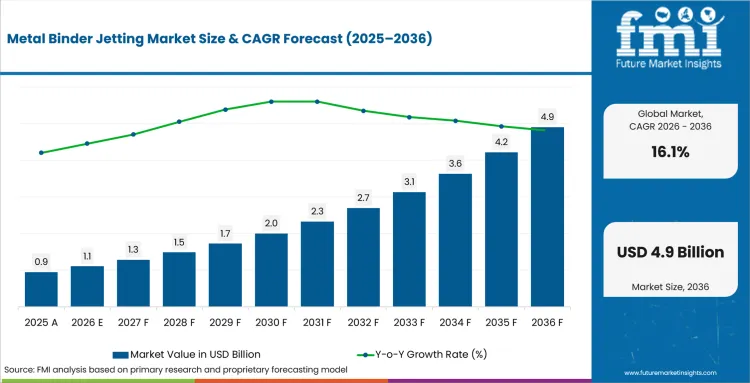
USD 1.1 billion in 2026 and USD 4.9 billion by 2036 at a 16.1% CAGR.
Demand for metal binder jetting is projected to expand at 16.1% CAGR between 2026 and 2036, increasing valuation from USD 1.1 billion in 2026 to USD 4.9 billion by 2036. Evaluating printer throughput with raw powder expenses and available furnace capacity remains a top priority for industrial manufacturers. Ricoh 3D achieved a 68% component weight reduction during an aluminum binder jetting thermal-management program in July 2025. Lighter parts directly accelerate functional testing across electric mobility and power-electronics cooling applications.
Precise dimensional proof and strict sintering controls dominate equipment reviews among sourcing teams in Japan and Germany. Canada and United States buyers direct their purchasing focus toward comprehensive application support and broad technical service access. Long-term production schedules across jewelry manufacturing and industrial engineering depend heavily on available material variety. Legor Group expanded its service offerings across precious and non-precious components by introducing support for 6 different metal options during February 2026. This broader alloy selection encourages engineering teams to screen new applications well beyond traditional stainless-steel production families.
Key Takeaways for the Metal Binder Jetting Market
- Demand for metal binder jetting receives support from repeatable complex-part production across automotive and industrial programs.
- Direct sales are set to secure 43.0% share of distribution channel in 2026, influenced by qualification support and integrated commercial discussions.
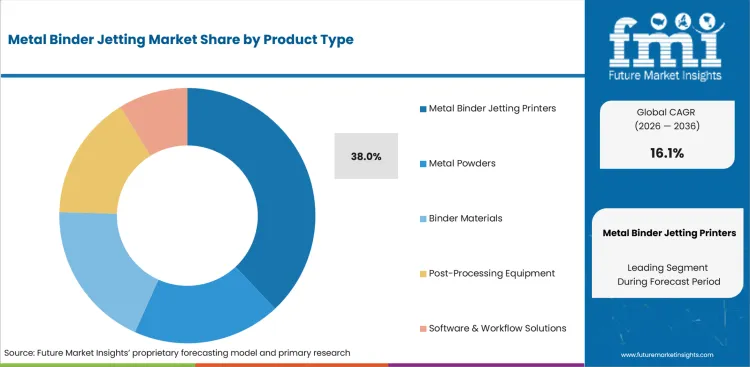
- Metal binder jetting printers are estimated to lead product type with 38.0% share in 2026, backed by capital spending on complete production systems.
- Sintering distortion and powder qualification represent primary barriers limiting predictable yield and investment approval.
- Competition focusses on HP Inc., Nano Dimension Ltd., Ricoh Company, Ltd., INDO-MIM Limited, GKN Powder Metallurgy, Sculpteo, Legor Group S.p.A., and Sandvik AB, with providers differentiating depending on material qualification and service reach.
Analyst Perspective
“Commercial leadership in metal binder jetting comes from controlling the complete production chain and proving repeatability across serial programs. Companies converting design freedom into qualified part families are positioned to secure long-term manufacturing value. Predictable sintering behavior and verified production economics separate credible suppliers from experimental participants.”
- Nikhil Kaitwade, Principal Analyst at Future Market Insights
How is Metal Binder Jetting Market segmented?
The metal binder jetting industry is segmented by product type, application, end user, distribution channel, material, and region.
The metal binder jetting sector is segmented by product type, application, end user, distribution channel, material, and region. Product type coverage includes metal binder jetting printers and metal powders serving equipment and 3D printing material requirements. Binder materials, post-processing equipment, and software and workflow solutions complete product type coverage. Application coverage includes automotive components, aerospace components, and medical and dental parts. Industrial tooling and consumer products extend analysis across production tools and finished goods. End-user coverage spans automotive manufacturers, aerospace and defense companies, healthcare companies, industrial manufacturing companies, and research and academic institutes. Distribution coverage includes direct sales, authorized distributors, system integrators, online sales, and technology partners. Material coverage includes stainless steel, tool steel, titanium alloys, nickel-based alloys, and copper and other alloys. Regional coverage includes North America, Europe, and East Asia. South Asia and Pacific, Latin America, and Middle East and Africa complete the geographic assessment.
What makes metal binder jetting printers central to product type selection?
Metal binder jetting printers combine powder deposition and binder placement inside one controlled production platform. Equipment selection affects layer consistency and build capacity across recurring part families. HP introduced a 170 mm build height for its Metal Jet S100 in June 2024, supporting additive manufacturing with metal powders among taller geometries. Printer evaluation extends beyond purchase price toward throughput and downstream furnace loading.
- Based on product type, metal binder jetting printers are predicted to secure 38.0% share in 2026 since being driven by manufacturer spending on integrated printing capacity. Buyers examine printhead control and powder spreading performance during qualification programs.
- Metal powders and binder materials support alloy expansion across qualified production recipes. Post-processing equipment and software & workflow solutions contribute to de-binding control and shrinkage compensation across complete batches.
Why do automotive components lead application demand?
Automotive components suit binder jetting led by repeated small-part volumes and consolidated internal geometries. Cooling parts and brackets require controlled dimensions following debinding and sintering. Ricoh reported an aluminium inverter heatsink fin weighing 11 grams in October 2025, demonstrating compact functional-part production based on metal binder jetting. Successful transfer into production requires test evidence covering thermal performance and batch consistency.
- By application, automotive components are likely to account for 31.0% share in 2026 as it reflects recurring demand for complex parts across vehicle platforms. Engineering teams compare machining cost against batch yield and occupied furnace capacity.
- Aerospace components and medical & dental parts require stricter material records and dimensional verification. Industrial tooling and consumer products create additional demand influenced by complex inserts and design-intensive finished parts.
What supports automotive manufacturers across end user demand?
Automotive manufacturers evaluate binder jetting due to cost-per-part and qualified production repeatability. Internal tooling provides an early application route prior to larger serial programs. HP reported OptiPowder Ni718 parts with more than 98% sintered density in November 2025, supporting review across demanding aerospace and energy applications. Comparable evidence strengthens automotive assessment of qualified alloys and controlled furnace recipes.
- In 2026, automotive manufacturers are set to represent 34.0% share due to repeated component programs and established powder-metallurgy knowledge. Approval teams require stable density and measured dimensional capability across several production lots.
- Aerospace 3D printing materials and healthcare components require tighter records across materials and final inspection. Industrial manufacturing companies and research & academic institutes support tooling trials and process development across new alloys.
Why does direct sales lead distribution channel selection?
Direct sales connects equipment discussions with material qualification and application engineering. Complex purchase decisions require coordinated printer and post-processing assessment. HP introduced a contained powder-management system in April 2026 for semi-automated de-powdering and refilling. Availability across 3 geographies strengthens direct technical support during workflow planning.
- Direct sales are estimated to secure 43.0% share of distribution channel in 2026, backed by complex qualification work and negotiated service arrangements. Manufacturer contact helps buyers align printing equipment with powder handling and furnace requirements.
- Authorized distributors and system integrators extend installation support across local industrial accounts. Online sales and technology partners contribute to standard component orders and specialized workflow connections.
How does stainless steel shape material demand?
Stainless steel offers established powder supply and familiar heat-treatment knowledge across industrial applications. Design limits remain important for holes and channels inside green parts. Fraunhofer researchers published 13 metal binder jetting design guidelines in 2024, covering process-specific restrictions and component design decisions. Documented rules support earlier geometry screening and reduce avoidable redesign during qualification.
- Stainless steel is projected to hold 33.0% share in 2026, guided by corrosion resistance and established sintering knowledge. Buyers assess powder flow and dimensional change across recurring production batches.
- Tool steel and titanium powder serve demanding tooling and lightweight applications under qualified recipes. Nickel-based alloys and copper & other alloys extend coverage across heat resistance and thermal-management components.
What are drivers, restraints, and opportunities in Metal Binder Jetting Market?
Higher batch productivity supports adoption across repeatable component families. Sintering variation slows commercial approval across demanding geometries.
- Driver: Manufacturers seek complex metal parts without dedicated tooling across recurring production batches. Binder jetting supports parallel part placement and efficient powder use across suitable geometries.
- Restraint: Dimensional change during de-binding and sintering complicates qualification across tight tolerances. Weak powder handling or furnace control increases scrap exposure across complete builds.
- Opportunity: Process monitoring and simulation improve defect detection across printing and post-processing stages. Service providers may convert validated design rules into repeatable production programs for specialized components.
Reactive powders require binder systems avoiding unnecessary thermal exposure during green-part preparation. Fraunhofer IFAM reported in September 2025 a curing-free binder removed one heating stage from the metal binder jetting process. Shorter process chains support sensitive material evaluation and reduce handling between printing and de-binding. Commercial adoption requires stable green strength and residue-free binder removal.
Sintering introduces predictable dimensional change only under controlled material and furnace conditions. Fraunhofer researchers reported shrinkage reaching 20% in a 2025 study of metal binder jetting components. Setter friction and thermal conditions influence distortion across the final densification stage. Qualification programs require measured compensation across each part orientation.
Automated inspection creates earlier fault screening across additive manufacturing and material workflows. Fraunhofer IAPT researchers trained a detection pipeline using 1,107 real process images in 2025. Faster defect identification reduces wasted furnace capacity across builds containing spreading faults. Commercial value follows integration with operator review and documented corrective actions.
How are country CAGRs aligned in Metal Binder Jetting Market?
| Country or Market | CAGR |
|---|---|
| Japan | 19.6% |
| Germany | 19.2% |
| Canada | 17.4% |
| UK | 14.8% |
| France | 13.9% |
| South Korea | 13.5% |
| USA | 12.3% |
Source: Future Market Insights analysis, 2026.
How do country-level CAGRs compare in Metal Binder Jetting Market?
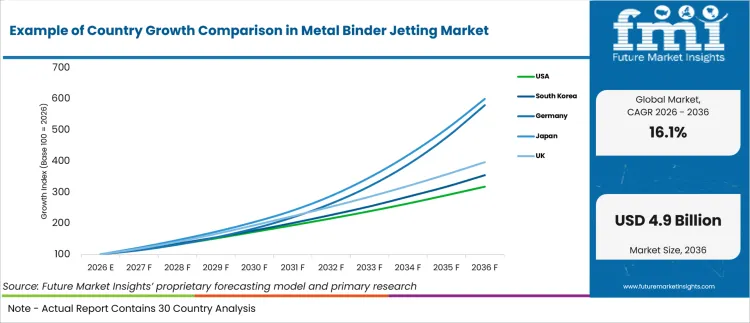
Country comparison shows a measured step-down across the seven profiled markets. Japan occupies the upper forecast position followed closely by Germany. Canada forms the next development tier across the disclosed comparison. UK and France occupy the middle-to-lower band. South Korea and United States complete the forecast range. A 7.3 percentage-point spread separates Japan from United States. National rates describe distinct qualification and manufacturing conditions.
- Japan is anticipated to lead the disclosed comparison due to advanced industrial design and aluminium binder jetting programs.
- Germany is projected to follow Japan led by established sinter-based manufacturing research and industrial workshops.
- Canada is expected to occupy the next rate band driven by metal additive manufacturing support and laboratory access.
- The United Kingdom is likely to maintain a mid-range position based on functional component research and service capability.
- France is forecast to follow United Kingdom through semi-industrial powder processing and sintering infrastructure.
- South Korea is predicted to advance depending on local binder jetting services across metal and ceramic materials.
- The United States is estimated to complete the comparison as it is influenced by established equipment providers and application qualification centers.
Markets carrying similar CAGRs are likely to present different entry conditions through alloy qualification and local service depth. Full report coverage includes North America, Latin America, Europe, East Asia, South Asia and Pacific, Middle East and Africa.
Country-wise Analysis
- Metal binder jetting demand in Japan is forecast to expand at 19.6% CAGR between 2026 and 2036, guided by aluminium application development and production-oriented design work. Ricoh documented four segregated internal flow areas inside an aluminium binder-jetted inkjet manifold in February 2026, demonstrating functional integration beyond simple part substitution. Compact fluid systems create a credible route for local industrial adoption through redesigned assemblies.
- Industrial users in Germany gain access to established expertise across debinding and sintering. Fraunhofer IFAM hosted its sixth sinter-based additive manufacturing workshop in October 2025, covering industrial metal binder jetting implementation and use cases. Demand in Germany is projected to record 19.2% CAGR by 2036, led by application engineering and process-chain knowledge.
- Adoption in Canada is anticipated to register 17.4% CAGR from 2026 to 2036, driven by applied research and first-use support for manufacturers. University of Waterloo named two co-directors for a sustainable metal additive manufacturing consortium in February 2025. Coordinated laboratory leadership supports company access to process development and quality-control expertise.
- Research groups in the United Kingdom continue testing recycled feedstocks for binder-jetted titanium parts. Cardiff University researchers reported 93% to 95% relative density from Ti-6Al-4V machining chips during 2025. Comparable density across recycled and atomized powders supports material-efficiency discussions during technical review. Sales in the United Kingdom are likely to rise at 14.8% CAGR during the forecast period, backed by domestic research on recycled Ti-6Al-4V feedstocks and qualified binder-jetted component production.
- Sector in France is forecast to expand at 13.9% CAGR between 2026 and 2036, aided by powder-metallurgy infrastructure and semi-industrial process development. CEA-Liten reported a 2,200-square-meter platform in May 2024. Equipment covered powder preparation through printing and final sintering. Integrated facilities support component trials across complex metal and ceramic production routes.
- Local service capability supports binder jetting assessment across South Korean semiconductor and industrial programs. SEMI reported MADDE’s use of two material families being metal and silicon carbide, through binder jetting services in February 2025. Multi-material experience improves local support for process selection and component redesign. Industry in South Korea is predicted to progress at 13.5% CAGR through 2036, helped by local binder jetting services spanning metal and silicon carbide applications.
- United States suppliers combine 3D printing equipment development with application centers and research programs. Market in the United States is estimated to increase at 12.3% CAGR from 2026 to 2036, reflecting established additive manufacturing capacity and demanding qualification requirements. Massachusetts Institute of Technology researchers reported a binder-jetted emitter operating at 24% higher voltage in April 2024, supporting functional use beyond conventional industrial parts. Application evidence reinforces demand for precise metal components across medical and analytical equipment.
Who are notable companies in Metal Binder Jetting Market?
HP Inc., Nano Dimension Ltd., Ricoh Company, Ltd., INDO-MIM Limited, GKN Powder Metallurgy, Sculpteo, Legor Group S.p.A., and Sandvik AB are prominent companies participating in metal binder jetting.
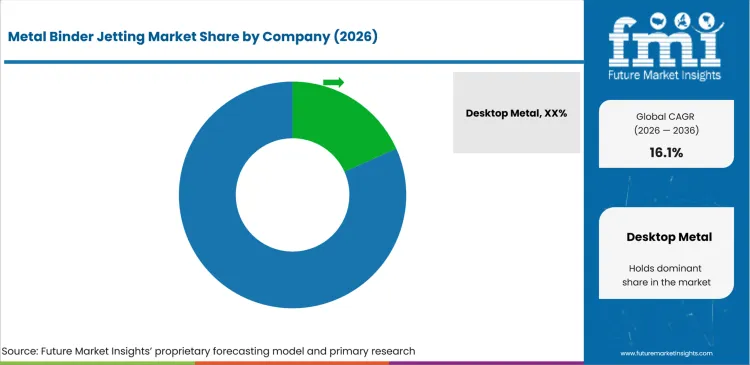
Competition centers on printer productivity and material qualification across production programs. Equipment providers connect hardware with software and powder-management support. Contract manufacturers focus on application development and recurring part production. Powder specialists extend alloy access through controlled feedstock properties. Service providers reduce entry barriers for companies lacking internal printing and sintering capacity.
- HP Inc. and Nano Dimension Ltd. compete based on printer platforms and process-development resources. Buyers assess build productivity and workflow control during equipment review.
- Ricoh Company, Ltd. and INDO-MIM Limited compete due to aluminium development and high-volume component manufacturing. Customer programs examine functional validation and repeat batch performance.
- GKN Powder Metallurgy and Sandvik AB compete led by powder knowledge and industrial material support. Manufacturing teams assess alloy consistency and qualification depth during material selection.
- Sculpteo and Legor Group S.p.A. compete depending on accessible production services across industrial and jewellery applications. Customers compare material access and application assistance prior to recurring orders.
Competitive Benchmarking: Metal Binder Jetting Market
| Company | Printer or Platform Depth | Material Capability | Production Support | Service Reach |
|---|---|---|---|---|
| HP Inc. | High | High | High | Global |
| Nano Dimension Ltd. | High | Medium | High | Global |
| Ricoh Company, Ltd. | Medium | High | High | International programs |
| INDO-MIM Limited | Medium | High | High | Global manufacturing |
| GKN Powder Metallurgy | Medium | High | High | Global |
| Sculpteo | Medium | Medium | High | Europe and North America |
| Legor Group S.p.A. | Medium | High | High | International programs |
| Sandvik AB | Medium | High | Medium | Global |
Source: Future Market Insights competitive analysis, 2026.
Key Developments in Metal Binder Jetting Market
- In April 2025, HP reported plans from INDO-MIM to add five HP Metal Jet S100 printers following initial production use. Added capacity supports wider application development across tooling and original-equipment component programs.
- During February 2026, Sculpteo launched an on-demand HP Metal Jet binder service for scaled metal-part production. Service access reduces initial capital requirements for companies evaluating stainless-steel components.
- A May 2026 agreement positioned Stratasys to acquire Markforged from Nano Dimension. Nano Dimension retained the Metal Binder Jetting product line under the proposed transaction.
Metal Binder Jetting Market Report Scope
| Coverage field | Report scope |
|---|---|
| Market breakdown | Product Type, Application, End User, Distribution Channel, Material, and Region. |
| Market Definition | Metal binder jetting deposits a liquid binder across metal powder layers prior to debinding and sintering. Defined coverage includes printers, powders, binders, software, post-processing equipment, and production services. Polymer binder jetting and laser powder-bed fusion are excluded. |
| Regions Covered | North America, Europe, East Asia, South Asia and Pacific, Latin America, Middle East and Africa. |
| Countries Covered | Japan, Germany, Canada, UK, France, South Korea, USA, and additional countries included in full report coverage. |
| Key Companies Profiled | HP Inc., Nano Dimension Ltd., Ricoh Company, Ltd., INDO-MIM Limited, GKN Powder Metallurgy, Sculpteo, Legor Group S.p.A., and Sandvik AB. |
| Forecast Period | 2026 to 2036 |
| Approach | Hybrid bottom-up and top-down methodology uses segment shares and country CAGRs. Company activity and buyer adoption support final market reconciliation. |
Source: Future Market Insights report analysis, 2026.
Metal Binder Jetting Market - Research Methodology
| Method | Approach |
|---|---|
| Primary Research | FMI analysts gathered input from manufacturers, service providers, technology developers, distributors, end users, procurement teams, and subject-matter experts. Interviews examined purchasing decisions, product or service evaluation, adoption barriers, approval requirements, pricing considerations, and expectations for technical or commercial support. Respondents were also asked what evidence is required before a trial, pilot, or initial order develops into regular purchasing. |
| Desk Research | Desk research covered government statistics, regulatory publications, trade data, industry associations, technical literature, standards, company filings, product information, and official corporate announcements. Sources were reviewed for relevance, publication date, geographic coverage, and consistency with the defined market scope. Claims relating to performance, applications, approvals, capacity, investment, and commercial activity were retained only when supported by credible public evidence. |
| Market Sizing and Forecasting | The market model combined the baseline value with historical performance, segment structure, pricing and volume indicators, adoption levels, company participation, and country-level demand conditions. Forecast assumptions considered economic activity, investment trends, regulatory developments, technology adoption, purchasing cycles, supply availability, and barriers to wider market use. Segment and regional estimates were reconciled before the final market total was calculated. |
| Data Validation | Estimates were checked against multiple independent indicators, including public data, company activity, trade patterns, industry developments, and findings from primary interviews. Validation also tested whether products, services, applications, and company revenues fell within the defined market boundaries. Adjacent categories, unsupported claims, overlapping revenues, and activities without direct market relevance were excluded to reduce double counting and maintain consistency across segments and countries. |
Source: Future Market Insights methodology, 2026.
Metal Binder Jetting Market by Segments
Metal Binder Jetting Market segmented by Product Type:
- Metal Binder Jetting Printers
- Metal Powders
- Binder Materials
- Post-Processing Equipment
- Software & Workflow Solutions
Metal Binder Jetting Market segmented by Application:
- Automotive Components
- Aerospace Components
- Medical & Dental
- Industrial Tooling
- Consumer Products
Metal Binder Jetting Market segmented by End User:
- Automotive Manufacturers
- Aerospace & Defense Companies
- Healthcare Companies
- Industrial Manufacturing Companies
- Research & Academic Institutes
Metal Binder Jetting Market segmented by Distribution Channel:
- Direct Sales
- Authorized Distributors
- System Integrators
- Online Sales
- Technology Partners
Metal Binder Jetting Market segmented by Material:
- Stainless Steel
- Tool Steel
- Titanium Alloys
- Nickel-Based Alloys
- Copper & Other Alloys
Metal Binder Jetting Market segmented by Region:
- North America
- United States
- Canada
- Latin America
- Brazil
- Mexico
- Argentina
- Chile
- Western Europe
- Germany
- France
- United Kingdom
- Italy
- Spain
- Benelux
- Nordics
- Eastern Europe
- Poland
- Czech Republic
- Romania
- Hungary
- East Asia
- China
- Japan
- South Korea
- South Asia and Pacific
- India
- ASEAN
- Australia and New Zealand
- Middle East and Africa
- GCC Countries
- South Africa
- Türkiye
- Israel
Research Sources and Bibliography
- Bhaduri, D., Baramate, K. A., Gangopadhyay, S., & Davies, T. E. (2025). Circular manufacturing of binder jetting additive parts from Ti-6Al-4V machining chips. CIRP Annals - Manufacturing Technology, 74(1), 303-307.
- Blunk, H., & Seibel, A. (2024). Design guidelines for metal binder jetting. Progress in Additive Manufacturing, 9(4), 725-732.
- Blunk, H., & Seibel, A. (2025). Reduction of sintering distortion in metal binder jetting: Measuring friction under sintering conditions. Journal of the Japan Society of Powder and Powder Metallurgy.
- CEA-Liten. (2024, May 27). Powder metallurgy, plastics processing and assembly platform.
- Fraunhofer IFAM. (2025, October 8-9). 6th workshop on sinter-based additive manufacturing 2025.
- HP Inc. (2024, June 25). HP to showcase breakthrough advancements in 3D printing at RAPID + TCT 2024.
- HP Inc. (2025, April 8). HP continues to advance additive manufacturing with new innovations and collaborations at RAPID + TCT 2025.
- HP Inc. (2025, November 18). HP drives additive manufacturing adoption through portfolio expansion, new material innovations and global collaborations at Formnext 2025.
- HP Inc. (2026, April 14). HP marks a decade of additive manufacturing innovation by introducing the new HP MJF 1200 3D printer at RAPID+TCT.
- Legor Group S.p.A. (2026, February 4). Legor and HP: Ready for the new edition of MECSPE 2026.
- Reineke, L., Clausen, A., Schlegel, R., Sandmann, M., & Hein, S. B. (2025, September). Development of a curingfree binder system for reactive materials in metal binder jetting.
- Ricoh 3D. (2025, July 17). Webinar: Ricoh 3D x ToffeeX - Next-gen thermal management using advanced manufacturing and generative design.
- Ricoh 3D. (2025, October 27). Ricoh wins Sinter-Based Additive Manufacturing Component Award 2025.
- Ricoh 3D. (2026, February 3). How Ricoh reinvented the inkjet manifold system with aluminium binder jetting.
- SEMI. (2025, February 12). MADDE Inc.
- Sculpteo. (2026, February 26). Sculpteo launches on-demand HP Metal Jet binder service to create 3D-printed metal parts at scale.
- Stratasys Ltd. (2026, May 27). Agreement for acquisition of Markforged, Inc. [Form 6-K]. U.S. Securities and Exchange Commission.
- University of Waterloo. (2025, February 13). Additive manufacturing lab awarded multi-million-dollar grant.
- Waalkes, L., Helmholz, J., Ölmez, A., & Brück, H. M. (2025). Leveraging synthetic data for defect detection in metal binder jetting.
- Zewe, A. (2024, April 4). Researchers 3D print key components for a point-of-care mass spectrometer. Massachusetts Institute of Technology.
This bibliography covers every external source used in this article. The full report coverage contains detailed evidence checks.
This Report Answers
- How do product type and application segments influence metal binder jetting demand?
- What criteria guide manufacturers evaluating metal binder jetting printers prior to production use?
- Why do country CAGRs differ across profiled national markets?
- What companies compete through printers and production services?
- How are forecasts validated through bottom-up and top-down analysis?
- What evidence supports customer review prior to serial component production?
- Why do sintered density and dimensional control influence equipment selection?
- How does weak furnace utilization limit investment return?
- How do material qualification records influence production approval?
- What company capabilities improve confidence across recurring orders?
Frequently Asked Questions
How big is the Metal Binder Jetting Market in 2026?
The metal binder jetting market is valued at USD 1.1 billion in 2026 and is forecast to reach USD 4.9 billion by 2036. Growth is supported by manufacturers seeking repeatable complex-part production across automotive and industrial programs without dedicated tooling, combining parallel part placement with efficient powder use across qualifying batch production schedules.
What is the CAGR of the Metal Binder Jetting Market from 2026 to 2036?
The metal binder jetting market grows at a CAGR of 16.1% between 2026 and 2036, supported by manufacturers converting design freedom into qualified part families across automotive, aerospace, and industrial programs that require controlled sintering behavior and verified production economics throughout recurring serial component production.
Which product type leads the Metal Binder Jetting Market?
Metal binder jetting printers account for 38.0% of the metal binder jetting market by product type in 2026, driven by capital spending on integrated production systems where buyers examine printhead control and powder spreading performance alongside throughput and downstream furnace loading during equipment qualification programs.
How much will the Metal Binder Jetting Market add between 2026 and 2036?
The metal binder jetting market is set to add USD 3.8 billion between 2026 and 2036, growing from USD 1.1 billion to USD 4.9 billion as process monitoring, expanded alloy qualification, and automated inspection improve predictable yield across automotive, aerospace, and industrial component programs in established and emerging manufacturing markets.
Who are the leading companies in the Metal Binder Jetting Market?
Eight companies lead the metal binder jetting market, including HP Inc., Nano Dimension Ltd., Ricoh Company Ltd., INDO-MIM Limited, GKN Powder Metallurgy, Sculpteo, Legor Group S.p.A., and Sandvik AB, competing through printer platform depth, material capability, production support, and service reach across global industrial and contract manufacturing programs.
Preview the report firsthand - request a free sample
Get SampleGet the brochure for pricing and purchase details.
Get PDFTable of Content
- Key Takeaways
- Market Size and CAGR
- Top Growth Driver
- Fastest Growing Segment
- Leading Region
- Key Companies
- Emerging Opportunities
- Executive Summary
- Global Market Outlook
- Demand-side Trends
- Supply-side Trends
- Technology Roadmap Analysis
- Analysis and Recommendations
- Analyst Perspective (What is happening? Why now? What should investors know?)
- Key Questions Answered
- How large is the market?
- What is the CAGR?
- What are key trends?
- Which region dominates?
- Who are the leaders?
- Market Overview
- Market Coverage / Taxonomy
- Market Definition / Scope / Limitations
- Research Methodology
- Chapter Orientation
- Analytical Lens and Working Hypotheses
- Market Structure, Signals, and Trend Drivers
- Benchmarking and Cross-market Comparability
- Market Sizing, Forecasting, and Opportunity Mapping
- Research Design and Evidence Framework
- Desk Research Programme (Secondary Evidence)
- Expert Input and Fieldwork (Primary Evidence)
- Tooling, Models, and Reference Databases
- Data Engineering and Model Build
- Quality Assurance and Audit Trail
- Market Background
- Market Dynamics (Drivers, Restraints, Opportunity, Trends)
- Scenario Forecast (Optimistic, Likely, Conservative)
- Impact Analysis
- AI Impact
- Sustainability Impact
- Regulatory Impact
- Technology Impact
- Consumer / Buyer Analysis
- Purchase Drivers
- Adoption Barriers
- Buyer Journey
- Opportunity Map Analysis
- Product Life Cycle Analysis
- Supply Chain Analysis
- Investment Feasibility Matrix
- Value Chain Analysis
- PESTLE and Porter's Analysis
- Regulatory Landscape
- Regional Parent Market Outlook
- Production and Consumption Statistics
- Import and Export Statistics
- Global Market Analysis and Forecast, 2021 to 2036
- Historical Market Size Value (USD Billion) Analysis, 2021 to 2025
- Current and Future Market Size Value (USD Billion) Projections, 2026 to 2036
- Y-o-Y Growth Trend Analysis
- Absolute $ Opportunity Analysis
- Global Market Pricing Analysis, 2021 to 2036
- Global Market Analysis and Forecast, By Product Type, 2021 to 2036
- Introduction / Key Findings
- Historical Market Size Value (USD Billion) Analysis By Product Type, 2021 to 2025
- Current and Future Market Size Value (USD Billion) Analysis and Forecast By Product Type, 2026 to 2036
- Metal Binder Jetting Printers
- Industrial Metal Binder Jetting Printers
- Desktop Metal Binder Jetting Printers
- Metal Powders
- Stainless Steel Powders
- Titanium Alloy Powders
- Binder Materials
- Organic Binders
- Polymer-Based Binders
- Post-Processing Equipment
- Sintering Furnaces
- Debinding Systems
- Software & Workflow Solutions
- Print Preparation Software
- Process Monitoring Software
- Metal Binder Jetting Printers
- Y-o-Y Growth Trend Analysis By Product Type, 2021 to 2025
- Absolute $ Opportunity Analysis By Product Type, 2026 to 2036
- Global Market Analysis and Forecast, By Application, 2021 to 2036
- Introduction / Key Findings
- Historical Market Size Value (USD Billion) Analysis By Application, 2021 to 2025
- Current and Future Market Size Value (USD Billion) Analysis and Forecast By Application, 2026 to 2036
- Automotive Components
- Engine Components
- Transmission Components
- Aerospace Components
- Structural Parts
- Engine Parts
- Medical & Dental
- Dental Implants
- Orthopedic Implants
- Industrial Tooling
- Molds & Dies
- Cutting Tools
- Consumer Products
- Jewelry
- Electronics Components
- Automotive Components
- Y-o-Y Growth Trend Analysis By Application, 2021 to 2025
- Absolute $ Opportunity Analysis By Application, 2026 to 2036
- Global Market Analysis and Forecast, By End User, 2021 to 2036
- Introduction / Key Findings
- Historical Market Size Value (USD Billion) Analysis By End User, 2021 to 2025
- Current and Future Market Size Value (USD Billion) Analysis and Forecast By End User, 2026 to 2036
- Automotive Manufacturers
- OEMs
- Tier-1 Suppliers
- Aerospace & Defense Companies
- Aircraft Manufacturers
- Defense Contractors
- Healthcare Companies
- Medical Device Manufacturers
- Dental Laboratories
- Industrial Manufacturing Companies
- Heavy Equipment Manufacturers
- Tooling Companies
- Research & Academic Institutes
- Universities
- Government Research Centers
- Automotive Manufacturers
- Y-o-Y Growth Trend Analysis By End User, 2021 to 2025
- Absolute $ Opportunity Analysis By End User, 2026 to 2036
- Global Market Analysis and Forecast, By Distribution Channel, 2021 to 2036
- Introduction / Key Findings
- Historical Market Size Value (USD Billion) Analysis By Distribution Channel, 2021 to 2025
- Current and Future Market Size Value (USD Billion) Analysis and Forecast By Distribution Channel, 2026 to 2036
- Direct Sales
- OEM Sales
- Enterprise Contracts
- Authorized Distributors
- Regional Distributors
- Value Added Resellers
- System Integrators
- Industrial Automation Integrators
- Additive Manufacturing Integrators
- Online Sales
- Manufacturer Websites
- B2B E-commerce Platforms
- Technology Partners
- Channel Partners
- Solution Providers
- Direct Sales
- Y-o-Y Growth Trend Analysis By Distribution Channel, 2021 to 2025
- Absolute $ Opportunity Analysis By Distribution Channel, 2026 to 2036
- Global Market Analysis and Forecast, By Material, 2021 to 2036
- Introduction / Key Findings
- Historical Market Size Value (USD Billion) Analysis By Material, 2021 to 2025
- Current and Future Market Size Value (USD Billion) Analysis and Forecast By Material, 2026 to 2036
- Stainless Steel
- 316L Stainless Steel
- 17-4 PH Stainless Steel
- Tool Steel
- H13 Tool Steel
- M2 Tool Steel
- Titanium Alloys
- Ti-6Al-4V
- Pure Titanium
- Nickel-Based Alloys
- Inconel 625
- Inconel 718
- Copper & Other Alloys
- Pure Copper
- Bronze Alloys
- Stainless Steel
- Y-o-Y Growth Trend Analysis By Material, 2021 to 2025
- Absolute $ Opportunity Analysis By Material, 2026 to 2036
- Global Market Analysis and Forecast, By Region, 2021 to 2036
- Introduction
- Historical Market Size Value (USD Billion) Analysis By Region, 2021 to 2025
- Current Market Size Value (USD Billion) Analysis and Forecast By Region, 2026 to 2036
- North America
- Latin America
- Western Europe
- Eastern Europe
- East Asia
- South Asia and Pacific
- Middle East & Africa
- Market Attractiveness Analysis By Region
- North America Market Analysis and Forecast, By Country, 2021 to 2036
- Historical Market Size Value (USD Billion) Trend Analysis By Market Taxonomy, 2021 to 2025
- Market Size Value (USD Billion) Forecast By Market Taxonomy, 2026 to 2036
- By Country
- USA
- Canada
- By Product Type
- By Application
- By End User
- By Distribution Channel
- By Material
- By Country
- Market Attractiveness Analysis
- By Country
- By Product Type
- By Application
- By End User
- By Distribution Channel
- By Material
- Key Takeaways
- Latin America Market Analysis and Forecast, By Country
- Historical Market Size Value (USD Billion) Trend Analysis By Market Taxonomy, 2021 to 2025
- Market Size Value (USD Billion) Forecast By Market Taxonomy, 2026 to 2036
- By Country
- Brazil
- Mexico
- Chile
- Rest of Latin America
- By Product Type
- By Application
- By End User
- By Distribution Channel
- By Material
- By Country
- Market Attractiveness Analysis
- By Country
- By Product Type
- By Application
- By End User
- By Distribution Channel
- By Material
- Key Takeaways
- Western Europe Market Analysis and Forecast, By Country
- Historical Market Size Value (USD Billion) Trend Analysis By Market Taxonomy, 2021 to 2025
- Market Size Value (USD Billion) Forecast By Market Taxonomy, 2026 to 2036
- By Country
- Germany
- UK
- Italy
- Spain
- France
- Nordic
- BENELUX
- Rest of Western Europe
- By Product Type
- By Application
- By End User
- By Distribution Channel
- By Material
- By Country
- Market Attractiveness Analysis
- By Country
- By Product Type
- By Application
- By End User
- By Distribution Channel
- By Material
- Key Takeaways
- Eastern Europe Market Analysis and Forecast, By Country
- Historical Market Size Value (USD Billion) Trend Analysis By Market Taxonomy, 2021 to 2025
- Market Size Value (USD Billion) Forecast By Market Taxonomy, 2026 to 2036
- By Country
- Russia
- Poland
- Hungary
- Balkan & Baltic
- Rest of Eastern Europe
- By Product Type
- By Application
- By End User
- By Distribution Channel
- By Material
- By Country
- Market Attractiveness Analysis
- By Country
- By Product Type
- By Application
- By End User
- By Distribution Channel
- By Material
- Key Takeaways
- East Asia Market Analysis and Forecast, By Country
- Historical Market Size Value (USD Billion) Trend Analysis By Market Taxonomy, 2021 to 2025
- Market Size Value (USD Billion) Forecast By Market Taxonomy, 2026 to 2036
- By Country
- China
- Japan
- South Korea
- By Product Type
- By Application
- By End User
- By Distribution Channel
- By Material
- By Country
- Market Attractiveness Analysis
- By Country
- By Product Type
- By Application
- By End User
- By Distribution Channel
- By Material
- Key Takeaways
- South Asia and Pacific Market Analysis and Forecast, By Country
- Historical Market Size Value (USD Billion) Trend Analysis By Market Taxonomy, 2021 to 2025
- Market Size Value (USD Billion) Forecast By Market Taxonomy, 2026 to 2036
- By Country
- India
- ASEAN
- Australia & New Zealand
- Rest of South Asia and Pacific
- By Product Type
- By Application
- By End User
- By Distribution Channel
- By Material
- By Country
- Market Attractiveness Analysis
- By Country
- By Product Type
- By Application
- By End User
- By Distribution Channel
- By Material
- Key Takeaways
- Middle East & Africa Market Analysis and Forecast, By Country
- Historical Market Size Value (USD Billion) Trend Analysis By Market Taxonomy, 2021 to 2025
- Market Size Value (USD Billion) Forecast By Market Taxonomy, 2026 to 2036
- By Country
- Kingdom of Saudi Arabia
- Other GCC Countries
- Türkiye
- South Africa
- Other African Union
- Rest of Middle East & Africa
- By Product Type
- By Application
- By End User
- By Distribution Channel
- By Material
- By Country
- Market Attractiveness Analysis
- By Country
- By Product Type
- By Application
- By End User
- By Distribution Channel
- By Material
- Key Takeaways
- Key Countries Market Analysis
- USA
- Pricing Analysis
- Market Share Analysis, 2025
- By Product Type
- By Application
- By End User
- By Distribution Channel
- By Material
- Canada
- Pricing Analysis
- Market Share Analysis, 2025
- By Product Type
- By Application
- By End User
- By Distribution Channel
- By Material
- Mexico
- Pricing Analysis
- Market Share Analysis, 2025
- By Product Type
- By Application
- By End User
- By Distribution Channel
- By Material
- Brazil
- Pricing Analysis
- Market Share Analysis, 2025
- By Product Type
- By Application
- By End User
- By Distribution Channel
- By Material
- Chile
- Pricing Analysis
- Market Share Analysis, 2025
- By Product Type
- By Application
- By End User
- By Distribution Channel
- By Material
- Germany
- Pricing Analysis
- Market Share Analysis, 2025
- By Product Type
- By Application
- By End User
- By Distribution Channel
- By Material
- UK
- Pricing Analysis
- Market Share Analysis, 2025
- By Product Type
- By Application
- By End User
- By Distribution Channel
- By Material
- Italy
- Pricing Analysis
- Market Share Analysis, 2025
- By Product Type
- By Application
- By End User
- By Distribution Channel
- By Material
- Spain
- Pricing Analysis
- Market Share Analysis, 2025
- By Product Type
- By Application
- By End User
- By Distribution Channel
- By Material
- France
- Pricing Analysis
- Market Share Analysis, 2025
- By Product Type
- By Application
- By End User
- By Distribution Channel
- By Material
- India
- Pricing Analysis
- Market Share Analysis, 2025
- By Product Type
- By Application
- By End User
- By Distribution Channel
- By Material
- ASEAN
- Pricing Analysis
- Market Share Analysis, 2025
- By Product Type
- By Application
- By End User
- By Distribution Channel
- By Material
- Australia & New Zealand
- Pricing Analysis
- Market Share Analysis, 2025
- By Product Type
- By Application
- By End User
- By Distribution Channel
- By Material
- China
- Pricing Analysis
- Market Share Analysis, 2025
- By Product Type
- By Application
- By End User
- By Distribution Channel
- By Material
- Japan
- Pricing Analysis
- Market Share Analysis, 2025
- By Product Type
- By Application
- By End User
- By Distribution Channel
- By Material
- South Korea
- Pricing Analysis
- Market Share Analysis, 2025
- By Product Type
- By Application
- By End User
- By Distribution Channel
- By Material
- Russia
- Pricing Analysis
- Market Share Analysis, 2025
- By Product Type
- By Application
- By End User
- By Distribution Channel
- By Material
- Poland
- Pricing Analysis
- Market Share Analysis, 2025
- By Product Type
- By Application
- By End User
- By Distribution Channel
- By Material
- Hungary
- Pricing Analysis
- Market Share Analysis, 2025
- By Product Type
- By Application
- By End User
- By Distribution Channel
- By Material
- Kingdom of Saudi Arabia
- Pricing Analysis
- Market Share Analysis, 2025
- By Product Type
- By Application
- By End User
- By Distribution Channel
- By Material
- Türkiye
- Pricing Analysis
- Market Share Analysis, 2025
- By Product Type
- By Application
- By End User
- By Distribution Channel
- By Material
- South Africa
- Pricing Analysis
- Market Share Analysis, 2025
- By Product Type
- By Application
- By End User
- By Distribution Channel
- By Material
- USA
- Market Structure Analysis
- Competition Dashboard
- Competition Benchmarking
- Market Share Analysis of Top Players
- By Regional
- By Product Type
- By Application
- By End User
- By Distribution Channel
- By Material
- Emerging Startups
- Innovation Benchmarking
- Competition Analysis
- Competition Deep Dive
- Desktop Metal
- Overview
- Product Portfolio
- Profitability by Market Segments
- Sales Footprint
- Strategy Overview
- Marketing Strategy
- Product Strategy
- Channel Strategy
- HP Inc.
- GE Additive
- ExOne
- Digital Metal
- Voxeljet
- Markforged
- EOS GmbH
- Renishaw plc
- TRUMPF
- Others
- Desktop Metal
- Case Studies
- Success Stories
- Recent Developments
- Competition Deep Dive
- Assumptions & Acronyms Used


