

- Market Size (2026)
- USD 1240.7 Mn
- Forecast (2036)
- USD 2910.4 Mn
- CAGR (2026 to 2036)
- 8.9%
How big is the Micro Molded Plastics Market in 2026?
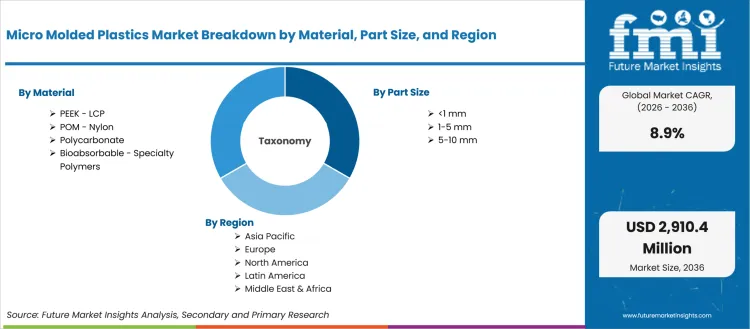
USD 1,240.7 million in 2026 and USD 2,910.4 million by 2036 at an 8.9% CAGR.
Demand for micro molded plastics is projected to expand at 8.9% CAGR between 2026 and 2036, increasing valuation from USD 1,240.7 million in 2026 to USD 2,910.4 million by 2036. Device makers need sub-millimeter housings and cannula tips that pass design review before tooling is locked. Microfluidic channels and connector inserts create another design path when OEMs shrink fluid handling or signal contact points. FDA listed a standard FY 2026 510(k) user fee of USD 26,067 in September 2025, so weak design files carry a real approval cost. Approval cost keeps micro molded parts close to medical device contract manufacturing decisions.
Engineering teams examine gate balance and resin behavior before a part drawing moves from prototype to frozen tool. United States and Germany accounts are expected to stress validation records for implantable and automotive micro parts before tooling ownership changes. China and India are projected to emphasize local molding capacity because device and electronics assembly volumes keep shorter launch calendars. Procurement teams compare metrology access and cleanroom handling before moving volume into a direct OEM route. The State Council of China reported integrated circuit output of 484.3 billion units in 2025, so small connector and sensor parts stay close to electronics capacity planning. The same production pressure keeps micro injection molded plastic research relevant for component makers that need stable cavities and traceable measurements before release.
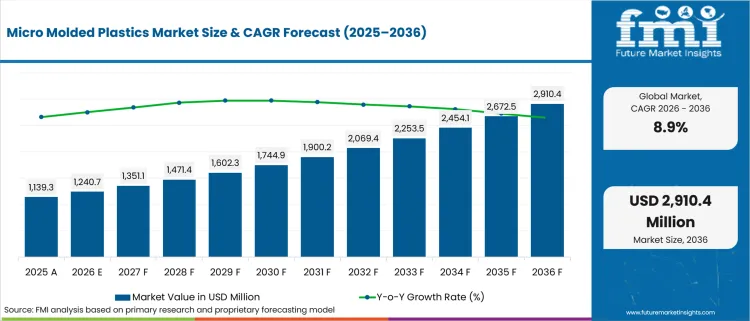
| Metric | Value |
|---|---|
| 2025 Market Size | USD 1,139.3 million |
| 2026 Market Size | USD 1,240.7 million |
| 2036 Market Size | USD 2,910.4 million |
| Forecast CAGR (2026-2036) | 8.9% |
| Sales Channel Focus | Direct OEM |
| Direct OEM Share (2026) | 47.2% |
| Part Size Focus | <1 mm |
| <1 mm Share (2026) | 46.0% |
| End Use Focus | Medical Devices |
| Medical Devices Share (2026) | 40.4% |
Summary of the Micro Molded Plastics Market
| Market Signal | Commercial Impact |
|---|---|
| Demand and Growth Drivers | Miniaturized device design is expected to drive purchases where molded parts carry fluid, signals, or drug-delivery functions. Approval cost and metrology proof are projected to move the category beyond standard small-part molding.
|
| Product and Segment View | Direct OEM, <1 mm parts, and medical devices are projected to lead their parent categories in 2026. The segment pattern shows a market built around qualification control before volume orders expand.
|
| Geography and Growth Outlook | India and China are projected to form the higher-growth tier because local assembly scale keeps molding suppliers near design teams. Established medical and automotive hubs are expected to expand with stricter documentation screens.
|
| Competitive Landscape | Competition is expected to center on toolmaking skill and metrology access. Cleanroom capacity and engineering response are expected to shape customer review.
|
| Analyst Perspective | Micro molded plastics expose tooling decisions earlier than standard molding because a small cavity error travels straight into device validation. Commercial strength is expected to rest with suppliers that prevent redesign before the first cleanroom run.
|
Source: FMI's proprietary forecasting model and primary research
How is the micro molded plastics market segmented?
The micro molded plastics industry is segmented by material, part size, application, end use, sales channel, and region.
The micro molded plastics market is segmented by material, part size, application, end use, sales channel, and region. By material, the market covers PEEK / LCP, POM / nylon, polycarbonate, and bioabsorbable / specialty polymers. By part size, it covers <1 mm, 1-5 mm, and 5-10 mm. By application, it covers medical micro parts, electronic connectors, automotive sensors, and microfluidics / optics. By end use, it covers medical devices, electronics, automotive, and industrial / life sciences. By sales channel, it covers contract manufacturers, direct OEM, and specialty molders. Regional coverage includes North America, Latin America, Europe, East Asia, South Asia and Pacific, and Middle East and Africa for comparison with medical device packaging demand.
How does direct OEM shape demand within the sales channel category?
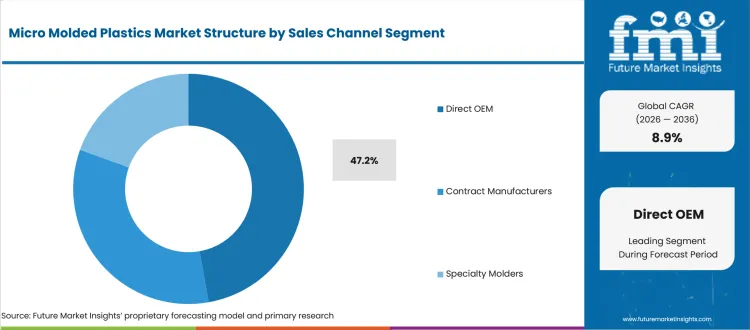
Direct OEM purchasing fits micro molded plastics because engineers need a short path from part drawing to tool correction. Accumold stated in April 2026 that it would meet medical device teams at MedtecLIVE in Stuttgart. Direct technical contact helps OEM engineers discuss wall thickness and micro features before production risk moves into purchase orders.
- Based on sales channel, direct OEM is projected to account for 47.2% in 2026 due to direct engineering ownership during design transfer. Accumold planned its MedtecLIVE 2026 presence around medical micro molding, which supports OEM reviews that start before a full tool package is released.
- Direct OEM demand is expected to grow among device makers because a shorter service path reduces handoff risk. Engineering teams connected to powder injection molding programs also compare tooling evidence before miniature part designs move into repeat supply.
What supports demand for <1 mm parts within the part size category?
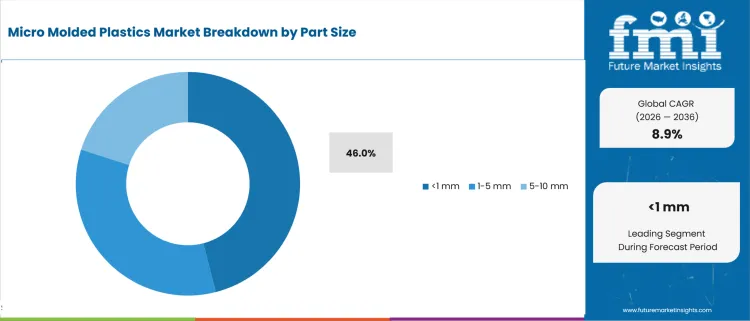
Sub-millimeter parts leave little room for molding drift because a thin wall or micro hole is prone to failure during assembly. MTD Micro Molding added optical 3D metrology in September 2025 for micro medical device components. The system complements CT inspection, so part size becomes a metrology question before it becomes a price question.
- By part size, <1 mm parts are estimated to hold 46.0% in 2026 owing to tight feature control and small-cavity repeatability. MTD said its optical 3D system supports faster documentation for complex micro medical components, which fits customer review of tiny molded features.
- <1 mm parts are drawing demand from catheter, drug-delivery and microfluidic design teams due to space limits inside small assemblies. Those teams compare cavity stability and inspection records before choosing a molder for repeat programs.
How are medical devices positioned within the end use category?
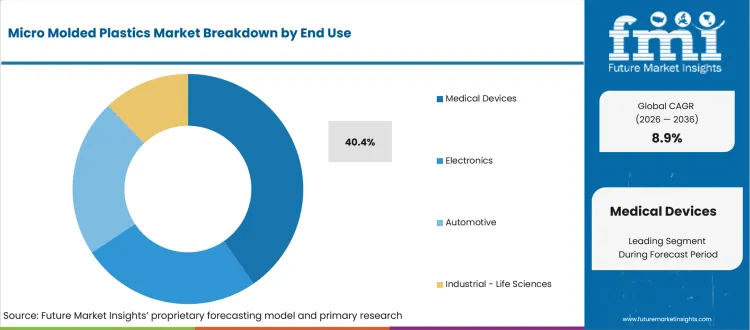
Medical device programs give micro molding a strict approval path because part failure is expected to delay a device submission. FDA said all De Novo submissions must use eSTAR from October 1, 2025 unless exempted. Digital submission discipline makes molded-part files more visible during design control, especially for microfluidic, implantable and catheter components.
- In 2026, medical devices are expected to lead end use with 40.4% share because device teams need cleanroom molding and traceable inspection. FDA expanded eSTAR submission use for De Novo filings in 2025, which keeps documentation quality close to component choice.
- Medical device demand is projected to rise among OEM engineers because miniaturized devices require molded features that assemble without rework. The same review path supports orthopedic contract manufacturing where device makers examine tolerances before release.
What drives medical micro parts within the application category?
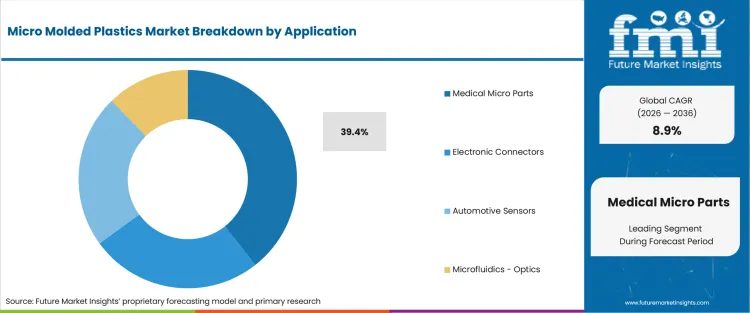
Medical micro parts are evaluated through the device function they protect, not only by their molded weight. Nissha Medical Technologies said in May 2026 that it broke ground in New Richmond to scale Isometric micro molding capabilities. The expansion keeps thin-wall molding, micro tooling and automated assembly near device development teams.
- By application, medical micro parts are forecast to represent 39.4% in 2026 driven by minimally invasive tools and fluid-control assemblies. Nissha Medical Technologies announced a New Richmond expansion for Isometric micro molding in May 2026, which reinforces capacity near medical customers.
- Medical micro parts adoption is gaining attention in catheter and diagnostics programs supported by smaller patient-contact designs. Teams assessing medical device analytical testing also ask whether molded surfaces and resin records support the validation file.
What makes PEEK / LCP central to the material category?
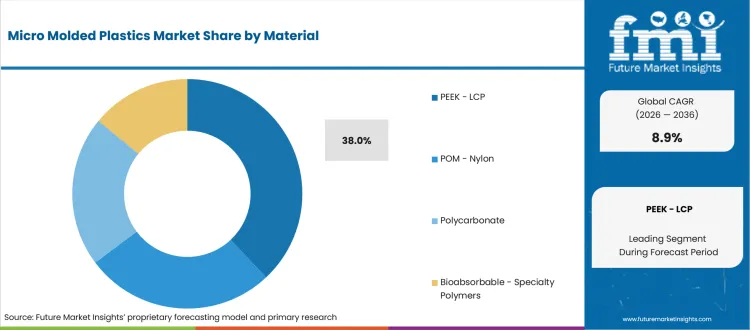
PEEK and LCP work less as resin labels than as ways to protect strength, heat resistance and signal stability in small spaces. Nissha Medical Technologies lists molding of long-term implantable, bioresorbable, fluoropolymer and LSR materials within its Isometric micro molding capability. That material breadth shows why resin choice stays part of early design review.
- PEEK / LCP is projected to lead the material category with 38.0% share in 2026 due to high-temperature and strength requirements. Nissha Medical Technologies lists long-term implantable and fluoropolymer molding capability, which supports material screening for difficult micro parts.
- Device and electronics engineers are expected to favor PEEK / LCP over commodity resins due to tolerance and heat needs. Purchase activity is also tied to injection molded plastic demand where resin choice affects part function and tooling life.
What are the drivers, restraints, and opportunities in the micro molded plastics market?
Near-term purchases are projected to reflect device miniaturization, long qualification work, and metrology-led service routes outlined below.
- Driver: Device and electronics OEMs are expected to purchase micro molded parts that keep fluid channels, sensor housings and connector inserts within tighter tolerance limits.
- Restraint: Adoption is anticipated to slow when cleanroom proof, resin records and tool-wear data are incomplete during customer qualification.
- Opportunity: Suppliers are forecast to gain account access by pairing sub-millimeter molding with inspection support and early design-for-molding guidance.
Device engineers are expected to raise interest in molders that find design risk before the tooling budget is locked. In September 2025, MTD Micro Molding expanded in-house metrology with an optical 3D system for micro medical device components. That capability gives customers faster dimensional evidence during development and quality review. A molder that supplies both parts and proof is projected to reduce redesign pressure after sampling.
Qualification teams are projected to delay supplier changes when resin traceability and part records remain unclear. FDA stated in December 2025 that all De Novo submissions must use eSTAR from October 1, 2025 unless exempted. The submission rule puts more pressure on device makers to keep component files clean. Micro molders with weak documentation are expected to face slower customer sign-off.
Metrology investment is anticipated to turn the restraint into a service route for molders that work early with design teams. In May 2026, Nissha Medical Technologies broke ground on a New Richmond expansion to scale Isometric micro molding capabilities. The expansion is expected to support tiny medical assemblies where inspection and toolmaking remain close together. That route also fits biopolymer injection molders when device teams compare specialty resins before design freeze.
Which country CAGRs are profiled in the micro molded plastics market?
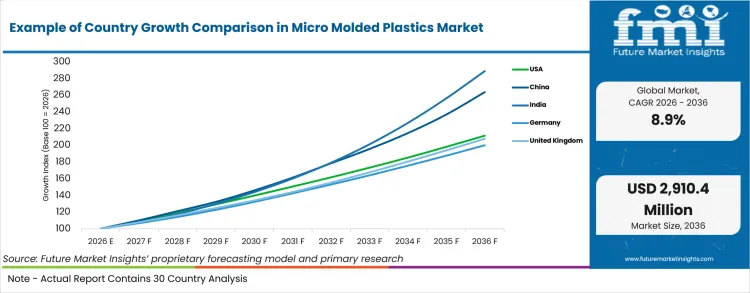
| Country | CAGR |
|---|---|
| United States | 7.78% |
| China | 10.18% |
| India | 11.18% |
| Germany | 7.18% |
| United Kingdom | 7.58% |
| Japan | 6.98% |
| South Korea | 8.38% |
Source: FMI's proprietary forecasting model and primary research
How do country-level CAGRs compare in the micro molded plastics market?
Country expansion is expected to split between fast assembly hubs and approval-heavy manufacturing bases. India and China are projected to move faster because electronics and vehicle programs pull small plastic parts into local supply chains. The United States, Germany and Japan are anticipated to expand through careful qualification where medical and automotive customers ask for stronger proof. The United Kingdom and South Korea are forecast to fall between both patterns because local production scale is narrower but engineering review remains demanding.
- USA medical device teams often treat micro molded parts as design-control evidence before a supplier receives repeat work. By 2036, the United States is projected to grow at 7.78% CAGR due to strict documentation and established medtech production. The USA Census Bureau reported plastics and rubber product shipments of USD 35.020 billion in February 2026. That production base keeps Accumold, MTD Micro Molding and Nissha Medical Technologies close to OEM engineers. Supplier choice is expected to hinge on traceable inspection records before volumes shift.
- China gives micro molded plastics a different pull because electronics output creates constant demand for smaller connectors and sensor housings. The micro molded plastics outlook in China is anticipated to advance at 10.18% CAGR over the assessment period due to local device and electronics assembly. The State Council of China reported integrated circuit output of 484.3 billion units in 2025. NMPA also released a revised medical device GMP in 2025, so local molding files face higher process scrutiny. Toolmakers that combine local sampling and stable resin control are expected to gain account access.
- India’s purchase case starts with production scale and cost review before it reaches medical or electronics applications. SIAM reported total vehicle production of 2,927,711 units in May 2026. Micro molded plastics demand in India is forecast to rise at 11.18% CAGR over the forecast period due to automotive sensors and local component sourcing. Maruti Suzuki, Tata Motors and device assemblers create a broad base for small plastic components. Vendors are expected to win by proving price discipline without losing inspection support.
- German customers approach micro molded plastics through engineering files because automotive and device programs protect approved supplier lists carefully. The Germany micro molded plastics sector is projected to record 7.18% CAGR during the assessment period due to validation-heavy procurement. VDA expected domestic passenger car production of 4.11 mn units in 2026. Bosch and other precision component accounts keep micro housings tied to sensor reliability and tooling records. The next question is whether molders prove cavity stability before German customers open repeat orders.
- UK demand is narrower than mainland Europe but still tied to engineering review in vehicles and health technology. SMMT reported that UK factories produced 208,088 vehicles in the first quarter of 2026. In the United Kingdom, micro molded plastics demand is anticipated to advance at 7.58% CAGR through 2036 due to export-focused component programs. JLR, NHS supply routes and local medical device firms keep qualification documents close to purchase decisions. Direct OEM access is expected to carry more weight when domestic production remains uneven.
- Japan’s micro molding accounts often prioritize stable processes because local OEMs plan parts around long supplier relationships. The Japan outlook is estimated to post 6.98% CAGR over the forecast period due to careful quality review and established automotive programs. JAMA reported motor vehicle production of 8.23 million units in 2024 in its September 2025 industry report. Toyota, Omron and device component teams keep micro plastic parts under repeatability checks. Growth is projected to depend on suppliers that document resin behavior before customers approve tool changes.
- South Korea connects micro molded plastics to compact electronics, vehicle controls and export-oriented precision parts. Korea’s free trade zone program lists 13 designated and operational zones on the Ministry of Trade, Industry and Energy portal. Adoption of micro molded plastics in South Korea is estimated to expand at 8.38% CAGR through 2036 due to concentrated electronics and automotive supply chains. Hyundai, Kia and medical precision equipment accounts require quick technical feedback. Regional molders are expected to compete on sampling speed and measurement proof.
Who are the notable companies in the micro molded plastics market?
Accumold, MTD Micro Molding, Makuta Technics, Nissha Medical Technologies - Isometric, SMC Ltd., Stamm AG, and Precipart are the notable companies shaping this market.
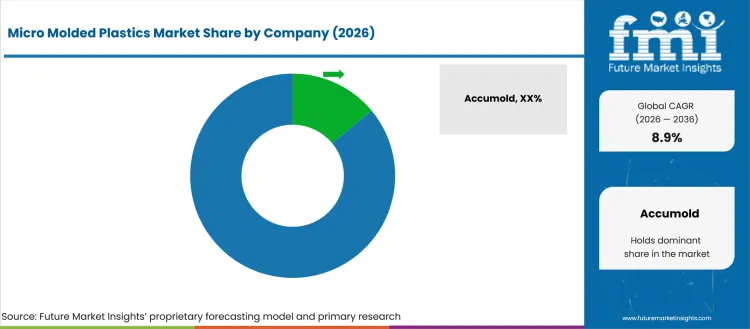
The competitive structure is expected to remain specialist-led because micro molded parts require tooling, metrology and process control before routine production begins. Standard injection molders face a harder path when customers need sub-millimeter features and cleanroom evidence. Device OEMs compare resin experience and design support before approving a supplier. Electronics and automotive accounts add pressure around repeatability because small connectors and sensor parts must fit existing assemblies. Service reach is projected to separate suppliers once sampling shifts into multi-site production, which also makes India injection molding machines a related capacity screen for local accounts. Adjacent equipment benchmarks stay separate from injection blow molding equipment because hollow packaging processes follow different tolerances.
- Micro molding specialists such as Accumold and MTD Micro Molding are expected to receive early design attention when device teams need tiny parts with documented dimensions. Accumold’s medical micro molding events and MTD’s metrology investment support a procurement case built around proof before scale-up.
- Makuta Technics and Stamm AG are projected to serve accounts that need small precision plastic parts and close tooling control. Their role is clearer when customers want compact geometries, application support and repeat molding performance without shifting to broad commodity molding routes.
- Medical manufacturing partners such as Nissha Medical Technologies - Isometric and SMC Ltd. are anticipated to compete where molded parts fit inside a larger device assembly. Their account access is tied to design transfer, cleanroom handling and the ability to support customer files during validation.
- Precision component specialists such as Precipart are estimated to stay relevant where plastic micro parts connect with metal motion components or miniature assemblies. The company’s precision engineering position gives OEMs another route when a molded component must work inside a broader mechanical system.
Competitive Benchmarking: Micro Molded Plastics Market
| Company | Micro Tolerance Fit | Medical Validation Support | Tooling and Metrology | Service Reach |
|---|---|---|---|---|
| Accumold | High | Strong | High | Global |
| MTD Micro Molding | High | Strong | High | Global |
| Makuta Technics | High | Medium | Strong | Regional; North America |
| Nissha Medical Technologies - Isometric | High | Strong | High | Global |
| SMC Ltd. | Medium | Strong | Medium | Global |
| Stamm AG | High | Medium | Strong | Regional; Europe |
| Precipart | Medium | Medium | Strong | Global |
Source: Future Market Insights competitive analysis, 2026. Ratings reflect relative portfolio relevance and workflow fit. Service capability and geographic reach shape the remaining comparison.
Key Developments in the Micro Molded Plastics Market
- In April 2026, Accumold, announced that it would exhibit high-precision medical micro molding capabilities at MedtecLIVE 2026 in Stuttgart. The company directed visitors to Booth 3-233 for discussions on medical device components and miniaturized molded features. European exposure is expected to support early design conversations before OEMs commit tool spending. The event also places Accumold closer to device engineers weighing tolerances and release risk.
- In September 2025, MTD Micro Molding, expanded in-house metrology by adding an optical 3D system for micro medical device components. The company said the system complements CT inspection and improves dimensional documentation for small and complex parts. The investment is projected to support faster decisions during development and quality review. Medical OEMs are expected to value the added inspection path before approving repeat supply.
- In May 2026, Nissha Medical Technologies, broke ground on a New Richmond expansion to scale Isometric micro molding capabilities. The project centers on the Wisconsin campus that supports micro tooling, micro molding, automation and inspection work. The expansion is anticipated to strengthen supply for medical device programs that need tight tolerances and design support. It also gives Nissha a clearer capacity story for customers shifting from prototype to production.
- In January 2025, SMC Ltd., reported a lift-and-shift production transfer case study aimed at global production stability. The company described a manufacturing transfer route for medical and pharmaceutical device programs that need continuity after site change. The work is expected to support customers that want assembly and molding responsibility under one contract partner. It also shows how device OEMs evaluate risk before moving production volume.
Key Players in the Micro Molded Plastics Market
Micro Molding Specialists
- Accumold
- MTD Micro Molding
- Makuta Technics
- Nissha Medical Technologies - Isometric
Medical and Precision Molding Partners
- SMC Ltd.
- Stamm AG
Precision Component Specialists
- Precipart
Micro Molded Plastics Market - Report Scope
| Coverage field | Report scope |
|---|---|
| Market breakdown | By material, part size, application, end use, sales channel, and region |
| Quantitative Units | Revenue in USD Million, Volume in Units, CAGR in % |
| Market Definition | Micro molded plastics are precision plastic components made through tightly controlled micro injection molding for medical, electronics, automotive, microfluidic and life science applications. |
| Regions Covered | North America, Latin America, Europe, East Asia, South Asia and Pacific, and Middle East and Africa |
| Countries Covered | United States, China, India, Germany, United Kingdom, Japan, South Korea, and 30+ countries |
| Key Companies Profiled | Accumold, MTD Micro Molding, Makuta Technics, Nissha Medical Technologies - Isometric, SMC Ltd., Stamm AG, and Precipart |
| Forecast Period | 2026 to 2036 |
| Approach | Hybrid bottom-up and top-down methodology using country demand, segment shares, company capability checks and primary interviews with OEM engineering and procurement contacts |
Source: Future Market Insights - analysis driven by proprietary forecasting models and primary research
Micro Molded Plastics Market - Research Methodology
| Method | Approach |
|---|---|
| Primary Research | FMI analysts reviewed inputs from medical OEM engineers, connector designers and specialty molders. Interviews tested part-size thresholds, resin choices, approval time and post-sampling service needs. The work also checked how direct OEM routes affect repeat orders when micro parts move from prototype tools to production tools. |
| Desk Research | Desk research reviewed FDA device submission rules, USA Census manufacturing data, OICA vehicle production, China electronic manufacturing statistics and official company disclosures. The sources helped connect micro molded plastics demand to medical devices, electronics, automotive sensors and cleanroom molding capacity without relying on commercial market reports. |
| Market Sizing and Forecasting | The model started with the 2026 market base and matched it with application use, part-size mix and direct OEM purchasing. Country values were reconciled against local medical, automotive and electronics indicators. Segment shares were checked against supplier capability and end-use demand before the 2036 forecast was finalized. |
| Data Validation | Data validation compared country CAGRs with segment shares and supplier presence. The team reviewed whether 2026 values aligned with the 2036 forecast and 8.9% CAGR. Company lists were retained only where official pages showed micro molding, precision molding or related medical device manufacturing capability. |
Source: Future Market Insights (FMI) analysis, based on proprietary forecasting model and primary research
Micro Molded Plastics Market by Segments
Micro Molded Plastics Market segmented by Material:
- PEEK / LCP
- POM / Nylon
- Polycarbonate
- Bioabsorbable / Specialty Polymers
Micro Molded Plastics Market segmented by Part Size:
- <1 mm
- 1-5 mm
- 5-10 mm
Micro Molded Plastics Market segmented by Application:
- Medical Micro Parts
- Electronic Connectors
- Automotive Sensors
- Microfluidics / Optics
Micro Molded Plastics Market segmented by End Use:
- Medical Devices
- Electronics
- Automotive
- Industrial / Life Sciences
Micro Molded Plastics Market segmented by Sales Channel:
- Contract Manufacturers
- Direct OEM
- Specialty Molders
Micro Molded Plastics Market by Region:
- North America
- United States
- Canada
- Latin America
- Brazil
- Mexico
- Rest of Latin America
- Europe
- Germany
- United Kingdom
- France
- Italy
- Spain
- Rest of Europe
- East Asia
- China
- Japan
- South Korea
- South Asia and Pacific
- India
- ASEAN
- Australia and New Zealand
- Rest of South Asia and Pacific
- Middle East and Africa
- GCC Countries
- South Africa
- Rest of Middle East and Africa
Research Sources and Bibliography
- USA Food and Drug Administration. (2025, September). Medical Device User Fee Amendments (MDUFA). USA Food and Drug Administration.
- USA Food and Drug Administration. (2025, December). Send and track medical device premarket submissions online: CDRH Portal. USA Food and Drug Administration.
- USA Census Bureau. (2026, April). Monthly full report on manufacturers’ shipments, inventories and orders: February 2026. USA Census Bureau.
- International Organization of Motor Vehicle Manufacturers. (2026, April). Auto industry growth shifted east in 2025 amid global repositioning. OICA.
- The State Council of the People’s Republic of China. (2026, January). China’s electronic information manufacturing sector posts steady growth in 2025. The State Council of the People’s Republic of China.
- National Medical Products Administration. (2025, December). Announcement of the National Medical Products Administration on the release of the Good Manufacturing Practice for Medical Devices. NMPA.
- Society of Indian Automobile Manufacturers. (2026, June). Auto Industry Performance of May-2026. SIAM.
- Verband der Automobilindustrie. (2025, December). Forecasts for 2026: New car registrations in Germany rise. VDA.
- Society of Motor Manufacturers and Traders. (2026, April). Car production stabilises but outlook still challenging. SMMT.
- Japan Automobile Manufacturers Association. (2025, September). The Motor Industry of Japan 2025. JAMA.
- Ministry of Trade, Industry and Energy. (2026, April). Korean Free Trade Zones. MOTIE.
- Accumold. (2026, April). Precision micro molding expertise at MedtecLIVE 2026. Accumold.
- MTD Micro Molding. (2025, September). MTD expands metrology capabilities to accelerate innovation. MTD Micro Molding.
- Nissha Medical Technologies. (2026, May). NMT breaks ground on New Richmond expansion to scale Isometric micro molding capabilities. Nissha Medical Technologies.
- SMC Ltd. (2025, January). Successful lift-and-shift transition for global production stability. SMC Ltd.
- Makuta Technics. (2026, June). Precision medical and micro injection molding. Makuta Technics.
- Precipart. (2026, February). Precipart at MD&M West 2026. Precipart.
- Stamm AG. (2026, June). Micro injection molding and precision component manufacturing. Stamm AG.
This bibliography is provided for reader reference and uses primary government, standards-body, official trade body, and company sources.
This Report Answers
- What value is the micro molded plastics market estimated to reach in 2026 and by 2036?
- What CAGR is projected for the micro molded plastics market from 2026 to 2036?
- Which segments are expected to shape demand across material, part size, application, end use and sales channel?
- Which design, inspection and approval pressures are expected to support purchase activity?
- How are country CAGRs expected to differ across the profiled markets?
- Which notable companies compete across tolerance fit, medical validation support, tooling and service reach?
- How does FMI validate forecasts through bottom-up and top-down methodology?
- What should OEM engineers and procurement teams address before broader sourcing commitment?
- How are device submission rules, metrology records and documentation demands expected to affect vendor selection?
Frequently Asked Questions
What is driving growth in the Micro Molded Plastics Market?
Growth is expected to be driven by medical miniaturization and tighter connector designs. Metrology proof is projected to support repeat purchasing.
Who are the key players in the Micro Molded Plastics Market?
Key players include Accumold, MTD Micro Molding, Makuta Technics, Nissha-Isometric, SMC, Stamm, and Precipart. Competition is projected to center on tolerance proof.
What is a significant restraint in the Micro Molded Plastics Market?
A significant restraint is long qualification work for sub-millimeter tools and medical-grade resins. Adoption is anticipated to slow when metrology records remain weak.
Why should executives track the Micro Molded Plastics Market?
Executives should track this market because medical devices electronics and automotive systems increasingly require sub-millimeter plastic components with extremely tight tolerances. Growing demand for miniaturized products is making micro molding capabilities and metrology expertise important competitive differentiators.
What business problem does the Micro Molded Plastics Market address?
The market addresses the challenge of manufacturing highly precise miniature components that support fluid handling sensing and connectivity functions. These parts help OEMs reduce device size while maintaining performance reliability and regulatory compliance.
What should procurement leaders evaluate before selecting suppliers?
Procurement leaders should evaluate tooling expertise metrology capabilities cleanroom standards and material performance. They should also assess documentation quality process validation and the supplier’s ability to consistently produce sub-millimeter components at scale.
What can limit return on investment for buyers?
Return on investment can be limited by lengthy qualification cycles weak inspection records and inconsistent micro-part performance. Delays in validation or tooling modifications can also increase development costs and extend product launch timelines.
How can suppliers build executive confidence?
Suppliers can build confidence by providing robust metrology data validated manufacturing processes and strong design-for-manufacturing support. Consistent quality performance transparent documentation and proven experience in regulated industries further strengthen customer trust.
Preview the report firsthand - request a free sample
Get SampleGet the brochure for pricing and purchase details.
Get PDFTable of Content
- Key Takeaways
- Market Size and CAGR
- Top Growth Driver
- Fastest Growing Segment
- Leading Region
- Key Companies
- Emerging Opportunities
- Executive Summary
- Global Market Outlook
- Demand-side Trends
- Supply-side Trends
- Technology Roadmap Analysis
- Analysis and Recommendations
- Analyst Perspective (What is happening? Why now? What should investors know?)
- Key Questions Answered
- How large is the market?
- What is the CAGR?
- What are key trends?
- Which region dominates?
- Who are the leaders?
- Market Overview
- Market Coverage / Taxonomy
- Market Definition / Scope / Limitations
- Research Methodology
- Chapter Orientation
- Analytical Lens and Working Hypotheses
- Market Structure, Signals, and Trend Drivers
- Benchmarking and Cross-market Comparability
- Market Sizing, Forecasting, and Opportunity Mapping
- Research Design and Evidence Framework
- Desk Research Programme (Secondary Evidence)
- Expert Input and Fieldwork (Primary Evidence)
- Tooling, Models, and Reference Databases
- Data Engineering and Model Build
- Quality Assurance and Audit Trail
- Market Background
- Market Dynamics (Drivers, Restraints, Opportunity, Trends)
- Scenario Forecast (Optimistic, Likely, Conservative)
- Impact Analysis
- AI Impact
- Sustainability Impact
- Regulatory Impact
- Technology Impact
- Consumer / Buyer Analysis
- Purchase Drivers
- Adoption Barriers
- Buyer Journey
- Opportunity Map Analysis
- Product Life Cycle Analysis
- Supply Chain Analysis
- Investment Feasibility Matrix
- Value Chain Analysis
- PESTLE and Porter's Analysis
- Regulatory Landscape
- Regional Parent Market Outlook
- Production and Consumption Statistics
- Import and Export Statistics
- Global Market Analysis and Forecast, 2021 to 2036
- Historical Market Size Value (USD Million) Analysis, 2021 to 2025
- Current and Future Market Size Value (USD Million) Projections, 2026 to 2036
- Y-o-Y Growth Trend Analysis
- Absolute $ Opportunity Analysis
- Global Market Pricing Analysis, 2021 to 2036
- Global Market Analysis and Forecast, By Material, 2021 to 2036
- Introduction / Key Findings
- Historical Market Size Value (USD Million) Analysis By Material, 2021 to 2025
- Current and Future Market Size Value (USD Million) Analysis and Forecast By Material, 2026 to 2036
- PEEK - LCP
- POM - Nylon
- Polycarbonate
- Bioabsorbable - Specialty Polymers
- PEEK - LCP
- Y-o-Y Growth Trend Analysis By Material, 2021 to 2025
- Absolute $ Opportunity Analysis By Material, 2026 to 2036
- Global Market Analysis and Forecast, By Part Size, 2021 to 2036
- Introduction / Key Findings
- Historical Market Size Value (USD Million) Analysis By Part Size, 2021 to 2025
- Current and Future Market Size Value (USD Million) Analysis and Forecast By Part Size, 2026 to 2036
- <1 mm
- 1-5 mm
- 5-10 mm
- <1 mm
- Y-o-Y Growth Trend Analysis By Part Size, 2021 to 2025
- Absolute $ Opportunity Analysis By Part Size, 2026 to 2036
- Global Market Analysis and Forecast, By Application, 2021 to 2036
- Introduction / Key Findings
- Historical Market Size Value (USD Million) Analysis By Application, 2021 to 2025
- Current and Future Market Size Value (USD Million) Analysis and Forecast By Application, 2026 to 2036
- Medical Micro Parts
- Electronic Connectors
- Automotive Sensors
- Microfluidics - Optics
- Medical Micro Parts
- Y-o-Y Growth Trend Analysis By Application, 2021 to 2025
- Absolute $ Opportunity Analysis By Application, 2026 to 2036
- Global Market Analysis and Forecast, By End Use, 2021 to 2036
- Introduction / Key Findings
- Historical Market Size Value (USD Million) Analysis By End Use, 2021 to 2025
- Current and Future Market Size Value (USD Million) Analysis and Forecast By End Use, 2026 to 2036
- Medical Devices
- Electronics
- Automotive
- Industrial - Life Sciences
- Medical Devices
- Y-o-Y Growth Trend Analysis By End Use, 2021 to 2025
- Absolute $ Opportunity Analysis By End Use, 2026 to 2036
- Global Market Analysis and Forecast, By Sales Channel, 2021 to 2036
- Introduction / Key Findings
- Historical Market Size Value (USD Million) Analysis By Sales Channel, 2021 to 2025
- Current and Future Market Size Value (USD Million) Analysis and Forecast By Sales Channel, 2026 to 2036
- Direct OEM
- Contract Manufacturers
- Specialty Molders
- Direct OEM
- Y-o-Y Growth Trend Analysis By Sales Channel, 2021 to 2025
- Absolute $ Opportunity Analysis By Sales Channel, 2026 to 2036
- Global Market Analysis and Forecast, By Region, 2021 to 2036
- Introduction
- Historical Market Size Value (USD Million) Analysis By Region, 2021 to 2025
- Current Market Size Value (USD Million) Analysis and Forecast By Region, 2026 to 2036
- North America
- Latin America
- Western Europe
- Eastern Europe
- East Asia
- South Asia and Pacific
- Middle East & Africa
- Market Attractiveness Analysis By Region
- North America Market Analysis and Forecast, By Country, 2021 to 2036
- Historical Market Size Value (USD Million) Trend Analysis By Market Taxonomy, 2021 to 2025
- Market Size Value (USD Million) Forecast By Market Taxonomy, 2026 to 2036
- By Country
- USA
- Canada
- By Material
- By Part Size
- By Application
- By End Use
- By Sales Channel
- By Country
- Market Attractiveness Analysis
- By Country
- By Material
- By Part Size
- By Application
- By End Use
- By Sales Channel
- Key Takeaways
- Latin America Market Analysis and Forecast, By Country
- Historical Market Size Value (USD Million) Trend Analysis By Market Taxonomy, 2021 to 2025
- Market Size Value (USD Million) Forecast By Market Taxonomy, 2026 to 2036
- By Country
- Brazil
- Mexico
- Chile
- Rest of Latin America
- By Material
- By Part Size
- By Application
- By End Use
- By Sales Channel
- By Country
- Market Attractiveness Analysis
- By Country
- By Material
- By Part Size
- By Application
- By End Use
- By Sales Channel
- Key Takeaways
- Western Europe Market Analysis and Forecast, By Country
- Historical Market Size Value (USD Million) Trend Analysis By Market Taxonomy, 2021 to 2025
- Market Size Value (USD Million) Forecast By Market Taxonomy, 2026 to 2036
- By Country
- Germany
- UK
- Italy
- Spain
- France
- Nordic
- BENELUX
- Rest of Western Europe
- By Material
- By Part Size
- By Application
- By End Use
- By Sales Channel
- By Country
- Market Attractiveness Analysis
- By Country
- By Material
- By Part Size
- By Application
- By End Use
- By Sales Channel
- Key Takeaways
- Eastern Europe Market Analysis and Forecast, By Country
- Historical Market Size Value (USD Million) Trend Analysis By Market Taxonomy, 2021 to 2025
- Market Size Value (USD Million) Forecast By Market Taxonomy, 2026 to 2036
- By Country
- Russia
- Poland
- Hungary
- Balkan & Baltic
- Rest of Eastern Europe
- By Material
- By Part Size
- By Application
- By End Use
- By Sales Channel
- By Country
- Market Attractiveness Analysis
- By Country
- By Material
- By Part Size
- By Application
- By End Use
- By Sales Channel
- Key Takeaways
- East Asia Market Analysis and Forecast, By Country
- Historical Market Size Value (USD Million) Trend Analysis By Market Taxonomy, 2021 to 2025
- Market Size Value (USD Million) Forecast By Market Taxonomy, 2026 to 2036
- By Country
- China
- Japan
- South Korea
- By Material
- By Part Size
- By Application
- By End Use
- By Sales Channel
- By Country
- Market Attractiveness Analysis
- By Country
- By Material
- By Part Size
- By Application
- By End Use
- By Sales Channel
- Key Takeaways
- South Asia and Pacific Market Analysis and Forecast, By Country
- Historical Market Size Value (USD Million) Trend Analysis By Market Taxonomy, 2021 to 2025
- Market Size Value (USD Million) Forecast By Market Taxonomy, 2026 to 2036
- By Country
- India
- ASEAN
- Australia & New Zealand
- Rest of South Asia and Pacific
- By Material
- By Part Size
- By Application
- By End Use
- By Sales Channel
- By Country
- Market Attractiveness Analysis
- By Country
- By Material
- By Part Size
- By Application
- By End Use
- By Sales Channel
- Key Takeaways
- Middle East & Africa Market Analysis and Forecast, By Country
- Historical Market Size Value (USD Million) Trend Analysis By Market Taxonomy, 2021 to 2025
- Market Size Value (USD Million) Forecast By Market Taxonomy, 2026 to 2036
- By Country
- Kingdom of Saudi Arabia
- Other GCC Countries
- Türkiye
- South Africa
- Other African Union
- Rest of Middle East & Africa
- By Material
- By Part Size
- By Application
- By End Use
- By Sales Channel
- By Country
- Market Attractiveness Analysis
- By Country
- By Material
- By Part Size
- By Application
- By End Use
- By Sales Channel
- Key Takeaways
- Key Countries Market Analysis
- USA
- Pricing Analysis
- Market Share Analysis, 2025
- By Material
- By Part Size
- By Application
- By End Use
- By Sales Channel
- Canada
- Pricing Analysis
- Market Share Analysis, 2025
- By Material
- By Part Size
- By Application
- By End Use
- By Sales Channel
- Mexico
- Pricing Analysis
- Market Share Analysis, 2025
- By Material
- By Part Size
- By Application
- By End Use
- By Sales Channel
- Brazil
- Pricing Analysis
- Market Share Analysis, 2025
- By Material
- By Part Size
- By Application
- By End Use
- By Sales Channel
- Chile
- Pricing Analysis
- Market Share Analysis, 2025
- By Material
- By Part Size
- By Application
- By End Use
- By Sales Channel
- Germany
- Pricing Analysis
- Market Share Analysis, 2025
- By Material
- By Part Size
- By Application
- By End Use
- By Sales Channel
- UK
- Pricing Analysis
- Market Share Analysis, 2025
- By Material
- By Part Size
- By Application
- By End Use
- By Sales Channel
- Italy
- Pricing Analysis
- Market Share Analysis, 2025
- By Material
- By Part Size
- By Application
- By End Use
- By Sales Channel
- Spain
- Pricing Analysis
- Market Share Analysis, 2025
- By Material
- By Part Size
- By Application
- By End Use
- By Sales Channel
- France
- Pricing Analysis
- Market Share Analysis, 2025
- By Material
- By Part Size
- By Application
- By End Use
- By Sales Channel
- India
- Pricing Analysis
- Market Share Analysis, 2025
- By Material
- By Part Size
- By Application
- By End Use
- By Sales Channel
- ASEAN
- Pricing Analysis
- Market Share Analysis, 2025
- By Material
- By Part Size
- By Application
- By End Use
- By Sales Channel
- Australia & New Zealand
- Pricing Analysis
- Market Share Analysis, 2025
- By Material
- By Part Size
- By Application
- By End Use
- By Sales Channel
- China
- Pricing Analysis
- Market Share Analysis, 2025
- By Material
- By Part Size
- By Application
- By End Use
- By Sales Channel
- Japan
- Pricing Analysis
- Market Share Analysis, 2025
- By Material
- By Part Size
- By Application
- By End Use
- By Sales Channel
- South Korea
- Pricing Analysis
- Market Share Analysis, 2025
- By Material
- By Part Size
- By Application
- By End Use
- By Sales Channel
- Russia
- Pricing Analysis
- Market Share Analysis, 2025
- By Material
- By Part Size
- By Application
- By End Use
- By Sales Channel
- Poland
- Pricing Analysis
- Market Share Analysis, 2025
- By Material
- By Part Size
- By Application
- By End Use
- By Sales Channel
- Hungary
- Pricing Analysis
- Market Share Analysis, 2025
- By Material
- By Part Size
- By Application
- By End Use
- By Sales Channel
- Kingdom of Saudi Arabia
- Pricing Analysis
- Market Share Analysis, 2025
- By Material
- By Part Size
- By Application
- By End Use
- By Sales Channel
- Türkiye
- Pricing Analysis
- Market Share Analysis, 2025
- By Material
- By Part Size
- By Application
- By End Use
- By Sales Channel
- South Africa
- Pricing Analysis
- Market Share Analysis, 2025
- By Material
- By Part Size
- By Application
- By End Use
- By Sales Channel
- USA
- Market Structure Analysis
- Competition Dashboard
- Competition Benchmarking
- Market Share Analysis of Top Players
- By Regional
- By Material
- By Part Size
- By Application
- By End Use
- By Sales Channel
- Emerging Startups
- Innovation Benchmarking
- Competition Analysis
- Competition Deep Dive
- Accumold
- Overview
- Product Portfolio
- Profitability by Market Segments
- Sales Footprint
- Strategy Overview
- Marketing Strategy
- Product Strategy
- Channel Strategy
- MTD Micro Molding
- Makuta Technics
- Nissha Medical Technologies - Isometric
- SMC Ltd.
- Stamm AG
- Precipart
- Accumold
- Case Studies
- Success Stories
- Recent Developments
- Competition Deep Dive
- Assumptions & Acronyms Used


