

- Market Size (2026)
- USD 708.2 Mn
- Forecast (2036)
- USD 1500.9 Mn
- CAGR (2026 to 2036)
- 7.8%
Microplastic Free Personal Care Polymers Market Size, Market Forecast and Outlook By FMI
USD 708.2 million in 2026 and USD 1,500.9 million by 2036 at a 7.8% CAGR.
The microplastic free personal care polymers industry value is forecast to grow from USD 657.0 million in 2025 to USD 1,500.9 million by 2036 at 7.8% CAGR as beauty formulators replace persistent synthetic polymer microparticles with biodegradable, natural-origin, and documented performance alternatives. Personal care applications are forecast to represent 57.0% share in 2026 because skin care, hair care, color cosmetics, and toiletries face the clearest reformulation pressure. Direct B2B supply is expected to secure 54.0% share in 2026, while industrial manufacturing is projected to account for 46.0% share as brand-owned plants and contract manufacturers control formula approval work.
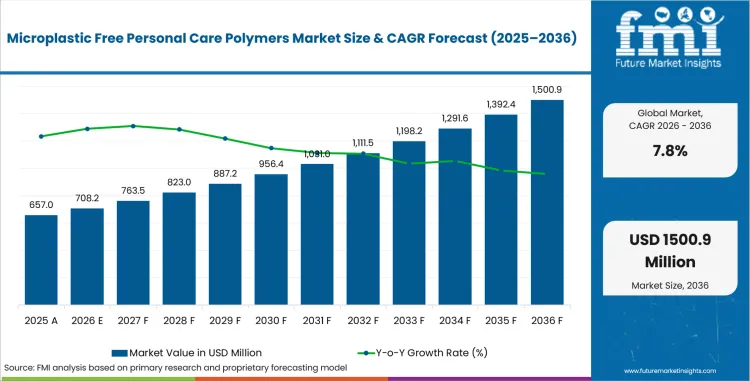
Microplastic Free Personal Care Polymers Market Overview: Size and Forecast
- 2026 Market Size: USD 708.2 million
- 2036 Market Size: USD 1,500.9 million
- Forecast CAGR: 7.8% from 2026 to 2036
- Leading Application: Personal Care
- Personal Care Share in 2026: 57.0%
- Leading Sales Channel: Direct B2B Supply
- Direct B2B Supply Share in 2026: 54.0%
- Fastest-growing Country: South Korea
- South Korea CAGR: 8.6% by 2036
Summary of the Microplastic Free Personal Care Polymers Market
- Demand and Growth Drivers
- Beauty brands are moving polymer decisions from marketing claims into technical files that explain biodegradation, natural origin, and formulation performance.
- Regulatory screening is increasing the need for ingredient statements that distinguish soluble, natural, inorganic, and biodegradable polymers from restricted microparticles.
- Hair styling and color cosmetics are expanding demand because film hold, powder slip, and soft-focus effects need replacements that retain sensory quality.
- Contract manufacturers are prioritizing ingredients with global documentation because one approved polymer can support several private-label and prestige beauty briefs.
- Product and Segment View
- Personal care applications are projected to lead with 57.0% share in 2026 as cosmetic reformulation creates the most direct demand for microplastic free polymers.
- Direct B2B supply is expected to represent 54.0% share in 2026 since brand owners prefer supplier-led documentation and formulation support before relaunch.
- Industrial manufacturing is estimated to hold 46.0% share in 2026 as large production plants manage ingredient approvals across skin, hair, and color product lines.
- Geography and Competitive Outlook
- South Korea is projected to record 8.6% CAGR by 2036, supported by export-led K-beauty manufacturers that need globally acceptable ingredient systems.
- India is expected to expand at 8.4% CAGR by 2036 as premium beauty demand raises interest in natural-origin and biodegradable formulation claims.
- China is forecast to grow at 8.3% CAGR through 2036 as online beauty channels accelerate visible ingredient stories and faster texture-led product launches.
- BASF, Nouryon, Ashland, Lubrizol, Eastman, Evonik, Clariant, and Dow compete through polymer chemistry, regulatory files, and application laboratory support.
- Analyst Opinion
- Nikhil Kaitwade, Associate Vice President at FMI, observes, “Microplastic free personal care polymers are becoming a proof-led formulation category rather than a simple sustainability label. Brands need replacements that protect sensory feel, film strength, color payoff, and rinse behavior. Suppliers with biodegradation evidence, regulatory letters, and working sample formulas should gain stronger specification positions across global beauty programs.”
Market outlook is being shaped by documentation rules, pollution scrutiny, and ingredient innovation. FDA reported 15,309 active cosmetic facility registrations and 1,102,092 active cosmetic product listings in April 2026, giving ingredient suppliers a larger traceability burden before reformulated products reach the shelf. EPA added microplastics to the draft CCL 6 in April 2026 alongside 75 chemicals and nine microbes, making polymer persistence more visible in USA drinking-water screening. Evonik opened an industrial-scale rhamnolipid biosurfactant facility in May 2024, strengthening the supply base for biodegradable ingredients used across personal care formulations.
Which factors support expansion in the microplastic free personal care polymers market?
Documented biodegradable ingredients and performance-equivalent substitutes support value across cosmetic formulation channels.
- Market value is supported by supplier revenue from cosmetic polymer ingredients before finished-product retail margins are added.
- Supplier pricing reflects biodegradation testing, natural-origin content, and application support before formulation scale affects purchasing terms.
- Revenue improves as brand owners convert legacy synthetic particles into compliant film formers, sensory powders, and rheology systems.
- Buyer confidence rises when ingredient files explain microplastic status, test method, INCI naming, and recommended use level in simple language.
Rheology and film-former decisions also connect the report with personal care ingredients market outlook as cosmetic brands compare performance claims before approving microplastic free replacements.
Why is the microplastic free personal care polymers market growing?
Personal care brands are moving toward biodegradable and natural-origin polymer systems as regulatory timetables and public scrutiny make persistence harder to defend.
Growth is supported by the need to replace polymeric particles without sacrificing texture, hold, or visual finish. OECD stated in 2024 that global plastic use could reach 736 Mt by 2040 under baseline conditions, while recycled plastics would account for only 6% of total plastics. That pressure strengthens buyer interest in ingredients that can demonstrate biodegradation and lower persistence risk. Cosmetic suppliers are therefore competing on proof documents, not only on natural marketing language. The strongest demand comes from products where polymers carry visible performance value, including hair mousses, styling sprays, foundations, pressed powders, cleansers, and body wash systems.
This reformulation trend is closely related to biodegradable polymers market analysis because ingredient buyers use biodegradation proof to compare polymer alternatives.
How is the microplastic free personal care polymers market segmented?
The microplastic free personal care polymers industry is segmented by chemistry type, function, application, end-use industry, and sales channel.
- Bio-based chemistry is projected to secure 42.0% share in 2026, led by renewable feedstock claims and stronger buyer preference for natural-origin formulation systems.
- Additives are anticipated to hold 38.0% share in 2026 since texture, suspension, slip, and sensory control are difficult to replace in finished cosmetic products.
- Personal care applications are expected to capture 57.0% share in 2026 due to direct pressure on skin care, hair care, color cosmetics, and toiletries.
- Industrial manufacturing is forecast to represent 46.0% share in 2026, guided by approval work inside brand-owned plants and contract manufacturing networks.
- Direct B2B supply is projected to account for 54.0% share in 2026, reflected by the need for supplier documentation and application support.
Which chemistry type leads the microplastic free personal care polymers market?
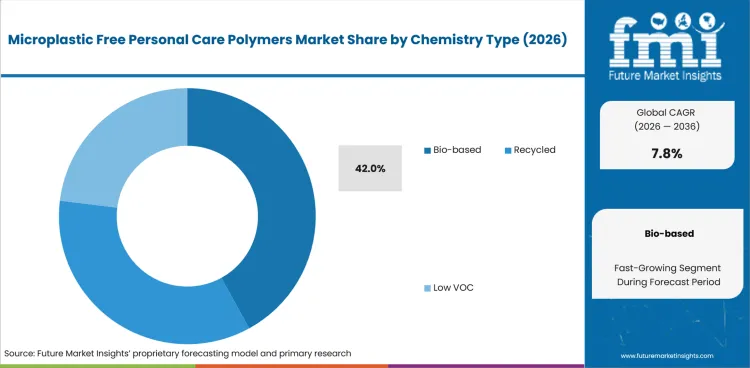
- Bio-based chemistry is projected to account for 42.0% share in 2026, influenced by renewable origin claims and buyer pressure to avoid persistent synthetic polymer microparticles.
- Recycled and waterborne systems gain attention where formulators need lower-impact positioning, yet they must still prove cosmetic safety, sensory stability, and compatibility with active ingredients.
Which function leads the microplastic free personal care polymers market?
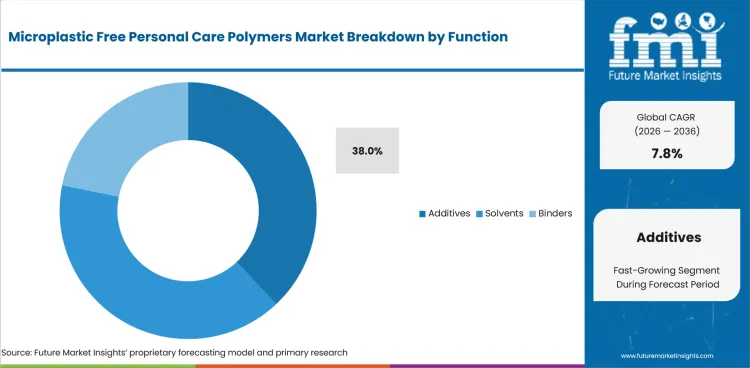
- Additives are anticipated to hold 38.0% share in 2026 through texture control, suspension, powder feel, and visual finish roles that decide consumer acceptance.
- Binders and coatings gain use when color cosmetic and hair styling formulas need better adhesion, film integrity, and product durability without restricted particles.
Which application leads the microplastic free personal care polymers market?
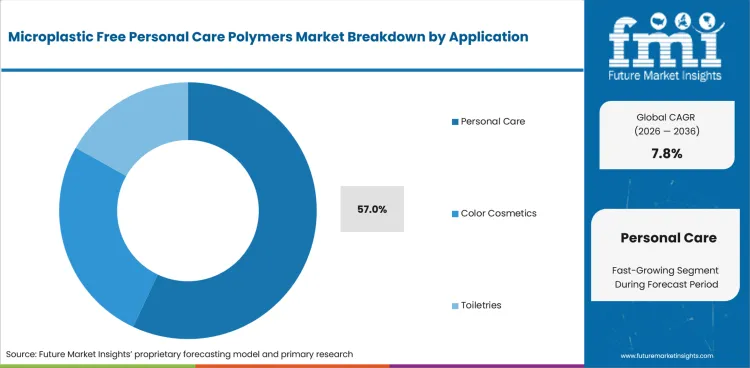
- Personal care is expected to represent 57.0% share in 2026, supported by direct reformulation in skin care, hair care, toiletries, and color cosmetics.
- Color cosmetics are creating higher-value trials as suppliers must replace plastic powder feel while preserving blur, slip, payoff, and pressability in compact formats.
Which end-use industry leads the microplastic free personal care polymers market?
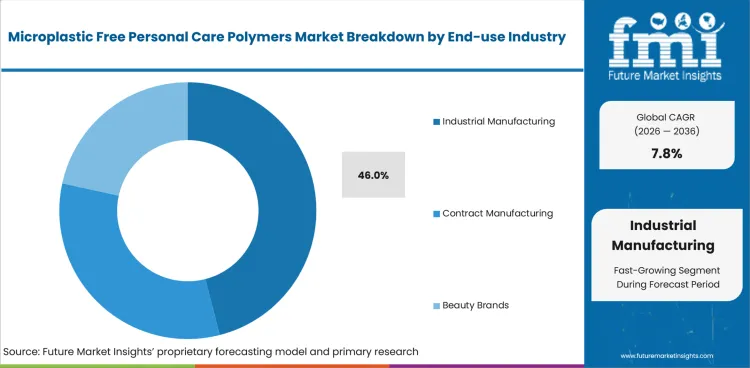
- Industrial manufacturing is forecast to secure 46.0% share in 2026, shaped by brand-owned and outsourced plants that approve ingredients before claims reach consumers.
- Beauty brands remain influential buyers because marketing teams push microplastic free positions while technical teams require stable viscosity, safety files, and processing guidance.
Which sales channel leads the microplastic free personal care polymers market?
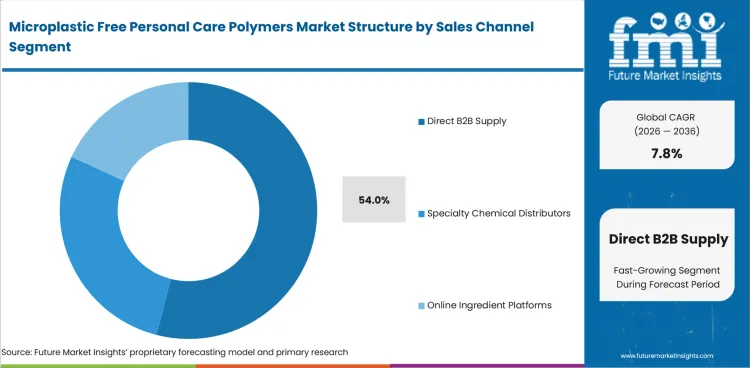
- Direct B2B supply is projected to account for 54.0% share in 2026, led by supplier-led documentation, sample formulas, and application testing for large beauty customers.
- Specialty chemical distributors support smaller brands and contract manufacturers by translating product files into shorter sampling cycles and faster ingredient comparisons.
Supplier evaluation also overlaps with cosmetic chemicals market outlook as formulation teams compare compliant performance ingredients across skin, hair, and color products.
What are the driver, restraints, and opportunities in the microplastic free personal care polymers market?
Regulation and performance replacement support demand while proof requirements and sensory risk slow faster conversion.
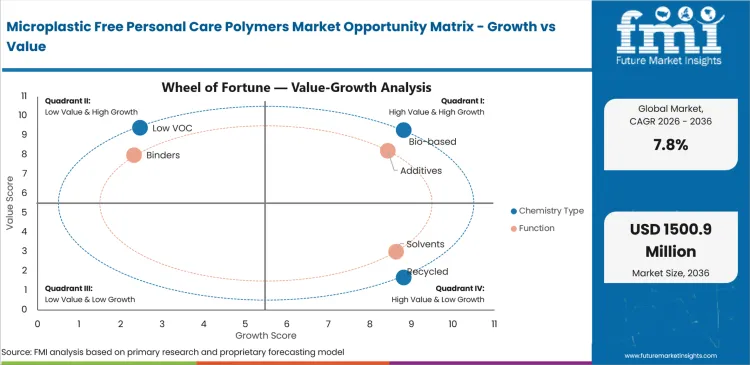
- Driver: Beauty manufacturers are replacing persistent synthetic particles with documented polymers that support compliant product relaunches.
- Restraint: Biodegradation proof and sensory equivalence testing can delay supplier approval when ingredient files are incomplete.
- Opportunity: Hair styling and color cosmetics create premium applications for substitutes that match film hold, slip, and soft-focus finish.
Regulatory Documentation Demand
Regulatory documentation is a central driver because cosmetic products now need clearer facility, product, and ingredient traceability. FDA reported 15,309 active cosmetic facility registrations and 1,102,092 active cosmetic product listings in April 2026 under MoCRA registration and listing data. This makes supplier files more important when brands reformulate with biodegradable polymer systems. Ingredient producers that provide test summaries, INCI references, and microplastic status statements can shorten technical review for contract manufacturers and brand owners.
Biodegradation Proof Burden
The main restraint is the cost of proof rather than the absence of substitute ingredients. EPA placed microplastics into draft CCL 6 in April 2026 along with four contaminant groups, 75 individual chemicals, and nine microbes under drinking-water screening. That official attention increases the burden on polymer suppliers to explain persistence and analytical status. Smaller suppliers can lose momentum when buyers request accepted biodegradation methods, formulation compatibility, and batch consistency before commercial scale.
Premium Sensory Replacement
Opportunity is strongest where cosmetic feel carries pricing power. Cosmetics Europe valued European skin care at EUR 32.3 billion, toiletries at EUR 26.4 billion, hair-care products at EUR 20.3 billion, and decorative cosmetics at EUR 13.6 billion in 2025. These large categories use polymers to manage film, thickening, slip, hold, and powder finish. Suppliers that match these sensory functions with compliant alternatives can win specification work before low-cost substitutes become acceptable.
The opportunity also connects with rheology modifiers market revenue as viscosity and suspension performance decide whether substitutions reach scale.
Which countries are growing fastest in the microplastic free personal care polymers market?
South Korea 8.6% CAGR, India 8.4% CAGR, China 8.3% CAGR, Germany 8.0% CAGR, France 7.9% CAGR, United States 7.4% CAGR, United Kingdom 7.2% CAGR, and Japan 6.8% CAGR through 2036.
.webp "Top Country Growth Comparison Microplastic Free Personal Care Polymers Market Cagr (2026 2036)")
| Country | CAGR |
|---|---|
| South Korea | 8.6% |
| India | 8.4% |
| China | 8.3% |
| Germany | 8.0% |
| France | 7.9% |
| United States | 7.4% |
| United Kingdom | 7.2% |
| Japan | 6.8% |
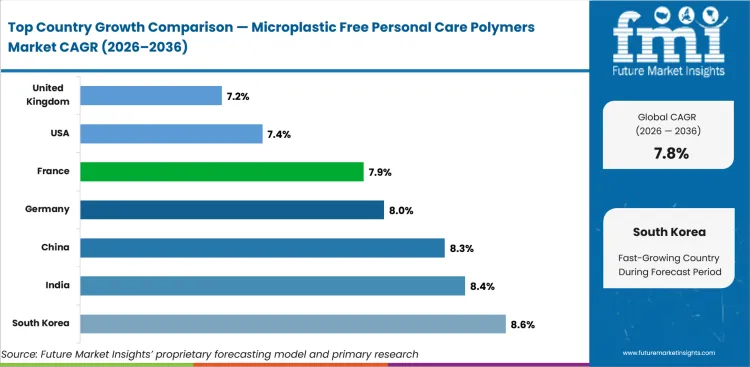
Source: Future Market Insights, 2026.
How do country-level CAGRs compare in the microplastic free personal care polymers market?
South Korea leads country growth while Japan records the most cautious expansion outlook among profiled markets.
- South Korea is forecast to record 8.6% CAGR by 2036 as K-beauty exporters adopt compliant texture and color systems for international buyers.
- India is expected to expand at 8.4% CAGR from 2026 to 2036 as premium beauty demand increases the value of natural-origin ingredient claims.
- China is projected to grow at 8.3% CAGR through 2036 as e-commerce beauty launches accelerate formulation testing and claim visibility.
- Germany is estimated to rise at 8.0% CAGR by 2036 as EU rules and domestic specialty chemical capability support reformulation.
- France is expected to advance at 7.9% CAGR over the forecast period as prestige beauty brands require sensory polymer substitutes.
- The United States is forecast to grow at 7.4% CAGR through 2036 as retailer screening and MoCRA documentation raise ingredient review discipline.
- The United Kingdom is projected to post 7.2% CAGR by 2036 as premium beauty and pharmacy channels strengthen claim scrutiny.
- Japan is expected to grow at 6.8% CAGR through 2036 as careful sensory validation extends ingredient qualification cycles.
How fast is the microplastic free personal care polymers market growing in South Korea?
An 8.6% CAGR through 2036 reflects export-led K-beauty manufacturing and fast adoption of documented cosmetic ingredients.
Country Market Snapshot Table
| Parameter | Value |
|---|---|
| Market Size in 2025 (Value) | USD 54.6 million |
| Market Size in 2026 (Value) | USD 59.3 million |
| Market Forecast in 2036 (Value) | USD 135.2 million |
| CAGR (2026 to 2036) | 8.6% |
| Years Considered | 2021 to 2036 |
| Base Year | 2025 |
| Forecast Period | 2026 to 2036 |
| Units Considered | Value (USD million) |
| Leading Sub-Region | Seoul and Gyeonggi export manufacturing corridors |
South Korea Microplastic Free Personal Care Polymers Market Outlook
South Korea demand is shaped by export-facing beauty manufacturers that need ingredient systems accepted across Europe, North America, and East Asia. ODM and OEM formulators are expected to prefer polymer suppliers that can support texture trials and global documentation in one technical package.
Local brands are likely to treat microplastic free polymers as a way to protect premium skin care, sunscreen, and color cosmetic launches. Suppliers with local application access and faster sampling support should gain stronger qualification opportunities.
Key Growth Drivers
- Export pressure is strong because official reporting showed South Korea cosmetics exports reached USD 11.4 billion in 2025, up 12.2% from the prior year.
- K-beauty scale supports faster polymer screening because 2024 cosmetics exports reached USD 10.2 billion and ranked third worldwide according to official Korean communication.
- ODM formulators can move compliant additives across many client briefs when one texture system works in creams, gels, and color formats.
- Digital beauty launches encourage faster ingredient stories, especially when brands need simple proof language for global consumers.
Key Restraints
- Global certification expectations can increase qualification work because exporters must prepare documentation for several destination-market rules.
- Safety assessment work can raise qualification costs because Trade.gov reported Korea will apply early requirements to companies with annual production or import volumes above KRW 1 billion, about USD 750,000.
- Premium texture expectations can slow substitutions when new polymers alter payoff, tack, shine, or after-feel in loyal product lines.
What makes South Korea unique
South Korea is unique because export-oriented K-beauty manufacturers can convert compliant polymers into global product briefs quickly.
Key Companies
- Kolmar Korea
- COSMAX
- BASF Korea
- Nouryon Korea
- Eastman Chemical Korea
- Ashland Korea
- Lubrizol Korea
Sales & Marketing Channels
- ODM/OEM formulation teams
- Direct supplier technical sales
- Specialty ingredient distributors
- Export brand sourcing teams
- Beauty trade exhibitions
- Application laboratory sampling
Country Segment Breakdown Table
| Segment | Sub-Segments |
|---|---|
| By Chemistry Type | Bio-based · Recycled · Low VOC · Halogen Free · Waterborne |
| By Function | Solvents · Additives · Binders · Coatings · Process Aids |
| By Application | Skin Care · Hair Care · Color Cosmetics · Toiletries · Baby Care |
| By End-use Industry | Industrial Manufacturing · Contract Manufacturing · Beauty Brands · Specialty Ingredient Distribution · Retail-Backed Private Label |
| By Sales Channel | Direct B2B Supply · Specialty Chemical Distributors · Online Ingredient Platforms · Contract Manufacturer Sourcing · Trade Shows |
| Key Sub-Regions Covered, Beauty Formulation and Ingredient Corridors | Seoul · Gyeonggi · Incheon · Busan · Daegu · Daejeon |
Market Taxonomy and Sub-Regions Covered
Frequently Asked Questions
How fast is South Korea microplastic free personal care polymers market growing?
Sales in South Korea are ready to scale at 8.6% CAGR from 2026 to 2036, guided by country-specific beauty reformulation demand.
Who leads South Korea microplastic free personal care polymers market?
Kolmar Korea, COSMAX, BASF Korea, and Eastman Chemical Korea compete through formulation support and export-ready ingredient systems.
What is driving adoption in South Korea microplastic free personal care polymers market?
Export-led K-beauty and global buyer requirements are moving manufacturers toward biodegradable and microplastic free polymers.
What is driving microplastic free personal care polymers growth in India?
An 8.4% CAGR through 2036 is supported by premium beauty demand and faster digital beauty product discovery.
Country Market Snapshot Table
| Parameter | Value |
|---|---|
| Market Size in 2025 (Value) | USD 42.3 million |
| Market Size in 2026 (Value) | USD 45.9 million |
| Market Forecast in 2036 (Value) | USD 102.9 million |
| CAGR (2026 to 2036) | 8.4% |
| Years Considered | 2021 to 2036 |
| Base Year | 2025 |
| Forecast Period | 2026 to 2036 |
| Units Considered | Value (USD million) |
| Leading Sub-Region | Mumbai, Delhi NCR, Bengaluru, and premium beauty manufacturing corridors |
India Microplastic Free Personal Care Polymers Market Outlook
India demand is expanding as premium beauty brands and contract manufacturers test natural-origin ingredient stories for skin care, hair care, and color cosmetics. Buyers remain price sensitive, so suppliers must show dose efficiency and sensory value before wide replacement.
Domestic formulation teams are expected to favor additives that reduce approval risk and work across several brand briefs. Imported technologies may gain faster acceptance when local distributors provide sampling, claims guidance, and technical training.
Key Growth Drivers
- Premium category expansion supports reformulation because IBEF valued India beauty and personal care at USD 28 billion in 2025 and projected USD 34 billion by 2028.
- E-commerce visibility supports ingredient claims as IBEF estimated Indian beauty and personal care GMV could reach USD 30 billion by CY2027.
- Local contract manufacturers are testing microplastic free claims in premium skin care and hair care before moving them into mass formats.
- Direct technical selling helps ingredient suppliers explain biodegradable polymer performance to formulators that need practical processing guidance.
Key Restraints
- Price pressure limits rapid conversion when biodegradable polymers carry higher costs than conventional texture systems.
- IBEF noted subscription e-commerce in India was valued at USD 10.34 billion in 2024, which raises digital comparison pressure and makes claim errors more visible.
- Imported ingredients can face longer qualification when distributors cannot provide full technical files, local samples, and recommended use levels.
What makes India unique
India is unique because premiumization is rising quickly while mass-market price limits keep formulation economics central.
Key Companies
- BASF India
- Ashland India
- Evonik India
- Clariant India
- Dow India
- Croda India
- Lubrizol India
Sales & Marketing Channels
- Direct B2B supply
- Specialty chemical distributors
- Contract manufacturer sourcing
- Premium brand R&D teams
- Online ingredient platforms
- Beauty trade shows
Country Segment Breakdown Table
| Segment | Sub-Segments |
|---|---|
| By Chemistry Type | Bio-based · Recycled · Low VOC · Halogen Free · Waterborne |
| By Function | Solvents · Additives · Binders · Coatings · Process Aids |
| By Application | Skin Care · Hair Care · Color Cosmetics · Toiletries · Baby Care |
| By End-use Industry | Industrial Manufacturing · Contract Manufacturing · Beauty Brands · Specialty Ingredient Distribution · Retail-Backed Private Label |
| By Sales Channel | Direct B2B Supply · Specialty Chemical Distributors · Online Ingredient Platforms · Contract Manufacturer Sourcing · Trade Shows |
| Key Sub-Regions Covered, Beauty Formulation and Ingredient Corridors | Mumbai · Delhi NCR · Bengaluru · Ahmedabad · Hyderabad · Chennai |
Market Taxonomy and Sub-Regions Covered
Frequently Asked Questions
How fast is India microplastic free personal care polymers market growing?
Sales in India are ready to scale at 8.4% CAGR from 2026 to 2036, guided by country-specific beauty reformulation demand.
Who leads India microplastic free personal care polymers market?
BASF India, Ashland India, Evonik India, and Clariant India compete through ingredient portfolios and technical support.
What is driving adoption in India microplastic free personal care polymers market?
Premium beauty launches and digital claim visibility are moving Indian buyers toward documented polymer alternatives.
How is the microplastic free personal care polymers market performing in China?
An 8.3% CAGR through 2036 reflects online beauty scale and faster testing of compliant texture systems.
Country Market Snapshot Table
| Parameter | Value |
|---|---|
| Market Size in 2025 (Value) | USD 88.5 million |
| Market Size in 2026 (Value) | USD 95.8 million |
| Market Forecast in 2036 (Value) | USD 212.7 million |
| CAGR (2026 to 2036) | 8.3% |
| Years Considered | 2021 to 2036 |
| Base Year | 2025 |
| Forecast Period | 2026 to 2036 |
| Units Considered | Value (USD million) |
| Leading Sub-Region | Shanghai, Guangzhou, and Hangzhou digital beauty corridors |
China Microplastic Free Personal Care Polymers Market Outlook
China demand is shaped by fast digital beauty launches and ingredient stories that must be clear on product pages. Local formulation houses need polymer systems that can move quickly from sample trials into e-commerce product cycles.
Safety assessment work and translation requirements keep supplier documentation important for foreign ingredient companies. Local partners that connect global biodegradation proof with Chinese product files should gain stronger conversion.
Key Growth Drivers
- China cosmetics retail sales reached CNY 465.3 billion in 2025, up 5.1%, which gives suppliers a large beauty reformulation base.
- Online physical goods sales reached CNY 13,092.3 billion in 2025 and represented 26.1% of total retail sales, supporting fast claim visibility.
- Local beauty houses can test compliant sensory additives quickly when e-commerce calendars require frequent product launches.
- Ingredient suppliers with Chinese technical partners can translate biodegradation proof into product files more easily.
Key Restraints
- Mass online products create price pressure when biodegradable polymers raise the cost of entry-level formulas.
- China’s specialty store retail value declined by 0.6% in 2025, which can narrow physical demonstration space for newer ingredient claims.
- Regulatory translation and safety assessment work can slow foreign supplier qualification before formulators accept new polymer systems.
What makes China unique
China is unique because e-commerce can turn a compliant texture claim into rapid product testing volume.
Key Companies
- BASF China
- Ashland China
- Dow China
- Eastman China
- Clariant China
- Evonik China
- Nouryon China
Sales & Marketing Channels
- Direct sales to formulators
- PCHi and trade show sampling
- Specialty chemical distributors
- E-commerce brand sourcing
- Contract manufacturer trials
- Local application labs
Country Segment Breakdown Table
| Segment | Sub-Segments |
|---|---|
| By Chemistry Type | Bio-based · Recycled · Low VOC · Halogen Free · Waterborne |
| By Function | Solvents · Additives · Binders · Coatings · Process Aids |
| By Application | Skin Care · Hair Care · Color Cosmetics · Toiletries · Baby Care |
| By End-use Industry | Industrial Manufacturing · Contract Manufacturing · Beauty Brands · Specialty Ingredient Distribution · Retail-Backed Private Label |
| By Sales Channel | Direct B2B Supply · Specialty Chemical Distributors · Online Ingredient Platforms · Contract Manufacturer Sourcing · Trade Shows |
| Key Sub-Regions Covered, Beauty Formulation and Ingredient Corridors | Shanghai · Guangzhou · Shenzhen · Hangzhou · Beijing · Suzhou |
Market Taxonomy and Sub-Regions Covered
Frequently Asked Questions
How fast is China microplastic free personal care polymers market growing?
Sales in China are ready to scale at 8.3% CAGR from 2026 to 2036, guided by country-specific beauty reformulation demand.
Who leads China microplastic free personal care polymers market?
BASF China, Ashland China, Eastman China, and Dow China compete through technical support and ingredient distribution.
What is driving adoption in China microplastic free personal care polymers market?
Digital beauty launches and safety documentation requirements are moving China toward compliant personal care polymers.
How fast is the microplastic free personal care polymers market growing in Germany?
An 8.0% CAGR through 2036 reflects EU compliance pressure and a strong domestic specialty chemical base.
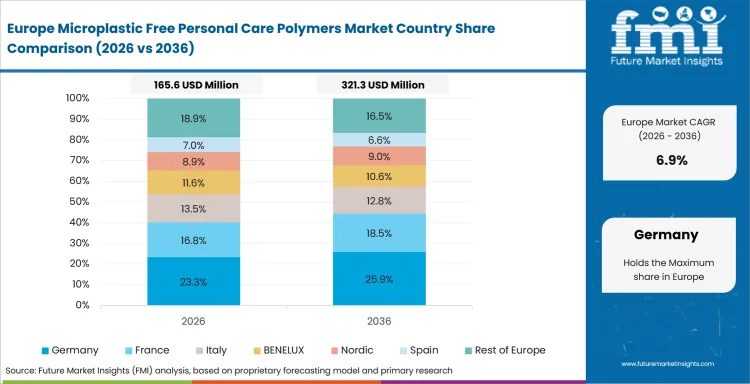
Country Market Snapshot Table
| Parameter | Value |
|---|---|
| Market Size in 2025 (Value) | USD 83.2 million |
| Market Size in 2026 (Value) | USD 89.9 million |
| Market Forecast in 2036 (Value) | USD 194.1 million |
| CAGR (2026 to 2036) | 8.0% |
| Years Considered | 2021 to 2036 |
| Base Year | 2025 |
| Forecast Period | 2026 to 2036 |
| Units Considered | Value (USD million) |
| Leading Sub-Region | North Rhine-Westphalia and southern specialty chemical corridors |
Germany Microplastic Free Personal Care Polymers Market Outlook
Germany demand is influenced by EU microplastic restrictions and the country’s mature cosmetic ingredient supply base. Buyers tend to ask for complete documentation early, making technical proof a commercial gatekeeping factor.
Drugstore private-label programs and natural cosmetics brands are expected to keep pressure on suppliers to combine compliant status with price discipline. Domestic application labs should help verified suppliers convert regulation into specification work.
Key Growth Drivers
- Germany was Europe’s largest cosmetics and personal care market at EUR 18.0 billion in 2025, creating a large base for reformulation projects.
- European skin care reached EUR 32.3 billion in 2025, supporting demand for polymer systems used in creams, lotions, serums, and skin feel modifiers.
- Domestic specialty chemical capability gives German buyers quicker access to formulation testing and technical troubleshooting.
- Natural cosmetics channels reward bio-based and biodegradable polymer claims when suppliers can support them with accepted data.
Key Restraints
- Documentation expectations can slow adoption when substitute ingredients lack biodegradation data and formulation stability evidence.
- European decorative cosmetics were valued at EUR 13.6 billion in 2025, making sensory replacement demanding in powders, foundations, and color products.
- Drugstore pricing can reduce the speed of conversion when premium substitutes increase formula costs for private-label products.
What makes Germany unique
Germany is unique because it combines Europe’s largest beauty market with a strong domestic specialty chemical supplier base.
Key Companies
- BASF SE
- Evonik Industries
- Clariant
- Nouryon
- Ashland
- Eastman
- Dow
Sales & Marketing Channels
- Direct brand-owner ingredient sales
- Drugstore private-label sourcing
- Specialty distributor networks
- Contract manufacturer approvals
- EU regulatory advisory channels
- In-house formulation labs
Country Segment Breakdown Table
| Segment | Sub-Segments |
|---|---|
| By Chemistry Type | Bio-based · Recycled · Low VOC · Halogen Free · Waterborne |
| By Function | Solvents · Additives · Binders · Coatings · Process Aids |
| By Application | Skin Care · Hair Care · Color Cosmetics · Toiletries · Baby Care |
| By End-use Industry | Industrial Manufacturing · Contract Manufacturing · Beauty Brands · Specialty Ingredient Distribution · Retail-Backed Private Label |
| By Sales Channel | Direct B2B Supply · Specialty Chemical Distributors · Online Ingredient Platforms · Contract Manufacturer Sourcing · Trade Shows |
| Key Sub-Regions Covered, Beauty Formulation and Ingredient Corridors | North Rhine-Westphalia · Bavaria · Baden-Württemberg · Hamburg · Berlin · Hesse |
Market Taxonomy and Sub-Regions Covered
Frequently Asked Questions
How fast is Germany microplastic free personal care polymers market growing?
Sales in Germany are ready to scale at 8.0% CAGR from 2026 to 2036, guided by country-specific beauty reformulation demand.
Who leads Germany microplastic free personal care polymers market?
BASF, Evonik, Clariant, Nouryon, and Ashland compete through polymer chemistry and application support.
What is driving adoption in Germany microplastic free personal care polymers market?
EU transition pressure and strong local ingredient capability are moving German brands toward documented substitutes.
What is the microplastic free personal care polymers market outlook in France?
A 7.9% CAGR through 2036 reflects prestige beauty reformulation and high sensory expectations.
Country Market Snapshot Table
| Parameter | Value |
|---|---|
| Market Size in 2025 (Value) | USD 72.4 million |
| Market Size in 2026 (Value) | USD 78.1 million |
| Market Forecast in 2036 (Value) | USD 167.0 million |
| CAGR (2026 to 2036) | 7.9% |
| Years Considered | 2021 to 2036 |
| Base Year | 2025 |
| Forecast Period | 2026 to 2036 |
| Units Considered | Value (USD million) |
| Leading Sub-Region | Paris, Lyon, and prestige beauty formulation corridors |
France Microplastic Free Personal Care Polymers Market Outlook
France demand is influenced by prestige brands that need sustainable substitution without losing sensory quality. Skin care, fragrance-adjacent products, and color cosmetics make formulation feel a central approval requirement.
French buyers are expected to test microplastic free polymers through supplier sampling, Paris trade events, and EU-facing documentation reviews. Suppliers that can protect luxury texture and global label consistency should gain stronger trial conversion.
Key Growth Drivers
- France was valued at EUR 14.5 billion in cosmetics and personal care retail sales in 2025, supporting a large premium reformulation base.
- Europe exported EUR 29.8 billion of cosmetic products in 2025, and France with Spain accounted for nearly 50% of that export value.
- Prestige beauty brands need compliant polymers that protect sensory feel, shine, payoff, and after-use comfort.
- Paris-based trade events give ingredient suppliers a visible channel to demonstrate biodegradable textures to European formulators.
Key Restraints
- Luxury formulas need repeated sensory testing because small powder or film-former changes can affect premium brand perception.
- The EU industry supports more than 3.6 million jobs, so compliance changes can require careful coordination across suppliers, manufacturers, and retailers.
- Global product labels can delay adoption when a polymer change requires parallel claim review across many destination markets.
What makes France unique
France is unique because high-value beauty brands turn microplastic replacement into a sensory performance challenge.
Key Companies
- BASF France
- Nouryon France
- Ashland France
- Clariant France
- Evonik France
- Eastman France
- Seppic
Sales & Marketing Channels
- Prestige brand technical sourcing
- Pharmacy beauty channel review
- Contract manufacturer trials
- Ingredient distributor networks
- Paris trade show sampling
- EU compliance documentation support
Country Segment Breakdown Table
| Segment | Sub-Segments |
|---|---|
| By Chemistry Type | Bio-based · Recycled · Low VOC · Halogen Free · Waterborne |
| By Function | Solvents · Additives · Binders · Coatings · Process Aids |
| By Application | Skin Care · Hair Care · Color Cosmetics · Toiletries · Baby Care |
| By End-use Industry | Industrial Manufacturing · Contract Manufacturing · Beauty Brands · Specialty Ingredient Distribution · Retail-Backed Private Label |
| By Sales Channel | Direct B2B Supply · Specialty Chemical Distributors · Online Ingredient Platforms · Contract Manufacturer Sourcing · Trade Shows |
| Key Sub-Regions Covered, Beauty Formulation and Ingredient Corridors | Paris · Lyon · Grasse · Lille · Marseille · Nantes |
Market Taxonomy and Sub-Regions Covered
Frequently Asked Questions
How fast is France microplastic free personal care polymers market growing?
Sales in France are ready to scale at 7.9% CAGR from 2026 to 2036, guided by country-specific beauty reformulation demand.
Who leads France microplastic free personal care polymers market?
BASF France, Nouryon France, Ashland France, Clariant France, and Seppic compete through ingredient support.
What is driving adoption in France microplastic free personal care polymers market?
Prestige beauty reformulation and EU compliance are moving French buyers toward documented microplastic free polymers.
What is the microplastic free personal care polymers market outlook in the United States?
A 7.4% CAGR through 2036 reflects retailer screening, MoCRA documentation, and premium beauty reformulation.
Country Market Snapshot Table
| Parameter | Value |
|---|---|
| Market Size in 2025 (Value) | USD 162.0 million |
| Market Size in 2026 (Value) | USD 174.0 million |
| Market Forecast in 2036 (Value) | USD 355.7 million |
| CAGR (2026 to 2036) | 7.4% |
| Years Considered | 2021 to 2036 |
| Base Year | 2025 |
| Forecast Period | 2026 to 2036 |
| Units Considered | Value (USD million) |
| Leading Sub-Region | Pacific Coast and Northeast beauty formulation corridors |
United States Microplastic Free Personal Care Polymers Market Outlook
United States demand is shaped by retailer ingredient standards and brand risk management rather than a single cosmetic microplastic timetable. Beauty brands often move early when retailers and consumers ask for safer material profiles.
Suppliers with USA application support can help brands translate biodegradation proof into product files, sample formulas, and claims language. This favors companies that combine polymer portfolios with regulatory and technical service teams.
Key Growth Drivers
- FDA reported 15,309 active cosmetic facility registrations in April 2026, increasing the importance of traceable supplier documentation.
- U.S. health and personal care store sales reached USD 475.970 billion in 2025, up 7.0%, creating a large retail base for reformulated products.
- Retailer ingredient standards push brands to justify polymer choices before broad shelf expansion.
- Domestic specialty chemical suppliers shorten sample testing and technical support cycles for skin, hair, and color cosmetic programs.
Key Restraints
- Federal microplastic policy is less direct for cosmetics than EU restrictions, which can reduce urgency for some mass-market suppliers.
- EPA draft CCL 6 included 75 individual chemicals and nine microbes alongside microplastic screening in 2026, raising broader proof expectations for chemical suppliers.
- Premium biodegradable systems can face price pushback in value and mass-market beauty formulas.
What makes United States unique
The United States is unique because retailer influence often moves ingredient decisions faster than formal cosmetic microplastic regulation.
Key Companies
- Ashland
- Lubrizol
- Eastman Chemical Company
- Dow
- BASF Corporation
- Nouryon
- Evonik Corporation
Sales & Marketing Channels
- Direct brand-owner ingredient sales
- Contract manufacturer approval lists
- Specialty chemical distributors
- Retailer compliance review support
- Beauty trade show sampling
- Technical service labs
Country Segment Breakdown Table
| Segment | Sub-Segments |
|---|---|
| By Chemistry Type | Bio-based · Recycled · Low VOC · Halogen Free · Waterborne |
| By Function | Solvents · Additives · Binders · Coatings · Process Aids |
| By Application | Skin Care · Hair Care · Color Cosmetics · Toiletries · Baby Care |
| By End-use Industry | Industrial Manufacturing · Contract Manufacturing · Beauty Brands · Specialty Ingredient Distribution · Retail-Backed Private Label |
| By Sales Channel | Direct B2B Supply · Specialty Chemical Distributors · Online Ingredient Platforms · Contract Manufacturer Sourcing · Trade Shows |
| Key Sub-Regions Covered, Beauty Formulation and Ingredient Corridors | California · New York · New Jersey · Texas · Ohio · Illinois |
Market Taxonomy and Sub-Regions Covered
Frequently Asked Questions
How fast is United States microplastic free personal care polymers market growing?
Sales in United States are ready to scale at 7.4% CAGR from 2026 to 2036, guided by country-specific beauty reformulation demand.
Who leads United States microplastic free personal care polymers market?
Ashland, Lubrizol, Eastman, Dow, BASF, and Nouryon compete through polymers and technical support.
What is driving adoption in United States microplastic free personal care polymers market?
Retailer screening and MoCRA documentation are moving U.S. buyers toward traceable, microplastic free ingredient systems.
How is the microplastic free personal care polymers market performing in the United Kingdom?
A 7.2% CAGR through 2036 reflects premium beauty screening and EU-facing formulation discipline.
Country Market Snapshot Table
| Parameter | Value |
|---|---|
| Market Size in 2025 (Value) | USD 55.5 million |
| Market Size in 2026 (Value) | USD 59.5 million |
| Market Forecast in 2036 (Value) | USD 119.3 million |
| CAGR (2026 to 2036) | 7.2% |
| Years Considered | 2021 to 2036 |
| Base Year | 2025 |
| Forecast Period | 2026 to 2036 |
| Units Considered | Value (USD million) |
| Leading Sub-Region | London and Midlands beauty supply corridors |
United Kingdom Microplastic Free Personal Care Polymers Market Outlook
United Kingdom demand is supported by premium beauty brands that follow stricter ingredient files for cross-border sales. Pharmacy chains, beauty specialists, and online retailers keep claim quality visible to consumers.
Ingredient import dependence means supplier reliability and documentation quality can matter as much as chemistry. UK formulators are expected to prefer partners that support claims, testing evidence, and sampling without adding long qualification delays.
Key Growth Drivers
- CTPA reported Great Britain toiletries and beauty sales of GBP 10.3 billion in 2024, up 8.4% year-on-year.
- ONS stated that online spending values increased 11.7% in Quarter 1 2026 compared with Quarter 1 2025, supporting digital claim visibility.
- Premium skin care brands use microplastic free claims to support shelf differentiation and retailer approval.
- EU-facing exports push UK brands to follow stricter polymer standards even outside the European Union.
Key Restraints
- Ingredient import dependence exposes buyers to exchange-rate pressure, minimum-order limits, and longer distributor lead times.
- GOV.UK reported 1,561 responses to its plastic-containing wet wipes consultation, showing how plastic substitution policy can create broad stakeholder pressure.
- Smaller brands can lack internal toxicology teams for full polymer file review before product relaunch.
What makes United Kingdom unique
The United Kingdom is unique because brands often align with EU standards to simplify cross-border beauty sales.
Key Companies
- Ashland UK
- BASF UK
- Croda International
- Azelis UK
- Nouryon UK
- Evonik UK
- Clariant UK
Sales & Marketing Channels
- Specialty ingredient distributors
- Contract manufacturer sourcing teams
- Pharmacy retail screening
- Premium beauty store buyers
- EU export compliance consultants
- Trade show supplier meetings
Country Segment Breakdown Table
| Segment | Sub-Segments |
|---|---|
| By Chemistry Type | Bio-based · Recycled · Low VOC · Halogen Free · Waterborne |
| By Function | Solvents · Additives · Binders · Coatings · Process Aids |
| By Application | Skin Care · Hair Care · Color Cosmetics · Toiletries · Baby Care |
| By End-use Industry | Industrial Manufacturing · Contract Manufacturing · Beauty Brands · Specialty Ingredient Distribution · Retail-Backed Private Label |
| By Sales Channel | Direct B2B Supply · Specialty Chemical Distributors · Online Ingredient Platforms · Contract Manufacturer Sourcing · Trade Shows |
| Key Sub-Regions Covered, Beauty Formulation and Ingredient Corridors | London · Manchester · Birmingham · Leeds · Glasgow · Bristol |
Market Taxonomy and Sub-Regions Covered
Frequently Asked Questions
How fast is United Kingdom microplastic free personal care polymers market growing?
Sales in United Kingdom are ready to scale at 7.2% CAGR from 2026 to 2036, guided by country-specific beauty reformulation demand.
Who leads United Kingdom microplastic free personal care polymers market?
Croda, Ashland UK, BASF UK, Azelis UK, and Nouryon UK compete through ingredient access and technical services.
What is driving adoption in United Kingdom microplastic free personal care polymers market?
Premium beauty screening and EU-facing formulation work are moving UK buyers toward documented polymer substitutes.
What is the microplastic free personal care polymers market forecast for Japan?
A 6.8% CAGR through 2036 reflects careful sensory validation and disciplined cosmetic product qualification.
Country Market Snapshot Table
| Parameter | Value |
|---|---|
| Market Size in 2025 (Value) | USD 47.5 million |
| Market Size in 2026 (Value) | USD 50.7 million |
| Market Forecast in 2036 (Value) | USD 98.0 million |
| CAGR (2026 to 2036) | 6.8% |
| Years Considered | 2021 to 2036 |
| Base Year | 2025 |
| Forecast Period | 2026 to 2036 |
| Units Considered | Value (USD million) |
| Leading Sub-Region | Tokyo, Osaka, and Kansai formulation corridors |
Japan Microplastic Free Personal Care Polymers Market Outlook
Japan demand is expected to build through cautious reformulation in skin care, sunscreens, hair care, and color cosmetics. Buyers typically prioritize texture consistency, skin feel, and brand trust before changing long-approved ingredients.
Suppliers should gain opportunities when they provide detailed test files, Japanese-language support, and application examples for mature product formats. The slower outlook reflects longer validation cycles rather than weak interest in sustainable polymers.
Key Growth Drivers
- JCIA’s 2024 color standards list noted 83 tar colors permitted by the Japanese government, showing the precision of cosmetic ingredient review.
- JCIA statistics placed skin care at 43.6%, hair care at 28.0%, and makeup at 20.7% of cosmetic shipment value in its published category structure.
- Premium skin care and sunscreen brands need microplastic free rheology systems that keep gentle sensory feel and stable viscosity.
- Local quality expectations support higher documentation standards for polymer suppliers serving Japanese formulators.
Key Restraints
- Long qualification cycles delay faster substitution across mature product lines with loyal repeat users.
- JCIA listed 20 tar colors that members voluntarily refrain from using, reflecting conservative ingredient-screening behavior.
- Brands can resist texture changes when new powders or film formers alter finish, spreadability, or after-feel.
What makes Japan unique
Japan is unique because sensory consistency often carries more weight than speed in polymer replacement decisions.
Key Companies
- Nikko Chemicals
- BASF Japan
- Ashland Japan
- Eastman Japan
- Evonik Japan
- Clariant Japan
- Dow Japan
Sales & Marketing Channels
- Direct supply to Japanese brand formulators
- Specialty ingredient distributors
- Documentation consultants
- Department store brand testing
- Contract manufacturer approvals
- Technical seminars for formulators
Country Segment Breakdown Table
| Segment | Sub-Segments |
|---|---|
| By Chemistry Type | Bio-based · Recycled · Low VOC · Halogen Free · Waterborne |
| By Function | Solvents · Additives · Binders · Coatings · Process Aids |
| By Application | Skin Care · Hair Care · Color Cosmetics · Toiletries · Baby Care |
| By End-use Industry | Industrial Manufacturing · Contract Manufacturing · Beauty Brands · Specialty Ingredient Distribution · Retail-Backed Private Label |
| By Sales Channel | Direct B2B Supply · Specialty Chemical Distributors · Online Ingredient Platforms · Contract Manufacturer Sourcing · Trade Shows |
| Key Sub-Regions Covered, Beauty Formulation and Ingredient Corridors | Tokyo · Osaka · Yokohama · Nagoya · Fukuoka · Sapporo |
Market Taxonomy and Sub-Regions Covered
Frequently Asked Questions
How fast is Japan microplastic free personal care polymers market growing?
Sales in Japan are ready to scale at 6.8% CAGR from 2026 to 2036, guided by country-specific beauty reformulation demand.
Who leads Japan microplastic free personal care polymers market?
Nikko Chemicals, BASF Japan, Ashland Japan, Eastman Japan, and Evonik Japan compete through ingredient supply and technical support.
What is driving adoption in Japan microplastic free personal care polymers market?
Careful sensory validation and documentation culture are moving Japanese brands toward tested polymer alternatives.
Who are the leading companies in the microplastic free personal care polymers market?
BASF, Nouryon, Ashland, Lubrizol, Eastman and Evonik lead the market through documented polymer platforms and personal care application support.
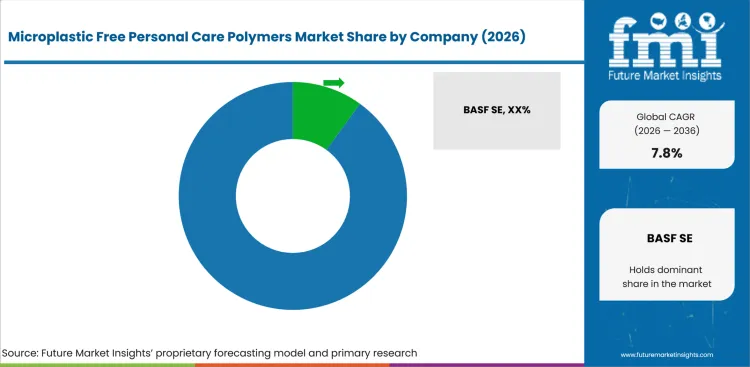
- Large specialty chemical companies hold an advantage through biodegradation evidence, global regulatory files, and formulation laboratories serving multinational beauty brands.
- Bio-based polymer suppliers gain specification strength when they combine renewable-origin claims with sensory performance in hair care and color cosmetics.
- Cellulose, starch, and biopolymer specialists gain stronger trial access when they provide sample formulas and clear microplastic status statements.
- Distribution partners support smaller brands by translating technical files into faster sampling cycles and more practical ingredient comparisons.
Specialty chemical groups in the market compete by combining product chemistry with formulation proof. BASF and Lubrizol hold strong positions through natural-based and biodegradable personal care polymers that target styling, rheology, and sensory functions. Nouryon, Ashland, and Eastman compete through starch, cellulose, and rheology systems designed to replace persistent polymer particles without weakening product feel. Buyers evaluate each supplier on documentation quality before they approve use in skin care, hair care, and color cosmetics.
Application support has become a competitive separator as reformulation work moves beyond simple scrub replacement. Suppliers must show how a polymer behaves in finished formulas, including viscosity, suspension, film hold, powder slip, and processing stability. Evonik and Clariant bring broad specialty ingredient portfolios that help brand owners build more complete sustainable formulation systems. Dow and Croda strengthen competition through global technical service and long-standing relationships with personal care manufacturers.
Smaller and regional suppliers can win when they solve localized formulation problems or provide faster sampling support. South Korea and China favor suppliers that can support export-ready documentation, while Europe rewards clear compliance alignment with EU microplastic rules. India and the United States create stronger opportunities for distributors that can balance cost, proof, and sensory performance. Companies with verified biodegradation data and practical application labs should gain more durable specification positions than suppliers relying only on sustainability language.
Competition also connects with bio-based polymers industry analysis as cosmetic ingredient suppliers use renewable content to improve replacement claims.
How do top microplastic free personal care polymers companies compare?
BASF and Lubrizol score strongest on biodegradable polymer positioning while Nouryon and Eastman lead in starch and cellulose replacement systems.
| Company | Relevance to Market Title | Biodegradation Proof Depth | Personal Care Polymer Portfolio | Application Support | Channel Reach | Geographic Footprint |
|---|---|---|---|---|---|---|
| BASF SE | Very High | Very Strong | Very Strong | Very Strong | Very Strong | Global |
| Lubrizol Corporation | Very High | Very Strong | Strong | Very Strong | Strong | Global |
| Nouryon | Very High | Strong | Very Strong | Strong | Strong | Global |
| Ashland Inc. | Very High | Strong | Very Strong | Strong | Very Strong | Global |
| Eastman Chemical Company | High | Very Strong | Strong | Strong | Moderate to Strong | Global |
| Evonik Industries AG | High | Strong | Strong | Very Strong | Strong | Global |
| Clariant AG | High | Moderate to Strong | Strong | Strong | Strong | Global |
| Dow Inc. | Moderate to High | Moderate | Strong | Very Strong | Very Strong | Global |
| Croda International Plc | High | Strong | Strong | Strong | Strong | Global |
| Seppic SA | Moderate to High | Strong | Moderate to Strong | Strong | Moderate | Europe and Global Export |
Source: Future Market Insights competitive analysis, 2026.
Who are the key players in the microplastic free personal care polymers market?
BASF, Nouryon, Ashland and Lubrizol are listed with Eastman, Evonik and Clariant among other suppliers.
Key global companies leading the microplastic free personal care polymers market include:
- BASF SE
- Nouryon
- Ashland Inc.
- Lubrizol Corporation
- Eastman Chemical Company
- Evonik Industries AG
- Clariant AG
- Dow Inc.
- Croda International Plc
- Seppic SA
Key Developments in the Microplastic Free Personal Care Polymers Market
- In April 2025, BASF launched Verdessence Maize as a plant-based and readily biodegradable styling ingredient for hair sprays and mousse formats.
- In April 2025, Lubrizol introduced Carbopol BioSense polymer with 98% natural-origin content for sensory performance in personal care formulations.
- In January 2026, Eastman and Kolmar Korea signed a memorandum of understanding to expand access to Esmeri technology for biodegradable personal care solutions.
Key Players in the Microplastic Free Personal Care Polymers Market
Global Specialty Chemical Groups
- BASF SE
- Dow Inc.
- Evonik Industries AG
- Clariant AG
Personal Care Polymer Specialists
- Ashland Inc.
- Lubrizol Corporation
- Nouryon
- Eastman Chemical Company
Regional and Application-Focused Suppliers
- Croda International Plc
- Seppic SA
- Nikko Chemicals
- Kolmar Korea
Microplastic Free Personal Care Polymers Market - Report Scope
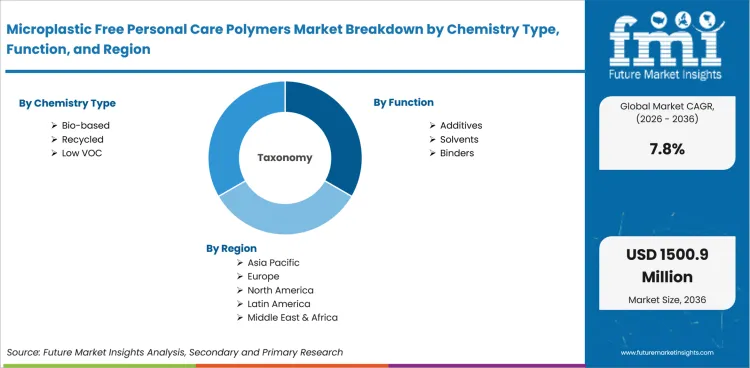
| Item | Value |
|---|---|
| Market size by 2036 | USD 1,500.9 million |
| Growth rate | 7.8% CAGR from 2026 to 2036 |
| Forecast period | 2026 to 2036 |
| Base year value (2025) | USD 657.0 million |
| By chemistry type | Bio-based, recycled, low VOC, halogen free, waterborne |
| By function | Solvents, additives, binders, coatings, process aids |
| By application | Skin care, hair care, color cosmetics, toiletries, baby care |
| By end-use industry | Industrial manufacturing, contract manufacturing, beauty brands, specialty ingredient distribution, retail-backed private label |
| By sales channel | Direct B2B supply, specialty chemical distributors, online ingredient platforms, contract manufacturer sourcing, trade shows |
| Regions covered | North America, Latin America, Europe, East Asia, South Asia and Pacific, Middle East and Africa |
| Countries covered | South Korea, India, China, Germany, France, United States, United Kingdom, Japan |
| Key companies profiled | BASF, Nouryon, Ashland, Lubrizol, Eastman, Evonik, Clariant, Dow |
| Approach | Bottom-up product-boundary approach using eligible ingredient revenue, formulation use rates, supplier positioning, application demand, and country-level reformulation readiness |
Source: Future Market Insights competitive analysis, 2026.
Microplastic Free Personal Care Polymers Market Breakdown by Chemistry Type, Function, Application, End-use Industry, Sales Channel, and Region
Microplastic Free Personal Care Polymers Market Segmented by Chemistry Type
- Bio-based
- Recycled
- Low VOC
- Halogen Free
- Waterborne
Microplastic Free Personal Care Polymers Market Segmented by Function
- Solvents
- Additives
- Binders
- Coatings
- Process Aids
Microplastic Free Personal Care Polymers Market Segmented by Application
- Skin Care
- Hair Care
- Color Cosmetics
- Toiletries
- Baby Care
Microplastic Free Personal Care Polymers Market Segmented by End-use Industry
- Industrial Manufacturing
- Contract Manufacturing
- Beauty Brands
- Specialty Ingredient Distribution
- Retail-Backed Private Label
Microplastic Free Personal Care Polymers Market Segmented by Sales Channel
- Direct B2B Supply
- Specialty Chemical Distributors
- Online Ingredient Platforms
- Contract Manufacturer Sourcing
- Trade Shows
Microplastic Free Personal Care Polymers Market by Region
- North America
- Latin America
- Europe
- East Asia
- South Asia and Pacific
- Middle East and Africa
Research Sources and Bibliography
- BASF SE. (2025, April 3). BASF launches natural-based innovations for personal care.
- Cosmetics Europe. (2026). Our industry.
- Department for Environment, Food & Rural Affairs. (2024, April 22). Summary of responses and government response: Wet wipes containing plastic.
- Department for Environment, Food & Rural Affairs. (2024, May 21). The Environmental Protection (Microbeads) (England) Regulations 2017 post-implementation review.
- Eastman Chemical Company. (2026, January 22). Eastman and Kolmar sign memorandum of understanding to advance sustainable innovation in personal care.
- European Commission. (2025, July 18). Commission Regulation (EU) 2023/2055: Restriction of microplastics intentionally added to products.
- Evonik Industries AG. (2024, May 29). Evonik drives sustainable biosurfactant revolution with inauguration of new facility in Slovakia.
- India Brand Equity Foundation. (2025, February 13). India, you e-beauty! The blush-and-glow of the new billion-dollar boom.
- India Brand Equity Foundation. (2026). India’s e-commerce boom: Growth, trends, and future prospects.
- International Trade Administration. (2025, September 30). South Korea cosmetics safety regulations.
- Japan Cosmetic Industry Association. (2024, September 11). The list of JCIA standards for tar colors.
- Japan Cosmetic Industry Association. (2024, October 11). Cosmetic shipments.
- Korea Culture and Information Service. (2026, January 8). Biohealth exports reach record high of USD 27.9 billion.
- Lubrizol Corporation. (2025, April 8). Lubrizol introduces Carbopol BioSense polymer.
- National Bureau of Statistics of China. (2026, January 20). Total retail sales of consumer goods in December 2025.
- Nouryon. (2024, September 25). Introducing Structure Silk starch, a readily biodegradable rheology modifier and texturizer for personal care formulations.
- Office for National Statistics. (2026, April 24). Retail sales, Great Britain: March 2026.
- Organisation for Economic Co-operation and Development. (2024, October 2). Policy scenarios for eliminating plastic pollution by 2040.
- USA Census Bureau. (2026, February 10). Advance monthly sales for retail and food services: December 2025.
- USA Environmental Protection Agency. (2026, April 2). EPA, HHS announce historic actions to protect Americans from microplastics and safeguard drinking water.
- USA Food and Drug Administration. (2026, April 14). Registration and listing of cosmetic product facilities and products.
- United Nations Environment Programme. (2025, June 2). Everything you should know about microplastics.
This bibliography is provided for reader reference and is not exhaustive. The full report contains the complete reference list and detailed citations.
This Report Answers
- Market size estimates for 2026 and forecasts through 2036 for the microplastic free personal care polymers market.
- Insights across more than 30 regional and country-level markets.
- Analysis of demand drivers, reformulation patterns, regulatory pressure, supplier documentation needs, and purchasing behavior.
- Evaluation of leading chemistry types, functions, applications, end-use industries, and sales channels used across personal care polymer substitution.
- Assessment of microplastic restrictions, biodegradation proof requirements, cosmetic ingredient documentation, and formulation approval impacts on market development.
- Identification of growth opportunities across bio-based polymers, additives, skin care, hair care, color cosmetics, and direct B2B supply channels.
- Evaluation of supply chain dynamics, ingredient innovation trends, application laboratory support, and specialty chemical distribution structures.
- Country-level growth analysis covering South Korea, India, China, Germany, France, the United States, the United Kingdom, and Japan.
- Assessment of the competitive landscape, including leading microplastic free personal care polymer suppliers and other market participants.
- Analysis of buyer preferences, formulation performance needs, market penetration trends, and emerging growth opportunities.
- Regional outlooks across North America, Latin America, Europe, East Asia, South Asia and Pacific, Middle East and Africa.
- Delivery of market data, forecasts, and supporting analysis in PDF and Excel formats.
Frequently Asked Questions
How big is the microplastic free personal care polymers market in 2026?
The market is valued at USD 708.2 million in 2026 and is forecast to reach USD 1,500.9 million by 2036.
What is the forecast CAGR for the microplastic free personal care polymers market?
The market is projected to expand at a 7.8% CAGR from 2026 to 2036.
Which application leads the microplastic free personal care polymers market?
Personal care leads the application segment with 57.0% share in 2026 due to direct reformulation needs in cosmetics.
Which sales channel leads the microplastic free personal care polymers market?
Direct B2B supply leads with 54.0% share in 2026 as buyers need supplier documentation and application support.
Which country grows fastest in the microplastic free personal care polymers market?
South Korea grows fastest at 8.6% CAGR through 2036 due to export-led K-beauty formulation demand.
Who are the leading companies in the market?
BASF, Nouryon, Ashland, Lubrizol, Eastman, Evonik, Clariant, and Dow lead through verified ingredient platforms and technical support.
Preview the report firsthand - request a free sample
Get SampleGet the brochure for pricing and purchase details.
Get PDFTable of Content
- Executive Summary
- Global Market Outlook
- Demand to side Trends
- Supply to side Trends
- Technology Roadmap Analysis
- Analysis and Recommendations
- Market Overview
- Market Coverage / Taxonomy
- Market Definition / Scope / Limitations
- Research Methodology
- Chapter Orientation
- Analytical Lens and Working Hypotheses
- Market Structure, Signals, and Trend Drivers
- Benchmarking and Cross-market Comparability
- Market Sizing, Forecasting, and Opportunity Mapping
- Research Design and Evidence Framework
- Desk Research Programme (Secondary Evidence)
- Company Annual and Sustainability Reports
- Peer-reviewed Journals and Academic Literature
- Corporate Websites, Product Literature, and Technical Notes
- Earnings Decks and Investor Briefings
- Statutory Filings and Regulatory Disclosures
- Technical White Papers and Standards Notes
- Trade Journals, Industry Magazines, and Analyst Briefs
- Conference Proceedings, Webinars, and Seminar Materials
- Government Statistics Portals and Public Data Releases
- Press Releases and Reputable Media Coverage
- Specialist Newsletters and Curated Briefings
- Sector Databases and Reference Repositories
- FMI Internal Proprietary Databases and Historical Market Datasets
- Subscription Datasets and Paid Sources
- Social Channels, Communities, and Digital Listening Inputs
- Additional Desk Sources
- Expert Input and Fieldwork (Primary Evidence)
- Primary Modes
- Qualitative Interviews and Expert Elicitation
- Quantitative Surveys and Structured Data Capture
- Blended Approach
- Why Primary Evidence is Used
- Field Techniques
- Interviews
- Surveys
- Focus Groups
- Observational and In-context Research
- Social and Community Interactions
- Stakeholder Universe Engaged
- C-suite Leaders
- Board Members
- Presidents and Vice Presidents
- R&D and Innovation Heads
- Technical Specialists
- Domain Subject-matter Experts
- Scientists
- Physicians and Other Healthcare Professionals
- Governance, Ethics, and Data Stewardship
- Research Ethics
- Data Integrity and Handling
- Primary Modes
- Tooling, Models, and Reference Databases
- Desk Research Programme (Secondary Evidence)
- Data Engineering and Model Build
- Data Acquisition and Ingestion
- Cleaning, Normalisation, and Verification
- Synthesis, Triangulation, and Analysis
- Quality Assurance and Audit Trail
- Market Background
- Market Dynamics
- Drivers
- Restraints
- Opportunity
- Trends
- Scenario Forecast
- Demand in Optimistic Scenario
- Demand in Likely Scenario
- Demand in Conservative Scenario
- Opportunity Map Analysis
- Product Life Cycle Analysis
- Supply Chain Analysis
- Investment Feasibility Matrix
- Value Chain Analysis
- PESTLE and Porter’s Analysis
- Regulatory Landscape
- Regional Parent Market Outlook
- Production and Consumption Statistics
- Import and Export Statistics
- Market Dynamics
- Global Market Analysis 2021 to 2025 and Forecast, 2026 to 2036
- Historical Market Size Value (USD Million) Analysis, 2021 to 2025
- Current and Future Market Size Value (USD Million) Projections, 2026 to 2036
- Y to o to Y Growth Trend Analysis
- Absolute $ Opportunity Analysis
- Global Market Pricing Analysis 2021 to 2025 and Forecast 2026 to 2036
- Global Market Analysis 2021 to 2025 and Forecast 2026 to 2036, By Chemistry Type
- Introduction / Key Findings
- Historical Market Size Value (USD Million) Analysis By Chemistry Type , 2021 to 2025
- Current and Future Market Size Value (USD Million) Analysis and Forecast By Chemistry Type , 2026 to 2036
- Bio-based
- Recycled
- Low VOC
- Bio-based
- Y to o to Y Growth Trend Analysis By Chemistry Type , 2021 to 2025
- Absolute $ Opportunity Analysis By Chemistry Type , 2026 to 2036
- Global Market Analysis 2021 to 2025 and Forecast 2026 to 2036, By Function
- Introduction / Key Findings
- Historical Market Size Value (USD Million) Analysis By Function, 2021 to 2025
- Current and Future Market Size Value (USD Million) Analysis and Forecast By Function, 2026 to 2036
- Additives
- Solvents
- Binders
- Additives
- Y to o to Y Growth Trend Analysis By Function, 2021 to 2025
- Absolute $ Opportunity Analysis By Function, 2026 to 2036
- Global Market Analysis 2021 to 2025 and Forecast 2026 to 2036, By Application
- Introduction / Key Findings
- Historical Market Size Value (USD Million) Analysis By Application, 2021 to 2025
- Current and Future Market Size Value (USD Million) Analysis and Forecast By Application, 2026 to 2036
- Personal Care
- Color Cosmetics
- Toiletries
- Personal Care
- Y to o to Y Growth Trend Analysis By Application, 2021 to 2025
- Absolute $ Opportunity Analysis By Application, 2026 to 2036
- Global Market Analysis 2021 to 2025 and Forecast 2026 to 2036, By End-use Industry
- Introduction / Key Findings
- Historical Market Size Value (USD Million) Analysis By End-use Industry, 2021 to 2025
- Current and Future Market Size Value (USD Million) Analysis and Forecast By End-use Industry, 2026 to 2036
- Industrial Manufacturing
- Contract Manufacturing
- Beauty Brands
- Industrial Manufacturing
- Y to o to Y Growth Trend Analysis By End-use Industry, 2021 to 2025
- Absolute $ Opportunity Analysis By End-use Industry, 2026 to 2036
- Global Market Analysis 2021 to 2025 and Forecast 2026 to 2036, By Sales Channel
- Introduction / Key Findings
- Historical Market Size Value (USD Million) Analysis By Sales Channel, 2021 to 2025
- Current and Future Market Size Value (USD Million) Analysis and Forecast By Sales Channel, 2026 to 2036
- Direct B2B Supply
- Specialty Chemical Distributors
- Online Ingredient Platforms
- Direct B2B Supply
- Y to o to Y Growth Trend Analysis By Sales Channel, 2021 to 2025
- Absolute $ Opportunity Analysis By Sales Channel, 2026 to 2036
- Global Market Analysis 2021 to 2025 and Forecast 2026 to 2036, By Region
- Introduction
- Historical Market Size Value (USD Million) Analysis By Region, 2021 to 2025
- Current Market Size Value (USD Million) Analysis and Forecast By Region, 2026 to 2036
- North America
- Latin America
- Western Europe
- Eastern Europe
- East Asia
- South Asia and Pacific
- Middle East & Africa
- Market Attractiveness Analysis By Region
- North America Market Analysis 2021 to 2025 and Forecast 2026 to 2036, By Country
- Historical Market Size Value (USD Million) Trend Analysis By Market Taxonomy, 2021 to 2025
- Market Size Value (USD Million) Forecast By Market Taxonomy, 2026 to 2036
- By Country
- USA
- Canada
- Mexico
- By Chemistry Type
- By Function
- By Application
- By End-use Industry
- By Sales Channel
- By Country
- Market Attractiveness Analysis
- By Country
- By Chemistry Type
- By Function
- By Application
- By End-use Industry
- By Sales Channel
- Key Takeaways
- Latin America Market Analysis 2021 to 2025 and Forecast 2026 to 2036, By Country
- Historical Market Size Value (USD Million) Trend Analysis By Market Taxonomy, 2021 to 2025
- Market Size Value (USD Million) Forecast By Market Taxonomy, 2026 to 2036
- By Country
- Brazil
- Chile
- Rest of Latin America
- By Chemistry Type
- By Function
- By Application
- By End-use Industry
- By Sales Channel
- By Country
- Market Attractiveness Analysis
- By Country
- By Chemistry Type
- By Function
- By Application
- By End-use Industry
- By Sales Channel
- Key Takeaways
- Western Europe Market Analysis 2021 to 2025 and Forecast 2026 to 2036, By Country
- Historical Market Size Value (USD Million) Trend Analysis By Market Taxonomy, 2021 to 2025
- Market Size Value (USD Million) Forecast By Market Taxonomy, 2026 to 2036
- By Country
- Germany
- UK
- Italy
- Spain
- France
- Nordic
- BENELUX
- Rest of Western Europe
- By Chemistry Type
- By Function
- By Application
- By End-use Industry
- By Sales Channel
- By Country
- Market Attractiveness Analysis
- By Country
- By Chemistry Type
- By Function
- By Application
- By End-use Industry
- By Sales Channel
- Key Takeaways
- Eastern Europe Market Analysis 2021 to 2025 and Forecast 2026 to 2036, By Country
- Historical Market Size Value (USD Million) Trend Analysis By Market Taxonomy, 2021 to 2025
- Market Size Value (USD Million) Forecast By Market Taxonomy, 2026 to 2036
- By Country
- Russia
- Poland
- Hungary
- Balkan & Baltic
- Rest of Eastern Europe
- By Chemistry Type
- By Function
- By Application
- By End-use Industry
- By Sales Channel
- By Country
- Market Attractiveness Analysis
- By Country
- By Chemistry Type
- By Function
- By Application
- By End-use Industry
- By Sales Channel
- Key Takeaways
- East Asia Market Analysis 2021 to 2025 and Forecast 2026 to 2036, By Country
- Historical Market Size Value (USD Million) Trend Analysis By Market Taxonomy, 2021 to 2025
- Market Size Value (USD Million) Forecast By Market Taxonomy, 2026 to 2036
- By Country
- China
- Japan
- South Korea
- By Chemistry Type
- By Function
- By Application
- By End-use Industry
- By Sales Channel
- By Country
- Market Attractiveness Analysis
- By Country
- By Chemistry Type
- By Function
- By Application
- By End-use Industry
- By Sales Channel
- Key Takeaways
- South Asia and Pacific Market Analysis 2021 to 2025 and Forecast 2026 to 2036, By Country
- Historical Market Size Value (USD Million) Trend Analysis By Market Taxonomy, 2021 to 2025
- Market Size Value (USD Million) Forecast By Market Taxonomy, 2026 to 2036
- By Country
- India
- ASEAN
- Australia & New Zealand
- Rest of South Asia and Pacific
- By Chemistry Type
- By Function
- By Application
- By End-use Industry
- By Sales Channel
- By Country
- Market Attractiveness Analysis
- By Country
- By Chemistry Type
- By Function
- By Application
- By End-use Industry
- By Sales Channel
- Key Takeaways
- Middle East & Africa Market Analysis 2021 to 2025 and Forecast 2026 to 2036, By Country
- Historical Market Size Value (USD Million) Trend Analysis By Market Taxonomy, 2021 to 2025
- Market Size Value (USD Million) Forecast By Market Taxonomy, 2026 to 2036
- By Country
- Kingdom of Saudi Arabia
- Other GCC Countries
- Turkiye
- South Africa
- Other African Union
- Rest of Middle East & Africa
- By Chemistry Type
- By Function
- By Application
- By End-use Industry
- By Sales Channel
- By Country
- Market Attractiveness Analysis
- By Country
- By Chemistry Type
- By Function
- By Application
- By End-use Industry
- By Sales Channel
- Key Takeaways
- Key Countries Market Analysis
- USA
- Pricing Analysis
- Market Share Analysis, 2025
- By Chemistry Type
- By Function
- By Application
- By End-use Industry
- By Sales Channel
- Canada
- Pricing Analysis
- Market Share Analysis, 2025
- By Chemistry Type
- By Function
- By Application
- By End-use Industry
- By Sales Channel
- Mexico
- Pricing Analysis
- Market Share Analysis, 2025
- By Chemistry Type
- By Function
- By Application
- By End-use Industry
- By Sales Channel
- Brazil
- Pricing Analysis
- Market Share Analysis, 2025
- By Chemistry Type
- By Function
- By Application
- By End-use Industry
- By Sales Channel
- Chile
- Pricing Analysis
- Market Share Analysis, 2025
- By Chemistry Type
- By Function
- By Application
- By End-use Industry
- By Sales Channel
- Germany
- Pricing Analysis
- Market Share Analysis, 2025
- By Chemistry Type
- By Function
- By Application
- By End-use Industry
- By Sales Channel
- UK
- Pricing Analysis
- Market Share Analysis, 2025
- By Chemistry Type
- By Function
- By Application
- By End-use Industry
- By Sales Channel
- Italy
- Pricing Analysis
- Market Share Analysis, 2025
- By Chemistry Type
- By Function
- By Application
- By End-use Industry
- By Sales Channel
- Spain
- Pricing Analysis
- Market Share Analysis, 2025
- By Chemistry Type
- By Function
- By Application
- By End-use Industry
- By Sales Channel
- France
- Pricing Analysis
- Market Share Analysis, 2025
- By Chemistry Type
- By Function
- By Application
- By End-use Industry
- By Sales Channel
- India
- Pricing Analysis
- Market Share Analysis, 2025
- By Chemistry Type
- By Function
- By Application
- By End-use Industry
- By Sales Channel
- ASEAN
- Pricing Analysis
- Market Share Analysis, 2025
- By Chemistry Type
- By Function
- By Application
- By End-use Industry
- By Sales Channel
- Australia & New Zealand
- Pricing Analysis
- Market Share Analysis, 2025
- By Chemistry Type
- By Function
- By Application
- By End-use Industry
- By Sales Channel
- China
- Pricing Analysis
- Market Share Analysis, 2025
- By Chemistry Type
- By Function
- By Application
- By End-use Industry
- By Sales Channel
- Japan
- Pricing Analysis
- Market Share Analysis, 2025
- By Chemistry Type
- By Function
- By Application
- By End-use Industry
- By Sales Channel
- South Korea
- Pricing Analysis
- Market Share Analysis, 2025
- By Chemistry Type
- By Function
- By Application
- By End-use Industry
- By Sales Channel
- Russia
- Pricing Analysis
- Market Share Analysis, 2025
- By Chemistry Type
- By Function
- By Application
- By End-use Industry
- By Sales Channel
- Poland
- Pricing Analysis
- Market Share Analysis, 2025
- By Chemistry Type
- By Function
- By Application
- By End-use Industry
- By Sales Channel
- Hungary
- Pricing Analysis
- Market Share Analysis, 2025
- By Chemistry Type
- By Function
- By Application
- By End-use Industry
- By Sales Channel
- Kingdom of Saudi Arabia
- Pricing Analysis
- Market Share Analysis, 2025
- By Chemistry Type
- By Function
- By Application
- By End-use Industry
- By Sales Channel
- Turkiye
- Pricing Analysis
- Market Share Analysis, 2025
- By Chemistry Type
- By Function
- By Application
- By End-use Industry
- By Sales Channel
- South Africa
- Pricing Analysis
- Market Share Analysis, 2025
- By Chemistry Type
- By Function
- By Application
- By End-use Industry
- By Sales Channel
- USA
- Market Structure Analysis
- Competition Dashboard
- Competition Benchmarking
- Market Share Analysis of Top Players
- By Regional
- By Chemistry Type
- By Function
- By Application
- By End-use Industry
- By Sales Channel
- Competition Analysis
- Competition Deep Dive
- BASF SE
- Overview
- Product Portfolio
- Profitability by Market Segments (Product/Age /Sales Channel/Region)
- Sales Footprint
- Strategy Overview
- Marketing Strategy
- Product Strategy
- Channel Strategy
- Nouryon
- Ashland Inc.
- Lubrizol Corporation
- Eastman Chemical Company
- BASF SE
- Competition Deep Dive
- Assumptions & Acronyms Used


