

- Market Size (2026)
- USD 260.0 Mn
- Forecast (2036)
- USD 3584.0 Mn
- CAGR (2026 to 2036)
- 30.0%
How big is Military & Security Quadrupeds Market in 2026?
Demand for Military & Security Quadrupeds is projected to expand at 30.0% CAGR between 2026 and 2036, increasing valuation from USD 260.0 million in 2026 to USD 3,584.0 million by 2036.
Armed forces are accelerating interest in legged robotic platforms as operational missions increasingly extend into environments that restrict conventional wheeled systems. Navigation across collapsed structures and obstacle-filled locations continues strengthening operational interest in quadruped mobility. Ghost Robotics announced the launch of a Manipulator Arm for the Vision 60 Q-UGV in December 2025, expanding the platform's mission capabilities for defence, explosive ordnance disposal, and hazardous environment operations.
Operational priorities continue varying across major defence regions. United States organizations concentrate on autonomous mission capability together with rapid operational deployment. South Korean developers continue emphasizing robotic mobility and artificial intelligence integration for defence applications. European defence programmes increasingly assess quadruped platforms for surveillance and infrastructure protection.
Investment patterns increasingly favour robotic systems capable of supporting multiple mission profiles throughout changing operational environments. Defence organizations evaluate payload flexibility and communication resilience before selecting deployment platforms. Commercial differentiation therefore reflects operational reliability together with mission adaptability instead of mechanical mobility alone.
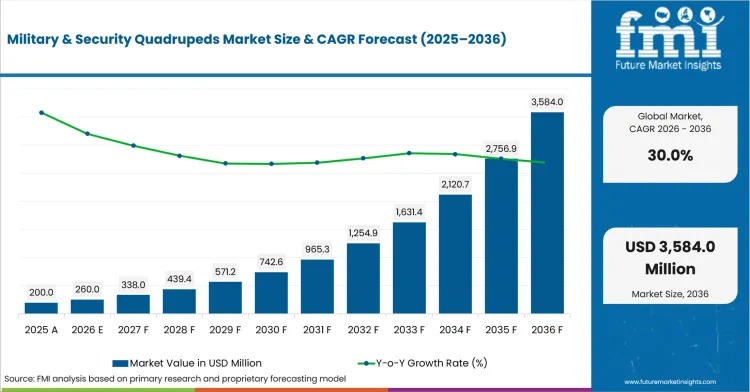
Key Takeaways of Military & Security Quadrupeds Market
- Demand for military and security quadrupeds is driven by rising interest in autonomous defence technologies, with emphasis on mobility, operational safety, and remote mission execution strengthening procurement activity.
- By payload, ISR & sensing quadrupeds are expected to lead with 48.0% share in 2026, maintaining the leading payload position across defence programs.
- Base & perimeter patrol is the dominant application segment, projected to hold 40.0% share in 2026, continuing to represent the principal use case.
- Platforms are estimated to lead the component category with 54.0% share in 2026, remaining the largest investment area throughout commercial deployment.
- Autonomous mobility and sensor integration remain critical purchasing considerations, supporting operational effectiveness during complex missions across difficult terrain.
- The United States and South Korea are expected to remain key markets, with North America and East Asia serving as important centres for autonomous military robotics development alongside expanding European evaluation programs.
- Competition centers on autonomous navigation capability, payload integration, endurance, and artificial intelligence performance, with vendors differentiating through mission adaptability and lifecycle support.
Analyst Perspective
"The defense quadruped robots market is being shaped by mission reliability rather than mobility alone. Procurement programs are placing greater emphasis on autonomous navigation, payload flexibility, and operational performance across varied terrain and mission profiles. Long-term adoption will depend on proven field capability, resilient communications, and the ability to support evolving defense requirements."
- Nikhil Kaitwade, Principal Consultant at FMI
How is the Military & Security Quadrupeds Market segmented?
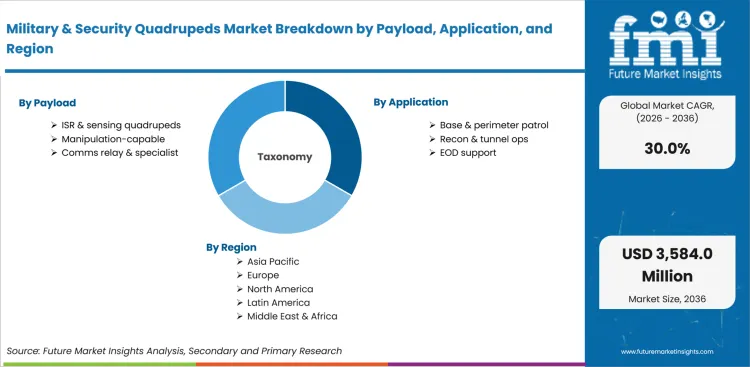
The Military & Security Quadrupeds market is segmented by payload, application, component, end user, business model, and region.
Payload classification includes ISR & sensing quadrupeds, logistics & cargo quadrupeds, and weapon-ready quadrupeds. Application analysis comprises base & perimeter patrol, reconnaissance & surveillance, explosive ordnance disposal support, and logistics support. Component evaluation covers platforms, autonomous software & AI, and sensors & payloads. End-user assessment includes armed forces, border security agencies, and homeland security organizations. Business model segmentation consists of direct procurement, long-term defence contracts, and robotics-as-a-service & support agreements. Regional assessment covers North America, Latin America, Europe, East Asia, South Asia, Oceania, and the Middle East & Africa.
Why do ISR & sensing quadrupeds dominate payload demand?
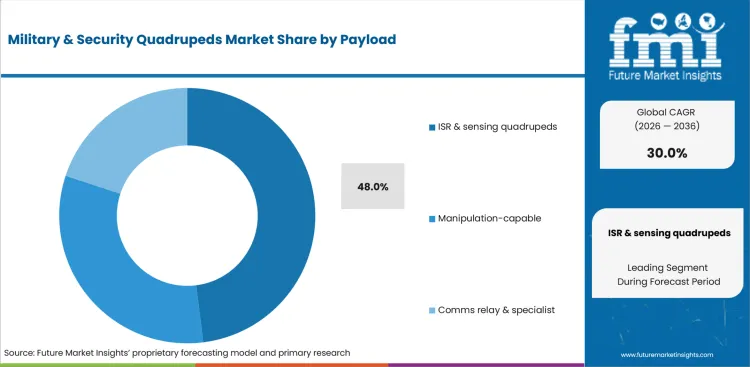
- Intelligence gathering remains a priority across modern defence operations, encouraging wider deployment of robotic systems capable of operating ahead of personnel. Quadrupeds equipped with electro-optical cameras, thermal sensors, LiDAR, and communication equipment continue supporting safer mission execution across hazardous locations.
- ISR & sensing quadrupeds preserve their leadership across payload categories at 48.0% during 2026. Defence organizations continue favouring robotic platforms capable of persistent surveillance without exposing personnel to elevated operational risk. The programme highlighted expanding use of legged robots across force protection and battlefield awareness.
- Manufacturers continue improving payload modularity, sensing accuracy, and onboard processing capability, enabling robotic systems to perform reconnaissance assignments across increasingly demanding environments.
Why does base & perimeter patrol remain the principal application?
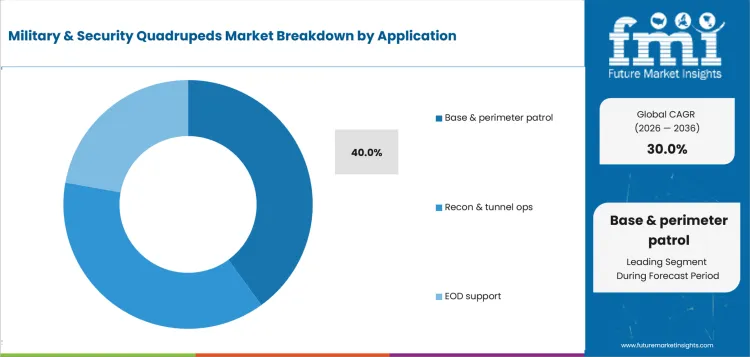
- Military installations require continuous surveillance across extensive facilities that include difficult terrain, remote boundaries, and restricted-access zones. Quadruped robots strengthen security coverage through autonomous patrol capability while reducing routine workload for security personnel.
- Base & perimeter patrol secures the foremost application position with a 40.0% share in 2026. Persistent monitoring together with autonomous navigation continues encouraging deployment across military bases, defence facilities, and strategic infrastructure.
- Developers continue refining route planning, obstacle avoidance, and threat detection capabilities, supporting dependable operation throughout extended security patrols.
Why do platforms account for the leading component share?
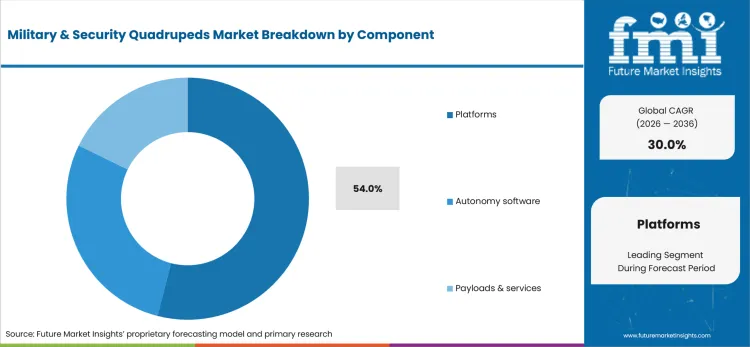
- Platform engineering determines overall mobility, endurance, payload support, and environmental performance across military quadruped systems. Defence organizations therefore continue allocating a substantial share of procurement budgets toward robust robotic chassis capable of supporting diverse mission requirements.
- Platforms occupy the leading component position, representing 54.0% of demand in 2026. Greater emphasis on durability, terrain adaptability, and payload compatibility continues strengthening investment in advanced robotic mobility systems. The development improves navigation, mission coordination, and situational awareness across military robotic platforms.
- Autonomous software & AI improve navigation, mission planning, and decision support, whereas sensors & payloads continue expanding operational awareness through advanced imaging and communication technologies.
What are the drivers, restraints, and opportunities in the Military & Security Quadrupeds Market?
Military organizations continue expanding investment in autonomous ground robotics to improve mission effectiveness and personnel safety across hazardous environments. Budget constraints and operational integration continue influencing procurement decisions, whereas advances in artificial intelligence and robotic mobility continue creating new deployment opportunities.
- Driver: Defence organizations continue strengthening investment in autonomous robotic platforms that improve surveillance capability and reduce personnel exposure across hazardous missions.
- Restraint: Extended qualification programmes together with demanding military certification requirements continue influencing deployment schedules.
- Opportunity: Progress in autonomous navigation, artificial intelligence, and modular payload integration continues expanding operational opportunities across defence and homeland security missions.
Military operations frequently involve reconnaissance, perimeter security, and infrastructure inspection across environments that restrict conventional vehicles. Quadruped robots improve operational flexibility through stable movement across stairs and confined locations while keeping personnel at safer distances from potential threats.
Platform qualification continues involving extensive operational testing before procurement approval. Defence organizations assess endurance, communication resilience, payload compatibility and maintenance support before approving large-scale deployment programmes. Multi-stage evaluation therefore continues extending procurement timelines across numerous defence agencies.
Artificial intelligence continues improving autonomous movement, terrain recognition, obstacle avoidance, and mission planning across complex operational environments. Advancements in computer vision, sensor fusion, and intelligent navigation continue enabling quadruped robots to perform increasingly sophisticated defence missions with greater operational consistency. Manufacturers delivering dependable mobility together with adaptable mission architecture are expected to strengthen future commercial opportunities across military and security organizations.
Which country CAGRs are profiled in the Military & Security Quadrupeds Market?
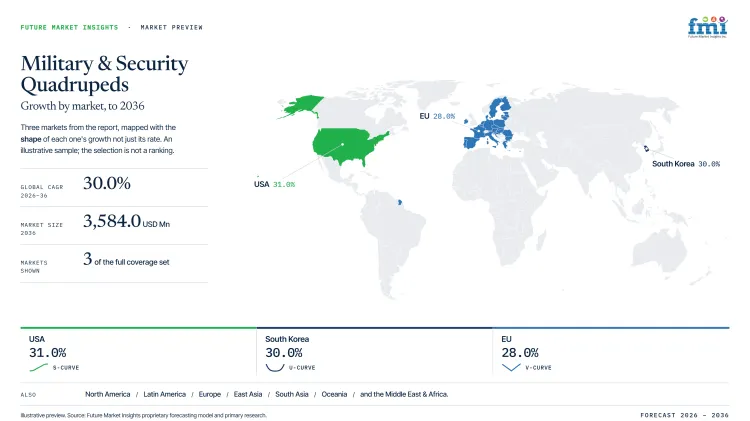
| Country | CAGR |
|---|---|
| USA | 31.0% |
| South Korea | 30.0% |
| EU | 28.0% |
How do country-level CAGRs compare in the Military & Security Quadrupeds Market?
The comparison spans 3.0 percentage points across the military & security quadrupeds market. The United States records the highest CAGR at 31.0%, followed by South Korea at 30.0% and the European Union at 28.0%. The relatively narrow spread indicates that defense organizations across the three markets are evaluating robotic quadrupeds for operational and security applications, although investment priorities differ.
- The United States leads with a CAGR of 31.0%. Defense and security agencies are expanding the evaluation of quadruped robots for reconnaissance, remote inspection, perimeter patrol and operations in environments that present elevated risk to personnel.
- South Korea follows at 30.0%, 1.0 percentage point below the United States. Military organizations continue incorporating quadruped robotic platforms into modernization programs, with attention focused on surveillance, mobility across complex terrain and support for security missions.
- The European Union records a CAGR of 28.0%, 2.0 percentage points behind South Korea. Investment is directed toward robotic systems for defense and critical security operations, although adoption differs among member states because procurement priorities, defense budgets and modernization programs are not uniform.
Comparable CAGRs do not indicate identical market conditions. Differences in defense procurement, operational requirements, robotics integration strategies and public investment priorities influence deployment patterns and long-term commercial opportunities. The full report provides country-level CAGR analysis across North America, Latin America, Europe, East Asia, South Asia, Oceania and the Middle East and Africa.
Source: FMI proprietary forecasting model and primary research.
Who are the notable companies in the Military & Security Quadrupeds Market?
Companies active in this market include Ghost Robotics (US), Boston Dynamics (US), Rainbow Robotics RBQ (KR).
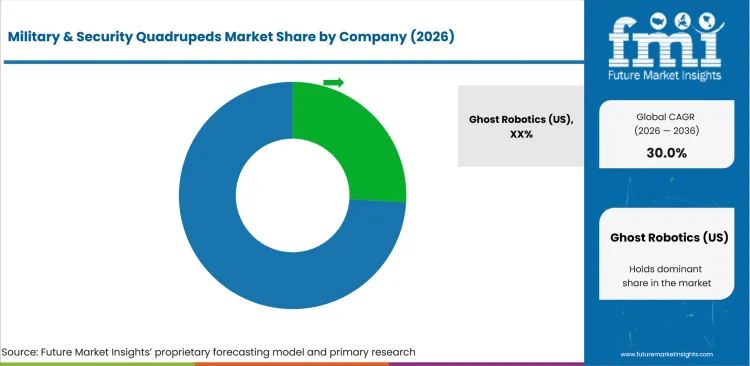
- Competition is assessed around product relevance, deployment fit, service capability, and ability to support procurement or integration requirements within this market.
- Ghost Robotics (US), Boston Dynamics (US), Rainbow Robotics RBQ (KR) represent the principal company group profiled in this report.
Competitive Benchmarking: Military & Security Quadrupeds Market
| Company | Autonomous Mobility | Mission Capability | Technology Innovation | Geographic Presence |
|---|---|---|---|---|
| Ghost Robotics (US) | High | High | High | Global |
| Boston Dynamics (US) | High | High | High | Global |
| Rainbow Robotics RBQ (KR) | High | Medium | High | Global |
Assessment reflects robotic mobility capability, operational deployment, technology advancement, and international defence presence.
Source: FMI proprietary competitive assessment based on company portfolios and primary research.
Key Players in the Military & Security Quadrupeds Market
- Ghost Robotics (US)
- Boston Dynamics (US)
- Rainbow Robotics RBQ (KR)
Military & Security Quadrupeds Market Report Scope
| Attribute | Details |
|---|---|
| Market Segmentation | Payload, application, component, end user, business model, country, and regional assessment. |
| Market Size & Forecast | Revenue in USD Million and CAGR in %. |
| Market Definition | Military & security quadrupeds are legged robotic systems designed for surveillance, reconnaissance, perimeter security, logistics support, explosive hazard response, and defence operations across complex terrain using autonomous or remotely supervised navigation. |
| Regions Covered | North America, Latin America, Europe, East Asia, South Asia, Oceania, and the Middle East & Africa. |
| Countries Covered | United States, South Korea, Germany, United Kingdom, France, China, Japan, Australia, and additional countries. |
| Key Companies Profiled | Ghost Robotics (US), Boston Dynamics (US), Rainbow Robotics RBQ (KR). |
| Forecast Period | 2026 to 2036 |
| Base Year | 2025 |
| Research Methodology | Market estimates were established through primary interviews, defence robotics assessment, company benchmarking, product portfolio evaluation, technology analysis, and regional demand validation. |
Source: FMI proprietary research and primary interviews.
Military & Security Quadrupeds Market Research Methodology
| Method | Approach |
|---|---|
| Primary Research | FMI analysts gathered input from manufacturers, service providers, technology developers, distributors, end users, procurement teams, and subject-matter experts. Interviews examined purchasing decisions, product or service evaluation, adoption barriers, approval requirements, pricing considerations, and expectations for technical or commercial support. Respondents were also asked what evidence is required before a trial, pilot, or initial order develops into regular purchasing. |
| Desk Research | Desk research covered government statistics, regulatory publications, trade data, industry associations, technical literature, standards, company filings, product information, and official corporate announcements. Sources were reviewed for relevance, publication date, geographic coverage, and consistency with the defined market scope. Claims relating to performance, applications, approvals, capacity, investment, and commercial activity were retained only when supported by credible public evidence. |
| Market Sizing and Forecasting | The market model combined the baseline value with historical performance, segment structure, pricing and volume indicators, adoption levels, company participation, and country-level demand conditions. Forecast assumptions considered economic activity, investment trends, regulatory developments, technology adoption, purchasing cycles, supply availability, and barriers to wider market use. Segment and regional estimates were reconciled before the final market total was calculated. |
| Data Validation | Estimates were checked against multiple independent indicators, including public data, company activity, trade patterns, industry developments, and findings from primary interviews. Validation also tested whether products, services, applications, and company revenues fell within the defined market boundaries. Adjacent categories, unsupported claims, overlapping revenues, and activities without direct market relevance were excluded to reduce double counting and maintain consistency across segments and countries. |
Source: Future Market Insights proprietary methodology and primary research
Military & Security Quadrupeds Market Segmentation
By Payload:
- ISR & Sensing Quadrupeds
- Logistics & Cargo Quadrupeds
- Weapon-Ready Quadrupeds
By Application:
- Base & Perimeter Patrol
- Reconnaissance & Surveillance
- Logistics Support
- Explosive Ordnance Disposal Support
- Search & Rescue
- Other Security Operations
By Component:
- Platforms
- Autonomous Software & AI
- Sensors & Payloads
By End User:
- Armed Forces
- Border Security Agencies
- Homeland Security Organizations
By Business Model:
- Direct Procurement
- Long-Term Defence Contracts
- Maintenance & Support Services
By Region:
- North America
- United States
- Canada
- Latin America
- Brazil
- Mexico
- Argentina
- Europe
- Germany
- United Kingdom
- France
- Italy
- Spain
- Rest of Europe
- East Asia
- China
- Japan
- South Korea
- South Asia
- India
- ASEAN
- Rest of South Asia
- Oceania
- Australia
- New Zealand
- Middle East & Africa
- GCC Countries
- South Africa
- Rest of Middle East & Africa
Research Sources and Bibliography
- Future Market Insights analysis and primary research.
- Company public materials reviewed for market relevance: Ghost Robotics (US), Boston Dynamics (US), Rainbow Robotics RBQ (KR).
- Public robotics, automation, defence, hospitality, maritime, and industrial sources reviewed for market context where applicable.
This Report Answers
- What is the projected valuation of the military & security quadrupeds market by 2036?
- Which CAGR is anticipated for the military & security quadrupeds market between 2026 and 2036?
- Which payload segment maintains the leading market share?
- Why does base & perimeter patrol remain the principal application?
- Which component contributes the largest share across military & security quadrupeds?
- How do country growth prospects compare during the forecast period?
- Which companies are shaping competition in the military & security quadrupeds market?
- Which factors continue supporting procurement of defence quadruped robots?
- Which operational challenges influence adoption across defence organizations?
- How does Future Market Insights estimate and validate market forecasts?
Frequently Asked Questions
What is encouraging demand for military & security quadrupeds?
Growing investment in autonomous defence systems, border protection, and robotic surveillance platforms continues accelerating deployment across military and homeland security organizations.
Which payload segment records the leading market share?
ISR & sensing quadrupeds remain the leading payload segment owing to expanding demand for autonomous reconnaissance and persistent surveillance missions.
Why does base & perimeter patrol represent the largest application?
Military installations increasingly deploy quadruped robots to strengthen continuous surveillance, reduce personnel exposure, and improve security coverage across challenging terrain.
Which component accounts for the highest share?
Platforms contribute the largest share as mobility, endurance, payload support, and terrain adaptability remain fundamental to operational performance.
Who are the major companies operating in the military & security quadrupeds market?
Companies active in this market include Ghost Robotics (US), Boston Dynamics (US), Rainbow Robotics RBQ (KR).
What remains the principal challenge for industry participants?
Military qualification procedures, cybersecurity requirements, interoperability standards, and extended procurement cycles continue influencing commercial deployment.
Which regions continue presenting attractive growth opportunities?
North America, East Asia, and Europe continue generating strong opportunities through defence modernization, autonomous robotics programmes, and expanding security investments.
Preview the report firsthand - request a free sample
Get SampleGet the brochure for pricing and purchase details.
Get PDFTable of Content
- Key Takeaways
- Market Size and CAGR
- Top Growth Driver
- Fastest Growing Segment
- Leading Region
- Key Companies
- Emerging Opportunities
- Executive Summary
- Global Market Outlook
- Demand-side Trends
- Supply-side Trends
- Technology Roadmap Analysis
- Analysis and Recommendations
- Analyst Perspective (What is happening? Why now? What should investors know?)
- Key Questions Answered
- How large is the market?
- What is the CAGR?
- What are key trends?
- Which region dominates?
- Who are the leaders?
- Market Overview
- Market Coverage / Taxonomy
- Market Definition / Scope / Limitations
- Research Methodology
- Chapter Orientation
- Analytical Lens and Working Hypotheses
- Market Structure, Signals, and Trend Drivers
- Benchmarking and Cross-market Comparability
- Market Sizing, Forecasting, and Opportunity Mapping
- Research Design and Evidence Framework
- Desk Research Programme (Secondary Evidence)
- Expert Input and Fieldwork (Primary Evidence)
- Tooling, Models, and Reference Databases
- Data Engineering and Model Build
- Quality Assurance and Audit Trail
- Market Background
- Market Dynamics (Drivers, Restraints, Opportunity, Trends)
- Scenario Forecast (Optimistic, Likely, Conservative)
- Impact Analysis
- AI Impact
- Sustainability Impact
- Regulatory Impact
- Technology Impact
- Consumer / Buyer Analysis
- Purchase Drivers
- Adoption Barriers
- Buyer Journey
- Opportunity Map Analysis
- Product Life Cycle Analysis
- Supply Chain Analysis
- Investment Feasibility Matrix
- Value Chain Analysis
- PESTLE and Porter's Analysis
- Regulatory Landscape
- Regional Parent Market Outlook
- Production and Consumption Statistics
- Import and Export Statistics
- Global Market Analysis and Forecast, 2021 to 2036
- Historical Market Size Value (USD Million) Analysis, 2021 to 2025
- Current and Future Market Size Value (USD Million) Projections, 2026 to 2036
- Y-o-Y Growth Trend Analysis
- Absolute $ Opportunity Analysis
- Global Market Pricing Analysis, 2021 to 2036
- Global Market Analysis and Forecast, By Payload, 2021 to 2036
- Introduction / Key Findings
- Historical Market Size Value (USD Million) Analysis By Payload, 2021 to 2025
- Current and Future Market Size Value (USD Million) Analysis and Forecast By Payload, 2026 to 2036
- ISR & sensing quadrupeds
- Manipulation-capable
- Comms relay & specialist
- ISR & sensing quadrupeds
- Y-o-Y Growth Trend Analysis By Payload, 2021 to 2025
- Absolute $ Opportunity Analysis By Payload, 2026 to 2036
- Global Market Analysis and Forecast, By Application, 2021 to 2036
- Introduction / Key Findings
- Historical Market Size Value (USD Million) Analysis By Application, 2021 to 2025
- Current and Future Market Size Value (USD Million) Analysis and Forecast By Application, 2026 to 2036
- Base & perimeter patrol
- Recon & tunnel ops
- EOD support
- Base & perimeter patrol
- Y-o-Y Growth Trend Analysis By Application, 2021 to 2025
- Absolute $ Opportunity Analysis By Application, 2026 to 2036
- Global Market Analysis and Forecast, By Component, 2021 to 2036
- Introduction / Key Findings
- Historical Market Size Value (USD Million) Analysis By Component, 2021 to 2025
- Current and Future Market Size Value (USD Million) Analysis and Forecast By Component, 2026 to 2036
- Platforms
- Autonomy software
- Payloads & services
- Platforms
- Y-o-Y Growth Trend Analysis By Component, 2021 to 2025
- Absolute $ Opportunity Analysis By Component, 2026 to 2036
- Global Market Analysis and Forecast, By End User, 2021 to 2036
- Introduction / Key Findings
- Historical Market Size Value (USD Million) Analysis By End User, 2021 to 2025
- Current and Future Market Size Value (USD Million) Analysis and Forecast By End User, 2026 to 2036
- Armed forces
- Security agencies
- Critical infrastructure
- Armed forces
- Y-o-Y Growth Trend Analysis By End User, 2021 to 2025
- Absolute $ Opportunity Analysis By End User, 2026 to 2036
- Global Market Analysis and Forecast, By Business Model, 2021 to 2036
- Introduction / Key Findings
- Historical Market Size Value (USD Million) Analysis By Business Model, 2021 to 2025
- Current and Future Market Size Value (USD Million) Analysis and Forecast By Business Model, 2026 to 2036
- Procurement
- RaaS - pilots
- R&D contracts
- Procurement
- Y-o-Y Growth Trend Analysis By Business Model, 2021 to 2025
- Absolute $ Opportunity Analysis By Business Model, 2026 to 2036
- Global Market Analysis and Forecast, By Region, 2021 to 2036
- Introduction
- Historical Market Size Value (USD Million) Analysis By Region, 2021 to 2025
- Current Market Size Value (USD Million) Analysis and Forecast By Region, 2026 to 2036
- North America
- Latin America
- Western Europe
- Eastern Europe
- East Asia
- South Asia and Pacific
- Middle East & Africa
- Market Attractiveness Analysis By Region
- North America Market Analysis and Forecast, By Country, 2021 to 2036
- Historical Market Size Value (USD Million) Trend Analysis By Market Taxonomy, 2021 to 2025
- Market Size Value (USD Million) Forecast By Market Taxonomy, 2026 to 2036
- By Country
- USA
- Canada
- By Payload
- By Application
- By Component
- By End User
- By Business Model
- By Country
- Market Attractiveness Analysis
- By Country
- By Payload
- By Application
- By Component
- By End User
- By Business Model
- Key Takeaways
- Latin America Market Analysis and Forecast, By Country
- Historical Market Size Value (USD Million) Trend Analysis By Market Taxonomy, 2021 to 2025
- Market Size Value (USD Million) Forecast By Market Taxonomy, 2026 to 2036
- By Country
- Brazil
- Mexico
- Chile
- Rest of Latin America
- By Payload
- By Application
- By Component
- By End User
- By Business Model
- By Country
- Market Attractiveness Analysis
- By Country
- By Payload
- By Application
- By Component
- By End User
- By Business Model
- Key Takeaways
- Western Europe Market Analysis and Forecast, By Country
- Historical Market Size Value (USD Million) Trend Analysis By Market Taxonomy, 2021 to 2025
- Market Size Value (USD Million) Forecast By Market Taxonomy, 2026 to 2036
- By Country
- Germany
- UK
- Italy
- Spain
- France
- Nordic
- BENELUX
- Rest of Western Europe
- By Payload
- By Application
- By Component
- By End User
- By Business Model
- By Country
- Market Attractiveness Analysis
- By Country
- By Payload
- By Application
- By Component
- By End User
- By Business Model
- Key Takeaways
- Eastern Europe Market Analysis and Forecast, By Country
- Historical Market Size Value (USD Million) Trend Analysis By Market Taxonomy, 2021 to 2025
- Market Size Value (USD Million) Forecast By Market Taxonomy, 2026 to 2036
- By Country
- Russia
- Poland
- Hungary
- Balkan & Baltic
- Rest of Eastern Europe
- By Payload
- By Application
- By Component
- By End User
- By Business Model
- By Country
- Market Attractiveness Analysis
- By Country
- By Payload
- By Application
- By Component
- By End User
- By Business Model
- Key Takeaways
- East Asia Market Analysis and Forecast, By Country
- Historical Market Size Value (USD Million) Trend Analysis By Market Taxonomy, 2021 to 2025
- Market Size Value (USD Million) Forecast By Market Taxonomy, 2026 to 2036
- By Country
- China
- Japan
- South Korea
- By Payload
- By Application
- By Component
- By End User
- By Business Model
- By Country
- Market Attractiveness Analysis
- By Country
- By Payload
- By Application
- By Component
- By End User
- By Business Model
- Key Takeaways
- South Asia and Pacific Market Analysis and Forecast, By Country
- Historical Market Size Value (USD Million) Trend Analysis By Market Taxonomy, 2021 to 2025
- Market Size Value (USD Million) Forecast By Market Taxonomy, 2026 to 2036
- By Country
- India
- ASEAN
- Australia & New Zealand
- Rest of South Asia and Pacific
- By Payload
- By Application
- By Component
- By End User
- By Business Model
- By Country
- Market Attractiveness Analysis
- By Country
- By Payload
- By Application
- By Component
- By End User
- By Business Model
- Key Takeaways
- Middle East & Africa Market Analysis and Forecast, By Country
- Historical Market Size Value (USD Million) Trend Analysis By Market Taxonomy, 2021 to 2025
- Market Size Value (USD Million) Forecast By Market Taxonomy, 2026 to 2036
- By Country
- Kingdom of Saudi Arabia
- Other GCC Countries
- Türkiye
- South Africa
- Other African Union
- Rest of Middle East & Africa
- By Payload
- By Application
- By Component
- By End User
- By Business Model
- By Country
- Market Attractiveness Analysis
- By Country
- By Payload
- By Application
- By Component
- By End User
- By Business Model
- Key Takeaways
- Key Countries Market Analysis
- USA
- Pricing Analysis
- Market Share Analysis, 2025
- By Payload
- By Application
- By Component
- By End User
- By Business Model
- Canada
- Pricing Analysis
- Market Share Analysis, 2025
- By Payload
- By Application
- By Component
- By End User
- By Business Model
- Mexico
- Pricing Analysis
- Market Share Analysis, 2025
- By Payload
- By Application
- By Component
- By End User
- By Business Model
- Brazil
- Pricing Analysis
- Market Share Analysis, 2025
- By Payload
- By Application
- By Component
- By End User
- By Business Model
- Chile
- Pricing Analysis
- Market Share Analysis, 2025
- By Payload
- By Application
- By Component
- By End User
- By Business Model
- Germany
- Pricing Analysis
- Market Share Analysis, 2025
- By Payload
- By Application
- By Component
- By End User
- By Business Model
- UK
- Pricing Analysis
- Market Share Analysis, 2025
- By Payload
- By Application
- By Component
- By End User
- By Business Model
- Italy
- Pricing Analysis
- Market Share Analysis, 2025
- By Payload
- By Application
- By Component
- By End User
- By Business Model
- Spain
- Pricing Analysis
- Market Share Analysis, 2025
- By Payload
- By Application
- By Component
- By End User
- By Business Model
- France
- Pricing Analysis
- Market Share Analysis, 2025
- By Payload
- By Application
- By Component
- By End User
- By Business Model
- India
- Pricing Analysis
- Market Share Analysis, 2025
- By Payload
- By Application
- By Component
- By End User
- By Business Model
- ASEAN
- Pricing Analysis
- Market Share Analysis, 2025
- By Payload
- By Application
- By Component
- By End User
- By Business Model
- Australia & New Zealand
- Pricing Analysis
- Market Share Analysis, 2025
- By Payload
- By Application
- By Component
- By End User
- By Business Model
- China
- Pricing Analysis
- Market Share Analysis, 2025
- By Payload
- By Application
- By Component
- By End User
- By Business Model
- Japan
- Pricing Analysis
- Market Share Analysis, 2025
- By Payload
- By Application
- By Component
- By End User
- By Business Model
- South Korea
- Pricing Analysis
- Market Share Analysis, 2025
- By Payload
- By Application
- By Component
- By End User
- By Business Model
- Russia
- Pricing Analysis
- Market Share Analysis, 2025
- By Payload
- By Application
- By Component
- By End User
- By Business Model
- Poland
- Pricing Analysis
- Market Share Analysis, 2025
- By Payload
- By Application
- By Component
- By End User
- By Business Model
- Hungary
- Pricing Analysis
- Market Share Analysis, 2025
- By Payload
- By Application
- By Component
- By End User
- By Business Model
- Kingdom of Saudi Arabia
- Pricing Analysis
- Market Share Analysis, 2025
- By Payload
- By Application
- By Component
- By End User
- By Business Model
- Türkiye
- Pricing Analysis
- Market Share Analysis, 2025
- By Payload
- By Application
- By Component
- By End User
- By Business Model
- South Africa
- Pricing Analysis
- Market Share Analysis, 2025
- By Payload
- By Application
- By Component
- By End User
- By Business Model
- USA
- Market Structure Analysis
- Competition Dashboard
- Competition Benchmarking
- Market Share Analysis of Top Players
- By Regional
- By Payload
- By Application
- By Component
- By End User
- By Business Model
- Emerging Startups
- Innovation Benchmarking
- Competition Analysis
- Competition Deep Dive
- Ghost Robotics (US)
- Overview
- Product Portfolio
- Profitability by Market Segments
- Sales Footprint
- Strategy Overview
- Marketing Strategy
- Product Strategy
- Channel Strategy
- Boston Dynamics (US)
- Rainbow Robotics RBQ (KR)
- Ghost Robotics (US)
- Case Studies
- Success Stories
- Recent Developments
- Competition Deep Dive
- Assumptions & Acronyms Used


