

- Market Size (2026)
- USD 167.3 Mn
- Forecast (2036)
- USD 364.5 Mn
- CAGR (2026 to 2036)
- 8.1%
How Big is the Mochi Inclusions Market in 2026?
The mochi inclusions market is estimated at USD 167.3 million in 2026.
The global mochi inclusions market was valued at USD 154.8 million in 2025 and is estimated to reach USD 167.3 million in 2026. The market is projected to reach USD 364.5 million by 2036, expanding at a compound annual growth rate (CAGR) of 8.1% between 2026 and 2036. Chocolate pieces accounted for the largest share of the Product Type breakdown, contributing 30.0% of total revenue in 2026. Demand is supported by bakeries developing mochi-filled buns, donuts and pastries that combine a chewy rice base with chocolate, fruit or crunchy inclusions. Rice costs in Japan, the main reference market for mochi, have eased after a sharp spike. According to Nippon.com, the average price of a 5-kilogram bag of rice in Japanese supermarkets fell to ¥2,971 in mid-September 2026, below ¥3,000 for the first time since September 2024, after peaking at ¥4,416 in early January 2026[5]. Chocolate costs remain high. Barry Callebaut, owner of the Callebaut brand, reported that its revenue rose by 49.0% in its 2024/25 financial year on higher cocoa-related pricing[7], although cocoa supply is recovering, with the International Cocoa Organization (ICCO) estimating an 8.5% rise in production in 2024/25[6].
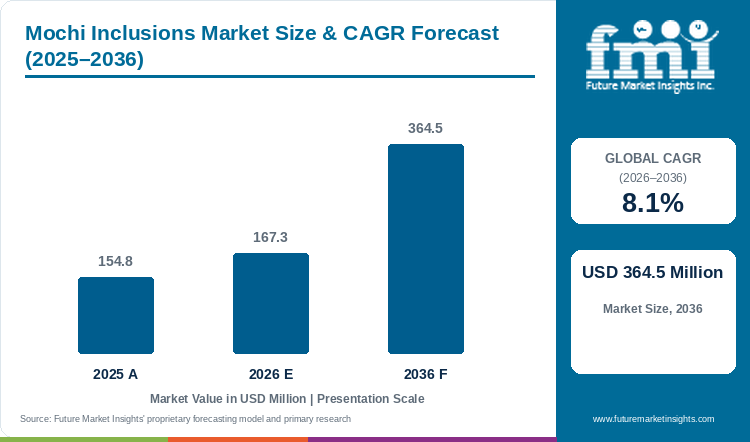
Table 1: Mochi Inclusions Market Size and Forecast (USD million), 2025 to 2036
| Market size and forecast | Value |
|---|---|
| 2025 market size | USD 154.8 million |
| Estimated market size in 2026 | USD 167.3 million |
| Projected market size by 2036 | USD 364.5 million |
| CAGR (2026-2036) | 8.1% |
| Added revenue, 2026 to 2036 | USD 197.2 million |
Key Market Trends & Insights
- By Product Type: The Chocolate pieces segment accounted for the largest share of the Product Type breakdown in 2026, representing 30.0% of total market revenue.
- By Form: Powder / dry products held the leading market position with a share of 46.0% in 2026, with dispersion and moisture balance governing their contribution.
- By Application: Bread & rolls remained the largest application segment, accounting for 32.0% of the market in 2026.
Regional Highlights
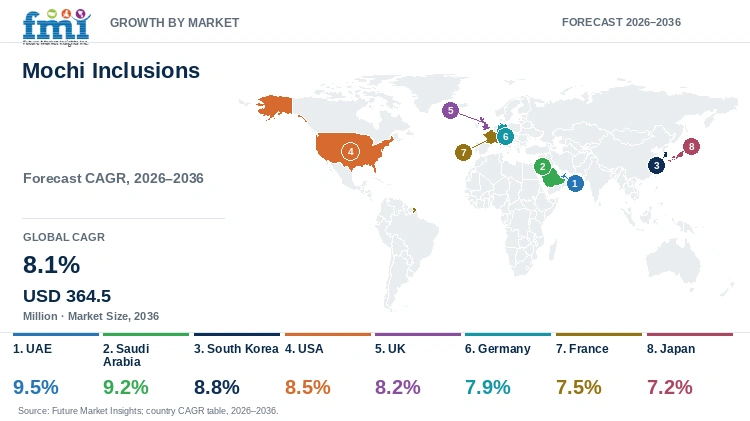
- Fastest-growing country: The UAE is expected to record the highest growth rate among the eight profiled countries, with a projected CAGR of 9.5% between 2026 and 2036.
- Growth across other countries: Saudi Arabia is projected to expand at a CAGR of 9.2%, followed by South Korea at 8.8% and the USA at 8.5%. Japan is expected to register comparatively slower growth, with a CAGR of 7.2% during the forecast period.
The cost of rice remains an important factor influencing mochi production. Nippon.com reported that Japanese private-sector rice inventories climbed to 1.6 million tons at the end of July 2026, up 700,000 tons from a year earlier and the highest July level since records began in 2008[5]. Larger stocks have pushed prices down, although rice remains more expensive than before the 2024 shortages, when a 5-kilogram bag retailed for around ¥2,000[5]. Globally, the Food and Agriculture Organization of the United Nations (FAO) All Rice Price Index rose by only 1.4% in September 2026[8]. Chocolate selection also shapes texture. Callebaut's chocolate mochi recipe links the choice of chocolate and cocoa ingredients to the desired softness of the filling[3], so an intact piece and a softer centre play different roles beside a chewy base.
Cocoa conditions affect the largest inclusion category. The ICCO estimated a 2024/25 cocoa supply surplus of 37,000 tonnes and an increase of almost 3.0% in stocks[6], while Barry Callebaut's sales volume fell by 6.8% as high prices reduced demand[7]. Recovering supply may ease chocolate costs for mochi inclusions over the forecast period. Assembly sequence also determines ingredient requirements. Puratos' Moncherries recipe places mochi filling in a Danish before baking and adds cherry filling afterwards[4], which shows how heat exposure, later depositing and contact during storage can change requirements within one pastry.
Bakels' July 2025 publication distinguishes the fat composition and processing requirements of chocolate and compound coatings[2]. These differences matter when a substitute is proposed for an approved mochi recipe, as a similar flavour does not guarantee the same handling or texture. With chocolate prices elevated[7], some bakeries may consider compound alternatives, and such changes need assessment in the finished product. Composition also affects ingredient information, and the US Food and Drug Administration's (FDA) January 2025 allergen guidance is relevant where chocolate, cream or nut components introduce or change declared allergens[1].
Table 2: Supporting Industry Indicators for the Mochi Inclusions Market, 2024/25 to 2026
| Indicator | Data point | Why it matters | Source |
|---|---|---|---|
| Japanese rice prices | The average 5 kg rice price fell to ¥2,971 in mid-September 2026, below ¥3,000 for the first time since September 2024. | Lower rice costs ease the cost of mochi bases. | [5] |
| Price peak | Rice prices peaked at ¥4,416 per 5 kg in early January 2026, against around ¥2,000 before the shortages. | The peak shows the scale of recent cost volatility. | [5] |
| Rice inventories | Japanese private-sector rice inventories reached 1.6 million tons at the end of July 2026, up 700,000 tons. | Higher stocks support continued price relief. | [5] |
| Global rice prices | The FAO All Rice Price Index rose by 1.4% in September 2026. | International rice prices remain relatively stable. | [8] |
| Cocoa supply | The ICCO estimated an 8.5% rise in cocoa production and a 37,000-tonne surplus in 2024/25. | Recovering cocoa supply may ease chocolate inclusion costs. | [6] |
| Chocolate pricing | Barry Callebaut's revenue rose by 49.0% in 2024/25 on cocoa-related pricing, while volume fell by 6.8%. | Chocolate pieces are the largest inclusion category. | [7] |
| Chocolate system selection | Bakels compared chocolate and compound coating fat composition and processing in July 2025. | Substitutions can change firmness and handling. | [2] |
| Chocolate filling design | Callebaut's chocolate mochi recipe connects chocolate selection with filling softness. | The intended role determines the texture specification. | [3] |
| Component sequence | Puratos' Moncherries places mochi filling in Danish and adds cherry filling after baking. | Different addition stages create distinct requirements. | [4] |
| Composition information | FDA issued Edition 5 of its allergen labelling guidance in January 2025. | Chocolate, cream and nut additions change ingredient information. | [1] |
Demand Intensity Analysis
A comparison of rice price movements provides a measure of the cost pressure faced by mochi producers. The average Japanese supermarket price for a 5-kilogram bag of rice fell by approximately 33.0% from its January 2026 peak to mid-September 2026, but remained approximately 49.0% above the pre-shortage level of around ¥2,000[5]. Mochi bases therefore remain more expensive to produce than before 2024, although the direction of costs has reversed.
Chocolate costs provide another reference point. Barry Callebaut's revenue per tonne rose by approximately 60.0% in 2024/25, based on a 49.0% increase in revenue and a 6.8% fall in volume[7]. FMI estimated the mochi inclusions market at USD 154.8 million in 2025, which is equivalent to approximately USD 33.0 for every tonne of cocoa ground worldwide in 2024/25, based on ICCO grindings of 4.649 million tonnes[6]. This is a reference point rather than a measure of cocoa use, as the market also includes fruit, caramel and crunchy inclusions.
A similar comparison can be made between projected market growth and input costs. FMI expects the market to grow at a CAGR of 8.1% between 2026 and 2036. With rice prices falling and cocoa supply recovering[5][6], input costs are moving in a favourable direction, which supports the development of new mochi-filled products outside Japan, where the fastest growth is expected.
Segment values show where demand is concentrated. Chocolate pieces represented USD 50.2 million in 2026, while Powder / dry, measured separately by Form, accounted for USD 77.0 million. Bread & rolls held USD 53.5 million in the Application dimension, and Direct to industrial bakeries accounted for USD 78.6 million. FMI projects USD 197.2 million in added market revenue between 2026 and 2036, with the market reaching 2.2 times its 2026 value.
Table 3: Demand Intensity Metrics for the Mochi Inclusions Market, 2025 and 2026 Input Data Against Market Values
| Demand intensity metric | Value | Basis |
|---|---|---|
| FMI market value, 2025 | USD 154.8 million | FMI estimate of mochi inclusion revenue. |
| Japanese rice price fall from peak | Approximately -33.0% | ¥4,416 to ¥2,971 per 5 kg. |
| Japanese rice price against pre-shortage level | Approximately +49.0% | ¥2,971 against around ¥2,000 per 5 kg. |
| World cocoa grindings, 2024/25 | 4.649 million tonnes | ICCO. |
| FMI value per tonne of cocoa ground | Approximately USD 33.0 | The calculation divides USD 154.8 million by 4.649 million tonnes. |
| Barry Callebaut implied revenue per tonne change | Approximately +60.0% | Revenue +49.0% and volume -6.8%. |
| FMI value CAGR, 2026 to 2036 | 8.1% | FMI market forecast. |
| Chocolate pieces revenue, 2026 | USD 50.2 million | 30.0% of the market. |
| Direct industrial bakery revenue, 2026 | USD 78.6 million | 47.0% of the market. |
| Market expansion multiple | 2.2 times | Projected 2036 market value relative to 2026. |
Analyst Perspective
"Rice prices in Japan are a third below their peak and cocoa supply is recovering, which gives bakeries outside Japan a better moment to launch mochi products than at any time in the past two years."
- Nandini Roy Choudhury, Principal Analyst at Future Market Insights
How is the mochi inclusions market segmented?
The mochi inclusions market is segmented by product type, form, application, claim and sales channel. Product Type covers chocolate, fruit, caramel and toffee, and crunchy cereal or cookie components. Form describes the ingredient's condition at handling, and Application places it in the mochi-related bakery format, while Claim and Sales Channel add sourcing and supply requirements.
Why do Chocolate pieces lead the Product Type category?
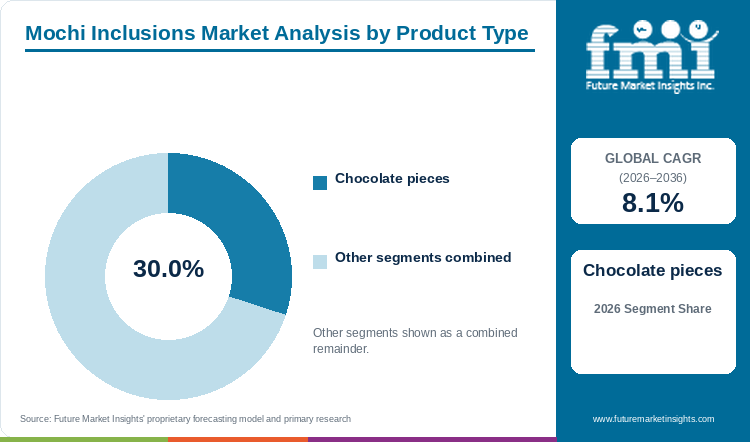
Chocolate pieces hold 30.0% of Product Type revenue in 2026.
The Chocolate pieces segment generated approximately USD 50.2 million in 2026. Pieces and softer chocolate centres perform distinct roles, as pieces bring visible contrast while their size and firmness must suit the finished portion. Distribution during mixing determines whether that contrast reaches every unit, and serving temperature influences how the chocolate feels beside the chewy base. Bakels' technical discussion of chocolate and compound coatings explains differences in fat composition that matter to this choice[2].
- Chocolate pieces hold 30.0% of Product Type revenue in 2026.
- Piece dimensions and fat behaviour need to match the texture intended at serving temperature.
What supports Powder / dry as the principal Form?
Powder / dry represents 46.0% of Form revenue in 2026.
Dry preparations generated approximately USD 77.0 million in 2026, as they permit measured addition without a liquid carrier. Their point of entry into mixing must allow even dispersion, since clumps or concentrated pockets change the flavour and texture balance between portions. Fine material also needs assessment for its effect on moisture balance and the texture of the base. Protection in the pack and careful handling after opening help preserve the material before use.
- Powder / dry represents 46.0% of Form revenue in 2026.
- Uniform dispersion matters as much as the weight added to the batch.
Why do Bread & rolls provide the largest Application base?
Bread & rolls account for 32.0% of Application revenue in 2026.
Mochi-filled breads and rolls accounted for approximately USD 53.5 million in 2026. Dough, filling and finishing positions create different processing requirements, as mixing and proofing matter for one recipe while a later injection or finishing step defines another. The intended ratio of base to chocolate, fruit or caramel gives portioning trials a clear target, and if that ratio varies between units, the eating experience varies with it.
- Bread & rolls account for 32.0% of Application revenue in 2026.
- Dough, filling and finishing positions expose an inclusion to different processing steps.
How does Conventional retain its lead in the Claim category?
Conventional holds 57.0% of Claim revenue in 2026.
Conventional formulations held 57.0% of Claim revenue in 2026, as they leave room to balance the fat and moisture of inclusions against a chewy base before any positioning claim is considered. Chocolate, fillings and coatings can introduce milk, nuts, soy or other allergens, so composition information must follow every component into the finished-product review, and FDA guidance is relevant[1]. A familiar flavour name does not establish that a replacement will behave or label identically.
- Conventional holds 57.0% of Claim revenue in 2026.
- Fillings and coatings belong in the same composition review as the main inclusion.
Why does Direct to industrial bakeries lead Sales Channel?
Direct to industrial bakeries represents 47.0% of Sales Channel revenue in 2026.
Moving from a development sample to commercial production exposes an inclusion to the bakery's actual mixing and depositing conditions, and direct supply to industrial bakeries accounted for approximately USD 78.6 million in 2026. Direct supply allows customers to agree particle tolerances, filling flow and temperature requirements with the producer, which is useful where a soft mochi component must stay evenly distributed around another material. Smaller orders may be better served through local distribution.
- Direct to industrial bakeries represents 47.0% of Sales Channel revenue in 2026.
- Particle and flow tolerances become meaningful when tied to the bakery's actual equipment.
What are the drivers, restraints and opportunities in the mochi inclusions market?
Chewy bases invite distinct flavour and texture combinations, while ingredient cost volatility and texture compatibility restrain the market and recipe-led supply can simplify qualification for new formats.
Chewy bases invite distinct flavour and texture combinations
The combination of a soft, elastic component with a familiar flavour gives mochi products a clear development direction. Puratos' Moncherries recipe incorporates mochi filling into a Danish and adds cherry filling after baking[4], which allows each ingredient to play a different role. Where the brief calls for recognisable fruit, fruit inclusions can be assessed against that role and the required amount per portion. Lower rice prices in Japan[5] and recovering cocoa supply[6] improve the cost outlook for new products, and the fastest growth is expected in markets such as the UAE and Saudi Arabia.
Ingredient cost volatility and texture compatibility restrain the market
Both main inputs have been volatile. Japanese rice prices more than doubled from pre-shortage levels to a peak of ¥4,416 per 5 kg in January 2026[5], and chocolate costs rose sharply with cocoa prices[7]. Texture compatibility is a further restraint. Piece firmness influences the soft bite, moisture can move from a filling into the base, and increased stickiness can disrupt portioning. Callebaut's recipe links its chocolate selection to the softness of the filling[3], so a change in fat composition can alter suitability. Trials through handling and storage establish the tolerances that matter.
Recipe-led supply can simplify qualification for new formats
Defined application routes focus ingredient qualification on the conditions needed for a mochi-filled bun or pastry, with addition point, portion weight and condition at assembly as practical starting points. This brings inclusion selection into the same development work as bakery fillings, as the centre and soft base must behave together. Bakels' July 2025 publication explains handling differences between chocolate and compound systems[2], and translating them into a recipe specification is more useful than listing alternatives by flavour alone.
Which country CAGRs are profiled in the mochi inclusions market?
Table 4: Country growth outlook for the mochi inclusions market
| Country | CAGR |
|---|---|
| UAE | 9.5% |
| Saudi Arabia | 9.2% |
| South Korea | 8.8% |
| USA | 8.5% |
| UK | 8.2% |
| Germany | 7.9% |
| France | 7.5% |
| Japan | 7.2% |
UAE
- The UAE is the fastest-growing market among the profiled countries, with a projected CAGR of 9.5% from 2026 to 2036. Serving temperature helps define the inclusion brief for a mochi pastry in the UAE, as chocolate and fruit components add familiar flavours while preparation, display and delivery determine whether the product keeps its intended texture. Portioning and storage instructions then support the same recipe across outlets.
Saudi Arabia
- In Saudi sweet bakery, commercial mixing and filling determine how evenly an inclusion reaches each portion. Saudi Arabia is forecast to grow at a CAGR of 9.2% from 2026 to 2036. A material that portions well at the development bench may need a different format at production speed, and testing should continue through the planned storage and reheating sequence. These steps also show the usable recipe cost, including rework.
South Korea
- With a projected CAGR of 8.8% from 2026 to 2036, South Korea ranks third among the profiled countries. Small mochi-themed portions require controlled size and dosage, as oversized pieces dominate the bite while fine dispersion removes the textural distinction. The inclusion must also permit neat shaping and sealing, and trials on the intended equipment connect presentation with routine production.
USA
- The USA market is forecast to grow at a CAGR of 8.5% from 2026 to 2036, with mochi donuts and filled pastries among the fastest-developing formats. For industrial recipes, the addition point determines whether an ingredient must withstand mixing, heat treatment or later assembly. Chocolate or nut-containing fillings may introduce allergens that need accurate communication under FDA guidance[1]. With chocolate costs elevated[7], a clear specification helps bakeries assess whether a lower-cost compound can perform the same role.
UK
- Mochi components introduce a new texture into UK sweet-bakery recipes, while chocolate, fruit and other familiar inclusions maintain a recognisable flavour. The UK is projected to grow at a CAGR of 8.2% from 2026 to 2036. Material mixed through the base behaves differently from a centre or a finish applied after cooking, so comparing the complete product after display or storage shows whether the original balance has changed.
Germany
- Germany is projected to grow at a CAGR of 7.9% from 2026 to 2036. In Germany, packaged mochi-containing bakery products need a texture balance that lasts through storage, so assessment focuses on the complete unit and its packaging. Distribution between portions, changes in firmness and the effects of slicing all show whether an inclusion remains compatible with the soft base.
France
- France is projected to grow at a CAGR of 7.5% from 2026 to 2036. In multi-component French pastries, the role of a mochi-related inclusion must be defined alongside the other layers and fillings, as contrast may come from flavour, firmness or visible pieces. A filling that complements the chewy layer in isolation still needs assessment beside the other components through storage and service.
Japan
- Japan, where mochi originates, is expected to register the slowest growth among the profiled countries, with a forecast CAGR of 7.2% from 2026 to 2036. Japanese producers have faced sharply higher rice costs, with prices peaking at ¥4,416 per 5 kg in January 2026 before falling below ¥3,000 in September[5]. The ratio of base to inclusion determines flavour and texture balance, so piece size and firmness must be considered together, and trials after storage show whether the chosen flavour remains compatible.
Who are the notable companies in the mochi inclusions market?
Barry Callebaut / Callebaut; Puratos; Dawn Foods; VIVANI; DLA Naturals
The profiled suppliers occupy different positions within mochi recipes. Callebaut documents a chocolate mochi filling, while Puratos combines mochi and cherry fillings in pastry[3][4]. Dawn Foods shows mochi donut combinations using strawberry fruit bits, and VIVANI and DLA Naturals publish chocolate applications for mochi preparations. Barry Callebaut, the owner of Callebaut, reported 2024/25 revenue of CHF 14.8 billion[7], and Puratos agreed in March 2026 to acquire Dawn Foods, which would bring two of these suppliers together[9].
Comparison begins with the documented specialty bakery ingredient role, as visible pieces, soft centres and dispersed flavour components meet different recipe requirements.
Competitive Benchmarking: Mochi Inclusions Market
Table 5: Company capabilities in the mochi inclusions market
| Company | Product capability | Application emphasis |
|---|---|---|
| Barry Callebaut / Callebaut | Chocolate for mochi filling recipes | Chocolate flavor and soft filling design |
| Puratos | Fruit fillings used in mochi-containing pastry | Mochi-filled Danish with cherry filling |
| Dawn Foods | Strawberry fruit bits and bakery finishing ingredients | Mochi donut decoration |
| VIVANI | Dark chocolate used in mochi ganache | Chocolate-hazelnut mochi filling |
| DLA Naturals | El Pao dark chocolate | Chocolate warabi mochi preparation |
Key Developments in the Mochi Inclusions Market
- In July 2025, Bakels published a technical comparison of real chocolate and compound coating, explaining differences in fat composition and processing[2].
- In November 2025, Barry Callebaut reported a 49.0% increase in revenue and a 6.8% decline in volume for 2024/25[7].
- In August 2026, the ICCO estimated an 8.5% increase in cocoa production and a 37,000-tonne surplus for 2024/25[6].
- In September 2026, the average price of a 5 kg bag of rice in Japan fell below ¥3,000 for the first time since September 2024[5].
- In January 2025, FDA issued the fifth edition of its allergen labelling guidance, which is relevant when chocolate, cream or nut components are introduced into mochi formulations[1].
Key Players in the Mochi Inclusions Market
- Barry Callebaut / Callebaut
- Puratos
- Dawn Foods
- VIVANI
- DLA Naturals
Mochi Inclusions Market - Report Scope
Table 6: Report scope for the mochi inclusions market
| Coverage field | Report scope |
|---|---|
| Market breakdown | Product Type; Form; Application; Claim; Sales Channel |
| Quantitative Units | USD Million |
| Market Definition | Revenue from inclusion ingredients sold for mochi-themed or mochi-containing bakery and snack formulations within the stated segmentation. Excludes finished mochi or bakery retail sales, mochi ice cream revenue, and general bakery ingredients without a qualifying mochi-inclusion application. Bundled ingredient systems are counted only for the relevant inclusion component, not downstream services. |
| Regions Covered | North America; Latin America; Western Europe; Eastern Europe; East Asia; South Asia and Pacific; Middle East and Africa |
| Countries Covered | UAE; Saudi Arabia; South Korea; USA; UK; Germany; France; Japan |
| Key Companies Profiled | Barry Callebaut / Callebaut; Puratos; Dawn Foods; VIVANI; DLA Naturals |
| Forecast Period | 2026 to 2036 |
| Approach | Market assessment supported by official technical and regulatory publications, company product information and country operating conditions. |
Mochi Inclusions Market - Research Methodology
Table 7: Research approach for the mochi inclusions market
| Method | Approach |
|---|---|
| Market definition | The assessment covers inclusion ingredients supplied for mochi-themed or mochi-containing bakery and snack formulations, following the stated product and application categories. |
| Desk research | Government and regulatory publications, technical literature and official product information establish the application and supply context. |
| Commercial assessment | Commercial assessment considers the relationship between a chewy base and its flavor or texture component, including portioning, addition point, processing and storage behavior. |
| Comparability | Market values, segment allocations and country growth rates use consistent units and the stated 2026 to 2036 forecast period. Company comparisons describe product roles and purchasing relevance. |
Mochi Inclusions Market by Segments
Product Type
- Chocolate pieces
- Fruit pieces
- Caramel & toffee
- Crunchy cereal & cookie
Form
- Powder / dry
- Liquid
- Paste / semi-solid
- Granules / pieces
Application
- Bread & rolls
- Cakes & muffins
- Biscuits & cookies
- Viennoiserie & pastry
- Other bakery & snacks
Claim
- Conventional
- Clean label
- Organic
- Non-GMO / identity preserved
Sales Channel
- Direct to industrial bakeries
- Ingredient distributors
- Foodservice & artisan supply
- Online B2B
Mochi Inclusions Market by Region
- North America
- United States
- Canada
- Latin America
- Brazil
- Mexico
- Argentina
- Chile
- Western Europe
- Germany
- France
- United Kingdom
- Italy
- Spain
- Benelux
- Nordics
- Eastern Europe
- Poland
- Czech Republic
- Romania
- Hungary
- East Asia
- China
- Japan
- South Korea
- South Asia and Pacific
- India
- ASEAN
- Australia and New Zealand
- Middle East and Africa
- GCC Countries
- South Africa
- Türkiye
- Israel
Research Sources and Bibliography
- [1] U.S. Food and Drug Administration. (2025, January). Guidance for industry: Questions and answers regarding food allergen labeling (Edition 5).
- [2] Bakels. (2025, July 10). Real Chocolate vs Compound Coating: Choosing the Right Product for Your Needs.
- [3] Callebaut. (n.d.). Chocolate mochi.
- [4] Puratos. (n.d.). Moncherries.
- [5] Nippon.com. (2026, September 30). Japan's rice prices drop below ¥3,000 for first time in two years.
- [6] International Cocoa Organization. (2026, August 31). August 2026 Quarterly Bulletin of Cocoa Statistics.
- [7] Eastlake, D. (2025, November 5). ConfectioneryNews. Barry Callebaut revenue up 49% but sales down, as cocoa price hikes hit industry leader.
- [8] Food and Agriculture Organization of the United Nations. (2026, October 2). FAO Food Price Index.
- [9] Food Ingredients First. (2026, March 12). Puratos strikes deal to acquire Dawn Foods in bakery industry shakeup.
Future Market Insights. (2026). Mochi Inclusions Market: Global Industry Analysis and Opportunity Assessment 2036.
This Report Answers
- What is the value of the mochi inclusions market in 2026, and what is projected for 2036?
- Which bakery formulation pressures and consumer-format developments support inclusion demand?
- Why do Chocolate pieces lead Product Type revenue in 2026?
- Why is Powder / dry the largest Form category in 2026?
- How do the profiled country CAGRs differ from the UAE to Japan?
- Which companies supply filling, flavor and finishing ingredients used in mochi-related recipes?
Frequently Asked Questions
How big is the mochi inclusions market in 2026, and what is forecast for 2036?
The market is valued at USD 167.3 million in 2026 and is expected to reach USD 364.5 million by 2036.
What is the mochi inclusions market CAGR from 2026 to 2036?
The market is forecast to grow at a CAGR of 8.1% from 2026 to 2036.
Which Product Type leads the mochi inclusions market?
Chocolate pieces lead Product Type with 30.0% in 2026.
Which Form category leads the mochi inclusions market?
Powder / dry is the leading Form category at 46.0% in 2026.
Which profiled countries have the highest mochi inclusions market growth rates?
The UAE leads at 9.5%, followed by Saudi Arabia at 9.2% and South Korea at 8.8% from 2026 to 2036.
Which companies participate in the mochi inclusions market?
The report profiles Barry Callebaut / Callebaut, Puratos, Dawn Foods, VIVANI and DLA Naturals, whose roles concern flavour, filling or finishing ingredients used in mochi recipes.
Preview the report firsthand - request a free sample
Get SampleGet the brochure for pricing and purchase details.
Get PDFTable of Content
- Key Takeaways
- Market Size and CAGR
- Top Growth Driver
- Fastest Growing Segment
- Leading Region
- Key Companies
- Emerging Opportunities
- Executive Summary
- Global Market Outlook
- Demand-side Trends
- Supply-side Trends
- Technology Roadmap Analysis
- Analysis and Recommendations
- Analyst Perspective (What is happening? Why now? What should investors know?)
- Key Questions Answered
- How large is the market?
- What is the CAGR?
- What are key trends?
- Which region dominates?
- Who are the leaders?
- Market Overview
- Market Coverage / Taxonomy
- Market Definition / Scope / Limitations
- Research Methodology
- Chapter Orientation
- Analytical Lens and Working Hypotheses
- Market Structure, Signals, and Trend Drivers
- Benchmarking and Cross-market Comparability
- Market Sizing, Forecasting, and Opportunity Mapping
- Research Design and Evidence Framework
- Desk Research Programme (Secondary Evidence)
- Expert Input and Fieldwork (Primary Evidence)
- Tooling, Models, and Reference Databases
- Data Engineering and Model Build
- Quality Assurance and Audit Trail
- Market Background
- Market Dynamics (Drivers, Restraints, Opportunity, Trends)
- Scenario Forecast (Optimistic, Likely, Conservative)
- Impact Analysis
- AI Impact
- Sustainability Impact
- Regulatory Impact
- Technology Impact
- Consumer / Buyer Analysis
- Purchase Drivers
- Adoption Barriers
- Buyer Journey
- Opportunity Map Analysis
- Product Life Cycle Analysis
- Supply Chain Analysis
- Investment Feasibility Matrix
- Value Chain Analysis
- PESTLE and Porter's Analysis
- Regulatory Landscape
- Regional Parent Market Outlook
- Production and Consumption Statistics
- Import and Export Statistics
- Global Market Analysis and Forecast, 2021 to 2036
- Historical Market Size Value (USD Million) Analysis, 2021 to 2025
- Current and Future Market Size Value (USD Million) Projections, 2026 to 2036
- Y-o-Y Growth Trend Analysis
- Absolute $ Opportunity Analysis
- Global Market Pricing Analysis, 2021 to 2036
- Global Market Analysis and Forecast, By Product Type, 2021 to 2036
- Introduction / Key Findings
- Historical Market Size Value (USD Million) Analysis By Product Type, 2021 to 2025
- Current and Future Market Size Value (USD Million) Analysis and Forecast By Product Type, 2026 to 2036
- Chocolate pieces
- Fruit pieces
- Caramel & toffee
- Crunchy cereal & cookie
- Y-o-Y Growth Trend Analysis By Product Type, 2021 to 2025
- Absolute $ Opportunity Analysis By Product Type, 2026 to 2036
- Global Market Analysis and Forecast, By Form, 2021 to 2036
- Introduction / Key Findings
- Historical Market Size Value (USD Million) Analysis By Form, 2021 to 2025
- Current and Future Market Size Value (USD Million) Analysis and Forecast By Form, 2026 to 2036
- Powder / dry
- Liquid
- Paste / semi-solid
- Granules / pieces
- Y-o-Y Growth Trend Analysis By Form, 2021 to 2025
- Absolute $ Opportunity Analysis By Form, 2026 to 2036
- Global Market Analysis and Forecast, By Application, 2021 to 2036
- Introduction / Key Findings
- Historical Market Size Value (USD Million) Analysis By Application, 2021 to 2025
- Current and Future Market Size Value (USD Million) Analysis and Forecast By Application, 2026 to 2036
- Bread & rolls
- Cakes & muffins
- Biscuits & cookies
- Viennoiserie & pastry
- Other bakery & snacks
- Y-o-Y Growth Trend Analysis By Application, 2021 to 2025
- Absolute $ Opportunity Analysis By Application, 2026 to 2036
- Global Market Analysis and Forecast, By Claim, 2021 to 2036
- Introduction / Key Findings
- Historical Market Size Value (USD Million) Analysis By Claim, 2021 to 2025
- Current and Future Market Size Value (USD Million) Analysis and Forecast By Claim, 2026 to 2036
- Conventional
- Clean label
- Organic
- Non-GMO / identity preserved
- Y-o-Y Growth Trend Analysis By Claim, 2021 to 2025
- Absolute $ Opportunity Analysis By Claim, 2026 to 2036
- Global Market Analysis and Forecast, By Sales Channel, 2021 to 2036
- Introduction / Key Findings
- Historical Market Size Value (USD Million) Analysis By Sales Channel, 2021 to 2025
- Current and Future Market Size Value (USD Million) Analysis and Forecast By Sales Channel, 2026 to 2036
- Direct to industrial bakeries
- Ingredient distributors
- Foodservice & artisan supply
- Online B2B
- Y-o-Y Growth Trend Analysis By Sales Channel, 2021 to 2025
- Absolute $ Opportunity Analysis By Sales Channel, 2026 to 2036
- Global Market Analysis and Forecast, By Region, 2021 to 2036
- Introduction
- Historical Market Size Value (USD Million) Analysis By Region, 2021 to 2025
- Current Market Size Value (USD Million) Analysis and Forecast By Region, 2026 to 2036
- North America
- Latin America
- Western Europe
- Eastern Europe
- East Asia
- South Asia and Pacific
- Middle East and Africa
- Market Attractiveness Analysis By Region
- North America Market Analysis and Forecast, By Country, 2021 to 2036
- Historical Market Size Value (USD Million) Trend Analysis By Market Taxonomy, 2021 to 2025
- Market Size Value (USD Million) Forecast By Market Taxonomy, 2026 to 2036
- By Country
- United States
- Canada
- By Product Type
- By Form
- By Application
- By Claim
- By Sales Channel
- By Country
- Market Attractiveness Analysis
- By Country
- By Product Type
- By Form
- By Application
- By Claim
- By Sales Channel
- Key Takeaways
- Latin America Market Analysis and Forecast, By Country
- Historical Market Size Value (USD Million) Trend Analysis By Market Taxonomy, 2021 to 2025
- Market Size Value (USD Million) Forecast By Market Taxonomy, 2026 to 2036
- By Country
- Brazil
- Mexico
- Argentina
- Chile
- By Product Type
- By Form
- By Application
- By Claim
- By Sales Channel
- By Country
- Market Attractiveness Analysis
- By Country
- By Product Type
- By Form
- By Application
- By Claim
- By Sales Channel
- Key Takeaways
- Western Europe Market Analysis and Forecast, By Country
- Historical Market Size Value (USD Million) Trend Analysis By Market Taxonomy, 2021 to 2025
- Market Size Value (USD Million) Forecast By Market Taxonomy, 2026 to 2036
- By Country
- Germany
- France
- United Kingdom
- Italy
- Spain
- Benelux
- Nordics
- By Product Type
- By Form
- By Application
- By Claim
- By Sales Channel
- By Country
- Market Attractiveness Analysis
- By Country
- By Product Type
- By Form
- By Application
- By Claim
- By Sales Channel
- Key Takeaways
- Eastern Europe Market Analysis and Forecast, By Country
- Historical Market Size Value (USD Million) Trend Analysis By Market Taxonomy, 2021 to 2025
- Market Size Value (USD Million) Forecast By Market Taxonomy, 2026 to 2036
- By Country
- Poland
- Czech Republic
- Romania
- Hungary
- By Product Type
- By Form
- By Application
- By Claim
- By Sales Channel
- By Country
- Market Attractiveness Analysis
- By Country
- By Product Type
- By Form
- By Application
- By Claim
- By Sales Channel
- Key Takeaways
- East Asia Market Analysis and Forecast, By Country
- Historical Market Size Value (USD Million) Trend Analysis By Market Taxonomy, 2021 to 2025
- Market Size Value (USD Million) Forecast By Market Taxonomy, 2026 to 2036
- By Country
- China
- Japan
- South Korea
- By Product Type
- By Form
- By Application
- By Claim
- By Sales Channel
- By Country
- Market Attractiveness Analysis
- By Country
- By Product Type
- By Form
- By Application
- By Claim
- By Sales Channel
- Key Takeaways
- South Asia and Pacific Market Analysis and Forecast, By Country
- Historical Market Size Value (USD Million) Trend Analysis By Market Taxonomy, 2021 to 2025
- Market Size Value (USD Million) Forecast By Market Taxonomy, 2026 to 2036
- By Country
- India
- ASEAN
- Australia and New Zealand
- By Product Type
- By Form
- By Application
- By Claim
- By Sales Channel
- By Country
- Market Attractiveness Analysis
- By Country
- By Product Type
- By Form
- By Application
- By Claim
- By Sales Channel
- Key Takeaways
- Middle East and Africa Market Analysis and Forecast, By Country
- Historical Market Size Value (USD Million) Trend Analysis By Market Taxonomy, 2021 to 2025
- Market Size Value (USD Million) Forecast By Market Taxonomy, 2026 to 2036
- By Country
- GCC Countries
- South Africa
- Türkiye
- Israel
- By Product Type
- By Form
- By Application
- By Claim
- By Sales Channel
- By Country
- Market Attractiveness Analysis
- By Country
- By Product Type
- By Form
- By Application
- By Claim
- By Sales Channel
- Key Takeaways
- Key Countries Market Analysis
- United States
- Pricing Analysis
- Market Share Analysis, 2025
- By Product Type
- By Form
- By Application
- By Claim
- By Sales Channel
- Canada
- Pricing Analysis
- Market Share Analysis, 2025
- By Product Type
- By Form
- By Application
- By Claim
- By Sales Channel
- Mexico
- Pricing Analysis
- Market Share Analysis, 2025
- By Product Type
- By Form
- By Application
- By Claim
- By Sales Channel
- Brazil
- Pricing Analysis
- Market Share Analysis, 2025
- By Product Type
- By Form
- By Application
- By Claim
- By Sales Channel
- Chile
- Pricing Analysis
- Market Share Analysis, 2025
- By Product Type
- By Form
- By Application
- By Claim
- By Sales Channel
- Germany
- Pricing Analysis
- Market Share Analysis, 2025
- By Product Type
- By Form
- By Application
- By Claim
- By Sales Channel
- United Kingdom
- Pricing Analysis
- Market Share Analysis, 2025
- By Product Type
- By Form
- By Application
- By Claim
- By Sales Channel
- Italy
- Pricing Analysis
- Market Share Analysis, 2025
- By Product Type
- By Form
- By Application
- By Claim
- By Sales Channel
- Spain
- Pricing Analysis
- Market Share Analysis, 2025
- By Product Type
- By Form
- By Application
- By Claim
- By Sales Channel
- France
- Pricing Analysis
- Market Share Analysis, 2025
- By Product Type
- By Form
- By Application
- By Claim
- By Sales Channel
- India
- Pricing Analysis
- Market Share Analysis, 2025
- By Product Type
- By Form
- By Application
- By Claim
- By Sales Channel
- ASEAN
- Pricing Analysis
- Market Share Analysis, 2025
- By Product Type
- By Form
- By Application
- By Claim
- By Sales Channel
- Australia and New Zealand
- Pricing Analysis
- Market Share Analysis, 2025
- By Product Type
- By Form
- By Application
- By Claim
- By Sales Channel
- China
- Pricing Analysis
- Market Share Analysis, 2025
- By Product Type
- By Form
- By Application
- By Claim
- By Sales Channel
- Japan
- Pricing Analysis
- Market Share Analysis, 2025
- By Product Type
- By Form
- By Application
- By Claim
- By Sales Channel
- South Korea
- Pricing Analysis
- Market Share Analysis, 2025
- By Product Type
- By Form
- By Application
- By Claim
- By Sales Channel
- Poland
- Pricing Analysis
- Market Share Analysis, 2025
- By Product Type
- By Form
- By Application
- By Claim
- By Sales Channel
- Hungary
- Pricing Analysis
- Market Share Analysis, 2025
- By Product Type
- By Form
- By Application
- By Claim
- By Sales Channel
- Türkiye
- Pricing Analysis
- Market Share Analysis, 2025
- By Product Type
- By Form
- By Application
- By Claim
- By Sales Channel
- South Africa
- Pricing Analysis
- Market Share Analysis, 2025
- By Product Type
- By Form
- By Application
- By Claim
- By Sales Channel
- UAE
- Pricing Analysis
- Market Share Analysis, 2025
- By Product Type
- By Form
- By Application
- By Claim
- By Sales Channel
- Saudi Arabia
- Pricing Analysis
- Market Share Analysis, 2025
- By Product Type
- By Form
- By Application
- By Claim
- By Sales Channel
- United States
- Market Structure Analysis
- Competition Dashboard
- Competition Benchmarking
- Market Share Analysis of Top Players
- By Regional
- By Product Type
- By Form
- By Application
- By Claim
- By Sales Channel
- Emerging Startups
- Innovation Benchmarking
- Competition Analysis
- Competition Deep Dive
- Barry Callebaut / Callebaut
- Overview
- Product Portfolio
- Profitability by Market Segments
- Sales Footprint
- Strategy Overview
- Marketing Strategy
- Product Strategy
- Channel Strategy
- Puratos
- Dawn Foods
- VIVANI
- DLA Naturals
- Barry Callebaut / Callebaut
- Case Studies
- Success Stories
- Recent Developments
- Competition Deep Dive
- Assumptions & Acronyms Used


