

- Industry Size (2026)
- USD 1.0 Bn
- Forecast (2036)
- USD 1.8 Bn
- CAGR (2026 to 2036)
- 6.6%
Mosquito Lamps Market Size, Market Forecast and Outlook By FMI
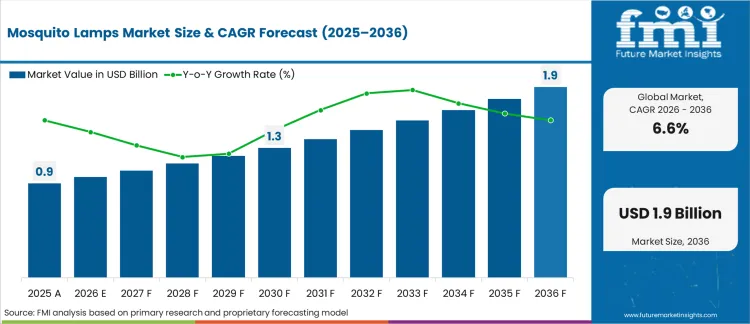
In 2025, the mosquito lamps market crossed USD 0.9 billion. The market is anticipated to be valued at USD 1.0 billion in 2026 and USD 1.8 billion by 2036, growing at a CAGR of 6.6% during the forecast period. The rising incidence of dengue and malaria and compacted urban living have bolstered the demand for mosquito lamps. Property owners and outdoor recreation participants are prioritizing non-toxic insect control solutions and cordless operation through devices that deliver protection without requiring chemical application or continuous monitoring.
Mosquito lamps are evolving from basic “zappers” into smarter, monitored insect-light systems aimed at higher-assurance environments (food/pharma facilities) where flying-insect control links directly to contamination risk and audit requirements. “We’re delighted to showcase Pelsis’ commitment to driving new standards in pest management best practice, by launching our market leading digital insect light trap. The benefits of this intelligent product fit squarely within Pelsis’ vision to help move the sector to a more sustainable way of working alongside nature and our environment, while protecting public health.”, noted, Alex Ashmore, CEO, Pelsis Group.
The market's value proposition is increasingly defined by integrated outdoor lighting solutions that combine illumination capabilities, insect attraction technology, and maintenance-free operation interfaces. Equipment brands are expanding retail partnerships while reinforcing technical credibility through coverage specifications, battery life metrics, and weather resistance ratings.
Summary of Mosquito Lamps Market
- Mosquito Lamps Market Definition
- The industry covers UV light-based insect control devices utilized for outdoor pest management including residential patios, commercial dining areas, and recreational facilities.
- Demand Drivers in the Market
- Rising outdoor living space investment drives equipment acquisition for chemical-free pest control solutions.
- Health awareness regarding vector-borne diseases expands demand for preventative insect control devices.
- Product innovation in solar charging reduces operational costs while maintaining effectiveness standards.
- Key Segments Analyzed in the Report
- Product Type: Electric Mosquito Lamps (46%) versus solar-powered units and portable battery devices.
- Distribution Channel: Online Retail (41%) versus home improvement stores and specialty pest control retailers.
- Geography: High-growth Asia versus mature North American and European markets.
- Analyst Opinion at FMI
- Nandini Roy Choudhury, Senior Consultant for Consumer Products at Future Market Insights, says, "The latest Mosquito Lamps Market Report for 2026 to 2036 highlights how performance verification for outdoor coverage areas is shaping design and compliance priorities across the category. My analysis points to UV spectrum calibration as a key determinant of development timelines, and indicates that mandatory third-party efficacy checks could slow market access for brands targeting cost-sensitive consumers.”
- Strategic Implications/Executive Takeaways
- Reposition product portfolios away from standalone insect zappers toward integrated outdoor lighting solutions that combine pest control with ambient illumination.
- Elevate partnerships with outdoor furniture and patio retailers to a core route-to-market role, rather than limiting them to secondary placement.
- Channel R&D efforts into longer-life battery systems to minimize replacement cycles and strengthen repeat engagement with end users over extended usage periods.
- Methodology
- Validated through direct retail sales data and outdoor product adoption surveys.
- Zero reliance on speculative pest control trend forecasting.
- Based on verifiable brand performance metrics and verified distribution agreements.
Product range expansions in hanging designs, stake-mounted configurations, and tabletop formats across major home improvement retailers underscore how mosquito control equipment is moving from seasonal specialty purchases into year-round outdoor living accessories linked to patio furniture sales and garden equipment categories. Companies are focusing on releasing enhanced product capabilities to achieve positive sales figures.
Mosquito Lamps Market Key Takeaways
| Metric | Value |
|---|---|
| Market Value (2026) | USD 1.0 billion |
| Market Forecast Value (2036) | USD 1.8 billion |
| Forecast CAGR (2026-2036) | 6.6% |
Source: FMI analysis based on proprietary forecasting model and primary research
Mosquito Lamps Market Definition
Mosquito lamps represent a key non-chemical solution within outdoor pest control, covering devices developed to attract and neutralize flying insects in both household and commercial environments. The mosquito lamps market includes worldwide manufacturing, technological development, and sales of UV-enabled insect control units that integrate electric killing mechanisms, wavelength-optimized light systems, and portable power configurations to support effective outdoor insect management across diverse use settings.
Mosquito Lamps Market Inclusions
The report includes a comprehensive analysis of market dynamics, featuring Global and Regional Market Sizes (Volume and Value) and a 10-year Forecast (2026-2036). It covers segmental breakdowns by product type (Electric Mosquito Lamps, Solar-Powered Mosquito Lamps, Battery-Operated Mosquito Lamps, UV Light Mosquito Traps), distribution channels (Home Improvement Retailers, Online Retail, Specialty Pest Control Stores, Direct Sales), and applications (Residential Use, Commercial Spaces, Outdoor Recreation, Hospitality Facilities).
Mosquito Lamps Market Exclusions
The market scope does not cover chemical-based repellents, mosquito coils, skin-applied deterrents, or large-scale professional pest control equipment. It leaves out upstream component participants such as UV light suppliers and electronic parts manufacturers, along with pest management service providers. The assessment is limited to fully assembled, consumer-ready mosquito lamps intended for outdoor use and their direct retail circulation. After-sales repair activities and secondary markets for refurbished or unbranded units fall outside the scope of this study.
Mosquito Lamps Market Research Methodology
- Primary Research: Interviews were conducted with outdoor equipment manufacturers, pest control product representatives, retail buyers, distribution channel managers, and outdoor recreation associations across major markets. Entomology consultants clarified insect attraction technology and effectiveness parameters.
- Desk Research: Consumer purchase data from home improvement retail analytics platforms, outdoor living product adoption rates from lifestyle surveys, and import/export statistics from trade organizations supported market benchmarking.
- Market-Sizing and Forecasting: A hybrid top-down and bottom-up model was developed. Demand was reconstructed from brand sales figures, retail store inventory turnover data, and seasonal purchase pattern volumes, then validated against manufacturing output capacity and distribution network coverage.
- Data Validation and Update Cycle: Outputs undergo variance checks across retail and wholesale datasets, cross-verification with pest control industry associations, and structured expert review prior to release.
Segmental Analysis
Mosquito Lamps Market Analysis by Product Type
The electric mosquito lamps segment is estimated to capture 46% share in 2026. Demand for electric mosquito lamps is rising as households seek safer, chemical free mosquito control for indoor spaces. Growing dengue and malaria incidence increases routine prevention adoption. As per the WHO, dengue affects an estimated 100-400 million people every year. [2] Urban apartment living limits ventilation, raising preference for quiet, low odor devices. Rising night time outdoor leisure, balcony use, and home gardening extend usage hours. E commerce access improves product availability and price comparison. Energy efficient UV LED designs and refill free formats support recurring household adoption.
- UV Attraction Systems: Manufacturers are refining wavelength tuning alongside high-voltage grid design to lift capture and kill efficiency, aligning product performance with buyer expectations across residential patios and hospitality venues where functional proof strongly shapes purchase behavior.
- Coverage Zone Engineering: Lamp designs now emphasize validated protection footprints that balance light spread with effective insect control, supporting premium positioning through certified performance claims across physical retail and direct-to-consumer sales routes.
Mosquito Lamps Market Analysis by Distribution Channel
The online retail segment is projected to hold a 41% market share in 2026. Mosquito lamps are widely sold through online channels as digital marketplaces simplify discovery, comparison, and education for a fragmented category with varied technologies such as UV light traps, fan based suction units, and electric grids. Detailed product pages help buyers assess coverage area, power draw, noise levels, and safety certifications before purchase. Rapid fulfillment suits seasonal demand spikes during monsoon periods. Subscription friendly accessory sales, including replacement bulbs and adhesive pads, improve repeat purchase economics. Influencer demonstrations and short form videos validate performance claims, accelerating conversion rates.
- Performance Transparency Tools: Online channels emphasize clear room coverage metrics, kill-rate benchmarks, and user safety notes, helping health-aware households assess chemical-free mosquito control options with confidence and align purchases with prevention priorities.
- Seasonal Campaign Structuring: Platforms deploy pre-monsoon deal cycles and value bundles to stimulate early buying, locking in demand through bundled refill components, spare lamps, and recurring accessory replacements that extend lifetime value.
Mosquito Lamps Market Drivers, Restraints, and Opportunities
Rising exposure to mosquito borne illnesses across humid and densely populated regions keeps preventive pest control products in regular household purchase cycles, particularly in tropical urban belts where year round breeding persists. Shrinking living spaces and high rise apartment formats limit airflow, increasing indoor insect concentration and making plug in electric control formats more practical than sprays or coils. Health concerns around inhalable chemicals and residue on furnishings shift consumer preference toward non contact electronic pest control products positioned as family safe. Evening focused lifestyles extend device usage hours, raising perceived utility. Declining UV LED and fan component costs support broader pricing tiers, widening access across middle income households.
Effectiveness variability across mosquito species and environmental conditions weakens consistent user satisfaction, particularly in high humidity regions. Noise levels, light brightness, and visible insect residue deter usage in bedrooms and hospitality settings. Limited performance in open or semi outdoor areas restricts functional scope versus sprays or coils. Low quality imports with weak durability erode category trust and shorten replacement cycles. Regulatory scrutiny on electrical safety standards and rising certification costs create compliance burdens for smaller manufacturers in emerging markets.
Technology upgrades using low power UV LED arrays, silent suction fans, and improved airflow design enable better night time usability. Integration of rechargeable batteries and solar assisted charging expands use in semi outdoor and low grid reliability zones. Product differentiation through child safe enclosures and low glare lighting supports placement in sleeping areas. Smart home compatibility and app based monitoring open premium positioning avenues. Institutional demand from schools, clinics, hostels, and hospitality properties offers scalable volume contracts across high exposure regions.
Regional Analysis
Based on regional analysis, the mosquito lamps market is segmented into North America, Europe, and Asia across key countries. The full report also offers market attractiveness analysis based on regional trends.
| Country | CAGR (2026 to 2036) |
|---|---|
| United States | 7.2% |
| United Kingdom | 6.1% |
| Germany | 6.4% |
| China | 8.5% |
| India | 8.9% |
Source: Market analysis based on proprietary forecasting model and primary research
North America Mosquito Lamps Market Analysis
North America's mosquito lamps market is expanding significantly. Strong discretionary incomes enable faster replacement cycles and upgrades toward quieter, higher-coverage devices. Cross-merchandising with outdoor furniture and garden assortments lifts visibility, while integrated lighting formats encourage repeat purchases across seasonal refresh cycles. Growing preference for low maintenance home solutions supports demand for refill free devices. Product standardization across big box retail improves consumer trust, lifting category conversion rates.
- United States: The mosquito lamps market in the United States is anticipated to grow at 7.2% CAGR during the study period. The market is gaining momentum as guidance and oversight from USA Environmental Protection Agency shape how households evaluate chemical pest control products used indoors. [3] Stricter labeling, safety reviews, and use-pattern disclosures around conventional repellents encourage consumers to adopt electric, non-chemical alternatives for routine home use. Certification requirements and electrical safety standards improve confidence in enclosed lamp designs for family spaces.
The study provides a focused assessment of expansion patterns across North America, outlining how outdoor living habits, shifts in retail formats, and category-level product strategies are shaping regional market development.
Europe Mosquito Lamps Market Analysis
Europe’s mosquito lamp category continues to evolve through incremental product upgrades aligned with changing outdoor usage patterns across households and leisure venues. Design roadmaps increasingly show product safety and sustainability guidance shaped by European Chemicals Agency, encouraging lower chemical reliance and safer consumer product positioning. [4] Eco-conscious priorities are driving greater use of recyclable housing materials, reduced plastic content, and lower-energy UV or LED light sources to limit environmental impact during prolonged outdoor use. Packaging formats are shifting toward reduced-volume cartons and fiber-based materials to meet retailer sustainability scorecards and circularity benchmarks.
- Germany: The mosquito lamps market in Germany is expected to grow at a 6.4% CAGR from 2026 to 2036, supported by rising uptake of electric pest control devices within suburban housing developments and increased installation across campsites, holiday parks, and lakeside recreational areas where insect exposure remains persistent during warmer months.
- United Kingdom: Demand for mosquito lamps in the United Kingdom is set to grow at a 6.1% CAGR during the study period, driven by wider use of outdoor heating and covered terrace setups that extend evening outdoor activity seasons, along with higher penetration of compact, weather-resistant mosquito control units suited to smaller residential outdoor spaces.
This section provides a focused review of mosquito lamp demand across key European markets, with dedicated coverage of the United Kingdom and Germany. It outlines how compliance frameworks for outdoor electrical products and rising preference for chemical-free control methods are shaping category uptake across the region.
Asia Mosquito Lamps Market Analysis
Regional producers are advancing low-cost power configurations suited to compact living formats, while multinational brands concentrate on performance-led positioning for hospitality and residential complexes seeking higher efficacy benchmarks. China remains a central manufacturing hub for mosquito trap and control equipment, supplying UV modules, electronic assemblies, and integrated lighting components used in outdoor and peri-urban pest management applications.
- China: The mosquito lamp market in China is set to grow at 8.5% CAGR during the study period. Growth is driven by rapid scaling of locally branded mosquito trap devices designed for compact balconies and shared outdoor corridors, alongside broad availability of domestically produced UV modules and control units that improve product accessibility across price tiers.
- India: The mosquito lamp industry in India is set to expand at 8.9% CAGR during the forecast period, supported by rising dengue awareness creating foundation for preventative device adoption and local manufacturing using cost-effective production methods. The country is also witnessing a significant expansion in manufacturing sector, which is leading to the creation of advanced products. [5]
The report delivers comprehensive coverage of the mosquito lamps market across Asia for the 2021 to 2036 period, with focused evaluation of demand patterns in China and India. It examines how usage of outdoor and semi-outdoor spaces is shaping product uptake, maps shifts in retail and e-commerce channel structures, and reviews performance benchmark trends influencing product positioning. The analysis also outlines pricing architecture strategies that support deeper category reach across varied income segments within the region.
Competitive Landscape for Mosquito Lamps Market Players
Established players maintain visibility through wide retail presence across garden centers, DIY chains, and online marketplaces, while smaller regional brands compete on value positioning and localized product configurations suited to compact outdoor spaces. Product differentiation increasingly centers on coverage range verification, power efficiency, and durability under varying weather conditions, pushing companies to refine enclosure design, grid safety mechanisms, and UV light performance stability.
Innovation cycles are shaped by incremental upgrades rather than breakthrough technologies, with competitive advantage linked to faster design refreshes aligned with seasonal demand cycles. Branding strategies emphasize reliability and safety compliance to build trust among household buyers, while hospitality-focused offerings prioritize extended runtime and higher attraction capacity. Partnerships with outdoor furniture retailers and e-commerce platforms strengthen route-to-market efficiency and bundled promotion strategies. Supply chain control over UV modules, battery systems, and casing materials supports margin stability, while regional assembly capabilities help manage cost pressures in price-sensitive markets. Competitive intensity remains elevated as new private-label entries continue to expand assortment breadth within mainstream retail channels.
Recent Developments
The report includes comprehensive coverage of key industry developments and competitive positioning:
- In March 2025, Thermacell Repellents, Inc. the leading manufacturer of trusted and highly effective zone mosquito repellents rolled out E65 Rechargeable Mosquito Repeller + Fast Charging Dock. It features a convenient drop-in charging dock, 3x faster charging, and a longer battery life. [6]
- In August 2024, Thermacell Repellents, Inc., the leading manufacturer of trusted and highly effective zone mosquito repellents inked a deal with Kennebunkport Resort Collection (KRC), the group behind renowned properties. This deal is set to bolster the company’s footprint in the hospitality space. [7]
Key Players in Mosquito Lamps Market
- Thermacell Repellents, Inc.
- Stanley Black & Decker
- Aspectek
- Flowtron Outdoor Products
- Gardner Fly Light Co.
- Summit Responsible Solutions
- Woodstream Corporation
Scope of the Report
| Metric | Value |
|---|---|
| Quantitative Units | USD 1.0 billion (2026) to USD 1.8 billion (2036), at a CAGR of 6.6% |
| Market Definition | The mosquito lamps market comprises the global development, production, and distribution of UV light-based insect control devices including electric zappers, solar-powered traps, and battery-operated units designed for outdoor pest management across residential and commercial applications. |
| Product Type Segmentation | Electric Mosquito Lamps, Solar-Powered Mosquito Lamps, Battery-Operated Mosquito Lamps, UV Light Mosquito Traps |
| Distribution Channel Coverage | Home Improvement Retailers, Online Retail, Specialty Pest Control Stores, Direct Sales |
| Application Segmentation | Residential Use, Commercial Spaces, Outdoor Recreation, Hospitality Facilities |
| Regions Covered | North America, Europe, Asia |
| Countries Covered | USA, UK, India, Germany, China |
| Key Companies Profiled | Thermacell Repellents Inc., Stanley Black & Decker, Aspectek, Flowtron Outdoor Products, Gardner Fly Light Co., Summit Responsible Solutions, Woodstream Corporation |
| Forecast Period | 2026 to 2036 |
| Approach | Hybrid top down and bottom up market modeling validated through retail sales tracking and outdoor product adoption surveys, supported by distribution network verification and seasonal purchase pattern analysis |
Key Segments Profiled in the Mosquito Lamps Market
Product Type
- Electric Mosquito Lamps
- Solar-Powered Mosquito Lamps
- Battery-Operated Mosquito Lamps
- UV Light Mosquito Traps
Distribution Channel
- Home Improvement Retailers
- Online Retail
- Specialty Pest Control Stores
- Direct Sales
- Others (outdoor furniture retailers, garden center partnerships)
Application
- Residential Use
- Commercial Spaces
- Outdoor Recreation
- Hospitality Facilities
Region
- Asia Pacific
- China
- Japan
- South Korea
- India
- Australia
- Singapore
- Thailand
- Rest of Asia Pacific
- Europe
- United Kingdom
- Germany
- France
- Italy
- Spain
- Netherlands
- Scandinavia
- Switzerland
- Rest of Europe
- North America
- United States
- Canada
- Latin America
- Brazil
- Mexico
- Argentina
- Rest of Latin America
- Middle East & Africa
- United Arab Emirates
- Saudi Arabia
- South Africa
- Israel
- Rest of Middle East & Africa
Bibliography
- [1] BrightAI. (2023, December 17). BrightAI and Pelsis launch next-gen AI flylights revolutionizing pest control.
- [2] World Health Organization. (n.d.). Dengue and severe dengue.
- [3] USA Environmental Protection Agency. (n.d.). Pesticide registration.
- [4] European Commission. (n.d.). Biocidal products.
- [5] Ministry of Micro, Small & Medium Enterprises, Government of India. (2025). MSME annual report 2024–25 (English).
- [6] Thermacell Repellents, Inc. (2025, March 18). Thermacell® introduces the E65 rechargeable mosquito repeller + fast charging dock to extend your time outdoors. Thermacell Blog.
- [7] Thermacell Repellents, Inc. (2024, July 30). Thermacell and Kennebunkport Resort Collection partner to provide mosquito-protected hotel stays. PR Newswire.
This bibliography is provided for reader reference and is not exhaustive. The full report contains the complete reference list and detailed citations.
This Report Addresses
- Market intelligence to enable strategic decision making across established and emerging outdoor living markets
- Market size estimation and 10-year revenue forecasts from 2026 to 2036, supported by validated retail sales data and outdoor product adoption surveys
- Growth opportunity mapping across product types and application segments with emphasis on effectiveness optimization
- Segment and regional revenue forecasts covering electric lamps, solar-powered units, battery-operated devices, and retail distribution networks
- Competition strategy assessment including outdoor retailer partnership requirements, coverage specification positioning, and power source technology adoption
- Product development tracking including UV LED innovations, solar charging integration trends, and weatherproof design capabilities
- Market access analysis covering distribution agreements, outdoor furniture retailer partnerships, and hospitality sector engagement programs
- Market report delivery in PDF, Excel, PPT, and interactive dashboard formats for executive and operational use
Frequently Asked Questions
How large is the demand for Mosquito Lamps in the global market in 2026?
Demand for Mosquito Lamps in the global market is estimated to be valued at USD 1.0 billion in 2026.
What will be the market size of Mosquito Lamps in the global market by 2036?
Market size for Mosquito Lamps is projected to reach USD 1.8 billion by 2036.
What is the expected demand growth for Mosquito Lamps in the global market between 2026 and 2036?
Demand for Mosquito Lamps in the global market is expected to grow at a CAGR of 6.6% between 2026 and 2036.
Which Product Type is poised to lead global sales by 2026?
Electric Mosquito Lamps is expected to be the dominant product type, capturing approximately 46.0% of global market share in 2026 due to grid-based elimination technology and consistent power supply advantages.
How significant is the role of Online Retail in driving Mosquito Lamps adoption in 2026?
Online retail represents a primary distribution channel, projected to hold approximately 41% share of the total market in 2026 as effectiveness information tools and broader product selection maintain digital channel relevance.
What is Driving Mosquito Lamps Demand in the United States?
Patio installation trends and increased outdoor dining preferences across residential categories are driving growth.
What Consumer Trends are Referenced for the United States?
Outdoor living space expansion patterns and chemical-free pest control preference shifts are referenced as key consumer behavior changes.
What is the United States Growth Outlook in this Report?
The United States is projected to grow at a CAGR of 7.2% during 2026 to 2036.
Why is Europe described as Important for Product Development in this Report?
Growth is driven by environmental regulation compliance and health safety preferences that establish chemical-free equipment specifications.
What Type of Product Development Dominates in Europe?
Eco-conscious pest control devices with garden integration and solar power capabilities dominate regional market segments.
What is Germany Growth Outlook in this Report?
Germany is projected to expand at a CAGR of 6.4% during 2026 to 2036.
What is United Kingdom Growth Outlook in this Report?
United Kingdom is projected to expand at a CAGR of 6.1% during 2026 to 2036.
Does the Report Cover China in its Regional Analysis?
China is included within Asia under the regional scope of analysis.
What are the Sources referred to for analyzing the Market in China?
Domestic manufacturing capacity data, urban outdoor space development statistics, and local brand performance tracking covering purchase patterns, price sensitivity analysis, and product preference evolution are cited as primary reference sources.
What is the Main Development Theme Linked to China in Asia Coverage?
Asia development is associated with domestic manufacturing capacity growth enabling product standardization across residential segments.
Does the Report Cover India in its Regional Analysis?
India is included within Asia under the regional coverage framework.
What is the Main India Related Development Theme in Asia Coverage?
Rising dengue awareness creating foundation for preventative device adoption and local manufacturing using cost-effective production methods is emphasized.
Which Distribution Strategies are Strategically Important for Asia Market Entry?
Outdoor furniture retailer partnerships and garden center programs are prioritized for cost-effective brand building across regional markets.
What is Mosquito Lamps and What is It Mainly Used For?
Mosquito lamps involve UV light-based insect control devices primarily used for outdoor pest management including residential patios, commercial dining areas, and recreational facilities.
What does Mosquito Lamps Market Mean in this Report?
Mosquito lamps market refers to global development, manufacturing, and retail distribution of pest control lighting equipment across various application categories and user segments.
What is Included in the Scope of this Mosquito Lamps Market Report?
Scope covers devices by product type, key distribution channels such as home improvement retailers and online platforms, and application segments including residential use, commercial spaces, and hospitality facilities.
What is Excluded from the Scope of this Report?
Chemical insect repellents, mosquito coils, topical repellent lotions, and industrial-grade pest control systems are excluded unless part of mosquito lamp product offerings.
What does Market Forecast Mean on this Page?
Market forecast represents model-based projections built on retail sales trends and outdoor product adoption assumptions for strategic planning purposes.
How is the Mosquito Lamps Market Forecast Built and Validated?
Forecast is developed using hybrid modeling validated through retail point-of-sale data, outdoor product adoption surveys, and distribution network verification.
What does Zero Reliance on Speculative Third Party Market Research Mean Here?
Market analysis is based on verifiable sales figures, outdoor product adoption data, and equipment purchase patterns rather than speculative pest control trend predictions.
Preview the report firsthand - request a free sample
Get SampleGet the brochure for pricing and purchase details.
Get PDFTable of Content
- Executive Summary
- Global Market Outlook
- Demand-side Trends
- Supply-side Trends
- Technology Roadmap Analysis
- Analysis and Recommendations
- Market Overview
- Market Coverage / Taxonomy
- Market Definition / Scope / Limitations
- Research Methodology
- Chapter Orientation
- Analytical Lens and Working Hypotheses
- Market Structure, Signals, and Trend Drivers
- Benchmarking and Cross-market Comparability
- Market Sizing, Forecasting, and Opportunity Mapping
- Research Design and Evidence Framework
- Desk Research Programme (Secondary Evidence)
- Company Annual and Sustainability Reports
- Peer-reviewed Journals and Academic Literature
- Corporate Websites, Product Literature, and Technical Notes
- Earnings Decks and Investor Briefings
- Statutory Filings and Regulatory Disclosures
- Technical White Papers and Standards Notes
- Trade Journals, Industry Magazines, and Analyst Briefs
- Conference Proceedings, Webinars, and Seminar Materials
- Government Statistics Portals and Public Data Releases
- Press Releases and Reputable Media Coverage
- Specialist Newsletters and Curated Briefings
- Sector Databases and Reference Repositories
- FMI Internal Proprietary Databases and Historical Market Datasets
- Subscription Datasets and Paid Sources
- Social Channels, Communities, and Digital Listening Inputs
- Additional Desk Sources
- Expert Input and Fieldwork (Primary Evidence)
- Primary Modes
- Qualitative Interviews and Expert Elicitation
- Quantitative Surveys and Structured Data Capture
- Blended Approach
- Why Primary Evidence is Used
- Field Techniques
- Interviews
- Surveys
- Focus Groups
- Observational and In-context Research
- Social and Community Interactions
- Stakeholder Universe Engaged
- C-suite Leaders
- Board Members
- Presidents and Vice Presidents
- R&D and Innovation Heads
- Technical Specialists
- Domain Subject-matter Experts
- Scientists
- Physicians and Other Healthcare Professionals
- Governance, Ethics, and Data Stewardship
- Research Ethics
- Data Integrity and Handling
- Primary Modes
- Tooling, Models, and Reference Databases
- Desk Research Programme (Secondary Evidence)
- Data Engineering and Model Build
- Data Acquisition and Ingestion
- Cleaning, Normalisation, and Verification
- Synthesis, Triangulation, and Analysis
- Quality Assurance and Audit Trail
- Market Background
- Market Dynamics
- Drivers
- Restraints
- Opportunity
- Trends
- Scenario Forecast
- Demand in Optimistic Scenario
- Demand in Likely Scenario
- Demand in Conservative Scenario
- Opportunity Map Analysis
- Product Life Cycle Analysis
- Supply Chain Analysis
- Investment Feasibility Matrix
- Value Chain Analysis
- PESTLE and Porter’s Analysis
- Regulatory Landscape
- Regional Parent Market Outlook
- Production and Consumption Statistics
- Import and Export Statistics
- Market Dynamics
- Global Market Analysis 2021 to 2025 and Forecast, 2026 to 2036
- Historical Market Size Value (USD Million) Analysis, 2021 to 2025
- Current and Future Market Size Value (USD Million) Projections, 2026 to 2036
- Y-o-Y Growth Trend Analysis
- Absolute $ Opportunity Analysis
- Global Market Pricing Analysis 2021 to 2025 and Forecast 2026 to 2036
- Global Market Analysis 2021 to 2025 and Forecast 2026 to 2036, By Product Type
- Introduction / Key Findings
- Historical Market Size Value (USD Million) Analysis By Product Type , 2021 to 2025
- Current and Future Market Size Value (USD Million) Analysis and Forecast By Product Type , 2026 to 2036
- Electric Mosquito Lamps
- Solar-Powered Mosquito Lamps
- Battery-Operated Mosquito Lamps
- Electric Mosquito Lamps
- Y-o-Y Growth Trend Analysis By Product Type , 2021 to 2025
- Absolute $ Opportunity Analysis By Product Type , 2026 to 2036
- Global Market Analysis 2021 to 2025 and Forecast 2026 to 2036, By Distribution Channel
- Introduction / Key Findings
- Historical Market Size Value (USD Million) Analysis By Distribution Channel, 2021 to 2025
- Current and Future Market Size Value (USD Million) Analysis and Forecast By Distribution Channel, 2026 to 2036
- Online Retail
- Home Improvement Retailers
- Direct Sales
- Online Retail
- Y-o-Y Growth Trend Analysis By Distribution Channel, 2021 to 2025
- Absolute $ Opportunity Analysis By Distribution Channel, 2026 to 2036
- Global Market Analysis 2021 to 2025 and Forecast 2026 to 2036, By Region
- Introduction
- Historical Market Size Value (USD Million) Analysis By Region, 2021 to 2025
- Current Market Size Value (USD Million) Analysis and Forecast By Region, 2026 to 2036
- North America
- Latin America
- Western Europe
- Eastern Europe
- East Asia
- South Asia and Pacific
- Middle East & Africa
- Market Attractiveness Analysis By Region
- North America Market Analysis 2021 to 2025 and Forecast 2026 to 2036, By Country
- Historical Market Size Value (USD Million) Trend Analysis By Market Taxonomy, 2021 to 2025
- Market Size Value (USD Million) Forecast By Market Taxonomy, 2026 to 2036
- By Country
- USA
- Canada
- Mexico
- By Product Type
- By Distribution Channel
- By Country
- Market Attractiveness Analysis
- By Country
- By Product Type
- By Distribution Channel
- Key Takeaways
- Latin America Market Analysis 2021 to 2025 and Forecast 2026 to 2036, By Country
- Historical Market Size Value (USD Million) Trend Analysis By Market Taxonomy, 2021 to 2025
- Market Size Value (USD Million) Forecast By Market Taxonomy, 2026 to 2036
- By Country
- Brazil
- Chile
- Rest of Latin America
- By Product Type
- By Distribution Channel
- By Country
- Market Attractiveness Analysis
- By Country
- By Product Type
- By Distribution Channel
- Key Takeaways
- Western Europe Market Analysis 2021 to 2025 and Forecast 2026 to 2036, By Country
- Historical Market Size Value (USD Million) Trend Analysis By Market Taxonomy, 2021 to 2025
- Market Size Value (USD Million) Forecast By Market Taxonomy, 2026 to 2036
- By Country
- Germany
- UK
- Italy
- Spain
- France
- Nordic
- BENELUX
- Rest of Western Europe
- By Product Type
- By Distribution Channel
- By Country
- Market Attractiveness Analysis
- By Country
- By Product Type
- By Distribution Channel
- Key Takeaways
- Eastern Europe Market Analysis 2021 to 2025 and Forecast 2026 to 2036, By Country
- Historical Market Size Value (USD Million) Trend Analysis By Market Taxonomy, 2021 to 2025
- Market Size Value (USD Million) Forecast By Market Taxonomy, 2026 to 2036
- By Country
- Russia
- Poland
- Hungary
- Balkan & Baltic
- Rest of Eastern Europe
- By Product Type
- By Distribution Channel
- By Country
- Market Attractiveness Analysis
- By Country
- By Product Type
- By Distribution Channel
- Key Takeaways
- East Asia Market Analysis 2021 to 2025 and Forecast 2026 to 2036, By Country
- Historical Market Size Value (USD Million) Trend Analysis By Market Taxonomy, 2021 to 2025
- Market Size Value (USD Million) Forecast By Market Taxonomy, 2026 to 2036
- By Country
- China
- Japan
- South Korea
- By Product Type
- By Distribution Channel
- By Country
- Market Attractiveness Analysis
- By Country
- By Product Type
- By Distribution Channel
- Key Takeaways
- South Asia and Pacific Market Analysis 2021 to 2025 and Forecast 2026 to 2036, By Country
- Historical Market Size Value (USD Million) Trend Analysis By Market Taxonomy, 2021 to 2025
- Market Size Value (USD Million) Forecast By Market Taxonomy, 2026 to 2036
- By Country
- India
- ASEAN
- Australia & New Zealand
- Rest of South Asia and Pacific
- By Product Type
- By Distribution Channel
- By Country
- Market Attractiveness Analysis
- By Country
- By Product Type
- By Distribution Channel
- Key Takeaways
- Middle East & Africa Market Analysis 2021 to 2025 and Forecast 2026 to 2036, By Country
- Historical Market Size Value (USD Million) Trend Analysis By Market Taxonomy, 2021 to 2025
- Market Size Value (USD Million) Forecast By Market Taxonomy, 2026 to 2036
- By Country
- Kingdom of Saudi Arabia
- Other GCC Countries
- Turkiye
- South Africa
- Other African Union
- Rest of Middle East & Africa
- By Product Type
- By Distribution Channel
- By Country
- Market Attractiveness Analysis
- By Country
- By Product Type
- By Distribution Channel
- Key Takeaways
- Key Countries Market Analysis
- USA
- Pricing Analysis
- Market Share Analysis, 2025
- By Product Type
- By Distribution Channel
- Canada
- Pricing Analysis
- Market Share Analysis, 2025
- By Product Type
- By Distribution Channel
- Mexico
- Pricing Analysis
- Market Share Analysis, 2025
- By Product Type
- By Distribution Channel
- Brazil
- Pricing Analysis
- Market Share Analysis, 2025
- By Product Type
- By Distribution Channel
- Chile
- Pricing Analysis
- Market Share Analysis, 2025
- By Product Type
- By Distribution Channel
- Germany
- Pricing Analysis
- Market Share Analysis, 2025
- By Product Type
- By Distribution Channel
- UK
- Pricing Analysis
- Market Share Analysis, 2025
- By Product Type
- By Distribution Channel
- Italy
- Pricing Analysis
- Market Share Analysis, 2025
- By Product Type
- By Distribution Channel
- Spain
- Pricing Analysis
- Market Share Analysis, 2025
- By Product Type
- By Distribution Channel
- France
- Pricing Analysis
- Market Share Analysis, 2025
- By Product Type
- By Distribution Channel
- India
- Pricing Analysis
- Market Share Analysis, 2025
- By Product Type
- By Distribution Channel
- ASEAN
- Pricing Analysis
- Market Share Analysis, 2025
- By Product Type
- By Distribution Channel
- Australia & New Zealand
- Pricing Analysis
- Market Share Analysis, 2025
- By Product Type
- By Distribution Channel
- China
- Pricing Analysis
- Market Share Analysis, 2025
- By Product Type
- By Distribution Channel
- Japan
- Pricing Analysis
- Market Share Analysis, 2025
- By Product Type
- By Distribution Channel
- South Korea
- Pricing Analysis
- Market Share Analysis, 2025
- By Product Type
- By Distribution Channel
- Russia
- Pricing Analysis
- Market Share Analysis, 2025
- By Product Type
- By Distribution Channel
- Poland
- Pricing Analysis
- Market Share Analysis, 2025
- By Product Type
- By Distribution Channel
- Hungary
- Pricing Analysis
- Market Share Analysis, 2025
- By Product Type
- By Distribution Channel
- Kingdom of Saudi Arabia
- Pricing Analysis
- Market Share Analysis, 2025
- By Product Type
- By Distribution Channel
- Turkiye
- Pricing Analysis
- Market Share Analysis, 2025
- By Product Type
- By Distribution Channel
- South Africa
- Pricing Analysis
- Market Share Analysis, 2025
- By Product Type
- By Distribution Channel
- USA
- Market Structure Analysis
- Competition Dashboard
- Competition Benchmarking
- Market Share Analysis of Top Players
- By Regional
- By Product Type
- By Distribution Channel
- Competition Analysis
- Competition Deep Dive
- Thermacell Repellents, Inc.
- Overview
- Product Portfolio
- Profitability by Market Segments (Product/Age /Sales Channel/Region)
- Sales Footprint
- Strategy Overview
- Marketing Strategy
- Product Strategy
- Channel Strategy
- Stanley Black & Decker
- Aspectek
- Flowtron Outdoor Products
- Gardner Fly Light Co.
- Summit Responsible Solutions
- Woodstream Corporation
- Thermacell Repellents, Inc.
- Competition Deep Dive
- Assumptions & Acronyms Used


