

- Market Size (2026)
- USD 7.8 Bn
- Forecast (2036)
- USD 33.2 Bn
- CAGR (2026 to 2036)
- 15.6%
How big is NLP in Healthcare and Life Sciences Market in 2026?
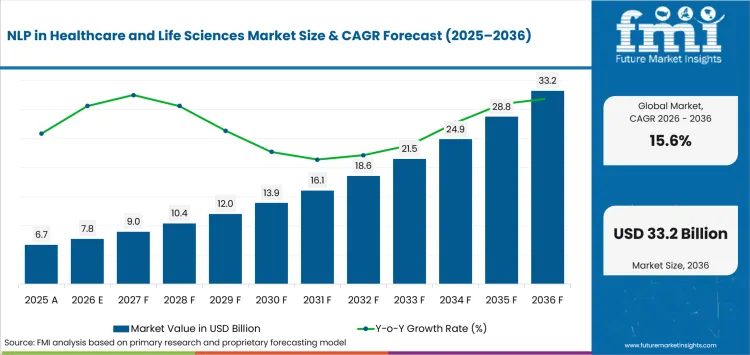
USD 7.8 billion in 2026 and USD 33.2 billion by 2036 at a 15.6% CAGR.
Demand for NLP in healthcare and life sciences is projected to expand at 15.6% CAGR between 2026 and 2036, increasing valuation from USD 7.8 billion in 2026 to USD 33.2 billion by 2036. Commercial adoption depends on whether extraction, classification, summarization or search can be connected to a defined clinical, coding or research workflow with an authorized reviewer.
Clinical text already sits inside widely deployed digital health systems. As of 2015 data cited by the USA Office of the National Coordinator for Health Information Technology, certified health IT supported care delivered by more than 96% of non-federal acute care hospitals and 78% of office-based physicians; more recent CDC data put certified-EHR adoption among office-based physicians at 84% as of 2024. This installed base makes EHR integration, source traceability and model-governance evidence practical requirements for NLP purchasing rather than optional platform features.
Key Takeaways of NLP in Healthcare and Life Sciences Market
- Reviewable clinical and scientific text processing expands as healthcare organizations connect NLP outputs with defined workflow owners and supporting evidence.
- Software is projected at 53.0% share in 2026 because recurring extraction, search and summarization functions are purchased through platforms integrated with health and research systems.
- Clinical documentation is estimated at 29.0% of application demand in 2026 owing to repeated note creation, review and EHR handoff during care delivery.
- Cloud-based deployment is forecast at 64.0% in 2026 as managed services provide scalable APIs and model infrastructure for distributed users.
- Validation, privacy controls and terminology coverage limit adoption when fluent output cannot be traced, corrected or approved inside the intended workflow.
- Microsoft Corporation, Oracle Health, IQVIA Holdings Inc., Amazon Web Services (AWS), Google Cloud, Solventum Corporation, NVIDIA Corporation, SAS Institute Inc., John Snow Labs and IBM Corporation serve clinical, coding, research or infrastructure routes.
Analyst Perspective
"The commercial test is whether an NLP system produces an output that a clinician, coder or scientist can inspect and use inside an existing process. Buyers should compare source traceability, terminology coverage and human approval at the workflow level rather than treating general language fluency as evidence of clinical readiness."
- Anurag Sharma,, Principal Consultant, Future Market Insights
How is the NLP in Healthcare and Life Sciences Market segmented?
The NLP in healthcare and life sciences market is segmented by component, application, deployment, end user, technology and region.
NLP in healthcare and life sciences is segmented by component, application, deployment, end user, technology and region across clinical and scientific workflows. Component separates software, services and hardware spending. Application covers documentation, coding and billing, drug discovery and clinical research, and decision support. Deployment distinguishes cloud-based, on-premises and hybrid operating models. End user identifies healthcare providers, pharmaceutical and biotechnology companies, healthcare payers and other research or public organizations. Technology separates machine learning-based, transformer-based, rule-based and hybrid or speech-linked NLP approaches.
Why does software lead the component category?
Software provides the recurring extraction, normalization, classification, summarization and search functions that users access through clinical or research applications. Platform value increases when terminology models, review interfaces and connectors can be reused across more than one text source without rebuilding the workflow for each department.
- Based on component, software is projected to account for 53.0% in 2026 because platform purchases connect NLP processing with EHR, coding and research systems.
- IQVIA describes an NLP platform that can search and transform unstructured text across local and cloud sources, while its human-assisted review tooling keeps extracted evidence available for inspection. Services and hardware remain important, but they support implementation, governance and processing capacity around the software layer.
Why does clinical documentation lead the application category?
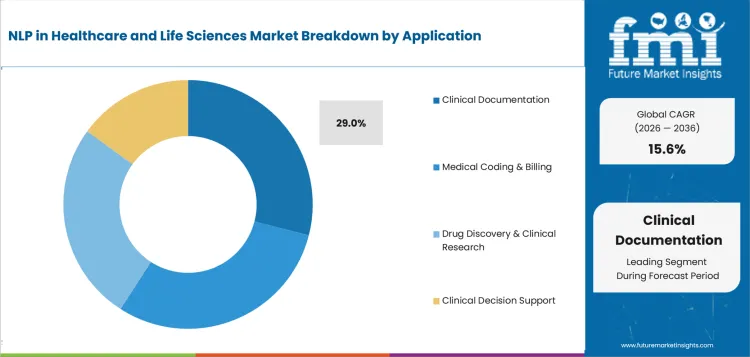
Clinical documentation places NLP inside a frequent workflow with a clear source, reviewer and destination. Ambient capture, dictation and note drafting can reduce manual preparation, but the draft still needs to preserve clinical meaning and fit the documentation standards of the receiving EHR.
- In 2026, clinical documentation is expected to lead the application category with 29.0% share because notes and summaries create repeated demand for structured, reviewable output.
- Microsoft introduced Dragon Copilot in March 2025 with ambient note creation, natural-language dictation, information retrieval and task support in one clinical assistant. Oracle Health separately describes draft notes and proposed next steps that clinicians review inside its EHR workflow, showing why integration depth matters as much as text generation.
Why does cloud-based deployment lead the deployment category?
Cloud-based deployment gives buyers access to managed language services, model infrastructure and application interfaces without maintaining every processing layer locally. The operating advantage depends on where data is stored, which regions support the service and whether the organization can enforce identity, logging and review requirements.
- The deployment category is forecast to be led by cloud-based systems at 64.0% share in 2026 due to scalable APIs and managed processing across connected applications.
- Amazon Comprehend Medical extracts entities from unstructured clinical text and links selected outputs to medical ontologies for coding, claims and trial workflows. Google Cloud has shifted medical text processing to general-availability Gemini models on Vertex AI after deprecating its standalone Healthcare Natural Language API in May 2025, illustrating how managed scale still requires a defined review path.
Why do healthcare providers lead the end-user category?
Healthcare providers generate clinical notes, discharge summaries, test results and administrative records throughout care delivery. Hospitals and health systems can therefore apply NLP to documentation, coding and decision-support workflows using data already produced inside their operating systems.
- Healthcare providers are projected to account for 36.0% of end-user demand in 2026 because recurring care delivery produces a continuous volume of clinical text.
- The ONC's most recent published figures (2015) show certified health IT adoption at more than 96% of USA hospitals and 78% of office-based physicians, with more recent CDC survey data (2024) showing 84% of office-based physicians using a certified EHR system. A large installed EHR base lowers the distribution barrier for NLP functions, although each organization still needs local validation, permissions and accountable clinical ownership.
Why does machine learning-based NLP lead the technology category?
Machine learning-based NLP supports entity detection, classification and summarization where teams can evaluate performance against a defined corpus and task. Transformer-based models extend context handling, while rule-based systems remain useful when terminology and decision logic must be explicit and stable.
- Machine learning-based NLP is forecast to lead technology with 41.0% share in 2026 because supervised and deep-learning models support repeatable extraction across clinical and scientific text.
- Amazon Comprehend Medical uses pretrained NLP models to detect clinical entities, link selected terms to ICD-10-CM, RxNorm or SNOMED CT and return confidence scores. The service documentation also warns that users must select thresholds appropriate to the use case, reinforcing the need to evaluate model output within the intended workflow.
What are the drivers, restraints and opportunities in the NLP in Healthcare and Life Sciences Market?
Unstructured clinical and scientific text expands demand for reviewable extraction while validation and privacy obligations restrain deployment as cloud and hybrid workflows connect NLP with documentation, coding and research.
- Driver: Clinical notes, reports, literature and trial records contain information that organizations need to search, structure and summarize within recurring workflows.
- Restraint: Clinical validation, terminology coverage, privacy controls and integration work can slow deployment when outputs affect care, coding or regulated evidence.
- Opportunity: Cloud and hybrid operating models can connect documentation, revenue-cycle and life sciences workflows while retaining local controls and human approval.
The driver is the repeated creation of text that remains difficult to query when it stays inside notes, reports and documents. AWS identifies physicians’ notes, discharge summaries, test results and case notes as sources for clinical entity extraction, while IQVIA positions NLP across healthcare and life sciences from bench to bedside. These routes give buyers a defined starting workflow rather than a general-purpose language project.
The restraint is the need to show that an output is suitable for its intended use. FDA lifecycle guidance for AI-enabled device software, ONC algorithm-transparency requirements and current guidance from Health Canada and the UK MHRA place attention on evidence, risk management and user understanding. Multilingual coverage also matters because some managed clinical NLP services remain limited to specific languages or regions.
The opportunity is a controlled operating model that combines managed processing with internal data systems and accountable review. Cloud-based services can scale extraction and summarization, while on-premises or hybrid deployment can keep selected data and models within local infrastructure. Life sciences teams can apply the same model to literature mining, medical coding, pharmacovigilance and trial evidence without treating generated output as a substitute for scientific judgment.
Which country CAGRs are profiled in the NLP in Healthcare and Life Sciences Market?
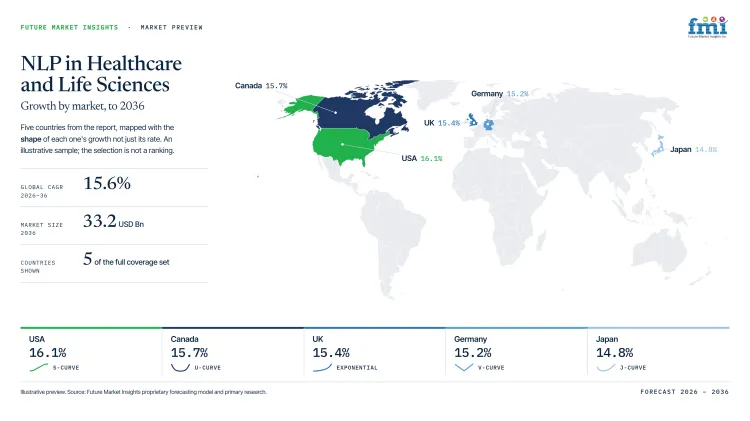
| Country | CAGR |
|---|---|
| USA | 16.1% |
| Canada | 15.7% |
| UK | 15.4% |
| Germany | 15.2% |
| Japan | 14.8% |
How do country-level CAGRs compare in the NLP in Healthcare and Life Sciences Market?
The seven profiled CAGRs span 2.0 percentage points across different health-data systems, regulatory pathways and language environments. The spacing measures expected expansion rather than current market size, installed software or the speed of an individual procurement cycle.
- The USA combines a large EHR installed base with algorithm-transparency and lifecycle expectations that reward vendors able to document model evidence and workflow governance.
- Canada follows closely as current pre-market guidance for machine-learning-enabled medical devices clarifies the evidence expected for Class II, III and IV submissions.
- The UK links market access with software classification, clinical evidence and post-market responsibilities, which favors suppliers with a clearly bounded intended use.
- Germany supports secure health-data use and AI-assisted analysis of unstructured information through its digitalisation strategy, while interoperability determines execution speed.
- Japan maintains a structured review focus on bias, training data and post-market learning, creating demand for local evidence and careful lifecycle management.
Comparable CAGRs can produce different market-entry conditions. The full report provides country-level analysis across North America, Latin America, Western Europe, Eastern Europe, East Asia, South Asia and Pacific, and the Middle East and Africa.
Country-wise Analysis
- The United States combines a broad EHR installed base with explicit expectations for algorithm transparency and lifecycle risk management. ONC’s HTI-1 Final Rule establishes transparency requirements for predictive algorithms in certified health IT, while FDA guidance addresses AI-enabled device software across the product lifecycle. USA demand is estimated to expand at 16.1% CAGR, with commercial advantage shifting toward suppliers that make source attributes, performance evidence and review responsibility visible.
- Canadian procurement is shaped by health-system digitisation and a current regulatory pathway for machine-learning-enabled medical devices. Health Canada’s April 2026 guidance applies to Class II, III and IV licence applications and requires objective evidence supporting intended use, safety and effectiveness. The Canadian market is forecast to advance at 15.7% CAGR as vendors align NLP deployment with documented validation and local data-handling requirements.
- United Kingdom buyers assess healthcare NLP against software classification, clinical evidence and post-market obligations. MHRA guidance explains when software and AI are regulated as medical devices, while the government’s 2025 response on AI medical-device regulation reinforces safe innovation and stronger surveillance. The UK market is projected to grow at 15.4% CAGR, with adoption favoring tools that define intended use and support evaluation inside National Health Service or private-care workflows.
- Germany provides a demand route through national health-data and interoperability initiatives that support secure AI use. The Federal Ministry of Health’s digitalisation strategy calls for rules governing health-data use in AI testing and training and recognizes AI-assisted processing of unstructured data. German demand is estimated to expand at 15.2% CAGR as buyers connect NLP with interoperable records while meeting European data-protection and AI-governance requirements.
- Japanese healthcare NLP deployment requires local-language performance and evidence that remains valid as models or data change. PMDA’s subcommittee on AI and machine-learning software as a medical device reviews bias, training and test data, medical-information databases and post-market learning. Japan is forecast to record 14.8% CAGR through 2036, with adoption depending on disciplined validation for Japanese clinical terminology and clearly bounded workflows.
Who are the notable companies in the NLP in Healthcare and Life Sciences Market?
Microsoft Corporation, Oracle Health, IQVIA Holdings Inc., Amazon Web Services (AWS), Google Cloud, Solventum Corporation, NVIDIA Corporation, SAS Institute Inc., John Snow Labs and IBM Corporation are the notable companies serving the NLP in healthcare and life sciences market.
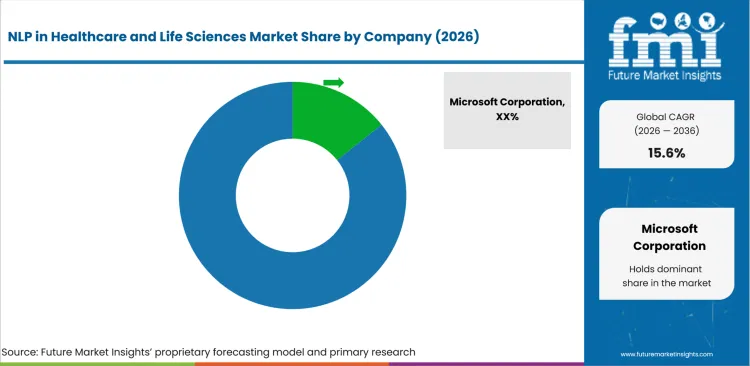
Competition is split between companies embedded in clinical workflows, cloud and AI infrastructure providers, life sciences intelligence platforms and specialist clinical NLP developers. Buyers compare the text sources supported, the terminology and models available, the deployment boundary and the point at which a person can inspect or approve the output. A broad AI portfolio does not by itself establish clinical suitability for every use case.
- Microsoft Corporation, Oracle Health and Solventum Corporation connect NLP with clinical documentation, EHR or coding workflows.
- Amazon Web Services, Google Cloud, NVIDIA Corporation and IBM Corporation provide managed NLP, model infrastructure or enterprise AI components that can be configured for healthcare and life sciences applications.
- IQVIA Holdings Inc., SAS Institute Inc. and John Snow Labs serve research, analytics or specialist clinical-language workflows with domain-specific tools and models.
Competitive Benchmarking: NLP in Healthcare and Life Sciences Market
| Company | Clinical NLP | Coding / RCM | Research / drug safety | Geographic reach |
|---|---|---|---|---|
| Microsoft Corporation | High | Medium | Evidence not assessed | Selected healthcare markets; availability varies |
| Oracle Health | High | High | Evidence not assessed | United States, Canada and wider Oracle Health markets |
| IQVIA Holdings Inc. | Medium | Evidence not assessed | High | Global healthcare and life sciences markets |
| Amazon Web Services (AWS) | High | Medium | High | Selected AWS regions; service availability varies |
| Google Cloud | High | Medium | High | Google Cloud markets; product availability varies |
| Solventum Corporation | Medium | High | Evidence not assessed | Global healthcare markets |
| NVIDIA Corporation | Evidence not assessed | Evidence not assessed | High | Global cloud, on-premises and research deployments |
| SAS Institute Inc. | Medium | Evidence not assessed | Medium | Global healthcare and life sciences markets |
| John Snow Labs | High | High | High | Global enterprise and developer deployments |
| IBM Corporation | Medium | Evidence not assessed | Medium | Global enterprise cloud markets |
Key Developments in the NLP in Healthcare and Life Sciences Market
- In June 2026, NVIDIA announced the BioNeMo Agent Toolkit for agentic life sciences workflows spanning biology, chemistry, genomics and drug discovery.
- In April 2025, IQVIA introduced Med-R1 8B, a healthcare-focused reasoning model designed for clinical and scientific text with expert review.
- In March 2025, Microsoft introduced Dragon Copilot for clinical documentation, information retrieval and workflow automation.
Key Players in the NLP in Healthcare and Life Sciences Market
Enterprise Health IT and Workflow Platforms
- Microsoft Corporation
- Oracle Health
- Solventum Corporation
Cloud and AI Infrastructure Providers
- Amazon Web Services (AWS)
- Google Cloud
- NVIDIA Corporation
- IBM Corporation
Life Sciences Intelligence and Analytics Providers
- IQVIA Holdings Inc.
- SAS Institute Inc.
Clinical NLP Specialist
- John Snow Labs
NLP in Healthcare and Life Sciences Market - Report Scope
| Coverage field | Report scope |
|---|---|
| Market breakdown | By component, application, deployment, end user, technology and region. |
| Quantitative Units | Revenue in USD billion and CAGR in %. |
| Market Definition | Software, services, infrastructure and related platforms that interpret or structure healthcare and life sciences text for defined clinical, coding, research or administrative workflows. |
| Regions Covered | North America, Latin America, Western Europe, Eastern Europe, East Asia, South Asia and Pacific, and Middle East and Africa. |
| Countries Covered | South Korea, USA, Canada, UK, Australia, Germany, Japan, and 20+ countries included in the full report. |
| Key Companies Profiled | Microsoft Corporation, Oracle Health, IQVIA Holdings Inc., Amazon Web Services (AWS), Google Cloud, Solventum Corporation, NVIDIA Corporation, SAS Institute Inc., John Snow Labs and IBM Corporation. |
| Forecast Period | 2026 to 2036. |
| Approach | Primary and secondary research with market triangulation. |
NLP in Healthcare and Life Sciences Market - Research Methodology
| Method | Approach |
|---|---|
| Primary Research | FMI analysts gathered input from healthcare providers, pharmaceutical and biotechnology companies, payers, technology vendors, implementation partners and subject-matter experts. Interviews examined text sources, purchasing decisions, workflow ownership, model evaluation, data controls, integration requirements and the evidence needed before a pilot develops into regular use. |
| Desk Research | Desk research covered government and regulatory publications, health IT policy, technical literature, standards, company filings, product documentation and official corporate announcements. Sources were reviewed for relevance, publication date, geographic coverage and consistency with the defined market scope. Claims relating to performance, deployment, approvals, applications and commercial activity were retained only when supported by credible public evidence. |
| Market Sizing and Forecasting | The market model combined the baseline value with historical performance, segment structure, platform adoption, deployment choices, company participation and country-level operating conditions. Forecast assumptions considered EHR penetration, cloud adoption, healthcare and life sciences investment, regulatory developments, purchasing cycles, integration requirements and barriers to production deployment. Segment and regional estimates were reconciled before the final market total was calculated. |
| Data Validation | Estimates were checked against multiple independent indicators, including public policy, company activity, product availability, clinical and research use cases, and findings from primary interviews. Validation also tested whether products, services and revenues fell within the market definition. Adjacent speech-only tools, general AI functions without relevant text workflows, unsupported claims and overlapping revenues were excluded to reduce double counting. |
NLP in Healthcare and Life Sciences Market by Segments
NLP in Healthcare and Life Sciences Market segmented by Component:
- Software
- Clinical NLP Platforms
- Text Analytics Solutions
- Services
- Consulting
- Implementation & Support
- Hardware
- AI Infrastructure
- GPU Accelerators
NLP in Healthcare and Life Sciences Market segmented by Application:
- Clinical Documentation
- Electronic Health Records (EHR)
- Clinical Note Summarization
- Medical Coding & Billing
- ICD Coding
- Revenue Cycle Management
- Drug Discovery & Clinical Research
- Biomarker Identification
- Literature Mining
- Clinical Decision Support
- Diagnosis Assistance
- Risk Prediction
NLP in Healthcare and Life Sciences Market segmented by Deployment:
- Cloud-Based
- Public Cloud
- Hybrid Cloud
- On-Premises
- Hospital Infrastructure
- Private Data Centers
- Hybrid
- Multi-Cloud
- Edge AI Deployment
NLP in Healthcare and Life Sciences Market segmented by End User:
- Healthcare Providers
- Hospitals
- Health Systems
- Pharmaceutical & Biotechnology Companies
- Drug Developers
- Biotech Firms
- Healthcare Payers
- Insurance Companies
- Managed Care Organizations
- Others
- Academic & Research Institutes
- CROs
- Government Agencies
NLP in Healthcare and Life Sciences Market segmented by Technology:
- Machine Learning-Based NLP
- Supervised Learning
- Deep Learning Models
- Transformer-Based NLP
- Large Language Models
- BERT-Based Models
- Rule-Based NLP
- Clinical Rule Engines
- Knowledge Graphs
- Others
- Hybrid NLP
- Speech-to-Text NLP
NLP in Healthcare and Life Sciences Market by Region:
- North America
- United States
- Canada
- Latin America
- Brazil
- Chile
- Mexico
- Rest of Latin America
- Western Europe
- Germany
- United Kingdom
- Italy
- Spain
- France
- Nordics
- Benelux
- Rest of Western Europe
- Eastern Europe
- Russia
- Poland
- Hungary
- Balkan and Baltic States
- Rest of Eastern Europe
- East Asia
- China
- Japan
- South Korea
- South Asia and Pacific
- India
- ASEAN
- Australia and New Zealand
- Rest of South Asia and Pacific
- Middle East and Africa
- Kingdom of Saudi Arabia
- Other GCC Countries
- Türkiye
- South Africa
- Other African Union Countries
- Rest of Middle East and Africa
Research Sources and Bibliography
- Office of the National Coordinator for Health Information Technology. HTI-1 Final Rule.
- USA Food and Drug Administration. (2025, January 7). Artificial Intelligence-Enabled Device Software Functions: Lifecycle Management and Marketing Submission Recommendations.
- Health Canada. (2026, April 1). Pre-market guidance for machine learning-enabled medical devices.
- UK Medicines and Healthcare products Regulatory Agency. (2025, February 3). Software and artificial intelligence as a medical device.
- Australian Government Department of Health and Aged Care. (2026, January 23). Artificial intelligence in health care.
- German Federal Ministry of Health. (2026). Germany’s Digitalisation Strategy for Health and Care.
- Pharmaceuticals and Medical Devices Agency. Subcommittee on Software as a Medical Device Utilizing AI and Machine Learning.
- Korean Ministry of Food and Drug Safety. Guidance on the Review and Approval of Artificial Intelligence-Based Medical Devices.
- Amazon Web Services. Amazon Comprehend Medical documentation and features.
- Google Cloud. Vertex AI Gemini models documentation (accessed 2026); Healthcare Natural Language API deprecation notice, May 27, 2025.
- Microsoft. (2025, March 3). Microsoft Dragon Copilot provides the healthcare industry’s first unified voice AI assistant.
- Oracle. (2025, March 4). Oracle Health Clinical AI Agent Reduces Physician Documentation Time by 30%.
- IQVIA. Natural Language Processing.
- IQVIA. (2025, April 7). Introducing IQVIA Medical Reasoning (Med-R1 8B).
- Solventum Corporation. Solventum 360 Encompass System and Health Information Systems materials; Solventum autonomous coding, Epic Toolbox listing, August 2024.
- NVIDIA Corporation. (2026, June 23). NVIDIA Announces BioNeMo Agent Toolkit.
- SAS Institute Inc. AI Health Care Solutions and SAS Health.
- John Snow Labs. Clinical NLP.
- IBM Corporation. IBM watsonx.ai.
This bibliography is provided for reader reference and is not exhaustive. The full report contains the complete reference list and detailed citations
This Report Answers
- How large is the NLP in Healthcare and Life Sciences Market in 2026 and 2036?
- Which operating conditions support recurring demand for clinical and scientific text processing?
- Which component segment accounts for the largest approved 2026 share?
- Why does clinical documentation lead application demand?
- How does cloud-based deployment shape commercial adoption?
- Which technology layer supports repeatable extraction from healthcare text?
- How do profiled country growth rates affect market-entry conditions?
- Which companies serve clinical, coding, research and infrastructure workflows?
Frequently Asked Questions
How big is the NLP in healthcare and life sciences market in 2026?
USD 7.8 billion represents the NLP in healthcare and life sciences market value in 2026 across software, services and infrastructure used for defined clinical, coding, research and administrative text workflows. The category is projected to reach USD 33.2 billion by 2036 as organizations connect unstructured text with reviewable outputs.
What is the CAGR of the NLP in healthcare and life sciences market from 2026 to 2036?
A 15.6% CAGR is projected for the NLP in healthcare and life sciences market between 2026 and 2036. Growth depends on EHR integration, managed model infrastructure and domain terminology, while privacy controls and evidence requirements determine whether a pilot can move into regular use.
Which component segment is projected to account for 53.0% of the market?
Software is projected to account for 53.0% of component demand in 2026. Reusable extraction, classification, summarization and search functions give platform purchases a larger recurring role than implementation services or dedicated processing hardware alone.
How much will the NLP in healthcare and life sciences market add between 2026 and 2036?
USD 25.4 billion is expected to be added to the NLP in healthcare and life sciences market between 2026 and 2036. The increase reflects wider use in documentation, coding, clinical research and scientific evidence review, subject to validation and accountable human oversight.
Which companies are active in the NLP in healthcare and life sciences market?
Ten companies active in the profiled market include Microsoft Corporation, Oracle Health, IQVIA Holdings Inc., Amazon Web Services, Google Cloud, Solventum Corporation, NVIDIA Corporation, SAS Institute Inc., John Snow Labs and IBM Corporation. The group covers clinical workflow software, cloud services, coding, life sciences intelligence and AI infrastructure.
Preview the report firsthand - request a free sample
Get SampleGet the brochure for pricing and purchase details.
Get PDFTable of Content
- Key Takeaways
- Market Size and CAGR
- Top Growth Driver
- Fastest Growing Segment
- Leading Region
- Key Companies
- Emerging Opportunities
- Executive Summary
- Global Market Outlook
- Demand-side Trends
- Supply-side Trends
- Technology Roadmap Analysis
- Analysis and Recommendations
- Analyst Perspective (What is happening? Why now? What should investors know?)
- Key Questions Answered
- How large is the market?
- What is the CAGR?
- What are key trends?
- Which region dominates?
- Who are the leaders?
- Market Overview
- Market Coverage / Taxonomy
- Market Definition / Scope / Limitations
- Research Methodology
- Chapter Orientation
- Analytical Lens and Working Hypotheses
- Market Structure, Signals, and Trend Drivers
- Benchmarking and Cross-market Comparability
- Market Sizing, Forecasting, and Opportunity Mapping
- Research Design and Evidence Framework
- Desk Research Programme (Secondary Evidence)
- Expert Input and Fieldwork (Primary Evidence)
- Tooling, Models, and Reference Databases
- Data Engineering and Model Build
- Quality Assurance and Audit Trail
- Market Background
- Market Dynamics (Drivers, Restraints, Opportunity, Trends)
- Scenario Forecast (Optimistic, Likely, Conservative)
- Impact Analysis
- AI Impact
- Sustainability Impact
- Regulatory Impact
- Technology Impact
- Consumer / Buyer Analysis
- Purchase Drivers
- Adoption Barriers
- Buyer Journey
- Opportunity Map Analysis
- Product Life Cycle Analysis
- Supply Chain Analysis
- Investment Feasibility Matrix
- Value Chain Analysis
- PESTLE and Porter's Analysis
- Regulatory Landscape
- Regional Parent Market Outlook
- Production and Consumption Statistics
- Import and Export Statistics
- Global Market Analysis and Forecast, 2021 to 2036
- Historical Market Size Value (USD Billion) Analysis, 2021 to 2025
- Current and Future Market Size Value (USD Billion) Projections, 2026 to 2036
- Y-o-Y Growth Trend Analysis
- Absolute $ Opportunity Analysis
- Global Market Pricing Analysis, 2021 to 2036
- Global Market Analysis and Forecast, By Component, 2021 to 2036
- Introduction / Key Findings
- Historical Market Size Value (USD Billion) Analysis By Component, 2021 to 2025
- Current and Future Market Size Value (USD Billion) Analysis and Forecast By Component, 2026 to 2036
- Software
- Clinical NLP Platforms
- Text Analytics Solutions
- Services
- Consulting
- Implementation & Support
- Hardware
- AI Infrastructure
- GPU Accelerators
- Software
- Y-o-Y Growth Trend Analysis By Component, 2021 to 2025
- Absolute $ Opportunity Analysis By Component, 2026 to 2036
- Global Market Analysis and Forecast, By Application, 2021 to 2036
- Introduction / Key Findings
- Historical Market Size Value (USD Billion) Analysis By Application, 2021 to 2025
- Current and Future Market Size Value (USD Billion) Analysis and Forecast By Application, 2026 to 2036
- Clinical Documentation
- Electronic Health Records (EHR)
- Clinical Note Summarization
- Medical Coding & Billing
- ICD Coding
- Revenue Cycle Management
- Drug Discovery & Clinical Research
- Biomarker Identification
- Literature Mining
- Clinical Decision Support
- Diagnosis Assistance
- Risk Prediction
- Clinical Documentation
- Y-o-Y Growth Trend Analysis By Application, 2021 to 2025
- Absolute $ Opportunity Analysis By Application, 2026 to 2036
- Global Market Analysis and Forecast, By Deployment, 2021 to 2036
- Introduction / Key Findings
- Historical Market Size Value (USD Billion) Analysis By Deployment, 2021 to 2025
- Current and Future Market Size Value (USD Billion) Analysis and Forecast By Deployment, 2026 to 2036
- Cloud-Based
- Public Cloud
- Hybrid Cloud
- On-Premises
- Hospital Infrastructure
- Private Data Centers
- Hybrid
- Multi-Cloud
- Edge AI Deployment
- Cloud-Based
- Y-o-Y Growth Trend Analysis By Deployment, 2021 to 2025
- Absolute $ Opportunity Analysis By Deployment, 2026 to 2036
- Global Market Analysis and Forecast, By End User, 2021 to 2036
- Introduction / Key Findings
- Historical Market Size Value (USD Billion) Analysis By End User, 2021 to 2025
- Current and Future Market Size Value (USD Billion) Analysis and Forecast By End User, 2026 to 2036
- Healthcare Providers
- Hospitals
- Health Systems
- Pharmaceutical & Biotechnology Companies
- Drug Developers
- Biotech Firms
- Healthcare Payers
- Insurance Companies
- Managed Care Organizations
- Others
- Academic & Research Institutes
- CROs
- Government Agencies
- Healthcare Providers
- Y-o-Y Growth Trend Analysis By End User, 2021 to 2025
- Absolute $ Opportunity Analysis By End User, 2026 to 2036
- Global Market Analysis and Forecast, By Technology, 2021 to 2036
- Introduction / Key Findings
- Historical Market Size Value (USD Billion) Analysis By Technology, 2021 to 2025
- Current and Future Market Size Value (USD Billion) Analysis and Forecast By Technology, 2026 to 2036
- Machine Learning-Based NLP
- Supervised Learning
- Deep Learning Models
- Transformer-Based NLP
- Large Language Models
- BERT-Based Models
- Rule-Based NLP
- Clinical Rule Engines
- Knowledge Graphs
- Others
- Hybrid NLP
- Speech-to-Text NLP
- Machine Learning-Based NLP
- Y-o-Y Growth Trend Analysis By Technology, 2021 to 2025
- Absolute $ Opportunity Analysis By Technology, 2026 to 2036
- Global Market Analysis and Forecast, By Region, 2021 to 2036
- Introduction
- Historical Market Size Value (USD Billion) Analysis By Region, 2021 to 2025
- Current Market Size Value (USD Billion) Analysis and Forecast By Region, 2026 to 2036
- North America
- Latin America
- Western Europe
- Eastern Europe
- East Asia
- South Asia and Pacific
- Middle East & Africa
- Market Attractiveness Analysis By Region
- North America Market Analysis and Forecast, By Country, 2021 to 2036
- Historical Market Size Value (USD Billion) Trend Analysis By Market Taxonomy, 2021 to 2025
- Market Size Value (USD Billion) Forecast By Market Taxonomy, 2026 to 2036
- By Country
- USA
- Canada
- By Component
- By Application
- By Deployment
- By End User
- By Technology
- By Country
- Market Attractiveness Analysis
- By Country
- By Component
- By Application
- By Deployment
- By End User
- By Technology
- Key Takeaways
- Latin America Market Analysis and Forecast, By Country
- Historical Market Size Value (USD Billion) Trend Analysis By Market Taxonomy, 2021 to 2025
- Market Size Value (USD Billion) Forecast By Market Taxonomy, 2026 to 2036
- By Country
- Brazil
- Mexico
- Chile
- Rest of Latin America
- By Component
- By Application
- By Deployment
- By End User
- By Technology
- By Country
- Market Attractiveness Analysis
- By Country
- By Component
- By Application
- By Deployment
- By End User
- By Technology
- Key Takeaways
- Western Europe Market Analysis and Forecast, By Country
- Historical Market Size Value (USD Billion) Trend Analysis By Market Taxonomy, 2021 to 2025
- Market Size Value (USD Billion) Forecast By Market Taxonomy, 2026 to 2036
- By Country
- Germany
- UK
- Italy
- Spain
- France
- Nordic
- BENELUX
- Rest of Western Europe
- By Component
- By Application
- By Deployment
- By End User
- By Technology
- By Country
- Market Attractiveness Analysis
- By Country
- By Component
- By Application
- By Deployment
- By End User
- By Technology
- Key Takeaways
- Eastern Europe Market Analysis and Forecast, By Country
- Historical Market Size Value (USD Billion) Trend Analysis By Market Taxonomy, 2021 to 2025
- Market Size Value (USD Billion) Forecast By Market Taxonomy, 2026 to 2036
- By Country
- Russia
- Poland
- Hungary
- Balkan & Baltic
- Rest of Eastern Europe
- By Component
- By Application
- By Deployment
- By End User
- By Technology
- By Country
- Market Attractiveness Analysis
- By Country
- By Component
- By Application
- By Deployment
- By End User
- By Technology
- Key Takeaways
- East Asia Market Analysis and Forecast, By Country
- Historical Market Size Value (USD Billion) Trend Analysis By Market Taxonomy, 2021 to 2025
- Market Size Value (USD Billion) Forecast By Market Taxonomy, 2026 to 2036
- By Country
- China
- Japan
- South Korea
- By Component
- By Application
- By Deployment
- By End User
- By Technology
- By Country
- Market Attractiveness Analysis
- By Country
- By Component
- By Application
- By Deployment
- By End User
- By Technology
- Key Takeaways
- South Asia and Pacific Market Analysis and Forecast, By Country
- Historical Market Size Value (USD Billion) Trend Analysis By Market Taxonomy, 2021 to 2025
- Market Size Value (USD Billion) Forecast By Market Taxonomy, 2026 to 2036
- By Country
- India
- ASEAN
- Australia & New Zealand
- Rest of South Asia and Pacific
- By Component
- By Application
- By Deployment
- By End User
- By Technology
- By Country
- Market Attractiveness Analysis
- By Country
- By Component
- By Application
- By Deployment
- By End User
- By Technology
- Key Takeaways
- Middle East & Africa Market Analysis and Forecast, By Country
- Historical Market Size Value (USD Billion) Trend Analysis By Market Taxonomy, 2021 to 2025
- Market Size Value (USD Billion) Forecast By Market Taxonomy, 2026 to 2036
- By Country
- Kingdom of Saudi Arabia
- Other GCC Countries
- Türkiye
- South Africa
- Other African Union
- Rest of Middle East & Africa
- By Component
- By Application
- By Deployment
- By End User
- By Technology
- By Country
- Market Attractiveness Analysis
- By Country
- By Component
- By Application
- By Deployment
- By End User
- By Technology
- Key Takeaways
- Key Countries Market Analysis
- USA
- Pricing Analysis
- Market Share Analysis, 2025
- By Component
- By Application
- By Deployment
- By End User
- By Technology
- Canada
- Pricing Analysis
- Market Share Analysis, 2025
- By Component
- By Application
- By Deployment
- By End User
- By Technology
- Mexico
- Pricing Analysis
- Market Share Analysis, 2025
- By Component
- By Application
- By Deployment
- By End User
- By Technology
- Brazil
- Pricing Analysis
- Market Share Analysis, 2025
- By Component
- By Application
- By Deployment
- By End User
- By Technology
- Chile
- Pricing Analysis
- Market Share Analysis, 2025
- By Component
- By Application
- By Deployment
- By End User
- By Technology
- Germany
- Pricing Analysis
- Market Share Analysis, 2025
- By Component
- By Application
- By Deployment
- By End User
- By Technology
- UK
- Pricing Analysis
- Market Share Analysis, 2025
- By Component
- By Application
- By Deployment
- By End User
- By Technology
- Italy
- Pricing Analysis
- Market Share Analysis, 2025
- By Component
- By Application
- By Deployment
- By End User
- By Technology
- Spain
- Pricing Analysis
- Market Share Analysis, 2025
- By Component
- By Application
- By Deployment
- By End User
- By Technology
- France
- Pricing Analysis
- Market Share Analysis, 2025
- By Component
- By Application
- By Deployment
- By End User
- By Technology
- India
- Pricing Analysis
- Market Share Analysis, 2025
- By Component
- By Application
- By Deployment
- By End User
- By Technology
- ASEAN
- Pricing Analysis
- Market Share Analysis, 2025
- By Component
- By Application
- By Deployment
- By End User
- By Technology
- Australia & New Zealand
- Pricing Analysis
- Market Share Analysis, 2025
- By Component
- By Application
- By Deployment
- By End User
- By Technology
- China
- Pricing Analysis
- Market Share Analysis, 2025
- By Component
- By Application
- By Deployment
- By End User
- By Technology
- Japan
- Pricing Analysis
- Market Share Analysis, 2025
- By Component
- By Application
- By Deployment
- By End User
- By Technology
- South Korea
- Pricing Analysis
- Market Share Analysis, 2025
- By Component
- By Application
- By Deployment
- By End User
- By Technology
- Russia
- Pricing Analysis
- Market Share Analysis, 2025
- By Component
- By Application
- By Deployment
- By End User
- By Technology
- Poland
- Pricing Analysis
- Market Share Analysis, 2025
- By Component
- By Application
- By Deployment
- By End User
- By Technology
- Hungary
- Pricing Analysis
- Market Share Analysis, 2025
- By Component
- By Application
- By Deployment
- By End User
- By Technology
- Kingdom of Saudi Arabia
- Pricing Analysis
- Market Share Analysis, 2025
- By Component
- By Application
- By Deployment
- By End User
- By Technology
- Türkiye
- Pricing Analysis
- Market Share Analysis, 2025
- By Component
- By Application
- By Deployment
- By End User
- By Technology
- South Africa
- Pricing Analysis
- Market Share Analysis, 2025
- By Component
- By Application
- By Deployment
- By End User
- By Technology
- USA
- Market Structure Analysis
- Competition Dashboard
- Competition Benchmarking
- Market Share Analysis of Top Players
- By Regional
- By Component
- By Application
- By Deployment
- By End User
- By Technology
- Emerging Startups
- Innovation Benchmarking
- Competition Analysis
- Competition Deep Dive
- Microsoft Corporation
- Overview
- Product Portfolio
- Profitability by Market Segments
- Sales Footprint
- Strategy Overview
- Marketing Strategy
- Product Strategy
- Channel Strategy
- Oracle Health
- IQVIA Holdings Inc.
- Amazon Web Services (AWS)
- Google Cloud
- 3M Health Information Systems
- NVIDIA Corporation
- SAS Institute Inc.
- John Snow Labs
- IBM Corporation
- Others
- Microsoft Corporation
- Case Studies
- Success Stories
- Recent Developments
- Competition Deep Dive
- Assumptions & Acronyms Used


