

- Market Size (2026)
- USD 2.6 Bn
- Forecast (2036)
- USD 6.9 Bn
- CAGR (2026 to 2036)
- 10.2%
How big is Non-Alcoholic & Zero-Proof Spirits Market in 2026?
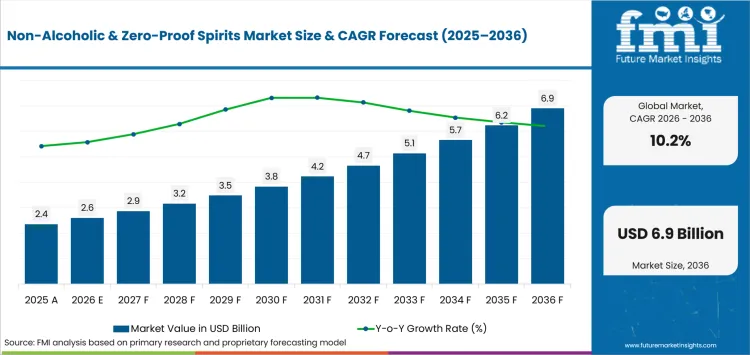
USD 2.6 billion in 2026 and USD 6.9 billion by 2036 at a 10.2% CAGR.
Sales of non-alcoholic and zero-proof spirits are projected to expand at 10.2% CAGR from 2026 to 2036. The valuation is expected to move from USD 2.6 billion in 2026 to USD 6.9 billion by 2036. Demand is expected to be driven by adult drinking occasions where customers want cocktail taste without ethanol.
Product approval depends on taste performance and label clarity at the same time. A zero-proof spirit has to behave like a food product while still reminding customers of a familiar cocktail serve. Food-label rules and protected spirit names can slow launches when brand teams copy alcohol terms too closely.
Key Takeaways of Non-Alcoholic & Zero-Proof Spirits Market
- The non-alcoholic and zero-proof spirits market is expanding as moderation-led occasions drive adult-beverage demand without ethanol, with commercial success tied to sensory repeatability, clean labelling, and stable shelf life across retail and foodservice channels.
- By product, Zero-proof Spirits are projected to hold 42.4% share in 2026 on cocktail occasion fit; by category, Whisky alternatives are forecast at 43.6% share in 2026, driven by familiar oak and malt cues in highball and sour serves.
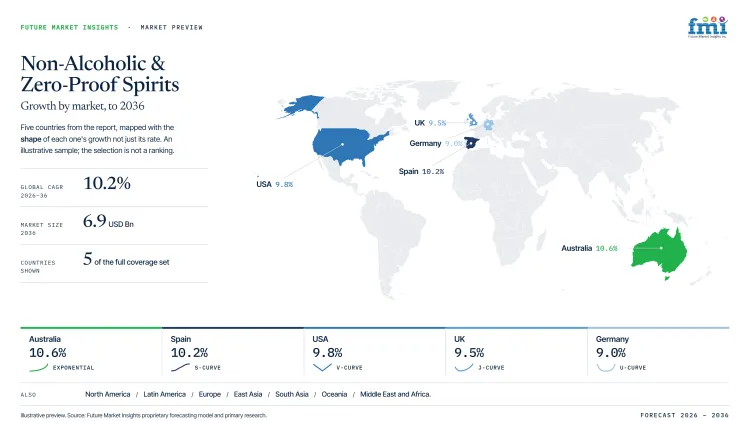
- Australia leads growth at 10.6% CAGR through 2036, followed by Spain at 10.2% and the USA at 9.8%, each supported by moderation trends, online discovery, and widening retail assortment.
- Hypermarkets/Supermarkets are estimated at 35.7% share in 2026, where shelf visibility lowers trial friction alongside mixer adjacencies.
- Diageo, Pernod Ricard, and Lyre's anchor the competitive landscape through brand extensions and focused botanical formulations.
- Procurement and retailer confidence hinges on batch consistency, storage stability, and country-specific label compliance before broader shelf expansion.
Analyst Perspective
"The non-alcoholic & zero-proof spirits market is increasingly shaped by sensory consistency, product stability, and clear regulatory positioning. Retailers and beverage companies are evaluating whether products maintain taste and quality through storage while meeting country-specific labeling requirements. Brands that deliver reliable consumer experience, consistent specifications, and clear product positioning will be better positioned to expand across retail channels."
— Nandini Roy Choudhury, Principal Analyst at Future Market Insights
Source: FMI's proprietary forecasting model and primary research
How is the Non-Alcoholic & Zero-Proof Spirits Market segmented?
The non-alcoholic and zero-proof spirits industry is segmented by product, category, sales channel, and region.
The segmentation framework separates beverage formats from flavor profiles and the channels used to reach customers. Product analysis covers zero-proof spirits together with non-alcoholic beer and non-alcoholic wine so each beverage format remains distinct. Category analysis separates whisky, gin, and aperitif alternatives according to the taste profile and drinking occasion they are designed to support. Sales channel analysis covers hypermarkets and supermarkets alongside convenience stores, specialty stores, online retail, and foodservice or HoReCa outlets, showing how products reach customers across retail and hospitality settings. Regional analysis explains how moderation trends, retail access, product naming rules, and drinking habits influence demand across countries with different beverage markets.
Why are zero-proof spirits central to the product category?
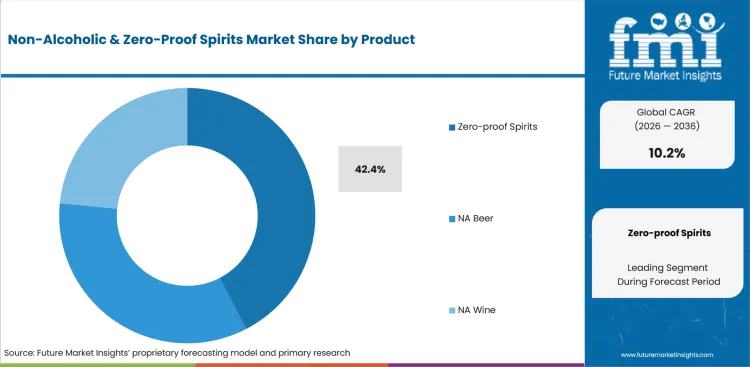
Zero-proof Spirits carry the clearest substitute role in the category. These products are made for mixed drinks and at-home cocktail routines where customers expect adult flavour without ethanol. The segment depends on extraction and aroma systems that remain stable after bottling.
- Zero-proof Spirits are projected to hold 42.4% share in 2026 due to their fit with cocktail occasions and premium serve cues.
- Retail and foodservice operators evaluate Zero-proof Spirits through taste carryover and shelf life before they add repeat listings.
Why does whisky lead the category category?
Whisky alternatives lead since the flavour job is easy for customers to understand. Oak and malt cues support serves that resemble highball or sour occasions. Producers have to build body and aroma release without the solvent effect that ethanol usually provides.
- Whisky is projected to hold 43.6% share in 2026 because familiar cocktail formats support trial and repeat purchase.
- Brands need sensory data that compares batch consistency and aftertaste control under normal retail storage.
What makes hypermarkets/supermarkets central to the sales channel category?
Hypermarkets and supermarkets provide the clearest mass-trial route. Customers already use these aisles for soft drinks and mixers. Store placement lets shoppers compare price and pack size beside related choices. Online discovery still matters, yet physical shelves reduce the effort needed for a first purchase.
- Hypermarkets/Supermarkets are expected to hold 35.7% share in 2026 due to shelf visibility and easier comparison with mixers.
- Retailers prefer brands that offer stable inventory and simple serve suggestions that make first purchase easier.
What are the drivers, restraints, and opportunities in the Non-Alcoholic & Zero-Proof Spirits Market?
Demand is strongest where producers deliver adult-drink cues without ethanol and meet food-label rules in each launch country.
- Driver: Moderation-led occasions are expected to lift demand when zero-proof spirits protect cocktail ritual without alcohol.
- Restraint: Spirit-name rules and low-alcohol descriptors limit direct category mimicry in several countries.
- Opportunity: Ready-to-serve formats and cocktail menus are expected to give brands more trial occasions.
Demand is forecast to benefit from customers who want a grown-up drinking occasion without the effect of ethanol. SAMHSA reported in July 2025 that alcohol use disorder among people aged 12 and older in the USA declined from 10.6% in 2021 to 9.7% in 2024. The public-health signal does not create demand by itself. It keeps moderation visible for retailers and foodservice operators that plan alcohol-free ranges.
The main restraint is proof. A water-led spirit alternative needs flavour stability and microbial safety before it becomes a repeat listing. The guidance leaves many zero-proof products closer to food regulation. This increases the need for careful labels and process records before a brand expands across channels.
The primary opportunity is concentrated in products that make alcohol-free cocktails easier to serve. Bars need consistent pours and retailers need clear use instructions on the pack.
Which country CAGRs are profiled in the Non-Alcoholic & Zero-Proof Spirits Market?
| Country | CAGR |
|---|---|
| USA | 9.8% |
| UK | 9.5% |
| Germany | 9.0% |
| Spain | 10.2% |
| Australia | 10.6% |
How do country-level CAGRs compare in the Non-Alcoholic & Zero-Proof Spirits Market?
The global growth rate represents the weighted average of all markets included in the analysis. It does not need to match the rate recorded by every country shown in the chart. Australia is positioned above the global figure while Spain remains aligned with it. The USA and the UK sit moderately below this benchmark. Germany occupies a separate lower position within the comparison.
- The countries are distinguished less by the overall CAGR range and more by the regular spacing between them. The total spread across the five markets is 1.6 percentage points. Each country is separated from the next by 0.4 percentage points. This creates a measured pattern rather than a pronounced divide between market groups.
- Australia and Spain form a compact upper cluster supported by moderation-led demand and accessible retail discovery. Australia follows a digital testing route while Spain relies more on hospitality occasions and supermarket exposure.
- The USA occupies the central position through online discovery and broad grocery distribution. The UK remains closely aligned with the USA but follows a different commercial route through supermarket ranges and alcohol-free menus. Germany sits outside this middle pairing as established alcohol-free beer habits create a different transition path toward spirit-style alternatives.
- Comparable CAGRs can therefore produce different market entry conditions. Brand expansion depends on retail testing and flavour performance as well as local naming requirements. Deployment timing may also vary according to whether trial begins through e-commerce or hospitality channels.
The full report provides country-level CAGR analysis across North America, Latin America, Europe, East Asia, South Asia, Oceania and the Middle East and Africa.
Country-wise Analysis
- United States retail networks combine e-commerce discovery with large store chains that can test alcohol-free ranges at scale. The USA is projected to post 9.8% CAGR over the forecast period, aided by online trial and broad grocery distribution. The USA Census Bureau reported in May 2026 that e-commerce accounted for 16.9% of total retail sales during the first quarter. The share gives zero-proof brands a route to test demand before national shelf placement. Retail expansion should follow measured repeat purchase instead of one-time novelty buying.
- UK retailers and bars are expected to support trial where customers want cocktail-style serves without alcohol. The UK is forecast to expand at 9.5% CAGR through 2036, supported by online retail and on-trade alcohol-free menus. ONS reported in 2026 that internet sales accounted for 27.4% of total retail sales in 2025. The figure supports direct trial before brands negotiate wider store listings. GOV.UK guidance updated in July 2025 states that alcohol-free or low-alcohol beverages cannot be labelled against spirit drink names such as rum or gin. Brand teams should make the serve cue clear without using protected spirit names incorrectly.
- Germany has strong alcohol-free beverage familiarity through beer and a demanding route for spirit-style naming. Demand in Germany is expected to rise at 9.0% CAGR through 2036, supported by established alcohol-free habits and careful retail testing. Destatis reported in July 2025 that Germany produced almost 579 million litres of non-alcoholic beer in 2024. The output value was around EUR 606 million and shows consumer acceptance of alcohol-free drinking occasions. Germany’s Federal Ministry of Health reported in 2026 that 8.6 million adults consumed risky alcohol quantities in 2024. Zero-proof spirit companies should treat taste quality as the main barrier to moving drinkers from familiar alcohol-free beer into cocktail alternatives.
- Spain combines hospitality culture with household moderation signals that can support alcohol-free spirit trial. Spain is projected to record 10.2% CAGR through 2036, helped by social drinking occasions and supermarket discovery. INE reported in 2026 that the share of people who did not consume alcohol rose from 31.3% in 2022 to 33.9% in 2025. The change supports a wider base for adult alcohol-free beverage choices. INE also reported in January 2026 that retail sales increased 4.3% across 2025 in the corrected series. Brands should focus on flavour depth because weak mouthfeel can block repeat orders in bars.
- Australia has a clear moderation signal and a strong online retail base for beverage testing. Australia is forecast to lead the profiled set at 10.6% CAGR through 2036, supported by lower alcohol availability and digital shopping. AIHW reported in 2025 that alcohol available per person fell from 10.5 litres in 2022-23 to 9.8 litres in 2023-24. ABS reported that total online retailing sales reached AUD 4,537.0 million in April 2025. The channel gives zero-proof brands a practical route for discovery and repeat ordering. FSANZ reported in August 2025 that Code changes were gazetted for packaged alcoholic beverages and beverages containing no less than 0.5% ABV. Products using fermented bases should keep alcohol-content checks close to label approval.
Who are the notable companies in the Non-Alcoholic & Zero-Proof Spirits Market?
Lyre's, Pernod Ricard, Three Spirit, CleanCo and Diageo are the notable companies shaping this market.
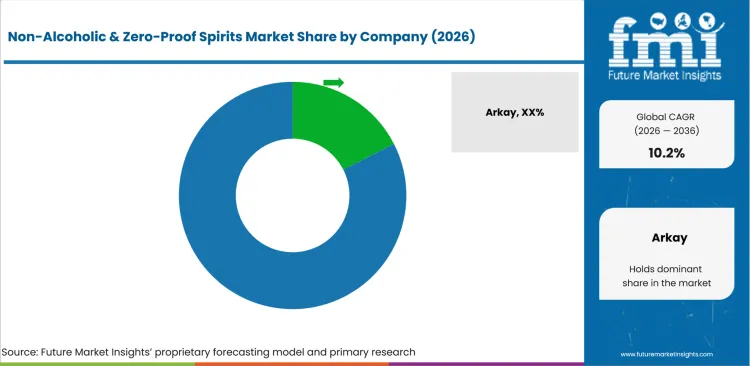
The competitive outlook combines dedicated zero-proof brands with large beverage groups that can open retail and on-trade doors. Dedicated brands compete through taste quality and clear serve guidance. Larger groups compete through distribution reach and existing relationships with bars and retailers. Ingredient and flavour companies influence performance where botanical inputs or aftertaste control decide repeat orders. Commercial success depends on a clear handoff between formulation, naming and channel placement.
- Lyre's compete through broad zero-proof portfolios and serve-led consumer education. Their practical test is repeat purchase after the first trial occasion.
- Diageo connect alcohol-free spirit alternatives with premium trade relationships. Diageo adds retail reach through established alcohol-free propositions.
- Pernod Ricard and CleanCo use brand familiarity to reduce customer uncertainty. Three Spirit competes where a clear alcohol-free proposition and stable flavour profile matter most.
Competitive Benchmarking: Non-Alcoholic & Zero-Proof Spirits Market
| Company | Zero-Proof Portfolio | Brand Conversion | Formulation Depth | Geographic Reach |
|---|---|---|---|---|
| Lyre's | High | High | Medium | Global |
| Pernod Ricard | Medium | High | Medium | Global |
| Three Spirit | Medium | Medium | Medium | Global |
| CleanCo | High | Medium | Medium | UK and selected export markets |
| Diageo | High | High | Medium | Global |
Scoring basis: High indicates a documented core capability within the exact workflow and a dedicated commercial offer. Medium indicates direct support through an adjacent platform or documented beverage use. Low indicates limited direct evidence that the company supports the named capability within zero-proof spirits.
Key Developments in the Non-Alcoholic & Zero-Proof Spirits Market
- In September 2025, Pernod Ricard UK launched Beefeater 0.0 for UK on-trade customers. The launch used a known gin brand name while presenting the product as an alcohol-free expression.
- In August 2025, FSANZ confirmed gazetted Code changes for energy labelling on packaged alcoholic beverages and beverages containing no less than 0.5% ABV. The change keeps alcohol boundary claims under review in Australia.
Key Players in the Non-Alcoholic & Zero-Proof Spirits Market
Dedicated Zero-Proof Spirit Brands
- Lyre's
- CleanCo
- Three Spirit
Scaled Beverage Groups
- Diageo plc
- Pernod Ricard SA
Non-Alcoholic & Zero-Proof Spirits Market - Report Scope
| Coverage field | Report scope |
|---|---|
| Market breakdown | Product and category as well as sales channel and region. |
| Quantitative Units | Revenue in USD Billion, CAGR in %. |
| Market Definition | Non-alcoholic and zero-proof spirits in this report refer to spirit-style drinks sold with zero or very low alcohol content for cocktail and adult beverage occasions. |
| Regions Covered | North America; Latin America; Europe; East Asia; South Asia; Oceania; Middle East and Africa. |
| Countries Covered | USA; UK; Germany; Spain; Australia. The full report covers 30+ countries. |
| Key Companies Profiled | Lyre's; Pernod Ricard; Three Spirit; CleanCo; Diageo. |
| Forecast Period | 2026 to 2036. |
| Approach | Hybrid bottom-up and top-down market sizing supported by primary interviews and official desk research. |
Non-Alcoholic & Zero-Proof Spirits Market - Research Methodology
| Method | Approach |
|---|---|
| Primary Research | FMI analysts gathered input from manufacturers, service providers, technology developers, distributors, end users, procurement teams, and subject-matter experts. Interviews examined purchasing decisions, product or service evaluation, adoption barriers, approval requirements, pricing considerations, and expectations for technical or commercial support. Respondents were asked what evidence is required before a trial, pilot, or initial order develops into regular purchasing. |
| Desk Research | Desk research covered government statistics, regulatory publications, trade data, industry associations, technical literature, standards, company filings, product information, and official corporate announcements. Sources were reviewed for relevance, publication date, geographic coverage, and consistency with the defined market scope. Claims relating to performance, applications, approvals, capacity, investment, and commercial activity were retained only when supported by credible public evidence. |
| Market Sizing and Forecasting | The market model combined the baseline value with historical performance, segment structure, pricing and volume indicators, adoption levels, company participation, and country-level demand conditions. Forecast assumptions considered economic activity, investment trends, regulatory developments, technology adoption, purchasing cycles, supply availability, and barriers to wider market use. Segment and regional estimates were reconciled before the final market total was calculated. |
| Data Validation | Estimates were checked against multiple independent indicators, including public data, company activity, trade patterns, industry developments, and findings from primary interviews. Validation tested whether products, services, applications, and company revenues fell within the defined market boundaries. Adjacent categories, unsupported claims, overlapping revenues, and activities without direct market relevance were excluded to reduce double counting and maintain consistency across segments and countries. |
Non-Alcoholic & Zero-Proof Spirits Market by Segments
Non-Alcoholic & Zero-Proof Spirits Market segmented by Product:
- Zero-proof Spirits
- NA Beer
- NA Wine
Non-Alcoholic & Zero-Proof Spirits Market segmented by Category:
- Whisky
- Gin
- Aperitif Alt
Non-Alcoholic & Zero-Proof Spirits Market segmented by Sales Channel:
- Hypermarkets/Supermarkets
- Convenience Stores
- Specialty Stores
- Online Retail
- Foodservice/HoReCa
Non-Alcoholic & Zero-Proof Spirits Market by Region:
- North America
- United States
- Canada
- Latin America
- Brazil
- Mexico
- Argentina
- Chile
- Western Europe
- Germany
- France
- United Kingdom
- Italy
- Spain
- Benelux
- Nordics
- Eastern Europe
- Poland
- Czech Republic
- Romania
- Hungary
- East Asia
- China
- Japan
- South Korea
- South Asia and Pacific
- India
- ASEAN
- Australia and New Zealand
- Middle East and Africa
- GCC Countries
- South Africa
- Türkiye
- Israel
Research Sources and Bibliography
- USA Census Bureau. (2026, May 18). Quarterly retail e-commerce sales report.
- Substance Abuse and Mental Health Services Administration. (2025, July 28). SAMHSA releases annual National Survey on Drug Use and Health.
- Instituto Nacional de Estadistica. (2026, April). Living Conditions Survey: Health module 2025.
- Instituto Nacional de Estadistica. (2026, January 29). Retail Trade Indices: December 2025 and year 2025.
- Australian Institute of Health and Welfare. (2025). Alcohol available for consumption in Australia.
- Australian Bureau of Statistics. (2025, April). Retail Trade, Australia: April 2025.
- Diageo plc. (2025). Annual report 2025.
- Pernod Ricard UK. (2025, September). Pernod Ricard UK launches Beefeater 0.0.
This bibliography is provided for reader reference and is not exhaustive. The full report contains the complete reference list and detailed citations
This Report Answers
- How large is the non-alcoholic and zero-proof spirits market in 2026 and 2036?
- Which moderation and retail signals support demand for zero-proof spirits?
- Why do Zero-proof Spirits lead the Product category in 2026?
- Why does Whisky lead the Category category in 2026?
- Why do Hypermarkets/Supermarkets lead the Sales Channel category?
- How does the profiled country set compare by forecast CAGR?
- Which country-specific factors shape launch planning?
- Which companies are notable in non-alcoholic and zero-proof spirits?
- Which public sources and company developments support the analysis?
Frequently Asked Questions
How big is the Non-Alcoholic and Zero-Proof Spirits Market in 2026?
The non-alcoholic and zero-proof spirits market is valued at USD 2.6 billion in 2026 and is forecast to reach USD 6.9 billion by 2036, reflecting growing adult demand for cocktail-occasion beverages that deliver familiar taste cues without ethanol across retail and foodservice channels.
What is the CAGR of the Non-Alcoholic and Zero-Proof Spirits Market from 2026 to 2036?
The non-alcoholic and zero-proof spirits market is projected to grow at a CAGR of 10.2% between 2026 and 2036, supported by moderation-led drinking occasions where consumers seek premium cocktail rituals without alcohol alongside widening retail assortment and online discovery routes.
Which category leads the Non-Alcoholic and Zero-Proof Spirits Market?
Whisky alternatives account for 43.6% of the non-alcoholic and zero-proof spirits market by category in 2026, driven by familiar oak and malt flavor cues that support highball and sour cocktail serves where customers can recognize the taste profile without requiring ethanol delivery.
Which country is growing fastest in the Non-Alcoholic and Zero-Proof Spirits Market?
The non-alcoholic and zero-proof spirits market in Australia is projected to expand at a CAGR of 10.6% through 2036, ahead of Spain at 10.2%, the USA at 9.8%, the UK at 9.5%, and Germany at 9.0%, reflecting declining per-capita alcohol availability and a strong online retail base that supports discovery and repeat ordering of zero-proof products.
Who are the leading companies in the Non-Alcoholic and Zero-Proof Spirits Market?
Leading companies in the non-alcoholic and zero-proof spirits market include Lyre's, Pernod Ricard, Three Spirit, CleanCo, and Diageo, spanning dedicated zero-proof botanical spirit brands and scaled global beverage groups that combine distribution reach with existing on-trade and retail relationships across major markets.
Preview the report firsthand - request a free sample
Get SampleGet the brochure for pricing and purchase details.
Get PDFTable of Content
- Key Takeaways
- Market Size and CAGR
- Top Growth Driver
- Fastest Growing Segment
- Leading Region
- Key Companies
- Emerging Opportunities
- Executive Summary
- Global Market Outlook
- Demand-side Trends
- Supply-side Trends
- Technology Roadmap Analysis
- Analysis and Recommendations
- Analyst Perspective (What is happening? Why now? What should investors know?)
- Key Questions Answered
- How large is the market?
- What is the CAGR?
- What are key trends?
- Which region dominates?
- Who are the leaders?
- Market Overview
- Market Coverage / Taxonomy
- Market Definition / Scope / Limitations
- Research Methodology
- Chapter Orientation
- Analytical Lens and Working Hypotheses
- Market Structure, Signals, and Trend Drivers
- Benchmarking and Cross-market Comparability
- Market Sizing, Forecasting, and Opportunity Mapping
- Research Design and Evidence Framework
- Desk Research Programme (Secondary Evidence)
- Expert Input and Fieldwork (Primary Evidence)
- Tooling, Models, and Reference Databases
- Data Engineering and Model Build
- Quality Assurance and Audit Trail
- Market Background
- Market Dynamics (Drivers, Restraints, Opportunity, Trends)
- Scenario Forecast (Optimistic, Likely, Conservative)
- Impact Analysis
- AI Impact
- Sustainability Impact
- Regulatory Impact
- Technology Impact
- Consumer / Buyer Analysis
- Purchase Drivers
- Adoption Barriers
- Buyer Journey
- Opportunity Map Analysis
- Product Life Cycle Analysis
- Supply Chain Analysis
- Investment Feasibility Matrix
- Value Chain Analysis
- PESTLE and Porter's Analysis
- Regulatory Landscape
- Regional Parent Market Outlook
- Production and Consumption Statistics
- Import and Export Statistics
- Global Market Analysis and Forecast, 2021 to 2036
- Historical Market Size Value (USD Billion) Analysis, 2021 to 2025
- Current and Future Market Size Value (USD Billion) Projections, 2026 to 2036
- Y-o-Y Growth Trend Analysis
- Absolute $ Opportunity Analysis
- Global Market Pricing Analysis, 2021 to 2036
- Global Market Analysis and Forecast, By Product, 2021 to 2036
- Introduction / Key Findings
- Historical Market Size Value (USD Billion) Analysis By Product, 2021 to 2025
- Current and Future Market Size Value (USD Billion) Analysis and Forecast By Product, 2026 to 2036
- Zero-proof Spirits
- NA Beer
- NA Wine
- Zero-proof Spirits
- Y-o-Y Growth Trend Analysis By Product, 2021 to 2025
- Absolute $ Opportunity Analysis By Product, 2026 to 2036
- Global Market Analysis and Forecast, By Category, 2021 to 2036
- Introduction / Key Findings
- Historical Market Size Value (USD Billion) Analysis By Category, 2021 to 2025
- Current and Future Market Size Value (USD Billion) Analysis and Forecast By Category, 2026 to 2036
- Whisky
- Gin
- Aperitif Alt
- Whisky
- Y-o-Y Growth Trend Analysis By Category, 2021 to 2025
- Absolute $ Opportunity Analysis By Category, 2026 to 2036
- Global Market Analysis and Forecast, By Sales Channel, 2021 to 2036
- Introduction / Key Findings
- Historical Market Size Value (USD Billion) Analysis By Sales Channel, 2021 to 2025
- Current and Future Market Size Value (USD Billion) Analysis and Forecast By Sales Channel, 2026 to 2036
- Hypermarkets/Supermarkets
- Convenience Stores
- Specialty Stores
- Online Retail
- Foodservice/HoReCa
- Hypermarkets/Supermarkets
- Y-o-Y Growth Trend Analysis By Sales Channel, 2021 to 2025
- Absolute $ Opportunity Analysis By Sales Channel, 2026 to 2036
- Global Market Analysis and Forecast, By Region, 2021 to 2036
- Introduction
- Historical Market Size Value (USD Billion) Analysis By Region, 2021 to 2025
- Current Market Size Value (USD Billion) Analysis and Forecast By Region, 2026 to 2036
- North America
- Latin America
- Western Europe
- Eastern Europe
- East Asia
- South Asia and Pacific
- Middle East & Africa
- Market Attractiveness Analysis By Region
- North America Market Analysis and Forecast, By Country, 2021 to 2036
- Historical Market Size Value (USD Billion) Trend Analysis By Market Taxonomy, 2021 to 2025
- Market Size Value (USD Billion) Forecast By Market Taxonomy, 2026 to 2036
- By Country
- USA
- Canada
- By Product
- By Category
- By Sales Channel
- By Country
- Market Attractiveness Analysis
- By Country
- By Product
- By Category
- By Sales Channel
- Key Takeaways
- Latin America Market Analysis and Forecast, By Country
- Historical Market Size Value (USD Billion) Trend Analysis By Market Taxonomy, 2021 to 2025
- Market Size Value (USD Billion) Forecast By Market Taxonomy, 2026 to 2036
- By Country
- Brazil
- Mexico
- Chile
- Rest of Latin America
- By Product
- By Category
- By Sales Channel
- By Country
- Market Attractiveness Analysis
- By Country
- By Product
- By Category
- By Sales Channel
- Key Takeaways
- Western Europe Market Analysis and Forecast, By Country
- Historical Market Size Value (USD Billion) Trend Analysis By Market Taxonomy, 2021 to 2025
- Market Size Value (USD Billion) Forecast By Market Taxonomy, 2026 to 2036
- By Country
- Germany
- UK
- Italy
- Spain
- France
- Nordic
- BENELUX
- Rest of Western Europe
- By Product
- By Category
- By Sales Channel
- By Country
- Market Attractiveness Analysis
- By Country
- By Product
- By Category
- By Sales Channel
- Key Takeaways
- Eastern Europe Market Analysis and Forecast, By Country
- Historical Market Size Value (USD Billion) Trend Analysis By Market Taxonomy, 2021 to 2025
- Market Size Value (USD Billion) Forecast By Market Taxonomy, 2026 to 2036
- By Country
- Russia
- Poland
- Hungary
- Balkan & Baltic
- Rest of Eastern Europe
- By Product
- By Category
- By Sales Channel
- By Country
- Market Attractiveness Analysis
- By Country
- By Product
- By Category
- By Sales Channel
- Key Takeaways
- East Asia Market Analysis and Forecast, By Country
- Historical Market Size Value (USD Billion) Trend Analysis By Market Taxonomy, 2021 to 2025
- Market Size Value (USD Billion) Forecast By Market Taxonomy, 2026 to 2036
- By Country
- China
- Japan
- South Korea
- By Product
- By Category
- By Sales Channel
- By Country
- Market Attractiveness Analysis
- By Country
- By Product
- By Category
- By Sales Channel
- Key Takeaways
- South Asia and Pacific Market Analysis and Forecast, By Country
- Historical Market Size Value (USD Billion) Trend Analysis By Market Taxonomy, 2021 to 2025
- Market Size Value (USD Billion) Forecast By Market Taxonomy, 2026 to 2036
- By Country
- India
- ASEAN
- Australia & New Zealand
- Rest of South Asia and Pacific
- By Product
- By Category
- By Sales Channel
- By Country
- Market Attractiveness Analysis
- By Country
- By Product
- By Category
- By Sales Channel
- Key Takeaways
- Middle East & Africa Market Analysis and Forecast, By Country
- Historical Market Size Value (USD Billion) Trend Analysis By Market Taxonomy, 2021 to 2025
- Market Size Value (USD Billion) Forecast By Market Taxonomy, 2026 to 2036
- By Country
- Kingdom of Saudi Arabia
- Other GCC Countries
- Türkiye
- South Africa
- Other African Union
- Rest of Middle East & Africa
- By Product
- By Category
- By Sales Channel
- By Country
- Market Attractiveness Analysis
- By Country
- By Product
- By Category
- By Sales Channel
- Key Takeaways
- Key Countries Market Analysis
- USA
- Pricing Analysis
- Market Share Analysis, 2025
- By Product
- By Category
- By Sales Channel
- Canada
- Pricing Analysis
- Market Share Analysis, 2025
- By Product
- By Category
- By Sales Channel
- Mexico
- Pricing Analysis
- Market Share Analysis, 2025
- By Product
- By Category
- By Sales Channel
- Brazil
- Pricing Analysis
- Market Share Analysis, 2025
- By Product
- By Category
- By Sales Channel
- Chile
- Pricing Analysis
- Market Share Analysis, 2025
- By Product
- By Category
- By Sales Channel
- Germany
- Pricing Analysis
- Market Share Analysis, 2025
- By Product
- By Category
- By Sales Channel
- UK
- Pricing Analysis
- Market Share Analysis, 2025
- By Product
- By Category
- By Sales Channel
- Italy
- Pricing Analysis
- Market Share Analysis, 2025
- By Product
- By Category
- By Sales Channel
- Spain
- Pricing Analysis
- Market Share Analysis, 2025
- By Product
- By Category
- By Sales Channel
- France
- Pricing Analysis
- Market Share Analysis, 2025
- By Product
- By Category
- By Sales Channel
- India
- Pricing Analysis
- Market Share Analysis, 2025
- By Product
- By Category
- By Sales Channel
- ASEAN
- Pricing Analysis
- Market Share Analysis, 2025
- By Product
- By Category
- By Sales Channel
- Australia & New Zealand
- Pricing Analysis
- Market Share Analysis, 2025
- By Product
- By Category
- By Sales Channel
- China
- Pricing Analysis
- Market Share Analysis, 2025
- By Product
- By Category
- By Sales Channel
- Japan
- Pricing Analysis
- Market Share Analysis, 2025
- By Product
- By Category
- By Sales Channel
- South Korea
- Pricing Analysis
- Market Share Analysis, 2025
- By Product
- By Category
- By Sales Channel
- Russia
- Pricing Analysis
- Market Share Analysis, 2025
- By Product
- By Category
- By Sales Channel
- Poland
- Pricing Analysis
- Market Share Analysis, 2025
- By Product
- By Category
- By Sales Channel
- Hungary
- Pricing Analysis
- Market Share Analysis, 2025
- By Product
- By Category
- By Sales Channel
- Kingdom of Saudi Arabia
- Pricing Analysis
- Market Share Analysis, 2025
- By Product
- By Category
- By Sales Channel
- Türkiye
- Pricing Analysis
- Market Share Analysis, 2025
- By Product
- By Category
- By Sales Channel
- South Africa
- Pricing Analysis
- Market Share Analysis, 2025
- By Product
- By Category
- By Sales Channel
- USA
- Market Structure Analysis
- Competition Dashboard
- Competition Benchmarking
- Market Share Analysis of Top Players
- By Regional
- By Product
- By Category
- By Sales Channel
- Emerging Startups
- Innovation Benchmarking
- Competition Analysis
- Competition Deep Dive
- Arkay
- Overview
- Product Portfolio
- Profitability by Market Segments
- Sales Footprint
- Strategy Overview
- Marketing Strategy
- Product Strategy
- Channel Strategy
- Lyre's
- Seedlip (Diageo)
- Ritual
- Pernod Ricard
- Diageo
- Athletic Brewing
- Arkay
- Case Studies
- Success Stories
- Recent Developments
- Competition Deep Dive
- Assumptions & Acronyms Used


