

- Market Size (2026)
- USD 2.3 Bn
- Forecast (2036)
- USD 5.1 Bn
- CAGR (2026 to 2036)
- 8.3%
How big is Noonan Syndrome Market in 2026?
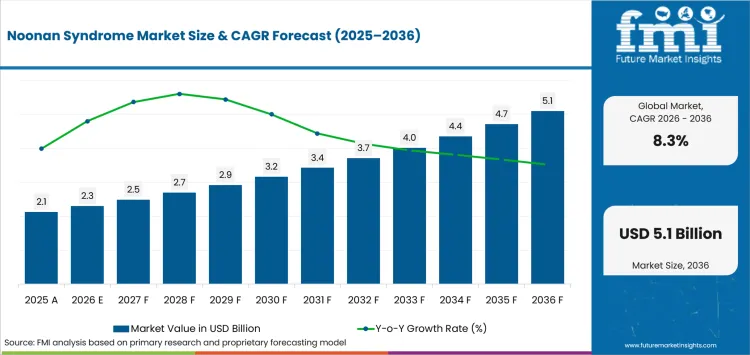
USD 2.3 billion in 2026 and USD 5.1 billion by 2036 at an 8.3% CAGR.
Demand for Noonan syndrome care is projected to expand at an 8.3% CAGR between 2026 and 2036, increasing valuation from USD 2.3 billion in 2026 to USD 5.1 billion by 2036. The commercial pathway begins with clinical recognition and molecular confirmation, then extends into growth management, cardiac review and long-term follow-up.
GeneReviews describes Noonan syndrome as a genetically heterogeneous RAS-MAPK disorder that can affect growth, the heart and development. The February 2026 FDA approval of SOGROYA for growth failure associated with Noonan syndrome added a once-weekly treatment route, while coordinated specialist monitoring remains central to care.
Key Takeaways of Noonan Syndrome Market
- Molecular confirmation moves patients from clinical suspicion into structured cardiac, endocrine and developmental follow-up.
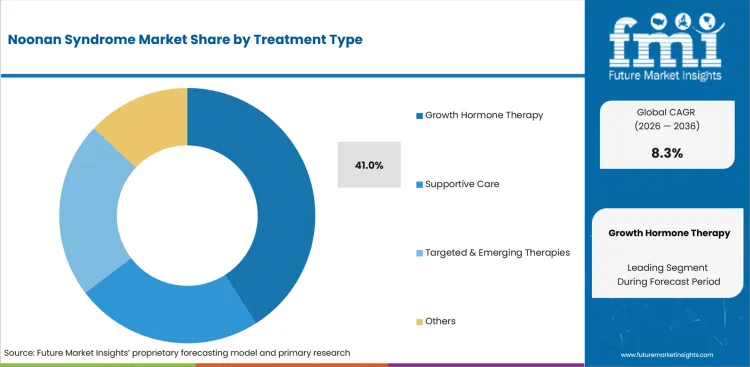
- Growth Hormone Therapy is projected at 41.0% share in 2026 due to its established role in short stature management.
- Genetic Testing is estimated at 48.0% of Diagnosis demand in 2026 as gene panels and broader sequencing improve molecular resolution.
- Hospitals lead End User at 42.0%, Hospital Pharmacies lead Distribution Channel at 46.0% and Growth Disorders lead Application at 39.0%.
- Pfizer Inc., Novo Nordisk A/S, Ascendis Pharma A/S, Merck KGaA, Eli Lilly and Company, Ipsen S.A., Recordati S.p.A., Sandoz Group AG, BioMarin Pharmaceutical Inc. and BridgeBio Pharma, Inc. are active across growth hormone, rare-disease and genetic-medicine pathways.
Analyst Perspective
"A Noonan syndrome product gains value when it fits the full care pathway. Molecular confirmation must connect with cardiac review and growth monitoring, while long-acting therapy must reduce injection burden without weakening specialist oversight."
- Anurag Sharma, Principal Consultant at Future Market Insights
How is the Noonan Syndrome Market segmented?
The Noonan syndrome market is segmented by treatment type, diagnosis, end user, distribution channel, application and region.
The market follows the patient journey from clinical suspicion and molecular diagnostics through treatment selection, specialist care, dispensing and long-term monitoring. Treatment Type covers Growth Hormone Therapy, Supportive Care, Targeted & Emerging Therapies and Others. Diagnosis includes Genetic Testing, Clinical Evaluation, Prenatal Diagnosis and Others. End User covers Hospitals, Specialty Clinics, Diagnostic Laboratories and Others. Distribution Channel includes Hospital Pharmacies, Retail Pharmacies, Specialty Pharmacies and Others. Application covers Growth Disorders, Cardiovascular Disorders, Genetic Disease Management and Others.
Why does Growth Hormone Therapy lead the Treatment Type category?
Growth Hormone Therapy links short stature management with an established pediatric endocrine pathway. Daily recombinant growth hormone remains the standard route, while long-acting options can reduce injection frequency when monitoring and dose review remain visible.
- Based on Treatment Type, Growth Hormone Therapy is projected to account for 41.0% in 2026 due to its established place in short stature care.
- The NORDITROPIN label includes pediatric short stature associated with Noonan syndrome. The 2026 REAL8 phase 3 study found once-weekly somapacitan produced higher annualized height velocity than daily growth hormone after 52 weeks, with a similar safety profile.
Why does Genetic Testing lead the Diagnosis category?
Noonan syndrome can arise from pathogenic variants across several RAS-MAPK pathway genes. Molecular confirmation can resolve overlapping clinical features and support genetic counseling, while a negative result does not remove the need for specialist evaluation when the phenotype remains suggestive.
- In 2026, Genetic Testing is expected to lead the Diagnosis category with 48.0% share because molecular confirmation supports care planning and family counseling.
- Gene-targeted panels and comprehensive genomic testing provide complementary routes. NGS-Based Testing and Targeted Gene Panels remain the two child entries under Genetic Testing.
Why do Hospitals lead the End User category?
Noonan syndrome can involve congenital heart disease, short stature and developmental needs. Hospitals concentrate pediatric cardiology, endocrinology and clinical genetics within one referral route, which supports diagnosis and treatment decisions for complex cases.
- Hospitals are forecast to hold 42.0% share in 2026 as multi-system assessment and treatment initiation remain concentrated in pediatric and specialty settings.
- Pediatric Hospitals and Specialty Care Hospitals form the child entries under Hospitals. The 2025 multidisciplinary consensus statement supports coordinated follow-up from childhood into adult care.
Why do Hospital Pharmacies lead the Distribution Channel category?
Hospital pharmacies sit close to specialist prescribing and dose review for pediatric growth hormone therapy. This position supports product initiation, administration training and follow-up when treatment must account for growth response and cardiac history.
- Hospital Pharmacies are estimated to represent 46.0% share in 2026 because specialist dispensing remains closely linked with supervised therapy.
- Inpatient Pharmacies and Outpatient Pharmacies are the child entries under Hospital Pharmacies, while Specialty Pharmacies provide an additional route for rare-disease products and biologics.
Why do Growth Disorders lead the Application category?
Short stature is a visible and measurable feature that often brings children into endocrine care. Growth assessment creates a recurring pathway for height measurement, treatment review and dose adjustment across childhood.
- Growth Disorders are likely to account for 39.0% share in 2026 owing to demand for short stature management and long-term growth monitoring.
- Short Stature Management and Growth Monitoring form the child entries under Growth Disorders, while Cardiovascular Disorders and Genetic Disease Management address the wider multi-system care pathway.
What are the drivers, restraints and opportunities in the Noonan Syndrome Market?
Molecular confirmation and coordinated specialist care expand treatment access, while genetic variability and monitoring burden limit continuity as long-acting growth hormone creates a lower-frequency treatment route.
- Driver: Molecular diagnosis moves patients into defined treatment and monitoring pathways.
- Restraint: Phenotypic variability and cardiac risk increase the need for specialist review throughout treatment.
- Opportunity: Long-acting growth hormone can reduce injection frequency within supervised pediatric care.
Molecular diagnosis is becoming a stronger operating requirement for Noonan syndrome care. GeneReviews recommends gene-targeted testing or broader genomic testing according to the clinical presentation. This supports demand for clinical genetics services, interpretation capacity and genomics platforms that can connect results with a usable care plan.
Care complexity remains a restraint because the disorder can affect growth, cardiac function and development. The 2025 consensus statement calls for multidisciplinary treatment and regular follow-up across the lifespan. Fragmented referral routes can delay treatment decisions or weaken continuity after pediatric care.
The opportunity sits between treatment convenience and clinical control. The SOGROYA prescribing information provides a once-weekly option for eligible children aged 2.5 years and older with growth failure associated with Noonan syndrome. Uptake depends on specialist selection, dose monitoring and reliable dispensing through hospital or specialty pharmacy routes.
Which country CAGRs are covered in the Noonan Syndrome Market?
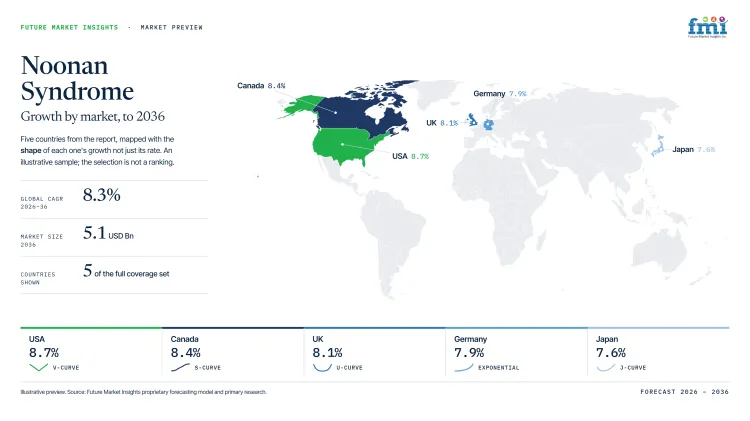
| Country | CAGR |
|---|---|
| South Korea | 9.1% |
| USA | 8.7% |
| Canada | 8.4% |
| UK | 8.1% |
| Australia | 8.0% |
| Germany | 7.9% |
| Japan | 7.6% |
How do country-level CAGRs compare in the Noonan Syndrome Market?
The seven country CAGRs span 1.5 percentage points, from South Korea at 9.1% to Japan at 7.6%. The range reflects differences in genetic testing access, pediatric specialty care and growth hormone treatment pathways rather than current market size.
- South Korea leads at 9.1% as rare-disease registration and hospital-based pediatric care support diagnosis and follow-up.
- USA records 8.7% with FDA-labeled daily and once-weekly growth hormone routes for pediatric Noonan syndrome.
- Canada advances at 8.4% as public genetic testing pathways and an approved Norditropin indication support treatment access.
- UK grows at 8.1% through NHS genetics services and multidisciplinary care pathways for children with suspected RASopathies.
- Australia records 8.0% as genetic confirmation and specialist-led management connect diagnosis with cardiac and growth review.
- Germany expands at 7.9% through medical genetics consultation and referral to specialist centers for rare developmental disorders.
- Japan posts 7.6% with an established Norditropin indication and long-term local evidence for growth response and safety.
Comparable CAGRs can lead to different entry conditions. Product labeling, reimbursement routes and the availability of pediatric endocrinology or clinical genetics determine how quickly diagnosis converts into sustained treatment.
Country-wise Analysis
- South Korean demand is supported by a national rare-disease information system that recognizes Noonan syndrome and directs families toward specialist assessment. The Korea Disease Control and Prevention Agency rare-disease portal describes diagnosis and management needs for the condition, which supports awareness among pediatric providers. The South Korean Noonan syndrome market is projected to record a 9.1% CAGR through 2036, with growth dependent on genetic confirmation and coordinated cardiac or endocrine follow-up.
- The USA combines molecular testing capacity with two FDA-labeled growth hormone routes for pediatric Noonan syndrome. NORDITROPIN provides a daily somatropin option, while SOGROYA provides once-weekly somapacitan for eligible children aged 2.5 years and older. USA demand is forecast to expand at an 8.7% CAGR, although access still depends on specialist review and payer approval.
- Canada has an established regulatory and laboratory route for Noonan syndrome care. Health Canada approved the Norditropin indication for pediatric short stature due to Noonan syndrome, while the Ontario Genetic Test Directory lists a Noonan syndrome and RASopathies gene panel. The Canadian market is expected to grow at 8.4% through 2036 as genetic confirmation supports treatment selection and family counseling.
- UK care begins with clinical assessment and can move into genomic testing through NHS referral pathways. NHS guidance identifies genetic testing, heart treatment and growth hormone among the principal routes used in care, while NHS Genomics Education supports recognition of RASopathies. UK demand is anticipated to rise at an 8.1% CAGR, with specialist coordination shaping access across childhood and transition to adult services.
- Australian care relies on clinical genetics and pediatric specialists to confirm the condition and assess heart or growth problems. Healthdirect Australia describes genetic confirmation, cardiac review and growth hormone as parts of the management pathway. The Australian Noonan syndrome market is projected to expand at an 8.0% CAGR as public referral routes support diagnosis, although travel and specialist availability can affect continuity outside major centers.
- Germany provides genetic counseling and specialist referral routes for hereditary conditions. The federal health portal explains that genetic consultation can combine family history, physical examination and laboratory analysis, while Orphanet maps Noonan syndrome expertise across Europe. German demand is estimated to grow at 7.9% through 2036 as molecular diagnosis and pediatric specialty care support longer treatment pathways.
- Japan has an established daily growth hormone route for short stature associated with Noonan syndrome. A PMDA review lists Norditropin dosing for this indication, and a 2026 post-marketing study reported improved height outcomes with no new safety issues while recommending careful monitoring for cardiomyopathy. Japan is forecast to record a 7.6% CAGR, supported by local evidence and specialist follow-up.
Who are the notable companies in the Noonan Syndrome Market?
Pfizer Inc., Novo Nordisk A/S, Ascendis Pharma A/S, Merck KGaA, Eli Lilly and Company, Ipsen S.A., Recordati S.p.A., Sandoz Group AG, BioMarin Pharmaceutical Inc. and BridgeBio Pharma, Inc. are the notable companies serving the Noonan syndrome market.
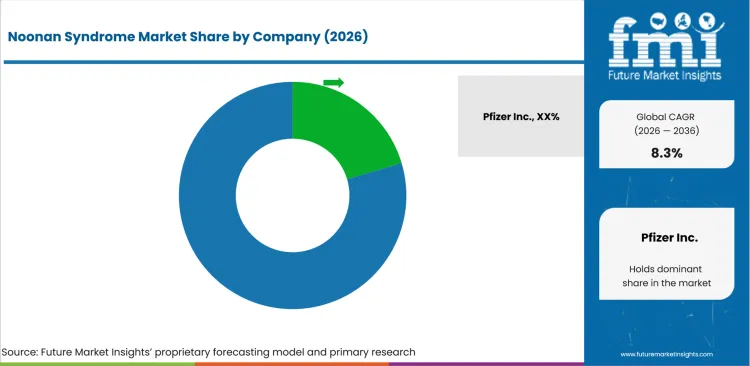
Competition spans established growth hormone manufacturers and long-acting endocrine developers. Rare-disease companies add specialist access or genetic-medicine capabilities. Direct Noonan-specific treatment evidence is concentrated in Novo Nordisk products within the public sources reviewed for this article.
- Growth hormone and endocrine coverage: Pfizer Inc., Novo Nordisk A/S, Ascendis Pharma A/S, Merck KGaA, Eli Lilly and Company and Sandoz Group AG.
- Rare-disease and endocrine coverage: Ipsen S.A. and Recordati S.p.A.
- Genetic rare-disease coverage: BioMarin Pharmaceutical Inc. and BridgeBio Pharma, Inc.
Competitive Benchmarking: Noonan Syndrome Market
| Company | Growth hormone or endocrine platform | Noonan-specific product or study evidence | Rare-disease or genetic-medicine relevance | Geographic Reach |
|---|---|---|---|---|
| Pfizer Inc. | High | Low | Medium | Global |
| Novo Nordisk A/S | High | High | High | Global |
| Ascendis Pharma A/S | High | Low | Medium | USA, Europe and selected markets |
| Merck KGaA | Medium | Low | Medium | Global |
| Eli Lilly and Company | Medium | Low | Medium | Global |
| Ipsen S.A. | Medium | Low | High | Global |
| Recordati S.p.A. | Low | Low | High | Europe, USA and selected markets |
| Sandoz Group AG | High | Low | Medium | Global |
| BioMarin Pharmaceutical Inc. | Low | Low | High | Global |
| BridgeBio Pharma, Inc. | Low | Low | High | USA and international programs |
Key Developments in the Noonan Syndrome Market
- In February 2026, the U.S. FDA approved SOGROYA for growth failure associated with Noonan syndrome in pediatric patients aged 2.5 years and older.
- In March 2026, the European Journal of Endocrinology published the REAL8 phase 3 study comparing once-weekly somapacitan with daily growth hormone in children with Noonan syndrome.
- In October 2025, JAMA Network Open published a multidisciplinary consensus statement covering diagnosis, treatment, transition and follow-up from childhood through adulthood.
Key Players in the Noonan Syndrome Market
Growth Hormone and Endocrine Therapy Companies
- Pfizer Inc.
- Novo Nordisk A/S
- Ascendis Pharma A/S
- Merck KGaA
- Eli Lilly and Company
- Sandoz Group AG
Rare Disease and Genetic Medicine Companies
- Ipsen S.A.
- Recordati S.p.A.
- BioMarin Pharmaceutical Inc.
- BridgeBio Pharma, Inc.
Noonan Syndrome Market - Report Scope
| Coverage field | Report scope |
|---|---|
| Market breakdown | By Treatment Type, Diagnosis, End User, Distribution Channel, Application and Region. |
| Quantitative Units | Revenue in USD billion and CAGR in %. |
| Market Definition | Commercial treatment, diagnostic, dispensing and monitoring activities associated with Noonan syndrome. |
| Regions Covered | North America, Latin America, Western Europe, Eastern Europe, East Asia, South Asia and Pacific, and Middle East and Africa. |
| Countries Covered | USA, Japan, Germany, UK, Canada, Australia and South Korea. |
| Key Companies | Pfizer Inc., Novo Nordisk A/S, Ascendis Pharma A/S, Merck KGaA, Eli Lilly and Company, Ipsen S.A., Recordati S.p.A., Sandoz Group AG, BioMarin Pharmaceutical Inc. and BridgeBio Pharma, Inc. |
| Forecast Period | 2026 to 2036. |
| Approach | Primary and secondary research with market triangulation. |
Noonan Syndrome Market - Research Methodology
| Method | Approach |
|---|---|
| Primary Research | FMI analysts gathered input from pharmaceutical manufacturers, diagnostic laboratories, pediatric specialists, hospital pharmacies, rare-disease service providers and other market participants. Interviews examined diagnosis routes, product evaluation, treatment selection, adoption barriers, reimbursement conditions and expectations for clinical or commercial support. |
| Desk Research | Desk research covered regulatory labels, clinical guidelines, peer-reviewed studies, trial registries, government health resources, company filings and official corporate materials. Sources were reviewed for publication date, geographic relevance and consistency with the market definition. Claims on indications, efficacy, safety, access and commercial activity were retained only when supported by credible public evidence. |
| Market Sizing and Forecasting | The market model combined the baseline value with segment structure, treatment adoption, diagnostic activity, pricing and volume indicators, company participation and country-level care conditions. Forecast assumptions considered molecular testing access, growth hormone use, specialist availability, reimbursement and barriers to wider treatment continuity. |
| Data Validation | Estimates were checked against independent indicators from regulatory actions, clinical evidence, company activity and primary interviews. Validation also tested whether products, services and revenues fell inside the market definition. Adjacent categories and overlapping activities were excluded to reduce double counting. |
Noonan Syndrome Market by Segments
Noonan Syndrome Market segmented by Treatment Type:
- Growth Hormone Therapy
- Recombinant Human Growth Hormone
- Long-Acting Growth Hormone
- Supportive Care
- Cardiac Management
- Endocrine & Developmental Care
- Targeted & Emerging Therapies
- RAS-MAPK Pathway Therapies
- Gene-Based Therapies
- Others
- Symptomatic Medications
- Rehabilitative Care
Noonan Syndrome Market segmented by Diagnosis:
- Genetic Testing
- NGS-Based Testing
- Targeted Gene Panels
- Clinical Evaluation
- Physical Examination
- Family History Assessment
- Prenatal Diagnosis
- Chorionic Villus Sampling
- Amniocentesis
- Others
- Cardiac Imaging
- Laboratory Testing
Noonan Syndrome Market segmented by End User:
- Hospitals
- Pediatric Hospitals
- Specialty Care Hospitals
- Specialty Clinics
- Genetic Clinics
- Endocrinology Clinics
- Diagnostic Laboratories
- Molecular Diagnostics Labs
- Clinical Genetics Labs
- Others
- Academic Research Centers
- CROs
Noonan Syndrome Market segmented by Distribution Channel:
- Hospital Pharmacies
- Inpatient Pharmacies
- Outpatient Pharmacies
- Retail Pharmacies
- Chain Pharmacies
- Independent Pharmacies
- Specialty Pharmacies
- Rare Disease Pharmacies
- Biologics Distribution
- Others
- Online Pharmacies
- Government Supply Programs
Noonan Syndrome Market segmented by Application:
- Growth Disorders
- Short Stature Management
- Growth Monitoring
- Cardiovascular Disorders
- Pulmonary Valve Stenosis
- Hypertrophic Cardiomyopathy
- Genetic Disease Management
- Long-Term Disease Monitoring
- Multidisciplinary Care
- Others
- Hematologic Disorders
- Developmental & Cognitive Support
Noonan Syndrome Market by Region:
- North America
- United States
- Canada
- Mexico
- Latin America
- Brazil
- Chile
- Rest of Latin America
- Western Europe
- Germany
- United Kingdom
- Italy
- Spain
- France
- Nordics
- Benelux
- Rest of Western Europe
- Eastern Europe
- Russia
- Poland
- Hungary
- Balkan and Baltic States
- Rest of Eastern Europe
- East Asia
- China
- Japan
- South Korea
- South Asia and Pacific
- India
- ASEAN
- Australia and New Zealand
- Rest of South Asia and Pacific
- Middle East and Africa
- Kingdom of Saudi Arabia
- Other GCC Countries
- Türkiye
- South Africa
- Other African Union Countries
- Rest of Middle East and Africa
Research Sources and Bibliography
- Roberts AE. Noonan Syndrome. GeneReviews. Revised February 17, 2022.
- U.S. Food and Drug Administration. SOGROYA prescribing information. 2026.
- U.S. Food and Drug Administration. SOGROYA supplement approval letter. February 27, 2026.
- U.S. Food and Drug Administration. NORDITROPIN prescribing information. 2025.
- Jorge AAL, et al. Once-weekly somapacitan in children with Noonan syndrome. European Journal of Endocrinology. 2026;194(3):393-403.
- Stagi S, et al. Multidisciplinary Treatment of Patients With Noonan Syndrome: A Consensus Statement. JAMA Network Open. 2025;8(10):e2537603.
- ClinicalTrials.gov. REAL8: A Research Study to Compare Somapacitan Once a Week With Norditropin Once a Day in Children Who Need Help to Grow. NCT05330325.
- National Health Service. Noonan syndrome. Updated June 2026.
- NHS Genomics Education Programme. RASopathies.
- Pharmaceuticals and Medical Devices Agency. Report on Investigation Results for somatropin products. 2022.
- Muroya K, et al. Long-term effectiveness and safety of daily growth hormone therapy in Japanese children with Noonan syndrome. Endocrine Journal. 2026;73(2):229-241.
- Health Canada. Regulatory Decision Summary for Norditropin Nordiflex.
- Ontario Health. Ontario Genetic Test Directory.
- Healthdirect Australia. Noonan syndrome.
- Federal Ministry of Health, Germany. Genetic testing and consultation.
- Orphanet. Noonan syndrome.
- Korea Disease Control and Prevention Agency. Rare Disease Helpline: Noonan syndrome.
This bibliography is provided for reader reference and is not exhaustive. The full report contains the complete reference list and detailed citations.
This Report Answers
- How large is the Noonan Syndrome Market in 2026 and 2036?
- What CAGR is expected for the Noonan Syndrome Market from 2026 to 2036?
- Which Treatment Type holds the leading share in 2026?
- How does molecular diagnosis shape treatment demand?
- Which End User and Distribution Channel lead the market structure?
- Which applications support recurring care demand?
- How do country growth rates differ across USA, Japan, Germany, UK, Canada, Australia and South Korea?
- Which companies participate in growth hormone and rare-disease pathways?
Frequently Asked Questions
How big is the Noonan Syndrome Market in 2026?
USD 2.3 billion represents the Noonan syndrome market value in 2026 across treatment, diagnosis, dispensing and long-term monitoring activities. Molecular confirmation and specialist-led care support expansion toward USD 5.1 billion by 2036.
What is the CAGR of the Noonan Syndrome Market from 2026 to 2036?
An 8.3% CAGR is projected for the Noonan syndrome market between 2026 and 2036. Growth depends on earlier molecular diagnosis, access to pediatric specialists and continued adoption of daily or long-acting growth hormone within supervised care.
Which Treatment Type is projected to account for 41.0% of the Noonan Syndrome Market?
Growth Hormone Therapy is projected to account for 41.0% of Treatment Type demand in 2026. The segment includes recombinant human growth hormone and long-acting growth hormone used for short stature management in eligible children.
How much will the Noonan Syndrome Market add between 2026 and 2036?
USD 2.8 billion is expected to be added to the Noonan syndrome market between 2026 and 2036. The increase reflects wider genetic testing and sustained treatment demand across growth, cardiac and multidisciplinary care pathways.
Which companies are active in the Noonan Syndrome Market?
Ten companies active across the Noonan syndrome market include Pfizer Inc., Novo Nordisk A/S, Ascendis Pharma A/S, Merck KGaA, Eli Lilly and Company, Ipsen S.A., Recordati S.p.A., Sandoz Group AG, BioMarin Pharmaceutical Inc. and BridgeBio Pharma, Inc.
Preview the report firsthand - request a free sample
Get SampleGet the brochure for pricing and purchase details.
Get PDFTable of Content
- Key Takeaways
- Market Size and CAGR
- Top Growth Driver
- Fastest Growing Segment
- Leading Region
- Key Companies
- Emerging Opportunities
- Executive Summary
- Global Market Outlook
- Demand-side Trends
- Supply-side Trends
- Technology Roadmap Analysis
- Analysis and Recommendations
- Analyst Perspective (What is happening? Why now? What should investors know?)
- Key Questions Answered
- How large is the market?
- What is the CAGR?
- What are key trends?
- Which region dominates?
- Who are the leaders?
- Market Overview
- Market Coverage / Taxonomy
- Market Definition / Scope / Limitations
- Research Methodology
- Chapter Orientation
- Analytical Lens and Working Hypotheses
- Market Structure, Signals, and Trend Drivers
- Benchmarking and Cross-market Comparability
- Market Sizing, Forecasting, and Opportunity Mapping
- Research Design and Evidence Framework
- Desk Research Programme (Secondary Evidence)
- Expert Input and Fieldwork (Primary Evidence)
- Tooling, Models, and Reference Databases
- Data Engineering and Model Build
- Quality Assurance and Audit Trail
- Market Background
- Market Dynamics (Drivers, Restraints, Opportunity, Trends)
- Scenario Forecast (Optimistic, Likely, Conservative)
- Impact Analysis
- AI Impact
- Sustainability Impact
- Regulatory Impact
- Technology Impact
- Consumer / Buyer Analysis
- Purchase Drivers
- Adoption Barriers
- Buyer Journey
- Opportunity Map Analysis
- Product Life Cycle Analysis
- Supply Chain Analysis
- Investment Feasibility Matrix
- Value Chain Analysis
- PESTLE and Porter's Analysis
- Regulatory Landscape
- Regional Parent Market Outlook
- Production and Consumption Statistics
- Import and Export Statistics
- Global Market Analysis and Forecast, 2021 to 2036
- Historical Market Size Value (USD Billion) Analysis, 2021 to 2025
- Current and Future Market Size Value (USD Billion) Projections, 2026 to 2036
- Y-o-Y Growth Trend Analysis
- Absolute $ Opportunity Analysis
- Global Market Pricing Analysis, 2021 to 2036
- Global Market Analysis and Forecast, By Treatment Type, 2021 to 2036
- Introduction / Key Findings
- Historical Market Size Value (USD Billion) Analysis By Treatment Type, 2021 to 2025
- Current and Future Market Size Value (USD Billion) Analysis and Forecast By Treatment Type, 2026 to 2036
- Growth Hormone Therapy
- Recombinant Human Growth Hormone
- Long-Acting Growth Hormone
- Supportive Care
- Cardiac Management
- Endocrine & Developmental Care
- Targeted & Emerging Therapies
- RAS-MAPK Pathway Therapies
- Gene-Based Therapies
- Others
- Symptomatic Medications
- Rehabilitative Care
- Growth Hormone Therapy
- Y-o-Y Growth Trend Analysis By Treatment Type, 2021 to 2025
- Absolute $ Opportunity Analysis By Treatment Type, 2026 to 2036
- Global Market Analysis and Forecast, By Diagnosis, 2021 to 2036
- Introduction / Key Findings
- Historical Market Size Value (USD Billion) Analysis By Diagnosis, 2021 to 2025
- Current and Future Market Size Value (USD Billion) Analysis and Forecast By Diagnosis, 2026 to 2036
- Genetic Testing
- NGS-Based Testing
- Targeted Gene Panels
- Clinical Evaluation
- Physical Examination
- Family History Assessment
- Prenatal Diagnosis
- Chorionic Villus Sampling
- Amniocentesis
- Others
- Cardiac Imaging
- Laboratory Testing
- Genetic Testing
- Y-o-Y Growth Trend Analysis By Diagnosis, 2021 to 2025
- Absolute $ Opportunity Analysis By Diagnosis, 2026 to 2036
- Global Market Analysis and Forecast, By End User, 2021 to 2036
- Introduction / Key Findings
- Historical Market Size Value (USD Billion) Analysis By End User, 2021 to 2025
- Current and Future Market Size Value (USD Billion) Analysis and Forecast By End User, 2026 to 2036
- Hospitals
- Pediatric Hospitals
- Specialty Care Hospitals
- Specialty Clinics
- Genetic Clinics
- Endocrinology Clinics
- Diagnostic Laboratories
- Molecular Diagnostics Labs
- Clinical Genetics Labs
- Others
- Academic Research Centers
- CROs
- Hospitals
- Y-o-Y Growth Trend Analysis By End User, 2021 to 2025
- Absolute $ Opportunity Analysis By End User, 2026 to 2036
- Global Market Analysis and Forecast, By Distribution Channel, 2021 to 2036
- Introduction / Key Findings
- Historical Market Size Value (USD Billion) Analysis By Distribution Channel, 2021 to 2025
- Current and Future Market Size Value (USD Billion) Analysis and Forecast By Distribution Channel, 2026 to 2036
- Hospital Pharmacies
- Inpatient Pharmacies
- Outpatient Pharmacies
- Retail Pharmacies
- Chain Pharmacies
- Independent Pharmacies
- Specialty Pharmacies
- Rare Disease Pharmacies
- Biologics Distribution
- Others
- Online Pharmacies
- Government Supply Programs
- Hospital Pharmacies
- Y-o-Y Growth Trend Analysis By Distribution Channel, 2021 to 2025
- Absolute $ Opportunity Analysis By Distribution Channel, 2026 to 2036
- Global Market Analysis and Forecast, By Application, 2021 to 2036
- Introduction / Key Findings
- Historical Market Size Value (USD Billion) Analysis By Application, 2021 to 2025
- Current and Future Market Size Value (USD Billion) Analysis and Forecast By Application, 2026 to 2036
- Growth Disorders
- Short Stature Management
- Growth Monitoring
- Cardiovascular Disorders
- Pulmonary Valve Stenosis
- Hypertrophic Cardiomyopathy
- Genetic Disease Management
- Long-Term Disease Monitoring
- Multidisciplinary Care
- Others
- Hematologic Disorders
- Developmental & Cognitive Support
- Growth Disorders
- Y-o-Y Growth Trend Analysis By Application, 2021 to 2025
- Absolute $ Opportunity Analysis By Application, 2026 to 2036
- Global Market Analysis and Forecast, By Region, 2021 to 2036
- Introduction
- Historical Market Size Value (USD Billion) Analysis By Region, 2021 to 2025
- Current Market Size Value (USD Billion) Analysis and Forecast By Region, 2026 to 2036
- North America
- Latin America
- Western Europe
- Eastern Europe
- East Asia
- South Asia and Pacific
- Middle East & Africa
- Market Attractiveness Analysis By Region
- North America Market Analysis and Forecast, By Country, 2021 to 2036
- Historical Market Size Value (USD Billion) Trend Analysis By Market Taxonomy, 2021 to 2025
- Market Size Value (USD Billion) Forecast By Market Taxonomy, 2026 to 2036
- By Country
- USA
- Canada
- By Treatment Type
- By Diagnosis
- By End User
- By Distribution Channel
- By Application
- By Country
- Market Attractiveness Analysis
- By Country
- By Treatment Type
- By Diagnosis
- By End User
- By Distribution Channel
- By Application
- Key Takeaways
- Latin America Market Analysis and Forecast, By Country
- Historical Market Size Value (USD Billion) Trend Analysis By Market Taxonomy, 2021 to 2025
- Market Size Value (USD Billion) Forecast By Market Taxonomy, 2026 to 2036
- By Country
- Brazil
- Mexico
- Chile
- Rest of Latin America
- By Treatment Type
- By Diagnosis
- By End User
- By Distribution Channel
- By Application
- By Country
- Market Attractiveness Analysis
- By Country
- By Treatment Type
- By Diagnosis
- By End User
- By Distribution Channel
- By Application
- Key Takeaways
- Western Europe Market Analysis and Forecast, By Country
- Historical Market Size Value (USD Billion) Trend Analysis By Market Taxonomy, 2021 to 2025
- Market Size Value (USD Billion) Forecast By Market Taxonomy, 2026 to 2036
- By Country
- Germany
- UK
- Italy
- Spain
- France
- Nordic
- BENELUX
- Rest of Western Europe
- By Treatment Type
- By Diagnosis
- By End User
- By Distribution Channel
- By Application
- By Country
- Market Attractiveness Analysis
- By Country
- By Treatment Type
- By Diagnosis
- By End User
- By Distribution Channel
- By Application
- Key Takeaways
- Eastern Europe Market Analysis and Forecast, By Country
- Historical Market Size Value (USD Billion) Trend Analysis By Market Taxonomy, 2021 to 2025
- Market Size Value (USD Billion) Forecast By Market Taxonomy, 2026 to 2036
- By Country
- Russia
- Poland
- Hungary
- Balkan & Baltic
- Rest of Eastern Europe
- By Treatment Type
- By Diagnosis
- By End User
- By Distribution Channel
- By Application
- By Country
- Market Attractiveness Analysis
- By Country
- By Treatment Type
- By Diagnosis
- By End User
- By Distribution Channel
- By Application
- Key Takeaways
- East Asia Market Analysis and Forecast, By Country
- Historical Market Size Value (USD Billion) Trend Analysis By Market Taxonomy, 2021 to 2025
- Market Size Value (USD Billion) Forecast By Market Taxonomy, 2026 to 2036
- By Country
- China
- Japan
- South Korea
- By Treatment Type
- By Diagnosis
- By End User
- By Distribution Channel
- By Application
- By Country
- Market Attractiveness Analysis
- By Country
- By Treatment Type
- By Diagnosis
- By End User
- By Distribution Channel
- By Application
- Key Takeaways
- South Asia and Pacific Market Analysis and Forecast, By Country
- Historical Market Size Value (USD Billion) Trend Analysis By Market Taxonomy, 2021 to 2025
- Market Size Value (USD Billion) Forecast By Market Taxonomy, 2026 to 2036
- By Country
- India
- ASEAN
- Australia & New Zealand
- Rest of South Asia and Pacific
- By Treatment Type
- By Diagnosis
- By End User
- By Distribution Channel
- By Application
- By Country
- Market Attractiveness Analysis
- By Country
- By Treatment Type
- By Diagnosis
- By End User
- By Distribution Channel
- By Application
- Key Takeaways
- Middle East & Africa Market Analysis and Forecast, By Country
- Historical Market Size Value (USD Billion) Trend Analysis By Market Taxonomy, 2021 to 2025
- Market Size Value (USD Billion) Forecast By Market Taxonomy, 2026 to 2036
- By Country
- Kingdom of Saudi Arabia
- Other GCC Countries
- Türkiye
- South Africa
- Other African Union
- Rest of Middle East & Africa
- By Treatment Type
- By Diagnosis
- By End User
- By Distribution Channel
- By Application
- By Country
- Market Attractiveness Analysis
- By Country
- By Treatment Type
- By Diagnosis
- By End User
- By Distribution Channel
- By Application
- Key Takeaways
- Key Countries Market Analysis
- USA
- Pricing Analysis
- Market Share Analysis, 2025
- By Treatment Type
- By Diagnosis
- By End User
- By Distribution Channel
- By Application
- Canada
- Pricing Analysis
- Market Share Analysis, 2025
- By Treatment Type
- By Diagnosis
- By End User
- By Distribution Channel
- By Application
- Mexico
- Pricing Analysis
- Market Share Analysis, 2025
- By Treatment Type
- By Diagnosis
- By End User
- By Distribution Channel
- By Application
- Brazil
- Pricing Analysis
- Market Share Analysis, 2025
- By Treatment Type
- By Diagnosis
- By End User
- By Distribution Channel
- By Application
- Chile
- Pricing Analysis
- Market Share Analysis, 2025
- By Treatment Type
- By Diagnosis
- By End User
- By Distribution Channel
- By Application
- Germany
- Pricing Analysis
- Market Share Analysis, 2025
- By Treatment Type
- By Diagnosis
- By End User
- By Distribution Channel
- By Application
- UK
- Pricing Analysis
- Market Share Analysis, 2025
- By Treatment Type
- By Diagnosis
- By End User
- By Distribution Channel
- By Application
- Italy
- Pricing Analysis
- Market Share Analysis, 2025
- By Treatment Type
- By Diagnosis
- By End User
- By Distribution Channel
- By Application
- Spain
- Pricing Analysis
- Market Share Analysis, 2025
- By Treatment Type
- By Diagnosis
- By End User
- By Distribution Channel
- By Application
- France
- Pricing Analysis
- Market Share Analysis, 2025
- By Treatment Type
- By Diagnosis
- By End User
- By Distribution Channel
- By Application
- India
- Pricing Analysis
- Market Share Analysis, 2025
- By Treatment Type
- By Diagnosis
- By End User
- By Distribution Channel
- By Application
- ASEAN
- Pricing Analysis
- Market Share Analysis, 2025
- By Treatment Type
- By Diagnosis
- By End User
- By Distribution Channel
- By Application
- Australia & New Zealand
- Pricing Analysis
- Market Share Analysis, 2025
- By Treatment Type
- By Diagnosis
- By End User
- By Distribution Channel
- By Application
- China
- Pricing Analysis
- Market Share Analysis, 2025
- By Treatment Type
- By Diagnosis
- By End User
- By Distribution Channel
- By Application
- Japan
- Pricing Analysis
- Market Share Analysis, 2025
- By Treatment Type
- By Diagnosis
- By End User
- By Distribution Channel
- By Application
- South Korea
- Pricing Analysis
- Market Share Analysis, 2025
- By Treatment Type
- By Diagnosis
- By End User
- By Distribution Channel
- By Application
- Russia
- Pricing Analysis
- Market Share Analysis, 2025
- By Treatment Type
- By Diagnosis
- By End User
- By Distribution Channel
- By Application
- Poland
- Pricing Analysis
- Market Share Analysis, 2025
- By Treatment Type
- By Diagnosis
- By End User
- By Distribution Channel
- By Application
- Hungary
- Pricing Analysis
- Market Share Analysis, 2025
- By Treatment Type
- By Diagnosis
- By End User
- By Distribution Channel
- By Application
- Kingdom of Saudi Arabia
- Pricing Analysis
- Market Share Analysis, 2025
- By Treatment Type
- By Diagnosis
- By End User
- By Distribution Channel
- By Application
- Türkiye
- Pricing Analysis
- Market Share Analysis, 2025
- By Treatment Type
- By Diagnosis
- By End User
- By Distribution Channel
- By Application
- South Africa
- Pricing Analysis
- Market Share Analysis, 2025
- By Treatment Type
- By Diagnosis
- By End User
- By Distribution Channel
- By Application
- USA
- Market Structure Analysis
- Competition Dashboard
- Competition Benchmarking
- Market Share Analysis of Top Players
- By Regional
- By Treatment Type
- By Diagnosis
- By End User
- By Distribution Channel
- By Application
- Emerging Startups
- Innovation Benchmarking
- Competition Analysis
- Competition Deep Dive
- Pfizer Inc.
- Overview
- Product Portfolio
- Profitability by Market Segments
- Sales Footprint
- Strategy Overview
- Marketing Strategy
- Product Strategy
- Channel Strategy
- Novo Nordisk A/S
- Ascendis Pharma A/S
- Merck KGaA
- Eli Lilly and Company
- Ipsen S.A.
- Recordati S.p.A.
- Sandoz Group AG
- BioMarin Pharmaceutical Inc.
- BridgeBio Pharma, Inc.
- Others
- Pfizer Inc.
- Case Studies
- Success Stories
- Recent Developments
- Competition Deep Dive
- Assumptions & Acronyms Used


