

- Market Size (2026)
- USD 2.4 Bn
- Forecast (2036)
- USD 3.9 Bn
- CAGR (2026 to 2036)
- 5.1%
How big is Usher Syndrome Market in 2026?
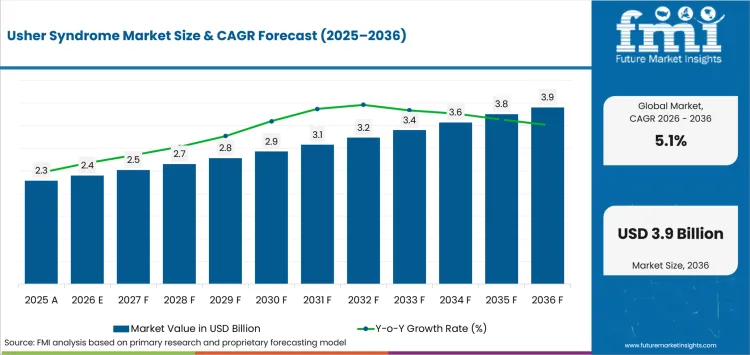
USD 2.4 billion in 2026 and USD 3.9 billion by 2036 at a 5.1% CAGR.
Demand for the Usher syndrome market is projected to expand at 5.1% CAGR between 2026 and 2036, increasing valuation from USD 2.4 billion in 2026 to USD 3.9 billion by 2036. Growth reflects recurring molecular diagnosis and long-term auditory care as retinal degeneration adds specialist monitoring across later disease stages.
Care demand begins with a defined patient population that requires coordinated services across several decades. GeneReviews updated its Usher syndrome type I review in June 2026 and reported an estimated prevalence of about one person in 29,000 across all subtypes. Specialist molecular diagnostics connect subtype confirmation with treatment planning across genetics and retinal services for affected families. Hearing implant systems support recurring fitting and rehabilitation for eligible patients across long-term auditory care pathways.
Key Takeaways of Usher Syndrome Market
- Earlier molecular confirmation links hearing loss with retinal surveillance and reduces referral gaps across coordinated specialist pathways.
- Usher syndrome type 2 is forecast at 52.0% in 2026 due to its extended auditory-to-retinal care pathway.
- Devices are estimated at 43.0% in 2026 owing to established fitting and rehabilitation pathways for hearing loss.
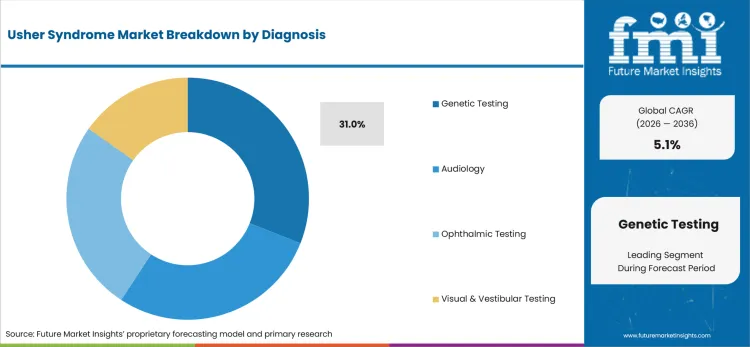
- Genetic testing is projected at 31.0% in 2026 as molecular results guide counseling and study eligibility.
- Genetic heterogeneity and scarce dual-sensory expertise restrict treatment conversion across mutation-defined pathways and dispersed specialist networks.
- Cochlear Limited, Advanced Bionics, MED-EL, WS Audiology, Laboratoires Théa, Nacuity Pharmaceuticals, Atsena Therapeutics and AAVantgarde Bio serve auditory or retinal care.
Analyst Perspective
“Hospital teams should compare fitting support with retinal-trial access instead of focusing on the initial device price. Commercial value depends on referrals linking molecular confirmation with implantation, rehabilitation and mutation-matched follow-up care.”
- Anurag Sharma, Principal Consultant for Healthcare, Future Market Insights
How is the Usher Syndrome Market segmented?
The Usher syndrome industry is segmented by type, treatment, diagnosis, distribution channel, end user and region.
The Usher syndrome industry is segmented by type, treatment, diagnosis, distribution channel, end user and region. Type covers syndromic forms and genetic subtypes, while treatment includes devices, drugs and gene therapies, supportive care and other interventions. Diagnosis covers genetic, audiology, ophthalmic and visual or vestibular testing, while distribution includes hospital, specialty and retail pharmacies plus other channels. End users include hospitals, specialty clinics, research institutes, rehabilitation centers and community settings across the final taxonomy.
Why does genetic testing lead demand within the diagnosis category?
Overlapping hearing and retinal findings can obscure subtype, so molecular confirmation through genomic testing separates genetic forms and guides counseling across affected families.
- Based on diagnosis, genetic testing is projected to account for 31.0% in 2026 due to molecular confirmation guiding counseling and study eligibility. The National Eye Institute updated its Usher syndrome guidance in March 2026 and includes genetic testing in diagnosis. Molecular confirmation then directs affected families toward surveillance and mutation-specific study screening across specialist services.
- Laboratories earn recurring value through result interpretation and family counseling as reports connect affected families with surveillance plans and mutation-specific trial screening.
Why does usher syndrome type 2 lead demand within the type category?
Usher syndrome type 2 pairs congenital moderate-to-severe hearing loss with retinal degeneration that often appears later. A March 2025 clinical review confirmed this staggered presentation across auditory management and later retinal degeneration. The timing sustains audiology earlier and adds specialist inherited-retinal assessment as visual function changes progressively.
- The type category is forecast to be led by Usher syndrome type 2 at 52.0% share in 2026 due to its long auditory-to-retinal care sequence.
- Hearing aids address the earlier auditory need, while retinal imaging gains importance as night vision and peripheral fields decline across adulthood over time.
Why do devices lead demand within the treatment category?
Hearing loss produces an immediate communication need that investigational retinal therapies do not address during daily life. Clinical teams therefore assess hearing aids or cochlear implants according to auditory severity and speech recognition across routine care pathways.
- By treatment, devices are estimated to hold 43.0% in 2026 owing to established fitting and rehabilitation pathways for immediate hearing needs.
- A June 2025 clinical review identified hearing devices and cochlear implants as standard care for people with Usher syndrome who retain usable auditory function. Long-term fitting support and rehabilitation sustain revenue beyond the initial device selection across continuing auditory care.
Why do hospitals lead demand within the end-user category?
Large hospitals combine audiology, ophthalmic diagnostic equipment and genetics within one route for a disorder affecting two sensory systems. ClinicalTrials.gov updated the LUNA Phase 2b study in June 2026 for repeated intravitreal treatment and retinal assessment. The study design reinforces demand for tertiary centers that coordinate dosing and longitudinal imaging services.
- In 2026, hospitals are expected to lead the end-user category with 46.0% share because multidisciplinary teams coordinate implantation and retinal monitoring.
- University hospitals coordinate implantation and specialist imaging across mutation-defined trials, while regional clinics provide rehabilitation but usually lack investigational retinal delivery capacity for eligible patients.
What are the drivers, restraints and opportunities in the Usher Syndrome Market?
Driver: Molecular confirmation connects hearing loss with retinal surveillance. Restraint: Genetic variation and scarce specialist capacity delay treatment conversion. Opportunity: Mutation-specific programs require verified eligibility and sustained clinical delivery.
- Driver: Molecular confirmation directs families toward coordinated auditory support and retinal monitoring through one clinical plan.
- Restraint: Small mutation-defined populations and variable progression complicate recruitment and require lengthy retinal outcome measurement.
- Opportunity: Therapy developers gain revenue by connecting testing access with specialist delivery and sustained outcome measurement.
Molecular confirmation changes the care sequence by linking hearing loss with retinal surveillance during earlier stages of visual decline. Genetics teams can then direct family testing and set specialist follow-up without repeated referrals across separate clinical systems or disconnected records.
Genetic heterogeneity narrows eligible cohorts and makes natural progression difficult to separate from treatment effects. Retinal gene therapy programs need repeated imaging and small mutation-defined cohorts, which raise recruitment costs and extend trial timelines for developers.
Revenue potential differs by delivery model across defined genotypes and gene-agnostic oral programs for retinal loss. ClinicalTrials.gov posted an 80-participant Phase 3 NPI-001 study in December 2025 for twice-daily oral treatment. The design avoids retinal surgery and retains specialist measurement throughout two-year rare-disease clinical trials services.
Which country CAGRs are profiled in the Usher Syndrome Market?
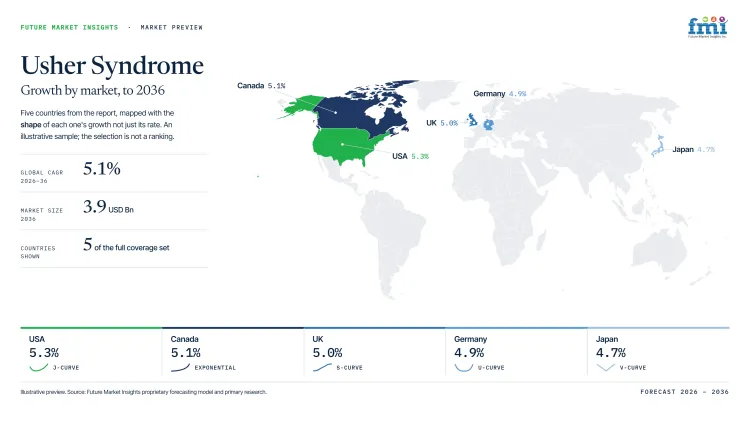
| Country | CAGR |
|---|---|
| Japan | 4.7% |
| United States | 5.3% |
| Canada | 5.1% |
| United Kingdom | 5.0% |
| Germany | 4.9% |
How do country-level CAGRs compare in the Usher Syndrome Market?
The five country CAGRs span 0.7 percentage point and describe forecast pace without measuring current revenue or treatment volume.
- South Korea combines regional genetic testing support with tertiary referrals that shorten the path to subtype confirmation.
- The United States combines implant centers with inherited-retinal research sites, although travel and coverage differences shape specialist access.
- Canada combines federal rare-disease agreements with provincial delivery, which produces different testing and treatment timelines.
- United Kingdom genomic laboratory hubs support specialist referrals, although capacity differs across its national health systems.
- Germany uses standardized newborn hearing screening, but Usher confirmation requires separate molecular and ophthalmic assessment.
Comparable CAGRs can produce different market entry conditions across the five profiled countries despite the narrow forecast range. The full report provides country-level CAGR analysis across North America, Latin America, Europe, East Asia, South Asia and Pacific, and the Middle East and Africa.
Country-wise Analysis
- South Korea routes suspected rare-disease cases through designated hospitals that collect samples regionally and coordinate molecular confirmation with family testing plus medical assistance referrals across the public health system for affected families nationwide. KDCA reported in April 2025 that supported patients would increase from 410 to 800 and participating institutions from 23 to 34. Regional collection routes can therefore reduce repeated long-distance travel for families seeking molecular confirmation and family testing. South Korea is estimated to post 5.6% CAGR over the forecast period, supported by wider diagnostic reach although limited dual-sensory expertise outside major tertiary centers separates auditory intervention from retinal follow-up services nationwide.
- United States care combines cochlear implant centers with inherited-retinal clinics and academic research sites that provide repeated auditory assessment or retinal imaging through established specialist referral routes across several major regions nationwide. ClinicalTrials.gov updated a cochlear-implant study for Usher syndrome in July 2025 with four locations, confirming that condition-specific research remains concentrated across a small group of academic centers. The United States' Usher syndrome outlook is anticipated to advance at 5.3% CAGR over the assessment period, reinforced by implant services and mutation-defined research capacity across academic medical centers. Coverage differences across state systems can delay specialist referral and trial participation for families outside major metropolitan areas.
- Canada coordinates rare-disease policy through federal agreements while provinces and territories retain responsibility for coverage decisions and specialist delivery across dispersed public health systems that serve remote or rural communities nationwide through referral networks. Health Canada confirmed in June 2026 that bilateral agreements covered all 13 provinces and territories and supported rare-disease drugs plus screening and diagnostic services through March 2027 across each public health system. Usher syndrome services in Canada are forecast to expand at 5.1% CAGR by 2036, aided by national evidence planning although separate coverage decisions can produce uneven access to genetic testing and retinal therapies.
- England delivers commissioned genomic testing through laboratory hubs within the United Kingdom rare-disease framework and connects eligible families with specialist interpretation through defined regional referral routes for inherited sensory conditions across public services nationwide. The February 2026 action plan recorded more than 340,000 rare-disease genomic tests during 2025 across England. National testing volume is substantial, yet coordinated dual-sensory referral capacity remains uneven outside major specialist centers. Usher syndrome demand in the United Kingdom is forecast to rise at 5.0% CAGR over the forecast period, driven by genomic capacity and specialist networks across national health systems and rural referral routes.
- Germany uses national newborn hearing screening rules that direct clinical follow-up for infants with abnormal results through statutory health insurance and documented regional recall routes serving maternity units or pediatric services across the country. The Federal Joint Committee reported in June 2026 that about two in 1,000 newborns have hearing loss and revised test sequencing plus control examinations to strengthen earlier clinical referral pathways across hospitals. Adoption of Usher syndrome services in Germany is estimated to expand at 4.9% CAGR through 2036, influenced by standardized auditory screening although molecular confirmation and retinal assessment remain concentrated in specialist centers nationwide.
Who are the notable companies in the Usher Syndrome Market?
Cochlear Limited, Advanced Bionics AG, MED-EL, WS Audiology A/S, Laboratoires Théa (Sepul Bio), Nacuity Pharmaceuticals, Atsena Therapeutics and AAVantgarde Bio s.r.l. are the notable companies serving this market.
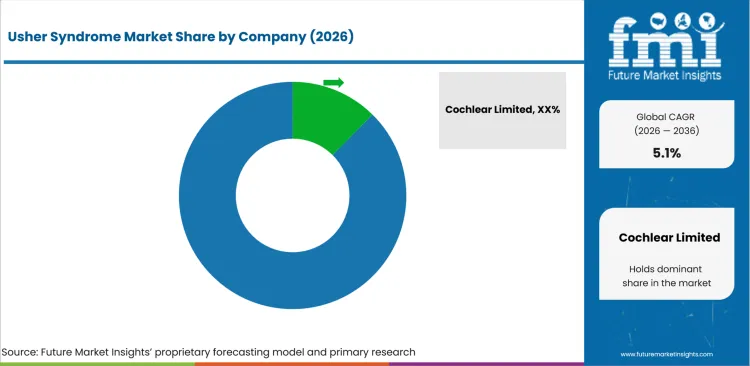
Competition divides into an established auditory-care layer and a smaller retinal-development layer serving separate clinical decisions. Implant and hearing-aid companies rely on fitting networks plus long-term clinical service capacity across established care pathways. Therapy developers require genotype-defined recruitment and specialist retinal delivery, which preserves separate barriers for program entry and expansion.
- Cochlear Limited, Advanced Bionics AG, MED-EL and WS Audiology A/S compete through marketed auditory systems and continuing clinical support across established care networks.
- Laboratoires Théa through Sepul Bio advances an antisense oligonucleotide program, while Nacuity Pharmaceuticals develops a gene-agnostic oral therapy for Usher-associated retinal degeneration.
- Atsena Therapeutics and AAVantgarde Bio focus on MYO7A-associated USH1B through dual-vector rare disease gene therapy that requires specialist retinal surgery.
Competitive Benchmarking: Usher Syndrome Market
| Company | Current auditory care | Exact Usher retinal program | Development maturity | Geographic Reach |
|---|---|---|---|---|
| Cochlear Limited | High | Low | High | Global |
| Advanced Bionics AG | High | Low | High | Global |
| MED-EL | High | Low | High | Global |
| WS Audiology A/S | High | Low | High | Global |
| Laboratoires Théa (Sepul Bio) | Low | High | High | Multicountry clinical network |
| Nacuity Pharmaceuticals | Low | High | High | United States and Australia |
| Atsena Therapeutics | Low | High | Medium | United States and partners |
| AAVantgarde Bio s.r.l. | Low | High | High | Europe and multicountry trial |
Key Developments in the Usher Syndrome Market
Recent activity has concentrated on implant-enabled drug delivery and retinal programs that require mutation-defined enrollment across specialist centers.
- In April 2026, Advanced Bionics announced an equity investment and research collaboration with Spiral Therapeutics to evaluate precision drug delivery during cochlear implant surgery.
- In January 2026, AAVantgarde Bio completed enrollment of 15 adults in the LUCE-1 Phase 1/2 study of AAVB-081 for MYO7A-associated Usher syndrome type 1B.
- In September 2025, Nacuity Pharmaceuticals reported Phase 1/2 SLO-RP results showing more than 50% lower photoreceptor loss over two years with NPI-001 in Usher-associated retinitis pigmentosa.
Key Players in the Usher Syndrome Market
Hearing Implant and Hearing Aid Platforms
- Cochlear Limited
- Advanced Bionics AG
- MED-EL
- WS Audiology A/S
Usher-Specific Therapy Developers
- Laboratoires Théa (Sepul Bio)
- Nacuity Pharmaceuticals
- Atsena Therapeutics
- AAVantgarde Bio s.r.l.
Usher Syndrome Market - Report Scope
| Coverage field | Report scope |
|---|---|
| Market breakdown | By type, treatment, diagnosis, distribution channel, end user and region. |
| Quantitative Units | Revenue in USD billion and CAGR in % |
| Market Definition | Diagnosis, hearing intervention, supportive care and investigational gene or RNA therapies used for Usher syndrome. |
| Regions Covered | North America, Latin America, Europe, East Asia, South Asia and Pacific, and Middle East and Africa. |
| Countries Covered | South Korea, United States, Canada, United Kingdom, Germany and 20+ countries included in the full report. |
| Key Companies Profiled | Cochlear Limited, Advanced Bionics AG, MED-EL, WS Audiology A/S, Laboratoires Théa (Sepul Bio), Nacuity Pharmaceuticals, Atsena Therapeutics and AAVantgarde Bio s.r.l. |
| Forecast Period | 2026 to 2036. |
| Approach | Primary and secondary research with market triangulation. |
Usher Syndrome Market - Research Methodology
| Method | Approach |
|---|---|
| Primary Research | FMI analysts gathered input from manufacturers, service providers, technology developers, distributors, end users, procurement teams, and subject-matter experts. Interviews examined purchasing decisions, product or service evaluation, adoption barriers, approval requirements, pricing considerations, and expectations for technical or commercial support. Respondents were also asked what evidence is required before a trial, pilot, or initial order develops into regular purchasing. |
| Desk Research | Desk research covered government statistics, regulatory publications, trade data, industry associations, technical literature, standards, company filings, product information, and official corporate announcements. Sources were reviewed for relevance, publication date, geographic coverage, and consistency with the defined market scope. Claims relating to performance, applications, approvals, capacity, investment, and commercial activity were retained only when supported by credible public evidence. |
| Market Sizing and Forecasting | The market model combined the baseline value with historical performance, segment structure, pricing and volume indicators, adoption levels, company participation, and country-level demand conditions. Forecast assumptions considered economic activity, investment trends, regulatory developments, technology adoption, purchasing cycles, supply availability, and barriers to wider market use. Segment and regional estimates were reconciled before the final market total was calculated. |
| Data Validation | Estimates were checked against multiple independent indicators, including public data, company activity, trade patterns, industry developments, and findings from primary interviews. Validation also tested whether products, services, applications, and company revenues fell within the defined market boundaries. Adjacent categories, unsupported claims, overlapping revenues, and activities without direct market relevance were excluded to reduce double counting and maintain consistency across segments and countries. |
Usher Syndrome Market by Segments
Usher Syndrome Market segmented by Type:
- Usher Syndrome Type 2
- USH2A-Related Usher Syndrome
- USH2C-Related Usher Syndrome
- Usher Syndrome Type 1
- USH1B-Related Usher Syndrome
- USH1C-Related Usher Syndrome
- Usher Syndrome Type 3
- CLRN1-Related Usher Syndrome
- USH3A-Related Usher Syndrome
- Other Types
- Rare Genetic Subtypes
- Unclassified Usher Syndrome
Usher Syndrome Market segmented by Treatment:
- Devices
- Cochlear Implants
- Hearing Aids
- Drugs & Gene Therapies
- Gene Therapy
- Antisense Oligonucleotides
- Supportive Therapy
- Low-Vision Rehabilitation
- Audiological Rehabilitation
- Other Treatments
- Visual Aids
- Genetic Counseling
Usher Syndrome Market segmented by Diagnosis:
- Genetic Testing
- Molecular Genetic Testing
- Gene Panel Testing
- Audiology
- Pure-Tone Audiometry
- Auditory Brainstem Response
- Ophthalmic Testing
- Electroretinography
- Optical Coherence Tomography
- Visual & Vestibular Testing
- Visual Field Testing
- Video Nystagmography
Usher Syndrome Market segmented by Distribution Channel:
- Hospital Pharmacies
- Inpatient Pharmacies
- Specialty Hospital Pharmacies
- Specialty Pharmacies
- Rare Disease Pharmacies
- Specialty Drug Distributors
- Retail Pharmacies
- Chain Pharmacies
- Independent Pharmacies
- Other Channels
- Online Pharmacies
- Direct Distribution
Usher Syndrome Market segmented by End User:
- Hospitals
- Tertiary Care Hospitals
- University Hospitals
- Specialty Clinics
- Ophthalmology Clinics
- Audiology & ENT Clinics
- Research & Academic Institutes
- Genetic Research Centers
- Clinical Research Institutes
- Others
- Rehabilitation Centers
- Community Healthcare Facilities
Usher Syndrome Market by Region:
- North America
- United States
- Canada
- Latin America
- Brazil
- Chile
- Mexico
- Rest of Latin America
- Western Europe
- Germany
- United Kingdom
- Italy
- Spain
- France
- Nordics
- Benelux
- Rest of Western Europe
- Eastern Europe
- Russia
- Poland
- Hungary
- Balkan and Baltic States
- Rest of Eastern Europe
- East Asia
- China
- Japan
- South Korea
- South Asia and Pacific
- India
- ASEAN
- Australia and New Zealand
- Rest of South Asia and Pacific
- Middle East and Africa
- Kingdom of Saudi Arabia
- Other GCC Countries
- Türkiye
- South Africa
- Other African Union Countries
- Rest of Middle East and Africa
Research Sources and Bibliography
- Koenekoop, R. K., Arriaga, M. A., Gillies, N., Trzupek, K. M., & Lentz, J. J. (2026, June 9). Usher Syndrome Type I. GeneReviews®.
- D’Esposito, F., Gagliano, G., Gagliano, C., Maniaci, A., Avitabile, A., Giglio, R., Reibaldi, M., Cordeiro, M. F., & Zeppieri, M. (2025, March 12). Usher Syndrome: New Insights into Classification, Genotype-Phenotype Correlation, and Management. Genes, 16(3), 332.
- Leith, F. K., Lye, J., Delaney, D. S., McLenachan, S., Chen, F. K., Atlas, M. D., & Wong, E. Y. M. (2025, June 20). Current approaches for Usher syndrome disease models and developing therapies. Frontiers in Cell and Developmental Biology, 13, 1547523.
- National Eye Institute. (2026, March 12). Usher Syndrome.
- ClinicalTrials.gov. (2026, June 18). Study to Evaluate Ultevursen in Subjects With Retinitis Pigmentosa (RP) Due to Mutations in Exon 13 of the USH2A Gene.
- ClinicalTrials.gov. (2025, December 18). 24-Month Trial of NPI-001 for the Preservation of Photoreceptors in Retinitis Pigmentosa Associated With Usher Syndrome.
- Korea Disease Control and Prevention Agency. (2025, April 8). KDCA Launches Expanded Rare Disease Diagnostic Support Program in 2025.
- ClinicalTrials.gov. (2025, July 29). Auditory Neural Function in Implanted Patients With Usher Syndrome.
- Health Canada. (2026, June 15). The National Strategy for Drugs for Rare Diseases.
- Department of Health and Social Care. (2026, February 27). England Rare Diseases Action Plan 2026: main report.
- Gemeinsamer Bundesausschuss. (2026, June 18). Hörtests bei Neugeborenen - G-BA verbessert das Früherkennungsangebot.
- Advanced Bionics. (2026, April 14). Advanced Bionics Announces Research Collaboration to Advance Next-Generation Cochlear Implant Innovation.
- AAVantgarde Bio. (2026, January 15). AAVantgarde Completes Enrollment in LUCE-1 Phase 1/2 Clinical Trial of AAVB-081 for Usher Syndrome Type B-associated Retinitis Pigmentosa.
- Nacuity Pharmaceuticals. (2025, September 11). Nacuity Pharmaceuticals Announces Positive Data from Clinical Trial Evaluating NPI-001 to Treat Retinitis Pigmentosa Associated with Usher Syndrome.
- Cochlear Limited. (2025, July 8). Cochlear Launches World's First and Only Smart Cochlear Implant System.
- MED-EL. (2025, December 4). USA: MED-EL Cochlear Implant Becomes First FDA-Approved Option for Children Seven Months and Older.
- WS Audiology. (2025, March 19). Widex Unveils the WIDEX ALLURE Platform Featuring Crystal Clear Speech and the World's First Cloud-Based Fitting Software.
- Atsena Therapeutics. (2026). Usher Syndrome 1B: ATSN-301. Retrieved August 4, 2026.
This bibliography is provided for reader reference and is not exhaustive. The full report contains the complete reference list and detailed citations.
This Report Answers
- How large is the Usher syndrome market in 2026 and 2036?
- Which care pathway explains recurring demand across hearing and retinal services?
- Why does Usher syndrome type 2 account for the approved 2026 share?
- Why do devices remain central to current treatment demand?
- How does genetic testing shape counseling and therapy eligibility?
- What slows development across mutation-defined retinal programs?
- How do profiled country growth rates translate into different entry conditions?
- Which companies provide current auditory care or exact Usher retinal programs?
- How should hospitals compare device support with investigational therapy access?
Frequently Asked Questions
How big is the Usher syndrome market in 2026?
USD 2.4 billion is the 2026 value of the Usher syndrome market across diagnosis, hearing intervention and continuing specialist support. Molecular confirmation connects affected families with auditory care and retinal surveillance as the industry approaches USD 3.9 billion by 2036.
What is the CAGR of the Usher syndrome market from 2026 to 2036?
The Usher syndrome market is projected to expand at 5.1% CAGR between 2026 and 2036. Recurring hearing services support current revenue, while genetic testing and mutation-defined retinal programs add specialist demand during the forecast period.
Which type segment leads the Usher syndrome market?
A 52.0% share is projected for Usher syndrome type 2 within the type category in 2026. Congenital hearing loss establishes an early service pathway, while later retinal degeneration adds monitoring and inherited-retinal assessment across adulthood.
How much value will the Usher syndrome market add between 2026 and 2036?
USD 1.5 billion is expected to be added to the Usher syndrome market between 2026 and 2036. The increase spans molecular diagnosis and hearing devices alongside rehabilitation or investigational retinal programs that require specialist testing and long follow-up.
Which companies are active in the Usher syndrome market?
Eight companies are profiled across established auditory care and exact retinal development within the Usher syndrome market. Cochlear Limited, Advanced Bionics AG, MED-EL and WS Audiology A/S support hearing intervention, while Laboratoires Théa through Sepul Bio, Nacuity Pharmaceuticals, Atsena Therapeutics and AAVantgarde Bio develop retinal programs.
Preview the report firsthand - request a free sample
Get SampleGet the brochure for pricing and purchase details.
Get PDFTable of Content
- Key Takeaways
- Market Size and CAGR
- Top Growth Driver
- Fastest Growing Segment
- Leading Region
- Key Companies
- Emerging Opportunities
- Executive Summary
- Global Market Outlook
- Demand-side Trends
- Supply-side Trends
- Technology Roadmap Analysis
- Analysis and Recommendations
- Analyst Perspective (What is happening? Why now? What should investors know?)
- Key Questions Answered
- How large is the market?
- What is the CAGR?
- What are key trends?
- Which region dominates?
- Who are the leaders?
- Market Overview
- Market Coverage / Taxonomy
- Market Definition / Scope / Limitations
- Research Methodology
- Chapter Orientation
- Analytical Lens and Working Hypotheses
- Market Structure, Signals, and Trend Drivers
- Benchmarking and Cross-market Comparability
- Market Sizing, Forecasting, and Opportunity Mapping
- Research Design and Evidence Framework
- Desk Research Programme (Secondary Evidence)
- Expert Input and Fieldwork (Primary Evidence)
- Tooling, Models, and Reference Databases
- Data Engineering and Model Build
- Quality Assurance and Audit Trail
- Market Background
- Market Dynamics (Drivers, Restraints, Opportunity, Trends)
- Scenario Forecast (Optimistic, Likely, Conservative)
- Impact Analysis
- AI Impact
- Sustainability Impact
- Regulatory Impact
- Technology Impact
- Consumer / Buyer Analysis
- Purchase Drivers
- Adoption Barriers
- Buyer Journey
- Opportunity Map Analysis
- Product Life Cycle Analysis
- Supply Chain Analysis
- Investment Feasibility Matrix
- Value Chain Analysis
- PESTLE and Porter's Analysis
- Regulatory Landscape
- Regional Parent Market Outlook
- Production and Consumption Statistics
- Import and Export Statistics
- Global Market Analysis and Forecast, 2021 to 2036
- Historical Market Size Value (USD Billion) Analysis, 2021 to 2025
- Current and Future Market Size Value (USD Billion) Projections, 2026 to 2036
- Y-o-Y Growth Trend Analysis
- Absolute $ Opportunity Analysis
- Global Market Pricing Analysis, 2021 to 2036
- Global Market Analysis and Forecast, By Type, 2021 to 2036
- Introduction / Key Findings
- Historical Market Size Value (USD Billion) Analysis By Type, 2021 to 2025
- Current and Future Market Size Value (USD Billion) Analysis and Forecast By Type, 2026 to 2036
- Usher Syndrome Type 2
- USH2A-Related Usher Syndrome
- USH2C-Related Usher Syndrome
- Usher Syndrome Type 1
- USH1B-Related Usher Syndrome
- USH1C-Related Usher Syndrome
- Usher Syndrome Type 3
- CLRN1-Related Usher Syndrome
- USH3A-Related Usher Syndrome
- Other Types
- Rare Genetic Subtypes
- Unclassified Usher Syndrome
- Usher Syndrome Type 2
- Y-o-Y Growth Trend Analysis By Type, 2021 to 2025
- Absolute $ Opportunity Analysis By Type, 2026 to 2036
- Global Market Analysis and Forecast, By Treatment, 2021 to 2036
- Introduction / Key Findings
- Historical Market Size Value (USD Billion) Analysis By Treatment, 2021 to 2025
- Current and Future Market Size Value (USD Billion) Analysis and Forecast By Treatment, 2026 to 2036
- Devices
- Cochlear Implants
- Hearing Aids
- Drugs & Gene Therapies
- Gene Therapy
- Antisense Oligonucleotides
- Supportive Therapy
- Low-Vision Rehabilitation
- Audiological Rehabilitation
- Other Treatments
- Visual Aids
- Genetic Counseling
- Devices
- Y-o-Y Growth Trend Analysis By Treatment, 2021 to 2025
- Absolute $ Opportunity Analysis By Treatment, 2026 to 2036
- Global Market Analysis and Forecast, By Diagnosis, 2021 to 2036
- Introduction / Key Findings
- Historical Market Size Value (USD Billion) Analysis By Diagnosis, 2021 to 2025
- Current and Future Market Size Value (USD Billion) Analysis and Forecast By Diagnosis, 2026 to 2036
- Genetic Testing
- Molecular Genetic Testing
- Gene Panel Testing
- Audiology
- Pure-Tone Audiometry
- Auditory Brainstem Response
- Ophthalmic Testing
- Electroretinography
- Optical Coherence Tomography
- Visual & Vestibular Testing
- Visual Field Testing
- Video Nystagmography
- Genetic Testing
- Y-o-Y Growth Trend Analysis By Diagnosis, 2021 to 2025
- Absolute $ Opportunity Analysis By Diagnosis, 2026 to 2036
- Global Market Analysis and Forecast, By Distribution Channel, 2021 to 2036
- Introduction / Key Findings
- Historical Market Size Value (USD Billion) Analysis By Distribution Channel, 2021 to 2025
- Current and Future Market Size Value (USD Billion) Analysis and Forecast By Distribution Channel, 2026 to 2036
- Hospital Pharmacies
- Inpatient Pharmacies
- Specialty Hospital Pharmacies
- Specialty Pharmacies
- Rare Disease Pharmacies
- Specialty Drug Distributors
- Retail Pharmacies
- Chain Pharmacies
- Independent Pharmacies
- Other Channels
- Online Pharmacies
- Direct Distribution
- Hospital Pharmacies
- Y-o-Y Growth Trend Analysis By Distribution Channel, 2021 to 2025
- Absolute $ Opportunity Analysis By Distribution Channel, 2026 to 2036
- Global Market Analysis and Forecast, By End User, 2021 to 2036
- Introduction / Key Findings
- Historical Market Size Value (USD Billion) Analysis By End User, 2021 to 2025
- Current and Future Market Size Value (USD Billion) Analysis and Forecast By End User, 2026 to 2036
- Hospitals
- Tertiary Care Hospitals
- University Hospitals
- Specialty Clinics
- Ophthalmology Clinics
- Audiology & ENT Clinics
- Research & Academic Institutes
- Genetic Research Centers
- Clinical Research Institutes
- Others
- Rehabilitation Centers
- Community Healthcare Facilities
- Hospitals
- Y-o-Y Growth Trend Analysis By End User, 2021 to 2025
- Absolute $ Opportunity Analysis By End User, 2026 to 2036
- Global Market Analysis and Forecast, By Region, 2021 to 2036
- Introduction
- Historical Market Size Value (USD Billion) Analysis By Region, 2021 to 2025
- Current Market Size Value (USD Billion) Analysis and Forecast By Region, 2026 to 2036
- North America
- Latin America
- Western Europe
- Eastern Europe
- East Asia
- South Asia and Pacific
- Middle East & Africa
- Market Attractiveness Analysis By Region
- North America Market Analysis and Forecast, By Country, 2021 to 2036
- Historical Market Size Value (USD Billion) Trend Analysis By Market Taxonomy, 2021 to 2025
- Market Size Value (USD Billion) Forecast By Market Taxonomy, 2026 to 2036
- By Country
- USA
- Canada
- By Type
- By Treatment
- By Diagnosis
- By Distribution Channel
- By End User
- By Country
- Market Attractiveness Analysis
- By Country
- By Type
- By Treatment
- By Diagnosis
- By Distribution Channel
- By End User
- Key Takeaways
- Latin America Market Analysis and Forecast, By Country
- Historical Market Size Value (USD Billion) Trend Analysis By Market Taxonomy, 2021 to 2025
- Market Size Value (USD Billion) Forecast By Market Taxonomy, 2026 to 2036
- By Country
- Brazil
- Mexico
- Chile
- Rest of Latin America
- By Type
- By Treatment
- By Diagnosis
- By Distribution Channel
- By End User
- By Country
- Market Attractiveness Analysis
- By Country
- By Type
- By Treatment
- By Diagnosis
- By Distribution Channel
- By End User
- Key Takeaways
- Western Europe Market Analysis and Forecast, By Country
- Historical Market Size Value (USD Billion) Trend Analysis By Market Taxonomy, 2021 to 2025
- Market Size Value (USD Billion) Forecast By Market Taxonomy, 2026 to 2036
- By Country
- Germany
- UK
- Italy
- Spain
- France
- Nordic
- BENELUX
- Rest of Western Europe
- By Type
- By Treatment
- By Diagnosis
- By Distribution Channel
- By End User
- By Country
- Market Attractiveness Analysis
- By Country
- By Type
- By Treatment
- By Diagnosis
- By Distribution Channel
- By End User
- Key Takeaways
- Eastern Europe Market Analysis and Forecast, By Country
- Historical Market Size Value (USD Billion) Trend Analysis By Market Taxonomy, 2021 to 2025
- Market Size Value (USD Billion) Forecast By Market Taxonomy, 2026 to 2036
- By Country
- Russia
- Poland
- Hungary
- Balkan & Baltic
- Rest of Eastern Europe
- By Type
- By Treatment
- By Diagnosis
- By Distribution Channel
- By End User
- By Country
- Market Attractiveness Analysis
- By Country
- By Type
- By Treatment
- By Diagnosis
- By Distribution Channel
- By End User
- Key Takeaways
- East Asia Market Analysis and Forecast, By Country
- Historical Market Size Value (USD Billion) Trend Analysis By Market Taxonomy, 2021 to 2025
- Market Size Value (USD Billion) Forecast By Market Taxonomy, 2026 to 2036
- By Country
- China
- Japan
- South Korea
- By Type
- By Treatment
- By Diagnosis
- By Distribution Channel
- By End User
- By Country
- Market Attractiveness Analysis
- By Country
- By Type
- By Treatment
- By Diagnosis
- By Distribution Channel
- By End User
- Key Takeaways
- South Asia and Pacific Market Analysis and Forecast, By Country
- Historical Market Size Value (USD Billion) Trend Analysis By Market Taxonomy, 2021 to 2025
- Market Size Value (USD Billion) Forecast By Market Taxonomy, 2026 to 2036
- By Country
- India
- ASEAN
- Australia & New Zealand
- Rest of South Asia and Pacific
- By Type
- By Treatment
- By Diagnosis
- By Distribution Channel
- By End User
- By Country
- Market Attractiveness Analysis
- By Country
- By Type
- By Treatment
- By Diagnosis
- By Distribution Channel
- By End User
- Key Takeaways
- Middle East & Africa Market Analysis and Forecast, By Country
- Historical Market Size Value (USD Billion) Trend Analysis By Market Taxonomy, 2021 to 2025
- Market Size Value (USD Billion) Forecast By Market Taxonomy, 2026 to 2036
- By Country
- Kingdom of Saudi Arabia
- Other GCC Countries
- Türkiye
- South Africa
- Other African Union
- Rest of Middle East & Africa
- By Type
- By Treatment
- By Diagnosis
- By Distribution Channel
- By End User
- By Country
- Market Attractiveness Analysis
- By Country
- By Type
- By Treatment
- By Diagnosis
- By Distribution Channel
- By End User
- Key Takeaways
- Key Countries Market Analysis
- USA
- Pricing Analysis
- Market Share Analysis, 2025
- By Type
- By Treatment
- By Diagnosis
- By Distribution Channel
- By End User
- Canada
- Pricing Analysis
- Market Share Analysis, 2025
- By Type
- By Treatment
- By Diagnosis
- By Distribution Channel
- By End User
- Mexico
- Pricing Analysis
- Market Share Analysis, 2025
- By Type
- By Treatment
- By Diagnosis
- By Distribution Channel
- By End User
- Brazil
- Pricing Analysis
- Market Share Analysis, 2025
- By Type
- By Treatment
- By Diagnosis
- By Distribution Channel
- By End User
- Chile
- Pricing Analysis
- Market Share Analysis, 2025
- By Type
- By Treatment
- By Diagnosis
- By Distribution Channel
- By End User
- Germany
- Pricing Analysis
- Market Share Analysis, 2025
- By Type
- By Treatment
- By Diagnosis
- By Distribution Channel
- By End User
- UK
- Pricing Analysis
- Market Share Analysis, 2025
- By Type
- By Treatment
- By Diagnosis
- By Distribution Channel
- By End User
- Italy
- Pricing Analysis
- Market Share Analysis, 2025
- By Type
- By Treatment
- By Diagnosis
- By Distribution Channel
- By End User
- Spain
- Pricing Analysis
- Market Share Analysis, 2025
- By Type
- By Treatment
- By Diagnosis
- By Distribution Channel
- By End User
- France
- Pricing Analysis
- Market Share Analysis, 2025
- By Type
- By Treatment
- By Diagnosis
- By Distribution Channel
- By End User
- India
- Pricing Analysis
- Market Share Analysis, 2025
- By Type
- By Treatment
- By Diagnosis
- By Distribution Channel
- By End User
- ASEAN
- Pricing Analysis
- Market Share Analysis, 2025
- By Type
- By Treatment
- By Diagnosis
- By Distribution Channel
- By End User
- Australia & New Zealand
- Pricing Analysis
- Market Share Analysis, 2025
- By Type
- By Treatment
- By Diagnosis
- By Distribution Channel
- By End User
- China
- Pricing Analysis
- Market Share Analysis, 2025
- By Type
- By Treatment
- By Diagnosis
- By Distribution Channel
- By End User
- Japan
- Pricing Analysis
- Market Share Analysis, 2025
- By Type
- By Treatment
- By Diagnosis
- By Distribution Channel
- By End User
- South Korea
- Pricing Analysis
- Market Share Analysis, 2025
- By Type
- By Treatment
- By Diagnosis
- By Distribution Channel
- By End User
- Russia
- Pricing Analysis
- Market Share Analysis, 2025
- By Type
- By Treatment
- By Diagnosis
- By Distribution Channel
- By End User
- Poland
- Pricing Analysis
- Market Share Analysis, 2025
- By Type
- By Treatment
- By Diagnosis
- By Distribution Channel
- By End User
- Hungary
- Pricing Analysis
- Market Share Analysis, 2025
- By Type
- By Treatment
- By Diagnosis
- By Distribution Channel
- By End User
- Kingdom of Saudi Arabia
- Pricing Analysis
- Market Share Analysis, 2025
- By Type
- By Treatment
- By Diagnosis
- By Distribution Channel
- By End User
- Türkiye
- Pricing Analysis
- Market Share Analysis, 2025
- By Type
- By Treatment
- By Diagnosis
- By Distribution Channel
- By End User
- South Africa
- Pricing Analysis
- Market Share Analysis, 2025
- By Type
- By Treatment
- By Diagnosis
- By Distribution Channel
- By End User
- USA
- Market Structure Analysis
- Competition Dashboard
- Competition Benchmarking
- Market Share Analysis of Top Players
- By Regional
- By Type
- By Treatment
- By Diagnosis
- By Distribution Channel
- By End User
- Emerging Startups
- Innovation Benchmarking
- Competition Analysis
- Competition Deep Dive
- Cochlear Limited
- Overview
- Product Portfolio
- Profitability by Market Segments
- Sales Footprint
- Strategy Overview
- Marketing Strategy
- Product Strategy
- Channel Strategy
- Advanced Bionics AG
- Spark Therapeutics
- ProQR Therapeutics N.V.
- Editas Medicine, Inc.
- Atsena Therapeutics
- Nacuity Pharmaceuticals
- Sensorion
- Laboratoires Théa
- GenSight Biologics
- Others
- Cochlear Limited
- Case Studies
- Success Stories
- Recent Developments
- Competition Deep Dive
- Assumptions & Acronyms Used


