

- Industry Size (2026)
- USD 6.8 Bn
- Forecast (2036)
- USD 9.9 Bn
- CAGR (2026 to 2036)
- 3.2%
Dermal Fillers Market Size, Market Forecast and Outlook By FMI
The dermal fillers market is expected to expand from USD 6.8 billion in 2026 to USD 9.9 billion by 2036. The market is anticipated to register a 3.2% CAGR during the forecast period. Hyaluronic acid is likely to lead ingredient demand with a 64.0% share, while cosmetic and aesthetic clinics are projected to account for 53.0% share of the distribution channel segment in 2026.
Summary of the Dermal Fillers Market
- Demand and Growth Drivers
- Repeat treatment cycles are expected to support dermal filler use across established aesthetic patient groups.
- Minimally invasive facial enhancement is likely to expand as consumers prefer visible correction without surgery.
- Product innovation is anticipated to improve treatment confidence through better durability and tissue integration.
- Product and Segment View
- Hyaluronic acid is expected to lead the ingredient segment due to reversibility and wide clinical familiarity.
- Cosmetic and aesthetic clinics are likely to remain the main treatment channel due to injector-led procedure planning.
- Facial contouring and wrinkle correction applications are anticipated to support recurring use across urban aesthetic clinics.
- Geography and Competitive Outlook
- India is expected to lead country-level growth due to clinic expansion and rising acceptance of aesthetic care.
- China is likely to record strong expansion as premium and mid-tier filler access improves across urban markets.
- Companies with stronger injector training and broader facial indication portfolios are anticipated to retain stronger clinic relationships.
- Analyst Opinion
- Anurag Sharma, Principal Consultant for Healthcare at FMI, suggests, “The dermal fillers market is likely to shift toward suppliers that combine product consistency with stronger injector education. Brands with deeper facial indication coverage and trusted safety records are expected to gain advantage as clinics prioritize repeat outcomes and patient confidence.”
- Dermal Fillers Market Value Analysis
- The dermal fillers market is moving from occasional cosmetic correction into routine maintenance-led aesthetic treatment.
- Demand is likely to rise as patients seek subtle facial contouring and wrinkle reduction through non-surgical procedures.
- Adoption is expected to improve through hyaluronic acid fillers used across high-frequency facial applications.
- Spending is anticipated to be supported by aesthetic clinic growth and wider acceptance of medically supervised injectable care.
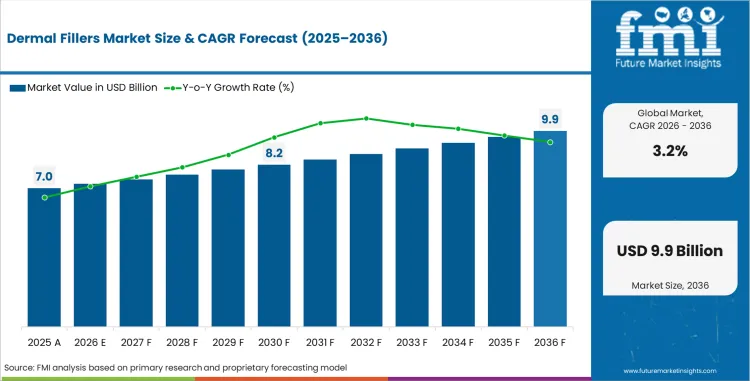
Key Takeaways, Market Size, and Forecast
| Metric | Value |
|---|---|
| Market Size (2026) | USD 6.8 Billion |
| Market Size (2036) | USD 9.9 Billion |
| CAGR (2026–2036) | 3.2% |
| Leading Ingredient (2026) | Hyaluronic Acid |
| Hyaluronic Acid Share (2026) | 64.0% |
| Leading Distribution Channel (2026) | Cosmetic And Aesthetic Clinics |
| Cosmetic And Aesthetic Clinics Share (2026) | 53.0% |
| Fastest-Growing Country | India |
| India CAGR | 7.6% |
Absolute dollar growth of USD 3.1 billion over the decade signals steady expansion rather than a demand reset. As per FMI, procedure demand is expected to remain supported by rising acceptance of minimally invasive facial enhancement, widening access to medically supervised aesthetic services, and repeat treatment cycles tied to maintenance and refinement. At the same time, treatment affordability constraints, injector skill concentration, and safety-led product governance are expected to keep value growth measured across mature aesthetic markets. “This milestone represents an exciting advancement in our long-term strategy to become the world’s leading dermatological megabrand at the crossroads of skincare and medical aesthetics, the launch of this product is a catalyst for our growth as we focus on delivering synergistic skincare and injectable offerings under the trusted Obagi Medical brand.” says Michel Brousset, co-founder and chief executive officer of Waldencast. [1]
Based on FMI’s report, India (7.6% CAGR) and China (7.1% CAGR) are expected to lead growth due to expanding clinic infrastructure, rising consumer spending on appearance-led care, and broader acceptance of non-surgical procedures. The United Kingdom (6.1% CAGR) is expected to remain a strong growth market within developed economies. Mature markets such as Brazil (4.5%), France (2.5%), Germany (2.3%), and the USA (1.6%) are expected to contribute mainly through repeat utilization, with growth constrained by high penetration, pricing discipline, and established treatment maturity
Dermal Fillers Market Definition
The market includes injectable soft tissue fillers used for the purpose of restoring facial tissue, reducing wrinkles and folds, contouring the face, and facilitating reconstructive or corrective aesthetic procedures. The market is sold to aesthetic or cosmetic clinics, hospitals, plastic surgery centers, medical spas, and similar healthcare providers or entities focused on providing aesthetic or reconstructive care where the need for dermal fillers is indicated in the process of minimally invasive facial enhancement or tissue reconstruction. The market includes hyaluronic acid, poly-l-lactic acid, calcium hydroxylapatite, polymethylmethacrylate, collagen, and polynucleotide injectable tissue fillers used in the process of routine aesthetic or reconstructive procedures. The market is fueled by the number of procedures being done, the injectors' preference, the longevity of the product, the safety perception of the product, and the demand for subtle or reversible aesthetic or reconstructive procedures. The revenue stream is the sale of dermal filler syringe products.
Dermal Fillers Market Inclusions
The report provides global and regional market sizing, as well as a 10-year forecast from 2026 to 2036. The report also provides market sizing by ingredient, gender, application, and distribution channel, with country-level CAGR comparisons across key markets. The report also provides analysis on competitive positioning of key suppliers, practitioner and clinic purchasing dynamics, and the influence of safety, product longevity, and injector familiarity on supplier choice, as per FMI.
Dermal Fillers Market Exclusions
The scope does not include botulinum toxin injectables, energy-based aesthetic devices, threads, implants, skin boosters sold outside filler positioning, and surgical facial reconstruction products. Topical cosmetics, oral beauty supplements, and non-injectable skincare interventions are also excluded. The scope also does not include counterfeit, illegally imported, or non-compliant products not used through regulated and professionally administered treatment pathways, but only dermal filler products used for patient-facing aesthetic and corrective procedures.
Dermal Fillers Market Research Methodology
- Primary research: Sample size of 350 Interviews were carried out with aesthetic physicians, dermatologists, plastic surgeons, clinic operators, and distributor-side commercial participants to confirm treatment demand patterns, product selection criteria, and procurement behavior.
- Desk research: Public data from regulatory bodies, aesthetic surgery associations, company annual reports, investor materials, and procedure statistics sources were analyzed to compare product positioning and treatment trends.
- Market sizing and forecasting: A hybrid approach was created based on treatment channel splits, ingredient mix, and procedure frequency, and then harmonized through volume and price triangulation based on filler usage intensity.
- Data validation and update cycle: Results were filtered for variance, tested for internal consistency, and assessed through structured peer review before distribution.
Segmental Analysis
Dermal Fillers Market Analysis by Ingredient
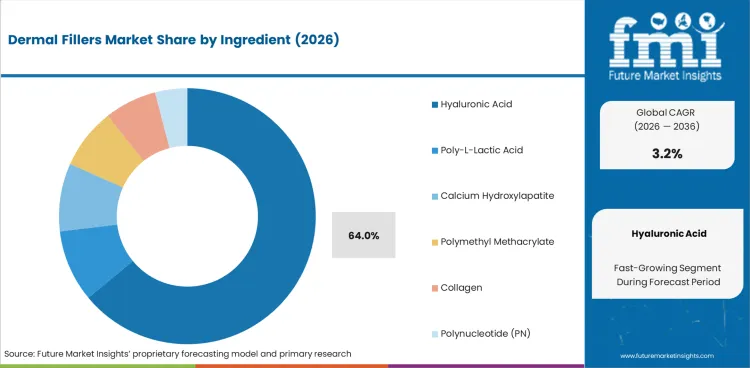
Based on FMI’s report, hyaluronic acid is estimated to hold 64.0% share in 2026. This lead position is supported by its wide clinical and cosmetic use across routine filler pathways, which keeps it embedded in standard facial rejuvenation and contouring protocols across aesthetic clinics and physician-led practices. Other filler categories remain relevant in volume restoration and longer-duration correction, but hyaluronic acid continues to hold the broadest procedural footprint because of its reversibility, tissue compatibility, and practitioner familiarity.
- Preferred safety and reversibility: Hyaluronic acid fillers remain the most widely used because their biocompatibility, favorable safety profile, and reversibility with hyaluronidase give injectors greater control in routine practice and increase confidence across both cosmetic and corrective facial procedures. [2]
- Broad facial use coverage: Recent reviews continue to show hyaluronic acid fillers are used across multiple high-volume indications, including midface volume loss, lips, nasolabial folds, jawline, and chin contouring, which gives them a wider procedural footprint than more indication-limited filler materials. [3]
- Established first-line filler: Hyaluronic acid holds the highest ingredient share because it remains the most broadly used first-line dermal filler material in aesthetic practice, supported by strong biocompatibility, wide facial indication coverage, and the option for enzymatic reversal when treatment adjustment is needed.
Dermal Fillers Market Analysis by Distribution Channel
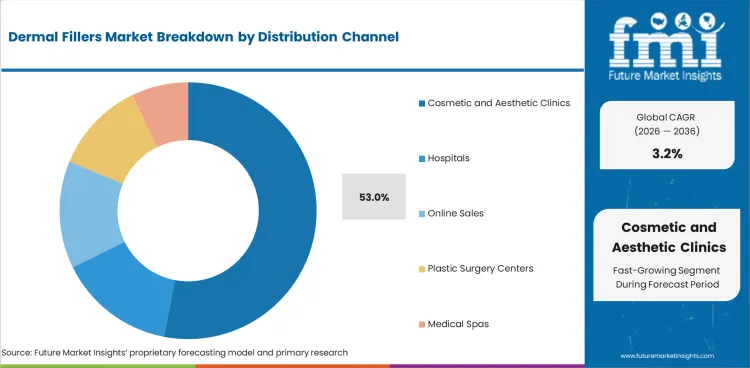
Cosmetic and aesthetic clinics account for 53.0% share in 2026, based on FMI’s report, reflecting their role as the primary setting for physician-supervised and injector-led facial enhancement procedures. Hospitals and plastic surgery centers remain relevant where corrective or higher-acuity cosmetic care is delivered, while medical spas contribute through consumer-facing aesthetic access in selective markets. The leading position of cosmetic and aesthetic clinics is supported by specialized consultation, product selection discipline, and integrated treatment planning for repeat cosmetic maintenance.
- Specialized injector-led setting: Dermal filler procedures are concentrated in cosmetic and aesthetic clinics because facial injectables require detailed anatomical assessment, product selection, injection planning, and complication readiness, all of which are best supported in specialized provider-led aesthetic practice settings. [4]
- Bundled treatment environment: Clinic-based demand is reinforced because fillers are frequently delivered alongside other minimally invasive aesthetic procedures. Consensus literature notes that practitioners commonly combine hyaluronic acid fillers with botulinum toxin and related modalities, strengthening procedure concentration within dedicated aesthetic clinic. [5]
- Follow-up driven repeat demand: Cosmetic and aesthetic clinics hold the highest share because dermal filler care commonly involves reassessment, touch-ups, and maintenance over time, which keeps repeat patient visits and ongoing product use concentrated in dedicated aesthetic clinics rather than dispersed care settings.
Dermal Fillers Market Drivers, Restraints, and Opportunities
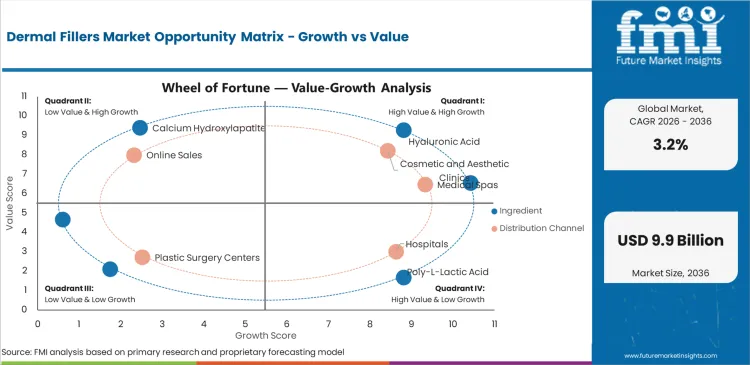
Future Market Insights analysis indicates that historical patterns point to a provider-driven aesthetic injectables category where demand is anchored in minimally invasive facial rejuvenation, contour enhancement, and volume restoration across medically supervised settings. Estimated valuation in 2026 is being supported by stronger consumer awareness, rising social influence on appearance-led care, and broader practitioner adoption of non-surgical treatment protocols, as per FMI.
While procedure demand is being restrained by treatment affordability, need for maintenance sessions, and dependence on highly trained injectors, value is being supported by premium product adoption, longer-lasting formulations, and wider procedural acceptance across both women and men seeking subtle cosmetic improvement. Based on FMI’s report, the forecast trajectory reflects a treatment environment where cosmetic and aesthetic clinics remain the largest channel, while ingredient preference and brand choice are filtered through safety profile, outcome reliability, and injector confidence.
- Aesthetic normalization: Demand is being supported as minimally invasive facial enhancement is being accepted across broader age groups and treatment demographics.
- Maintenance-cost: Repeat sessions and premium treatment pricing continue to limit volume expansion in price-sensitive and less mature markets.
- Technique-led expansion: Demand is being supported as improved injection methods and training programs broaden use across newer facial applications and patient profiles.
Regional Analysis
Based on the regional analysis, dermal fillers market is segmented into North America, Latin America, Western Europe, Eastern Europe, East Asia, South Asia & Pacific, and Middle East & Africa across 40+ countries. Regional performance is assessed using country-level demand signals tied to aesthetic awareness, clinic density, injector expertise, and product accessibility, as per FMI. The full report also offers market attractiveness analysis based on regional trends.
.webp "Top Country Growth Comparison Dermal Fillers Market Cagr (2026 2036)")
| Country | CAGR |
|---|---|
| India | 7.6% |
| China | 7.1% |
| United Kingdom | 6.1% |
| Brazil | 4.5% |
| France | 2.5% |
| Germany | 2.3% |
| United States | 1.6% |
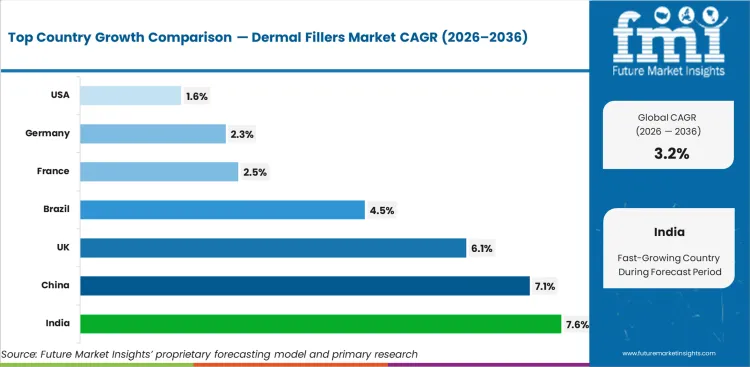
Source: Future Market Insights (FMI) analysis, based on proprietary forecasting model and primary research
North America Dermal Fillers Market Analysis
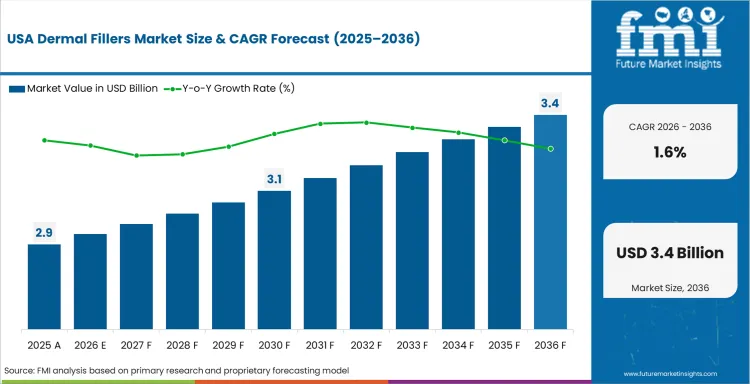
This is because the region has high procedure awareness, physician-led aesthetic practice, and premium treatment adoption. The selection of fillers in this region depends on brand familiarity, product performance for specific indications, and patient demand for natural appearance correction. Allergan Aesthetics, an AbbVie company, has a good position in the market due to brand familiarity and product continuity. Galderma Pharma S.A. has a good position in the market due to its well-established filler product line and practitioner relations in the aesthetic markets. Merz Pharma GmbH & Co. KGaA has a competitive position in the market due to its product positioning and medically supervised aesthetic access. According to the FMI report, the demand in the region is driven by repeat procedure cycles and premium facial refinement.
- United States: The demand for dermal fillers in the United States is expected to grow at a CAGR of 1.6% over the 2026 to 2036 forecast period. This is driven by widespread treatment adoption, strong practitioner expertise, and continued premium procedure demand, although this is tempered by market saturation and high penetration across core patient groups.
FMI’s report includes a detailed analysis of the growth in the North American region, along with a country-wise assessment that includes the United States. Readers can also find regional trends, regulations, and market growth based on different segments and countries in the North America region.
Asia Pacific Dermal Fillers Market Analysis
Asia Pacific remains the market with the highest demand growth rate due to increasing aesthetic awareness, expanding clinic ecosystems, and improving willingness to spend on non-surgical aesthetic procedures. LG Chem Ltd. retains high relevance in terms of brand awareness and availability in Asian aesthetic markets. Sinclair Pharma plc and Teoxane SA compete based on premium positioning, targeting practitioners, and differentiation in contouring and rejuvenation applications. Increasing clinic ecosystems and medical tourism activities are expanding non-surgical procedure availability in all major cities. According to FMI, demand is supported by urban spending on cosmetics and formalization of clinic ecosystems.
- China: China’s market for dermal fillers is expected to grow at a CAGR of 7.1% over the 2026 to 2036 forecast period. This is attributed to factors such as the rise in disposable income, the positive reception of minimally invasive aesthetic treatments, and the availability of premium and mid-tier fillers.
- India: India’s market for dermal fillers is expected to grow at a rate of 7.6% over the 2026 to 2036 forecast period. This is attributed to factors such as the positive reception and awareness of aesthetics, the development of urban cosmetic ecosystems, and the demand for non-surgical facial rejuvenation and anti-aging treatments.
The full report covers the market for dermal fillers in East Asia and South Asia from 2021 to 2036. It covers the market trends, such as the price of dermal fillers in China, Japan, South Korea, India, Indonesia, Malaysia, and Thailand. This gives a clear understanding of the trends affecting the demand and purchase behavior.
Europe Dermal Fillers Market Analysis
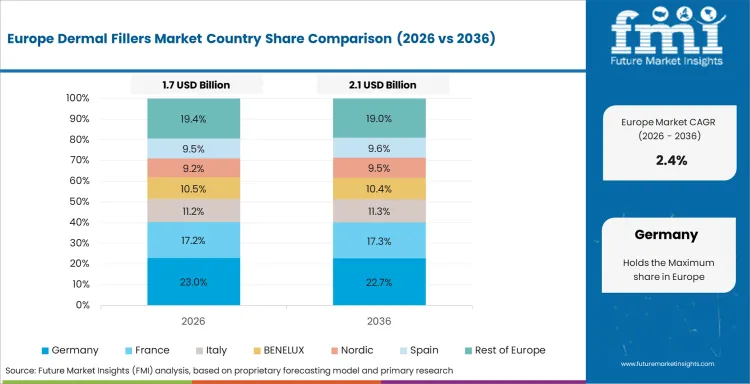
Europe is a quality-led, regulation-conscious marketplace in which filler acquisition and utilization are driven by medicinally managed aesthetic cultures, practitioner training, and the quest for subtle, natural aesthetic outcomes. Galderma Pharma S.A. and Teoxane SA have high practitioner connectivity through their high-quality filler positioning and training-centric engagement in the European aesthetic landscape. Croma Pharma and Merz Pharma GmbH & Co. KGaA compete through their science-supported filler portfolio and established practitioner connections in dermatology and aesthetic medicine clinics. According to FMI, patient trust, ethical practice, and product selection are key influencers in filler therapy adoption in the region.
- United Kingdom: The market for dermal fillers in the United Kingdom has a predicted growth rate of 6.1% CAGR over the forecast period of 2036. This is because the aesthetic culture in the United Kingdom is already advanced, practitioners are skilled in the field, and the application of clinical protocols in the treatment process is on the increase, albeit with high standards and expectations.
- France: The demand for dermal fillers in France is set to grow at a rate of 2.5% CAGR over the 2026 to 2036 forecast period. The demand is fueled by ongoing interest in anti-aging treatments and volume restoration, but is structured through conservative practice and premium product selection.
- Germany: The demand for dermal fillers in Germany is set to grow at a rate of 2.3% CAGR over the 2026 to 2036 forecast period. The demand is fueled by conservative practice, evidence-based practice, and high levels of safety, but is moderated by mature markets.
FMI’s analysis of dermal fillers market in Europe consists of country-wise assessment that includes the United Kingdom, Germany, France, Italy, Spain, Nordic countries, BENELUX, and Rest of Europe. Readers can know various regulations and latest trends in the regional market.
Latin America Dermal Fillers Market Analysis
The region has a high beauty-centric consumer culture and a high rate of access to private aesthetic services, where the demand for fillers is affected by urban density, price bands, and the desire to seek medically supervised cosmetic enhancement. Companies such as Galderma Pharma S.A. and Allergan Aesthetics (AbbVie) maintain a presence in the market by virtue of established networks and premium brands. Growth in the region is being supplemented by the expansion in private aesthetic healthcare, participation in the market by consumers, and the adoption rate of facial contouring and rejuvenation. Demand conversion in the region is being supplemented by cultural acceptance and infrastructure.
- Brazil: The demand for dermal fillers in Brazil is anticipated to rise at a CAGR of 4.5% over the 2026 to 2036 forecast period. This is because of high acceptance of cosmetic procedures, growing private aesthetic networks, and increasing interest in advanced filler technology, although this is still dependent on affordability and concentration.
The report includes an analysis of the market in Brazil, Mexico, Chile, Argentina, Peru, and Rest of Latin America. The reader can gain information about various factors, such as the pricing analysis and trends, that are currently influencing the market in the Latin America region.
Competitive Landscape for Market Players
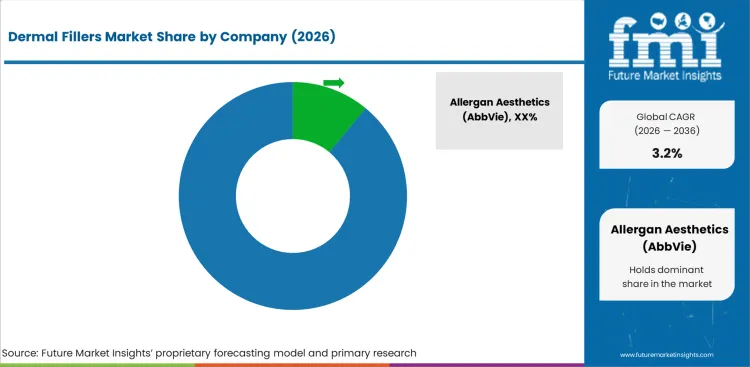
The market structure remains moderately concentrated, with effective competition centered on suppliers capable of supporting clinically differentiated filler portfolios, strong practitioner education, and consistent product performance across facial indications. The data provided shows the presence of clear scale leaders in the market, with the rest of demand distributed across a limited set of global and regional manufacturers. The key competitive factor is treatment confidence supported by safety, reversibility, durability, and natural-looking outcomes, as purchasing and usage are strongly influenced by injector trust and patient retention. The product portfolio also reflects this emphasis, as hyaluronic acid remains the leading ingredient category in the supplied segmentation, as indicated by FMI.
Companies with established aesthetic brands, mature clinical support systems, and broad training networks carry structural advantages because practitioner qualification is governed by technique familiarity, adverse event management, and confidence in predictable correction across facial areas. Scale leaders benefit from multi-product portfolios, facial area-specific formulations, and the ability to support premium clinic positioning through long-term injector engagement. Portfolio depth across lips, folds, contouring, and volume restoration helps protect account positions when clinics reduce active brands and concentrate around proven injectables. Suppliers with narrower geographic reach or limited education infrastructure tend to compete through targeted regional access, pricing flexibility, or niche indication positioning, which can weaken their standing during brand conversion cycles.
Customer concentration reinforces provider influence. Cosmetic and aesthetic clinics account for the largest treatment pool in the supplied segmentation, with hospitals, plastic surgery centers, and medical spas forming the next tier of demand. Large clinic networks commonly standardize around a small number of preferred brands, keep alternate products for selective use, and prioritize products that align with injector comfort and patient expectation for repeat maintenance. Pricing power is therefore moderated for standard filler categories, with measured premiums retained only where a formulation, indication fit, or brand reputation supports stronger clinical preference, Future Market Insights analysis.
Recent Developments
- In March 2026, Allergan Aesthetics, an AbbVie company, a global leader in medical aesthetics treatments and manufacturers of the market-leading JUVÉDERM Collection of Fillers, is forging ahead and has announced that the 'Undetectable Era' will drive the next chapter in the Hyaluronic Acid (HA) injectable category at the Aesthetic & Anti-Aging Medicine World Congress (AMWC) 2026 in Monaco. [6]
- In August 2025, Revance, a fast-growing global aesthetics and skincare company, announces the innovation in its aesthetic portfolio with the launch of the Teoxane RHA Collection with Mepivacaine.1 As of today, mepivacaine will replace lidocaine as the anesthetic in the Teoxane RHA Collection in the USA market, celebrating the first major anesthetic innovation in hyaluronic acid filler in almost two decades. [7]
Key Players in Dermal Fillers Market
- Allergan Aesthetics (AbbVie)
- Galderma Pharma S.A.
- Merz Pharma GmbH & Co. KGaA
- Sinclair Pharma plc (Huadong Medicine Co., Ltd.)
- Zimmer Aesthetics
- Croma Pharma
- Prollenium Medical Technologies Inc.
- Suneva Medical Inc.
- Teoxane SA
- LG Chem Ltd.
Scope of the Report
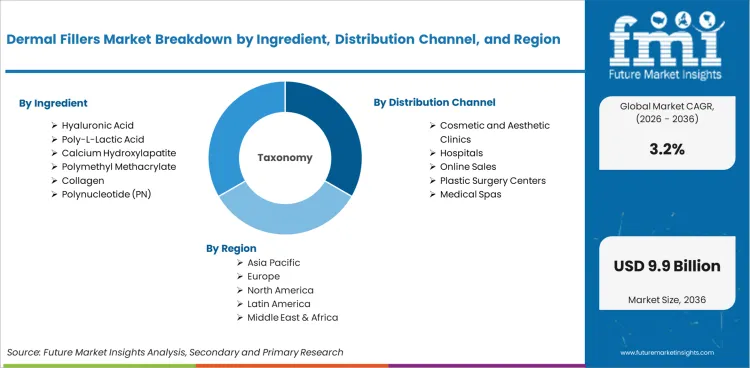
| Metric | Value |
|---|---|
| Quantitative Units | USD 6.8 billion (2026) to USD 9.9 billion (2036), at a CAGR of 3.2% |
| Market Definition | The dermal fillers market comprises injectable soft tissue fillers used to restore volume, improve facial contour, and reduce wrinkles and folds across aesthetic and selective corrective procedures, where demand is shaped by minimally invasive treatment adoption, injector confidence, and patient preference for natural-looking outcomes in regulated care settings. |
| Ingredient Segmentation | Hyaluronic Acid, Poly-L-Lactic Acid, Calcium Hydroxylapatite, Polymethyl Methacrylate, Collagen, Polynucleotide (PN) |
| Gender Segmentation | Male, Female, Transgender |
| Application Segmentation | Wrinkle Reduction, Skin Folds/Nasolabial Folds, Augmentation of Lips/Cheek & Chin, Scar Treatment, Hand Rejuvenation, Jawline and Chin Contouring, Eyebrows Treatment, Hollowness Under Eyes, Nose Reshaping, Volume Restoration, Restoring Damaged Tissues, Restoration of Facial Fat Loss, Dentistry |
| Distribution Channel Segmentation | Cosmetic and Aesthetic Clinics, Hospitals, Online Sales, Plastic Surgery Centers, Medical Spas |
| Regions Covered | North America, Latin America, East Asia, South Asia & Pacific, Western Europe, Eastern Europe, and Middle East & Africa |
| Countries Covered | United States, Canada, United Kingdom, Germany, France, China, Japan, South Korea, Brazil, Australia, India, and 40+ countries |
| Key Companies Profiled | Galderma Pharma S.A., Merz Pharma GmbH & Co. KGaA, Sinclair Pharma plc (Huadong Medicine Co., Ltd.), Zimmer Aesthetics, Croma Pharma, Prollenium Medical Technologies Inc., Suneva Medical Inc., Allergan Aesthetics (AbbVie), Teoxane SA, LG Chem Ltd. |
| Forecast Period | 2026 to 2036 |
| Approach | Hybrid top down and bottom up market modeling validated through primary interviews with aesthetic practitioners and distribution stakeholders, supported by demand triangulation across procedure volumes, treatment settings, and formulation-level adoption patterns, as per FMI. |
Dermal Fillers Market Analysis by Segments
Ingredient
- Hyaluronic Acid
- Poly-L-Lactic Acid
- Calcium Hydroxylapatite
- Polymethyl Methacrylate
- Collagen
- Polynucleotide (PN)
Gender
- Male
- Female
- Transgender
Application
- Wrinkle Reduction
- Skin Folds/Nasolabial Folds
- Augmentation of Lips, Cheek & Chin
- Scar Treatment
- Hand Rejuvenation
- Jawline and Chin Contouring
- Eyebrows Treatment
- Hollowness Under Eyes
- Nose Reshaping
- Volume Restoration
- Restoring Damaged Tissues
- Restoration of Facial Fat Loss
- Dentistry
Distribution Channel
- Cosmetic and Aesthetic Clinics
- Hospitals
- Online Sales
- Plastic Surgery Centers
- Medical Spas
Region
- North America
- USA
- Canada
- Mexico
- Latin America
- Brazil
- Argentina
- Rest of Latin America
- East Asia
- China
- Japan
- South Korea
- South Asia & Pacific
- India
- ASEAN Countries
- Australia & New Zealand
- Rest of South Asia
- Western Europe
- Germany
- UK
- France
- Italy
- Spain
- BENELUX
- Nordic Countries
- Rest of Western Europe
- Eastern Europe
- Russia
- Hungary
- Poland
- Rest of Eastern Europe
- Middle East & Africa
- Saudi Arabia
- Türkiye
- South Africa
- Other African Union
- Rest of Middle East & Africa
Bibliography
- [1] Waldencast plc (2025), FDA Greenlights New Hyaluronic Acid Dermal Filler, Introducing Brand to HA Filler Market.
- [2] PubMed Central (2024), Hyaluronidase for Dermal Filler Complications: Review of Applications and Dosage Recommendations.
- [3] PubMed Central (2025), Efficacy and Safety of Hyaluronic Acid Fillers for Midface Augmentation: A Systematic Review and Meta-Analysis
- [4] PubMed Central (2025), Facial Injectable Fillers in Aesthetic Medicine: Clinical Applications and Safety Strategies
- [5] PubMed Central (2021), A Review on the Combined Use of Soft Tissue Filler, Suspension Threads, and Botulinum Toxin for Facial Rejuvenation
- [6] Allergan Aesthetics, an AbbVie company (2026), Allergan Aesthetics Ushers in a New Age of Hyaluronic Acid (HA) Injectables with JUVÉDERM at AMWC Monaco
- [7] Revance (2025), Revance Launches the Teoxane RHA Collection with Mepivacaine.
This Report Addresses
- Market intelligence to enable structured strategic decision making across aesthetic procedure expansion and filler portfolio planning
- Market size estimation and 10-year revenue forecasts from 2026 to 2036 for dermal filler demand
- Growth opportunity mapping across ingredient classes and distribution channel treatment pools
- Segment and regional revenue forecasts aligned to the stated taxonomy and covered geographies
- Competition strategy assessment including supplier positioning, portfolio fit, and practitioner coverage benchmarking
- Product and compliance tracking focused on safety expectations, treatment protocols, and injector-led quality standards
- Regulatory impact analysis covering product-led treatment selection and clinic-level protocol adoption in regulated care settings
- Market report delivery in PDF, Excel, PPT, and interactive dashboard formats for executive and operational use
Frequently Asked Questions
How large is the demand for Dermal Fillers in the global market in 2026?
Demand for dermal fillers in the global market is estimated to be valued at USD 6.8 billion in 2026, as per FMI.
What will be the market size of Dermal Fillers in the global market by 2036?
Market size for dermal fillers is projected to reach USD 9.9 billion by 2036.
What is the expected demand growth for Dermal Fillers in the global market between 2026 and 2036?
Demand for dermal fillers in the global market is expected to grow at a CAGR of 3.2% between 2026 and 2036.
Which ingredient is poised to lead global sales by 2026?
Hyaluronic acid is expected to be the dominant ingredient, capturing 64.0% share in 2026.
How significant is the role of cosmetic and aesthetic clinics in driving adoption in 2026?
Cosmetic and aesthetic clinics are projected to hold 53.0% share of distribution channel demand in 2026.
Which country is expected to record the fastest growth during the forecast period?
India is projected to grow at a CAGR of 7.6% during 2026 to 2036 among the listed countries.
Preview the report firsthand - request a free sample
Get SampleGet the brochure for pricing and purchase details.
Get PDFTable of Content
- Executive Summary
- Global Market Outlook
- Demand-side Trends
- Supply-side Trends
- Technology Roadmap Analysis
- Analysis and Recommendations
- Market Overview
- Market Coverage / Taxonomy
- Market Definition / Scope / Limitations
- Research Methodology
- Chapter Orientation
- Analytical Lens and Working Hypotheses
- Market Structure, Signals, and Trend Drivers
- Benchmarking and Cross-market Comparability
- Market Sizing, Forecasting, and Opportunity Mapping
- Research Design and Evidence Framework
- Desk Research Programme (Secondary Evidence)
- Company Annual and Sustainability Reports
- Peer-reviewed Journals and Academic Literature
- Corporate Websites, Product Literature, and Technical Notes
- Earnings Decks and Investor Briefings
- Statutory Filings and Regulatory Disclosures
- Technical White Papers and Standards Notes
- Trade Journals, Industry Magazines, and Analyst Briefs
- Conference Proceedings, Webinars, and Seminar Materials
- Government Statistics Portals and Public Data Releases
- Press Releases and Reputable Media Coverage
- Specialist Newsletters and Curated Briefings
- Sector Databases and Reference Repositories
- FMI Internal Proprietary Databases and Historical Market Datasets
- Subscription Datasets and Paid Sources
- Social Channels, Communities, and Digital Listening Inputs
- Additional Desk Sources
- Expert Input and Fieldwork (Primary Evidence)
- Primary Modes
- Qualitative Interviews and Expert Elicitation
- Quantitative Surveys and Structured Data Capture
- Blended Approach
- Why Primary Evidence is Used
- Field Techniques
- Interviews
- Surveys
- Focus Groups
- Observational and In-context Research
- Social and Community Interactions
- Stakeholder Universe Engaged
- C-suite Leaders
- Board Members
- Presidents and Vice Presidents
- R&D and Innovation Heads
- Technical Specialists
- Domain Subject-matter Experts
- Scientists
- Physicians and Other Healthcare Professionals
- Governance, Ethics, and Data Stewardship
- Research Ethics
- Data Integrity and Handling
- Primary Modes
- Tooling, Models, and Reference Databases
- Desk Research Programme (Secondary Evidence)
- Data Engineering and Model Build
- Data Acquisition and Ingestion
- Cleaning, Normalisation, and Verification
- Synthesis, Triangulation, and Analysis
- Quality Assurance and Audit Trail
- Market Background
- Market Dynamics
- Drivers
- Restraints
- Opportunity
- Trends
- Scenario Forecast
- Demand in Optimistic Scenario
- Demand in Likely Scenario
- Demand in Conservative Scenario
- Opportunity Map Analysis
- Product Life Cycle Analysis
- Supply Chain Analysis
- Investment Feasibility Matrix
- Value Chain Analysis
- PESTLE and Porter’s Analysis
- Regulatory Landscape
- Regional Parent Market Outlook
- Production and Consumption Statistics
- Import and Export Statistics
- Market Dynamics
- Global Market Analysis 2021 to 2025 and Forecast, 2026 to 2036
- Historical Market Size Value (USD Million) Analysis, 2021 to 2025
- Current and Future Market Size Value (USD Million) Projections, 2026 to 2036
- Y-o-Y Growth Trend Analysis
- Absolute $ Opportunity Analysis
- Global Market Pricing Analysis 2021 to 2025 and Forecast 2026 to 2036
- Global Market Analysis 2021 to 2025 and Forecast 2026 to 2036, By Ingredient
- Introduction / Key Findings
- Historical Market Size Value (USD Million) Analysis By Ingredient , 2021 to 2025
- Current and Future Market Size Value (USD Million) Analysis and Forecast By Ingredient , 2026 to 2036
- Hyaluronic Acid
- Poly-L-Lactic Acid
- Calcium Hydroxylapatite
- Polymethyl Methacrylate
- Collagen
- Polynucleotide (PN)
- Hyaluronic Acid
- Y-o-Y Growth Trend Analysis By Ingredient , 2021 to 2025
- Absolute $ Opportunity Analysis By Ingredient , 2026 to 2036
- Global Market Analysis 2021 to 2025 and Forecast 2026 to 2036, By Distribution Channel
- Introduction / Key Findings
- Historical Market Size Value (USD Million) Analysis By Distribution Channel, 2021 to 2025
- Current and Future Market Size Value (USD Million) Analysis and Forecast By Distribution Channel, 2026 to 2036
- Cosmetic and Aesthetic Clinics
- Hospitals
- Online Sales
- Plastic Surgery Centers
- Medical Spas
- Cosmetic and Aesthetic Clinics
- Y-o-Y Growth Trend Analysis By Distribution Channel, 2021 to 2025
- Absolute $ Opportunity Analysis By Distribution Channel, 2026 to 2036
- Global Market Analysis 2021 to 2025 and Forecast 2026 to 2036, By Region
- Introduction
- Historical Market Size Value (USD Million) Analysis By Region, 2021 to 2025
- Current Market Size Value (USD Million) Analysis and Forecast By Region, 2026 to 2036
- North America
- Latin America
- Western Europe
- Eastern Europe
- East Asia
- South Asia and Pacific
- Middle East & Africa
- Market Attractiveness Analysis By Region
- North America Market Analysis 2021 to 2025 and Forecast 2026 to 2036, By Country
- Historical Market Size Value (USD Million) Trend Analysis By Market Taxonomy, 2021 to 2025
- Market Size Value (USD Million) Forecast By Market Taxonomy, 2026 to 2036
- By Country
- USA
- Canada
- Mexico
- By Ingredient
- By Distribution Channel
- By Country
- Market Attractiveness Analysis
- By Country
- By Ingredient
- By Distribution Channel
- Key Takeaways
- Latin America Market Analysis 2021 to 2025 and Forecast 2026 to 2036, By Country
- Historical Market Size Value (USD Million) Trend Analysis By Market Taxonomy, 2021 to 2025
- Market Size Value (USD Million) Forecast By Market Taxonomy, 2026 to 2036
- By Country
- Brazil
- Chile
- Rest of Latin America
- By Ingredient
- By Distribution Channel
- By Country
- Market Attractiveness Analysis
- By Country
- By Ingredient
- By Distribution Channel
- Key Takeaways
- Western Europe Market Analysis 2021 to 2025 and Forecast 2026 to 2036, By Country
- Historical Market Size Value (USD Million) Trend Analysis By Market Taxonomy, 2021 to 2025
- Market Size Value (USD Million) Forecast By Market Taxonomy, 2026 to 2036
- By Country
- Germany
- UK
- Italy
- Spain
- France
- Nordic
- BENELUX
- Rest of Western Europe
- By Ingredient
- By Distribution Channel
- By Country
- Market Attractiveness Analysis
- By Country
- By Ingredient
- By Distribution Channel
- Key Takeaways
- Eastern Europe Market Analysis 2021 to 2025 and Forecast 2026 to 2036, By Country
- Historical Market Size Value (USD Million) Trend Analysis By Market Taxonomy, 2021 to 2025
- Market Size Value (USD Million) Forecast By Market Taxonomy, 2026 to 2036
- By Country
- Russia
- Poland
- Hungary
- Balkan & Baltic
- Rest of Eastern Europe
- By Ingredient
- By Distribution Channel
- By Country
- Market Attractiveness Analysis
- By Country
- By Ingredient
- By Distribution Channel
- Key Takeaways
- East Asia Market Analysis 2021 to 2025 and Forecast 2026 to 2036, By Country
- Historical Market Size Value (USD Million) Trend Analysis By Market Taxonomy, 2021 to 2025
- Market Size Value (USD Million) Forecast By Market Taxonomy, 2026 to 2036
- By Country
- China
- Japan
- South Korea
- By Ingredient
- By Distribution Channel
- By Country
- Market Attractiveness Analysis
- By Country
- By Ingredient
- By Distribution Channel
- Key Takeaways
- South Asia and Pacific Market Analysis 2021 to 2025 and Forecast 2026 to 2036, By Country
- Historical Market Size Value (USD Million) Trend Analysis By Market Taxonomy, 2021 to 2025
- Market Size Value (USD Million) Forecast By Market Taxonomy, 2026 to 2036
- By Country
- India
- ASEAN
- Australia & New Zealand
- Rest of South Asia and Pacific
- By Ingredient
- By Distribution Channel
- By Country
- Market Attractiveness Analysis
- By Country
- By Ingredient
- By Distribution Channel
- Key Takeaways
- Middle East & Africa Market Analysis 2021 to 2025 and Forecast 2026 to 2036, By Country
- Historical Market Size Value (USD Million) Trend Analysis By Market Taxonomy, 2021 to 2025
- Market Size Value (USD Million) Forecast By Market Taxonomy, 2026 to 2036
- By Country
- Kingdom of Saudi Arabia
- Other GCC Countries
- Turkiye
- South Africa
- Other African Union
- Rest of Middle East & Africa
- By Ingredient
- By Distribution Channel
- By Country
- Market Attractiveness Analysis
- By Country
- By Ingredient
- By Distribution Channel
- Key Takeaways
- Key Countries Market Analysis
- USA
- Pricing Analysis
- Market Share Analysis, 2025
- By Ingredient
- By Distribution Channel
- Canada
- Pricing Analysis
- Market Share Analysis, 2025
- By Ingredient
- By Distribution Channel
- Mexico
- Pricing Analysis
- Market Share Analysis, 2025
- By Ingredient
- By Distribution Channel
- Brazil
- Pricing Analysis
- Market Share Analysis, 2025
- By Ingredient
- By Distribution Channel
- Chile
- Pricing Analysis
- Market Share Analysis, 2025
- By Ingredient
- By Distribution Channel
- Germany
- Pricing Analysis
- Market Share Analysis, 2025
- By Ingredient
- By Distribution Channel
- UK
- Pricing Analysis
- Market Share Analysis, 2025
- By Ingredient
- By Distribution Channel
- Italy
- Pricing Analysis
- Market Share Analysis, 2025
- By Ingredient
- By Distribution Channel
- Spain
- Pricing Analysis
- Market Share Analysis, 2025
- By Ingredient
- By Distribution Channel
- France
- Pricing Analysis
- Market Share Analysis, 2025
- By Ingredient
- By Distribution Channel
- India
- Pricing Analysis
- Market Share Analysis, 2025
- By Ingredient
- By Distribution Channel
- ASEAN
- Pricing Analysis
- Market Share Analysis, 2025
- By Ingredient
- By Distribution Channel
- Australia & New Zealand
- Pricing Analysis
- Market Share Analysis, 2025
- By Ingredient
- By Distribution Channel
- China
- Pricing Analysis
- Market Share Analysis, 2025
- By Ingredient
- By Distribution Channel
- Japan
- Pricing Analysis
- Market Share Analysis, 2025
- By Ingredient
- By Distribution Channel
- South Korea
- Pricing Analysis
- Market Share Analysis, 2025
- By Ingredient
- By Distribution Channel
- Russia
- Pricing Analysis
- Market Share Analysis, 2025
- By Ingredient
- By Distribution Channel
- Poland
- Pricing Analysis
- Market Share Analysis, 2025
- By Ingredient
- By Distribution Channel
- Hungary
- Pricing Analysis
- Market Share Analysis, 2025
- By Ingredient
- By Distribution Channel
- Kingdom of Saudi Arabia
- Pricing Analysis
- Market Share Analysis, 2025
- By Ingredient
- By Distribution Channel
- Turkiye
- Pricing Analysis
- Market Share Analysis, 2025
- By Ingredient
- By Distribution Channel
- South Africa
- Pricing Analysis
- Market Share Analysis, 2025
- By Ingredient
- By Distribution Channel
- USA
- Market Structure Analysis
- Competition Dashboard
- Competition Benchmarking
- Market Share Analysis of Top Players
- By Region
- By Ingredient
- By Distribution Channel
- Competition Analysis
- Competition Deep Dive
- Allergan Aesthetics (AbbVie)
- Overview
- Product Portfolio
- Profitability by Market Segments (Ingredient / Distribution Channel / Region)
- Sales Footprint
- Strategy Overview
- Marketing Strategy
- Product Strategy
- Channel Strategy
- Galderma Pharma S.A.
- Merz Pharma GmbH & Co. KGaA
- Sinclair Pharma plc (Huadong Medicine Co., Ltd.)
- Zimmer Aesthetics
- Croma Pharma
- Prollenium Medical Technologies Inc.
- Suneva Medical Inc.
- Teoxane SA
- LG Chem Ltd.
- Allergan Aesthetics (AbbVie)
- Competition Deep Dive
- Assumptions & Acronyms Used


