

- Market Size (2026)
- USD 640.6 Mn
- Forecast (2036)
- USD 1754.4 Mn
- CAGR (2026 to 2036)
- 10.6%
How big is the Odor Scavenger Packaging Additives Market?
The Odor Scavenger Packaging Additives Market is projected to grow from USD 640.6 million in 2026 to USD 1754.4 million by 2036, at a CAGR of 10.6%.
The Odor Scavenger Packaging Additives Market was valued at USD 579.2043 million in 2025 and is projected to reach USD 640.6 million in 2026. The market is expected to attain USD 1754.4 million by 2036 at a CAGR of 10.6% from 2026 to 2036. Activated Carbon-based additives are projected to account for a 38.0% share in 2026 as they offer broad volatile capture across food and recycled polymer uses.
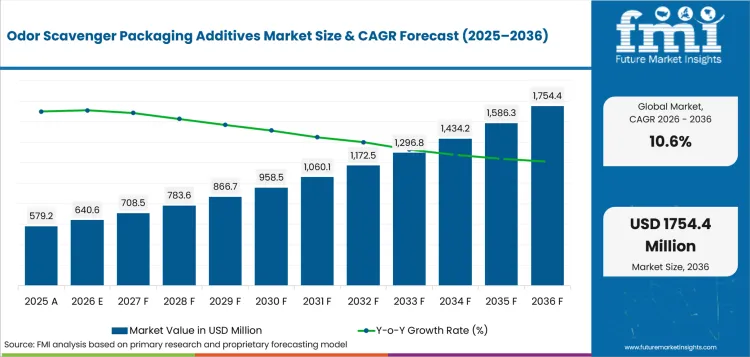
| Metric | Value |
|---|---|
| 2025 Market Size | USD 579.2043 Million |
| 2026 Market Size | USD 640.6 Million |
| 2036 Market Size | USD 1,754.4 Million |
| Forecast CAGR (2026–2036) | 10.6% |
| Featured Additive Type | Activated Carbon-based |
| Activated Carbon-based Share (2026) | 38.0% |
| Featured Packaging Format | Films |
| Films Share (2026) | 42.5% |
| Country CAGR Highlight | India |
| India CAGR (by 2036) | 12.4% |
Summary of the Odor Scavenger Packaging Additives Market
| Market Signal | Commercial Impact |
|---|---|
| Demand and Growth Drivers | Demand for odor-control additives is rising as recycled content and food packaging requirements become more stringent.
|
| Product and Segment View | Activated carbon additives and film applications continue to dominate market demand.
|
| Geography and Competitive Outlook | Asia is expected to deliver the strongest growth while Europe remains a specification-driven market.
|
| Analyst Perspective | Odor-control additives are becoming specification-driven solutions rather than commodity packaging materials.
— Nandini Roy, Principal Consultant, Packaging Domain, Future Market Insights |
In January 2024, Avient launched ColorMatrix AAnchor acetaldehyde control technology for PET packaging. The development matters as recycled PET raises sensory and migration-control concerns. In January 2024, ProAmpac collaborated with Aptar CSP Technologies to launch MP-1000 moisture-adsorbing active packaging. This is used as adjacent active-packaging context, not as an odor-scavenger-specific launch.
The same FDA page notes that recycled polymer food-contact processes may receive favorable opinion letters after safety review.
Why is the Odor Scavenger Packaging Additives Market growing?
Recycled polyolefin use creates volatile carryover that can weaken consumer acceptance in food and consumer packaging. Active films are gaining specification value as brands want odor control without separate sachet insertion.
- Recycled polyolefin use creates volatile carryover that can weaken consumer acceptance in food and consumer packaging.
- Active films are gaining specification value as brands want odor control without separate sachet insertion.
- Food-contact review raises the value of documented formulations with migration and toxicology support.
Recycled plastic packaging is turning odor control into a front-end material decision. FDA food-contact guidance states that recycled polymeric food-contact materials are reviewed through a process that can lead to favorable opinion letters when safety information supports the use. This creates a practical filter for suppliers selling additives into food packs. Odor scavengers must work without creating migration or sensory risk. Buyers therefore prefer suppliers that can support technical files, trial reports, and polymer-specific dosing guidance. That raises entry barriers for generic powder suppliers and supports the forecast for documented masterbatch systems. Regulation is also changing how European buyers specify additive packages.
How is the Odor Scavenger Packaging Additives Market segmented?
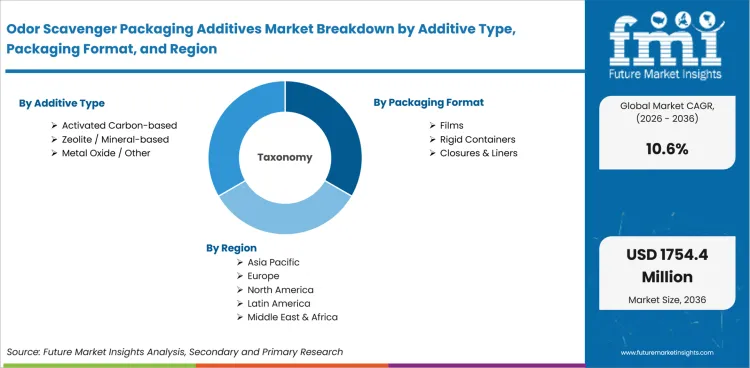
The Odor Scavenger Packaging Additives Market is segmented by additive type, packaging format, end use, polymer compatibility, sales channel, and region.
- With an estimated 38.0% share in 2026, Activated Carbon-based additives are expected to support by Additive Type due to broad volatile adsorption.
- Films are projected to account for 42.5% of Packaging Format demand in 2026 as masterbatch dosing suits blown and cast film lines.
- Food Packaging buyers are expected to direct 51.0% of End Use demand in 2026 toward odor-control additives as sensory acceptance affects reorder rates.
How does Activated Carbon-based contribute to the additive type category?
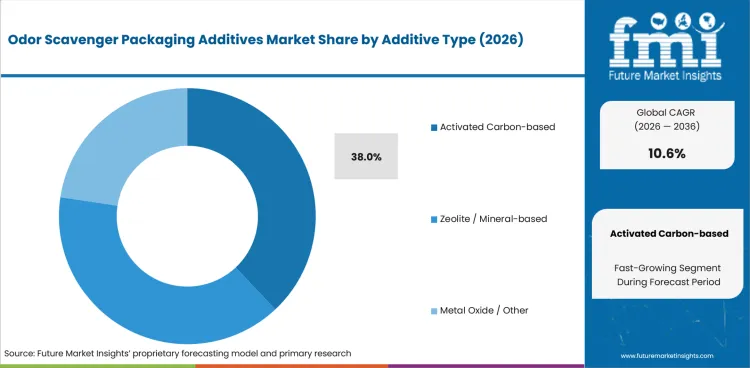
- Activated Carbon-based additives are projected to account for a 38.0% share in 2026 as their porous structure adsorbs sulfur compounds, amines, and rancid notes across food and recycled polymer packaging.
- Cilicant explains that activated carbon has high adsorption capacity for odor molecules due to porosity and surface area. This makes it suited to active pouches and canisters.
What supports demand for Films?
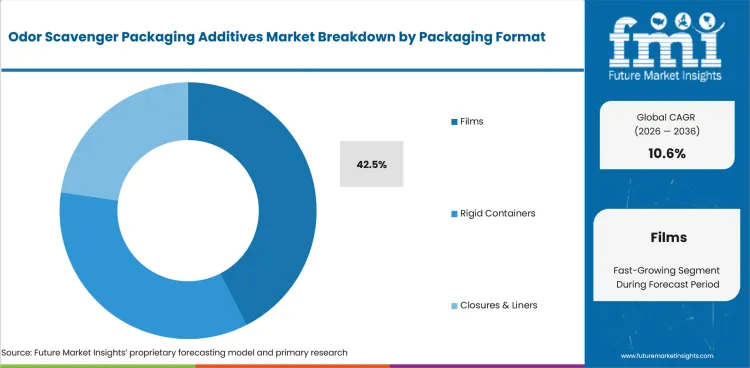
- Films are expected to account for a 42.5% share in 2026 as odor control can be dosed during extrusion for snack packs, pet food pouches, and recycled polyolefin wraps.
- Symphony Environmental states that active ingredients can be embedded in PE / PP films and used on existing lines. This lowers the adoption barrier for produce packaging.
How do buyers evaluate Food Packaging within the end use category?
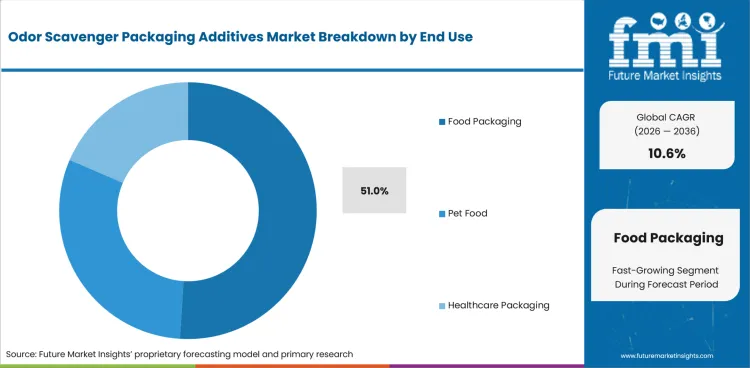
- Food Packaging is anticipated to account for a 51.0% share in 2026 as off-odor can trigger rejection before texture or shelf-life benefits are visible.
- Clariant notes that oxygen affects flavor, color, smell, and texture in packaged foods. That link between odor and product quality supports active scavenger use.
What market factors influence demand for PE / PP?
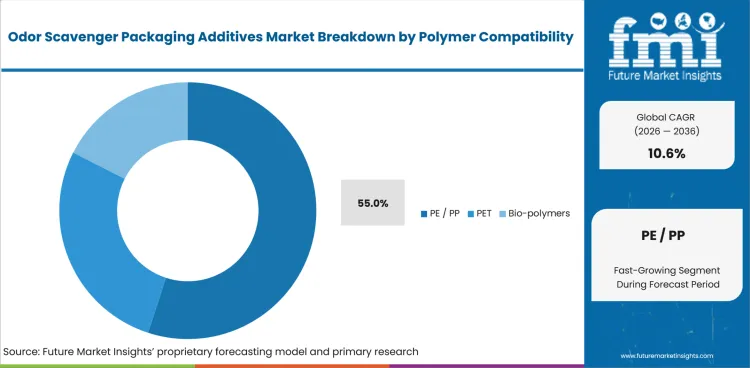
- PE / PP is projected to hold a 55.0% share in 2026 as recycled polyolefin streams often retain volatile residues from prior contents and washing gaps.
- Ampacet states that its odor scavenger for recycled polyethylene does not significantly affect production processes or polymer properties. This reduces converter qualification risk.
How does Masterbatch Suppliers affect the sales channel outlook?
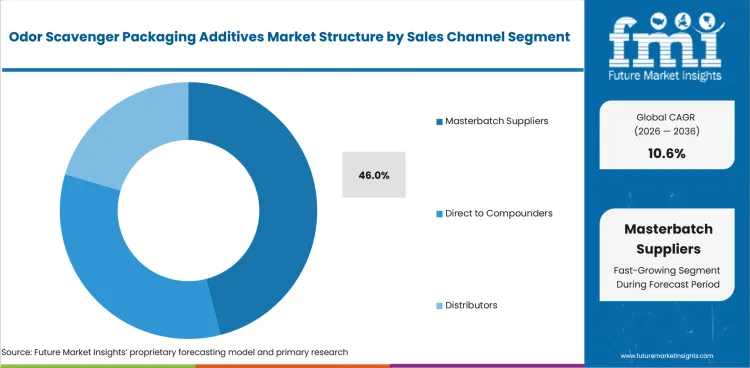
- Masterbatch Suppliers are expected to account for a 46.0% share in 2026 as converters prefer controlled let-down ratios and carrier-resin fit.
- Tosaf lists OdorSeal odor-control solutions in its 2025 injection molding catalog. That shows how odor control is sold as a practical additive package.
What drives and restrains the market?
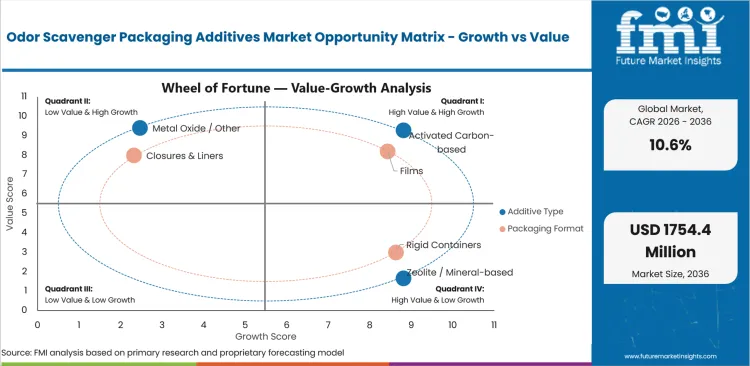
Driver: Recycled resin odor management drives trial activity as brand owners push converters toward higher PCR content without sensory compromise; restraint: Food-contact documentation acts as a restraint as suppliers must prove additives do not create migration or taste risk; opportunity: film-integrated active systems create opportunity as they remove sachet insertion steps and suit high-speed pouch lines.
The market reflects a balance between the identified demand driver, adoption constraints, and the supplier opportunity outlined below.
- Driver: Recycled resin odor management drives trial activity as brand owners push converters toward higher PCR content without sensory compromise.
- Restraint: Food-contact documentation acts as a restraint as suppliers must prove additives do not create migration or taste risk.
- Opportunity: film-integrated active systems create opportunity as they remove sachet insertion steps and suit high-speed pouch lines.
PCR Odor Qualification Recycled polyolefin use is the notable driver for this market. Ampacet describes post-consumer recycled plastics as materials that can carry strong smell from contaminants or residual contents that degrade during recycling. This specific issue changes how converters evaluate additives. A product that removes odor but changes film strength or color will not pass qualification. Suppliers therefore need resin-specific dosing windows and sensory test evidence. The opportunity is notable in PE / PP packaging that uses recycled content but still sells into consumer-facing applications.
Integrated Active Films: Integrated active films create the most practical opportunity for volume conversion. ProAmpac launched ProActive Intelligence Moisture Protect MP-1000 with Aptar CSP Technologies in January 2024 as a moisture-adsorbing active packaging technology. The company said the platform lowers moisture in package headspace and can remove the need for desiccant packets. Because MP-1000 targets moisture, it is best read as adjacent active-packaging evidence showing buyer interest in built-in protection formats. Odor scavenger suppliers can use the same buyer preference for fewer inserts and simpler line operation. Film converters with active additive know-how can win where pack redesign costs are tightly controlled.
Which factors support expansion?
Commercial expansion is reinforced by the value, workflow, and recurring-demand factors below.
- The value pool is expanding as converters move odor control into polymer processing instead of treating smell as a post-packaging quality issue.
- Recycled resin use creates a stronger need for odor-neutralizing packaging additives in films and rigid packs.
- Pet food and dry food brands are expected to pay premium prices for scavengers that reduce rancid notes during shelf life.
Which country markets are included in the CAGR comparison?
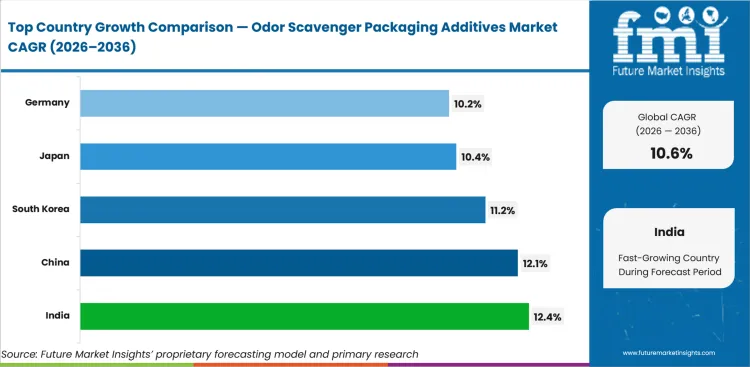
The selected CAGR comparison covers India (12.4%), China (12.1%), South Korea (11.2%), Japan (10.4%), and Germany (10.2%) through 2036.
.webp "Top Country Growth Comparison Odor Scavenger Packaging Additives Market Cagr (2026 2036)")
| Country | CAGR |
|---|---|
| India | 12.4% |
| China5 | 12.1% |
| South Korea | 11.2% |
| Japan | 10.4% |
| Germany | 10.2% |
Source: Future Market Insights analysis based on the supplied country forecast table.
How do country-level CAGRs compare?
- India (CAGR: 12.4%): Packaged snacks, sweets, nutraceuticals, and diagnostics create active-packaging demand.
- China (CAGR: 12.1%): Large flexible packaging output creates high volume potential for PE / PP odor scavengers.
- South Korea (CAGR: 11.2%): Food delivery, snacks, cosmetics, and healthcare packs need odor control in compact formats.
- Japan (CAGR: 10.4%): High-barrier food and healthcare packaging supports odor-control use in premium formats.
- Germany (CAGR: 10.2%): Recycled-content packaging needs odor control that does not disrupt sorting or recycling claims.
The global Odor Scavenger Packaging Additives Market is forecast to record a CAGR of 10.6% from 2026 to 2036. The supplied study covers 8 named country forecasts across the report regions.
How is the Odor Scavenger Packaging Additives Market developing in India?
India is projected to record a CAGR of 12.4% through 2036. The country outlook identifies this demand signal: Packaged snacks, sweets, nutraceuticals, and diagnostics create active-packaging demand.
Country Market Snapshot
| Country | India |
|---|---|
| Forecast CAGR | 12.4% |
| Policy context | India’s centralized plastic packaging EPR portal guides producer and processor compliance. |
| Demand anchor | Packaged snacks, sweets, nutraceuticals, and diagnostics create active-packaging demand. |
| Supply base | Cilicant supplies active packaging products for pharma, medical devices, nutraceuticals, and processed food. |
| Channel signal | Local suppliers sell through direct enterprise sales and distributor routes. |
| Restraint | Price sensitivity limits use in low-value flexible packaging. |
| Application mix | Food packaging and healthcare packaging form the notable adoption pockets. |
| Primary demand signal | Packaged snacks, sweets, nutraceuticals, and diagnostics create active-packaging demand. |
Market Outlook
India is projected to record a CAGR of 12.4% through 2036 as packaged food volume and local active-packaging supply expand together. The Central Pollution Control Board’s plastic packaging EPR portal carried June 2024 and July 2024 notices on annual return filing for registered plastic waste processors. That shows a more formal compliance path for plastic packaging players. Odor scavengers gain relevance when recycled resin moves into consumer-facing packs. Local active-packaging capability gives India a practical supply-side advantage.
Key Growth Drivers
- Packaged snacks and sweets create demand for odor control in high-turnover flexible packs.
- Local active-packaging suppliers support faster trials for food and healthcare buyers.
- EPR portal activity increases attention on recycled plastic quality and compliance.
- Packaged snacks, sweets, nutraceuticals, and diagnostics create active-packaging demand.
Key Restraints
- Low-margin packaging buyers may avoid premium additives unless odor complaints are visible.
- Smaller converters may lack sensory testing systems for accurate odor evaluation.
- Price sensitivity limits use in low-value flexible packaging.
Country Market FAQs
Why should executives monitor Odor Scavenger Packaging Additives Market demand in India?
Executives should monitor India because local buyer readiness, packaged snacks, sweets, nutraceuticals, and diagnostics create active-packaging demand, and service capacity can influence account timing and market-entry priorities.
What should suppliers localize for India?
Suppliers should localize proof points, pricing logic, partner coverage, and training support around buyer access and account ownership and local suppliers sell through direct enterprise sales and distributor routes.
What adoption risk needs attention in India?
Executive teams should watch adoption risk because low-margin packaging buyers may avoid premium additives unless odor complaints are visible can delay conversion from evaluation to commercial deployment.
How is the Odor Scavenger Packaging Additives Market developing in China?
China is projected to record a CAGR of 12.1% through 2036. The country outlook identifies this demand signal: Large flexible packaging output creates high volume potential for PE / PP odor scavengers.
Country Market Snapshot
| Country | China |
|---|---|
| Forecast CAGR | 12.1% |
| Demand anchor | Large flexible packaging output creates high volume potential for PE / PP odor scavengers. |
| Policy context | China continues to push plastic recycling and resource circulation policy. |
| Channel signal | Masterbatch suppliers sell through converters serving food, e-commerce, and consumer goods. |
| Application mix | Snack food, pet food, personal care, and household products are key demand pockets. |
| Restraint | Price pressure limits premium additive use outside export or branded packaging. |
| Supply structure | Local compounders can scale fast once brand-owner specifications are clear. |
| Primary demand signal | Large flexible packaging output creates high volume potential for PE / PP odor scavengers. |
Market Outlook
China is forecast to grow at a CAGR of 12.1% through 2036 as packaging conversion volume and recycled resin use create a broad trial base. SWITCH-Asia’s 2025 China plastic policy profile estimates China generates over 55,697,000 tonnes of plastic waste annually. That number points to the scale of recycling and odor-control challenges. Recycled resin streams often vary by source and washing quality, which makes odor performance hard to standardize.
Key Growth Drivers
- Large recycled plastic streams create a wide need for odor-neutralizing additive systems.
- Food and pet food pouch production supports film-based odor scavenger use.
- Local compounders can adapt masterbatch dosing for different resin and converter lines.
- Large flexible packaging output creates high volume potential for PE / PP odor scavengers.
Key Restraints
- Price pressure limits use in low-margin commodity packaging.
- Resin source variability increases the cost of performance testing and customer trials.
- That number points to the scale of recycling and odor-control challenges.
Country Market FAQs
Why should executives monitor Odor Scavenger Packaging Additives Market demand in China?
Executives should monitor China because local buyer readiness, large flexible packaging output creates high volume potential for pe / pp odor scavengers, and service capacity can influence account timing and market-entry priorities.
What should suppliers localize for China?
Suppliers should localize proof points, pricing logic, partner coverage, and training support around buyer access and account ownership and masterbatch suppliers sell through converters serving food, e-commerce, and consumer goods.
What adoption risk needs attention in China?
Executive teams should watch adoption risk because price pressure limits use in low-margin commodity packaging can delay conversion from evaluation to commercial deployment.
How is the Odor Scavenger Packaging Additives Market developing in South Korea?
South Korea is projected to record a CAGR of 11.2% through 2036. The country outlook identifies this demand signal: Food delivery, snacks, cosmetics, and healthcare packs need odor control in compact formats.
Country Market Snapshot
| Country | South Korea |
|---|---|
| Forecast CAGR | 11.2% |
| Policy context | Korea’s EPR system covers packaging materials and assigns recycling obligations. |
| Demand anchor | Food delivery, snacks, cosmetics, and healthcare packs need odor control in compact formats. |
| Channel signal | Buyers often work through converters tied to consumer electronics and packaged goods supply chains. |
| Application mix | Consumer goods and healthcare packaging create higher-margin niches. |
| Restraint | Small pack runs can make additive qualification costs hard to recover. |
| Competitive context | Public company evidence is limited for odor-only additive suppliers active in South Korea. |
| Primary demand signal | Food delivery, snacks, cosmetics, and healthcare packs need odor control in compact formats. |
Market Outlook
South Korea is expected to record a CAGR of 11.2% through 2036 as high-value consumer packaging and EPR pressure support active additives. Korea Environment Corporation material presented in 2025 states that Korea’s EPR system covers four packaging material types and 24 product types. This keeps recycling responsibility visible for packaging producers. Odor scavengers fit suitable when they do not disturb packaging recovery or small-pack aesthetics. Demand is concentrated in products with strong brand sensitivity.
Key Growth Drivers
- EPR obligations keep recyclability and pack performance visible for brand owners.
- Cosmetics and healthcare packaging create high-value demand for low-odor materials.
- Food delivery and snack packaging support active additives in flexible formats.
- Food delivery, snacks, cosmetics, and healthcare packs need odor control in compact formats.
Key Restraints
- Smaller order runs can make qualification costs harder to absorb.
- Public evidence on local odor-scavenger producers is limited.
- Small pack runs can make additive qualification costs hard to recover.
Country Market FAQs
Why should executives monitor Odor Scavenger Packaging Additives Market demand in South Korea?
Executives should monitor South Korea because local buyer readiness, food delivery, snacks, cosmetics, and healthcare packs need odor control in compact formats, and service capacity can influence account timing and market-entry priorities.
What should suppliers localize for South Korea?
Suppliers should localize proof points, pricing logic, partner coverage, and training support around buyer access and account ownership and buyers often work through converters tied to consumer electronics and packaged goods supply chains.
What adoption risk needs attention in South Korea?
Executive teams should watch adoption risk because smaller order runs can make qualification costs harder to absorb can delay conversion from evaluation to commercial deployment.
How is the Odor Scavenger Packaging Additives Market developing in Japan?
Japan is projected to record a CAGR of 10.4% through 2036. The country outlook identifies this demand signal: High-barrier food and healthcare packaging supports odor-control use in premium formats.
Country Market Snapshot
| Country | Japan |
|---|---|
| Forecast CAGR | 10.4% |
| Policy context | Japan’s plastic resource circulation policy supports recycling plans with municipalities and recyclers. |
| Demand anchor | High-barrier food and healthcare packaging supports odor-control use in premium formats. |
| Buyer behavior | Japanese converters place high weight on sensory quality and clean pack presentation. |
| Channel signal | Additives often enter through material suppliers and packaging converters with long qualification cycles. |
| Restraint | Conservative validation slows substitution of existing food-contact materials. |
| Application mix | Convenience food, healthcare, pet food, and personal care packaging carry the notable use cases. |
| Primary demand signal | High-barrier food and healthcare packaging supports odor-control use in premium formats. |
Market Outlook
Japan is projected to grow at a CAGR of 10.4% through 2036 as high-specification packaging buyers seek odor control with low visual impact. Japan’s Ministry of the Environment presentation in April 2024 noted that municipalities can recycle plastic product waste under the current container and packaging recycling scheme. This supports packaging designs that keep recycling routes workable. Odor scavengers must therefore perform without damaging material recovery expectations. Japanese buyers tend to use longer qualification cycles for food-contact and healthcare packaging.
Key Growth Drivers
- Plastic resource circulation policy supports material choices compatible with recycling plans.
- Convenience food packaging creates demand for odor control in sealed high-turnover formats.
- Healthcare packaging buyers value active odor and moisture control when product stability is sensitive.
- High-barrier food and healthcare packaging supports odor-control use in premium formats.
Key Restraints
- Long validation cycles can slow new additive approval in food and healthcare packaging.
- Limited public evidence on odor-only suppliers reduces visibility for market entry planning.
- Conservative validation slows substitution of existing food-contact materials.
Country Market FAQs
Why should executives monitor Odor Scavenger Packaging Additives Market demand in Japan?
Executives should monitor Japan because local buyer readiness, high-barrier food and healthcare packaging supports odor-control use in premium formats, and service capacity can influence account timing and market-entry priorities.
What should suppliers localize for Japan?
Suppliers should localize proof points, pricing logic, partner coverage, and training support around buyer access and account ownership and additives often enter through material suppliers and packaging converters with long qualification cycles.
What adoption risk needs attention in Japan?
Executive teams should watch adoption risk because long validation cycles can slow new additive approval in food and healthcare packaging can delay conversion from evaluation to commercial deployment.
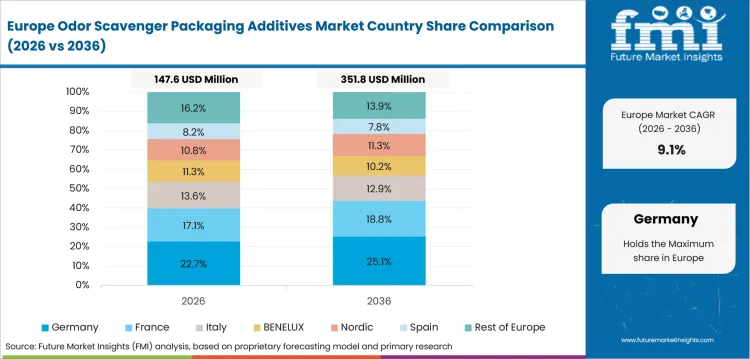
How is the Odor Scavenger Packaging Additives Market developing in Germany?
Germany is projected to record a CAGR of 10.2% through 2036. The country outlook identifies this demand signal: Recycled-content packaging needs odor control that does not disrupt sorting or recycling claims.
Country Market Snapshot
| Country | Germany |
|---|---|
| Forecast CAGR | 10.2% |
| Policy context | LUCID registration obligations keep packaging compliance visible for producers selling packaged goods. |
| Demand anchor | Recycled-content packaging needs odor control that does not disrupt sorting or recycling claims. |
| Supply base | Germany has strong packaging machinery and specialty chemical buying expertise. |
| Channel signal | Converters often qualify additives through compounders and machinery-linked trials. |
| Restraint | High documentation expectations slow supplier replacement in food packaging. |
| Competitive context | Clariant and Sanner have relevant active-packaging and specialty packaging capabilities in the wider German-speaking supply chain. |
| Primary demand signal | Recycled-content packaging needs odor control that does not disrupt sorting or recycling claims. |
Market Outlook
Germany is forecast to grow at a CAGR of 10.2% through 2036 due to strict packaging compliance and a mature converter base. The German LUCID Packaging Register states that companies distributing packaged goods in Germany must register under packaging law. This keeps producer responsibility visible across the selling chain. For odor scavenger additives, the result is a buyer preference for documented formulations and clear recycling compatibility. German buyers are likely to pay for performance when it reduces downstream compliance risk.
Key Growth Drivers
- Producer registration duties keep packaging compliance central to converter and brand-owner decisions.
- High-specification food packs support additives with documentation and sensory test evidence.
- German machinery and compounder networks support accurate dosing in film and rigid packaging.
- Recycled-content packaging needs odor control that does not disrupt sorting or recycling claims.
Key Restraints
- Buyer validation processes can slow qualification of new odor-control chemistries.
- Recyclability requirements restrict additives that change haze, residue, or sorting performance.
- High documentation expectations slow supplier replacement in food packaging.
Country Market FAQs
Why should executives monitor Odor Scavenger Packaging Additives Market demand in Germany?
Executives should monitor Germany because local buyer readiness, recycled-content packaging needs odor control that does not disrupt sorting or recycling claims, and service capacity can influence account timing and market-entry priorities.
What should suppliers localize for Germany?
Suppliers should localize proof points, pricing logic, partner coverage, and training support around buyer access and account ownership and converters often qualify additives through compounders and machinery-linked trials.
What adoption risk needs attention in Germany?
Executive teams should watch adoption risk because buyer validation processes can slow qualification of new odor-control chemistries can delay conversion from evaluation to commercial deployment.
Which companies are discussed in the Odor Scavenger Packaging Additives Market?
The preview discusses Avient, Ampacet, Tosaf, Clariant, and Aptar CSP Technologies among the companies active in this market.
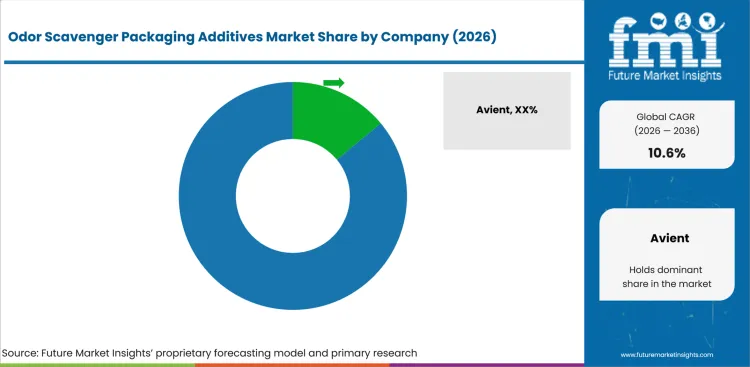
Competition is moderately fragmented as active packaging specialists and masterbatch suppliers serve different buyer routes. established suppliers win on adsorption range, carrier-resin fit, food-contact documentation, and line-trial support. Smaller companies compete in sachets, custom canisters, and localized active-packaging formats with faster service.
Entry barriers are elevated in food and healthcare uses due to migration testing and customer validation needs. Supplier positioning is shaped by the difference between additive chemistry and packaging execution. Ampacet’s Odor Scavenger 1000258-E shows the masterbatch route, since it targets recycled polyethylene and multiple conversion processes.
How is competition structured?
Competition reflects differences in specialization, portfolio scope, geographic reach, evidence, and customer access.
The market includes masterbatch formulators, active insert suppliers, and integrated active packaging developers.
- Masterbatch and Additive Formulators: Avient, Ampacet, Tosaf, and Clariant compete with polymer-additive systems used in films, rigid packs, closures, and liners.
- Active Insert and Sorbent Suppliers: Multisorb, Cilicant, and Clariant serve food, healthcare, nutraceutical, and diagnostics buyers using odor-control sachets, pouches, canisters, desiccant-adjacent inserts, and active-protection formats where odor management is part of the buyer specification.
- Integrated Active Packaging Developers: Aptar CSP Technologies, ProAmpac, Symphony Environmental, and Porex support active materials, flexible films, porous components, and built-in protection systems.
How do selected companies compare?
The selected companies differ in portfolio focus, geographic reach, evidence depth, and channel strength.
| Company | Competitive position |
|---|---|
| Avient | Avient launched ColorMatrix AAnchor in January 2024 for PET packaging and cited low migration tendency and processing stability. |
| Ampacet | Ampacet’s Odor Scavenger 1000258-E shows the masterbatch route, since it targets recycled polyethylene and multiple conversion processes. |
| Tosaf | Masterbatch and Additive Formulators: Avient, Ampacet, Tosaf, and Clariant compete with polymer-additive systems used in films, rigid packs, closures, and liners. |
| Clariant | Masterbatch and Additive Formulators: Avient, Ampacet, Tosaf, and Clariant compete with polymer-additive systems used in films, rigid packs, closures, and liners. |
| Aptar CSP Technologies | Aptar CSP Technologies is referenced through adjacent moisture-control active packaging activity with ProAmpac; this context supports active-packaging adoption signals without treating MP-1000 as a direct odor-scavenger product. |
What are the key developments in the Odor Scavenger Packaging Additives Market?
- In January 2024, Avient launched ColorMatrix AAnchor acetaldehyde control technology for PET packaging. The development matters as recycled PET raises sensory and migration-control concerns.
- In January 2024, ProAmpac collaborated with Aptar CSP Technologies to launch MP-1000 moisture-adsorbing active packaging. This is used as adjacent active-packaging context, not as an odor-scavenger-specific launch.
- In March 2025, ProAmpac expanded active and intelligent packaging with sustainable moisture-adsorbing solutions. The move strengthens the case for active functions built into flexible packs.
Selected Companies in the Odor Scavenger Packaging Additives Market
Companies referenced in this preview
- Avient.
- Ampacet.
- Tosaf.
- Clariant.
- Aptar CSP Technologies.
- ProAmpac.
- Cilicant.
- Multisorb.
- Symphony Environmental.
- Porex.
Market Scope & Definition
| Market definition | Odor scavenger packaging additives are active materials added to packaging polymers or pack inserts to adsorb or neutralize volatile compounds. |
|---|---|
| Functions covered | Activated Carbon-based, Zeolite / Mineral-based, Cyclodextrin-based, Metal Oxide / Other |
| Applications covered | Food Packaging, Pet Food, Healthcare Packaging, Consumer Goods |
| End-use industries | Food Packaging, Pet Food, Healthcare Packaging, Consumer Goods |
| Inclusions | Market scope covers activated carbon-based, zeolite / mineral-based, cyclodextrin-based, and metal oxide / other additives used across films, rigid containers, closures & liners, and active pads / sachets in food packaging, pet food, healthcare packaging, and consumer goods across selected global countries. |
| Exclusions | Market scope excludes fragrance additives, deodorizing sprays, industrial air filtration media, antimicrobial agents without odor-scavenging function, oxygen-only absorbers without odor-control role, and recycled resin processing aids sold outside packaging applications. |
Research Methodology
| Primary Research | FMI analysts reviewed input from packaging converters, active-packaging suppliers, compounders, masterbatch distributors, and food packaging buyers. Discussions focused on odor thresholds, dosing practice, polymer compatibility, and qualification barriers. |
|---|---|
| Desk Research | covered food-contact rules, packaging waste law, active packaging product data, and company portfolio evidence. Sources included regulator pages, company product pages, standards references, and official policy documents. |
| Market Sizing and Forecasting | The model combined additive consumption by packaging format, polymer compatibility, end-use demand, and country-level adoption rates. Pricing assumptions were adjusted for additive type, food-contact documentation, and masterbatch delivery format. |
| Data Validation | Forecasts were checked against active packaging adoption, recycled plastic rules, food-contact safety review, and supplier product evidence. Final estimates were validated across active packaging and oxygen scavenger masterbatch demand patterns. |
What does the report cover?
The report covers additive type, packaging format, end use, polymer compatibility, sales channel, and region across the 2026-2036 forecast period in 30+ countries.
| Periods | Base year 2025; estimated year 2026; forecast period 2026-2036 |
|---|---|
| Quantitative units | USD 640.6 million in 2026 to USD 1754.4 million in 2036, at a CAGR of 10.6% |
| Segment axes | additive type, packaging format, end use, polymer compatibility, sales channel, and region |
| Regions | North America, Europe, East Asia, South Asia and Pacific |
| Countries | United States, United Kingdom, Germany, France, Japan, China, South Korea, India and 30+ |
| Companies | Avient, Ampacet, Tosaf, Clariant, Aptar CSP Technologies, ProAmpac, Cilicant, Multisorb, Symphony Environmental, Porex |
| Approach | Hybrid bottom-up and selected-down methodology using packaging format demand, additive dosing assumptions, polymer compatibility, and country-level adoption patterns. |
Market Segmentation Analysis
Segmented by Additive Type
- Activated Carbon-based.
- Zeolite / Mineral-based.
- Cyclodextrin-based.
- Metal Oxide / Other.
Segmented by Packaging Format
- Films.
- Rigid Containers.
- Closures & Liners.
- Active Pads / Sachets.
Segmented by End Use
- Food Packaging.
- Pet Food.
- Healthcare Packaging.
- Consumer Goods.
Segmented by Polymer Compatibility
- PE / PP.
- PET.
- Bio-polymers.
- Other.
Segmented by Sales Channel
- Direct to Compounders.
- Masterbatch Suppliers.
- Distributors.
By Region
- North America.
- United States.
- Western Europe.
- Germany.
- France.
- East Asia.
- China.
- Japan.
- South Korea.
- South Asia and Pacific.
- India.
- United Kingdom.
Research Sources and Bibliography
- 1. for consumers. USA Food and Drug Administration.
- 2. European Commission. (2025). Packaging and packaging waste regulation. European Commission.
- 3. ProAmpac. (2024, January 24). ProAmpac collaborates with Aptar CSP Technologies to launch moisture adsorbing active packaging technology. ProAmpac.
- 4. Avient Corporation. (2024, January 22). Avient unveils ColorMatrix AAnchor: New acetaldehyde control technology for PET packaging. Avient Corporation.
- 5. Clariant. (2026, February 6). OXY-GUARD oxygen absorbers. Clariant.
- 6. Ampacet Corporation. (2024). Ampacet Odor Scavenger 1000258-E: Powerful wide spectrum odor-absorbing masterbatch. Ampacet Corporation.
- 7. Cilicant. (2024). Active packaging solutions: Oxygen absorber. Cilicant.
- 8. Symphony Environmental. (2026). Active packaging technologies. Symphony Environmental.
- 9. UK Parliament. (2026, January 13). Packaging extended producer responsibility. House of Commons Library.
- 10. Ministry for Ecological Transition. (2025). Lutte contre la pollution plastique. Government of France.
- 11. Ministry of the Environment Japan. (2024, April). Japan’s policy related to plastic resource circulation. Ministry of the Environment Japan.
- 12. SWITCH-Asia. (2025). Plastic policies in China. SWITCH-Asia.
- 13. Central Pollution Control Board. (2024, June 25). Centralized EPR portal for plastic packaging. Central Pollution Control Board.
- 14. Korea Environment Corporation. (2025, October). K-Circular Economy: Turning waste into resources. Korea Environment Corporation.
- 15. This bibliography is provided for reader reference and all sources are primary official, regulatory, company, or trade-body publications.
The bibliography is provided for reader reference and uses primary regulatory, official company, academic, or recognized institutional sources.
This Report Answers
- What is the projected value of the Odor Scavenger Packaging Additives Market in 2026?
- What value is forecast for the Odor Scavenger Packaging Additives Market by 2036?
- What CAGR is forecast for the Odor Scavenger Packaging Additives Market from 2026 to 2036?
- What 2026 share is projected for Activated Carbon-based within the additive type category?
- What 2026 share is projected for Films within the packaging format category?
- Which demand factors support the Odor Scavenger Packaging Additives Market outlook?
- Which restraints and opportunities affect adoption in the Odor Scavenger Packaging Additives Market?
- How are country CAGR outlooks, including India at 12.4%, compared?
- Which companies and product developments are covered in the competitive analysis?
- What is included in the market scope, and how is the forecast validated?
Frequently Asked Questions
Why should executives track the Odor Scavenger Packaging Additives Market?
Executives should track this market because it can affect capital allocation, supplier strategy, operating risk, and competitive positioning across end-use settings.
What business problem does the Odor Scavenger Packaging Additives Market address?
It helps executive teams judge where customer pain, supplier capability, compliance exposure, and implementation economics justify investment, procurement, or market-entry decisions.
What should procurement leaders evaluate before selecting suppliers?
Procurement leaders should assess evidence quality, integration fit, service coverage, compliance readiness, total cost of ownership, and supplier execution capability.
What can limit return on investment for buyers?
Return on investment can be limited by low utilization, integration delays, training gaps, unclear ownership, pricing pressure, or weak fit with existing workflows.
How can suppliers build executive confidence?
Suppliers can build confidence by proving implementation speed, risk reduction, support depth, reference use cases, and measurable outcomes for budget owners.
Preview the report firsthand - request a free sample
Get SampleGet the brochure for pricing and purchase details.
Get PDFTable of Content
- Key Takeaways
- Market Size and CAGR
- Top Growth Driver
- Fastest Growing Segment
- Leading Region
- Key Companies
- Emerging Opportunities
- Executive Summary
- Global Market Outlook
- Demand-side Trends
- Supply-side Trends
- Technology Roadmap Analysis
- Analysis and Recommendations
- Analyst Perspective (What is happening? Why now? What should investors know?)
- Key Questions Answered
- How large is the market?
- What is the CAGR?
- What are key trends?
- Which region dominates?
- Who are the leaders?
- Market Overview
- Market Coverage / Taxonomy
- Market Definition / Scope / Limitations
- Research Methodology
- Chapter Orientation
- Analytical Lens and Working Hypotheses
- Market Structure, Signals, and Trend Drivers
- Benchmarking and Cross-market Comparability
- Market Sizing, Forecasting, and Opportunity Mapping
- Research Design and Evidence Framework
- Desk Research Programme (Secondary Evidence)
- Expert Input and Fieldwork (Primary Evidence)
- Tooling, Models, and Reference Databases
- Data Engineering and Model Build
- Quality Assurance and Audit Trail
- Market Background
- Market Dynamics (Drivers, Restraints, Opportunity, Trends)
- Scenario Forecast (Optimistic, Likely, Conservative)
- Impact Analysis
- AI Impact
- Sustainability Impact
- Regulatory Impact
- Technology Impact
- Consumer / Buyer Analysis
- Purchase Drivers
- Adoption Barriers
- Buyer Journey
- Opportunity Map Analysis
- Product Life Cycle Analysis
- Supply Chain Analysis
- Investment Feasibility Matrix
- Value Chain Analysis
- PESTLE and Porter's Analysis
- Regulatory Landscape
- Regional Parent Market Outlook
- Production and Consumption Statistics
- Import and Export Statistics
- Global Market Analysis and Forecast, 2021 to 2036
- Historical Market Size Value (USD Million) Analysis, 2021 to 2025
- Current and Future Market Size Value (USD Million) Projections, 2026 to 2036
- Y-o-Y Growth Trend Analysis
- Absolute $ Opportunity Analysis
- Global Market Pricing Analysis, 2021 to 2036
- Global Market Analysis and Forecast, By Additive Type, 2021 to 2036
- Introduction / Key Findings
- Historical Market Size Value (USD Million) Analysis By Additive Type, 2021 to 2025
- Current and Future Market Size Value (USD Million) Analysis and Forecast By Additive Type, 2026 to 2036
- Activated Carbon-based
- Zeolite / Mineral-based
- Metal Oxide / Other
- Activated Carbon-based
- Y-o-Y Growth Trend Analysis By Additive Type, 2021 to 2025
- Absolute $ Opportunity Analysis By Additive Type, 2026 to 2036
- Global Market Analysis and Forecast, By Packaging Format, 2021 to 2036
- Introduction / Key Findings
- Historical Market Size Value (USD Million) Analysis By Packaging Format, 2021 to 2025
- Current and Future Market Size Value (USD Million) Analysis and Forecast By Packaging Format, 2026 to 2036
- Films
- Rigid Containers
- Closures & Liners
- Films
- Y-o-Y Growth Trend Analysis By Packaging Format, 2021 to 2025
- Absolute $ Opportunity Analysis By Packaging Format, 2026 to 2036
- Global Market Analysis and Forecast, By End Use, 2021 to 2036
- Introduction / Key Findings
- Historical Market Size Value (USD Million) Analysis By End Use, 2021 to 2025
- Current and Future Market Size Value (USD Million) Analysis and Forecast By End Use, 2026 to 2036
- Food Packaging
- Pet Food
- Healthcare Packaging
- Food Packaging
- Y-o-Y Growth Trend Analysis By End Use, 2021 to 2025
- Absolute $ Opportunity Analysis By End Use, 2026 to 2036
- Global Market Analysis and Forecast, By Polymer Compatibility, 2021 to 2036
- Introduction / Key Findings
- Historical Market Size Value (USD Million) Analysis By Polymer Compatibility, 2021 to 2025
- Current and Future Market Size Value (USD Million) Analysis and Forecast By Polymer Compatibility, 2026 to 2036
- PE / PP
- PET
- Bio-polymers
- PE / PP
- Y-o-Y Growth Trend Analysis By Polymer Compatibility, 2021 to 2025
- Absolute $ Opportunity Analysis By Polymer Compatibility, 2026 to 2036
- Global Market Analysis and Forecast, By Sales Channel, 2021 to 2036
- Introduction / Key Findings
- Historical Market Size Value (USD Million) Analysis By Sales Channel, 2021 to 2025
- Current and Future Market Size Value (USD Million) Analysis and Forecast By Sales Channel, 2026 to 2036
- Masterbatch Suppliers
- Direct to Compounders
- Distributors
- Masterbatch Suppliers
- Y-o-Y Growth Trend Analysis By Sales Channel, 2021 to 2025
- Absolute $ Opportunity Analysis By Sales Channel, 2026 to 2036
- Global Market Analysis and Forecast, By Region, 2021 to 2036
- Introduction
- Historical Market Size Value (USD Million) Analysis By Region, 2021 to 2025
- Current Market Size Value (USD Million) Analysis and Forecast By Region, 2026 to 2036
- North America
- Latin America
- Western Europe
- Eastern Europe
- East Asia
- South Asia and Pacific
- Middle East & Africa
- Market Attractiveness Analysis By Region
- North America Market Analysis and Forecast, By Country, 2021 to 2036
- Historical Market Size Value (USD Million) Trend Analysis By Market Taxonomy, 2021 to 2025
- Market Size Value (USD Million) Forecast By Market Taxonomy, 2026 to 2036
- By Country
- USA
- Canada
- Mexico
- By Additive Type
- By Packaging Format
- By End Use
- By Polymer Compatibility
- By Sales Channel
- By Country
- Market Attractiveness Analysis
- By Country
- By Additive Type
- By Packaging Format
- By End Use
- By Polymer Compatibility
- By Sales Channel
- Key Takeaways
- Latin America Market Analysis and Forecast, By Country
- Historical Market Size Value (USD Million) Trend Analysis By Market Taxonomy, 2021 to 2025
- Market Size Value (USD Million) Forecast By Market Taxonomy, 2026 to 2036
- By Country
- Brazil
- Chile
- Rest of Latin America
- By Additive Type
- By Packaging Format
- By End Use
- By Polymer Compatibility
- By Sales Channel
- By Country
- Market Attractiveness Analysis
- By Country
- By Additive Type
- By Packaging Format
- By End Use
- By Polymer Compatibility
- By Sales Channel
- Key Takeaways
- Western Europe Market Analysis and Forecast, By Country
- Historical Market Size Value (USD Million) Trend Analysis By Market Taxonomy, 2021 to 2025
- Market Size Value (USD Million) Forecast By Market Taxonomy, 2026 to 2036
- By Country
- Germany
- UK
- Italy
- Spain
- France
- Nordic
- BENELUX
- Rest of Western Europe
- By Additive Type
- By Packaging Format
- By End Use
- By Polymer Compatibility
- By Sales Channel
- By Country
- Market Attractiveness Analysis
- By Country
- By Additive Type
- By Packaging Format
- By End Use
- By Polymer Compatibility
- By Sales Channel
- Key Takeaways
- Eastern Europe Market Analysis and Forecast, By Country
- Historical Market Size Value (USD Million) Trend Analysis By Market Taxonomy, 2021 to 2025
- Market Size Value (USD Million) Forecast By Market Taxonomy, 2026 to 2036
- By Country
- Russia
- Poland
- Hungary
- Balkan & Baltic
- Rest of Eastern Europe
- By Additive Type
- By Packaging Format
- By End Use
- By Polymer Compatibility
- By Sales Channel
- By Country
- Market Attractiveness Analysis
- By Country
- By Additive Type
- By Packaging Format
- By End Use
- By Polymer Compatibility
- By Sales Channel
- Key Takeaways
- East Asia Market Analysis and Forecast, By Country
- Historical Market Size Value (USD Million) Trend Analysis By Market Taxonomy, 2021 to 2025
- Market Size Value (USD Million) Forecast By Market Taxonomy, 2026 to 2036
- By Country
- China
- Japan
- South Korea
- By Additive Type
- By Packaging Format
- By End Use
- By Polymer Compatibility
- By Sales Channel
- By Country
- Market Attractiveness Analysis
- By Country
- By Additive Type
- By Packaging Format
- By End Use
- By Polymer Compatibility
- By Sales Channel
- Key Takeaways
- South Asia and Pacific Market Analysis and Forecast, By Country
- Historical Market Size Value (USD Million) Trend Analysis By Market Taxonomy, 2021 to 2025
- Market Size Value (USD Million) Forecast By Market Taxonomy, 2026 to 2036
- By Country
- India
- ASEAN
- Australia & New Zealand
- Rest of South Asia and Pacific
- By Additive Type
- By Packaging Format
- By End Use
- By Polymer Compatibility
- By Sales Channel
- By Country
- Market Attractiveness Analysis
- By Country
- By Additive Type
- By Packaging Format
- By End Use
- By Polymer Compatibility
- By Sales Channel
- Key Takeaways
- Middle East & Africa Market Analysis and Forecast, By Country
- Historical Market Size Value (USD Million) Trend Analysis By Market Taxonomy, 2021 to 2025
- Market Size Value (USD Million) Forecast By Market Taxonomy, 2026 to 2036
- By Country
- Kingdom of Saudi Arabia
- Other GCC Countries
- Türkiye
- South Africa
- Other African Union
- Rest of Middle East & Africa
- By Additive Type
- By Packaging Format
- By End Use
- By Polymer Compatibility
- By Sales Channel
- By Country
- Market Attractiveness Analysis
- By Country
- By Additive Type
- By Packaging Format
- By End Use
- By Polymer Compatibility
- By Sales Channel
- Key Takeaways
- Key Countries Market Analysis
- USA
- Pricing Analysis
- Market Share Analysis, 2025
- By Additive Type
- By Packaging Format
- By End Use
- By Polymer Compatibility
- By Sales Channel
- Canada
- Pricing Analysis
- Market Share Analysis, 2025
- By Additive Type
- By Packaging Format
- By End Use
- By Polymer Compatibility
- By Sales Channel
- Mexico
- Pricing Analysis
- Market Share Analysis, 2025
- By Additive Type
- By Packaging Format
- By End Use
- By Polymer Compatibility
- By Sales Channel
- Brazil
- Pricing Analysis
- Market Share Analysis, 2025
- By Additive Type
- By Packaging Format
- By End Use
- By Polymer Compatibility
- By Sales Channel
- Chile
- Pricing Analysis
- Market Share Analysis, 2025
- By Additive Type
- By Packaging Format
- By End Use
- By Polymer Compatibility
- By Sales Channel
- Germany
- Pricing Analysis
- Market Share Analysis, 2025
- By Additive Type
- By Packaging Format
- By End Use
- By Polymer Compatibility
- By Sales Channel
- UK
- Pricing Analysis
- Market Share Analysis, 2025
- By Additive Type
- By Packaging Format
- By End Use
- By Polymer Compatibility
- By Sales Channel
- Italy
- Pricing Analysis
- Market Share Analysis, 2025
- By Additive Type
- By Packaging Format
- By End Use
- By Polymer Compatibility
- By Sales Channel
- Spain
- Pricing Analysis
- Market Share Analysis, 2025
- By Additive Type
- By Packaging Format
- By End Use
- By Polymer Compatibility
- By Sales Channel
- France
- Pricing Analysis
- Market Share Analysis, 2025
- By Additive Type
- By Packaging Format
- By End Use
- By Polymer Compatibility
- By Sales Channel
- India
- Pricing Analysis
- Market Share Analysis, 2025
- By Additive Type
- By Packaging Format
- By End Use
- By Polymer Compatibility
- By Sales Channel
- ASEAN
- Pricing Analysis
- Market Share Analysis, 2025
- By Additive Type
- By Packaging Format
- By End Use
- By Polymer Compatibility
- By Sales Channel
- Australia & New Zealand
- Pricing Analysis
- Market Share Analysis, 2025
- By Additive Type
- By Packaging Format
- By End Use
- By Polymer Compatibility
- By Sales Channel
- China
- Pricing Analysis
- Market Share Analysis, 2025
- By Additive Type
- By Packaging Format
- By End Use
- By Polymer Compatibility
- By Sales Channel
- Japan
- Pricing Analysis
- Market Share Analysis, 2025
- By Additive Type
- By Packaging Format
- By End Use
- By Polymer Compatibility
- By Sales Channel
- South Korea
- Pricing Analysis
- Market Share Analysis, 2025
- By Additive Type
- By Packaging Format
- By End Use
- By Polymer Compatibility
- By Sales Channel
- Russia
- Pricing Analysis
- Market Share Analysis, 2025
- By Additive Type
- By Packaging Format
- By End Use
- By Polymer Compatibility
- By Sales Channel
- Poland
- Pricing Analysis
- Market Share Analysis, 2025
- By Additive Type
- By Packaging Format
- By End Use
- By Polymer Compatibility
- By Sales Channel
- Hungary
- Pricing Analysis
- Market Share Analysis, 2025
- By Additive Type
- By Packaging Format
- By End Use
- By Polymer Compatibility
- By Sales Channel
- Kingdom of Saudi Arabia
- Pricing Analysis
- Market Share Analysis, 2025
- By Additive Type
- By Packaging Format
- By End Use
- By Polymer Compatibility
- By Sales Channel
- Türkiye
- Pricing Analysis
- Market Share Analysis, 2025
- By Additive Type
- By Packaging Format
- By End Use
- By Polymer Compatibility
- By Sales Channel
- South Africa
- Pricing Analysis
- Market Share Analysis, 2025
- By Additive Type
- By Packaging Format
- By End Use
- By Polymer Compatibility
- By Sales Channel
- USA
- Market Structure Analysis
- Competition Dashboard
- Competition Benchmarking
- Market Share Analysis of Top Players
- By Regional
- By Additive Type
- By Packaging Format
- By End Use
- By Polymer Compatibility
- By Sales Channel
- Emerging Startups
- Innovation Benchmarking
- Competition Analysis
- Competition Deep Dive
- Avient
- Overview
- Product Portfolio
- Profitability by Market Segments (Product/Region/Sales Channel)
- Sales Footprint
- Strategy Overview
- Marketing Strategy
- Product Strategy
- Channel Strategy
- Ampacet
- Tosaf
- Clariant
- Aptar CSP Technologies
- ProAmpac
- Cilicant
- Multisorb
- Symphony Environmental
- Avient
- Case Studies
- Success Stories
- Recent Developments
- Competition Deep Dive
- Assumptions & Acronyms Used


