

- Market Size (2026)
- USD 9.6 Bn
- Forecast (2036)
- USD 22.7 Bn
- CAGR (2026 to 2036)
- 9.0%
How big is Packaging Sorting and Distribution Automation Market in 2026?
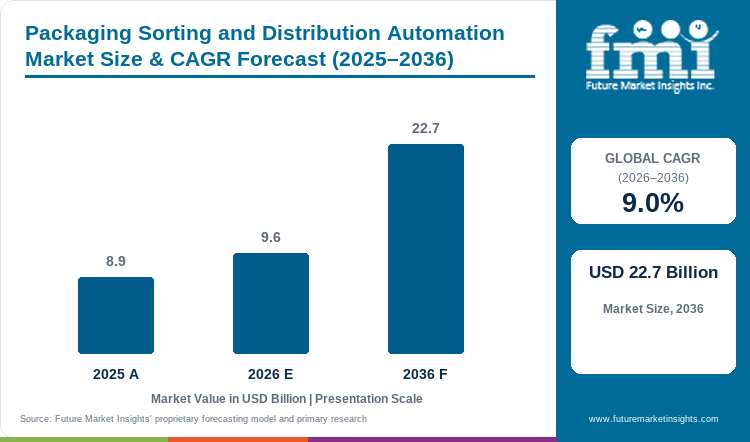
The Packaging Sorting and Distribution Automation Market is valued at USD 9.6 billion in 2026, compared with USD 8.9 billion in 2025. The market is projected to reach USD 22.7 billion by 2036.
Demand for packaging sorting and distribution automation is projected to expand at 9.0% CAGR between 2026 and 2036. Parcel hubs and fulfillment centers are treating package routing as a daily operating need. The Universal Postal Union reported in September 2025 that online sales remained strong across many postal networks. Site teams are using postal automation systems to scan packages early and send them toward the right route. Reliable sorting is reducing hand work and helping teams meet late shipping cut-off times. Managers are comparing rated speed with the parcel mix moving through each building. Good routing keeps parcels moving and reduces extra work at busy hubs.
Buyers at older sites are adding new equipment inside buildings that keep shipping orders every day. Daifuku noted in August 2026 that staffing and work steps must support each installed system. Sites are adding warehouse robotics in stages to reduce disruption around working conveyors and pick areas. Older buildings are handling software links, tight floor space, and short shutdown periods. Teams are keeping working equipment in place as new sorters connect with current controls. Phased work is raising capacity without forcing teams to build the full system again.
Key Takeaways
- Parcel and e-commerce operations are increasing demand for faster routing with fewer manual touches across each transfer point.
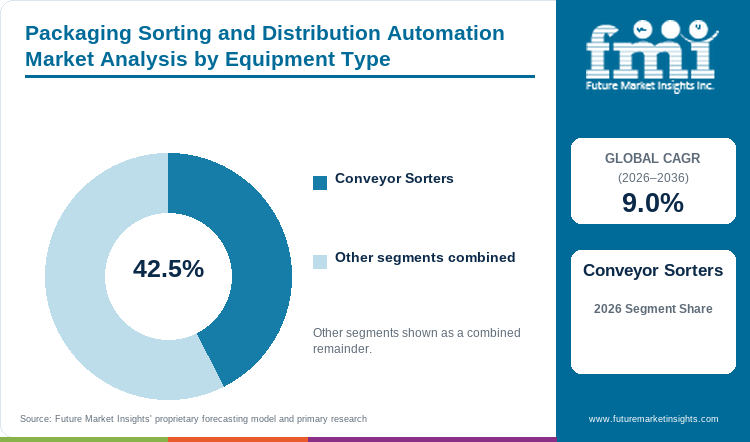
- By equipment type, conveyor sorters are projected to account for 42.5% in 2026 because fixed lanes support high-volume parcel routing.
- Linear sortation is estimated to hold 55.1% of sorting technology demand in 2026, supported by direct paths and accessible service zones.
- In 2026, retail and e-commerce fulfillment is expected to lead end users with 47.2% share as mixed orders need frequent routing.
- Brownfield system work is slowing projects because software changes and short commissioning windows can disrupt daily distribution schedules.
- Notable companies include Daifuku Co., Ltd., Vanderlande Industries, Dematic, Intelligrated, BEUMER Group, Interroll Group, SSI SCHAEFER, and KNAPP AG.
Analyst Perspective
“Parcel hubs are likely to favor phased automation that raises sorting capacity without long site shutdowns. Integrators should prove software fit and local service coverage as buyers extend automation across older facilities.”
- Nandini Roy Choudhury, Principal Consultant, Future Market Insights
How is the Packaging Sorting and Distribution Automation Market segmented?
The Packaging Sorting and Distribution Automation Market is segmented five ways. The five dimensions are equipment type, sorting technology, end user, material flow mode, and region. Conveyor sorters lead equipment type with 42.5% of 2026 revenue.
The market has five dimensions: equipment type, sorting technology, end user, material flow mode, and region. Equipment type includes conveyor sorters, robotic sorters, pouch/pocket systems, tilt-tray/cross-belt systems, and AMR-based sorters. Sorting technology includes linear sortation, loop/carousel sortation, vision-guided AI sortation, and IoT-enabled smart sortation. End user includes retail and e-commerce fulfillment, third-party logistics, postal and parcel, food and beverage, and pharma and healthcare. Material flow mode includes goods-to-person, person-to-goods, and hybrid/orchestrated systems across different facility layouts.
Why do conveyor sorters remain central to equipment type decisions?
Conveyor sorters are moving parcels along fixed paths inside busy parcel hubs. Engineers are placing scanners and diverts at set points near each chute. Interroll showed a connected conveying and sorting platform at LogiMAT in March 2026. The platform links conveyor systems with drives and controls through standard interfaces. Fixed lanes help teams track large parcel flows and reach service points without delay.
- Based on equipment type, conveyor sorters are projected to account for 42.5% in 2026. Fixed lanes support conveyor sorter demand by moving large parcel volumes through set induction points.
- Operators are keeping conveyor sortation because existing chutes handle peak flows without major layout changes.
Why does linear sortation lead sorting technology demand?
Linear sortation is moving products along a straight path without a full return loop. It works well in sites with staged outbound doors and service access. BEUMER Group showed line, loop, and pouch sortation at MODEX in March 2026. Teams are using machine vision to read products at each divert and confirm the route. Linear layouts are easier to service because teams can reach lanes without entering a tight loop.
- By sorting technology, linear sortation is estimated to hold 55.1% in 2026. Straight routes support linear sortation demand by reducing layout needs and keeping service areas easy to reach.
- Operators are choosing loop or AI-guided systems for dense destinations and products that need more careful handling.
How does retail and e-commerce fulfillment shape end-user requirements?
Retail warehouses are mixing store and consumer orders inside the same flow. Sorters are handling cartons and parcels while sending each order toward the right route. Dematic announced an automated grocery fulfillment center for Pattison Food Group in June 2026. The project links storage and routing with e-commerce packaging flows that change during each shift. Retail teams are keeping lanes open through promotions and seasonal peaks.
- In 2026, retail and e-commerce fulfillment is expected to lead end users with 47.2% share. Mixed store and consumer orders support frequent routing across shared fulfillment networks.
- Fulfillment teams are choosing systems that switch between store cases and consumer parcels without a manual sorting stage.
Why do goods-to-person systems lead material flow mode?
Goods-to-person systems are bringing stored totes to fixed pick stations. Pickers are walking less and spending more time checking orders and packing goods. Daifuku described goods-to-person as a main model in new automation projects in January 2026. Many sites are linking the model with intralogistics automation for restock and outbound sorting. Busy sites are keeping each station supplied with a steady line of work.
- Goods-to-person is set to lead material flow mode with 60.2% share in 2026. Automated presentation supports goods-to-person demand by reducing worker travel between storage and picking areas.
- Hybrid systems are gaining interest as sites mix fixed automation with mobile robots across changing order profiles.
What are the drivers, restraints and opportunities in the Packaging Sorting and Distribution Automation Market?
In the Packaging Sorting and Distribution Automation Market, the key driver is higher parcel volume that raises routing needs. The key restraint is brownfield system work that slows projects inside active distribution sites. The key opportunity is AI-guided routing that handles changing parcel paths with fewer fixed rules.
- Driver: Parcel and fulfillment networks are requiring consistent routing speed as package volumes and destination counts increase.
- Restraint: Legacy controls and short shutdown windows are making brownfield system work costly and difficult to schedule.
- Opportunity: AI-guided robotics are handling changing products without hard-coding every routing condition into fixed equipment.
Parcel networks are handling more routes and tighter cut-off times across busy hubs. Higher route counts are raising the need for faster parcel entry and sorting. The U.S. Postal Service reported in May 2026 that shipping and package volume reached 6.8 billion pieces for fiscal 2025. Large daily flows are leaving less room for hand sorting at each transfer point. Teams are using automated lanes to keep routes accurate during peak periods. More automated parcel terminals are adding routes that upstream systems must feed. Site teams are testing rated speed against the real package mix on each line. Reliable diverts protect shipping schedules during service work on jams and scanner faults.
Brownfield sites are limiting upgrade windows because daily shipping cannot stop for long tests. Honeywell said in April 2026 that older warehouse software can add setup costs and shutdown time. New industrial automation controls are sharing data with older scanners, conveyors, and warehouse systems. Project teams are reducing risk through modular controls and staged start-up plans. Buyers are keeping working equipment in place to avoid unnecessary replacement work. Older links are lengthening tests as engineers check data across several shifts. Teams use rollback plans to resume order flow if a start-up step creates a fault. Local service teams are helping sites recover faster during short commissioning windows.
Flexible routing is expanding the role of robots and physical AI beyond fixed conveyor rules. Daifuku and JDSC reported in September 2026 a 97% simulation test success rate on unseen products and routes. The simulation is supporting factory automation that can learn new item paths with less manual rule writing. Live sites use safe trials to build trust in more automated routing. Project teams are pairing mobile handling with proven safety controls for staged work. Mixed parcels are creating route cases that fixed rules do not handle well. Projects expand as teams prove reliable flow across more package types. Clear safety steps are giving site teams a practical path toward wider use.
Which country CAGRs are profiled in the Packaging Sorting and Distribution Automation Market?
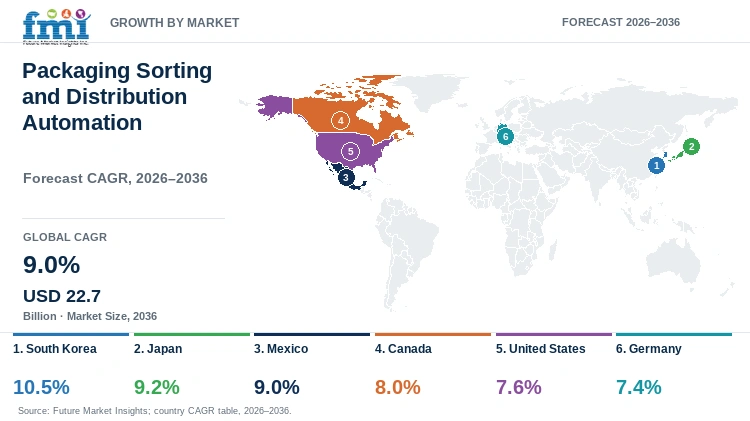
| Country | CAGR |
|---|---|
| South Korea | 10.5% |
| Japan | 9.2% |
| Mexico | 9.0% |
| Canada | 8.0% |
| United States | 7.6% |
| Germany | 7.4% |
How do country-level CAGRs compare in the Packaging Sorting and Distribution Automation Market?
South Korea and Japan are using compact systems because dense online networks send more orders through small warehouse sites. Mexico is adding new sites while Canada, the United States, and Germany are updating older hubs.
- South Korea's mobile shopping network is raising the need for fast sorting inside tight city warehouses.
- Japan favors compact systems as warehouse teams raise output without adding floor space in large cities.
- Across Mexico, new warehouse space near cities is shaping early plans for sorting lanes and loading docks.
- Canadian retailers are updating local hubs to sort online orders across long domestic routes with fewer delays.
- The United States uses large parcel hubs that add sorter capacity while daily shipping keeps running.
- Germany favors staged upgrades because older parcel hubs use fixed conveyors and nearby service teams.
Country operating conditions shape buyer choices between fixed sorters, mobile robots, and phased software upgrades.
Country CAGR analysis covers all regions and links each forecast to a local operating condition.
Country-wise Analysis
- Large U.S. warehouses are updating sorters inside busy parcel networks. United States demand is projected at 7.6% CAGR through 2036. The U.S. Census Bureau reported in August 2026 that e-commerce made up 17.1% of second-quarter retail sales. Online orders are keeping pressure on hubs to move smaller shipments faster. Older sites are linking new scanners and software with working conveyor lines. Cutover teams are planning around shipping schedules that cannot stop for long. Modular sorter packages are raising capacity without replacing the full controls stack. Local service teams are helping hubs recover faster from start-up faults. Local support is protecting parcel flow during busy sales and shipping periods.
- Canada is forecast at 8.0% CAGR through 2036 as retailers serve long delivery routes. Statistics Canada reported in August 2026 that e-commerce made up 7.7% of June retail trade. Warehouses are grouping online orders for long regional truck routes. Winter weather is raising service needs for sensors, drives, and spare parts. Older buildings are limiting conveyor growth near doors with little free space. Operators are using remote checks to find faults and guide local technicians. Project teams are scheduling upgrades around peak weeks to protect shipment flow. Local parts stocks are helping buyers trust automated distribution sites. The service model is helping retailers manage long routes with fewer shutdowns.
- Mexico is projected to grow at 9.0% CAGR through 2036. Large online platforms are adding warehouse space near major Mexican cities. The Government of Mexico announced a USD 4.6 billion Mercado Libre investment in June 2026. The plan includes more logistics capacity for the company's growing network. Project teams are planning sorting lanes during early wall and dock work. Older sites have less room because fixed conveyors fill key work areas. Cross-border orders need clean labels and reliable destination data across systems. Local service teams are reducing shutdown time from sorter and controls faults. Engineers are linking warehouse and transport systems to keep routing data consistent. Local project teams are supporting more upgrades as operators add new capacity.
- Japan is expected to post a 9.2% CAGR through 2036. Warehouses are seeking higher output within limited floor space in major cities. METI reported in August 2025 that business-to-consumer e-commerce grew 5.1% during 2024. More online orders are raising demand for compact parcel sorting systems. Warehouse teams are using mobile systems to move totes through tight layouts. Local engineers are tuning controls around small service areas and fixed structures. Buyers are planning maintenance around city delivery windows because long stops can disrupt routes. Suppliers are pairing compact equipment with local start-up and service support. Compact equipment and local support are helping sites protect daily order flow during seasonal peaks.
- South Korea is projected to grow at 10.5% CAGR through 2036. Mobile shopping is raising sorting pressure inside city warehouses with limited floor space. The Ministry of Data and Statistics reported in December 2025 that mobile shopping made up 78.0% of October online shopping value. Frequent mobile orders are creating sharp volume peaks across city warehouses. Dense sites have limited space for long fixed conveyor additions. Mobile robots are moving totes between zones with less permanent conveyor work. Project teams are linking robot travel with outbound lanes through shared software. The software is balancing changing order volumes across busy shipping periods. Local service teams are helping sites avoid long stops during peak sales.
- Germany is forecast to grow at 7.4% CAGR through 2036. Busy parcel hubs are adding capacity through staged equipment and controls upgrades. BPEX reported in April 2026 that Germany handled 4.37 billion courier, express, and parcel shipments during 2025. Large shipment volumes are supporting demand for fast sorters and steady route control. Older hubs are working around fixed conveyors and tight building layouts. Short start-up windows are raising the value of local service teams. Labor and power costs are keeping buyers focused on efficient equipment. Suppliers are adding modular sorters instead of replacing complete hub systems. Staged work is reducing shutdown time during local peaks and busy shipping weeks.
Who are the notable companies in the Packaging Sorting and Distribution Automation Market?
Notable companies in the Packaging Sorting and Distribution Automation Market include Daifuku Co., Ltd., Vanderlande Industries, Dematic, and Intelligrated. BEUMER Group, Interroll Group, SSI SCHAEFER, and KNAPP AG offer sorting and warehouse flow systems within the defined market.
Large automation projects are bringing full-line suppliers into planning because equipment and software must work together. Brownfield sites need specialists that add sorters around existing material handling equipment. Distribution teams check software access, local service, and spare-parts support during long-term contract review. Busy parcel hubs are giving more weight to proven sorter speed and fast fault recovery. Retail warehouses are favoring goods-to-person flow as order profiles change during promotions and seasonal peaks.
- Integrated warehouse automation: Daifuku Co., Ltd., Dematic, and Intelligrated offer equipment, controls, and software for coordinated material flow.
- High-speed parcel sortation: Vanderlande Industries, BEUMER Group, and Interroll Group offer conveyor and sorter platforms for dense routing networks.
- Goods-to-person and robotic fulfillment: SSI SCHAEFER and KNAPP AG integrate storage, picking, mobile flow, and warehouse software.
Competitive Benchmarking: Packaging Sorting and Distribution Automation Market
| Company | High-Speed Sortation | Robotic / Mobile Flow | Software Orchestration | Geographic Reach |
|---|---|---|---|---|
| Daifuku Co., Ltd. | High | High | High | Global |
| Vanderlande Industries | High | High | High | Global |
| Dematic | High | High | High | Global |
| Intelligrated | High | High | High | North America and international installations |
| BEUMER Group | High | Medium | High | Global |
| Interroll Group | High | Medium | Medium | Global |
| SSI SCHAEFER | Medium | High | High | Global |
| KNAPP AG | High | High | High | Global |
Scoring basis: High means current company records show the named capability across active projects. Medium means current records show that capability across fewer use cases. Low means current records show a limited role in this market. Geographic reach describes active regions and does not change the capability rating.
Key Developments in the Packaging Sorting and Distribution Automation Market
- In September 2026, Vanderlande Industries and DPD started a live SPOX line-sorter pilot at DPD's Crawley depot in the United Kingdom.
- In September 2026, SSI SCHAEFER commissioned its first SSI Piece Picking cell with a Pick & Place feature at Würth Industrie Service.
- In September 2026, KNAPP AG announced an automated European distribution center for Skechers in Liège with phased operation planned through 2030.
Key Players in the Packaging Sorting and Distribution Automation Market
High-Speed Sortation and Conveyor Systems
- Vanderlande Industries
- BEUMER Group
- Interroll Group
Integrated Fulfillment Automation
- Daifuku Co., Ltd.
- Dematic
- Intelligrated
Robotic Picking and Goods-to-Person Systems
- SSI SCHAEFER
- KNAPP AG
Packaging Sorting and Distribution Automation Market - Report Scope
| Coverage field | Report scope |
|---|---|
| Market breakdown | By equipment type, sorting technology, end user, material flow mode and region. |
| Quantitative Units | USD billion. |
| Market Definition | Commercial packaging sorting and distribution automation includes conveyor, robotic, pouch, cross-belt, tilt-tray, AMR, vision, sensing, control, and orchestration systems used to route packaged goods through warehouses, fulfillment centers, parcel hubs, and distribution facilities. Manual-only handling and standalone packaging machinery without sorting or distribution functions are excluded. |
| Regions Covered | North America, Latin America, Europe, East Asia, South Asia and Pacific, and Middle East and Africa. |
| Countries Covered | United States, Canada, Mexico, Japan, South Korea, Germany, and 20+ countries included in the full report. |
| Key Companies Profiled | Daifuku Co., Ltd., Vanderlande Industries, Dematic, Intelligrated, BEUMER Group, Interroll Group, SSI SCHAEFER, KNAPP AG. |
| Forecast Period | 2026 to 2036. |
| Approach | Primary and secondary research with market triangulation. |
Packaging Sorting and Distribution Automation Market - Research Methodology
| Method | Approach |
|---|---|
| Primary Research | FMI analysts gathered input from manufacturers, service providers, technology developers, distributors, end users, procurement teams, and subject-matter experts. Interviews examined purchasing decisions, product or service evaluation, adoption barriers, approval requirements, pricing considerations, and expectations for technical or commercial support. Respondents were also asked what evidence is required before a trial, pilot, or initial order develops into regular purchasing. |
| Desk Research | Desk research covered government statistics, regulatory publications, trade data, industry associations, technical literature, standards, company filings, product information, and official corporate announcements. Sources were reviewed for relevance, publication date, geographic coverage, and consistency with the defined market scope. Claims relating to performance, applications, approvals, capacity, investment, and commercial activity were retained only when supported by credible public evidence. |
| Market Sizing and Forecasting | The market model combined the baseline value with historical performance, segment structure, pricing and volume indicators, adoption levels, company participation, and country-level demand conditions. Forecast assumptions considered economic activity, investment trends, regulatory developments, technology adoption, purchasing cycles, supply availability, and barriers to wider market use. Segment and regional estimates were reconciled before the final market total was calculated. |
| Data Validation | Estimates were checked against multiple independent indicators, including public data, company activity, trade patterns, industry developments, and findings from primary interviews. Validation also tested whether products, services, applications, and company revenues fell within the defined market boundaries. Adjacent categories, unsupported claims, overlapping revenues, and activities without direct market relevance were excluded to reduce double counting and maintain consistency across segments and countries. |
Packaging Sorting and Distribution Automation Market by Segments
Packaging Sorting and Distribution Automation Market segmented by Equipment Type:
- Conveyor Sorters
- Robotic Sorters
- Pouch/Pocket Systems
- Tilt-Tray/Cross-Belt Systems
- AMR-Based Sorters
Packaging Sorting and Distribution Automation Market segmented by Sorting Technology:
- Linear Sortation
- Loop/Carousel Sortation
- Vision-Guided AI Sortation
- IoT-Enabled Smart Sortation
Packaging Sorting and Distribution Automation Market segmented by End User:
- Retail & E-commerce Fulfillment
- Third-Party Logistics
- Postal & Parcel
- Food & Beverage
- Pharma & Healthcare
Packaging Sorting and Distribution Automation Market segmented by Material Flow Mode:
- Goods-to-Person
- Person-to-Goods
- Hybrid/Orchestrated
Packaging Sorting and Distribution Automation Market by Region:
- North America
- United States
- Canada
- Latin America
- Brazil
- Mexico
- Chile
- Rest of Latin America
- Western Europe
- Germany
- United Kingdom
- Italy
- Spain
- France
- Nordics
- Benelux
- Rest of Western Europe
- Eastern Europe
- Russia
- Poland
- Hungary
- Balkan and Baltic States
- Rest of Eastern Europe
- East Asia
- China
- Japan
- South Korea
- South Asia and Pacific
- India
- ASEAN
- Australia and New Zealand
- Rest of South Asia and Pacific
- Middle East and Africa
- Kingdom of Saudi Arabia
- Other GCC Countries
- Türkiye
- South Africa
- Other African Union Countries
- Rest of Middle East and Africa
Research Sources and Bibliography
- Universal Postal Union. (2025, September 8). The state of the postal sector 2025: Postal power reimagined. Country context: Global.
- Daifuku Co., Ltd. (2026, August 25). Beyond the install: Turning warehouse automation into operational advantage. Country context: Global.
- Interroll Group. (2026, March 25). Interroll at LogiMAT 2026: An integrated material flow system for flexible automation solutions. Country context: Global.
- BEUMER Group. (2026, March 31). BEUMER Group highlights scalable sortation strategies for operational resilience at MODEX 2026. Country context: Global.
- Dematic. (2026, June 24). Pattison Food Group invests in grocery fulfillment with Dematic automation. Country context: Canada.
- Daifuku Co., Ltd. (2026, January 14). Automation trends to watch in 2026: From rapid adoption to practical balance. Country context: Global.
- U.S. Postal Service. (2026, May 15). Total shipping and package volume. Country context: United States.
- Honeywell. (2026, April 13). Honeywell introduces new warehouse software platform and innovative sortation solution. Country context: United States.
- Daifuku Co., Ltd. (2026, September 9). Daifuku and JDSC verify physical AI technology for fully unmanned logistics [English translation]. Country context: Japan.
- U.S. Census Bureau. (2026, August 18). Quarterly retail e-commerce sales, second quarter 2026. Country context: United States.
- Statistics Canada. (2026, August 21). Retail trade, June 2026. Country context: Canada.
- Presidency of the Republic, Government of Mexico. (2026, June 10). Plan Mexico: President highlights Mercado Libre investment and logistics expansion [English translation]. Country context: Mexico.
- Ministry of Economy, Trade and Industry. (2025, August 26). Results of FY2024 e-commerce market survey compiled. Country context: Japan.
- Ministry of Data and Statistics, Republic of Korea. (2025, December 1). Online shopping in October 2025. Country context: South Korea.
- Bundesverband Paket- und Expresslogistik. (2026, April 13). Light upward trend in the courier, express, and parcel sector continues [English translation]. Country context: Germany.
- Vanderlande Industries. (2026, September 23). Vanderlande and DPD celebrate 25 years of successful collaboration at Parcel and Post Expo 2026. Country context: United Kingdom.
- SSI SCHAEFER. (2026, September 14). Precise placement, efficient consolidation: Würth Industrie Service and SSI SCHAEFER jointly advance picking robot technology. Country context: Germany.
- KNAPP AG. (2026, September 8). Skechers and KNAPP advance European logistics with new distribution center. Country context: Belgium.
- Daifuku Co., Ltd. (2026, March 11). Daifuku opens Tokyo Lab, a new R&D hub for advanced technologies. Country context: Japan.
- Dematic. (2026, March 18). Dematic redefines warehouse intelligence with launch of Command Center. Country context: United States.
- Interroll Holding AG. (2026, May 8). Interroll Holding AG announces the acquisition of Royal Apollo Group. Country context: Global.
- BEUMER Group. (2026, March 17). BEUMER Group and Fraunhofer IML launch joint Enterprise Lab for mobile robotics. Country context: Germany.
- SSI SCHAEFER. (2026, March 27). Smart connectivity for dynamic material flows: FastBots Solution by SSI SCHAEFER. Country context: Global.
- Daifuku Co., Ltd. (2025, September 11). Daifuku Intralogistics America completes factory expansion. Country context: United States.
- Vanderlande Industries. (2026, February 5). Vanderlande opens India Innovation Centre in Pune. Country context: India.
- Dematic. (2026, July 22). Dematic unveils global destination for companies to explore warehouse automation. Country context: United States.
- American Industrial Partners. (2026, July 27). Intelligrated, Trew and Transnorm unite to create warehouse automation provider. Country context: United States.
- BEUMER Group. (2026, January 6). LogiMAT 2026: BEUMER Group focuses on innovation, automation and data-driven customer support. Country context: Germany.
- Interroll Group. (2026, July 31). Executing the strategy and strengthening the market position. Country context: Global.
- SSI SCHAEFER. (2026, July 1). Oriola selects SSI SCHAEFER as intralogistics solution provider for its new distribution center. Country context: Finland.
- KNAPP AG. (2026, April 28). KNAPP builds largest shuttle system in Korea for Asung Daiso [English translation]. Country context: South Korea.
The bibliography does not include every source used in the full report. Other primary and secondary sources support country, segment, company, and competitive analysis within the defined market.
This Report Answers
- How large is the Packaging Sorting and Distribution Automation Market in 2026 and by 2036?
- Which equipment type accounts for 42.5% of 2026 revenue?
- Why does linear sortation lead the sorting technology category?
- How does retail and e-commerce fulfillment shape automation specifications?
- Why do goods-to-person systems account for 60.2% of material flow mode demand?
- What conditions support or delay brownfield sortation projects?
- How do country forecast CAGRs differ through 2036?
- Which companies are active in sorting, robotics, software, and fulfillment automation?
- Which recent company developments affect distribution automation procurement?
Frequently Asked Questions
How big is the Packaging Sorting and Distribution Automation Market in 2026?
The Packaging Sorting and Distribution Automation Market is valued at USD 9.6 billion in 2026. Market value is projected to reach USD 22.7 billion by 2036.
What is the forecast CAGR for the Packaging Sorting and Distribution Automation Market?
The Packaging Sorting and Distribution Automation Market is projected to expand at 9.0% CAGR from 2026 to 2036. Parcel networks are investing in faster routing as project teams reduce site-work risk.
Which equipment type leads the Packaging Sorting and Distribution Automation Market?
Conveyor sorters account for 42.5% of equipment type demand in 2026. Fixed lanes support high-volume routing through set entry points and outbound chutes.
Which end user accounts for 47.2% of demand in 2026?
Retail and e-commerce fulfillment represents 47.2% of end-user demand in 2026. Mixed store and consumer orders need frequent route changes across shared warehouses.
Which material flow mode leads the market in 2026?
Goods-to-person systems hold 60.2% of material flow mode demand in 2026. The goods-to-person model cuts worker travel by bringing stored totes to fixed pick stations.
Which country is projected at 10.5% CAGR through 2036?
South Korea's packaging sorting and distribution automation demand is projected at 10.5% CAGR through 2036. Dense mobile shopping and tight warehouse space support new routing systems.
Who are the key companies in the Packaging Sorting and Distribution Automation Market?
Notable companies in the Packaging Sorting and Distribution Automation Market include Daifuku Co., Ltd., Vanderlande Industries, Dematic, and Intelligrated. BEUMER Group, Interroll Group, SSI SCHAEFER, and KNAPP AG offer sorting, robotics, controls, and warehouse flow systems.
Preview the report firsthand - request a free sample
Get SampleGet the brochure for pricing and purchase details.
Get PDFTable of Content
- Key Takeaways
- Market Size and CAGR
- Top Growth Driver
- Fastest Growing Segment
- Leading Region
- Key Companies
- Emerging Opportunities
- Executive Summary
- Global Market Outlook
- Demand-side Trends
- Supply-side Trends
- Technology Roadmap Analysis
- Analysis and Recommendations
- Analyst Perspective (What is happening? Why now? What should investors know?)
- Key Questions Answered
- How large is the market?
- What is the CAGR?
- What are key trends?
- Which region dominates?
- Who are the leaders?
- Market Overview
- Market Coverage / Taxonomy
- Market Definition / Scope / Limitations
- Research Methodology
- Chapter Orientation
- Analytical Lens and Working Hypotheses
- Market Structure, Signals, and Trend Drivers
- Benchmarking and Cross-market Comparability
- Market Sizing, Forecasting, and Opportunity Mapping
- Research Design and Evidence Framework
- Desk Research Programme (Secondary Evidence)
- Expert Input and Fieldwork (Primary Evidence)
- Tooling, Models, and Reference Databases
- Data Engineering and Model Build
- Quality Assurance and Audit Trail
- Market Background
- Market Dynamics (Drivers, Restraints, Opportunity, Trends)
- Scenario Forecast (Optimistic, Likely, Conservative)
- Impact Analysis
- AI Impact
- Sustainability Impact
- Regulatory Impact
- Technology Impact
- Consumer / Buyer Analysis
- Purchase Drivers
- Adoption Barriers
- Buyer Journey
- Opportunity Map Analysis
- Product Life Cycle Analysis
- Supply Chain Analysis
- Investment Feasibility Matrix
- Value Chain Analysis
- PESTLE and Porter's Analysis
- Regulatory Landscape
- Regional Parent Market Outlook
- Production and Consumption Statistics
- Import and Export Statistics
- Global Market Analysis and Forecast, 2021 to 2036
- Historical Market Size Value (USD Billion) Analysis, 2021 to 2025
- Current and Future Market Size Value (USD Billion) Projections, 2026 to 2036
- Y-o-Y Growth Trend Analysis
- Absolute $ Opportunity Analysis
- Global Market Pricing Analysis, 2021 to 2036
- Global Market Analysis and Forecast, By Equipment Type, 2021 to 2036
- Introduction / Key Findings
- Historical Market Size Value (USD Billion) Analysis By Equipment Type, 2021 to 2025
- Current and Future Market Size Value (USD Billion) Analysis and Forecast By Equipment Type, 2026 to 2036
- Conveyor Sorters
- Robotic Sorters
- Pouch/Pocket Systems
- Tilt-Tray/Cross-Belt Systems
- AMR-Based Sorters
- Y-o-Y Growth Trend Analysis By Equipment Type, 2021 to 2025
- Absolute $ Opportunity Analysis By Equipment Type, 2026 to 2036
- Global Market Analysis and Forecast, By Sorting Technology, 2021 to 2036
- Introduction / Key Findings
- Historical Market Size Value (USD Billion) Analysis By Sorting Technology, 2021 to 2025
- Current and Future Market Size Value (USD Billion) Analysis and Forecast By Sorting Technology, 2026 to 2036
- Linear Sortation
- Loop/Carousel Sortation
- Vision-Guided AI Sortation
- IoT-Enabled Smart Sortation
- Y-o-Y Growth Trend Analysis By Sorting Technology, 2021 to 2025
- Absolute $ Opportunity Analysis By Sorting Technology, 2026 to 2036
- Global Market Analysis and Forecast, By End User, 2021 to 2036
- Introduction / Key Findings
- Historical Market Size Value (USD Billion) Analysis By End User, 2021 to 2025
- Current and Future Market Size Value (USD Billion) Analysis and Forecast By End User, 2026 to 2036
- Retail & E-commerce Fulfillment
- Third-Party Logistics
- Postal & Parcel
- Food & Beverage
- Pharma & Healthcare
- Y-o-Y Growth Trend Analysis By End User, 2021 to 2025
- Absolute $ Opportunity Analysis By End User, 2026 to 2036
- Global Market Analysis and Forecast, By Material Flow Mode, 2021 to 2036
- Introduction / Key Findings
- Historical Market Size Value (USD Billion) Analysis By Material Flow Mode, 2021 to 2025
- Current and Future Market Size Value (USD Billion) Analysis and Forecast By Material Flow Mode, 2026 to 2036
- Goods-to-Person
- Person-to-Goods
- Hybrid/Orchestrated
- Y-o-Y Growth Trend Analysis By Material Flow Mode, 2021 to 2025
- Absolute $ Opportunity Analysis By Material Flow Mode, 2026 to 2036
- Global Market Analysis and Forecast, By Region, 2021 to 2036
- Introduction
- Historical Market Size Value (USD Billion) Analysis By Region, 2021 to 2025
- Current Market Size Value (USD Billion) Analysis and Forecast By Region, 2026 to 2036
- North America
- Latin America
- Western Europe
- Eastern Europe
- East Asia
- South Asia and Pacific
- Middle East and Africa
- Market Attractiveness Analysis By Region
- North America Market Analysis and Forecast, By Country, 2021 to 2036
- Historical Market Size Value (USD Billion) Trend Analysis By Market Taxonomy, 2021 to 2025
- Market Size Value (USD Billion) Forecast By Market Taxonomy, 2026 to 2036
- By Country
- United States
- Canada
- By Equipment Type
- By Sorting Technology
- By End User
- By Material Flow Mode
- By Country
- Market Attractiveness Analysis
- By Country
- By Equipment Type
- By Sorting Technology
- By End User
- By Material Flow Mode
- Key Takeaways
- Latin America Market Analysis and Forecast, By Country
- Historical Market Size Value (USD Billion) Trend Analysis By Market Taxonomy, 2021 to 2025
- Market Size Value (USD Billion) Forecast By Market Taxonomy, 2026 to 2036
- By Country
- Brazil
- Mexico
- Chile
- Rest of Latin America
- By Equipment Type
- By Sorting Technology
- By End User
- By Material Flow Mode
- By Country
- Market Attractiveness Analysis
- By Country
- By Equipment Type
- By Sorting Technology
- By End User
- By Material Flow Mode
- Key Takeaways
- Western Europe Market Analysis and Forecast, By Country
- Historical Market Size Value (USD Billion) Trend Analysis By Market Taxonomy, 2021 to 2025
- Market Size Value (USD Billion) Forecast By Market Taxonomy, 2026 to 2036
- By Country
- Germany
- United Kingdom
- Italy
- Spain
- France
- Nordics
- Benelux
- Rest of Western Europe
- By Equipment Type
- By Sorting Technology
- By End User
- By Material Flow Mode
- By Country
- Market Attractiveness Analysis
- By Country
- By Equipment Type
- By Sorting Technology
- By End User
- By Material Flow Mode
- Key Takeaways
- Eastern Europe Market Analysis and Forecast, By Country
- Historical Market Size Value (USD Billion) Trend Analysis By Market Taxonomy, 2021 to 2025
- Market Size Value (USD Billion) Forecast By Market Taxonomy, 2026 to 2036
- By Country
- Russia
- Poland
- Hungary
- Balkan and Baltic States
- Rest of Eastern Europe
- By Equipment Type
- By Sorting Technology
- By End User
- By Material Flow Mode
- By Country
- Market Attractiveness Analysis
- By Country
- By Equipment Type
- By Sorting Technology
- By End User
- By Material Flow Mode
- Key Takeaways
- East Asia Market Analysis and Forecast, By Country
- Historical Market Size Value (USD Billion) Trend Analysis By Market Taxonomy, 2021 to 2025
- Market Size Value (USD Billion) Forecast By Market Taxonomy, 2026 to 2036
- By Country
- China
- Japan
- South Korea
- By Equipment Type
- By Sorting Technology
- By End User
- By Material Flow Mode
- By Country
- Market Attractiveness Analysis
- By Country
- By Equipment Type
- By Sorting Technology
- By End User
- By Material Flow Mode
- Key Takeaways
- South Asia and Pacific Market Analysis and Forecast, By Country
- Historical Market Size Value (USD Billion) Trend Analysis By Market Taxonomy, 2021 to 2025
- Market Size Value (USD Billion) Forecast By Market Taxonomy, 2026 to 2036
- By Country
- India
- ASEAN
- Australia and New Zealand
- Rest of South Asia and Pacific
- By Equipment Type
- By Sorting Technology
- By End User
- By Material Flow Mode
- By Country
- Market Attractiveness Analysis
- By Country
- By Equipment Type
- By Sorting Technology
- By End User
- By Material Flow Mode
- Key Takeaways
- Middle East and Africa Market Analysis and Forecast, By Country
- Historical Market Size Value (USD Billion) Trend Analysis By Market Taxonomy, 2021 to 2025
- Market Size Value (USD Billion) Forecast By Market Taxonomy, 2026 to 2036
- By Country
- Kingdom of Saudi Arabia
- Other GCC Countries
- Türkiye
- South Africa
- Other African Union Countries
- Rest of Middle East and Africa
- By Equipment Type
- By Sorting Technology
- By End User
- By Material Flow Mode
- By Country
- Market Attractiveness Analysis
- By Country
- By Equipment Type
- By Sorting Technology
- By End User
- By Material Flow Mode
- Key Takeaways
- Key Countries Market Analysis
- United States
- Pricing Analysis
- Market Share Analysis, 2025
- By Equipment Type
- By Sorting Technology
- By End User
- By Material Flow Mode
- Canada
- Pricing Analysis
- Market Share Analysis, 2025
- By Equipment Type
- By Sorting Technology
- By End User
- By Material Flow Mode
- Mexico
- Pricing Analysis
- Market Share Analysis, 2025
- By Equipment Type
- By Sorting Technology
- By End User
- By Material Flow Mode
- Brazil
- Pricing Analysis
- Market Share Analysis, 2025
- By Equipment Type
- By Sorting Technology
- By End User
- By Material Flow Mode
- Chile
- Pricing Analysis
- Market Share Analysis, 2025
- By Equipment Type
- By Sorting Technology
- By End User
- By Material Flow Mode
- Germany
- Pricing Analysis
- Market Share Analysis, 2025
- By Equipment Type
- By Sorting Technology
- By End User
- By Material Flow Mode
- United Kingdom
- Pricing Analysis
- Market Share Analysis, 2025
- By Equipment Type
- By Sorting Technology
- By End User
- By Material Flow Mode
- Italy
- Pricing Analysis
- Market Share Analysis, 2025
- By Equipment Type
- By Sorting Technology
- By End User
- By Material Flow Mode
- Spain
- Pricing Analysis
- Market Share Analysis, 2025
- By Equipment Type
- By Sorting Technology
- By End User
- By Material Flow Mode
- France
- Pricing Analysis
- Market Share Analysis, 2025
- By Equipment Type
- By Sorting Technology
- By End User
- By Material Flow Mode
- India
- Pricing Analysis
- Market Share Analysis, 2025
- By Equipment Type
- By Sorting Technology
- By End User
- By Material Flow Mode
- ASEAN
- Pricing Analysis
- Market Share Analysis, 2025
- By Equipment Type
- By Sorting Technology
- By End User
- By Material Flow Mode
- Australia and New Zealand
- Pricing Analysis
- Market Share Analysis, 2025
- By Equipment Type
- By Sorting Technology
- By End User
- By Material Flow Mode
- China
- Pricing Analysis
- Market Share Analysis, 2025
- By Equipment Type
- By Sorting Technology
- By End User
- By Material Flow Mode
- Japan
- Pricing Analysis
- Market Share Analysis, 2025
- By Equipment Type
- By Sorting Technology
- By End User
- By Material Flow Mode
- South Korea
- Pricing Analysis
- Market Share Analysis, 2025
- By Equipment Type
- By Sorting Technology
- By End User
- By Material Flow Mode
- Russia
- Pricing Analysis
- Market Share Analysis, 2025
- By Equipment Type
- By Sorting Technology
- By End User
- By Material Flow Mode
- Poland
- Pricing Analysis
- Market Share Analysis, 2025
- By Equipment Type
- By Sorting Technology
- By End User
- By Material Flow Mode
- Hungary
- Pricing Analysis
- Market Share Analysis, 2025
- By Equipment Type
- By Sorting Technology
- By End User
- By Material Flow Mode
- Kingdom of Saudi Arabia
- Pricing Analysis
- Market Share Analysis, 2025
- By Equipment Type
- By Sorting Technology
- By End User
- By Material Flow Mode
- Türkiye
- Pricing Analysis
- Market Share Analysis, 2025
- By Equipment Type
- By Sorting Technology
- By End User
- By Material Flow Mode
- South Africa
- Pricing Analysis
- Market Share Analysis, 2025
- By Equipment Type
- By Sorting Technology
- By End User
- By Material Flow Mode
- United States
- Market Structure Analysis
- Competition Dashboard
- Competition Benchmarking
- Market Share Analysis of Top Players
- By Regional
- By Equipment Type
- By Sorting Technology
- By End User
- By Material Flow Mode
- Emerging Startups
- Innovation Benchmarking
- Competition Analysis
- Competition Deep Dive
- Daifuku Co., Ltd.
- Overview
- Product Portfolio
- Profitability by Market Segments
- Sales Footprint
- Strategy Overview
- Marketing Strategy
- Product Strategy
- Channel Strategy
- Vanderlande Industries
- Dematic
- Intelligrated
- BEUMER Group
- Interroll Group
- SSI SCHAEFER
- KNAPP AG
- Daifuku Co., Ltd.
- Case Studies
- Success Stories
- Recent Developments
- Competition Deep Dive
- Assumptions & Acronyms Used


