

- Market Size (2026)
- USD 2.4 Bn
- Forecast (2036)
- USD 8.7 Bn
- CAGR (2026 to 2036)
- 13.8%
How big is the Packaging Manufacturing Execution & AI Software Market in 2026?
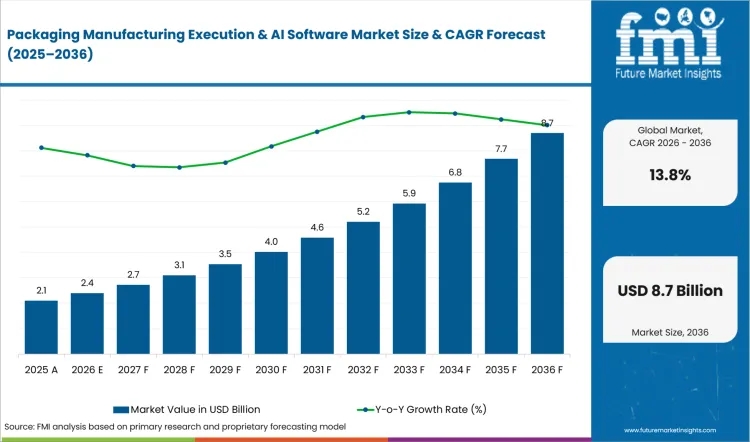
USD 2.4 billion in 2026 and USD 8.7 billion by 2036 at a 13.8% CAGR.
Sales in the packaging manufacturing execution and AI software market are projected to expand at 13.8% CAGR between 2026 and 2036, with valuation rising from USD 2.4 billion in 2026 to USD 8.7 billion by 2036. Packaging converters and manufacturers are replacing separate shift logs with manufacturing execution systems (MES) that link orders, material use, quality records, and line events in one operating record. In July 2024, the USA Department of Energy opened a USD 33 million funding opportunity for smart manufacturing technologies, reinforcing how production software is now being assessed alongside sensors and automation upgrades.
Country demand follows plant age and local integration capacity instead of one common software cycle across all markets. Companies in India and China find more implementation work at newly built plants because new lines permit common data rules from the first production run. Plants in Germany and Japan require longer testing because established controls cannot pause during software qualification work. Packaging groups are also comparing cloud security before extending AI in packaging applications beyond one pilot line. The USA International Trade Administration estimated in June 2026 that South Korea's AI market was valued at USD 2.45 billion in 2025, which gives regional packaging plants more choices among cloud and AI implementation partners.
| Metric | Value |
|---|---|
| 2025 Market Size | USD 2.11 billion |
| 2026 Market Size | USD 2.4 billion |
| 2036 Market Size | USD 8.7 billion |
| Forecast CAGR (2026-2036) | 13.8% |
| Software Focus | MES Core (41.0% share in 2026) |
| Deployment Focus | Cloud (64.0% share in 2026) |
| Line Type Focus | Converting & Printing (38.0% share in 2026) |
Summary of the Packaging Manufacturing Execution & AI Software Market
| Market Signal | Commercial Impact |
|---|---|
| Demand and Growth Drivers | Packaging plants are expected to fund software that gives supervisors one dependable production record across every active shift. Frequent job changes expose gaps between planned orders and actual line conditions before managers approve wider use.
|
| Product and Segment View | MES core creates the operating record that later analytics need for dependable decisions across several packaging lines. Cloud delivery reduces separate server work while supporting common software releases across multiple production plants.
|
| Geography and Growth Outlook | India and China are projected to combine new capacity with software ecosystems that support implementation at newly built plants. Established markets are expected to advance through controlled upgrades across older production equipment and stricter validation routines.
|
| Competitive Landscape | Competition combines full MES platforms with narrower AI tools that support inspection and equipment health across packaging plants. Packaging fit depends on line evidence and service depth instead of company size or product-list breadth.
|
| Analyst Perspective | Packaging software creates value only after operators trust the production record enough to change daily production decisions. Commercial separation appears during implementation because product demonstrations rarely expose weak data or unclear support responsibility.
|
Source: FMI's proprietary forecasting model and primary research
How is the packaging manufacturing execution & AI software market segmented?
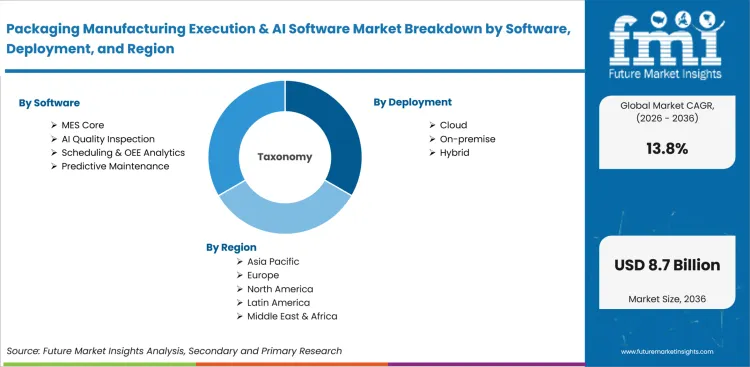
The packaging manufacturing execution & AI software market is segmented by software, deployment, line type, end use, organization size, and region.
Software coverage includes MES core and AI quality inspection for production control across active packaging plants and line types. Scheduling and OEE analytics show where planned output diverges from actual line performance during each production run. Predictive maintenance is treated as a distinct function because equipment-health tools monitor machine condition without controlling complete orders or material records. Deployment coverage includes cloud and on-premise systems, while hybrid designs keep local execution available during network interruptions. Line analysis distinguishes converting and printing from filling and sealing because each workflow generates different machine events, downtime patterns, and changeover records. End-use coverage groups flexible packaging converters, rigid plastics producers, paper and board plants, and metal and glass facilities according to their operating requirements. Organization-size coverage separates large enterprises from smaller manufacturers before regional analysis follows production centers within the broader smart factory software landscape.
What supports demand for MES core within the software category?
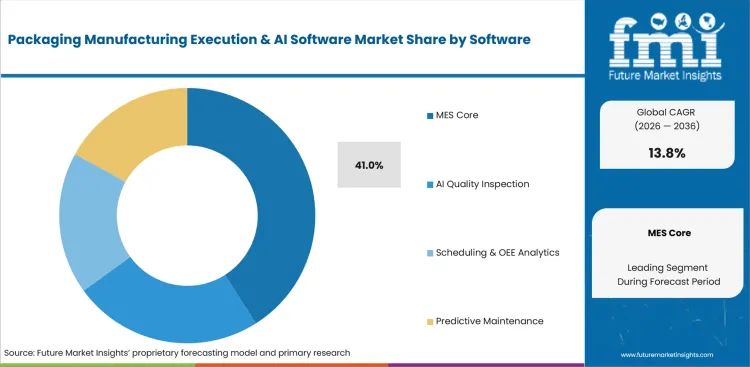
Packaging plants need one production record before separate AI tools guide scheduling or quality decisions. Siemens reported in February 2025 that low-code additions to Opcenter reduced the implementation effort for some tasks by more than half. MES core reduces that burden by linking orders and material use with current machine status across every active shift. Its value depends on clean signals and consistent product definitions that operators trust during repeated changeovers.
- MES core is projected to hold 41.0% share in 2026 owing to its role in order execution and traceability across packaging lines. Packaging managers commonly approve this layer before quality AI or maintenance models since later modules require dependable timestamps and material records for audit review.
- Operations teams are expected to favor MES core because retailer audits and frequent changeovers expose gaps in separate production logs. Suppliers must show how the selected platform exchanges records with existing controls and other MES software for discrete manufacturing without duplicate entry. A practical interface should preserve order context across every shift and reduce the time supervisors spend reconciling conflicting records.
How do packaging plant managers evaluate cloud deployment?
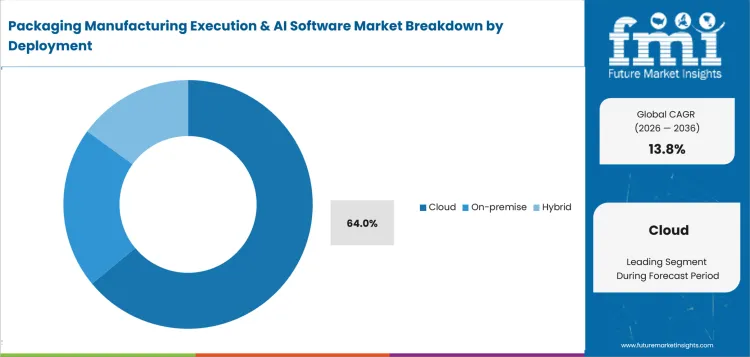
Packaging groups with multiple converting sites often lack a common view of downtime, waste, and order progress because each facility records line events differently. Cloud delivery helps standardize releases and production definitions across sites while reducing the server work handled by local teams. Suppliers such as GE Vernova are adding order-control and document-management functions to MES platforms, but adoption still depends on whether plant teams can verify response time and recovery plans for continuous packaging lines.
- By deployment, cloud is estimated to represent 64.0% share in 2026 attributable to centralized support and quicker multi-site rollout. This model suits packaging groups that need common production definitions across plants with different equipment ages. Each site must confirm system response time and recovery procedures before replacing local systems that support continuous production and reliable order release.
- Cloud deployment is drawing attention from packaging groups that need common reporting across several facilities and countries. Procurement teams review data location, integration responsibility, and the broader value of enterprise manufacturing intelligence before selecting one system design. Local teams also test offline access and recovery during planned network work before approving the same model for active production.
What drives converting and printing demand within the line type category?
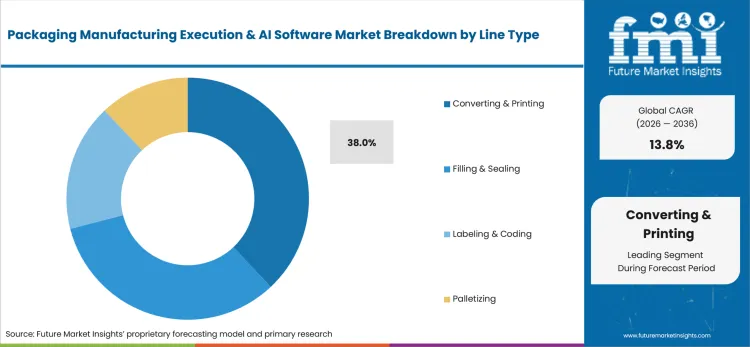
High-mix converting and printing lines expose scheduling gaps quickly because artwork/ substrate and tooling changes affect setup time before every short run. Rockwell Automation reported in August 2025 that 44% of consumer-packaged goods manufacturers used data to guide decisions, a signal that production teams are increasingly relying on line information instead of post-shift summaries.
- The converting and printing segment is projected to lead its line type category with 38.0% share in 2026 due to frequent setup changes. MES records help supervisors compare planned and actual preparation time across similar jobs before the next order enters production.
- Short-run converting and printing operations are expected to increase software spending as rapid job switching raises pressure on scheduling, material staging, and waste control. Plants often pair scheduling data with machine condition monitoring systems so maintenance work does not create another avoidable delay. The combined record helps supervisors protect delivery windows and explain recurring losses during repeat production orders.
What are the drivers, restraints, and opportunities in the packaging manufacturing execution & AI software market?
Line visibility is expected to drive purchases, legacy integration is anticipated to restrain rollouts, and multi-plant cloud standards are projected to create expansion routes.
- Driver: Packaging plants are expected to replace separate logs with systems that connect production orders and traceability records to live line events.
- Restraint: Older controls are anticipated to slow implementation because equipment states often need custom mapping before software produces dependable results.
- Opportunity: Cloud-based MES is projected to support common production definitions across plants that currently compare results through manually prepared reports.
Line visibility becomes useful after supervisors trace a late order or scrap event to the actual machine condition. Rockwell Automation reported in June 2025 that 50% of surveyed manufacturers planned to apply AI to product quality. Packaging plants are therefore expected to favor projects that connect inspection results with order history and material records. An isolated dashboard offers less value because operators cannot see which job created the defect or whether the same condition has returned.
Older equipment can slow rollout because many legacy machines provide incomplete signals or limited access to operating states. The United Kingdom Technology Adoption Review reported in June 2025 that only 8% of surveyed manufacturers had introduced AI successfully, with skills and integration capacity identified as major barriers. Packaging software pilots are therefore likely to take longer where line data must be cleaned before managers trust automated schedules and defect alerts.
Multi-plant converters gain a clearer expansion route after one facility establishes common data definitions and operator routines. Cloud administration lets the same MES release support several locations without removing local recovery controls for continuous lines. A successful production test gives plant teams evidence for wider agreements that cover factory automation and industrial controls. Well-documented cases show that common standards preserve plant flexibility during network outages and frequent product changes.
Which country CAGRs are profiled in the packaging manufacturing execution & AI software market?
.webp "Top Country Growth Comparison Packaging Manufacturing Execution And Ai Software Market Cagr (2026 2036)")
| Country | CAGR |
|---|---|
| United States | 12.9% |
| China | 15.2% |
| India | 15.9% |
| Germany | 13.6% |
| United Kingdom | 13.1% |
| Japan | 11.7% |
| South Korea | 14.3% |
Source: FMI's proprietary forecasting model and primary research
How do country-level CAGRs compare in the packaging manufacturing execution & AI software market?
Country growth is expected to depend on factory investment and the amount of local integration support available to packaging plants. India and China combine new capacity with expanding software ecosystems that support implementation at newly built plants. Germany and Japan favor controlled upgrades because established equipment needs careful validation before production teams accept new software. The United States and United Kingdom examine security and operator readiness before extending pilots across additional sites. South Korea benefits from coordinated smart-factory investment and concentrated technical support near major industrial clusters. These differences shape how connected packaging systems exchange information with plant execution records across the profiled markets.
- American packaging groups often operate large plant networks with mixed equipment, so pilot results must show that execution records remain dependable across different controls and line ages. USA adoption is estimated to expand at 12.9% CAGR from 2026 to 2036 due to investment in industrial AI infrastructure. The National Institute of Standards and Technology announced in July 2024 that it expected up to USD 70 million over five years for an AI-focused Manufacturing USA institute. The funding strengthens the local testing and research ecosystem without measuring packaging MES revenue directly.
- Large factory networks create demand for production records that remain usable across new lines and locations. In China, software demand is predicted to advance at 15.2% CAGR from 2026 to 2036 led by industrial AI deployment. The State Council reported in March 2026 that the country's core AI industry exceeded USD 173.9 billion during 2025. That scale expands the local supply of AI models and integration services without defining packaging execution software revenue. Domestic software options increase price pressure while local implementation partners shorten support distances after deployment.
- New packaging capacity gives software teams an opening to define production data before manual practices become fixed. India is estimated to post 15.9% CAGR from 2026 to 2036 attributable to newly built plants and cloud availability. Growth is expected to be significant in places where companies can combine practical implementation costs with local support near packaging clusters in Gujarat and Maharashtra. Local implementation cost remains decisive for converters operating across major production clusters.
- German packaging plants commonly treat software changes as engineering projects that require formal interface and security review. Germany demand is projected to record 13.6% CAGR from 2026 to 2036 reinforced by Industrie 4.0 investment. The USA International Trade Administration estimated in August 2025 that German robotics and automation turnover would reach USD 15.6 billion during 2025. The turnover figure reflects related automation spending that supports an installed base for MES integration. Siemens provides an established domestic MES portfolio that supports control integration with packaging machinery systems and local engineering work.
- Older machinery and limited internal AI skills make implementation design more important than the first subscription price. The United Kingdom outlook is anticipated to advance at 13.1% CAGR from 2026 to 2036, shaped by gradual plant upgrades and careful validation of production data. Packaging converters are expected to favor short pilots that explain operator training and recovery responsibility before procurement teams approve wider cloud use.
- Japanese plants are expected to favor measured upgrades that protect stable production and documented quality routines. Software demand is forecast to rise at 11.7% CAGR from 2026 to 2036 owing to selective automation and strict change control. The USA International Trade Administration estimated Japan manufacturing software spending at USD 12.9 billion in April 2025, which supports staged MES upgrades across Japanese packaging plants. Local plants often require careful interface testing before cloud or AI modules influence release decisions. Suppliers that support staged validation are better aligned with established quality systems and long equipment replacement cycles.
- Concentrated manufacturing networks allow suppliers to collect plant feedback quickly and improve implementation methods across nearby sites. South Korea is projected to grow at 14.3% CAGR from 2026 to 2036 supported by coordinated factory automation programs. According to a June 2026 USA International Trade Administration guide, the government announced USD 227 million in 2024 for public-private smart manufacturing partnerships. The program expands testbeds and implementation skills for smart factories across South Korea beyond the packaging sector. Samsung SDS and local integrators deepen regional software skills while shortening the distance between plants and technical teams.
Who are the notable companies in the packaging manufacturing execution & AI software market?
Siemens, Rockwell Automation, Dassault Systèmes, AVEVA, Körber, SAP, Honeywell, GE Vernova, Tulip, and Augury are notable companies serving this market.
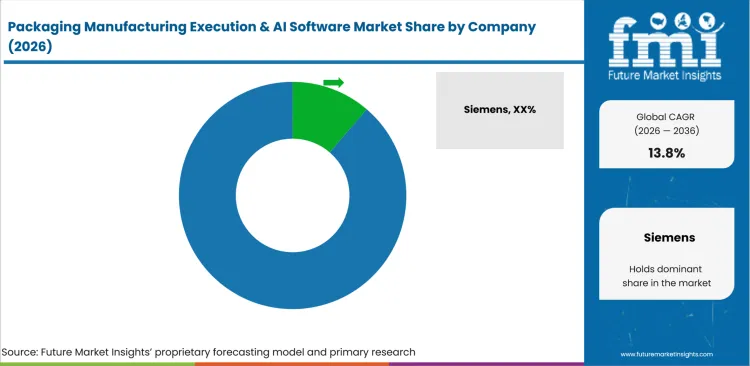
The competitive field combines full MES platforms with narrower AI tools for inspection and equipment health. Large suppliers fit multi-plant projects after packaging groups seek one common system design across several facilities. Broad reach does not prove line fit because converters need evidence for changeovers and traceability. Focused vendors compete by solving a smaller packaging workflow with less integration work and a shorter pilot period. Purchasers compare data ownership and integration responsibility before testing smart packaging technologies beside execution software. The final shortlist depends on installed controls and the supplier's ability to support operators after launch.
- Siemens and Rockwell Automation combine MES products with broad automation portfolios that connect software with existing controls. Siemens offers Opcenter and industrial AI tools while Rockwell links Plex and FactoryTalk products with equipment used by consumer packaged goods manufacturers. Both suppliers suit projects where execution data must remain connected to production machinery during plant upgrades.
- Dassault Systèmes and AVEVA support manufacturers that need shared production data across several plants and regions. DELMIA Apriso manages multi-site execution while AVEVA links MES with industrial data services and plant integration. Packaging fit depends on the templates and implementation partner selected for each line type during rollout.
- Körber and SAP address regulated records and enterprise integration from different positions within the plant software system. Körber brings PAS-X experience around pharmaceutical production and packaging while SAP connects plant events with planning records. Each platform needs separate testing against high-speed converting requirements and the existing production controls at every plant.
- Honeywell and GE Vernova combine operations software with control and equipment data across batch and continuous production environments. GE Vernova documents Proficy use in packaging and consumer goods while Honeywell has deeper evidence in life-sciences production. Plant teams should verify industry templates and integration responsibility before comparing software licenses or implementation costs.
- Tulip and Augury enter narrower programs centered on operator workflows or machine health across production lines. Tulip has documented packaging deployments that reduce scrap while Augury supports equipment monitoring in consumer packaged goods plants. Both tools require clean data exchange with the selected MES before production teams approve wider use.
Competitive Benchmarking: Packaging Manufacturing Execution & AI Software Market
| Company | MES Execution Depth | AI Quality and Maintenance Fit | Packaging Workflow Fit | Service Reach |
|---|---|---|---|---|
| Siemens | High | High | High | Global |
| Rockwell Automation | High | High | High | Global |
| Dassault Systèmes | High | Medium | Medium | Global |
| AVEVA | High | High | Medium | Global |
| Körber | High | Medium | High | Global |
| SAP | High | Medium | Medium | Global |
| Honeywell | Medium | High | Medium | Global |
| GE Vernova | High | Medium | High | Global |
| Tulip | Medium | Medium | High | Global |
| Augury | Low | High | Medium | Global |
Scoring basis: High indicates direct evidence for the dimension. Medium indicates partial relevance and Low indicates limited direct evidence.
Source: Future Market Insights competitive analysis, 2026. Ratings reflect portfolio relevance and packaging workflow fit. Service reach reflects documented operations and support access.
Key Developments in the Packaging Manufacturing Execution & AI Software Market
- In May 2025, Siemens introduced industrial AI agents for planning and operations inside its Industrial Copilot environment. The agents access production information and support workflow execution under user control across connected industrial systems.
- In December 2025, Rockwell Automation announced updates to its elastic MES portfolio across Plex and FactoryTalk products. The system supports cloud and local configurations used by different plant teams across mixed equipment environments.
- In May 2026, AVEVA announced AI-enabled updates across CONNECT and its industrial operations portfolio at AVEVA World. The release expanded integration and data-processing functions used by analysis software across distributed production sites.
- In March 2025, Körber released the cloud-native PAS-X Track & Trace platform for pharmaceutical serialization and lifecycle management. The product links compliance records with packaging operations while reducing local infrastructure needs inside regulated plants. The development strengthens Körber's relevance where execution software must preserve audit records and product identifiers.
Key Players in the Packaging Manufacturing Execution & AI Software Market
Full MES and automation platforms
- Siemens
- Rockwell Automation
- Dassault Systèmes
- AVEVA
- GE Vernova
Regulated and enterprise production platforms
- Körber
- SAP
- Honeywell
Frontline and machine-health specialists
- Tulip
- Augury
Packaging Manufacturing Execution & AI Software Market - Report Scope
| Coverage Field | Report Scope |
|---|---|
| Market breakdown | Packaging Manufacturing Execution & AI Software Market Breakdown By Software, Deployment, Line Type, End Use, Organization Size, and Region |
| Quantitative Units | USD billion |
| Market Definition | Software used by packaging plants to manage production execution, quality records, traceability, maintenance, scheduling, and line analytics. |
| Regions Covered | North America, Latin America, Europe, East Asia, South Asia, Oceania, and Middle East and Africa |
| Countries Covered | United States, China, India, Germany, United Kingdom, Japan, South Korea, and additional national markets across each covered region |
| Key Companies Profiled | Siemens, Rockwell Automation, Dassault Systèmes, AVEVA, Körber, SAP, Honeywell, GE Vernova, Tulip, and Augury |
| Forecast Period | 2026 to 2036 |
| Approach | Market estimates combine supplier participation with packaging line use and country indicators. Verified company capabilities provide the final cross-check. |
Source: Future Market Insights - analysis driven by proprietary forecasting models and primary research
Packaging Manufacturing Execution & AI Software Market - Research Methodology
| Method | Approach |
|---|---|
| Primary Research | FMI analysts reviewed inputs from packaging plant managers and converter operations teams across several production formats. Interviews examined production visibility and changeover control beside traceability requirements and routine daily maintenance decisions. The research tested how plants approve software pilots and assign responsibility for integration work after vendor selection. Responses from flexible packaging and rigid-container operations were compared to identify different support and approval needs. |
| Desk Research | Desk research covered official manufacturing programs and current company documentation for MES and industrial AI products. Analysts compared each portfolio with the needs of converting and printing lines inside active packaging plants. Evidence was checked against adjacent food packaging operations to separate packaging workflows from general factory software. Direct execution products were separated from maintenance tools that support only one part of the production workflow. |
| Market Sizing and Forecasting | Market sizing combined supplier participation with software use across the disclosed packaging line categories and deployment models. Country assumptions reflected factory investment and local implementation capacity without treating broad digital spending as direct market revenue. Adoption rates were adjusted for plant size and deployment model before final values were validated. |
| Data Validation | Forecasts were compared with primary interviews and official smart-manufacturing indicators from each profiled country market. Company relevance was checked against direct MES or industrial AI capabilities documented on official product pages. Benchmark ratings were evaluated independently for execution depth and packaging workflow fit across the supplier set. Geographic reach required documented operations or service access across named regions instead of export activity alone. |
Source: Future Market Insights (FMI) analysis, based on proprietary forecasting model and primary research
Packaging Manufacturing Execution & AI Software Market by Segments
Packaging Manufacturing Execution & AI Software Market segmented by Software:
- MES Core
- AI Quality Inspection
- Scheduling & OEE Analytics
- Predictive Maintenance
Packaging Manufacturing Execution & AI Software Market segmented by Deployment:
- Cloud
- On-premise
- Hybrid
Packaging Manufacturing Execution & AI Software Market segmented by Line Type:
- Converting & Printing
- Filling & Sealing
- Labeling & Coding
- Palletizing
Packaging Manufacturing Execution & AI Software Market segmented by End Use:
- Flexible Packaging Converters
- Rigid Plastics
- Paper & Board
- Metal & Glass
Packaging Manufacturing Execution & AI Software Market segmented by Organization Size:
- Large Enterprises
- Small and Medium-sized Enterprises
Packaging Manufacturing Execution & AI Software Market by Region:
- North America
- United States
- Canada
- Latin America
- Brazil
- Mexico
- Argentina
- Europe
- Germany
- United Kingdom
- France
- Italy
- Spain
- East Asia
- China
- Japan
- South Korea
- South Asia
- India
- Thailand
- Indonesia
- Oceania
- Australia
- New Zealand
- Middle East and Africa
- GCC countries
- South Africa
- Turkey
Research Sources and Bibliography
- USA Department of Energy. (2024, July 18). $33 million in funding available to advance smart manufacturing technologies.
- International Trade Administration. (2026, June 29). Korea - Digital Economy.
- Siemens Digital Industries Software. (2025, February 27). The digital future for manufacturing execution systems: Enhancing production flexibility with AI, cloud, and low-code tools.
- GE Vernova. (2025, February 20). Proficy 2025 product update webinar series: Proficy Smart Factory MES 2025.
- Rockwell Automation. (2025, August 19). Rockwell Automation report finds CPG industry prioritizing innovation over cost-cutting.
- Rockwell Automation. (2025, June 3). Ninety-five percent of manufacturers are investing in AI to navigate uncertainty and accelerate smart manufacturing.
- Department for Science, Innovation and Technology. (2025, June). Technology Adoption Review 2025.
- National Institute of Standards and Technology. (2024, July 22). NIST announces funding opportunity for AI-focused Manufacturing USA institute.
- State Council of the People's Republic of China. (2026, March 5). China's core AI industry scale tops 1.2 trln yuan in 2025: Official.
- Press Information Bureau. (2025, March 6). India's AI revolution: A roadmap to Viksit Bharat.
- International Trade Administration. (2025, August 1). Germany - Advanced Manufacturing.
- International Trade Administration. (2026, February 2). United Kingdom - Information and Communication Technology.
- International Trade Administration. (2025, April 18). Japan advanced manufacturing opportunities.
- International Trade Administration. (2026, June 29). South Korea - Manufacturing Technology - Smart Factory.
- Siemens. (2025, May 12). Siemens introduces AI agents for industrial automation.
- Rockwell Automation. (2025, December 9). Rockwell Automation leads new era of manufacturing with elastic MES offerings.
- AVEVA. (2026, May 20). AVEVA announces new capabilities to embed AI across industrial organizations and data infrastructure.
- Körber. (2025, March 4). Körber releases new cloud-native PAS-X Track & Trace.
This bibliography is provided for reader reference and uses primary government, standards-body, official trade body, and company sources.
This Report Answers
- What value is forecast for the Packaging Manufacturing Execution & AI Software Market in 2026 and by 2036?
- What CAGR is projected for the Packaging Manufacturing Execution & AI Software Market from 2026 to 2036?
- Which software and deployment segments define the disclosed share view for this market?
- What operating pressures support adoption across converting and printing production lines?
- How do country CAGRs differ across the seven profiled national markets?
- Which competitive dimensions separate full MES platforms from focused AI applications?
- How does FMI validate market values and the relevance of profiled companies?
- What should packaging purchasers test before extending a software pilot across plants?
- How do data control and integration requirements influence supplier selection decisions?
Frequently Asked Questions
What is driving growth in the Packaging Manufacturing Execution & AI Software Market?
Packaging plants need a dependable production record that connects line events with orders and quality checks across each shift. Demand is expected to expand after operators replace separate logs with shared execution systems that support traceability and faster decisions.
Who are the key players in the Packaging Manufacturing Execution & AI Software Market?
Siemens and Rockwell Automation provide broad MES and automation portfolios for complex packaging plant environments across several regions. Dassault Systèmes and AVEVA compete beside Körber and suppliers that address narrower production and equipment-health workflows.
What is a significant restraint in the Packaging Manufacturing Execution & AI Software Market?
Older machines often provide incomplete data and need custom integration before software results become dependable for production teams. Plant managers are likely to delay expansion until operators trust the new production record during routine line changes.
Why should executives track the Packaging Manufacturing Execution & AI Software Market?
The software affects scheduling and traceability decisions that influence delivery performance across high-mix packaging production lines. Executives should track whether pilot results create repeatable operating changes across additional plants and equipment generations.
What business problem does the Packaging Manufacturing Execution & AI Software Market address?
The software replaces scattered production records stored across machine systems and separate shift reports inside packaging plants. A connected production system gives supervisors one account of orders and quality events alongside downtime and material use.
What should procurement leaders evaluate before selecting suppliers?
Procurement leaders should compare integration ownership and cybersecurity beside subscription pricing and expected support coverage. They should confirm operator training and recovery responsibilities before approving a wider rollout across additional production lines.
What limits return on investment for purchasers?
Returns weaken after plants spend more effort cleaning production data than improving schedules or reducing avoidable scrap. Limited operator use and unclear expansion rules often extend pilots without producing repeatable benefits across packaging lines.
How do suppliers build long-term account confidence?
Suppliers build confidence by documenting production results and resolving integration problems after every approved plant launch. Consistent site support helps teams renew subscriptions and extend proven workflows to additional lines and facilities.
Preview the report firsthand - request a free sample
Get SampleGet the brochure for pricing and purchase details.
Get PDFTable of Content
- Key Takeaways
- Market Size and CAGR
- Top Growth Driver
- Fastest Growing Segment
- Leading Region
- Key Companies
- Emerging Opportunities
- Executive Summary
- Global Market Outlook
- Demand-side Trends
- Supply-side Trends
- Technology Roadmap Analysis
- Analysis and Recommendations
- Analyst Perspective (What is happening? Why now? What should investors know?)
- Key Questions Answered
- How large is the market?
- What is the CAGR?
- What are key trends?
- Which region dominates?
- Who are the leaders?
- Market Overview
- Market Coverage / Taxonomy
- Market Definition / Scope / Limitations
- Research Methodology
- Chapter Orientation
- Analytical Lens and Working Hypotheses
- Market Structure, Signals, and Trend Drivers
- Benchmarking and Cross-market Comparability
- Market Sizing, Forecasting, and Opportunity Mapping
- Research Design and Evidence Framework
- Desk Research Programme (Secondary Evidence)
- Expert Input and Fieldwork (Primary Evidence)
- Tooling, Models, and Reference Databases
- Data Engineering and Model Build
- Quality Assurance and Audit Trail
- Market Background
- Market Dynamics (Drivers, Restraints, Opportunity, Trends)
- Scenario Forecast (Optimistic, Likely, Conservative)
- Impact Analysis
- AI Impact
- Sustainability Impact
- Regulatory Impact
- Technology Impact
- Consumer / Buyer Analysis
- Purchase Drivers
- Adoption Barriers
- Buyer Journey
- Opportunity Map Analysis
- Product Life Cycle Analysis
- Supply Chain Analysis
- Investment Feasibility Matrix
- Value Chain Analysis
- PESTLE and Porter's Analysis
- Regulatory Landscape
- Regional Parent Market Outlook
- Production and Consumption Statistics
- Import and Export Statistics
- Global Market Analysis and Forecast, 2021 to 2036
- Historical Market Size Value (USD Billion) Analysis, 2021 to 2025
- Current and Future Market Size Value (USD Billion) Projections, 2026 to 2036
- Y-o-Y Growth Trend Analysis
- Absolute $ Opportunity Analysis
- Global Market Pricing Analysis, 2021 to 2036
- Global Market Analysis and Forecast, By Software, 2021 to 2036
- Introduction / Key Findings
- Historical Market Size Value (USD Billion) Analysis By Software, 2021 to 2025
- Current and Future Market Size Value (USD Billion) Analysis and Forecast By Software, 2026 to 2036
- MES Core
- AI Quality Inspection
- Scheduling & OEE Analytics
- Predictive Maintenance
- MES Core
- Y-o-Y Growth Trend Analysis By Software, 2021 to 2025
- Absolute $ Opportunity Analysis By Software, 2026 to 2036
- Global Market Analysis and Forecast, By Deployment, 2021 to 2036
- Introduction / Key Findings
- Historical Market Size Value (USD Billion) Analysis By Deployment, 2021 to 2025
- Current and Future Market Size Value (USD Billion) Analysis and Forecast By Deployment, 2026 to 2036
- Cloud
- On-premise
- Hybrid
- Cloud
- Y-o-Y Growth Trend Analysis By Deployment, 2021 to 2025
- Absolute $ Opportunity Analysis By Deployment, 2026 to 2036
- Global Market Analysis and Forecast, By Line Type, 2021 to 2036
- Introduction / Key Findings
- Historical Market Size Value (USD Billion) Analysis By Line Type, 2021 to 2025
- Current and Future Market Size Value (USD Billion) Analysis and Forecast By Line Type, 2026 to 2036
- Converting & Printing
- Filling & Sealing
- Labeling & Coding
- Palletizing
- Converting & Printing
- Y-o-Y Growth Trend Analysis By Line Type, 2021 to 2025
- Absolute $ Opportunity Analysis By Line Type, 2026 to 2036
- Global Market Analysis and Forecast, By End Use, 2021 to 2036
- Introduction / Key Findings
- Historical Market Size Value (USD Billion) Analysis By End Use, 2021 to 2025
- Current and Future Market Size Value (USD Billion) Analysis and Forecast By End Use, 2026 to 2036
- Flexible Packaging Converters
- Rigid Plastics
- Paper & Board
- Metal & Glass
- Flexible Packaging Converters
- Y-o-Y Growth Trend Analysis By End Use, 2021 to 2025
- Absolute $ Opportunity Analysis By End Use, 2026 to 2036
- Global Market Analysis and Forecast, By Organization Size, 2021 to 2036
- Introduction / Key Findings
- Historical Market Size Value (USD Billion) Analysis By Organization Size, 2021 to 2025
- Current and Future Market Size Value (USD Billion) Analysis and Forecast By Organization Size, 2026 to 2036
- Large Enterprises
- SMEs
- Large Enterprises
- Y-o-Y Growth Trend Analysis By Organization Size, 2021 to 2025
- Absolute $ Opportunity Analysis By Organization Size, 2026 to 2036
- Global Market Analysis and Forecast, By Region, 2021 to 2036
- Introduction
- Historical Market Size Value (USD Billion) Analysis By Region, 2021 to 2025
- Current Market Size Value (USD Billion) Analysis and Forecast By Region, 2026 to 2036
- North America
- Latin America
- Western Europe
- Eastern Europe
- East Asia
- South Asia and Pacific
- Middle East & Africa
- Market Attractiveness Analysis By Region
- North America Market Analysis and Forecast, By Country, 2021 to 2036
- Historical Market Size Value (USD Billion) Trend Analysis By Market Taxonomy, 2021 to 2025
- Market Size Value (USD Billion) Forecast By Market Taxonomy, 2026 to 2036
- By Country
- USA
- Canada
- By Software
- By Deployment
- By Line Type
- By End Use
- By Organization Size
- By Country
- Market Attractiveness Analysis
- By Country
- By Software
- By Deployment
- By Line Type
- By End Use
- By Organization Size
- Key Takeaways
- Latin America Market Analysis and Forecast, By Country
- Historical Market Size Value (USD Billion) Trend Analysis By Market Taxonomy, 2021 to 2025
- Market Size Value (USD Billion) Forecast By Market Taxonomy, 2026 to 2036
- By Country
- Brazil
- Mexico
- Chile
- Rest of Latin America
- By Software
- By Deployment
- By Line Type
- By End Use
- By Organization Size
- By Country
- Market Attractiveness Analysis
- By Country
- By Software
- By Deployment
- By Line Type
- By End Use
- By Organization Size
- Key Takeaways
- Western Europe Market Analysis and Forecast, By Country
- Historical Market Size Value (USD Billion) Trend Analysis By Market Taxonomy, 2021 to 2025
- Market Size Value (USD Billion) Forecast By Market Taxonomy, 2026 to 2036
- By Country
- Germany
- UK
- Italy
- Spain
- France
- Nordic
- BENELUX
- Rest of Western Europe
- By Software
- By Deployment
- By Line Type
- By End Use
- By Organization Size
- By Country
- Market Attractiveness Analysis
- By Country
- By Software
- By Deployment
- By Line Type
- By End Use
- By Organization Size
- Key Takeaways
- Eastern Europe Market Analysis and Forecast, By Country
- Historical Market Size Value (USD Billion) Trend Analysis By Market Taxonomy, 2021 to 2025
- Market Size Value (USD Billion) Forecast By Market Taxonomy, 2026 to 2036
- By Country
- Russia
- Poland
- Hungary
- Balkan & Baltic
- Rest of Eastern Europe
- By Software
- By Deployment
- By Line Type
- By End Use
- By Organization Size
- By Country
- Market Attractiveness Analysis
- By Country
- By Software
- By Deployment
- By Line Type
- By End Use
- By Organization Size
- Key Takeaways
- East Asia Market Analysis and Forecast, By Country
- Historical Market Size Value (USD Billion) Trend Analysis By Market Taxonomy, 2021 to 2025
- Market Size Value (USD Billion) Forecast By Market Taxonomy, 2026 to 2036
- By Country
- China
- Japan
- South Korea
- By Software
- By Deployment
- By Line Type
- By End Use
- By Organization Size
- By Country
- Market Attractiveness Analysis
- By Country
- By Software
- By Deployment
- By Line Type
- By End Use
- By Organization Size
- Key Takeaways
- South Asia and Pacific Market Analysis and Forecast, By Country
- Historical Market Size Value (USD Billion) Trend Analysis By Market Taxonomy, 2021 to 2025
- Market Size Value (USD Billion) Forecast By Market Taxonomy, 2026 to 2036
- By Country
- India
- ASEAN
- Australia & New Zealand
- Rest of South Asia and Pacific
- By Software
- By Deployment
- By Line Type
- By End Use
- By Organization Size
- By Country
- Market Attractiveness Analysis
- By Country
- By Software
- By Deployment
- By Line Type
- By End Use
- By Organization Size
- Key Takeaways
- Middle East & Africa Market Analysis and Forecast, By Country
- Historical Market Size Value (USD Billion) Trend Analysis By Market Taxonomy, 2021 to 2025
- Market Size Value (USD Billion) Forecast By Market Taxonomy, 2026 to 2036
- By Country
- Kingdom of Saudi Arabia
- Other GCC Countries
- Türkiye
- South Africa
- Other African Union
- Rest of Middle East & Africa
- By Software
- By Deployment
- By Line Type
- By End Use
- By Organization Size
- By Country
- Market Attractiveness Analysis
- By Country
- By Software
- By Deployment
- By Line Type
- By End Use
- By Organization Size
- Key Takeaways
- Key Countries Market Analysis
- USA
- Pricing Analysis
- Market Share Analysis, 2025
- By Software
- By Deployment
- By Line Type
- By End Use
- By Organization Size
- Canada
- Pricing Analysis
- Market Share Analysis, 2025
- By Software
- By Deployment
- By Line Type
- By End Use
- By Organization Size
- Mexico
- Pricing Analysis
- Market Share Analysis, 2025
- By Software
- By Deployment
- By Line Type
- By End Use
- By Organization Size
- Brazil
- Pricing Analysis
- Market Share Analysis, 2025
- By Software
- By Deployment
- By Line Type
- By End Use
- By Organization Size
- Chile
- Pricing Analysis
- Market Share Analysis, 2025
- By Software
- By Deployment
- By Line Type
- By End Use
- By Organization Size
- Germany
- Pricing Analysis
- Market Share Analysis, 2025
- By Software
- By Deployment
- By Line Type
- By End Use
- By Organization Size
- UK
- Pricing Analysis
- Market Share Analysis, 2025
- By Software
- By Deployment
- By Line Type
- By End Use
- By Organization Size
- Italy
- Pricing Analysis
- Market Share Analysis, 2025
- By Software
- By Deployment
- By Line Type
- By End Use
- By Organization Size
- Spain
- Pricing Analysis
- Market Share Analysis, 2025
- By Software
- By Deployment
- By Line Type
- By End Use
- By Organization Size
- France
- Pricing Analysis
- Market Share Analysis, 2025
- By Software
- By Deployment
- By Line Type
- By End Use
- By Organization Size
- India
- Pricing Analysis
- Market Share Analysis, 2025
- By Software
- By Deployment
- By Line Type
- By End Use
- By Organization Size
- ASEAN
- Pricing Analysis
- Market Share Analysis, 2025
- By Software
- By Deployment
- By Line Type
- By End Use
- By Organization Size
- Australia & New Zealand
- Pricing Analysis
- Market Share Analysis, 2025
- By Software
- By Deployment
- By Line Type
- By End Use
- By Organization Size
- China
- Pricing Analysis
- Market Share Analysis, 2025
- By Software
- By Deployment
- By Line Type
- By End Use
- By Organization Size
- Japan
- Pricing Analysis
- Market Share Analysis, 2025
- By Software
- By Deployment
- By Line Type
- By End Use
- By Organization Size
- South Korea
- Pricing Analysis
- Market Share Analysis, 2025
- By Software
- By Deployment
- By Line Type
- By End Use
- By Organization Size
- Russia
- Pricing Analysis
- Market Share Analysis, 2025
- By Software
- By Deployment
- By Line Type
- By End Use
- By Organization Size
- Poland
- Pricing Analysis
- Market Share Analysis, 2025
- By Software
- By Deployment
- By Line Type
- By End Use
- By Organization Size
- Hungary
- Pricing Analysis
- Market Share Analysis, 2025
- By Software
- By Deployment
- By Line Type
- By End Use
- By Organization Size
- Kingdom of Saudi Arabia
- Pricing Analysis
- Market Share Analysis, 2025
- By Software
- By Deployment
- By Line Type
- By End Use
- By Organization Size
- Türkiye
- Pricing Analysis
- Market Share Analysis, 2025
- By Software
- By Deployment
- By Line Type
- By End Use
- By Organization Size
- South Africa
- Pricing Analysis
- Market Share Analysis, 2025
- By Software
- By Deployment
- By Line Type
- By End Use
- By Organization Size
- USA
- Market Structure Analysis
- Competition Dashboard
- Competition Benchmarking
- Market Share Analysis of Top Players
- By Regional
- By Software
- By Deployment
- By Line Type
- By End Use
- By Organization Size
- Emerging Startups
- Innovation Benchmarking
- Competition Analysis
- Competition Deep Dive
- Siemens
- Overview
- Product Portfolio
- Profitability by Market Segments
- Sales Footprint
- Strategy Overview
- Marketing Strategy
- Product Strategy
- Channel Strategy
- Rockwell Automation
- Dassault Systèmes
- AVEVA
- Körber
- SAP
- Honeywell
- Plataine
- Tulip
- Augury
- Siemens
- Case Studies
- Success Stories
- Recent Developments
- Competition Deep Dive
- Assumptions & Acronyms Used


