

- Market Size (2026)
- USD 273.4 Mn
- Forecast (2036)
- USD 696.3 Mn
- CAGR (2026 to 2036)
- 9.8%
How big is ERP Software for Packaging Industry Market in 2026?
Sales in the ERP software for packaging industry market are projected to grow at 9.8% CAGR through 2036. Market size rises from USD 249.0 million in 2025 to USD 273.4 million in 2026 and is expected to reach USD 696.3 million by 2036.
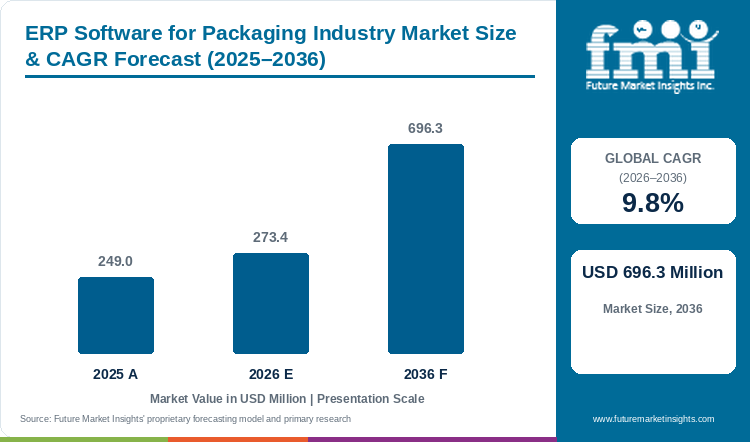
ERP software for packaging industry market has gained considerable demand as packaging converters are shifting from separate estimating and stock records towards connected production systems. The market was valued at USD 249.0 million in 2025 and is projected to increase from USD 273.4 million in 2026 to USD 696.3 million by 2036, at 9.8% CAGR from 2026 to 2036. Cloud-based deployment leads with 64.0% share in 2026, owing to requirement for common estimating, scheduling, inventory and finance records. United States flexible packaging sales reached USD 42.6 billion in 2024, increasing by 2.9% from 2023.[1] Radius ERP states that direct machine interface can reduce waste by around 2%.[2] Aicomp reported 65% lower quotation time and 85% fewer product-specification errors from packaging configuration add-ons.[3] These operating benefits are anticipated to support repeat use of packaging ERP software.
Key Market Trends & Insights
- By deployment type: Cloud-based software led with 64.0% share in 2026, owing to remote access and lower local infrastructure requirements across multi-site plants.
- By enterprise size: Large enterprises accounted for 58.0% of revenue in 2026, as multi-plant groups require common product masters, role controls, and consolidated reporting.
- By packaging format: Flexible packaging held the leading share of 34.0% in 2026, supported by high converting volumes and detailed multi-layer film, ink, and cylinder tracking needs.
- By functional module: Production planning represented 31.0% of demand in 2026, reflecting the requirement for balancing substrate arrival, press schedules, changeovers, and dispatch.
Regional Highlights
- Fastest-growing profiled country: Netherlands (9.4% CAGR, 2026 to 2036).
- By country: United States (9.3%) and Italy (9.1%) follow, while Canada records the lowest profiled CAGR at 8.7%.
Market Size & Forecast
Table 1: Market Size and Forecast for the ERP Software for Packaging Industry Market (USD million and percentage), 2025 to 2036
| Metric | Value |
|---|---|
| 2025 Market Size | USD 249.0 million |
| Estimated Market Size in 2026 | USD 273.4 million |
| Projected Market Size by 2036 | USD 696.3 million |
| CAGR, 2026 to 2036 | 9.8% |
| Added Revenue, 2026 to 2036 | USD 422.9 million |
| Market Expansion Multiple | 2.55x |
Cloud-based ERP is increasingly preferred as sales, finance and production teams can use the same records across different packaging plants. UK official statistics reported 69% adoption of cloud systems in 2023 and associated technology adopters with 19% higher turnover per worker.[4] In the Netherlands, 89% of SMEs reached basic digital intensity in 2025, which supports connected ERP use among packaging and logistics companies.[5] Modern converters are also adopting smart packaging formats that require serialized batch records and cloud-linked inventory tracking. United States manufacturing contributed USD 2.4 trillion to GDP in 2023 and employed 15.0 million people in 2024, creating a wider but fragmented implementation base.[6] Apart from that, product masters, machine links and trained users remains important for regular software use. Vendors offering staged deployment and packaging-specific configuration are expected to receive preference before wider multi-plant adoption.
Packaging ERP Operating Value Indicators
Table 2: Operating and Adoption Indicators for the ERP Software for Packaging Industry Market (USD, percentages, workers, and performance measures), mixed reporting years from 2023 to 2025
| Indicator | Data Point | Market Meaning | Source |
|---|---|---|---|
| United States flexible packaging sales | USD 42.6 billion in 2024; 2.9% growth | Expanding converter output increases the number of jobs, materials and production records managed through ERP. | [1] |
| Direct machine interface waste reduction | Around 2% | Waste control changes job margin and supports shop-floor integration with ERP. | [2] |
| Packaging quotation improvement | 65% lower quotation time | Faster estimating supports short runs and customer-specific packaging orders. | [3] |
| Product specification accuracy | 85% fewer errors | Configuration tools reduce rework where packaging variants use different materials and dimensions. | [3] |
| UK cloud adoption | 69% of firms in 2023 | Cloud familiarity lowers the deployment barrier for browser-based ERP. | [4] |
| Technology adopter productivity | 19% higher turnover per worker | Productivity value supports investment where implementation links daily production work. | [4] |
| Dutch SME digital intensity | 89% in 2025 | Higher digital readiness supports connected ERP use among converters and logistics businesses. | [5] |
| United States manufacturing scale | USD 2.4 trillion GDP contribution in 2023; 15.0 million employees in 2024 | A large manufacturing base creates broad demand, but training and integration requirements varies by plant. | [6] |
Basis: Added revenue equals USD 696.3 million less USD 273.4 million. Expansion multiple equals USD 696.3 million divided by USD 273.4 million. External indicators retain their stated reporting years.
Analyst Perspective
“Packaging converters will favour ERP systems that shows material loss before a job reaches dispatch. Cloud adoption will expand, but correct plant records will decide regular use across multiple packaging sites.”
- Nandini Roy Choudhury, Principal Consultant, Future Market Insights.
How is the ERP software for packaging industry market segmented?
On the basis of deployment type, enterprise size, packaging format and functional module, cloud-based platforms are projected at 64.0%, large enterprises at 58.0%, flexible packaging at 34.0% and production planning at 31.0% in 2026.
By deployment type: cloud-based and on-premises.
By enterprise size: large enterprises and small and medium enterprises.
By packaging format: flexible packaging, corrugated and folding cartons, labels, rigid packaging, and others.
By functional module: production planning, inventory and procurement, estimating and costing, quality and traceability, finance, and others.
By region: North America, Latin America, Western Europe, Eastern Europe, East Asia, South Asia and Pacific, and Middle East and Africa.
Why are cloud-based platforms preferred for packaging ERP deployment?
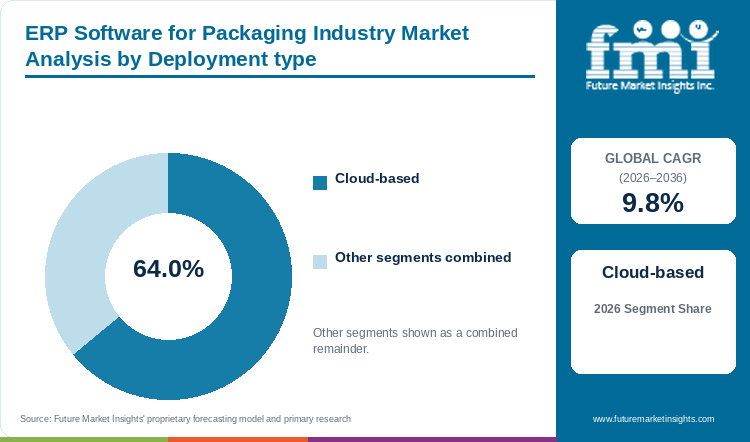
Cloud-based software is projected to account for 64.0% share in 2026, owing to remote access and lower local infrastructure requirement.
Table 3: Deployment Type Share for the ERP Software for Packaging Industry Market (percentage share), 2026
| Deployment Type | Share (2026) |
|---|---|
| Cloud-based | 64.0% |
| Other Segments Combined | 36.0%* |
| Total | 100.0% |
*Calculated as the balance remaining after deducting the leading segment's reported share from 100.0%.
Table 4: Deployment Type Leadership and Market Growth for the ERP Software for Packaging Industry Market (segment and CAGR percentage), 2026 to 2036
| Metric | Value |
|---|---|
| Global CAGR (2026 to 2036) | 9.8% |
| Leading Segment | Cloud-based |
Cloud-based ERP stores production, inventory, sales and finance records on a common platform which can be used across different packaging plants. The UK SME Digital Adoption Taskforce reported in July 2025 that resource planning and other digital technologies can increase firm-level productivity by 7% to 18% per technology.[7] Smaller converters are preferring cloud deployment due to lower server requirement, while multi-site groups uses it for common records across plants. Integration with packaging automation software is expected to support adoption where production and inventory data changes throughout the day.
- Cloud-based software is projected to hold 64.0% share in 2026, supported by remote multi-plant access and lower local server infrastructure costs.
- Phased migration, role-based controls, and user training remain critical operational requirements before full cloud deployment across plants.
What supports large enterprises in the enterprise size category?
Large enterprises are likely to capture 58.0% share in 2026, driven by multi-plant reporting and wider integration requirements.
Large packaging enterprises operates several plants, production lines, users, currencies and customer specifications. In February 2026, NIST reported that manufacturing competitiveness is affected by investment, supply chains, capital and productivity conditions.[8] Such companies requires one ERP system for linking plant production, inventory, finance and manufacturing execution records. Common product masters and consolidated reporting also reduces difference between plant records. Expansion of multi-plant packaging operations is therefore anticipated to support demand from large enterprises.
- Large enterprises are estimated to account for 58.0% share in 2026, attributed to multi-plant planning, common product records and consolidated reporting.
- Moreover, common product records, security, uptime and equipment integration remains important factors for ERP use across several plants.
How does flexible packaging shape ERP module requirements today?
Flexible packaging is forecast to represent 34.0% share in 2026, reflecting detailed roll, material, waste and job tracking needs.
Flexible packaging is manufactured using films, inks, adhesives, cylinders and different lamination, slitting, and digital printing processes. Every job requires material, machine time, waste and finished-roll records. In September 2025, Aicomp described packaging configuration tools that connect material rules, bills of materials, cost calculations and production restrictions.[9] Flexible packaging converters are preferring ERP software for controlling material substitutions and roll traceability. Wider requirement for job-level material and process records is expected to support adoption of packaging ERP software in this segment.
- Flexible packaging is projected to account for 34.0% of format revenue in 2026 due to wider requirement for material, roll and job records.
- Besides this, control over material substitutions, machine time, waste and finished-roll traceability is boosting use of ERP software among flexible packaging converters.
Which needs keep production planning central to packaging ERP?
Production planning is forecast to hold 31.0% share in 2026, supported by increasing requirements for machine capacity and schedule control.
Production planning balances machine availability, material arrival, artwork approval, changeovers and delivery schedules in corrugated packaging and converting plants. In November 2025, DynamicsPrint described ERP functions covering estimating, Gantt scheduling, shop-floor control, analytics and multi-site operations.[10] Current job status and material availability allows planners to change schedules before dispatch. This reduces machine idle time and prevents one delayed job from affecting the following production runs. Due to these operating requirements, production planning modules are expected to witness higher use throughout the forecast period.
- Production planning is projected to hold 31.0% share in 2026 as changes in schedule directly affects material use, machine time and dispatch.
- Availability of current capacity, approved specification and job status allows schedule changes before they affects material use and dispatch.
What are the drivers, restraints, and opportunities in the ERP software for packaging industry market?
Increasing requirement for connected plant records is driving the market, whereas implementation complexity may hamper growth and cloud modernization is expected to create new avenues.
- Driver: Increasing requirement for connecting estimates, material, production, quality, inventory and delivery records is driving the adoption of packaging ERP software.
- Restraint: High migration work, customization, training and machine integration increases implementation time, which may hamper the market growth.
- Opportunity: Expansion of cloud-based ERP and staged deployment is creating growth opportunities among small converters and multi-site packaging companies.
Connected Records Improve Plant Visibility
Difference between quotation and actual material use directly changes the cost of a packaging job. In July 2025, ePS stated that the rebuilt Radius ERP supports cloud and on-premises deployment with automation and open integrations.[11] Connected records allows packaging plants to compare substrate use, setup time, waste and run speed with the original estimate. As noted by FMI, wider application of the same production data in costing and traceability systems is expected to improve plant visibility and drive the market growth.
Implementation Work Limits Early Returns
A key factor restraining ERP replacement is the work required for product masters, bills of materials, reports and user roles across folding carton and label printing operations. ICTC reported in June 2026 that 57% of surveyed Canadian manufacturers remained in the earliest stage of digital implementation, while only 23% reported fully successful initiatives.[12] Shortage of trained users increases project cost and delays regular use of the software. Phased training and correct manufacturing data can reduce this burden; however, implementation complexity may hamper the growth of the market.
Cloud Modernization Widens Access
With the expansion of cloud manufacturing platforms, smaller packaging companies can begin with finance, inventory and order records before adding production links. The European Commission reported in June 2025 that 70.2% of Italian SMEs had at least basic digital intensity, whereas AI was used by 8.2% of enterprises.[13] This difference shows that connected business records will be adopted before advanced automation by many manufacturers. Lower server requirement and staged deployment is expected to create new avenues for packaging ERP software.
Which country CAGRs are profiled in the ERP software for packaging industry market?
Table 5: Country CAGR Comparison for the ERP Software for Packaging Industry Market (CAGR percentage), 2026 to 2036
| Country | CAGR |
|---|---|
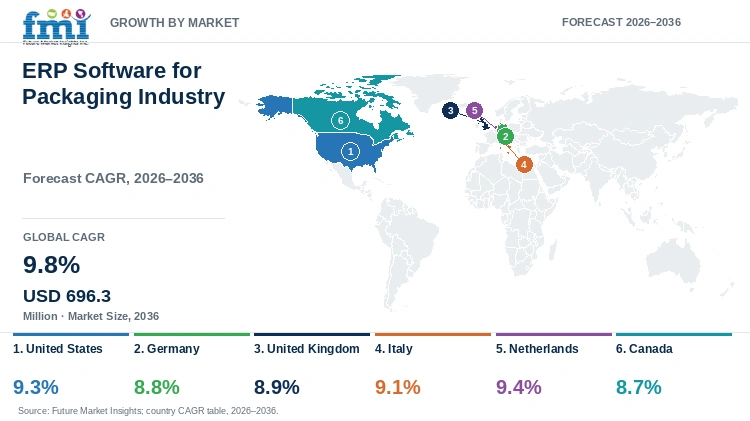
| United States | 9.3% |
| Germany | 8.8% |
| United Kingdom | 8.9% |
| Italy | 9.1% |
| Netherlands | 9.4% |
| Canada | 8.7% |
How do country-level CAGRs compare in the ERP software for packaging industry market?
Country demand conditions differ as manufacturing size, cloud readiness, public support, and the availability of trained implementation partners affect the adoption of packaging ERP software. Packaging manufacturers are using industrial cloud services for sharing production and inventory records between plants. FMI data suggests that countries having strong connectivity and wider manufacturing activities are expected to witness higher demand over the forecast period. The Netherlands is projected to grow at 9.4% CAGR through 2036, followed by the United States at 9.3%, Italy at 9.1%, the United Kingdom at 8.9%, Germany at 8.8%, and Canada at 8.7%. Netherlands and United States demand is expected to remain firmer, whereas Germany and Canada follow measured modernization. Local implementation services and access to trained users are anticipated to influence country market growth.
Country-wise Analysis
- The United States ERP software for packaging industry market is projected to grow at 9.3% CAGR through 2036. A 2025 manufacturing study reported that small and medium-sized manufacturers represents more than 95% of manufacturing firms, while skills, awareness and business-case gaps remains adoption barriers.[14] Packaging converters are increasingly requiring ERP software for scheduling, inventory, waste and traceability. Cloud deployment reduces local infrastructure requirement, but correct product records and trained users are required for plant integration. Growing number of manufacturing companies and need for auditable production data is expected to support the United States market growth.
- Germany ERP software for packaging industry market is anticipated to expand at 8.8% CAGR through 2036. The European Commission recorded 652 edge nodes in Germany during 2024 and reported strong business use of digital technologies in its 2025 country report.[15] Packaging manufacturers are using ERP software for connecting material planning, production orders, costing and shipment records. However, presence of legacy systems and different plant practices may slow down implementation. Expansion of industrial digitization is likely to fuel the Germany market growth.
- Demand for packaging ERP software in the United Kingdom is forecast to rise at 8.9% CAGR through 2036. In July 2025, the SME Digital Adoption Taskforce reported more than 5.5 million SMEs, accounting for 99.8% of the UK business population.[16] Resource planning software reduces administration and connects estimating, purchasing, stock, production and dispatch records. Smaller converters can begin with finance and inventory, whereas larger packaging groups requires multi-site reporting. Government support for SME technology adoption is anticipated to drive the market growth.
- Italy ERP software for packaging industry market is estimated to expand at 9.1% CAGR through 2036. In June 2025, the European Commission reported that 70.2% of Italian SMEs had at least basic digital intensity, while 8.2% of enterprises used AI.[17] Packaging machinery and converting companies are increasingly adopting digital systems for orders, materials, production and traceability. Availability of local workflows and staged migration is expected to increase the adoption among small and medium enterprises. Expansion of manufacturing digitization is anticipated to support the Italy market revenue growth.
- The Netherlands ERP software for packaging industry market is anticipated to grow at 9.4% CAGR between 2026 and 2036. The European Commission reported 59 edge nodes and 32 unicorns in 2024, while smaller Dutch enterprises continued to lag in key digital technologies.[18] Strong connectivity allows packaging and logistics companies to share order, inventory, production and shipment records across supply networks. Increasing digital innovation and requirement for connected operating data is expected to propel the Netherlands market growth.
- Sales of packaging ERP software in Canada are forecast to expand at 8.7% CAGR through 2036. In July 2025, the Government of Canada published its Digital Ambition for improving digital services, data use and technology capability.[19] Packaging companies can begin with finance, inventory and production records before adding machine and analytics links. However, high purchase cost and workforce training requirement may delay adoption. Staged implementation is anticipated to create growth opportunities in the Canada market.
Who are the notable companies in the ERP software for packaging industry market?
HashMicro, SapphireOne, Ebizframe, Katana, WinMan, SYSPRO, ePS Packaging, and Aicomp are notable companies profiled in this market.
ERP software for packaging industry market is fragmented with presence of packaging software specialists, manufacturing ERP providers and broad business management platforms. In the FMI report, ePS Packaging and Aicomp are assessed around estimating, configuration, production and traceability used by packaging converters. SYSPRO, WinMan, Katana and Ebizframe provides planning, materials, inventory, production and finance functions, whereas HashMicro and SapphireOne offers wider business management modules. Companies are focusing on cloud access, product development and integration support in order to increase market share and expand customer base.
- Packaging-specific platforms: ePS Packaging and Aicomp provides converter workflow, configuration, estimating and production records.
- Manufacturing ERP providers: SYSPRO, WinMan, Katana, and Ebizframe provide planning, materials, inventory, production, and finance functions.
- Broad business platforms: HashMicro and SapphireOne offers business management functions for growing and multi-function organizations.
Competitive Benchmarking: ERP Software for Packaging Industry Market
Table 6: Competitive Benchmarking for the ERP Software for Packaging Industry Market (qualitative capability ratings), 2026
| Company | Packaging depth | Manufacturing fit | Current activity | Reach |
|---|---|---|---|---|
| HashMicro | Medium | Medium | Medium | Medium |
| SapphireOne | Low | Medium | Medium | Medium |
| Ebizframe | Medium | High | Medium | Medium |
| Katana | Medium | High | High | Medium |
| WinMan | Medium | High | Medium | Medium |
| SYSPRO | High | High | High | High |
| ePS Packaging | High | High | High | High |
| Aicomp | High | High | High | High |
High indicates wider public evidence of the stated capability, Medium indicates narrower evidence and Low indicates limited documented coverage. These ratings are not used for representing product quality, market share or company rank.
Key Developments in the ERP Software for Packaging Industry Market
- In September 2026, SYSPRO launched Torque, an industrial AI platform that places logged and explainable AI actions inside manufacturing systems.[20] The development is expected to increase the use of AI functions in manufacturing ERP.
- In April 2026, ePS Packaging launched CommandCore for connecting ERP, production and plant data in one packaging platform.[21] The platform is expected to support packaging companies using different operating systems across plants.
- In September 2025, Aicomp completed 25 years of packaging-focused SAP variant configuration and outlined further cloud, data and AI development.[22] Expansion of these functions is anticipated to support packaging-specific ERP applications.
- In July 2025, SYSPRO acquired riteSOFT for adding mobile warehouse, time tracking and scheduling functions to its manufacturing suite.[23] The acquisition is expected to expand the use of connected warehouse and production records.
Key Players in the ERP Software for Packaging Industry Market
Packaging workflow specialists
- ePS Packaging
- Aicomp
Manufacturing ERP providers
- SYSPRO
- WinMan
- Katana
- Ebizframe
Broad business management platforms
- HashMicro
- SapphireOne
ERP Software for Packaging Industry Market - Report Scope
Table 7: Report Scope for the ERP Software for Packaging Industry Market (coverage fields and definitions), 2026 to 2036
| Coverage field | Report scope |
|---|---|
| Market breakdown | Deployment type, enterprise size, packaging format, functional module, and region. |
| Quantitative units | USD million. |
| Market definition | Supplier revenue from ERP software licenses, subscriptions, implementation, and directly related support used by packaging manufacturers and converters. Standalone accounting, generic office software, and unrelated shop-floor systems are excluded. |
| Regions covered | North America; Latin America; Western Europe; Eastern Europe; East Asia; South Asia and Pacific; Middle East and Africa. |
| Countries covered | United States, Germany, United Kingdom, Italy, Netherlands, Canada, and additional countries in the full report. |
| Key companies profiled | HashMicro, SapphireOne, Ebizframe, Katana, WinMan, SYSPRO, ePS Packaging, Aicomp. |
| Forecast period | 2026 to 2036. |
| Approach | The report covers supplier activity, deployment structure, packaging workflows, and country adoption conditions within the stated market boundary. |
ERP Software for Packaging Industry Market - Research Methodology
Table 8: Research Methodology for the ERP Software for Packaging Industry Market (research methods and approach), 2026 edition
| Method | Approach |
|---|---|
| Primary Research | Analysts gathered input from manufacturers, service providers, technology developers, distributors, end users, procurement teams, and subject-matter experts. Interviews examined purchasing decisions, product or service evaluation, adoption barriers, approval requirements, pricing considerations, and expectations for technical or commercial support. Respondents were also asked what evidence is required before a trial, pilot, or initial order develops into regular purchasing. |
| Desk Research | Desk research covered government statistics, regulatory publications, trade data, industry associations, technical literature, standards, company filings, product information, and official corporate announcements. Sources were reviewed for relevance, publication date, geographic coverage, and consistency with the defined market scope. Claims relating to performance, applications, approvals, capacity, investment, and commercial activity were retained only when supported by credible public evidence. |
| Market Sizing and Forecasting | The market model combined the baseline value with historical performance, segment structure, pricing and volume indicators, adoption levels, company participation, and country-level demand conditions. Forecast assumptions considered economic activity, investment trends, regulatory developments, technology adoption, purchasing cycles, supply availability, and barriers to wider market use. Segment and regional estimates were reconciled before the final market total was calculated. |
| Data Validation | Estimates were checked against multiple independent indicators, including public data, company activity, trade patterns, industry developments, and findings from primary interviews. Validation also tested whether products, services, applications, and company revenues fell within the defined market boundaries. Adjacent categories, unsupported claims, overlapping revenues, and activities without direct market relevance were excluded to reduce double counting and maintain consistency across segments and countries. |
Segment shares and forecast estimates are proprietary analytical values and are not direct government measurements of global market share.
ERP Software for Packaging Industry Market by Segments
ERP Software for Packaging Industry Market segmented by Deployment type:
- Cloud-based
- On-premises
ERP Software for Packaging Industry Market segmented by Enterprise size:
- Large enterprises
- Small and medium enterprises
ERP Software for Packaging Industry Market segmented by Packaging format:
- Flexible packaging
- Corrugated and folding cartons
- Labels
- Rigid packaging
- Others
ERP Software for Packaging Industry Market segmented by Functional module:
- Production planning
- Inventory and procurement
- Estimating and costing
- Quality and traceability
- Finance
- Others
ERP Software for Packaging Industry Market by Region
- North America
- United States
- Canada
- Latin America
- Brazil
- Mexico
- Argentina
- Chile
- Western Europe
- Germany
- France
- United Kingdom
- Italy
- Spain
- Benelux
- Nordics
- Eastern Europe
- Poland
- Czech Republic
- Romania
- Hungary
- East Asia
- China
- Japan
- South Korea
- South Asia and Pacific
- India
- ASEAN
- Australia and New Zealand
- Middle East and Africa
- GCC Countries
- South Africa
- Türkiye
- Israel
Research Sources and Bibliography
- [1] Flexible Packaging Association. (2026, April 8). FPA publishes 2025 State of the U.S. Flexible Packaging Industry Report.
- [2] eProductivity Software. (n.d.). Radius ERP software for the packaging industry. Retrieved October 8, 2026.
- [3] Aicomp. (2025, September 15). SAP variant configuration in the packaging industry.
- [4] Office for National Statistics. (2025, March 24). Management practices and the adoption of technology and artificial intelligence in UK firms: 2023.
- [5] Statistics Netherlands. (2026, March 30). Dutch firms in top three in EU for digitalisation.
- [6] National Institute of Standards and Technology. (2026). U.S. manufacturing economy.
- [7] Department for Business and Trade. (2025, July 31). SME Digital Adoption Taskforce: Final report.
- [8] Thomas, D. (2026, February). Annual report on the U.S. manufacturing economy: 2025. National Institute of Standards and Technology.
- [9] Aicomp. (2025, September 15). Intelligent add-on solutions for SAP variant configuration.
- [10] DynamicsPrint. (2025, November 19). Digital Packaging Summit 2025 with DynamicsPrint.
- [11] eProductivity Software. (2025, May). Pace version 34.01 release notes.
- [12] Information and Communications Technology Council. (2026, June 30). Accelerating digital transformation in Canada’s advanced manufacturing sector.
- [13] European Commission. (2025, June 18). Italy 2025 Digital Decade country report.
- [14] U.S. Census Bureau. (2025, September 17). Made in America: A data-driven look at U.S. manufacturing.
- [15] European Commission. (2025, June 18). Germany 2025 Digital Decade country report.
- [16] Department for Science, Innovation and Technology. (2025). Technology Adoption Review 2025.
- [17] International Trade Administration. (2026, February 3). Italy: Advanced manufacturing.
- [18] Government of the Netherlands. (2025, September 2). The Netherlands’ Digitalisation Strategy.
- [19] Government of Canada. (2025, July 11). Digital Ambition.
- [20] SYSPRO. (2026, September 2). SYSPRO launches Torque: The industrial AI platform.
- [21] eProductivity Software. (2026, April 29). ePS launches CommandCore to unify packaging operations.
- [22] Aicomp. (2025, September 30). 25 years of Aicomp: From vision to global success story.
- [23] SYSPRO. (2025, July 1). SYSPRO expands smart manufacturing capabilities with acquisition of riteSOFT.
This bibliography is provided for reader reference. The full report contains the complete reference list and detailed citations.
This Report Answers
- What is ERP Software for Packaging Industry Market worth during 2026?
- What value is ERP Software for Packaging Industry Market projected by 2036?
- Which deployment type holds notable packaging ERP software market share?
- Which enterprise size holds notable packaging ERP software market share?
- Which countries show notable packaging ERP software market growth?
- The ERP software for packaging industry market is valued at USD 273.4 million in 2026, rising from USD 249.0 million in 2025 and reaching USD 696.3 million by 2036.
Frequently Asked Questions
How big is the ERP software for packaging industry market in 2026?
The market is valued at USD 273.4 million in 2026, up from USD 249.0 million in 2025.
What CAGR is projected for the ERP software for packaging industry market?
As per FMI analysis, the market is projected to expand at 9.8% CAGR from 2026 to 2036.
What value is the market projected to reach by 2036?
The ERP software for packaging industry market is projected to reach USD 696.3 million by 2036.
Which deployment type holds a notable share in 2026?
Cloud-based software is projected to hold 64.0% of deployment type revenue in 2026.
Which enterprise size holds a notable share in 2026?
Large enterprises are estimated to account for 58.0% of enterprise size revenue in 2026.
Which country has a notable market expansion outlook through 2036?
FMI research projects the Netherlands market to expand at 9.4% CAGR from 2026 to 2036.
Preview the report firsthand - request a free sample
Get SampleGet the brochure for pricing and purchase details.
Get PDFTable of Content
- Key Takeaways
- Market Size and CAGR
- Top Growth Driver
- Fastest Growing Segment
- Leading Region
- Key Companies
- Emerging Opportunities
- Executive Summary
- Global Market Outlook
- Demand-side Trends
- Supply-side Trends
- Technology Roadmap Analysis
- Analysis and Recommendations
- Analyst Perspective (What is happening? Why now? What should investors know?)
- Key Questions Answered
- How large is the market?
- What is the CAGR?
- What are key trends?
- Which region dominates?
- Who are the leaders?
- Market Overview
- Market Coverage / Taxonomy
- Market Definition / Scope / Limitations
- Research Methodology
- Chapter Orientation
- Analytical Lens and Working Hypotheses
- Market Structure, Signals, and Trend Drivers
- Benchmarking and Cross-market Comparability
- Market Sizing, Forecasting, and Opportunity Mapping
- Research Design and Evidence Framework
- Desk Research Programme (Secondary Evidence)
- Expert Input and Fieldwork (Primary Evidence)
- Tooling, Models, and Reference Databases
- Data Engineering and Model Build
- Quality Assurance and Audit Trail
- Market Background
- Market Dynamics (Drivers, Restraints, Opportunity, Trends)
- Scenario Forecast (Optimistic, Likely, Conservative)
- Impact Analysis
- AI Impact
- Sustainability Impact
- Regulatory Impact
- Technology Impact
- Consumer / Buyer Analysis
- Purchase Drivers
- Adoption Barriers
- Buyer Journey
- Opportunity Map Analysis
- Product Life Cycle Analysis
- Supply Chain Analysis
- Investment Feasibility Matrix
- Value Chain Analysis
- PESTLE and Porter's Analysis
- Regulatory Landscape
- Regional Parent Market Outlook
- Production and Consumption Statistics
- Import and Export Statistics
- Global Market Analysis and Forecast, 2021 to 2036
- Historical Market Size Value (USD Million) Analysis, 2021 to 2025
- Current and Future Market Size Value (USD Million) Projections, 2026 to 2036
- Y-o-Y Growth Trend Analysis
- Absolute $ Opportunity Analysis
- Global Market Pricing Analysis, 2021 to 2036
- Global Market Analysis and Forecast, By Deployment type, 2021 to 2036
- Introduction / Key Findings
- Historical Market Size Value (USD Million) Analysis By Deployment type, 2021 to 2025
- Current and Future Market Size Value (USD Million) Analysis and Forecast By Deployment type, 2026 to 2036
- Cloud-based
- On-premises
- Y-o-Y Growth Trend Analysis By Deployment type, 2021 to 2025
- Absolute $ Opportunity Analysis By Deployment type, 2026 to 2036
- Global Market Analysis and Forecast, By Enterprise size, 2021 to 2036
- Introduction / Key Findings
- Historical Market Size Value (USD Million) Analysis By Enterprise size, 2021 to 2025
- Current and Future Market Size Value (USD Million) Analysis and Forecast By Enterprise size, 2026 to 2036
- Large enterprises
- Small and medium enterprises
- Y-o-Y Growth Trend Analysis By Enterprise size, 2021 to 2025
- Absolute $ Opportunity Analysis By Enterprise size, 2026 to 2036
- Global Market Analysis and Forecast, By Packaging format, 2021 to 2036
- Introduction / Key Findings
- Historical Market Size Value (USD Million) Analysis By Packaging format, 2021 to 2025
- Current and Future Market Size Value (USD Million) Analysis and Forecast By Packaging format, 2026 to 2036
- Flexible packaging
- Corrugated and folding cartons
- Labels
- Rigid packaging
- Others
- Y-o-Y Growth Trend Analysis By Packaging format, 2021 to 2025
- Absolute $ Opportunity Analysis By Packaging format, 2026 to 2036
- Global Market Analysis and Forecast, By Functional module, 2021 to 2036
- Introduction / Key Findings
- Historical Market Size Value (USD Million) Analysis By Functional module, 2021 to 2025
- Current and Future Market Size Value (USD Million) Analysis and Forecast By Functional module, 2026 to 2036
- Production planning
- Inventory and procurement
- Estimating and costing
- Quality and traceability
- Finance
- Others
- Y-o-Y Growth Trend Analysis By Functional module, 2021 to 2025
- Absolute $ Opportunity Analysis By Functional module, 2026 to 2036
- Global Market Analysis and Forecast, By Region, 2021 to 2036
- Introduction
- Historical Market Size Value (USD Million) Analysis By Region, 2021 to 2025
- Current Market Size Value (USD Million) Analysis and Forecast By Region, 2026 to 2036
- North America
- Latin America
- Western Europe
- Eastern Europe
- East Asia
- South Asia and Pacific
- Middle East and Africa
- Market Attractiveness Analysis By Region
- North America Market Analysis and Forecast, By Country, 2021 to 2036
- Historical Market Size Value (USD Million) Trend Analysis By Market Taxonomy, 2021 to 2025
- Market Size Value (USD Million) Forecast By Market Taxonomy, 2026 to 2036
- By Country
- United States
- Canada
- By Deployment type
- By Enterprise size
- By Packaging format
- By Functional module
- By Country
- Market Attractiveness Analysis
- By Country
- By Deployment type
- By Enterprise size
- By Packaging format
- By Functional module
- Key Takeaways
- Latin America Market Analysis and Forecast, By Country
- Historical Market Size Value (USD Million) Trend Analysis By Market Taxonomy, 2021 to 2025
- Market Size Value (USD Million) Forecast By Market Taxonomy, 2026 to 2036
- By Country
- Brazil
- Mexico
- Argentina
- Chile
- By Deployment type
- By Enterprise size
- By Packaging format
- By Functional module
- By Country
- Market Attractiveness Analysis
- By Country
- By Deployment type
- By Enterprise size
- By Packaging format
- By Functional module
- Key Takeaways
- Western Europe Market Analysis and Forecast, By Country
- Historical Market Size Value (USD Million) Trend Analysis By Market Taxonomy, 2021 to 2025
- Market Size Value (USD Million) Forecast By Market Taxonomy, 2026 to 2036
- By Country
- Germany
- France
- United Kingdom
- Italy
- Spain
- Benelux
- Nordics
- By Deployment type
- By Enterprise size
- By Packaging format
- By Functional module
- By Country
- Market Attractiveness Analysis
- By Country
- By Deployment type
- By Enterprise size
- By Packaging format
- By Functional module
- Key Takeaways
- Eastern Europe Market Analysis and Forecast, By Country
- Historical Market Size Value (USD Million) Trend Analysis By Market Taxonomy, 2021 to 2025
- Market Size Value (USD Million) Forecast By Market Taxonomy, 2026 to 2036
- By Country
- Poland
- Czech Republic
- Romania
- Hungary
- By Deployment type
- By Enterprise size
- By Packaging format
- By Functional module
- By Country
- Market Attractiveness Analysis
- By Country
- By Deployment type
- By Enterprise size
- By Packaging format
- By Functional module
- Key Takeaways
- East Asia Market Analysis and Forecast, By Country
- Historical Market Size Value (USD Million) Trend Analysis By Market Taxonomy, 2021 to 2025
- Market Size Value (USD Million) Forecast By Market Taxonomy, 2026 to 2036
- By Country
- China
- Japan
- South Korea
- By Deployment type
- By Enterprise size
- By Packaging format
- By Functional module
- By Country
- Market Attractiveness Analysis
- By Country
- By Deployment type
- By Enterprise size
- By Packaging format
- By Functional module
- Key Takeaways
- South Asia and Pacific Market Analysis and Forecast, By Country
- Historical Market Size Value (USD Million) Trend Analysis By Market Taxonomy, 2021 to 2025
- Market Size Value (USD Million) Forecast By Market Taxonomy, 2026 to 2036
- By Country
- India
- ASEAN
- Australia and New Zealand
- By Deployment type
- By Enterprise size
- By Packaging format
- By Functional module
- By Country
- Market Attractiveness Analysis
- By Country
- By Deployment type
- By Enterprise size
- By Packaging format
- By Functional module
- Key Takeaways
- Middle East and Africa Market Analysis and Forecast, By Country
- Historical Market Size Value (USD Million) Trend Analysis By Market Taxonomy, 2021 to 2025
- Market Size Value (USD Million) Forecast By Market Taxonomy, 2026 to 2036
- By Country
- GCC Countries
- South Africa
- Türkiye
- Israel
- By Deployment type
- By Enterprise size
- By Packaging format
- By Functional module
- By Country
- Market Attractiveness Analysis
- By Country
- By Deployment type
- By Enterprise size
- By Packaging format
- By Functional module
- Key Takeaways
- Key Countries Market Analysis
- United States
- Pricing Analysis
- Market Share Analysis, 2025
- By Deployment type
- By Enterprise size
- By Packaging format
- By Functional module
- Canada
- Pricing Analysis
- Market Share Analysis, 2025
- By Deployment type
- By Enterprise size
- By Packaging format
- By Functional module
- Mexico
- Pricing Analysis
- Market Share Analysis, 2025
- By Deployment type
- By Enterprise size
- By Packaging format
- By Functional module
- Brazil
- Pricing Analysis
- Market Share Analysis, 2025
- By Deployment type
- By Enterprise size
- By Packaging format
- By Functional module
- Chile
- Pricing Analysis
- Market Share Analysis, 2025
- By Deployment type
- By Enterprise size
- By Packaging format
- By Functional module
- Germany
- Pricing Analysis
- Market Share Analysis, 2025
- By Deployment type
- By Enterprise size
- By Packaging format
- By Functional module
- United Kingdom
- Pricing Analysis
- Market Share Analysis, 2025
- By Deployment type
- By Enterprise size
- By Packaging format
- By Functional module
- Italy
- Pricing Analysis
- Market Share Analysis, 2025
- By Deployment type
- By Enterprise size
- By Packaging format
- By Functional module
- Spain
- Pricing Analysis
- Market Share Analysis, 2025
- By Deployment type
- By Enterprise size
- By Packaging format
- By Functional module
- France
- Pricing Analysis
- Market Share Analysis, 2025
- By Deployment type
- By Enterprise size
- By Packaging format
- By Functional module
- India
- Pricing Analysis
- Market Share Analysis, 2025
- By Deployment type
- By Enterprise size
- By Packaging format
- By Functional module
- ASEAN
- Pricing Analysis
- Market Share Analysis, 2025
- By Deployment type
- By Enterprise size
- By Packaging format
- By Functional module
- Australia and New Zealand
- Pricing Analysis
- Market Share Analysis, 2025
- By Deployment type
- By Enterprise size
- By Packaging format
- By Functional module
- China
- Pricing Analysis
- Market Share Analysis, 2025
- By Deployment type
- By Enterprise size
- By Packaging format
- By Functional module
- Japan
- Pricing Analysis
- Market Share Analysis, 2025
- By Deployment type
- By Enterprise size
- By Packaging format
- By Functional module
- South Korea
- Pricing Analysis
- Market Share Analysis, 2025
- By Deployment type
- By Enterprise size
- By Packaging format
- By Functional module
- Poland
- Pricing Analysis
- Market Share Analysis, 2025
- By Deployment type
- By Enterprise size
- By Packaging format
- By Functional module
- Hungary
- Pricing Analysis
- Market Share Analysis, 2025
- By Deployment type
- By Enterprise size
- By Packaging format
- By Functional module
- Türkiye
- Pricing Analysis
- Market Share Analysis, 2025
- By Deployment type
- By Enterprise size
- By Packaging format
- By Functional module
- South Africa
- Pricing Analysis
- Market Share Analysis, 2025
- By Deployment type
- By Enterprise size
- By Packaging format
- By Functional module
- Netherlands
- Pricing Analysis
- Market Share Analysis, 2025
- By Deployment type
- By Enterprise size
- By Packaging format
- By Functional module
- United States
- Market Structure Analysis
- Competition Dashboard
- Competition Benchmarking
- Market Share Analysis of Top Players
- By Regional
- By Deployment type
- By Enterprise size
- By Packaging format
- By Functional module
- Emerging Startups
- Innovation Benchmarking
- Competition Analysis
- Competition Deep Dive
- HashMicro
- Overview
- Product Portfolio
- Profitability by Market Segments
- Sales Footprint
- Strategy Overview
- Marketing Strategy
- Product Strategy
- Channel Strategy
- SapphireOne
- Ebizframe
- Katana
- WinMan
- SYSPRO
- ePS Packaging
- Aicomp
- HashMicro
- Case Studies
- Success Stories
- Recent Developments
- Competition Deep Dive
- Assumptions & Acronyms Used


