

- Market Size (2026)
- USD 638.5 Mn
- Forecast (2036)
- USD 1198.6 Mn
- CAGR (2026 to 2036)
- 6.5%
How big is Industrial Robot Linear Track Systems Market in 2026?
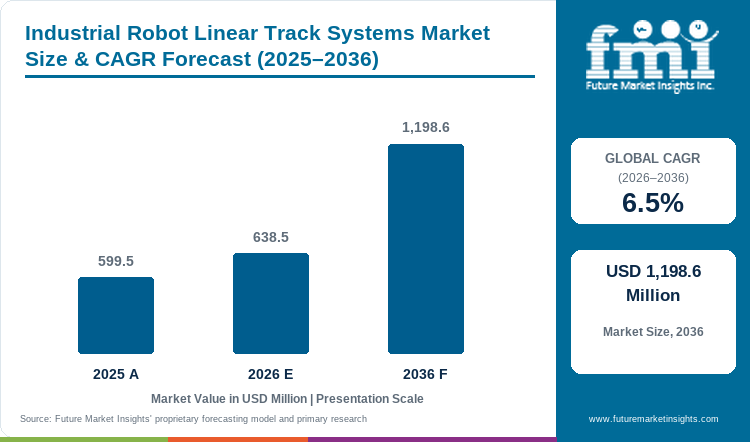
USD 638.5 million in 2026 and USD 1198.6 million by 2036 at a 6.5% CAGR.
The market was valued at USD 599.5 million in 2025. Demand is estimated at USD 638.5 million in 2026 and is projected to reach USD 1198.6 million by 2036 at 6.5% CAGR. The estimate covers servo-driven linear axes that transport industrial robots, including rails, carriages, drives, controls integration and major rebuilds. Static pedestals, passive gantries and linear guides sold without a robot travel function are excluded.
Demand expands with the industrial robotics market, as manufacturers extend one robot across several fixtures or process stations. Track-system revenue reflects axis length, payload, protective equipment and integration rather than robot unit count alone.
Key Takeaways
- The market is valued at USD 638.5 million in 2026 and is projected to create USD 560.1 million in additional value by 2036.
- Floor-mounted tracks is projected to hold 62.0% of Mounting Configuration demand in 2026 because they combine structural capacity with practical plant access.
- Above 1,000 kg moving mass is projected to hold 44.0% of Payload Class demand in 2026 because structural and drive requirements rise with combined moving mass.
- Above 10 meters is projected to hold 49.0% of Travel Length demand in 2026 because multi-station cells use reach extension to reduce robot count.
- A track can extend reach but also adds axis calibration, guarding and maintenance points that may reduce cell availability if integration is weak.
- Some of the key players in this market include Güdel, KUKA, ABB, FANUC, Yaskawa Motoman, Comau, Rollon, igus, Thomson Industries, Kawasaki Robotics.
Analyst Perspective
"A robot track creates value only when extra reach converts into fewer robots, higher fixture use or less handling. Structural accuracy and coordinated control determine whether that value survives production speed."
- Nikhil Kaitwade, Principal Consultant, Future Market Insights
How is the industrial robot linear track systems market segmented?
The industrial robot linear track systems market is segmented by mounting configuration, payload class, travel length, application, demand type and region.
Mounting configuration defines floor, overhead, wall or vertical layout. Payload class covers the moving robot package. Travel length and application determine reach duty, while demand type separates new cells from expansions and rebuilds.
Why do floor-mounted tracks lead mounting demand?
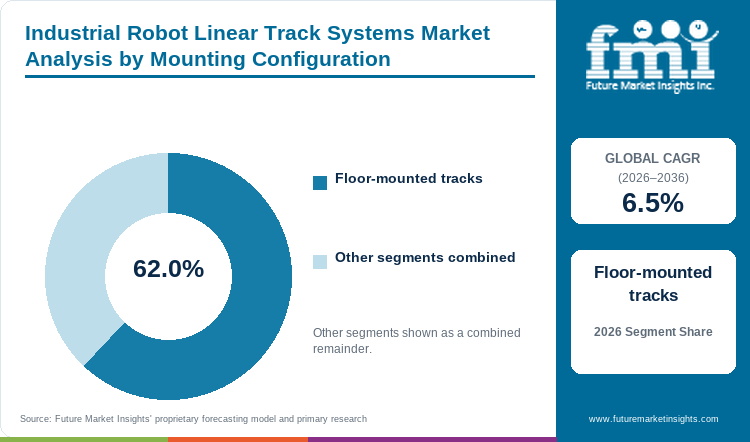
Floor-mounted tracks give the robot a rigid linear base without requiring the supporting structure of an elevated or wall-mounted system. They fit naturally beside welding lines, machine tools and pallet stations, and service access remains straightforward because the drive, carriage and cable-management components stay at floor level. Güdel's TrackMotion Floor range is designed to absorb dynamic robot loads in multiple directions and includes configurations for automotive body-in-white, general manufacturing and heavier robot classes.
- Floor-mounted tracks are estimated to account for 62.0% of mounting demand in 2026.
- Güdel's floor-mounted systems span standard and heavy-duty configurations, while overhead and wall-mounted variants are positioned as separate alternatives where plant layout requires them.
Why does the heavy-duty class lead value demand?
Track capacity is determined by more than robot payload. The structure also has to withstand the mass of the robot, process tooling and carried load together with acceleration, braking and overturning forces. That raises the engineering content of heavier systems through larger beams, guideways, gearboxes and carriages. Güdel's TMF-5, for example, is designed for robots such as the ABB IRB 8700, FANUC M-1000iA and KUKA KR 1000 titan, with robot weight plus payload extending to 6,300 kg.
- Above 1,000 kg moving mass is estimated to account for 44.0% of load-class value in 2026.
- Heavy-duty tracks use reinforced guide systems, larger drive components and stronger foundations to manage dynamic loads that rise well beyond the nominal weight of the robot itself.
Why do tracks above 10 meters lead travel-length value?
Long travel changes the economics of a robot cell by allowing one robot to serve work that would otherwise require several fixed stations. The rail can run past multiple fixtures, machines or sections of a large workpiece, but longer stroke also adds cost through beam sections, rack-and-pinion length, cable management and alignment work. Commercial systems extend well beyond 10 meters: Güdel specifies track lengths up to 100 meters on its heavy-duty TMF-5, while its precision platform offers strokes up to 48.5 meters.
- Tracks above 10 meters are estimated to account for 49.0% of travel-length value in 2026.
- Long-stroke designs allow a robot to cover several work positions from one coordinated linear axis, trading additional rail and installation cost against the need for more fixed robots.
Why do welding and joining lead application demand?
Large weldments often distribute seams across an area that exceeds the useful envelope of a stationary robot. Moving the complete robot along a linear axis keeps the torch within a workable orientation as it progresses along automotive structures, rail components and fabricated assemblies. Güdel has a floor-track variant specifically developed for automotive body-in-white handling and welding robots, while ABB integrates track motion into the robot's motion planning so the rail and manipulator follow a coordinated path.
- Welding and joining are estimated to account for 41.0% of application demand in 2026.
- Automotive body-in-white and other distributed welding tasks use robot tracks to extend the working envelope while retaining coordinated motion between the linear axis and robot.
Why do new installations lead demand type?
A robot track affects the physical cell from the foundation upward. Rail alignment, floor loading, guarding, cable routing, controller configuration and the robot's reachable envelope all have to be considered together. Heavy-duty systems can require specified floor thickness, anchor arrangements and load-bearing capacity, which makes installation easier to engineer before the cell is built than after production equipment is already in place.
- New cell installations are estimated to account for 55.0% of demand type in 2026.
- Track suppliers provide modular mechanical axes that can be configured around robot payload, stroke and application requirements during cell engineering, while retrofit projects must work around existing foundations and production layouts.
What are the drivers, restraints and opportunities in the Industrial Robot Linear Track Systems Market?
Multi-station automation drives adoption, foundation and guarding complexity restrain retrofits, and modular coordinated axes create an opportunity in flexible production.
- Driver: Manufacturers use one track-mounted robot to cover work envelopes that would otherwise require several fixed units.
- Restraint: Foundations, guarding, cable routing and coordinated-axis commissioning raise installed cost and project risk.
- Opportunity: Modular rails and offline simulation can shorten engineering for flexible, reconfigurable production cells.
Growth in the industrial robots market increases demand for external axes that extend robot reach. IFR reported 542,000 industrial-robot installations in 2024, providing a current activity benchmark for systems built around those robots.
A track changes the safety envelope and dynamic behavior of the robot. Integrators must verify floor load, rail straightness, stops, cable travel and coordinated control. These tasks can make a retrofit less attractive than adding a fixed robot unless the shared-workspace benefit is clear.
The industrial automation market supports modular cells in which robots serve several machines or fixtures. Standard rail modules, digital layout tools and condition monitoring can lower engineering effort and improve life-cycle service.
Which country CAGRs are profiled in the Industrial Robot Linear Track Systems Market?
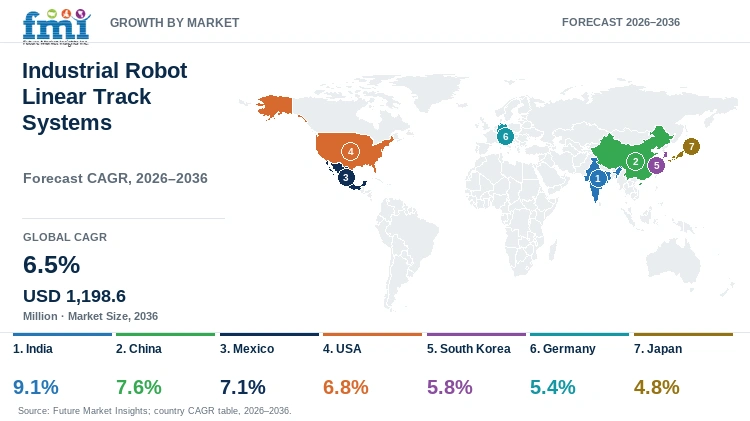
| Country | CAGR |
|---|---|
| India | 9.1% |
| China | 7.6% |
| Mexico | 7.1% |
| USA | 6.8% |
| South Korea | 5.8% |
| Germany | 5.4% |
| Japan | 4.8% |
How do country-level CAGRs compare in the Industrial Robot Linear Track Systems Market?
Industrial robot linear track demand depends on how often manufacturers need one robot to cover several work positions, long workpieces or multiple machines. India is adding new welding and machine-tending cells from a relatively low automation base. China combines high robot deployment with large automotive, battery and machinery industries. Mexico's opportunity is more concentrated in automotive production, while the USA has a broader mix of manufacturing applications. South Korea, Germany and Japan are mature automation markets, so purchasing is more closely tied to high-specification tracks, cell reconstruction and external-axis upgrades.
- India: New automotive and general-industry cells create room for locally engineered rail systems, especially where one robot must serve several fixtures or machines.
- China: About 295,000 industrial robots were installed in 2024, giving track suppliers a large flow of new cells alongside an installed base exceeding 2 million robots.
- Mexico: Automotive accounted for 63% of robot installations in 2024. Long-axis welding and body-component cells therefore form a more concentrated demand base than the country's overall manufacturing footprint suggests.
- USA: New robot installations reached 38,000 units in 2025. Automotive remained a major user, while metal and machinery, electrical-electronics and food processing broadened the types of cells that can use extended robot travel.
- South Korea: Robot density stood at 1,220 units per 10,000 manufacturing employees, reflecting an environment where linear tracks are used selectively to extend already intensive automation rather than simply introduce robotics.
- Germany: A dense installed robot base supports track replacements and brownfield redesigns where floor layout, safety zones and coordinated motion have to fit existing production assets. Germany had 449 robots per 10,000 manufacturing employees in the latest IFR comparison.
- Japan: Around 44,453 industrial robots were installed in 2024. Mature robot adoption favors external-axis upgrades where additional travel can expand cell coverage without adding another fixed robot.
Across the key countries in this market, these rates measure revenue within the defined product boundary and do not represent growth of the wider parent industry.
Country-wise Analysis
- India: 9.1% CAGR through 2036. New welding and machine-tending projects create demand for tracks designed into the cell from the beginning. Local system builders can fabricate bases, guarding and cable-management structures around imported robots and servo components, making commissioning support an important part of the purchase.
- China: 7.6% CAGR through 2036. A large stream of new robot installations gives linear-axis suppliers opportunities across automotive, battery and machinery plants. Domestic competition is strong, so differentiation moves toward moving-mass capacity, travel accuracy and reliable coordination between the robot and external servo axis. China's installed robot stock exceeded 2 million units in 2024.
- Mexico: 7.1% CAGR through 2036. Automotive concentration favors long welding cells where a robot moves between body or component fixtures rather than remaining at one fixed station. Regional integration capability, spare-part access and compatibility with robot brands used across North American plants influence equipment selection. Automotive represented 63% of Mexican robot installations in 2024.
- USA: 6.8% CAGR through 2036. The 38,000 industrial robots installed in 2025 add to the future base for external axes, while the application mix is becoming less dependent on vehicle production alone. Linear tracks are useful in fabrication and machine tending when one robot can cover several work zones more economically than multiple fixed units.
- South Korea: 5.8% CAGR through 2036. High automation density changes the role of the track system. Battery, electronics and vehicle plants are more likely to use linear axes where floor space is constrained or where one robot must cover several process positions. Structural stiffness and coordinated motion matter more in these cells than simple reach extension.
- Germany: 5.4% CAGR through 2036. Much of the opportunity sits in established production lines. Adding or replacing a rail axis requires attention to foundations, guarding, offline simulation and the interaction between new motion equipment and existing robot programs. That favors engineered retrofit work rather than standardized track sales.
- Japan: 4.8% CAGR through 2036. Demand centers on precise integration with established domestic robot platforms. With 44,453 industrial robots installed in 2024 and a mature automation base already in place, linear-track purchases are more closely associated with cell upgrades, additional process coverage and replacement of older external axes.
Who are the notable companies in the Industrial Robot Linear Track Systems Market?
Güdel, KUKA, ABB, FANUC, Yaskawa Motoman, Comau, Rollon, igus, Thomson Industries, Kawasaki Robotics are the notable companies profiled in this market.
Robot OEMs compete with independent track specialists and linear-motion suppliers. Direct scores require a named robot travel axis or track-integrated system; component suppliers remain Unscored where public evidence does not establish a complete track package.
- Dedicated Track and Linear-Axis Suppliers: Güdel, Rollon, igus.
- Robot OEM Track Platforms: KUKA, ABB, FANUC, Yaskawa Motoman, Kawasaki Robotics.
- Integrated Automation and Components: Comau, Thomson Industries.
Competitive Benchmarking: Industrial Robot Linear Track Systems Market
| Company | Direct Track Evidence | Coordinated Control | Global Support | Geographic Reach |
|---|---|---|---|---|
| Güdel | High | High | High | Global |
| KUKA | High | High | High | Global |
| ABB | High | High | High | Global |
| FANUC | High | High | High | Global |
| Yaskawa Motoman | High | High | High | Global |
| Comau | Medium | High | High | Global |
| Rollon | Medium | High | High | Global |
| igus | Medium | Medium | High | Global |
| Thomson Industries | Unscored | High | High | Global |
| Kawasaki Robotics | Medium | High | High | Global |
High direct evidence requires a named industrial-robot track platform. Medium reflects track-integrated systems or relevant seventh-axis supply. Unscored denotes component capability without a complete public robot-track system.
Key Developments in the Industrial Robot Linear Track Systems Market
- In 2026, IFR reported that US industrial-robot installations rose 11.0% to 38,000 units in 2025, expanding the potential base for external axes.
- In September 2025, IFR reported 542,000 industrial robots installed worldwide in 2024, with 74.0% installed in Asia.
- In 2025, Güdel continued to expand the documented TrackMotion family across floor, overhead, precision and vertical robot travel configurations.
Key Players in the Industrial Robot Linear Track Systems Market
Dedicated Track and Linear-Axis Suppliers
- Güdel
- Rollon
- igus
Robot OEM Track Platforms
- KUKA
- ABB
- FANUC
- Yaskawa Motoman
- Kawasaki Robotics
Integrated Automation and Components
- Comau
- Thomson Industries
Industrial Robot Linear Track Systems Market - Report Scope
| Coverage field | Report scope |
|---|---|
| Market Size | USD 638.5 million in 2026 and USD 1198.6 million by 2036 at 6.5% CAGR. |
| Market Definition | Servo-driven linear tracks that transport an industrial robot as an external axis, including rail, carriage, drive, control integration and major rebuild packages. |
| Segmentation | Mounting configuration, payload class, travel length, application, demand type and region. |
| Regional Coverage | North America, Latin America, Western Europe, Eastern Europe, East Asia, South Asia and Pacific, and Middle East and Africa. |
| Countries Covered | India, China, Mexico, USA, South Korea, Germany, Japan and more than 20 countries included in the full report. |
| Key Companies Profiled | Güdel, KUKA, ABB, FANUC, Yaskawa Motoman, Comau, Rollon, igus, Thomson Industries, Kawasaki Robotics. |
| Forecast Period | 2026 to 2036. |
| Approach | Bottom-up model using robot installations, track attachment rates, travel length, payload mix, new-cell activity and rebuild spending. |
Industrial Robot Linear Track Systems Market - Research Methodology
| Method | Approach |
|---|---|
| Primary Research | FMI analysts gathered input from manufacturers, system integrators, distributors, plant engineers, procurement teams and application specialists. Interviews tested purchasing criteria, replacement cycles, qualification work and technical-service requirements. |
| Desk Research | Desk research covered government statistics, standards, industry associations, technical literature, patents, official product information and corporate announcements. Evidence was screened for scope, date and direct relevance. |
| Market Sizing and Forecasting | Bottom-up model using robot installations, track attachment rates, travel length, payload mix, new-cell activity and rebuild spending. |
| Data Validation | Estimates were checked against parent-market activity, installed-base indicators, product specifications and supplier participation. Adjacent products without the defined function were excluded. |
Industrial Robot Linear Track Systems Market by Segments
Industrial Robot Linear Track Systems Market segmented by Mounting Configuration:
- Floor-mounted tracks
- Overhead tracks
- Wall-mounted tracks
- Vertical and multi-axis track systems
Industrial Robot Linear Track Systems Market segmented by Payload Class:
- Up to 500 kg
- 501 to 1,000 kg
- Above 1,000 kg moving mass
Industrial Robot Linear Track Systems Market segmented by Travel Length:
- Up to 5 meters
- Above 5 to 10 meters
- Above 10 meters
Industrial Robot Linear Track Systems Market segmented by Application:
- Welding and joining
- Machine tending
- Material handling and palletizing
- Painting and coating
- Inspection and other processes
Industrial Robot Linear Track Systems Market segmented by Demand Type:
- New cell installations
- Capacity expansions
- Replacement and rebuilds
- Control and cable upgrades
Industrial Robot Linear Track Systems Market by Region:
- North America
- United States
- Canada
- Latin America
- Brazil
- Mexico
- Argentina
- Chile
- Western Europe
- Germany
- France
- United Kingdom
- Italy
- Spain
- Benelux
- Nordics
- Eastern Europe
- Poland
- Czech Republic
- Romania
- Hungary
- East Asia
- China
- Japan
- South Korea
- South Asia and Pacific
- India
- ASEAN
- Australia and New Zealand
- Middle East and Africa
- GCC Countries
- South Africa
- Türkiye
- Israel
Research Sources and Bibliography
- International Federation of Robotics. (2025, September 25). World Robotics 2025 industrial robot statistics.
- International Federation of Robotics. (2026). United States robot installation update for 2025.
- International Organization for Standardization. (2011). ISO 10218-1 Robots and robotic devices safety requirements.
- Güdel. (n.d.; accessed September 23, 2026). TrackMotion product family.
- KUKA. (n.d.; accessed September 23, 2026). KL linear units.
- ABB. (n.d.; accessed September 23, 2026). IRBT track motion systems.
- National Institute of Standards and Technology. (2025). Robotics and intelligent systems resources.
- Future Market Insights. (2026). Industrial Robotics Market.
This bibliography is provided for reader reference and is not exhaustive. The full report contains the complete reference list and detailed citations.
This Report Answers
- How large is the industrial robot linear track systems market in 2026 and 2036?
- Which product specification leads demand in 2026?
- What operating condition converts technical need into a purchase?
- Which constraint can delay qualification or replacement?
- How do country growth rates compare across the profiled markets?
- Which companies provide direct or adjacent market capability?
Frequently Asked Questions
How big is the industrial robot linear track systems market in 2026?
The industrial robot linear track systems market is valued at USD 638.5 million in 2026 and is projected to reach USD 1198.6 million by 2036. The estimate covers revenue within the stated market definition and excludes adjacent equipment or chemicals sold without the required function.
What is the CAGR of the industrial robot linear track systems market from 2026 to 2036?
The market is projected to grow at 6.5% CAGR between 2026 and 2036. Expansion depends on end-market output together with the rate at which plants adopt higher-specification products.
Which mounting configuration leads the industrial robot linear track systems market?
Floor-mounted tracks is expected to hold 62.0% share in 2026 because they combine structural capacity with practical plant access. Floor mounting remains the reference arrangement for long travel and heavy robots.
Which countries are projected to record higher growth?
India is projected at 9.1% CAGR, followed by China at 7.6% and Mexico at 7.1% through 2036. The comparison reflects local production investment and the timing of replacement or qualification cycles.
Which companies are active in the industrial robot linear track systems market?
The profiled group includes Güdel, KUKA, ABB, FANUC, Yaskawa Motoman, Comau, Rollon, igus, Thomson Industries, Kawasaki Robotics. Capability differs by product range and application evidence.
Preview the report firsthand - request a free sample
Get SampleGet the brochure for pricing and purchase details.
Get PDFTable of Content
- Key Takeaways
- Market Size and CAGR
- Top Growth Driver
- Fastest Growing Segment
- Leading Region
- Key Companies
- Emerging Opportunities
- Executive Summary
- Global Market Outlook
- Demand-side Trends
- Supply-side Trends
- Technology Roadmap Analysis
- Analysis and Recommendations
- Analyst Perspective (What is happening? Why now? What should investors know?)
- Key Questions Answered
- How large is the market?
- What is the CAGR?
- What are key trends?
- Which region dominates?
- Who are the leaders?
- Market Overview
- Market Coverage / Taxonomy
- Market Definition / Scope / Limitations
- Research Methodology
- Chapter Orientation
- Analytical Lens and Working Hypotheses
- Market Structure, Signals, and Trend Drivers
- Benchmarking and Cross-market Comparability
- Market Sizing, Forecasting, and Opportunity Mapping
- Research Design and Evidence Framework
- Desk Research Programme (Secondary Evidence)
- Expert Input and Fieldwork (Primary Evidence)
- Tooling, Models, and Reference Databases
- Data Engineering and Model Build
- Quality Assurance and Audit Trail
- Market Background
- Market Dynamics (Drivers, Restraints, Opportunity, Trends)
- Scenario Forecast (Optimistic, Likely, Conservative)
- Impact Analysis
- AI Impact
- Sustainability Impact
- Regulatory Impact
- Technology Impact
- Consumer / Buyer Analysis
- Purchase Drivers
- Adoption Barriers
- Buyer Journey
- Opportunity Map Analysis
- Product Life Cycle Analysis
- Supply Chain Analysis
- Investment Feasibility Matrix
- Value Chain Analysis
- PESTLE and Porter's Analysis
- Regulatory Landscape
- Regional Parent Market Outlook
- Production and Consumption Statistics
- Import and Export Statistics
- Global Market Analysis and Forecast, 2021 to 2036
- Historical Market Size Value (USD Million) Analysis, 2021 to 2025
- Current and Future Market Size Value (USD Million) Projections, 2026 to 2036
- Y-o-Y Growth Trend Analysis
- Absolute $ Opportunity Analysis
- Global Market Pricing Analysis, 2021 to 2036
- Global Market Analysis and Forecast, By Mounting Configuration, 2021 to 2036
- Introduction / Key Findings
- Historical Market Size Value (USD Million) Analysis By Mounting Configuration, 2021 to 2025
- Current and Future Market Size Value (USD Million) Analysis and Forecast By Mounting Configuration, 2026 to 2036
- Floor-mounted tracks
- Overhead tracks
- Wall-mounted tracks
- Vertical and multi-axis track systems
- Y-o-Y Growth Trend Analysis By Mounting Configuration, 2021 to 2025
- Absolute $ Opportunity Analysis By Mounting Configuration, 2026 to 2036
- Global Market Analysis and Forecast, By Payload Class, 2021 to 2036
- Introduction / Key Findings
- Historical Market Size Value (USD Million) Analysis By Payload Class, 2021 to 2025
- Current and Future Market Size Value (USD Million) Analysis and Forecast By Payload Class, 2026 to 2036
- Up to 500 kg
- 501 to 1,000 kg
- Above 1,000 kg moving mass
- Y-o-Y Growth Trend Analysis By Payload Class, 2021 to 2025
- Absolute $ Opportunity Analysis By Payload Class, 2026 to 2036
- Global Market Analysis and Forecast, By Travel Length, 2021 to 2036
- Introduction / Key Findings
- Historical Market Size Value (USD Million) Analysis By Travel Length, 2021 to 2025
- Current and Future Market Size Value (USD Million) Analysis and Forecast By Travel Length, 2026 to 2036
- Up to 5 meters
- Above 5 to 10 meters
- Above 10 meters
- Y-o-Y Growth Trend Analysis By Travel Length, 2021 to 2025
- Absolute $ Opportunity Analysis By Travel Length, 2026 to 2036
- Global Market Analysis and Forecast, By Application, 2021 to 2036
- Introduction / Key Findings
- Historical Market Size Value (USD Million) Analysis By Application, 2021 to 2025
- Current and Future Market Size Value (USD Million) Analysis and Forecast By Application, 2026 to 2036
- Welding and joining
- Machine tending
- Material handling and palletizing
- Painting and coating
- Inspection and other processes
- Y-o-Y Growth Trend Analysis By Application, 2021 to 2025
- Absolute $ Opportunity Analysis By Application, 2026 to 2036
- Global Market Analysis and Forecast, By Demand Type, 2021 to 2036
- Introduction / Key Findings
- Historical Market Size Value (USD Million) Analysis By Demand Type, 2021 to 2025
- Current and Future Market Size Value (USD Million) Analysis and Forecast By Demand Type, 2026 to 2036
- New cell installations
- Capacity expansions
- Replacement and rebuilds
- Control and cable upgrades
- Y-o-Y Growth Trend Analysis By Demand Type, 2021 to 2025
- Absolute $ Opportunity Analysis By Demand Type, 2026 to 2036
- Global Market Analysis and Forecast, By Region, 2021 to 2036
- Introduction
- Historical Market Size Value (USD Million) Analysis By Region, 2021 to 2025
- Current Market Size Value (USD Million) Analysis and Forecast By Region, 2026 to 2036
- North America
- Latin America
- Western Europe
- Eastern Europe
- East Asia
- South Asia and Pacific
- Middle East and Africa
- Market Attractiveness Analysis By Region
- North America Market Analysis and Forecast, By Country, 2021 to 2036
- Historical Market Size Value (USD Million) Trend Analysis By Market Taxonomy, 2021 to 2025
- Market Size Value (USD Million) Forecast By Market Taxonomy, 2026 to 2036
- By Country
- United States
- Canada
- By Mounting Configuration
- By Payload Class
- By Travel Length
- By Application
- By Demand Type
- By Country
- Market Attractiveness Analysis
- By Country
- By Mounting Configuration
- By Payload Class
- By Travel Length
- By Application
- By Demand Type
- Key Takeaways
- Latin America Market Analysis and Forecast, By Country
- Historical Market Size Value (USD Million) Trend Analysis By Market Taxonomy, 2021 to 2025
- Market Size Value (USD Million) Forecast By Market Taxonomy, 2026 to 2036
- By Country
- Brazil
- Mexico
- Argentina
- Chile
- By Mounting Configuration
- By Payload Class
- By Travel Length
- By Application
- By Demand Type
- By Country
- Market Attractiveness Analysis
- By Country
- By Mounting Configuration
- By Payload Class
- By Travel Length
- By Application
- By Demand Type
- Key Takeaways
- Western Europe Market Analysis and Forecast, By Country
- Historical Market Size Value (USD Million) Trend Analysis By Market Taxonomy, 2021 to 2025
- Market Size Value (USD Million) Forecast By Market Taxonomy, 2026 to 2036
- By Country
- Germany
- France
- United Kingdom
- Italy
- Spain
- Benelux
- Nordics
- By Mounting Configuration
- By Payload Class
- By Travel Length
- By Application
- By Demand Type
- By Country
- Market Attractiveness Analysis
- By Country
- By Mounting Configuration
- By Payload Class
- By Travel Length
- By Application
- By Demand Type
- Key Takeaways
- Eastern Europe Market Analysis and Forecast, By Country
- Historical Market Size Value (USD Million) Trend Analysis By Market Taxonomy, 2021 to 2025
- Market Size Value (USD Million) Forecast By Market Taxonomy, 2026 to 2036
- By Country
- Poland
- Czech Republic
- Romania
- Hungary
- By Mounting Configuration
- By Payload Class
- By Travel Length
- By Application
- By Demand Type
- By Country
- Market Attractiveness Analysis
- By Country
- By Mounting Configuration
- By Payload Class
- By Travel Length
- By Application
- By Demand Type
- Key Takeaways
- East Asia Market Analysis and Forecast, By Country
- Historical Market Size Value (USD Million) Trend Analysis By Market Taxonomy, 2021 to 2025
- Market Size Value (USD Million) Forecast By Market Taxonomy, 2026 to 2036
- By Country
- China
- Japan
- South Korea
- By Mounting Configuration
- By Payload Class
- By Travel Length
- By Application
- By Demand Type
- By Country
- Market Attractiveness Analysis
- By Country
- By Mounting Configuration
- By Payload Class
- By Travel Length
- By Application
- By Demand Type
- Key Takeaways
- South Asia and Pacific Market Analysis and Forecast, By Country
- Historical Market Size Value (USD Million) Trend Analysis By Market Taxonomy, 2021 to 2025
- Market Size Value (USD Million) Forecast By Market Taxonomy, 2026 to 2036
- By Country
- India
- ASEAN
- Australia and New Zealand
- By Mounting Configuration
- By Payload Class
- By Travel Length
- By Application
- By Demand Type
- By Country
- Market Attractiveness Analysis
- By Country
- By Mounting Configuration
- By Payload Class
- By Travel Length
- By Application
- By Demand Type
- Key Takeaways
- Middle East and Africa Market Analysis and Forecast, By Country
- Historical Market Size Value (USD Million) Trend Analysis By Market Taxonomy, 2021 to 2025
- Market Size Value (USD Million) Forecast By Market Taxonomy, 2026 to 2036
- By Country
- GCC Countries
- South Africa
- Türkiye
- Israel
- By Mounting Configuration
- By Payload Class
- By Travel Length
- By Application
- By Demand Type
- By Country
- Market Attractiveness Analysis
- By Country
- By Mounting Configuration
- By Payload Class
- By Travel Length
- By Application
- By Demand Type
- Key Takeaways
- Key Countries Market Analysis
- United States
- Pricing Analysis
- Market Share Analysis, 2025
- By Mounting Configuration
- By Payload Class
- By Travel Length
- By Application
- By Demand Type
- Canada
- Pricing Analysis
- Market Share Analysis, 2025
- By Mounting Configuration
- By Payload Class
- By Travel Length
- By Application
- By Demand Type
- Mexico
- Pricing Analysis
- Market Share Analysis, 2025
- By Mounting Configuration
- By Payload Class
- By Travel Length
- By Application
- By Demand Type
- Brazil
- Pricing Analysis
- Market Share Analysis, 2025
- By Mounting Configuration
- By Payload Class
- By Travel Length
- By Application
- By Demand Type
- Chile
- Pricing Analysis
- Market Share Analysis, 2025
- By Mounting Configuration
- By Payload Class
- By Travel Length
- By Application
- By Demand Type
- Germany
- Pricing Analysis
- Market Share Analysis, 2025
- By Mounting Configuration
- By Payload Class
- By Travel Length
- By Application
- By Demand Type
- United Kingdom
- Pricing Analysis
- Market Share Analysis, 2025
- By Mounting Configuration
- By Payload Class
- By Travel Length
- By Application
- By Demand Type
- Italy
- Pricing Analysis
- Market Share Analysis, 2025
- By Mounting Configuration
- By Payload Class
- By Travel Length
- By Application
- By Demand Type
- Spain
- Pricing Analysis
- Market Share Analysis, 2025
- By Mounting Configuration
- By Payload Class
- By Travel Length
- By Application
- By Demand Type
- France
- Pricing Analysis
- Market Share Analysis, 2025
- By Mounting Configuration
- By Payload Class
- By Travel Length
- By Application
- By Demand Type
- India
- Pricing Analysis
- Market Share Analysis, 2025
- By Mounting Configuration
- By Payload Class
- By Travel Length
- By Application
- By Demand Type
- ASEAN
- Pricing Analysis
- Market Share Analysis, 2025
- By Mounting Configuration
- By Payload Class
- By Travel Length
- By Application
- By Demand Type
- Australia and New Zealand
- Pricing Analysis
- Market Share Analysis, 2025
- By Mounting Configuration
- By Payload Class
- By Travel Length
- By Application
- By Demand Type
- China
- Pricing Analysis
- Market Share Analysis, 2025
- By Mounting Configuration
- By Payload Class
- By Travel Length
- By Application
- By Demand Type
- Japan
- Pricing Analysis
- Market Share Analysis, 2025
- By Mounting Configuration
- By Payload Class
- By Travel Length
- By Application
- By Demand Type
- South Korea
- Pricing Analysis
- Market Share Analysis, 2025
- By Mounting Configuration
- By Payload Class
- By Travel Length
- By Application
- By Demand Type
- Poland
- Pricing Analysis
- Market Share Analysis, 2025
- By Mounting Configuration
- By Payload Class
- By Travel Length
- By Application
- By Demand Type
- Hungary
- Pricing Analysis
- Market Share Analysis, 2025
- By Mounting Configuration
- By Payload Class
- By Travel Length
- By Application
- By Demand Type
- Türkiye
- Pricing Analysis
- Market Share Analysis, 2025
- By Mounting Configuration
- By Payload Class
- By Travel Length
- By Application
- By Demand Type
- South Africa
- Pricing Analysis
- Market Share Analysis, 2025
- By Mounting Configuration
- By Payload Class
- By Travel Length
- By Application
- By Demand Type
- United States
- Market Structure Analysis
- Competition Dashboard
- Competition Benchmarking
- Market Share Analysis of Top Players
- By Regional
- By Mounting Configuration
- By Payload Class
- By Travel Length
- By Application
- By Demand Type
- Emerging Startups
- Innovation Benchmarking
- Competition Analysis
- Competition Deep Dive
- Güdel
- Overview
- Product Portfolio
- Profitability by Market Segments
- Sales Footprint
- Strategy Overview
- Marketing Strategy
- Product Strategy
- Channel Strategy
- KUKA
- ABB
- FANUC
- Yaskawa Motoman
- Comau
- Rollon
- igus
- Thomson Industries
- Kawasaki Robotics
- Güdel
- Case Studies
- Success Stories
- Recent Developments
- Competition Deep Dive
- Assumptions & Acronyms Used


