

- Industry Size (2026)
- USD 760 Mn
- Forecast (2036)
- USD 2180 Mn
- CAGR (2026 to 2036)
- 11.1%
AI Packaging Sensor Market Forecast and Outlook 2026 to 2036
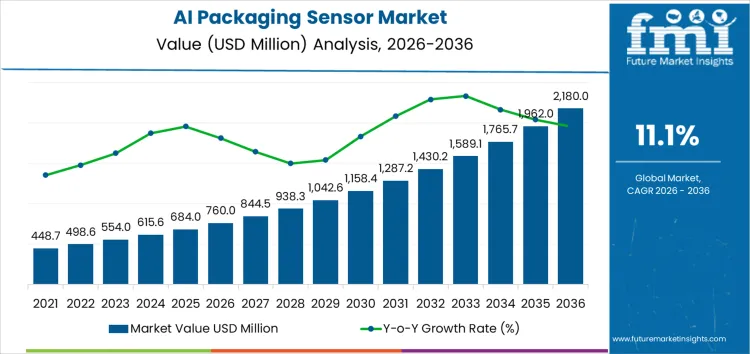
In 2026, the market is expected to be valued at USD 760 million, with steady growth anticipated, reaching USD 2,180 million by 2036. The compound annual growth rate (CAGR) for the market is forecasted at 11.1%, driven by increasing demand for intelligent packaging solutions across various industries such as food and beverage, pharmaceuticals, and logistics. AI-powered sensors in packaging provide valuable real-time data on product conditions, enhancing supply chain efficiency and product quality control.
The market growth is influenced by the rising adoption of smart packaging technologies, as companies seek ways to improve traceability, reduce waste, and ensure product safety. With growing consumer demand for transparency and safety, AI packaging sensors are gaining traction. The market is expected to continue its upward trend, supported by technological advancements and increased investment in automation across industries that rely heavily on packaging.
Quick Stats of the AI Packaging Sensor Market
- AI Packaging Sensor Market Value (2026): USD 760 million
- AI Packaging Sensor Market Forecast Value (2036): USD 2,180 million
- AI Packaging Sensor Market Global Forecast CAGR (2026-2036): 11.1%
- AI Packaging Sensor Market Leading Segment: AI-Driven Sensor Fusion & Analytics 55%
- Key Growth Regions in AI Packaging Sensor Market: China
- Top Players in AI Packaging Sensor Market: Avery Dennison, Schreiner MediPharm, Innosens, UFlex, Local integrators, Toppan, Sensitech
What is the Growth Forecast for the AI Packaging Sensor Market through 2036?
The growth forecast for the AI packaging sensor market reflects strong and consistent expansion, with a projected CAGR of 11.1%. Starting at USD 760 million in 2026, the market is expected to rise steadily over the next decade, reaching USD 844.8 million in 2027, USD 939.2 million in 2028, and USD 1,044.9 million in 2029. By 2030, the market value is projected to grow to USD 1,162.2 million, continuing its upward trajectory.
From 2031 to 2036, the market will experience continued growth, reaching USD 1,291.4 million in 2031, USD 1,433 million in 2032, and USD 1,587.3 million in 2033. The market will continue expanding, with values reaching USD 1,755.7 million in 2034, USD 1,939.7 million in 2035, and USD 2,180 million by 2036. The growth contribution index highlights the significant role of AI packaging sensors in advancing packaging solutions and improving efficiency, positioning the market for long-term success.
AI Packaging Sensor Market Key Takeaways
| Metric | Value |
|---|---|
| Industry Sales Value (2026) | USD 760 million |
| Industry Forecast Value (2036) | USD 2,180 million |
| Industry Forecast CAGR (2026-2036) | 11.1% |
What Is Driving the Demand for the AI Packaging Sensor Market Globally?
The global demand for AI packaging sensors is being driven by rising expectations for smarter, more efficient packaging systems that enhance product safety, traceability, and supply chain visibility. AI packaging sensors combine real time data capture with machine learning analytics to monitor package conditions such as temperature, humidity, shock, tilt, and seal integrity-throughout distribution and storage. In industries such as food and beverage, pharmaceuticals, and electronics, maintaining optimal conditions is essential to prevent spoilage, degradation, or damage.
Traditional static monitoring methods often fail to identify transient excursions or patterns that may affect product quality, whereas AI enabled sensors can detect anomalies, predict failures, and trigger corrective actions before losses occur. Growth in global cold chain logistics, rising demand for accountable quality assurance, and expanding e commerce fulfilment networks reinforce the need for intelligent sensor systems that help stakeholders minimize waste, reduce recalls, and demonstrate compliance with safety standards and regulatory requirements.
Future demand for AI packaging sensors is expected to grow as digital transformation continues across supply chains and as stakeholders seek deeper insights into packaging performance and environmental impact. Advances in sensor technology, connectivity (including low power wide area networks and 5G), and edge AI processing will make real time monitoring more accurate, cost effective, and scalable across diverse packaging formats. Integration with blockchain and traceability platforms will support end to end data integrity and transparency, meeting customer expectations for provenance and authenticity.
Sustainability goals will further influence adoption, as intelligent sensors help optimize transport routes, reduce over packaging, and minimize spoilage, contributing to lower carbon footprints. Regulatory frameworks that emphasize product safety and accountability-from food safety modernization to pharmaceutical cold chain governance-will reinforce requirements for robust monitoring solutions. As manufacturing, logistics, and retail sectors prioritize risk mitigation and continuous improvement, AI packaging sensors are poised to become standard tools for enhancing operational resilience, customer satisfaction, and quality assurance in global supply chains.
What are the Leading Segments in the Global AI Packaging Sensor Market?
The global AI packaging sensor market is segmented by material/substrate and technology. Among materials, printed electronics on PET/paper lead the market, capturing 50% of the share, followed by paper/PET hybrids, PET-based films, and paper substrates. Printed electronics on PET/paper are favored for their flexibility, cost-effectiveness, and compatibility with a wide range of packaging applications. On the technology side, AI-driven sensor fusion & analytics dominates the market, holding 55% of the share, followed by edge AI + cloud analytics, low-cost AI sensor chips, and cloud AI monitoring. AI-driven sensor fusion and analytics enable real-time data processing and decision-making, improving packaging functionality and consumer experiences.
What Drives the Growth of Printed Electronics on PET/Paper in the AI Packaging Sensor Market?
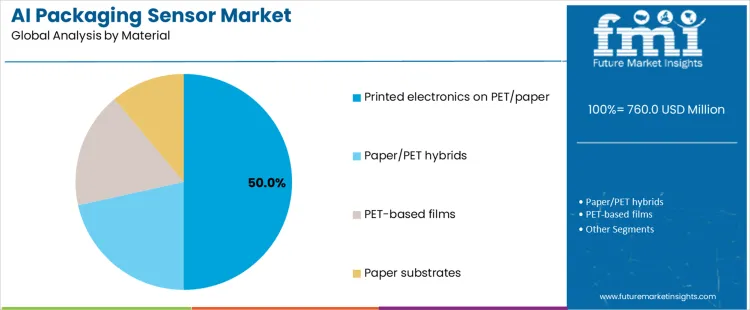
Printed electronics on PET/paper are the leading material/substrate in the AI packaging sensor market, capturing 50% of the share. This material is widely used due to its ability to integrate electronic components such as sensors and circuits onto flexible, lightweight substrates, making it ideal for packaging applications. PET/paper-based substrates provide the necessary durability, flexibility, and low cost for mass production, making them a preferred choice for packaging solutions that require smart functionalities, such as real-time tracking, environmental monitoring, and interactive features.
The growing demand for smart packaging in industries such as food, pharmaceuticals, and logistics, where real-time data and enhanced consumer engagement are becoming increasingly important, is driving the adoption of printed electronics on PET/paper substrates. Additionally, advancements in printing technologies have made it possible to produce these materials at scale, further supporting their widespread use. As the trend toward smart, connected packaging continues to grow, printed electronics on PET/paper will likely remain a dominant material in the AI packaging sensor market.
What is Driving the Demand for AI-Driven Sensor Fusion & Analytics in the AI Packaging Sensor Market?
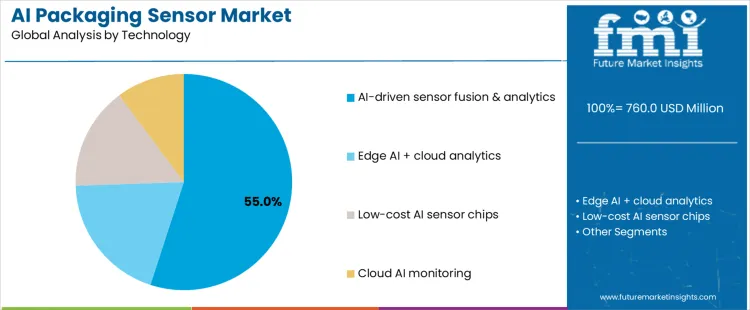
AI-driven sensor fusion & analytics is the leading technology in the AI packaging sensor market, accounting for 55% of the share. This technology combines data from multiple sensors to provide enhanced accuracy and actionable insights in real-time, making it particularly valuable for packaging applications that require constant monitoring and dynamic adjustments. AI-driven sensor fusion enables packaging systems to detect and respond to changes in environmental factors such as temperature, humidity, and product integrity, providing a more comprehensive view of the condition of packaged goods.
The integration of AI analytics allows for predictive insights, optimization of supply chains, and improvements in product quality, all of which contribute to enhanced consumer experiences and reduced waste. The demand for AI-driven sensor fusion & analytics is fueled by the growing need for smart packaging solutions that offer enhanced functionality, real-time monitoring, and greater consumer interaction. As industries continue to invest in automation, data-driven decision-making, and supply chain efficiency, the adoption of AI-driven sensor fusion & analytics in packaging is expected to continue to expand, further solidifying its dominance in the market.
What is the Key Dynamics of the Global AI Packaging Sensor Market?
The global AI packaging sensor market is expanding as manufacturers integrate smart sensing technologies into packaging systems to improve visibility, quality, safety and supply chain efficiency. AI enabled sensors monitor conditions such as temperature, humidity, shock, tampering and seal integrity throughout distribution and storage, providing real time data that drives predictive analytics and automated decisions. Growth is supported by rising demand for cold chain assurance, anti counterfeiting, product quality monitoring and digital traceability. Adoption spans food and beverage, pharmaceuticals, logistics and consumer goods sectors where enhanced packaging intelligence helps reduce waste, improve compliance and boost customer confidence worldwide.
What are the Key Drivers for the Global AI Packaging Sensor Market?
Increasing focus on product safety and quality assurance is a primary driver of the AI packaging sensor market. Brands and supply chain partners deploy smart sensors that detect deviations from ideal conditions and trigger alerts or corrective actions. Rising expectations for real time visibility and traceability in cold chain logistics, particularly for perishable foods and temperature sensitive medicines, encourage use of AI driven sensing platforms. Improvements in sensor hardware, connectivity (e.g., IoT) and machine learning analytics enable richer interpretation of packaging condition data. Regulatory emphasis on compliance and reporting further motivates investment in intelligent packaging systems that deliver actionable insights and risk reduction.
What are the Restraints for the Global AI Packaging Sensor Market?
One restraint is the complexity and cost of integrating AI packaging sensors into existing packaging and data management ecosystems. Deploying sensors, connectivity modules and analytics infrastructure requires upfront investment and often backend integration with enterprise systems and cloud platforms. Smaller enterprises may find the technology cost prohibitive relative to traditional monitoring approaches. Challenges in ensuring reliable connectivity, particularly in remote or cross border logistics environments, can influence sensor performance and data continuity. Data privacy, security and governance concerns also affect adoption, requiring careful planning to protect sensitive shipment information and compliance with regional data regulations.
What is the Key Trends in the Global AI Packaging Sensor Market?
A key trend is convergence of AI packaging sensors with cloud platforms and edge analytics that process data in real time and deliver predictive insights. Packaging solutions increasingly leverage federated learning and adaptive models that improve performance monitoring with limited data transfer. Development of low power, miniaturised sensor hardware and energy harvesting techniques enhances viability for single use and reusable packaging formats. Integration of AI sensors with digital product passports, blockchain and traceability ecosystems supports transparent, authenticated supply chain records. Collaboration among packaging manufacturers, sensor developers and logistics partners is advancing standardised interfaces and protocols that scale smart packaging across industries and regions.
What is the Country-Wise Analysis of the AI Packaging Sensor Market?
The AI packaging sensor market is expected to experience strong growth, driven by the increasing demand for intelligent, data-driven packaging solutions across industries such as food and beverage, pharmaceuticals, and logistics. AI packaging sensors enable real-time monitoring and optimization of packaging systems, enhancing product quality, reducing waste, and improving supply chain efficiency. High-growth markets like China and India are witnessing strong demand due to rapid industrialization, technological advancements, and increasing focus on smart packaging solutions. Developed markets such as the USA, Germany, and Brazil are also experiencing steady growth, supported by the increasing adoption of automation, AI-driven technologies, and the push for sustainability and efficiency in packaging systems.
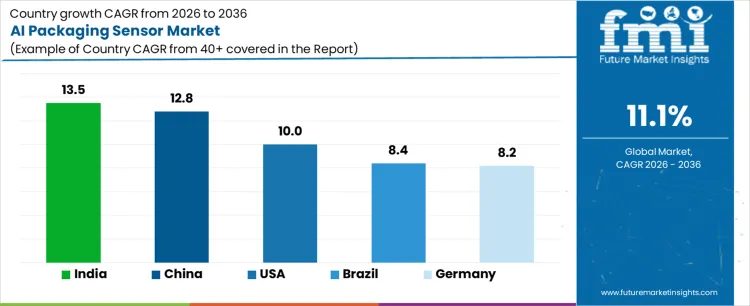
| Country | CAGR (%) |
|---|---|
| China | 12.8 |
| India | 13.5 |
| United States | 10 |
| Germany | 8.2 |
| Brazil | 8.4 |
What is the Growth Outlook for the AI Packaging Sensor Market in China?
The AI packaging sensor market in China is expected to grow at a strong pace, with a projected CAGR of 12.8%. China’s rapidly expanding industrial base, coupled with growing investments in automation and AI technologies, is driving significant demand for intelligent packaging solutions. The increasing focus on supply chain optimization, product quality control, and waste reduction is further fueling the adoption of AI packaging sensors. As China continues to lead in manufacturing and logistics, the demand for AI-powered packaging systems that can monitor and improve efficiency in real-time is expected to grow rapidly. The market is also supported by government initiatives aimed at improving manufacturing standards and promoting the use of smart technologies in packaging.
What is the Market Outlook for the AI Packaging Sensor Market in India?
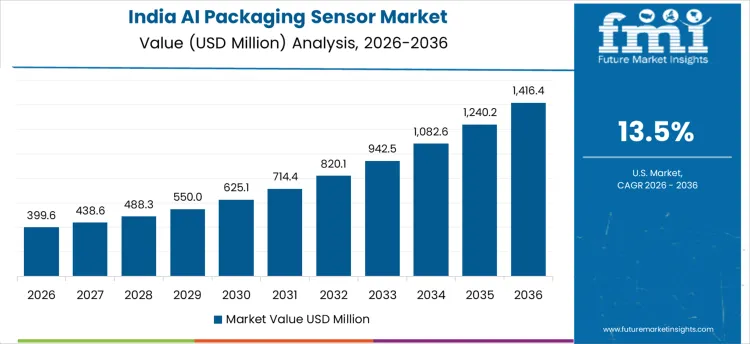
The AI packaging sensor market in India is projected to grow at the highest rate, with a projected CAGR of 13.5%. India’s growing manufacturing sector, coupled with increasing digitalization and advancements in AI technology, is driving the demand for smarter, data-driven packaging solutions. The need for packaging systems that improve efficiency, reduce waste, and enhance supply chain visibility is pushing the adoption of AI packaging sensors in various industries, including food and beverage, pharmaceuticals, and logistics. Additionally, India’s focus on improving product quality and reducing operational costs in manufacturing is supporting the growth of the AI packaging sensor market. As the country continues to invest in automation and digital solutions, the market is set to experience substantial growth.
What is the Growth Forecast for the AI Packaging Sensor Market in the United States?
The AI packaging sensor market in the United States is expected to grow steadily, with a projected CAGR of 10%. The U.S. is one of the largest markets for AI technologies, and industries across the country are increasingly adopting AI-driven packaging systems to enhance operational efficiency, reduce costs, and optimize supply chain management. The rise of e-commerce, the need for improved inventory control, and growing consumer demand for high-quality products are all contributing to the growing adoption of AI packaging sensors. As businesses in the U.S. continue to embrace automation and data-driven technologies, the market for AI packaging sensors is expected to expand steadily, particularly in sectors like food packaging, pharmaceuticals, and consumer goods.
What is the Market Outlook for the AI Packaging Sensor Market in Germany?
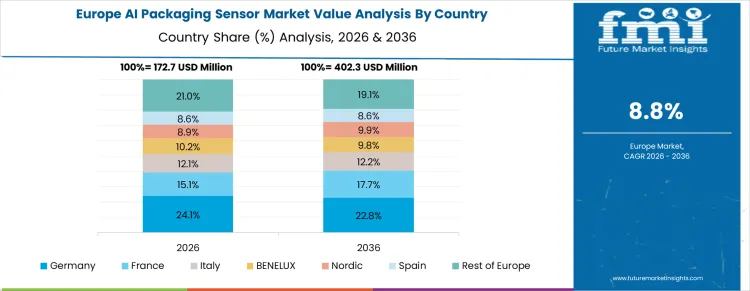
The AI packaging sensor market in Germany is projected to grow at a steady pace, with a projected CAGR of 8.2%. Germany’s strong manufacturing base, particularly in the automotive, pharmaceutical, and consumer goods industries, is driving the demand for AI-powered packaging solutions. German companies are increasingly seeking intelligent packaging systems that can improve efficiency, reduce waste, and enhance product quality. Additionally, Germany’s commitment to sustainability and innovation is pushing the adoption of AI technologies in packaging. With a focus on improving operational performance and adhering to environmental standards, the demand for AI packaging sensors is expected to continue growing steadily in the German market.
What are the Growth Prospects for the AI Packaging Sensor Market in Brazil?
The AI packaging sensor market in Brazil is expected to grow at a moderate pace, with a projected CAGR of 8.4%. Brazil’s manufacturing and logistics sectors are gradually adopting AI-powered technologies to improve supply chain efficiency, reduce waste, and enhance packaging performance. As the country focuses on digitalization and the optimization of industrial processes, AI packaging sensors are becoming an integral part of packaging systems across various sectors. The market is also supported by Brazil’s growing focus on sustainability and regulatory pressures to reduce waste in packaging. While growth in Brazil may be slower compared to other regions, the demand for smart, data-driven packaging solutions will continue to support steady market expansion.
What is the Competitive Landscape for the AI Packaging Sensor Market?
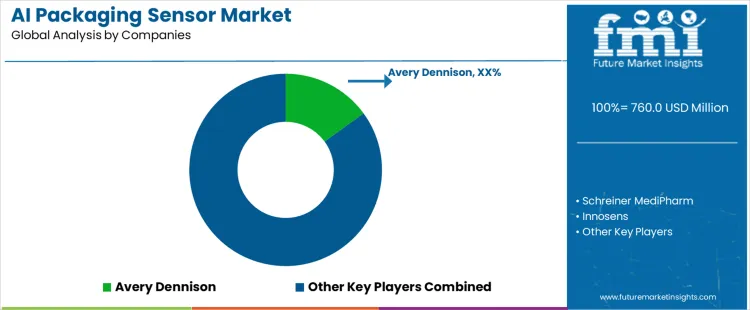
The AI packaging sensor market is growing rapidly as industries seek intelligent solutions to enhance packaging functionality, product safety, and supply chain visibility. Avery Dennison leads the market with its innovative AI-powered packaging sensors, offering solutions that provide real-time tracking, environmental monitoring, and data analytics to improve packaging performance and ensure product integrity. Their strong focus on innovation and sustainability positions them as a dominant player. Schreiner MediPharm, Innosens, and UFlex are key competitors, providing specialized sensor solutions that integrate artificial intelligence for improved packaging intelligence. Schreiner MediPharm focuses on pharmaceutical packaging with integrated sensors, while Innosens delivers intelligent packaging systems that enhance product traceability and safety. UFlex offers packaging solutions with built-in AI sensors for better supply chain management.
Local integrators, Toppan, and Sensitech further contribute to the competitive landscape by offering AI-driven sensor solutions for packaging applications. Toppan integrates advanced sensor technologies into packaging for product authentication and condition monitoring, while Sensitech specializes in providing cold chain and supply chain monitoring solutions using AI-powered sensors. These companies compete by focusing on innovation, data integration, and their ability to deliver packaging solutions that enhance product protection, traceability, and supply chain efficiency.
Key Players of the AI Packaging Sensor Market
- Avery Dennison
- Schreiner MediPharm
- Innosens
- UFlex
- Local integrators
- Toppan
- Sensitech
Scope of the Report
| Items | Values |
|---|---|
| Quantitative Units (2026) | USD Million |
| End-use | Food & Pharma Smart Packaging, Cold-Chain & Pharma, FMCG & Logistics, Food Delivery & Retail, Export Packaging, High-Precision Sensing |
| Sensor Type / Format | Temperature, Freshness Sensors, Time-Temperature Indicators, Multi-Parameter Sensors, QR-Linked Sensor Labels, Others |
| Material / Substrate | Printed Electronics on PET/Paper, Paper/PET Hybrids, PET-Based Films, Paper Substrates |
| Technology | AI-Driven Sensor Fusion & Analytics, Edge AI + Cloud Analytics, Low-Cost AI Sensor Chips, Cloud AI Monitoring |
| Companies | Avery Dennison, Schreiner MediPharm, Innosens, UFlex, Local Integrators, Toppan, Sensitech |
| Regions Covered | North America, Latin America, Western Europe, Eastern Europe, South Asia and Pacific, East Asia, Middle East & Africa |
| Countries Covered | United States, Canada, Mexico, Brazil, Argentina, Germany, France, United Kingdom, Italy, Spain, Netherlands, China, India, Japan, South Korea, ANZ, GCC Countries, South Africa |
| Additional Attributes | Dollar by sales by end-use, sensor type/format, material/substrate, technology, and region. Includes market trends in AI packaging sensors, focusing on temperature, freshness, and multi-parameter sensors. Highlights the role of printed electronics, AI sensor fusion, and cloud analytics in food, pharma, FMCG, logistics, and retail applications. Focus on low-cost sensor chips, performance, sustainability, and market share of key companies in the smart packaging and sensor market. |
AI Packaging Sensor Market Segmentation
End-use:
- Food & pharma smart packaging
- Cold-chain & pharma
- FMCG & logistics
- Food delivery & retail
- Export packaging
- High-precision sensing
Sensor Type / Format:
- Temperature, freshness sensors
- Time-temperature indicators
- Multi-parameter sensors
- QR-linked sensor labels
- Others
Material / Substrate:
- Printed electronics on PET/paper
- Paper/PET hybrids
- PET-based films
- Paper substrates
- Others
Technology:
- AI-driven sensor fusion & analytics
- Edge AI + cloud analytics
- Low-cost AI sensor chips
- Cloud AI monitoring
- Others
Region:
- Asia Pacific
- China
- Japan
- South Korea
- India
- Australia & New Zealand
- ASEAN
- Rest of Asia Pacific
- Europe
- Germany
- United Kingdom
- France
- Italy
- Spain
- Nordic
- BENELUX
- Rest of Europe
- North America
- United States
- Canada
- Mexico
- Latin America
- Brazil
- Chile
- Rest of Latin America
- Middle East & Africa
- Kingdom of Saudi Arabia
- Other GCC Countries
- Turkey
- South Africa
- Other African Union
- Rest of Middle East & Africa
Frequently Asked Questions
How big is the AI packaging sensor market in 2026?
The global AI packaging sensor market is valued at USD 760 million in 2026.
What will be the size of the AI packaging sensor market in 2036?
The market is projected to reach USD 2,180 million by 2036.
How fast will the AI packaging sensor market grow between 2026 and 2036?
The market will grow at a CAGR of 11.1% from 2026 to 2036.
Which segment leads the AI packaging sensor market in 2026?
AI-driven sensor fusion and analytics lead the market with a 55% share in 2026.
Who are the major players in the AI packaging sensor market?
Key players include Avery Dennison, Schreiner MediPharm, Innosens, UFlex, Toppan, Sensitech, and local integrators.
Preview the report firsthand - request a free sample
Get SampleGet the brochure for pricing and purchase details.
Get PDFTable of Content
- Executive Summary
- Global Market Outlook
- Demand-side Trends
- Supply-side Trends
- Technology Roadmap Analysis
- Analysis and Recommendations
- Market Overview
- Market Coverage / Taxonomy
- Market Definition / Scope / Limitations
- Market Background
- Market Dynamics
- Drivers
- Restraints
- Opportunity
- Trends
- Scenario Forecast
- Demand in Optimistic Scenario
- Demand in Likely Scenario
- Demand in Conservative Scenario
- Opportunity Map Analysis
- Product Life Cycle Analysis
- Supply Chain Analysis
- Investment Feasibility Matrix
- Value Chain Analysis
- PESTLE and Porter’s Analysis
- Regulatory Landscape
- Regional Parent Market Outlook
- Production and Consumption Statistics
- Import and Export Statistics
- Market Dynamics
- Global Market Analysis 2021 to 2025 and Forecast, 2026 to 2036
- Historical Market Size Value (USD Million) Analysis, 2021 to 2025
- Current and Future Market Size Value (USD Million) Projections, 2026 to 2036
- Y-o-Y Growth Trend Analysis
- Absolute $ Opportunity Analysis
- Global Market Pricing Analysis 2021 to 2025 and Forecast 2026 to 2036
- Global Market Analysis 2021 to 2025 and Forecast 2026 to 2036, By End-use
- Introduction / Key Findings
- Historical Market Size Value (USD Million) Analysis By End-use , 2021 to 2025
- Current and Future Market Size Value (USD Million) Analysis and Forecast By End-use , 2026 to 2036
- Food & pharma smart packaging
- Cold-chain & pharma
- FMCG & logistics
- Food delivery & retail
- Export packaging
- High-precision sensing
- Food & pharma smart packaging
- Y-o-Y Growth Trend Analysis By End-use , 2021 to 2025
- Absolute $ Opportunity Analysis By End-use , 2026 to 2036
- Global Market Analysis 2021 to 2025 and Forecast 2026 to 2036, By Sensor Type
- Introduction / Key Findings
- Historical Market Size Value (USD Million) Analysis By Sensor Type, 2021 to 2025
- Current and Future Market Size Value (USD Million) Analysis and Forecast By Sensor Type, 2026 to 2036
- Temperature, freshness sensors
- Time–temperature indicators
- Multi-parameter sensors
- QR-linked sensor labels
- Temperature, freshness sensors
- Y-o-Y Growth Trend Analysis By Sensor Type, 2021 to 2025
- Absolute $ Opportunity Analysis By Sensor Type, 2026 to 2036
- Global Market Analysis 2021 to 2025 and Forecast 2026 to 2036, By Material
- Introduction / Key Findings
- Historical Market Size Value (USD Million) Analysis By Material, 2021 to 2025
- Current and Future Market Size Value (USD Million) Analysis and Forecast By Material, 2026 to 2036
- Printed electronics on PET/paper
- Paper/PET hybrids
- PET-based films
- Paper substrates
- Printed electronics on PET/paper
- Y-o-Y Growth Trend Analysis By Material, 2021 to 2025
- Absolute $ Opportunity Analysis By Material, 2026 to 2036
- Global Market Analysis 2021 to 2025 and Forecast 2026 to 2036, By Technology
- Introduction / Key Findings
- Historical Market Size Value (USD Million) Analysis By Technology, 2021 to 2025
- Current and Future Market Size Value (USD Million) Analysis and Forecast By Technology, 2026 to 2036
- AI-driven sensor fusion & analytics
- Edge AI + cloud analytics
- Low-cost AI sensor chips
- Cloud AI monitoring
- AI-driven sensor fusion & analytics
- Y-o-Y Growth Trend Analysis By Technology, 2021 to 2025
- Absolute $ Opportunity Analysis By Technology, 2026 to 2036
- Global Market Analysis 2021 to 2025 and Forecast 2026 to 2036, By Region
- Introduction
- Historical Market Size Value (USD Million) Analysis By Region, 2021 to 2025
- Current Market Size Value (USD Million) Analysis and Forecast By Region, 2026 to 2036
- North America
- Latin America
- Western Europe
- Eastern Europe
- East Asia
- South Asia and Pacific
- Middle East & Africa
- Market Attractiveness Analysis By Region
- North America Market Analysis 2021 to 2025 and Forecast 2026 to 2036, By Country
- Historical Market Size Value (USD Million) Trend Analysis By Market Taxonomy, 2021 to 2025
- Market Size Value (USD Million) Forecast By Market Taxonomy, 2026 to 2036
- By Country
- USA
- Canada
- Mexico
- By End-use
- By Sensor Type
- By Material
- By Technology
- By Country
- Market Attractiveness Analysis
- By Country
- By End-use
- By Sensor Type
- By Material
- By Technology
- Key Takeaways
- Latin America Market Analysis 2021 to 2025 and Forecast 2026 to 2036, By Country
- Historical Market Size Value (USD Million) Trend Analysis By Market Taxonomy, 2021 to 2025
- Market Size Value (USD Million) Forecast By Market Taxonomy, 2026 to 2036
- By Country
- Brazil
- Chile
- Rest of Latin America
- By End-use
- By Sensor Type
- By Material
- By Technology
- By Country
- Market Attractiveness Analysis
- By Country
- By End-use
- By Sensor Type
- By Material
- By Technology
- Key Takeaways
- Western Europe Market Analysis 2021 to 2025 and Forecast 2026 to 2036, By Country
- Historical Market Size Value (USD Million) Trend Analysis By Market Taxonomy, 2021 to 2025
- Market Size Value (USD Million) Forecast By Market Taxonomy, 2026 to 2036
- By Country
- Germany
- UK
- Italy
- Spain
- France
- Nordic
- BENELUX
- Rest of Western Europe
- By End-use
- By Sensor Type
- By Material
- By Technology
- By Country
- Market Attractiveness Analysis
- By Country
- By End-use
- By Sensor Type
- By Material
- By Technology
- Key Takeaways
- Eastern Europe Market Analysis 2021 to 2025 and Forecast 2026 to 2036, By Country
- Historical Market Size Value (USD Million) Trend Analysis By Market Taxonomy, 2021 to 2025
- Market Size Value (USD Million) Forecast By Market Taxonomy, 2026 to 2036
- By Country
- Russia
- Poland
- Hungary
- Balkan & Baltic
- Rest of Eastern Europe
- By End-use
- By Sensor Type
- By Material
- By Technology
- By Country
- Market Attractiveness Analysis
- By Country
- By End-use
- By Sensor Type
- By Material
- By Technology
- Key Takeaways
- East Asia Market Analysis 2021 to 2025 and Forecast 2026 to 2036, By Country
- Historical Market Size Value (USD Million) Trend Analysis By Market Taxonomy, 2021 to 2025
- Market Size Value (USD Million) Forecast By Market Taxonomy, 2026 to 2036
- By Country
- China
- Japan
- South Korea
- By End-use
- By Sensor Type
- By Material
- By Technology
- By Country
- Market Attractiveness Analysis
- By Country
- By End-use
- By Sensor Type
- By Material
- By Technology
- Key Takeaways
- South Asia and Pacific Market Analysis 2021 to 2025 and Forecast 2026 to 2036, By Country
- Historical Market Size Value (USD Million) Trend Analysis By Market Taxonomy, 2021 to 2025
- Market Size Value (USD Million) Forecast By Market Taxonomy, 2026 to 2036
- By Country
- India
- ASEAN
- Australia & New Zealand
- Rest of South Asia and Pacific
- By End-use
- By Sensor Type
- By Material
- By Technology
- By Country
- Market Attractiveness Analysis
- By Country
- By End-use
- By Sensor Type
- By Material
- By Technology
- Key Takeaways
- Middle East & Africa Market Analysis 2021 to 2025 and Forecast 2026 to 2036, By Country
- Historical Market Size Value (USD Million) Trend Analysis By Market Taxonomy, 2021 to 2025
- Market Size Value (USD Million) Forecast By Market Taxonomy, 2026 to 2036
- By Country
- Kingdom of Saudi Arabia
- Other GCC Countries
- Turkiye
- South Africa
- Other African Union
- Rest of Middle East & Africa
- By End-use
- By Sensor Type
- By Material
- By Technology
- By Country
- Market Attractiveness Analysis
- By Country
- By End-use
- By Sensor Type
- By Material
- By Technology
- Key Takeaways
- Key Countries Market Analysis
- USA
- Pricing Analysis
- Market Share Analysis, 2025
- By End-use
- By Sensor Type
- By Material
- By Technology
- Canada
- Pricing Analysis
- Market Share Analysis, 2025
- By End-use
- By Sensor Type
- By Material
- By Technology
- Mexico
- Pricing Analysis
- Market Share Analysis, 2025
- By End-use
- By Sensor Type
- By Material
- By Technology
- Brazil
- Pricing Analysis
- Market Share Analysis, 2025
- By End-use
- By Sensor Type
- By Material
- By Technology
- Chile
- Pricing Analysis
- Market Share Analysis, 2025
- By End-use
- By Sensor Type
- By Material
- By Technology
- Germany
- Pricing Analysis
- Market Share Analysis, 2025
- By End-use
- By Sensor Type
- By Material
- By Technology
- UK
- Pricing Analysis
- Market Share Analysis, 2025
- By End-use
- By Sensor Type
- By Material
- By Technology
- Italy
- Pricing Analysis
- Market Share Analysis, 2025
- By End-use
- By Sensor Type
- By Material
- By Technology
- Spain
- Pricing Analysis
- Market Share Analysis, 2025
- By End-use
- By Sensor Type
- By Material
- By Technology
- France
- Pricing Analysis
- Market Share Analysis, 2025
- By End-use
- By Sensor Type
- By Material
- By Technology
- India
- Pricing Analysis
- Market Share Analysis, 2025
- By End-use
- By Sensor Type
- By Material
- By Technology
- ASEAN
- Pricing Analysis
- Market Share Analysis, 2025
- By End-use
- By Sensor Type
- By Material
- By Technology
- Australia & New Zealand
- Pricing Analysis
- Market Share Analysis, 2025
- By End-use
- By Sensor Type
- By Material
- By Technology
- China
- Pricing Analysis
- Market Share Analysis, 2025
- By End-use
- By Sensor Type
- By Material
- By Technology
- Japan
- Pricing Analysis
- Market Share Analysis, 2025
- By End-use
- By Sensor Type
- By Material
- By Technology
- South Korea
- Pricing Analysis
- Market Share Analysis, 2025
- By End-use
- By Sensor Type
- By Material
- By Technology
- Russia
- Pricing Analysis
- Market Share Analysis, 2025
- By End-use
- By Sensor Type
- By Material
- By Technology
- Poland
- Pricing Analysis
- Market Share Analysis, 2025
- By End-use
- By Sensor Type
- By Material
- By Technology
- Hungary
- Pricing Analysis
- Market Share Analysis, 2025
- By End-use
- By Sensor Type
- By Material
- By Technology
- Kingdom of Saudi Arabia
- Pricing Analysis
- Market Share Analysis, 2025
- By End-use
- By Sensor Type
- By Material
- By Technology
- Turkiye
- Pricing Analysis
- Market Share Analysis, 2025
- By End-use
- By Sensor Type
- By Material
- By Technology
- South Africa
- Pricing Analysis
- Market Share Analysis, 2025
- By End-use
- By Sensor Type
- By Material
- By Technology
- USA
- Market Structure Analysis
- Competition Dashboard
- Competition Benchmarking
- Market Share Analysis of Top Players
- By Regional
- By End-use
- By Sensor Type
- By Material
- By Technology
- Competition Analysis
- Competition Deep Dive
- Avery Dennison
- Overview
- Product Portfolio
- Profitability by Market Segments (Product/Age /Sales Channel/Region)
- Sales Footprint
- Strategy Overview
- Marketing Strategy
- Product Strategy
- Channel Strategy
- Schreiner MediPharm
- Innosens
- UFlex
- Local integrators
- Toppan
- Sensitech
- Avery Dennison
- Competition Deep Dive
- Assumptions & Acronyms Used
- Research Methodology


