

- Industry Size (2026)
- USD 0.9 Bn
- Forecast (2036)
- USD 3.7 Bn
- CAGR (2026 to 2036)
- 14.5%
AI-Driven Packaging Heat Seal Inspection Cameras Market Size, Market Forecast and Outlook By FMI
The AI‑driven packaging heat seal inspection camera market reached USD 0.8 billion in 2025 and is estimated to hit USD 0.9 billion in 2026. With a sustained 14.5% CAGR, the industry’s long‑range valuation climbs to USD 3.7 billion by 2036, powered by the sector‑wide shift from statistical sampling to real‑time, AI‑based thermal verification. Capital allocation decisions across the rigid and flexible packaging sectors increasingly prioritize automated defect classification over manual visual inspection protocols.
Vision system integrators deploying AI powered packaging inspection machine hardware recognize that legacy optical sensors cannot reliably distinguish between acceptable cosmetic variations and critical micro-leaks in clear film structures. Integrating neural network-based thermal cameras directly into the sealing jaws resolves this constraint by evaluating the latent heat signature of every individual pouch or blister pack before it exits the production line. Quality control engineers who secure these advanced inspection capabilities establish a decisive yield advantage over competitors still relying on destructive burst testing.
Summary of AI-Driven Packaging Heat Seal Inspection Cameras Market
- AI-Driven Packaging Heat Seal Inspection Cameras Market Definition:
- AI-driven packaging heat seal inspection cameras are advanced machine vision systems utilizing thermal, hyperspectral, or high-speed optical sensors combined with deep learning algorithms to detect micro-leaks, weak seals, and material inclusions in sealed flexible or semi-rigid packaging.
- Demand Drivers in the Market:
- Regulatory bodies enforcing strict serialization and contamination-prevention standards force medical device packagers to implement continuous verification systems that document the integrity of every sterilized barrier.
- Rising material costs for complex multi-layer barrier films compel converting operations to integrate predictive inspection loops that adjust sealing parameters in real-time to prevent large-scale batch rejections.
- Throughput acceleration on form-fill-seal lines pushes standard optical sensors past their processing limits, requiring hardware-accelerated neural networks capable of analyzing complex thermal signatures in milliseconds.
- Key Segments Analyzed in the FMI Report:
- Thermal Imaging Cameras: 52.0% share in 2026, driven by the absolute necessity to detect invisible heat-signature anomalies in opaque foil and highly reflective packaging materials.
- Inline Inspection: 80.0% share in 2026, reflecting the industry-wide shift toward immediate defect rejection prior to secondary packaging and palletization.
- China: 16.5% compound growth anchored by massive greenfield pharmaceutical manufacturing investments specifying automated quality control architectures from initial blueprints.
- Analyst Opinion at FMI:
- Ismail Sutaria, Principal Consultant for Packaging, opines “Quality assurance leaders routinely underestimate the compounding cost of destructive sample testing on high-speed lines. While traditional optical cameras identify gross misalignments, they systematically fail to detect micro-channel leaks hidden within multi-layer laminates. Deep learning thermal arrays solve this specific blind spot by reading the residual heat footprint immediately post-seal. Production lines that have not integrated predictive thermal profiling will find themselves structurally incapable of meeting the parts-per-million defect ceilings demanded by upcoming medical device and sterile consumable contracts.”
- Strategic Implications / Executive Takeaways:
- Packaging machinery engineers must embed high-speed inference processing directly into control architectures to eliminate latency between defect detection and sealing jaw recalibration.
- Compliance officers directing pharmaceutical validation procedures should mandate 100% inline thermal inspection to satisfy impending regulatory electronic record requirements.
- Co-manufacturing business leaders must leverage verifiable zero-defect sealing metrics as a primary differentiator during contract negotiations with Tier-1 consumable brands.
- Methodology:
- Primary Research: FMI conducted extensive technical interviews with vision system integrators, quality assurance directors, and packaging line engineers across major industrial hubs to map camera adoption timelines.
- Desk Research: Analysts evaluated public standards documentation from ASTM, FDA compliance registries, corporate hardware launch data, and international packaging safety directives.
- Market-Sizing and Forecasting: The baseline value derives from a bottom-up aggregation of industrial camera shipments, applying specific modernization curves for the pharmaceutical and food sectors to project future adoption.
- Data Validation and Update Cycle: Segment forecasts undergo cross-validation against quarterly semiconductor shipment volumes for industrial machine vision silicon.
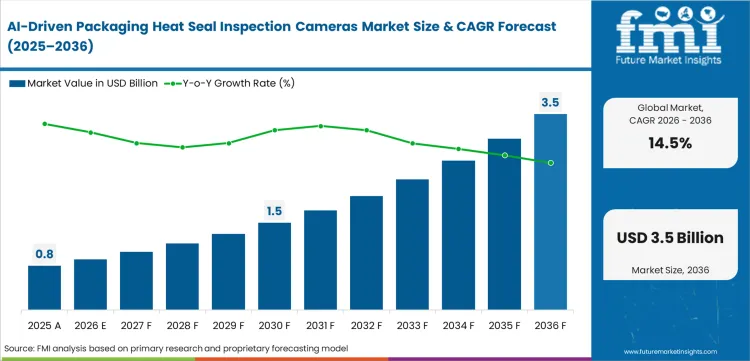
FMI analysts observe that the projected 14.5% compound expansion relies entirely on a structural pivot from reactive batch testing to continuous, proactive quality control. Relying on destructive burst testing creates unacceptable quarantine windows and significant product waste for high-value sterile goods. Advancements in edge computing enable packaging line managers to process complex thermal datasets locally, isolating flawed units without halting the entire production sequence. Understanding how different geographic regulatory environments enforce these transition timelines reveals distinct adoption velocities across regional manufacturing centers.
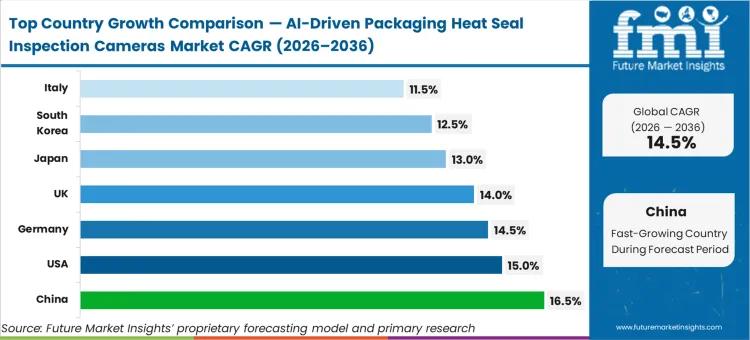
Based on regional dynamics, China leads global expansion with a 16.5% CAGR as high-volume production facilities bypass legacy optical systems entirely. The USA advances at a 15.0% pace driven by rigorous FDA validation frameworks, while Germany registers a 14.5% trajectory anchored by precision medical device manufacturing. The UK maintains a 14.0% rate tied to localized pharmaceutical production initiatives. Japan expands at 13.0% and South Korea tracks at 12.5% as both nations integrate advanced neural networks into automated cleanroom environments. Italy supports an 11.5% growth curve reflecting systematic upgrades across its mature food processing equipment sector.
AI‑Driven Packaging Heat Seal Inspection Cameras Market Key Takeaways
| Metric | Details |
|---|---|
| Industry Size (2026) | USD 0.9 billion |
| Industry Value (2036) | USD 3.7 billion |
| CAGR (2026 to 2036) | 14.5% |
AI-Driven Packaging Heat Seal Inspection Cameras Market Definition
AI-driven packaging heat seal inspection cameras constitute the physical sensing hardware and integrated machine learning software engineered to evaluate the integrity of hermetic seals on high-speed production lines. The primary functionality involves utilizing thermal imaging, hyperspectral scanning, or high-speed optical capture to identify micro-channels, pleats, product inclusions, and weak bonds without disrupting the manufacturing flow. Integration typically occurs directly after the sealing jaws on horizontal or vertical form-fill-seal equipment. Advanced configurations utilize closed-loop feedback mechanisms to dynamically adjust sealing temperature and pressure based on real-time defect analysis.
AI-Driven Packaging Heat Seal Inspection Cameras Market Inclusions
The market scope incorporates industrial-grade thermal imaging arrays, high-speed optical sensors, and hyperspectral camera systems dedicated to seal inspection applications. Dedicated edge computing hardware, neural network training software, and proprietary defect classification algorithms designed specifically for packaging validation fall within the boundaries. Inline inspection modules that integrate physical rejection mechanisms triggered by AI-driven analysis are fully included. Systems analyzing both clear polyethylene films and opaque aluminum foils are part of the core valuation.
AI-Driven Packaging Heat Seal Inspection Cameras Market Exclusions
Standard optical sensors used solely for barcode verification or label alignment lacking seal integrity analysis capabilities are excluded. X-ray inspection systems designed strictly for foreign body detection and metal detectors are omitted. General-purpose enterprise AI software platforms without specific packaging line integrations fall outside the defined parameters. Manual desktop burst testers and offline vacuum leak detection chambers lacking automated camera-based evaluation are explicitly omitted from the valuation.
AI-Driven Packaging Heat Seal Inspection Cameras Market Research Methodology
- Primary Research: Analysts engaged with vision system integrators, pharmaceutical packaging line managers, and quality assurance directors to map the specific defect-reduction targets triggering camera upgrades.
- Desk Research: The data collection phase aggregated compliance roadmaps from the FDA, ISO standard ratification schedules, and major hardware OEM technical specifications.
- Market-Sizing and Forecasting: The baseline value derives from a bottom-up aggregation of specialized industrial camera shipments, applying sector-specific modernization curves to project adoption velocity.
- Data Validation and Update Cycle: Projections are rigorously tested against publicly reported capital expenditure guidance from leading discrete manufacturing and machine vision conglomerates.
Segmental Analysis
AI-Driven Packaging Heat Seal Inspection Cameras Market Analysis by Camera Type
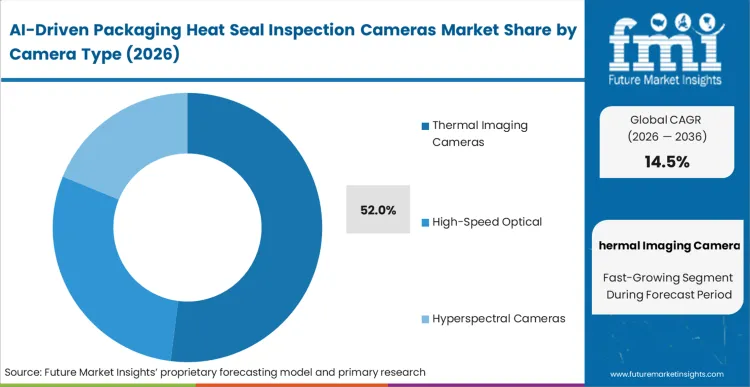
Hardware suppliers unable to supply high-resolution thermal sensors risk immediate exclusion from the next wave of medical device packaging RFPs. Relying on packaging inspection systems that analyze residual heat dissipation enables line managers to identify worn sealing jaws before they produce critical failures. With legacy optical arrays proving inadequate for detecting hidden micro-channels in complex laminates, packaging machinery engineers execute full-scale sensor replacement programs. Thermal Imaging Cameras command a dominant 52.0% share in 2026, reflecting the absolute requirement for physical heat-signature validation before secondary packaging can occur. As per FMI's projection, facilities transitioning to thermal profiling realize measurable reductions in false-reject rates. Integrators specifying these cameras into new form-fill-seal lines establish the foundation for truly predictive quality control environments.
- Defect Resolution: Thermal gradients provide clear visibility into product inclusions trapped within opaque foil seals that standard optical lenses cannot penetrate.
- Integration Footprint: Modern compact thermal arrays mount directly adjacent to the sealing station without requiring extensive line modifications or additional cooling apparatus.
- Feedback Automation: Real-time temperature mapping allows edge processors to send immediate correction signals to the heater bands, stabilizing the sealing process continuously.
AI-Driven Packaging Heat Seal Inspection Cameras Market Analysis by Deployment
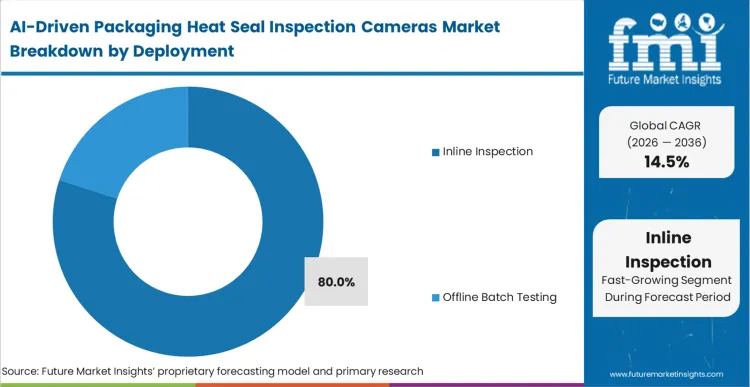
Continuous high-speed production environments require immediate defect isolation rather than delayed batch quarantine protocols. Inline Inspection accounts for an overwhelming 80.0% segment share in 2026 as production managers eliminate the bottlenecks associated with offline laboratory testing. Integrating inspection arrays directly onto the conveyor network accelerates the extraction of quality telemetry for overarching factory analytics. According to FMI's estimates, facilities deploying unified inline inspection drastically reduce their scrap rates by catching systemic sealing errors at the source. Line engineers evaluating new capital equipment prioritize form-fill-seal machines with native camera integration to avoid the complexity of aftermarket retrofits. Competitors continuing to rely on offline sampling face widening cost disadvantages due to elevated material waste and prolonged release times.
- Throughput Synchronization: Advanced edge processors evaluate complex thermal images in milliseconds, matching the mechanical output of rotary sealing equipment without causing delays.
- Immediate Rejection: Automated blow-off mechanisms triggered directly by the camera logic remove defective pouches before they enter downstream cartoning equipment.
- Traceability Documentation: Continuous inline systems generate permanent digital records for every individual package, simplifying compliance audits and targeted recalls.
AI-Driven Packaging Heat Seal Inspection Cameras Market Analysis by End-Use Industry
FMI analysts opine that the convergence of serialization mandates with seal integrity requirements amplifies the demand for unified, camera-based documentation. Contract packagers failing to demonstrate robust inline validation lose priority status during upcoming sourcing cycles for high-value biologic therapeutics. Strict adherence criteria for sterile barrier validation forces medical and pharmaceutical manufacturers to seek absolute certainty in their sealing processes. Pharmaceuticals represents a leading 45.0% segment share in 2026. Quality assurance directors operating controlled cleanroom facilities reject validation methods that introduce destructive sampling and subsequent yield losses. Incorporating high-resolution neural networks guarantees that critically compromised heat seal film structures never reach vulnerable patient populations.
- Contamination Prevention: Detecting micron-level channels in blister packs prevents moisture ingress and active pharmaceutical ingredient degradation during prolonged storage.
- Material Complexity: AI models reliably adapt to the varying reflective properties of specialized cold-form foils and complex transparent barrier structures.
- Audit Compliance: Algorithmic defect classification removes human subjectivity from the quality control process, ensuring consistent adherence to stringent validation protocols.
AI-Driven Packaging Heat Seal Inspection Cameras Market Drivers, Restraints, and Opportunities
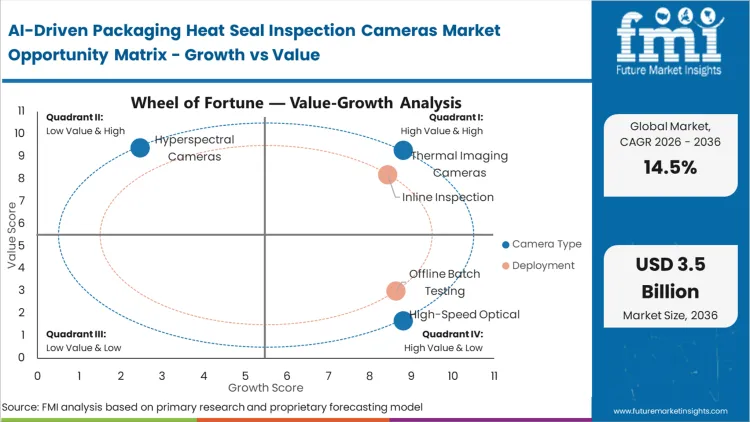
The convergence of high-speed throughput demands and zero-defect quality mandates forces packaging line engineers to extract actionable intelligence directly from the sealing jaws. Relying on statistical sampling leaves production facilities exposed to massive recall events if a systematic sealing failure occurs between testing intervals. Transitioning to 100% inline AI camera inspection mitigates this risk entirely by evaluating every single unit produced. Co-manufacturers that fail to modernize their inspection protocols risk losing lucrative contracts from Tier-1 brands requiring comprehensive digital quality records.
The intricate neural network training required to optimize defect classification algorithms creates steep learning curves for traditional quality technicians. Designing robust machine learning models across constantly changing packaging artwork and film types demands specialized software expertise that many mid-market facilities lack internally. To mitigate this skill gap, vision system integrators increasingly deploy pre-trained foundation models that learn acceptable sealing variances dynamically during standard production runs, significantly reducing initial configuration times.
- Predictive Maintenance Integration: Packaging machinery engineers link thermal camera anomaly data directly to machine maintenance schedules. Identifying uneven heat distribution early prevents catastrophic sealing jaw failures and unplanned downtime.
- Sustainable Material Processing: Plant operators testing thinner, recyclable mono-material films require highly sensitive inspection cameras. Dynamic thermal feedback prevents delicate eco-friendly substrates from burning or melting during the sealing process.
- Centralized Quality Dashboards: Quality assurance directors aggregate inspection telemetry from multiple global facilities into a unified analytics platform. Establishing a centralized view allows process engineers to standardize sealing parameters across disparate geographic locations.
Regional Analysis
Based on the regional analysis, the AI-Driven Packaging Heat Seal Inspection Cameras market is segmented into North America, Latin America, Europe, East Asia, South Asia, Oceania and Middle East & Africa across 40+ countries. The full report also offers market attractiveness analysis based on regional trends.
.webp "Top Country Growth Comparison Ai Driven Packaging Heat Seal Inspection Cameras Market Cagr (2026 2036)")
| Country | CAGR (2026 to 2036) |
|---|---|
| China | 16.5% |
| USA | 15.0% |
| Germany | 14.5% |
| UK | 14.0% |
| Japan | 13.0% |
| South Korea | 12.5% |
| Italy | 11.5% |
Source: Future Market Insights (FMI) analysis, based on proprietary forecasting model and primary research
North America AI-Driven Packaging Heat Seal Inspection Cameras Market Analysis
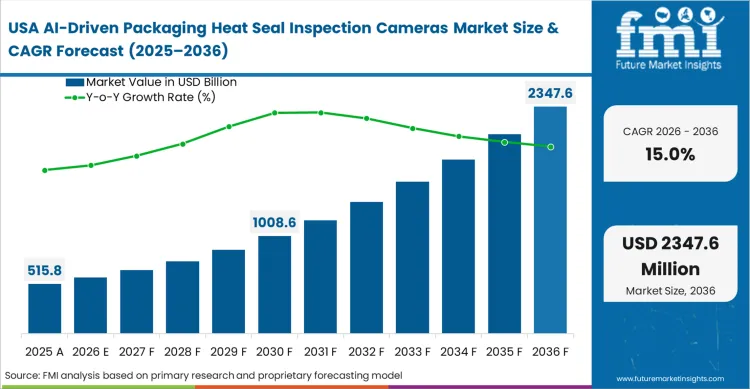
Quality assurance directors spearheading medical device production overhauls face strict FDA directives to implement verifiable, non-destructive testing across all sterile barrier systems. This strategic pivot demands significant capital allocation toward edge-processing hardware that can seamlessly handle massive visual data streams. Across North America, industrial modernization mandates actively target the systematic eradication of manual quality control processes within critical supply chains. By implementing sophisticated thermal imaging architectures, facilities can rapidly secure AI in packaging design approvals while maintaining the necessary rigorous compliance documentation. Ultimately, the success of these modernization initiatives relies entirely on the deployment of highly accurate neural network models explicitly tailored for complex packaging substrates.
- USA: Advancing at a 15.0% compound rate across the forecast decade, the United States market reflects discrete manufacturers aggressively unifying their logical quality control topologies. The domestic pharmaceutical and medical device manufacturing sector enforces strict 21 CFR Part 11 compliance for electronic records across its entire supply chain ecosystem. Quality validation engineers replacing destructive burst testing must deploy continuous camera architectures capable of generating immutable digital certificates for every sealed pouch. FDA inspection protocols increasingly view inline automated validation as the industry baseline rather than an optional enhancement. Hardware vendors lacking documented compliance with these rigorous federal auditing standards face immediate exclusion from defense-adjacent and healthcare modernization contracts.
FMI's report includes comprehensive evaluation of the North American vision inspection sector. It features specific analysis of the Canadian and Mexican industrial markets. A defining dynamic in these countries involves the rapid localization of contract manufacturing for the food and beverage industry, which requires standardized inspection protocols to coordinate cross-border logistics and maintain synchronized shelf-life guarantees.
Europe AI-Driven Packaging Heat Seal Inspection Cameras Market Analysis
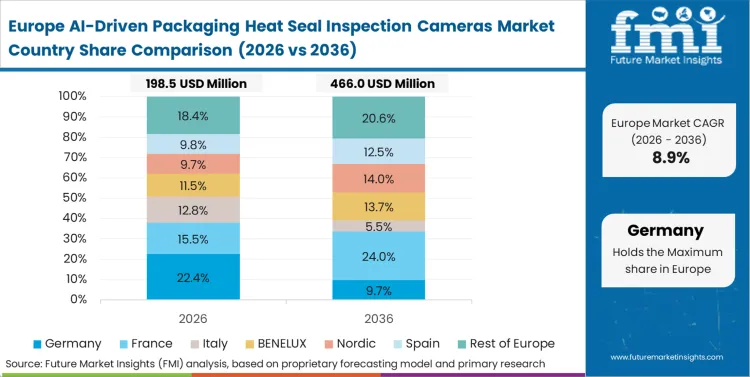
Facility directors increasingly recognize that maintaining outdated optical sensors severely limits their ability to comply with upcoming European Union packaging waste directives. Consequently, packaging machinery engineers redesigning high-speed production lines must integrate continuous feedback loops to stabilize sealing operations and eliminate defective material generation. European industrial policy actively penalizes the creation of preventable plastic waste and packaging scrap within the food supply chain. This stringent sustainability requirement forces the rapid adoption of thermal and hyperspectral cameras to guarantee seal integrity before product contamination can occur. Upgrading the core inspection infrastructure provides the critical precision needed to support the regional transition toward delicate, mono-material recyclable films.
- Germany: Systems architects designing form-fill-seal equipment must demonstrate flawless execution of inline thermal analysis before receiving authorization to ship new production cells. This systemic qualification pressure drives a CAGR value of 14.5% for certified inspection hardware as the standard proliferates across domestic machinery retooling projects. Germany's precision machinery export sector dictates stringent validation criteria for advanced packaging equipment destined for global pharmaceutical markets. The national focus on Industry 4.0 connectivity drives the integration of edge computing directly into the camera hardware, creating a recurring innovation cycle that accelerates component replacement. Vision infrastructure providers targeting these applications must guarantee microsecond-level image processing performance prior to the finalization of capital procurement budgets.
- UK: Retail procurement officers managing national grocery distribution networks mandate communication architectures capable of tracking specific lot quality metrics back to the exact sealing station. The shift toward premium, extended-shelf-life ready meals forces food manufacturers to abandon legacy manual checks in favor of highly sensitive hyperspectral cameras. The United Kingdom's concentrated food processing and retail sector requires absolute supply chain visibility to enforce strict allergen and freshness guarantees Contract packagers unable to demonstrate absolute seal verification under severe line speeds forfeit qualification for national private-label production programs. This critical consumer protection transition anchors the UK's CAGR at 14.0% trajectory to 2036 as major grocers systematically audit supplier capabilities.
- Italy: Process engineers evaluating new equipment designs must integrate thermal arrays capable of detecting product trapped within the seal zone of complex pasta and dairy packaging. Italy's dominant food packaging and beverage bottling machinery sector enforces strict quality validation protocols for continuous flow wrapping and tray sealing applications. Sustaining an 11.5% annual growth rate, Italy's market expansion reflects the continuous integration of AI modules into standard equipment catalogs. The concentration of specialized packaging OEM engineering centers necessitates continuous investment in advanced neural networks to maintain global export leadership. Integrators failing to provide seamless software interfaces for these cameras face disqualification from major machinery design platforms.
FMI's report includes thorough investigation of the European packaging inspection framework. The analysis encompasses France, Spain, the Nordics, and the Benelux region. A prevailing structural condition across these nations is the mandatory compliance with strict food safety directives, forcing brand owners to specify vision networks that can reliably detect microscopic contamination alongside standard labeling verification.
Asia Pacific AI-Driven Packaging Heat Seal Inspection Cameras Market Analysis
Quality assurance directors constructing new biopharmaceutical and advanced electronics packaging facilities now specify unified AI-driven vision networking in their initial site blueprints. Aggressive manufacturing localization across the Asia Pacific region accelerates the bypass of legacy manual inspection constraints entirely. By building native thermal inspection capabilities into the foundation, regional asset owners establish highly efficient production environments capable of zero-defect output. The integration of robust camera architecture forms the critical prerequisite for satisfying stringent export market compliance standards. This forward-looking capital deployment strategy directly fuels the demand for high-performance edge processing hardware.
- China: Expanding at an aggressive 16.5% CAGR for AI-driven inspection systems through 2036, China's trajectory is propelled by a sheer volume of new cleanroom construction that establishes a massive installed base of advanced inspection infrastructure. The domestic biopharmaceutical manufacturing sector deploys highly automated, software-defined production lines requiring seamless integration between thermal inspection cameras and central quality management systems. Greenfield facility architects bypass basic optical sensors entirely, specifying native hyperspectral endpoints for all new sterile barrier procurement contracts. Vision vendors unable to demonstrate verified high-bandwidth edge processing capabilities lose access to the most lucrative greenfield life sciences projects in the eastern industrial corridor.
- Japan: Japan's highly automated food and pharmaceutical supply chain enforces strict consumer safety standards through rigorous packaging integrity checks. Production engineers managing high-speed lines must validate thermal imaging performance before receiving authorization to run new flexible packaging formats. This continuous automation push sustains a 13.0% CAGR for vision-network upgrades in Japan's advanced manufacturing hubs. The domestic electronics manufacturing sector embeds advanced image processing silicon directly into smart cameras to maintain a global competitive advantage in optical engineering. Component suppliers lacking verified deep learning testing records forfeit access to the next generation of automated packaging line contracts.
- South Korea: Packaging line managers mandate zero-defect architectures to ensure multi-axis robotic transfer systems handle sensitive components without compromising the protective seal. The concentration of high-value export manufacturing necessitates continuous investment in ultra-sensitive thermal networks to maximize overall yield rates. Sensor hardware suppliers targeting the next facility expansion cycle must prove sub-millisecond anomaly detection before entering the approved vendor list. Consequently, South Korea's inspection camera demand is rising at a CAGR of 12.5% through 2036 as this zero-tolerance standard becomes the universal procurement baseline. South Korea's advanced electronics and medical components packaging sector operates to quality tolerances that exceed standard commercial specifications by orders of magnitude.
FMI's report includes extensive coverage of the Asia Pacific automated inspection landscape. It incorporates detailed analysis of Taiwan, India, Australia, and the broader ASEAN region. A primary trend shaping these nations is the rapid localization of pharmaceutical contract manufacturing, forcing regional operators to deploy sophisticated vision architectures to satisfy stringent global regulatory traceability requirements.
Competitive Aligners for Market Players
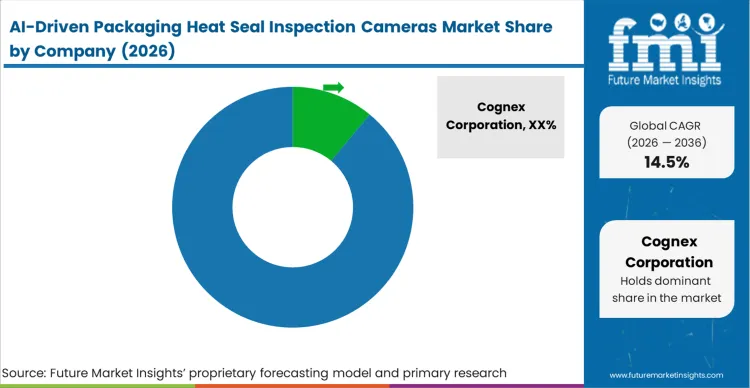
Strict electronic record-keeping mandates across sterile pharmaceutical packaging have transformed thermal inspection from a quality-assurance luxury into an absolute baseline requirement for vendor shortlisting. Quality assurance directors no longer accept standard pass/fail optical validation; they now require intelligent sensing arrays that capture and retain complex heat-signature telemetry for every individual blister pack and pouch. Compliance with FDA 21 CFR Part 11 electronic documentation standards dictates that inspection hardware must natively generate immutable digital certificates without relying on external enterprise software translation. Vision system integrators evaluating these architectures increasingly baseline their tenders against the deep-learning thermal and optical capabilities established by Cognex Corporation, Keyence Corporation, and Sick AG, who have effectively set the new algorithmic threshold for high-speed anomaly detection. Contract packagers that delay the transition to these verifiable, continuous-inspection frameworks face immediate exclusion from upcoming high-value biologic manufacturing cycles.
Embedding high-bandwidth inference processing directly into the camera housing marks a fundamental architectural pivot in packaging line design, shifting the neural network payload away from centralized servers. This silicon-level consolidation allows advanced thermal imaging and hyperspectral sensors to execute real-time closed-loop adjustments to the form-fill-seal jaws in sub-millisecond windows. Decentralizing the computational burden eliminates the latency that previously plagued high-speed lines, enabling continuous inspection of complex mono-material films without throttling production velocity. Hardware specialists like Teledyne FLIR and Basler AG are driving this hardware acceleration, while automation providers such as Omron Corporation utilize these embedded capabilities to shrink the physical control-cabinet footprint and simplify edge deployment. Sensor hardware providers unable to deliver self-contained smart cameras with native edge-processing engines surrender critical market share as facility engineers aggressively eliminate latency-inducing translation gateways.
Achieving zero-defect output in highly regulated medical device and food packaging environments requires unified data exchange between isolated vision sensors and overarching factory analytics platforms. Proprietary inspection data isolated within closed vendor ecosystems is no longer viable, forcing a structural migration toward interoperable communication protocols that aggregate lot-quality metrics across disparate geographic locations. Adherence to emerging open-architecture frameworks like OPC UA allows facility managers to directly correlate thermal seal profiling with upstream processing variables. This ecosystem convergence is reshaping the competitive posture of integrated solutions providers like Mettler-Toledo International Inc. and specialized pharmaceutical engineering firms like Stevanato Group, who now design their inspection modules to function as interoperable nodes within a broader digital thread. Integrators that persist in offering closed, non-communicative vision systems face rapid disqualification as major consumer brands and pharmaceutical OEMs standardize their global quality dashboards on vendor-agnostic data foundations.
Key Players in AI-Driven Packaging Heat Seal Inspection Cameras Market
- Cognex Corporation
- Keyence Corporation
- Teledyne FLIR
- Sick AG
- Omron Corporation
- Basler AG
- Mettler-Toledo International Inc.
- Stevanato Group
Scope of the Report
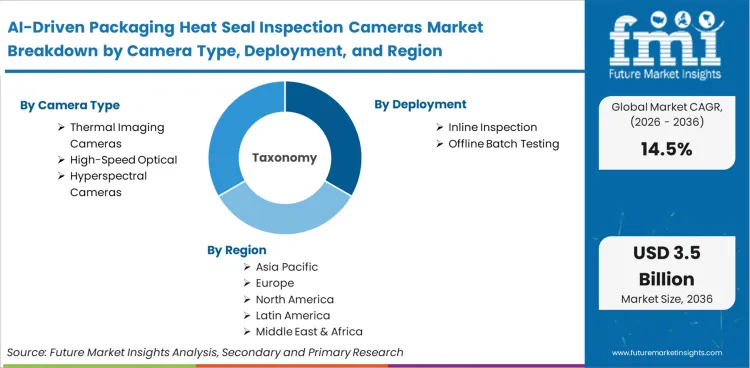
| Metric | Value |
|---|---|
| Quantitative Units | USD 0.9 billion to USD 3.7 billion, at a CAGR of 14.5% |
| Market Definition | AI-driven packaging heat seal inspection cameras are advanced machine vision systems utilizing thermal, hyperspectral, or high-speed optical sensors combined with deep learning algorithms to detect micro-leaks, weak seals, and material inclusions in sealed flexible or semi-rigid packaging. |
| Camera Type Segmentation | Thermal Imaging Cameras, High-Speed Optical, Hyperspectral Cameras |
| Deployment Segmentation | Inline Inspection, Offline Batch Testing |
| End-Use Industry Segmentation | Pharmaceuticals, Food & Beverage, Medical Devices |
| Regions Covered | North America, Latin America, Europe, East Asia, South Asia, Oceania, Middle East & Africa |
| Countries Covered | China, USA, Germany, UK, Japan, South Korea, Italy, and 40 plus countries |
| Key Companies Profiled | Cognex Corporation, Keyence Corporation, Teledyne FLIR, Sick AG, Omron Corporation, Basler AG, Mettler-Toledo International Inc., Stevanato Group |
| Forecast Period | 2026 to 2036 |
| Approach | The baseline value derives from a bottom-up aggregation of specialized industrial camera shipments, applying sector-specific modernization curves to project adoption velocity. |
Source: Future Market Insights (FMI) analysis, based on proprietary forecasting model and primary research
Segmental Analysis
Camera Type:
- Thermal Imaging Cameras
- High-Speed Optical
- Hyperspectral Cameras
Deployment:
- Inline Inspection
- Offline Batch Testing
End-Use Industry:
- Pharmaceuticals
- Food & Beverage
- Medical Devices
Region:
- Asia Pacific
- India
- China
- Japan
- South Korea
- Indonesia
- Australia & New Zealand
- ASEAN
- Rest of Asia Pacific
- Europe
- Germany
- Italy
- France
- United Kingdom
- Spain
- Benelux
- Nordics
- Central & Eastern Europe
- Rest of Europe
- North America
- United States
- Canada
- Mexico
- Latin America
- Brazil
- Argentina
- Chile
- Rest of Latin America
- Middle East & Africa
- Kingdom of Saudi Arabia
- United Arab Emirates
- South Africa
- Turkey
- Rest of Middle East & Africa
Bibliography
- USA Food and Drug Administration. (2025, January 15). Guidance for Industry: Container and Closure System Integrity Testing in Lieu of Sterility Testing as a Component of the Stability Protocol for Sterile Products (Regulatory guidance).
- ASTM International. (2024, November 10). Standard Test Method for Nondestructive Detection of Leaks in Packages by Vacuum Decay Method (Standards publication).
- PMMI. (2025, February 22). Vision Systems and AI in Packaging Machinery: 2025 State of the Industry (Industry report).
- International Organization for Standardization. (2024, September 05). ISO 11607-1:2019 Packaging for terminally sterilized medical devices (Standards publication).
- European Medicines Agency. (2024, October 18). Guideline on the manufacture of the finished dosage form (Regulatory filing).
- Packaging Machinery Manufacturers Institute. (2025, April 04). Transitioning from Destructive Testing to Inline Vision Verification (Sector survey).
- Parenteral Drug Association. (2025, February 14). Technical Report No. 27: Pharmaceutical Package Integrity (Industry report).
This bibliography is provided for reader reference. The full FMI report contains the complete reference list with primary research documentation.
This Report Addresses
- Market sizing and quantitative forecast metrics detailing the precise capital expenditure dedicated to AI-driven thermal inspection hardware across major pharmaceutical and food sectors through 2036.
- Segmentation analysis mapping the adoption velocity of hyperspectral camera systems and evaluating the technical limitations driving the transition away from offline batch testing.
- Regional deployment intelligence comparing the aggressive greenfield pharmaceutical construction strategies in China against the strict medical device modernization requirements prevalent in the United States.
- Regulatory compliance assessment analyzing how stringent FDA serialization mandates and European packaging waste directives force the adoption of continuous inline validation architectures.
- Competitive posture evaluation tracking the mandatory shift toward intelligent edge processing and the resulting acquisition strategies among legacy machine vision hardware manufacturers.
- Capital project strategic guidance defining the exact neural network processing requirements and synchronization tolerances necessary to support high-throughput form-fill-seal equipment.
- Supply chain vulnerability analysis identifying the specific quality assurance bottlenecks that extend product release timelines in sterile consumable manufacturing.
- Custom data delivery formats encompassing interactive dashboards, raw Excel datasets, and comprehensive PDF narrative reports.
Frequently Asked Questions
How large is the demand for AI-Driven Packaging Heat Seal Inspection Cameras in the global market in 2026?
Demand for AI-Driven Packaging Heat Seal Inspection Cameras in the global market is estimated to be valued at USD 0.9 billion in 2026.
What will be the market size of AI-Driven Packaging Heat Seal Inspection Cameras in the global market by 2036?
Market size for AI-Driven Packaging Heat Seal Inspection Cameras is projected to reach USD 3.7 billion by 2036.
What is the expected demand growth for AI-Driven Packaging Heat Seal Inspection Cameras in the global market between 2026 and 2036?
Demand for AI-Driven Packaging Heat Seal Inspection Cameras is expected to grow at a CAGR of 14.5% between 2026 and 2036.
Which Camera Type is poised to lead global sales by 2026?
Thermal Imaging Cameras commands 52.0% in 2026 as quality assurance directors execute full-scale sensor replacement programs to detect micro-channels in complex opaque laminates.
How significant is the role of Pharmaceuticals in driving AI-Driven Packaging Heat Seal Inspection Cameras adoption in 2026?
Pharmaceuticals represents 45.0% of segment share as sterile cleanroom operators standardize on unified camera networks to eliminate destructive batch testing.
What is driving demand in China?
China's biopharmaceutical manufacturing sector deploys highly automated production lines, forcing greenfield facility architects to bypass legacy optical sensors and specify native hyperspectral endpoints.
What compliance standards or regulations are referenced for the USA?
The United States pharmaceutical manufacturing sector operates under rigorous FDA 21 CFR Part 11 requirements for electronic records and immutable quality documentation.
What is the China growth outlook in this report?
China is projected to grow at a CAGR of 16.5% during 2026 to 2036.
Why is North America described as a priority region in this report?
The North American medical device and pharmaceutical manufacturing sectors actively drive inspection network consolidation to secure comprehensive supply chain traceability.
What type of demand dominates in North America?
Demand heavily focuses on replacing manual visual inspections with intelligent thermal architectures that comply with strict federal quality validation mandates.
What is Germany's growth outlook in this report?
Germany is projected to expand at a CAGR of 14.5% during 2026 to 2036.
Does the report cover the UK in its regional analysis?
Yes, the UK is included within Europe under the regional scope of analysis.
What are the sources referred to for analyzing the UK?
National retail grocery safety standards and commercial packaging supply chain tracking initiatives form the analytical basis.
What is the main demand theme linked to the UK in its region coverage?
Strict allergen and freshness guarantees across food processing lines force the deployment of sensitive hyperspectral seal inspection cameras.
Does the report cover South Korea in its regional analysis?
Yes, South Korea is included within Asia Pacific under the regional coverage framework.
What is the main South Korea related demand theme in its region coverage?
Stringent validation criteria for highly automated cleanroom components compel the adoption of zero-defect edge-processing inspection networks.
Which product formats or configurations are strategically important for Europe supply chains?
Compact thermal imaging arrays integrated directly into the sealing jaws are critical for supporting the region's transition toward delicate mono-material recyclable films.
What is AI-Driven Packaging Heat Seal Inspection Cameras and what is it mainly used for?
AI-driven packaging heat seal inspection cameras utilize thermal or optical sensors combined with machine learning to evaluate pouch and blister seals. They are primarily used to identify micro-leaks and product inclusions without slowing down high-speed production lines.
What does AI-Driven Packaging Heat Seal Inspection Cameras mean in this report?
The scope encompasses specialized physical camera hardware and the corresponding neural network software engineered to validate hermetic seals on automated packaging equipment.
What is included in the scope of this AI-Driven Packaging Heat Seal Inspection Cameras report?
The market covers industrial thermal imaging arrays, hyperspectral sensors, edge computing hardware, and AI defect classification software utilized for packaging integrity.
What is excluded from the scope of this report?
Standard barcode verification scanners, X-ray foreign body detectors, manual offline burst testing chambers, and general-purpose enterprise AI software are explicitly excluded.
What does market forecast mean on this page?
The market forecast represents a model-based projection built on defined industrial and technology adoption assumptions for strategic planning purposes.
How does FMI build and validate the AI-Driven Packaging Heat Seal Inspection Cameras forecast?
The baseline value derives from a bottom-up aggregation of specialized industrial camera shipments and cross-validates projections against publicly reported machine vision capital expenditure guidance.
What does zero reliance on speculative third-party market research mean here?
Primary interviews, verified regulatory compliance registries, and official vision hardware capability data are used exclusively instead of unverified syndicated estimates.
Preview the report firsthand - request a free sample
Get SampleGet the brochure for pricing and purchase details.
Get PDFTable of Content
- Executive Summary
- Global Market Outlook
- Demand-side Trends
- Technology Roadmap Analysis
- Analysis and Recommendations
- Market Overview
- Market Coverage / Taxonomy
- Market Definition / Scope / Limitations
- Research Methodology
- Chapter Orientation
- Analytical Lens and Working Hypotheses
- Market Structure, Signals, and Trend Drivers
- Research Design and Evidence Framework
- Desk Research Programme (Secondary Evidence)
- Company Annual and Sustainability Reports
- Peer-reviewed Journals and Academic Literature
- Corporate Websites, Product Literature, and Technical Notes
- Earnings Decks and Investor Briefings
- Statutory Filings and Regulatory Disclosures
- Technical White Papers and Standards Notes
- Trade Journals, Industry Magazines, and Analyst Briefs
- Conference Proceedings, Webinars, and Seminar Materials
- Government Statistics Portals and Public Data Releases
- Press Releases and Reputable Media Coverage
- Specialist Newsletters and Curated Briefings
- Sector Databases and Reference Repositories
- FMI Internal Proprietary Databases and Historical Market Datasets
- Subscription Datasets and Paid Sources
- Social Channels, Communities, and Digital Listening Inputs
- Additional Desk Sources
- Expert Input and Fieldwork (Primary Evidence)
- Primary Modes
- Qualitative Interviews and Expert Elicitation
- Quantitative Surveys and Structured Data Capture
- Blended Approach
- Why Primary Evidence is Used
- Field Techniques
- Interviews
- Surveys
- Focus Groups
- Observational and In-context Research
- Social and Community Interactions
- Stakeholder Universe Engaged
- C-suite Leaders
- Board Members
- Presidents and Vice Presidents
- R&D and Innovation Heads
- Technical Specialists
- Domain Subject-matter Experts
- Scientists
- Physicians and Other Healthcare Professionals
- Governance, Ethics, and Data Stewardship
- Research Ethics
- Data Integrity and Handling
- Primary Modes
- Tooling, Models, and Reference Databases
- Desk Research Programme (Secondary Evidence)
- Data Engineering and Model Build
- Data Acquisition and Ingestion
- Cleaning, Normalisation, and Verification
- Synthesis, Triangulation, and Analysis
- Quality Assurance and Audit Trail
- Market Background
- Market Dynamics
- Drivers
- Restraints
- Opportunity
- Trends
- Scenario Forecast
- Demand in Optimistic Scenario
- Demand in Likely Scenario
- Demand in Conservative Scenario
- Opportunity Map Analysis
- Product Life Cycle Analysis
- Supply Chain Analysis
- Investment Feasibility Matrix
- Value Chain Analysis
- PESTLE and Porter’s Analysis
- Regulatory Landscape
- Regional Parent Market Outlook
- Production and Consumption Statistics
- Import and Export Statistics
- Market Dynamics
- Global Market Analysis 2021 to 2025 and Forecast, 2026 to 2036
- Historical Market Size Value (USD Million) Analysis, 2021 to 2025
- Current and Future Market Size Value (USD Million) Projections, 2026 to 2036
- Y-o-Y Growth Trend Analysis
- Absolute $ Opportunity Analysis
- Global Market Pricing Analysis 2021 to 2025 and Forecast 2026 to 2036
- Global Market Analysis 2021 to 2025 and Forecast 2026 to 2036, By Camera Type
- Introduction / Key Findings
- Historical Market Size Value (USD Million) Analysis By Camera Type , 2021 to 2025
- Current and Future Market Size Value (USD Million) Analysis and Forecast By Camera Type , 2026 to 2036
- Thermal Imaging Cameras
- High-Speed Optical
- Hyperspectral Cameras
- Thermal Imaging Cameras
- Y-o-Y Growth Trend Analysis By Camera Type , 2021 to 2025
- Absolute $ Opportunity Analysis By Camera Type , 2026 to 2036
- Global Market Analysis 2021 to 2025 and Forecast 2026 to 2036, By Deployment
- Introduction / Key Findings
- Historical Market Size Value (USD Million) Analysis By Deployment, 2021 to 2025
- Current and Future Market Size Value (USD Million) Analysis and Forecast By Deployment, 2026 to 2036
- Inline Inspection
- Offline Batch Testing
- Inline Inspection
- Y-o-Y Growth Trend Analysis By Deployment, 2021 to 2025
- Absolute $ Opportunity Analysis By Deployment, 2026 to 2036
- Global Market Analysis 2021 to 2025 and Forecast 2026 to 2036, By Region
- Introduction
- Historical Market Size Value (USD Million) Analysis By Region, 2021 to 2025
- Current Market Size Value (USD Million) Analysis and Forecast By Region, 2026 to 2036
- North America
- Latin America
- Western Europe
- Eastern Europe
- East Asia
- South Asia and Pacific
- Middle East & Africa
- Market Attractiveness Analysis By Region
- North America Market Analysis 2021 to 2025 and Forecast 2026 to 2036, By Country
- Historical Market Size Value (USD Million) Trend Analysis By Market Taxonomy, 2021 to 2025
- Market Size Value (USD Million) Forecast By Market Taxonomy, 2026 to 2036
- By Country
- USA
- Canada
- Mexico
- By Camera Type
- By Deployment
- By Country
- Market Attractiveness Analysis
- By Country
- By Camera Type
- By Deployment
- Key Takeaways
- Latin America Market Analysis 2021 to 2025 and Forecast 2026 to 2036, By Country
- Historical Market Size Value (USD Million) Trend Analysis By Market Taxonomy, 2021 to 2025
- Market Size Value (USD Million) Forecast By Market Taxonomy, 2026 to 2036
- By Country
- Brazil
- Chile
- Rest of Latin America
- By Camera Type
- By Deployment
- By Country
- Market Attractiveness Analysis
- By Country
- By Camera Type
- By Deployment
- Key Takeaways
- Western Europe Market Analysis 2021 to 2025 and Forecast 2026 to 2036, By Country
- Historical Market Size Value (USD Million) Trend Analysis By Market Taxonomy, 2021 to 2025
- Market Size Value (USD Million) Forecast By Market Taxonomy, 2026 to 2036
- By Country
- Germany
- UK
- Italy
- Spain
- France
- Nordic
- BENELUX
- Rest of Western Europe
- By Camera Type
- By Deployment
- By Country
- Market Attractiveness Analysis
- By Country
- By Camera Type
- By Deployment
- Key Takeaways
- Eastern Europe Market Analysis 2021 to 2025 and Forecast 2026 to 2036, By Country
- Historical Market Size Value (USD Million) Trend Analysis By Market Taxonomy, 2021 to 2025
- Market Size Value (USD Million) Forecast By Market Taxonomy, 2026 to 2036
- By Country
- Russia
- Poland
- Hungary
- Balkan & Baltic
- Rest of Eastern Europe
- By Camera Type
- By Deployment
- By Country
- Market Attractiveness Analysis
- By Country
- By Camera Type
- By Deployment
- Key Takeaways
- East Asia Market Analysis 2021 to 2025 and Forecast 2026 to 2036, By Country
- Historical Market Size Value (USD Million) Trend Analysis By Market Taxonomy, 2021 to 2025
- Market Size Value (USD Million) Forecast By Market Taxonomy, 2026 to 2036
- By Country
- China
- Japan
- South Korea
- By Camera Type
- By Deployment
- By Country
- Market Attractiveness Analysis
- By Country
- By Camera Type
- By Deployment
- Key Takeaways
- South Asia and Pacific Market Analysis 2021 to 2025 and Forecast 2026 to 2036, By Country
- Historical Market Size Value (USD Million) Trend Analysis By Market Taxonomy, 2021 to 2025
- Market Size Value (USD Million) Forecast By Market Taxonomy, 2026 to 2036
- By Country
- India
- ASEAN
- Australia & New Zealand
- Rest of South Asia and Pacific
- By Camera Type
- By Deployment
- By Country
- Market Attractiveness Analysis
- By Country
- By Camera Type
- By Deployment
- Key Takeaways
- Middle East & Africa Market Analysis 2021 to 2025 and Forecast 2026 to 2036, By Country
- Historical Market Size Value (USD Million) Trend Analysis By Market Taxonomy, 2021 to 2025
- Market Size Value (USD Million) Forecast By Market Taxonomy, 2026 to 2036
- By Country
- Kingdom of Saudi Arabia
- Other GCC Countries
- Turkiye
- South Africa
- Other African Union
- Rest of Middle East & Africa
- By Camera Type
- By Deployment
- By Country
- Market Attractiveness Analysis
- By Country
- By Camera Type
- By Deployment
- Key Takeaways
- Key Countries Market Analysis
- USA
- Pricing Analysis
- Market Share Analysis, 2025
- By Camera Type
- By Deployment
- Canada
- Pricing Analysis
- Market Share Analysis, 2025
- By Camera Type
- By Deployment
- Mexico
- Pricing Analysis
- Market Share Analysis, 2025
- By Camera Type
- By Deployment
- Brazil
- Pricing Analysis
- Market Share Analysis, 2025
- By Camera Type
- By Deployment
- Chile
- Pricing Analysis
- Market Share Analysis, 2025
- By Camera Type
- By Deployment
- Germany
- Pricing Analysis
- Market Share Analysis, 2025
- By Camera Type
- By Deployment
- UK
- Pricing Analysis
- Market Share Analysis, 2025
- By Camera Type
- By Deployment
- Italy
- Pricing Analysis
- Market Share Analysis, 2025
- By Camera Type
- By Deployment
- Spain
- Pricing Analysis
- Market Share Analysis, 2025
- By Camera Type
- By Deployment
- France
- Pricing Analysis
- Market Share Analysis, 2025
- By Camera Type
- By Deployment
- India
- Pricing Analysis
- Market Share Analysis, 2025
- By Camera Type
- By Deployment
- ASEAN
- Pricing Analysis
- Market Share Analysis, 2025
- By Camera Type
- By Deployment
- Australia & New Zealand
- Pricing Analysis
- Market Share Analysis, 2025
- By Camera Type
- By Deployment
- China
- Pricing Analysis
- Market Share Analysis, 2025
- By Camera Type
- By Deployment
- Japan
- Pricing Analysis
- Market Share Analysis, 2025
- By Camera Type
- By Deployment
- South Korea
- Pricing Analysis
- Market Share Analysis, 2025
- By Camera Type
- By Deployment
- Russia
- Pricing Analysis
- Market Share Analysis, 2025
- By Camera Type
- By Deployment
- Poland
- Pricing Analysis
- Market Share Analysis, 2025
- By Camera Type
- By Deployment
- Hungary
- Pricing Analysis
- Market Share Analysis, 2025
- By Camera Type
- By Deployment
- Kingdom of Saudi Arabia
- Pricing Analysis
- Market Share Analysis, 2025
- By Camera Type
- By Deployment
- Turkiye
- Pricing Analysis
- Market Share Analysis, 2025
- By Camera Type
- By Deployment
- South Africa
- Pricing Analysis
- Market Share Analysis, 2025
- By Camera Type
- By Deployment
- USA
- Market Structure Analysis
- Competition Dashboard
- Competition Benchmarking
- Market Share Analysis of Top Players
- By Regional
- By Camera Type
- By Deployment
- Competition Analysis
- Competition Deep Dive
- Cognex Corporation
- Overview
- Product Portfolio
- Profitability by Market Segments (Product/Age /Sales Channel/Region)
- Sales Footprint
- Strategy Overview
- Marketing Strategy
- Product Strategy
- Channel Strategy
- Keyence Corporation
- Teledyne FLIR
- Sick AG
- Omron Corporation
- Basler AG
- Mettler-Toledo International Inc
- Cognex Corporation
- Competition Deep Dive
- Assumptions & Acronyms Used


