

- Market Size (2026)
- USD 242.8 Mn
- Forecast (2036)
- USD 555.5 Mn
- CAGR (2026 to 2036)
- 8.6%
How big is the Packaging Specification Management Software Market in 2026?
Demand for packaging specification management software is projected to expand at 8.6% CAGR between 2026 and 2036. Industry value grows from USD 223.5 million in 2025 to USD 242.8 million in 2026 and is projected to reach USD 555.5 million by 2036.
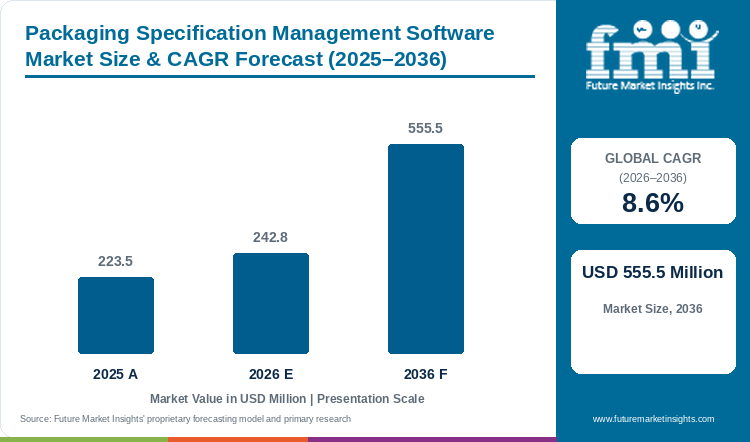
Packaging specification management software maintains material, dimension, artwork, claim, supplier and approval information required before a package is released. The global market was valued at USD 223.5 million in 2025 and is projected to grow from USD 242.8 million in 2026 to USD 555.5 million by 2036, at 8.6% CAGR. Food and beverage accounted for 60.0% of application revenue in 2026, owing to repeated formula, allergen, claim and label changes. TraceGains reported that 21 of 45 U.S. food and beverage recalls in the first quarter of 2025 involved undeclared allergens or packaging and labeling errors.[3] The U.S. Environmental Protection Agency also estimated USD 36.5 billion to USD 43.4 billion for recycling collection and processing modernization, covering materials equal to about 82% of municipal solid waste.[2] Larger packaging volumes and repeated product changes is expected to support demand for controlled package records.
Key Market Trends & Insights
- By application: Food and beverage accounted for 60.0% of revenue in 2026, supported by frequent formula, allergen, claim and label changes.
- By deployment mode, cloud-based software held a 68.0% share in 2026, as brand owners, suppliers, converters and artwork teams requires access to the same current specification. Specright provides versioning, duplicate detection, supplier access and component-level PPWR records within one platform.[4]
- By function, packaging specifications represented the leading 35.0% share in 2026. The approved component record supplies dimensions, materials, tolerances and files used across artwork, compliance and sustainability work.
- By enterprise size, large enterprises accounted for 62.0% in 2026, owing to multi-brand portfolios, regional labels and reuse of common packaging components across several plants.
Regional Highlights
- Fastest-growing profiled country: the Netherlands at 8.8% CAGR from 2026 to 2036, supported by circular-economy planning and stronger requirement for material and reuse records.
- The United States follows at 8.7%, while Germany and Japan are projected at 8.6%, the United Kingdom at 8.5%, and France records the lowest profiled CAGR at 8.4%.
Market Size & Forecast
Table 1: Market Size and Forecast for the Packaging Specification Management Software Market (USD million), 2025 to 2036
| Metric | Value |
|---|---|
| 2025 Market Size | USD 223.5 million |
| Estimated Market Size in 2026 | USD 242.8 million |
| Projected Market Size by 2036 | USD 555.5 million |
| CAGR, 2026 to 2036 | 8.6% |
| Added Revenue, 2026 to 2036 | USD 312.7 million |
| Market Expansion Multiple | 2.29x |
Packaging compliance is becoming one of the primary factors supporting software adoption. The European Commission reported 178 kg of packaging waste per European in 2023 and estimated total packaging waste could increase 19% by 2030 from 2018, while plastic packaging waste could rise 46%.[16] A 2026 Joint Research Centre assessment found that 19 EU countries representing 97% of EU population placed 42.8 million tonnes of packaging on the market in 2024, equal to 98 kg per person, while plastic packaging reached 5.9 million tonnes in 2025.[17] Higher packaging volumes creates more material, recyclability and producer records for companies, as noted by FMI. Platforms keeping the same component information across declarations, supplier evidence, labels and artwork are expected to receive higher preference.
Packaging Data and Compliance Intensity
Packaging specification management software connects package design, supplier evidence, artwork approval and compliance reporting through the same product record. Material weight, component structure, recyclability and approved files are used several times after the package is created. Due to this, companies having larger package portfolios requires information that can be carried from supplier review to production and reporting. The indicators below show the packaging volume and regulatory activity supporting demand for structured package data.
Table 2: Packaging Data and Compliance Indicators for the Packaging Specification Management Software Market (waste, packaging volume, percentages, and investment), mixed reporting years from 2023 to 2026
| Indicator | Data Point | Why It Matters | Source |
|---|---|---|---|
| U.S. recycling modernization requirement | USD 36.5 billion to USD 43.4 billion | More collection and processing activity increases material and recyclability records required from packaging owners. | [2] |
| Materials covered by U.S. assessment | About 82% of municipal solid waste | Packaging and organic recyclable materials form a large reporting base for recovery systems. | [2] |
| European packaging waste | 178 kg per person in 2023 | High waste intensity raises the number of packaging formats subject to prevention, reuse and recycling rules. | [16] |
| Potential EU packaging-waste increase | 19% by 2030 from 2018 | Without intervention, volume growth expands compliance and reporting work for packaged products. | [16] |
| Packaging placed on market | 42.8 million tonnes in 19 EU countries in 2024 | Large package volume supports repeated specification, supplier and declaration activity. | [17] |
| Plastic packaging trend | 5.9 million tonnes in 2025, up 11% from 2011 | Material growth increases requirement for component-level plastic and recycled-content information. | [17] |
Basis: Added revenue equals USD 555.5 million less USD 242.8 million. Market expansion multiple equals USD 555.5 million divided by USD 242.8 million. External indicators retain their original reporting year and are used to explain specification-data intensity, not to estimate the proprietary market size.
Analyst Perspective
“Demand will remain strongest where product changes move directly into packaging and artwork review. Suppliers maintaining one approved record across brands and plants will receive higher preference from manufacturers.”
- Nandini Roy Choudhury, Principal Consultant, Future Market Insights.
How is the packaging specification management software market segmented?
Packaging specification management software is segmented by application, deployment mode, function, enterprise size, and region. In 2026, food and beverage is projected at 60.0%, cloud-based deployment at 68.0%, packaging specifications at 35.0%, and large enterprises at 62.0%.
By application: food and beverage, pharmaceuticals, consumer goods, cosmetics and personal care, and other applications.
By deployment mode: cloud-based and on-premises.
By function: packaging specifications, labeling content, sustainability metrics, supplier collaboration, and compliance documentation.
By enterprise size: large enterprises and small and medium enterprises.
By region: North America, Latin America, Western Europe, Eastern Europe, East Asia, South Asia and Pacific, and Middle East and Africa.
Why does food and beverage account for notable application demand?
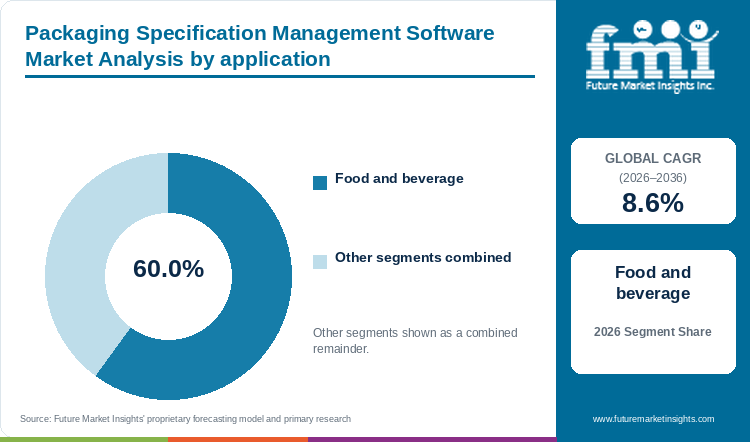
Based on application, food and beverage is projected to account for 60.0% in 2026, driven by frequent specification changes.
Table 3: Application Share for the Packaging Specification Management Software Market (percentage share), 2026
| Application | Share (2026) |
|---|---|
| Food and Beverage | 60.0% |
| Other Segments Combined | 40.0%* |
| Total | 100.0% |
*Calculated as the balance remaining after deducting the leading segment\'s reported share from 100.0%.
Table 4: Application Leadership and Market Growth for the Packaging Specification Management Software Market (segment and CAGR percentage), 2026 to 2036
| Metric | Value |
|---|---|
| Global CAGR (2026 to 2036) | 8.6% |
| Leading Segment | Food and Beverage |
Food and beverage products requires formula, allergen, claim, pack size and supplier information before the package is released for production. One ingredient or allergen change can affect several labels and package records. Connected specifications can identify the affected label when product information changes, which helps manufacturers remove old artwork before production. Frequent product launches and higher number of label changes is expected to drive software demand from food and beverage manufacturers.
- Food and beverage is projected to hold 60.0% of application revenue in 2026 because one product change can affect several package records.
- In February 2026, TraceGains and Esko allied to connect packaging specifications with native artwork approvals, reducing packaging risk across food and beverage portfolios.[1]
What supports cloud-based software as the preferred deployment mode?
By deployment mode, cloud-based software is estimated to hold 68.0% in 2026, supported by shared supplier access.
Cloud-based packaging specification management software allows brand owners, suppliers, converters, laboratories and artwork teams to use the same current record. Separate local files can result in an older package specification being used when several participants updates the information. Specright provides searchable specifications, supplier collaboration, version control and compliance records within its packaging platform.[4] Shared access and wider supplier participation is anticipated to support cloud-based software adoption.
- Cloud-based software is estimated to hold 68.0% of deployment revenue in 2026 as external partners can use common workflows.
- Access control and change history remains important when suppliers updates the same specification.
How do packaging specifications anchor connected software workflows?
In 2026, packaging specifications are expected to lead function with 35.0% share, owing to record-level control.
Packaging specifications contains dimensions, materials, tolerances, components, approved files and supplier information used for producing a package. The same information is applied in artwork, manufacturing instruction, compliance and sustainability reporting.[5] Availability of structured component details reduces repeated entry of the same package information. Wider use of approved attributes across connected packaging work is expected to support the segment growth.
- Packaging specifications are projected to hold 35.0% of function revenue in 2026 because other workflows depends on approved attributes.
- Structured component data can be used for compliance, supplier review and sustainability reporting.
Why do large enterprises retain a notable enterprise-size share?
Large enterprises are set to lead enterprise size with 62.0% share in 2026, underpinned by portfolio complexity.
Large enterprises manages several brands, plants, suppliers and regional package versions, due to which one outdated specification can affect many products. Common packaging components are also reused across different brands and manufacturing sites. Central control allows companies to retain approved component information while maintaining regional label differences.[6] Expansion of multi-brand portfolios is anticipated to support software adoption among large enterprises.
- Large enterprises are forecast to account for 62.0% of enterprise-size revenue in 2026 as multi-site portfolios requires common controls.
- Portfolio control becomes more useful when one packaging change affects several products and regional labels.
What are the drivers, restraints, and opportunities in this market?
In the packaging specification management software market, the key driver is compliance data, the key restraint is legacy migration, and the key opportunity is connected automation.
- Driver: Companies adopt specification platforms when packaging rules require traceable material, label, and supplier records.
- Restraint: Incomplete legacy specifications delay migration and reduce trust in automated approvals.
- Opportunity: Product passports and integrated artwork workflows create demand for reusable structured packaging data.
Compliance Data Expands Platform Use
Packaging rules requires material composition, recyclability, labeling and producer information to remain available with the approved package. In July 2026, the European Commission established the Digital Product Passport Registry framework.[7] Packaging specification software can maintain product and material attributes required for such electronic records. An FMI analyst notes that movement of compliance information into regular packaging approval is expected to drive market growth.
Legacy Records Slow System Migration
Packaging specifications of several companies are retained in spreadsheets, PDF files, emails and supplier portals. These records may contain duplicate components, different units, missing owners and incorrect artwork links. Specright expanded duplicate detection, comparison, versioning and component-level PPWR controls during 2026.[8] However, manufacturers still requires complete source files before older information can be moved. High volume of incomplete legacy records may hamper software adoption among companies having large product portfolios.
Connected Automation Opens New Workflows
Connected platforms can move an approved ingredient, claim or material change into packaging and artwork review without depending on a separate email chain. TraceGains introduced packaging specification management during 2026 for connecting ingredients, finished goods, packaging and artwork.[9] The affected package can be identified when source information changes. This is expected to create growth opportunities for vendors connecting product information with print-ready artwork.
Which country CAGRs are profiled in this market?
Table 5: Country CAGR Comparison for the Packaging Specification Management Software Market (CAGR percentage), 2026 to 2036
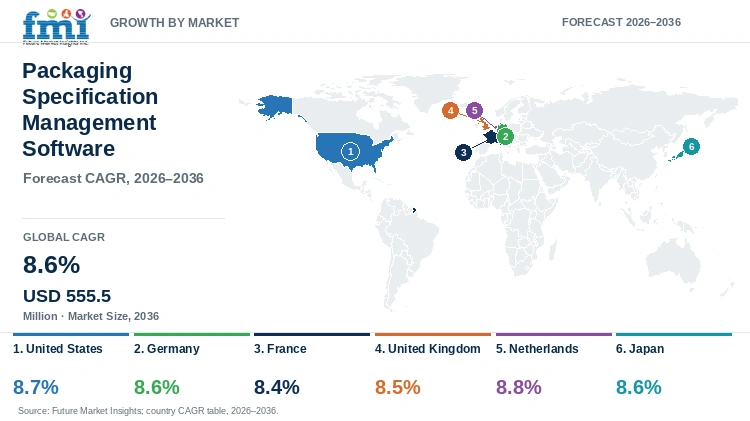
| Country | CAGR |
|---|---|
| United States | 8.7% |
| Germany | 8.6% |
| France | 8.4% |
| United Kingdom | 8.5% |
| Netherlands | 8.8% |
| Japan | 8.6% |
How do country-level CAGRs compare in this market?
Commercial conditions differ across the profiled countries as packaging manufacturers transition from separate files toward controlled records. In the FMI report, the Netherlands and the United States show comparatively stronger expansion, while Germany, Japan, the United Kingdom and France develop through different packaging reporting and compliance conditions. Difference in growth is attributed to packaging reporting maturity, cloud adoption, consumer-product portfolios and speed of regulatory change.
- The United States combines cloud adoption with high packaging and recycling data requirements.
- Germany connects packaging records with material, recycling and European compliance requirements.
- France requires detailed packaging and environmental information across consumer product portfolios.
- The United Kingdom adds producer reporting and packaging recycling obligations to product change workflows.
- The Netherlands connects circular-economy planning with material efficiency and business data management.
- Japan relies on detailed container and packaging recycling processes and material-circulation planning.
Full report country CAGRs cover: North America; Latin America; Western Europe; Eastern Europe; East Asia; South Asia and Pacific; Middle East and Africa.
Country-wise Analysis
- The United States packaging specification management software market is projected to expand at 8.7% CAGR through 2036. The U.S. Environmental Protection Agency reported in July 2026 that commonly recycled materials includes metal cans, paper, glass and plastics, while the recycling system requires USD 36.5 billion to USD 43.4 billion in modernization investment.[10] Packaging owners needs material and component records that remain consistent from design to recovery reporting. FMI research indicates that cloud platforms connecting material records with suppliers, artwork and finished goods will support software demand in the United States.
- Germany packaging specification management software market is projected to expand at 8.6% CAGR through 2036. A March 2025 European Environment Agency profile reported that Germany exceeded all 2025 packaging recycling targets using 2022 reference data, while plastic packaging recycling was above 50.0%.[11] High reporting maturity increases requirement for material composition, supplier evidence and approved package structures in reusable records. German manufacturers are increasingly using controlled specifications before artwork and production release, which is anticipated to support market growth.
- France packaging specification management software market is projected to expand at 8.4% CAGR through 2036. A 2025 French government publication stated that France generates more than 3 million tonnes of plastic waste every year and 75.0% is not recycled.[12] Brand owners therefore requires clearer records for component weights, multilayer structures and approved alternatives when packaging is changed. Software that keeps these attributes with supplier documents and artwork versions is expected to witness increasing demand in France.
- The United Kingdom packaging specification management software market is projected to expand at 8.5% CAGR through 2036. The Department for Environment, Food and Rural Affairs reported in September 2026 that 70.5% of UK packaging waste was provisionally recycled in 2025.[13] Producer reporting requires accurate material, weight and market-placement records. Specification software can connect these fields with suppliers and approved packaging versions, due to which adoption is anticipated to rise among companies managing several product and label changes.
- The Netherlands packaging specification management software market is projected to expand at 8.8% CAGR through 2036. The Government of the Netherlands published its National Circular Economy Programme 2025 in October 2025 and connected resource efficiency with business competitiveness.[14] Packaging teams requires structured records for reused content, component choices and supplier evidence across product portfolios. FMI data suggests that shared platforms connecting material-efficiency decisions into purchasing and compliance work will continue to drive market growth in the Netherlands.
- Japan packaging specification management software market is projected to expand at 8.6% CAGR through 2036. A 2026 Ministry of Economy, Trade and Industry review reported 38.97 million tonnes of municipal waste in fiscal 2023 and 851 grams generated per person each day.[15] The review also covers separate collection, recycling and obligations for specified businesses. Packaging owners requires component-level data that can be connected with Japanese labels, material categories and supplier documents. This is anticipated to support software demand in Japan.
Who are the notable companies in this market?
Specright, TraceGains, Esko, SpecPage, Trace One, Lascom, QADEX, and Dassault Systèmes are notable companies profiled in this market.
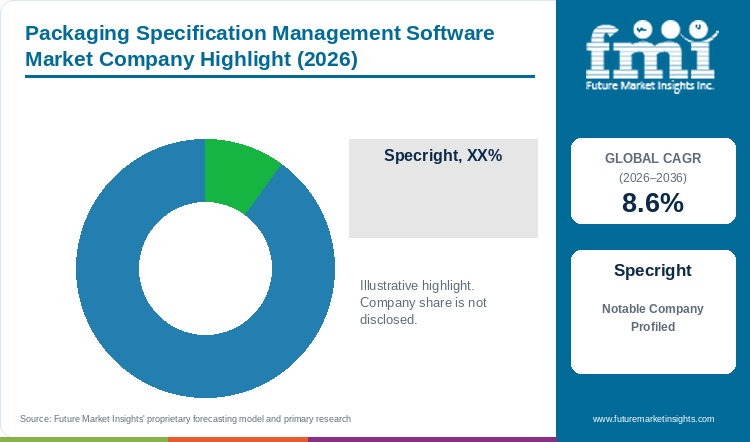
Packaging specification management software market is moderately fragmented with companies operating in specification records, packaging artwork, supplier quality and product lifecycle management. Specright, TraceGains, SpecPage and QADEX focuses on specifications and supplier information, while Esko provides artwork review. Trace One, Lascom and Dassault Systèmes connects packaging information with wider product-development activities. Some of the key players are introducing integrations and compliance fields in order to cater the growing demand from packaging manufacturers.
- Specification-led platforms: Specright, TraceGains, SpecPage, and QADEX.
- Packaging and artwork platform: Esko.
- Product lifecycle suites: Trace One, Lascom, and Dassault Systèmes.
Competitive Benchmarking: Packaging Specification Management Software Market
Table 6: Competitive Benchmarking for the Packaging Specification Management Software Market (qualitative capability ratings), 2026
| Company | Specification depth | Workflow fit | Current activity | Reach |
|---|---|---|---|---|
| Specright | High | High | High | High |
| TraceGains | High | High | High | High |
| Esko | Medium | High | High | High |
| SpecPage | High | Medium | Medium | Medium |
| Trace One | Medium | High | High | High |
| Lascom | Medium | High | Medium | Medium |
| QADEX | Medium | High | Medium | Medium |
| Dassault Systèmes | Medium | High | High | High |
High represents broad public evidence across the stated capability, Medium represents narrower evidence, and Low represents limited documented breadth. Ratings describe public capability and do not indicate quality, revenue share, or company ranking.
Key Developments in the Packaging Specification Management Software Market
- In February 2026, TraceGains launched Packaging Specification Management with native Esko WebCenter Go integration for connected specifications and artwork approvals.
- In 2026, Specright expanded its packaging platform around PPWR declarations, duplicate detection, versioning and component-level material records.
- In July 2026, the European Commission established the Digital Product Passport Registry framework for standardised product information.
- In October 2025, the Netherlands published its National Circular Economy Programme 2025 with updated material-efficiency objectives.
Key Players in the Packaging Specification Management Software Market
Specification and quality platforms
- Specright
- TraceGains
- SpecPage
- QADEX
Packaging and artwork workflow
- Esko
Product lifecycle and portfolio suites
- Trace One
- Lascom
- Dassault Systèmes
Packaging Specification Management Software Market - Report Scope
Table 7: Report Scope for the Packaging Specification Management Software Market (coverage fields and definitions), 2026 to 2036
| Coverage field | Report scope |
|---|---|
| Market breakdown | Application, deployment mode, function, enterprise size, and region. |
| Quantitative units | USD million. |
| Market definition | Supplier revenue from software used to create, control, approve, and share packaging specifications and connected records. |
| Exclusions | Standalone graphic design tools, generic document storage, and implementation services not bundled with the software platform. |
| Regions covered | North America; Latin America; Western Europe; Eastern Europe; East Asia; South Asia and Pacific; Middle East and Africa. |
| Countries profiled | United States, Germany, France, United Kingdom, Netherlands, and Japan. |
| Forecast period | 2026 to 2036. |
| Approach | The Future Market Insights report covers software revenue, platform functions, deployment models, application demand, and country adoption conditions. |
Packaging Specification Management Software Market - Research Methodology
Table 8: Research Methodology for the Packaging Specification Management Software Market (research methods and approach), 2026 edition
| Method | Approach |
|---|---|
| Primary Research | Analysts gathered input from software providers, packaging teams, implementation partners, end users, procurement teams and industry experts. Interviews covers purchasing decision, platform evaluation, adoption barriers, pricing and approval requirement. |
| Desk Research | Desk research includes government statistics, regulatory publications, associations, technical literature, standards, product information and official company announcements. Sources were checked for date, relevance, country and defined market scope. |
| Market Sizing and Forecasting | Market sizing combines baseline value with historical performance, segment structure, software pricing, adoption indicators, company participation and country demand. Forecast considers packaging regulation, cloud adoption, purchasing cycle and barriers to wider use. |
| Data Validation | Estimates were checked against public data, company activity, industry developments and primary interviews. Adjacent categories, overlapping revenue and unsupported activities were excluded. |
Packaging Specification Management Software Market by Segments
Packaging specification management software market segmented by application:
- Food and beverage
- Pharmaceuticals
- Consumer goods
- Cosmetics and personal care
- Other applications
Packaging specification management software market segmented by deployment mode:
- Cloud-based
- On-premises
Packaging specification management software market segmented by function:
- Packaging specifications
- Labeling content
- Sustainability metrics
- Supplier collaboration
- Compliance documentation
Packaging specification management software market segmented by enterprise size:
- Large enterprises
- Small and medium enterprises
Packaging Specification Management Software Market by Region
- North America
- United States
- Canada
- Latin America
- Brazil
- Mexico
- Argentina
- Chile
- Western Europe
- Germany
- France
- United Kingdom
- Netherlands
- Italy
- Spain
- Benelux
- Nordics
- Eastern Europe
- Poland
- Czech Republic
- Romania
- Hungary
- East Asia
- Japan
- South Korea
- South Asia and Pacific
- ASEAN
- Australia and New Zealand
- Middle East and Africa
- GCC Countries
- South Africa
- Türkiye
- Israel
Research Sources and Bibliography
- [1] TraceGains. (2026, February 4). TraceGains and Esko alliance helps brands reduce packaging risk and accelerate time to market with unified spec ecosystem.
- [2] U.S. Environmental Protection Agency. (2026, July 31). U.S. recycling infrastructure assessment and state data collection reports. www.epa.gov/smm/us-recycling-infrastructure-assessment-and-state-data-collection-reports
- [3] TraceGains. (2025). Recall analysis: Undeclared allergens and packaging or labeling errors in first-quarter U.S. food and beverage recalls.
- [4] Specright. (2026). Packaging management software solutions.
- [5] European Commission. (2026). Digital Product Passport.
- [6] Dassault Systèmes. (2026). Product lifecycle management solutions.
- [7] European Commission. (2026, July). Digital Product Passport Registry framework.
- [8] Specright. (2026). Packaging management: PPWR declaration, versioning, and specification controls.
- [9] TraceGains. (2026). Packaging specification management.
- [10] U.S. Environmental Protection Agency. (2026, July 31). An assessment of the U.S. recycling system: Financial estimates to modernize material recovery infrastructure.
- [11] European Environment Agency. (2025, March). Waste management country profile: Germany. www.eea.europa.eu/en/topics/in-depth/waste-and-recycling/municipal-and-packaging-waste-management-country-profiles-2025/de-municipal-waste-factsheet.pdf/@@download/file
- [12] Ministry for Ecological Transition, France. (2025, January). Recycling of complex plastic waste: Contribution to the national adaptation plan.
- [13] Department for Environment, Food and Rural Affairs. (2026, September 23). UK statistics on waste.
- [14] Government of the Netherlands. (2025, October 13). National Circular Economy Programme 2025.
- [15] Ministry of Economy, Trade and Industry, Japan. (2026). Current status of the container and packaging recycling system. www.meti.go.jp/shingikai/sankoshin/sangyo_gijutsu/resource_circulation/container_packaging_recycling_wg/pdf/003_s02_00.pdf
- [16] European Commission. (2026, March 30). Commission publishes guidance to support implementation of new packaging rules, for a more sustainable and competitive EU packaging sector. ec.europa.eu/commission/presscorner/detail/en/ip_24_1741
- [17] European Commission, Joint Research Centre. (2026). Estimating packaging placed on the market at national level.
This bibliography is provided for reader reference. The full report contains the complete reference list and detailed citations.
This Report Answers
- What is the packaging specification management software market worth during 2026?
- What value is the market projected to reach by 2036?
- Which application holds a notable market share during 2026?
- Which deployment mode holds a notable market share during 2026?
- Which countries show notable packaging software growth through 2036?
- Which companies are notable in packaging specification management software?
Frequently Asked Questions
How big is the Packaging Specification Management Software Market in 2026?
The market is valued at USD 242.8 million in 2026 and is projected to reach USD 555.5 million by 2036.
What CAGR is projected for the market from 2026 to 2036?
As per FMI, packaging specification management software demand is projected to expand at 8.6% CAGR from 2026 to 2036.
Which application holds a notable market share in 2026?
Food and beverage is projected to hold 60.0% of application revenue in 2026 owing to frequent formula, claim and label changes.
Which deployment mode holds a notable market share in 2026?
Cloud-based software is estimated to hold 68.0% of deployment revenue in 2026, supported by supplier and cross-site access.
Which country has a notable expansion outlook through 2036?
According to FMI, the Netherlands is projected to record 8.8% CAGR through 2036, followed by the United States at 8.7%.
Which companies are active in this market during 2026?
Notable companies include Specright, TraceGains, Esko, SpecPage, Trace One, Lascom, QADEX, and Dassault Systèmes.
Preview the report firsthand - request a free sample
Get SampleGet the brochure for pricing and purchase details.
Get PDFTable of Content
- Key Takeaways
- Market Size and CAGR
- Top Growth Driver
- Fastest Growing Segment
- Leading Region
- Key Companies
- Emerging Opportunities
- Executive Summary
- Global Market Outlook
- Demand-side Trends
- Supply-side Trends
- Technology Roadmap Analysis
- Analysis and Recommendations
- Analyst Perspective (What is happening? Why now? What should investors know?)
- Key Questions Answered
- How large is the market?
- What is the CAGR?
- What are key trends?
- Which region dominates?
- Who are the leaders?
- Market Overview
- Market Coverage / Taxonomy
- Market Definition / Scope / Limitations
- Research Methodology
- Chapter Orientation
- Analytical Lens and Working Hypotheses
- Market Structure, Signals, and Trend Drivers
- Benchmarking and Cross-market Comparability
- Market Sizing, Forecasting, and Opportunity Mapping
- Research Design and Evidence Framework
- Desk Research Programme (Secondary Evidence)
- Expert Input and Fieldwork (Primary Evidence)
- Tooling, Models, and Reference Databases
- Data Engineering and Model Build
- Quality Assurance and Audit Trail
- Market Background
- Market Dynamics (Drivers, Restraints, Opportunity, Trends)
- Scenario Forecast (Optimistic, Likely, Conservative)
- Impact Analysis
- AI Impact
- Sustainability Impact
- Regulatory Impact
- Technology Impact
- Consumer / Buyer Analysis
- Purchase Drivers
- Adoption Barriers
- Buyer Journey
- Opportunity Map Analysis
- Product Life Cycle Analysis
- Supply Chain Analysis
- Investment Feasibility Matrix
- Value Chain Analysis
- PESTLE and Porter's Analysis
- Regulatory Landscape
- Regional Parent Market Outlook
- Production and Consumption Statistics
- Import and Export Statistics
- Global Market Analysis and Forecast, 2021 to 2036
- Historical Market Size Value (USD Million) Analysis, 2021 to 2025
- Current and Future Market Size Value (USD Million) Projections, 2026 to 2036
- Y-o-Y Growth Trend Analysis
- Absolute $ Opportunity Analysis
- Global Market Pricing Analysis, 2021 to 2036
- Global Market Analysis and Forecast, By application, 2021 to 2036
- Introduction / Key Findings
- Historical Market Size Value (USD Million) Analysis By application, 2021 to 2025
- Current and Future Market Size Value (USD Million) Analysis and Forecast By application, 2026 to 2036
- Food and beverage
- Pharmaceuticals
- Consumer goods
- Cosmetics and personal care
- Other applications
- Y-o-Y Growth Trend Analysis By application, 2021 to 2025
- Absolute $ Opportunity Analysis By application, 2026 to 2036
- Global Market Analysis and Forecast, By deployment mode, 2021 to 2036
- Introduction / Key Findings
- Historical Market Size Value (USD Million) Analysis By deployment mode, 2021 to 2025
- Current and Future Market Size Value (USD Million) Analysis and Forecast By deployment mode, 2026 to 2036
- Cloud-based
- On-premises
- Y-o-Y Growth Trend Analysis By deployment mode, 2021 to 2025
- Absolute $ Opportunity Analysis By deployment mode, 2026 to 2036
- Global Market Analysis and Forecast, By function, 2021 to 2036
- Introduction / Key Findings
- Historical Market Size Value (USD Million) Analysis By function, 2021 to 2025
- Current and Future Market Size Value (USD Million) Analysis and Forecast By function, 2026 to 2036
- Packaging specifications
- Labeling content
- Sustainability metrics
- Supplier collaboration
- Compliance documentation
- Y-o-Y Growth Trend Analysis By function, 2021 to 2025
- Absolute $ Opportunity Analysis By function, 2026 to 2036
- Global Market Analysis and Forecast, By enterprise size, 2021 to 2036
- Introduction / Key Findings
- Historical Market Size Value (USD Million) Analysis By enterprise size, 2021 to 2025
- Current and Future Market Size Value (USD Million) Analysis and Forecast By enterprise size, 2026 to 2036
- Large enterprises
- Small and medium enterprises
- Y-o-Y Growth Trend Analysis By enterprise size, 2021 to 2025
- Absolute $ Opportunity Analysis By enterprise size, 2026 to 2036
- Global Market Analysis and Forecast, By Region, 2021 to 2036
- Introduction
- Historical Market Size Value (USD Million) Analysis By Region, 2021 to 2025
- Current Market Size Value (USD Million) Analysis and Forecast By Region, 2026 to 2036
- North America
- Latin America
- Western Europe
- Eastern Europe
- East Asia
- South Asia and Pacific
- Middle East and Africa
- Market Attractiveness Analysis By Region
- North America Market Analysis and Forecast, By Country, 2021 to 2036
- Historical Market Size Value (USD Million) Trend Analysis By Market Taxonomy, 2021 to 2025
- Market Size Value (USD Million) Forecast By Market Taxonomy, 2026 to 2036
- By Country
- United States
- Canada
- By application
- By deployment mode
- By function
- By enterprise size
- By Country
- Market Attractiveness Analysis
- By Country
- By application
- By deployment mode
- By function
- By enterprise size
- Key Takeaways
- Latin America Market Analysis and Forecast, By Country
- Historical Market Size Value (USD Million) Trend Analysis By Market Taxonomy, 2021 to 2025
- Market Size Value (USD Million) Forecast By Market Taxonomy, 2026 to 2036
- By Country
- Brazil
- Mexico
- Argentina
- Chile
- By application
- By deployment mode
- By function
- By enterprise size
- By Country
- Market Attractiveness Analysis
- By Country
- By application
- By deployment mode
- By function
- By enterprise size
- Key Takeaways
- Western Europe Market Analysis and Forecast, By Country
- Historical Market Size Value (USD Million) Trend Analysis By Market Taxonomy, 2021 to 2025
- Market Size Value (USD Million) Forecast By Market Taxonomy, 2026 to 2036
- By Country
- Germany
- France
- United Kingdom
- Netherlands
- Italy
- Spain
- Benelux
- Nordics
- By application
- By deployment mode
- By function
- By enterprise size
- By Country
- Market Attractiveness Analysis
- By Country
- By application
- By deployment mode
- By function
- By enterprise size
- Key Takeaways
- Eastern Europe Market Analysis and Forecast, By Country
- Historical Market Size Value (USD Million) Trend Analysis By Market Taxonomy, 2021 to 2025
- Market Size Value (USD Million) Forecast By Market Taxonomy, 2026 to 2036
- By Country
- Poland
- Czech Republic
- Romania
- Hungary
- By application
- By deployment mode
- By function
- By enterprise size
- By Country
- Market Attractiveness Analysis
- By Country
- By application
- By deployment mode
- By function
- By enterprise size
- Key Takeaways
- East Asia Market Analysis and Forecast, By Country
- Historical Market Size Value (USD Million) Trend Analysis By Market Taxonomy, 2021 to 2025
- Market Size Value (USD Million) Forecast By Market Taxonomy, 2026 to 2036
- By Country
- Japan
- South Korea
- By application
- By deployment mode
- By function
- By enterprise size
- By Country
- Market Attractiveness Analysis
- By Country
- By application
- By deployment mode
- By function
- By enterprise size
- Key Takeaways
- South Asia and Pacific Market Analysis and Forecast, By Country
- Historical Market Size Value (USD Million) Trend Analysis By Market Taxonomy, 2021 to 2025
- Market Size Value (USD Million) Forecast By Market Taxonomy, 2026 to 2036
- By Country
- ASEAN
- Australia and New Zealand
- By application
- By deployment mode
- By function
- By enterprise size
- By Country
- Market Attractiveness Analysis
- By Country
- By application
- By deployment mode
- By function
- By enterprise size
- Key Takeaways
- Middle East and Africa Market Analysis and Forecast, By Country
- Historical Market Size Value (USD Million) Trend Analysis By Market Taxonomy, 2021 to 2025
- Market Size Value (USD Million) Forecast By Market Taxonomy, 2026 to 2036
- By Country
- GCC Countries
- South Africa
- Türkiye
- Israel
- By application
- By deployment mode
- By function
- By enterprise size
- By Country
- Market Attractiveness Analysis
- By Country
- By application
- By deployment mode
- By function
- By enterprise size
- Key Takeaways
- Key Countries Market Analysis
- United States
- Pricing Analysis
- Market Share Analysis, 2025
- By application
- By deployment mode
- By function
- By enterprise size
- Canada
- Pricing Analysis
- Market Share Analysis, 2025
- By application
- By deployment mode
- By function
- By enterprise size
- Mexico
- Pricing Analysis
- Market Share Analysis, 2025
- By application
- By deployment mode
- By function
- By enterprise size
- Brazil
- Pricing Analysis
- Market Share Analysis, 2025
- By application
- By deployment mode
- By function
- By enterprise size
- Chile
- Pricing Analysis
- Market Share Analysis, 2025
- By application
- By deployment mode
- By function
- By enterprise size
- Germany
- Pricing Analysis
- Market Share Analysis, 2025
- By application
- By deployment mode
- By function
- By enterprise size
- United Kingdom
- Pricing Analysis
- Market Share Analysis, 2025
- By application
- By deployment mode
- By function
- By enterprise size
- Italy
- Pricing Analysis
- Market Share Analysis, 2025
- By application
- By deployment mode
- By function
- By enterprise size
- Spain
- Pricing Analysis
- Market Share Analysis, 2025
- By application
- By deployment mode
- By function
- By enterprise size
- France
- Pricing Analysis
- Market Share Analysis, 2025
- By application
- By deployment mode
- By function
- By enterprise size
- ASEAN
- Pricing Analysis
- Market Share Analysis, 2025
- By application
- By deployment mode
- By function
- By enterprise size
- Australia and New Zealand
- Pricing Analysis
- Market Share Analysis, 2025
- By application
- By deployment mode
- By function
- By enterprise size
- Japan
- Pricing Analysis
- Market Share Analysis, 2025
- By application
- By deployment mode
- By function
- By enterprise size
- South Korea
- Pricing Analysis
- Market Share Analysis, 2025
- By application
- By deployment mode
- By function
- By enterprise size
- Poland
- Pricing Analysis
- Market Share Analysis, 2025
- By application
- By deployment mode
- By function
- By enterprise size
- Hungary
- Pricing Analysis
- Market Share Analysis, 2025
- By application
- By deployment mode
- By function
- By enterprise size
- Türkiye
- Pricing Analysis
- Market Share Analysis, 2025
- By application
- By deployment mode
- By function
- By enterprise size
- South Africa
- Pricing Analysis
- Market Share Analysis, 2025
- By application
- By deployment mode
- By function
- By enterprise size
- Netherlands
- Pricing Analysis
- Market Share Analysis, 2025
- By application
- By deployment mode
- By function
- By enterprise size
- United States
- Market Structure Analysis
- Competition Dashboard
- Competition Benchmarking
- Market Share Analysis of Top Players
- By Regional
- By application
- By deployment mode
- By function
- By enterprise size
- Emerging Startups
- Innovation Benchmarking
- Competition Analysis
- Competition Deep Dive
- Specright
- Overview
- Product Portfolio
- Profitability by Market Segments
- Sales Footprint
- Strategy Overview
- Marketing Strategy
- Product Strategy
- Channel Strategy
- TraceGains
- Esko
- SpecPage
- Trace One
- Lascom
- QADEX
- Dassault Systèmes
- Specright
- Case Studies
- Success Stories
- Recent Developments
- Competition Deep Dive
- Assumptions & Acronyms Used


