

- Industry Size (2026)
- USD 737.10 Bn
- Forecast (2036)
- USD 1235.41 Bn
- CAGR (2026 to 2036)
- 5.30%
Ornithology Tourism Market Size, Market Forecast and Outlook By FMI
The ornithology tourism market was valued at USD 700.00 billion in 2025 and is estimated to increase to USD 737.10 billion in 2026. The market is projected to reach USD 1235.41 billion by 2036, registering a 5.30% CAGR during the forecast period. Domestic tourist is likely to lead tourist type with a 61.4% share, while independent traveler is anticipated to account for 47.8% share of tour type revenue in 2026.
Summary of the Ornithology Tourism Market
- Demand and Growth Drivers
- Citizen science platforms are expected to convert casual birdwatchers into active travelers planning species-focused trips.
- Nature-based travel preferences are likely to support birding tours across wetlands, forests, reserves, and protected habitats.
- Birding festivals are anticipated to increase destination spending by concentrating visitors around seasonal birdwatching events.
- Product and Segment View
- Domestic tourist is expected to lead the tourist type segment due to day-trip and weekend birdwatching demand.
- Independent traveler is likely to remain the main tour type as mobile birding apps reduce dependence on guided operators.
- Online booking is anticipated to support trip planning because birding destinations need advance information and route clarity.
- Geography and Competitive Outlook
- India is expected to lead country-level expansion due to high bird species diversity and wider protected area tourism.
- Japan is likely to record steady expansion as birding trails and wildlife tourism facilities support nature-based recreation.
- Operators with stronger destination knowledge and photography-focused itineraries are anticipated to improve their competitive position.
- Analyst Opinion
- Ronak Shah, Principal Consultant for Travel and Tourism at FMI, suggests, “The ornithology tourism market is likely to move toward experience providers that can combine habitat access, species knowledge, and flexible trip formats. Domestic birdwatchers and independent travelers are expected to shape spending as digital birding tools make self-guided travel easier.”
- Ornithology Tourism Market Value Analysis
- The ornithology tourism market has moved from a specialist hobby category into a wider nature-based travel segment.
- Industry value is expected to rise as birdwatching apps and citizen science platforms increase trip planning activity.
- Domestic tourism is likely to support repeat visitation because birding trips often occur near regional habitats.
- Spending is anticipated to be supported by photography tours, birding festivals, and destination-led ecotourism programs.

Key Takeaways, Market Size, and Forecast
- The ornithology tourism market was valued at USD 700.00 billion in 2025.
- The ornithology tourism market is estimated to reach USD 737.10 billion in 2026.
- By 2036, the ornithology tourism market is projected to reach USD 1235.41 billion.
- From 2026 to 2036, the market is anticipated to expand at a 5.30% CAGR.
- Domestic tourist is expected to lead the tourist type segment with a 61.4% share in 2026.
- Independent traveler is likely to command the tour type segment with a 47.8% share in 2026.
- India is projected to record the fastest country-level expansion at 8.80% CAGR by 2036.
Ornithology Tourism Market Definition
The ornithology tourism market represents travel experiences purposefully centered on bird observation, identification, and photography in natural habitats. The market spans guided multi-day birding expeditions, self-guided day-trip birdwatching, birding festival attendance, and avian photography tours across domestic and international destinations. FMI is of the opinion that the market is experiencing a digital-platform-driven expansion where citizen science apps (eBird, Merlin Bird ID) are lowering the entry barrier to active birdwatching and creating a measurable conversion pathway from casual observation to dedicated birding tourism spending.
Ornithology Tourism Market Inclusions
Market scope covers domestic and international ornithology tourism revenue from guided birding tours, independent birdwatching trips, birding festival attendance, and avian photography expeditions, booked through online, phone, and in-person channels across all age groups.
Ornithology Tourism Market Exclusions
General wildlife safari tourism where birding is incidental, bird-related merchandise and equipment sales (binoculars, field guides), ornithological research expeditions funded by academic institutions, and aviculture (captive bird breeding) tourism are excluded.
Ornithology Tourism Market Research Methodology
- Primary Research: Analysts conducted structured interviews with procurement managers, product engineers, and distribution channel operators to map purchase decision triggers and specification requirements across key verticals.
- Desk Research: Data collection aggregated regulatory filings, industry standards documentation, patent registries, trade body publications, and company annual reports across all target geographies.
- Market-Sizing and Forecasting: Baseline values derive from a bottom-up aggregation of product shipment volumes and average selling prices, validated against publicly disclosed revenue figures from leading suppliers.
- Data Validation and Update Cycle: Projections are cross-referenced against quarterly earnings data, import-export trade statistics, and industry association production reports to maintain forecast integrity.
Ornithology Tourism Market Growth Drivers
- As people become more environmentally conscious and seek meaningful travel experiences, there's a growing interest in nature-based tourism activities like birdwatching, driving the growth of the ornithology tourism market.
- Advances in technology, such as digital cameras, smartphones with bird identification apps, and online birding forums, make it easier for enthusiasts to engage in birdwatching and share their experiences, thus expanding the market.
- Governments and organizations promote ecotourism as a sustainable way to appreciate and conserve natural resources, including bird habitats, which boosts the appeal of ornithology tourism.
- Improved transportation infrastructure and increased accessibility to remote birding destinations make it more convenient for birdwatchers to explore diverse habitats and species, driving market growth.
- The aging population, coupled with a growing interest in outdoor activities and wildlife observation among younger generations, contributes to the expansion of the ornithology tourism market.
Ornithology Tourism Market Key Challenges
- Despite the growing popularity of ornithology tourism, there remains a lack of awareness and understanding about the importance of bird conservation and responsible birdwatching practices.
- Balancing the needs of tourism with the conservation of bird habitats and species is a continuous challenge.
- Invasive species pose a threat to native bird populations by competing for resources, predating on native species, and altering ecosystems. Invasive plants, animals, and diseases can negatively impact bird habitats and biodiversity, potentially reducing the diversity of species available for birdwatching.
Country-wise Analysis
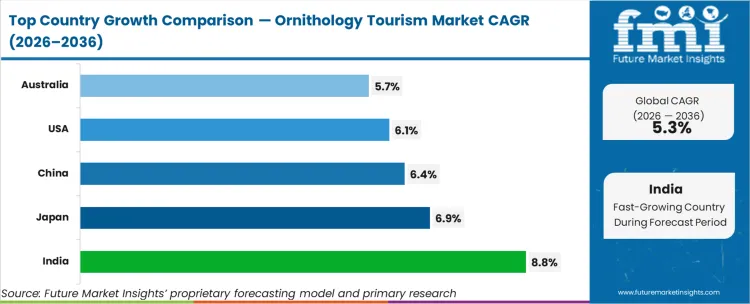
The provided table highlights the top five countries in terms of revenue, with Japan and India leading the list. Increasing environmental awareness and a desire for sustainable travel experiences have led to a surge in interest in nature-based tourism activities like birdwatching in India.
Japan is experiencing a rise in interest in nature-based tourism activities, driven by increasing environmental awareness and a desire to connect with the natural world.
.webp "Top Country Growth Comparison Ornithology Tourism Market Cagr (2026 2036)")
| Countries | Forecast CAGRs from 2026 to 2036 |
|---|---|
| The United States | 6.1% |
| Australia | 5.7% |
| China | 6.4% |
| Japan | 6.9% |
| India | 8.8% |
Growing Interest in Nature-Based Activities in the United States Propels Market Growth
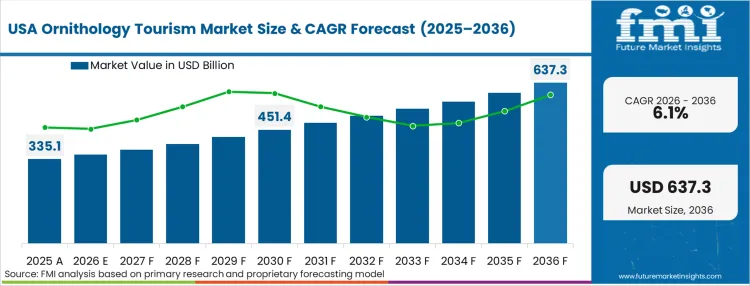
The ornithology tourism market in the United States is expected to expand with a CAGR of 6.1% from 2026 to 2036. The United States is home to numerous national parks, wildlife refuges, and other protected areas that serve as important habitats for birds. These areas offer prime birdwatching opportunities and are often well-maintained and accessible to tourists.
There is a growing interest among Americans in nature-based activities and ecotourism, including birdwatching. As people become more environmentally conscious and seek meaningful outdoor experiences, birdwatching has emerged as a popular leisure activity.
Increasing Environmental Awareness to Drive the Ornithology Tourism Market in India
The ornithology tourism market in India is expected to expand with a CAGR of 8.8% from 2026 to 2036. India's vast and varied geography, coupled with its favorable climate, establishes it as a significant stopover for a diverse array of migrating birds.
During winter, when these birds seek warmer climes, India becomes a hub for avian activity, hosting migratory species from Europe, Africa, and its northern regions.
This seasonal influx has sparked a surge in tourist interest in birdwatching, prompting numerous tour operators to craft curated experiences along migration routes. India emerges as a burgeoning hotspot for migratory bird tourism, offering enthusiasts unparalleled opportunities to witness this natural spectacle up close.
India's diverse landscapes, including tropical forests, grasslands, wetlands, and high-altitude regions, provide varied habitats for birds. Popular birdwatching destinations such as Bharatpur Bird Sanctuary, Corbett National Park, and Western Ghats offer enthusiasts the opportunity to explore a wide range of ecosystems and bird species.
Steady Growth in China's Ornithology Tourism Fuelled by Rising Environmental Awareness
The ornithology tourism market in China is expected to expand with a CAGR of 6.4% from 2026 to 2036. With growing environmental consciousness in China, there has been a heightened interest in nature-based tourism activities, including birdwatching. Many Chinese citizens are eager to explore and appreciate the country's rich biodiversity, including its diverse bird species.
As incomes rise and lifestyles become more affluent, an increasing number of Chinese people have the means and leisure time to pursue recreational activities such as birdwatching. This has led to a growing demand for nature tourism experiences, including birdwatching tours and excursions.
Rising Interest in Nature-Based Tourism Driving Ornithology Tourism Market in Japan
The ornithology tourism market in Japan is expected to expand with a CAGR of 6.9% from 2026 to 2036. Japan has developed a well-established tourism infrastructure, including national parks, wildlife reserves, and birdwatching facilities, to cater to the needs of birdwatchers.
Many regions offer guided birdwatching tours, birding trails, and birdwatching events to attract visitors interested in avian biodiversity.
Japan's diverse landscapes, ranging from coastal areas to mountains and forests, provide habitats for a wide variety of bird species. This abundance of birdlife attracts both domestic and international birdwatchers keen to observe and photograph rare and endemic species.
Japan's population is increasingly drawn to nature-based activities, including birdwatching, as a means of relaxation and recreation. This interest has spurred the development of ornithology tourism as a niche within the broader ecotourism sector.
Steady Growth of Ornithology Tourism in Australia Driven by Cultural Appreciation for Nature and Ecotourism Promotion
Australia is renowned for its incredibly diverse range of bird species, including unique and endemic birds found nowhere else in the world. This rich avian biodiversity attracts birdwatchers from around the globe who come to observe and photograph a wide variety of species in their natural habitats.
Advances in technology, such as digital cameras, binoculars, and bird identification apps, have made birdwatching more accessible and enjoyable for enthusiasts in Australia. These tools allow birdwatchers to capture high-quality images, identify bird species with ease, and share their observations with others online.
The Australian government and conservation organizations actively promote ecotourism initiatives, including birdwatching, as a sustainable way to appreciate and conserve the country's natural resources.
This support for ecotourism helps to raise awareness about the importance of bird conservation and attract visitors to birdwatching destinations. The ornithology tourism market in Australia is expected to expand with a CAGR of 5.7% from 2026 to 2036.
Category-wise Insights
The below section shows the leading segment. The online booking segment is to account for a market share of 44% in 2026. Based on the age group, the (35-55 year) segment is expected to have a share of 28%.
| Category | Market Share |
|---|---|
| Online booking | 44% |
| 36-55 years | 28% |
Tourists Increasingly Favor Online Booking
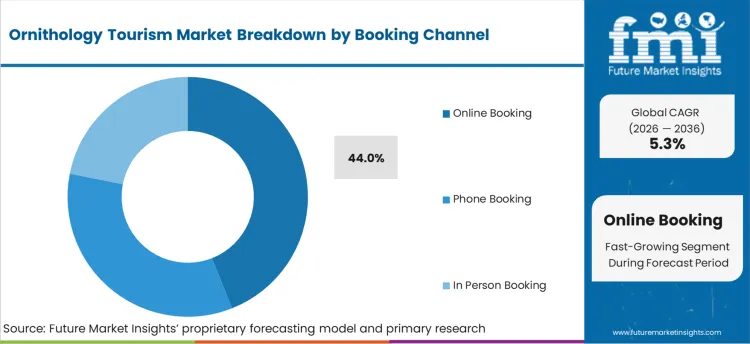
Based on the booking channel, the online booking segment is expected to account for market share of 44% in 2026. With the exponential growth of internet usage in recent years, the online booking channel has become the preferred choice for the majority of tourists, offering unparalleled convenience and accessibility. This trend is particularly pronounced in ornithology tourism, where destinations are often situated away from urban centers.
Online booking provides travelers with the flexibility to select and schedule specific tours while accessing comprehensive information about their chosen destinations. This seamless digital interface simplifies the planning process, allowing tourists to efficiently organize their journeys from the comfort of their own homes.
Ornithology Tourism will continue to be favored by Individuals between the Ages of 36 to 45.

Based on age group, the 36-45 year segment is expected to account for 28% of the market share in 2026. The ornithology tourism market predominantly attracts travelers aged 35 to 55, with the average age of tourists being 50 years.
Middle-aged individuals and seniors comprise the majority of birdwatching enthusiasts due to their availability and inclination to spend time exploring bird habitats. However, there is a notable shift occurring as more millennials show interest in birdwatching tourism.
This trend is driven by a growing awareness of sustainability issues, particularly the significance of biodiversity conservation, which resonates across generations. While older birdwatchers remain the primary target demographic, the evolving landscape suggests a broader appeal among younger generations.
Competitive Landscape

Key players in the market are actively devising innovative strategies to enhance the ornithology tourism sector. This includes an upsurge in the number of tour operators specializing in birdwatching, offering tailored experiences for enthusiasts.
These providers are diligently expanding their presence globally, aiming to cater to birdwatchers in every corner of the world. Notably, birdwatching tours are now being extended to remote regions such as Antarctica and Africa, renowned for their rich avifauna, demonstrating the sector's commitment to offering immersive experiences in diverse habitats.
- Victor Emanuel Nature Tours is a renowned tour company specializing in birdwatching and wildlife adventures worldwide. Founded by Victor Emanuel, a prominent figure in the birding community, the company offers a wide range of expert-led tours to various destinations across the globe. With a focus on sustainable and responsible travel, Victor Emanuel Nature Tours provides exceptional birdwatching experiences, educational opportunities, and opportunities for conservation engagement.
- Himalaya Birding is a specialized tour operator focusing on birdwatching expeditions in the Himalayan region. They offer guided tours and birding trips to explore the diverse avian species found in the Himalayas, including endemic and migratory birds. Himalaya Birding provides expert-led excursions, tailored itineraries, and a deep understanding of the region's birdlife, making them a popular choice for birdwatchers seeking immersive experiences in this unique and biodiverse habitat.
Key Coverage in Ornithology Tourism Market Report
- Ornithology Tourism Market Growth in East Asia
- Opportunities for Ornithology Tourism in the United Kingdom
- Strategies of Key Players of the Ornithology Tourism Market
- Recent Advances in Ornithology Tourism Market
- Promising Opportunities in Ornithology Tourism in the European Countries
Scope of the Report
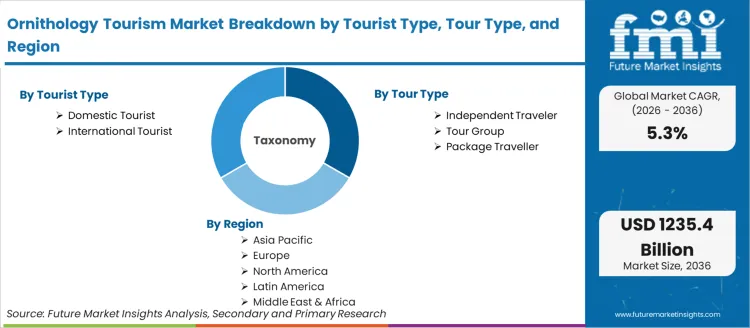
| Metric | Value |
|---|---|
| Quantitative Units | USD 737.10 Billion to USD 1235.41 Billion, at a CAGR of 5.30% |
| Market Definition | Ornithology tourism (birding tourism) encompasses travel experiences centered on bird observation, identification, and photography, including guided birding tours, self-guided birdwatching trips, birding festivals, and avian photography expeditions conducted in natural habitats, wildlife reserves, and designated Important Bird Areas (IBAs) worldwide. |
| Tourist Type Segmentation | Domestic Tourist, International Tourist |
| Tour Type Segmentation | Independent Traveler, Tour Group, Package Traveller |
| Booking Channel Segmentation | Online Booking, Phone Booking, In Person Booking |
| Regions Covered | North America, Latin America, Europe, East Asia, South Asia, Oceania, Middle East & Africa |
| Countries Covered | India, Japan, China, USA, Australia, and 40 plus countries |
| Key Companies Profiled | National Geographic Partners, India Bird Watching, Junglelore Pvt Ltd, Rockjumper Birding Tours, Travel Tour World, Shikhar Travels, Victor Emanuel Nature Tours, Toehold Travel, Himalaya Birding, Nature Trip, Tropical Birding |
| Forecast Period | 2026 to 2036 |
| Approach | Hybrid bottom-up and top-down modeling validated against primary research inputs and publicly available industry data. |
Ornithology Tourism Market - Key Segments
By Tourist Type:
- Domestic Tourist
- International Tourist
By Tour Type:
- Independent Traveler
- Tour Group
- Package Traveller
By Age Group:
- 15 to 25 Years
- 26 to 35 Years
- 36 to 45 Years
- 46 to 55 Years
- 56 to 65 Years
- 66 to 75 Years
- More Than 75 Years
By Booking Channel:
- Phone Booking
- Online Booking
- In Person Booking
By Region:
- North America
- Latin America
- Western Europe
- Eastern Europe
- South Asia and Pacific
- East Asia
- The Middle East and Africa
Bibliography
- [1] BirdLife International. (2024). State of the World's Birds: Important Bird Areas and Birding Tourism. BirdLife.
- [2] Cornell Lab of Ornithology. (2024). eBird Annual Report: Global Observation Volume and User Statistics. Cornell.
- [3] World Tourism Organization. (2024). UNWTO Tourism Barometer: Nature-Based Tourism Spending Trends. UNWTO.
- [4] Ministry of Tourism, India. (2024). Incredible India: Wildlife and Birding Tourism Development Programme. MOT India.
- [5] Royal Society for the Protection of Birds. (2024). RSPB Annual Review: Birding Participation Statistics. RSPB.
This bibliography is provided for reader reference. The full FMI report contains the complete reference list with primary research documentation.
Frequently Asked Questions
How large is the demand for Ornithology Tourism in the global market in 2026?
Demand for Ornithology Tourism in the global market is estimated to be valued at USD 737.10 billion in 2026.
What will be the market size of Ornithology Tourism by 2036?
Market size for Ornithology Tourism is projected to reach USD 1235.41 billion by 2036.
What is the expected demand growth between 2026 and 2036?
Demand is expected to grow at a CAGR of 5.30% between 2026 and 2036.
Which Tourist Type is poised to lead by 2026?
Domestic Tourist accounts for 61.4% in 2026.
How significant is Independent Traveler in driving adoption?
Independent Traveler represents 47.8% of segment share in 2026.
What country records the fastest growth?
India is projected to grow at a CAGR of 8.80% during 2026 to 2036.
What is the projected growth for Japan?
Japan is projected to expand at a CAGR of 6.90% during 2026 to 2036.
What is included in the scope of this report?
Market scope covers domestic and international ornithology tourism revenue from guided birding tours, independent birdwatching trips, birding festival attendance, and avian photography expeditions, booked through online, phone, and in-person channels across all age groups.
Preview the report firsthand - request a free sample
Get SampleGet the brochure for pricing and purchase details.
Get PDFTable of Content
- Executive Summary
- Global Market Outlook
- Demand-side Trends
- Supply-side Trends
- Technology Roadmap Analysis
- Analysis and Recommendations
- Market Overview
- Market Coverage / Taxonomy
- Market Definition / Scope / Limitations
- Research Methodology
- Chapter Orientation
- Analytical Lens and Working Hypotheses
- Market Structure, Signals, and Trend Drivers
- Benchmarking and Cross-market Comparability
- Market Sizing, Forecasting, and Opportunity Mapping
- Research Design and Evidence Framework
- Desk Research Programme (Secondary Evidence)
- Company Annual and Sustainability Reports
- Peer-reviewed Journals and Academic Literature
- Corporate Websites, Product Literature, and Technical Notes
- Earnings Decks and Investor Briefings
- Statutory Filings and Regulatory Disclosures
- Technical White Papers and Standards Notes
- Trade Journals, Industry Magazines, and Analyst Briefs
- Conference Proceedings, Webinars, and Seminar Materials
- Government Statistics Portals and Public Data Releases
- Press Releases and Reputable Media Coverage
- Specialist Newsletters and Curated Briefings
- Sector Databases and Reference Repositories
- FMI Internal Proprietary Databases and Historical Market Datasets
- Subscription Datasets and Paid Sources
- Social Channels, Communities, and Digital Listening Inputs
- Additional Desk Sources
- Expert Input and Fieldwork (Primary Evidence)
- Primary Modes
- Qualitative Interviews and Expert Elicitation
- Quantitative Surveys and Structured Data Capture
- Blended Approach
- Why Primary Evidence is Used
- Field Techniques
- Interviews
- Surveys
- Focus Groups
- Observational and In-context Research
- Social and Community Interactions
- Stakeholder Universe Engaged
- C-suite Leaders
- Board Members
- Presidents and Vice Presidents
- R&D and Innovation Heads
- Technical Specialists
- Domain Subject-matter Experts
- Scientists
- Physicians and Other Healthcare Professionals
- Governance, Ethics, and Data Stewardship
- Research Ethics
- Data Integrity and Handling
- Primary Modes
- Tooling, Models, and Reference Databases
- Desk Research Programme (Secondary Evidence)
- Data Engineering and Model Build
- Data Acquisition and Ingestion
- Cleaning, Normalisation, and Verification
- Synthesis, Triangulation, and Analysis
- Quality Assurance and Audit Trail
- Market Background
- Market Dynamics
- Drivers
- Restraints
- Opportunity
- Trends
- Scenario Forecast
- Demand in Optimistic Scenario
- Demand in Likely Scenario
- Demand in Conservative Scenario
- Opportunity Map Analysis
- Product Life Cycle Analysis
- Supply Chain Analysis
- Investment Feasibility Matrix
- Value Chain Analysis
- PESTLE and Porter’s Analysis
- Regulatory Landscape
- Regional Parent Market Outlook
- Production and Consumption Statistics
- Import and Export Statistics
- Market Dynamics
- Global Market Analysis 2021 to 2025 and Forecast, 2026 to 2036
- Historical Market Size Value (USD Billion) Analysis, 2021 to 2025
- Current and Future Market Size Value (USD Billion) Projections, 2026 to 2036
- Y-o-Y Growth Trend Analysis
- Absolute $ Opportunity Analysis
- Global Market Pricing Analysis 2021 to 2025 and Forecast 2026 to 2036
- Global Market Analysis 2021 to 2025 and Forecast 2026 to 2036, By Tourist Type
- Introduction / Key Findings
- Historical Market Size Value (USD Billion) Analysis By Tourist Type , 2021 to 2025
- Current and Future Market Size Value (USD Billion) Analysis and Forecast By Tourist Type , 2026 to 2036
- Domestic Tourist
- International Tourist
- Domestic Tourist
- Y-o-Y Growth Trend Analysis By Tourist Type , 2021 to 2025
- Absolute $ Opportunity Analysis By Tourist Type , 2026 to 2036
- Global Market Analysis 2021 to 2025 and Forecast 2026 to 2036, By Tour Type
- Introduction / Key Findings
- Historical Market Size Value (USD Billion) Analysis By Tour Type, 2021 to 2025
- Current and Future Market Size Value (USD Billion) Analysis and Forecast By Tour Type, 2026 to 2036
- Independent Traveler
- Tour Group
- Package Traveller
- Independent Traveler
- Y-o-Y Growth Trend Analysis By Tour Type, 2021 to 2025
- Absolute $ Opportunity Analysis By Tour Type, 2026 to 2036
- Global Market Analysis 2021 to 2025 and Forecast 2026 to 2036, By Age Group
- Introduction / Key Findings
- Historical Market Size Value (USD Billion) Analysis By Age Group, 2021 to 2025
- Current and Future Market Size Value (USD Billion) Analysis and Forecast By Age Group, 2026 to 2036
- 26 to 35 Years
- 15 to 25 Years
- 36 to 45 Years
- 46 to 55 Years
- 56 to 65 Years
- 66 to 75 Years
- More Than 75 Years
- 26 to 35 Years
- Y-o-Y Growth Trend Analysis By Age Group, 2021 to 2025
- Absolute $ Opportunity Analysis By Age Group, 2026 to 2036
- Global Market Analysis 2021 to 2025 and Forecast 2026 to 2036, By Booking Channel
- Introduction / Key Findings
- Historical Market Size Value (USD Billion) Analysis By Booking Channel, 2021 to 2025
- Current and Future Market Size Value (USD Billion) Analysis and Forecast By Booking Channel, 2026 to 2036
- Online Booking
- Phone Booking
- In Person Booking
- Online Booking
- Y-o-Y Growth Trend Analysis By Booking Channel, 2021 to 2025
- Absolute $ Opportunity Analysis By Booking Channel, 2026 to 2036
- Global Market Analysis 2021 to 2025 and Forecast 2026 to 2036, By Region
- Introduction
- Historical Market Size Value (USD Billion) Analysis By Region, 2021 to 2025
- Current Market Size Value (USD Billion) Analysis and Forecast By Region, 2026 to 2036
- North America
- Latin America
- Western Europe
- Eastern Europe
- East Asia
- South Asia and Pacific
- Middle East & Africa
- Market Attractiveness Analysis By Region
- North America Market Analysis 2021 to 2025 and Forecast 2026 to 2036, By Country
- Historical Market Size Value (USD Billion) Trend Analysis By Market Taxonomy, 2021 to 2025
- Market Size Value (USD Billion) Forecast By Market Taxonomy, 2026 to 2036
- By Country
- USA
- Canada
- Mexico
- By Tourist Type
- By Tour Type
- By Age Group
- By Booking Channel
- By Country
- Market Attractiveness Analysis
- By Country
- By Tourist Type
- By Tour Type
- By Age Group
- By Booking Channel
- Key Takeaways
- Latin America Market Analysis 2021 to 2025 and Forecast 2026 to 2036, By Country
- Historical Market Size Value (USD Billion) Trend Analysis By Market Taxonomy, 2021 to 2025
- Market Size Value (USD Billion) Forecast By Market Taxonomy, 2026 to 2036
- By Country
- Brazil
- Chile
- Rest of Latin America
- By Tourist Type
- By Tour Type
- By Age Group
- By Booking Channel
- By Country
- Market Attractiveness Analysis
- By Country
- By Tourist Type
- By Tour Type
- By Age Group
- By Booking Channel
- Key Takeaways
- Western Europe Market Analysis 2021 to 2025 and Forecast 2026 to 2036, By Country
- Historical Market Size Value (USD Billion) Trend Analysis By Market Taxonomy, 2021 to 2025
- Market Size Value (USD Billion) Forecast By Market Taxonomy, 2026 to 2036
- By Country
- Germany
- UK
- Italy
- Spain
- France
- Nordic
- BENELUX
- Rest of Western Europe
- By Tourist Type
- By Tour Type
- By Age Group
- By Booking Channel
- By Country
- Market Attractiveness Analysis
- By Country
- By Tourist Type
- By Tour Type
- By Age Group
- By Booking Channel
- Key Takeaways
- Eastern Europe Market Analysis 2021 to 2025 and Forecast 2026 to 2036, By Country
- Historical Market Size Value (USD Billion) Trend Analysis By Market Taxonomy, 2021 to 2025
- Market Size Value (USD Billion) Forecast By Market Taxonomy, 2026 to 2036
- By Country
- Russia
- Poland
- Hungary
- Balkan & Baltic
- Rest of Eastern Europe
- By Tourist Type
- By Tour Type
- By Age Group
- By Booking Channel
- By Country
- Market Attractiveness Analysis
- By Country
- By Tourist Type
- By Tour Type
- By Age Group
- By Booking Channel
- Key Takeaways
- East Asia Market Analysis 2021 to 2025 and Forecast 2026 to 2036, By Country
- Historical Market Size Value (USD Billion) Trend Analysis By Market Taxonomy, 2021 to 2025
- Market Size Value (USD Billion) Forecast By Market Taxonomy, 2026 to 2036
- By Country
- China
- Japan
- South Korea
- By Tourist Type
- By Tour Type
- By Age Group
- By Booking Channel
- By Country
- Market Attractiveness Analysis
- By Country
- By Tourist Type
- By Tour Type
- By Age Group
- By Booking Channel
- Key Takeaways
- South Asia and Pacific Market Analysis 2021 to 2025 and Forecast 2026 to 2036, By Country
- Historical Market Size Value (USD Billion) Trend Analysis By Market Taxonomy, 2021 to 2025
- Market Size Value (USD Billion) Forecast By Market Taxonomy, 2026 to 2036
- By Country
- India
- ASEAN
- Australia & New Zealand
- Rest of South Asia and Pacific
- By Tourist Type
- By Tour Type
- By Age Group
- By Booking Channel
- By Country
- Market Attractiveness Analysis
- By Country
- By Tourist Type
- By Tour Type
- By Age Group
- By Booking Channel
- Key Takeaways
- Middle East & Africa Market Analysis 2021 to 2025 and Forecast 2026 to 2036, By Country
- Historical Market Size Value (USD Billion) Trend Analysis By Market Taxonomy, 2021 to 2025
- Market Size Value (USD Billion) Forecast By Market Taxonomy, 2026 to 2036
- By Country
- Kingdom of Saudi Arabia
- Other GCC Countries
- Turkiye
- South Africa
- Other African Union
- Rest of Middle East & Africa
- By Tourist Type
- By Tour Type
- By Age Group
- By Booking Channel
- By Country
- Market Attractiveness Analysis
- By Country
- By Tourist Type
- By Tour Type
- By Age Group
- By Booking Channel
- Key Takeaways
- Key Countries Market Analysis
- USA
- Pricing Analysis
- Market Share Analysis, 2025
- By Tourist Type
- By Tour Type
- By Age Group
- By Booking Channel
- Canada
- Pricing Analysis
- Market Share Analysis, 2025
- By Tourist Type
- By Tour Type
- By Age Group
- By Booking Channel
- Mexico
- Pricing Analysis
- Market Share Analysis, 2025
- By Tourist Type
- By Tour Type
- By Age Group
- By Booking Channel
- Brazil
- Pricing Analysis
- Market Share Analysis, 2025
- By Tourist Type
- By Tour Type
- By Age Group
- By Booking Channel
- Chile
- Pricing Analysis
- Market Share Analysis, 2025
- By Tourist Type
- By Tour Type
- By Age Group
- By Booking Channel
- Germany
- Pricing Analysis
- Market Share Analysis, 2025
- By Tourist Type
- By Tour Type
- By Age Group
- By Booking Channel
- UK
- Pricing Analysis
- Market Share Analysis, 2025
- By Tourist Type
- By Tour Type
- By Age Group
- By Booking Channel
- Italy
- Pricing Analysis
- Market Share Analysis, 2025
- By Tourist Type
- By Tour Type
- By Age Group
- By Booking Channel
- Spain
- Pricing Analysis
- Market Share Analysis, 2025
- By Tourist Type
- By Tour Type
- By Age Group
- By Booking Channel
- France
- Pricing Analysis
- Market Share Analysis, 2025
- By Tourist Type
- By Tour Type
- By Age Group
- By Booking Channel
- India
- Pricing Analysis
- Market Share Analysis, 2025
- By Tourist Type
- By Tour Type
- By Age Group
- By Booking Channel
- ASEAN
- Pricing Analysis
- Market Share Analysis, 2025
- By Tourist Type
- By Tour Type
- By Age Group
- By Booking Channel
- Australia & New Zealand
- Pricing Analysis
- Market Share Analysis, 2025
- By Tourist Type
- By Tour Type
- By Age Group
- By Booking Channel
- China
- Pricing Analysis
- Market Share Analysis, 2025
- By Tourist Type
- By Tour Type
- By Age Group
- By Booking Channel
- Japan
- Pricing Analysis
- Market Share Analysis, 2025
- By Tourist Type
- By Tour Type
- By Age Group
- By Booking Channel
- South Korea
- Pricing Analysis
- Market Share Analysis, 2025
- By Tourist Type
- By Tour Type
- By Age Group
- By Booking Channel
- Russia
- Pricing Analysis
- Market Share Analysis, 2025
- By Tourist Type
- By Tour Type
- By Age Group
- By Booking Channel
- Poland
- Pricing Analysis
- Market Share Analysis, 2025
- By Tourist Type
- By Tour Type
- By Age Group
- By Booking Channel
- Hungary
- Pricing Analysis
- Market Share Analysis, 2025
- By Tourist Type
- By Tour Type
- By Age Group
- By Booking Channel
- Kingdom of Saudi Arabia
- Pricing Analysis
- Market Share Analysis, 2025
- By Tourist Type
- By Tour Type
- By Age Group
- By Booking Channel
- Turkiye
- Pricing Analysis
- Market Share Analysis, 2025
- By Tourist Type
- By Tour Type
- By Age Group
- By Booking Channel
- South Africa
- Pricing Analysis
- Market Share Analysis, 2025
- By Tourist Type
- By Tour Type
- By Age Group
- By Booking Channel
- USA
- Market Structure Analysis
- Competition Dashboard
- Competition Benchmarking
- Market Share Analysis of Top Players
- By Regional
- By Tourist Type
- By Tour Type
- By Age Group
- By Booking Channel
- Competition Analysis
- Competition Deep Dive
- National Geographic Partners
- Overview
- Product Portfolio
- Profitability by Market Segments (Product/Age /Sales Channel/Region)
- Sales Footprint
- Strategy Overview
- Marketing Strategy
- Product Strategy
- Channel Strategy
- India Bird Watching
- Junglelore Pvt Ltd
- Rockjumper Birding Tours
- Travel Tour World
- Shikhar Travels
- Victor Emanuel Nature Tours
- Toehold Travel
- Himalaya Birding
- Nature trip
- Tropical Birding
- National Geographic Partners
- Competition Deep Dive
- Assumptions & Acronyms Used


