

- Industry Size (2026)
- USD 3.59 Bn
- Forecast (2036)
- USD 8.35 Bn
- CAGR (2026 to 2036)
- 8.8%
Oscilloscope Market Size, Market Forecast and Outlook By FMI
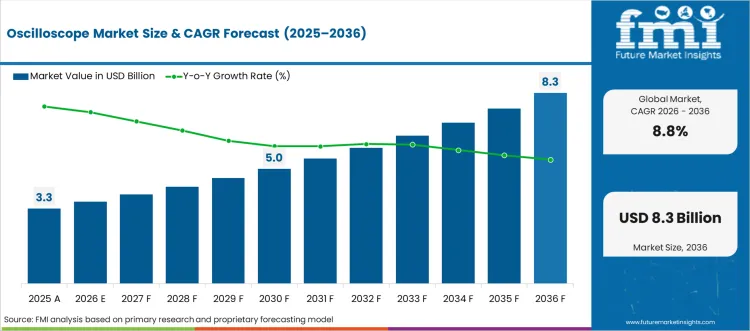
The oscilloscope market was valued at USD 3.30 billion in 2025, projected to reach USD 3.59 billion in 2026, and is forecast to expand to USD 8.35 billion by 2036 at a 8.8% CAGR. Based on FMI's analysis, FMI analysts observe that the oscilloscope market has historically tracked capital expenditure cycles in the semiconductor and electronics industries, where each new product development cycle requires updated test equipment capable of capturing faster signal transitions. The installed base spans millions of units globally, but replacement demand is accelerating as legacy analog instruments cannot characterize signals in modern high-speed digital circuits operating at multi-gigahertz frequencies.
Summary of Oscilloscope Market
- Market Snapshot
- The oscilloscope market is valued at USD 3.30 billion in 2025 and is projected to reach USD 8.35 billion by 2036.
- The industry is expected to grow at a 8.8% CAGR from 2026 to 2036, creating an incremental opportunity of USD 4.75 billion.
- The market is positioned within the electronic test and measurement instrumentation sector, where regulatory requirements, technology adoption cycles, and procurement consolidation define competitive entry barriers.
- Demand and Growth Drivers
- Semiconductor design complexity at advanced nodes: Chipmakers designing at 5 nm and below require oscilloscopes with bandwidth above 50 GHz to characterize signal integrity in high-speed SerDes interfaces.
- Automotive electronics proliferation in EVs: Electric vehicles contain 3x to 5x more electronic control units (ECUs) than internal combustion vehicles, and each ECU requires validation testing during development and production.
- 5G and high-speed communications testing: The rollout of 5G NR infrastructure and 400G/800G data center interconnects requires oscilloscopes capable of capturing millimeter-wave signals and verifying compliance with 3GPP and IEEE 802.
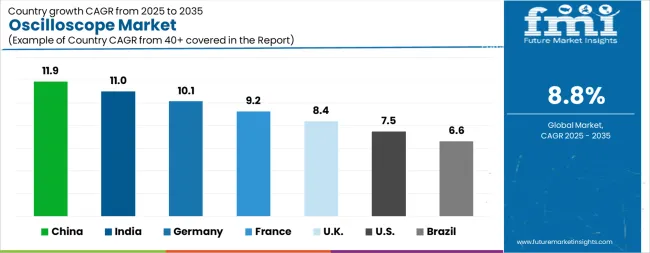
- As per FMI, among key countries, China leads at 11.9% CAGR, followed by India at 11.0%, Germany at 10.1%, and Brazil at 6.6%.
- Product and Segment View
- The market includes oscilloscopes are electronic test instruments that capture, display, and analyze electrical signal waveforms over time.
- Digital leads by Type with 55.0% share in 2026.
- Handheld Oscilloscope leads by Product Type with 50.0% share in 2026.
- Scope includes oscilloscope instruments sold globally across semiconductor, automotive, aerospace, medical, and general electronics end-use sectors. The scope excludes standalone logic analyzers, spectrum analyzers, network analyzers, and signal generators sold independently of oscilloscope platforms.
- Geography and Competitive Outlook
- China and India are the fastest-growing markets, while USA and Brazil represent mature demand bases.
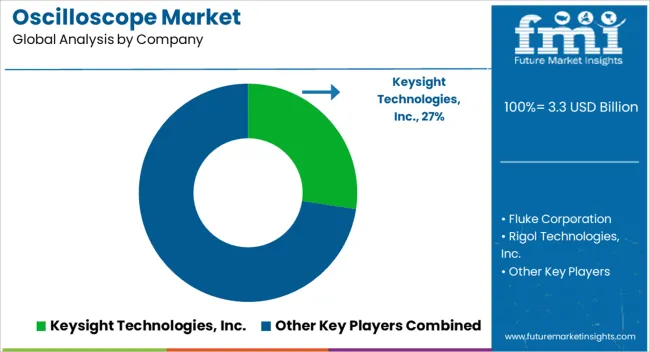
- Competition is shaped by Keysight Technologies and Tektronix (a Fortive subsidiary) dominate the high-bandwidth benchtop segment, while Rohde & Schwarz maintains a leading position in the European and aerospace markets.
- Key companies include Keysight Technologies, Inc., Fluke Corporation, Rigol Technologies, Inc., Rohde & Schwarz GmbH & CoKG, Tektronix, Inc., Teledyne LeCroy Inc., Yokogawa Test & Measurement Corporation.
- Analyst Opinion at FMI
- Nikhil Kaitwade, Principal Consultant for Electronic Test, opines: 'The structural transition is the migration from analog oscilloscopes to digital platforms with software-defined analysis capabilities. Digital oscilloscopes now represent 55.0% of unit sales, and the share is expanding as manufacturers embed protocol decoders, automated compliance test routines, and cloud-based data sharing into instrument firmware.'
- Strategic Implications / Executive Takeaways
- Procurement directors should evaluate supplier qualification timelines against planned capacity expansion schedules to avoid delays tied to single-source dependencies in the oscilloscope category.
- Capital project planners must integrate oscilloscope specifications into facility design phases rather than retrofitting, reducing commissioning time and total qualification costs.
- Technology officers should benchmark current system performance against next-generation specifications to identify upgrade windows aligned with competitive capability requirements.
Oscilloscope Market Key Takeaways
| Metric | Details |
|---|---|
| Industry Size (2026) | USD 3.59 Billion |
| Industry Value (2036) | USD 8.35 Billion |
| CAGR (2026-2036) | 8.8% |
Source: Future Market Insights, 2026
The structural transition is the migration from analog oscilloscopes to digital platforms with software-defined analysis capabilities. Digital oscilloscopes now represent 55.0% of unit sales, and the share is expanding as manufacturers embed protocol decoders, automated compliance test routines, and cloud-based data sharing into instrument firmware. The price premium for digital over analog has narrowed from 5x to 2x over the past decade, crossing the affordability threshold for small and mid-size electronics workshops that previously relied on analog instruments. As per FMI, country-level growth trajectories reflect distinct end-market structures. China leads at 11.9% CAGR, India registers at 11.0% CAGR, Germany registers at 10.1% CAGR, France registers at 9.2% CAGR, UK registers at 8.4% CAGR, USA registers at 7.5% CAGR, Brazil registers at 6.6% CAGR.
Oscilloscope Market Definition
Oscilloscopes are electronic test instruments that capture, display, and analyze electrical signal waveforms over time. These devices are used by engineers, technicians, and researchers to diagnose circuit behavior, verify design specifications, and troubleshoot electronic systems across industries including semiconductor development, automotive electronics, aerospace defense, telecommunications, and medical device manufacturing. Modern oscilloscopes range from handheld portable units for field service to benchtop digital storage oscilloscopes (DSO) with bandwidths exceeding 100 GHz for advanced research applications.
Oscilloscope Market Inclusions
Market scope covers oscilloscope instruments sold globally across semiconductor, automotive, aerospace, medical, and general electronics end-use sectors. The report includes regional and country-level market sizes, forecast values from 2026 to 2036, segmentation by type, product type, and end use, along with competitive landscape and technology bandwidth analysis.
Oscilloscope Market Exclusions
The scope excludes standalone logic analyzers, spectrum analyzers, network analyzers, and signal generators sold independently of oscilloscope platforms. Oscilloscope probes and accessories sold as aftermarket components are not included unless bundled with complete instrument sales. Educational training oscilloscopes with bandwidth below 50 MHz sold exclusively to academic institutions are also omitted.
Oscilloscope Market Research Methodology
- Primary Research: Analysts engaged with electronic test and measurement instrumentation procurement specialists, facility operators, and clinical or engineering directors to map decision triggers for system upgrades and new installations.
- Desk Research: Data collection aggregated regulatory filings, trade body publications, company annual reports, and government procurement records across all covered regions.
- Market-Sizing and Forecasting: Baseline values derive from a bottom-up aggregation of product shipments and license volumes, applying region-specific adoption curves to project forward demand through 2036.
- Data Validation and Update Cycle: Projections are cross-validated against publicly reported expenditure guidance from leading industry participants and government statistical agencies.
Why is the Oscilloscope Market Growing?
The Oscilloscope market is experiencing steady growth driven by increasing demand for high-precision measurement and diagnostic solutions across electronics, semiconductor, and industrial sectors. The market is being shaped by the rising adoption of digital oscilloscopes, which provide enhanced accuracy, real-time signal analysis, and advanced software integration compared to traditional analog systems. Growing complexity in electronic devices and the rapid development of semiconductors have created a need for versatile and high-performance test and measurement equipment.
Advancements in handheld and portable oscilloscopes are enabling engineers and technicians to perform field diagnostics efficiently, improving troubleshooting and system validation. The market is also being influenced by the increasing investment in research and development, as well as expanding automation and electronics manufacturing sectors.
As companies prioritize faster product development cycles and quality assurance, oscilloscopes are becoming critical tools for testing, monitoring, and optimizing electronic circuits The combination of hardware innovation, software-driven capabilities, and portability is setting the stage for sustained market expansion, particularly in high-growth regions with expanding electronics industries.
Segmental Analysis
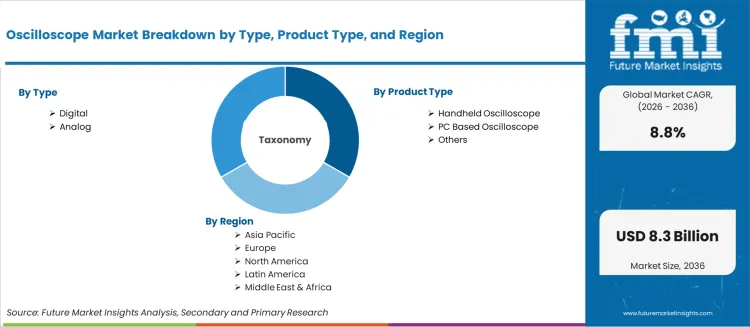
The oscilloscope market is segmented by type, product type, end use, and geographic regions. By type, oscilloscope market is divided into Digital and Analog. In terms of product type, oscilloscope market is classified into Handheld Oscilloscope, PC Based Oscilloscope, and Others. Based on end use, oscilloscope market is segmented into Semiconductor & Electronics Industry, Medical & Healthcare Industry, Automotive Industry, Aerospace & Defense Industry, and Others. Regionally, the oscilloscope industry is classified into North America, Latin America, Western Europe, Eastern Europe, Balkan & Baltic Countries, Russia & Belarus, Central Asia, East Asia, South Asia & Pacific, and the Middle East & Africa.
Insights into the Digital Type Segment
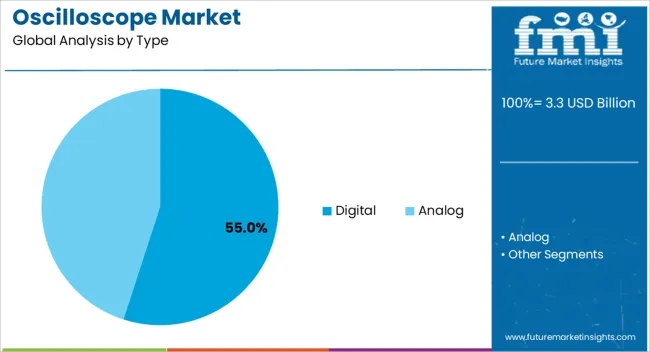
The digital type segment is projected to hold 55.00% of the Oscilloscope market revenue share in 2026, positioning it as the leading type in the market. This dominance is being driven by the enhanced functionality offered by digital oscilloscopes, including higher accuracy, better waveform capture, and advanced signal analysis. Adoption has been accelerated by increasing complexity in electronic circuits and the need for precise diagnostics in research and development environments.
Digital oscilloscopes allow for long-term data storage, real-time analysis, and integration with automated testing systems, providing significant value for engineering teams. The flexibility to upgrade software features and the ability to interface with computers for advanced analysis has further reinforced their position.
Additionally, growing requirements for high-speed data acquisition in semiconductor testing and industrial applications have favored the digital type over analog counterparts The overall market growth is being supported by the combination of portability, reliability, and software-driven enhancements, ensuring that the digital type segment maintains its leadership position.
Insights into the Handheld Oscilloscope Segment
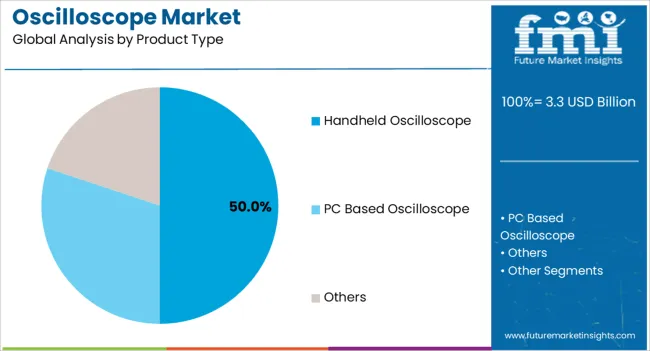
The handheld oscilloscope segment is expected to account for 50.00% of the Oscilloscope market revenue share in 2026, making it the dominant product type based on mobility and ease of use. The growth of this segment is being attributed to the increasing need for field testing and on-site diagnostics across various industries. Handheld oscilloscopes provide engineers and technicians with portable solutions that eliminate the need for lab-bound equipment, enabling faster troubleshooting and maintenance of electronic systems.
The compact design and battery-operated functionality support operations in remote locations, industrial plants, and service environments where conventional bench oscilloscopes cannot be deployed efficiently. Their compatibility with advanced digital measurement features allows handheld models to offer performance comparable to traditional systems while improving operational flexibility.
The rising adoption of IoT-enabled devices and embedded electronics has further propelled demand for portable testing equipment As industries continue to prioritize operational efficiency, handheld oscilloscopes are expected to maintain a leading position due to their convenience, versatility, and robust performance.
Insights into the Semiconductor and Electronics Industry Segment
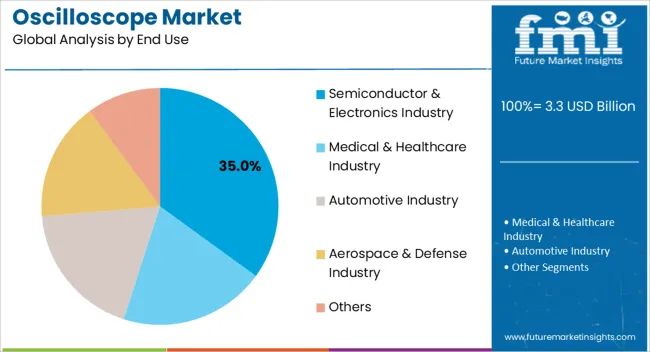
The semiconductor and electronics industry segment is projected to hold 35.00% of the Oscilloscope market revenue share in 2026, establishing it as the largest end-use sector. This prominence is being driven by the rapid growth of semiconductor manufacturing, electronic device development, and R&D activities across both established and emerging markets. Oscilloscopes are critical in this sector for testing high-speed circuits, validating design integrity, and ensuring compliance with quality standards.
The increasing complexity of integrated circuits and miniaturization of electronic components has amplified the need for precise, real-time measurement capabilities. Adoption is also influenced by the shift toward automated and smart manufacturing processes, where oscilloscopes play a vital role in monitoring and optimizing production lines.
The sector’s focus on innovation and continuous improvement has created a strong demand for both digital and handheld oscilloscopes capable of advanced waveform analysis and data logging As the semiconductor and electronics industry continues to expand, the requirement for versatile, high-accuracy measurement equipment is expected to sustain the growth of this segment in the coming years.
Market Overview
Oscilloscope Market: Introduction
Oscilloscope is a laboratory instrument that is commonly used in analyzing and to display the waveform of electronic signals. It is one of the widely used testing instrument in laboratory applications. It is used to look at the shape of electrical signals by displaying a graph of voltage against time. Oscilloscope works like voltmeter with an additional information regarding the variation of voltage with respect to time.
The key use of oscilloscope is to observe the exact wave shape of an electrical signal. Scientific instruments and medical monitoring instruments are widely getting adopted in the developing and developed economies which is supporting the growth in the applications of oscilloscope. The technological innovation is playing a significant role in the adoption of real time oscilloscope among the end user industries.
The key advantage of adopting oscilloscope is due to its advanced user interface, high acquisition rate, signal fidelity, and an innovative trigger system. The innovation in wireless sensor is a driving factor for the adoption of advanced oscilloscope in the global market. The development in digital oscilloscope has led to creation of other types of digital oscilloscope namely digital storage oscilloscopes, digital phosphor oscilloscopes and sampling oscilloscopes.
Analysis of Oscilloscope Market By Key Countries
.webp "Top Country Growth Comparison Oscilloscope Market Cagr (2026 2036)")
| Country | CAGR |
|---|---|
| China | 11.9% |
| India | 11.0% |
| Germany | 10.1% |
| France | 9.2% |
| UK | 8.4% |
| USA | 7.5% |
| Brazil | 6.6% |
Source: FMI analysis based on primary research and proprietary forecasting model
Country-wise Analysis
The Oscilloscope Market is expected to register a CAGR of 8.8% during the forecast period, exhibiting varied country level momentum. China leads with the highest CAGR of 11.9%, followed by India at 11.0%. Developed markets such as Germany, France, and the UK continue to expand steadily, while the USA is likely to grow at consistent rates. Brazil posts the lowest CAGR at 6.6%, yet still underscores a broadly positive trajectory for the global Oscilloscope Market. In 2024, Germany held a dominant revenue in the Western Europe market and is expected to grow with a CAGR of 10.1%. The USA Oscilloscope Market is estimated to be valued at USD 1.2 billion in 2026 and is anticipated to reach a valuation of USD 2.5 billion by 2036. Sales are projected to rise at a CAGR of 7.5% over the forecast period between 2026 and 2036. While Japan and South Korea markets are estimated to be valued at USD 151.1 million and USD 92.4 million respectively in 2026.
Key Players in the Oscilloscope Market
- Keysight Technologies, Inc.
- Fluke Corporation
- Rigol Technologies, Inc.
- Rohde & Schwarz GmbH & CoKG
- Tektronix, Inc.
- Teledyne LeCroy Inc.
- Yokogawa Test & Measurement Corporation
Scope of the Report
| Metric | Value |
|---|---|
| Quantitative Units | USD 3.59 Billion to USD 8.35 Billion, at a CAGR of 8.8% |
| Market Definition | Oscilloscopes are electronic test instruments that capture, display, and analyze electrical signal waveforms over time. These devices are used by engineers, technicians, and researchers to diagnose circuit behavior, verify design specifications, and troubleshoot electronic systems across industries including semiconductor development, automotive electronics, aerospace defense, telecommunications, and medical device manufacturing. |
| Type Segmentation | Digital, Analog |
| Product Type Segmentation | Handheld Oscilloscope, PC Based Oscilloscope, Others |
| End Use Segmentation | Semiconductor & Electronics Industry, Medical & Healthcare Industry, Automotive Industry, Aerospace & Defense Industry, Others |
| Regions Covered | North America, Latin America, Europe, East Asia, South Asia, Oceania, Middle East & Africa |
| Countries Covered | China, India, Germany, France, UK, USA, Brazil, and 40 plus countries |
| Key Companies Profiled | Keysight Technologies, Inc., Fluke Corporation, Rigol Technologies, Inc., Rohde & Schwarz GmbH & CoKG, Tektronix, Inc., Teledyne LeCroy Inc., Yokogawa Test & Measurement Corporation |
| Forecast Period | 2026 to 2036 |
| Approach | Forecasting models apply a bottom-up methodology starting with global installed base metrics and projecting conversion rates based on regulatory and technology adoption curves. |
Oscilloscope Market by Segments
Type:
- Digital
- Analog
Product Type:
- Handheld Oscilloscope
- PC Based Oscilloscope
- Others
End Use:
- Semiconductor & Electronics Industry
- Medical & Healthcare Industry
- Automotive Industry
- Aerospace & Defense Industry
- Others
Region:
- North America
- USA
- Canada
- Mexico
- Latin America
- Brazil
- Chile
- Rest of Latin America
- Western Europe
- Germany
- UK
- Italy
- Spain
- France
- Nordic
- BENELUX
- Rest of Western Europe
- Eastern Europe
- Russia
- Poland
- Hungary
- Balkan & Baltic
- Rest of Eastern Europe
- East Asia
- China
- Japan
- South Korea
- South Asia and Pacific
- India
- ASEAN
- Australia & New Zealand
- Rest of South Asia and Pacific
- Middle East & Africa
- Kingdom of Saudi Arabia
- Other GCC Countries
- Turkiye
- South Africa
- Other African Union
- Rest of Middle East & Africa
Bibliography
- 1. Semiconductor Industry Association. (2024). Global Semiconductor R&D Spending Report. SIA.
- 2. International Electrotechnical Commission. (2023). IEC 61010-1: Safety Requirements for Electrical Equipment. IEC.
- 3. Keysight Technologies Inc. (2024). Annual Report 2023. Keysight.
- 4. Tektronix Inc. (2024). Product Catalog: Real-Time Oscilloscopes. Tektronix.
- 5. 3GPP. (2024). Release 18 Specifications for 5G NR. 3GPP.
- 6. Rigol Technologies Inc. (2024). Annual Report 2023. Rigol.
This bibliography is provided for reader reference. The full Future Market Insights report contains the complete reference list with primary research documentation.
Frequently Asked Questions
How large is the demand for Oscilloscope in the global market in 2026?
Demand for oscilloscope in the global market is estimated to be valued at USD 3.59 billion in 2026.
What will be the market size of Oscilloscope in the global market by 2036?
Market size for oscilloscope is projected to reach USD 8.35 billion by 2036.
What is the expected demand growth for Oscilloscope in the global market between 2026 and 2036?
Demand for oscilloscope is expected to grow at a CAGR of 8.8% between 2026 and 2036.
Which Type is poised to lead global sales by 2026?
Digital accounts for 55.0% share in 2026, driven by established adoption patterns and buyer preference across primary end-use applications.
What is driving demand in China?
China leads with a 11.9% CAGR through 2036, driven by expanding industrial capacity and increasing regulatory alignment with international standards.
What is the India growth outlook in this report?
India is projected to grow at a CAGR of 11.0% during 2026 to 2036.
What is Oscilloscope and what is it mainly used for?
Oscilloscopes are electronic test instruments that capture, display, and analyze electrical signal waveforms over time. These devices are used by engineers, technicians, and researchers to diagnose circuit behavior, verify design specifications, and troubleshoot electronic systems across industries including semiconductor development, automotive electronics, aerospace defense, telecommunications, and medical device manufacturing.
How does FMI build and validate the Oscilloscope forecast?
Future Market Insights analysis applies a bottom-up methodology starting with global installed base metrics and cross-validates projections against reported industry expenditure and regulatory compliance data.
Preview the report firsthand - request a free sample
Get SampleGet the brochure for pricing and purchase details.
Get PDFTable of Content
- Executive Summary
- Global Market Outlook
- Demand-side Trends
- Supply-side Trends
- Technology Roadmap Analysis
- Analysis and Recommendations
- Market Overview
- Market Coverage / Taxonomy
- Market Definition / Scope / Limitations
- Research Methodology
- Chapter Orientation
- Analytical Lens and Working Hypotheses
- Market Structure, Signals, and Trend Drivers
- Benchmarking and Cross-market Comparability
- Market Sizing, Forecasting, and Opportunity Mapping
- Research Design and Evidence Framework
- Desk Research Programme (Secondary Evidence)
- Company Annual and Sustainability Reports
- Peer-reviewed Journals and Academic Literature
- Corporate Websites, Product Literature, and Technical Notes
- Earnings Decks and Investor Briefings
- Statutory Filings and Regulatory Disclosures
- Technical White Papers and Standards Notes
- Trade Journals, Industry Magazines, and Analyst Briefs
- Conference Proceedings, Webinars, and Seminar Materials
- Government Statistics Portals and Public Data Releases
- Press Releases and Reputable Media Coverage
- Specialist Newsletters and Curated Briefings
- Sector Databases and Reference Repositories
- FMI Internal Proprietary Databases and Historical Market Datasets
- Subscription Datasets and Paid Sources
- Social Channels, Communities, and Digital Listening Inputs
- Additional Desk Sources
- Expert Input and Fieldwork (Primary Evidence)
- Primary Modes
- Qualitative Interviews and Expert Elicitation
- Quantitative Surveys and Structured Data Capture
- Blended Approach
- Why Primary Evidence is Used
- Field Techniques
- Interviews
- Surveys
- Focus Groups
- Observational and In-context Research
- Social and Community Interactions
- Stakeholder Universe Engaged
- C-suite Leaders
- Board Members
- Presidents and Vice Presidents
- R&D and Innovation Heads
- Technical Specialists
- Domain Subject-matter Experts
- Scientists
- Physicians and Other Healthcare Professionals
- Governance, Ethics, and Data Stewardship
- Research Ethics
- Data Integrity and Handling
- Primary Modes
- Tooling, Models, and Reference Databases
- Desk Research Programme (Secondary Evidence)
- Data Engineering and Model Build
- Data Acquisition and Ingestion
- Cleaning, Normalisation, and Verification
- Synthesis, Triangulation, and Analysis
- Quality Assurance and Audit Trail
- Market Background
- Market Dynamics
- Drivers
- Restraints
- Opportunity
- Trends
- Scenario Forecast
- Demand in Optimistic Scenario
- Demand in Likely Scenario
- Demand in Conservative Scenario
- Opportunity Map Analysis
- Product Life Cycle Analysis
- Supply Chain Analysis
- Investment Feasibility Matrix
- Value Chain Analysis
- PESTLE and Porter’s Analysis
- Regulatory Landscape
- Regional Parent Market Outlook
- Production and Consumption Statistics
- Import and Export Statistics
- Market Dynamics
- Global Market Analysis 2021 to 2025 and Forecast, 2026 to 2036
- Historical Market Size Value (USD Million) Analysis, 2021 to 2025
- Current and Future Market Size Value (USD Million) Projections, 2026 to 2036
- Y-o-Y Growth Trend Analysis
- Absolute $ Opportunity Analysis
- Global Market Pricing Analysis 2021 to 2025 and Forecast 2026 to 2036
- Global Market Analysis 2021 to 2025 and Forecast 2026 to 2036, By Type
- Introduction / Key Findings
- Historical Market Size Value (USD Million) Analysis By Type , 2021 to 2025
- Current and Future Market Size Value (USD Million) Analysis and Forecast By Type , 2026 to 2036
- Digital
- Analog
- Digital
- Y-o-Y Growth Trend Analysis By Type , 2021 to 2025
- Absolute $ Opportunity Analysis By Type , 2026 to 2036
- Global Market Analysis 2021 to 2025 and Forecast 2026 to 2036, By Product Type
- Introduction / Key Findings
- Historical Market Size Value (USD Million) Analysis By Product Type, 2021 to 2025
- Current and Future Market Size Value (USD Million) Analysis and Forecast By Product Type, 2026 to 2036
- Handheld Oscilloscope
- PC Based Oscilloscope
- Others
- Handheld Oscilloscope
- Y-o-Y Growth Trend Analysis By Product Type, 2021 to 2025
- Absolute $ Opportunity Analysis By Product Type, 2026 to 2036
- Global Market Analysis 2021 to 2025 and Forecast 2026 to 2036, By End Use
- Introduction / Key Findings
- Historical Market Size Value (USD Million) Analysis By End Use, 2021 to 2025
- Current and Future Market Size Value (USD Million) Analysis and Forecast By End Use, 2026 to 2036
- Semiconductor & Electronics Industry
- Medical & Healthcare Industry
- Automotive Industry
- Aerospace & Defense Industry
- Others
- Semiconductor & Electronics Industry
- Y-o-Y Growth Trend Analysis By End Use, 2021 to 2025
- Absolute $ Opportunity Analysis By End Use, 2026 to 2036
- Global Market Analysis 2021 to 2025 and Forecast 2026 to 2036, By Region
- Introduction
- Historical Market Size Value (USD Million) Analysis By Region, 2021 to 2025
- Current Market Size Value (USD Million) Analysis and Forecast By Region, 2026 to 2036
- North America
- Latin America
- Western Europe
- Eastern Europe
- East Asia
- South Asia and Pacific
- Middle East & Africa
- Market Attractiveness Analysis By Region
- North America Market Analysis 2021 to 2025 and Forecast 2026 to 2036, By Country
- Historical Market Size Value (USD Million) Trend Analysis By Market Taxonomy, 2021 to 2025
- Market Size Value (USD Million) Forecast By Market Taxonomy, 2026 to 2036
- By Country
- USA
- Canada
- Mexico
- By Type
- By Product Type
- By End Use
- By Country
- Market Attractiveness Analysis
- By Country
- By Type
- By Product Type
- By End Use
- Key Takeaways
- Latin America Market Analysis 2021 to 2025 and Forecast 2026 to 2036, By Country
- Historical Market Size Value (USD Million) Trend Analysis By Market Taxonomy, 2021 to 2025
- Market Size Value (USD Million) Forecast By Market Taxonomy, 2026 to 2036
- By Country
- Brazil
- Chile
- Rest of Latin America
- By Type
- By Product Type
- By End Use
- By Country
- Market Attractiveness Analysis
- By Country
- By Type
- By Product Type
- By End Use
- Key Takeaways
- Western Europe Market Analysis 2021 to 2025 and Forecast 2026 to 2036, By Country
- Historical Market Size Value (USD Million) Trend Analysis By Market Taxonomy, 2021 to 2025
- Market Size Value (USD Million) Forecast By Market Taxonomy, 2026 to 2036
- By Country
- Germany
- UK
- Italy
- Spain
- France
- Nordic
- BENELUX
- Rest of Western Europe
- By Type
- By Product Type
- By End Use
- By Country
- Market Attractiveness Analysis
- By Country
- By Type
- By Product Type
- By End Use
- Key Takeaways
- Eastern Europe Market Analysis 2021 to 2025 and Forecast 2026 to 2036, By Country
- Historical Market Size Value (USD Million) Trend Analysis By Market Taxonomy, 2021 to 2025
- Market Size Value (USD Million) Forecast By Market Taxonomy, 2026 to 2036
- By Country
- Russia
- Poland
- Hungary
- Balkan & Baltic
- Rest of Eastern Europe
- By Type
- By Product Type
- By End Use
- By Country
- Market Attractiveness Analysis
- By Country
- By Type
- By Product Type
- By End Use
- Key Takeaways
- East Asia Market Analysis 2021 to 2025 and Forecast 2026 to 2036, By Country
- Historical Market Size Value (USD Million) Trend Analysis By Market Taxonomy, 2021 to 2025
- Market Size Value (USD Million) Forecast By Market Taxonomy, 2026 to 2036
- By Country
- China
- Japan
- South Korea
- By Type
- By Product Type
- By End Use
- By Country
- Market Attractiveness Analysis
- By Country
- By Type
- By Product Type
- By End Use
- Key Takeaways
- South Asia and Pacific Market Analysis 2021 to 2025 and Forecast 2026 to 2036, By Country
- Historical Market Size Value (USD Million) Trend Analysis By Market Taxonomy, 2021 to 2025
- Market Size Value (USD Million) Forecast By Market Taxonomy, 2026 to 2036
- By Country
- India
- ASEAN
- Australia & New Zealand
- Rest of South Asia and Pacific
- By Type
- By Product Type
- By End Use
- By Country
- Market Attractiveness Analysis
- By Country
- By Type
- By Product Type
- By End Use
- Key Takeaways
- Middle East & Africa Market Analysis 2021 to 2025 and Forecast 2026 to 2036, By Country
- Historical Market Size Value (USD Million) Trend Analysis By Market Taxonomy, 2021 to 2025
- Market Size Value (USD Million) Forecast By Market Taxonomy, 2026 to 2036
- By Country
- Kingdom of Saudi Arabia
- Other GCC Countries
- Turkiye
- South Africa
- Other African Union
- Rest of Middle East & Africa
- By Type
- By Product Type
- By End Use
- By Country
- Market Attractiveness Analysis
- By Country
- By Type
- By Product Type
- By End Use
- Key Takeaways
- Key Countries Market Analysis
- USA
- Pricing Analysis
- Market Share Analysis, 2025
- By Type
- By Product Type
- By End Use
- Canada
- Pricing Analysis
- Market Share Analysis, 2025
- By Type
- By Product Type
- By End Use
- Mexico
- Pricing Analysis
- Market Share Analysis, 2025
- By Type
- By Product Type
- By End Use
- Brazil
- Pricing Analysis
- Market Share Analysis, 2025
- By Type
- By Product Type
- By End Use
- Chile
- Pricing Analysis
- Market Share Analysis, 2025
- By Type
- By Product Type
- By End Use
- Germany
- Pricing Analysis
- Market Share Analysis, 2025
- By Type
- By Product Type
- By End Use
- UK
- Pricing Analysis
- Market Share Analysis, 2025
- By Type
- By Product Type
- By End Use
- Italy
- Pricing Analysis
- Market Share Analysis, 2025
- By Type
- By Product Type
- By End Use
- Spain
- Pricing Analysis
- Market Share Analysis, 2025
- By Type
- By Product Type
- By End Use
- France
- Pricing Analysis
- Market Share Analysis, 2025
- By Type
- By Product Type
- By End Use
- India
- Pricing Analysis
- Market Share Analysis, 2025
- By Type
- By Product Type
- By End Use
- ASEAN
- Pricing Analysis
- Market Share Analysis, 2025
- By Type
- By Product Type
- By End Use
- Australia & New Zealand
- Pricing Analysis
- Market Share Analysis, 2025
- By Type
- By Product Type
- By End Use
- China
- Pricing Analysis
- Market Share Analysis, 2025
- By Type
- By Product Type
- By End Use
- Japan
- Pricing Analysis
- Market Share Analysis, 2025
- By Type
- By Product Type
- By End Use
- South Korea
- Pricing Analysis
- Market Share Analysis, 2025
- By Type
- By Product Type
- By End Use
- Russia
- Pricing Analysis
- Market Share Analysis, 2025
- By Type
- By Product Type
- By End Use
- Poland
- Pricing Analysis
- Market Share Analysis, 2025
- By Type
- By Product Type
- By End Use
- Hungary
- Pricing Analysis
- Market Share Analysis, 2025
- By Type
- By Product Type
- By End Use
- Kingdom of Saudi Arabia
- Pricing Analysis
- Market Share Analysis, 2025
- By Type
- By Product Type
- By End Use
- Turkiye
- Pricing Analysis
- Market Share Analysis, 2025
- By Type
- By Product Type
- By End Use
- South Africa
- Pricing Analysis
- Market Share Analysis, 2025
- By Type
- By Product Type
- By End Use
- USA
- Market Structure Analysis
- Competition Dashboard
- Competition Benchmarking
- Market Share Analysis of Top Players
- By Regional
- By Type
- By Product Type
- By End Use
- Competition Analysis
- Competition Deep Dive
- Keysight Technologies, Inc.
- Overview
- Product Portfolio
- Profitability by Market Segments (Product/Age /Sales Channel/Region)
- Sales Footprint
- Strategy Overview
- Marketing Strategy
- Product Strategy
- Channel Strategy
- Fluke Corporation
- Rigol Technologies, Inc.
- Rohde & Schwarz GmbH & CoKG
- Tektronix, Inc.
- Teledyne LeCroy Inc.
- Yokogawa Test & Measurement Corporation
- Keysight Technologies, Inc.
- Competition Deep Dive
- Assumptions & Acronyms Used


