

- Industry Size (2026)
- USD 2.33 Bn
- Forecast (2036)
- USD 4.09 Bn
- CAGR (2026 to 2036)
- 5.8%
Otoscope Market Size, Market Forecast and Outlook By FMI
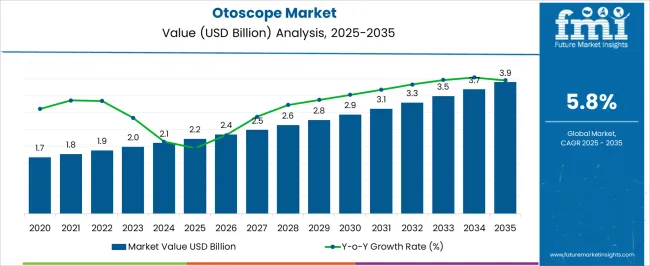
The otoscope market was valued at USD 2.20 billion in 2025, projected to reach USD 2.33 billion in 2026, and is forecast to expand to USD 4.09 billion by 2036 at a 5.8% CAGR. Based on FMI's analysis, FMI analysts observe that the otoscope market is a mature, replacement-driven category where growth tracks the expansion of primary care infrastructure and the refresh cycles of diagnostic equipment fleets in hospitals and clinics. The global installed base of otoscopes exceeds 15 million units, with replacement occurring every 5 to 8 years for conventional models and every 3 to 5 years for digital models with electronic components.
Summary of Otoscope Market
- Market Snapshot
- The otoscope market is valued at USD 2.20 billion in 2025 and is projected to reach USD 4.09 billion by 2036.
- The industry is expected to grow at a 5.8% CAGR from 2026 to 2036, creating an incremental opportunity of USD 1.76 billion.
- The market is positioned within the medical diagnostic instruments and primary care equipment sector, where regulatory frameworks, technology cycles, and procurement patterns shape competitive dynamics.
- Demand and Growth Drivers
- Primary care infrastructure expansion in developing economies: India's Ayushman Bharat Health and Wellness Centre (AB-HWC) initiative targets 150,000 primary care facilities by 2025, each requiring basic diagnostic equipment including otoscopes.
- Telemedicine integration and store-and-forward diagnostics: Digital video otoscopes with Wi-Fi or Bluetooth connectivity enable store-and-forward telemedicine workflows where primary care providers capture ear canal images and transmit them to ENT specialists for remote evaluation.
- Infection control and single-use specula adoption: Updated infection control guidelines from the CDC and European Centre for Disease Prevention and Control (ECDC) recommend single-use disposable specula over reusable tips for otoscopic examinations.
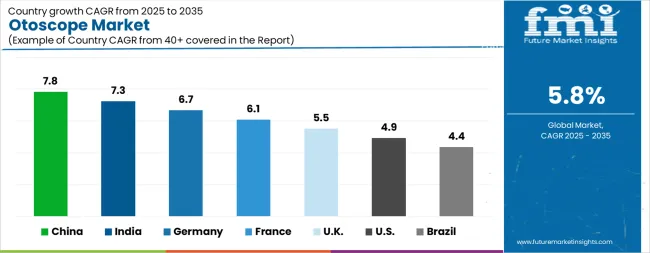
- As per FMI, among key countries, China leads at 7.8% CAGR, followed by India at 7.3%, Germany at 6.7%, and Brazil at 4.4%.
- Product and Segment View
- The market includes otoscopes are handheld optical instruments used by clinicians to examine the external ear canal and tympanic membrane (eardrum) for signs of infection, perforation, cerumen impaction, and other pathologies.
- Portable Type leads by Product Type with 54.6% share in 2026.
- Hospitals leads by Application with 49.8% share in 2026.
- Scope includes otoscope instruments and associated accessories (specula, charging stations, fiber optic handles) sold globally across hospitals, clinics, and ambulatory care facilities. The scope excludes operating microscopes used in ENT surgery, standalone tympanometers, audiometers, and otoacoustic emission screeners.
- Geography and Competitive Outlook
- China and India are the fastest-growing markets, while USA and Brazil represent mature demand bases.
- Competition is shaped by Welch Allyn dominates the North American hospital channel through its established distribution relationships and integration with the Connex diagnostic platform.
- Key companies include Welch Allyn, Inc., Heine Optotechnik GmbH & Co. KG, 3M Company, American Diagnostic Corporation, Riester GmbH, Medtronic plc, Hill-Rom Holdings, Inc., GF Health Products, Inc..
- Analyst Opinion at FMI
- Anurag Sharma, Principal Consultant for Medical Diagnostic Instruments, opines: 'The structural shift is the transition from conventional direct-illumination otoscopes to digital video otoscopes that capture and store examination images. Digital otoscopes command a 3x to 5x price premium over conventional models but generate value through telemedicine integration, clinical documentation compliance, and reduced unnecessary ENT referrals by enabling primary care physicians to share images with specialists remotely. The COVID-19 pandemic accelerated telemedicine adoption, and digital otoscopes have retained their post-pandemic market share as telehealth reimbursement policies solidified.'
- Strategic Implications / Executive Takeaways
- Procurement directors should evaluate supplier qualification timelines against planned capacity expansion to avoid delays tied to single-source dependencies in otoscope.
- Capital project planners must integrate otoscope specifications into facility design phases rather than retrofitting, reducing commissioning time and qualification costs.
- Technology officers should benchmark current system capabilities against next-generation specifications to identify upgrade windows aligned with competitive requirements.
Otoscope Market Key Takeaways
| Metric | Details |
|---|---|
| Industry Size (2026) | USD 2.33 Billion |
| Industry Value (2036) | USD 4.09 Billion |
| CAGR (2026-2036) | 5.8% |
Source: Future Market Insights, 2026
The structural shift is the transition from conventional direct-illumination otoscopes to digital video otoscopes that capture and store examination images. Digital otoscopes command a 3x to 5x price premium over conventional models but generate value through telemedicine integration, clinical documentation compliance, and reduced unnecessary ENT referrals by enabling primary care physicians to share images with specialists remotely. The COVID-19 pandemic accelerated telemedicine adoption, and digital otoscopes have retained their post-pandemic market share as telehealth reimbursement policies solidified. As per FMI, country-level growth trajectories reflect distinct market structures. China leads at 7.8% CAGR, India registers at 7.3% CAGR, Germany registers at 6.7% CAGR, France registers at 6.1% CAGR, UK registers at 5.5% CAGR, USA registers at 4.9% CAGR, Brazil registers at 4.4% CAGR.
Otoscope Market Definition
Otoscopes are handheld optical instruments used by clinicians to examine the external ear canal and tympanic membrane (eardrum) for signs of infection, perforation, cerumen impaction, and other pathologies. The category spans conventional direct-illumination otoscopes powered by halogen or LED light sources, pneumatic otoscopes for tympanic mobility assessment, and digital video otoscopes that capture high-resolution images for documentation, telemedicine, and patient education. Otoscopes are standard diagnostic equipment in primary care offices, pediatric clinics, emergency departments, and ENT specialty practices.
Otoscope Market Inclusions
Market scope covers otoscope instruments and associated accessories (specula, charging stations, fiber optic handles) sold globally across hospitals, clinics, and ambulatory care facilities. The report includes regional and country-level market sizes, forecast values from 2026 to 2036, segmentation by product type and application, along with competitive landscape and technology analysis.
Otoscope Market Exclusions
The scope excludes operating microscopes used in ENT surgery, standalone tympanometers, audiometers, and otoacoustic emission screeners. Consumer-grade smartphone otoscope attachments not cleared for clinical diagnostic use are also omitted.
Otoscope Market Research Methodology
- Primary Research: Analysts engaged with medical diagnostic instruments and primary care equipment specialists, facility operators, and procurement directors to map decision triggers for upgrades and new deployments.
- Desk Research: Data collection aggregated regulatory filings, trade body publications, company annual reports, and government procurement records across all covered regions.
- Market-Sizing and Forecasting: Baseline values derive from a bottom-up aggregation of product shipments and service contracts, applying region-specific adoption curves to project forward demand through 2036.
- Data Validation and Update Cycle: Projections are cross-validated against publicly reported expenditure guidance from leading industry participants and government statistical agencies.
Why is the Otoscope Market Growing?
The Otoscope market is experiencing strong growth, driven by increasing demand for accurate and efficient diagnostic tools in healthcare settings. Rising prevalence of ear-related disorders and hearing impairments has created a critical need for reliable examination devices. Adoption of portable and advanced otoscope models is being fueled by their ease of use, accuracy, and ability to enhance diagnostic efficiency in hospitals, clinics, and telemedicine applications.
Integration of high-resolution imaging, LED lighting, and digital connectivity is further improving examination quality and enabling remote consultations. Growing investments in healthcare infrastructure, especially in emerging economies, are supporting the market expansion. Regulatory emphasis on patient safety and accurate diagnosis is accelerating the adoption of certified and standardized otoscope devices.
Additionally, the shift towards telehealth and point-of-care diagnostics is increasing demand for portable, user-friendly otoscopes As healthcare providers seek efficient, scalable, and technologically advanced diagnostic tools, the Otoscope market is expected to sustain robust growth over the next decade, driven by continuous innovation and expanding clinical applications.
Segmental Analysis
The otoscope market is segmented by product type, application, and geographic regions. By product type, otoscope market is divided into Portable Type and Wall-Mounted Type. In terms of application, otoscope market is classified into Hospitals, Clinics, and Others. Regionally, the otoscope industry is classified into North America, Latin America, Western Europe, Eastern Europe, Balkan & Baltic Countries, Russia & Belarus, Central Asia, East Asia, South Asia & Pacific, and the Middle East & Africa.
Insights into the Portable Type Product Type Segment
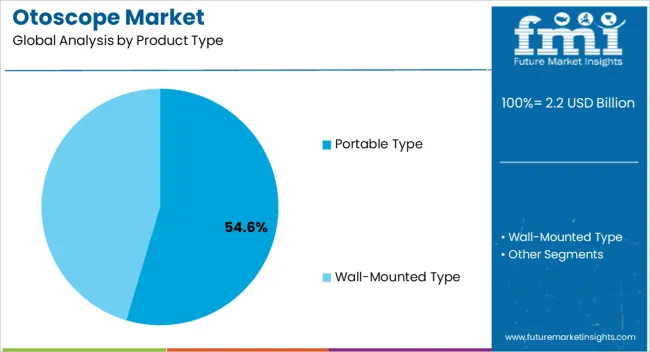
The portable type otoscope segment is projected to hold 54.6% of the market revenue in 2026, establishing it as the leading product type. Growth in this segment is being driven by the increasing demand for mobile, easy-to-use diagnostic devices that provide accurate ear examinations across diverse healthcare settings. Portable otoscopes allow clinicians to conduct examinations efficiently without being constrained by fixed equipment, supporting point-of-care and remote healthcare services.
Integration of digital imaging, LED illumination, and rechargeable power sources has improved device functionality, reliability, and ease of use. These devices are particularly valuable in hospitals, emergency care, and telemedicine, where rapid and precise assessments are critical.
The segment’s growth is also reinforced by its cost-effectiveness compared to traditional stationary devices, enabling broader adoption in both developed and emerging markets With increasing focus on patient convenience, mobility, and diagnostic accuracy, portable otoscopes are expected to maintain their market leadership, supported by continuous technological advancements and expanding clinical applications.
Insights into the Hospitals Application Segment
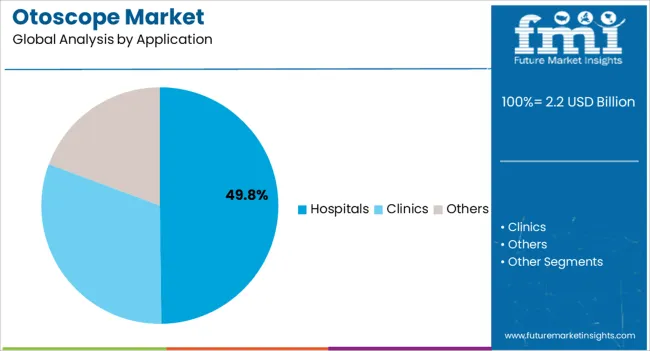
The hospitals application segment is anticipated to account for 49.8% of the Otoscope market revenue in 2026, making it the leading application area. Growth in this segment is being driven by the widespread use of otoscopes for routine ear examinations, hearing assessments, and ENT diagnostics in hospital settings. Hospitals require high-performance, reliable diagnostic tools capable of supporting large patient volumes while maintaining accuracy and efficiency.
The adoption of portable and digital otoscopes has enhanced workflow efficiency, enabling clinicians to perform rapid assessments, capture diagnostic images, and share data for consultations or electronic health records. Increasing awareness of ear health, the rise in chronic and acute ear conditions, and the emphasis on timely diagnosis have further strengthened demand.
Additionally, hospital investments in advanced medical devices, point-of-care technologies, and telehealth initiatives have accelerated the adoption of otoscopes As healthcare facilities continue to focus on improving patient outcomes and operational efficiency, the hospitals segment is expected to remain the largest revenue contributor, driven by technological innovation and clinical effectiveness.
Market Overview
According to a recent report published by WHO (World Health Organization) 360 million people worldwide is presently victims of some kind of audibility related disease. More than 32 million children are victims of deafness. Apart from this a massive pool of an adult population of the world is also crippled by deafness. This population is swelling alarmingly every year in South-Asia, Asia-Pacific and sub-Saharan Africa, which is also promoting the prospects of the emerging otoscope market in these regions of the world.
The otoscopes and ophthalmoscopes are predominantly used by ENT specialists across the world for detecting any sort of ENT related disease. Presently a population of 285million visually impaired adults and children are living in this world. The population is rising every day. The otoscope/ophthalmoscope market can fetch the direct benefits of this rise as they are mostly needed for diagnosing eye and ear related ailments. Countries like India, China, Oman, Brazil and Morocco are some of the nation living in the shadows of diseases like glaucoma.
Over the years they have made several consorted efforts to eradicate the disease but still it is prevalent amongst a large population. The market is completely untouched and mostly dominated by few domestic players and it is definitely under the radar of some of the biggies of the otoscope market.
The US is not only one of the leading producers of otoscope devices, it also caters to the demand of the large global and local population. Statistics shows that almost 37 million Americans are suffering from sinus-related diseases. Thus the US is one of the largest thriving otoscope markets of the world.
Analysis of Otoscope Market By Key Countries
.webp "Top Country Growth Comparison Otoscope Market Cagr (2026 2036)")
| Country | CAGR |
|---|---|
| China | 7.8% |
| India | 7.3% |
| Germany | 6.7% |
| France | 6.1% |
| UK | 5.5% |
| USA | 4.9% |
| Brazil | 4.4% |
Source: FMI analysis based on primary research and proprietary forecasting model
Country-wise Analysis
The Otoscope Market is expected to register a CAGR of 5.8% during the forecast period, exhibiting varied country level momentum. China leads with the highest CAGR of 7.8%, followed by India at 7.3%. Developed markets such as Germany, France, and the UK continue to expand steadily, while the USA is likely to grow at consistent rates. Brazil posts the lowest CAGR at 4.4%, yet still underscores a broadly positive trajectory for the global Otoscope Market. In 2024, Germany held a dominant revenue in the Western Europe market and is expected to grow with a CAGR of 6.7%. The USA Otoscope Market is estimated to be valued at USD 805.4 million in 2026 and is anticipated to reach a valuation of USD 1.3 billion by 2036. Sales are projected to rise at a CAGR of 4.9% over the forecast period between 2026 and 2036. While Japan and South Korea markets are estimated to be valued at USD 120.4 million and USD 71.3 million respectively in 2026.
Key Players in the Otoscope Market
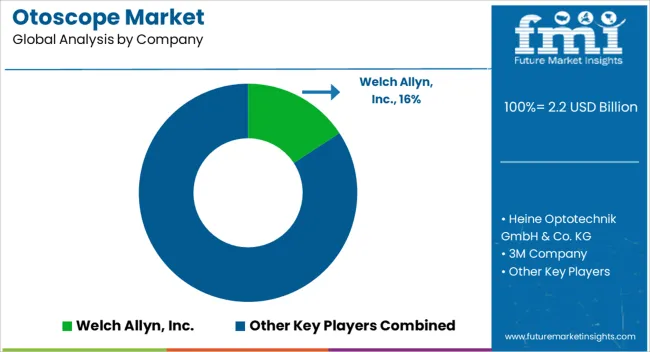
- Welch Allyn, Inc.
- Heine Optotechnik GmbH & Co. KG
- 3M Company
- American Diagnostic Corporation
- Riester GmbH
- Medtronic plc
- Hill-Rom Holdings, Inc.
- GF Health Products, Inc.
- Olympus Corporation
- Luxamed GmbH & Co. KG
- KaWe (Kirchner & Wilhelm GmbH + Co. KG)
- Firefly Global
- Inventis Srl
Scope of the Report
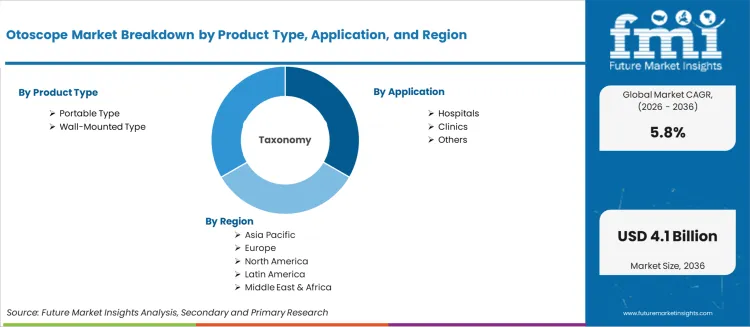
| Metric | Value |
|---|---|
| Quantitative Units | USD 2.33 Billion to USD 4.09 Billion, at a CAGR of 5.8% |
| Market Definition | Otoscopes are handheld optical instruments used by clinicians to examine the external ear canal and tympanic membrane (eardrum) for signs of infection, perforation, cerumen impaction, and other pathologies. The category spans conventional direct-illumination otoscopes powered by halogen or LED light sources, pneumatic otoscopes for tympanic mobility assessment, and digital video otoscopes that capture high-resolution images for documentation, telemedicine, and patient education. |
| Product Type Segmentation | Portable Type, Wall-Mounted Type |
| Application Segmentation | Hospitals, Clinics, Others |
| Regions Covered | North America, Latin America, Europe, East Asia, South Asia, Oceania, Middle East & Africa |
| Countries Covered | China, India, Germany, France, UK, USA, Brazil, and 40 plus countries |
| Key Companies Profiled | Welch Allyn, Inc., Heine Optotechnik GmbH & Co. KG, 3M Company, American Diagnostic Corporation, Riester GmbH, Medtronic plc, Hill-Rom Holdings, Inc., GF Health Products, Inc., Olympus Corporation, Luxamed GmbH & Co. KG, KaWe (Kirchner & Wilhelm GmbH + Co. KG), Firefly Global |
| Forecast Period | 2026 to 2036 |
| Approach | Forecasting models apply a bottom-up methodology starting with global installed base metrics and projecting conversion rates based on regulatory and technology adoption curves. |
Otoscope Market by Segments
Product Type:
- Portable Type
- Wall-Mounted Type
Application:
- Hospitals
- Clinics
- Others
Region:
- North America
- USA
- Canada
- Mexico
- Latin America
- Brazil
- Chile
- Rest of Latin America
- Western Europe
- Germany
- UK
- Italy
- Spain
- France
- Nordic
- BENELUX
- Rest of Western Europe
- Eastern Europe
- Russia
- Poland
- Hungary
- Balkan & Baltic
- Rest of Eastern Europe
- East Asia
- China
- Japan
- South Korea
- South Asia and Pacific
- India
- ASEAN
- Australia & New Zealand
- Rest of South Asia and Pacific
- Middle East & Africa
- Kingdom of Saudi Arabia
- Other GCC Countries
- Turkiye
- South Africa
- Other African Union
- Rest of Middle East & Africa
Bibliography
- 1. National Health Authority, Government of India. (2024). Ayushman Bharat Health and Wellness Centres: Progress Report. NHA.
- 2. Centers for Medicare & Medicaid Services. (2024). Telehealth Services Billing and Coding Guide. CMS.
- 3. Centers for Disease Control and Prevention. (2024). Guideline for Disinfection and Sterilization in Healthcare Facilities. CDC.
- 4. Baxter International Inc. (2024). Annual Report 2023: Connected Care Division. Baxter.
- 5. Heine Optotechnik GmbH & Co. KG. (2024). Product Catalog 2024. Heine.
- 6. European Centre for Disease Prevention and Control. (2024). Infection Control Guidelines for Primary Care Settings. ECDC.
This bibliography is provided for reader reference. The full Future Market Insights report contains the complete reference list with primary research documentation.
Frequently Asked Questions
How large is the demand for Otoscope in the global market in 2026?
Demand for otoscope in the global market is estimated to be valued at USD 2.33 billion in 2026.
What will be the market size of Otoscope in the global market by 2036?
Market size for otoscope is projected to reach USD 4.09 billion by 2036.
What is the expected demand growth for Otoscope in the global market between 2026 and 2036?
Demand for otoscope is expected to grow at a CAGR of 5.8% between 2026 and 2036.
Which Product Type is poised to lead global sales by 2026?
Portable Type accounts for 54.6% share in 2026, driven by established adoption patterns and buyer preference across primary end-use applications.
What is driving demand in China?
China leads with a 7.8% CAGR through 2036, driven by expanding capacity and increasing regulatory alignment with international standards.
What is the India growth outlook in this report?
India is projected to grow at a CAGR of 7.3% during 2026 to 2036.
What is Otoscope and what is it mainly used for?
Otoscopes are handheld optical instruments used by clinicians to examine the external ear canal and tympanic membrane (eardrum) for signs of infection, perforation, cerumen impaction, and other pathologies. The category spans conventional direct-illumination otoscopes powered by halogen or LED light sources, pneumatic otoscopes for tympanic mobility assessment, and digital video otoscopes that capture high-resolution images for documentation, telemedicine, and patient education.
How does FMI build and validate the Otoscope forecast?
Future Market Insights analysis applies a bottom-up methodology starting with global installed base metrics and cross-validates projections against reported industry expenditure and regulatory compliance data.
Preview the report firsthand - request a free sample
Get SampleGet the brochure for pricing and purchase details.
Get PDFTable of Content
- Executive Summary
- Global Market Outlook
- Demand-side Trends
- Supply-side Trends
- Technology Roadmap Analysis
- Analysis and Recommendations
- Market Overview
- Market Coverage / Taxonomy
- Market Definition / Scope / Limitations
- Research Methodology
- Chapter Orientation
- Analytical Lens and Working Hypotheses
- Market Structure, Signals, and Trend Drivers
- Benchmarking and Cross-market Comparability
- Market Sizing, Forecasting, and Opportunity Mapping
- Research Design and Evidence Framework
- Desk Research Programme (Secondary Evidence)
- Company Annual and Sustainability Reports
- Peer-reviewed Journals and Academic Literature
- Corporate Websites, Product Literature, and Technical Notes
- Earnings Decks and Investor Briefings
- Statutory Filings and Regulatory Disclosures
- Technical White Papers and Standards Notes
- Trade Journals, Industry Magazines, and Analyst Briefs
- Conference Proceedings, Webinars, and Seminar Materials
- Government Statistics Portals and Public Data Releases
- Press Releases and Reputable Media Coverage
- Specialist Newsletters and Curated Briefings
- Sector Databases and Reference Repositories
- FMI Internal Proprietary Databases and Historical Market Datasets
- Subscription Datasets and Paid Sources
- Social Channels, Communities, and Digital Listening Inputs
- Additional Desk Sources
- Expert Input and Fieldwork (Primary Evidence)
- Primary Modes
- Qualitative Interviews and Expert Elicitation
- Quantitative Surveys and Structured Data Capture
- Blended Approach
- Why Primary Evidence is Used
- Field Techniques
- Interviews
- Surveys
- Focus Groups
- Observational and In-context Research
- Social and Community Interactions
- Stakeholder Universe Engaged
- C-suite Leaders
- Board Members
- Presidents and Vice Presidents
- R&D and Innovation Heads
- Technical Specialists
- Domain Subject-matter Experts
- Scientists
- Physicians and Other Healthcare Professionals
- Governance, Ethics, and Data Stewardship
- Research Ethics
- Data Integrity and Handling
- Primary Modes
- Tooling, Models, and Reference Databases
- Desk Research Programme (Secondary Evidence)
- Data Engineering and Model Build
- Data Acquisition and Ingestion
- Cleaning, Normalisation, and Verification
- Synthesis, Triangulation, and Analysis
- Quality Assurance and Audit Trail
- Market Background
- Market Dynamics
- Drivers
- Restraints
- Opportunity
- Trends
- Scenario Forecast
- Demand in Optimistic Scenario
- Demand in Likely Scenario
- Demand in Conservative Scenario
- Opportunity Map Analysis
- Product Life Cycle Analysis
- Supply Chain Analysis
- Investment Feasibility Matrix
- Value Chain Analysis
- PESTLE and Porter’s Analysis
- Regulatory Landscape
- Regional Parent Market Outlook
- Production and Consumption Statistics
- Import and Export Statistics
- Market Dynamics
- Global Market Analysis 2021 to 2025 and Forecast, 2026 to 2036
- Historical Market Size Value (USD Million) Analysis, 2021 to 2025
- Current and Future Market Size Value (USD Million) Projections, 2026 to 2036
- Y-o-Y Growth Trend Analysis
- Absolute $ Opportunity Analysis
- Global Market Pricing Analysis 2021 to 2025 and Forecast 2026 to 2036
- Global Market Analysis 2021 to 2025 and Forecast 2026 to 2036, By Product Type
- Introduction / Key Findings
- Historical Market Size Value (USD Million) Analysis By Product Type , 2021 to 2025
- Current and Future Market Size Value (USD Million) Analysis and Forecast By Product Type , 2026 to 2036
- Portable Type
- Wall-Mounted Type
- Portable Type
- Y-o-Y Growth Trend Analysis By Product Type , 2021 to 2025
- Absolute $ Opportunity Analysis By Product Type , 2026 to 2036
- Global Market Analysis 2021 to 2025 and Forecast 2026 to 2036, By Application
- Introduction / Key Findings
- Historical Market Size Value (USD Million) Analysis By Application, 2021 to 2025
- Current and Future Market Size Value (USD Million) Analysis and Forecast By Application, 2026 to 2036
- Hospitals
- Clinics
- Others
- Hospitals
- Y-o-Y Growth Trend Analysis By Application, 2021 to 2025
- Absolute $ Opportunity Analysis By Application, 2026 to 2036
- Global Market Analysis 2021 to 2025 and Forecast 2026 to 2036, By Region
- Introduction
- Historical Market Size Value (USD Million) Analysis By Region, 2021 to 2025
- Current Market Size Value (USD Million) Analysis and Forecast By Region, 2026 to 2036
- North America
- Latin America
- Western Europe
- Eastern Europe
- East Asia
- South Asia and Pacific
- Middle East & Africa
- Market Attractiveness Analysis By Region
- North America Market Analysis 2021 to 2025 and Forecast 2026 to 2036, By Country
- Historical Market Size Value (USD Million) Trend Analysis By Market Taxonomy, 2021 to 2025
- Market Size Value (USD Million) Forecast By Market Taxonomy, 2026 to 2036
- By Country
- USA
- Canada
- Mexico
- By Product Type
- By Application
- By Country
- Market Attractiveness Analysis
- By Country
- By Product Type
- By Application
- Key Takeaways
- Latin America Market Analysis 2021 to 2025 and Forecast 2026 to 2036, By Country
- Historical Market Size Value (USD Million) Trend Analysis By Market Taxonomy, 2021 to 2025
- Market Size Value (USD Million) Forecast By Market Taxonomy, 2026 to 2036
- By Country
- Brazil
- Chile
- Rest of Latin America
- By Product Type
- By Application
- By Country
- Market Attractiveness Analysis
- By Country
- By Product Type
- By Application
- Key Takeaways
- Western Europe Market Analysis 2021 to 2025 and Forecast 2026 to 2036, By Country
- Historical Market Size Value (USD Million) Trend Analysis By Market Taxonomy, 2021 to 2025
- Market Size Value (USD Million) Forecast By Market Taxonomy, 2026 to 2036
- By Country
- Germany
- UK
- Italy
- Spain
- France
- Nordic
- BENELUX
- Rest of Western Europe
- By Product Type
- By Application
- By Country
- Market Attractiveness Analysis
- By Country
- By Product Type
- By Application
- Key Takeaways
- Eastern Europe Market Analysis 2021 to 2025 and Forecast 2026 to 2036, By Country
- Historical Market Size Value (USD Million) Trend Analysis By Market Taxonomy, 2021 to 2025
- Market Size Value (USD Million) Forecast By Market Taxonomy, 2026 to 2036
- By Country
- Russia
- Poland
- Hungary
- Balkan & Baltic
- Rest of Eastern Europe
- By Product Type
- By Application
- By Country
- Market Attractiveness Analysis
- By Country
- By Product Type
- By Application
- Key Takeaways
- East Asia Market Analysis 2021 to 2025 and Forecast 2026 to 2036, By Country
- Historical Market Size Value (USD Million) Trend Analysis By Market Taxonomy, 2021 to 2025
- Market Size Value (USD Million) Forecast By Market Taxonomy, 2026 to 2036
- By Country
- China
- Japan
- South Korea
- By Product Type
- By Application
- By Country
- Market Attractiveness Analysis
- By Country
- By Product Type
- By Application
- Key Takeaways
- South Asia and Pacific Market Analysis 2021 to 2025 and Forecast 2026 to 2036, By Country
- Historical Market Size Value (USD Million) Trend Analysis By Market Taxonomy, 2021 to 2025
- Market Size Value (USD Million) Forecast By Market Taxonomy, 2026 to 2036
- By Country
- India
- ASEAN
- Australia & New Zealand
- Rest of South Asia and Pacific
- By Product Type
- By Application
- By Country
- Market Attractiveness Analysis
- By Country
- By Product Type
- By Application
- Key Takeaways
- Middle East & Africa Market Analysis 2021 to 2025 and Forecast 2026 to 2036, By Country
- Historical Market Size Value (USD Million) Trend Analysis By Market Taxonomy, 2021 to 2025
- Market Size Value (USD Million) Forecast By Market Taxonomy, 2026 to 2036
- By Country
- Kingdom of Saudi Arabia
- Other GCC Countries
- Turkiye
- South Africa
- Other African Union
- Rest of Middle East & Africa
- By Product Type
- By Application
- By Country
- Market Attractiveness Analysis
- By Country
- By Product Type
- By Application
- Key Takeaways
- Key Countries Market Analysis
- USA
- Pricing Analysis
- Market Share Analysis, 2025
- By Product Type
- By Application
- Canada
- Pricing Analysis
- Market Share Analysis, 2025
- By Product Type
- By Application
- Mexico
- Pricing Analysis
- Market Share Analysis, 2025
- By Product Type
- By Application
- Brazil
- Pricing Analysis
- Market Share Analysis, 2025
- By Product Type
- By Application
- Chile
- Pricing Analysis
- Market Share Analysis, 2025
- By Product Type
- By Application
- Germany
- Pricing Analysis
- Market Share Analysis, 2025
- By Product Type
- By Application
- UK
- Pricing Analysis
- Market Share Analysis, 2025
- By Product Type
- By Application
- Italy
- Pricing Analysis
- Market Share Analysis, 2025
- By Product Type
- By Application
- Spain
- Pricing Analysis
- Market Share Analysis, 2025
- By Product Type
- By Application
- France
- Pricing Analysis
- Market Share Analysis, 2025
- By Product Type
- By Application
- India
- Pricing Analysis
- Market Share Analysis, 2025
- By Product Type
- By Application
- ASEAN
- Pricing Analysis
- Market Share Analysis, 2025
- By Product Type
- By Application
- Australia & New Zealand
- Pricing Analysis
- Market Share Analysis, 2025
- By Product Type
- By Application
- China
- Pricing Analysis
- Market Share Analysis, 2025
- By Product Type
- By Application
- Japan
- Pricing Analysis
- Market Share Analysis, 2025
- By Product Type
- By Application
- South Korea
- Pricing Analysis
- Market Share Analysis, 2025
- By Product Type
- By Application
- Russia
- Pricing Analysis
- Market Share Analysis, 2025
- By Product Type
- By Application
- Poland
- Pricing Analysis
- Market Share Analysis, 2025
- By Product Type
- By Application
- Hungary
- Pricing Analysis
- Market Share Analysis, 2025
- By Product Type
- By Application
- Kingdom of Saudi Arabia
- Pricing Analysis
- Market Share Analysis, 2025
- By Product Type
- By Application
- Turkiye
- Pricing Analysis
- Market Share Analysis, 2025
- By Product Type
- By Application
- South Africa
- Pricing Analysis
- Market Share Analysis, 2025
- By Product Type
- By Application
- USA
- Market Structure Analysis
- Competition Dashboard
- Competition Benchmarking
- Market Share Analysis of Top Players
- By Regional
- By Product Type
- By Application
- Competition Analysis
- Competition Deep Dive
- Welch Allyn, Inc.
- Overview
- Product Portfolio
- Profitability by Market Segments (Product/Age /Sales Channel/Region)
- Sales Footprint
- Strategy Overview
- Marketing Strategy
- Product Strategy
- Channel Strategy
- Heine Optotechnik GmbH & Co. KG
- 3M Company
- American Diagnostic Corporation
- Riester GmbH
- Medtronic plc
- Hill-Rom Holdings, Inc.
- GF Health Products, Inc.
- Olympus Corporation
- Luxamed GmbH & Co. KG
- KaWe (Kirchner & Wilhelm GmbH + Co. KG)
- Firefly Global
- Inventis Srl
- Welch Allyn, Inc.
- Competition Deep Dive
- Assumptions & Acronyms Used


