

- Market Size (2026)
- USD 720.1 Mn
- Forecast (2036)
- USD 1784.5 Mn
- CAGR (2026 to 2036)
- 9.5%
How big is Outpatient Chemotherapy-Free Cancer Treatment Market size?
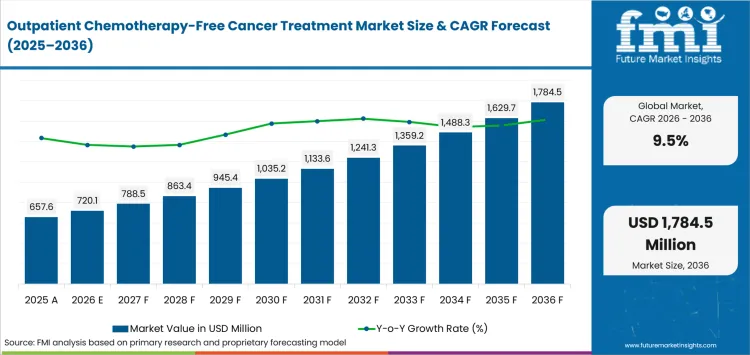
USD 720.1 million in 2026 and USD 1784.5 million by 2036 at a 9.5% CAGR.
Demand for outpatient chemotherapy-free cancer treatment is projected to expand at a CAGR of 9.5% between 2026 and 2036, increasing valuation from USD 720.1 million in 2026 to USD 1,784.5 million by 2036. Persistent disease burden keeps global oncology services under severe pressure across diagnosis and treatment pathways. In July 2026, the World Health Organization reported nearly 10 million cancer deaths in 2024. This critical mortality report reinforces the urgent demand for treatments beyond conventional cytotoxic infusion schedules. Resulting with cancer clinics requiring flexible drug formats to successfully manage repeated outpatient care.
International healthcare systems adopt unique strategies to evaluate non-infusion cancer therapies. United States and Germany care networks prioritize validated outcomes and specialist monitoring across repeated outpatient treatment cycles. South Korea and Japan providers emphasize concentrated cancer-centre capacity and shorter administration time. Recent clinical data provides essential evidence to guide these distinct regional adoption plans. In September 2025, the Food and Drug Administration reported results from a trial involving 377 patients receiving subcutaneous pembrolizumab. Such a pivotal study directly supports comparing subcutaneous injection with intravenous delivery across outpatient solid-tumour care.
Key Takeaways of Outpatient Chemotherapy-Free Cancer Treatment Market
- Demand for outpatient chemotherapy-free cancer treatment is driven by oncology services seeking lower chair-time pressure and consistent monitoring across repeated therapy cycles, with clinical adoption favoring regimens supported by clear dosing records.
- By route of administration, subcutaneous delivery holds the leading share at 53.9% in 2026, aided by reduced chair occupancy across eligible biologic treatments.
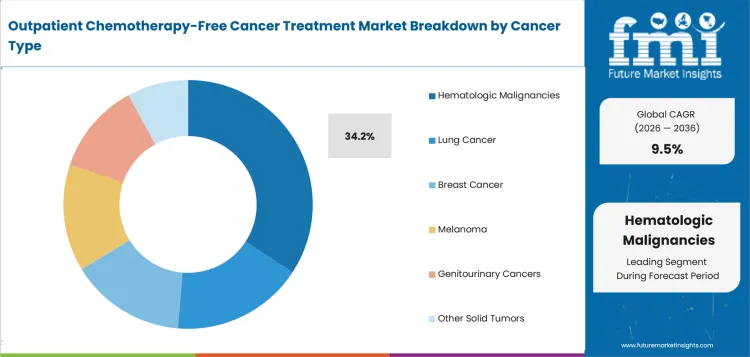
- Hematologic malignancies are the dominant cancer type segment, holding 34.2% share in 2026, reflecting substantial use of immune-directed regimens across lymphoma and myeloma.
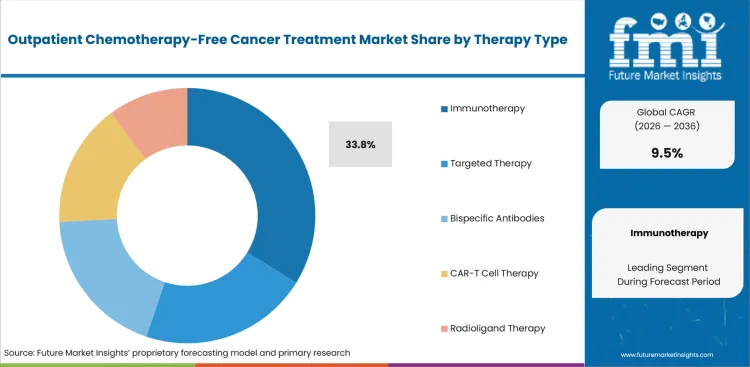
- Immunotherapy leads the therapy type category at 33.8% share in 2026, driven by checkpoint inhibitors applied across several solid-tumour indications.
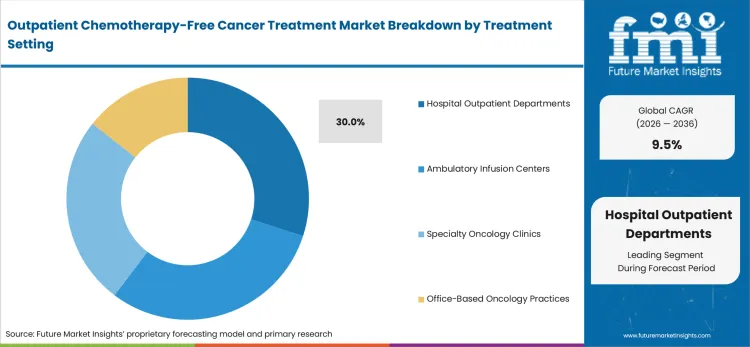
- Hospital outpatient departments account for 30.0% treatment setting share in 2026, owing to centralized pharmacy access and specialist monitoring within one institution.
- South Korea, the United Kingdom, and the United States record CAGRs of 10.6%, 9.8%, and 9.0% respectively through 2036, shaped by tertiary-care infrastructure, national treatment pathways, and extensive oncology network availability.
- Competition centers on F. Hoffmann-La Roche, Merck & Co., Novartis, AbbVie, and Genmab, with vendors differentiating through checkpoint and subcutaneous immunotherapy portfolios, cellular and radioligand therapy pathways, and bispecific antibody programs for hematologic malignancies.
Analyst Perspective
The shift toward subcutaneous delivery is less about patient preference than clinic economics: a seven-minute injection versus a thirty-to-sixty-minute infusion directly changes how many patients an outpatient department can cycle through in a day. That capacity gain only holds up if nursing teams can absorb the observation and preparation steps without creating a bottleneck elsewhere in the treatment room. For hematologic regimens especially, cytokine-release and infection monitoring during step-up dosing remain the harder constraint, so administration speed alone won't determine which centers can safely scale these outpatient pathways.
-Anurag Sharma, Principal Consultant for Healthcare at Future Market Insights
Source: Future Market Insights analysis, 2026.
How is Outpatient Chemotherapy-Free Cancer Treatment Market segmented?
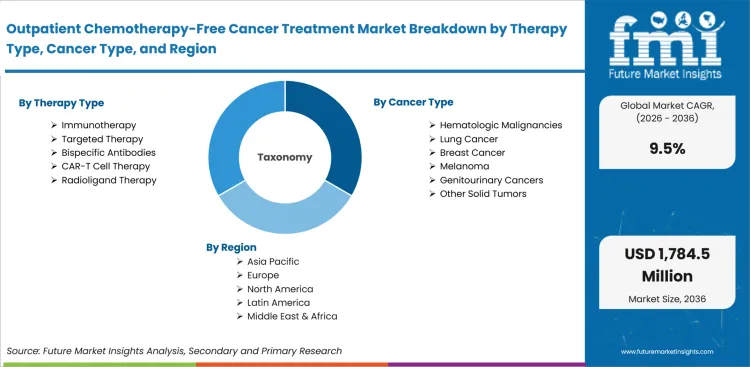
The outpatient chemotherapy-free cancer treatment industry is segmented by therapy type, cancer type, treatment setting, route of administration, and region.
The outpatient chemotherapy-free cancer treatment market is segmented by therapy type, cancer type, treatment setting, route of administration, and region. Therapy type coverage includes immunotherapy and targeted therapy followed by bispecific antibodies and Chimeric antigen receptor (CAR) t-cell therapy. Radioligand therapy completes classification across advanced cancer pathways requiring specialist oversight and structured treatment planning. Cancer type coverage addresses hematologic malignancies and lung cancer together with breast cancer and melanoma. Genitourinary cancers and other solid tumours complete disease classification across evaluated outpatient care pathways and treatment planning. Treatment setting coverage encompasses hospital outpatient departments and ambulatory infusion centres supported by specialty oncology clinics. Office-based oncology practices add selected capacity for regimens requiring limited observation and dependable referral access. Route coverage includes subcutaneous and intravenous administration with oral formats applied across suitable patient groups. Regional coverage spans North America and Latin America together with Western Europe and Eastern Europe. East Asia combines with South Asia and Pacific across the Asian assessment for outpatient cancer treatment. Middle East and Africa complete geographic analysis across developing oncology systems and specialist referral networks.
How does immunotherapy shape therapy type selection?
In December 2024, the Food and Drug Administration reported results from a randomized study involving 495 patients receiving subcutaneous or intravenous nivolumab. Recorded response rates reached 24% for subcutaneous delivery and 18% for intravenous administration, supporting continued assessment of next generation immunotherapies across outpatient solid-tumour pathways. Treatment planning also considers laboratory timing and escalation ownership across recurring immune-directed therapy cycles within specialist oncology services.
- Immunotherapy is predicted to garner a 33.8% share of therapy type revenue in 2026, driven by immune checkpoint inhibitors applied across several solid-tumour indications. Oncology committees assess immune-mediated safety requirements and treatment duration across pathways using scheduled laboratory review and documented escalation procedures.
- Targeted therapy and bispecific antibody options address biomarker-defined populations needing non-cytotoxic treatment based on molecular testing and indication-specific evidence. CAR-T cell therapy and radioligand therapy extend clinical choice across selected hematologic and genitourinary cancers under specialist supervision.
How do hematologic malignancies shape cancer type demand?
Care teams coordinate step-up dosing and supportive monitoring across repeated specialist visits for complex hematologic cases. In May 2025, the National Cancer Institute estimated 80,350 new non-Hodgkin lymphoma cases in the United States for 2025. Such disease volume sustains demand for Blood cancer treatment involving monoclonal antibodies and cellular therapies across relapsed or refractory settings.
- In 2026, hematologic malignancies are set to represent a 34.2% share due to substantial use of immune-directed regimens across lymphoma and myeloma. Specialist teams compare cytokine-release management and infection monitoring during step-up dosing and continuing outpatient administration.
- Lung cancer and breast cancer support extensive checkpoint-inhibitor use through established biomarker testing and specialist supervision. Melanoma and genitourinary cancers add treatment demand through established immune and targeted regimens administered across specialist oncology services.
Why do hospital outpatient departments lead treatment setting demand?
Centralized pharmacy access and emergency support help departments manage complex regimens within scheduled outpatient care windows. In April 2025, NHS England reported for more than 3.1 million additional appointments being delivered from July 2024 through January 2025. Expanded outpatient and diagnostic activity supports hospital departments managing specialist treatment delivery and rapid clinical escalation across complex oncology pathways.
- Based on treatment setting, hospital outpatient departments are likely to account for a 30.0% share in 2026 owing to pharmacy access and specialist monitoring within one institution. Multidisciplinary teams coordinate laboratory review and adverse-event escalation during every scheduled cycle and follow-up assessment.
- Ambulatory infusion centres and specialty oncology clinics provide recurring treatment capacity across established cancer networks. Office-based oncology practices serve selected regimens requiring lower monitoring intensity and dependable referral access for clinical complications.
Why does subcutaneous administration lead route selection?
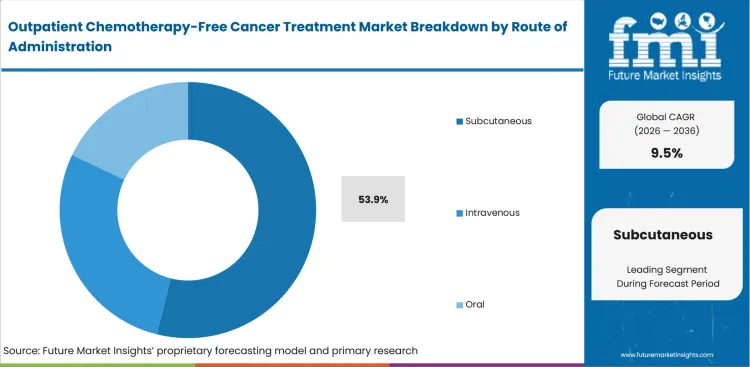
In September 2024, Roche reported that Tecentriq Hybreza administration required approximately 7 minutes compared with 30 to 60 minutes for intravenous Tecentriq. Shorter delivery supports subcutaneous bispecific antibody auto-injectors and other injectable formats designed around outpatient capacity. Treatment teams assess storage and preparation requirements during formulation review across pharmacy and nursing operations.
- Subcutaneous administration is expected to secure a 53.9% share in 2026, aided by reduced chair occupancy across eligible biologic treatments. Nursing teams review injection observation requirements and preparation steps across pharmacy and treatment-room operations during service planning.
- Intravenous administration retains importance for regimens requiring controlled infusion and immediate clinical supervision across complex biologic treatments and high-risk patients. Oral therapies support home-based dosing across selected targeted treatments under adherence monitoring and scheduled oncology review.
How do demand drivers and restraints shape opportunity in Outpatient Chemotherapy-Free Cancer Treatment Market?
Cancer-service demand and new non-cytotoxic approvals support outpatient pathway development across established oncology networks and specialist referral systems. Safety monitoring and specialist resource requirements may restrict routine use across lower-capacity centres lacking immediate escalation support.
- Driver: Oncology services need treatment pathways reducing conventional chemotherapy exposure across selected patients receiving biomarker-guided care. Clinical teams favor regimens supported by validated response evidence and structured outpatient monitoring across complete treatment courses.
- Restraint: Immune-mediated toxicity and cellular-therapy complications increase observation requirements across advanced treatment programmes serving complex patients. Smaller centres face implementation pressure from specialist staffing and emergency-response obligations during scheduled outpatient administration.
- Opportunity: Injectable biologics and targeted therapies create room for shorter administration across established cancer services and recurring appointments. Regional treatment networks may extend access through shared protocols and specialist referral support across community oncology locations.
In July 2026, NHS England reported a record of 700,000 cancer treatments having started during the year ending in May. Rising treatment activity supports outpatient formats limiting chair occupancy and maintaining scheduling capacity across repeated oncology visits. Provider demand favors regimens supporting greater patient throughput without extending infusion-room occupancy.
Specialist centres face continuing staffing pressure from surveillance duties and delayed adverse-event assessment. In April 2024, the Food and Drug Administration required boxed warnings for 6 approved CAR-T products following reports of T-cell malignancies. Lifelong monitoring requirements illustrate operational burdens affecting cellular-therapy delivery beyond initial administration and continuing survivorship follow-up.
In June 2024, the Food and Drug Administration reported an 82% objective response rate and a 60% complete response rate among 127 patients receiving epcoritamab for relapsed follicular lymphoma. Such evidence supports outpatient antibody therapy expansion across heavily treated hematologic populations requiring carefully managed dosing and observation. Commercial opportunity increases as specialist referral pathways support structured step-up dosing across community oncology services.
How are country CAGRs aligned in Outpatient Chemotherapy-Free Cancer Treatment Market?
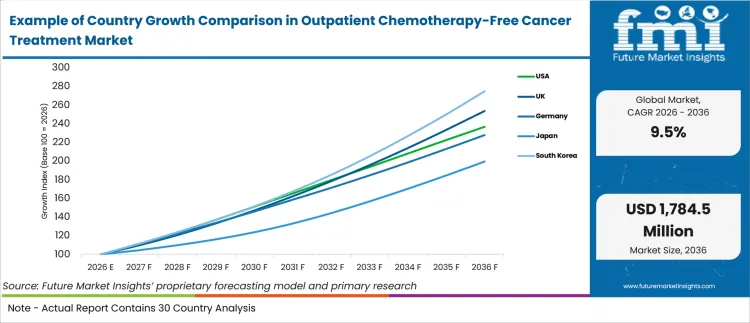
| Country | CAGR |
|---|---|
| South Korea | 10.6% |
| UK | 9.8% |
| USA | 9.0% |
| Germany | 8.6% |
| Japan | 7.1% |
Source: Future Market Insights analysis, 2026.
How do country-level CAGRs compare in Outpatient Chemotherapy-Free Cancer Treatment Market?
Country comparison shows a measured step-down across five profiled markets with South Korea occupying the upper position. United Kingdom follows through coordinated national pathways supporting outpatient injectable treatment across public cancer services. United States and Germany form the middle range through extensive provider networks and structured hospital access. Japan records the lower disclosed rate within the selected comparison due to measured clinical review. The 3.5-point spread shows shared expansion across all five profiled countries. Relative positions indicate different levels of commercial progression. Differences reflect specialist capacity and injectable-treatment readiness across national oncology services serving distinct patient populations.
- South Korea leads the comparison through concentrated hospital resources and rapid review of new oncology technologies across tertiary cancer centres.
- United Kingdom follows through national treatment pathways and coordinated adoption across public cancer services managing recurring oncology appointments.
- United States maintains substantial outpatient activity across academic and community oncology networks serving diverse tumour populations.
- Germany reflects structured hospital access and extensive diagnostic capacity across regional care systems supporting biomarker-led treatment selection.
- Japan records measured expansion shaped by specialist concentration and an ageing population requiring sustained cancer care across outpatient services.
Profiled markets with similar CAGRs may present distinct access conditions due to clinical capacity and payment arrangements. Full geographic coverage includes North America and Latin America with Western Europe and Eastern Europe. East Asia joins South Asia and Pacific across the final Asian coverage block serving varied treatment systems. Middle East and Africa complete regional analysis across developing cancer-service systems and specialist referral networks.
Country-wise Analysis
- Sales in South Korea are set to expand at 10.6% CAGR between 2026 and 2036, guided by concentrated tertiary oncology services and rapid therapy evaluation. Referral networks promote specialist monitoring across cellular and antibody-based programmes requiring coordinated laboratory review and toxicity management. OECD data released in November 2025 recorded 87 CT scanners with MRI units and PET scanners per million people in South Korea, indicating substantial diagnostic capacity for biomarker-led cancer pathways.
- A May 2026 NHS England publication reported annual pembrolizumab starts for around 14,000 patients in England, highlighting substantial injectable-treatment volume across public oncology services. Injectable adoption frees oncology appointments and supports recurring treatment through coordinated national cancer pathways serving extensive patient populations. Sector in the United Kingdom is projected to scale at 9.8% CAGR during the study period, backed by treatment protocols and coordinated implementation across hospital networks
- Academic centres and community oncology practices provide extensive settings for immune-directed and targeted treatment across diverse tumour populations. The market in United States is likely to rise at 9.0% CAGR from 2026 to 2036, aided by therapy availability and specialist service depth support estimated A National Cancer Institute estimate published in May 2025 placed 2.04191 million new cancer cases in the United States during 2025, influencing demand for efficient outpatient pathways across diverse tumour types.
- Demand in Germany is anticipated to grow at 8.6% CAGR during the forecast period, helped by structured hospital access and regulated adoption across cancer centres. Regional care systems support specialist oversight across antibody and targeted therapy schedules requiring dependable diagnostic coordination. OECD data released in November 2025 recorded 74 CT scanners with MRI units and PET scanners per million people in Germany, indicating substantial diagnostic capacity for treatment selection and monitoring.
- Cabinet Office figures published in June 2025 recorded 36.24 million residents aged 65 years or older as of October 2024, reflecting sustained oncology demand across outpatient services. Concentrated cancer-care expertise supports measured adoption across university hospitals and regional referral networks serving older patient populations. Industry in Japan is expected to progress at 7.1% CAGR by 2036, influenced by careful clinical review and specialist treatment capacity support
Who are notable companies in Outpatient Chemotherapy-Free Cancer Treatment Market?
F. Hoffmann-La Roche Ltd., Merck & Co., Inc., Bristol Myers Squibb Company, AstraZeneca PLC, Pfizer Inc., Amgen Inc., Novartis AG, AbbVie Inc., Genmab A/S, and Gilead Sciences, Inc. are the notable companies shaping this market.
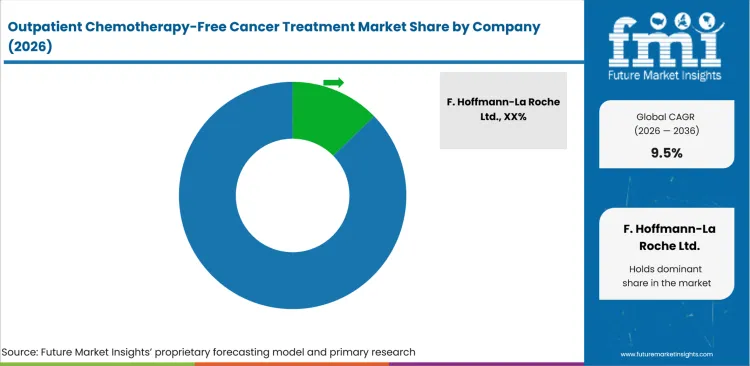
The competitive outlook combines multinational pharmaceutical companies with specialists focused on cellular and bispecific therapies across several cancer pathways. Checkpoint-inhibitor companies compete depending on indication breadth and injectable dosing across repeated outpatient treatment. Targeted medicine developers compete led by biomarker alignment and flexible administration across selected tumour populations. Cellular and radioligand therapy companies compete due to treatment-centre coordination and long-term monitoring across specialist networks. Cancer immunotherapy market analysis provides a useful comparison for clinical support and service responsibility within outpatient programmes. Commercial success requires reliable dosing and monitoring coordination since one weak handoff can disrupt treatment continuity across the entire pathway.
- F. Hoffmann-La Roche Ltd. and Merck & Co., Inc. are estimated to receive review led by established checkpoint portfolios and subcutaneous formulations. Hospital teams compare dosing flexibility and service guidance across repeated outpatient treatment requiring consistent monitoring and patient education.
- Bristol Myers Squibb Company and AstraZeneca PLC are projected to compete across solid-tumour immunotherapy pathways. Clinical committees assess indication breadth and immune-mediated toxicity management across specialist services supporting multiple solid-tumour pathways.
- Novartis AG and Gilead Sciences, Inc. are anticipated to retain attention across advanced cellular and radioligand treatments. Treatment centres examine manufacturing coordination and long-term patient monitoring during programme evaluation across advanced therapy networks.
- AbbVie Inc. and Genmab A/S are likely to support hematologic care through bispecific antibody programmes. Pfizer Inc. and Amgen Inc. add targeted and immune-engaging options across selected cancer pathways.
Competitive Benchmarking: Outpatient Chemotherapy-Free Cancer Treatment Market
| Company | Portfolio Depth | Clinical Match | Service Support | Service Reach |
|---|---|---|---|---|
| F. Hoffmann-La Roche Ltd. | High | High | High | Global oncology networks |
| Merck & Co., Inc. | High | High | High | Global oncology networks |
| Bristol Myers Squibb Company | High | High | High | Global oncology networks |
| AstraZeneca PLC | High | High | High | Global oncology networks |
| Pfizer Inc. | High | Medium | High | Global and regional networks |
| Novartis AG | High | High | High | Global specialist centres |
| AbbVie Inc. | Medium | High | High | Selected global markets |
| Gilead Sciences, Inc. | High | High | High | Cellular-therapy centres |
| Genmab A/S | Medium | High | Medium | Partner-supported markets |
| Amgen Inc. | High | Medium | High | Global and regional networks |
Source: Future Market Insights competitive analysis, 2026.
Key Developments in Outpatient Chemotherapy-Free Cancer Treatment Market
- In March 2025, Novartis announced United States approval for earlier Pluvicto use in PSMA-positive metastatic castration-resistant prostate cancer. Company results more than doubled median radiographic progression-free survival to 11.6 months from 5.6 months, reflecting a radioligand pathway intended to delay chemotherapy.
- In November 2025, Genmab announced United States approval for EPKINLY with rituximab and lenalidomide in relapsed or refractory follicular lymphoma. Company data reported a 79% reduction in disease progression or death risk, strengthening chemotherapy-free outpatient treatment across second-line care pathways.
- In December 2025, Roche announced United States approval for subcutaneous Lunsumio Velo in relapsed or refractory follicular lymphoma. Company results recorded a 75% objective response rate and a 59% complete response rate, supporting approximately one-minute outpatient bispecific treatment across specialist oncology services.
Key Players in Outpatient Chemotherapy-Free Cancer Treatment Market
Checkpoint and Subcutaneous Immunotherapy Companies
- F. Hoffmann-La Roche Ltd.
- Merck & Co., Inc.
- Bristol Myers Squibb Company
- AstraZeneca PLC
Hematology and Cell Therapy Companies
- Novartis AG
- Gilead Sciences, Inc.
- AbbVie Inc.
- Genmab A/S
Bispecific and Targeted Therapy Participants
- Pfizer Inc.
- Amgen Inc.
Outpatient Chemotherapy-Free Cancer Treatment Market Report Scope
| Coverage Field | Report Scope |
|---|---|
| Market Breakdown | Outpatient chemotherapy-free cancer treatment market breakdown by therapy type, cancer type, treatment setting, route of administration, and region |
| Market Definition | Outpatient chemotherapy-free cancer treatment covers products and supporting services used for non-cytotoxic cancer care delivered without overnight hospital admission. |
| Regions Covered | North America, Latin America, Western Europe, Eastern Europe, East Asia, South Asia and Pacific, and Middle East and Africa |
| Countries Covered | USA, UK, Germany, Japan, and South Korea |
| Key Companies Profiled | F. Hoffmann-La Roche Ltd., Merck & Co., Inc., Bristol Myers Squibb Company, AstraZeneca PLC, Pfizer Inc., Novartis AG, AbbVie Inc., Gilead Sciences, Inc., Genmab A/S, Amgen Inc. |
| Forecast Period | 2026 to 2036 |
| Approach | Hybrid bottom-up and top-down assessment using segment shares and country CAGRs with clinical evidence and company participation. |
Source: Future Market Insights analysis, 2026.
Outpatient Chemotherapy-Free Cancer Treatment Market - Research Methodology
| Method | Approach |
|---|---|
| Primary Research | FMI analysts gathered input from manufacturers, service providers, technology developers, distributors, end users, sourcing teams, and subject-matter experts. Interviews examined purchasing decisions, product or service evaluation, adoption barriers, approval requirements, pricing considerations, and expectations for technical or commercial support. Respondents were also asked what evidence is required before a trial, pilot, or initial order develops into regular purchasing. |
| Desk Research | Desk research covered government statistics, regulatory publications, trade data, industry associations, technical literature, standards, company filings, product information, and official corporate announcements. Sources were reviewed for relevance, publication date, geographic coverage, and consistency with the defined market scope. Claims relating to performance, applications, approvals, capacity, investment, and commercial activity were retained only when supported by credible public evidence. |
| Market Sizing and Forecasting | The market model combined the baseline value with historical performance, segment structure, pricing and volume indicators, adoption levels, company participation, and country-level demand conditions. Forecast assumptions considered economic activity, investment trends, regulatory developments, technology adoption, purchasing cycles, supply availability, and barriers to wider market use. Segment and regional estimates were reconciled before the final market total was calculated. |
| Data Validation | Estimates were checked against multiple independent indicators, including public data, company activity, trade patterns, industry developments, and findings from primary interviews. Validation also tested whether products, services, applications, and company revenues fell within the defined market boundaries. Adjacent categories, unsupported claims, overlapping revenues, and activities without direct market relevance were excluded to reduce double counting and maintain consistency across segments and countries. |
Source: Future Market Insights analysis, 2026.
Outpatient Chemotherapy-Free Cancer Treatment Market by Segments
Outpatient Chemotherapy-Free Cancer Treatment Market Segmented by Therapy Type
- Immunotherapy
- Targeted Therapy
- Bispecific Antibodies
- CAR-T Cell Therapy
- Radioligand Therapy
Outpatient Chemotherapy-Free Cancer Treatment Market Segmented by Cancer Type
- Hematologic Malignancies
- Lung Cancer
- Breast Cancer
- Melanoma
- Genitourinary Cancers
- Other Solid Tumours
Outpatient Chemotherapy-Free Cancer Treatment Market Segmented by Treatment Setting
- Hospital Outpatient Departments
- Ambulatory Infusion Centres
- Specialty Oncology Clinics
- Office-Based Oncology Practices
Outpatient Chemotherapy-Free Cancer Treatment Market Segmented by Route of Administration
- Subcutaneous
- Intravenous
- Oral
Outpatient Chemotherapy-Free Cancer Treatment Market Segmented by Region
- North America
- United States
- Canada
- Latin America
- Brazil
- Mexico
- Argentina
- Chile
- Western Europe
- Germany
- France
- United Kingdom
- Italy
- Spain
- Benelux
- Nordics
- Eastern Europe
- Poland
- Czech Republic
- Romania
- Hungary
- East Asia
- China
- Japan
- South Korea
- South Asia and Pacific
- India
- ASEAN
- Australia and New Zealand
- Middle East and Africa
- GCC Countries
- South Africa
- Türkiye
- Israel
Research Sources and Bibliography
- World Health Organization. (2026, July 3). Cancer.
- USA Food and Drug Administration. (2025, September 19). FDA approves pembrolizumab and berahyaluronidase alfa-pmph for subcutaneous injection.
- USA Food and Drug Administration. (2024, December 27). FDA approves nivolumab and hyaluronidase-nvhy for subcutaneous injection.
- National Cancer Institute. (2025, May 6). Common cancer types.
- NHS England. (2025, April 10). Over three million additional appointments delivered as NHS exceeds faster diagnosis standard for cancer.
- Roche. (2024, September 13). FDA approves Roche’s Tecentriq Hybreza, the first and only subcutaneous anti-PD-(L)1 cancer immunotherapy.
- NHS England. (2026, July 16). Cancer patients rate NHS care highly as record numbers checked and treated.
- USA Food and Drug Administration. (2024, April 18). FDA requires boxed warning for T cell malignancies following treatment with BCMA-directed or CD19-directed autologous chimeric antigen receptor (CAR) T cell immunotherapies.
- USA Food and Drug Administration. (2024, June 26). FDA grants accelerated approval to epcoritamab-bysp for relapsed or refractory follicular lymphoma.
- OECD. (2025, November 13). Health at a glance 2025: Korea.
- NHS England. (2026, May 4). ‘1-minute’ immunotherapy jab rolled out on NHS for tens of thousands with cancer.
- National Cancer Institute. (2025, May 7). Cancer statistics.
- OECD. (2025, November 13). Health at a glance 2025: Germany.
- Cabinet Office, Government of Japan. (2025, June). Annual report on the ageing society: Summary FY2025.
- Novartis. (2025, March 28). FDA approves Novartis radioligand therapy Pluvicto for earlier use before chemotherapy in PSMA-positive metastatic castration-resistant prostate cancer.
- Genmab A/S. (2025, November 18). Genmab announces EPKINLY (epcoritamab-bysp) in combination with rituximab and lenalidomide approved by the USA Food and Drug Administration for the treatment of relapsed or refractory follicular lymphoma.
- Roche. (2025, December 22). FDA approves Roche’s Lunsumio Velo for subcutaneous use in relapsed or refractory follicular lymphoma.
This bibliography is provided for reader reference and is not exhaustive. The full report contains the complete reference list and detailed citations.
This Report Answers
- How are therapy type and cancer type segments assessed with treatment setting and route of administration?
- How do oncology teams evaluate outpatient chemotherapy-free treatment prior to routine use?
- How do country CAGRs differ across profiled national cancer-service systems?
- How do companies compete through portfolio depth and clinical evidence with dependable service support?
- How are forecasts validated through hybrid bottom-up and top-down analysis?
- How does subcutaneous delivery influence oncology appointment capacity and patient experience?
- How do immune-mediated safety requirements affect treatment-setting selection?
- How do biomarker records guide targeted and immune-directed therapy selection?
- How do specialist monitoring resources influence regional adoption?
- How do company capabilities support long-term outpatient treatment confidence?
Frequently Asked Questions
How big is the Outpatient Chemotherapy-Free Cancer Treatment Market in 2026?
The outpatient chemotherapy-free cancer treatment market is valued at USD 720.1 million in 2026 and is forecast to reach USD 1784.5 million by 2036. Growth reflects oncology clinics requiring flexible drug formats to manage repeated outpatient care amid persistent global cancer disease burden.
What is the CAGR of the Outpatient Chemotherapy-Free Cancer Treatment Market from 2026 to 2036?
The outpatient chemotherapy-free cancer treatment market grows at a CAGR of 9.5% between 2026 and 2036, supported by oncology services needing treatment pathways that reduce conventional chemotherapy exposure across selected patients receiving biomarker-guided care.
Which route of administration leads the Outpatient Chemotherapy-Free Cancer Treatment Market?
Subcutaneous administration accounts for 53.9% of the outpatient chemotherapy-free cancer treatment market by route in 2026, aided by reduced chair occupancy that lets nursing teams cycle more patients through eligible biologic treatments each day.
How much will the Outpatient Chemotherapy-Free Cancer Treatment Market add between 2026 and 2036?
The outpatient chemotherapy-free cancer treatment market is set to add USD 1064.4 million between 2026 and 2036, growing from USD 720.1 million to USD 1784.5 million as subcutaneous and injectable biologic therapies extend across a widening base of outpatient oncology networks.
Who are the leading companies in the Outpatient Chemotherapy-Free Cancer Treatment Market?
Five companies lead the outpatient chemotherapy-free cancer treatment market, including F. Hoffmann-La Roche, Merck & Co., Novartis, AbbVie, and Genmab, competing through checkpoint and subcutaneous immunotherapy portfolios, cellular and radioligand therapy pathways, and bispecific antibody programs.
Preview the report firsthand - request a free sample
Get SampleGet the brochure for pricing and purchase details.
Get PDFTable of Content
- Key Takeaways
- Market Size and CAGR
- Top Growth Driver
- Fastest Growing Segment
- Leading Region
- Key Companies
- Emerging Opportunities
- Executive Summary
- Global Market Outlook
- Demand-side Trends
- Supply-side Trends
- Technology Roadmap Analysis
- Analysis and Recommendations
- Analyst Perspective (What is happening? Why now? What should investors know?)
- Key Questions Answered
- How large is the market?
- What is the CAGR?
- What are key trends?
- Which region dominates?
- Who are the leaders?
- Market Overview
- Market Coverage / Taxonomy
- Market Definition / Scope / Limitations
- Research Methodology
- Chapter Orientation
- Analytical Lens and Working Hypotheses
- Market Structure, Signals, and Trend Drivers
- Benchmarking and Cross-market Comparability
- Market Sizing, Forecasting, and Opportunity Mapping
- Research Design and Evidence Framework
- Desk Research Programme (Secondary Evidence)
- Expert Input and Fieldwork (Primary Evidence)
- Tooling, Models, and Reference Databases
- Data Engineering and Model Build
- Quality Assurance and Audit Trail
- Market Background
- Market Dynamics (Drivers, Restraints, Opportunity, Trends)
- Scenario Forecast (Optimistic, Likely, Conservative)
- Impact Analysis
- AI Impact
- Sustainability Impact
- Regulatory Impact
- Technology Impact
- Consumer / Buyer Analysis
- Purchase Drivers
- Adoption Barriers
- Buyer Journey
- Opportunity Map Analysis
- Product Life Cycle Analysis
- Supply Chain Analysis
- Investment Feasibility Matrix
- Value Chain Analysis
- PESTLE and Porter's Analysis
- Regulatory Landscape
- Regional Parent Market Outlook
- Production and Consumption Statistics
- Import and Export Statistics
- Global Market Analysis and Forecast, 2021 to 2036
- Historical Market Size Value (USD Million) Analysis, 2021 to 2025
- Current and Future Market Size Value (USD Million) Projections, 2026 to 2036
- Y-o-Y Growth Trend Analysis
- Absolute $ Opportunity Analysis
- Global Market Pricing Analysis, 2021 to 2036
- Global Market Analysis and Forecast, By Therapy Type, 2021 to 2036
- Introduction / Key Findings
- Historical Market Size Value (USD Million) Analysis By Therapy Type, 2021 to 2025
- Current and Future Market Size Value (USD Million) Analysis and Forecast By Therapy Type, 2026 to 2036
- Immunotherapy
- Targeted Therapy
- Bispecific Antibodies
- CAR-T Cell Therapy
- Radioligand Therapy
- Immunotherapy
- Y-o-Y Growth Trend Analysis By Therapy Type, 2021 to 2025
- Absolute $ Opportunity Analysis By Therapy Type, 2026 to 2036
- Global Market Analysis and Forecast, By Cancer Type, 2021 to 2036
- Introduction / Key Findings
- Historical Market Size Value (USD Million) Analysis By Cancer Type, 2021 to 2025
- Current and Future Market Size Value (USD Million) Analysis and Forecast By Cancer Type, 2026 to 2036
- Hematologic Malignancies
- Lung Cancer
- Breast Cancer
- Melanoma
- Genitourinary Cancers
- Other Solid Tumors
- Hematologic Malignancies
- Y-o-Y Growth Trend Analysis By Cancer Type, 2021 to 2025
- Absolute $ Opportunity Analysis By Cancer Type, 2026 to 2036
- Global Market Analysis and Forecast, By Treatment Setting, 2021 to 2036
- Introduction / Key Findings
- Historical Market Size Value (USD Million) Analysis By Treatment Setting, 2021 to 2025
- Current and Future Market Size Value (USD Million) Analysis and Forecast By Treatment Setting, 2026 to 2036
- Hospital Outpatient Departments
- Ambulatory Infusion Centers
- Specialty Oncology Clinics
- Office-Based Oncology Practices
- Hospital Outpatient Departments
- Y-o-Y Growth Trend Analysis By Treatment Setting, 2021 to 2025
- Absolute $ Opportunity Analysis By Treatment Setting, 2026 to 2036
- Global Market Analysis and Forecast, By Route of Administration, 2021 to 2036
- Introduction / Key Findings
- Historical Market Size Value (USD Million) Analysis By Route of Administration, 2021 to 2025
- Current and Future Market Size Value (USD Million) Analysis and Forecast By Route of Administration, 2026 to 2036
- Subcutaneous
- Intravenous
- Oral
- Subcutaneous
- Y-o-Y Growth Trend Analysis By Route of Administration, 2021 to 2025
- Absolute $ Opportunity Analysis By Route of Administration, 2026 to 2036
- Global Market Analysis and Forecast, By Region, 2021 to 2036
- Introduction
- Historical Market Size Value (USD Million) Analysis By Region, 2021 to 2025
- Current Market Size Value (USD Million) Analysis and Forecast By Region, 2026 to 2036
- North America
- Latin America
- Western Europe
- Eastern Europe
- East Asia
- South Asia and Pacific
- Middle East & Africa
- Market Attractiveness Analysis By Region
- North America Market Analysis and Forecast, By Country, 2021 to 2036
- Historical Market Size Value (USD Million) Trend Analysis By Market Taxonomy, 2021 to 2025
- Market Size Value (USD Million) Forecast By Market Taxonomy, 2026 to 2036
- By Country
- USA
- Canada
- By Therapy Type
- By Cancer Type
- By Treatment Setting
- By Route of Administration
- By Country
- Market Attractiveness Analysis
- By Country
- By Therapy Type
- By Cancer Type
- By Treatment Setting
- By Route of Administration
- Key Takeaways
- Latin America Market Analysis and Forecast, By Country
- Historical Market Size Value (USD Million) Trend Analysis By Market Taxonomy, 2021 to 2025
- Market Size Value (USD Million) Forecast By Market Taxonomy, 2026 to 2036
- By Country
- Brazil
- Mexico
- Chile
- Rest of Latin America
- By Therapy Type
- By Cancer Type
- By Treatment Setting
- By Route of Administration
- By Country
- Market Attractiveness Analysis
- By Country
- By Therapy Type
- By Cancer Type
- By Treatment Setting
- By Route of Administration
- Key Takeaways
- Western Europe Market Analysis and Forecast, By Country
- Historical Market Size Value (USD Million) Trend Analysis By Market Taxonomy, 2021 to 2025
- Market Size Value (USD Million) Forecast By Market Taxonomy, 2026 to 2036
- By Country
- Germany
- UK
- Italy
- Spain
- France
- Nordic
- BENELUX
- Rest of Western Europe
- By Therapy Type
- By Cancer Type
- By Treatment Setting
- By Route of Administration
- By Country
- Market Attractiveness Analysis
- By Country
- By Therapy Type
- By Cancer Type
- By Treatment Setting
- By Route of Administration
- Key Takeaways
- Eastern Europe Market Analysis and Forecast, By Country
- Historical Market Size Value (USD Million) Trend Analysis By Market Taxonomy, 2021 to 2025
- Market Size Value (USD Million) Forecast By Market Taxonomy, 2026 to 2036
- By Country
- Russia
- Poland
- Hungary
- Balkan & Baltic
- Rest of Eastern Europe
- By Therapy Type
- By Cancer Type
- By Treatment Setting
- By Route of Administration
- By Country
- Market Attractiveness Analysis
- By Country
- By Therapy Type
- By Cancer Type
- By Treatment Setting
- By Route of Administration
- Key Takeaways
- East Asia Market Analysis and Forecast, By Country
- Historical Market Size Value (USD Million) Trend Analysis By Market Taxonomy, 2021 to 2025
- Market Size Value (USD Million) Forecast By Market Taxonomy, 2026 to 2036
- By Country
- China
- Japan
- South Korea
- By Therapy Type
- By Cancer Type
- By Treatment Setting
- By Route of Administration
- By Country
- Market Attractiveness Analysis
- By Country
- By Therapy Type
- By Cancer Type
- By Treatment Setting
- By Route of Administration
- Key Takeaways
- South Asia and Pacific Market Analysis and Forecast, By Country
- Historical Market Size Value (USD Million) Trend Analysis By Market Taxonomy, 2021 to 2025
- Market Size Value (USD Million) Forecast By Market Taxonomy, 2026 to 2036
- By Country
- India
- ASEAN
- Australia & New Zealand
- Rest of South Asia and Pacific
- By Therapy Type
- By Cancer Type
- By Treatment Setting
- By Route of Administration
- By Country
- Market Attractiveness Analysis
- By Country
- By Therapy Type
- By Cancer Type
- By Treatment Setting
- By Route of Administration
- Key Takeaways
- Middle East & Africa Market Analysis and Forecast, By Country
- Historical Market Size Value (USD Million) Trend Analysis By Market Taxonomy, 2021 to 2025
- Market Size Value (USD Million) Forecast By Market Taxonomy, 2026 to 2036
- By Country
- Kingdom of Saudi Arabia
- Other GCC Countries
- Türkiye
- South Africa
- Other African Union
- Rest of Middle East & Africa
- By Therapy Type
- By Cancer Type
- By Treatment Setting
- By Route of Administration
- By Country
- Market Attractiveness Analysis
- By Country
- By Therapy Type
- By Cancer Type
- By Treatment Setting
- By Route of Administration
- Key Takeaways
- Key Countries Market Analysis
- USA
- Pricing Analysis
- Market Share Analysis, 2025
- By Therapy Type
- By Cancer Type
- By Treatment Setting
- By Route of Administration
- Canada
- Pricing Analysis
- Market Share Analysis, 2025
- By Therapy Type
- By Cancer Type
- By Treatment Setting
- By Route of Administration
- Mexico
- Pricing Analysis
- Market Share Analysis, 2025
- By Therapy Type
- By Cancer Type
- By Treatment Setting
- By Route of Administration
- Brazil
- Pricing Analysis
- Market Share Analysis, 2025
- By Therapy Type
- By Cancer Type
- By Treatment Setting
- By Route of Administration
- Chile
- Pricing Analysis
- Market Share Analysis, 2025
- By Therapy Type
- By Cancer Type
- By Treatment Setting
- By Route of Administration
- Germany
- Pricing Analysis
- Market Share Analysis, 2025
- By Therapy Type
- By Cancer Type
- By Treatment Setting
- By Route of Administration
- UK
- Pricing Analysis
- Market Share Analysis, 2025
- By Therapy Type
- By Cancer Type
- By Treatment Setting
- By Route of Administration
- Italy
- Pricing Analysis
- Market Share Analysis, 2025
- By Therapy Type
- By Cancer Type
- By Treatment Setting
- By Route of Administration
- Spain
- Pricing Analysis
- Market Share Analysis, 2025
- By Therapy Type
- By Cancer Type
- By Treatment Setting
- By Route of Administration
- France
- Pricing Analysis
- Market Share Analysis, 2025
- By Therapy Type
- By Cancer Type
- By Treatment Setting
- By Route of Administration
- India
- Pricing Analysis
- Market Share Analysis, 2025
- By Therapy Type
- By Cancer Type
- By Treatment Setting
- By Route of Administration
- ASEAN
- Pricing Analysis
- Market Share Analysis, 2025
- By Therapy Type
- By Cancer Type
- By Treatment Setting
- By Route of Administration
- Australia & New Zealand
- Pricing Analysis
- Market Share Analysis, 2025
- By Therapy Type
- By Cancer Type
- By Treatment Setting
- By Route of Administration
- China
- Pricing Analysis
- Market Share Analysis, 2025
- By Therapy Type
- By Cancer Type
- By Treatment Setting
- By Route of Administration
- Japan
- Pricing Analysis
- Market Share Analysis, 2025
- By Therapy Type
- By Cancer Type
- By Treatment Setting
- By Route of Administration
- South Korea
- Pricing Analysis
- Market Share Analysis, 2025
- By Therapy Type
- By Cancer Type
- By Treatment Setting
- By Route of Administration
- Russia
- Pricing Analysis
- Market Share Analysis, 2025
- By Therapy Type
- By Cancer Type
- By Treatment Setting
- By Route of Administration
- Poland
- Pricing Analysis
- Market Share Analysis, 2025
- By Therapy Type
- By Cancer Type
- By Treatment Setting
- By Route of Administration
- Hungary
- Pricing Analysis
- Market Share Analysis, 2025
- By Therapy Type
- By Cancer Type
- By Treatment Setting
- By Route of Administration
- Kingdom of Saudi Arabia
- Pricing Analysis
- Market Share Analysis, 2025
- By Therapy Type
- By Cancer Type
- By Treatment Setting
- By Route of Administration
- Türkiye
- Pricing Analysis
- Market Share Analysis, 2025
- By Therapy Type
- By Cancer Type
- By Treatment Setting
- By Route of Administration
- South Africa
- Pricing Analysis
- Market Share Analysis, 2025
- By Therapy Type
- By Cancer Type
- By Treatment Setting
- By Route of Administration
- USA
- Market Structure Analysis
- Competition Dashboard
- Competition Benchmarking
- Market Share Analysis of Top Players
- By Regional
- By Therapy Type
- By Cancer Type
- By Treatment Setting
- By Route of Administration
- Emerging Startups
- Innovation Benchmarking
- Competition Analysis
- Competition Deep Dive
- F. Hoffmann-La Roche Ltd.
- Overview
- Product Portfolio
- Profitability by Market Segments
- Sales Footprint
- Strategy Overview
- Marketing Strategy
- Product Strategy
- Channel Strategy
- Merck & Co., Inc.
- Bristol Myers Squibb
- AstraZeneca PLC
- Pfizer Inc.
- Novartis AG
- AbbVie Inc.
- Gilead Sciences, Inc.
- Genmab A/S
- Amgen Inc.
- F. Hoffmann-La Roche Ltd.
- Case Studies
- Success Stories
- Recent Developments
- Competition Deep Dive
- Assumptions & Acronyms Used


