

- 2025 (base history)
- USD 38.8 Mn
- 2026 (current)
- USD 45.4 Mn
- 2036 (forecast)
- USD 221.0 Mn
- CAGR (2026–2036)
- 17.1%
How big is the overhead-work construction exoskeletons market in 2026?
USD 45.4 million in 2026 and USD 221.0 million by 2036 at a 17.1% CAGR.
The overhead-work construction exoskeletons industry value is forecast to grow from USD 38.8 million in 2025 to USD 221.0 million by 2036 at 17.1% CAGR as contractors add body-worn support to overhead drilling, fastening, sanding, and ceiling installation. Passive systems are forecast to represent 78.0% share in 2026 because most contractors favor low-maintenance shoulder support without charging downtime. Shoulder systems are expected to secure 66.0% share in 2026, led by repeated arm elevation in MEP, drywall, painting, and maintenance work.
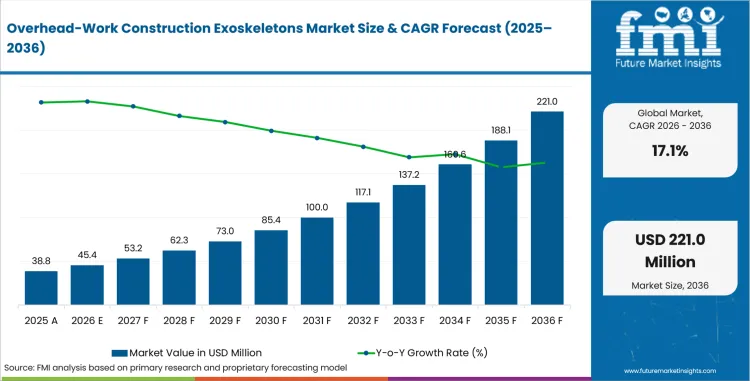
Overhead-Work Construction Exoskeletons Market Overview: Size and Forecast
- 2025 (base history): USD 38.8 million
- 2026 (current): USD 45.4 million
- 2036 (forecast): USD 221.0 million
- CAGR (2026–2036): 17.1%
- Leading Support Type: Passive
- Passive Systems Share in 2026: 78.0%
- Leading Body Focus: Shoulder
- Shoulder Systems Share in 2026: 66.0%
- Fastest-growing Country: China
- China CAGR: 19.2% by 2036
Summary of the Overhead-Work Construction Exoskeletons Market
- Demand and Growth Drivers
- Rising adoption of passive shoulder-support exoskeletons across commercial and industrial construction projects is driven by the need to reduce worker fatigue during prolonged overhead tasks such as ceiling installation, electrical work, and painting.
- Demand for construction exoskeletons is increasing as contractors focus on improving workforce productivity, minimizing musculoskeletal injuries, and lowering costs associated with worker compensation claims and lost workdays.
- Sales growth is being supported by labor shortages in the construction sector, prompting companies to invest in wearable ergonomic technologies that help workers perform physically demanding tasks more efficiently and for longer durations.
- Large construction firms and infrastructure contractors are increasingly incorporating exoskeletons into safety and ergonomics programs, accelerating market penetration and creating repeat procurement opportunities across project sites.
- Product and Segment View
- MEP is expected to lead Trade Use with 34.0% share in 2026 as drilling and hanger installation create repeated arm elevation.
- Purchase is projected to lead Sales Model with 58.0% share in 2026 since lower passive unit prices support direct safety budgets.
- Light Assist is expected to lead Assistance Level with 52.0% share in 2026 as comfort takes priority over peak torque.
- Passive products remain the fastest route to trial because they avoid charging downtime and electrical approvals on active sites.
- Worker acceptance remains central because fit speed, heat, cleaning, and PPE compatibility decide whether devices move beyond pilots.
- Geography and Competitive Outlook
- China is projected to record 19.2% CAGR through 2036 as construction activity expands and worker safety programs gain traction across major infrastructure projects.
- The United States is projected to record 18.5% CAGR through 2036 as large contractors connect exoskeleton trials with injury-cost reduction.
- Germany is expected to expand at 17.4% CAGR through 2036 as ergonomic risk assessment is more formal across skilled trades.
- France is forecast at 15.9% CAGR through 2036 as prevention programs guide adoption through large contractors.
- Hilti, SUITX by Ottobock, Skelex, Auxivo, Ekso Bionics, Levitate, and German Bionic form the benchmark set.
- Specialist suppliers compete on fit adjustment and field comfort, while construction-channel brands win through demos and contractor service routes.
- Analyst Opinion
- Nikhil Kaitwade, Associate Vice President at FMI, says, “I see this market less as a robotics story and more as an ergonomic buying shift inside construction safety budgets. The first buying path comes from repetitive overhead trades such as MEP and drywall. The second comes from workforce retention as older skilled workers stay longer in physically demanding roles. The third comes from contractors trying to prove risk control to insurers and project owners. The winning suppliers are not expected to be the ones with the highest assist force alone. They are expected to be the ones proving comfort over a full shift, fast fit adjustment across body sizes, and no interference with helmets or fall protection. Clients should watch worker acceptance data closely. A device that stays in the site trailer after week two has no forecast value.”
Physical strain is one of the main commercial entry point for overhead-work construction exoskeletons. CPWR reported in June 2025 that musculoskeletal disorders cost the USA construction industry over USD 700.0 million in 2023. NIOSH describes construction exoskeletons as passive or active assistive devices that may help where fixed engineering controls are not practical. Suppliers with field-comfort proof and contractor training support are better placed to convert pilots into crew-level purchases.
The overhead-work construction exoskeletons market is expected to expand through 2036 as contractors test body-worn support for overhead drilling, fastening, sanding, painting, welding, and ceiling installation. Demand is led by passive shoulder systems because construction buyers favor low-maintenance devices that can enter paid pilots without battery charging, software setup, or complex jobsite approvals.
Country-wise CAGR Projections (2026–2036)
China is the fastest-growing market in the overhead-work construction exoskeletons industry, with a projected 19.2% CAGR through 2036, ahead of the USA at 18.5%, Germany at 17.4%, and France at 15.9%.
- China: 19.2% CAGR
- USA: 18.5% CAGR
- Germany: 17.4% CAGR
- France: 15.9% CAGR
Overhead-Work Construction Exoskeletons Market Breakdown by Support Type, Body Focus, Trade Use, Sales Model, Assistance Level, and Region
Overhead-Work Construction Exoskeletons Market Segmented by Support Type
- Passive
- Active
- Hybrid
Overhead-Work Construction Exoskeletons Market Segmented by Body Focus
- Shoulder
- Back
- Neck
- Arm
Overhead-Work Construction Exoskeletons Market Segmented by Trade Use
- MEP
- Drywall
- Painting
- Welding
- General Works
Overhead-Work Construction Exoskeletons Market Segmented by Sales Model
- Purchase
- Fleet Rental
- Pilot Lease
Overhead-Work Construction Exoskeletons Market Segmented by Assistance Level
- Light Assist
- Moderate Assist
- Heavy Assist
Overhead-Work Construction Exoskeletons Market by Region
- North America
- Latin America
- Europe
- East Asia
- South Asia and Pacific
- Middle East and Africa
Research Sources and Bibliography
- CPWR. (2025, June). Musculoskeletal disorder (MSD) trends in construction. The Center for Construction Research and Training.
- Health and Safety Executive. (2025, November 20). Key figures for Great Britain 2024 to 2025.
- Office for National Statistics. (2026, May 14). Construction output in Great Britain: March 2026.
- USA Census Bureau. (2026, June 1). Monthly construction spending, April 2026.
- USA Bureau of Labor Statistics. (2026, January 22). Employer-reported workplace injuries and illnesses, 2023 to 2024.
- USA Bureau of Labor Statistics. (2026, February 19). National census of fatal occupational injuries in 2024.
- National Bureau of Statistics of China. (2024, December 26). Communiqué on the Fifth National Economic Census (No. 3).
- National Bureau of Statistics of China. (2026, February 28). Statistical Communiqué of the People’s Republic of China on the 2025 National Economic and Social Development.
- Statistisches Bundesamt. (2025, March 5). Construction: Local unit, employed persons and turnover in the construction industry.
- Federal Institute for Occupational Safety and Health. (2026). Health and physical workloads.
- Ministry of Data and Statistics. (2025, August 22). Preliminary results of the 2024 construction survey (construction output record). Republic of Korea.
- Japan Institute for Labour Policy and Training. (2025, Spring). The “long-lasting and persistent” labor shortage since the 2010s: MHLW’s White Paper on the Labour Economy 2024.
- Bank of Japan. (2025, August 24). Japan’s labor market under demographic decline.
- OECD. (2025, November 28). Artificial intelligence and the labour market in Japan.
- Eurogip. (2025, May). Annual report 2024.
- Eurostat. (2026, June). Employment in construction, France, March 2026.
- INSEE. (2026, April 3). In February 2026, manufacturing output was stable.
- Ministry of Statistics and Programme Implementation. (2026, April 10). Pilot study on construction activities in unincorporated sector establishments and households.
- Press Information Bureau. (2026, January 7). First advance estimates of gross domestic product, 2025 to 2026.
- Press Information Bureau. (2025, October 4). Building the workforce: India adds about 17 crore jobs in six years.
- Tian, J., Zhu, H., Yang, C., Liu, Y., Wei, B., & Yi, C. (2024, November). A novel passive occupational shoulder exoskeleton with adjustable peak assistive torque angle for overhead tasks.
- Martinez, A., Tovar, L., Irigoyen Amparan, C., Gonzalez, K., Edayath, P., & Pennathur, A. (2024, August). Usability of back support, shoulder support and sit-stand passive occupational exoskeletons.
- Auxivo. (2024, October 4). Auxivo launches the DeltaSuit, an exoskeleton for enhanced shoulder support.
- German Bionic. (2025, January 7). German Bionic unveils Apogee Ultra.
- German Bionic. (2025, May 27). German Bionic unveils Exia.
- Hilti. (2026, June). EXO-S shoulder exoskeleton.
- Skelex. (2026, June). Skelex 360.
- Auxivo. (2026, June). Occupational exoskeletons.
- Ekso Bionics. (2026, June). Ekso EVO.
- SUITX by Ottobock. (2026, June). IX Shoulder Air exoskeleton.
- GOV.UK. (2026, May 6). Construction building materials: Commentary, April 2026.
- Ministry of Economy and Finance. (2026, June 12). Current economic situation, June 2026.
- Reserve Bank of India. (2025, July). India KLEMS database, 2023 to 2024 employment estimates.
The bibliography is provided for reader reference and all retained sources are government, regulatory, academic, official trade body, or direct company publications.
This Report Answers
- Market size estimates for 2026 and forecasts through 2036 for the overhead-work construction exoskeletons market.
- Insights across more than 30 regional and country-level markets.
- Analysis of support type, body focus, trade use, sales model, and assistance level segments.
- Evaluation of construction safety budgets, ergonomic risk controls, and pilot-to-purchase conversion patterns.
- Identification of growth opportunities across passive shoulder systems, fleet rental, and MEP trade use.
- Country-level growth analysis covering the United States, United Kingdom, Germany, France, Japan, China, South Korea, and India.
- Assessment of the competitive landscape, including construction-channel leaders and specialist exoskeleton suppliers.
- Evaluation of worker acceptance, PPE compatibility, fit time, cleaning needs, and cost barriers.
- Regional outlooks across North America, Europe, East Asia, and South Asia and Pacific.
- Delivery of market data, forecasts, and supporting analysis in PDF and Excel formats.
Frequently Asked Questions
What is the global market demand for overhead-work construction exoskeletons in 2026?
The global overhead-work construction exoskeletons market is expected to be worth USD 45.4 million in 2026 with passive systems leading early use.
What will be the value of the overhead-work construction exoskeletons market by 2036?
The market is forecast to reach USD 221.0 million by 2036 as contractor fleets scale overhead-task support.
What CAGR is expected for the overhead-work construction exoskeletons market?
The market is projected to expand at a 17.1% CAGR from 2026 to 2036.
Which support type leads the market in 2026?
Passive systems are projected to lead with 78.0% share in 2026 due to low maintenance, lower prices, and no charging needs.
Which trade use is expected to lead demand in 2026?
MEP is projected to lead trade use with 34.0% share in 2026 as overhead drilling and hanger installation repeat across projects.
Which country is growing fastest in this market?
China is forecast to grow fastest at 19.2% CAGR through 2036 due to construction labor scale and local hardware capacity.
What products are included in this market?
The market includes passive shoulder frames, active work exoskeletons, hybrid support suits, and task accessories used for overhead construction work.
How does FMI forecast this market?
FMI uses worker pools, task exposure, unit pricing, supplier portfolios, trial conversion, and country safety context to forecast adoption from 2026 to 2036.
Which exoskeleton is best for overhead construction work?
A passive shoulder exoskeleton is usually best for overhead drilling, sanding, and fastening because it supports arm weight without batteries.
What are the disadvantages of overhead construction exoskeletons?
The main disadvantages are fit time, body-size variation, heat, PPE interference, cleaning needs, and low worker acceptance if the device feels restrictive.
Preview the report firsthand - request a free sample
Get SampleGet the brochure for pricing and purchase details.
Get PDFTable of Content
- Executive Summary
- Global Market Outlook
- Demand to side Trends
- Supply to side Trends
- Technology Roadmap Analysis
- Analysis and Recommendations
- Market Overview
- Market Coverage / Taxonomy
- Market Definition / Scope / Limitations
- Research Methodology
- Chapter Orientation
- Analytical Lens and Working Hypotheses
- Market Structure, Signals, and Trend Drivers
- Benchmarking and Cross-market Comparability
- Market Sizing, Forecasting, and Opportunity Mapping
- Research Design and Evidence Framework
- Desk Research Programme (Secondary Evidence)
- Company Annual and Sustainability Reports
- Peer-reviewed Journals and Academic Literature
- Corporate Websites, Product Literature, and Technical Notes
- Earnings Decks and Investor Briefings
- Statutory Filings and Regulatory Disclosures
- Technical White Papers and Standards Notes
- Trade Journals, Industry Magazines, and Analyst Briefs
- Conference Proceedings, Webinars, and Seminar Materials
- Government Statistics Portals and Public Data Releases
- Press Releases and Reputable Media Coverage
- Specialist Newsletters and Curated Briefings
- Sector Databases and Reference Repositories
- FMI Internal Proprietary Databases and Historical Market Datasets
- Subscription Datasets and Paid Sources
- Social Channels, Communities, and Digital Listening Inputs
- Additional Desk Sources
- Expert Input and Fieldwork (Primary Evidence)
- Primary Modes
- Qualitative Interviews and Expert Elicitation
- Quantitative Surveys and Structured Data Capture
- Blended Approach
- Why Primary Evidence is Used
- Field Techniques
- Interviews
- Surveys
- Focus Groups
- Observational and In-context Research
- Social and Community Interactions
- Stakeholder Universe Engaged
- C-suite Leaders
- Board Members
- Presidents and Vice Presidents
- R&D and Innovation Heads
- Technical Specialists
- Domain Subject-matter Experts
- Scientists
- Physicians and Other Healthcare Professionals
- Governance, Ethics, and Data Stewardship
- Research Ethics
- Data Integrity and Handling
- Primary Modes
- Tooling, Models, and Reference Databases
- Desk Research Programme (Secondary Evidence)
- Data Engineering and Model Build
- Data Acquisition and Ingestion
- Cleaning, Normalisation, and Verification
- Synthesis, Triangulation, and Analysis
- Quality Assurance and Audit Trail
- Market Background
- Market Dynamics
- Drivers
- Restraints
- Opportunity
- Trends
- Scenario Forecast
- Demand in Optimistic Scenario
- Demand in Likely Scenario
- Demand in Conservative Scenario
- Opportunity Map Analysis
- Product Life Cycle Analysis
- Supply Chain Analysis
- Investment Feasibility Matrix
- Value Chain Analysis
- PESTLE and Porter’s Analysis
- Regulatory Landscape
- Regional Parent Market Outlook
- Production and Consumption Statistics
- Import and Export Statistics
- Market Dynamics
- Global Market Analysis 2021 to 2025 and Forecast, 2026 to 2036
- Historical Market Size Value (USD Million) Analysis, 2021 to 2025
- Current and Future Market Size Value (USD Million) Projections, 2026 to 2036
- Y to o to Y Growth Trend Analysis
- Absolute $ Opportunity Analysis
- Global Market Pricing Analysis 2021 to 2025 and Forecast 2026 to 2036
- Global Market Analysis 2021 to 2025 and Forecast 2026 to 2036, By Support Type
- Introduction / Key Findings
- Historical Market Size Value (USD Million) Analysis By Support Type , 2021 to 2025
- Current and Future Market Size Value (USD Million) Analysis and Forecast By Support Type , 2026 to 2036
- Passive systems
- Active
- Hybrid
- Passive systems
- Y to o to Y Growth Trend Analysis By Support Type , 2021 to 2025
- Absolute $ Opportunity Analysis By Support Type , 2026 to 2036
- Global Market Analysis 2021 to 2025 and Forecast 2026 to 2036, By Body Focus
- Introduction / Key Findings
- Historical Market Size Value (USD Million) Analysis By Body Focus, 2021 to 2025
- Current and Future Market Size Value (USD Million) Analysis and Forecast By Body Focus, 2026 to 2036
- Shoulder
- Back
- Neck
- Shoulder
- Y to o to Y Growth Trend Analysis By Body Focus, 2021 to 2025
- Absolute $ Opportunity Analysis By Body Focus, 2026 to 2036
- Global Market Analysis 2021 to 2025 and Forecast 2026 to 2036, By Trade Use
- Introduction / Key Findings
- Historical Market Size Value (USD Million) Analysis By Trade Use, 2021 to 2025
- Current and Future Market Size Value (USD Million) Analysis and Forecast By Trade Use, 2026 to 2036
- MEP
- Drywall
- Painting
- MEP
- Y to o to Y Growth Trend Analysis By Trade Use, 2021 to 2025
- Absolute $ Opportunity Analysis By Trade Use, 2026 to 2036
- Global Market Analysis 2021 to 2025 and Forecast 2026 to 2036, By Sales Model
- Introduction / Key Findings
- Historical Market Size Value (USD Million) Analysis By Sales Model, 2021 to 2025
- Current and Future Market Size Value (USD Million) Analysis and Forecast By Sales Model, 2026 to 2036
- Purchase
- Fleet Rental
- Pilot Lease
- Purchase
- Y to o to Y Growth Trend Analysis By Sales Model, 2021 to 2025
- Absolute $ Opportunity Analysis By Sales Model, 2026 to 2036
- Global Market Analysis 2021 to 2025 and Forecast 2026 to 2036, By Assistance Level
- Introduction / Key Findings
- Historical Market Size Value (USD Million) Analysis By Assistance Level, 2021 to 2025
- Current and Future Market Size Value (USD Million) Analysis and Forecast By Assistance Level, 2026 to 2036
- Light Assist
- Moderate Assist
- Heavy Assist
- Light Assist
- Y to o to Y Growth Trend Analysis By Assistance Level, 2021 to 2025
- Absolute $ Opportunity Analysis By Assistance Level, 2026 to 2036
- Global Market Analysis 2021 to 2025 and Forecast 2026 to 2036, By Region
- Introduction
- Historical Market Size Value (USD Million) Analysis By Region, 2021 to 2025
- Current Market Size Value (USD Million) Analysis and Forecast By Region, 2026 to 2036
- North America
- Latin America
- Western Europe
- Eastern Europe
- East Asia
- South Asia and Pacific
- Middle East & Africa
- Market Attractiveness Analysis By Region
- North America Market Analysis 2021 to 2025 and Forecast 2026 to 2036, By Country
- Historical Market Size Value (USD Million) Trend Analysis By Market Taxonomy, 2021 to 2025
- Market Size Value (USD Million) Forecast By Market Taxonomy, 2026 to 2036
- By Country
- USA
- Canada
- Mexico
- By Support Type
- By Body Focus
- By Trade Use
- By Sales Model
- By Assistance Level
- By Country
- Market Attractiveness Analysis
- By Country
- By Support Type
- By Body Focus
- By Trade Use
- By Sales Model
- By Assistance Level
- Key Takeaways
- Latin America Market Analysis 2021 to 2025 and Forecast 2026 to 2036, By Country
- Historical Market Size Value (USD Million) Trend Analysis By Market Taxonomy, 2021 to 2025
- Market Size Value (USD Million) Forecast By Market Taxonomy, 2026 to 2036
- By Country
- Brazil
- Chile
- Rest of Latin America
- By Support Type
- By Body Focus
- By Trade Use
- By Sales Model
- By Assistance Level
- By Country
- Market Attractiveness Analysis
- By Country
- By Support Type
- By Body Focus
- By Trade Use
- By Sales Model
- By Assistance Level
- Key Takeaways
- Western Europe Market Analysis 2021 to 2025 and Forecast 2026 to 2036, By Country
- Historical Market Size Value (USD Million) Trend Analysis By Market Taxonomy, 2021 to 2025
- Market Size Value (USD Million) Forecast By Market Taxonomy, 2026 to 2036
- By Country
- Germany
- UK
- Italy
- Spain
- France
- Nordic
- BENELUX
- Rest of Western Europe
- By Support Type
- By Body Focus
- By Trade Use
- By Sales Model
- By Assistance Level
- By Country
- Market Attractiveness Analysis
- By Country
- By Support Type
- By Body Focus
- By Trade Use
- By Sales Model
- By Assistance Level
- Key Takeaways
- Eastern Europe Market Analysis 2021 to 2025 and Forecast 2026 to 2036, By Country
- Historical Market Size Value (USD Million) Trend Analysis By Market Taxonomy, 2021 to 2025
- Market Size Value (USD Million) Forecast By Market Taxonomy, 2026 to 2036
- By Country
- Russia
- Poland
- Hungary
- Balkan & Baltic
- Rest of Eastern Europe
- By Support Type
- By Body Focus
- By Trade Use
- By Sales Model
- By Assistance Level
- By Country
- Market Attractiveness Analysis
- By Country
- By Support Type
- By Body Focus
- By Trade Use
- By Sales Model
- By Assistance Level
- Key Takeaways
- East Asia Market Analysis 2021 to 2025 and Forecast 2026 to 2036, By Country
- Historical Market Size Value (USD Million) Trend Analysis By Market Taxonomy, 2021 to 2025
- Market Size Value (USD Million) Forecast By Market Taxonomy, 2026 to 2036
- By Country
- China
- Japan
- South Korea
- By Support Type
- By Body Focus
- By Trade Use
- By Sales Model
- By Assistance Level
- By Country
- Market Attractiveness Analysis
- By Country
- By Support Type
- By Body Focus
- By Trade Use
- By Sales Model
- By Assistance Level
- Key Takeaways
- South Asia and Pacific Market Analysis 2021 to 2025 and Forecast 2026 to 2036, By Country
- Historical Market Size Value (USD Million) Trend Analysis By Market Taxonomy, 2021 to 2025
- Market Size Value (USD Million) Forecast By Market Taxonomy, 2026 to 2036
- By Country
- India
- ASEAN
- Australia & New Zealand
- Rest of South Asia and Pacific
- By Support Type
- By Body Focus
- By Trade Use
- By Sales Model
- By Assistance Level
- By Country
- Market Attractiveness Analysis
- By Country
- By Support Type
- By Body Focus
- By Trade Use
- By Sales Model
- By Assistance Level
- Key Takeaways
- Middle East & Africa Market Analysis 2021 to 2025 and Forecast 2026 to 2036, By Country
- Historical Market Size Value (USD Million) Trend Analysis By Market Taxonomy, 2021 to 2025
- Market Size Value (USD Million) Forecast By Market Taxonomy, 2026 to 2036
- By Country
- Kingdom of Saudi Arabia
- Other GCC Countries
- Turkiye
- South Africa
- Other African Union
- Rest of Middle East & Africa
- By Support Type
- By Body Focus
- By Trade Use
- By Sales Model
- By Assistance Level
- By Country
- Market Attractiveness Analysis
- By Country
- By Support Type
- By Body Focus
- By Trade Use
- By Sales Model
- By Assistance Level
- Key Takeaways
- Key Countries Market Analysis
- USA
- Pricing Analysis
- Market Share Analysis, 2025
- By Support Type
- By Body Focus
- By Trade Use
- By Sales Model
- By Assistance Level
- Canada
- Pricing Analysis
- Market Share Analysis, 2025
- By Support Type
- By Body Focus
- By Trade Use
- By Sales Model
- By Assistance Level
- Mexico
- Pricing Analysis
- Market Share Analysis, 2025
- By Support Type
- By Body Focus
- By Trade Use
- By Sales Model
- By Assistance Level
- Brazil
- Pricing Analysis
- Market Share Analysis, 2025
- By Support Type
- By Body Focus
- By Trade Use
- By Sales Model
- By Assistance Level
- Chile
- Pricing Analysis
- Market Share Analysis, 2025
- By Support Type
- By Body Focus
- By Trade Use
- By Sales Model
- By Assistance Level
- Germany
- Pricing Analysis
- Market Share Analysis, 2025
- By Support Type
- By Body Focus
- By Trade Use
- By Sales Model
- By Assistance Level
- UK
- Pricing Analysis
- Market Share Analysis, 2025
- By Support Type
- By Body Focus
- By Trade Use
- By Sales Model
- By Assistance Level
- Italy
- Pricing Analysis
- Market Share Analysis, 2025
- By Support Type
- By Body Focus
- By Trade Use
- By Sales Model
- By Assistance Level
- Spain
- Pricing Analysis
- Market Share Analysis, 2025
- By Support Type
- By Body Focus
- By Trade Use
- By Sales Model
- By Assistance Level
- France
- Pricing Analysis
- Market Share Analysis, 2025
- By Support Type
- By Body Focus
- By Trade Use
- By Sales Model
- By Assistance Level
- India
- Pricing Analysis
- Market Share Analysis, 2025
- By Support Type
- By Body Focus
- By Trade Use
- By Sales Model
- By Assistance Level
- ASEAN
- Pricing Analysis
- Market Share Analysis, 2025
- By Support Type
- By Body Focus
- By Trade Use
- By Sales Model
- By Assistance Level
- Australia & New Zealand
- Pricing Analysis
- Market Share Analysis, 2025
- By Support Type
- By Body Focus
- By Trade Use
- By Sales Model
- By Assistance Level
- China
- Pricing Analysis
- Market Share Analysis, 2025
- By Support Type
- By Body Focus
- By Trade Use
- By Sales Model
- By Assistance Level
- Japan
- Pricing Analysis
- Market Share Analysis, 2025
- By Support Type
- By Body Focus
- By Trade Use
- By Sales Model
- By Assistance Level
- South Korea
- Pricing Analysis
- Market Share Analysis, 2025
- By Support Type
- By Body Focus
- By Trade Use
- By Sales Model
- By Assistance Level
- Russia
- Pricing Analysis
- Market Share Analysis, 2025
- By Support Type
- By Body Focus
- By Trade Use
- By Sales Model
- By Assistance Level
- Poland
- Pricing Analysis
- Market Share Analysis, 2025
- By Support Type
- By Body Focus
- By Trade Use
- By Sales Model
- By Assistance Level
- Hungary
- Pricing Analysis
- Market Share Analysis, 2025
- By Support Type
- By Body Focus
- By Trade Use
- By Sales Model
- By Assistance Level
- Kingdom of Saudi Arabia
- Pricing Analysis
- Market Share Analysis, 2025
- By Support Type
- By Body Focus
- By Trade Use
- By Sales Model
- By Assistance Level
- Turkiye
- Pricing Analysis
- Market Share Analysis, 2025
- By Support Type
- By Body Focus
- By Trade Use
- By Sales Model
- By Assistance Level
- South Africa
- Pricing Analysis
- Market Share Analysis, 2025
- By Support Type
- By Body Focus
- By Trade Use
- By Sales Model
- By Assistance Level
- USA
- Market Structure Analysis
- Competition Dashboard
- Competition Benchmarking
- Market Share Analysis of Top Players
- By Regional
- By Support Type
- By Body Focus
- By Trade Use
- By Sales Model
- By Assistance Level
- Competition Analysis
- Competition Deep Dive
- Hilti
- Overview
- Product Portfolio
- Profitability by Market Segments (Product/Age /Sales Channel/Region)
- Sales Footprint
- Strategy Overview
- Marketing Strategy
- Product Strategy
- Channel Strategy
- SUITX by Ottobock
- Ekso Bionics
- German Bionic
- Auxivo
- Hilti
- Competition Deep Dive
- Assumptions & Acronyms Used


