

- Market Size (2026)
- USD 101.3 Mn
- Forecast (2036)
- USD 455.8 Mn
- CAGR (2026 to 2036)
- 16.2%
BIM-Enabled Construction Drilling Robots Market Size, Market Forecast and Outlook By FMI
USD 101.3 million in 2026 and USD 455.8 million by 2036 at a 16.2% CAGR.
The BIM-enabled construction drilling robots market was valued at USD 82.0 million in 2025.
It is expected to grow from USD 101.3 million in 2026 to USD 455.8 million by 2036 at a 16.2% CAGR. Overhead drilling is projected to account for 44.0% of task-type demand in 2026. BIM jobfiles are expected to hold 52.0% of guidance-stack demand in 2026.
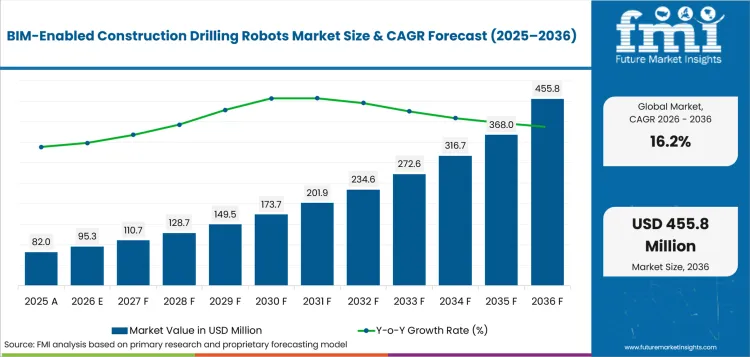
BIM-Enabled Construction Drilling Robots Market Overview: Size and Forecast
- 2026 Market Size: USD 101.3 million
- 2036 Market Size: USD 455.8 million
- Forecast CAGR: 16.2% from 2026 to 2036
- Leading Task Type: Overhead Drilling
- Overhead Drilling Share in 2026: 44.0%
- Leading Guidance Stack: BIM Jobfiles
- BIM Jobfiles Share in 2026: 52.0%
- Fastest-growing Country: United States
- United States CAGR: 18.6% by 2036
What are the key takeaways for the BIM-enabled construction drilling robots market?
Overhead drilling leads at 44.0% with BIM jobfiles at 52.0% and the United States fastest at 18.6%.
- Demand and Growth Drivers
- Rising adoption of BIM-integrated automation in commercial and infrastructure projects is driving demand for construction drilling robots, particularly in urban high-rise developments where precision and speed are critical.
- Increasing labor shortages and rising workforce costs across the construction sector are accelerating sales of robotic drilling systems as contractors seek productivity gains and reduced dependency on manual operations.
- Strong growth in prefabrication and modular construction practices is boosting the uptake of BIM-enabled drilling robots, as these systems enable accurate, repeatable drilling aligned with digital building models.
- Infrastructure modernization programs and large-scale public investments are contributing to higher deployment rates of drilling robots, with contractors prioritizing technologies that enhance project timelines and minimize rework.
- Product and Segment View
- Overhead Drilling is projected to lead Task Type demand with 44.0% share in 2026 as MEP ceiling work stays the clearest use case.
- Semi-Autonomous systems are expected to lead Autonomy Level demand with 58.0% share in 2026 since supervisors still control setup and safety.
- MEP Contractors are projected to account for 46.0% of End Use demand in 2026 with repeated support drilling driving the purchase case.
- Direct Sales is expected to lead Commercial Model demand with 48.0% share in 2026 as large contractors internalize fleet planning.
- BIM Jobfiles are projected to lead Guidance Stack demand with 52.0% share in 2026 as field teams want model-based placement records.
- Geography and Competitive Outlook
- The United States is projected to grow fastest at 18.6% CAGR through 2036 due to data center scale and specialty trade depth.
- India is expected to advance at 17.2% CAGR through 2036 as infrastructure work and digital construction pilots widen the long-term pool.
- China is forecast to grow at 16.0% CAGR through 2036 despite real estate pressure as industrial and public works use smart construction pilots.
- Hilti, DEWALT, August Robotics, Dusty Robotics, HP SitePrint, Civ Robotics, and Rugged Robotics form the verified benchmark set.
- Hilti is estimated to hold 24.0% share in 2026 due to its earlier commercial ceiling-drilling position and contractor channel depth.
- Analyst Opinion
- Nikhil Kaitwade, Principal Consultant at Future Market Insights says, “I see this market less as a robot sale and more as a field-data control point. The buyer is not only asking whether the robot drills faster. The buyer is asking whether the robot turns a coordinated BIM model into holes that match the approved support plan. That is why data centers and MEP contractors matter first. They have dense drilling patterns, high rework cost, and clear quality records. Suppliers will win if they prove three things on site. They need jobfile preparation support, reliable total-station alignment, and documented hole accuracy. The next risk is not demand. It is execution discipline. If model quality is poor, the robot only automates the error faster.”
- What supports value in the BIM-enabled construction drilling robots market?
- Robot fleet revenue and jobfile support anchor value as data center drill density builds repeat demand.
- Market value is rising as drilling robots replace manual layout where thousands of repeated holes create measurable time savings.
- Data center construction changes the buying case since drilling volume is dense enough to justify fleet-based scheduling.
- MEP contractors are expected to buy first as overhead drilling creates worker strain and repeat quality issues.
- Layout robots create an adjacent demand pool as contractors use floor printing to guide downstream drilling and installation.
- RaaS is expected to expand after 2026 as smaller contractors need access without carrying full equipment ownership risk.
Adoption is moving from trial projects to repeat placement where contractors must convert coordinated models into verified field work. Hilti describes Jaibot as a semi-automated ceiling-drilling robot that uses digital plans to mark and drill MEP holes. DEWALT and August Robotics reported 99.97% drilling accuracy across more than 90,000 holes during a data center pilot. These signals show that the market is no longer only about robotic hardware. It is becoming a workflow market in which BIM accuracy and total-station control decide supplier selection. Dust control and jobsite proof records also shape buyer evaluation.
Why is the BIM-enabled construction drilling robots market growing?
Dense MEP drilling and data center construction are moving buyers toward repeat robot use through BIM-to-field documentation.
- Dense MEP hole patterns are shifting work toward robots as manual measurement creates cumulative errors on large floor plates.
- Data center projects support fleet use since server rack and services work repeats across phases.
- BIM-to-field workflows are improving buyer confidence as robots leave progress records and hole-location documentation.
- Labor strain in overhead drilling pushes contractors toward semi-automated systems with dust removal and safer operator roles.
- Layout robots expand the addressable workflow as printed model data guides trades before drilling begins.
Professional service robots give the clearest adoption benchmark for this niche. The International Federation of Robotics reported that sales of professional service robots reached almost 200,000 units in 2024, up 9% from the prior year. That broad rise does not size construction drilling directly. It does show that buyers are accepting mobile robots for skilled work when the task is repeatable and measurable. BIM-enabled drilling fits that rule because the robot receives a defined file and returns a verifiable output. This supports a high CAGR but keeps the value base small. The United States shows why the market is pulling ahead in complex building projects. The USA Census Bureau reported private construction spending at a seasonally adjusted annual rate of USD 1,639.7 billion in April 2026. Its private construction table also listed data center construction at USD 50.7 billion annualized for April 2026. That project pool creates enough repeated anchor and support work for robotic drilling to move from pilot use into fleet planning. Suppliers that link drilling, layout, and field documentation are expected to win the first scaled orders.
How is the BIM-enabled construction drilling robots market segmented?
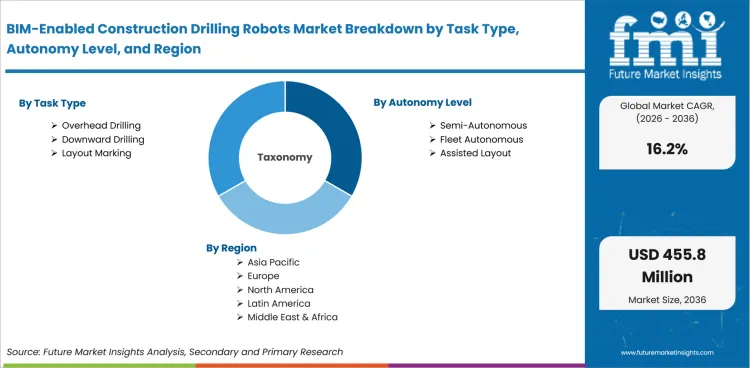
The market is segmented by task type, autonomy level, end use, commercial model, and guidance stack.
- With an estimated 44.0% share in 2026, Overhead Drilling is expected to lead Task Type demand as ceiling MEP work creates high strain and repeat hole patterns.
- Semi-Autonomous systems are projected to account for 58.0% of Autonomy Level demand in 2026 with operators still managing setup and exclusion zones.
- MEP Contractors are expected to represent 46.0% of End Use demand in 2026 as support drilling directly affects installation speed.
- Direct Sales is projected to reach 48.0% of Commercial Model demand in 2026 as large contractors prefer internal control over robot utilization.
- BIM Jobfiles are anticipated to hold 52.0% of Guidance Stack demand in 2026 as model-linked execution becomes the proof point for buyers.
Segmentation reflects how contractors buy the system rather than how robotics engineers classify it. Hilti’s Jaibot uses AutoCAD or Revit data, a Hilti cloud jobfile, a field tablet, and a total station before it drills holes within range. That workflow shows why guidance stack matters as much as the robot arm. A buyer does not gain value from hardware alone if the design file is not drill-ready. This gives BIM jobfile services and field setup support a high share of demand.
Why does overhead drilling lead the BIM-enabled construction drilling robots market?
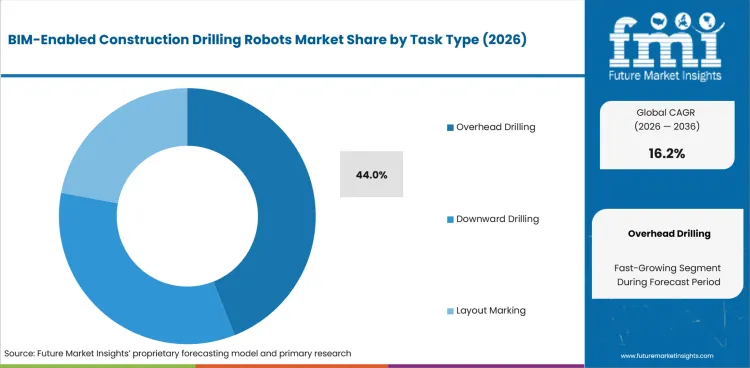
- Overhead Drilling is projected to account for 44.0% of Task Type demand in 2026 as ceiling support points are repetitive and physically difficult for crews.
- Ceiling drilling buyers compare dust control and drill-depth accuracy before speed claims, since poor holes can affect anchors and MEP support acceptance.
Which autonomy level leads the BIM-enabled construction drilling robots market?
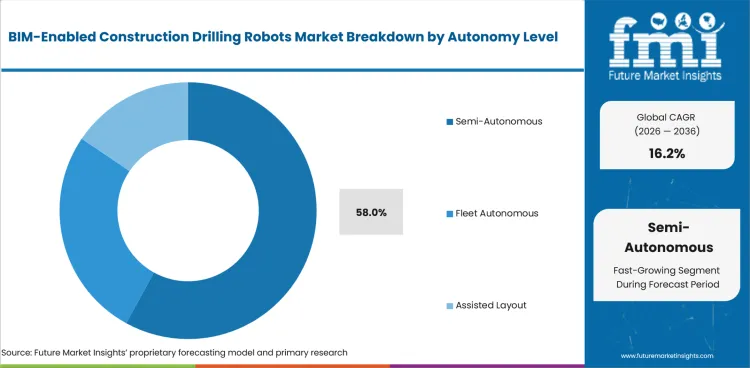
- Semi-Autonomous systems are expected to hold 58.0% of Autonomy Level demand in 2026 as contractors want robot execution with human-controlled setup.
- Fleet autonomy gains faster in data centers, where DEWALT and August Robotics reported 10 completed pilot phases and more than 90,000 drilled holes.
Which end-use segment leads the BIM-enabled construction drilling robots market?
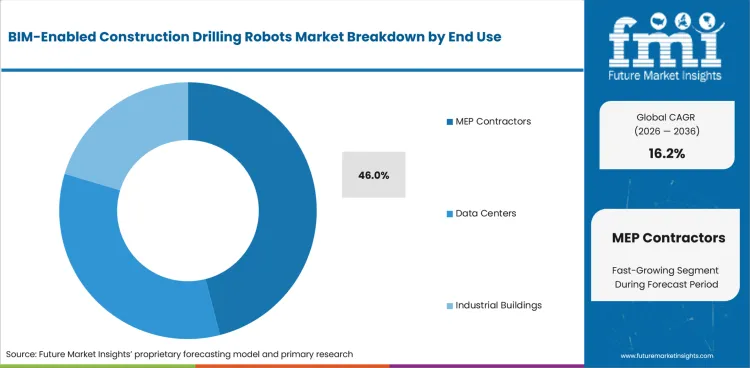
- MEP Contractors are anticipated to account for 46.0% of End Use demand in 2026 as supports for ducts, cable trays, and pipes need repeated placement.
- MEP buyers value field documentation because support points must match coordinated models before other trades install ceiling services.
Which commercial model leads the BIM-enabled construction drilling robots market?
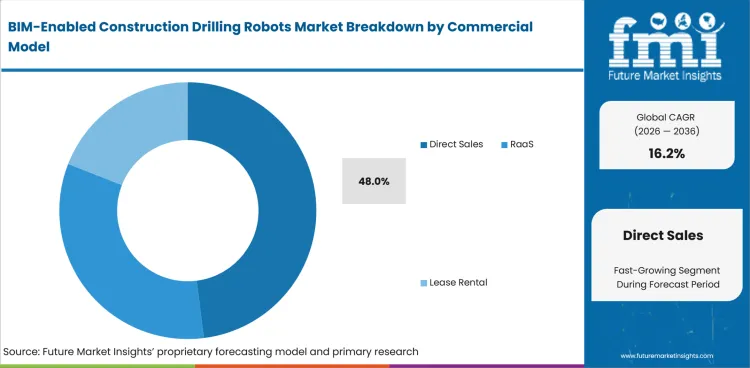
- Direct Sales is estimated to represent 48.0% of Commercial Model demand in 2026 as large contractors want owned tools for repeat project use.
- RaaS expands among smaller contractors when project density is uneven and trained operator availability limits full-time robot use.
Which guidance stack leads the BIM-enabled construction drilling robots market?
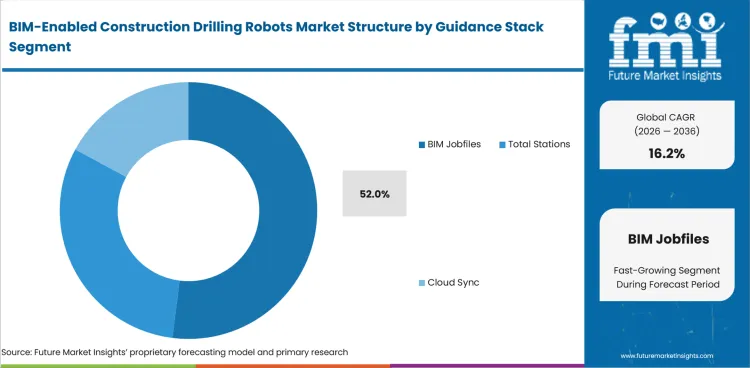
- BIM Jobfiles are projected to account for 52.0% of Guidance Stack demand in 2026 as jobsite robots need clean model data before work starts.
- Total-station integration stays critical since HP SitePrint and Hilti workflows depend on site control points and robot positioning accuracy.
What are the drivers, restraints, and opportunities in the BIM-enabled construction drilling robots market?
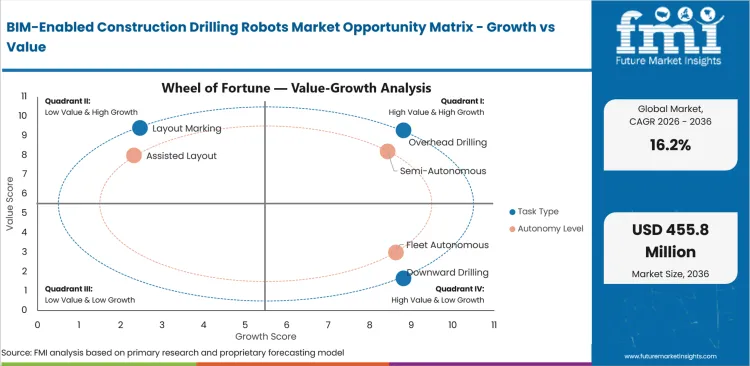
Dense anchor drilling and data center drill density support adoption while cost and model quality limit wider rollout.
- Dense anchor drilling creates the strongest driver as repeated hole patterns convert robot accuracy into schedule savings.
- BIM jobfile readiness acts as a demand filter because poor model quality delays robot work.
- Data center construction creates the clearest opportunity since drilling volumes repeat across halls and phases.
- High system cost restrains small contractors when robot use cannot be spread across several projects.
- Layout robots open an adjacent route as printed field data reduces errors before drilling starts.
BIM-to-Hole Traceability BIM-to-hole traceability is becoming the core buyer requirement in this market. Contractors want proof that a drilled point matches the approved model and the correct installation package. Dusty Robotics states that its FieldPrint Platform prints full-size BIM models on the jobsite floor with 1/16 inch accuracy. That point matters for drilling even though Dusty is a layout supplier. It shows how contractors are turning model information into field action before trades install hardware. Suppliers that combine drill execution with proof records are expected to gain stronger margins.
Data Center Drill Density
Data centers create a different demand curve from ordinary commercial buildings. The drilling pattern is dense, repetitive, and tied to server rack supports and MEP systems. DEWALT and August Robotics said their robotic drilling solution cut 80 weeks across 10 data center projects during pilot work. That claim is linked to a specific use case rather than broad automation. It explains why data centers are projected to account for 26.0% of end-use demand in 2026. The buyer is paying for time certainty and hole accuracy.
Model Quality Bottlenecks
The main restraint is not robot capability alone. It is the quality of the digital file and the readiness of the jobsite control system. HP SitePrint requires CAD preparation, total-station setup, control points, surface preparation, and ink selection before field output starts. The same constraint applies to drilling robots because the robot can only execute what the model defines. This keeps adoption slower in fragmented contractor markets and smaller jobs. Suppliers with file-preparation services gain an advantage over hardware-only competitors.
Competitive Landscape and Strategic Positioning
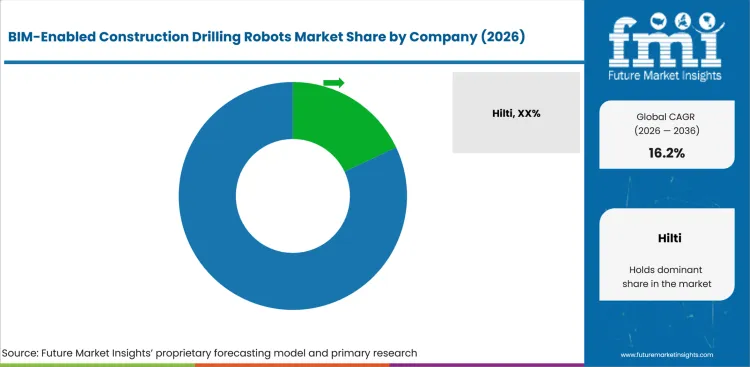
- The market is concentrated around a small group of construction robot and layout automation suppliers.
- Hilti leads on overhead drilling due to Jaibot and its contractor service network.
- DEWALT and August Robotics raise competitive pressure through downward drilling for data centers.
- Dusty Robotics and HP SitePrint compete in adjacent BIM-to-field layout workflows.
- Entry barriers include site safety proof, robot uptime, BIM file preparation, and field support.
Established tool companies hold an advantage because contractors already buy anchors, drills, and layout tools through them. Hilti’s Jaibot links drilling hardware with BIM data, total-station alignment, and dust-controlled overhead work. That creates a fuller buying case than a standalone robot. DEWALT’s move with August Robotics changes the competitive frame by taking robotic drilling into concrete floors for data centers. The practical result is a split between ceiling-first systems and slab-drilling fleet systems. Specialist robotics firms win where the task is narrow and the workflow is repeatable. August Robotics reported a USD 30 million Series B round in May 2026 to scale autonomous robot fleets for construction, exhibitions, industrial workflows, and infrastructure. That funding matters because fleet operation needs capital for hardware, software, and customer support. It also signals that drilling is part of a wider autonomous field-work platform.
Layout automation firms have a strong adjacency even when they do not drill. Dusty Robotics prints BIM models on the jobsite floor and HP SitePrint works with robotic total stations from Leica, Topcon, and Trimble. These capabilities make the field layout more reliable before installers drill or mount supports. FMI expects buyers to compare robotic drilling with construction bots and construction 4.0 systems as one combined digital jobsite budget. The hardest entry barrier is not building a mobile platform. It is proving that a robot works inside messy construction sequencing. Contractors must manage access, dust, power, slab tolerances, exclusion zones, model revisions, and union or crew acceptance. This is why suppliers with support contracts, training, and verified field records will lead. Adjacent spend in smart construction equipment also supports adoption when owners fund site-wide productivity programs.
Key Companies in the BIM-Enabled Construction Drilling Robots Market
The competitive structure is role-based because drilling, layout, and workflow-control suppliers shape the same buying decision.
- Drilling Robot Providers: Hilti, DEWALT, and August Robotics lead the drilling side of the market. Hilti focuses on semi-automated overhead drilling for MEP and interior work. DEWALT and August Robotics target downward concrete drilling for data center construction with fleet-capable operation and drilling accuracy claims.
- BIM-to-Field Layout Providers: Dusty Robotics and HP SitePrint support the pre-drilling workflow by turning digital plans into physical layout. Dusty focuses on full-size model printing from BIM workflows. HP SitePrint combines layout printing, floor deviation marking, total-station integration, and pay-as-you-go commercial access.
- Layout and Service Specialists: Civ Robotics and Rugged Robotics compete around robotic layout and jobsite field marking services. They matter because contractors often adopt layout automation before drilling automation. Their channel role is strongest where general contractors want layout-as-a-service before owning robotic equipment.
Competitive Benchmarking: BIM-Enabled Construction Drilling Robots Market
| Company | BIM-to-Field Execution Depth | Drilling Automation Fit | Site Support Model | Geographic Footprint |
|---|---|---|---|---|
| Hilti | High | High | Strong | Global |
| DEWALT | Medium | High | Strong | North America-led |
| August Robotics | High | High | Medium | Global pilots |
| Dusty Robotics | High | Low | Strong | North America |
| HP SitePrint | High | Low | Strong | North America and Europe |
| Civ Robotics | Medium | Low | Medium | North America |
| Rugged Robotics | Medium | Low | Medium | North America |
Source: Future Market Insights competitive analysis, 2026.
Key Developments in BIM-Enabled Construction Drilling Robots Market
- In January 2026, DEWALT and August Robotics launched a downward-drilling fleet-capable robot for data center construction. The system reported 99.97% accuracy across more than 90,000 holes.
- In May 2026, August Robotics raised USD 30 million in Series B funding to scale autonomous robot fleets across construction and infrastructure.
- In October 2024, Dusty Robotics announced general availability of FieldPrint Platform, FieldPrinter 2, and Floor Elevation features.
- In 2025, HP SitePrint promoted Value Pack 3.0 with up to 30% faster point printing and improved obstacle avoidance.
- In 2025, Hilti expanded its heavy-duty cordless portfolio under Nuron, which supports broader construction productivity positioning around robotic and digital workflows.
Key Players in the BIM-Enabled Construction Drilling Robots Market
Drilling Robot Providers
- Hilti
- DEWALT
- August Robotics
BIM-to-Field Layout Providers
- Dusty Robotics
- HP SitePrint
Layout and Service Specialists
- Civ Robotics
- Rugged Robotics
Which countries are growing fastest in the BIM-enabled construction drilling robots market?
.webp "Top Country Growth Comparison Bim Enabled Construction Drilling Robots Market Cagr (2026 2036)")
The United States reaches 18.6% CAGR followed by India at 17.2% and China at 16.0% through 2036.
| Country | CAGR |
|---|---|
| United States | 18.6% |
| India | 17.2% |
| China | 16.0% |
| South Korea | 15.6% |
| United Kingdom | 15.4% |
| Germany | 15.1% |
| Japan | 14.7% |
| France | 13.8% |
Source: Future Market Insights, 2026.
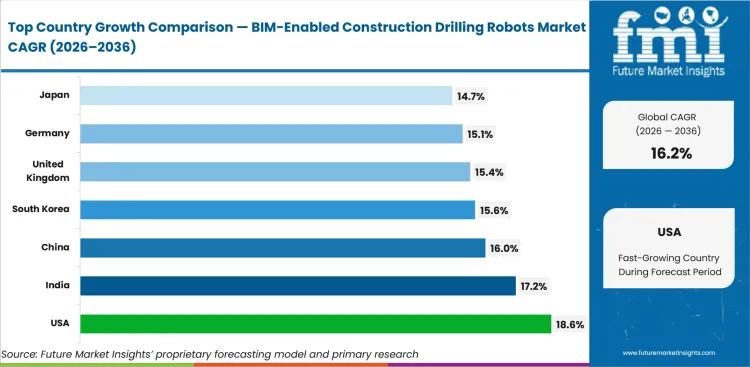
How do country-level CAGRs compare in the BIM-enabled construction drilling robots market?
The United States leads country growth while France records the most cautious expansion outlook among profiled markets.
- The United States is projected to record 18.6% CAGR by 2036 as data center work creates dense drilling schedules.
- India is expected to advance at 17.2% CAGR during the forecast period with infrastructure projects widening the trial pool.
- China is forecast to grow at 16.0% CAGR by 2036 as smart construction pilots support robot trials.
- South Korea is anticipated to post 15.6% CAGR over the assessment period with semiconductor facilities anchoring early demand.
- The United Kingdom is estimated to rise at 15.4% CAGR across the forecast decade through infrastructure planning and contractor governance.
- Germany is projected to reach 15.1% CAGR by the end of 2036 owing to industrial construction and safety-led validation.
- Japan is expected to grow at 14.7% CAGR over the ten-year period as automation policy supports field robotics.
- France is forecast to record 13.8% CAGR by 2036 with BIM maturity supporting selective project trials.
What is the BIM-enabled construction drilling robots market outlook in the United States?
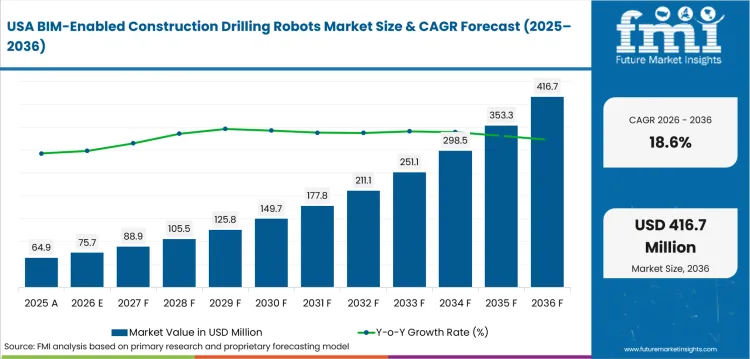
An 18.6% CAGR through 2036 is supported by data center construction and specialty trade depth.
Country Market Snapshot Table
| Parameter | Value |
|---|---|
| Market Size in 2025 (Value) | USD 24.0 million |
| Market Size in 2026 (Value) | USD 28.5 million |
| Market Forecast in 2036 (Value) | USD 156.9 million |
| CAGR (2026 to 2036) | 18.6% |
| Years Considered | 2021 to 2036 |
| Base Year | 2025 |
| Forecast Period | 2026 to 2036 |
| Units Considered | Value (USD million) |
| Leading Sub-Region | South Atlantic and national data center corridors |
United States BIM-Enabled Construction Drilling Robots Market Outlook
United States demand is shaped by data center construction and specialty trade scale. Contractors are expected to use drilling robots where ceiling supports and slab anchors repeat across large projects.
Large contractors are likely to favor direct sales and pilot-to-framework agreements. Suppliers with accuracy proof and jobsite support should gain faster access across MEP and data center programs.
Key Growth Drivers
- Data center drill density gives robots a clear work package. USA Census Bureau listed data center construction at USD 50.7 billion annualized in April 2026.
- Private nonresidential project scale supports repeated MEP drilling. USA Census Bureau reported private construction spending at USD 1,639.7 billion annualized in April 2026.
- Specialty trade contractors can spread robot use across several projects when the same crew handles repeat support drilling.
- Domestic supplier visibility supports buyer confidence through Hilti, DEWALT, August Robotics and layout automation providers.
Key Restraints
- Labor and operating cost pressure keeps payback under review. BLS listed construction average hourly earnings for all employees at USD 40.70 in May 2026.
- Jobsite control-point setup can delay robot use on fast-moving interiors that have incomplete model coordination.
- Smaller subcontractors may avoid full ownership when robot utilization cannot be booked across enough projects.
What makes United States unique
The United States combines data center scale with a visible drilling and layout robot supplier ecosystem.
Key Companies
- Hilti
- DEWALT
- August Robotics
- Dusty Robotics
- HP SitePrint
- Rugged Robotics
- Civ Robotics
Sales & Marketing Channels
- Direct enterprise sales
- Contractor pilot projects
- Data center owner frameworks
- MEP subcontractor channels
- Layout-as-a-service partners
- Tool distributor relationships
Country Segment Breakdown Table
| Segment | Sub-Segments |
|---|---|
| By Task Type | Overhead Drilling · Downward Drilling · Layout Marking · Floor Mapping |
| By Autonomy Level | Semi-Autonomous · Fleet Autonomous · Assisted Layout |
| By End Use | MEP Contractors · Data Centers · Industrial Buildings · Infrastructure Sites |
| By Commercial Model | Direct Sales · RaaS · Lease Rental |
| By Guidance Stack | BIM Jobfiles · Total Stations · Cloud Sync |
| Key Sub-Regions Covered, Construction and Digital Jobsite Corridors | South Atlantic · Texas · Northern Virginia · California · Midwest · Pacific Northwest |
Frequently Asked Questions
How fast is United States BIM-enabled construction drilling robots market growing?
United States is expected to expand at 18.6% from 2026 to 2036, supported by its project mix and digital construction readiness.
Who leads United States BIM-enabled construction drilling robots market?
Hilti, DEWALT and August Robotics lead drilling relevance while Dusty and HP SitePrint support adjacent layout workflows.
What is driving adoption in United States BIM-enabled construction drilling robots market?
Data center drilling density and specialty trade depth are moving buyers toward BIM-to-field drilling robots.
What is driving BIM-enabled construction drilling robot growth in India?
A 17.2% CAGR through 2036 reflects infrastructure scale and early digital construction pilots.
Country Market Snapshot Table
| Parameter | Value |
|---|---|
| Market Size in 2025 (Value) | USD 8.4 million |
| Market Size in 2026 (Value) | USD 9.8 million |
| Market Forecast in 2036 (Value) | USD 47.9 million |
| CAGR (2026 to 2036) | 17.2% |
| Years Considered | 2021 to 2036 |
| Base Year | 2025 |
| Forecast Period | 2026 to 2036 |
| Units Considered | Value (USD million) |
| Leading Sub-Region | Mumbai, Bengaluru and Delhi NCR project corridors |
India BIM-Enabled Construction Drilling Robots Market Outlook
India demand is expected to develop from infrastructure projects and commercial interiors in major cities. Early robot use should concentrate in data centers, metro works and private campuses.
Buyers will compare robot rental cost against manual drilling and rework avoidance. Service-led models should matter more than outright ownership outside top metros.
Key Growth Drivers
- Construction activity supports a larger trial pool. MOSPI estimated India’s construction sector growth at 9.4% in FY 2024-25.
- Secondary-sector momentum keeps project pipelines active. MOSPI estimated manufacturing and construction growth at 7.0% at constant prices for FY 2025-26.
- Large infrastructure contractors can trial robots where repeated support drilling affects schedule certainty.
- Private campuses and data centers create cleaner jobsite conditions for BIM-to-field drilling workflows.
Key Restraints
- Cost scrutiny remains high in early adoption. MOSPI’s FY 2025-26 estimate placed manufacturing and construction growth at 7.0%, below the prior construction-sector pace.
- Manual labor cost keeps payback checks strict when drilling density is limited in smaller city projects.
- Dust, power supply and site readiness issues can disrupt uptime when trained support teams are not available.
What makes India unique
India offers fast long-term growth but needs rental-friendly and service-led models to pass the cost test.
Key Companies
- Hilti India
- Larsen & Toubro
- Tata Projects
- Shapoorji Pallonji Group
- Godrej Construction
- KEC International
- Afcons Infrastructure
Sales & Marketing Channels
- Direct sales to large contractors
- Rental and demo programs
- MEP subcontractor partnerships
- Data center contractor pilots
- BIM consultant referrals
- Tool distributor networks
Country Segment Breakdown Table
| Segment | Sub-Segments |
|---|---|
| By Task Type | Overhead Drilling · Downward Drilling · Layout Marking · Floor Mapping |
| By Autonomy Level | Semi-Autonomous · Fleet Autonomous · Assisted Layout |
| By End Use | MEP Contractors · Data Centers · Industrial Buildings · Infrastructure Sites |
| By Commercial Model | Direct Sales · RaaS · Lease Rental |
| By Guidance Stack | BIM Jobfiles · Total Stations · Cloud Sync |
| Key Sub-Regions Covered, Construction and Digital Jobsite Corridors | Mumbai · Bengaluru · Delhi NCR · Hyderabad · Pune · Chennai |
Frequently Asked Questions
How fast is India BIM-enabled construction drilling robots market growing?
India is expected to expand at 17.2% from 2026 to 2036, supported by its project mix and digital construction readiness.
Who leads India BIM-enabled construction drilling robots market?
Hilti India is the most visible tool-channel participant while major Indian contractors can shape early pilots.
What is driving adoption in India BIM-enabled construction drilling robots market?
Infrastructure growth and data center construction are supporting early BIM-to-field drilling trials in India.
How is the BIM-enabled construction drilling robots market performing in China?
A 16.0% CAGR through 2036 reflects smart construction pilots and large public-sector project scale.
Country Market Snapshot Table
| Parameter | Value |
|---|---|
| Market Size in 2025 (Value) | USD 13.3 million |
| Market Size in 2026 (Value) | USD 15.4 million |
| Market Forecast in 2036 (Value) | USD 67.9 million |
| CAGR (2026 to 2036) | 16.0% |
| Years Considered | 2021 to 2036 |
| Base Year | 2025 |
| Forecast Period | 2026 to 2036 |
| Units Considered | Value (USD million) |
| Leading Sub-Region | Yangtze River Delta and Greater Bay Area industrial corridors |
China BIM-Enabled Construction Drilling Robots Market Outlook
China demand is expected to be strongest in industrial projects and public construction. Property-sector stress keeps the residential route weaker for BIM-enabled drilling robots.
State-linked builders and pilot-city programs can support robot trials. Suppliers should separate infrastructure and data center demand from weaker housing developers.
Key Growth Drivers
- Construction-sector scale gives robot trials a large project pool. NBS reported construction value added of RMB 8,994.9 billion in 2024.
- Public and industrial projects support repeat workflows. NBS reported construction value added rose 3.8% in 2024.
- Smart construction pilot cities can support BIM, robotics and digital jobsite systems across large builder groups.
- Industrial and data center construction create repeat drilling demand outside weaker residential development.
Key Restraints
- Property-sector weakness limits residential buyer budgets. NBS reported real estate development investment fell 17.2% to RMB 8,278.8 billion in 2025.
- Local price competition can pressure imported robot margins when domestic alternatives meet basic layout needs.
- Public procurement cycles can delay adoption when project owners require local testing and service capacity.
What makes China unique
China offers scale but suppliers must target public, industrial and data center projects rather than broad residential demand.
Key Companies
- Hilti China
- HP China
- Giant Leap Construction Technology
- CSCEC-linked technology units
- China Railway Construction Corporation
- China Communications Construction Company
- SANY Robotics-linked channels
Sales & Marketing Channels
- State-builder partnerships
- Local integrator channels
- Smart construction pilots
- Industrial owner programs
- Distributor-led demonstrations
- BIM software integrator routes
Country Segment Breakdown Table
| Segment | Sub-Segments |
|---|---|
| By Task Type | Overhead Drilling · Downward Drilling · Layout Marking · Floor Mapping |
| By Autonomy Level | Semi-Autonomous · Fleet Autonomous · Assisted Layout |
| By End Use | MEP Contractors · Data Centers · Industrial Buildings · Infrastructure Sites |
| By Commercial Model | Direct Sales · RaaS · Lease Rental |
| By Guidance Stack | BIM Jobfiles · Total Stations · Cloud Sync |
| Key Sub-Regions Covered, Construction and Digital Jobsite Corridors | Shanghai · Shenzhen · Guangzhou · Beijing · Suzhou · Chengdu |
Frequently Asked Questions
How fast is China BIM-enabled construction drilling robots market growing?
China is expected to expand at 16.0% from 2026 to 2036, supported by its project mix and digital construction readiness.
Who leads China BIM-enabled construction drilling robots market?
Hilti and HP have visible China relevance while local integrators support public and industrial project access.
What is driving adoption in China BIM-enabled construction drilling robots market?
Smart construction pilots and industrial project scale are supporting BIM-enabled drilling robot trials in China.
What is the BIM-enabled construction drilling robots market outlook in South Korea?
A 15.6% CAGR through 2036 reflects high-spec facilities and contractor technology readiness.
Country Market Snapshot Table
| Parameter | Value |
|---|---|
| Market Size in 2025 (Value) | USD 5.4 million |
| Market Size in 2026 (Value) | USD 6.2 million |
| Market Forecast in 2036 (Value) | USD 26.4 million |
| CAGR (2026 to 2036) | 15.6% |
| Years Considered | 2021 to 2036 |
| Base Year | 2025 |
| Forecast Period | 2026 to 2036 |
| Units Considered | Value (USD million) |
| Leading Sub-Region | Seoul metropolitan and semiconductor project corridors |
South Korea BIM-Enabled Construction Drilling Robots Market Outlook
South Korea demand is expected to concentrate in semiconductor plants, data centers and high-rise commercial interiors. Buyers will focus on precision facility work rather than broad construction volume.
Large contractors can trial robots inside controlled project systems. Imported systems need local service partners to meet uptime expectations.
Key Growth Drivers
- New project awards support controlled trials. Statistics Korea reported construction orders rose 22.4% year over year in July 2025.
- Building work drove the order rebound. Statistics Korea reported building construction orders rose 45.7% year over year in July 2025.
- Semiconductor and data center facilities need accurate service supports that match coordinated digital drawings.
- Large contractor groups can test drilling robots inside quality-managed project systems before wider rollout.
Key Restraints
- Near-term activity remains uneven. Statistics Korea reported construction completed fell 14.2% year over year in July 2025.
- Imported systems need Korean-language service and local support to meet uptime expectations on high-spec sites.
- Contractors may delay purchases when facility work is concentrated in a few large projects.
What makes South Korea unique
South Korea is a high-spec project market where precision facility work matters more than overall construction volume.
Key Companies
- Hilti Korea
- Samsung C&T
- Hyundai Engineering & Construction
- DL E&C
- GS Engineering & Construction
- POSCO E&C
- August Robotics exhibition channels
Sales & Marketing Channels
- Major contractor pilots
- Semiconductor facility contractors
- Local robotics partners
- BIM integration firms
- Direct enterprise sales
- MEP specialist channels
Country Segment Breakdown Table
| Segment | Sub-Segments |
|---|---|
| By Task Type | Overhead Drilling · Downward Drilling · Layout Marking · Floor Mapping |
| By Autonomy Level | Semi-Autonomous · Fleet Autonomous · Assisted Layout |
| By End Use | MEP Contractors · Data Centers · Industrial Buildings · Infrastructure Sites |
| By Commercial Model | Direct Sales · RaaS · Lease Rental |
| By Guidance Stack | BIM Jobfiles · Total Stations · Cloud Sync |
| Key Sub-Regions Covered, Construction and Digital Jobsite Corridors | Seoul · Incheon · Gyeonggi · Busan · Daejeon · Daegu |
Frequently Asked Questions
How fast is South Korea BIM-enabled construction drilling robots market growing?
South Korea is expected to expand at 15.6% from 2026 to 2036, supported by its project mix and digital construction readiness.
Who leads South Korea BIM-enabled construction drilling robots market?
Hilti Korea and large Korean contractors shape early buyer access while specialist suppliers need local service routes.
What is driving adoption in South Korea BIM-enabled construction drilling robots market?
Semiconductor facilities and data center projects are moving South Korean buyers toward precision drilling automation.
What is the BIM-enabled construction drilling robots market outlook in the United Kingdom?
A 15.4% CAGR through 2036 is supported by infrastructure planning and contractor governance.
Country Market Snapshot Table
| Parameter | Value |
|---|---|
| Market Size in 2025 (Value) | USD 8.2 million |
| Market Size in 2026 (Value) | USD 9.5 million |
| Market Forecast in 2036 (Value) | USD 39.8 million |
| CAGR (2026 to 2036) | 15.4% |
| Years Considered | 2021 to 2036 |
| Base Year | 2025 |
| Forecast Period | 2026 to 2036 |
| Units Considered | Value (USD million) |
| Leading Sub-Region | London and national infrastructure corridors |
United Kingdom BIM-Enabled Construction Drilling Robots Market Outlook
United Kingdom demand is expected to enter through large contractors and public infrastructure programs. BIM-linked documentation should matter where tender governance and handover records influence supplier choice.
Subcontractor adoption will likely depend on rental access and proven rework reduction. Suppliers must show safer overhead drilling rather than only faster drilling speed.
Key Growth Drivers
- Infrastructure scale gives robots a structured route into large projects. GOV.UK listed 734 planned projects worth GBP 718 billion over the next decade.
- Construction output has returned to modest growth. ONS estimated total construction output grew 1.6% in the three months to April 2026.
- Tier-one contractors can trial robots across repeat programs where safety records and documentation are reviewed.
- Public project frameworks can support BIM-to-field proof records before smaller subcontractors purchase equipment.
Key Restraints
- Cost caution remains relevant. ONS reported new work grew only 0.3% in the three months to April 2026.
- Fragmented refurbishment sites reduce setup efficiency when each floor plate needs different control-point preparation.
- Budget pressure limits robot use where drilling density is too low to justify rental or ownership.
What makes United Kingdom unique
The United Kingdom links construction technology adoption closely to governance, safety proof and project documentation.
Key Companies
- Hilti Great Britain
- HP UK
- Dusty Robotics UK channels
- Balfour Beatty
- Mace Group
- Skanska UK
- Laing O’Rourke
Sales & Marketing Channels
- Tier-one contractor pilots
- MEP subcontractor buying
- Public project frameworks
- Tool-hire partnerships
- Digital construction consultants
- Layout-service providers
Country Segment Breakdown Table
| Segment | Sub-Segments |
|---|---|
| By Task Type | Overhead Drilling · Downward Drilling · Layout Marking · Floor Mapping |
| By Autonomy Level | Semi-Autonomous · Fleet Autonomous · Assisted Layout |
| By End Use | MEP Contractors · Data Centers · Industrial Buildings · Infrastructure Sites |
| By Commercial Model | Direct Sales · RaaS · Lease Rental |
| By Guidance Stack | BIM Jobfiles · Total Stations · Cloud Sync |
| Key Sub-Regions Covered, Construction and Digital Jobsite Corridors | London · Manchester · Birmingham · Leeds · Glasgow · Bristol |
Frequently Asked Questions
How fast is United Kingdom BIM-enabled construction drilling robots market growing?
United Kingdom is expected to expand at 15.4% from 2026 to 2036, supported by its project mix and digital construction readiness.
Who leads United Kingdom BIM-enabled construction drilling robots market?
Hilti and HP have visible relevance while major contractors shape early project-level trials.
What is driving adoption in United Kingdom BIM-enabled construction drilling robots market?
Infrastructure planning and BIM governance are moving UK contractors toward documented drilling automation.
How is the BIM-enabled construction drilling robots market performing in Germany?
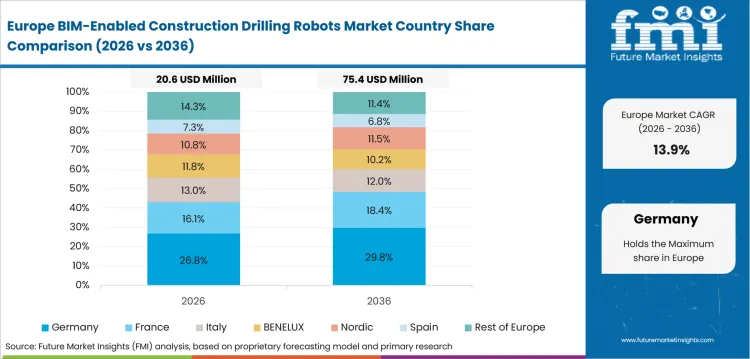
A 15.1% CAGR through 2036 reflects industrial construction demand and strict process validation.
Country Market Snapshot Table
| Parameter | Value |
|---|---|
| Market Size in 2025 (Value) | USD 7.0 million |
| Market Size in 2026 (Value) | USD 8.1 million |
| Market Forecast in 2036 (Value) | USD 33.1 million |
| CAGR (2026 to 2036) | 15.1% |
| Years Considered | 2021 to 2036 |
| Base Year | 2025 |
| Forecast Period | 2026 to 2036 |
| Units Considered | Value (USD million) |
| Leading Sub-Region | North Rhine-Westphalia and southern industrial clusters |
Germany BIM-Enabled Construction Drilling Robots Market Outlook
Germany demand is expected to come from industrial buildings, commercial projects and public facilities. Buyers value process validation and service reliability before scaling robot use.
Hilti’s European base gives the country strong supplier visibility. Adoption should grow where robots can reduce overhead exposure and document hole accuracy.
Key Growth Drivers
- Building permits show a meaningful project pool. Destatis reported 149,748 permits for building construction in Germany in 2025.
- Permitted building value supports premium tool trials. Destatis placed estimated building costs under permits at EUR 113.8 billion in 2025.
- Industrial building work supports repeat anchor and services drilling in controlled environments.
- European safety practice favors reduced overhead exposure when equipment can document drilling quality.
Key Restraints
- Construction weakness keeps capital spending cautious. Destatis showed total building permits in 2025 stayed far below the 248,688 recorded in 2021.
- Conservative qualification cycles can slow new robot approvals when process documentation is incomplete.
- Contractors may delay purchases if service reliability cannot be proven across multiple project types.
What makes Germany unique
Germany is a process-validation market where accuracy proof and service reliability matter more than early adoption speed.
Key Companies
- Hilti Deutschland
- HP Germany
- STRABAG Germany
- HOCHTIEF
- ZÜBLIN
- Goldbeck
- Max Bögl
Sales & Marketing Channels
- Direct contractor sales
- Technical demo centers
- Distributor-supported trials
- Industrial owner projects
- MEP installer networks
- Tool-service networks
Country Segment Breakdown Table
| Segment | Sub-Segments |
|---|---|
| By Task Type | Overhead Drilling · Downward Drilling · Layout Marking · Floor Mapping |
| By Autonomy Level | Semi-Autonomous · Fleet Autonomous · Assisted Layout |
| By End Use | MEP Contractors · Data Centers · Industrial Buildings · Infrastructure Sites |
| By Commercial Model | Direct Sales · RaaS · Lease Rental |
| By Guidance Stack | BIM Jobfiles · Total Stations · Cloud Sync |
| Key Sub-Regions Covered, Construction and Digital Jobsite Corridors | North Rhine-Westphalia · Bavaria · Baden-Württemberg · Berlin · Hamburg · Hesse |
Frequently Asked Questions
How fast is Germany BIM-enabled construction drilling robots market growing?
Germany is expected to expand at 15.1% from 2026 to 2036, supported by its project mix and digital construction readiness.
Who leads Germany BIM-enabled construction drilling robots market?
Hilti Deutschland and HP Germany have visible relevance while major contractors influence project trials.
What is driving adoption in Germany BIM-enabled construction drilling robots market?
Industrial construction and process-validation needs are supporting cautious drilling robot adoption in Germany.
What is the BIM-enabled construction drilling robots market forecast for Japan?
A 14.7% CAGR through 2036 reflects automation policy and construction workforce pressure.
Country Market Snapshot Table
| Parameter | Value |
|---|---|
| Market Size in 2025 (Value) | USD 6.6 million |
| Market Size in 2026 (Value) | USD 7.6 million |
| Market Forecast in 2036 (Value) | USD 30.0 million |
| CAGR (2026 to 2036) | 14.7% |
| Years Considered | 2021 to 2036 |
| Base Year | 2025 |
| Forecast Period | 2026 to 2036 |
| Units Considered | Value (USD million) |
| Leading Sub-Region | Tokyo and Osaka public works corridors |
Japan BIM-Enabled Construction Drilling Robots Market Outlook
Japan demand is expected to build around public works, transport facilities and commercial towers. Site discipline and localization will shape supplier qualification.
Robotics readiness supports technical adoption but buyers will expect safety procedures and Japanese-language support. Foreign suppliers need local partners before wider scaling.
Key Growth Drivers
- Construction automation policy supports robot acceptance. MLIT’s 2025 white paper summary states skilled construction workers are expected to decline by about 7.0% to 8.0% every five years.
- Digital field methods have a public-sector base. MLIT reported ICT earthwork use in about 86.0% of direct-control works in fiscal 2022.
- High-quality expectations reward accurate drilling and traceable records in public and commercial projects.
- BIM and CIM workflow discipline can support cleaner jobfile preparation for robot drilling.
Key Restraints
- Workforce aging raises urgency but complicates training. MLIT stated workers aged 50 and above would account for roughly half of the construction workforce in 2025.
- Local safety validation can slow imported system approvals when operating methods are not documented in Japanese.
- Contractors may require localized software and support before trusting robots on regulated public works.
What makes Japan unique
Japan combines robotics readiness with strict site discipline and a high qualification bar for foreign suppliers.
Key Companies
- Hilti Japan
- HP Japan
- Kajima Corporation
- Obayashi Corporation
- Shimizu Corporation
- Takenaka Corporation
- Taisei Corporation
Sales & Marketing Channels
- Local distributor partnerships
- General contractor pilots
- Public works demonstrations
- MEP contractor training
- BIM software integrator routes
- Tool-service channels
Country Segment Breakdown Table
| Segment | Sub-Segments |
|---|---|
| By Task Type | Overhead Drilling · Downward Drilling · Layout Marking · Floor Mapping |
| By Autonomy Level | Semi-Autonomous · Fleet Autonomous · Assisted Layout |
| By End Use | MEP Contractors · Data Centers · Industrial Buildings · Infrastructure Sites |
| By Commercial Model | Direct Sales · RaaS · Lease Rental |
| By Guidance Stack | BIM Jobfiles · Total Stations · Cloud Sync |
| Key Sub-Regions Covered, Construction and Digital Jobsite Corridors | Tokyo · Osaka · Yokohama · Nagoya · Fukuoka · Sapporo |
Frequently Asked Questions
How fast is Japan BIM-enabled construction drilling robots market growing?
Japan is expected to expand at 14.7% from 2026 to 2036, supported by its project mix and digital construction readiness.
Who leads Japan BIM-enabled construction drilling robots market?
Hilti Japan and large general contractors influence early trials while specialist robotic drilling coverage remains limited.
What is driving adoption in Japan BIM-enabled construction drilling robots market?
Construction workforce pressure and i-Construction 2.0 policy are supporting automation trials in Japan.
How is the BIM-enabled construction drilling robots market performing in France?
A 13.8% CAGR through 2036 reflects BIM maturity but slower construction-cycle conditions.
Country Market Snapshot Table
| Parameter | Value |
|---|---|
| Market Size in 2025 (Value) | USD 5.4 million |
| Market Size in 2026 (Value) | USD 6.1 million |
| Market Forecast in 2036 (Value) | USD 22.2 million |
| CAGR (2026 to 2036) | 13.8% |
| Years Considered | 2021 to 2036 |
| Base Year | 2025 |
| Forecast Period | 2026 to 2036 |
| Units Considered | Value (USD million) |
| Leading Sub-Region | Île-de-France and Grand Paris project corridors |
France BIM-Enabled Construction Drilling Robots Market Outlook
France demand is expected to start with major public buildings, transport upgrades and large commercial interiors. BIM maturity supports layout robots before drilling robots scale.
Public owners and engineering teams will shape digital workflow requirements. Suppliers must show lower rework and reliable setup before broader MEP adoption.
Key Growth Drivers
- Non-residential work supports field automation trials. SDES reported 9.0 million m² of non-residential construction authorizations from February to April 2026.
- Site starts provide a measurable project pool. SDES reported 5.3 million m² of non-residential premises started from February to April 2026.
- Grand Paris and transport upgrades can create repeat layout and drilling packages for MEP contractors.
- BIM practice among large engineering teams can support cleaner model-to-field preparation before drilling.
Key Restraints
- Permit weakness keeps near-term buying cautious. SDES reported non-residential construction authorizations fell 4.1% over the 12 months to April 2026.
- Public procurement cycles can slow robot trials when safety and documentation requirements are not yet standardized.
- Smaller contractors may prefer layout-only tools until drilling robot service support becomes easier to access.
What makes France unique
France has BIM maturity and public-project complexity but needs clearer commercial proof for drilling robot payback.
Key Companies
- Hilti France
- HP France
- Bouygues Construction
- Vinci Construction
- Eiffage Construction
- Spie Batignolles
- Fayat Group
Sales & Marketing Channels
- Public owner pilots
- Major contractor frameworks
- MEP subcontractor demos
- Digital engineering consultants
- Equipment rental partners
- BIM integrator referrals
Country Segment Breakdown Table
| Segment | Sub-Segments |
|---|---|
| By Task Type | Overhead Drilling · Downward Drilling · Layout Marking · Floor Mapping |
| By Autonomy Level | Semi-Autonomous · Fleet Autonomous · Assisted Layout |
| By End Use | MEP Contractors · Data Centers · Industrial Buildings · Infrastructure Sites |
| By Commercial Model | Direct Sales · RaaS · Lease Rental |
| By Guidance Stack | BIM Jobfiles · Total Stations · Cloud Sync |
| Key Sub-Regions Covered, Construction and Digital Jobsite Corridors | Île-de-France · Paris · Lyon · Marseille · Toulouse · Lille |
Frequently Asked Questions
How fast is France BIM-enabled construction drilling robots market growing?
France is expected to expand at 13.8% from 2026 to 2036, supported by its project mix and digital construction readiness.
Who leads France BIM-enabled construction drilling robots market?
Hilti France and HP France have visible relevance while major contractors can influence wider trials.
What is driving adoption in France BIM-enabled construction drilling robots market?
BIM maturity and public-project complexity are supporting selective drilling robot evaluation in France.
BIM-Enabled Construction Drilling Robots Market - Report Scope
| Item | Value |
|---|---|
| Market size by 2036 | USD 455.8 million |
| Growth rate | 16.2% CAGR from 2026 to 2036 |
| Forecast period | 2026 to 2036 |
| Base year value (2025) | USD 82.0 million |
| By task type | Overhead drilling, downward drilling, layout marking, floor mapping |
| By autonomy level | Semi-autonomous, fleet autonomous, assisted layout |
| By end use | MEP contractors, data centers, industrial buildings, infrastructure sites |
| By commercial model | Direct sales, RaaS, lease rental |
| By guidance stack | BIM jobfiles, total stations, cloud sync |
| Regions covered | North America, Latin America, Europe, East Asia, South Asia and Pacific, Middle East and Africa |
| Countries covered | United States, United Kingdom, Germany, France, Japan, China, South Korea, India |
| Key companies profiled | Hilti, DEWALT, August Robotics, Dusty Robotics, HP SitePrint, Civ Robotics, Rugged Robotics |
| Approach | Hybrid bottom-up and top-down methodology using robot fleet estimates, construction activity, workflow adoption, and supplier evidence |
Source: Future Market Insights, 2026.
BIM-Enabled Construction Drilling Robots Market - Scope & Definition
| Attribute | Detail |
|---|---|
| Market Definition | Mobile robots that use BIM files, CAD files, total stations, cloud jobfiles and onboard control systems to mark or drill construction holes |
| Functions Covered | Model-to-field positioning, overhead drilling, downward drilling, drill-point layout, floor mapping and jobsite proof recording |
| Applications Covered | MEP ceiling support drilling, slab anchor drilling, floor layout marking, field mapping and downstream installation preparation |
| End-Use Industries | MEP contracting, data center construction, industrial buildings, infrastructure sites and complex commercial construction |
| Technology Stack Covered | BIM jobfiles, total stations, cloud sync, field tablets, robotic drilling arms, dust control and positioning software |
| Inclusions | Commercially supplied robots sold or rented with software, field tablets, support services and workflow setup for BIM-to-field drilling or layout |
| Exclusions | Autonomous earthmoving equipment, solar pile drivers, demolition robots, bricklaying systems, 3D concrete printers, exoskeletons and non-BIM handheld drilling tools |
BIM-Enabled Construction Drilling Robots Market - Research Methodology
| Method | Description |
|---|---|
| Primary Research | FMI analyst interviews with contractors, MEP installers, robotic system suppliers, total-station vendors, layout specialists, data center builders and construction technology integrators |
| Desk Research | Review of official company sources, government construction statistics, professional robotics data, national construction output data and public digital construction programs |
| Market Sizing & Forecasting | Hybrid model using active robot fleet estimates, average system revenue, rental mix, country construction intensity, data center activity and MEP contractor concentration |
| Evidence Review | Review using supplier portfolios, official construction indicators, robotics adoption data, digital construction readiness and project-level workflow evidence |
BIM-Enabled Construction Drilling Robots Market by Segments
BIM-Enabled Construction Drilling Robots Market Segmented by Task Type:
- Overhead Drilling
- Downward Drilling
- Layout Marking
- Floor Mapping
BIM-Enabled Construction Drilling Robots Market Segmented by Autonomy Level:
- Semi-Autonomous
- Fleet Autonomous
- Assisted Layout
BIM-Enabled Construction Drilling Robots Market Segmented by End Use:
- MEP Contractors
- Data Centers
- Industrial Buildings
- Infrastructure Sites
BIM-Enabled Construction Drilling Robots Market Segmented by Commercial Model:
- Direct Sales
- RaaS
- Lease Rental
BIM-Enabled Construction Drilling Robots Market Segmented by Guidance Stack:
- BIM Jobfiles
- Total Stations
- Cloud Sync
BIM-Enabled Construction Drilling Robots Market by Region:
- North America
- United States
- Canada
- Mexico
- Latin America
- Brazil
- Chile
- Rest of Latin America
- Western Europe
- Germany
- UK
- Italy
- Spain
- France
- Nordic
- BENELUX
- Rest of Western Europe
- Eastern Europe
- Russia
- Poland
- Hungary
- Balkan & Baltic
- Rest of Eastern Europe
- East Asia
- China
- Japan
- South Korea
- South Asia and Pacific
- India
- ASEAN
- Australia & New Zealand
- Rest of South Asia and Pacific
- Middle East & Africa
- Kingdom of Saudi Arabia
- Other GCC Countries
- Turkiye
- South Africa
- Other African Union
- Rest of Middle East & Africa
Research Sources and Bibliography
- August Robotics. (2026, January 20). DEWALT unveils the world’s first downward drilling, fleet-capable robot to accelerate data center construction. August Robotics.
- August Robotics. (2026, May 21). August Robotics raises $30m Series B to accelerate autonomous construction robotics. August Robotics.
- Dusty Robotics. (2024, October 10). Dusty Robotics announces general availability of the FieldPrint Platform, FieldPrinter 2, and Floor Elevation. Dusty Robotics.
- German Federal Statistical Office. (2026, February 18). Building permits for building construction in Germany. Destatis.
- Hilti. (2026). Jaibot drilling robot. Hilti USA.
- HP. (2026). HP SitePrint robotic layout solution. HP.
- International Federation of Robotics. (2025, October 7). World Robotics 2025 report: Service robots see global growth boom. IFR.
- Ministry of Land, Infrastructure, Transport and Tourism. (2024). i-Construction 2.0: Automation of construction sites. MLIT.
- Ministry of Statistics and Programme Implementation. (2025, May 30). Press note on provisional estimates of annual gross domestic product for FY 2024-25. Government of India.
- Ministry of Statistics and Programme Implementation. (2026, January 7). Press note on first advance estimates of national income 2025-26. Government of India.
- National Bureau of Statistics of China. (2025, February 28). Statistical communique of the People’s Republic of China on the 2024 national economic and social development. NBS China.
- National Bureau of Statistics of China. (2026, January 20). Investment in real estate development for 2025. NBS China.
- National Infrastructure and Service Transformation Authority. (2026, March 9). Infrastructure pipeline update signals future workforce needs. GOV.UK.
- Office for National Statistics. (2026, June 12). Construction industry. ONS.
- République Française. (2024, April 24). Baromètre sur l’usage du numérique et du BIM des professionnels de la construction. Ministère de la Transition écologique.
- Statistics Korea. (2025, July). Monthly industrial statistics, July 2025. KOSTAT.
- USA Bureau of Labor Statistics. (2026, May). Construction: NAICS 23. BLS.
- USA Bureau of Labor Statistics. (2026, May). Table B-1. Employees on nonfarm payrolls by industry sector and selected industry detail. BLS.
- USA Census Bureau. (2026, June 1). Monthly construction spending, April 2026. USA Department of Commerce.
- USA Census Bureau. (2026, June 1). Value of private construction put in place. USA Department of Commerce.
- Service des données et études statistiques. (2026, June 1). Construction de locaux : résultats à fin avril 2026. Ministère de la Transition écologique.
- Service des données et études statistiques. (2026, March 31). Construction de logements : résultats à fin février 2026. Ministère de la Transition écologique.
- Ministry of Land, Infrastructure, Transport and Tourism. (2025). Summary of the White Paper on Land, Infrastructure, Transport and Tourism in Japan 2025. MLIT.
- Ministry of Land, Infrastructure, Transport and Tourism. (2024). i-Construction 2.0: Automation of construction sites. MLIT.
- Press Information Bureau. (2025, May 30). Provisional estimates of annual gross domestic product for FY 2024-25. Government of India.
- Press Information Bureau. (2026, January 7). First advance estimates of gross domestic product, 2025-26. Government of India.
The bibliography is provided for reader reference and uses primary government, official company, regulator, academic, or trade body sources.
This Report Answers
- What is the global BIM-Enabled Construction Drilling Robots Market size in 2026 and by 2036?
- What CAGR is expected for BIM-enabled drilling robots between 2026 and 2036?
- Which task type is expected to lead demand for BIM-enabled drilling robots in 2026?
- Why are MEP contractors expected to be the leading end-use buyer group?
- How do data center projects change the business case for drilling robots?
- Which countries are expected to grow fastest and what local factors explain that growth?
- Which companies have verified relevance in robotic drilling and BIM-to-field layout workflows?
- What products and systems are included in the market definition?
- How did FMI size this early-stage market without using commercial publisher figures?
- What restraints limit adoption among smaller contractors and fragmented jobsite environments?
Frequently Asked Questions
What is the global market demand for BIM-Enabled Construction Drilling Robots in 2026?
In 2026, the global BIM-Enabled Construction Drilling Robots Market is expected to be worth USD 101.3 million with MEP contractors leading early demand.
What is the forecast value of the BIM-Enabled Construction Drilling Robots Market by 2036?
By 2036, the market is projected to reach USD 455.8 million as data centers and complex commercial projects expand robot use.
What CAGR is expected for the BIM-Enabled Construction Drilling Robots Market?
The market is forecast to expand at 16.2% CAGR from 2026 to 2036 with growth concentrated in repeat drilling applications.
Which task segment leads the BIM-Enabled Construction Drilling Robots Market?
Overhead Drilling is projected to lead with 44.0% share in 2026 as ceiling MEP supports create repeatable hole patterns.
Which end-use segment is expected to lead demand?
MEP Contractors are expected to account for 46.0% of end-use demand in 2026 due to support drilling and installation sequencing.
Which country grows fastest in the forecast?
The United States is projected to record an 18.6% CAGR through 2036 due to data center construction and specialty trade depth.
What is included in the market definition?
The market includes BIM-enabled robots that mark or drill construction holes using digital jobfiles, total stations, and field control software.
How was the forecast developed?
The forecast used robot fleet estimates, supplier evidence, construction activity, data center demand, pricing assumptions, and workflow adoption checks.
Preview the report firsthand - request a free sample
Get SampleGet the brochure for pricing and purchase details.
Get PDFTable of Content
- Key Takeaways
- Market Size and CAGR
- Top Growth Driver
- Fastest Growing Segment
- Leading Region
- Key Companies
- Emerging Opportunities
- Executive Summary
- Global Market Outlook
- Demand-side Trends
- Supply-side Trends
- Technology Roadmap Analysis
- Analysis and Recommendations
- Analyst Perspective (What is happening? Why now? What should investors know?)
- Key Questions Answered
- How large is the market?
- What is the CAGR?
- What are key trends?
- Which region dominates?
- Who are the leaders?
- Market Overview
- Market Coverage / Taxonomy
- Market Definition / Scope / Limitations
- Research Methodology
- Chapter Orientation
- Analytical Lens and Working Hypotheses
- Market Structure, Signals, and Trend Drivers
- Benchmarking and Cross-market Comparability
- Market Sizing, Forecasting, and Opportunity Mapping
- Research Design and Evidence Framework
- Desk Research Programme (Secondary Evidence)
- Expert Input and Fieldwork (Primary Evidence)
- Tooling, Models, and Reference Databases
- Data Engineering and Model Build
- Quality Assurance and Audit Trail
- Market Background
- Market Dynamics (Drivers, Restraints, Opportunity, Trends)
- Scenario Forecast (Optimistic, Likely, Conservative)
- Impact Analysis
- AI Impact
- Sustainability Impact
- Regulatory Impact
- Technology Impact
- Consumer / Buyer Analysis
- Purchase Drivers
- Adoption Barriers
- Buyer Journey
- Opportunity Map Analysis
- Product Life Cycle Analysis
- Supply Chain Analysis
- Investment Feasibility Matrix
- Value Chain Analysis
- PESTLE and Porter's Analysis
- Regulatory Landscape
- Regional Parent Market Outlook
- Production and Consumption Statistics
- Import and Export Statistics
- Global Market Analysis and Forecast, 2021 to 2036
- Historical Market Size Value (USD Million) & Volume (Unit) Analysis, 2021 to 2025
- Current and Future Market Size Value (USD Million) & Volume (Unit) Projections, 2026 to 2036
- Y-o-Y Growth Trend Analysis
- Absolute $ Opportunity Analysis
- Global Market Pricing Analysis, 2021 to 2036
- Global Market Analysis and Forecast, By Task Type, 2021 to 2036
- Introduction / Key Findings
- Historical Market Size Value (USD Million) & Volume (Unit) Analysis By Task Type, 2021 to 2025
- Current and Future Market Size Value (USD Million) & Volume (Unit) Analysis and Forecast By Task Type, 2026 to 2036
- Overhead Drilling
- Downward Drilling
- Layout Marking
- Floor Mapping
- Overhead Drilling
- Y-o-Y Growth Trend Analysis By Task Type, 2021 to 2025
- Absolute $ Opportunity Analysis By Task Type, 2026 to 2036
- Global Market Analysis and Forecast, By Autonomy Level, 2021 to 2036
- Introduction / Key Findings
- Historical Market Size Value (USD Million) & Volume (Unit) Analysis By Autonomy Level, 2021 to 2025
- Current and Future Market Size Value (USD Million) & Volume (Unit) Analysis and Forecast By Autonomy Level, 2026 to 2036
- Semi-Autonomous
- Fleet Autonomous
- Assisted Layout
- Semi-Autonomous
- Y-o-Y Growth Trend Analysis By Autonomy Level, 2021 to 2025
- Absolute $ Opportunity Analysis By Autonomy Level, 2026 to 2036
- Global Market Analysis and Forecast, By End Use, 2021 to 2036
- Introduction / Key Findings
- Historical Market Size Value (USD Million) & Volume (Unit) Analysis By End Use, 2021 to 2025
- Current and Future Market Size Value (USD Million) & Volume (Unit) Analysis and Forecast By End Use, 2026 to 2036
- MEP Contractors
- Data Centers
- Industrial Buildings
- Infrastructure Sites
- MEP Contractors
- Y-o-Y Growth Trend Analysis By End Use, 2021 to 2025
- Absolute $ Opportunity Analysis By End Use, 2026 to 2036
- Global Market Analysis and Forecast, By Commercial Model, 2021 to 2036
- Introduction / Key Findings
- Historical Market Size Value (USD Million) & Volume (Unit) Analysis By Commercial Model, 2021 to 2025
- Current and Future Market Size Value (USD Million) & Volume (Unit) Analysis and Forecast By Commercial Model, 2026 to 2036
- Direct Sales
- RaaS
- Lease Rental
- Direct Sales
- Y-o-Y Growth Trend Analysis By Commercial Model, 2021 to 2025
- Absolute $ Opportunity Analysis By Commercial Model, 2026 to 2036
- Global Market Analysis and Forecast, By Guidance Stack, 2021 to 2036
- Introduction / Key Findings
- Historical Market Size Value (USD Million) & Volume (Unit) Analysis By Guidance Stack, 2021 to 2025
- Current and Future Market Size Value (USD Million) & Volume (Unit) Analysis and Forecast By Guidance Stack, 2026 to 2036
- BIM Jobfiles
- Total Stations
- Cloud Sync
- BIM Jobfiles
- Y-o-Y Growth Trend Analysis By Guidance Stack, 2021 to 2025
- Absolute $ Opportunity Analysis By Guidance Stack, 2026 to 2036
- Global Market Analysis and Forecast, By Region, 2021 to 2036
- Introduction
- Historical Market Size Value (USD Million) & Volume (Unit) Analysis By Region, 2021 to 2025
- Current Market Size Value (USD Million) & Volume (Unit) Analysis and Forecast By Region, 2026 to 2036
- North America
- Latin America
- Western Europe
- Eastern Europe
- East Asia
- South Asia and Pacific
- Middle East & Africa
- Market Attractiveness Analysis By Region
- North America Market Analysis and Forecast, By Country, 2021 to 2036
- Historical Market Size Value (USD Million) & Volume (Unit) Trend Analysis By Market Taxonomy, 2021 to 2025
- Market Size Value (USD Million) & Volume (Unit) Forecast By Market Taxonomy, 2026 to 2036
- By Country
- USA
- Canada
- Mexico
- By Task Type
- By Autonomy Level
- By End Use
- By Commercial Model
- By Guidance Stack
- By Country
- Market Attractiveness Analysis
- By Country
- By Task Type
- By Autonomy Level
- By End Use
- By Commercial Model
- By Guidance Stack
- Key Takeaways
- Latin America Market Analysis and Forecast, By Country
- Historical Market Size Value (USD Million) & Volume (Unit) Trend Analysis By Market Taxonomy, 2021 to 2025
- Market Size Value (USD Million) & Volume (Unit) Forecast By Market Taxonomy, 2026 to 2036
- By Country
- Brazil
- Chile
- Rest of Latin America
- By Task Type
- By Autonomy Level
- By End Use
- By Commercial Model
- By Guidance Stack
- By Country
- Market Attractiveness Analysis
- By Country
- By Task Type
- By Autonomy Level
- By End Use
- By Commercial Model
- By Guidance Stack
- Key Takeaways
- Western Europe Market Analysis and Forecast, By Country
- Historical Market Size Value (USD Million) & Volume (Unit) Trend Analysis By Market Taxonomy, 2021 to 2025
- Market Size Value (USD Million) & Volume (Unit) Forecast By Market Taxonomy, 2026 to 2036
- By Country
- Germany
- UK
- Italy
- Spain
- France
- Nordic
- BENELUX
- Rest of Western Europe
- By Task Type
- By Autonomy Level
- By End Use
- By Commercial Model
- By Guidance Stack
- By Country
- Market Attractiveness Analysis
- By Country
- By Task Type
- By Autonomy Level
- By End Use
- By Commercial Model
- By Guidance Stack
- Key Takeaways
- Eastern Europe Market Analysis and Forecast, By Country
- Historical Market Size Value (USD Million) & Volume (Unit) Trend Analysis By Market Taxonomy, 2021 to 2025
- Market Size Value (USD Million) & Volume (Unit) Forecast By Market Taxonomy, 2026 to 2036
- By Country
- Russia
- Poland
- Hungary
- Balkan & Baltic
- Rest of Eastern Europe
- By Task Type
- By Autonomy Level
- By End Use
- By Commercial Model
- By Guidance Stack
- By Country
- Market Attractiveness Analysis
- By Country
- By Task Type
- By Autonomy Level
- By End Use
- By Commercial Model
- By Guidance Stack
- Key Takeaways
- East Asia Market Analysis and Forecast, By Country
- Historical Market Size Value (USD Million) & Volume (Unit) Trend Analysis By Market Taxonomy, 2021 to 2025
- Market Size Value (USD Million) & Volume (Unit) Forecast By Market Taxonomy, 2026 to 2036
- By Country
- China
- Japan
- South Korea
- By Task Type
- By Autonomy Level
- By End Use
- By Commercial Model
- By Guidance Stack
- By Country
- Market Attractiveness Analysis
- By Country
- By Task Type
- By Autonomy Level
- By End Use
- By Commercial Model
- By Guidance Stack
- Key Takeaways
- South Asia and Pacific Market Analysis and Forecast, By Country
- Historical Market Size Value (USD Million) & Volume (Unit) Trend Analysis By Market Taxonomy, 2021 to 2025
- Market Size Value (USD Million) & Volume (Unit) Forecast By Market Taxonomy, 2026 to 2036
- By Country
- India
- ASEAN
- Australia & New Zealand
- Rest of South Asia and Pacific
- By Task Type
- By Autonomy Level
- By End Use
- By Commercial Model
- By Guidance Stack
- By Country
- Market Attractiveness Analysis
- By Country
- By Task Type
- By Autonomy Level
- By End Use
- By Commercial Model
- By Guidance Stack
- Key Takeaways
- Middle East & Africa Market Analysis and Forecast, By Country
- Historical Market Size Value (USD Million) & Volume (Unit) Trend Analysis By Market Taxonomy, 2021 to 2025
- Market Size Value (USD Million) & Volume (Unit) Forecast By Market Taxonomy, 2026 to 2036
- By Country
- Kingdom of Saudi Arabia
- Other GCC Countries
- Türkiye
- South Africa
- Other African Union
- Rest of Middle East & Africa
- By Task Type
- By Autonomy Level
- By End Use
- By Commercial Model
- By Guidance Stack
- By Country
- Market Attractiveness Analysis
- By Country
- By Task Type
- By Autonomy Level
- By End Use
- By Commercial Model
- By Guidance Stack
- Key Takeaways
- Key Countries Market Analysis
- USA
- Pricing Analysis
- Market Share Analysis, 2025
- By Task Type
- By Autonomy Level
- By End Use
- By Commercial Model
- By Guidance Stack
- Canada
- Pricing Analysis
- Market Share Analysis, 2025
- By Task Type
- By Autonomy Level
- By End Use
- By Commercial Model
- By Guidance Stack
- Mexico
- Pricing Analysis
- Market Share Analysis, 2025
- By Task Type
- By Autonomy Level
- By End Use
- By Commercial Model
- By Guidance Stack
- Brazil
- Pricing Analysis
- Market Share Analysis, 2025
- By Task Type
- By Autonomy Level
- By End Use
- By Commercial Model
- By Guidance Stack
- Chile
- Pricing Analysis
- Market Share Analysis, 2025
- By Task Type
- By Autonomy Level
- By End Use
- By Commercial Model
- By Guidance Stack
- Germany
- Pricing Analysis
- Market Share Analysis, 2025
- By Task Type
- By Autonomy Level
- By End Use
- By Commercial Model
- By Guidance Stack
- UK
- Pricing Analysis
- Market Share Analysis, 2025
- By Task Type
- By Autonomy Level
- By End Use
- By Commercial Model
- By Guidance Stack
- Italy
- Pricing Analysis
- Market Share Analysis, 2025
- By Task Type
- By Autonomy Level
- By End Use
- By Commercial Model
- By Guidance Stack
- Spain
- Pricing Analysis
- Market Share Analysis, 2025
- By Task Type
- By Autonomy Level
- By End Use
- By Commercial Model
- By Guidance Stack
- France
- Pricing Analysis
- Market Share Analysis, 2025
- By Task Type
- By Autonomy Level
- By End Use
- By Commercial Model
- By Guidance Stack
- India
- Pricing Analysis
- Market Share Analysis, 2025
- By Task Type
- By Autonomy Level
- By End Use
- By Commercial Model
- By Guidance Stack
- ASEAN
- Pricing Analysis
- Market Share Analysis, 2025
- By Task Type
- By Autonomy Level
- By End Use
- By Commercial Model
- By Guidance Stack
- Australia & New Zealand
- Pricing Analysis
- Market Share Analysis, 2025
- By Task Type
- By Autonomy Level
- By End Use
- By Commercial Model
- By Guidance Stack
- China
- Pricing Analysis
- Market Share Analysis, 2025
- By Task Type
- By Autonomy Level
- By End Use
- By Commercial Model
- By Guidance Stack
- Japan
- Pricing Analysis
- Market Share Analysis, 2025
- By Task Type
- By Autonomy Level
- By End Use
- By Commercial Model
- By Guidance Stack
- South Korea
- Pricing Analysis
- Market Share Analysis, 2025
- By Task Type
- By Autonomy Level
- By End Use
- By Commercial Model
- By Guidance Stack
- Russia
- Pricing Analysis
- Market Share Analysis, 2025
- By Task Type
- By Autonomy Level
- By End Use
- By Commercial Model
- By Guidance Stack
- Poland
- Pricing Analysis
- Market Share Analysis, 2025
- By Task Type
- By Autonomy Level
- By End Use
- By Commercial Model
- By Guidance Stack
- Hungary
- Pricing Analysis
- Market Share Analysis, 2025
- By Task Type
- By Autonomy Level
- By End Use
- By Commercial Model
- By Guidance Stack
- Kingdom of Saudi Arabia
- Pricing Analysis
- Market Share Analysis, 2025
- By Task Type
- By Autonomy Level
- By End Use
- By Commercial Model
- By Guidance Stack
- Türkiye
- Pricing Analysis
- Market Share Analysis, 2025
- By Task Type
- By Autonomy Level
- By End Use
- By Commercial Model
- By Guidance Stack
- South Africa
- Pricing Analysis
- Market Share Analysis, 2025
- By Task Type
- By Autonomy Level
- By End Use
- By Commercial Model
- By Guidance Stack
- USA
- Market Structure Analysis
- Competition Dashboard
- Competition Benchmarking
- Market Share Analysis of Top Players
- By Regional
- By Task Type
- By Autonomy Level
- By End Use
- By Commercial Model
- By Guidance Stack
- Emerging Startups
- Innovation Benchmarking
- Competition Analysis
- Competition Deep Dive
- Hilti
- Overview
- Product Portfolio
- Profitability by Market Segments (Product/Region/Sales Channel)
- Sales Footprint
- Strategy Overview
- Marketing Strategy
- Product Strategy
- Channel Strategy
- DEWALT
- August Robotics
- Dusty Robotics
- HP SitePrint
- Civ Robotics
- Rugged Robotics
- Hilti
- Case Studies
- Success Stories
- Recent Developments
- Competition Deep Dive
- Assumptions & Acronyms Used


