

- Industry Size (2026)
- USD 1.2 Bn
- Forecast (2036)
- USD 3.3 Bn
- CAGR (2026 to 2036)
- 10.8%
Paint Drying Lamp Market Forecast and Outlook 2026 to 2036
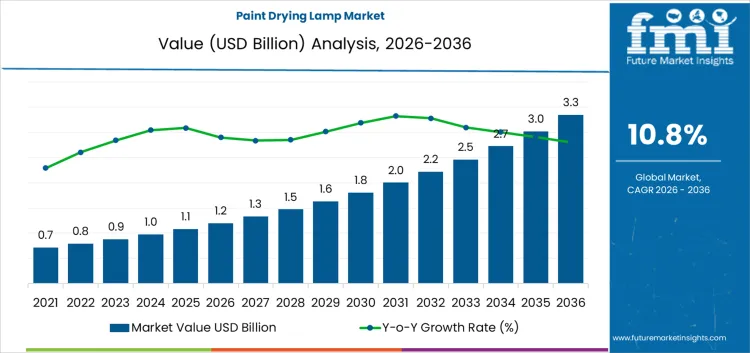
The paint drying lamp market is likely to grow from USD 1.2 billion in 2026 to USD 3.3 billion by 2036, representing a CAGR of 10.80%. Purchasing decisions are driven by labor utilization and bay turnover time rather than by energy efficiency or lamp output ratings alone. In collision repair and industrial finishing, the economic value of faster cure cycles lies in freeing floor space and reducing work in progress inventory. Facilities that run multi shift operations adopt these systems earlier because the revenue impact is immediate and measurable. Smaller shops evaluate payback against daily job mix, which explains wide differences in adoption even within the same city.
As the period advances, the market develops along operational maturity lines rather than simple geographic spread. High throughput networks standardize equipment to stabilize cycle times and training routines, while independent workshops continue to mix methods based on job type. Equipment suppliers increasingly bundle lamps with workflow layouts and process training instead of selling them as standalone tools. Leasing and rental models also shape uptake in cost sensitive segments. Growth remains strong, yet it is governed by changes in shop operating models and service promises, not by uniform shifts in coating technology or paint chemistry.
Quick Stats for Paint Drying Lamp Market
- Paint Drying Lamp Market Value (2026): USD 1.2 billion
- Paint Drying Lamp Market Forecast Value (2036): USD 3.3 billion
- Paint Drying Lamp Market Forecast CAGR 2026 to 2036: 10.8%
- Leading Type in Paint Drying Lamp Market: Infrared drying lamps
- Key Growth Regions in Paint Drying Lamp Market: Asia Pacific, North America, Europe
- Top Players in Paint Drying Lamp Market: Wagner Group, 3M, SATA GmbH & Co. KG, Astro Pneumatic Tool Company, Devilbiss (Iwata Medea), Preval Corporation, Infralux AG
What is the Growth Forecast for Paint Drying Lamp Market through 2036?
Between 2026 and 2031, the paint drying lamp market is projected to grow from USD 1.2 billion along a trajectory consistent with a 10.8% CAGR, shaped by changes in repair throughput expectations rather than by refinishing technology shifts alone. Body shops and industrial coating lines face constant pressure to shorten cycle times and free up booth capacity, which makes localized, fast-curing solutions economically attractive. Infrared and UV-assisted lamps are increasingly used as workflow tools to eliminate waiting time between coating stages. Growth in this phase is driven by collision repair networks, small workshops, and industrial maintenance operations seeking predictable turnaround rather than premium finish differentiation. Purchasing decisions emphasize curing speed, energy efficiency, portability, and reliability instead of maximum power or advanced automation features.
From 2031 to 2036, the market is expected to reach USD 3.3 billion, with expansion tied to higher utilization density rather than to simple shop count growth. As repair networks consolidate and process standards tighten, fast-curing stations become routine equipment rather than optional productivity add-ons. This increases the number of lamps per site and raises replacement demand as utilization hours climb. Value growth comes from wider deployment across prep, spot repair, and partial repaint operations, not from unit price inflation. Competitive positioning depends on durability, service support, and compatibility with modern coating systems, as buyers prioritize uptime and consistent curing performance over marginal differences in technical specifications.
Paint Drying Lamp Market Key Takeaways
| Metric | Value |
|---|---|
| Market Value (2026) | USD 1.2 billion |
| Forecast Value (2036) | USD 3.3 billion |
| Forecast CAGR 2026 to 2036 | 10.8% |
How Is the Paint Drying Lamp Market Supporting Efficient Coating Processes?
Paint drying lamps are increasingly adopted to accelerate curing, improve surface finish, and reduce downtime in automotive, industrial, and furniture coating applications. Historically, painted surfaces relied on ambient drying or basic heating methods, which extended production cycles, increased dust contamination, and limited workflow efficiency. Modern paint drying lamps integrate infrared, LED, or halogen technologies with controlled intensity and wavelength to provide uniform heating, faster curing, and energy-efficient operation. Automotive manufacturers, body shops, furniture producers, and industrial coating facilities prioritize curing speed, energy consumption, and lamp durability. Early adoption focused on high-volume automotive painting lines, while current demand spans industrial coating plants, custom workshops, and small-scale production units, driven by efficiency requirements, surface quality standards, and operational productivity. Lamp lifespan, heat uniformity, and energy efficiency influence supplier selection.
Increasing production efficiency needs, quality standards, and cost optimization are shaping market growth. Compared with conventional drying methods, modern paint drying lamps emphasize controlled heat delivery, reduced curing time, and minimal surface defects. Cost structures depend on lamp type, energy efficiency, and maintenance requirements, concentrating margins among suppliers capable of delivering high-performance, reliable systems. Manufacturers adopt these lamps to accelerate production, ensure consistent finish quality, and reduce operational downtime. By 2036, paint drying lamps are expected to become standard in automotive, industrial, and furniture coating applications, supporting efficient, high-quality, and reliable finishing processes.
What Factors Are Shaping the Demand for Paint Drying Lamps by Heating Technology and End Use in 2026?
The paint drying lamp market in 2026 is segmented by lamp type and by application. By heating technology, demand is divided into infrared, UV curing, halogen, and LED drying lamps, each offering different heat transfer behavior, energy efficiency, and cure time profiles. By application, demand is organized around automotive refinishing, industrial coating lines, wood finishing and furniture production, and DIY or home improvement, which differ in throughput requirements, surface sensitivity, and workspace constraints. These segments reflect how users balance drying speed, energy cost, and process control while selecting equipment that must integrate with existing coating workflows and quality standards.
Why Do Infrared Drying Lamps Represent the Largest Technology Segment?
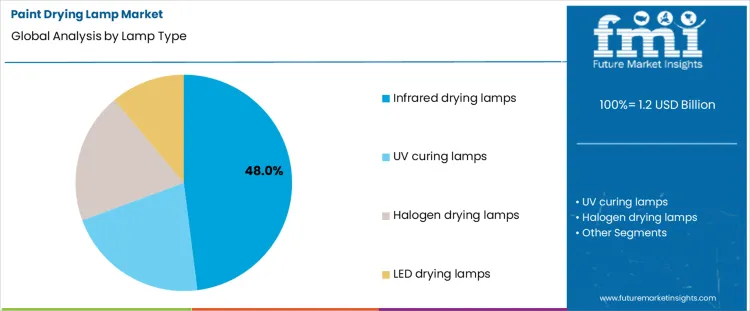
Infrared drying lamps account for about 48% of demand in 2026, reflecting their ability to deliver fast, targeted heating to coated surfaces. In automotive and industrial environments, reducing cure time directly increases booth or line throughput. Infrared systems heat the substrate and coating together, which shortens flash off and hardening stages compared with ambient or convection methods. Equipment is relatively simple to install and can be moved between work areas, which suits repair shops and flexible production cells. Operators are familiar with process behavior and control settings, which lowers training requirements. This combination of speed, practicality, and established usage keeps infrared as the dominant drying technology.
UV, halogen, and LED systems address more specific coating chemistries or operating constraints. UV curing requires compatible coatings and precise exposure control, which limits its use to defined processes. Halogen lamps provide strong radiant heat but consume more power and generate higher surface temperatures, which can damage sensitive substrates. LED drying systems offer efficiency and long life, yet their output and spectrum are optimized for certain materials rather than for universal use. These technologies grow where their strengths match the process, but their narrower applicability keeps them behind infrared in overall market share.
Why Does Automotive Refinishing Dominate Application Demand?
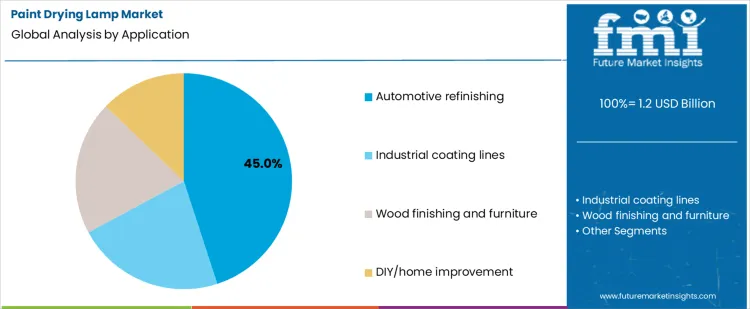
Automotive refinishing represents about 45% of demand in 2026 because collision repair and repainting work depends heavily on minimizing vehicle turnaround time. Each hour a car spends in a paint booth or drying area reduces shop capacity and revenue. Drying lamps allow technicians to cure spot repairs and full panels without waiting for ambient conditions or long oven cycles. The large global base of body shops and repair centers creates continuous replacement and upgrade demand. Quality standards in this sector also emphasize consistent finish appearance, which depends on controlled drying. These operational and economic pressures explain why automotive refinishing remains the largest single application area.
Industrial coating lines, wood finishing, and DIY uses follow different dynamics. Factory lines often integrate drying into continuous ovens or tunnels rather than relying on standalone lamps. Wood and furniture finishing involves more delicate substrates and variable coating systems, which limits the use of high intensity spot drying. DIY users value convenience and price, yet their purchase frequency and usage intensity are lower. These segments are important, but none matches the combination of volume, time pressure, and process dependence found in automotive refinishing.
Why Are Throughput Targets and Finishing Bottleneck Economics Driving the Paint Drying Lamp Market through 2036?
Demand is anchored in line speed rather than in paint chemistry. In automotive refinishing, industrial coating, and component finishing, curing time often sets the pace for the entire process. Drying lamps allow operators to shorten cycle times, free booth capacity, and reduce work in progress. In repair shops, faster cure directly increases daily job count. In factories, predictable drying windows stabilize scheduling and labor utilization. Once a line is balanced around a certain curing time, the drying method becomes part of the production equation. Replacement and upgrade demand follows equipment usage intensity and throughput targets more than new facility construction.
What Energy Cost, Process Compatibility, and Capital Discipline Are Limiting Faster Expansion?
The main restraint is operating and integration cost. Drying lamps consume significant power, and in high volume environments this becomes a visible utility expense. Not all coatings or substrates tolerate rapid or localized heating, which limits where lamps can be used without risking defects. Heat management, shielding, and safety systems add to installation complexity. In some lines, extending flash off or air drying time is cheaper than adding equipment. Smaller shops also hesitate to invest in dedicated systems unless utilization is high. These factors confine adoption to processes where time savings clearly outweigh energy and equipment costs.
How Are Coating System Changes and Production Layout Strategies Reshaping This Category?
The category is evolving with how finishing lines are designed. Manufacturers are increasingly pairing specific coatings with matched curing equipment, making lamps part of a defined process cell rather than a general utility. Modular finishing stations favor compact, targeted drying units that can be moved or reconfigured. In repair environments, portable and zone based systems are gaining share to avoid heating entire booths. Control systems are also being added to regulate exposure time and temperature more precisely. The role of paint drying lamps is shifting from ad hoc accelerators to engineered elements within tightly controlled finishing workflows.
What is the Demand for Paint Drying Lamps by Country?
| Country | CAGR (%) |
|---|---|
| US | 10.0 |
| UK | 9.5 |
| China | 11.5 |
| India | 12.8 |
| Brazil | 10.2 |
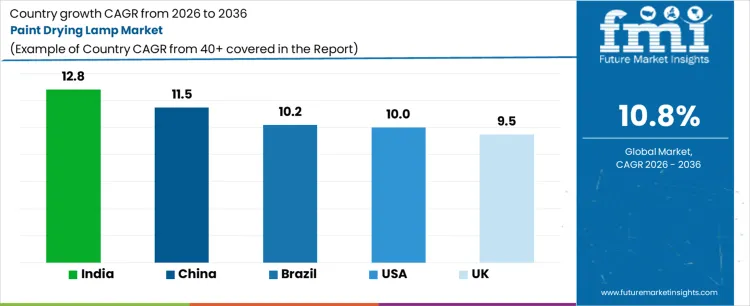
Demand for paint drying lamps is rising as automotive, industrial, and furniture manufacturers adopt efficient drying solutions to improve coating quality, reduce production time, and enhance workflow efficiency. India leads with a 12.8% CAGR, driven by increasing manufacturing output, growing automotive production, and demand for fast-drying coating solutions. China follows at 11.5%, supported by high-volume industrial operations and adoption of modern finishing technologies. Brazil records 10.2% growth, shaped by manufacturing and furniture production requirements. The US grows at 10.0%, influenced by replacement demand and integration in automotive and industrial painting processes. The UK shows 9.5% CAGR, reflecting steady adoption in commercial and industrial coating applications.
How is the United States experiencing growth in the paint drying lamp market?
United States is experiencing growth at a CAGR of 10%, driven by demand from automotive repair, commercial painting, and industrial coating facilities in Michigan, Texas, and California. Paint drying lamps are optimized for rapid curing, energy efficiency, and uniform heat distribution, reducing downtime in production and repair operations. Demand is concentrated in automotive body shops, industrial coating plants, and manufacturing facilities. Investments focus on lamp efficiency, safety features, and compliance with federal electrical and occupational standards. Growth reflects increasing adoption of faster curing technologies, efficiency improvements, and quality-focused painting operations.
- Automotive and industrial coating facilities drive adoption.
- Lamps optimize rapid curing and uniform heat.
- Body shops and industrial plants concentrate demand.
- Energy efficiency and regulatory compliance guide investment.
How is the United Kingdom witnessing growth in the paint drying lamp market?
United Kingdom is witnessing growth at a CAGR of 9.5%, supported by automotive repair workshops, furniture manufacturers, and industrial coating operations in London, Birmingham, and Manchester. Paint drying lamps are optimized for energy-efficient curing, consistent surface finish, and reduced operational downtime. Demand is concentrated in auto body shops, industrial painting facilities, and furniture production units. Investments prioritize lamp performance, safety, and compliance with UK electrical and workplace standards. Growth reflects the adoption of time-saving painting technologies and enhanced efficiency in repair and production processes.
- Automotive and furniture sectors drive adoption.
- Lamps enhance energy-efficient and consistent curing.
- Workshops and production units concentrate demand.
- Performance and safety compliance guide investment.
How is China experiencing growth in the paint drying lamp market?
China is experiencing growth at a CAGR of 11.5%, fueled by expansion in automotive manufacturing, industrial coating, and furniture production in Shanghai, Guangzhou, and Shenzhen. Paint drying lamps are optimized for high-volume curing, uniform temperature control, and energy-efficient operation. Demand is concentrated in large-scale automotive assembly plants, industrial painting facilities, and furniture manufacturing zones. Investments focus on material durability, lamp efficiency, and compliance with national safety and electrical standards. Growth reflects the rapid industrial production pace and increasing adoption of efficient curing technologies.
- Automotive and industrial production drive adoption.
- Lamps optimize uniform temperature and energy efficiency.
- Industrial and manufacturing zones concentrate demand.
- Material durability and safety compliance guide investment.
How is India witnessing growth in the paint drying lamp market?
India is witnessing growth at a CAGR of 12.8%, supported by expanding automotive repair centers, industrial coating units, and furniture manufacturers in Mumbai, Delhi, and Bengaluru. Paint drying lamps are optimized for rapid paint curing, energy efficiency, and durability under high-use conditions. Demand is concentrated in auto body shops, industrial facilities, and commercial furniture production units. Investments focus on lamp reliability, thermal performance, and compliance with national electrical and safety standards. Growth reflects rising industrial output, expansion of repair and manufacturing operations, and increased adoption of efficient painting technologies.
- Automotive and industrial facilities drive adoption.
- Lamps enhance rapid curing and energy efficiency.
- Workshops and industrial units concentrate demand.
- Reliability and safety compliance guide investment.
How is Brazil experiencing growth in the paint drying lamp market?
Brazil is experiencing growth at a CAGR of 10.2%, driven by automotive repair shops, furniture production, and industrial painting operations in São Paulo, Rio de Janeiro, and Paraná. Paint drying lamps are optimized for consistent heat distribution, rapid paint curing, and energy-efficient operation in tropical conditions. Demand is concentrated in automotive body shops, industrial coating facilities, and furniture manufacturers. Investments prioritize lamp performance, material durability, and compliance with Brazilian electrical and workplace safety regulations. Growth reflects increasing industrial and commercial activity and adoption of technologies that improve painting efficiency.
- Automotive and industrial painting drive adoption.
- Lamps optimize heat distribution and rapid curing.
- Workshops and manufacturing hubs concentrate demand.
- Material performance and compliance guide investment.
UPS Supply Chain Solutions
Who Are the Major Competitors in the Logistics 4.0 Market and How Do They Differ?
Competition in the Logistics 4.0 market is shaped by digital integration, automation, and data-driven operational visibility across supply chains. DHL Supply Chain provides advanced solutions that integrate warehouse robotics, real-time tracking, and analytics platforms to support inventory management and fulfilment optimisation at scale. Kuehne + Nagel focuses on end-to-end digital logistics, combining transportation management systems with cloud-based visibility and predictive insights for global freight flows. DB Schenker supplies integrated digital tools for shipment tracking, customs processing, and multimodal coordination, emphasising platform interoperability. XPO Logistics offers supply chain automation solutions, including warehouse automation and optimisation software, designed to reduce manual processing and improve fulfilment speeds. Ceva Logistics delivers digital freight forwarding and contract logistics support with tools for real-time shipment visibility and performance benchmarking.
FedEx Supply Chain competes with adaptive fulfilment and data-enabled supply chain services that integrate warehouse execution systems with delivery routing analytics. UPS Supply Chain Solutions provides platform-based logistics services that combine tracking, predictive modelling, and automated scheduling to support complex distribution networks. Other regional and specialised logistics providers focus on modular digital solutions tailored to specific industry verticals or transport modes. Market differentiation arises from the depth of digital toolsets, cloud and mobile integration, analytics sophistication, and ability to support interoperability with customer enterprise systems. Adoption reflects demand for real-time visibility, exception management, and automated workflows that reduce latency and improve decision quality across global and regional supply chains. Competitive positioning depends on demonstrated integration success, scalability, and capacity to improve operational efficiency in dynamic logistics environments.
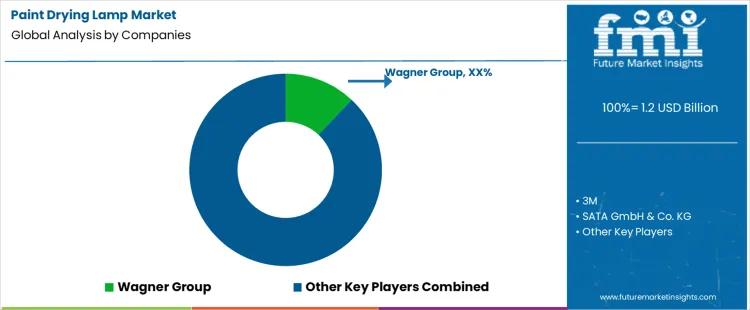
Paint Drying Lamp Market- Wagner Group 3M SATA GmbH & Co. KG Astro Pneumatic Tool Company Devilbiss (Iwata-Medea) Preval Corporation Infralux AG
Who Competes in the Paint Drying Lamp Market and What Defines Their Capabilities?
Competition in the paint drying lamp market is shaped by lamp technology, heat output control, and suitability for automotive, industrial, and refinishing applications. Wagner Group supplies drying lamps engineered for consistent infrared output and ergonomic handling in body shop settings. 3M provides systems that integrate heat control with safety features for controlled curing of coatings. SATA GmbH &Co. KG offers lamps and heaters designed to support professional refinishing workflows with emphasis on stable thermal profiles. Astro Pneumatic Tool Company supplies compact, durable drying lamps suited to mobile and light industrial use. DeVilbiss (Iwata-Medea) delivers infrared curing solutions engineered for fine finish work and controlled heat distribution.
Preval Corporation provides paint drying lamps and accessories focused on ease of use and portability for refinishing and repair applications. Infralux AG develops infrared lamp systems with adjustable output levels tailored to specific coating chemistries and drying rates. Other regional and specialty suppliers offer lamps optimized for energy efficiency, rapid warm-up, and precise wavelength control to support a range of coating types and substrate materials. Competitive differences arise from heat output consistency, lamp life, safety features, ease of integration into existing workflows, and service support. Suppliers with documented performance metrics, field support, and compatibility with a variety of coating systems maintain relevance among professional refinishers, industrial finishers, and workshops where controlled drying is critical to quality and throughput.
Key Players in the Paint Drying Lamp Market
- Wagner Group
- 3M
- SATA GmbH & Co. KG
- Astro Pneumatic Tool Company
- Devilbiss (Iwata Medea)
- Preval Corporation
- Infralux AG
Scope of the Report
| Items | Values |
|---|---|
| Quantitative Units (2026) | USD billion |
| Lamp Type | Infrared Drying Lamps, UV Curing Lamps, Halogen Drying Lamps, LED Drying Lamps |
| Application | Automotive Refinishing, Industrial Coating Lines, Wood Finishing and Furniture, DIY or Home Improvement |
| Regions Covered | Asia Pacific, Europe, North America, Latin America, Middle East & Africa |
| Countries Covered | China, Japan, South Korea, India, Australia & New Zealand, ASEAN, Germany, United Kingdom, France, Italy, Spain, Nordic, BENELUX, United States, Canada, Mexico, Brazil, Chile, Saudi Arabia, Turkey, South Africa, and other regional markets |
| Key Companies Profiled | Wagner Group, 3M, SATA GmbH & Co. KG, Astro Pneumatic Tool Company, Devilbiss (Iwata Medea), Preval Corporation, Infralux AG |
| Additional Attributes | Dollar sales by lamp type and application; infrared lamps as the leading technology; automotive refinishing as the largest use case; demand driven by throughput and bay utilization economics; procurement shaped by durability, service support, and workflow integration; adoption constrained by energy cost, coating compatibility, and capital discipline. |
Paint Drying Lamp Market Segmentation
Lamp Type:
- Infrared drying lamps
- UV curing lamps
- Halogen drying lamps
- LED drying lamps
Application:
- Automotive refinishing
- Industrial coating lines
- Wood finishing and furniture
- DIY or home improvement
Region
- Asia Pacific
- China
- Japan
- South Korea
- India
- Australia & New Zealand
- ASEAN
- Rest of Asia Pacific
- Europe
- Germany
- United Kingdom
- France
- Italy
- Spain
- Nordic
- BENELUX
- Rest of Europe
- North America
- United States
- Canada
- Mexico
- Latin America
- Brazil
- Chile
- Rest of Latin America
- Middle East & Africa
- Kingdom of Saudi Arabia
- Other GCC Countries
- Turkey
- South Africa
- Other African Union
- Rest of Middle East & Africa
Bibliography
- International Electrotechnical Commission. (2023). IEC 60598-1: Luminaires - Part 1: General requirements and tests. IEC.
- International Electrotechnical Commission. (2024). IEC 62471: Photobiological safety of lamps and lamp systems. IEC.
- European Committee for Standardization. (2023). EN 60598-2-22: Luminaires - Part 2-22: Particular requirements - Portable general lighting luminaires. CEN.
- International Organization for Standardization. (2024). ISO 14001: Environmental management systems - Requirements with guidance for use. ISO.
- USA Department of Energy. (2024). Federal energy management program: Lighting energy standards and guidance. USA DOE.
Frequently Asked Questions
How big is the paint drying lamp market in 2026?
The global paint drying lamp market is estimated to be valued at USD 1.2 billion in 2026.
What will be the size of paint drying lamp market in 2036?
The market size for the paint drying lamp market is projected to reach USD 3.3 billion by 2036.
How much will be the paint drying lamp market growth between 2026 and 2036?
The paint drying lamp market is expected to grow at a 10.8% CAGR between 2026 and 2036.
What are the key product types in the paint drying lamp market?
The key product types in paint drying lamp market are infrared drying lamps , uv curing lamps, halogen drying lamps and led drying lamps.
Which application segment to contribute significant share in the paint drying lamp market in 2026?
In terms of application, automotive refinishing segment to command 45.0% share in the paint drying lamp market in 2026.
Preview the report firsthand - request a free sample
Get SampleGet the brochure for pricing and purchase details.
Get PDFTable of Content
- Executive Summary
- Global Market Outlook
- Demand-side Trends
- Supply-side Trends
- Technology Roadmap Analysis
- Analysis and Recommendations
- Market Overview
- Market Coverage / Taxonomy
- Market Definition / Scope / Limitations
- Market Background
- Market Dynamics
- Drivers
- Restraints
- Opportunity
- Trends
- Scenario Forecast
- Demand in Optimistic Scenario
- Demand in Likely Scenario
- Demand in Conservative Scenario
- Opportunity Map Analysis
- Product Life Cycle Analysis
- Supply Chain Analysis
- Investment Feasibility Matrix
- Value Chain Analysis
- PESTLE and Porter’s Analysis
- Regulatory Landscape
- Regional Parent Market Outlook
- Production and Consumption Statistics
- Import and Export Statistics
- Market Dynamics
- Global Market Analysis 2021 to 2025 and Forecast, 2026 to 2036
- Historical Market Size Value (USD Million) Analysis, 2021 to 2025
- Current and Future Market Size Value (USD Million) Projections, 2026 to 2036
- Y-o-Y Growth Trend Analysis
- Absolute $ Opportunity Analysis
- Global Market Pricing Analysis 2021 to 2025 and Forecast 2026 to 2036
- Global Market Analysis 2021 to 2025 and Forecast 2026 to 2036, By Lamp Type
- Introduction / Key Findings
- Historical Market Size Value (USD Million) Analysis By Lamp Type , 2021 to 2025
- Current and Future Market Size Value (USD Million) Analysis and Forecast By Lamp Type , 2026 to 2036
- Infrared drying lamps
- UV curing lamps
- Halogen drying lamps
- LED drying lamps
- Infrared drying lamps
- Y-o-Y Growth Trend Analysis By Lamp Type , 2021 to 2025
- Absolute $ Opportunity Analysis By Lamp Type , 2026 to 2036
- Global Market Analysis 2021 to 2025 and Forecast 2026 to 2036, By Application
- Introduction / Key Findings
- Historical Market Size Value (USD Million) Analysis By Application, 2021 to 2025
- Current and Future Market Size Value (USD Million) Analysis and Forecast By Application, 2026 to 2036
- Automotive refinishing
- Industrial coating lines
- Wood finishing and furniture
- DIY/home improvement
- Automotive refinishing
- Y-o-Y Growth Trend Analysis By Application, 2021 to 2025
- Absolute $ Opportunity Analysis By Application, 2026 to 2036
- Global Market Analysis 2021 to 2025 and Forecast 2026 to 2036, By Region
- Introduction
- Historical Market Size Value (USD Million) Analysis By Region, 2021 to 2025
- Current Market Size Value (USD Million) Analysis and Forecast By Region, 2026 to 2036
- North America
- Latin America
- Western Europe
- Eastern Europe
- East Asia
- South Asia and Pacific
- Middle East & Africa
- Market Attractiveness Analysis By Region
- North America Market Analysis 2021 to 2025 and Forecast 2026 to 2036, By Country
- Historical Market Size Value (USD Million) Trend Analysis By Market Taxonomy, 2021 to 2025
- Market Size Value (USD Million) Forecast By Market Taxonomy, 2026 to 2036
- By Country
- USA
- Canada
- Mexico
- By Lamp Type
- By Application
- By Country
- Market Attractiveness Analysis
- By Country
- By Lamp Type
- By Application
- Key Takeaways
- Latin America Market Analysis 2021 to 2025 and Forecast 2026 to 2036, By Country
- Historical Market Size Value (USD Million) Trend Analysis By Market Taxonomy, 2021 to 2025
- Market Size Value (USD Million) Forecast By Market Taxonomy, 2026 to 2036
- By Country
- Brazil
- Chile
- Rest of Latin America
- By Lamp Type
- By Application
- By Country
- Market Attractiveness Analysis
- By Country
- By Lamp Type
- By Application
- Key Takeaways
- Western Europe Market Analysis 2021 to 2025 and Forecast 2026 to 2036, By Country
- Historical Market Size Value (USD Million) Trend Analysis By Market Taxonomy, 2021 to 2025
- Market Size Value (USD Million) Forecast By Market Taxonomy, 2026 to 2036
- By Country
- Germany
- UK
- Italy
- Spain
- France
- Nordic
- BENELUX
- Rest of Western Europe
- By Lamp Type
- By Application
- By Country
- Market Attractiveness Analysis
- By Country
- By Lamp Type
- By Application
- Key Takeaways
- Eastern Europe Market Analysis 2021 to 2025 and Forecast 2026 to 2036, By Country
- Historical Market Size Value (USD Million) Trend Analysis By Market Taxonomy, 2021 to 2025
- Market Size Value (USD Million) Forecast By Market Taxonomy, 2026 to 2036
- By Country
- Russia
- Poland
- Hungary
- Balkan & Baltic
- Rest of Eastern Europe
- By Lamp Type
- By Application
- By Country
- Market Attractiveness Analysis
- By Country
- By Lamp Type
- By Application
- Key Takeaways
- East Asia Market Analysis 2021 to 2025 and Forecast 2026 to 2036, By Country
- Historical Market Size Value (USD Million) Trend Analysis By Market Taxonomy, 2021 to 2025
- Market Size Value (USD Million) Forecast By Market Taxonomy, 2026 to 2036
- By Country
- China
- Japan
- South Korea
- By Lamp Type
- By Application
- By Country
- Market Attractiveness Analysis
- By Country
- By Lamp Type
- By Application
- Key Takeaways
- South Asia and Pacific Market Analysis 2021 to 2025 and Forecast 2026 to 2036, By Country
- Historical Market Size Value (USD Million) Trend Analysis By Market Taxonomy, 2021 to 2025
- Market Size Value (USD Million) Forecast By Market Taxonomy, 2026 to 2036
- By Country
- India
- ASEAN
- Australia & New Zealand
- Rest of South Asia and Pacific
- By Lamp Type
- By Application
- By Country
- Market Attractiveness Analysis
- By Country
- By Lamp Type
- By Application
- Key Takeaways
- Middle East & Africa Market Analysis 2021 to 2025 and Forecast 2026 to 2036, By Country
- Historical Market Size Value (USD Million) Trend Analysis By Market Taxonomy, 2021 to 2025
- Market Size Value (USD Million) Forecast By Market Taxonomy, 2026 to 2036
- By Country
- Kingdom of Saudi Arabia
- Other GCC Countries
- Turkiye
- South Africa
- Other African Union
- Rest of Middle East & Africa
- By Lamp Type
- By Application
- By Country
- Market Attractiveness Analysis
- By Country
- By Lamp Type
- By Application
- Key Takeaways
- Key Countries Market Analysis
- USA
- Pricing Analysis
- Market Share Analysis, 2025
- By Lamp Type
- By Application
- Canada
- Pricing Analysis
- Market Share Analysis, 2025
- By Lamp Type
- By Application
- Mexico
- Pricing Analysis
- Market Share Analysis, 2025
- By Lamp Type
- By Application
- Brazil
- Pricing Analysis
- Market Share Analysis, 2025
- By Lamp Type
- By Application
- Chile
- Pricing Analysis
- Market Share Analysis, 2025
- By Lamp Type
- By Application
- Germany
- Pricing Analysis
- Market Share Analysis, 2025
- By Lamp Type
- By Application
- UK
- Pricing Analysis
- Market Share Analysis, 2025
- By Lamp Type
- By Application
- Italy
- Pricing Analysis
- Market Share Analysis, 2025
- By Lamp Type
- By Application
- Spain
- Pricing Analysis
- Market Share Analysis, 2025
- By Lamp Type
- By Application
- France
- Pricing Analysis
- Market Share Analysis, 2025
- By Lamp Type
- By Application
- India
- Pricing Analysis
- Market Share Analysis, 2025
- By Lamp Type
- By Application
- ASEAN
- Pricing Analysis
- Market Share Analysis, 2025
- By Lamp Type
- By Application
- Australia & New Zealand
- Pricing Analysis
- Market Share Analysis, 2025
- By Lamp Type
- By Application
- China
- Pricing Analysis
- Market Share Analysis, 2025
- By Lamp Type
- By Application
- Japan
- Pricing Analysis
- Market Share Analysis, 2025
- By Lamp Type
- By Application
- South Korea
- Pricing Analysis
- Market Share Analysis, 2025
- By Lamp Type
- By Application
- Russia
- Pricing Analysis
- Market Share Analysis, 2025
- By Lamp Type
- By Application
- Poland
- Pricing Analysis
- Market Share Analysis, 2025
- By Lamp Type
- By Application
- Hungary
- Pricing Analysis
- Market Share Analysis, 2025
- By Lamp Type
- By Application
- Kingdom of Saudi Arabia
- Pricing Analysis
- Market Share Analysis, 2025
- By Lamp Type
- By Application
- Turkiye
- Pricing Analysis
- Market Share Analysis, 2025
- By Lamp Type
- By Application
- South Africa
- Pricing Analysis
- Market Share Analysis, 2025
- By Lamp Type
- By Application
- USA
- Market Structure Analysis
- Competition Dashboard
- Competition Benchmarking
- Market Share Analysis of Top Players
- By Regional
- By Lamp Type
- By Application
- Competition Analysis
- Competition Deep Dive
- Wagner Group
- Overview
- Product Portfolio
- Profitability by Market Segments (Product/Age /Sales Channel/Region)
- Sales Footprint
- Strategy Overview
- Marketing Strategy
- Product Strategy
- Channel Strategy
- 3M
- SATA GmbH & Co. KG
- Astro Pneumatic Tool Company
- Devilbiss (Iwata‑Medea)
- Preval Corporation
- Infralux AG
- Wagner Group
- Competition Deep Dive
- Assumptions & Acronyms Used
- Research Methodology


