

- Industry Size (2026)
- USD 332 Mn
- Forecast (2036)
- USD 641 Mn
- CAGR (2026 to 2036)
- 6.8%
Repaintable Anti-Graffiti Building Facade Coatings Market Forecast and Outlook 2026 to 2036
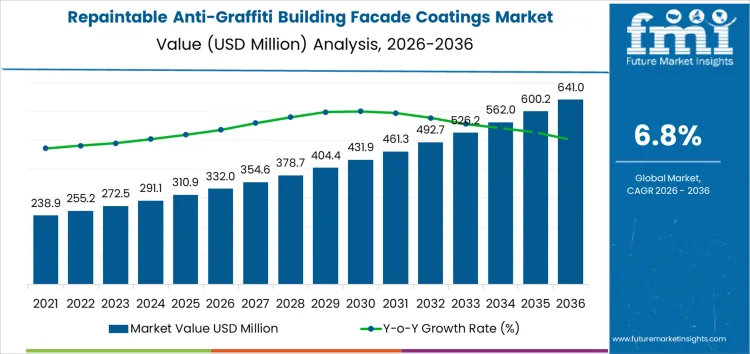
The repaintable anti-graffiti building facade coatings market is valued at USD 332 million in 2026 and is projected to reach USD 641 million by 2036, reflecting a CAGR of 6.8%. Growth over this period is linked to urban asset maintenance cycles, surface protection policies, and municipal cleanup economics. Cost structures reflect coating durability, recoating tolerance, and labor time required for graffiti removal. Products that allow repeated cleaning without surface degradation reduce lifecycle expense. Pricing discipline favors suppliers offering predictable performance across masonry, concrete, and composite facades. Demand is driven by maintenance efficiency rather than new construction intensity.
Between 2026 and 2036, adoption patterns are shaped by ownership profiles and service contracts. City authorities, transit agencies, and commercial landlords prioritize coatings that support rapid restoration and consistent appearance. Once specified, products remain in use due to maintenance protocol alignment and contractor familiarity. Entry barriers persist through field performance proof and long evaluation timelines. Strategic tradeoffs emerge between ease of repainting and long term coating resilience. Firms aligning formulations with routine maintenance schedules secure stable demand. Competitive outcomes depend on integration into asset management plans rather than price competition alone.
Quick Stats for Repaintable Anti-Graffiti Building Facade Coatings Market
- Repaintable Anti-Graffiti Building Facade Coatings Market Value (2026): USD 332 million
- Repaintable Anti-Graffiti Building Facade Coatings Market Forecast Value (2036): USD 641 million
- Repaintable Anti-Graffiti Building Facade Coatings Market Forecast CAGR (2026 to 2036): 6.8%
- Leading Coating Type in Repaintable Anti-Graffiti Building Facade Coatings Market: Water borne acrylic repaintable coating systems
- Key Growth Regions in Repaintable Anti-Graffiti Building Facade Coatings Market: Europe, North America, Asia Pacific
- Top Players in Repaintable Anti-Graffiti Building Facade Coatings Market: AkzoNobel, PPG Industries, RPM International (Rust-Oleum), Sherwin-Williams, Hempel, KEIM Mineral Coatings
What Is the Growth Forecast for Repaintable Anti-Graffiti Building Facade Coatings Market through 2036?
Urban surface protection needs and maintenance cost control define the early growth phase of the repaintable anti-graffiti building facade coatings market between 2026 and 2031. During this period, the market expands from USD 332 million to USD 435 million, adding USD 103 million in value. Annual progression from USD 230 million to USD 332 million reflects wider use on public buildings, transport infrastructure, and commercial façades exposed to repeated vandalism. Historical growth was constrained by limited awareness and reliance on sacrificial coatings with short service life. Forward expansion in this phase is supported by improved recoating compatibility, acceptable visual finish retention, and growing adoption by municipalities seeking predictable maintenance cycles.
Lifecycle management focus and portfolio level adoption drive growth from 2031 to 2036. Over this period, the market increases from USD 435 million to USD 641 million, adding USD 210 million and representing the stronger expansion window. Annual values rise from USD 464 million to USD 641 million, indicating steady year over year momentum. Earlier demand centered on high risk urban zones, while future growth reflects broader specification across mixed use developments and institutional buildings. Larger coated surface areas, repeat repainting capability, and reduced façade downtime support sustained expansion as repaintable anti-graffiti coatings become standard protective systems for building exteriors.
Repaintable Anti-Graffiti Building Facade Coatings Market Key Takeaways
| Metric | Value |
|---|---|
| Market Value (2026) | USD 332 million |
| Forecast Value (2036) | USD 641 million |
| Forecast CAGR (2026 to 2036) | 6.8% |
What Is Driving Growth in the Repaintable Anti-Graffiti Building Facade Coatings Market?
Demand for repaintable anti-graffiti facade coatings is being shaped by urban maintenance economics and aesthetic preservation imperatives rather than by general protective coatings demand alone. Traditional building envelope coatings often lacked the ability to withstand repeated cleaning after graffiti removal without surface degradation, leading to costly restoration cycles. In urban environments with high pedestrian traffic and public art interactions, property owners and facility managers observed that solvent-based removers and abrasive cleaning methods damaged original finishes. Repaintable anti-graffiti systems were introduced to allow graffiti to be removed and the surface restored with minimal impact on substrate integrity, reducing long-term maintenance costs.
Future market growth will be driven by structured urban policy requirements, lifecycle cost planning, and documented performance benchmarks rather than isolated graffiti incidents. Municipal authorities and commercial property owners are increasingly incorporating anti-graffiti performance criteria into facade design standards and maintenance contracts, reflecting broader urban cleanliness and brand reputation objectives. Formalised testing protocols that quantify cleanability, colour retention, and repaintability after multiple graffiti removal cycles are guiding procurement decisions. Advances in coating chemistries are improving adhesion, UV resistance, and ease of repaint without substrate damage.
What Factors Are Affecting the Demand for Repaintable Anti-Graffiti Building Facade Coatings Market in Terms of Coating Type and Surface Substrate?
The repaintable anti-graffiti building facade coatings market is driven by urban vandalism management needs, lifecycle maintenance planning, and increasing preference for non-sacrificial surface protection. Demand centers on coating systems that allow repeated overcoating without surface damage or performance loss. Adoption depends on substrate compatibility, ease of maintenance, and long term appearance retention. Market leadership reflects durability, repaintability, and cost efficiency over multiple cleaning cycles rather than one time graffiti resistance.
What Is Driving Leadership by Coating Type in the Repaintable Anti-Graffiti Building Facade Coatings Market?
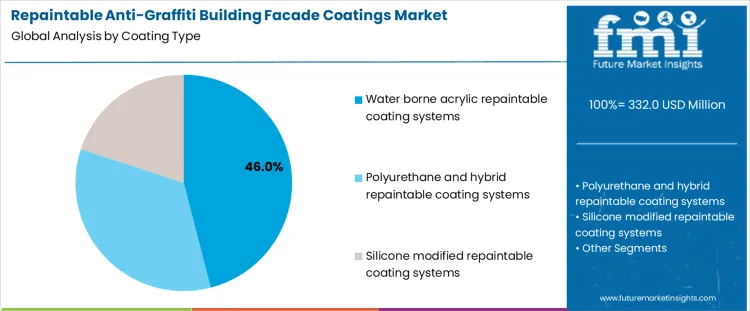
Water borne acrylic repaintable coating systems account for about 46% of demand because they balance graffiti resistance, repaintability, and regulatory compliance. These coatings form continuous films that prevent paint penetration while allowing cleaning or overcoating without surface stripping. Building owners and municipalities favor water borne acrylics due to low odor, low VOC emissions, and compatibility with occupied buildings. Their ease of application on large vertical surfaces supports use in maintenance and retrofit projects. Acrylic systems also offer color stability and breathability, which is important for exterior facades. Predictable performance across repeated repaint cycles reduces long term maintenance cost and downtime. These characteristics position water borne acrylic systems as the preferred solution for high visibility urban facades requiring ongoing protection.
Polyurethane, hybrid, and silicone modified repaintable systems serve secondary roles. Polyurethane systems offer higher abrasion resistance but involve higher material and application cost. Silicone modified coatings improve water repellency but may limit repaint adhesion over time. These systems are selected for specific exposure conditions rather than broad deployment. Coating type leadership therefore reflects repaint tolerance, regulatory alignment, and maintenance practicality rather than peak resistance performance alone.
What Is Driving Leadership by Surface Substrate in the Repaintable Anti-Graffiti Building Facade Coatings Market?
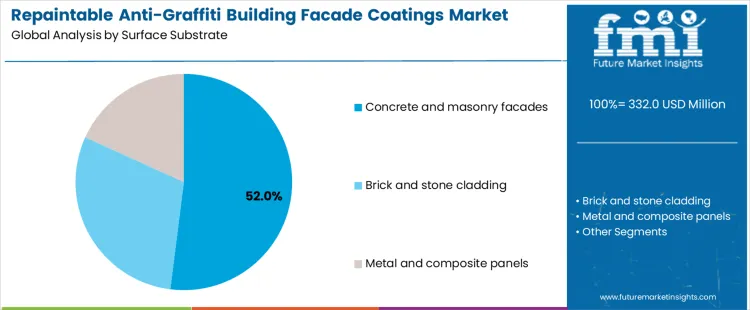
Concrete and masonry facades represent about 52% of demand because they dominate urban building envelopes and are frequent targets for graffiti. These porous substrates readily absorb paint, making unprotected surfaces difficult to clean. Repaintable anti-graffiti coatings create a barrier that prevents deep penetration while preserving vapor permeability. Municipal buildings, transit infrastructure, and residential blocks rely heavily on concrete and masonry, driving consistent coating demand. Large surface areas and repetitive maintenance cycles further reinforce volume concentration in this substrate category. Owners prioritize solutions that protect appearance without altering texture or breathability, supporting widespread adoption.
Brick, stone cladding, metal panels, and composite surfaces contribute secondary demand. Brick and stone require careful coating selection to preserve aesthetics. Metal and composite panels are less porous and easier to clean, reducing urgency. These substrates adopt anti-graffiti coatings selectively based on location and exposure. Surface substrate leadership therefore reflects prevalence, porosity, and maintenance burden rather than architectural value or material cost.
How Are Repaintable Anti-Graffiti Coatings Being Applied Across Building Facades?
Use appears in commercial, public, and residential buildings where vandalism and graffiti affect exterior aesthetics and maintenance costs. Manufacturers adopt repaintable anti-graffiti coatings to allow easy removal of spray paint or markers while enabling subsequent repainting without surface damage. Facility managers and contractors integrate these coatings on walls, panels, and architectural elements to maintain visual appeal and reduce cleaning frequency. These applications reflect operational and maintenance priorities rather than decorative purposes, with adoption driven by surface protection, ease of maintenance, and lifecycle cost reduction.
What Operational and Material Conditions Support Adoption of Repaintable Anti-Graffiti Coatings?
Selection aligns with substrates such as concrete, masonry, metal, and composite panels requiring strong adhesion and durability. Coatings are formulated for chemical resistance, UV stability, and mechanical robustness while maintaining transparency or intended finish. Application processes monitor surface preparation, coating thickness, and curing conditions to ensure uniform coverage and long-term performance. Quality control evaluates ease of graffiti removal, repaintability, and resistance to weathering. These conditions emerge from operational efficiency, surface protection, and maintenance optimization priorities in structured building maintenance workflows.
Which Practical Considerations Limit Wider Use of Repaintable Anti-Graffiti Coatings?
Higher material cost and specialized application requirements may limit adoption in budget-sensitive projects. Performance can vary depending on substrate porosity, environmental exposure, and graffiti type. Compatibility with paints, primers, and finishes must be verified. Long-term durability and periodic maintenance are necessary to sustain protective properties. These factors lead to selective deployment where façade protection, maintenance efficiency, and lifecycle cost savings justify incremental cost and careful application management.
What is the Demand for Repaintable Anti-Graffiti Building Facade Coatings by Country?
| Country | CAGR (%) |
|---|---|
| USA | 6.5% |
| Germany | 6.8% |
| UK | 7.2% |
| Japan | 5.9% |
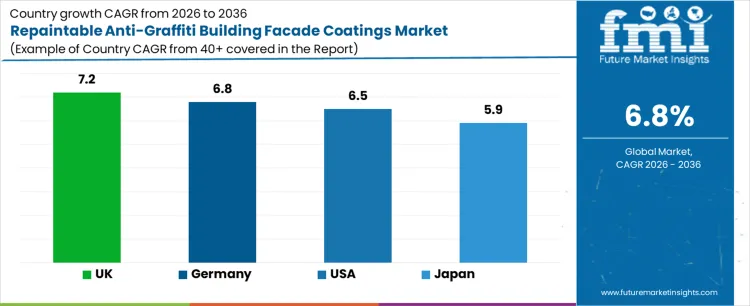
The demand for repaintable anti-graffiti building facade coatings varies across countries, driven by urban development, building maintenance, and aesthetic preservation requirements. The UK leads with a 7.2% CAGR, supported by urban infrastructure growth, historic building maintenance, and adoption of protective coating solutions. Germany follows at 6.8%, driven by commercial and residential building renovations and regulatory standards for façade protection. The USA grows at 6.5%, reflecting steady adoption in commercial buildings and public infrastructure. Japan records 5.9%, shaped by urban development and maintenance of high value property façades. These coatings help reduce maintenance costs and extend the life of building exteriors.
How Are Repaintable Anti-Graffiti Coatings Expanding Building Facade Applications in the United States?
In the United States, the Repaintable Anti-Graffiti Building Facade Coatings Market is growing at a CAGR of 6.5% through 2036, driven by urban infrastructure development, rising property protection initiatives, and demand for low-maintenance building surfaces. Contractors and facade maintenance companies are adopting repaintable coatings to enable repeated cleaning cycles, preserve aesthetic quality, and reduce long-term maintenance costs. Demand is concentrated in metropolitan construction hubs, commercial building districts, and municipal facility projects. Compared to Germany, the USA market emphasizes large-scale urban adoption and cost efficiency. Domestic suppliers provide high-performance, UV-stable coatings suitable for recurring repainting and cleaning cycles.
- Metropolitan construction hubs, commercial districts, and municipal projects drive adoption
- Coatings enable repeated cleaning while preserving facade aesthetics
- Domestic suppliers provide UV-stable, high-performance repaintable solutions
How Are Property Protection Regulations Driving Growth in Germany?
In Germany, revenue is growing at a CAGR of 6.8% through 2036, supported by building protection regulations, urban renewal programs, and sustainable construction initiatives. Facility managers and contractors are adopting repaintable anti-graffiti coatings to maintain facade appearance, reduce chemical cleaning use, and comply with environmental guidelines. Demand is concentrated in industrial zones, commercial office buildings, and public infrastructure projects. Compared to the USA, Germany emphasizes compliance and long-term environmental performance over operational scale. Domestic suppliers provide EU-certified coatings suitable for recurring repainting and maintenance operations.
- Industrial zones, commercial offices, and public infrastructure projects drive adoption
- Coatings reduce cleaning chemicals and maintain facade appearance
- Domestic suppliers provide EU-certified, environmentally compliant solutions
How Are Urban Renewal Initiatives Supporting Adoption in the United Kingdom?
In the United Kingdom, the market is expanding at a CAGR of 7.2% through 2036, fueled by urban regeneration programs, commercial development, and sustainability requirements. Contractors and building owners are integrating repaintable anti-graffiti coatings to protect facades from vandalism, reduce maintenance costs, and extend building lifespan. Demand is concentrated in metropolitan redevelopment zones, commercial building hubs, and public infrastructure projects. Compared to Germany, the UK emphasizes high adoption in large urban redevelopment programs. Domestic suppliers provide high-durability coatings suitable for recurring maintenance and repainting cycles.
- Metropolitan redevelopment zones, commercial hubs, and public infrastructure projects drive adoption
- Coatings protect facades from vandalism and reduce maintenance costs
- Domestic suppliers provide high-durability, long-lasting solutions
How Are Commercial and Urban Construction Trends Driving Growth in Japan?
In Japan, revenue is growing at a CAGR of 5.9% through 2036, supported by urban infrastructure expansion, commercial building projects, and aesthetic preservation initiatives. Contractors and building owners are adopting repaintable anti-graffiti coatings to maintain facade appearance, enhance surface durability, and reduce cleaning frequency. Demand is concentrated in urban commercial districts, high-rise developments, and public facilities. Compared to the UK, adoption in Japan focuses on precision, surface protection, and maintenance efficiency rather than large-scale urban redevelopment. Domestic suppliers provide high-performance coatings suitable for recurring cleaning and repainting cycles.
- Urban commercial districts, high-rise developments, and public facilities drive adoption
- Coatings enhance surface durability and reduce cleaning frequency
- Domestic suppliers provide high-performance, maintenance-efficient solutions
Which Strategic Approaches Define Competition in the Repaintable Anti-Graffiti Building Facade Coatings Market across Urban and Public Assets?
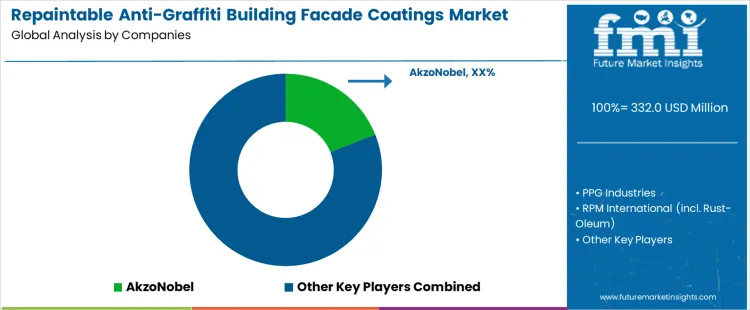
Competition in repaintable anti-graffiti façade coatings is shaped by how well systems allow repeated cleaning and recoating without degrading substrate appearance or adhesion. AkzoNobel and PPG Industries approach this market through protective coating platforms designed to tolerate solvent and pressure washing while preserving repaintability over multiple maintenance cycles. Their strategies emphasize balance between sacrificial performance and long term façade aesthetics, particularly for concrete, masonry, and composite panels. RPM International, including Rust Oleum, positions products for municipal and commercial buildings where maintenance budgets and ease of reapplication influence specification. Selection is driven by durability after repeated graffiti removal, color stability, and compatibility with existing façade coatings rather than initial repellency alone.
A different competitive logic applies among suppliers focused on mineral and specialty systems. Sherwin Williams and Hempel compete by aligning anti-graffiti functionality with broader façade protection strategies, including weather resistance and breathability. KEIM Mineral Coatings emphasizes mineral based systems suited for historic and architecturally sensitive buildings, where vapor permeability and substrate integrity are critical. Across the market, competitive advantage depends on documented repaint cycles, installer guidance, and predictable long term behavior. Adoption favors suppliers that reduce lifecycle maintenance risk, support urban asset management practices, and preserve façade appearance over repeated interventions rather than those prioritizing single cycle graffiti resistance.
Key Players in the Repaintable Anti-Graffiti Building Facade Coatings Market
- AkzoNobel
- PPG Industries
- RPM International (incl. Rust-Oleum)
- Sherwin-Williams
- Hempel
- KEIM Mineral Coatings
Scope of the Report
| Items | Values |
|---|---|
| Quantitative Units (2026) | USD million |
| Type | Water borne acrylic repaintable coating systems, Polyurethane and hybrid repaintable coating systems, Silicone modified repaintable coating systems |
| Application | Concrete and masonry facades, Brick and stone cladding, Metal and composite panels |
| End Users | Municipal authorities, Transit agencies, Commercial property owners, Facility management companies, Building maintenance contractors |
| Regions Covered | Asia Pacific, Europe, North America, Latin America, Middle East and Africa |
| Countries Covered | United States, United Kingdom, Germany, Japan, France, Italy, Spain, China, South Korea, India, Canada, Australia, GCC countries, and other urban markets |
| Key Companies Profiled | AkzoNobel, PPG Industries, RPM International including Rust-Oleum, Sherwin-Williams, Hempel, KEIM Mineral Coatings |
| Additional Attributes | Dollar by sales across coating type surface substrate and application method, repaint cycle tolerance and cleanability benchmarks, compatibility with repeated graffiti removal and recoating processes, urban asset maintenance and lifecycle cost considerations, façade appearance retention across multiple cleaning cycles, contractor and municipal specification practices |
Repaintable Anti-Graffiti Building Facade Coatings Market Segmentation
Coating Type:
- Water borne acrylic repaintable coating systems
- Polyurethane and hybrid repaintable coating systems
- Silicone modified repaintable coating systems
Surface Substrate:
- Concrete and masonry facades
- Brick and stone cladding
- Metal and composite panels
Application Method:
- Professional Contractor Application
- Municipal Maintenance Crews
- DIY and Small building owners
Region
- Asia Pacific
- China
- Japan
- South Korea
- India
- Australia & New Zealand
- ASEAN
- Rest of Asia Pacific
- Europe
- Germany
- United Kingdom
- France
- Italy
- Spain
- Nordic
- BENELUX
- Rest of Europe
- North America
- United States
- Canada
- Mexico
- Latin America
- Brazil
- Chile
- Rest of Latin America
- Middle East & Africa
- Kingdom of Saudi Arabia
- Other GCC Countries
- Turkey
- South Africa
- Other African Union
- Rest of Middle East & Africa
Frequently Asked Questions
How big is the repaintable anti-graffiti building facade coatings market in 2026?
The global repaintable anti-graffiti building facade coatings market is estimated to be valued at USD 332.0 million in 2026.
What will be the size of repaintable anti-graffiti building facade coatings market in 2036?
The market size for the repaintable anti-graffiti building facade coatings market is projected to reach USD 641.0 million by 2036.
How much will be the repaintable anti-graffiti building facade coatings market growth between 2026 and 2036?
The repaintable anti-graffiti building facade coatings market is expected to grow at a 6.8% CAGR between 2026 and 2036.
What are the key product types in the repaintable anti-graffiti building facade coatings market?
The key product types in repaintable anti-graffiti building facade coatings market are water borne acrylic repaintable coating systems, polyurethane and hybrid repaintable coating systems and silicone modified repaintable coating systems.
Which surface substrate segment to contribute significant share in the repaintable anti-graffiti building facade coatings market in 2026?
In terms of surface substrate, concrete and masonry facades segment to command 52.0% share in the repaintable anti-graffiti building facade coatings market in 2026.
Preview the report firsthand - request a free sample
Get SampleGet the brochure for pricing and purchase details.
Get PDFTable of Content
- Executive Summary
- Global Market Outlook
- Demand-side Trends
- Supply-side Trends
- Technology Roadmap Analysis
- Analysis and Recommendations
- Market Overview
- Market Coverage / Taxonomy
- Market Definition / Scope / Limitations
- Market Background
- Market Dynamics
- Drivers
- Restraints
- Opportunity
- Trends
- Scenario Forecast
- Demand in Optimistic Scenario
- Demand in Likely Scenario
- Demand in Conservative Scenario
- Opportunity Map Analysis
- Product Life Cycle Analysis
- Supply Chain Analysis
- Investment Feasibility Matrix
- Value Chain Analysis
- PESTLE and Porter’s Analysis
- Regulatory Landscape
- Regional Parent Market Outlook
- Production and Consumption Statistics
- Import and Export Statistics
- Market Dynamics
- Global Market Analysis 2021 to 2025 and Forecast, 2026 to 2036
- Historical Market Size Value (USD Million) Analysis, 2021 to 2025
- Current and Future Market Size Value (USD Million) Projections, 2026 to 2036
- Y-o-Y Growth Trend Analysis
- Absolute $ Opportunity Analysis
- Global Market Pricing Analysis 2021 to 2025 and Forecast 2026 to 2036
- Global Market Analysis 2021 to 2025 and Forecast 2026 to 2036, By Coating Type
- Introduction / Key Findings
- Historical Market Size Value (USD Million) Analysis By Coating Type , 2021 to 2025
- Current and Future Market Size Value (USD Million) Analysis and Forecast By Coating Type , 2026 to 2036
- Water borne acrylic repaintable coating systems
- Polyurethane and hybrid repaintable coating systems
- Silicone modified repaintable coating systems
- Water borne acrylic repaintable coating systems
- Y-o-Y Growth Trend Analysis By Coating Type , 2021 to 2025
- Absolute $ Opportunity Analysis By Coating Type , 2026 to 2036
- Global Market Analysis 2021 to 2025 and Forecast 2026 to 2036, By Surface Substrate
- Introduction / Key Findings
- Historical Market Size Value (USD Million) Analysis By Surface Substrate, 2021 to 2025
- Current and Future Market Size Value (USD Million) Analysis and Forecast By Surface Substrate, 2026 to 2036
- Concrete and masonry facades
- Brick and stone cladding
- Metal and composite panels
- Concrete and masonry facades
- Y-o-Y Growth Trend Analysis By Surface Substrate, 2021 to 2025
- Absolute $ Opportunity Analysis By Surface Substrate, 2026 to 2036
- Global Market Analysis 2021 to 2025 and Forecast 2026 to 2036, By Application Method
- Introduction / Key Findings
- Historical Market Size Value (USD Million) Analysis By Application Method, 2021 to 2025
- Current and Future Market Size Value (USD Million) Analysis and Forecast By Application Method, 2026 to 2036
- Professional Contractor Application
- Municipal Maintenance Crews
- DIY / Small building owners
- Professional Contractor Application
- Y-o-Y Growth Trend Analysis By Application Method, 2021 to 2025
- Absolute $ Opportunity Analysis By Application Method, 2026 to 2036
- Global Market Analysis 2021 to 2025 and Forecast 2026 to 2036, By Region
- Introduction
- Historical Market Size Value (USD Million) Analysis By Region, 2021 to 2025
- Current Market Size Value (USD Million) Analysis and Forecast By Region, 2026 to 2036
- North America
- Latin America
- Western Europe
- Eastern Europe
- East Asia
- South Asia and Pacific
- Middle East & Africa
- Market Attractiveness Analysis By Region
- North America Market Analysis 2021 to 2025 and Forecast 2026 to 2036, By Country
- Historical Market Size Value (USD Million) Trend Analysis By Market Taxonomy, 2021 to 2025
- Market Size Value (USD Million) Forecast By Market Taxonomy, 2026 to 2036
- By Country
- USA
- Canada
- Mexico
- By Coating Type
- By Surface Substrate
- By Application Method
- By Country
- Market Attractiveness Analysis
- By Country
- By Coating Type
- By Surface Substrate
- By Application Method
- Key Takeaways
- Latin America Market Analysis 2021 to 2025 and Forecast 2026 to 2036, By Country
- Historical Market Size Value (USD Million) Trend Analysis By Market Taxonomy, 2021 to 2025
- Market Size Value (USD Million) Forecast By Market Taxonomy, 2026 to 2036
- By Country
- Brazil
- Chile
- Rest of Latin America
- By Coating Type
- By Surface Substrate
- By Application Method
- By Country
- Market Attractiveness Analysis
- By Country
- By Coating Type
- By Surface Substrate
- By Application Method
- Key Takeaways
- Western Europe Market Analysis 2021 to 2025 and Forecast 2026 to 2036, By Country
- Historical Market Size Value (USD Million) Trend Analysis By Market Taxonomy, 2021 to 2025
- Market Size Value (USD Million) Forecast By Market Taxonomy, 2026 to 2036
- By Country
- Germany
- UK
- Italy
- Spain
- France
- Nordic
- BENELUX
- Rest of Western Europe
- By Coating Type
- By Surface Substrate
- By Application Method
- By Country
- Market Attractiveness Analysis
- By Country
- By Coating Type
- By Surface Substrate
- By Application Method
- Key Takeaways
- Eastern Europe Market Analysis 2021 to 2025 and Forecast 2026 to 2036, By Country
- Historical Market Size Value (USD Million) Trend Analysis By Market Taxonomy, 2021 to 2025
- Market Size Value (USD Million) Forecast By Market Taxonomy, 2026 to 2036
- By Country
- Russia
- Poland
- Hungary
- Balkan & Baltic
- Rest of Eastern Europe
- By Coating Type
- By Surface Substrate
- By Application Method
- By Country
- Market Attractiveness Analysis
- By Country
- By Coating Type
- By Surface Substrate
- By Application Method
- Key Takeaways
- East Asia Market Analysis 2021 to 2025 and Forecast 2026 to 2036, By Country
- Historical Market Size Value (USD Million) Trend Analysis By Market Taxonomy, 2021 to 2025
- Market Size Value (USD Million) Forecast By Market Taxonomy, 2026 to 2036
- By Country
- China
- Japan
- South Korea
- By Coating Type
- By Surface Substrate
- By Application Method
- By Country
- Market Attractiveness Analysis
- By Country
- By Coating Type
- By Surface Substrate
- By Application Method
- Key Takeaways
- South Asia and Pacific Market Analysis 2021 to 2025 and Forecast 2026 to 2036, By Country
- Historical Market Size Value (USD Million) Trend Analysis By Market Taxonomy, 2021 to 2025
- Market Size Value (USD Million) Forecast By Market Taxonomy, 2026 to 2036
- By Country
- India
- ASEAN
- Australia & New Zealand
- Rest of South Asia and Pacific
- By Coating Type
- By Surface Substrate
- By Application Method
- By Country
- Market Attractiveness Analysis
- By Country
- By Coating Type
- By Surface Substrate
- By Application Method
- Key Takeaways
- Middle East & Africa Market Analysis 2021 to 2025 and Forecast 2026 to 2036, By Country
- Historical Market Size Value (USD Million) Trend Analysis By Market Taxonomy, 2021 to 2025
- Market Size Value (USD Million) Forecast By Market Taxonomy, 2026 to 2036
- By Country
- Kingdom of Saudi Arabia
- Other GCC Countries
- Turkiye
- South Africa
- Other African Union
- Rest of Middle East & Africa
- By Coating Type
- By Surface Substrate
- By Application Method
- By Country
- Market Attractiveness Analysis
- By Country
- By Coating Type
- By Surface Substrate
- By Application Method
- Key Takeaways
- Key Countries Market Analysis
- USA
- Pricing Analysis
- Market Share Analysis, 2025
- By Coating Type
- By Surface Substrate
- By Application Method
- Canada
- Pricing Analysis
- Market Share Analysis, 2025
- By Coating Type
- By Surface Substrate
- By Application Method
- Mexico
- Pricing Analysis
- Market Share Analysis, 2025
- By Coating Type
- By Surface Substrate
- By Application Method
- Brazil
- Pricing Analysis
- Market Share Analysis, 2025
- By Coating Type
- By Surface Substrate
- By Application Method
- Chile
- Pricing Analysis
- Market Share Analysis, 2025
- By Coating Type
- By Surface Substrate
- By Application Method
- Germany
- Pricing Analysis
- Market Share Analysis, 2025
- By Coating Type
- By Surface Substrate
- By Application Method
- UK
- Pricing Analysis
- Market Share Analysis, 2025
- By Coating Type
- By Surface Substrate
- By Application Method
- Italy
- Pricing Analysis
- Market Share Analysis, 2025
- By Coating Type
- By Surface Substrate
- By Application Method
- Spain
- Pricing Analysis
- Market Share Analysis, 2025
- By Coating Type
- By Surface Substrate
- By Application Method
- France
- Pricing Analysis
- Market Share Analysis, 2025
- By Coating Type
- By Surface Substrate
- By Application Method
- India
- Pricing Analysis
- Market Share Analysis, 2025
- By Coating Type
- By Surface Substrate
- By Application Method
- ASEAN
- Pricing Analysis
- Market Share Analysis, 2025
- By Coating Type
- By Surface Substrate
- By Application Method
- Australia & New Zealand
- Pricing Analysis
- Market Share Analysis, 2025
- By Coating Type
- By Surface Substrate
- By Application Method
- China
- Pricing Analysis
- Market Share Analysis, 2025
- By Coating Type
- By Surface Substrate
- By Application Method
- Japan
- Pricing Analysis
- Market Share Analysis, 2025
- By Coating Type
- By Surface Substrate
- By Application Method
- South Korea
- Pricing Analysis
- Market Share Analysis, 2025
- By Coating Type
- By Surface Substrate
- By Application Method
- Russia
- Pricing Analysis
- Market Share Analysis, 2025
- By Coating Type
- By Surface Substrate
- By Application Method
- Poland
- Pricing Analysis
- Market Share Analysis, 2025
- By Coating Type
- By Surface Substrate
- By Application Method
- Hungary
- Pricing Analysis
- Market Share Analysis, 2025
- By Coating Type
- By Surface Substrate
- By Application Method
- Kingdom of Saudi Arabia
- Pricing Analysis
- Market Share Analysis, 2025
- By Coating Type
- By Surface Substrate
- By Application Method
- Turkiye
- Pricing Analysis
- Market Share Analysis, 2025
- By Coating Type
- By Surface Substrate
- By Application Method
- South Africa
- Pricing Analysis
- Market Share Analysis, 2025
- By Coating Type
- By Surface Substrate
- By Application Method
- USA
- Market Structure Analysis
- Competition Dashboard
- Competition Benchmarking
- Market Share Analysis of Top Players
- By Regional
- By Coating Type
- By Surface Substrate
- By Application Method
- Competition Analysis
- Competition Deep Dive
- AkzoNobel
- Overview
- Product Portfolio
- Profitability by Market Segments (Product/Age /Sales Channel/Region)
- Sales Footprint
- Strategy Overview
- Marketing Strategy
- Product Strategy
- Channel Strategy
- PPG Industries
- RPM International (incl. Rust-Oleum)
- Sherwin-Williams
- Hempel
- KEIM Mineral Coatings
- AkzoNobel
- Competition Deep Dive
- Assumptions & Acronyms Used
- Research Methodology


