

- Market Size (2026)
- USD 157.6 Mn
- Forecast (2036)
- USD 274.5 Mn
- CAGR (2026 to 2036)
- 5.7%
How big is PET Preform Reheat Additives Market in 2026?
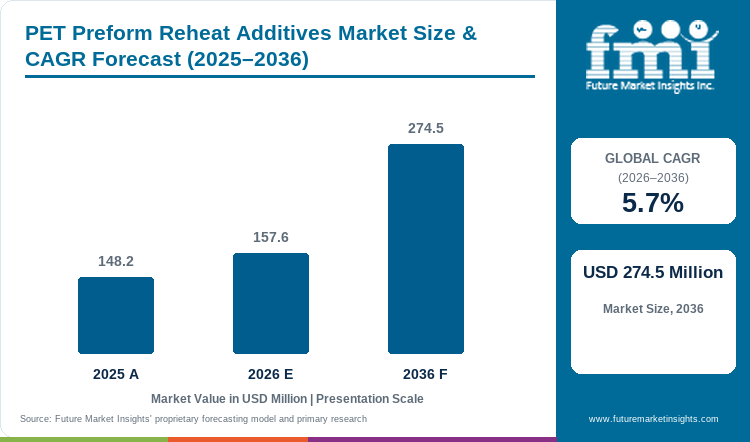
The PET preform reheat additives market is valued at USD 157.6 million in 2026 and is projected to reach USD 274.5 million by 2036, expanding at a CAGR of 5.7% over the 2026-2036 period.
The market was valued at USD 148.2 million in 2025 and is estimated to reach USD 157.6 million in 2026 and USD 274.5 million by 2036, expanding at a 5.7% CAGR. The forecast begins with PET preform conversion value and then isolates the incremental cost of reheat concentrates and reactor-stage infrared absorbers used in two-stage stretch blow molding. Ordinary color masterbatch is excluded unless reheat performance is part of the formulation. The demand base is linked to the PET preform market, which FMI values at USD 18.3 billion in 2026. Reheat-additive value grows faster than preform revenue because recycled resin brings greater variation in color and thermal behavior.
Key Takeaways
- The PET preform reheat additives market is valued at USD 157.6 million in 2026 and is projected to add USD 116.9 million in value by 2036.
- Clear near-infrared absorbers are expected to account for 38.0% of additive chemistry demand in 2026 because they improve lamp-energy uptake while causing less visible darkening than conventional black absorbers.
- Liquid dispersions are projected to represent 44.0% of product form demand in 2026, supported by precise low-dose metering into PET resin and during preform production.
- Bottled water is forecast to account for 41.0% of application demand in 2026 owing to the fact hat haze and color shifts remain readily visible in clear containers.
- Recycled-content rules increase the value of formulations that can handle variable rPET feedstock without moving preform heating outside the qualified process window.
- Companies profiled in the market include Avient, REPI, Penn Color, NYACOL Nano Technologies, Americhem, Sukano, Gabriel-Chemie, Holland Colours, Tosaf and Lifocolor.
Analyst Perspective
" A good reheat additive lowers oven energy while protecting bottle clarity and recyclability. Its true value shows on the plant floor: delivering consistent reheat across resin batches, even with high recycled content”
- Nandini Roy Choudhury, Principal Consultant, Future Market Insights
How is the PET preform reheat additives market segmented?
The PET preform reheat additives market is segmented by additive chemistry, product form, resin profile, bottle application, dosing stage, and region. Clear near-infrared absorbers lead the additive chemistry category with 38.0% of 2026 revenue.
Additive chemistry includes clear near-infrared absorbers, carbon-based absorbers, metal-oxide systems and hybrid formulations. Product form covers liquid dispersions, pellet masterbatch and reactor-stage concentrates. Resin profile is segmented into virgin PET, rPET blends and high-rPET formulations. Bottle application and dosing stage complete the segmentation used for market sizing.
How do rPET blends change the resin profile category?
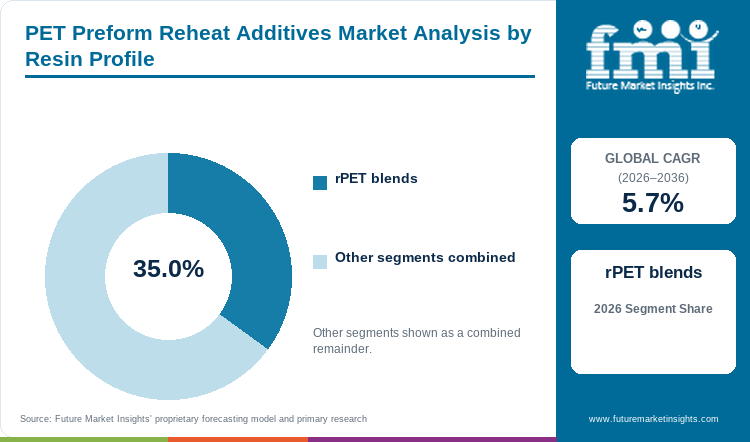
Recycled PET brings prior heat damage and color drift from one batch to the next. Because rPET flakes naturally absorb infrared heat differently than virgin pellets, companies can’t simply carry over existing oven recipes without risking hot spots or bad blows. In response, additive packages increasingly combine infrared absorbers with optical toners and process stabilizers so blow molders can maintain rapid cycle times without failing color specs.
- rPET blends are projected to take 35.0% of the reheat resin profile market in 2026, driven directly by brand pledges to incorporate post-consumer resin into beverage lines.
- The European Commission is enforcing this transition with a mandatory 25.0% recycled content floor for PET beverage bottles starting in 2025, scaling to 30.0% across all single-use beverage containers by 2030.
Why do clear near-infrared absorbers lead the additive chemistry category?
Clear near-infrared (NIR) absorbers lead the market because standard PET lets too much quartz-lamp heat pass right through preforms. While carbon black catches that lost energy, it quickly turns bottles gray. Clear NIR absorbers trap the heat instead without clouding the plastic which is crucial for clear bottles, where even tiny shifts in haze, yellowing, or brightness trigger quality rejects.
- Clear NIR absorbers are set to drive 38.0% of reheat additive demand in 2026, because they cut cycle energy without sacrificing shelf appeal.
- Common systems include nanoscale antimony-doped tin oxide dispersions (50-90 nm, engineered by suppliers like NYACOL) and tungsten oxide, which EFSA cleared for PET reheat formulations at levels up to 75 ppm.
What supports liquid dispersions in the product form category?
Clumps mean visible black specks and hot spots in the preform. Liquid systems let producers and blow molders dose tiny amounts smoothly with fewer aggregates, though they do require dedicated pumps and climate-controlled storage to prevent settling.
- Liquid dispersions are on track to capture 44.0% of the reheat market in 2026, largely because they make precise micro-dosing far easier to manage.
- Suppliers target different steps in the chain: Avient’s Joule system is built for upstream addition directly in the PET reactor, while REPI sells liquid additives converters can pump at the blow molder instead of buying premium fast-reheat resin.
Why does bottled water lead the bottle application category?
Because bottled water is completely clear, any slight yellow tint, gray haze, or optical flaw stands out immediately on the retail shelf. At the same time, water lines run at blistering speeds, meaning even a fractional reduction in reheat cycle time saves serious energy across millions of preforms. Additive suppliers have to walk a fine line: shaving kilowatts off the oven lamps while guaranteeing zero flavor migration and crystal-clear transparency.
- Bottled water is set to represent 41.0% of all reheat bottle application demand in 2026, where line speed and visual clarity dictate purchasing choices.
- With UNEP estimating that consumers buy roughly one million plastic bottles every minute, shaving even a fraction of a second or a few watts off each bottle multiplies into massive commercial savings.
What drives converter-side dosing in the dosing stage category?
Dosing additives at the preform machine lets converters tweak reheat levels on the fly for different bottle weights and oven setups without having to inventory custom resin grades for every single SKU. The catch is that it demands strict plant-floor discipline: feed throat drying, letdown ratios, and screw mixing must stay dead-consistent to prevent visual banding, color drift, or uneven preform wall temperatures.
- Converter-side dosing is projected to command 53.0% of dosing-stage demand in 2026, favored primarily for the operational agility it gives plants running multiple container designs.
- Commercial masterbatches, such as NYACOL's, typically run at lean letdown ratios between 100:1 and 200:1, illustrating the tight metering accuracy required directly on the production floor.
What are the drivers, restraints and opportunities in the PET Preform Reheat Additives Market?
In the PET preform reheat additives market, the key driver is higher rPET use that increases demand for thermal control, the key restraint is optical trade-offs that constrain formulation flexibility, and the key opportunity is line-specific qualification for low-dose clear absorbers.
- Driver: Recycled-content mandates and converter energy targets are increasing demand for stable preform heating across variable resin lots.
- Restraint: An absorber may heat efficiently but can still fail if it darkens the bottle, increases haze or disrupts closed-loop recycling.
- Opportunity: Clear low-dose systems can be tuned to specific lamp spectra, preform weights and rPET ratios.
The recycled PET packaging market expands the addressable base because a higher rPET share makes thermal behavior less uniform. Mandatory EU recycled-content targets turn sustainability into a hard compliance deadline. For converters, the trick is swapping in rPET without constantly halting lines to re-tune oven profiles. Reheat packages that stabilize the blow-molding process window let plants take on variable recycled batches without wasting time on line adjustments.
The opportunity lies between the masterbatch market and the blow-molding process. Suppliers that understand how lamp wavelengths interact with finished bottle color can formulate tailor-made packages instead of peddling generic absorbers off the shelf. This gives an edge to vendors offering hands-on dosing support and pilot stretch-blow molding lines, especially for converters dialing in featherweight water bottles or running tricky, high-rPET preforms where the margin for error is razor-thin.Which country CAGRs are profiled in the PET Preform Reheat Additives Market?
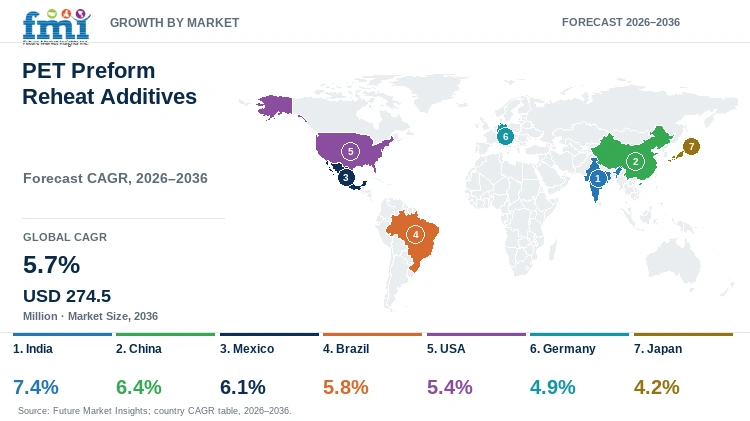
| Country | CAGR |
|---|---|
| India | 7.4% |
| China | 6.4% |
| Mexico | 6.1% |
| Brazil | 5.8% |
| USA | 5.4% |
| Germany | 4.9% |
| Japan | 4.2% |
How do country-level CAGRs compare in the PET Preform Reheat Additives Market?
India and China lead market growth as new beverage capacity comes online alongside tightening recycled-content rules. Mexico and Brazil follow through regional bottle conversion, while the US market is driven primarily by converters qualifying rPET blends. Meanwhile, Germany and Japan expand steadily from mature PET collection ecosystems.
- India: Growth is fueled by rapid beverage-line expansions and strict Extended Producer Responsibility (EPR) mandates, which require brands to hit phased recycled-content targets in rigid PET packaging.
- China: Combines high domestic beverage volume with massive local PET resin synthesis and converter capacity.
- Mexico: Benefits from strong preform and bottle manufacturing integrated with North American beverage supply chains.
- Brazil: Demand is driven by rising soft drink packaging and an established, commercialized PET recovery network.
- United States: Adoption accelerates when lot-to-lot rPET variation causes scrap, blow-molding defects, and line slowdowns that justify investment in stabilizing additives.
- Germany: Prioritizes formulations that satisfy rigorous deposit-return schemes (Pfand) and closed-loop recyclability guidelines.
- Japan: Emphasizes ultra-consistent optical clarity and processing stability within one of the world's most disciplined bottle-to-bottle collection loops.
Across these regions, growth rates track additive revenue rather than gross bottle volume. Real commercial value depends on preform penetration rates and the price converters are willing to pay for high-performance, qualified formulations that protect plant uptime.
Country-by-Country Market Drivers
- India. Growth is anchored by the Central Pollution Control Board’s national EPR portal, turning recycled-content mandates into strict reporting requirements. In a cost-sensitive market, additives have to prove their worth on unit economics by cutting oven kilowatt-hours or boosting hourly bottle output. The biggest opportunity sits with contract converters running multi-SKU lines for water and CSD brands, though resin batch variation keeps color qualification a constant hurdle.
- China. Industrial scale drives the business. Steady output growth in beverage and tea manufacturing translates into massive preform production runs where small oven efficiencies deliver significant cash savings. Domestic polymer capacity also creates prime entry points for upstream reactor-level dosing. The operational hurdle is procurement: buyers evaluate reheat efficiency strictly against separate optical and color-toning specs.
- Mexico. Growth tracks closely with North American beverage supply chains. At the plant level, converter-side dosing wins out because it lets facilities switch bottle molds without inventorying dedicated fast-reheat resin for every job. Key bottlenecks include heavy reliance on imported specialty chemistry and food-contact approvals; hands-on technical service on the plant floor is what actually closes trials.
- Brazil. Rising bottle volume and a mature collection network keep two-stage blow molders running hot. Reheat packages compete directly on electricity saved per thousand bottles rather than raw ppm dosing. Formulations that prevent yellowing in rPET blends command higher margins, though real-to-dollar swings and resin price volatility can stall conversion if the energy payback is too thin.
- United States. With domestic PET bottle recycling holding near 30.2% and higher recycled content hitting production lines, converters are juggling a wider mix of resin feedstocks. That feed variability drives adoption of clear NIR absorbers paired with optical toners. Before securing volume contracts, formulations must clear three non-negotiables: FDA food-contact status, strict haze limits, and APR design-for-recyclability compliance.
- Germany. A high-return deposit scheme (Pfand) delivers clean, consistent rPET, while EU circularity mandates push that resin through repeated bottle-to-bottle cycles. That makes German plants a tough proving ground: additives cannot just work on one pass; they have to survive multi-cycle extrusion without degrading flake color. Suppliers win by showing closed-loop recovery data rather than simple single-pass energy savings.
- Japan. High collection rates and an established recycling loop limit raw volume upside, shifting focus to high-spec bottle-to-bottle performance. Japanese brands enforce zero-tolerance standards on bottle clarity, setting a very high bar for new formulations. Real growth comes from replacing legacy broad-spectrum absorbers or solving hot-spotting in ultra-lightweight water preforms.
Who are the notable companies in the PET Preform Reheat Additives Market?
Avient, REPI, Penn Color, NYACOL Nano Technologies, Americhem, Sukano, Gabriel-Chemie, Holland Colours, Tosaf and Lifocolor are the notable companies profiled in this market.
The competitive field splits between dedicated reheat specialists and diversified color and masterbatch houses. The strongest contenders back their claims with open data, publishing specific absorber chemistries, recommended letdown ratios, or real oven-heating curves. Broader masterbatch producers certainly have the PET compounding muscle, but buyers treat them cautiously until they validate performance on a production stretch-blow molding line.
- Direct reheat suppliers. Companies with dedicated, off-the-shelf reheat chemistries include Avient, REPI, Penn Color, NYACOL Nano Technologies, and Americhem.
- Broad masterbatch platforms. Compounding groups with deep PET development capabilities include Sukano, Gabriel-Chemie, Holland Colours, Tosaf, and Lifocolor.
- Qualification gatekeepers. Moving beyond trial runs comes down to four strict criteria: protecting $L^*$ brightness, keeping haze below brand limits, securing food-contact clearance, and surviving multi-pass rPET recycling loops without degrading bottle optical quality.
Competitive Benchmarking: PET Preform Reheat Additives Market
| Company | Direct Reheat Evidence | Clear PET Capability | rPET Positioning | Geographic Reach |
|---|---|---|---|---|
| Avient | High | High | High | Global |
| REPI | High | High | High | Europe, Americas, Asia |
| Penn Color | High | High | High | North America, Europe, Asia |
| NYACOL Nano Technologies | High | High | Medium | Global technical supply |
| Americhem | High | Medium | Medium | Global |
| Sukano | Medium | High | High | Global |
| Gabriel-Chemie | Low | High | Medium | Europe, Asia, Americas |
| Holland Colours | Low | High | High | Global |
| Tosaf | Low | High | High | Global |
| Lifocolor | Low | Medium | Medium | Europe |
Scoring basis: High direct evidence requires a named PET reheat product or published application data. Medium indicates PET heating or functional-additive evidence with more limited public detail. Low means current public material confirms PET additive capability but does not support a direct reheat rating. Clear PET capability reflects published attention to haze or visible color. rPET positioning requires explicit recycled-PET formulation evidence.
Key Developments in the PET Preform Reheat Additives Market
- In December 2025, NAPCOR published its 2024 PET recycling report, recording a 30.2% US bottle recycling rate. The revised feedstock picture increases attention to additive performance across mixed rPET histories.
- In July 2025, the European Commission opened a consultation on calculation rules for chemically recycled content under the Single-Use Plastics Directive. The work affects how recycled content is verified in bottles that may also contain functional additives.
- In October 2024, the European PET Bottle Platform issued a technical assessment for a REPI blowing additive used in PET preforms. The assessment considered recycling compatibility alongside heating performance in commercial qualification.
Key Players in the PET Preform Reheat Additives Market
Direct Reheat Additive Platforms
- Avient
- REPI
- Penn Color
- NYACOL Nano Technologies
- Americhem
PET Additive and Masterbatch Specialists
- Sukano
- Gabriel-Chemie
- Holland Colours
- Tosaf
- Lifocolor
Technology Routes
- Clear near-infrared absorber dispersions
- Carbon-based masterbatches
- Metal-oxide reactor additives
- Hybrid reheat and toning packages
PET Preform Reheat Additives Market - Report Scope
| Coverage field | Report scope |
|---|---|
| Market Size | USD 157.6 million in 2026 and USD 274.5 million by 2036 at 5.7% CAGR. |
| Market Definition | Specialty additives sold to improve infrared energy absorption and heating control in PET preforms before stretch blow molding. |
| Segmentation | Additive chemistry, product form, resin profile, bottle application and dosing stage. |
| Regional Coverage | North America, Latin America, Western Europe, Eastern Europe, East Asia, South Asia and Pacific, and Middle East and Africa. |
| Countries Covered | India, China, Mexico, Brazil, USA, Germany, Japan and more than 20 countries in the full report. |
| Key Companies Profiled | Avient, REPI, Penn Color, NYACOL Nano Technologies, Americhem, Sukano, Gabriel-Chemie, Holland Colours, Tosaf and Lifocolor. |
| Forecast Period | 2026 to 2036. |
| Approach | Bottom-up converter demand model checked against PET preform value, additive dosing ranges and regional bottle-production indicators. |
PET Preform Reheat Additives Market - Research Methodology
| Method | Approach |
|---|---|
| Primary Research | Interviews with PET resin producers, preform converters, bottle blowers, additive suppliers and packaging procurement teams test dosage practice, qualification time, pricing structure and adoption barriers. |
| Desk Research | Government rules, recycling-platform guidance, food-contact assessments, patents, technical papers and official company product documentation establish market scope and application evidence. |
| Market Sizing and Forecasting | Regional preform conversion value is multiplied by the share using dedicated reheat chemistry and the qualified additive value per tonne. Forecasts adjust for rPET penetration, beverage output and replacement of built-in fast-reheat resin grades. |
| Data Validation | Values are checked against published dosing ranges, PET preform market growth, bottle-recycling indicators and supplier participation. Ordinary colorants without a reheat function are excluded. |
PET Preform Reheat Additives Market by Segments
PET Preform Reheat Additives Market segmented by Additive Chemistry:
- Clear near-infrared absorbers
- Carbon-based absorbers
- Metal-oxide systems
- Hybrid reheat and toning formulations
PET Preform Reheat Additives Market segmented by Product Form:
- Liquid dispersions
- Pellet masterbatch
- Reactor-stage concentrates
- Powder or custom compounds
PET Preform Reheat Additives Market segmented by Resin Profile:
- Virgin PET
- rPET blends
- High-rPET formulations
- Specialty copolyester preforms
PET Preform Reheat Additives Market segmented by Bottle Application:
- Bottled water
- Carbonated soft drinks
- Juices and functional beverages
- Edible oils and food
- Personal care and household products
PET Preform Reheat Additives Market segmented by Dosing Stage:
- Preform-converter dosing
- PET resin reactor addition
- Compounder or masterbatch integration
- Bottle-line correction packages
PET Preform Reheat Additives Market by Region:
- North America
- United States
- Canada
- Latin America
- Brazil
- Mexico
- Argentina
- Chile
- Western Europe
- Germany
- France
- United Kingdom
- Italy
- Spain
- Benelux
- Nordics
- Eastern Europe
- Poland
- Czech Republic
- Romania
- Hungary
- East Asia
- China
- Japan
- South Korea
- South Asia and Pacific
- India
- ASEAN
- Australia and New Zealand
- Middle East and Africa
- GCC Countries
- South Africa
- Türkiye
- Israel
Research Sources and Bibliography
- European Commission. (2025, July 8). Commission consults on new rules for chemically recycled content in plastic bottles.
- European Commission. (n.d.; accessed September 23, 2026). Single-use plastics.
- European Food Safety Authority. (2017). Safety assessment of tungsten oxide for use as a reheat agent in PET food-contact materials.
- European PET Bottle Platform. (2024, October 10). Technical assessment of REPI blowing additive for PET preforms.
- European PET Bottle Platform. (n.d.; accessed September 23, 2026). Design guidelines for PET bottles.
- National Association for PET Container Resources. (2025, December 10). 2024 PET Recycling Report.
- National Association for PET Container Resources. (2024, December 12). 2023 US PET Bottle Recycling Rate Reaches New Heights.
- Central Pollution Control Board, India. (n.d.; accessed September 23, 2026). Centralized EPR Portal for Plastic Packaging.
- National Bureau of Statistics of China. (2024, November 27). Industrial Production Operation in October 2024.
- Council for PET Bottle Recycling, Japan. (n.d.; accessed September 23, 2026). PET bottle collection and recycling statistics.
- German Environment Agency. (n.d.; accessed September 23, 2026). Packaging and the Packaging Act.
- United Nations Environment Programme. (2017, November 17). A price on their heads: how bottle deposits help beat plastic pollution.
- Avient Corporation. (n.d.; accessed September 23, 2026). ColorMatrix Joule Reheat Additive for PET.
- REPI. (n.d.; accessed September 23, 2026). Blowing additives for PET preforms.
- Penn Color. (2024). Reheat Additives technical bulletin.
- NYACOL Nano Technologies. (n.d.; accessed September 23, 2026). Clear Fast Reheat and SN902 product information.
- Google Patents. (2007). US7189777B2: Compositions and method for improving reheat rate of PET using activated carbon.
- Future Market Insights. (2026). PET Preform Market.
This bibliography is provided for reader reference and is not exhaustive. The full report contains the complete reference list and detailed citations.
This Report Answers
- How large is the PET preform reheat additives market in 2026 and 2036?
- Which absorber technologies balance heating speed with clear-bottle appearance?
- How does recycled PET change additive qualification at preform plants?
- Why do liquid dispersions hold a leading product-form position?
- How do country growth rates differ across India, China, Mexico, Brazil, USA, Germany and Japan?
- Which companies have direct public evidence for PET reheat formulations?
Frequently Asked Questions
How big is the PET preform reheat additives market in 2026?
The PET preform reheat additives market is valued at USD 157.6 million in 2026 and is projected to reach USD 274.5 million by 2036. Demand follows two-stage PET bottle production plus the adoption rate of dedicated infrared absorbers.
What is the CAGR of the PET preform reheat additives market from 2026 to 2036?
The market is projected to grow at 5.7% CAGR between 2026 and 2036. Growth exceeds the underlying preform market as rPET use raises the need for tighter heating control.
Which additive chemistry leads the PET preform reheat additives market?
Clear near-infrared absorbers are expected to hold 38.0% share in 2026. They address the trade-off between faster heating and visible bottle darkening.
Which countries are projected to record higher growth?
India is projected at 7.4% CAGR, followed by China at 6.4% and Mexico at 6.1% through 2036. Beverage-line investment and recycled-content obligations influence the relative pace.
Which companies are active in PET preform reheat additives?
The profiled group includes Avient, REPI, Penn Color, NYACOL Nano Technologies, Americhem, Sukano, Gabriel-Chemie, Holland Colours, Tosaf and Lifocolor. Direct public reheat evidence varies across the group.
Preview the report firsthand - request a free sample
Get SampleGet the brochure for pricing and purchase details.
Get PDFTable of Content
- Key Takeaways
- Market Size and CAGR
- Top Growth Driver
- Fastest Growing Segment
- Leading Region
- Key Companies
- Emerging Opportunities
- Executive Summary
- Global Market Outlook
- Demand-side Trends
- Supply-side Trends
- Technology Roadmap Analysis
- Analysis and Recommendations
- Analyst Perspective (What is happening? Why now? What should investors know?)
- Key Questions Answered
- How large is the market?
- What is the CAGR?
- What are key trends?
- Which region dominates?
- Who are the leaders?
- Market Overview
- Market Coverage / Taxonomy
- Market Definition / Scope / Limitations
- Research Methodology
- Chapter Orientation
- Analytical Lens and Working Hypotheses
- Market Structure, Signals, and Trend Drivers
- Benchmarking and Cross-market Comparability
- Market Sizing, Forecasting, and Opportunity Mapping
- Research Design and Evidence Framework
- Desk Research Programme (Secondary Evidence)
- Expert Input and Fieldwork (Primary Evidence)
- Tooling, Models, and Reference Databases
- Data Engineering and Model Build
- Quality Assurance and Audit Trail
- Market Background
- Market Dynamics (Drivers, Restraints, Opportunity, Trends)
- Scenario Forecast (Optimistic, Likely, Conservative)
- Impact Analysis
- AI Impact
- Sustainability Impact
- Regulatory Impact
- Technology Impact
- Consumer / Buyer Analysis
- Purchase Drivers
- Adoption Barriers
- Buyer Journey
- Opportunity Map Analysis
- Product Life Cycle Analysis
- Supply Chain Analysis
- Investment Feasibility Matrix
- Value Chain Analysis
- PESTLE and Porter's Analysis
- Regulatory Landscape
- Regional Parent Market Outlook
- Production and Consumption Statistics
- Import and Export Statistics
- Global Market Analysis and Forecast, 2021 to 2036
- Historical Market Size Value (USD Million) Analysis, 2021 to 2025
- Current and Future Market Size Value (USD Million) Projections, 2026 to 2036
- Y-o-Y Growth Trend Analysis
- Absolute $ Opportunity Analysis
- Global Market Pricing Analysis, 2021 to 2036
- Global Market Analysis and Forecast, By Additive Chemistry, 2021 to 2036
- Introduction / Key Findings
- Historical Market Size Value (USD Million) Analysis By Additive Chemistry, 2021 to 2025
- Current and Future Market Size Value (USD Million) Analysis and Forecast By Additive Chemistry, 2026 to 2036
- Clear near-infrared absorbers
- Carbon-based absorbers
- Metal-oxide systems
- Hybrid reheat and toning formulations
- Y-o-Y Growth Trend Analysis By Additive Chemistry, 2021 to 2025
- Absolute $ Opportunity Analysis By Additive Chemistry, 2026 to 2036
- Global Market Analysis and Forecast, By Product Form, 2021 to 2036
- Introduction / Key Findings
- Historical Market Size Value (USD Million) Analysis By Product Form, 2021 to 2025
- Current and Future Market Size Value (USD Million) Analysis and Forecast By Product Form, 2026 to 2036
- Liquid dispersions
- Pellet masterbatch
- Reactor-stage concentrates
- Powder or custom compounds
- Y-o-Y Growth Trend Analysis By Product Form, 2021 to 2025
- Absolute $ Opportunity Analysis By Product Form, 2026 to 2036
- Global Market Analysis and Forecast, By Resin Profile, 2021 to 2036
- Introduction / Key Findings
- Historical Market Size Value (USD Million) Analysis By Resin Profile, 2021 to 2025
- Current and Future Market Size Value (USD Million) Analysis and Forecast By Resin Profile, 2026 to 2036
- Virgin PET
- rPET blends
- High-rPET formulations
- Specialty copolyester preforms
- Y-o-Y Growth Trend Analysis By Resin Profile, 2021 to 2025
- Absolute $ Opportunity Analysis By Resin Profile, 2026 to 2036
- Global Market Analysis and Forecast, By Bottle Application, 2021 to 2036
- Introduction / Key Findings
- Historical Market Size Value (USD Million) Analysis By Bottle Application, 2021 to 2025
- Current and Future Market Size Value (USD Million) Analysis and Forecast By Bottle Application, 2026 to 2036
- Bottled water
- Carbonated soft drinks
- Juices and functional beverages
- Edible oils and food
- Personal care and household products
- Y-o-Y Growth Trend Analysis By Bottle Application, 2021 to 2025
- Absolute $ Opportunity Analysis By Bottle Application, 2026 to 2036
- Global Market Analysis and Forecast, By Dosing Stage, 2021 to 2036
- Introduction / Key Findings
- Historical Market Size Value (USD Million) Analysis By Dosing Stage, 2021 to 2025
- Current and Future Market Size Value (USD Million) Analysis and Forecast By Dosing Stage, 2026 to 2036
- Preform-converter dosing
- PET resin reactor addition
- Compounder or masterbatch integration
- Bottle-line correction packages
- Y-o-Y Growth Trend Analysis By Dosing Stage, 2021 to 2025
- Absolute $ Opportunity Analysis By Dosing Stage, 2026 to 2036
- Global Market Analysis and Forecast, By Region, 2021 to 2036
- Introduction
- Historical Market Size Value (USD Million) Analysis By Region, 2021 to 2025
- Current Market Size Value (USD Million) Analysis and Forecast By Region, 2026 to 2036
- North America
- Latin America
- Western Europe
- Eastern Europe
- East Asia
- South Asia and Pacific
- Middle East and Africa
- Market Attractiveness Analysis By Region
- North America Market Analysis and Forecast, By Country, 2021 to 2036
- Historical Market Size Value (USD Million) Trend Analysis By Market Taxonomy, 2021 to 2025
- Market Size Value (USD Million) Forecast By Market Taxonomy, 2026 to 2036
- By Country
- United States
- Canada
- By Additive Chemistry
- By Product Form
- By Resin Profile
- By Bottle Application
- By Dosing Stage
- By Country
- Market Attractiveness Analysis
- By Country
- By Additive Chemistry
- By Product Form
- By Resin Profile
- By Bottle Application
- By Dosing Stage
- Key Takeaways
- Latin America Market Analysis and Forecast, By Country
- Historical Market Size Value (USD Million) Trend Analysis By Market Taxonomy, 2021 to 2025
- Market Size Value (USD Million) Forecast By Market Taxonomy, 2026 to 2036
- By Country
- Brazil
- Mexico
- Argentina
- Chile
- By Additive Chemistry
- By Product Form
- By Resin Profile
- By Bottle Application
- By Dosing Stage
- By Country
- Market Attractiveness Analysis
- By Country
- By Additive Chemistry
- By Product Form
- By Resin Profile
- By Bottle Application
- By Dosing Stage
- Key Takeaways
- Western Europe Market Analysis and Forecast, By Country
- Historical Market Size Value (USD Million) Trend Analysis By Market Taxonomy, 2021 to 2025
- Market Size Value (USD Million) Forecast By Market Taxonomy, 2026 to 2036
- By Country
- Germany
- France
- United Kingdom
- Italy
- Spain
- Benelux
- Nordics
- By Additive Chemistry
- By Product Form
- By Resin Profile
- By Bottle Application
- By Dosing Stage
- By Country
- Market Attractiveness Analysis
- By Country
- By Additive Chemistry
- By Product Form
- By Resin Profile
- By Bottle Application
- By Dosing Stage
- Key Takeaways
- Eastern Europe Market Analysis and Forecast, By Country
- Historical Market Size Value (USD Million) Trend Analysis By Market Taxonomy, 2021 to 2025
- Market Size Value (USD Million) Forecast By Market Taxonomy, 2026 to 2036
- By Country
- Poland
- Czech Republic
- Romania
- Hungary
- By Additive Chemistry
- By Product Form
- By Resin Profile
- By Bottle Application
- By Dosing Stage
- By Country
- Market Attractiveness Analysis
- By Country
- By Additive Chemistry
- By Product Form
- By Resin Profile
- By Bottle Application
- By Dosing Stage
- Key Takeaways
- East Asia Market Analysis and Forecast, By Country
- Historical Market Size Value (USD Million) Trend Analysis By Market Taxonomy, 2021 to 2025
- Market Size Value (USD Million) Forecast By Market Taxonomy, 2026 to 2036
- By Country
- China
- Japan
- South Korea
- By Additive Chemistry
- By Product Form
- By Resin Profile
- By Bottle Application
- By Dosing Stage
- By Country
- Market Attractiveness Analysis
- By Country
- By Additive Chemistry
- By Product Form
- By Resin Profile
- By Bottle Application
- By Dosing Stage
- Key Takeaways
- South Asia and Pacific Market Analysis and Forecast, By Country
- Historical Market Size Value (USD Million) Trend Analysis By Market Taxonomy, 2021 to 2025
- Market Size Value (USD Million) Forecast By Market Taxonomy, 2026 to 2036
- By Country
- India
- ASEAN
- Australia and New Zealand
- By Additive Chemistry
- By Product Form
- By Resin Profile
- By Bottle Application
- By Dosing Stage
- By Country
- Market Attractiveness Analysis
- By Country
- By Additive Chemistry
- By Product Form
- By Resin Profile
- By Bottle Application
- By Dosing Stage
- Key Takeaways
- Middle East and Africa Market Analysis and Forecast, By Country
- Historical Market Size Value (USD Million) Trend Analysis By Market Taxonomy, 2021 to 2025
- Market Size Value (USD Million) Forecast By Market Taxonomy, 2026 to 2036
- By Country
- GCC Countries
- South Africa
- Türkiye
- Israel
- By Additive Chemistry
- By Product Form
- By Resin Profile
- By Bottle Application
- By Dosing Stage
- By Country
- Market Attractiveness Analysis
- By Country
- By Additive Chemistry
- By Product Form
- By Resin Profile
- By Bottle Application
- By Dosing Stage
- Key Takeaways
- Key Countries Market Analysis
- United States
- Pricing Analysis
- Market Share Analysis, 2025
- By Additive Chemistry
- By Product Form
- By Resin Profile
- By Bottle Application
- By Dosing Stage
- Canada
- Pricing Analysis
- Market Share Analysis, 2025
- By Additive Chemistry
- By Product Form
- By Resin Profile
- By Bottle Application
- By Dosing Stage
- Mexico
- Pricing Analysis
- Market Share Analysis, 2025
- By Additive Chemistry
- By Product Form
- By Resin Profile
- By Bottle Application
- By Dosing Stage
- Brazil
- Pricing Analysis
- Market Share Analysis, 2025
- By Additive Chemistry
- By Product Form
- By Resin Profile
- By Bottle Application
- By Dosing Stage
- Chile
- Pricing Analysis
- Market Share Analysis, 2025
- By Additive Chemistry
- By Product Form
- By Resin Profile
- By Bottle Application
- By Dosing Stage
- Germany
- Pricing Analysis
- Market Share Analysis, 2025
- By Additive Chemistry
- By Product Form
- By Resin Profile
- By Bottle Application
- By Dosing Stage
- United Kingdom
- Pricing Analysis
- Market Share Analysis, 2025
- By Additive Chemistry
- By Product Form
- By Resin Profile
- By Bottle Application
- By Dosing Stage
- Italy
- Pricing Analysis
- Market Share Analysis, 2025
- By Additive Chemistry
- By Product Form
- By Resin Profile
- By Bottle Application
- By Dosing Stage
- Spain
- Pricing Analysis
- Market Share Analysis, 2025
- By Additive Chemistry
- By Product Form
- By Resin Profile
- By Bottle Application
- By Dosing Stage
- France
- Pricing Analysis
- Market Share Analysis, 2025
- By Additive Chemistry
- By Product Form
- By Resin Profile
- By Bottle Application
- By Dosing Stage
- India
- Pricing Analysis
- Market Share Analysis, 2025
- By Additive Chemistry
- By Product Form
- By Resin Profile
- By Bottle Application
- By Dosing Stage
- ASEAN
- Pricing Analysis
- Market Share Analysis, 2025
- By Additive Chemistry
- By Product Form
- By Resin Profile
- By Bottle Application
- By Dosing Stage
- Australia and New Zealand
- Pricing Analysis
- Market Share Analysis, 2025
- By Additive Chemistry
- By Product Form
- By Resin Profile
- By Bottle Application
- By Dosing Stage
- China
- Pricing Analysis
- Market Share Analysis, 2025
- By Additive Chemistry
- By Product Form
- By Resin Profile
- By Bottle Application
- By Dosing Stage
- Japan
- Pricing Analysis
- Market Share Analysis, 2025
- By Additive Chemistry
- By Product Form
- By Resin Profile
- By Bottle Application
- By Dosing Stage
- South Korea
- Pricing Analysis
- Market Share Analysis, 2025
- By Additive Chemistry
- By Product Form
- By Resin Profile
- By Bottle Application
- By Dosing Stage
- Poland
- Pricing Analysis
- Market Share Analysis, 2025
- By Additive Chemistry
- By Product Form
- By Resin Profile
- By Bottle Application
- By Dosing Stage
- Hungary
- Pricing Analysis
- Market Share Analysis, 2025
- By Additive Chemistry
- By Product Form
- By Resin Profile
- By Bottle Application
- By Dosing Stage
- Türkiye
- Pricing Analysis
- Market Share Analysis, 2025
- By Additive Chemistry
- By Product Form
- By Resin Profile
- By Bottle Application
- By Dosing Stage
- South Africa
- Pricing Analysis
- Market Share Analysis, 2025
- By Additive Chemistry
- By Product Form
- By Resin Profile
- By Bottle Application
- By Dosing Stage
- United States
- Market Structure Analysis
- Competition Dashboard
- Competition Benchmarking
- Market Share Analysis of Top Players
- By Regional
- By Additive Chemistry
- By Product Form
- By Resin Profile
- By Bottle Application
- By Dosing Stage
- Emerging Startups
- Innovation Benchmarking
- Competition Analysis
- Competition Deep Dive
- Avient
- Overview
- Product Portfolio
- Profitability by Market Segments
- Sales Footprint
- Strategy Overview
- Marketing Strategy
- Product Strategy
- Channel Strategy
- REPI
- Penn Color
- NYACOL Nano Technologies
- Americhem
- Sukano
- Gabriel-Chemie
- Holland Colours
- Tosaf
- Lifocolor
- Clear near-infrared absorber dispersions
- Carbon-based masterbatches
- Metal-oxide reactor additives
- Hybrid reheat and toning packages
- Avient
- Case Studies
- Success Stories
- Recent Developments
- Competition Deep Dive
- Assumptions & Acronyms Used


