
- Market Size (2026)
- USD 1.4 Bn
- Forecast (2036)
- USD 2.6 Bn
- CAGR (2026 to 2036)
- 6.3%
How big is the Phase-Transfer Catalyst Market in 2026?
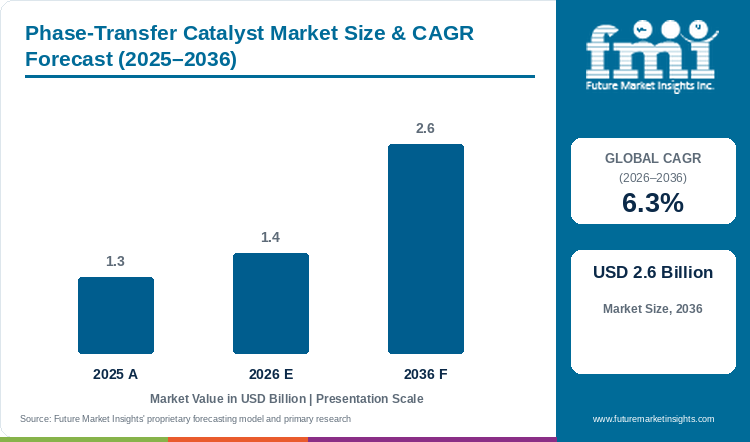
The Phase-Transfer Catalyst Market is projected to reach USD 2.6 billion by 2036, growing at a 6.3% CAGR from 2026 to 2036. The market is estimated at USD 1.4 billion in 2026. The market was valued at USD 1.3 billion in 2025. A phase-transfer catalyst moves a reactant from one phase into another in a mixture that would otherwise react slowly. The product therefore sells into pharmaceutical, agrochemical and fine-chemical synthesis, not to consumers [1]. Tatva Chintan reported on 19 October 2026 that its quarter to 30 September 2026 was its highest-ever quarterly turnover. Revenue from operations for the quarter was INR 2,173 million. Phase-transfer catalysts made up about a fifth of that quarter's operating revenue and nearly a quarter of the first-half total of INR 3,844 million [1][2]. The company described its phase-transfer catalyst business as established and said it aimed to build on customers' demand for process efficiency and more sustainable production [1].
Input costs and compliance rules affect pricing. In its October 2026 presentation, Tatva Chintan said erratic short supplies had pushed the price of some solvents up by 60% to 100% during the quarter. It also said freight in certain sectors of the United States and Europe had risen by more than 100%. It expected both to ease within its third quarter [1]. On the buyer side, the ICH Q3C(R9) guideline on residual solvents has an effective date of 29 April 2024 at the European Medicines Agency. It sets acceptable residual solvent amounts in medicines and recommends less toxic solvents. A reaction that needs less solvent therefore has a regulatory as well as a cost argument [12].
Key Market Trends & Insights
- On 19 October 2026 Tatva Chintan reported revenue from operations of INR 2,173 million for the quarter to 30 September 2026. The figure compares with INR 1,235 million a year earlier [1].
- SACHEM, a supplier of quaternary ammonium salts, named John Foley chief executive officer on 21 July 2026. It called the change a planned leadership transition, and John Mooney remains as chairman [5].
- Pharmaceutical buyers faced an EMA consultation on draft ICH Q3C(R9) annex revisions from 29 April to 30 June 2026 [12].
Regional Highlights
- North America: Canada exported CAD 119.9 billion of chemical and plastic products in 2024. It trades more than CAD 115 billion of such products with the United States each year. Cross-border supply of catalyst inputs is therefore exposed to the tariffs announced in August 2026 [16][17].
- Continental Europe: Germany's chemical and pharmaceutical industry had sales of EUR 220 billion and exports above EUR 252 billion in 2025. Italy's pharmaceutical industry produces more than EUR 70 billion a year. Synthesis-grade catalyst demand therefore sits in dense pharmaceutical and fine-chemical clusters [14][20].
- United Kingdom: the Chemical Industries Association expects UK chemical production to fall 2.4% in 2026. Of the surveyed firms, 52% name energy cost as their biggest challenge, which limits local specialty chemical expansion [15].
Phase-Transfer Catalyst Market Size and Forecast
Table 1: Phase-Transfer Catalyst Market Size and Forecast
| Market size and forecast | Value |
|---|---|
| Market size in 2025 | USD 1.3 billion |
| Estimated market size in 2026 | USD 1.4 billion |
| Projected market size by 2036 | USD 2.6 billion |
| CAGR from 2026 to 2036 | 6.3% |
Source: Future Market Insights analysis of the phase-transfer catalyst market, 2026.
Analyst Perspective
“Phase-transfer catalysts are a small-volume, high-consequence input. A plant spends little on them but relies on them to hold yield and keep solvent use within regulatory limits. Suppliers that can document grade and keep a plant supplied through a freight or solvent shock gain an edge. The pharmaceutical customer is the one to watch because its solvent rules are tightening. Makers that sell the same salts into electronics, coatings or epoxy curing can move volume elsewhere when one end market softens.”
- Nikhil Kaitwade, Principal Consultant, FMI
How is the Phase-Transfer Catalyst Market segmented?
- By type: Ammonium Salts, Phosphonium Salts and Others
- By end-use: Pharmaceuticals, Agriculture and Chemical
- By region: North America and Europe
Why does Ammonium Salts lead by Type in the Phase-Transfer Catalyst Market in 2026?
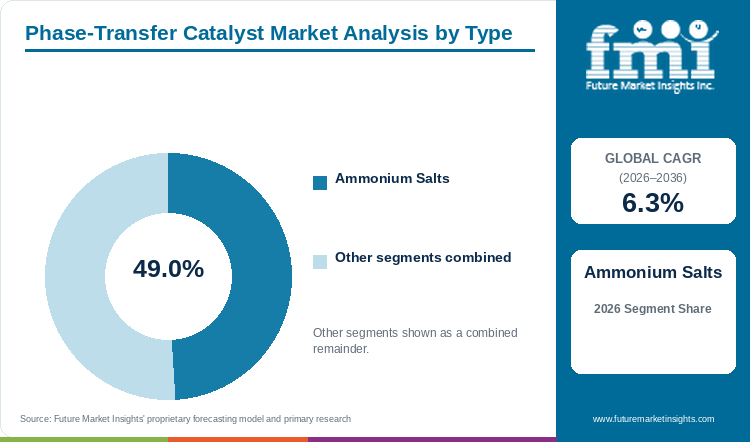
Ammonium Salts is estimated to account for 49.0% of the Phase-Transfer Catalyst Market by type in 2026. Catalogues from companies that make and sell these catalysts are built around quaternary ammonium compounds. Tatva Chintan's phase-transfer catalyst list opens with tetrabutylammonium bromide, chloride, iodide and fluoride, and tetraoctylammonium bromide. It also names methyltrioctylammonium chloride, benzyltriethylammonium chloride and benzalkonium chloride [3]. SACHEM lists tetrabutylammonium bromide, methyltributylammonium chloride and three further quaternary ammonium salts in its product navigation [4]. Its product index also carries a phase-transfer catalyst category tied to its Ferrion PTC line [4]. Central Drug House lists benzyltriethylammonium chloride, Aliquat 336 and several benzyl-tributylammonium salts among its synthesis reagents [10]. Ammonium salts also sell as disinfectants, structure directing agents and electrolytes, so a plant making them can serve several customers [3][4]. Phosphonium salts are the main alternative. Nippon Chemical Industrial lists phase-transfer catalysis among the uses of its tetraethyl, tetrabutyl and methyltributyl phosphonium salts, alongside epoxy curing and antibacterial uses [8]. Phosphonium salts hold 29.0%, and other classes hold the rest.
Table 2: Type, 2026 Share
| Leading Share | 2026 market share |
|---|---|
| Ammonium Salts | 49.0% |
| All Other Segments Combined Share | 51.0% |
Source: Future Market Insights analysis of the phase-transfer catalyst market, 2026.
Why does Pharmaceuticals lead by End-Use in the Phase-Transfer Catalyst Market in 2026?
Pharmaceuticals is estimated to account for 49.0% of the Phase-Transfer Catalyst Market by end-use in 2026. Tatva Chintan names pharmaceutical active ingredients first among the end-user industries for its phase-transfer catalysts, ahead of flavours and fragrances, environment control processes and agrochemicals [1]. The company says its customers are in more than 30 countries and that exports were 75% of revenue in the year to 31 March 2026 [1]. Nippon Chemical Industrial's description of its phosphonium salts lists alkylation, nitrile formation and ether and sulfide synthesis. Those are standard steps in drug synthesis [8]. The residual solvent rules add a second reason for the lead. The ICH Q3C(R9) guideline sets acceptable amounts of residual solvents in pharmaceuticals and recommends less toxic solvents [12]. Tatva Chintan describes its catalysts as giving faster reactions, higher yields and fewer by-products, and at times removing the need for expensive or dangerous solvents [1]. These are the company's own claims, and they apply reaction by reaction. Large pharmaceutical export bases add to the demand. Germany's chemical and pharmaceutical industry exported more than EUR 252 billion in 2025, and Italy's pharmaceutical industry exports about EUR 69 billion a year [14][20].
Table 3: End-Use, 2026 Share
| Leading Share | 2026 market share |
|---|---|
| Pharmaceuticals | 49.0% |
| All Other Segments Combined Share | 51.0% |
Source: Future Market Insights analysis of the phase-transfer catalyst market, 2026.
What are the key drivers, restraints and opportunities?
Driver
Pharmaceutical synthesis. Drug makers use phase-transfer catalysis for alkylation and similar steps [8]. The ICH Q3C(R9) guideline recommends less toxic solvents, which gives drug makers a reason to cut solvent use [12]. Tatva Chintan reported that its pharma, agro and speciality chemicals business gained momentum in the quarter to 30 September 2026. A recently commercialised pharma product began to contribute to sales [1]. Readers who follow pharmaceutical intermediates will recognise many of the same drug-making customers.
Crop protection chemistry. Agrochemicals are a named end-user industry for phase-transfer catalysts at Tatva Chintan [1]. FAO data show global pesticide use of 3.73 million tonnes of active ingredient in 2023. That is double the 1990 level. Trade in formulated pesticides was worth USD 42.8 billion [13]. Tatva Chintan said its recently commercialised agro products performed well in the October 2026 quarter [1].
Restraint
Solvent and freight cost. Tatva Chintan said solvent prices rose 60% to 100% in the quarter to 30 September 2026. It also said freight rose by more than 100% in certain sectors of the United States and Europe [1]. Its earnings before interest, tax, depreciation and amortisation stayed at nearly similar levels despite record sales [1]. A maker that cannot pass such costs on loses margin on a low-volume product.
Weak western chemical demand. The Chemical Industries Association forecasts UK chemical production to fall 2.4% in 2026, and by a further 7.1% in the fourth quarter. About 45% of surveyed firms cut production or operating activity in the quarter [15]. Growth in French chemicals slowed sharply in the second quarter as a temporary demand boost faded [23]. Canadian producers face new United States tariffs announced in August 2026 [16].
Opportunity
Process efficiency in synthesis. Tatva Chintan says demand is rising for advanced, environment-friendly catalysts and for greener chemistry in organic synthesis [1]. Its greenfield project is on schedule to add capacity for existing businesses and new molecules [1]. Buyers that need lower-solvent routes under ICH Q3C(R9) are the natural customers [12].
Phosphonium and specialty grades. Nippon Chemical Industrial sells fifteen phosphonium and related products under one brand, from tetrabutylphosphonium salts to ionic liquids [8]. A buyer can source a phase-transfer catalyst and an epoxy curing catalyst from one chemistry [8]. Quaternary ammonium compounds sold into disinfectant and personal care markets give ammonium producers a second outlet for capacity [3]. Tatva Chintan also lists benzalkonium chloride among its phase-transfer products. Its structure directing agents are used to make zeolites [1][3].
Phase-Transfer Catalyst Market by Country (2026 to 2036)
Table 4: Phase-Transfer Catalyst Market Country Growth Forecast
| Country | CAGR, 2026 to 2036 |
|---|---|
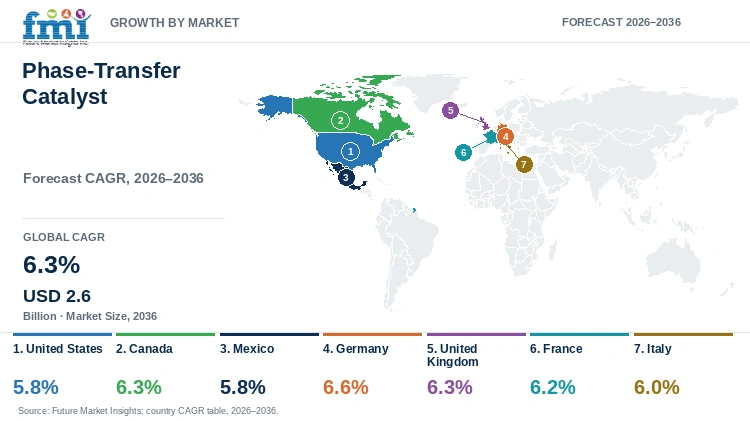
| United States | 5.8% |
| Canada | 6.3% |
| Mexico | 5.8% |
| Germany | 6.6% |
| United Kingdom | 6.3% |
| France | 6.2% |
| Italy | 6.0% |
Source: Future Market Insights analysis of the phase-transfer catalyst market, 2026.
United States
SACHEM, which makes quaternary ammonium salts including tetrabutylammonium bromide, announced on 17 January 2025 that it was moving its global headquarters to Monterey Oaks Corporate Park in Austin, Texas. Finance, marketing and research and development would move there, and its Cleburne, Texas facility would continue without interruption [7][4]. It named John Foley chief executive officer on 21 July 2026 [5].
SACHEM's Asia business operations included assets in Osaka and Wuxi and sales offices in Taiwan and Shanghai. The company agreed on 18 March 2025 to sell them to Nagase [6]. Nagase completed the acquisition in June 2025 [25]. The Wuxi company was renamed Nagase Circrea (Wuxi) Co., Ltd. in March 2026 [26]. American buyers should confirm which legal entity supplies a given grade [6].
The American Chemistry Council describes the business of chemistry as generating USD 673 billion a year [24]. Tatva Chintan serves the United States through a subsidiary, Tatva Chintan USA Inc. In the October 2026 quarter, it recorded freight cost increases of more than 100% in certain sectors of the United States and Europe [1]. Import-dependent buyers of Indian-made catalysts therefore carry logistics risk as well as price risk.
Canada
The Chemistry Industry Association of Canada reports that Canada exported CAD 119.9 billion of chemical and plastic products in 2024. The sector supports 192,700 jobs and is the fourth-largest manufacturing sector in the country [17]. Phase-transfer catalysts make up a small part of that trade.
On 24 August 2026 the association responded to new United States tariffs on Canadian goods. It said more than CAD 115 billion of chemical and plastic products move between the two countries each year. Materials often cross the border several times before reaching a finished good [16]. A synthesis plant that imports a catalyst through the United States, or exports an intermediate made with one, is exposed to that duty.
Canadian buyers can hold more stock of qualified grades and ask suppliers for a second shipping route. Lead times and customs handling now matter as much as price.
Mexico
The Asociacion Nacional de la Industria Quimica represents more than 95% of private chemical production in Mexico, through about 258 companies [19]. Its June 2026 bulletin said North America was preparing for the 2026 review of the Mexico, United States and Canada trade agreement. The association, with the American Chemistry Council and the Canadian association, had scheduled a trilateral meeting in Washington on 9 June 2026. It covered regulatory simplification and rules of origin [18].
Catalyst buyers face origin and paperwork questions. Fine chemicals that cross the border for pharmaceutical or agricultural formulation depend on stable tariff treatment and clear origin rules. The trade agreement's chemical sector annex was a stated focus of the industry's position [18].
Suppliers that ship small, documented lots with clear origin paperwork can serve Mexican buyers more easily than bulk-only sellers. The trade agreement review keeps origin rules in focus.
Germany
Germany has the highest forecast growth of the profiled countries, at 6.6%. The Verband der Chemischen Industrie reported on 13 August 2026 that the chemical and pharmaceutical industry had sales of EUR 220 billion. It had about 476,300 employees and more than 2,100 companies. Exports exceeded EUR 252 billion in 2025, with about 62% of sales made abroad [14].
Catalyst value shows up in process development, so research intensity matters. The same publication puts industry research spending at about EUR 16 billion in 2025. It counts 47,100 people working in research and development, and notes that 96% of companies have fewer than 1,000 employees [14]. Mid-sized firms favour suppliers that provide small lots and technical support.
ICH Q3C(R9) recommends less toxic solvents, which pushes demand toward cleaner routes [12]. The residual solvent guideline is published in Europe by the European Medicines Agency, which lists a consultation on draft annex revisions from 29 April to 30 June 2026. Tatva Chintan has a wholly owned subsidiary, Tatva Chintan Europe B.V., and a warehousing facility in the Netherlands [1].
United Kingdom
The UK has the weakest near-term outlook of the profiled markets. The Chemical Industries Association's third-quarter 2026 survey, published on 19 October 2026, forecasts UK chemical production to fall 2.4% in 2026. It forecasts a further 7.1% fall in the fourth quarter. Of the surveyed firms, 52% name energy cost as their biggest challenge [15].
The survey found that 5% of firms reported permanent capacity closures, 14% reported temporary shutdowns and 19% reported lower operating rates. The survey also found that 57% said market conditions had hurt planned investment [15]. Chemicals were the second-largest UK export commodity group in 2025, at GBP 66.3 billion. Imports exceeded exports [15].
Since 57% of firms say market conditions had hurt planned investment, new local catalyst capacity looks unlikely. UK buyers will likely need to qualify suppliers abroad and plan for customs lead times.
France
France Chimie describes the French chemical industry as the country's leading industrial exporter. It has more than 4,000 companies, 229,000 employees and 19 industrial platforms [22]. Its bulletin for the second quarter of 2026, dated 14 September 2026, reports the slowdown in chemical growth [23].
Ahead of the 2027 elections, the federation has published 22 proposals to help chemical companies produce, invest and innovate in France. It also joined seven other national federations in backing a call from 10 EU member states to support the European chemical sector [22]. The proposals aim to keep fine-chemical and pharmaceutical production on French sites.
French buyers of specialty catalysts are likely to prefer suppliers that hold European stock. Slower growth makes buyers more cautious about lead times.
Italy
Italy's pharmaceutical industry is a sizeable user. Farmindustria represents around 200 companies and more than 130 manufacturing plants. Production is above EUR 70 billion, of which EUR 69 billion is exported. Farmindustria says Italy is the world's second-largest exporter of packaged medicines, with a 10% share [20]. Chemically synthesised medicines, antibiotics and contract development and manufacturing are among the sector's activities [20].
Federchimica groups upstream suppliers by sector. Pharmaceutical raw materials and intermediates sit under Aschimfarma. Intermediates, active ingredients, catalysts and other fine chemicals sit under Aispec, and crop protection products under Agrofarma [21]. Catalyst buyers therefore sit in the fine-chemical chain that feeds drug makers.
Italian drug makers export nearly all they produce. Suppliers that offer a technical file for each grade and local stock are therefore better placed for repeat orders.
Who are the notable companies in the Phase-Transfer Catalyst Market?
Notable companies in the Phase-Transfer Catalyst Market include SACHEM, Inc., Nippon Chemical Industrial Co., Ltd., Tatva Chintan Pharma Chem Limited and Central Drug House.
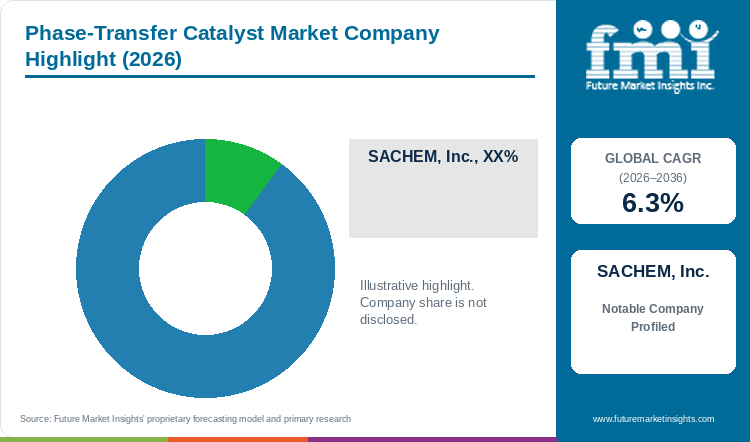
Suppliers differ most in where the catalyst sits in their business. Tatva Chintan makes it as a core product and has manufactured phase-transfer catalysts since 1996. Phase-transfer catalysts account for 23% of its revenue, or INR 1,173 million, in the year to 31 March 2026. It also reported INR 881 million in the first half of fiscal 2027 [1]. The company runs plants at Ankleshwar and Dahej SEZ in Gujarat, with 791 kilolitres of reactor capacity and 39 assembly lines as at 31 March 2026 [1]. It calls itself one of the leading producers of the full range in India and one of the key producers globally [1]. SACHEM, by contrast, sells quaternary ammonium salts within a catalogue aimed mainly at electronics, energy and advanced materials. A phase-transfer catalyst category sits inside that catalogue [4][7].
Chemistry choice separates suppliers too. Ammonium salts hold the largest share of the market. Nippon Chemical Industrial sells phosphonium salts under its Hishicolin brand. It lists phase-transfer catalysis, alkylation, nitrile formation and ether and sulfide synthesis among their uses, along with epoxy curing, antistatic and antibacterial uses and ionic liquids [8]. Its phosphine derivatives sit beside inorganic phosphorus products in its range [9]. In 2026, SACHEM holds 11.5% of the market, Nippon Chemical Industrial 8.9%, Central Drug House 6.1% and Tatva Chintan 1.2%.
Central Drug House serves laboratories and small-batch users. It has supplied laboratory fine chemicals, reagents and culture media since 1981 and lists more than 9,000 products [11]. Its synthesis range includes benzyltriethylammonium chloride, Aliquat 336, benzyl-tributylammonium salts, benzalkonium chloride and crown ethers. Each has a grade label and a specification file [10]. Process-scale and bench-scale buyers therefore tend to shop in different places. A supplier that can move a customer from a catalogue lot to a contract volume gains an advantage.
Key Developments in the Phase-Transfer Catalyst Market
- On 19 October 2026, Tatva Chintan reported quarterly revenue from operations of INR 2,173 million and said its greenfield project was on the planned schedule [1][2].
- On 21 July 2026, SACHEM announced that John Foley had been appointed chief executive officer. John Mooney continues as chairman of the board [5].
- From 29 April to 30 June 2026, the European Medicines Agency ran a consultation on draft annex revisions to the ICH Q3C(R9) residual solvents guideline. Only Annex I was updated [12].
- On 18 March 2025, SACHEM agreed to sell its Asia business operations to Nagase. The acquisition completed in June 2025 [25].
Key Players in the Phase-Transfer Catalyst Market
- SACHEM, Inc.
- Nippon Chemical Industrial Co., Ltd.
- Tatva Chintan Pharma Chem Limited
- Central Drug House
Phase-Transfer Catalyst Market Report Scope
Table 5: Phase-Transfer Catalyst Market Report Scope
| Coverage field | Report scope |
|---|---|
| Market definition | Catalysts that move a reactant between phases in heterogeneous organic reactions, measured by value of sales to end-use industries |
| Type | Ammonium Salts, Phosphonium Salts, Others |
| End-Use | Pharmaceuticals, Agriculture, Chemical |
| Regions and profiled countries | North America and Europe (United States, Canada, Mexico, Germany, United Kingdom, France, Italy) |
| Companies covered | SACHEM, Inc., Nippon Chemical Industrial Co., Ltd., Tatva Chintan Pharma Chem Limited, Central Drug House |
| Forecast period | 2026 to 2036, with 2025 as the historical base year |
| Quantitative Units | USD billion |
Source: Future Market Insights analysis of the phase-transfer catalyst market, 2026.
Phase-Transfer Catalyst Market by Segments
Phase-Transfer Catalyst Market segmented by Type:
- Ammonium Salts
- Phosphonium Salts
- Others
Phase-Transfer Catalyst Market segmented by End-Use:
- Pharmaceuticals
- Agriculture
- Chemical
Phase-Transfer Catalyst Market by Region
- North America
- Europe
- United States
- Canada
- Mexico
- Germany
- United Kingdom
- France
- Italy
Research Sources and Bibliography
- [1] Tatva Chintan Pharma Chem Limited. (2026, October 19). Investor Presentation, Q2 FY27 (updated version). https://www.tatvachintan.com//webfiles/FinancialInformation/PDF/19072026100758Investor%20Presentation.pdf
- [2] Tatva Chintan Pharma Chem Limited. (2026, October 19). Unaudited financial results for the quarter and half year ended 30 September 2026 (stock exchange intimation under Regulations 30 and 33). https://www.tatvachintan.com//webfiles/FinancialInformation/PDF/19592026045958Financial%20Results.pdf
- [3] Tatva Chintan Pharma Chem Limited. (n.d.). Phase Transfer Catalysts. https://www.tatvachintan.com/tatva-chintan-phase-transfer-catalysts.aspx
- [4] SACHEM, Inc. (n.d.). Products. https://www.sacheminc.com/products/
- [5] SACHEM, Inc. (2026, July 21). SACHEM Names John Foley as Chief Executive Officer. https://www.sacheminc.com/sachem-names-john-foley-as-chief-executive-officer/
- [6] SACHEM, Inc. (2025, March 18). SACHEM Agrees to Sell Asia Business Operations to Nagase Corporation. https://www.sacheminc.com/sachem-agrees-to-sell-asia-business-operations-to-nagase-corporation/
- [7] SACHEM, Inc. (2025, January 17). SACHEM, Inc. Announces Relocation of Global Headquarters in Austin, Texas. https://www.sacheminc.com/sachem-inc-announces-relocation-of-global-headquarters-in-austin-texas/
- [8] Nippon Chemical Industrial Co., Ltd. (n.d.). Phosphonium salts (Hishicolin). https://www.nippon-chem.co.jp/products/phosphine/phosphonium/
- [9] Nippon Chemical Industrial Co., Ltd. (n.d.). Phosphine derivatives. https://www.nippon-chem.co.jp/products/phosphine/
- [10] Central Drug House. (n.d.). Chemical Synthesis. https://www.cdhfinechemical.com/chemicals/chemical-synthesis
- [11] Central Drug House. (n.d.). Home. https://www.cdhfinechemical.com
- [12] European Medicines Agency. (2024, April 29). ICH Q3C (R9) Guideline on impurities: guideline for residual solvents (Step 5). https://www.ema.europa.eu/en/ich-q3c-r9-residual-solvents-scientific-guideline
- [13] Food and Agriculture Organization of the United Nations. (2025, July 15). Pesticides use and trade, 1990-2023 (FAOSTAT highlights). https://www.fao.org/statistics/highlights-archive/highlights-detail/pesticides-use-and-trade-1990-2023/en
- [14] Verband der Chemischen Industrie. (2026, August 13). Chemie und Pharma in Deutschland (Branchenportraet). https://www.vci.de/die-branche/zahlen-berichte/branchenportraet-der-deutschen-chemisch-pharmazeutischen-industrie.jsp
- [15] Chemical Industries Association. (2026, October 19). Q3 2026 CIA Business Survey: factories under pressure, UK chemical industry warns of deepening manufacturing decline. https://www.cia.org.uk/q3-2026-cia-business-survey-factories-under-pressure-uk-chemical-industry-warns-of-deepening-manufacturing-decline/1750.article
- [16] Chemistry Industry Association of Canada. (2026, August 24). CIAC Responds to New U.S. Tariffs on Canadian Goods. https://canadianchemistry.ca/ciac-responds-to-new-u-s-tariffs-on-canadian-goods/
- [17] Chemistry Industry Association of Canada. (n.d.). Canadian Chemistry by the Numbers. https://canadianchemistry.ca/
- [18] Asociacion Nacional de la Industria Quimica. (2026, June). Boletin de junio 2026: Reunion Trilateral de la Industria Quimica de Norteamerica. https://aniq.org.mx/boletines/2026/junio/
- [19] Asociacion Nacional de la Industria Quimica. (n.d.). Home. https://aniq.org.mx/webpublico/
- [20] Farmindustria. (n.d.). English content: About Farmindustria. https://www.farmindustria.it/english-content/
- [21] Federchimica. (n.d.). The chemical sectors in Italy. https://www.federchimica.it/en/sector-and-associations/the-chemical-sectors-in-italy
- [22] France Chimie. (n.d.). Home. https://francechimie.fr/
- [23] France Chimie. (2026, September 14). Bulletin economique, 2eme trimestre 2026 (Chiffres cles et conjoncture). https://francechimie.fr/chiffres-cles-conjoncture
- [24] American Chemistry Council. (n.d.). Data and industry statistics. https://americanchemistry.com/chemistry-in-america/data-industry-statistics
- [25] Nagase & Co., Ltd. (2026, February 5). Investor relations material on consolidated subsidiaries and the SACHEM Asia acquisition (PDF). https://www.nagase.co.jp/assetfiles/uploads/20260205_IR_05e.pdf
- [26] Nagase & Co., Ltd. (2026, May 7). Investor relations material on consolidation scope and entity name changes (PDF). https://www.nagase.co.jp/assetfiles/uploads/20260507_IR_01e.pdf
Table of Content
Table of Content
- Key Takeaways
- Market Size and CAGR
- Top Growth Driver
- Fastest Growing Segment
- Leading Region
- Key Companies
- Emerging Opportunities
- Executive Summary
- Global Market Outlook
- Demand-side Trends
- Supply-side Trends
- Technology Roadmap Analysis
- Analysis and Recommendations
- Analyst Perspective (What is happening? Why now? What should investors know?)
- Key Questions Answered
- How large is the market?
- What is the CAGR?
- What are key trends?
- Which region dominates?
- Who are the leaders?
Read More...
- Market Overview
- Market Coverage / Taxonomy
- Market Definition / Scope / Limitations
- Research Methodology
- Chapter Orientation
- Analytical Lens and Working Hypotheses
- Market Structure, Signals, and Trend Drivers
- Benchmarking and Cross-market Comparability
- Market Sizing, Forecasting, and Opportunity Mapping
- Research Design and Evidence Framework
- Desk Research Programme (Secondary Evidence)
- Expert Input and Fieldwork (Primary Evidence)
- Tooling, Models, and Reference Databases
- Data Engineering and Model Build
- Quality Assurance and Audit Trail
- Market Background
- Market Dynamics (Drivers, Restraints, Opportunity, Trends)
- Scenario Forecast (Optimistic, Likely, Conservative)
- Impact Analysis
- AI Impact
- Sustainability Impact
- Regulatory Impact
- Technology Impact
- Consumer / Buyer Analysis
- Purchase Drivers
- Adoption Barriers
- Buyer Journey
- Opportunity Map Analysis
- Product Life Cycle Analysis
- Supply Chain Analysis
- Investment Feasibility Matrix
- Value Chain Analysis
- PESTLE and Porter's Analysis
- Regulatory Landscape
- Regional Parent Market Outlook
- Production and Consumption Statistics
- Import and Export Statistics
- Global Market Analysis and Forecast, 2021 to 2036
- Historical Market Size Value (USD Billion) Analysis, 2021 to 2025
- Current and Future Market Size Value (USD Billion) Projections, 2026 to 2036
- Y-o-Y Growth Trend Analysis
- Absolute $ Opportunity Analysis
- Global Market Pricing Analysis, 2021 to 2036
- Global Market Analysis and Forecast, By Type, 2021 to 2036
- Introduction / Key Findings
- Historical Market Size Value (USD Billion) Analysis By Type, 2021 to 2025
- Current and Future Market Size Value (USD Billion) Analysis and Forecast By Type, 2026 to 2036
- Ammonium Salts
- Phosphonium Salts
- Others
- Y-o-Y Growth Trend Analysis By Type, 2021 to 2025
- Absolute $ Opportunity Analysis By Type, 2026 to 2036
- Global Market Analysis and Forecast, By End-Use, 2021 to 2036
- Introduction / Key Findings
- Historical Market Size Value (USD Billion) Analysis By End-Use, 2021 to 2025
- Current and Future Market Size Value (USD Billion) Analysis and Forecast By End-Use, 2026 to 2036
- Pharmaceuticals
- Agriculture
- Chemical
- Y-o-Y Growth Trend Analysis By End-Use, 2021 to 2025
- Absolute $ Opportunity Analysis By End-Use, 2026 to 2036
- Global Market Analysis and Forecast, By Region, 2021 to 2036
- Introduction
- Historical Market Size Value (USD Billion) Analysis By Region, 2021 to 2025
- Current Market Size Value (USD Billion) Analysis and Forecast By Region, 2026 to 2036
- North America
- Europe
- Market Attractiveness Analysis By Region
- North America Market Analysis and Forecast, By Country, 2021 to 2036
- Historical Market Size Value (USD Billion) Trend Analysis By Market Taxonomy, 2021 to 2025
- Market Size Value (USD Billion) Forecast By Market Taxonomy, 2026 to 2036
- By Country
- By Type
- By End-Use
- Market Attractiveness Analysis
- By Country
- By Type
- By End-Use
- Key Takeaways
- Europe Market Analysis and Forecast, By Country
- Historical Market Size Value (USD Billion) Trend Analysis By Market Taxonomy, 2021 to 2025
- Market Size Value (USD Billion) Forecast By Market Taxonomy, 2026 to 2036
- By Country
- United States
- Canada
- Mexico
- Germany
- United Kingdom
- France
- Italy
- By Type
- By End-Use
- By Country
- Market Attractiveness Analysis
- By Country
- By Type
- By End-Use
- Key Takeaways
- Key Countries Market Analysis
- United States
- Pricing Analysis
- Market Share Analysis, 2025
- By Type
- By End-Use
- Canada
- Pricing Analysis
- Market Share Analysis, 2025
- By Type
- By End-Use
- Mexico
- Pricing Analysis
- Market Share Analysis, 2025
- By Type
- By End-Use
- Germany
- Pricing Analysis
- Market Share Analysis, 2025
- By Type
- By End-Use
- United Kingdom
- Pricing Analysis
- Market Share Analysis, 2025
- By Type
- By End-Use
- Italy
- Pricing Analysis
- Market Share Analysis, 2025
- By Type
- By End-Use
- France
- Pricing Analysis
- Market Share Analysis, 2025
- By Type
- By End-Use
- United States
- Market Structure Analysis
- Competition Dashboard
- Competition Benchmarking
- Market Share Analysis of Top Players
- By Regional
- By Type
- By End-Use
- Emerging Startups
- Innovation Benchmarking
- Competition Analysis
- Competition Deep Dive
- SACHEM, Inc.
- Overview
- Product Portfolio
- Profitability by Market Segments
- Sales Footprint
- Strategy Overview
- Marketing Strategy
- Product Strategy
- Channel Strategy
- Nippon Chemical Industrial Co., Ltd.
- Tatva Chintan Pharma Chem Limited
- Central Drug House
- SACHEM, Inc.
- Case Studies
- Success Stories
- Recent Developments
- Competition Deep Dive
- Assumptions & Acronyms Used
List of Tables
- Table 1: Global Market Value (USD Billion) Forecast by Region, 2021 to 2036
- Table 2: Global Market Value (USD Billion) Forecast by Type, 2021 to 2036
- Table 3: Global Market Value (USD Billion) Forecast by End-Use, 2021 to 2036
- Table 4: North America Market Value (USD Billion) Forecast by Country, 2021 to 2036
- Table 5: North America Market Value (USD Billion) Forecast by Type, 2021 to 2036
- Table 6: North America Market Value (USD Billion) Forecast by End-Use, 2021 to 2036
- Table 7: Europe Market Value (USD Billion) Forecast by Country, 2021 to 2036
- Table 8: Europe Market Value (USD Billion) Forecast by Type, 2021 to 2036
- Table 9: Europe Market Value (USD Billion) Forecast by End-Use, 2021 to 2036
List of Figures
- Figure 1: Global Market Pricing Analysis
- Figure 2: Global Market Value (USD Billion) Forecast 2021-2036
- Figure 3: Global Market Value Share and BPS Analysis by Type, 2026 and 2036
- Figure 4: Global Market Y-o-Y Growth Comparison by Type, 2026-2036
- Figure 5: Global Market Attractiveness Analysis by Type
- Figure 6: Global Market Value Share and BPS Analysis by End-Use, 2026 and 2036
- Figure 7: Global Market Y-o-Y Growth Comparison by End-Use, 2026-2036
- Figure 8: Global Market Attractiveness Analysis by End-Use
- Figure 9: Global Market Value (USD Billion) Share and BPS Analysis by Region, 2026 and 2036
- Figure 10: Global Market Y-o-Y Growth Comparison by Region, 2026-2036
- Figure 11: Global Market Attractiveness Analysis by Region
- Figure 12: North America Market Incremental Dollar Opportunity, 2026-2036
- Figure 13: Europe Market Incremental Dollar Opportunity, 2026-2036
- Figure 14: North America Market Value Share and BPS Analysis by Country, 2026 and 2036
- Figure 15: North America Market Value Share and BPS Analysis by Type, 2026 and 2036
- Figure 16: North America Market Y-o-Y Growth Comparison by Type, 2026-2036
- Figure 17: North America Market Attractiveness Analysis by Type
- Figure 18: North America Market Value Share and BPS Analysis by End-Use, 2026 and 2036
- Figure 19: North America Market Y-o-Y Growth Comparison by End-Use, 2026-2036
- Figure 20: North America Market Attractiveness Analysis by End-Use
- Figure 21: Europe Market Value Share and BPS Analysis by Country, 2026 and 2036
- Figure 22: Europe Market Value Share and BPS Analysis by Type, 2026 and 2036
- Figure 23: Europe Market Y-o-Y Growth Comparison by Type, 2026-2036
- Figure 24: Europe Market Attractiveness Analysis by Type
- Figure 25: Europe Market Value Share and BPS Analysis by End-Use, 2026 and 2036
- Figure 26: Europe Market Y-o-Y Growth Comparison by End-Use, 2026-2036
- Figure 27: Europe Market Attractiveness Analysis by End-Use
- Figure 28: Global Market - Tier Structure Analysis
- Figure 29: Global Market - Company Share Analysis
Frequently Asked Questions
How big is the phase-transfer catalyst market in 2026?
The Phase-Transfer Catalyst Market is estimated at USD 1.4 billion in 2026, up from USD 1.3 billion in 2025. It is projected to reach USD 2.6 billion by 2036, a 6.3% CAGR from 2026 to 2036. Tatva Chintan reported on 19 October 2026 its highest-ever quarterly turnover, with phase-transfer catalysts about a fifth of it [1].
Which type and end-use lead the phase-transfer catalyst market?
Ammonium Salts lead by type with 49.0% of the market in 2026. Pharmaceuticals lead by end-use with 49.0%. Tatva Chintan, SACHEM and Central Drug House all list quaternary ammonium products [1][3][4][10]. Tatva Chintan also names pharmaceutical active ingredients first among its end-user industries [1].
Which other segments matter?
By type, Phosphonium Salts hold 29.0% and Others 22.0%. By end-use, Agriculture holds 29.0% and Chemical 22.0%. Phosphonium salts are the main alternative chemistry. Nippon Chemical Industrial lists phase-transfer catalysis among the uses of its tetrabutyl and methyltributyl phosphonium salts [8]. FAO data show global pesticide use of 3.73 million tonnes of active ingredient in 2023. That volume is the backdrop for the agriculture end-use [13].
Which profiled country is forecast to grow fastest?
Germany has the highest forecast CAGR of the seven profiled countries, at 6.6% from 2026 to 2036. Canada and the United Kingdom follow at 6.3% each, and France at 6.2%. Germany's chemical and pharmaceutical industry had sales of EUR 220 billion and exports above EUR 252 billion in 2025 [14].
Which regulation affects phase-transfer catalyst demand?
The ICH Q3C(R9) guideline on residual solvents sets acceptable amounts of residual solvents in pharmaceuticals. It recommends less toxic solvents. The European Medicines Agency lists an effective date of 29 April 2024 and a consultation on draft annex revisions from 29 April to 30 June 2026 [12]. Reactions that need less solvent therefore have a compliance benefit. Each route still has to be validated by the drug maker.
What should a buyer check when choosing a supplier?
Confirm the grade, the salt and the documentation first. Central Drug House labels grades such as for synthesis and analytical reagent, and links a specification file to each product [10]. Then check the supply route. SACHEM agreed in March 2025 to sell its Asia operations to Nagase, so buyers should confirm which entity ships a lot [6]. Tatva Chintan also reported freight increases above 100% in certain sectors of the United States and Europe in the quarter to 30 September 2026 [1].
Preview the report firsthand - request a free sample
Get SampleGet the brochure for pricing and purchase details.
Get PDF
