

- Industry Size (2026)
- USD 2.856 Bn
- Forecast (2036)
- USD 3.481 Bn
- CAGR (2026 to 2036)
- 2.00%
E-Series Glycol Ether Market Size, Market Forecast and Outlook By FMI
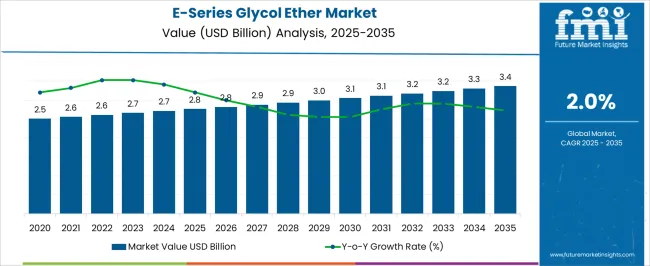
The E-Series Glycol Ether Market was valued at USD Billion 2.639 in 2025, projected to reach USD Billion 2.856 in 2026, and is forecast to expand to USD Billion 3.481 by 2036 at a 2.00% CAGR. The transition toward sustainable solvent formulations and bio-based alternatives is reshaping procurement specifications across coatings, cleaning, and personal care industries. Rising compliance mandates and technology advancement cycles are accelerating adoption across primary end-use verticals.
Summary of E-Series Glycol Ether Market
- Market Snapshot
- The E-Series Glycol Ether Market is valued at USD Billion 2.639 in 2025 and is projected to reach USD Billion 3.481 by 2036.
- The industry is expected to grow at a 2.00% CAGR from 2026 to 2036, creating an incremental opportunity of USD Billion 0.625.
- The market operates as a regulation-influenced specialty chemical category where VOC compliance mandates, REACH restrictions, and sustainable formulation trends define product positioning and customer procurement criteria.
- Demand and Growth Drivers
- Demand is rising as coatings and cleaning formulation manufacturers face increasing regulatory pressure to replace high-VOC solvents with compliant glycol ether alternatives.
- Paints and coatings industry expansion across Asia Pacific and residential construction growth in emerging markets are creating sustained volume demand for E-series glycol ether coalescents and coupling agents.
- Industrial cleaning and precision manufacturing sectors are expanding glycol ether solvent consumption as high-performance degreasing and surface preparation requirements increase across electronics and aerospace verticals.
- Among key countries, India leads at 3.8% CAGR, followed by China at 3.2%, the USA at 2.3%, Germany at 1.6%, the UK at 1.4%, and Japan at 1.1%.
- Product and Segment View
- The E-Series Glycol Ether Market encompasses Glycol Ether Type, Molecular Weight, Application, EGBE categories formulated to meet solvency, coalescence, and coupling performance specifications across industrial and specialty chemical end uses.
- EGBE leads the Glycol Ether Type category with 32.6% share in 2026, driven by broad industrial solvency profile and established formulation compatibility across paints, coatings, and cleaning applications.
- Low Molecular Weight E-Series Glycol Ether captures 54.8% of segment revenue, supported by growing adoption in specialty chemical intermediates and cosmetics formulation as formulators transition toward compliant alternatives.
- Scope includes certified E-series glycol ether compounds; excludes P-series glycol ethers and general petroleum solvents without glycol ether functional group composition.
- Geography and Competitive Outlook
- India and China represent the fastest-growing adoption zones, while North America and Europe anchor high-value demand through mature industrial coatings and specialty chemical manufacturing.
- Competition is defined by feedstock access, application formulation expertise, and REACH/EPA compliance certification capabilities.
- Key companies active in this market include LyondellBasell, Mitsubishi Chemical Holdings, BASF, Evonik Industries, LG Chem, Solvay, Eastman Chemical Company, Huntsman, Daicel, Tosoh.
E-Series Glycol Ether Market Key Takeaways
| Metric | Details |
|---|---|
| Industry Size (2026) | USD Billion 2.856 |
| Industry Value (2036) | USD Billion 3.481 |
| CAGR (2026-2036) | 2.00% |
Source: Future Market Insights, 2026
The transition toward sustainable solvent formulations and bio-based alternatives is reshaping procurement specifications across coatings, cleaning, and personal care industries. Regulatory restrictions under REACH and EPA guidelines on volatile organic compound emissions have elevated demand for compliant glycol ether grades that meet performance thresholds without exceeding permissible exposure limits. Formulators operating in paints and coatings, industrial cleaners, and specialty chemical markets have restructured purchasing frameworks around certified low-VOC ether grades.
India sets the pace with a 3.8% CAGR, followed by China at 3.2% as both nations expand domestic paints, coatings, and specialty chemical manufacturing. United States operations advance at a 2.3% rate, supported by industrial coatings and cleaning formulation demand. Germany registers a 1.6% pace, driven by precision coatings and automotive finishing applications. United Kingdom networks maintain a 1.4% expansion trajectory anchored by specialty chemical and cosmetics manufacturing. Japan expands at a 1.1% trajectory supported by electronics cleaning and semiconductor process chemical applications.
E-Series Glycol Ether Market Definition
The E-Series Glycol Ether Market encompasses E-series glycol ethers derived from ethylene oxide and alcohols, serving as coupling agents, solvents, and coalescents across paints, coatings, cleaning formulations, and cosmetics manufacturing. These compounds are characterized by their hydroxyl and ether functional groups that confer tunable solvency, water miscibility, and controlled evaporation rates for industrial process applications.
E-Series Glycol Ether Market Inclusions
Market scope includes ethylene glycol monobutyl ether (EGBE), ethylene glycol monopropyl ether (EGPE), ethylene glycol monobutyl ether acetate (EGBEA), and related E-series glycol ether compounds across low and high molecular weight grades. Industrial solvent formulations, coalescent applications, and specialty chemical intermediates utilizing certified E-series glycol ethers fall within defined analytical boundaries.
E-Series Glycol Ether Market Exclusions
Standard petroleum-derived solvents lacking glycol ether functional groups are excluded. P-series glycol ethers derived from propylene oxide fall outside analytical parameters. General-purpose industrial solvents without certified glycol ether composition and downstream finished chemical products manufactured using E-series glycol ethers as process inputs are explicitly omitted from market valuation scope.
E-Series Glycol Ether Market Research Methodology
- Primary Research: Analysts engaged with specialty chemical procurement managers, formulation chemists, and industrial coatings technical leads to map solvent qualification processes and regulatory compliance investment cycles.
- Desk Research: Data collection phases aggregated REACH regulation restriction schedules, EPA VOC emission standard updates, chemical industry trade association production statistics, and national industrial output data.
- Market-Sizing and Forecasting: Baseline values derive from a bottom-up aggregation of E-series glycol ether production volumes by grade and end-use application, applying regional demand growth curves to project forward consumption trajectories.
- Data Validation and Update Cycle: Projections are tested against publicly reported chemical production capacity announcements, feedstock pricing disclosures, and trade flow data from national customs authorities.
Why is the E-Series Glycol Ether Market Growing?
The E-Series Glycol Ether market is experiencing steady growth, driven by increasing industrial and commercial demand for solvents that provide enhanced performance, safety, and environmental compliance. Rising consumption in coatings, paints, cleaning agents, and industrial chemicals is supporting market expansion, as E-Series glycol ethers are favored for their excellent solvency, low volatility, and compatibility with a range of formulations. The market is further shaped by technological innovations in low molecular weight and specialty glycol ethers, which improve drying time, viscosity control, and performance efficiency in formulations.
Environmental and regulatory considerations, including VOC reduction mandates and worker safety regulations, are influencing the adoption of safer glycol ether variants. Growth is also being propelled by ongoing research in alternative, sustainable solvents and bio-based raw materials.
With increasing demand for high-quality chemical intermediates across paints, coatings, and cleaning applications, the market is expected to expand steadily Manufacturers focusing on high-performance, compliant, and application-specific E-Series glycol ethers are anticipated to drive future growth, reinforcing the relevance of these compounds in industrial and commercial use.
Segmental Analysis
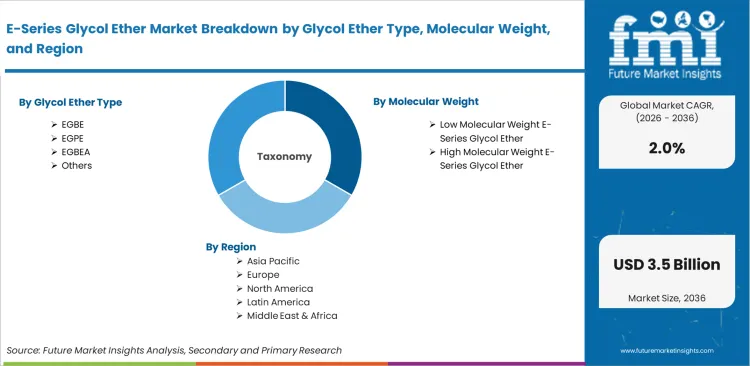
The e-series glycol ether market is segmented by glycol ether type, molecular weight, application, and geographic regions. By glycol ether type, e-series glycol ether market is divided into EGBE (Ethylene Glycol Butyl Ether), EGPE (Ethylene Glycol Propyl Ether), EGBEA (Ethylene Glycol Butyl Ether Acetate), and Others. In terms of molecular weight, e-series glycol ether market is classified into Low Molecular Weight E-Series Glycol Ether and High Molecular Weight E-Series Glycol Ether. Based on application, e-series glycol ether market is segmented into Paints & Coatings, Cleaners, Cosmetics & Personal Care, Chemical Intermediates, Pharmaceuticals, Printing Ink, and Others. Regionally, the e-series glycol ether industry is classified into North America, Latin America, Western Europe, Eastern Europe, Balkan & Baltic Countries, Russia & Belarus, Central Asia, East Asia, South Asia & Pacific, and the Middle East & Africa.
Insights into the EGBE Ethylene Glycol Butyl Ether Glycol Ether Type Segment
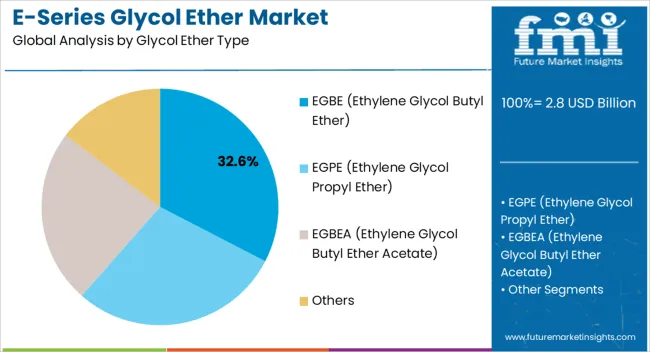
The EGBE Ethylene Glycol Butyl Ether segment is projected to hold 32.6% of the market revenue in 2026, positioning it as the leading glycol ether type. Its dominance is being driven by superior solvency, low evaporation rate, and compatibility with various industrial and commercial formulations. EGBE is widely utilized in paints, coatings, and cleaning applications where effective wetting, leveling, and drying control are critical for high-quality performance.
The chemical’s stability under varying temperature conditions and its ability to enhance film formation have strengthened its preference among formulators. Regulatory compliance, including VOC limits and worker safety requirements, has further reinforced EGBE’s adoption, as it balances performance with environmental and safety considerations.
The segment is supported by ongoing innovation in solvent blends and formulation optimization, which enable higher efficiency and reduced production costs As industrial sectors continue to prioritize performance, safety, and compliance, EGBE is expected to maintain its leadership in the glycol ether type category, driven by its reliability, versatility, and integration into high-demand applications.
Insights into the Low Molecular Weight E-Series Glycol Ether Molecular Weight Segment
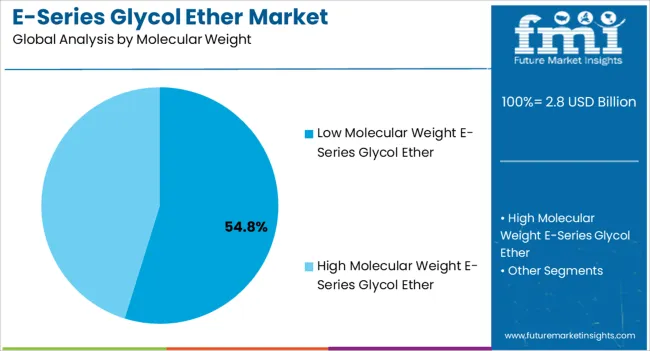
The low molecular weight E-Series glycol ether segment is anticipated to account for 54.8% of the market revenue in 2026, making it the leading molecular weight category. Its growth is being driven by superior volatility control, high solvency power, and excellent compatibility with a range of industrial formulations. Low molecular weight variants are preferred in applications such as paints, coatings, and cleaning agents because they improve drying times, film formation, and surface finish quality.
The ability to reduce viscosity while maintaining high performance enhances production efficiency and formulation flexibility. Safety and environmental compliance further support adoption, as low molecular weight E-Series glycol ethers offer reduced exposure risks and align with regulatory requirements.
Manufacturers benefit from the segment’s versatility, which enables optimization of solvent blends for various end-use applications As demand for efficient, compliant, and high-performing chemical solutions continues to rise, the low molecular weight E-Series glycol ether segment is expected to maintain its dominant market position, supported by technological innovation and increasing adoption across industrial applications.
Insights into the Paints and Coatings Application Segment
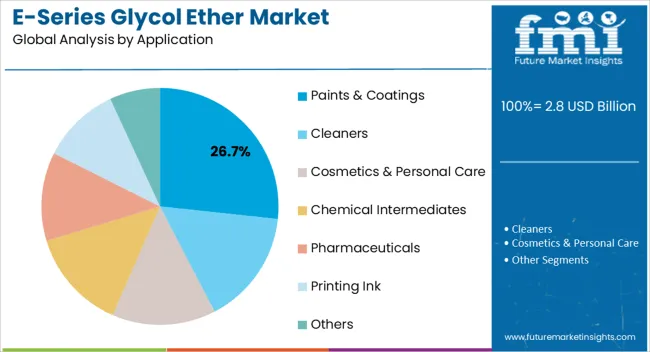
The paints and coatings application segment is expected to account for 26.7% of the market revenue in 2026, establishing it as the leading application area. Growth in this segment is being driven by the need for high-performance formulations that provide uniform coverage, smooth finishing, and enhanced durability. E-Series glycol ethers, particularly low molecular weight variants, are widely used in paints and coatings to improve flow, leveling, and drying characteristics.
Their compatibility with a wide range of resins and pigments enhances formulation efficiency and final product quality. Regulatory requirements for low VOC content and safer chemical profiles are reinforcing the adoption of these solvents in coatings applications.
Demand is further supported by the growth of construction, automotive, and industrial maintenance sectors, which rely on high-performance coatings for durability and aesthetic quality As manufacturers continue to prioritize formulation performance, compliance, and process efficiency, the paints and coatings application segment is expected to remain the primary driver of E-Series glycol ether market growth, sustained by technological advancements and increasing industrial demand.
Market Overview
E-Series Glycol Ether Market Overview
Glycol ethers form family of solvents based on alkyl ethers of propylene glycol or ethylene glycol. E-series glycol ether is made from ethylene oxide as a raw material and hence called as e-series. On attachment of repetitive units of ethylene oxide group’s e-series can have mono, di, and tri-ethylene glycol ethers.
E-series glycol ether are characterised by their strong compatibility with water and also with various organic solvents. The other important properties of e-series glycol ether includes low volatility, solvent strength, and ability to act as coupling agents promoting the miscibility of organic and aqueous phases.
E-series glycol ether find wide applications in cleaning, pharmaceutical, personal care and cosmetic, act as plasticizer in plastic resins and solvents in paints etc. The high molecular weight e-series glycol ether are commonly used as fluids in hydraulic brakes. The global e-series glycol ether market is expected to grow significantly during the forecast period with increasing use of e-series glycol ether in various industries.
Analysis of E-Series Glycol Ether Market By Key Countries
.webp "Top Country Growth Comparison E Series Glycol Ether Market Cagr (2026 2036)")
| Country | CAGR |
|---|---|
| China | 2.7% |
| India | 2.5% |
| Germany | 2.3% |
| France | 2.1% |
| UK | 1.9% |
| USA | 1.7% |
| Brazil | 1.5% |
Country-wise Analysis
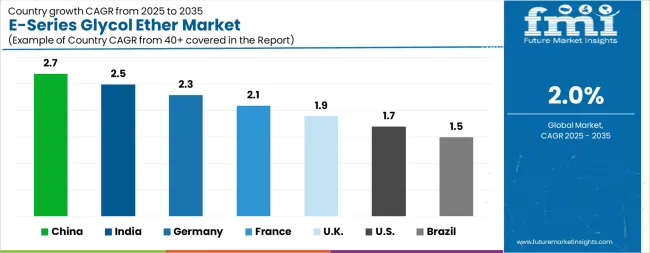
The E-Series Glycol Ether Market is expected to register a CAGR of 2.0% during the forecast period, exhibiting varied country level momentum. China leads with the highest CAGR of 2.7%, followed by India at 2.5%. Developed markets such as Germany, France, and the UK continue to expand steadily, while the USA is likely to grow at consistent rates. Brazil posts the lowest CAGR at 1.5%, yet still underscores a broadly positive trajectory for the global E-Series Glycol Ether Market. In 2026, Germany held a dominant revenue in the Western Europe market and is expected to grow with a CAGR of 2.3%. The USA E-Series Glycol Ether Market is estimated to be valued at USD 1.0 billion in 2026 and is anticipated to reach a valuation of USD 1.2 billion by 2036. Sales are projected to rise at a CAGR of 1.7% over the forecast period between 2026 and 2036. While Japan and South Korea markets are estimated to be valued at USD 136.1 million and USD 79.3 million respectively in 2026.
Key Players in the E-Series Glycol Ether Market
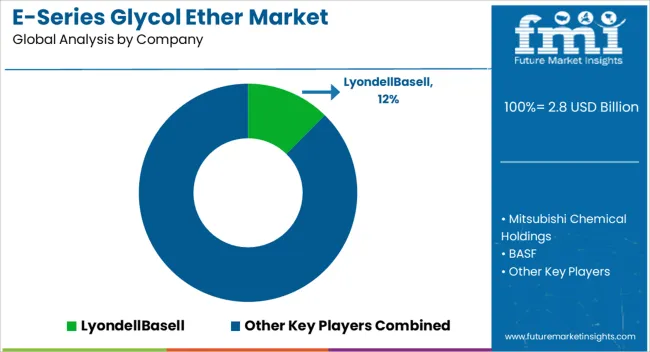
- LyondellBasell
- Mitsubishi Chemical Holdings
- BASF
- Evonik Industries
- LG Chem
- Solvay
- Eastman Chemical Company
- Huntsman
- Daicel
- Tosoh
- INEOS
- Dow Chemical Company
- Kuraray
- SABIC
- Shell
Scope of the Report
| Metric | Value |
|---|---|
| Quantitative Units | USD Billion 2.856 to USD Billion 3.481, at a CAGR of 2.00% |
| Market Definition | The E-Series Glycol Ether Market encompasses E-series glycol ethers derived from ethylene oxide and alcohols, serving as coupling agents, solvents, and coalescents across paints, coatings, cleaning fo... |
| Glycol Ether Type Segmentation | Glycol Ether Type, Molecular Weight, Application, EGBE |
| EGBE Segmentation | Low Molecular Weight E-Series Glycol Ether, Paints & Coatings, EGPE, High Molecular Weight E-Series Glycol Ether |
| Regions Covered | North America, Latin America, Europe, East Asia, South Asia, Oceania, Middle East & Africa |
| Countries Covered | India, China, USA, Canada, UK, Germany, Japan, and 40 plus countries |
| Key Companies Profiled | LyondellBasell, Mitsubishi Chemical Holdings, BASF, Evonik Industries, LG Chem, Solvay, Eastman Chemical Company, Huntsman, Daicel, Tosoh |
| Forecast Period | 2026 to 2036 |
| Approach | Bottom-up methodology with primary research validation and scenario-based demand modeling. |
E-Series Glycol Ether Market by Segments
Glycol Ether Type:
- EGBE (Ethylene Glycol Butyl Ether)
- EGPE (Ethylene Glycol Propyl Ether)
- EGBEA (Ethylene Glycol Butyl Ether Acetate)
- Others
Molecular Weight:
- Low Molecular Weight E-Series Glycol Ether
- High Molecular Weight E-Series Glycol Ether
Application:
- Paints & Coatings
- Cleaners
- Cosmetics & Personal Care
- Chemical Intermediates
- Pharmaceuticals
- Printing Ink
- Others
Region:
- North America
- USA
- Canada
- Mexico
- Latin America
- Brazil
- Chile
- Rest of Latin America
- Western Europe
- Germany
- UK
- Italy
- Spain
- France
- Nordic
- BENELUX
- Rest of Western Europe
- Eastern Europe
- Russia
- Poland
- Hungary
- Balkan & Baltic
- Rest of Eastern Europe
- East Asia
- China
- Japan
- South Korea
- South Asia and Pacific
- India
- ASEAN
- Australia & New Zealand
- Rest of South Asia and Pacific
- Middle East & Africa
- Kingdom of Saudi Arabia
- Other GCC Countries
- Turkiye
- South Africa
- Other African Union
- Rest of Middle East & Africa
Bibliography
- 1. European Chemicals Agency. (2025). REACH Regulation Substance Evaluation and Restriction Updates. ECHA. https://www.echa.europa.eu/
- 2. USA Environmental Protection Agency. (2025). National Volatile Organic Compound Emission Standards for Consumer Products. EPA. https://www.epa.gov/
- 3. Organisation for Economic Co-operation and Development. (2025). Chemicals Outlook 2025. OECD Publishing. https://www.oecd.org/
- 4. European Commission, Directorate-General for Internal Market, Industry, Entrepreneurship and SMEs. (2025). European Chemical Industry Strategy. European Commission. https://ec.europa.eu/
- 5. American Chemistry Council. (2025). Chemical Industry Situation and Outlook Report. ACC. https://www.americanchemistry.com/
- 6. World Bank. (2025). Commodity Markets Outlook: Chemical Sector. World Bank Group. https://www.worldbank.org/
- 7. International Labour Organization. (2023). Safety and Health in the Chemical Industries. ILO. https://www.ilo.org/
This bibliography is provided for reader reference. The full Future Market Insights report contains the complete reference list with primary research documentation.
Frequently Asked Questions
How large is the demand for E-Series Glycol Ether Market in the global market in 2026?
Demand for E-Series Glycol Ether Market in the global market is estimated to be valued at USD Billion 2.856 in 2026.
What will the market size of E-Series Glycol Ether Market be by 2036?
Market size for E-Series Glycol Ether Market is projected to reach USD Billion 3.481 by 2036.
What is the expected demand growth for E-Series Glycol Ether Market between 2026 and 2036?
Demand for E-Series Glycol Ether Market is expected to grow at a CAGR of 2.00% between 2026 and 2036.
Which Glycol Ether Type segment is poised to lead global sales by 2026?
EGBE accounts for 32.6% in 2026 as formulators across paints, coatings, and industrial cleaning applications rely on established EGBE solvency and coupling performance specifications.
What is driving demand in India for E-Series Glycol Ether Market?
Indian paints and coatings manufacturing capacity expansion and domestic specialty chemical industry growth, supported by government industrial policy frameworks, are driving adoption at ${indiaCAGR}% CAGR.
Which companies are profiled in this E-Series Glycol Ether Market report?
Key companies profiled include LyondellBasell, Mitsubishi Chemical Holdings, BASF, Evonik Industries, LG Chem, Solvay, Eastman Chemical Company, Huntsman, Daicel, Tosoh.
What compliance standards are referenced in this report?
The report references REACH Regulation (EC) No 1907/2006, EPA National Volatile Organic Compound Emission Standards, and national chemical safety classification frameworks across applicable market segments.
Preview the report firsthand - request a free sample
Get SampleGet the brochure for pricing and purchase details.
Get PDFTable of Content
- Executive Summary
- Global Market Outlook
- Demand-side Trends
- Supply-side Trends
- Technology Roadmap Analysis
- Analysis and Recommendations
- Market Overview
- Market Coverage / Taxonomy
- Market Definition / Scope / Limitations
- Research Methodology
- Chapter Orientation
- Analytical Lens and Working Hypotheses
- Market Structure, Signals, and Trend Drivers
- Benchmarking and Cross-market Comparability
- Market Sizing, Forecasting, and Opportunity Mapping
- Research Design and Evidence Framework
- Desk Research Programme (Secondary Evidence)
- Company Annual and Sustainability Reports
- Peer-reviewed Journals and Academic Literature
- Corporate Websites, Product Literature, and Technical Notes
- Earnings Decks and Investor Briefings
- Statutory Filings and Regulatory Disclosures
- Technical White Papers and Standards Notes
- Trade Journals, Industry Magazines, and Analyst Briefs
- Conference Proceedings, Webinars, and Seminar Materials
- Government Statistics Portals and Public Data Releases
- Press Releases and Reputable Media Coverage
- Specialist Newsletters and Curated Briefings
- Sector Databases and Reference Repositories
- FMI Internal Proprietary Databases and Historical Market Datasets
- Subscription Datasets and Paid Sources
- Social Channels, Communities, and Digital Listening Inputs
- Additional Desk Sources
- Expert Input and Fieldwork (Primary Evidence)
- Primary Modes
- Qualitative Interviews and Expert Elicitation
- Quantitative Surveys and Structured Data Capture
- Blended Approach
- Why Primary Evidence is Used
- Field Techniques
- Interviews
- Surveys
- Focus Groups
- Observational and In-context Research
- Social and Community Interactions
- Stakeholder Universe Engaged
- C-suite Leaders
- Board Members
- Presidents and Vice Presidents
- R&D and Innovation Heads
- Technical Specialists
- Domain Subject-matter Experts
- Scientists
- Physicians and Other Healthcare Professionals
- Governance, Ethics, and Data Stewardship
- Research Ethics
- Data Integrity and Handling
- Primary Modes
- Tooling, Models, and Reference Databases
- Desk Research Programme (Secondary Evidence)
- Data Engineering and Model Build
- Data Acquisition and Ingestion
- Cleaning, Normalisation, and Verification
- Synthesis, Triangulation, and Analysis
- Quality Assurance and Audit Trail
- Market Background
- Market Dynamics
- Drivers
- Restraints
- Opportunity
- Trends
- Scenario Forecast
- Demand in Optimistic Scenario
- Demand in Likely Scenario
- Demand in Conservative Scenario
- Opportunity Map Analysis
- Product Life Cycle Analysis
- Supply Chain Analysis
- Investment Feasibility Matrix
- Value Chain Analysis
- PESTLE and Porter’s Analysis
- Regulatory Landscape
- Regional Parent Market Outlook
- Production and Consumption Statistics
- Import and Export Statistics
- Market Dynamics
- Global Market Analysis 2021 to 2025 and Forecast, 2026 to 2036
- Historical Market Size Value (USD Million) Analysis, 2021 to 2025
- Current and Future Market Size Value (USD Million) Projections, 2026 to 2036
- Y-o-Y Growth Trend Analysis
- Absolute $ Opportunity Analysis
- Global Market Pricing Analysis 2021 to 2025 and Forecast 2026 to 2036
- Global Market Analysis 2021 to 2025 and Forecast 2026 to 2036, By Glycol Ether Type
- Introduction / Key Findings
- Historical Market Size Value (USD Million) Analysis By Glycol Ether Type , 2021 to 2025
- Current and Future Market Size Value (USD Million) Analysis and Forecast By Glycol Ether Type , 2026 to 2036
- EGBE
- EGPE
- EGBEA
- Others
- EGBE
- Y-o-Y Growth Trend Analysis By Glycol Ether Type , 2021 to 2025
- Absolute $ Opportunity Analysis By Glycol Ether Type , 2026 to 2036
- Global Market Analysis 2021 to 2025 and Forecast 2026 to 2036, By Molecular Weight
- Introduction / Key Findings
- Historical Market Size Value (USD Million) Analysis By Molecular Weight, 2021 to 2025
- Current and Future Market Size Value (USD Million) Analysis and Forecast By Molecular Weight, 2026 to 2036
- Low Molecular Weight E-Series Glycol Ether
- High Molecular Weight E-Series Glycol Ether
- Low Molecular Weight E-Series Glycol Ether
- Y-o-Y Growth Trend Analysis By Molecular Weight, 2021 to 2025
- Absolute $ Opportunity Analysis By Molecular Weight, 2026 to 2036
- Global Market Analysis 2021 to 2025 and Forecast 2026 to 2036, By Application
- Introduction / Key Findings
- Historical Market Size Value (USD Million) Analysis By Application, 2021 to 2025
- Current and Future Market Size Value (USD Million) Analysis and Forecast By Application, 2026 to 2036
- Paints & Coatings
- Cleaners
- Cosmetics & Personal Care
- Chemical Intermediates
- Pharmaceuticals
- Printing Ink
- Others
- Paints & Coatings
- Y-o-Y Growth Trend Analysis By Application, 2021 to 2025
- Absolute $ Opportunity Analysis By Application, 2026 to 2036
- Global Market Analysis 2021 to 2025 and Forecast 2026 to 2036, By Region
- Introduction
- Historical Market Size Value (USD Million) Analysis By Region, 2021 to 2025
- Current Market Size Value (USD Million) Analysis and Forecast By Region, 2026 to 2036
- North America
- Latin America
- Western Europe
- Eastern Europe
- East Asia
- South Asia and Pacific
- Middle East & Africa
- Market Attractiveness Analysis By Region
- North America Market Analysis 2021 to 2025 and Forecast 2026 to 2036, By Country
- Historical Market Size Value (USD Million) Trend Analysis By Market Taxonomy, 2021 to 2025
- Market Size Value (USD Million) Forecast By Market Taxonomy, 2026 to 2036
- By Country
- USA
- Canada
- Mexico
- By Glycol Ether Type
- By Molecular Weight
- By Application
- By Country
- Market Attractiveness Analysis
- By Country
- By Glycol Ether Type
- By Molecular Weight
- By Application
- Key Takeaways
- Latin America Market Analysis 2021 to 2025 and Forecast 2026 to 2036, By Country
- Historical Market Size Value (USD Million) Trend Analysis By Market Taxonomy, 2021 to 2025
- Market Size Value (USD Million) Forecast By Market Taxonomy, 2026 to 2036
- By Country
- Brazil
- Chile
- Rest of Latin America
- By Glycol Ether Type
- By Molecular Weight
- By Application
- By Country
- Market Attractiveness Analysis
- By Country
- By Glycol Ether Type
- By Molecular Weight
- By Application
- Key Takeaways
- Western Europe Market Analysis 2021 to 2025 and Forecast 2026 to 2036, By Country
- Historical Market Size Value (USD Million) Trend Analysis By Market Taxonomy, 2021 to 2025
- Market Size Value (USD Million) Forecast By Market Taxonomy, 2026 to 2036
- By Country
- Germany
- UK
- Italy
- Spain
- France
- Nordic
- BENELUX
- Rest of Western Europe
- By Glycol Ether Type
- By Molecular Weight
- By Application
- By Country
- Market Attractiveness Analysis
- By Country
- By Glycol Ether Type
- By Molecular Weight
- By Application
- Key Takeaways
- Eastern Europe Market Analysis 2021 to 2025 and Forecast 2026 to 2036, By Country
- Historical Market Size Value (USD Million) Trend Analysis By Market Taxonomy, 2021 to 2025
- Market Size Value (USD Million) Forecast By Market Taxonomy, 2026 to 2036
- By Country
- Russia
- Poland
- Hungary
- Balkan & Baltic
- Rest of Eastern Europe
- By Glycol Ether Type
- By Molecular Weight
- By Application
- By Country
- Market Attractiveness Analysis
- By Country
- By Glycol Ether Type
- By Molecular Weight
- By Application
- Key Takeaways
- East Asia Market Analysis 2021 to 2025 and Forecast 2026 to 2036, By Country
- Historical Market Size Value (USD Million) Trend Analysis By Market Taxonomy, 2021 to 2025
- Market Size Value (USD Million) Forecast By Market Taxonomy, 2026 to 2036
- By Country
- China
- Japan
- South Korea
- By Glycol Ether Type
- By Molecular Weight
- By Application
- By Country
- Market Attractiveness Analysis
- By Country
- By Glycol Ether Type
- By Molecular Weight
- By Application
- Key Takeaways
- South Asia and Pacific Market Analysis 2021 to 2025 and Forecast 2026 to 2036, By Country
- Historical Market Size Value (USD Million) Trend Analysis By Market Taxonomy, 2021 to 2025
- Market Size Value (USD Million) Forecast By Market Taxonomy, 2026 to 2036
- By Country
- India
- ASEAN
- Australia & New Zealand
- Rest of South Asia and Pacific
- By Glycol Ether Type
- By Molecular Weight
- By Application
- By Country
- Market Attractiveness Analysis
- By Country
- By Glycol Ether Type
- By Molecular Weight
- By Application
- Key Takeaways
- Middle East & Africa Market Analysis 2021 to 2025 and Forecast 2026 to 2036, By Country
- Historical Market Size Value (USD Million) Trend Analysis By Market Taxonomy, 2021 to 2025
- Market Size Value (USD Million) Forecast By Market Taxonomy, 2026 to 2036
- By Country
- Kingdom of Saudi Arabia
- Other GCC Countries
- Turkiye
- South Africa
- Other African Union
- Rest of Middle East & Africa
- By Glycol Ether Type
- By Molecular Weight
- By Application
- By Country
- Market Attractiveness Analysis
- By Country
- By Glycol Ether Type
- By Molecular Weight
- By Application
- Key Takeaways
- Key Countries Market Analysis
- USA
- Pricing Analysis
- Market Share Analysis, 2025
- By Glycol Ether Type
- By Molecular Weight
- By Application
- Canada
- Pricing Analysis
- Market Share Analysis, 2025
- By Glycol Ether Type
- By Molecular Weight
- By Application
- Mexico
- Pricing Analysis
- Market Share Analysis, 2025
- By Glycol Ether Type
- By Molecular Weight
- By Application
- Brazil
- Pricing Analysis
- Market Share Analysis, 2025
- By Glycol Ether Type
- By Molecular Weight
- By Application
- Chile
- Pricing Analysis
- Market Share Analysis, 2025
- By Glycol Ether Type
- By Molecular Weight
- By Application
- Germany
- Pricing Analysis
- Market Share Analysis, 2025
- By Glycol Ether Type
- By Molecular Weight
- By Application
- UK
- Pricing Analysis
- Market Share Analysis, 2025
- By Glycol Ether Type
- By Molecular Weight
- By Application
- Italy
- Pricing Analysis
- Market Share Analysis, 2025
- By Glycol Ether Type
- By Molecular Weight
- By Application
- Spain
- Pricing Analysis
- Market Share Analysis, 2025
- By Glycol Ether Type
- By Molecular Weight
- By Application
- France
- Pricing Analysis
- Market Share Analysis, 2025
- By Glycol Ether Type
- By Molecular Weight
- By Application
- India
- Pricing Analysis
- Market Share Analysis, 2025
- By Glycol Ether Type
- By Molecular Weight
- By Application
- ASEAN
- Pricing Analysis
- Market Share Analysis, 2025
- By Glycol Ether Type
- By Molecular Weight
- By Application
- Australia & New Zealand
- Pricing Analysis
- Market Share Analysis, 2025
- By Glycol Ether Type
- By Molecular Weight
- By Application
- China
- Pricing Analysis
- Market Share Analysis, 2025
- By Glycol Ether Type
- By Molecular Weight
- By Application
- Japan
- Pricing Analysis
- Market Share Analysis, 2025
- By Glycol Ether Type
- By Molecular Weight
- By Application
- South Korea
- Pricing Analysis
- Market Share Analysis, 2025
- By Glycol Ether Type
- By Molecular Weight
- By Application
- Russia
- Pricing Analysis
- Market Share Analysis, 2025
- By Glycol Ether Type
- By Molecular Weight
- By Application
- Poland
- Pricing Analysis
- Market Share Analysis, 2025
- By Glycol Ether Type
- By Molecular Weight
- By Application
- Hungary
- Pricing Analysis
- Market Share Analysis, 2025
- By Glycol Ether Type
- By Molecular Weight
- By Application
- Kingdom of Saudi Arabia
- Pricing Analysis
- Market Share Analysis, 2025
- By Glycol Ether Type
- By Molecular Weight
- By Application
- Turkiye
- Pricing Analysis
- Market Share Analysis, 2025
- By Glycol Ether Type
- By Molecular Weight
- By Application
- South Africa
- Pricing Analysis
- Market Share Analysis, 2025
- By Glycol Ether Type
- By Molecular Weight
- By Application
- USA
- Market Structure Analysis
- Competition Dashboard
- Competition Benchmarking
- Market Share Analysis of Top Players
- By Regional
- By Glycol Ether Type
- By Molecular Weight
- By Application
- Competition Analysis
- Competition Deep Dive
- LyondellBasell
- Overview
- Product Portfolio
- Profitability by Market Segments (Product/Age /Sales Channel/Region)
- Sales Footprint
- Strategy Overview
- Marketing Strategy
- Product Strategy
- Channel Strategy
- Mitsubishi Chemical Holdings
- BASF
- Evonik Industries
- LG Chem
- Solvay
- Eastman Chemical Company
- Huntsman
- Daicel
- Tosoh
- INEOS
- Dow Chemical Company
- Kuraray
- SABIC
- Shell
- LyondellBasell
- Competition Deep Dive
- Assumptions & Acronyms Used


