

- Industry Size (2026)
- USD 16.9 Bn
- Forecast (2036)
- USD 34.3 Bn
- CAGR
- (2026 to 2036)
Zeolite Market Size and Share Forecast Outlook By FMI
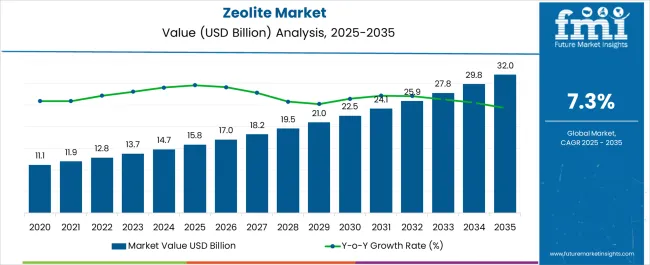
In 2025, the Zeolite Market secured a value of USD 15.8 billion. Based on Future Market Insights' analysis, demand is estimated to grow to USD 16.9 billion in 2026 and USD 34.3 billion by 2036. FMI projects a CAGR of 7.3% during the forecast period.
The sector is undergoing a structural evolution driven by the global push for sustainability and resource efficiency. The first half of the decade (2026-2030) will witness steady growth fueled by the expanding use of zeolites in emissions control (automotive catalysts) and eco-friendly detergents. The latter half (2031-2036) will see sustained demand driven by emerging applications in renewable fuel production, carbon capture, and advanced water treatment. The shift toward synthetic zeolites with tailored pore structures is effectively creating a high-value tier in the market, distinguishing specialized solutions from standard natural deposits.
Summary of Zeolite Market
- Market Definition:
- The industry covers porous aluminosilicate materials essential for catalysis, separation, and ion exchange processes in modern industry.
- Demand Drivers:
- Petrochemical Efficiency: Zeolites are critical for maximizing yield in refining and chemical synthesis.
- Environmental Regulations: Stricter standards for water quality and emissions drive demand for zeolite adsorbents.
- Sustainable Consumer Goods: The shift to phosphate-free detergents boosts the use of zeolite builders.
- Key Segments Analyzed:
- Type: Natural Zeolite (55.3% share) dominates due to its abundance and cost-effectiveness in large-scale applications like agriculture and water treatment.
- Function: Catalysts (38.7% share) lead by value, driven by their indispensable role in the high-value petrochemical and refining sectors.
- Geography: Asia Pacific leads volume growth, supported by the massive industrial and construction output of China and India.
- Analyst Opinion:
- Nikhil Kaitwade, Principal Consultant at Future Market Insights, opines, "In the updated Zeolite Market Report for 2026 to 2036, CXOs will find that value capture is moving from commodity mining to 'Material Science Engineering.' My findings point at a 'Selectivity Premium' where synthetic zeolites designed for specific molecular separations will command significantly higher margins than general-purpose grades."
- Strategic Implications:
- Invest in synthetic zeolite capacity to meet the growing demand for specialized catalysts in renewable fuel production.
- Partner with agricultural firms to promote natural zeolites as soil conditioners and nutrient retention agents.
- Develop recycling technologies for spent zeolite catalysts to align with circular economy goals.
- Methodology:
- Validated through primary interviews with chemical engineers and supply chain managers.
- Zero reliance on speculative third-party market research reports.
- Based on verifiable industrial consumption patterns and mining output data.
Kurt Bitting, CEO of Ecovyst, noted that “We remain very positive on the long-term outlook for Advanced Materials & Catalysts as supported by our growth investments in the business. AM&C manufactures high-performance products and is a critical innovation partner for its customers.” [1].
This reflects the expanding strategic role of zeolite-based advanced materials and catalysts in high-value applications such as cleaner fuels production and emissions control, aligning with FMI’s view of a shift from bulk commodity to functional precision markets.
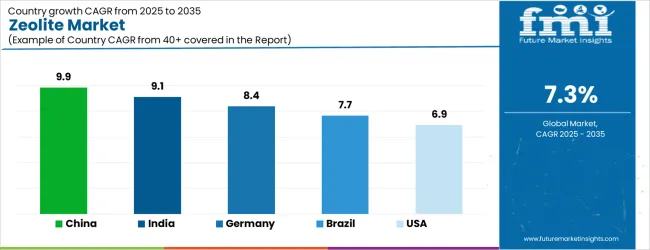
China (9.9% CAGR), India (9.1% CAGR), Germany (8.4% CAGR), Brazil (7.7% CAGR), and the USA (6.9% CAGR) are driving global expansion, with growth weighted heavily toward regions with rapidly developing industrial and environmental infrastructure.
Zeolite Market Definition
The zeolite market comprises the global exploration, production, synthesis, and trade of hydrated aluminosilicate minerals characterized by a porous structure. These materials are used as catalysts, adsorbents, and ion exchangers in a wide range of industries, including petrochemicals, water treatment, agriculture, and construction.
Zeolite Market Market Inclusions
The report includes a comprehensive analysis of market dynamics, featuring Global and Regional Market Sizes (Volume and Value) and a 10-year Forecast (2026-2036). It covers segmental breakdowns by Type (Natural, Synthetic), Function (Catalysts, Adsorbents, Ion Exchange), and Application (Chemical, Agriculture, Petrochemical, Water Treatment). It specifically tracks the adoption of zeolites in fluid catalytic cracking (FCC) and detergent formulations.
Zeolite Market Market Exclusions
The scope excludes non-zeolitic molecular sieves (like activated carbon or silica gel) unless they are part of a composite material where zeolite is the primary active component. It also omits small-scale, lab-grade zeolites not intended for industrial or commercial use.
Zeolite Market Research Methodology
- Primary Research: Interviews were conducted with R&D heads at major chemical companies, mining engineers, and procurement managers in the petrochemical and detergent industries.
- Desk Research: Production data from the International Zeolite Association (IZA), corporate annual reports of key players (BASF, Honeywell UOP), and geological survey reports supported volume benchmarking.
- Market-Sizing and Forecasting: A hybrid top-down and bottom-up model was developed, reconstructing demand from industrial output indices and catalyst replacement cycles.
- Data Validation and Update Cycle: Outputs undergo anomaly screening against global chemical production trends and structured peer review prior to release.
Segmental Analysis
Zeolite Market Analysis by Type
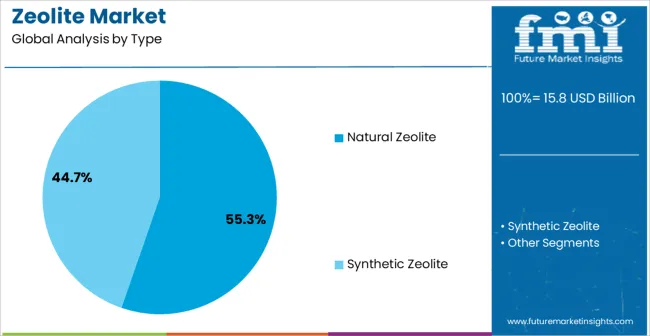
Based on FMI’s analysis, Natural Zeolite is estimated to hold a 55.3% market share in 2026. This dominance is driven by the abundant availability of natural deposits worldwide and low extraction costs, making it the preferred choice for volume-heavy, cost-sensitive applications such as animal feed additives, soil amendments, wastewater treatment, and construction materials where high purity is less critical than bulk affordability.
- Synthetic Zeolite: This segment is growing rapidly in value terms, driven by the need for high-purity, uniform pore structures in catalytic and molecular sieve applications.
Zeolite Market Analysis by Function
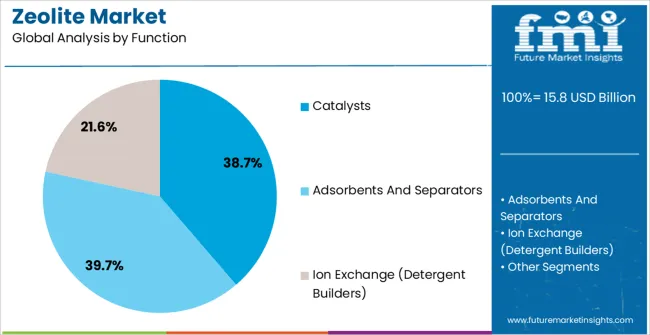
The Catalysts segment accounts for 38.7% of the market revenue in 2026. This leadership is underpinned by the irreplaceable role of zeolites in the fluid catalytic cracking (FCC) process within oil refineries and petrochemical plants. As the demand for refined fuels, propylene, and other chemical feedstocks grows, particularly in emerging economies, the consumption of high-performance zeolite catalysts continues to rise to ensure process efficiency and yield maximization.
- Adsorbents & Separators: Driven by demand for gas separation (oxygen concentrators) and environmental remediation.
- Ion Exchange: Remains vital for the detergent industry as a phosphate replacement.
Zeolite Market Analysis by Application
The Chemical segment is anticipated to account for 30.2% of the market revenue in 2026. This prominence is due to the extensive use of zeolites in the synthesis of various intermediate chemicals and specialty products. Their unique ability to act as shape-selective catalysts and efficient adsorbents makes them integral to numerous chemical manufacturing processes, including the production of detergents, adsorbents, and desiccants.
- Petrochemicals: A major consumer for refining and cracking processes.
- Water Treatment: Growing due to stringent regulations on industrial effluent and municipal water quality.
- Agriculture: expanding use as soil conditioners and slow-release fertilizer carriers.
Zeolite Market Drivers, Restraints, Opportunities
Future Market Insights analysis observes that the intensification of environmental regulations is the primary accelerator. Governments worldwide are enforcing stricter limits on industrial emissions and wastewater discharge, compelling industries to adopt advanced filtration and separation technologies where zeolites excel. Furthermore, the petrochemical industry's quest for higher efficiency drives the demand for advanced zeolite catalysts that can improve yield and selectivity in cracking and synthesis processes [2].
However, growth is restrained by the availability of cost-competitive alternatives. In some applications, materials like activated carbon, silica gel, or polymeric resins can substitute for zeolites, particularly if price sensitivity is high. The opportunity lies in bio-based and green synthesis. Developing methods to produce synthetic zeolites from waste materials (like fly ash or rice husk ash) presents a sustainable and cost-effective avenue for expansion, addressing both raw material costs and environmental concerns [3].
- Carbon Capture: Zeolites show immense potential as adsorbents for CO2 capture, opening a new frontier in climate change mitigation technologies.
- Nuclear Waste Remediation: The high ion-exchange capacity of zeolites makes them ideal for treating radioactive waste, a niche but critical application.
- Personal Care: Increasing use of zeolites in cosmetics and personal care products for their odor-absorbing and texture-enhancing properties offers a new growth vertical.
Regional Analysis
Based on the regional analysis, the Zeolite market is segmented into North America, Latin America, Europe, East Asia, South Asia & Pacific, and Middle East & Africa. The full report offers market attractiveness analysis based on industrial output and environmental regulations.
| Country | CAGR (2026 to 2036) |
|---|---|
| China | 9.9% |
| India | 9.1% |
| Germany | 8.4% |
| Brazil | 7.7% |
| USA | 6.9% |
| UK | 6.2% |
| Japan | 5.5% |
Source: Future Market Insights (FMI) analysis, based on proprietary forecasting model and primary research.
East Asia Zeolite Market Analysis
East Asia commands the largest market volume globally, serving as the undisputed engine for chemical manufacturing, heavy industry, and advanced electronics. The region's dominance is underpinned by its massive industrial infrastructure and a strategic shift toward higher-value petrochemical derivatives. Furthermore, increasingly stringent environmental regulations regarding air and water purification are accelerating the adoption of high-grade synthetic zeolites, positioning the region as both a volume leader and a technology adopter.
- China: Demand is projected to escalate at a 9.9% CAGR through 2036. The market is propelled by China's massive industrial base, particularly in petrochemicals and construction, coupled with increasingly stringent environmental regulations that are driving the adoption of zeolite-based filtration and catalytic solutions to reduce pollution and improve process efficiency [4].
- Japan: A 5.5% CAGR is anticipated. Growth is supported by a strong focus on high-tech materials and specialty chemicals, with advanced applications in nuclear waste treatment and high-purity gas separation driving demand for synthetic zeolites.
FMI’s report includes a detailed analysis of growth in the East Asia region, along with a country-wise assessment that includes China, Japan, and South Korea.
South Asia & Pacific Zeolite Market Analysis
South Asia & Pacific is emerging as the second fastest-growing region, driven by a rapid convergence of urbanization, agricultural modernization, and expanding industrial capacity. As global manufacturing supply chains diversify, nations in this region are seeing a surge in construction and refining activities, which directly fuels demand for zeolite-based concrete additives and fluid catalytic cracking (FCC) catalysts. Additionally, the rising middle class is boosting the consumption of detergents and personal care products, creating a robust baseline for market expansion.
- India: An 9.1% CAGR is projected. Growth is supported by the expanding petrochemical refining capacity and the government's push for sustainable agriculture, which encourages the use of natural zeolites as soil conditioners. Additionally, the growing detergent market due to rising hygiene standards fuels demand for builder zeolites [5].
- ASEAN: The region is emerging as a key manufacturing hub, driving demand for industrial absorbents and catalysts.
FMI’s report includes a detailed analysis of growth in the South Asia & Pacific region, covering India, ASEAN, and Australia.
Western Europe Zeolite Market Analysis
Western Europe serves as the global leader in environmental sustainability and advanced chemical engineering, driving specific demand for high-value, specialty synthetic zeolites. The market is characterized by a strong regulatory framework, such as the EU Green Deal, which mandates rigorous emission controls and waste remediation protocols. Consequently, the region prioritizes zeolites for niche applications in circular economy initiatives, bio-refining, and next-generation emission control systems, shifting value capture from volume to technical performance.
- Germany: The market is forecast to expand at an 8.4% CAGR through 2036. As the industrial engine of Europe, Germany drives innovation in green chemistry and energy efficiency, utilizing advanced zeolite catalysts in its world-class chemical and automotive sectors for emission control and process optimization.
- UK: A 6.2% CAGR is expected, supported by strict water treatment regulations and a focus on circular economy initiatives that utilize zeolites for waste remediation and resource recovery.
FMI’s report includes a detailed analysis of growth in Western Europe, including Germany, UK, France, and Italy.
Competitive Aligners for Market Players
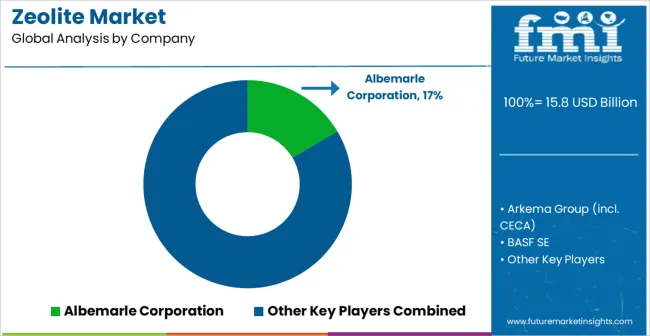
The market structure remains moderately fragmented but is consolidating around players who can offer "sustainability-as-a-service." Competition is no longer solely about price per kilogram but about the carbon intensity per catalytic cycle. Integrated producers like Honeywell UOP, which solidified its dominance by acquiring Johnson Matthey’s catalyst division in May 2025, leverage their upstream control to guarantee low-carbon supply to petrochemical OEMs, creating a defensive moat against non-integrated converters.
Primary competitive variables are shifting toward closed-loop capabilities. Suppliers who can take back spent catalysts and re-introduce them into the production line, a model exemplified by W. R. Grace & Co.’s partnership with Repsol to integrate pyrolysis oils into FCC units, are winning long-term contracts. This "circular lock-in" reduces exposure to volatile raw material pricing and strengthens the relationship with refineries facing strict Extended Producer Responsibility (EPR) mandates. Clariant’s "EcoCircle" initiative further illustrates the race to localize high-performance material supply near major production hubs to support the chemical recycling of plastics.
Regulatory compliance is narrowing the field for smaller entrants. The capital intensity required to meet emerging standards, such as the EU’s ReFuelEU Aviation mandates, favors large, capitalized incumbents. Companies like Ecovyst (Zeolyst International) are leveraging their scale to develop certified sustainable grades like the Opal™ series for renewable fuels, effectively raising the barrier to entry for generic material suppliers who cannot provide verifiable chain-of-custody data for bio-based feedstocks.
Recent Developments
- In January 2026, Honeywell UOP announced a strategic collaboration with SAF One and Tata Projects to deploy its Ecofining™ technology in India. This initiative utilizes advanced zeolite-based catalysts to convert waste fats and oils into Sustainable Aviation Fuel (SAF), directly addressing the region's growing demand for renewable energy solutions [6].
- In December 2025, BASF SE revealed details regarding its new X3D® catalyst shaping technology, confirming that its dedicated 3D-printing facility in Ludwigshafen will commence operations in 2026. This breakthrough allows for the production of zeolite catalysts with highly complex pore structures that reduce reactor pressure drop and increase output by up to 20% compared to conventional extruded forms [7].
Key Players in Zeolite Market
- Albemarle Corporation
- Arkema Group (incl. CECA)
- BASF SE
- Clariant AG
- Honeywell International Inc. (UOP)
- PQ Corporation (PQ Group)
- Tosoh Corporation
- W. R. Grace & Co.
- Zeochem AG
- Zeolyst International
Scope of the Report
| Metric | Value |
|---|---|
| Quantitative Units | USD 16.9 billion (2026) to USD 34.3 billion (2036), at a CAGR of 7.3% |
| Market Definition | The zeolite market comprises the global production and trade of hydrated aluminosilicate minerals, both natural and synthetic, used as catalysts, adsorbents, and ion exchangers. |
| Type Segmentation | Natural Zeolite, Synthetic Zeolite |
| Function Segmentation | Catalysts, Adsorbents & Separators, Ion Exchange |
| Application Segmentation | Chemical, Agriculture, Petrochemicals, Water Treatment, Others |
| Regions Covered | North America, Latin America, Western Europe, Eastern Europe, East Asia, South Asia & Pacific, Middle East & Africa |
| Countries Covered | USA, Canada, Brazil, Germany, UK, France, China, Japan, India, South Korea, Saudi Arabia, South Africa |
| Key Companies Profiled | Albemarle, Arkema, BASF, Clariant, Honeywell, PQ Corporation, Tosoh, W. R. Grace, Zeochem, Zeolyst |
| Forecast Period | 2026 to 2036 |
| Approach | Hybrid top-down and bottom-up market modeling validated through primary interviews with chemical industry experts and mining operators, supported by global production data and industrial consumption benchmarks. |
Zeolite Market Analysis by Segments
Type
- Natural Zeolite
- Synthetic Zeolite
Function
- Catalysts
- Adsorbents and Separators
- Ion Exchange (Detergent Builders)
Application
- Chemical
- Agriculture
- Petrochemicals
- Water Treatment
- Others
Region
- North America
- Latin America
- Western Europe
- Eastern Europe
- East Asia
- South Asia & Pacific
- Middle East & Africa
Bibliography
- [1] Ecovyst. (2024, December 2). Ecovyst announces strategic review of its advanced materials & catalysts business unit.
- [2] European Commission. (2023). Euro 7: New rules for vehicle emissions.
- [3] International Council on Clean Transportation. (2023). China Stage 6 Emission Standard for Light-duty Vehicles.
- [4] Society of Indian Automobile Manufacturers. (2024). Automobile Industry Trends.
- [5] Continental AG. (2023). Continental Automotive: Fuel Management Systems.
- [6] Honeywell International Inc. (2026). Honeywell Collaborates with SAF One and Tata Projects to Enable Sustainable Aviation Fuel Production. Honeywell News Release.
- [7] BASF SE. (2025). BASF Research Press Briefing: Innovations in 3D-Printed Catalysts. BASF Media Relations.
This bibliography is provided for reader reference and is not exhaustive. The full report contains the complete reference list and detailed citations.
This Report Addresses
- Market intelligence to enable structured strategic decision making across mature and emerging automotive fuel system hubs.
- Market size estimation and 10 year revenue forecasts from 2026 to 2036, supported by validated vehicle production benchmarks and engine platform data.
- Growth opportunity mapping across OEM and Aftermarket sales channels with emphasis on hybrid powertrain transitions.
- Segment and regional revenue forecasts covering passenger cars, light commercial vehicles, and heavy commercial vehicle applications.
- Competition strategy assessment including component integration models, partnership trends, and global supply chain positioning.
- Product innovation tracking including lightweight materials, pulsation dampening technologies, and biofuel compatibility.
- Regulatory impact analysis covering global emission standards (Euro 7, China 6b, EPA Tier 3) and fuel efficiency mandates (CAFE).
- Market report delivery in PDF, Excel, PPT, and interactive dashboard formats for executive and operational use.
Frequently Asked Questions
How big is the Zeolite Market in 2026?
The global market is estimated to be valued at USD 16.9 billion in 2026.
What will be the market size of the Zeolite Market by 2036?
The market size is projected to reach USD 34.3 billion by 2036.
What is the expected demand growth for Zeolites in the global market between 2026 and 2036?
The market is expected to grow at a CAGR of 7.3% between 2026 and 2036.
Which Type segment is poised to lead global sales in 2026?
Natural Zeolite is expected to be the dominant form, capturing approximately 55.3% of the global market share.
Which Function segment contributes the significant share in 2026?
The Catalysts segment commands a 38.7% share in the market in 2026 due to its high value in petrochemical applications.
What is the primary driver for market growth in China?
Growth in China is driven by massive industrial expansion, particularly in petrochemicals and construction, along with environmental cleanup initiatives.
Why are synthetic zeolites preferred for catalysis?
Synthetic zeolites offer uniform pore sizes and high purity, which are essential for the selectivity and efficiency required in chemical reactions.
What role do zeolites play in detergents?
They act as ion exchangers (builders) to remove calcium and magnesium ions from water, replacing phosphates to prevent water pollution.
How does the agriculture sector use zeolites?
Natural zeolites are used as soil conditioners to improve water retention and as feed additives to improve animal health.
Who are the key players in the market?
Key players include BASF, Honeywell UOP, Albemarle, Clariant, and W. R. Grace.
What is the impact of environmental regulations?
Regulations drive demand for zeolites in water treatment, air filtration, and eco-friendly detergents, boosting market growth.
What emerging application shows promise?
Carbon capture and storage (CCS) is a significant emerging application where zeolites are used to adsorb CO2 from industrial emissions.
What is the growth outlook for the USA market?
The USA market is projected to grow at a CAGR of 6.9%, supported by a strong refining sector and advanced water treatment infrastructure.
Are bio-based zeolites a reality?
Yes, research into synthesizing zeolites from biomass ash (like rice husk) is growing to create more sustainable production methods.
Why is the Chemical application segment dominant?
The chemical industry relies heavily on zeolites for synthesis, purification, and separation processes across a vast array of products.
Preview the report firsthand - request a free sample
Get SampleGet the brochure for pricing and purchase details.
Get PDFTable of Content
- Executive Summary
- Global Market Outlook
- Demand-side Trends
- Supply-side Trends
- Technology Roadmap Analysis
- Analysis and Recommendations
- Market Overview
- Market Coverage / Taxonomy
- Market Definition / Scope / Limitations
- Research Methodology
- Chapter Orientation
- Analytical Lens and Working Hypotheses
- Market Structure, Signals, and Trend Drivers
- Benchmarking and Cross-market Comparability
- Market Sizing, Forecasting, and Opportunity Mapping
- Research Design and Evidence Framework
- Desk Research Programme (Secondary Evidence)
- Company Annual and Sustainability Reports
- Peer-reviewed Journals and Academic Literature
- Corporate Websites, Product Literature, and Technical Notes
- Earnings Decks and Investor Briefings
- Statutory Filings and Regulatory Disclosures
- Technical White Papers and Standards Notes
- Trade Journals, Industry Magazines, and Analyst Briefs
- Conference Proceedings, Webinars, and Seminar Materials
- Government Statistics Portals and Public Data Releases
- Press Releases and Reputable Media Coverage
- Specialist Newsletters and Curated Briefings
- Sector Databases and Reference Repositories
- FMI Internal Proprietary Databases and Historical Market Datasets
- Subscription Datasets and Paid Sources
- Social Channels, Communities, and Digital Listening Inputs
- Additional Desk Sources
- Expert Input and Fieldwork (Primary Evidence)
- Primary Modes
- Qualitative Interviews and Expert Elicitation
- Quantitative Surveys and Structured Data Capture
- Blended Approach
- Why Primary Evidence is Used
- Field Techniques
- Interviews
- Surveys
- Focus Groups
- Observational and In-context Research
- Social and Community Interactions
- Stakeholder Universe Engaged
- C-suite Leaders
- Board Members
- Presidents and Vice Presidents
- R&D and Innovation Heads
- Technical Specialists
- Domain Subject-matter Experts
- Scientists
- Physicians and Other Healthcare Professionals
- Governance, Ethics, and Data Stewardship
- Research Ethics
- Data Integrity and Handling
- Primary Modes
- Tooling, Models, and Reference Databases
- Desk Research Programme (Secondary Evidence)
- Data Engineering and Model Build
- Data Acquisition and Ingestion
- Cleaning, Normalisation, and Verification
- Synthesis, Triangulation, and Analysis
- Quality Assurance and Audit Trail
- Market Background
- Market Dynamics
- Drivers
- Restraints
- Opportunity
- Trends
- Scenario Forecast
- Demand in Optimistic Scenario
- Demand in Likely Scenario
- Demand in Conservative Scenario
- Opportunity Map Analysis
- Product Life Cycle Analysis
- Supply Chain Analysis
- Investment Feasibility Matrix
- Value Chain Analysis
- PESTLE and Porter’s Analysis
- Regulatory Landscape
- Regional Parent Market Outlook
- Production and Consumption Statistics
- Import and Export Statistics
- Market Dynamics
- Global Market Analysis 2021 to 2025 and Forecast, 2026 to 2036
- Historical Market Size Value (USD Million) Analysis, 2021 to 2025
- Current and Future Market Size Value (USD Million) Projections, 2026 to 2036
- Y-o-Y Growth Trend Analysis
- Absolute $ Opportunity Analysis
- Global Market Pricing Analysis 2021 to 2025 and Forecast 2026 to 2036
- Global Market Analysis 2021 to 2025 and Forecast 2026 to 2036, By Type
- Introduction / Key Findings
- Historical Market Size Value (USD Million) Analysis By Type , 2021 to 2025
- Current and Future Market Size Value (USD Million) Analysis and Forecast By Type , 2026 to 2036
- Natural Zeolite
- Synthetic Zeolite
- Natural Zeolite
- Y-o-Y Growth Trend Analysis By Type , 2021 to 2025
- Absolute $ Opportunity Analysis By Type , 2026 to 2036
- Global Market Analysis 2021 to 2025 and Forecast 2026 to 2036, By Function
- Introduction / Key Findings
- Historical Market Size Value (USD Million) Analysis By Function, 2021 to 2025
- Current and Future Market Size Value (USD Million) Analysis and Forecast By Function, 2026 to 2036
- Catalysts
- Adsorbents and Separators
- Ion Exchange (Detergent Builders)
- Catalysts
- Y-o-Y Growth Trend Analysis By Function, 2021 to 2025
- Absolute $ Opportunity Analysis By Function, 2026 to 2036
- Global Market Analysis 2021 to 2025 and Forecast 2026 to 2036, By Region
- Introduction
- Historical Market Size Value (USD Million) Analysis By Region, 2021 to 2025
- Current Market Size Value (USD Million) Analysis and Forecast By Region, 2026 to 2036
- North America
- Latin America
- Western Europe
- Eastern Europe
- East Asia
- South Asia and Pacific
- Middle East & Africa
- Market Attractiveness Analysis By Region
- North America Market Analysis 2021 to 2025 and Forecast 2026 to 2036, By Country
- Historical Market Size Value (USD Million) Trend Analysis By Market Taxonomy, 2021 to 2025
- Market Size Value (USD Million) Forecast By Market Taxonomy, 2026 to 2036
- By Country
- USA
- Canada
- Mexico
- By Type
- By Function
- By Country
- Market Attractiveness Analysis
- By Country
- By Type
- By Function
- Key Takeaways
- Latin America Market Analysis 2021 to 2025 and Forecast 2026 to 2036, By Country
- Historical Market Size Value (USD Million) Trend Analysis By Market Taxonomy, 2021 to 2025
- Market Size Value (USD Million) Forecast By Market Taxonomy, 2026 to 2036
- By Country
- Brazil
- Chile
- Rest of Latin America
- By Type
- By Function
- By Country
- Market Attractiveness Analysis
- By Country
- By Type
- By Function
- Key Takeaways
- Western Europe Market Analysis 2021 to 2025 and Forecast 2026 to 2036, By Country
- Historical Market Size Value (USD Million) Trend Analysis By Market Taxonomy, 2021 to 2025
- Market Size Value (USD Million) Forecast By Market Taxonomy, 2026 to 2036
- By Country
- Germany
- UK
- Italy
- Spain
- France
- Nordic
- BENELUX
- Rest of Western Europe
- By Type
- By Function
- By Country
- Market Attractiveness Analysis
- By Country
- By Type
- By Function
- Key Takeaways
- Eastern Europe Market Analysis 2021 to 2025 and Forecast 2026 to 2036, By Country
- Historical Market Size Value (USD Million) Trend Analysis By Market Taxonomy, 2021 to 2025
- Market Size Value (USD Million) Forecast By Market Taxonomy, 2026 to 2036
- By Country
- Russia
- Poland
- Hungary
- Balkan & Baltic
- Rest of Eastern Europe
- By Type
- By Function
- By Country
- Market Attractiveness Analysis
- By Country
- By Type
- By Function
- Key Takeaways
- East Asia Market Analysis 2021 to 2025 and Forecast 2026 to 2036, By Country
- Historical Market Size Value (USD Million) Trend Analysis By Market Taxonomy, 2021 to 2025
- Market Size Value (USD Million) Forecast By Market Taxonomy, 2026 to 2036
- By Country
- China
- Japan
- South Korea
- By Type
- By Function
- By Country
- Market Attractiveness Analysis
- By Country
- By Type
- By Function
- Key Takeaways
- South Asia and Pacific Market Analysis 2021 to 2025 and Forecast 2026 to 2036, By Country
- Historical Market Size Value (USD Million) Trend Analysis By Market Taxonomy, 2021 to 2025
- Market Size Value (USD Million) Forecast By Market Taxonomy, 2026 to 2036
- By Country
- India
- ASEAN
- Australia & New Zealand
- Rest of South Asia and Pacific
- By Type
- By Function
- By Country
- Market Attractiveness Analysis
- By Country
- By Type
- By Function
- Key Takeaways
- Middle East & Africa Market Analysis 2021 to 2025 and Forecast 2026 to 2036, By Country
- Historical Market Size Value (USD Million) Trend Analysis By Market Taxonomy, 2021 to 2025
- Market Size Value (USD Million) Forecast By Market Taxonomy, 2026 to 2036
- By Country
- Kingdom of Saudi Arabia
- Other GCC Countries
- Turkiye
- South Africa
- Other African Union
- Rest of Middle East & Africa
- By Type
- By Function
- By Country
- Market Attractiveness Analysis
- By Country
- By Type
- By Function
- Key Takeaways
- Key Countries Market Analysis
- USA
- Pricing Analysis
- Market Share Analysis, 2025
- By Type
- By Function
- Canada
- Pricing Analysis
- Market Share Analysis, 2025
- By Type
- By Function
- Mexico
- Pricing Analysis
- Market Share Analysis, 2025
- By Type
- By Function
- Brazil
- Pricing Analysis
- Market Share Analysis, 2025
- By Type
- By Function
- Chile
- Pricing Analysis
- Market Share Analysis, 2025
- By Type
- By Function
- Germany
- Pricing Analysis
- Market Share Analysis, 2025
- By Type
- By Function
- UK
- Pricing Analysis
- Market Share Analysis, 2025
- By Type
- By Function
- Italy
- Pricing Analysis
- Market Share Analysis, 2025
- By Type
- By Function
- Spain
- Pricing Analysis
- Market Share Analysis, 2025
- By Type
- By Function
- France
- Pricing Analysis
- Market Share Analysis, 2025
- By Type
- By Function
- India
- Pricing Analysis
- Market Share Analysis, 2025
- By Type
- By Function
- ASEAN
- Pricing Analysis
- Market Share Analysis, 2025
- By Type
- By Function
- Australia & New Zealand
- Pricing Analysis
- Market Share Analysis, 2025
- By Type
- By Function
- China
- Pricing Analysis
- Market Share Analysis, 2025
- By Type
- By Function
- Japan
- Pricing Analysis
- Market Share Analysis, 2025
- By Type
- By Function
- South Korea
- Pricing Analysis
- Market Share Analysis, 2025
- By Type
- By Function
- Russia
- Pricing Analysis
- Market Share Analysis, 2025
- By Type
- By Function
- Poland
- Pricing Analysis
- Market Share Analysis, 2025
- By Type
- By Function
- Hungary
- Pricing Analysis
- Market Share Analysis, 2025
- By Type
- By Function
- Kingdom of Saudi Arabia
- Pricing Analysis
- Market Share Analysis, 2025
- By Type
- By Function
- Turkiye
- Pricing Analysis
- Market Share Analysis, 2025
- By Type
- By Function
- South Africa
- Pricing Analysis
- Market Share Analysis, 2025
- By Type
- By Function
- USA
- Market Structure Analysis
- Competition Dashboard
- Competition Benchmarking
- Market Share Analysis of Top Players
- By Regional
- By Type
- By Function
- Competition Analysis
- Competition Deep Dive
- Albemarle Corporation
- Overview
- Product Portfolio
- Profitability by Market Segments (Product/Age /Sales Channel/Region)
- Sales Footprint
- Strategy Overview
- Marketing Strategy
- Product Strategy
- Channel Strategy
- Arkema Group (incl. CECA)
- BASF SE
- Clariant AG
- Honeywell International Inc. (UOP)
- PQ Corporation (PQ Group)
- Tosoh Corporation
- Albemarle Corporation
- Competition Deep Dive
- Assumptions & Acronyms Used


