

- Market Size (2026)
- USD 0.6789 Mn
- Forecast (2036)
- USD 1.1788 Mn
- CAGR (2026 to 2036)
- 5.6%
How big is the Phenylephrine HCL Market?
The Phenylephrine HCL Market is projected to grow from USD 0.6789 million in 2026 to USD 1.1788 million by 2036, at a CAGR of 5.672%.
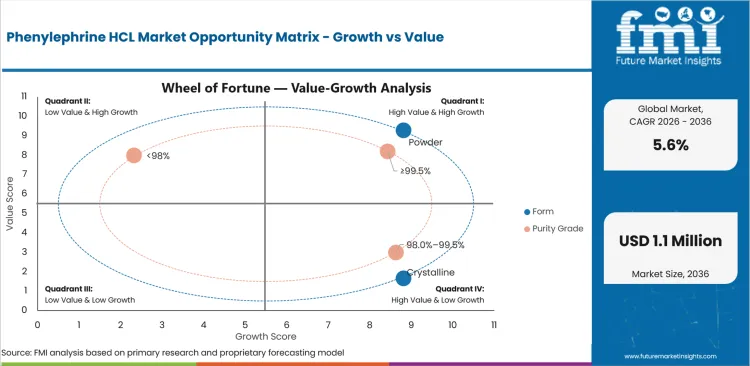
The Phenylephrine HCL Market was valued at USD 0.6506 million in 2025 and is expected to reach USD 0.6789 million in 2026. The market is projected to reach USD 1.1788 million by 2036 at a CAGR of 5.672% from 2026 to 2036. Powder is projected to account for a 62.8% share of By Form in 2026. The ≥99.5% purity grade is expected to represent a 56.4% share of By Purity Grade in 2026.
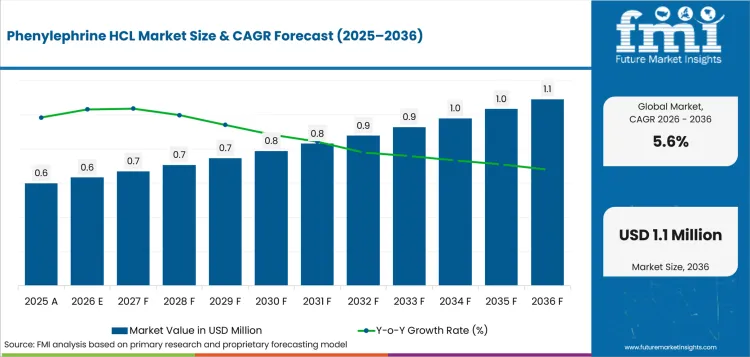
| Metric | Value |
|---|---|
| 2025 Market Size | USD 0.6506 million. |
| 2026 Market Size | USD 0.6789 million. |
| 2036 Market Size | USD 1.1788 million. |
| Forecast CAGR | 5.672% from 2026 to 2036. |
| Featured Form | Powder. |
| Powder Share in 2026 | 62.8%. |
| Featured Purity Grade | ≥99.5%. |
| ≥99.5% Share in 2026 | 56.4%. |
| Country CAGR Highlight | China. |
| China CAGR | 7.0% by 2036. |
Summary of the Phenylephrine HCL Market
| Market Signal | Commercial Impact |
|---|---|
| Demand and Growth Drivers | Demand for high-purity pharmaceutical APIs remains supported by sterile, ophthalmic, and specialty formulations.
|
| Product and Segment View | Powder form and high-purity grades continue to dominate the market.
|
| Geography and Competitive Outlook | North America and East Asia remain key regions for regulated pharmaceutical API production.
|
| Analyst Perspective | Supplier qualification and regulatory compliance are becoming more important than price in this API market.
— Anurag Sharma, Principal Consultant, Healthcare Domain, Future Market Insights |
In November 2024, the USA FDA proposed removing oral phenylephrine from the OTC nasal decongestant monograph. This raised reformulation risk for oral decongestant API demand. In February 2024, FDA approved Somerset Therapeutics’ ANDA for Phenylephrine Hydrochloride Injection USP 500 mcg per 5 mL single-dose ampule. This supported generic injectable competition.
The second is hospital and eye-care use, where labels for phenylephrine hydrochloride injection and ophthalmic solution define clear clinical roles in blood pressure support and pupil dilation.
Why is the Phenylephrine HCL Market growing?
Sterile vasopressor use supports high-purity API demand since hospital products need stable filing and quality records. Ophthalmic formulations keep demand resilient as pupil dilation use relies on defined strengths and controlled purity.
- Sterile vasopressor use supports high-purity API demand since hospital products need stable filing and quality records.
- Ophthalmic formulations keep demand resilient as pupil dilation use relies on defined strengths and controlled purity.
- Nasal spray and non-USA OTC channels continue to support demand while USA oral products face review pressure.
Hospital demand behaves differently from consumer decongestant demand. Phenylephrine hydrochloride injection is indicated for increasing blood pressure in adults with clinically important hypotension linked mainly to vasodilation in anesthesia settings. DailyMed labels identify ready-to-use 20 mg per 250 mL bags and 10 mg per mL vial formats, which keeps API buyers focused on sterility-linked documentation.
This means suppliers serving injectable customers need impurity control and reliable certificates more than broad retail visibility. The practical result is steadier value contribution from smaller but higher-specification dosage routes. Ophthalmic use creates another protected demand lane for qualified API suppliers. DailyMed labels state that phenylephrine hydrochloride ophthalmic solution is used at 2.5% and 10% strengths to dilate the pupil.
How is the Phenylephrine HCL Market segmented?
The Phenylephrine HCL Market is segmented by form, purity grade, application, sales channel, and region.
- With an estimated 62.8% share in 2026, Powder is expected to support By Form due to standard API packaging and easier blending.
- Crystalline material is projected to account for a 37.2% share in 2026, mainly for buyers specifying tighter physical handling attributes.
- The ≥99.5% grade is anticipated to represent a 56.4% share in 2026 as injectable and ophthalmic customers screen supplier quality closely.
How does Powder contribute to the form category?
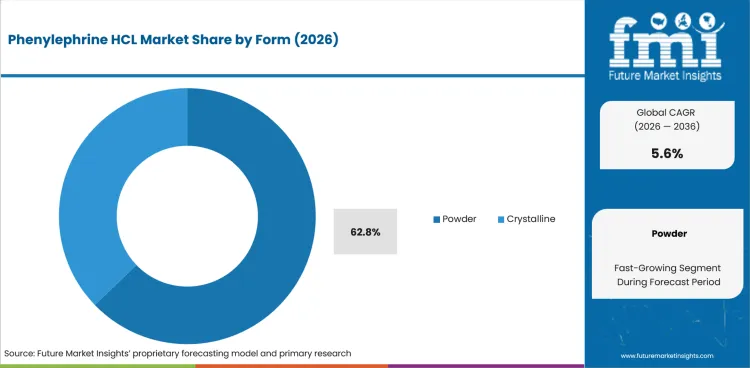
- Powder is projected to account for 62.8% of By Form in 2026 as most formulation buyers need standard bulk API handling, validated blending behavior, and direct transfer into oral or liquid manufacturing steps.
- Crystalline grades serve more selective buyers that specify particle behavior and handling control, especially where ophthalmic or injectable customers need tighter checks before formulation release.
What supports demand for ≥99.5%?
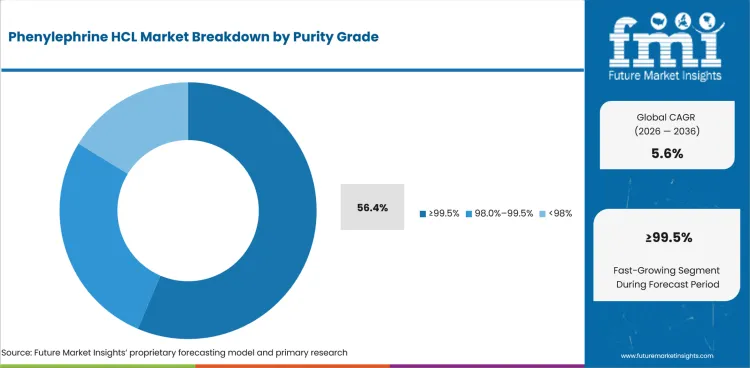
- The ≥99.5% grade is estimated to account for 56.4% of By Purity Grade in 2026 as regulated dosage makers avoid supplier changes that trigger added validation work.
- Buyers using lower-purity grades tend to serve less sensitive formulations, but pricing gains are limited when regulatory teams ask for the same supplier documentation as premium grades.
How do buyers evaluate Nasal Decongestant within the application category?
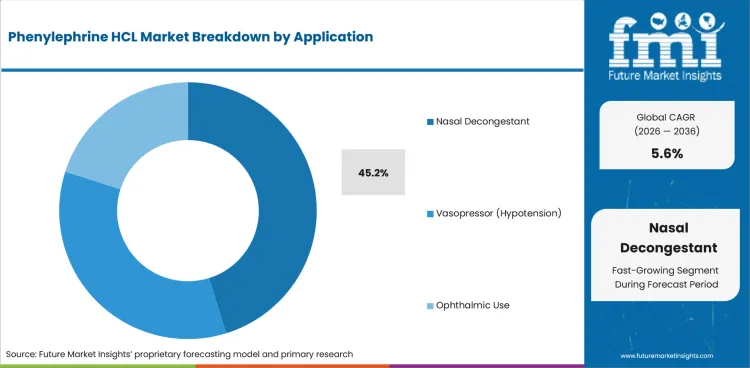
- Nasal Decongestant is projected to account for 45.2% of By Application in 2026 as global OTC and nasal spray products continue to use the molecule.
- The segment carries the elevated policy risk after the FDA said oral phenylephrine is not effective for OTC nasal congestion relief in its proposed order.
What market factors influence demand for Direct?
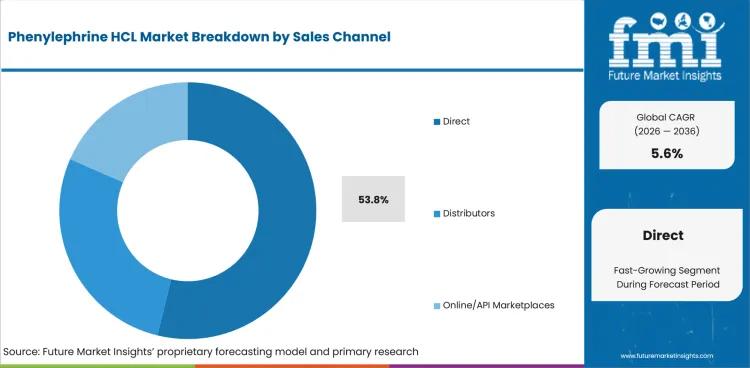
- Direct is expected to account for 53.8% of By Sales Channel in 2026 as regulated buyers need supplier audits, document exchange, and batch traceability before approving supply.
- Distributor sales work better for smaller orders, but distributor-led buying weakens when customers need pharmacopoeial support and rapid answers to regulatory deficiency letters.
How does North America affect the regional outlook?
- North America is projected to account for 32.0% of By Region in 2026 due to FDA-regulated finished products and hospital injectable use.
- The region’s demand mix is unusual because OTC oral products face review pressure, while injection and ophthalmic labels continue to support qualified API demand.
What drives and restrains the market?
Driver: Hospital hypotension use creates a durable driver for high-purity API suppliers with sterile dosage customer access; restraint: USA oral OTC reformulation risk is the main restraint because it can reduce decongestant API call-off orders; opportunity: supplier qualification creates an opportunity for Indian and European producers with recognized filings and audit histories.
The market reflects a balance between the identified demand driver, adoption constraints, and the supplier opportunity outlined below.
- Driver: Hospital hypotension use creates a durable driver for high-purity API suppliers with sterile dosage customer access.
- Restraint: USA oral OTC reformulation risk is the main restraint because it can reduce decongestant API call-off orders.
- Opportunity: supplier qualification creates an opportunity for Indian and European producers with recognized filings and audit histories.
Oral Monograph Reassessment: The main demand tension comes from the difference between oral decongestant use and clinical product use. In November 2024, the FDA proposed removing oral phenylephrine from the OTC monograph for nasal decongestant use after reviewing efficacy data. The agency stated that companies may continue marketing such products until a final order changes what can be sold. This creates inventory and sourcing caution for oral product makers. API suppliers should expect shorter visibility from customers exposed to USA oral products.
Sterile Vasopressor Pull: Sterile vasopressor demand supports a more defensible part of the market. Phenylephrine hydrochloride injection labels describe use for clinically important hypotension linked to vasodilation in anesthesia settings. Those products require controlled excipients, validated dilution instructions, and supplier documentation that can pass regulatory review. API suppliers with sterile-dose customer references can therefore hold stronger buyer relationships than firms selling only into OTC channels. The commercial implication is clear for CEOs. The suitable growth does not come from chasing volume alone, but from serving applications where supplier switching costs are high.
Which factors support expansion?
Commercial expansion is reinforced by the value, workflow, and recurring-demand factors below.
- Market value is rising as sterile injectable and ophthalmic buyers keep paying for high-purity API documentation.
- Oral decongestant exposure creates a real demand risk, especially for suppliers over-weighted to USA OTC formulations.
- The small market size limits large capacity moves, which keeps supplier selection tied to batch flexibility and filing depth.
Which country markets are included in the CAGR comparison?
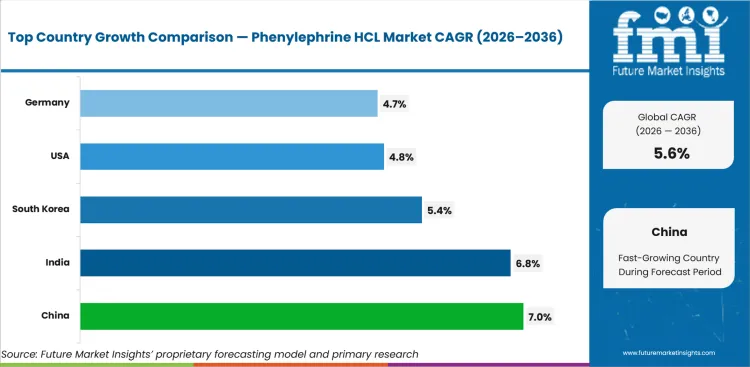
The selected CAGR comparison covers China (7.0%), India (6.8%), South Korea (5.4%), United States (4.8%), and Germany (4.7%) through 2036.
.webp "Top Country Growth Comparison Phenylephrine Hcl Market Cagr (2026 2036)")
| Country | CAGR |
|---|---|
| China | 7.0% |
| India | 6.8% |
| South Korea | 5.4% |
| United States | 4.8% |
| Germany | 4.7% |
Source: Future Market Insights analysis based on the supplied country forecast table.
How do country-level CAGRs compare?
- China (CAGR: 7.0%): China is expected to record a CAGR of 7.0% through 2036 as API supply depth supports faster growth.
- India (CAGR: 6.8%): India is projected to record a CAGR of 6.8% through 2036 as API export capability supports growth.
- South Korea (CAGR: 5.4%): South Korea is forecast to grow at a CAGR of 5.4% through 2036 as regulated import demand supports moderate expansion.
- United States (CAGR: 4.8%): The United States is projected to record a CAGR of 4.8% through 2036 as hospital and ophthalmic use offsets oral OTC pressure.
- Germany (CAGR: 4.7%): Germany is forecast to grow at a CAGR of 4.7% through 2036 as regulated quality expectations support premium supplier selection.
The global Phenylephrine HCL Market is forecast to record a CAGR of 5.672% from 2026 to 2036. The supplied study covers 8 named country forecasts across the report regions.
How is the Phenylephrine HCL Market developing in China?
China is projected to record a CAGR of 7.0% through 2036. The country outlook identifies this demand signal: API manufacturing depth supports small molecule supply.
Country Market Snapshot
| Country | China |
|---|---|
| Forecast CAGR | 7.0% |
| Growth role | China is forecast to record the comparatively rapid selected-country CAGR at 7.0%. |
| Supply structure | Domestic API clusters support export-ready small molecule production. |
| Buyer route | Export buyers screen Chinese suppliers through filings and audit records. |
| Application mix | Nasal and hospital applications support demand across domestic and export channels. |
| Restraint | Overseas buyers remain cautious about documentation and supply continuity. |
| Regional signal | East Asia is projected to represent 22.5% regional share in 2026. |
| Primary demand signal | China is expected to record a CAGR of 7.0% through 2036 as API supply depth supports faster growth. |
Market Outlook
China is expected to record a CAGR of 7.0% through 2036 as API supply depth supports faster growth. The country benefits from established small molecule synthesis capacity and export-linked customer networks. For phenylephrine HCL, buyers look for proof of pharmacopoeial alignment and stable impurity control. Supplier selection is therefore tied to documentation as much as cost. Domestic demand is supported by retail respiratory products and hospital use. Export opportunities are more attractive when suppliers can support customer audits and regulatory files.
Key Growth Drivers
- API manufacturing depth supports small molecule supply.
- Export channels create demand from formulation customers outside China.
- Domestic hospital and respiratory products provide a wider application base.
- Nasal and hospital applications support demand across domestic and export channels.
Key Restraints
- Overseas buyers require deeper audit evidence before supplier approval.
- Price competition can reduce supplier willingness to support small custom batches.
- Overseas buyers remain cautious about documentation and supply continuity.
Country Market FAQs
Why should executives monitor Phenylephrine HCL Market demand in China?
Executives should monitor China because local buyer readiness, nasal and hospital applications support demand across domestic and export channels, and service capacity can influence account timing and market-entry priorities.
What should suppliers localize for China?
Suppliers should localize proof points, pricing logic, partner coverage, and training support around export buyers screen chinese suppliers through filings and audit records and local support coverage.
What adoption risk needs attention in China?
Executive teams should watch adoption risk because overseas buyers require deeper audit evidence before supplier approval can delay conversion from evaluation to commercial deployment.
How is the Phenylephrine HCL Market developing in India?
India is projected to record a CAGR of 6.8% through 2036. The country outlook identifies this demand signal: Export-ready API plants support regulated-market sourcing.
Country Market Snapshot
| Country | India |
|---|---|
| Forecast CAGR | 6.8% |
| Growth role | India is projected to record 6.8% CAGR through 2036. |
| Supplier proof | MHRA API records list Divi’s Laboratories with phenylephrine hydrochloride evidence. |
| Manufacturing base | Telangana, Andhra Pradesh, Maharashtra, and Karnataka support API production clusters. |
| Buyer route | Export customers rely on DMF-style files and plant audit histories. |
| Restraint | Price competition can compress margins in lower-purity grades. |
| Channel signal | Direct export selling is stronger than open marketplace sales for regulated buyers. |
| Primary demand signal | India is projected to record a CAGR of 6.8% through 2036 as API export capability supports growth |
Market Outlook
India is projected to record a CAGR of 6.8% through 2036 as API export capability supports growth. MHRA API registration evidence lists Divi’s Laboratories with phenylephrine hydrochloride, which signals regulated-market linkage. Indian suppliers benefit when buyers seek alternate sources outside one country. This creates opportunity in small-volume APIs where documentation and responsiveness matter. Domestic demand comes from OTC cold products, hospital formulations, and ophthalmic products. Export demand is more attractive when suppliers can support pharmacopoeial standards and customer audits.
Key Growth Drivers
- Export-ready API plants support regulated-market sourcing.
- Alternate supplier qualification favors Indian producers with audit histories.
- Domestic formulation demand supports baseline API consumption.
- Direct export selling is stronger than open marketplace sales for regulated buyers.
Key Restraints
- Lower-grade API competition compresses pricing.
- Regulatory documentation gaps can slow access to premium buyers.
- Price competition can compress margins in lower-purity grades.
Country Market FAQs
Why should executives monitor Phenylephrine HCL Market demand in India?
Executives should monitor India because local buyer readiness, local use-case priorities, and service capacity can influence account timing and market-entry priorities.
What should suppliers localize for India?
Suppliers should localize proof points, pricing logic, partner coverage, and training support around export customers rely on dmf-style files and plant audit histories and direct export selling is stronger than open marketplace sales for regulated buyers.
What adoption risk needs attention in India?
Executive teams should watch adoption risk because lower-grade api competition compresses pricing can delay conversion from evaluation to commercial deployment.
How is the Phenylephrine HCL Market developing in South Korea?
South Korea is projected to record a CAGR of 5.4% through 2036. The country outlook identifies this demand signal: Imported API demand supports suppliers with established regulated-market files.
Country Market Snapshot
| Country | South Korea |
|---|---|
| Forecast CAGR | 5.4% |
| Market role | South Korea is forecast to grow at a CAGR of 5.4% through 2036. |
| Buyer behavior | Local formulation buyers rely on imported APIs and regulated documentation. |
| Application mix | Hospital and OTC routes both matter, but supplier files guide approval. |
| Procurement route | Pharmaceutical manufacturers and distributors manage sourcing decisions. |
| Restraint | Small market volume limits local supplier bargaining power. |
| Channel signal | KDMF-style documentation expectations shape API qualification behavior. |
| Primary demand signal | South Korea is forecast to grow at a CAGR of 5.4% through 2036 as regulated import demand supports moderate expansion. |
Market Outlook
South Korea is forecast to grow at a CAGR of 5.4% through 2036 as regulated import demand supports moderate expansion. Buyers need API sources that fit local filing expectations and can respond quickly to documentation questions. This gives established Indian and European suppliers an advantage when they already have multi-market records. South Korean demand is not large, but it is quality-sensitive. The market combines OTC respiratory products with hospital formulations.
Key Growth Drivers
- Imported API demand supports suppliers with established regulated-market files.
- OTC respiratory products sustain baseline demand for decongestant ingredients.
- Hospital products support higher-grade sourcing behavior.
- KDMF-style documentation expectations shape API qualification behavior.
Key Restraints
- Limited local volume reduces room for broad supplier expansion.
- Documentation gaps can delay qualification for foreign producers.
- Small market volume limits local supplier bargaining power.
Country Market FAQs
Why should executives monitor Phenylephrine HCL Market demand in South Korea?
Executives should monitor South Korea because local buyer readiness, hospital and otc routes both matter, but supplier files guide approval, and service capacity can influence account timing and market-entry priorities.
What should suppliers localize for South Korea?
Suppliers should localize proof points, pricing logic, partner coverage, and training support around pharmaceutical manufacturers and distributors manage sourcing decisions and kdmf-style documentation expectations shape api qualification behavior.
What adoption risk needs attention in South Korea?
Executive teams should watch adoption risk because limited local volume reduces room for broad supplier expansion can delay conversion from evaluation to commercial deployment.
How is the Phenylephrine HCL Market developing in the United States?
The United States is projected to record a CAGR of 4.8% through 2036. The country outlook identifies this demand signal: FDA-regulated sterile products keep high-purity API demand tied to hospital use.
Country Market Snapshot
| Country | United States |
|---|---|
| Forecast CAGR | 4.8% |
| Policy signal | FDA proposed removing oral phenylephrine from the OTC nasal decongestant monograph in November 2024. |
| Clinical anchor | DailyMed labels support phenylephrine hydrochloride injection for anesthesia-linked hypotension. |
| Ophthalmic use | USA labels include 2.5% and 10% ophthalmic solution strengths for pupil dilation. |
| Channel behavior | Hospital injectable buyers favor direct qualified suppliers and FDA file support. |
| Restraint | OTC oral product reformulation risk may reduce decongestant API call-off orders. |
| Company context | Hikma and Fresenius Kabi are visible in USA phenylephrine injection product channels. |
| Primary demand signal | The United States is projected to record a CAGR of 4.8% through 2036 as hospital and ophthalmic use offsets oral OTC pressure. |
Market Outlook
The United States is projected to record a CAGR of 4.8% through 2036 as hospital and ophthalmic use offsets oral OTC pressure. FDA’s proposed order does not affect what products can be marketed until final action, but it has already changed buyer risk screening. OTC formulators are expected to reduce long forward commitments for oral tablets. This shifts demand toward shorter contracts and alternate sourcing. Hospital buyers behave differently from OTC brand owners.
Key Growth Drivers
- FDA-regulated sterile products keep high-purity API demand tied to hospital use.
- Ophthalmic labels support continued use in pupil dilation products.
- Alternate supplier qualification is expected to rise among OTC-exposed buyers.
- The United States is the clearest example of application split, with oral OTC risk and sterile clinical demand moving in opposite directions.
Key Restraints
- Oral decongestant reformulation risk limits API visibility for tablet producers.
- Finished-dose recall sensitivity raises the cost of supplier changes.
- OTC oral product reformulation risk may reduce decongestant API call-off orders.
Country Market FAQs
Why should executives monitor Phenylephrine HCL Market demand in the United States?
Executives should monitor the United States because local buyer readiness, local use-case priorities, and service capacity can influence account timing and market-entry priorities.
What should suppliers localize for the United States?
Suppliers should localize proof points, pricing logic, partner coverage, and training support around buyer access and account ownership and hospital injectable buyers favor direct qualified suppliers and fda file support.
What adoption risk needs attention in the United States?
Executive teams should watch adoption risk because oral decongestant reformulation risk limits api visibility for tablet producers can delay conversion from evaluation to commercial deployment.
How is the Phenylephrine HCL Market developing in Germany?
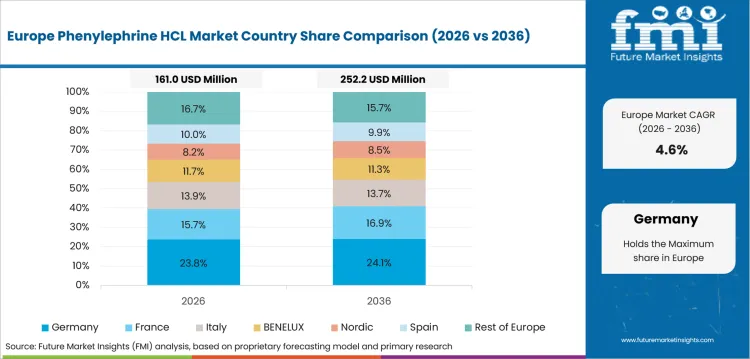
Germany is projected to record a CAGR of 4.7% through 2036. The country outlook identifies this demand signal: European Pharmacopoeia alignment raises demand for well-documented API sources.
Country Market Snapshot
| Country | Germany |
|---|---|
| Forecast CAGR | 4.7% |
| Quality anchor | German buyers follow European Pharmacopoeia and GMP expectations for API qualification. |
| Supplier signal | Siegfried AG is linked to regulated API manufacturing depth in Germany. |
| Application mix | Ophthalmic and hospital use carry more stable demand than oral OTC use. |
| Procurement route | German hospital buying often runs through institutional tenders and wholesalers. |
| Restraint | High documentation cost limits low-margin API supplier switching. |
| Regional role | Germany acts as a European quality benchmark for small-volume APIs. |
| Primary demand signal | Germany is forecast to grow at a CAGR of 4.7% through 2036 as regulated quality expectations support premium supplier selection. |
Market Outlook
Germany is forecast to grow at a CAGR of 4.7% through 2036 as regulated quality expectations support premium supplier selection. The country is less about volume growth and more about qualification depth. Buyers tend to favor suppliers with European documentation, stable pharmacopoeial compliance, and audit readiness. This supports stronger pricing discipline than open-market API trading. Demand is shaped by institutional use and EU-wide product movement. Ophthalmic and sterile dosage buyers need documentation that works beyond one national market.
Key Growth Drivers
- European Pharmacopoeia alignment raises demand for well-documented API sources.
- Hospital product use supports direct supplier screening.
- German quality expectations influence broader EU customer qualification.
- Ophthalmic and hospital use carry more stable demand than oral OTC use.
Key Restraints
- High audit and documentation costs favor established suppliers.
- Generic buyers resist premium pricing for low-volume oral products.
- High documentation cost limits low-margin API supplier switching.
Country Market FAQs
Why should executives monitor Phenylephrine HCL Market demand in Germany?
Executives should monitor Germany because local buyer readiness, ophthalmic and hospital use carry more stable demand than oral otc use, and service capacity can influence account timing and market-entry priorities.
What should suppliers localize for Germany?
Suppliers should localize proof points, pricing logic, partner coverage, and training support around german hospital buying often runs through institutional tenders and wholesalers and local support coverage.
What adoption risk needs attention in Germany?
Executive teams should watch adoption risk because high audit and documentation costs favor established suppliers can delay conversion from evaluation to commercial deployment.
Which companies are discussed in the Phenylephrine HCL Market?
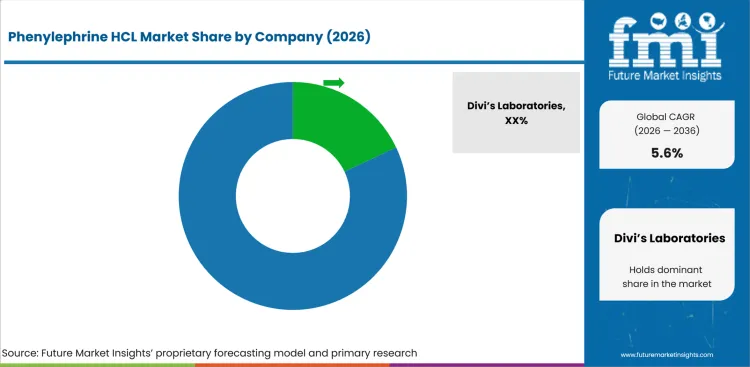
The preview discusses Divi’s Laboratories, Siegfried AG, Cambrex Corporation, Malladi Drugs & Pharmaceuticals, Somerset Therapeutics, and Sintetica SA among companies and downstream product holders relevant to this market.
The market is moderately fragmented, with regulated API suppliers and finished-dose companies influencing buyer qualification. established suppliers win through pharmacopoeial support, impurity control, and multi-market documentation. Smaller suppliers compete on responsiveness for low-volume orders and alternate-source qualification.
Entry barriers come from documentation, audit history, and customer validation cost. Oral OTC uncertainty raises the value of suppliers serving injectable and ophthalmic customers. Competition is not only about who can synthesize phenylephrine HCL. Buyers first ask whether the supplier can support a product filing and maintain batch consistency over time.
How is competition structured?
Competition reflects differences in specialization, portfolio scope, geographic reach, evidence, and customer access.
The competitive structure includes API producers, regulated suppliers, and finished-dose firms that shape API pull-through.
- Regulated API and ingredient suppliers: Divi’s Laboratories, Siegfried AG, Cambrex Corporation, and are referenced as regulated small molecule supply participants where documentation and buyer qualification matter. Their strengths lie in pharmacopoeial documentation, GMP systems, technical files, and multi-market buyer familiarity.
- India-centered API producers: Malladi Drugs & Pharmaceuticals, Supriya Lifescience, and R. L. Fine Chem are referenced as Indian supply participants; buyer validation should rely on direct product files and customer qualification evidence.
- Finished-Dose Influencers: Fresenius Kabi, Hikma Pharmaceuticals, Somerset Therapeutics, and Sintetica SA influence demand through phenylephrine injection products and approvals. These companies do not all act as merchant API sellers, but their product activity signals downstream pull for qualified API supply.
How do selected companies compare?
- The selected companies differ in portfolio focus, geographic reach, evidence depth, and channel strength.
| Company | Competitive position |
|---|---|
| Divi’s Laboratories | Divi’s Laboratories has visible UK API registration evidence for phenylephrine hydrochloride, while Siegfried AG and Cambrex Corporation bring broader regulated API manufacturing credibility. |
| Siegfried AG | Divi’s Laboratories has visible UK API registration evidence for phenylephrine hydrochloride, while Siegfried AG and Cambrex Corporation bring broader regulated API manufacturing credibility. |
| Cambrex Corporation | Divi’s Laboratories has visible UK API registration evidence for phenylephrine hydrochloride, while Siegfried AG and Cambrex Corporation bring broader regulated API manufacturing credibility. |
| Regulated API and ingredient suppliers: Divi’s Laboratories, Siegfried AG, Cambrex Corporation, and are referenced as regulated small molecule supply participants where documentation and buyer qualification matter. | |
| Malladi Drugs & Pharmaceuticals | India-Centered API Producers: Malladi Drugs & Pharmaceuticals, Supriya Lifescience, and R. |
What are the key developments in the Phenylephrine HCL Market?
- In November 2024, the USA FDA proposed removing oral phenylephrine from the OTC nasal decongestant monograph. This raised reformulation risk for oral decongestant API demand.
- In February 2024, FDA approved Somerset Therapeutics’ ANDA for Phenylephrine Hydrochloride Injection USP 500 mcg per 5 mL single-dose ampule. This supported generic injectable competition.
- In May 2025, FDA approved Sintetica SA’s phenylephrine hydrochloride in sodium chloride injection. This strengthened the ready-to-use vasopressor product route.
Selected Companies in the Phenylephrine HCL Market
Companies referenced in this preview
- Divi’s Laboratories.
- Siegfried AG.
- Cambrex Corporation.
- .
- Malladi Drugs & Pharmaceuticals.
- Supriya Lifescience.
- R. L. Fine Chem.
- Zhejiang Hisoar Chuannan Pharmaceutical.
- Fresenius Kabi.
- Hikma Pharmaceuticals.
Market Scope & Definition
| Market definition | The Phenylephrine HCL Market covers commercially traded phenylephrine hydrochloride active pharmaceutical ingredient used in finished medicines. Included applications cover nasal decongestant formulations, vasopressor products for hypotension, and ophthalmic preparations used for pupil dilation. |
|---|---|
| Functions covered | Powder, Crystalline |
| Applications covered | Nasal Decongestant, Vasopressor (Hypotension), Ophthalmic Use |
| End-use industries | Pharmaceutical manufacturers, generic formulation companies, hospital procurement channels, and regulated distributors |
| Inclusions | Market scope covers all commercially traded Phenylephrine HCL API categorized by form, including Powder and Crystalline; purity grade, including ≥99.5%, 98.0%–99.5%, and <98%; application, including Nasal Decongestant, Vasopressor (Hypotension), and Ophthalmic Use; sales channel, including Direct, Distributors, and Online/API Marketplaces; and regions, including North America, Latin America, Europe, East Asia, South Asia & Pacific, and Middle East & Africa. |
| Exclusions | Market scope excludes finished cough and cold medicines, ophthalmic drug products, injectable finished dosage forms, captive API output, pseudoephedrine APIs, oxymetazoline APIs, and non-commercial research quantities. |
Research Methodology
| Primary Research | FMI analysts reviewed inputs from API buyers, formulation companies, qualified distributors, and regulatory affairs specialists. Discussions focused on supplier qualification, application mix, purity requirements, and sourcing behavior for small-volume regulated APIs. |
|---|---|
| Desk Research | reviewed official drug labels, regulatory monograph updates, API registration evidence, and company product information. Sources included FDA, DailyMed, EMA, MHRA, and selected company documents tied to API or finished dosage relevance. |
| Market Sizing and Forecasting | The model combined merchant API demand, application-level use rates, purity mix, and country-level sourcing behavior. Forecasts were adjusted for oral decongestant reformulation risk and steadier demand in sterile injectable and ophthalmic products. |
| Data Validation | Forecasts were checked against decongestant API demand, small molecule API sourcing patterns, and regulated supplier evidence. Company portfolios and official registrations were cross-checked before final competitive positioning was finalized. |
What does the report cover?
The report covers form, purity grade, application, sales channel, and region across the 2026-2036 forecast period in 30+ countries.
| Periods | Base year 2025; estimated year 2026; forecast period 2026-2036 |
|---|---|
| Quantitative units | USD 0.6789 million to USD 1.1788 million, at a CAGR of 5.672% |
| Segment axes | form, purity grade, application, sales channel, and region |
| Regions | North America, Latin America, Europe, East Asia, South Asia and Pacific, Middle East and Africa |
| Countries | United States, United Kingdom, Germany, France, Japan, China, South Korea, India and 30+ |
| Companies | Divi’s Laboratories, Siegfried AG, Cambrex Corporation, Malladi Drugs & Pharmaceuticals, Supriya Lifescience, R. L. Fine Chem, Zhejiang Hisoar Chuannan Pharmaceutical, Fresenius Kabi, Hikma Pharmaceuticals, Somerset Therapeutics, Sintetica SA |
| Approach | Hybrid bottom-up and selected-down methodology starting with verified transaction data, projecting adoption velocity across segments and regions. |
Market Segmentation Analysis
Segmented by Form
- Powder.
- Crystalline.
Segmented by Purity Grade
- ≥99.5%.
- 98.0%–99.5%.
- <98%.
Segmented by Application
- Nasal Decongestant.
- Vasopressor (Hypotension).
- Ophthalmic Use.
Segmented by Sales Channel
- Direct.
- Distributors.
- Online/API Marketplaces.
Research Sources and Bibliography
- 1. USA Food and Drug Administration. (2024, November 7). FDA proposes ending use of oral phenylephrine as OTC monograph nasal decongestant active ingredient after extensive review. FDA.
- 2. USA Food and Drug Administration. (2024, November). Order Number OTC000036. OTC Monographs at FDA.
- 3. DailyMed. (2025). Phenylephrine hydrochloride in 0.9% sodium chloride injection label. National Library of Medicine.
- 4. DailyMed. (2025). Phenylephrine hydrochloride ophthalmic solution label. National Library of Medicine.
- 5. European Medicines Agency. (2025). Omidria European public assessment information. EMA.
- 6. Medicines and Healthcare products Regulatory Agency. (2026, June 8). UK API 43567. MHRA.
- 7. Medicines and Healthcare products Regulatory Agency. (2026). UK API 49402. MHRA.
- 8. Medicines and Healthcare products Regulatory Agency. (2026). UK API 43457. MHRA.
- 9. Medicines and Healthcare products Regulatory Agency. (2026). UK API 42785. MHRA.
- 10. USA Food and Drug Administration. (2024, February 23). ANDA approval letter for phenylephrine hydrochloride injection USP. FDA.
- 11. USA Food and Drug Administration. (2025, May 30). NDA approval letter for phenylephrine hydrochloride in sodium chloride injection. FDA.
- 12. Fresenius Kabi. (2025, July). Phenylephrine hydrochloride injection, USP product information. Fresenius Kabi USA.
- 13. Mallinckrodt. (2025, November). Introducing Keenova and Par Health. Mallinckrodt.
- 14. Siegfried AG. (2026). API manufacturing services and drug substances CDMO. Siegfried.
- 15. Cambrex Corporation. (2026). Generic API manufacturing product catalog. Cambrex.
- 16. This bibliography is provided for reader reference and includes primary regulatory, official medicine, and direct company sources used for market interpretation.
The bibliography is provided for reader reference and uses primary regulatory, official company, academic, or recognized institutional sources.
This Report Answers
- What is the projected value of the Phenylephrine HCL Market in 2026?
- What value is forecast for the Phenylephrine HCL Market by 2036?
- What CAGR is forecast for the Phenylephrine HCL Market from 2026 to 2036?
- What 2026 share is projected for Powder within the form category?
- What 2026 share is projected for ≥99.5% within the purity grade category?
- Which demand factors support the Phenylephrine HCL Market outlook?
- Which restraints and opportunities affect adoption in the Phenylephrine HCL Market?
- How are country CAGR outlooks, including China at 7.0%, compared?
- Which companies and product developments are covered in the competitive analysis?
- What is included in the market scope, and how is the forecast validated?
Frequently Asked Questions
Why should executives track the Phenylephrine HCL Market?
Executives should track this market because it can affect capital allocation, supplier strategy, operating risk, and competitive positioning across applications.
What business problem does the Phenylephrine HCL Market address?
It helps executive teams judge where customer pain, supplier capability, compliance exposure, and implementation economics justify investment, procurement, or market-entry decisions.
What should procurement leaders evaluate before selecting suppliers?
Procurement leaders should assess evidence quality, integration fit, service coverage, compliance readiness, total cost of ownership, and supplier execution capability.
What can limit return on investment for buyers?
Return on investment can be limited by low utilization, integration delays, training gaps, unclear ownership, pricing pressure, or weak fit with existing workflows.
How can suppliers build executive confidence?
Suppliers can build confidence by proving implementation speed, risk reduction, support depth, reference use cases, and measurable outcomes for budget owners.
Preview the report firsthand - request a free sample
Get SampleGet the brochure for pricing and purchase details.
Get PDFTable of Content
- Key Takeaways
- Market Size and CAGR
- Top Growth Driver
- Fastest Growing Segment
- Leading Region
- Key Companies
- Emerging Opportunities
- Executive Summary
- Global Market Outlook
- Demand-side Trends
- Supply-side Trends
- Technology Roadmap Analysis
- Analysis and Recommendations
- Analyst Perspective (What is happening? Why now? What should investors know?)
- Key Questions Answered
- How large is the market?
- What is the CAGR?
- What are key trends?
- Which region dominates?
- Who are the leaders?
- Market Overview
- Market Coverage / Taxonomy
- Market Definition / Scope / Limitations
- Research Methodology
- Chapter Orientation
- Analytical Lens and Working Hypotheses
- Market Structure, Signals, and Trend Drivers
- Benchmarking and Cross-market Comparability
- Market Sizing, Forecasting, and Opportunity Mapping
- Research Design and Evidence Framework
- Desk Research Programme (Secondary Evidence)
- Expert Input and Fieldwork (Primary Evidence)
- Tooling, Models, and Reference Databases
- Data Engineering and Model Build
- Quality Assurance and Audit Trail
- Market Background
- Market Dynamics (Drivers, Restraints, Opportunity, Trends)
- Scenario Forecast (Optimistic, Likely, Conservative)
- Impact Analysis
- AI Impact
- Sustainability Impact
- Regulatory Impact
- Technology Impact
- Consumer / Buyer Analysis
- Purchase Drivers
- Adoption Barriers
- Buyer Journey
- Opportunity Map Analysis
- Product Life Cycle Analysis
- Supply Chain Analysis
- Investment Feasibility Matrix
- Value Chain Analysis
- PESTLE and Porter's Analysis
- Regulatory Landscape
- Regional Parent Market Outlook
- Production and Consumption Statistics
- Import and Export Statistics
- Global Market Analysis and Forecast, 2021 to 2036
- Historical Market Size Value (USD Million) Analysis, 2021 to 2025
- Current and Future Market Size Value (USD Million) Projections, 2026 to 2036
- Y-o-Y Growth Trend Analysis
- Absolute $ Opportunity Analysis
- Global Market Pricing Analysis, 2021 to 2036
- Global Market Analysis and Forecast, By Form, 2021 to 2036
- Introduction / Key Findings
- Historical Market Size Value (USD Million) Analysis By Form, 2021 to 2025
- Current and Future Market Size Value (USD Million) Analysis and Forecast By Form, 2026 to 2036
- Powder
- Crystalline
- Powder
- Y-o-Y Growth Trend Analysis By Form, 2021 to 2025
- Absolute $ Opportunity Analysis By Form, 2026 to 2036
- Global Market Analysis and Forecast, By Purity Grade, 2021 to 2036
- Introduction / Key Findings
- Historical Market Size Value (USD Million) Analysis By Purity Grade, 2021 to 2025
- Current and Future Market Size Value (USD Million) Analysis and Forecast By Purity Grade, 2026 to 2036
- ≥99.5%
- 98.0%–99.5%
- <98%
- ≥99.5%
- Y-o-Y Growth Trend Analysis By Purity Grade, 2021 to 2025
- Absolute $ Opportunity Analysis By Purity Grade, 2026 to 2036
- Global Market Analysis and Forecast, By Application, 2021 to 2036
- Introduction / Key Findings
- Historical Market Size Value (USD Million) Analysis By Application, 2021 to 2025
- Current and Future Market Size Value (USD Million) Analysis and Forecast By Application, 2026 to 2036
- Nasal Decongestant
- Vasopressor (Hypotension)
- Ophthalmic Use
- Nasal Decongestant
- Y-o-Y Growth Trend Analysis By Application, 2021 to 2025
- Absolute $ Opportunity Analysis By Application, 2026 to 2036
- Global Market Analysis and Forecast, By Sales Channel, 2021 to 2036
- Introduction / Key Findings
- Historical Market Size Value (USD Million) Analysis By Sales Channel, 2021 to 2025
- Current and Future Market Size Value (USD Million) Analysis and Forecast By Sales Channel, 2026 to 2036
- Direct
- Distributors
- Online/API Marketplaces
- Direct
- Y-o-Y Growth Trend Analysis By Sales Channel, 2021 to 2025
- Absolute $ Opportunity Analysis By Sales Channel, 2026 to 2036
- Global Market Analysis and Forecast, By Region, 2021 to 2036
- Introduction
- Historical Market Size Value (USD Million) Analysis By Region, 2021 to 2025
- Current Market Size Value (USD Million) Analysis and Forecast By Region, 2026 to 2036
- North America
- Latin America
- Western Europe
- Eastern Europe
- East Asia
- South Asia and Pacific
- Middle East & Africa
- Market Attractiveness Analysis By Region
- North America Market Analysis and Forecast, By Country, 2021 to 2036
- Historical Market Size Value (USD Million) Trend Analysis By Market Taxonomy, 2021 to 2025
- Market Size Value (USD Million) Forecast By Market Taxonomy, 2026 to 2036
- By Country
- USA
- Canada
- Mexico
- By Form
- By Purity Grade
- By Application
- By Sales Channel
- By Country
- Market Attractiveness Analysis
- By Country
- By Form
- By Purity Grade
- By Application
- By Sales Channel
- Key Takeaways
- Latin America Market Analysis and Forecast, By Country
- Historical Market Size Value (USD Million) Trend Analysis By Market Taxonomy, 2021 to 2025
- Market Size Value (USD Million) Forecast By Market Taxonomy, 2026 to 2036
- By Country
- Brazil
- Chile
- Rest of Latin America
- By Form
- By Purity Grade
- By Application
- By Sales Channel
- By Country
- Market Attractiveness Analysis
- By Country
- By Form
- By Purity Grade
- By Application
- By Sales Channel
- Key Takeaways
- Western Europe Market Analysis and Forecast, By Country
- Historical Market Size Value (USD Million) Trend Analysis By Market Taxonomy, 2021 to 2025
- Market Size Value (USD Million) Forecast By Market Taxonomy, 2026 to 2036
- By Country
- Germany
- UK
- Italy
- Spain
- France
- Nordic
- BENELUX
- Rest of Western Europe
- By Form
- By Purity Grade
- By Application
- By Sales Channel
- By Country
- Market Attractiveness Analysis
- By Country
- By Form
- By Purity Grade
- By Application
- By Sales Channel
- Key Takeaways
- Eastern Europe Market Analysis and Forecast, By Country
- Historical Market Size Value (USD Million) Trend Analysis By Market Taxonomy, 2021 to 2025
- Market Size Value (USD Million) Forecast By Market Taxonomy, 2026 to 2036
- By Country
- Russia
- Poland
- Hungary
- Balkan & Baltic
- Rest of Eastern Europe
- By Form
- By Purity Grade
- By Application
- By Sales Channel
- By Country
- Market Attractiveness Analysis
- By Country
- By Form
- By Purity Grade
- By Application
- By Sales Channel
- Key Takeaways
- East Asia Market Analysis and Forecast, By Country
- Historical Market Size Value (USD Million) Trend Analysis By Market Taxonomy, 2021 to 2025
- Market Size Value (USD Million) Forecast By Market Taxonomy, 2026 to 2036
- By Country
- China
- Japan
- South Korea
- By Form
- By Purity Grade
- By Application
- By Sales Channel
- By Country
- Market Attractiveness Analysis
- By Country
- By Form
- By Purity Grade
- By Application
- By Sales Channel
- Key Takeaways
- South Asia and Pacific Market Analysis and Forecast, By Country
- Historical Market Size Value (USD Million) Trend Analysis By Market Taxonomy, 2021 to 2025
- Market Size Value (USD Million) Forecast By Market Taxonomy, 2026 to 2036
- By Country
- India
- ASEAN
- Australia & New Zealand
- Rest of South Asia and Pacific
- By Form
- By Purity Grade
- By Application
- By Sales Channel
- By Country
- Market Attractiveness Analysis
- By Country
- By Form
- By Purity Grade
- By Application
- By Sales Channel
- Key Takeaways
- Middle East & Africa Market Analysis and Forecast, By Country
- Historical Market Size Value (USD Million) Trend Analysis By Market Taxonomy, 2021 to 2025
- Market Size Value (USD Million) Forecast By Market Taxonomy, 2026 to 2036
- By Country
- Kingdom of Saudi Arabia
- Other GCC Countries
- Türkiye
- South Africa
- Other African Union
- Rest of Middle East & Africa
- By Form
- By Purity Grade
- By Application
- By Sales Channel
- By Country
- Market Attractiveness Analysis
- By Country
- By Form
- By Purity Grade
- By Application
- By Sales Channel
- Key Takeaways
- Key Countries Market Analysis
- USA
- Pricing Analysis
- Market Share Analysis, 2025
- By Form
- By Purity Grade
- By Application
- By Sales Channel
- Canada
- Pricing Analysis
- Market Share Analysis, 2025
- By Form
- By Purity Grade
- By Application
- By Sales Channel
- Mexico
- Pricing Analysis
- Market Share Analysis, 2025
- By Form
- By Purity Grade
- By Application
- By Sales Channel
- Brazil
- Pricing Analysis
- Market Share Analysis, 2025
- By Form
- By Purity Grade
- By Application
- By Sales Channel
- Chile
- Pricing Analysis
- Market Share Analysis, 2025
- By Form
- By Purity Grade
- By Application
- By Sales Channel
- Germany
- Pricing Analysis
- Market Share Analysis, 2025
- By Form
- By Purity Grade
- By Application
- By Sales Channel
- UK
- Pricing Analysis
- Market Share Analysis, 2025
- By Form
- By Purity Grade
- By Application
- By Sales Channel
- Italy
- Pricing Analysis
- Market Share Analysis, 2025
- By Form
- By Purity Grade
- By Application
- By Sales Channel
- Spain
- Pricing Analysis
- Market Share Analysis, 2025
- By Form
- By Purity Grade
- By Application
- By Sales Channel
- France
- Pricing Analysis
- Market Share Analysis, 2025
- By Form
- By Purity Grade
- By Application
- By Sales Channel
- India
- Pricing Analysis
- Market Share Analysis, 2025
- By Form
- By Purity Grade
- By Application
- By Sales Channel
- ASEAN
- Pricing Analysis
- Market Share Analysis, 2025
- By Form
- By Purity Grade
- By Application
- By Sales Channel
- Australia & New Zealand
- Pricing Analysis
- Market Share Analysis, 2025
- By Form
- By Purity Grade
- By Application
- By Sales Channel
- China
- Pricing Analysis
- Market Share Analysis, 2025
- By Form
- By Purity Grade
- By Application
- By Sales Channel
- Japan
- Pricing Analysis
- Market Share Analysis, 2025
- By Form
- By Purity Grade
- By Application
- By Sales Channel
- South Korea
- Pricing Analysis
- Market Share Analysis, 2025
- By Form
- By Purity Grade
- By Application
- By Sales Channel
- Russia
- Pricing Analysis
- Market Share Analysis, 2025
- By Form
- By Purity Grade
- By Application
- By Sales Channel
- Poland
- Pricing Analysis
- Market Share Analysis, 2025
- By Form
- By Purity Grade
- By Application
- By Sales Channel
- Hungary
- Pricing Analysis
- Market Share Analysis, 2025
- By Form
- By Purity Grade
- By Application
- By Sales Channel
- Kingdom of Saudi Arabia
- Pricing Analysis
- Market Share Analysis, 2025
- By Form
- By Purity Grade
- By Application
- By Sales Channel
- Türkiye
- Pricing Analysis
- Market Share Analysis, 2025
- By Form
- By Purity Grade
- By Application
- By Sales Channel
- South Africa
- Pricing Analysis
- Market Share Analysis, 2025
- By Form
- By Purity Grade
- By Application
- By Sales Channel
- USA
- Market Structure Analysis
- Competition Dashboard
- Competition Benchmarking
- Market Share Analysis of Top Players
- By Regional
- By Form
- By Purity Grade
- By Application
- By Sales Channel
- Emerging Startups
- Innovation Benchmarking
- Competition Analysis
- Competition Deep Dive
- Divi’s Laboratories
- Overview
- Product Portfolio
- Profitability by Market Segments (Product/Region/Sales Channel)
- Sales Footprint
- Strategy Overview
- Marketing Strategy
- Product Strategy
- Channel Strategy
- Siegfried AG.
- Cambrex Corporation.
- .
- Malladi Drugs & Pharmaceuticals.
- Supriya Lifescience.
- Divi’s Laboratories
- Case Studies
- Success Stories
- Recent Developments
- Competition Deep Dive
- Assumptions & Acronyms Used


