

- Market Size (2026)
- USD 2.58 Mn
- Forecast (2036)
- USD 3.37 Mn
- CAGR (2026 to 2036)
- 2.72%
Ambroxol HCL Market Size, Market Forecast and Outlook By FMI
USD 2.58 million in 2026 and USD 3.37 million by 2036 at a 2.72% CAGR.
The ambroxol HCL industry value is forecast to move from USD 2.50 million in 2025 and USD 2.58 million in 2026 to USD 3.37 million by 2036, reflecting a 2.72% CAGR from 2026 to 2036 as approved respiratory formulations keep qualified API suppliers inside repeat sourcing cycles. Respiratory tract disorders are forecast to represent 82.0% share in 2026, led by mucolytic dosage continuity across cough and mucus-clearance products. Powder is expected to secure 72.0% share in 2026, supported by bulk API handling and supplier file comparison.
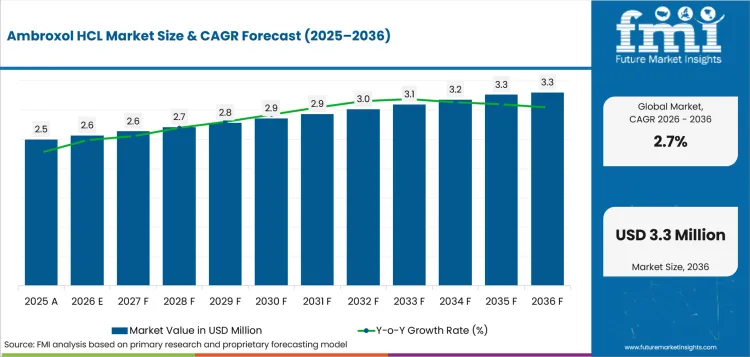
Ambroxol HCL Market Overview: Size and Forecast
- 2025 Market Size: USD 2.5 million
- 2026 Market Size: USD 2.58 million
- 2036 Market Size: USD 3.37 million
- Forecast CAGR: 2.72% from 2026 to 2036
- Leading Application Segment: Respiratory Tract Disorders
- Respiratory Tract Disorders Share in 2026: 82.0%
- Leading Form Segment: Powder
- Powder Share in 2026: 72.0%
- Fastest-growing Country: China
- China Forecast CAGR: 3.6% from 2026 to 2036
Summary of the Ambroxol HCL Market
- Demand and Growth Drivers
- Mucolytic respiratory formulations keep Ambroxol HCL inside recurring API sourcing cycles for finished-dose producers.
- Sore-throat dosage routes add limited but steady value through lozenges and local product approvals.
- Quality teams screen pharmacopoeial alignment and change-control support before price discussions advance.
- Product and Segment View
- Respiratory tract disorders are forecast to represent 82.0% share in 2026, led by continued use in approved mucus-clearance formulations.
- Powder is projected to hold 72.0% share in 2026, influenced by established API weighing and blending routines.
- 99.5% and above purity grade is expected to secure 64.0% share in 2026, supported by regulated buyer preference for stronger impurity control.
- Geography and Competitive Outlook
- China is projected to record 3.6% CAGR by 2036, backed by domestic formulation activity and respiratory product depth.
- India is expected to expand at 3.4% CAGR through 2036, driven by API supplier depth and export-oriented formulation work.
- Anuh Pharma and Shilpa Pharma shape API supply signals through CEP-linked documentation and product-file visibility.
- Cipla, Opella, Chiesi Farmaceutici, and Viatris influence downstream formulation pull through maintained respiratory portfolios.
- Analyst Opinion
- Anurag Sharma, Principal Consultant for Healthcare at FMI, says, “Ambroxol HCL is a qualification-led API market, not a molecule discovery market. Buyers already know the active ingredient. Supplier advantage comes from pharmacopoeial compliance and change-notification support. Suppliers should sell proof first and price second.”
- Which factors support expansion in the Ambroxol HCL market?
- Finished respiratory formulations and qualified API supply support value across regulated medicine channels.
- Market value is supported by repeat API revenue before distributor discovery adds smaller regional orders.
- Supplier pricing reflects assay control and documentation strength before volume discounts affect negotiations.
- Revenue improves as finished-dose owners maintain cough and selected sore-throat products.
- Buyer confidence improves as API files and batch records make supplier comparison easier.
API qualification pressure is shaping Ambroxol HCL sales planning. FDA stated in 2025 that only 11% of API manufacturers were based in the United States, compared with 22% in China and 44% in India. CDC estimated 51 million influenza illnesses and 710,000 hospitalizations during the 2024 to 2025 flu season, keeping respiratory product continuity commercially useful for formulation owners. Shilpa Pharma listed Ambroxol Hydrochloride API with 280 to 300 tonnes annual capacity and a CEP-linked DMF signal, giving regulated buyers a clearer supplier screening point. Commercial value therefore comes from documentation and dosage-form continuity rather than new molecule creation.
Why is the Ambroxol HCL market growing?
Adult and pediatric respiratory formulations need stable Ambroxol HCL supply for approved mucus-clearance products.
Ambroxol HCL demand grows slowly as respiratory medicine portfolios still need reliable mucolytic API supply. CDC mortality data recorded 145,643 deaths from chronic lower respiratory diseases in the United States in 2024, showing sustained clinical burden across chronic airway conditions. API suppliers gain from formulation continuity rather than rapid product invention. Buyers treat Ambroxol HCL as a regulated medicine ingredient tied to approved dosage forms and supplier files. Stronger suppliers protect repeat accounts through pharmacopoeial evidence and clear change-control communication.
How is the Ambroxol HCL market segmented?
Ambroxol HCL industry is segmented by form, purity grade, application, sales channel, and end user.
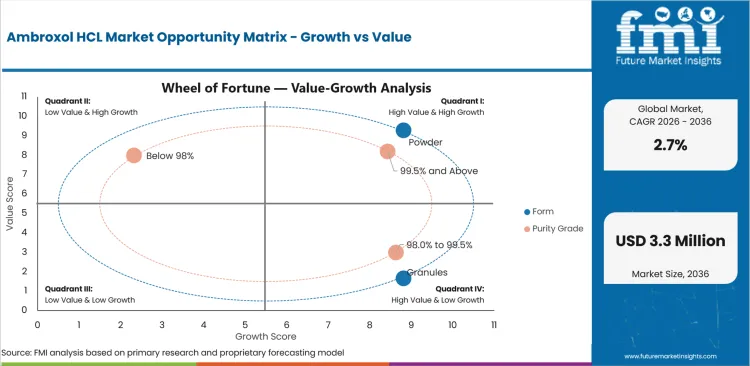
- Powder is projected to secure 72.0% share in 2026, led by API buyers needing direct assay checks and familiar specification files.
- 99.5% and above purity grade is anticipated to hold 64.0% share in 2026, supported by product-file discipline and impurity screening across regulated formulation work.
- Respiratory tract disorders are expected to capture 82.0% share in 2026, guided by mucus-clearance use across cough and respiratory dosage portfolios.
- Direct sales are forecast to represent 58.0% share in 2026, shaped by technical file review and supplier qualification meetings.
- Pharmaceutical manufacturers are projected to account for 68.0% share in 2026, reflected by finished-dose owners converting the API into registered products.
Why does powder dominate the Ambroxol HCL market?
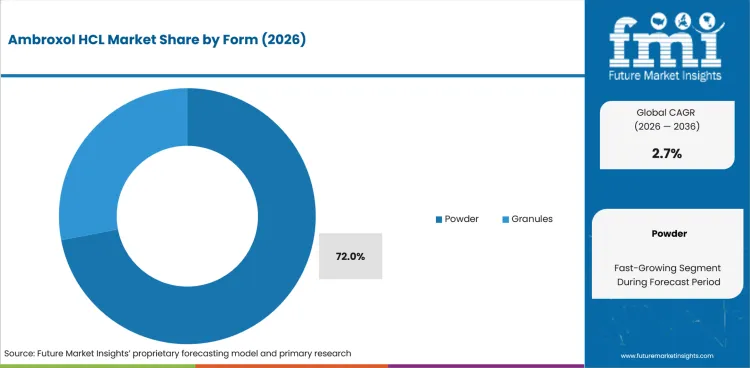
- Powder is projected to account for 72.0% share in 2026, influenced by bulk API buyers needing assay control and direct comparison across supplier certificates.
- Granules gain limited use as handling convenience supports smaller buyers. Established formulation teams often avoid format change after process validation.
Which purity grade leads the Ambroxol HCL market?
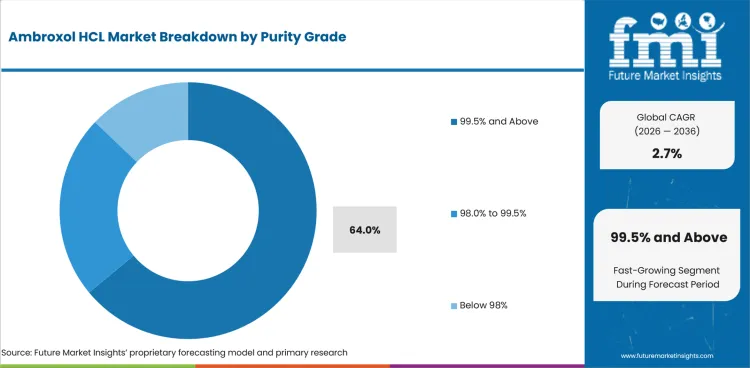
- 99.5% and above purity grade is anticipated to hold 64.0% share in 2026, supported by regulated buyers screening impurity profiles before supplier approval.
- 98.0% to 99.5% grade gains selective demand among buyers with less demanding product files. Audit-led customers usually prefer stronger purity evidence.
Which application leads the Ambroxol HCL market?
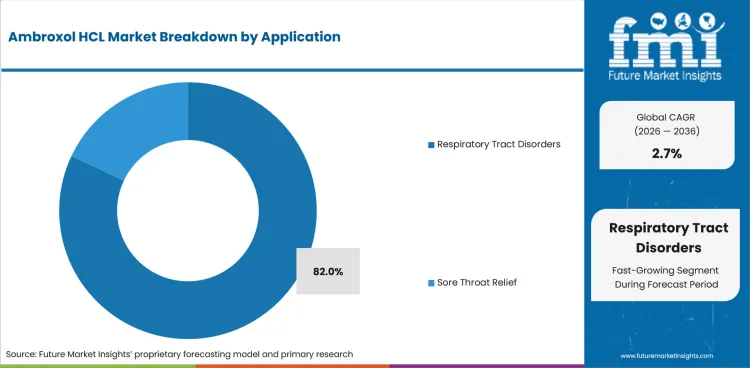
- Respiratory tract disorders are forecast to secure 82.0% share in 2026, led by cough and mucus-clearance formulations using Ambroxol HCL as a mature mucolytic ingredient.
- Sore throat relief adds value through lozenge and local OTC routes, while demand is smaller and more country-specific.
Which sales channel leads the Ambroxol HCL market?
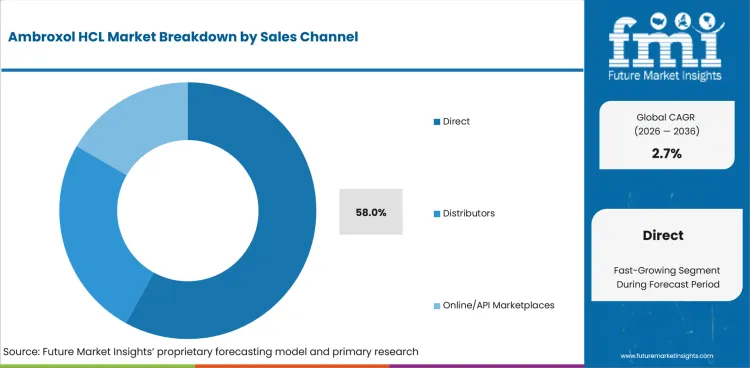
- Direct sales are expected to represent 58.0% share in 2026, shaped by supplier file review and repeat ordering from qualified formulation plants.
- Distributors support smaller buyers and regional formulators by helping compare specifications and bridge supplier discovery before direct approval.
Which end user leads the Ambroxol HCL market?
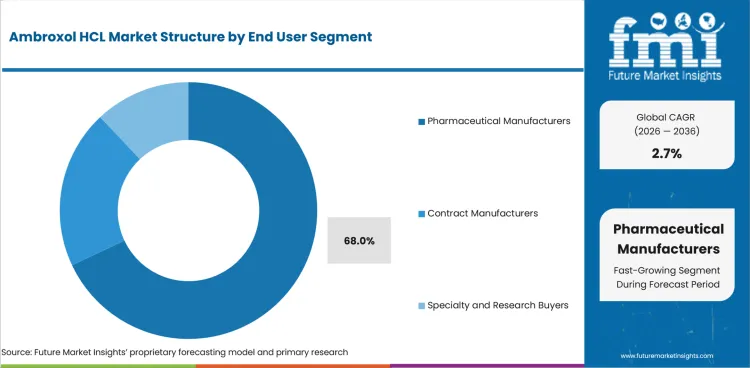
- Pharmaceutical manufacturers are projected to account for 68.0% share in 2026, reflected by conversion of Ambroxol HCL into registered respiratory dosage products.
- Contract manufacturers gain steady demand as product owners outsource manufacturing and need supplier files aligned with existing dossiers.
What are the drivers, restraints, and opportunities in the Ambroxol HCL market?
Repeat respiratory products support demand while mature-molecule pricing limits supplier upside.
- Approved mucolytic formulations require steady Ambroxol HCL supply from qualified vendors because finished-dose manufacturers cannot risk approval delays or batch interruptions.
- Mature molecule pricing limits supplier upside when documentation, audit readiness, and impurity-control evidence do not clearly differ from competing API sources.
- CEP-backed and pharmacopoeial suppliers can win regulated accounts by giving buyers stronger proof packages for audits, registration updates, and repeat procurement.
Respiratory Formulation Continuity
Approved cough and mucus-clearance portfolios continue to support Ambroxol HCL API demand. CDC estimated 23 million flu-related medical visits during the 2024 to 2025 season, showing recurring healthcare contact linked to respiratory illness. Formulation owners therefore need stable ingredient access for respiratory products already accepted in local markets. Suppliers benefit most through consistent batch release and alignment with product-file maintenance requirements.
Mature Molecule Pricing Pressure
Ambroxol HCL faces price pressure as buyers can compare multiple suppliers for a known ingredient. FDA reported 50 novel drug approvals in 2024, including 26 therapies with signaling greater regulatory and investor attention toward innovation rather than mature cough ingredients. Mature APIs must therefore defend value through quality proof. Suppliers lacking impurity discipline or audit support face sharper price comparison.
Documentation-Led Account Advantage
Strong documentation creates the clearest opportunity for Ambroxol HCL suppliers. EDQM reported 13 new European Pharmacopoeia reference standards and 16 replacement batches in its April 2026 reference standards update, showing ongoing technical maintenance around medicine quality tools. API vendors with CEP evidence and responsive regulatory teams can protect repeat accounts. Strong files reduce buyer review time and lower disruption risk for approved finished products.
Who are the leading companies in the Ambroxol HCL market?
Anuh Pharma, Shilpa Pharma, Cipla, Opella and Viatris.
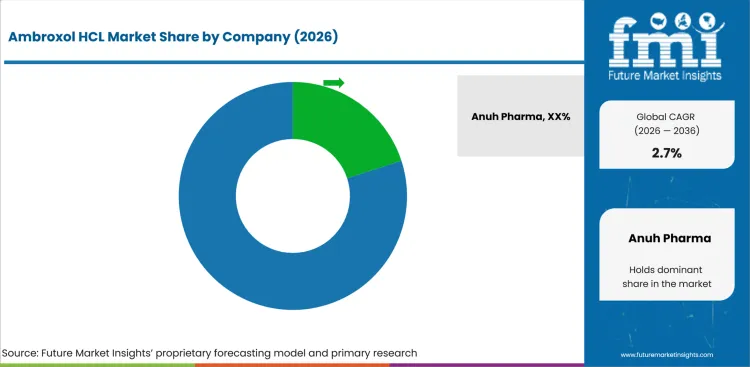
- API suppliers hold an advantage through CEP-linked documentation and repeat batch manufacturing depth.
- Finished respiratory product owners influence pull-through demand by maintaining cough and mucus-clearance portfolios.
- Distributor-led access supports smaller buyers that need samples and specification comparison before direct approval.
- Documentation-ready supply helps qualified vendors defend accounts through impurity files and change-control support.
API groups in the market compete by combining pharmacopoeial evidence with buyer-facing technical support. Anuh Pharma and Shilpa Pharma hold stronger importance based on public Ambroxol HCL API listings and CEP-linked documentation signals. Cipla, Opella, Chiesi Farmaceutici, and Viatris influence downstream demand through maintained respiratory and cough product portfolios. Buyers assess file strength and batch consistency before moving price discussions forward.
Supply assurance has become a competitive separator as formulation owners avoid supplier changes that could add review work. Anuh Pharma’s Ambroxol Hydrochloride Ph. Eur. listing adds supplier-file visibility for regulated buyers. Documentation alone is not enough if batch responsiveness and change notifications fail.
Smaller and regional suppliers can win through faster sampling and local technical service. Europe and Japan create more disciplined review settings due to public medicine files and strict product information. India and China create stronger volume-linked opportunities, with pricing pressure staying higher. Suppliers selling only low price are expected to face weaker repeat acceptance in regulated accounts.
How do top Ambroxol HCL companies compare?
Anuh Pharma and Shilpa Pharma score strongest on API documentation while finished product owners support downstream formulation demand.
| Company | Relevance to Market Title | API Coverage | Documentation Signal | Finished Formulation Reach | Channel Reach | Geographic Footprint |
|---|---|---|---|---|---|---|
| Anuh Pharma | Very High | Very Strong | Very Strong | Moderate | Strong | India and export markets |
| Shilpa Pharma | Very High | Very Strong | Very Strong | Low to Moderate | Strong | India and export markets |
| Cipla | High | Moderate | Strong | Very Strong | Very Strong | India and export markets |
| Opella | High | Low to Moderate | Strong | Very Strong | Very Strong | Europe and global consumer health |
| Viatris | High | Low to Moderate | Strong | Strong | Strong | Europe and global markets |
| Chiesi Farmaceutici | Moderate to High | Low | Strong | Strong | Strong | Europe |
| AX Pharmaceutical | Moderate | Moderate | Moderate | Low | Moderate | United States |
| Regional API Distributors | Moderate | Moderate | Moderate | Low | Strong | Country-specific |
| Contract Manufacturers | Moderate | Low to Moderate | Strong | Moderate | Moderate | Regional |
| Online API Marketplaces | Low to Moderate | Low | Moderate | Low | Moderate | Global discovery routes |
Source: Future Market Insights competitive analysis, 2026.
Who are the key players in the Ambroxol HCL market?
Anuh Pharma, Shilpa Pharma and Cipla are listed with Opella and Viatris among other suppliers.
Key global companies leading the Ambroxol HCL market include:
- Anuh Pharma
- Shilpa Pharma
- Cipla
- Opella
- Chiesi Farmaceutici
- Viatris
- AX Pharmaceutical
- Regional API distributors
- Contract manufacturers
- Online API marketplaces
Key Developments in Ambroxol HCL Market
- In February 2026, Shilpa Pharma published Ambroxol Hydrochloride API information listing CEP-linked DMF reference CEP-2004-201-Rev 06 and annual capacity of 280 to 300 tonnes.
- In 2025, Anuh Pharma’s manufacturing certification information listed Ambroxol Hydrochloride Ph. Eur. with EDQM CEP reference 2018-033, supporting regulated buyer screening.
Key Players in the Ambroxol HCL Market
API Suppliers
- Anuh Pharma
- Shilpa Pharma
- AX Pharmaceutical
- Regional API producers
Finished Product Owners
- Cipla
- Opella
- Chiesi Farmaceutici
- Viatris
Distributor and Specialty Routes
- API distributors
- Contract manufacturers
- Online/API marketplaces
- Specialty ingredient suppliers
Which countries are growing fastest in the Ambroxol HCL market?
China 3.6% CAGR, India 3.4% CAGR, Germany 2.9% CAGR, Japan 2.8% CAGR, South Korea 2.7% CAGR, France 2.5% CAGR, United Kingdom 2.2% CAGR, and United States 1.6% CAGR through 2036.
.webp "Top Country Growth Comparison Ambroxol Hcl Market Cagr (2026 2036)")
| Country | CAGR |
|---|---|
| China | 3.6% |
| India | 3.4% |
| Germany | 2.9% |
| Japan | 2.8% |
| South Korea | 2.7% |
| France | 2.5% |
| United Kingdom | 2.2% |
| United States | 1.6% |
Source: Future Market Insights, 2026.
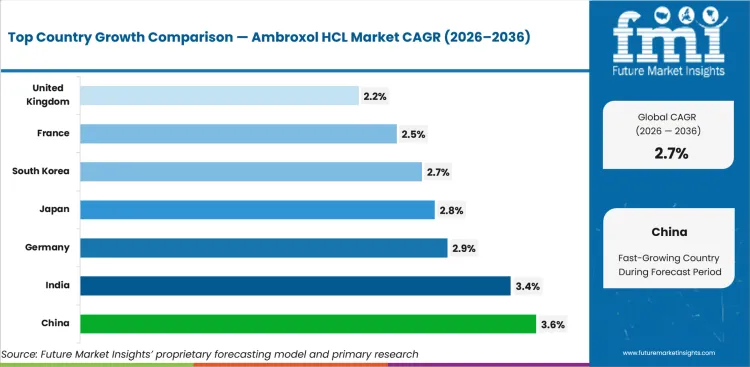
How do country-level CAGRs compare in the Ambroxol HCL market?
China leads country growth while the United States records the most cautious expansion outlook among profiled markets.
- China is forecast to record 3.6% CAGR by 2036, reflected by domestic formulation activity supports API qualification demand.
- India is expected to expand at 3.4% CAGR by 2036 through API supplier depth and export-oriented formulation work.
- Germany is projected to grow at 2.9% CAGR by 2036 as medicine transparency and regulatory discipline support supplier file review.
- Japan is estimated to rise at 2.8% CAGR by 2036 with label discipline shaping repeat respiratory product demand.
- South Korea is expected to advance at 2.7% CAGR over the forecast period due to MFDS process discipline guiding API screening.
- France is forecast to grow at 2.5% CAGR through 2036 since pharmacy-controlled respiratory products maintain API pull.
- United Kingdom is projected to post 2.2% CAGR by 2036, backed by pharmacovigilance discipline sustaining cautious supplier switching.
- United States is expected to record 1.6% CAGR through 2036 due to limited Ambroxol HCL human OTC visibility and specialized use signals.
What is the Ambroxol HCL market outlook in China?
A 3.6% CAGR through 2036 reflects domestic formulation activity and stronger API-linked manufacturing depth.
Country Market Snapshot Table
| Parameter | Value |
|---|---|
| Market Size in 2025 (Value) | USD 0.45 million |
| Market Size in 2026 (Value) | USD 0.47 million |
| Market Forecast in 2036 (Value) | USD 0.67 million |
| CAGR (2026 to 2036) | 3.6% |
| Years Considered | 2021 to 2036 |
| Base Year | 2025 |
| Forecast Period | 2026 to 2036 |
| Units Considered | Value (USD million) |
| Leading Sub-Region | Yangtze River Delta pharmaceutical corridors |
China Ambroxol HCL Market Outlook
China Ambroxol HCL demand is supported by domestic respiratory formulations and API manufacturing depth. Finished-dose producers need suppliers that can support oral and injectable dosage routes with reliable impurity evidence.
Domestic formulation scale gives China the fastest country outlook in the profiled group. Price pressure stays high, so supplier advantage comes from documentation and consistency.
Key Growth Drivers
- API sourcing depth supports qualified Ambroxol HCL supply, measured by FDA manufacturing-supply data placing 22.0% of global API manufacturers in China in 2025.
- Respiratory product planning receives seasonal demand support, evidenced by Chinese influenza surveillance reporting 171 influenza-like illness outbreaks in week 52 of 2024.
- Domestic respiratory product depth supports above-average Ambroxol HCL API qualification demand.
- Local manufacturers can serve cost-sensitive formulation buyers through scale and repeated production experience.
Key Restraints
- Price competition limits supplier premiums unless documentation quality is strong.
- Buyers may press for alternate sources as API concentration attracts policy attention in export markets.
- Innovation-focused review priorities can limit attention to mature mucolytic APIs, reflected by China’s 30-day clinical-trial review pathway for Class I innovative drugs.
What makes China unique
China is unique due to API manufacturing scale and domestic respiratory formulation depth.
Key Companies
- Local API producers
- Domestic formulation manufacturers
- Export-oriented suppliers
- Distributor networks
- Contract manufacturers
- Hospital product holders
- Regional respiratory medicine firms
Sales & Marketing Channels
- Direct supplier qualification
- Domestic distributors
- Export API channels
- Contract manufacturing routes
- Hospital-linked respiratory products
- Online API discovery routes
Country Segment Breakdown Table
| Segment | Sub-Segments |
|---|---|
| By Form | Powder · Granules |
| By Purity Grade | 99.5% and Above · 98.0% to 99.5% · Below 98% |
| By Application | Respiratory Tract Disorders · Sore Throat Relief |
| By Sales Channel | Direct · Distributors · Online/API Marketplaces |
| By End User | Pharmaceutical Manufacturers · Contract Manufacturers · Specialty and Research Buyers |
| Key Sub-Regions Covered, API and Formulation Corridors | Shanghai · Jiangsu · Zhejiang · Shandong · Guangdong · Sichuan |
Frequently Asked Questions
How fast is China Ambroxol HCL market growing?
Sales in China are expected to increase at 3.6% CAGR from 2026 to 2036, led by domestic formulation activity.
Who leads China Ambroxol HCL market?
Local API producers, domestic formulation firms, and export-oriented suppliers lead country-level activity.
What is driving adoption in China Ambroxol HCL market?
API manufacturing depth and respiratory product volume support Ambroxol HCL demand.
What is the Ambroxol HCL market outlook in India?
A 3.4% CAGR through 2036 is supported by API supplier depth and export-oriented formulation activity.
Country Market Snapshot Table
| Parameter | Value |
|---|---|
| Market Size in 2025 (Value) | USD 0.36 million |
| Market Size in 2026 (Value) | USD 0.37 million |
| Market Forecast in 2036 (Value) | USD 0.52 million |
| CAGR (2026 to 2036) | 3.4% |
| Years Considered | 2021 to 2036 |
| Base Year | 2025 |
| Forecast Period | 2026 to 2036 |
| Units Considered | Value (USD million) |
| Leading Sub-Region | Western India API corridors |
India Ambroxol HCL Market Outlook
India Ambroxol HCL demand is supply-led as domestic API producers support local and export-oriented formulation demand. Supplier documentation and price discipline shape account wins.
India holds a stronger role than most profiled countries due to API manufacturing depth. Buyers still press price, but stronger documentation protects qualified suppliers from purely price-led substitution.
Key Growth Drivers
- Export-oriented formulation demand supports API qualification, quantified by official trade material placing pharmaceutical exports at USD 30.5 billion across 191 countries in 2024 to 2025.
- Regulated-market exposure pushes supplier-file discipline, supported by official trade material stating 50.0% of India’s pharmaceutical exports moved to highly regulated markets in 2024 to 2025.
- Anuh Pharma and Shilpa Pharma provide public Ambroxol HCL API signals through CEP-linked documentation.
- Domestic finished-dose activity supports recurring demand for mucolytic and cough formulations.
Key Restraints
- Price competition is intense across mature APIs, limiting margin expansion for weakly differentiated suppliers.
- Export-focused buyers demand strong impurity control and change-notification discipline.
- Quality surveillance raises buyer scrutiny, with Indian health ministry data showing 116,323 drug samples tested, 3,104 classified as not of standard quality, and 245 classified as spurious or adulterated in 2024 to 2025.
What makes India unique
India is unique due to export-oriented formulation capacity and CEP-backed Ambroxol HCL supply signals.
Key Companies
- Anuh Pharma
- Shilpa Pharma
- Cipla
- API distributors
- Contract manufacturers
- Export-oriented formulation companies
- Regional cough formulation suppliers
Sales & Marketing Channels
- Direct supplier qualification
- API distributors
- Export API channels
- Contract manufacturing routes
- Domestic formulation networks
- Online API discovery platforms
Country Segment Breakdown Table
| Segment | Sub-Segments |
|---|---|
| By Form | Powder · Granules |
| By Purity Grade | 99.5% and Above · 98.0% to 99.5% · Below 98% |
| By Application | Respiratory Tract Disorders · Sore Throat Relief |
| By Sales Channel | Direct · Distributors · Online/API Marketplaces |
| By End User | Pharmaceutical Manufacturers · Contract Manufacturers · Specialty and Research Buyers |
| Key Sub-Regions Covered, API Corridors | Maharashtra · Gujarat · Telangana · Andhra Pradesh · Karnataka · Himachal Pradesh |
Frequently Asked Questions
How fast is India Ambroxol HCL market growing?
Sales in India are expected to rise at 3.4% CAGR from 2026 to 2036, supported by API supply depth.
Who leads India Ambroxol HCL market?
Anuh Pharma, Shilpa Pharma, Cipla, API distributors, and export-oriented formulation companies shape country demand.
What is driving adoption in India Ambroxol HCL market?
CEP-linked supply signals and export-oriented manufacturing support Ambroxol HCL demand.
What is the Ambroxol HCL market outlook in Germany?
A 2.9% CAGR through 2036 reflects transparency-led qualification and stronger medicine information access.
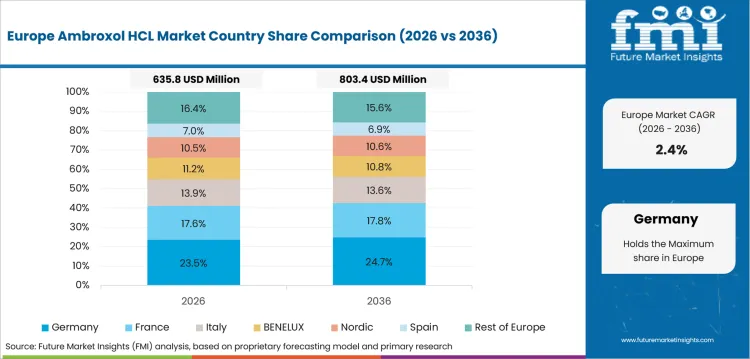
Country Market Snapshot Table
| Parameter | Value |
|---|---|
| Market Size in 2025 (Value) | USD 0.29 million |
| Market Size in 2026 (Value) | USD 0.30 million |
| Market Forecast in 2036 (Value) | USD 0.39 million |
| CAGR (2026 to 2036) | 2.9% |
| Years Considered | 2021 to 2036 |
| Base Year | 2025 |
| Forecast Period | 2026 to 2036 |
| Units Considered | Value (USD million) |
| Leading Sub-Region | Rhine-Ruhr and southern pharmaceutical corridors |
Germany Ambroxol HCL Market Outlook
Germany Ambroxol HCL demand is shaped by medicine information transparency and disciplined product review. Public product information access helps buyers check authorization status and technical documentation signals.
Supplier qualification favors API vendors able to support pharmacopoeial files and repeated batch release. Germany also acts as a reference market for cautious European sourcing decisions.
Key Growth Drivers
- Adult respiratory-risk exposure sustains mucolytic product use, indicated by Germany’s 13.9 million current adult smokers and 19.3% adult smoking prevalence in 2024.
- Respiratory-season monitoring supports pharmacy product planning, shown by German sentinel evidence estimating 31.0% influenza vaccine effectiveness against any influenza during 2024 to 2025.
- German product review culture supports supplier preference for strong certificates and batch histories.
- Pharmacy and generic channels maintain respiratory medicine continuity across mature cough products.
Key Restraints
- Strict medicine documentation expectations can slow supplier changes for existing respiratory products.
- Price discipline limits premium potential for mature APIs without clear quality proof.
- Prevention policy can reduce symptomatic treatment reliance, with European seasonal guidance covering 30 countries that recommended influenza vaccination for adults with chronic medical conditions in 2024 to 2025.
What makes Germany unique
Germany is unique due to public medicine information access and disciplined supplier file review across regulated respiratory products.
Key Companies
- Opella
- Viatris
- Chiesi Germany
- Generic medicine suppliers
- API distributors
- Contract manufacturers
- Pharmacy channel partners
Sales & Marketing Channels
- Direct supplier qualification
- API distributors
- Pharmacy-linked respiratory products
- Contract manufacturing routes
- Technical documentation reviews
- Regulated medicine channels
Country Segment Breakdown Table
| Segment | Sub-Segments |
|---|---|
| By Form | Powder · Granules |
| By Purity Grade | 99.5% and Above · 98.0% to 99.5% · Below 98% |
| By Application | Respiratory Tract Disorders · Sore Throat Relief |
| By Sales Channel | Direct · Distributors · Online/API Marketplaces |
| By End User | Pharmaceutical Manufacturers · Contract Manufacturers · Specialty and Research Buyers |
| Key Sub-Regions Covered, Pharmaceutical Corridors | North Rhine-Westphalia · Bavaria · Baden-Württemberg · Hesse · Berlin-Brandenburg · Lower Saxony |
Frequently Asked Questions
How fast is Germany Ambroxol HCL market growing?
Sales in Germany are expected to increase at 2.9% CAGR from 2026 to 2036, supported by transparent medicine information access.
Who leads Germany Ambroxol HCL market?
Opella, Viatris, Chiesi, generic suppliers, and API distributors shape respiratory formulation demand.
What is driving adoption in Germany Ambroxol HCL market?
Medicine information transparency and pharmacopoeial discipline support Ambroxol HCL supplier qualification.
What is the Ambroxol HCL market outlook in Japan?
A 2.8% CAGR through 2036 reflects label discipline and mature respiratory product continuity.
Country Market Snapshot Table
| Parameter | Value |
|---|---|
| Market Size in 2025 (Value) | USD 0.22 million |
| Market Size in 2026 (Value) | USD 0.22 million |
| Market Forecast in 2036 (Value) | USD 0.29 million |
| CAGR (2026 to 2036) | 2.8% |
| Years Considered | 2021 to 2036 |
| Base Year | 2025 |
| Forecast Period | 2026 to 2036 |
| Units Considered | Value (USD million) |
| Leading Sub-Region | Kanto and Kansai pharmaceutical corridors |
Japan Ambroxol HCL Market Outlook
Japan Ambroxol HCL demand is shaped by label discipline and conservative supplier review. Product information sheets provide clear dose and administration details for ambroxol hydrochloride products.
Pharmaceutical buyers favor suppliers able to maintain batch consistency and documentation accuracy. Quality review limits rapid switching for mature respiratory ingredients.
Key Growth Drivers
- Dose clarity supports repeat respiratory product use, shown by Japanese patient medicine information specifying 15 mg Ambroxol HCL tablets taken 3 times daily for adults.
- Manufacturing-quality oversight supports conservative API screening, with PMDA reporting 131 on-site GMP inspections and 2,062 desk-top GMP inspections in FY 2024.
- Japan’s generic respiratory product base supports recurring API need for established formulations.
- Contract manufacturers need supplier files aligning with domestic product expectations and internal quality reviews.
Key Restraints
- Quality review can slow supplier substitution for mature API files, reflected by 590 facility inspections and 46 ad-hoc on-site inspections in FY 2024.
- Local product labels reduce room for unsupported dosage or indication claims.
- Influenza therapeutic surveillance adds respiratory-market caution as resistance tracking keeps product guidance under review.
What makes Japan unique
Japan is unique due to clear medicine information sheets and disciplined supplier review across established respiratory products.
Key Companies
- Chiesi Japan-linked channels
- Viatris Japan
- Domestic generic manufacturers
- API distributors
- Contract manufacturers
- Pharmacy product holders
- Specialty respiratory medicine suppliers
Sales & Marketing Channels
- Direct supplier qualification
- API distributors
- Contract manufacturing routes
- Hospital-linked respiratory products
- Pharmacy channels
- Technical documentation reviews
Country Segment Breakdown Table
| Segment | Sub-Segments |
|---|---|
| By Form | Powder · Granules |
| By Purity Grade | 99.5% and Above · 98.0% to 99.5% · Below 98% |
| By Application | Respiratory Tract Disorders · Sore Throat Relief |
| By Sales Channel | Direct · Distributors · Online/API Marketplaces |
| By End User | Pharmaceutical Manufacturers · Contract Manufacturers · Specialty and Research Buyers |
| Key Sub-Regions Covered, Pharmaceutical Corridors | Kanto · Kansai · Chubu · Kyushu · Tohoku · Hokkaido |
Frequently Asked Questions
How fast is Japan Ambroxol HCL market growing?
Sales in Japan are expected to increase at 2.8% CAGR from 2026 to 2036, shaped by label discipline.
Who leads Japan Ambroxol HCL market?
Domestic generic manufacturers and contract manufacturers influence demand.
What is driving adoption in Japan Ambroxol HCL market?
Product label clarity and repeat respiratory formulation use support qualified API sourcing.
What is the Ambroxol HCL market outlook in South Korea?
A 2.7% CAGR through 2036 reflects regulator-process discipline and steady generic respiratory product activity.
Country Market Snapshot Table
| Parameter | Value |
|---|---|
| Market Size in 2025 (Value) | USD 0.12 million |
| Market Size in 2026 (Value) | USD 0.13 million |
| Market Forecast in 2036 (Value) | USD 0.16 million |
| CAGR (2026 to 2036) | 2.7% |
| Years Considered | 2021 to 2036 |
| Base Year | 2025 |
| Forecast Period | 2026 to 2036 |
| Units Considered | Value (USD million) |
| Leading Sub-Region | Seoul-Incheon pharmaceutical corridors |
South Korea Ambroxol HCL Market Outlook
South Korea Ambroxol HCL sector is guided by MFDS technical review and inspection discipline. Pharmaceutical ingredients and finished products undergo safety and quality checks before manufacturing and distribution approval.
Generic respiratory products need repeat API supply, yet supplier review remains controlled. Vendors need complete technical files and reliable batch evidence to defend accounts.
Key Growth Drivers
- Respiratory surveillance breadth supports formulation planning, shown by 299 primary-care sentinel clinics and 220 hospitals participating in the 2024 to 2025 season.
- Acute respiratory demand signals remained strong, with influenza-like illness peaking at 99.8 cases per 1,000 outpatients in week 1 of 2025.
- Generic drug product review supports stable demand for mature respiratory APIs.
- Local buyers value supplier responsiveness during technical review and post-approval file updates.
Key Restraints
- MFDS review separates new drugs and generics, keeping dossier preparation demanding.
- Supplier switching can slow if inspection or ingredient documentation creates extra review.
- Hospital case concentration can tighten product availability planning, with 8,640 hospitalized influenza cases reported in 2024 to 2025 and 52.4% involving adults aged 65 years and older.
What makes South Korea unique
South Korea is unique due to process discipline and clearly structured review for pharmaceutical ingredients and drug products.
Key Companies
- Domestic generic manufacturers
- API importers
- Contract manufacturers
- Respiratory product holders
- Distributor networks
- Hospital-linked suppliers
- Technical regulatory service providers
Sales & Marketing Channels
- Direct supplier qualification
- API import distributors
- Contract manufacturing routes
- Hospital respiratory channels
- Pharmacy products
- Technical dossier support networks
Country Segment Breakdown Table
| Segment | Sub-Segments |
|---|---|
| By Form | Powder · Granules |
| By Purity Grade | 99.5% and Above · 98.0% to 99.5% · Below 98% |
| By Application | Respiratory Tract Disorders · Sore Throat Relief |
| By Sales Channel | Direct · Distributors · Online/API Marketplaces |
| By End User | Pharmaceutical Manufacturers · Contract Manufacturers · Specialty and Research Buyers |
| Key Sub-Regions Covered, Pharmaceutical Corridors | Seoul · Incheon · Gyeonggi · Daejeon · Daegu · Busan |
Frequently Asked Questions
How fast is South Korea Ambroxol HCL market growing?
Sales in South Korea are expected to increase at 2.7% CAGR from 2026 to 2036, guided by MFDS process discipline.
Who leads South Korea Ambroxol HCL market?
Domestic generic manufacturers and contract manufacturers shape demand.
What is driving adoption in South Korea Ambroxol HCL market?
Structured drug review and recurring generic respiratory formulations support Ambroxol HCL demand.
What is the Ambroxol HCL market outlook in France?
A 2.5% CAGR through 2036 is supported by pharmacy-controlled product continuity and registered mucolytic formulations.
Country Market Snapshot Table
| Parameter | Value |
|---|---|
| Market Size in 2025 (Value) | USD 0.24 million |
| Market Size in 2026 (Value) | USD 0.25 million |
| Market Forecast in 2036 (Value) | USD 0.32 million |
| CAGR (2026 to 2036) | 2.5% |
| Years Considered | 2021 to 2036 |
| Base Year | 2025 |
| Forecast Period | 2026 to 2036 |
| Units Considered | Value (USD million) |
| Leading Sub-Region | Île-de-France and Rhône-Alpes pharmaceutical corridors |
France Ambroxol HCL Market Outlook
France Ambroxol HCL industry is connected to registered respiratory medicines and pharmacy-controlled channels. Product files make strength and mucolytic classification central to API demand.
Generic product holders and consumer health companies influence repeat API pull through maintained finished products. Suppliers need strong quality evidence and stable commercial terms.
Key Growth Drivers
- Registered oral-solution dosing supports formulation continuity, shown by French public medicine data listing 30 mg ambroxol hydrochloride per 5 mL graduation.
- Respiratory-season burden sustains pharmacy product planning, measured by French public service material estimating influenza affects 2 million to 6 million people each winter.
- Pharmacy-controlled distribution keeps finished respiratory product standards disciplined.
- Generic product continuity supports repeat API sourcing from qualified suppliers.
Key Restraints
- Mature product lines reduce rapid supplier change as finished-dose owners avoid dossier disruption.
- Strong pharmacy oversight limits speculative product claims around mucolytic ingredients.
- Safety monitoring adds review pressure, with the French medicine safety platform drawing from 5 health-product data sources, including national pharmacovigilance data.
What makes France unique
France is unique due to pharmacy-controlled respiratory products and public medicine database support for registered strengths.
Key Companies
- Viatris
- Opella
- Chiesi Farmaceutici
- Generic medicine suppliers
- API distributors
- Pharmacy channel partners
- Contract manufacturers
Sales & Marketing Channels
- Pharmacy-linked respiratory products
- Direct supplier qualification
- API distributors
- Hospital and pharmacy buyers
- Contract manufacturing routes
- Regulated medicine channels
Country Segment Breakdown Table
| Segment | Sub-Segments |
|---|---|
| By Form | Powder · Granules |
| By Purity Grade | 99.5% and Above · 98.0% to 99.5% · Below 98% |
| By Application | Respiratory Tract Disorders · Sore Throat Relief |
| By Sales Channel | Direct · Distributors · Online/API Marketplaces |
| By End User | Pharmaceutical Manufacturers · Contract Manufacturers · Specialty and Research Buyers |
| Key Sub-Regions Covered, Pharmacy and Manufacturing Corridors | Île-de-France · Auvergne-Rhône-Alpes · Occitanie · Nouvelle-Aquitaine · Hauts-de-France · Provence-Alpes-Côte d’Azur |
Frequently Asked Questions
How fast is France Ambroxol HCL market growing?
Sales in France are expected to rise at 2.5% CAGR from 2026 to 2036, supported by registered respiratory formulations.
Who leads France Ambroxol HCL market?
Viatris, Opella, Chiesi, and generic medicine suppliers shape finished product demand.
What is driving adoption in France Ambroxol HCL market?
Registered mucolytic formulations and pharmacy-controlled channels support stable API demand.
What is the Ambroxol HCL market outlook in the United Kingdom?
A 2.2% CAGR through 2036 is supported by pharmacovigilance discipline and cautious respiratory product-file management.
Country Market Snapshot Table
| Parameter | Value |
|---|---|
| Market Size in 2025 (Value) | USD 0.16 million |
| Market Size in 2026 (Value) | USD 0.16 million |
| Market Forecast in 2036 (Value) | USD 0.20 million |
| CAGR (2026 to 2036) | 2.2% |
| Years Considered | 2021 to 2036 |
| Base Year | 2025 |
| Forecast Period | 2026 to 2036 |
| Units Considered | Value (USD million) |
| Leading Sub-Region | England respiratory medicine corridors |
United Kingdom Ambroxol HCL Market Outlook
United Kingdom Ambroxol HCL demand is shaped by medicine safety monitoring and conservative supplier qualification. Finished product holders prefer approved suppliers that can support batch evidence and product-file maintenance.
Pharmacy-linked respiratory products maintain a measured API base. Vendors need pharmacopoeial alignment and quality communication before repeat accounts expand.
Key Growth Drivers
- Respiratory illness creates steady pharmacy and healthcare contact, marked by England’s 7,757 influenza-attributable excess deaths in 2024 to 2025.
- Vaccination modelling still shows large respiratory care load, indicated by 96,000 to 120,200 influenza hospital admissions averted in England during 2024 to 2025.
- Pharmacovigilance culture supports careful product-file upkeep across established respiratory ingredients.
- Finished-dose owners prefer suppliers documenting impurity control and avoid extra review work.
Key Restraints
- Ambroxol HCL lacks the same high-visibility OTC position seen across several continental European markets.
- Buyer switching stays cautious as pharmacovigilance teams prefer stable suppliers for mature respiratory products.
- Lower at-risk adult vaccination can keep winter demand uneven, illustrated by 34.6% influenza vaccine uptake among at-risk groups in Scotland by week 14 of 2025.
What makes the United Kingdom unique
United Kingdom demand is unique due to safety-monitoring discipline and cautious supplier switching across mature medicine ingredients.
Key Companies
- Viatris
- Opella
- Cipla UK
- Generic medicine distributors
- API importers
- Contract manufacturers
- Pharmacy-led respiratory product suppliers
Sales & Marketing Channels
- Direct supplier qualification
- API distributors
- Pharmacy-linked product channels
- Contract manufacturers
- Regulatory consulting networks
- Online API discovery routes
Country Segment Breakdown Table
| Segment | Sub-Segments |
|---|---|
| By Form | Powder · Granules |
| By Purity Grade | 99.5% and Above · 98.0% to 99.5% · Below 98% |
| By Application | Respiratory Tract Disorders · Sore Throat Relief |
| By Sales Channel | Direct · Distributors · Online/API Marketplaces |
| By End User | Pharmaceutical Manufacturers · Contract Manufacturers · Specialty and Research Buyers |
| Key Sub-Regions Covered, Medicine Supply Corridors | London · South East England · North West England · West Midlands · Scotland · Wales |
Frequently Asked Questions
How fast is the United Kingdom Ambroxol HCL market growing?
Sector in the United Kingdom are expected to advance at 2.2% CAGR from 2026 to 2036, shaped by safety-led medicine review.
Who leads the United Kingdom Ambroxol HCL market?
Viatris, Opella, Cipla UK, and generic medicine distributors influence downstream respiratory product demand.
What is driving adoption in the United Kingdom Ambroxol HCL market?
Pharmacovigilance discipline and respiratory medicine continuity support Ambroxol HCL supplier qualification.
What is the Ambroxol HCL market outlook in the United States?
A 1.6% CAGR through 2036 reflects narrow compliance-led demand and limited mainstream human OTC respiratory use.
Country Market Snapshot Table
| Parameter | Value |
|---|---|
| Market Size in 2025 (Value) | USD 0.24 million |
| Market Size in 2026 (Value) | USD 0.24 million |
| Market Forecast in 2036 (Value) | USD 0.28 million |
| CAGR (2026 to 2036) | 1.6% |
| Years Considered | 2021 to 2036 |
| Base Year | 2025 |
| Forecast Period | 2026 to 2036 |
| Units Considered | Value (USD million) |
| Leading Sub-Region | Regulated specialty sourcing corridors |
United States Ambroxol HCL Market Outlook
United States Ambroxol HCL demand is specialized as the ingredient has limited mainstream human OTC respiratory visibility. Buyers assess intended use and documentation before any recurring sourcing decision.
Specialty bulk ingredient routes and rare-disease research awareness create limited market visibility. API suppliers need stronger compliance files and technical support to protect accounts.
Key Growth Drivers
- Respiratory illness keeps interest in mucus-clearance ingredients active, estimated at 51 million flu illnesses and 23 million medical visits during the 2024 to 2025 season.
- Supply-chain review supports API file discipline, with FDA manufacturing-supply material showing 69.0% of generic drug products distributed in the United States were manufactured outside the country in 2025.
- Specialty compounding references provide limited ingredient visibility for Ambroxol HCL, with human OTC respiratory adoption being incomparable to many other markets.
- Formulation teams value suppliers providing clear certificates and change-control support before repeat orders.
Key Restraints
- Ambroxol HCL has limited approved human OTC visibility in the United States, keeping commercial demand narrower than Europe and Asia.
- Rare-disease research awareness has limited commercial translation without approved finished-use pathways.
- Older-adult respiratory burden can pull attention toward prevention and treatment prioritization beyond mature mucolytics, with adults aged 65 years and older accounting for 57.0% of flu hospitalizations and 71.0% of deaths in 2024 to 2025.
What makes the United States unique
United States demand is unique due to strict intended-use boundaries and a stronger emphasis on compliance-led sourcing than mainstream cough-product volume.
Key Companies
- AX Pharmaceutical Corp
- Cipla USA
- Viatris
- Sanofi Consumer Healthcare legacy channels
- Contract API distributors
- Specialty compounding suppliers
- Generic formulation companies
Sales & Marketing Channels
- Direct supplier qualification
- API distributors
- Specialty ingredient channels
- Contract manufacturing networks
- Research-use discovery routes
- Regulated compounding channels
Country Segment Breakdown Table
| Segment | Sub-Segments |
|---|---|
| By Form | Powder · Granules |
| By Purity Grade | 99.5% and Above · 98.0% to 99.5% · Below 98% |
| By Application | Respiratory Tract Disorders · Sore Throat Relief |
| By Sales Channel | Direct · Distributors · Online/API Marketplaces |
| By End User | Pharmaceutical Manufacturers · Contract Manufacturers · Specialty and Research Buyers |
| Key Sub-Regions Covered, Regulated Sourcing Corridors | New Jersey · Pennsylvania · North Carolina · California · Texas · Illinois |
Frequently Asked Questions
How fast is the United States Ambroxol HCL market growing?
Industry in the United States are expected to rise at 1.6% CAGR from 2026 to 2036, guided by specialty API demand.
Who leads the United States Ambroxol HCL market?
AX Pharmaceutical and generic formulation companies shape market activity through specialty ingredient access.
What is driving adoption in the United States Ambroxol HCL market?
Compliance-led sourcing and respiratory formulation awareness support limited Ambroxol HCL demand.
Ambroxol HCL Market - Report Scope
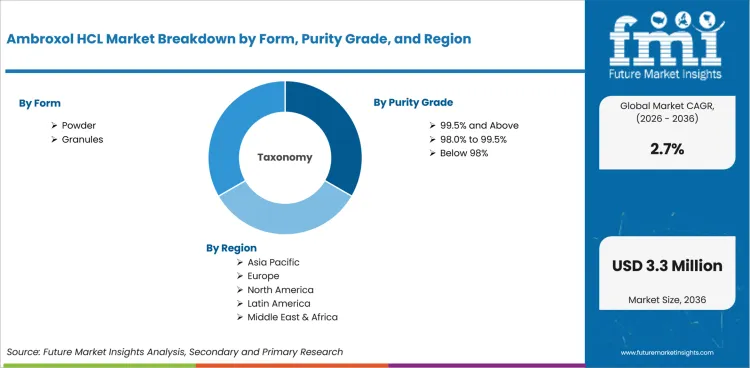
| Parameter | Details |
|---|---|
| Forecast period | 2026 to 2036 |
| Historical period | 2021 to 2025 |
| Quantitative unit | Revenue in USD million |
| By form | Powder, granules |
| By purity grade | 99.5% and above, 98.0% to 99.5%, below 98% |
| By application | Respiratory tract disorders, sore throat relief |
| By sales channel | Direct, distributors, online/API marketplaces |
| By end user | Pharmaceutical manufacturers, contract manufacturers, specialty and research buyers |
| Regions covered | North America, Latin America, Europe, East Asia, South Asia and Pacific, Middle East and Africa |
| Countries covered | China, India, Germany, Japan, South Korea, France, United Kingdom, United States |
| Key companies profiled | Anuh Pharma, Shilpa Pharma, Cipla, Opella, Chiesi Farmaceutici, Viatris, AX Pharmaceutical |
| Approach | Hybrid bottom-up and top-down sizing using API demand, public product files, supplier certification signals, and country channel behavior |
Source: Future Market Insights, 2026.
Ambroxol HCL Market - Scope & Definition
| Attribute | Detail |
|---|---|
| Market Definition | Commercially traded ambroxol hydrochloride active pharmaceutical ingredient supplied for regulated respiratory tract disorder and selected sore throat relief formulations |
| Functions Covered | Mucus clearance support, expectorant formulation support, API supply for finished respiratory dosage products, impurity-controlled ingredient sourcing |
| Applications Covered | Respiratory tract disorders, cough and mucus-clearance formulations, selected sore throat relief products |
| End-Use Industries | Pharmaceutical formulation manufacturing, contract manufacturing, respiratory medicine production, specialty API sourcing |
| Grades Covered | 99.5% and above, 98.0% to 99.5%, below 98% purity grades |
| Inclusions | Ambroxol HCL API supplied in powder or granule form across direct, distributor, and online/API discovery channels for regulated formulation work |
| Exclusions | Finished cough syrups, finished lozenges, finished tablets, retail pharmacy sales, bromhexine API, acetylcysteine API, guaifenesin API, excipients, and packaging materials |
Ambroxol HCL Market - Research Methodology
| Method | Description |
|---|---|
| Primary Research | FMI analyst interviews with formulation manufacturers, API distributors, contract manufacturers, quality teams, and technical sourcing teams across regulated respiratory product markets |
| Desk Research | Review of medicine authority data, public product files, API supplier product pages, pharmacopoeial references, safety reporting material, and company documentation |
| Market Sizing & Forecasting | Hybrid bottom-up and top-down sizing using API volume assumptions, price bands, application mix, supplier qualification signals, and country-level channel behavior |
| Data Validation | Cross-verification using public medicine labels, supplier certification evidence, finished-product signals, and regulatory review indicators |
Ambroxol HCL Market Breakdown by Form, Purity Grade, Application, Sales Channel, End User, and Region
Ambroxol HCL Market Segmented by Form
- Powder
- Granules
Ambroxol HCL Market Segmented by Purity Grade
- 99.5% and Above
- 98.0% to 99.5%
- Below 98%
Ambroxol HCL Market Segmented by Application
- Respiratory Tract Disorders
- Sore Throat Relief
Ambroxol HCL Market Segmented by Sales Channel
- Direct
- Distributors
- Online/API Marketplaces
Ambroxol HCL Market Segmented by End User
- Pharmaceutical Manufacturers
- Contract Manufacturers
- Specialty and Research Buyers
Ambroxol HCL Market by Region
- North America
- Latin America
- Europe
- East Asia
- South Asia and Pacific
- Middle East and Africa
Research Sources and Bibliography
- Anuh Pharma. (2025). Manufacturing certifications for Ambroxol Hydrochloride.
- Centers for Disease Control and Prevention. (2025). 2024 to 2025 influenza season summary: Severity, disease burden and burden prevented by vaccination.
- Chinese National Influenza Center. (2025, January 2). Chinese weekly influenza surveillance report: Week 52, 2024.
- Chinese National Medical Products Administration. (2025, October 14). Announcement on optimizing review and approval of clinical trials for innovative drugs.
- Erdwiens, A., Hackmann, C., Wedde, M., Biere, B., Reiche, J., Preuß, U., Tolksdorf, K., Buda, S., & Dürrwald, R. (2025). Interim estimates of 2024 to 2025 seasonal influenza vaccine effectiveness in Germany: Data from primary care and hospital sentinel surveillance. Influenza and Other Respiratory Viruses, 19(5), e70115.
- European Centre for Disease Prevention and Control. (2025). Seasonal influenza vaccination recommendations and coverage for the 2024 to 2025 season.
- European Directorate for the Quality of Medicines & HealthCare. (2026, May 6). EDQM reference standards monthly newsletter: April 2026.
- European Medicines Agency. (2026, June 11). EMA’s 2025 annual report shows strong approval numbers for human and veterinary medicines.
- Food and Drug Administration. (2025, January 8). CDER brings many safe and effective therapies to patients and consumers in 2024.
- Food and Drug Administration. (2026, April 10). FDA PreCheck pilot program.
- French National Agency for Medicines and Health Products Safety. (2024, September 11). Annual report 2023.
- French Public Service. (2025). Seasonal influenza vaccination campaign extension for winter 2024 to 2025.
- French public medicines database. (2024). Ambroxol Viatris Conseil 0.6%, oral solution.
- Global State of Tobacco Harm Reduction. (2025). Tobacco smoking in Germany.
- Indian Ministry of Health and Family Welfare. (2026, March 24). Steps taken to ensure drug quality and curb counterfeit medicines.
- Japan Institute for Health Security. (2025). Antiviral resistance surveillance in Japan: 2024 to 2025 influenza season.
- Korea Disease Control and Prevention Agency. (2026). Influenza sentinel surveillance in the post-coronavirus disease 2019 period.
- Pharmaceuticals and Medical Devices Agency. (2025, September 5). FY 2024 GMP/GCTP annual report.
- Press Information Bureau. (2026, March 21). India’s pharmaceuticals in global healthcare.
- RAD-AR Council, Japan. (2026). Ambroxol hydrochloride tablets 15 mg patient medicine information.
- Shilpa Pharma. (2026). Ambroxol Hydrochloride API manufacturers and suppliers.
- UK Health Security Agency. (2025, May 22). Influenza in the UK, annual epidemiological report: Winter 2024 to 2025.
- World Health Organization. (2025, January 7). Trends of acute respiratory infection, including human metapneumovirus, in the Northern Hemisphere.
This bibliography is provided for reader reference and is not exhaustive. The full report contains the complete reference list and detailed citations.
This Report Answers
- Market size estimates for 2026 and forecasts through 2036 for the Ambroxol HCL market.
- Insights across regional and country-level API demand patterns.
- Analysis of demand drivers and buyer sourcing patterns.
- Evaluation of form, purity grade, application, sales channel, and end-user dynamics.
- Assessment of regulatory review and supplier documentation impacts on market development.
- Identification of opportunity areas across high-purity APIs and direct supplier qualification.
- Evaluation of supply chain dynamics and channel structures.
- Country-level growth analysis covering China, India, Germany, Japan, South Korea, France, United Kingdom, and United States.
- Assessment of the competitive outlook, including API suppliers and distributor participants.
- Analysis of buyer preferences and documentation-led account protection.
- Regional outlooks across North America, Latin America, Europe, East Asia, South Asia and Pacific, and Middle East and Africa.
- Delivery of market data, forecasts, and supporting analysis in PDF and Excel formats.
Frequently Asked Questions
What is the growth prospect for Ambroxol HCL?
Demand for Ambroxol HCL is expected to rise at a measured pace as mature respiratory formulations continue to need qualified API supply.
Which companies are expected to shape the Ambroxol HCL market?
Anuh Pharma, Shilpa Pharma, Cipla, Opella, Chiesi Farmaceutici, Viatris, and AX Pharmaceutical are expected to shape market competition through API supply and finished formulation demand.
Why do buyers prefer strong documentation for Ambroxol HCL?
Buyers need impurity data and change-control support before qualifying an API supplier for regulated respiratory products.
Why does powder remain important in this market?
Powder is easier for formulation teams to assay and blend into established dosage manufacturing routines.
How do distributors support Ambroxol HCL purchasing?
Distributors help smaller buyers compare specifications and obtain smaller lots before direct supplier approval.
What is the main sourcing risk for Ambroxol HCL?
Main sourcing risk comes from weak documentation rather than basic chemical availability.
How do regulators influence Ambroxol HCL demand?
Regulators influence demand through product authorisation files, safety language, pharmacopoeial expectations, and inspection requirements.
Why is market growth modest for Ambroxol HCL?
Demand is modest as the molecule is mature and value comes from maintaining approved respiratory products.
Which segment leads the Ambroxol HCL market?
Respiratory tract disorders lead with 82.0% share in 2026, supported by continued use in mucolytic respiratory dosage products.
Which country is expected to grow fastest in the Ambroxol HCL market?
China is expected to grow fastest at 3.6% CAGR through 2036, supported by domestic formulation activity and API manufacturing depth.
Preview the report firsthand - request a free sample
Get SampleGet the brochure for pricing and purchase details.
Get PDFTable of Content
- Key Takeaways
- Market Size and CAGR
- Top Growth Driver
- Fastest Growing Segment
- Leading Region
- Key Companies
- Emerging Opportunities
- Executive Summary
- Global Market Outlook
- Demand-side Trends
- Supply-side Trends
- Technology Roadmap Analysis
- Analysis and Recommendations
- Analyst Perspective (What is happening? Why now? What should investors know?)
- Key Questions Answered
- How large is the market?
- What is the CAGR?
- What are key trends?
- Which region dominates?
- Who are the leaders?
- Market Overview
- Market Coverage / Taxonomy
- Market Definition / Scope / Limitations
- Research Methodology
- Chapter Orientation
- Analytical Lens and Working Hypotheses
- Market Structure, Signals, and Trend Drivers
- Benchmarking and Cross-market Comparability
- Market Sizing, Forecasting, and Opportunity Mapping
- Research Design and Evidence Framework
- Desk Research Programme (Secondary Evidence)
- Expert Input and Fieldwork (Primary Evidence)
- Tooling, Models, and Reference Databases
- Data Engineering and Model Build
- Quality Assurance and Audit Trail
- Market Background
- Market Dynamics (Drivers, Restraints, Opportunity, Trends)
- Scenario Forecast (Optimistic, Likely, Conservative)
- Impact Analysis
- AI Impact
- Sustainability Impact
- Regulatory Impact
- Technology Impact
- Consumer / Buyer Analysis
- Purchase Drivers
- Adoption Barriers
- Buyer Journey
- Opportunity Map Analysis
- Product Life Cycle Analysis
- Supply Chain Analysis
- Investment Feasibility Matrix
- Value Chain Analysis
- PESTLE and Porter's Analysis
- Regulatory Landscape
- Regional Parent Market Outlook
- Production and Consumption Statistics
- Import and Export Statistics
- Global Market Analysis and Forecast, 2021 to 2036
- Historical Market Size Value (USD Million) Analysis, 2021 to 2025
- Current and Future Market Size Value (USD Million) Projections, 2026 to 2036
- Y-o-Y Growth Trend Analysis
- Absolute $ Opportunity Analysis
- Global Market Pricing Analysis, 2021 to 2036
- Global Market Analysis and Forecast, By Form, 2021 to 2036
- Introduction / Key Findings
- Historical Market Size Value (USD Million) Analysis By Form, 2021 to 2025
- Current and Future Market Size Value (USD Million) Analysis and Forecast By Form, 2026 to 2036
- Powder
- Granules
- Powder
- Y-o-Y Growth Trend Analysis By Form, 2021 to 2025
- Absolute $ Opportunity Analysis By Form, 2026 to 2036
- Global Market Analysis and Forecast, By Purity Grade, 2021 to 2036
- Introduction / Key Findings
- Historical Market Size Value (USD Million) Analysis By Purity Grade, 2021 to 2025
- Current and Future Market Size Value (USD Million) Analysis and Forecast By Purity Grade, 2026 to 2036
- 99.5% and Above
- 98.0% to 99.5%
- Below 98%
- 99.5% and Above
- Y-o-Y Growth Trend Analysis By Purity Grade, 2021 to 2025
- Absolute $ Opportunity Analysis By Purity Grade, 2026 to 2036
- Global Market Analysis and Forecast, By Application, 2021 to 2036
- Introduction / Key Findings
- Historical Market Size Value (USD Million) Analysis By Application, 2021 to 2025
- Current and Future Market Size Value (USD Million) Analysis and Forecast By Application, 2026 to 2036
- Respiratory Tract Disorders
- Sore Throat Relief
- Respiratory Tract Disorders
- Y-o-Y Growth Trend Analysis By Application, 2021 to 2025
- Absolute $ Opportunity Analysis By Application, 2026 to 2036
- Global Market Analysis and Forecast, By Sales Channel, 2021 to 2036
- Introduction / Key Findings
- Historical Market Size Value (USD Million) Analysis By Sales Channel, 2021 to 2025
- Current and Future Market Size Value (USD Million) Analysis and Forecast By Sales Channel, 2026 to 2036
- Direct
- Distributors
- Online/API Marketplaces
- Direct
- Y-o-Y Growth Trend Analysis By Sales Channel, 2021 to 2025
- Absolute $ Opportunity Analysis By Sales Channel, 2026 to 2036
- Global Market Analysis and Forecast, By End User, 2021 to 2036
- Introduction / Key Findings
- Historical Market Size Value (USD Million) Analysis By End User, 2021 to 2025
- Current and Future Market Size Value (USD Million) Analysis and Forecast By End User, 2026 to 2036
- Pharmaceutical Manufacturers
- Contract Manufacturers
- Specialty and Research Buyers
- Pharmaceutical Manufacturers
- Y-o-Y Growth Trend Analysis By End User, 2021 to 2025
- Absolute $ Opportunity Analysis By End User, 2026 to 2036
- Global Market Analysis and Forecast, By Region, 2021 to 2036
- Introduction
- Historical Market Size Value (USD Million) Analysis By Region, 2021 to 2025
- Current Market Size Value (USD Million) Analysis and Forecast By Region, 2026 to 2036
- North America
- Latin America
- Western Europe
- Eastern Europe
- East Asia
- South Asia and Pacific
- Middle East & Africa
- Market Attractiveness Analysis By Region
- North America Market Analysis and Forecast, By Country, 2021 to 2036
- Historical Market Size Value (USD Million) Trend Analysis By Market Taxonomy, 2021 to 2025
- Market Size Value (USD Million) Forecast By Market Taxonomy, 2026 to 2036
- By Country
- USA
- Canada
- Mexico
- By Form
- By Purity Grade
- By Application
- By Sales Channel
- By End User
- By Country
- Market Attractiveness Analysis
- By Country
- By Form
- By Purity Grade
- By Application
- By Sales Channel
- By End User
- Key Takeaways
- Latin America Market Analysis and Forecast, By Country
- Historical Market Size Value (USD Million) Trend Analysis By Market Taxonomy, 2021 to 2025
- Market Size Value (USD Million) Forecast By Market Taxonomy, 2026 to 2036
- By Country
- Brazil
- Chile
- Rest of Latin America
- By Form
- By Purity Grade
- By Application
- By Sales Channel
- By End User
- By Country
- Market Attractiveness Analysis
- By Country
- By Form
- By Purity Grade
- By Application
- By Sales Channel
- By End User
- Key Takeaways
- Western Europe Market Analysis and Forecast, By Country
- Historical Market Size Value (USD Million) Trend Analysis By Market Taxonomy, 2021 to 2025
- Market Size Value (USD Million) Forecast By Market Taxonomy, 2026 to 2036
- By Country
- Germany
- UK
- Italy
- Spain
- France
- Nordic
- BENELUX
- Rest of Western Europe
- By Form
- By Purity Grade
- By Application
- By Sales Channel
- By End User
- By Country
- Market Attractiveness Analysis
- By Country
- By Form
- By Purity Grade
- By Application
- By Sales Channel
- By End User
- Key Takeaways
- Eastern Europe Market Analysis and Forecast, By Country
- Historical Market Size Value (USD Million) Trend Analysis By Market Taxonomy, 2021 to 2025
- Market Size Value (USD Million) Forecast By Market Taxonomy, 2026 to 2036
- By Country
- Russia
- Poland
- Hungary
- Balkan & Baltic
- Rest of Eastern Europe
- By Form
- By Purity Grade
- By Application
- By Sales Channel
- By End User
- By Country
- Market Attractiveness Analysis
- By Country
- By Form
- By Purity Grade
- By Application
- By Sales Channel
- By End User
- Key Takeaways
- East Asia Market Analysis and Forecast, By Country
- Historical Market Size Value (USD Million) Trend Analysis By Market Taxonomy, 2021 to 2025
- Market Size Value (USD Million) Forecast By Market Taxonomy, 2026 to 2036
- By Country
- China
- Japan
- South Korea
- By Form
- By Purity Grade
- By Application
- By Sales Channel
- By End User
- By Country
- Market Attractiveness Analysis
- By Country
- By Form
- By Purity Grade
- By Application
- By Sales Channel
- By End User
- Key Takeaways
- South Asia and Pacific Market Analysis and Forecast, By Country
- Historical Market Size Value (USD Million) Trend Analysis By Market Taxonomy, 2021 to 2025
- Market Size Value (USD Million) Forecast By Market Taxonomy, 2026 to 2036
- By Country
- India
- ASEAN
- Australia & New Zealand
- Rest of South Asia and Pacific
- By Form
- By Purity Grade
- By Application
- By Sales Channel
- By End User
- By Country
- Market Attractiveness Analysis
- By Country
- By Form
- By Purity Grade
- By Application
- By Sales Channel
- By End User
- Key Takeaways
- Middle East & Africa Market Analysis and Forecast, By Country
- Historical Market Size Value (USD Million) Trend Analysis By Market Taxonomy, 2021 to 2025
- Market Size Value (USD Million) Forecast By Market Taxonomy, 2026 to 2036
- By Country
- Kingdom of Saudi Arabia
- Other GCC Countries
- Türkiye
- South Africa
- Other African Union
- Rest of Middle East & Africa
- By Form
- By Purity Grade
- By Application
- By Sales Channel
- By End User
- By Country
- Market Attractiveness Analysis
- By Country
- By Form
- By Purity Grade
- By Application
- By Sales Channel
- By End User
- Key Takeaways
- Key Countries Market Analysis
- USA
- Pricing Analysis
- Market Share Analysis, 2025
- By Form
- By Purity Grade
- By Application
- By Sales Channel
- By End User
- Canada
- Pricing Analysis
- Market Share Analysis, 2025
- By Form
- By Purity Grade
- By Application
- By Sales Channel
- By End User
- Mexico
- Pricing Analysis
- Market Share Analysis, 2025
- By Form
- By Purity Grade
- By Application
- By Sales Channel
- By End User
- Brazil
- Pricing Analysis
- Market Share Analysis, 2025
- By Form
- By Purity Grade
- By Application
- By Sales Channel
- By End User
- Chile
- Pricing Analysis
- Market Share Analysis, 2025
- By Form
- By Purity Grade
- By Application
- By Sales Channel
- By End User
- Germany
- Pricing Analysis
- Market Share Analysis, 2025
- By Form
- By Purity Grade
- By Application
- By Sales Channel
- By End User
- UK
- Pricing Analysis
- Market Share Analysis, 2025
- By Form
- By Purity Grade
- By Application
- By Sales Channel
- By End User
- Italy
- Pricing Analysis
- Market Share Analysis, 2025
- By Form
- By Purity Grade
- By Application
- By Sales Channel
- By End User
- Spain
- Pricing Analysis
- Market Share Analysis, 2025
- By Form
- By Purity Grade
- By Application
- By Sales Channel
- By End User
- France
- Pricing Analysis
- Market Share Analysis, 2025
- By Form
- By Purity Grade
- By Application
- By Sales Channel
- By End User
- India
- Pricing Analysis
- Market Share Analysis, 2025
- By Form
- By Purity Grade
- By Application
- By Sales Channel
- By End User
- ASEAN
- Pricing Analysis
- Market Share Analysis, 2025
- By Form
- By Purity Grade
- By Application
- By Sales Channel
- By End User
- Australia & New Zealand
- Pricing Analysis
- Market Share Analysis, 2025
- By Form
- By Purity Grade
- By Application
- By Sales Channel
- By End User
- China
- Pricing Analysis
- Market Share Analysis, 2025
- By Form
- By Purity Grade
- By Application
- By Sales Channel
- By End User
- Japan
- Pricing Analysis
- Market Share Analysis, 2025
- By Form
- By Purity Grade
- By Application
- By Sales Channel
- By End User
- South Korea
- Pricing Analysis
- Market Share Analysis, 2025
- By Form
- By Purity Grade
- By Application
- By Sales Channel
- By End User
- Russia
- Pricing Analysis
- Market Share Analysis, 2025
- By Form
- By Purity Grade
- By Application
- By Sales Channel
- By End User
- Poland
- Pricing Analysis
- Market Share Analysis, 2025
- By Form
- By Purity Grade
- By Application
- By Sales Channel
- By End User
- Hungary
- Pricing Analysis
- Market Share Analysis, 2025
- By Form
- By Purity Grade
- By Application
- By Sales Channel
- By End User
- Kingdom of Saudi Arabia
- Pricing Analysis
- Market Share Analysis, 2025
- By Form
- By Purity Grade
- By Application
- By Sales Channel
- By End User
- Türkiye
- Pricing Analysis
- Market Share Analysis, 2025
- By Form
- By Purity Grade
- By Application
- By Sales Channel
- By End User
- South Africa
- Pricing Analysis
- Market Share Analysis, 2025
- By Form
- By Purity Grade
- By Application
- By Sales Channel
- By End User
- USA
- Market Structure Analysis
- Competition Dashboard
- Competition Benchmarking
- Market Share Analysis of Top Players
- By Regional
- By Form
- By Purity Grade
- By Application
- By Sales Channel
- By End User
- Emerging Startups
- Innovation Benchmarking
- Competition Analysis
- Competition Deep Dive
- Anuh Pharma
- Overview
- Product Portfolio
- Profitability by Market Segments (Product/Region/Sales Channel)
- Sales Footprint
- Strategy Overview
- Marketing Strategy
- Product Strategy
- Channel Strategy
- Shilpa Pharma
- Cipla
- Opella
- Chiesi Farmaceutici
- Viatris
- Anuh Pharma
- Case Studies
- Success Stories
- Recent Developments
- Competition Deep Dive
- Assumptions & Acronyms Used


