

- Market Size (2026)
- USD 72.5 Mn
- Forecast (2036)
- USD 120.4 Mn
- CAGR (2026 to 2036)
- 5.2%
How big is the irbesartan market in 2026?
USD 72.5 million in 2026 and USD 120.4 million by 2036 at a 5.2% CAGR.
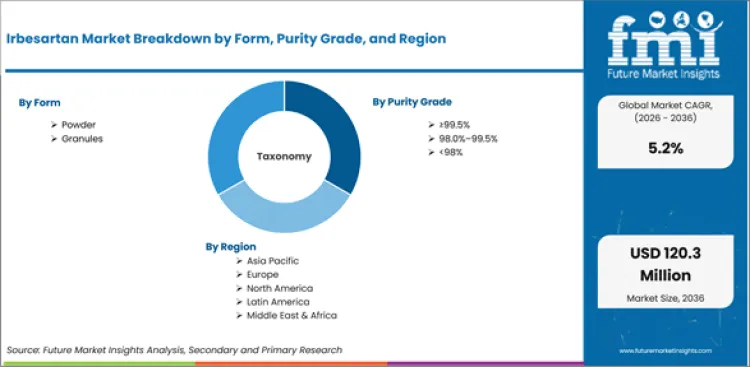
The irbesartan market was valued at USD 68.9 million in 2025. It is expected to grow from USD 72.5 million in 2026 to USD 120.4 million in 2036 at a CAGR of 5.2%. Powder is projected to account for an 83.0% share in 2026, while the ≥99.5% purity grade is expected to represent a 62.0% share, supported by processing flexibility in oral solid dose manufacturing and increased buyer scrutiny of impurity trend documentation.
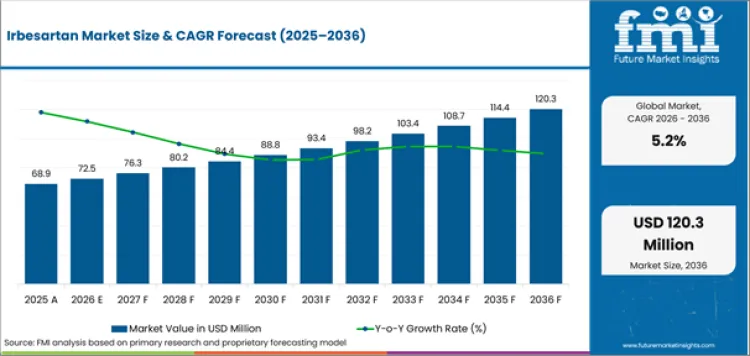
| Metric | Value |
|---|---|
| 2026 Market Size | USD 72.5 million |
| 2036 Market Size | USD 120.4 million |
| Forecast CAGR (2026-2036) | 5.2% |
| Leading Form | Powder |
| Powder Share (2026) | 83.0% |
| Leading Purity Grade | ≥99.5% |
| ≥99.5% Purity Grade Share (2026) | 62.0% |
| Fastest-growing Country | India |
| India CAGR by 2036 | 6.4% |
Summary of the Irbesartan Market
| Market Signal | Commercial Impact |
|---|---|
| Demand and Growth Drivers | Demand for irbesartan remains steady as chronic hypertension management and renal-risk prescribing continue to require long-term therapy, supporting recurring procurement across global pharmaceutical supply chains.
|
| Product and Segment View | Powder formulations, ≥99.5% purity grade, hypertension applications, and direct sales channels continue to lead their respective market segments.
|
| Geography and Growth Outlook | Asia remains the primary manufacturing hub while regulated pharmaceutical markets continue to support stable long-term demand.
|
| Competitive Landscape | Competition increasingly centers on regulatory compliance, manufacturing consistency, and dependable API supply.
|
| Analyst Perspective | Irbesartan continues to represent a stable pharmaceutical market where supply reliability and regulatory readiness increasingly influence purchasing decisions beyond price.
- Anurag Sharma, Principal Analyst at Future Market Insights |
Irbesartan industry expansion is supported by repeated blood pressure control and diabetic nephropathy management, not short-course treatment. CDC says 48.1% of U.S. adults have high blood pressure and this equals 119.9 million people. This creates a large prescription base where pharmacies and formulators need steady ARB supply across chronic-use strengths. FDA issued an August 2025 approval letter for Sanofi’s Avapro labeling supplement, and the current label keeps hypertension plus diabetic nephropathy in type 2 diabetes as approved use settings. Pharmaceutical intermediates sourcing shows a similar buyer focus on low-impurity chemistry and supplier documentation. DailyMed labeling continues to identify hypertension and diabetic nephropathy as approved uses for irbesartan tablets.
Which factors support revenue growth in the irbesartan market?
Qualified API sourcing and recurring chronic therapy use support measured value expansion through 2036.
- Market value is supported by repeat finished-dose production while tender pricing moderates revenue per kilogram.
- Supplier pricing reflects impurity-control records before spot discounts influence buyer negotiations.
- Revenue retention improves for formulators that keep registered API sources to avoid fresh approval work.
- Buyer trust rises through batch consistency and faster responses to nitrosamine documentation requests.
Why is the irbesartan market growing at a measured pace?
Chronic therapy demand is supporting growth while ARB price pressure limits faster value expansion.
Irbesartan continues to serve hypertension and diabetic nephropathy treatment. The molecule operates inside a mature generic class with limited brand premium. WHO reported in September 2025 that 1.4 billion adults aged 30 to 79 had hypertension in 2024. The diabetic nephropathy treatment context gives the molecule a smaller clinical pocket beyond hypertension. That support helps sustain measured API value growth.
Quality expectations is another pressure point influencing market growth. FDA’s September 2024 guidance raised the practical burden on API and finished-dose makers. The effect is visible in treatment-resistant hypertension management procurement too. Buyers compare clinical continuity with product safety controls. Irbesartan suppliers therefore need impurity files before price negotiation begins.
How is the irbesartan market segmented?
The irbesartan industry is segmented by form, purity grade, application, and sales channel.
- Powder is projected to secure 83.0% share in 2026 with easier handling in oral solid production.
- ≥99.5% purity grade is expected to hold 62.0% share in 2026 through lower impurity review risk.
- Hypertension is forecast to represent 71.0% share in 2026 with repeat chronic therapy demand.
- Direct sales are anticipated to account for 54.0% share in 2026 through audited supplier contracts.
Which form category holds a notable share in the irbesartan market?
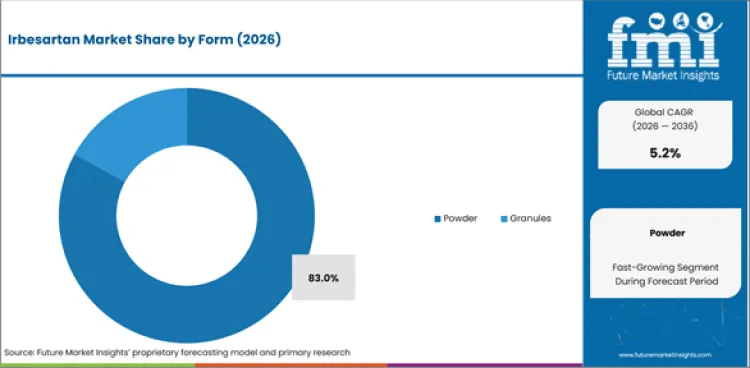
- Powder is projected to account for 83.0% form share in 2026 with blending flexibility and dossier familiarity.
- Granules serve buyers seeking lower handling loss. Many regulated formulators avoid form changes after source approval.
How does the purity grade segment perform in the irbesartan market?
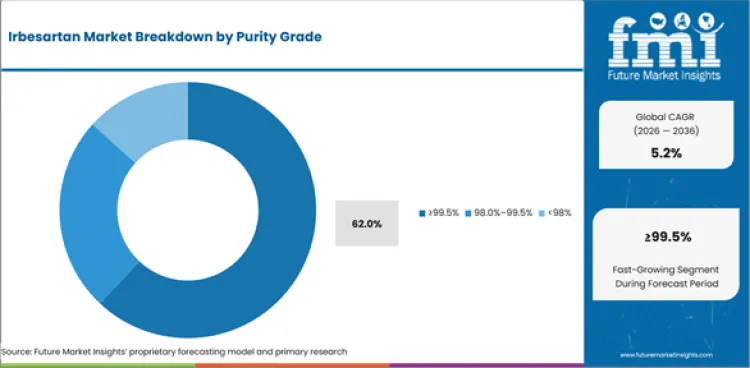
- ≥99.5% purity grade is expected to represent 62.0% share in 2026. Regulated buyers prioritize impurity trend files.
- Lower-purity grades mainly serve price-sensitive routes that require less stringent documentation support.
What drives demand across the application segment in the irbesartan market?
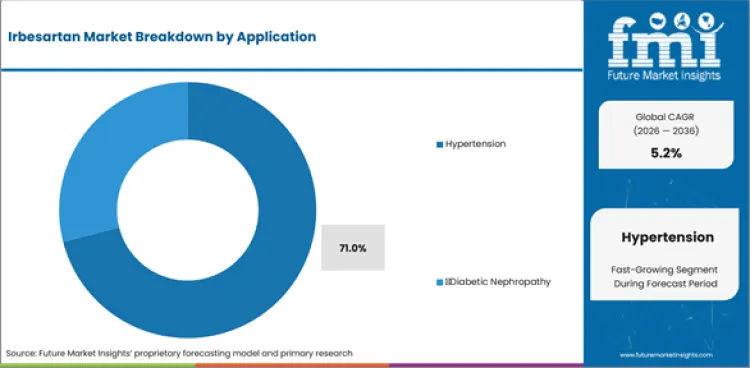
- Hypertension is anticipated to account for 71.0% application share in 2026 with broad once-daily ARB use.
- Diabetic nephropathy represents a smaller clinical pocket that protects repeat demand among renal-risk patients.
How are buyers selecting across sales channel options in the irbesartan market?
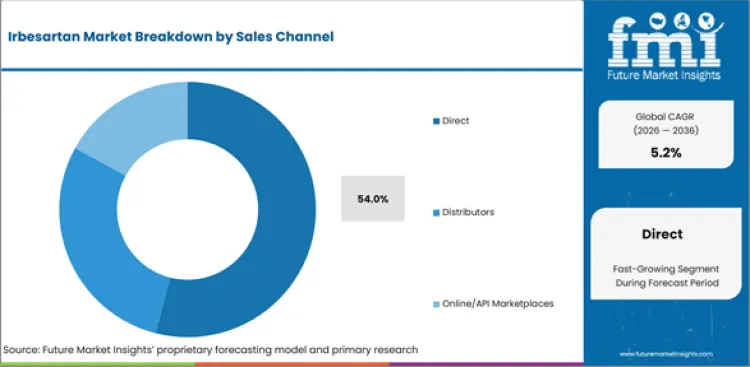
- Direct sales are projected to hold 54.0% channel share in 2026 through audited supplier relationships.
- Distributors serve smaller buyers and spot demand that do not justify direct technical account coverage.
What are the driver, restraints, and opportunities in the irbesartan market?
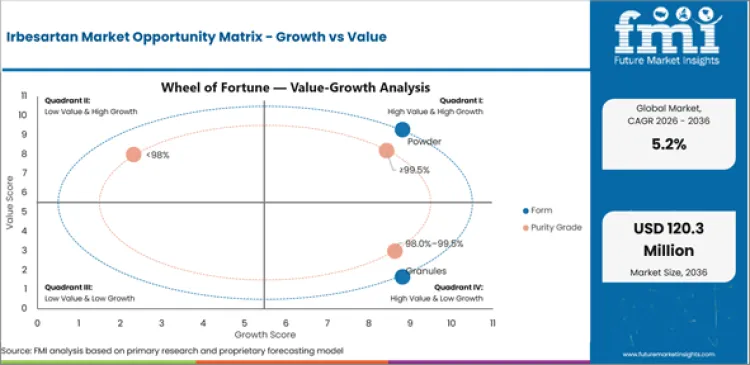
Chronic therapy and quality-file discipline support demand. Mature generic pricing limits faster revenue expansion.
- Driver: Chronic hypertension prescribing keeps irbesartan API volumes active while market value expands steadily.
- Restraint: Generic ARB price pressure limits API margin recovery in tender-based finished-dose markets.
- Opportunity: Cleaner sartan process files can improve access to regulated formulation buyers.
Sartan Impurity Control Raises the Supplier Bar
Irbesartan sourcing now depends on cleaner process evidence because sartans remain exposed to nitrosamine scrutiny. FDA’s September 2024 guidance says API and drug product manufacturers should detect and prevent unacceptable nitrosamine levels in pharmaceutical products. FDA also points to NDSRIs as a class that can be unique to each API. That makes impurity packages more than a batch-release formality. Suppliers that can provide route-risk assessment and validated testing are better placed to defend repeat API accounts. Corrective control evidence also helps buyers justify continued use during quality reviews.
Generic Competition Keeps Pricing Discipline Tight
Generic price pressure limits irbesartan upside even while chronic hypertension use keeps volumes stable. FDA’s FY 2024 GDUFA report recorded 694 ANDA approvals and 162 tentative approvals. That approval flow shows why finished-dose buyers can benchmark chronic generics against many available alternatives. For irbesartan API suppliers, the commercial risk is not demand disappearance. It is margin pressure from tender buyers and distributors that can move volume to lower-cost qualified sources. Suppliers need dependable quality and cost discipline to hold accounts in this pricing environment.
API Qualification Protects Repeat Contracts
Direct buyer qualification protects irbesartan suppliers after a formulation company registers an API source. FDA says a facility listed in an approved generic submission incurs annual facility fees as long as it remains identified in that submission. FDA also says a DMF is unavailable for reference if the required DMF fee is not paid. This shows why changing sources is not just a purchasing decision. Buyers prefer suppliers that can keep facility status and DMF access current. Release documents and audit responses also need to be ready for repeat orders.
Which countries are growing at a notable pace in the irbesartan market?
India 6.4% CAGR, China 5.9% CAGR, United States 5.4% CAGR, Germany 5.1% CAGR, France 5.0% CAGR, United Kingdom 4.9% CAGR, South Korea 4.6% CAGR, and Japan 4.3% CAGR through 2036.
.webp "Top Country Growth Comparison Irbesartan Market Cagr (2026 2036)")
| Country | CAGR |
|---|---|
| India | 6.4% |
| China | 5.9% |
| United States | 5.4% |
| Germany | 5.1% |
| France | 5.0% |
| United Kingdom | 4.9% |
| South Korea | 4.6% |
| Japan | 4.3% |
Source: Future Market Insights, 2026.
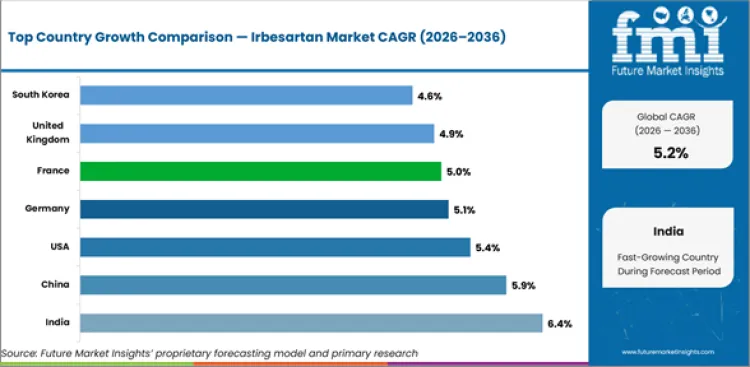
How do country-level CAGRs compare in the irbesartan market?
India is projected to register the stable growth rate among the selected countries, while Japan is expected to experience comparatively moderate market expansion over the forecast period.
- India is forecast to record 6.4% CAGR through 2036, supported by domestic formulation strength and export API demand.
- China is projected to grow at 5.9% CAGR through 2036, driven by production scale and wider regulated export participation.
- The United States is expected to post 5.4% CAGR through 2036, attributable to FDA-led quality expectations and supplier compliance needs.
- Germany is anticipated to grow at 5.1% CAGR through 2036, underpinned by EU quality-file discipline and regulated procurement standards.
- France is estimated to record 5.0% CAGR through 2036, led by broad treatment need and payer-led cost discipline.
- The United Kingdom is forecast to expand at 4.9% CAGR through 2036, shaped by NHS-based generic sourcing and controlled reimbursement pathways.
- South Korea is projected to post 4.6% CAGR through 2036, supported by KDMF-backed sourcing and local supplier development.
- Japan is expected to grow at 4.3% CAGR through 2036, due to documentation-led supplier qualification and conservative procurement review.
How fast is the irbesartan market growing in India?
A 6.4% CAGR through 2036 reflects local API production depth and export-oriented supplier reach.
Country Market Snapshot Table
| Parameter | Value |
|---|---|
| Market Size in 2025 (Value) | USD 7.0 million |
| Market Size in 2026 (Value) | USD 7.4 million |
| Market Forecast in 2036 (Value) | USD 13.8 million |
| CAGR (2026 to 2036) | 6.4% |
| Years Considered | 2021 to 2036 |
| Base Year | 2025 |
| Forecast Period | 2026 to 2036 |
| Units Considered | Value (USD million) |
| Leading Sub-Region | Hyderabad, Bengaluru, Gujarat, and Maharashtra API corridors |
India Irbesartan Market Outlook
India irbesartan API demand is expected to grow in value while retaining a broader supplier base. Domestic hypertension need and export formulation activity keep the molecule visible in cardiovascular API sourcing.
Buyer selection is expected to favor suppliers that combine cost discipline with CEP or DMF documentation. Local manufacturing clusters help qualified firms respond faster to regulated-market queries.
Key Growth Drivers
- Domestic treatment need supports repeat oral solid production. A 2024 BMC Public Health study estimated India hypertension prevalence at 22.6%.
- Older patients widen the treated population. The same study placed hypertension prevalence among adults aged 60 and above at 48.4%.
- Export API contracts are expected to support order continuity for Indian suppliers that maintain CEP and DMF files.
- Local manufacturing clusters are likely to shorten response time for formulation buyers seeking repeat batches.
Key Restraints
- Regional care gaps can keep demand uneven. The 2024 study reported state prevalence ranging from 16.5% to 37.9%.
- Domestic supplier competition is expected to limit price recovery for mature cardiovascular APIs.
- Quality findings at API plants can slow buyer approvals and increase audit time before order placement.
What makes India unique
India is distinct due to domestic therapy demand and export-oriented API production depth.
Key Companies
- Dr. Reddy’s Laboratories
- Lupin
- Hetero Drugs
- Aurobindo Pharma
- Hikal
- CTX Lifesciences
- Smilax Laboratories
Sales & Marketing Channels
- Direct API sales
- Export API contracts
- Domestic distributor sourcing
- CEP and DMF-backed technical sales
- Online/API marketplace discovery
- Tender-based formulation supply
Country Segment Breakdown Table
| Segment | Sub-Segments |
|---|---|
| By Form | Powder · Granules |
| By Purity Grade | ≥99.5% · 98.0%-99.5% · <98% |
| By Application | Hypertension · Diabetic Nephropathy |
| By Sales Channel | Direct · Distributors · Online/API Marketplaces |
| Key Sub-Regions Covered, Urban Manufacturing or Buyer Clusters | Hyderabad, Bengaluru, Gujarat, and Maharashtra API corridors |
Frequently Asked Questions
How fast is India irbesartan market growing?
India is projected to record 6.4% CAGR from 2026 to 2036 due to domestic formulation demand and export API capacity.
Who leads India irbesartan market?
Dr. Reddy’s Laboratories, Lupin, Hetero Drugs, and Aurobindo Pharma remain relevant India-based suppliers.
What is driving adoption in India irbesartan market?
Chronic hypertension treatment and supplier qualification needs are sustaining irbesartan sourcing in India.
What is the irbesartan market outlook in China?
A 5.9% CAGR through 2036 reflects production scale that supports growth despite price pressure.
Country Market Snapshot Table
| Parameter | Value |
|---|---|
| Market Size in 2025 (Value) | USD 8.0 million |
| Market Size in 2026 (Value) | USD 8.5 million |
| Market Forecast in 2036 (Value) | USD 15.1 million |
| CAGR (2026 to 2036) | 5.9% |
| Years Considered | 2021 to 2036 |
| Base Year | 2025 |
| Forecast Period | 2026 to 2036 |
| Units Considered | Value (USD million) |
| Leading Sub-Region | Zhejiang and coastal API clusters |
China Irbesartan Market Outlook
China remains central to irbesartan API value formation due to sartan manufacturing scale. Domestic treatment need supports finished-dose production but export buyer scrutiny controls supplier acceptance.
Chinese suppliers with clearer impurity files and stable export documentation can defend more contracts. Price-led competition still limits faster revenue expansion across the forecast period.
Key Growth Drivers
- Domestic treatment need supports finished-dose production. A 2026 study estimated about 274 million adults in China had hypertension.
- Scale supply gives Chinese producers pricing influence. Local production depth helps qualified suppliers defend export accounts.
- Export documentation is expected to improve access to regulated formulation buyers with strict sartan review routines.
- Coastal API clusters are likely to support faster batch availability for buyers seeking large repeat supply.
Key Restraints
- Historic sartan impurity events keep overseas buyer audits intensive before new supplier approvals.
- Price-led competition can reduce margins even for scale producers that defend volume.
- Export buyers may require extra impurity data after FDA’s September 2024 nitrosamine guidance strengthened detection expectations.
What makes China unique
China is distinct due to its role as a demand country and global price-setting sartan API base.
Key Companies
- Zhejiang Huahai Pharmaceutical
- Zhejiang Tianyu Pharmaceutical
Sales & Marketing Channels
- Direct export API sales
- Domestic formulation contracts
- Trading-house export routes
- DMF and CEP-backed technical sales
- Distributor channels
- Regulatory response support
Country Segment Breakdown Table
| Segment | Sub-Segments |
|---|---|
| By Form | Powder · Granules |
| By Purity Grade | ≥99.5% · 98.0%-99.5% · <98% |
| By Application | Hypertension · Diabetic Nephropathy |
| By Sales Channel | Direct · Distributors · Online/API Marketplaces |
| Key Sub-Regions Covered, Urban Manufacturing or Buyer Clusters | Zhejiang and coastal API clusters |
Frequently Asked Questions
How fast is China irbesartan market growing?
China is projected to record 5.9% CAGR from 2026 to 2036 due to production scale and regulated export participation.
Who leads China irbesartan market?
Zhejiang Huahai Pharmaceutical and Zhejiang Tianyu Pharmaceutical remain the main China-based irbesartan supplier references.
What is driving adoption in China irbesartan market?
Chronic hypertension treatment and supplier qualification needs are sustaining irbesartan sourcing in China.
How is the irbesartan market performing in the United States?
A 5.4% CAGR through 2036 reflects audit-heavy sourcing and steady generic tablet demand.
Country Market Snapshot Table
| Parameter | Value |
|---|---|
| Market Size in 2025 (Value) | USD 10.9 million |
| Market Size in 2026 (Value) | USD 11.5 million |
| Market Forecast in 2036 (Value) | USD 19.5 million |
| CAGR (2026 to 2036) | 5.4% |
| Years Considered | 2021 to 2036 |
| Base Year | 2025 |
| Forecast Period | 2026 to 2036 |
| Units Considered | Value (USD million) |
| Leading Sub-Region | Large generic formulation accounts |
United States Irbesartan Market Outlook
United States demand is anchored by a large treated hypertension pool and broad generic tablet access. API revenue is expected to grow at a measured pace as payer-driven substitution keeps pricing pressure high.
FDA nitrosamine expectations make impurity files central to supplier approval. Large formulation companies are likely to keep qualified API sources but pressure them on price.
Key Growth Drivers
- Chronic therapy volume supports repeat generic tablet production. CDC reported 119.9 million U.S. adults with high blood pressure in June 2026.
- Labeling sustains clear clinical use. DailyMed’s 2026 irbesartan label identifies hypertension and diabetic nephropathy as approved indications.
- Large generic formulators need continuity from API suppliers with active DMF-backed technical support.
- Mail-order and retail pharmacy channels are expected to sustain recurrent finished-dose movement.
Key Restraints
- Generic contracting limits API price recovery across long-term supply agreements.
- Prior ARB impurity recalls keep buyer audits strict before source changes.
- Quality-system risk remains visible. FDA’s September 2025 Hikal warning letter cited CGMP deviations for APIs.
What makes United States unique
The United States is distinct due to FDA oversight and large generic formulation accounts.
Key Companies
- Teva Pharmaceuticals USA
- Aurobindo Pharma USA
- Lupin Pharmaceuticals
- Camber Pharmaceuticals
- Macleods Pharmaceuticals
- Unichem Pharmaceuticals USA
- Solco Healthcare
Sales & Marketing Channels
- Direct generic-formulator sales
- DMF-backed technical sales
- Distributor supply
- Regulatory documentation support
- Long-term supply contracts
- Quality-audit account management
Country Segment Breakdown Table
| Segment | Sub-Segments |
|---|---|
| By Form | Powder · Granules |
| By Purity Grade | ≥99.5% · 98.0%-99.5% · <98% |
| By Application | Hypertension · Diabetic Nephropathy |
| By Sales Channel | Direct · Distributors · Online/API Marketplaces |
| Key Sub-Regions Covered, Urban Manufacturing or Buyer Clusters | Large generic formulation accounts |
Frequently Asked Questions
How fast is United States irbesartan market growing?
United States is projected to record 5.4% CAGR from 2026 to 2036 due to chronic treatment demand and FDA-led supplier scrutiny.
Who leads United States irbesartan market?
Teva Pharmaceuticals USA, Aurobindo Pharma USA, Lupin Pharmaceuticals, and Camber Pharmaceuticals remain active U.S. market references.
What is driving adoption in United States irbesartan market?
Chronic hypertension treatment and supplier qualification needs are sustaining irbesartan sourcing in United States.
What is the irbesartan market forecast for Germany?
A 5.1% CAGR through 2036 reflects EU quality discipline and reimbursement-led price pressure.
Country Market Snapshot Table
| Parameter | Value |
|---|---|
| Market Size in 2025 (Value) | USD 4.6 million |
| Market Size in 2026 (Value) | USD 4.8 million |
| Market Forecast in 2036 (Value) | USD 7.9 million |
| CAGR (2026 to 2036) | 5.1% |
| Years Considered | 2021 to 2036 |
| Base Year | 2025 |
| Forecast Period | 2026 to 2036 |
| Units Considered | Value (USD million) |
| Leading Sub-Region | EU quality-file buyers |
Germany Irbesartan Market Outlook
Germany demand is expected to stay clinically relevant through chronic hypertension treatment. Revenue growth remains moderated by reference pricing and generic substitution that reduce downstream margin.
Buyers place high weight on CEP coverage and impurity-control documentation. Qualified suppliers can defend access while pricing pressure continues in mature ARB sourcing.
Key Growth Drivers
- Diagnosed hypertension supports repeat treatment demand. RKI reported that 36.3% of German adults had ever received a physician diagnosis in 2022.
- Quality-file discipline supports regulated API selection. RKI’s May 2026 update separately reported 37.0% prevalence among adult men.
- EU pharmacopoeial alignment is expected to favor suppliers with clear CEP and impurity evidence.
- Pharmacy substitution-based demand keeps mature generic ARB products commercially active.
Key Restraints
- Reference pricing reduces downstream margin and limits API price flexibility.
- Buyer switching remains slow due to regulatory work and batch-release continuity needs.
- Female diagnosed prevalence at 35.8% shows broad treatment need but does not remove API pricing pressure.
What makes Germany unique
Germany is distinct due to the combined weight of quality files and reimbursement discipline.
Key Companies
- Ratiopharm
- AbZ-Pharma
- Hexal
- 1A Pharma
- ALIUD Pharma
- Puren Pharma
- Aurobindo Pharma Germany
Sales & Marketing Channels
- Direct EU formulation supply
- CEP-backed qualification
- Distributor support
- Pharmacy substitution channels
- Contract manufacturing routes
- Quality-audit engagement
Country Segment Breakdown Table
| Segment | Sub-Segments |
|---|---|
| By Form | Powder · Granules |
| By Purity Grade | ≥99.5% · 98.0%-99.5% · <98% |
| By Application | Hypertension · Diabetic Nephropathy |
| By Sales Channel | Direct · Distributors · Online/API Marketplaces |
| Key Sub-Regions Covered, Urban Manufacturing or Buyer Clusters | EU quality-file buyers |
Frequently Asked Questions
How fast is Germany irbesartan market growing?
Germany is projected to record 5.1% CAGR from 2026 to 2036 due to chronic therapy demand and EU quality-file discipline.
Who leads Germany irbesartan market?
Ratiopharm, AbZ-Pharma, Hexal, and 1A Pharma remain active Germany-facing irbesartan market references.
What is driving adoption in Germany irbesartan market?
Chronic hypertension treatment and supplier qualification needs are sustaining irbesartan sourcing in Germany.
What is the irbesartan market outlook in France?
A 5.0% CAGR through 2036 reflects large clinical need and strict payer influence.
Country Market Snapshot Table
| Parameter | Value |
|---|---|
| Market Size in 2025 (Value) | USD 3.4 million |
| Market Size in 2026 (Value) | USD 3.6 million |
| Market Forecast in 2036 (Value) | USD 5.9 million |
| CAGR (2026 to 2036) | 5.0% |
| Years Considered | 2021 to 2036 |
| Base Year | 2025 |
| Forecast Period | 2026 to 2036 |
| Units Considered | Value (USD million) |
| Leading Sub-Region | Regulated pharmacy and payer channels |
France Irbesartan Market Outlook
France keeps a meaningful patient base for antihypertensive therapy. API value is expected to grow steadily while reimbursement pressure limits price recovery in finished generics.
French-facing formulation buyers are likely to prefer suppliers with EU documentation and reliable impurity packages. Local public data gives a clear care burden but limited API supplier visibility.
Key Growth Drivers
- Clinical need remains broad. Santé publique France reported in January 2026 that 17 million adults over 18 have hypertension in France.
- Primary care intensity supports ongoing medicine use. Santé publique France reported 10 visits per year to a primary care physician for people with high blood pressure.
- Pharmacy substitution is expected to keep generic ARB products active in outpatient channels.
- EU supplier documentation supports sourcing for French-facing formulation firms with strict quality review needs.
Key Restraints
- Treatment gaps can limit predictable volume. Santé publique France reported that 1 in 2 people with high blood pressure receive medication.
- Reimbursement pressure limits the price passed back to API suppliers.
- Public sources offer limited visibility into individual irbesartan API supplier shares.
What makes France unique
France is distinct due to broad hypertension care needs and strict public payer control.
Key Companies
- Zentiva
- Teva Santé
- Biogaran
- Mylan Pharma
- EG Labo
- Sandoz
- Arrow Génériques
Sales & Marketing Channels
- EU formulation supply contracts
- Pharmacy-distribution channels
- Hospital and outpatient formularies
- Distributor-backed sourcing
- CEP-led supplier qualification
- Quality documentation selling
Country Segment Breakdown Table
| Segment | Sub-Segments |
|---|---|
| By Form | Powder · Granules |
| By Purity Grade | ≥99.5% · 98.0%–99.5% · <98% |
| By Application | Hypertension · Diabetic Nephropathy |
| By Sales Channel | Direct · Distributors · Online/API Marketplaces |
| Key Sub-Regions Covered, Urban Manufacturing or Buyer Clusters | Regulated pharmacy and payer channels |
Frequently Asked Questions
How fast is France irbesartan market growing?
France is projected to record 5.0% CAGR from 2026 to 2036 due to broad treatment need and EU supplier documentation requirements.
Who leads France irbesartan market?
Zentiva, Teva Santé, Biogaran, and Mylan Pharma remain active France-facing irbesartan market references.
What is driving adoption in France irbesartan market?
Chronic hypertension treatment and supplier qualification needs are sustaining irbesartan sourcing in France.
What is driving the irbesartan market in the United Kingdom?
A 4.9% CAGR through 2036 reflects NHS-based generic demand and tight reimbursement pressure.
Country Market Snapshot Table
| Parameter | Value |
|---|---|
| Market Size in 2025 (Value) | USD 3.8 million |
| Market Size in 2026 (Value) | USD 4.0 million |
| Market Forecast in 2036 (Value) | USD 6.5 million |
| CAGR (2026 to 2036) | 4.9% |
| Years Considered | 2021 to 2036 |
| Base Year | 2025 |
| Forecast Period | 2026 to 2036 |
| Units Considered | Value (USD million) |
| Leading Sub-Region | NHS-based generic sourcing |
United Kingdom Irbesartan Market Outlook
United Kingdom demand is tied to NHS prescribing and community pharmacy dispensing. API value is expected to grow at a measured pace under generic price controls and buyer pressure on suppliers.
Finished-dose suppliers serving UK channels need stable API documentation and continuity. Country-specific API supplier visibility remains limited in public materials.
Key Growth Drivers
- Recorded disease burden supports antihypertensive prescribing. NHS Digital reported hypertension QOF prevalence of 15.2% for 2024-25.
- Primary care coverage supports predictable monitoring. NHS Digital reported 6,188 practices in the 2024-25 QOF publication.
- Community pharmacy dispensing keeps chronic therapy flows steady across local access points.
- European-quality documentation helps API suppliers serve UK-facing formulation firms.
Key Restraints
- Generic reimbursement pressure narrows price room for finished-dose and API suppliers.
- Limited public country-level API sourcing visibility makes local competitive mapping difficult.
- NHS Digital reported 97.6% QOF participation in 2024-25, which makes price and quality review highly structured.
What makes United Kingdom unique
The United Kingdom is distinct due to NHS-based prescribing data and pharmacy-led chronic care access.
Key Companies
- Aurobindo Pharma - Milpharm
- Amarox
- Zentiva
- Teva UK
- Accord Healthcare
- Sandoz
- Viatris
Sales & Marketing Channels
- Finished-dose supplier contracts
- Community pharmacy distribution
- NHS tender-influenced supply
- Distributor-backed sourcing
- Regulatory file support
- Direct sales to UK-facing formulators
Country Segment Breakdown Table
| Segment | Sub-Segments |
|---|---|
| By Form | Powder · Granules |
| By Purity Grade | ≥99.5% · 98.0%-99.5% · <98% |
| By Application | Hypertension · Diabetic Nephropathy |
| By Sales Channel | Direct · Distributors · Online/API Marketplaces |
| Key Sub-Regions Covered, Urban Manufacturing or Buyer Clusters | NHS-based generic sourcing |
Frequently Asked Questions
How fast is United Kingdom irbesartan market growing?
United Kingdom is projected to record 4.9% CAGR from 2026 to 2036 due to NHS-based generic demand and supplier qualification needs.
Who leads United Kingdom irbesartan market?
Aurobindo Pharma - Milpharm, Amarox, Zentiva, and Teva UK remain active U.K. market references.
What is driving adoption in United Kingdom irbesartan market?
Chronic hypertension treatment and supplier qualification needs are sustaining irbesartan sourcing in United Kingdom.
How is the irbesartan market developing in South Korea?
A 4.6% CAGR through 2036 reflects strict buyer qualification and local price pressure.
Country Market Snapshot Table
| Parameter | Value |
|---|---|
| Market Size in 2025 (Value) | USD 2.7 million |
| Market Size in 2026 (Value) | USD 2.8 million |
| Market Forecast in 2036 (Value) | USD 4.4 million |
| CAGR (2026 to 2036) | 4.6% |
| Years Considered | 2021 to 2036 |
| Base Year | 2025 |
| Forecast Period | 2026 to 2036 |
| Units Considered | Value (USD million) |
| Leading Sub-Region | KDMF-supported formulation buyers |
South Korea Irbesartan Market Outlook
South Korea has a sizable treated population and disciplined chronic care infrastructure. API revenue is expected to grow at a measured pace as reimbursement controls and generic competition limit value capture.
Korean buyers place weight on documentation quality and supply reliability. Supplier approval is expected to favor companies with clear KDMF support and consistent impurity records.
Key Growth Drivers
- Treatment need remains sizable. Korea Hypertension Fact Sheet 2024 estimated that 30% of Korean adults have hypertension.
- The same fact sheet estimated 13 million Korean adults with hypertension, supporting repeat antihypertensive prescribing.
- Regulated manufacturers need reliable API sources for chronic cardiovascular medicine portfolios.
- Documentation quality supports supplier acceptance in Korean finished-dose channels.
Key Restraints
- Reimbursement pressure limits finished-dose and upstream API price upside.
- Public company-level irbesartan API sourcing evidence is limited for local mapping.
- The fact sheet reported 59% control among adults with hypertension, which shows treatment quality pressure beyond pure medicine volume.
What makes South Korea unique
South Korea is distinct due to high treatment discipline and strict imported API documentation expectations.
Key Companies
- Hanmi Pharmaceutical
- Sanofi-Aventis Korea
- Kyongbo Pharmaceutical
- Chong Kun Dang
Sales & Marketing Channels
- Direct formulation-company supply
- Importer and distributor routes
- KDMF-supported qualification
- Hospital and retail prescription channels
- Regulatory file support
- Quality-audit engagement
Country Segment Breakdown Table
| Segment | Sub-Segments |
|---|---|
| By Form | Powder · Granules |
| By Purity Grade | ≥99.5% · 98.0%–99.5% · <98% |
| By Application | Hypertension · Diabetic Nephropathy |
| By Sales Channel | Direct · Distributors · Online/API Marketplaces |
| Key Sub-Regions Covered, Urban Manufacturing or Buyer Clusters | KDMF-supported formulation buyers |
Frequently Asked Questions
How fast is South Korea irbesartan market growing?
South Korea is projected to record 4.6% CAGR from 2026 to 2036 due to treatment discipline and documentation-led supplier acceptance.
Who leads South Korea irbesartan market?
Hanmi Pharmaceutical, Sanofi-Aventis Korea, Kyongbo Pharmaceutical, and Chong Kun Dang remain active Korea-facing references.
What is driving adoption in South Korea irbesartan market?
Chronic hypertension treatment and supplier qualification needs are sustaining irbesartan sourcing in South Korea.
What is the irbesartan market forecast for Japan?
A 4.3% CAGR through 2036 reflects documentation discipline and sharper price revisions.
Country Market Snapshot Table
| Parameter | Value |
|---|---|
| Market Size in 2025 (Value) | USD 4.0 million |
| Market Size in 2026 (Value) | USD 4.2 million |
| Market Forecast in 2036 (Value) | USD 6.4 million |
| CAGR (2026 to 2036) | 4.3% |
| Years Considered | 2021 to 2036 |
| Base Year | 2025 |
| Forecast Period | 2026 to 2036 |
| Units Considered | Value (USD million) |
| Leading Sub-Region | Documentation-led supplier qualification |
Japan Irbesartan Market Outlook
Japan irbesartan demand is supported by chronic hypertension treatment and cautious supplier qualification. Revenue is expected to grow more moderately due to mature ARB prescribing and official price revisions.
Buyer switching is slow after source approval under strict documentation expectations. Suppliers with Japan-facing files and local partner support can retain accounts longer.
Key Growth Drivers
- Chronic treatment need remains visible. A 2025 Japan study found that only 26.7% of treated patients achieved a blood pressure target below 130/80 mmHg.
- Long approval cycles protect incumbent suppliers after qualification, especially in Japan-facing formulation accounts.
- Strict buyer qualification favors suppliers with consistent impurity and quality records.
- Local partner support helps foreign API suppliers handle documentation and technical queries.
Key Restraints
- National drug price revisions reduce finished-dose value and upstream API pricing room.
- Entry is difficult for suppliers without Japan-specific documentation and partner support.
- The 2025 study used a 130/80 mmHg treatment target, which signals stricter control expectations for chronic therapy review.
What makes Japan unique
Japan is distinct due to conservative documentation practices that protect incumbents but slow new entrants.
Key Companies
- Towa Pharmaceutical
- Sawai Pharmaceutical
- Nichi-Iko Pharmaceutical
- Nipro Corporation
- Nippon Chemiphar
- Sumitomo Pharma Promo
- Ohara Pharmaceutical
Sales & Marketing Channels
- Direct formulation partner supply
- Local regulatory documentation support
- Trading-house routes
- Distributor routes
- PMDA-facing technical files
- Quality-audit selling
Country Segment Breakdown Table
| Segment | Sub-Segments |
|---|---|
| By Form | Powder · Granules |
| By Purity Grade | ≥99.5% · 98.0%–99.5% · <98% |
| By Application | Hypertension · Diabetic Nephropathy |
| By Sales Channel | Direct · Distributors · Online/API Marketplaces |
| Key Sub-Regions Covered, Urban Manufacturing or Buyer Clusters | Documentation-led supplier qualification |
Frequently Asked Questions
How fast is Japan irbesartan market growing?
Japan is projected to record 4.3% CAGR from 2026 to 2036 due to chronic treatment demand and documentation-led supplier qualification.
Who leads Japan irbesartan market?
Towa Pharmaceutical, Sawai Pharmaceutical, Nichi-Iko Pharmaceutical, and Nipro Corporation remain active Japan-facing references.
What is driving adoption in Japan irbesartan market?
Chronic hypertension treatment and supplier qualification needs are sustaining irbesartan sourcing in Japan.
Who are the leading companies in the irbesartan market?
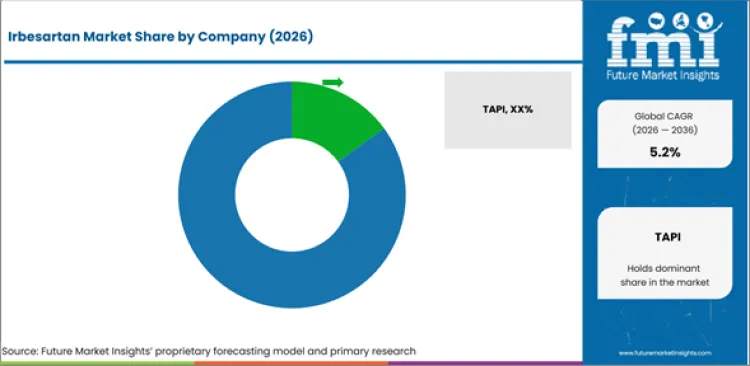
TAPI, Dr. Reddy’s Laboratories, Lupin, Aurobindo Pharma, Hetero Drugs, Hikal, Zhejiang Huahai Pharmaceutical, and Zhejiang Tianyu Pharmaceutical remain profiled supplier references.
- Regulated API suppliers compete through impurity documentation and sartan process control.
- Global generic manufacturers hold better account access through DMF and CEP-backed supply files.
- Indian and Chinese suppliers compete on cost position and batch availability. Documentation speed remains a separate contract filter.
- Specialist API firms target mid-volume formulation buyers that need flexible batch sizes.
Irbesartan companies compete through API quality systems and regulatory filings. Cardiovascular chemistry experience also shapes buyer confidence. Buyers compare process history before price. Demand for antibiotics API procurement shows the same bulk API need for dependable supplier files among regulated formulation customers.
Manufacturing scale and regulatory filing support separate the supplier tiers. TAPI remains a global API supplier reference. Dr. Reddy’s lists an Irbesartan CEP grant in 2024. Lupin reported global API sales in May 2025. Pharmaceutical drug delivery buyers follow a different category, but they show the same preference for reliable documentation in healthcare supply chains.
Suppliers with clean sartan chemistry records are better positioned than firms competing only on low price. Durable positions belong to companies with audited production and fast impurity-method support. Stable export documentation adds another buyer filter. Pharmaceutical packaging demand reinforces the wider pharmaceutical shift toward compliance-led supplier selection.
How do top irbesartan companies compare?
Dr. Reddy’s and TAPI score higher on filing support. Lupin adds API sales scale while Chinese suppliers retain scale relevance.
| Company | Relevance to Market Title | Sartan Process Control | Regulatory Filing Support | Cardiovascular API Depth | Channel Reach | Geographic Footprint |
|---|---|---|---|---|---|---|
| Dr. Reddy’s Laboratories | Very High | High | High | Strong | Strong | Global |
| TAPI | Very High | High | High | Strong | Strong | Global |
| Lupin | High | High | Strong | Strong | Strong | Global |
| Hetero Drugs | High | Medium | Strong | Strong | Medium | Asia and global exports |
| Zhejiang Huahai Pharmaceutical | High | Medium | Strong | Strong | Medium | China and global exports |
| Hikal | Medium | Medium | Medium | Moderate | Medium | India and export markets |
| Zhejiang Tianyu Pharmaceutical | Medium | Medium | Medium | Strong | Medium | China and export markets |
| CTX Lifesciences | Medium | Medium | Medium | Moderate | Medium | India and export markets |
Source: Future Market Insights competitive analysis, 2026.
Key global companies leading the irbesartan market include:
- TAPI
- Dr. Reddy’s Laboratories
- Lupin
- Aurobindo Pharma
- Hetero Drugs
- Zhejiang Huahai Pharmaceutical
- Zhejiang Tianyu Pharmaceutical
- Hikal
- CTX Lifesciences
- Smilax Laboratories
Key Developments in Irbesartan Market
- In January 2024, Teva announced its intention to divest TAPI as part of its Pivot to Growth strategy.
- • In April 2026, Jubilant Cadista Pharmaceuticals updated its U.S. DailyMed label for Irbesartan tablets across 75 mg, 150 mg, and 300 mg strengths.
- In June 2025, EDQM described nitrosamine testing activity covering sartan drug substances including irbesartan.
Key Players in the Irbesartan Market
Global API Platforms
- TAPI
- Dr. Reddy’s Laboratories
- Lupin
- Aurobindo Pharma
Regional API Suppliers
- Hetero Drugs
- Hikal
- Zhejiang Huahai Pharmaceutical
- Zhejiang Tianyu Pharmaceutical
Specialist Suppliers
- CTX Lifesciences
- Smilax Laboratories
Irbesartan Market - Report Scope
| Parameter | Details |
|---|---|
| Forecast period | 2026 to 2036 |
| Historical period | 2021 to 2025 |
| Quantitative unit | Revenue in USD million and CAGR in percent |
| Form covered | Powder and granules |
| Purity grade covered | ≥99.5%, 98.0%–99.5%, and <98% |
| Application covered | Hypertension and diabetic nephropathy |
| Sales channel covered | Direct, distributors, and online/API marketplaces |
| Regions covered | North America, Latin America, Europe, East Asia, South Asia and Pacific, Middle East and Africa |
| Countries covered | United States, United Kingdom, Germany, France, Japan, China, South Korea, and India |
| Key companies profiled | TAPI, Dr. Reddy’s Laboratories, Lupin, Aurobindo Pharma, Hetero Drugs, Hikal, CTX Lifesciences, Smilax Laboratories, Zhejiang Huahai Pharmaceutical, and Zhejiang Tianyu Pharmaceutical |
| Approach | Hybrid bottom-up and top-down methodology using verified transaction signals, supplier qualification patterns, and country-level sourcing behavior |
Source: Future Market Insights, 2026.
Irbesartan Market - Scope & Definition
| Attribute | Detail |
|---|---|
| Market Definition | Commercially traded irbesartan active pharmaceutical ingredient used in oral solid dosage manufacturing for hypertension and diabetic nephropathy products. |
| Functions Covered | Angiotensin receptor blocker API supply, impurity-controlled sourcing, formulation input, and chronic therapy production support. |
| Applications Covered | Hypertension and diabetic nephropathy applications in oral solid dosage manufacturing. |
| End-Use Industries | Generic pharmaceutical manufacturers, formulation companies, contract manufacturers, API distributors, and regulated sourcing teams. |
| Grades Covered | ≥99.5%, 98.0%–99.5%, and <98% purity grades. |
| Inclusions | Powder and granule irbesartan API sold through direct channels, distributors, and online/API marketplaces. |
| Exclusions | Finished tablets, fixed-dose irbesartan-hydrochlorothiazide products, unrelated ARB APIs, excipients, packaging, and clinical treatment services. |
Irbesartan Market - Research Methodology
| Method | Description |
|---|---|
| Primary Research | FMI analyst interviews with API suppliers, formulation buyers, sourcing teams, and regulatory consultants active in cardiovascular generics. |
| Desk Research | Review of regulator databases, product labeling, pharmacopoeial references, company API portfolios, and official public health sources. |
| Market Sizing & Forecasting | The model combined 2025 and 2026 anchors, measured growth assumptions, country supplier access, and segment use rates. |
| Data Validation | Forecasts were checked against hypertension treatment relevance, generic pricing behavior, ARB quality history, and supplier portfolio signals. |
Irbesartan Market Breakdown by Form, Purity Grade, Application, Sales Channel, and Region
Irbesartan Market Segmented by Form:
- Powder
- Granules
Irbesartan Market Segmented by Purity Grade:
- ≥99.5%
- 98.0%-99.5%
- <98%
Irbesartan Market Segmented by Application:
- Hypertension
- Diabetic Nephropathy
Irbesartan Market Segmented by Sales Channel:
- Direct
- Distributors
- Online/API Marketplaces
Irbesartan Market by Region:
- North America
- Latin America
- Europe
- East Asia
- South Asia and Pacific
- Middle East and Africa
Research Sources and Bibliography
- Centers for Disease Control and Prevention. (2026, June 2). High blood pressure facts.
- DailyMed. (2026, April). Irbesartan tablet prescribing information. U.S. National Library of Medicine.
- European Directorate for the Quality of Medicines & HealthCare. (2025, June 4). Nitrosamine testing activities of the OMCL Network.
- Food and Drug Administration. (2024, September). Control of nitrosamine impurities in human drugs: Guidance for industry.
- Food and Drug Administration. (2025, September 9). Hikal Limited MARCS-CMS 709370.
- Food and Drug Administration. (2026, March). CDER nitrosamine impurity acceptable intake limits.
- Federal Trade Commission. (2026, June 18). FTC takes action to protect Americans from higher drug costs in Aurobindo, Lannett deal.
- Kim, H. C., Lee, H., Lee, H. H., Ahn, S. V., Lee, J. M., Cheon, D. Y., Jhee, J. H., Yoon, S., Shin, M. H., Heo, J., Kim, E., Lee, S. W., Lee, J., Oh, Y. W., Jeon, J., Cho, M., Son, D., & Ahn, N. Y. (2025). Korea Hypertension Fact Sheet 2024. Clinical Hypertension.
- Lupin Limited. (2025, May 14). Lupin FY2025 results.
- Mohammad, R., Garg, R., & Kumar, S. (2024). Hypertension in India: A gender-based study of prevalence and associated risk factors. BMC Public Health.
- NHS Digital. (2025, August 28). Quality and Outcomes Framework, 2024-25.
- Robert Koch Institute. (2026, May 19). Hypertension: Prevalence from 18 years.
- Santé publique France. (2026, January 26). High blood pressure data.
- TAPI. (2026). Irbesartan API catalog.
- Teva Pharmaceutical Industries Ltd. (2024, January 31). Teva announces intention to divest API business as part of Pivot to Growth strategy.
- Teva Pharmaceutical Industries Ltd. (2025, January 29). Teva delivers second consecutive year of growth and announces fourth-quarter and full-year 2024 results.
- U.S. Food and Drug Administration. (2024, September). Control of nitrosamine impurities in human drugs.
- World Health Organization. (2025, September 25). Hypertension.
- Zhejiang Huahai Pharmaceutical Co., Ltd. (2026). Finished pharmaceutical products.
- CTX Lifesciences. (2026). Irbesartan API manufacturer and supplier.
- Electronic Medicines Compendium. (2026, April 17). Irbesartan 150 mg tablets, Aurobindo Pharma - Milpharm Ltd.
- RAD-AR Council, Japan. (2026). Kusuri-no-Shiori drug information sheets for irbesartan tablets.
- Smilax Laboratories Limited. (2025, April). Active pharmaceutical ingredients list.
- Zhejiang Huahai Pharmaceutical Co., Ltd. (2026). APIs & intermediates.
- Zhejiang Tianyu Pharmaceutical Co., Ltd. (2026). Products and services API list.
This bibliography is provided for reader reference and is not exhaustive. The full report contains the complete reference list and detailed citations.
This Report Answers
- The report estimates the irbesartan market size for 2026 and forecasts value through 2036.
- The report explains why the market grows at a measured pace despite generic ARB price pressure.
- The report identifies the core segments that shape API sourcing and buyer qualification.
- The report evaluates country-level performance across eight profiled markets.
- The report reviews nitrosamine documentation and impurity-control requirements that affect supplier selection.
- The report compares major API suppliers by sartan process control and regulatory filing support.
- The report defines inclusions and exclusions used for the irbesartan market forecast.
Frequently Asked Questions
What is the growth prospect for irbesartan?
Demand for irbesartan API is expected to grow at a measured pace due to chronic ARB use and supplier qualification needs.
Which companies are expected to shape the irbesartan market?
TAPI and Dr. Reddy’s Laboratories are expected to shape competition. Lupin and Zhejiang Huahai add API supply depth.
Why are API suppliers investing in impurity documentation?
API suppliers are investing in impurity documentation to protect access to regulated formulation buyers.
Why are direct sales channels important in the irbesartan market?
Direct sales channels support audit work and technical communication. Source continuity remains important for registered finished-dose products.
Which irbesartan form is gaining attention among buyers?
Powder remains the preferred form for oral solid manufacturers that need fewer extra processing steps.
How do regulations influence irbesartan API sourcing?
Regulations influence sourcing through nitrosamine testing expectations and stricter supplier documentation reviews.
Why is ≥99.5% purity important for irbesartan API?
Higher purity helps buyers lower impurity investigation risk and strengthen regulatory file acceptance.
How does diabetic nephropathy affect irbesartan demand?
Diabetic nephropathy provides a smaller but defensible clinical use case for repeat irbesartan formulation demand.
How do distributors support irbesartan API purchasing?
Distributors support smaller buyers and spot orders that do not require direct technical account coverage.
Preview the report firsthand - request a free sample
Get SampleGet the brochure for pricing and purchase details.
Get PDFTable of Content
- Key Takeaways
- Market Size and CAGR
- Top Growth Driver
- Fastest Growing Segment
- Leading Region
- Key Companies
- Emerging Opportunities
- Executive Summary
- Global Market Outlook
- Demand-side Trends
- Supply-side Trends
- Technology Roadmap Analysis
- Analysis and Recommendations
- Analyst Perspective (What is happening? Why now? What should investors know?)
- Key Questions Answered
- How large is the market?
- What is the CAGR?
- What are key trends?
- Which region dominates?
- Who are the leaders?
- Market Overview
- Market Coverage / Taxonomy
- Market Definition / Scope / Limitations
- Research Methodology
- Chapter Orientation
- Analytical Lens and Working Hypotheses
- Market Structure, Signals, and Trend Drivers
- Benchmarking and Cross-market Comparability
- Market Sizing, Forecasting, and Opportunity Mapping
- Research Design and Evidence Framework
- Desk Research Programme (Secondary Evidence)
- Expert Input and Fieldwork (Primary Evidence)
- Tooling, Models, and Reference Databases
- Data Engineering and Model Build
- Quality Assurance and Audit Trail
- Market Background
- Market Dynamics (Drivers, Restraints, Opportunity, Trends)
- Scenario Forecast (Optimistic, Likely, Conservative)
- Impact Analysis
- AI Impact
- Sustainability Impact
- Regulatory Impact
- Technology Impact
- Consumer / Buyer Analysis
- Purchase Drivers
- Adoption Barriers
- Buyer Journey
- Opportunity Map Analysis
- Product Life Cycle Analysis
- Supply Chain Analysis
- Investment Feasibility Matrix
- Value Chain Analysis
- PESTLE and Porter's Analysis
- Regulatory Landscape
- Regional Parent Market Outlook
- Production and Consumption Statistics
- Import and Export Statistics
- Global Market Analysis and Forecast, 2021 to 2036
- Historical Market Size Value (USD Million) & Volume (Unit) Analysis, 2021 to 2025
- Current and Future Market Size Value (USD Million) & Volume (Unit) Projections, 2026 to 2036
- Y-o-Y Growth Trend Analysis
- Absolute $ Opportunity Analysis
- Global Market Pricing Analysis, 2021 to 2036
- Global Market Analysis and Forecast, By Form, 2021 to 2036
- Introduction / Key Findings
- Historical Market Size Value (USD Million) & Volume (Unit) Analysis By Form, 2021 to 2025
- Current and Future Market Size Value (USD Million) & Volume (Unit) Analysis and Forecast By Form, 2026 to 2036
- Powder
- Granules
- Powder
- Y-o-Y Growth Trend Analysis By Form, 2021 to 2025
- Absolute $ Opportunity Analysis By Form, 2026 to 2036
- Global Market Analysis and Forecast, By Purity Grade, 2021 to 2036
- Introduction / Key Findings
- Historical Market Size Value (USD Million) & Volume (Unit) Analysis By Purity Grade, 2021 to 2025
- Current and Future Market Size Value (USD Million) & Volume (Unit) Analysis and Forecast By Purity Grade, 2026 to 2036
- ≥99.5%
- 98.0%–99.5%
- <98%
- ≥99.5%
- Y-o-Y Growth Trend Analysis By Purity Grade, 2021 to 2025
- Absolute $ Opportunity Analysis By Purity Grade, 2026 to 2036
- Global Market Analysis and Forecast, By Application, 2021 to 2036
- Introduction / Key Findings
- Historical Market Size Value (USD Million) & Volume (Unit) Analysis By Application, 2021 to 2025
- Current and Future Market Size Value (USD Million) & Volume (Unit) Analysis and Forecast By Application, 2026 to 2036
- Hypertension
- Diabetic Nephropathy
- Hypertension
- Y-o-Y Growth Trend Analysis By Application, 2021 to 2025
- Absolute $ Opportunity Analysis By Application, 2026 to 2036
- Global Market Analysis and Forecast, By Sales Channel, 2021 to 2036
- Introduction / Key Findings
- Historical Market Size Value (USD Million) & Volume (Unit) Analysis By Sales Channel, 2021 to 2025
- Current and Future Market Size Value (USD Million) & Volume (Unit) Analysis and Forecast By Sales Channel, 2026 to 2036
- Direct
- Distributors
- Online/API Marketplaces
- Direct
- Y-o-Y Growth Trend Analysis By Sales Channel, 2021 to 2025
- Absolute $ Opportunity Analysis By Sales Channel, 2026 to 2036
- Global Market Analysis and Forecast, By Region, 2021 to 2036
- Introduction
- Historical Market Size Value (USD Million) & Volume (Unit) Analysis By Region, 2021 to 2025
- Current Market Size Value (USD Million) & Volume (Unit) Analysis and Forecast By Region, 2026 to 2036
- North America
- Latin America
- Western Europe
- Eastern Europe
- East Asia
- South Asia and Pacific
- Middle East & Africa
- Market Attractiveness Analysis By Region
- North America Market Analysis and Forecast, By Country, 2021 to 2036
- Historical Market Size Value (USD Million) & Volume (Unit) Trend Analysis By Market Taxonomy, 2021 to 2025
- Market Size Value (USD Million) & Volume (Unit) Forecast By Market Taxonomy, 2026 to 2036
- By Country
- USA
- Canada
- Mexico
- By Form
- By Purity Grade
- By Application
- By Sales Channel
- By Country
- Market Attractiveness Analysis
- By Country
- By Form
- By Purity Grade
- By Application
- By Sales Channel
- Key Takeaways
- Latin America Market Analysis and Forecast, By Country
- Historical Market Size Value (USD Million) & Volume (Unit) Trend Analysis By Market Taxonomy, 2021 to 2025
- Market Size Value (USD Million) & Volume (Unit) Forecast By Market Taxonomy, 2026 to 2036
- By Country
- Brazil
- Chile
- Rest of Latin America
- By Form
- By Purity Grade
- By Application
- By Sales Channel
- By Country
- Market Attractiveness Analysis
- By Country
- By Form
- By Purity Grade
- By Application
- By Sales Channel
- Key Takeaways
- Western Europe Market Analysis and Forecast, By Country
- Historical Market Size Value (USD Million) & Volume (Unit) Trend Analysis By Market Taxonomy, 2021 to 2025
- Market Size Value (USD Million) & Volume (Unit) Forecast By Market Taxonomy, 2026 to 2036
- By Country
- Germany
- UK
- Italy
- Spain
- France
- Nordic
- BENELUX
- Rest of Western Europe
- By Form
- By Purity Grade
- By Application
- By Sales Channel
- By Country
- Market Attractiveness Analysis
- By Country
- By Form
- By Purity Grade
- By Application
- By Sales Channel
- Key Takeaways
- Eastern Europe Market Analysis and Forecast, By Country
- Historical Market Size Value (USD Million) & Volume (Unit) Trend Analysis By Market Taxonomy, 2021 to 2025
- Market Size Value (USD Million) & Volume (Unit) Forecast By Market Taxonomy, 2026 to 2036
- By Country
- Russia
- Poland
- Hungary
- Balkan & Baltic
- Rest of Eastern Europe
- By Form
- By Purity Grade
- By Application
- By Sales Channel
- By Country
- Market Attractiveness Analysis
- By Country
- By Form
- By Purity Grade
- By Application
- By Sales Channel
- Key Takeaways
- East Asia Market Analysis and Forecast, By Country
- Historical Market Size Value (USD Million) & Volume (Unit) Trend Analysis By Market Taxonomy, 2021 to 2025
- Market Size Value (USD Million) & Volume (Unit) Forecast By Market Taxonomy, 2026 to 2036
- By Country
- China
- Japan
- South Korea
- By Form
- By Purity Grade
- By Application
- By Sales Channel
- By Country
- Market Attractiveness Analysis
- By Country
- By Form
- By Purity Grade
- By Application
- By Sales Channel
- Key Takeaways
- South Asia and Pacific Market Analysis and Forecast, By Country
- Historical Market Size Value (USD Million) & Volume (Unit) Trend Analysis By Market Taxonomy, 2021 to 2025
- Market Size Value (USD Million) & Volume (Unit) Forecast By Market Taxonomy, 2026 to 2036
- By Country
- India
- ASEAN
- Australia & New Zealand
- Rest of South Asia and Pacific
- By Form
- By Purity Grade
- By Application
- By Sales Channel
- By Country
- Market Attractiveness Analysis
- By Country
- By Form
- By Purity Grade
- By Application
- By Sales Channel
- Key Takeaways
- Middle East & Africa Market Analysis and Forecast, By Country
- Historical Market Size Value (USD Million) & Volume (Unit) Trend Analysis By Market Taxonomy, 2021 to 2025
- Market Size Value (USD Million) & Volume (Unit) Forecast By Market Taxonomy, 2026 to 2036
- By Country
- Kingdom of Saudi Arabia
- Other GCC Countries
- Türkiye
- South Africa
- Other African Union
- Rest of Middle East & Africa
- By Form
- By Purity Grade
- By Application
- By Sales Channel
- By Country
- Market Attractiveness Analysis
- By Country
- By Form
- By Purity Grade
- By Application
- By Sales Channel
- Key Takeaways
- Key Countries Market Analysis
- USA
- Pricing Analysis
- Market Share Analysis, 2025
- By Form
- By Purity Grade
- By Application
- By Sales Channel
- Canada
- Pricing Analysis
- Market Share Analysis, 2025
- By Form
- By Purity Grade
- By Application
- By Sales Channel
- Mexico
- Pricing Analysis
- Market Share Analysis, 2025
- By Form
- By Purity Grade
- By Application
- By Sales Channel
- Brazil
- Pricing Analysis
- Market Share Analysis, 2025
- By Form
- By Purity Grade
- By Application
- By Sales Channel
- Chile
- Pricing Analysis
- Market Share Analysis, 2025
- By Form
- By Purity Grade
- By Application
- By Sales Channel
- Germany
- Pricing Analysis
- Market Share Analysis, 2025
- By Form
- By Purity Grade
- By Application
- By Sales Channel
- UK
- Pricing Analysis
- Market Share Analysis, 2025
- By Form
- By Purity Grade
- By Application
- By Sales Channel
- Italy
- Pricing Analysis
- Market Share Analysis, 2025
- By Form
- By Purity Grade
- By Application
- By Sales Channel
- Spain
- Pricing Analysis
- Market Share Analysis, 2025
- By Form
- By Purity Grade
- By Application
- By Sales Channel
- France
- Pricing Analysis
- Market Share Analysis, 2025
- By Form
- By Purity Grade
- By Application
- By Sales Channel
- India
- Pricing Analysis
- Market Share Analysis, 2025
- By Form
- By Purity Grade
- By Application
- By Sales Channel
- ASEAN
- Pricing Analysis
- Market Share Analysis, 2025
- By Form
- By Purity Grade
- By Application
- By Sales Channel
- Australia & New Zealand
- Pricing Analysis
- Market Share Analysis, 2025
- By Form
- By Purity Grade
- By Application
- By Sales Channel
- China
- Pricing Analysis
- Market Share Analysis, 2025
- By Form
- By Purity Grade
- By Application
- By Sales Channel
- Japan
- Pricing Analysis
- Market Share Analysis, 2025
- By Form
- By Purity Grade
- By Application
- By Sales Channel
- South Korea
- Pricing Analysis
- Market Share Analysis, 2025
- By Form
- By Purity Grade
- By Application
- By Sales Channel
- Russia
- Pricing Analysis
- Market Share Analysis, 2025
- By Form
- By Purity Grade
- By Application
- By Sales Channel
- Poland
- Pricing Analysis
- Market Share Analysis, 2025
- By Form
- By Purity Grade
- By Application
- By Sales Channel
- Hungary
- Pricing Analysis
- Market Share Analysis, 2025
- By Form
- By Purity Grade
- By Application
- By Sales Channel
- Kingdom of Saudi Arabia
- Pricing Analysis
- Market Share Analysis, 2025
- By Form
- By Purity Grade
- By Application
- By Sales Channel
- Türkiye
- Pricing Analysis
- Market Share Analysis, 2025
- By Form
- By Purity Grade
- By Application
- By Sales Channel
- South Africa
- Pricing Analysis
- Market Share Analysis, 2025
- By Form
- By Purity Grade
- By Application
- By Sales Channel
- USA
- Market Structure Analysis
- Competition Dashboard
- Competition Benchmarking
- Market Share Analysis of Top Players
- By Regional
- By Form
- By Purity Grade
- By Application
- By Sales Channel
- Emerging Startups
- Innovation Benchmarking
- Competition Analysis
- Competition Deep Dive
- TAPI
- Overview
- Product Portfolio
- Profitability by Market Segments (Product/Region/Sales Channel)
- Sales Footprint
- Strategy Overview
- Marketing Strategy
- Product Strategy
- Channel Strategy
- Dr. Reddy’s Laboratories
- Lupin
- Aurobindo Pharma
- Hetero Drugs
- Zhejiang Huahai Pharmaceutical
- TAPI
- Case Studies
- Success Stories
- Recent Developments
- Competition Deep Dive
- Assumptions & Acronyms Used


