

- Market Size (2026)
- USD 6.4 Bn
- Forecast (2036)
- USD 12.8 Bn
- CAGR (2026 to 2036)
- 7.1%
How big is Ustekinumab Biosimilar Market size?
USD 6.4 billion in 2026 and USD 12.8 billion by 2036 at a 7.1% CAGR.
Demand for ustekinumab biosimilar is projected to expand at 7.1% CAGR between 2026 and 2036, increasing valuation from USD 6.4 billion in 2026 to USD 12.8 billion by 2036. Patients with chronic conditions gain wider access to affordable treatments led by expanding biosimilar agreements. Biocon Biologics stated in May 2025 for Yesintek access agreements covering more than 100 million lives. This extensive coverage ensures substantial availability across commercial and public health plans. Medical specialists connect the psoriasis biosimilars directly with established inflammatory-disease pathways. Leading active pharmacy coordination to sustain treatment continuity across induction and maintenance schedules.
Regulatory frameworks vary significantly between different international healthcare systems. United States and United Kingdom care systems prioritize formulary governance and structured patient transitions. Germany and Japan services emphasize traceability records and physician-led product selection. Celltrion stated in March 2025 stating its United States portfolio contained 9 FDA-approved biosimilars. Such extensive regulatory experience directly supports new product introductions by developers in South Korea. Developers in South Korea use such international experience during regional product introductions. Resulting with care networks comparing support programs and medicine availability across inflammatory diseases to ensure optimal patient care.
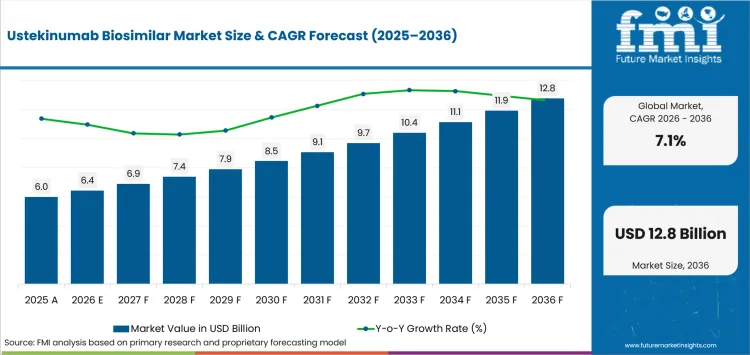
Key Takeaways of Ustekinumab Biosimilar Market
- Demand for ustekinumab biosimilars is shaped by the expansion of treatment choice across chronic inflammatory diseases, with clinical evidence, treatment continuity, and medicine availability influencing adoption across specialist services.
- By product, pre-filled syringe is expected to lead with 52.4% share in 2026, reflecting measured subcutaneous dosing and reduced preparation requirements across dermatology and rheumatology treatment pathways.
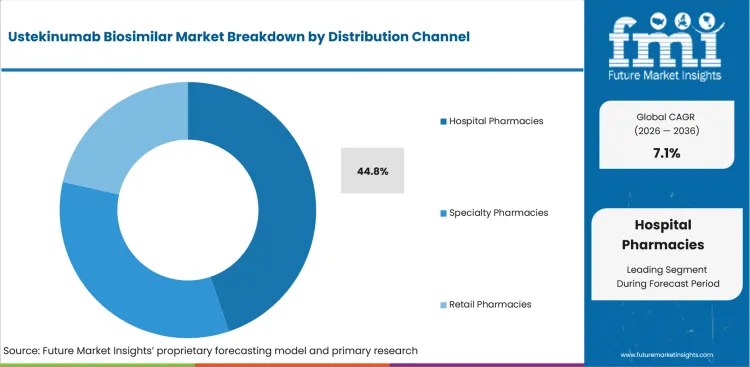
- Hospital pharmacies are anticipated to hold the leading distribution channel position with 44.8% share in 2026, reflecting specialist prescribing, institutional medicine oversight, and coordination of inventory with scheduled treatment.
- Plaque psoriasis is projected to remain the leading indication with 37.0% share in 2026, reflecting established biologic prescribing and continued specialist management of moderate-to-severe disease.
- Transition complexity, reimbursement differences, traceability requirements, and patient communication remain key barriers to wider ustekinumab biosimilar adoption across fragmented care systems.
- Competition centers on Amgen, Celltrion, Alvotech, Samsung Bioepis, Formycon, Fresenius Kabi, Biocon Biologics, Accord BioPharma, and Bio-Thera Solutions, with differentiation focused on formulation coverage, regulatory positioning, patient support, and supply continuity.
Analyst Perspective
"The ustekinumab biosimilar market is increasingly shaped by treatment continuity, interchangeability confidence, and practical access rather than price competition alone. Clinicians and health systems are evaluating evidence supporting switching, consistent supply, reimbursement conditions, and pharmacy workflow integration across induction and maintenance therapy. Companies that strengthen clinical education and reliable distribution will be better positioned to expand biosimilar adoption."
— Anurag Sharma, Principal Consultant for Healthcare at Future Market Insights
Source: Future Market Insights analysis, 2026.
How is Ustekinumab Biosimilar Market segmented?
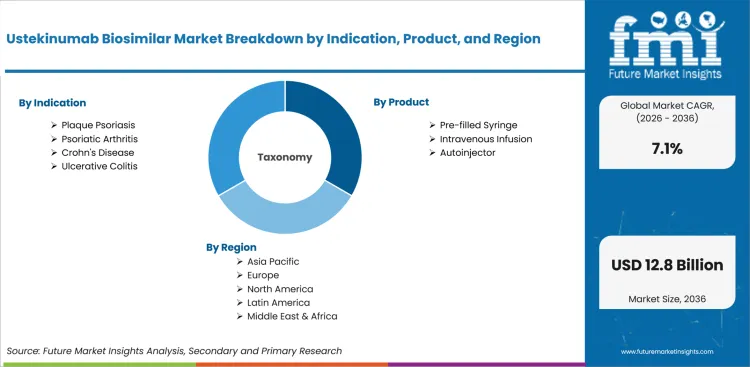
The ustekinumab biosimilar sector is segmented by indication, product, manufacturer, distribution channel, and region.
The ustekinumab biosimilar industry is segmented by indication, product, manufacturer, distribution channel, and region. Indication coverage includes plaque psoriasis and psoriatic arthritis followed by Crohn's disease and ulcerative colitis. Product coverage addresses pre-filled syringes and intravenous infusion with autoinjector formats. Manufacturer coverage encompasses Amgen and Celltrion followed by Alvotech, Samsung Bioepis, Formycon, Fresenius Kabi, Biocon Biologics, Accord BioPharma, and Bio-Thera Solutions. Distribution-channel coverage spans hospital pharmacies and specialty pharmacies with retail pharmacies serving selected prescriptions. Regional coverage includes North America and Europe together with East Asia. Latin America and South Asia and Pacific extend geographic analysis across developing biologic systems. Middle East and Africa complete regional coverage.
Why does plaque psoriasis shape indication demand?
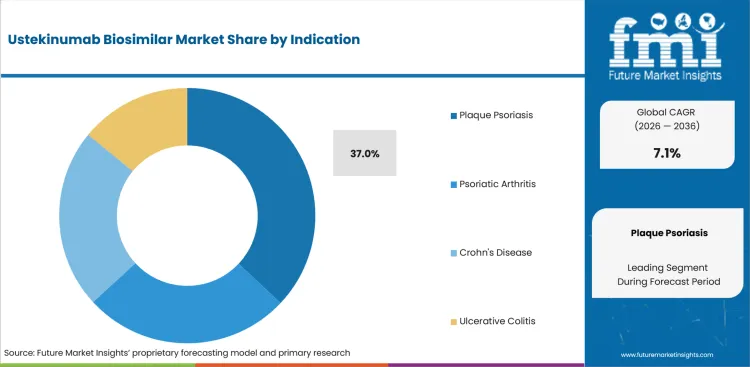
Mehta and Sathe reported in September 2025 stating plaque psoriasis represented approximately 80% to 90% of psoriasis cases, promoting extensive biologic evaluation across dermatology services. Long dosing intervals increase attention toward appointment planning and missed-dose management. Cross-specialty review requires unified product records across several clinical services.
- Plaque psoriasis is likely to garner 37.0% share in 2026, backed by established biologic prescribing across moderate-to-severe disease management. Dermatology teams assess symptom control and treatment persistence across complete care pathways.
- Psoriatic arthritis and Crohn's disease create separate clinical requirements involving specialist monitoring. Ulcerative colitis planning reflects disease activity and prior therapy response during product selection.
Why does pre-filled syringe shape product selection?
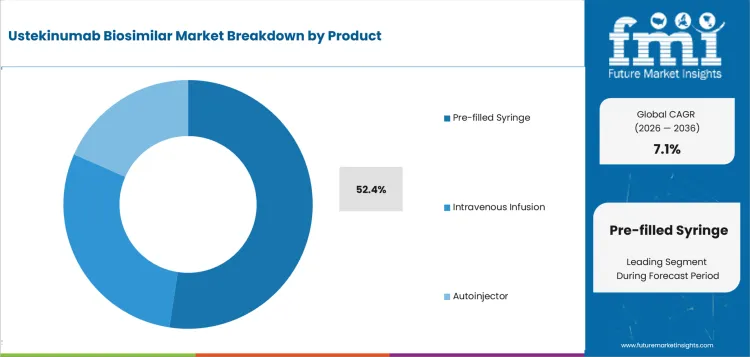
Pack configuration influences storage design and dispensing accuracy inside specialty pharmacies. Device labeling directs staff education during first-dose preparation. United States Food and Drug Administration Purple Book records from October 2024 listed 3 Imuldosa presentations, comprising two pre-filled syringe strengths and one intravenous vial.
- Based on product, pre-filled syringe is anticipated to secure 52.4% share in 2026 owing to measured dosing and reduced preparation requirements. Dermatology and rheumatology services value formats suited to clinic-based treatment and qualified self-administration programs.
- Intravenous infusion supports gastrointestinal induction under specialist supervision and links initial treatment with subcutaneous maintenance. Autoinjectors are projected to receive selective review through convenience requirements and patient-training considerations across self-administered biologics.
How does Amgen shape manufacturer positioning?
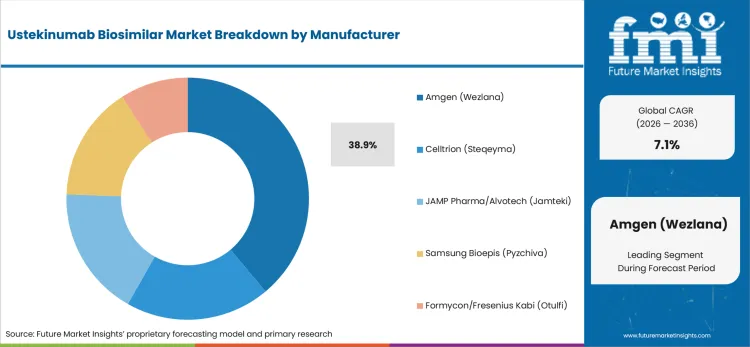
Amgen reported in a Securities and Exchange Commission filing from May 2025 Wezlana entered United States commercial use during first-quarter 2025 across 4 inflammatory indications. Commercial launch timing influences formulary sequencing across payer networks. Brand-specific coding shapes claims setup during hospital onboarding.
- By manufacturer, Amgen (Wezlana) is anticipated to hold 38.9% share in 2026 since it is driven by subcutaneous and intravenous presentations across approved treatment pathways. Hospital committees assess medicine availability and transition resources prior to routine adoption.
- Celltrion and Alvotech expand manufacturer choice through approved ustekinumab products. Samsung Bioepis and Formycon extend company participation, with Fresenius Kabi and Bio-Thera Solutions supporting interchangeable biosimilar assessment.
Why do hospital pharmacies lead distribution channel demand?
Code activation determines charge-master updates for infusion departments. Specialty distributors schedule refrigerated deliveries around approved administration dates. Fresenius Kabi reported in April 2025 claiming CMS assigned permanent product-specific code Q9999 to Otulfi for subcutaneous and intravenous administration.
- Hospital pharmacies are forecast to garner 44.8% share of distribution channel in 2026, led by specialist prescribing and institution-level medicine oversight. Pharmacy departments coordinate inventory and treatment scheduling across approved indications.
- Specialty pharmacies manage benefit verification and refill coordination for maintenance treatment across outpatient services. Retail pharmacies are likely to receive selective participation according to coverage policy and temperature-controlled distribution requirements.
What are drivers, restraints, and opportunities in ustekinumab biosimilar market?
Reference-aligned treatment choice and expanding manufacturer participation support ustekinumab biosimilar evaluation. Transition complexity and uneven coverage policies are likely to delay routine prescribing across selected care systems.
- Driver: Healthcare systems seek treatment choice across chronic inflammatory diseases using an established therapeutic molecule. Specialist teams favor products supported by comparative evidence and dependable medicine availability.
- Restraint: Medicine transitions require physician engagement and patient communication across scheduled treatment pathways. Traceability and reimbursement administration may extend implementation across newly participating providers.
- Opportunity: Multi-format portfolios support dermatology and gastroenterology services through shared product infrastructure. Patient-support programs are expected to improve continuity across clinic and home-based maintenance treatment.
Greater approval experience is projected to support institutional evaluation of biosimilar and biologics. United States Food and Drug Administration reported in April 2024 for approval of its 50th biosimilar, illustrating expanding regulatory familiarity across chronic and severe disease treatment. Pharmacy committees gain additional reference points for clinical and operational review.
United States Food and Drug Administration reported in October 2025 claiming biosimilar market share remained below 20%. Such uptake indicates persistent adoption barriers despite a growing approval base. Coverage differences and transition workload may slow prescribing across fragmented payer systems. Clear patient communication is anticipated to reduce uncertainty during product changes.
Specialist services are projected to use national guidance during local implementation planning. NHS England requested in April 2024 a minimum adoption of 80% for priority generics and biosimilars within specified implementation periods. Structured adoption objectives create openings for suppliers offering transition resources and dependable distribution.
How are country CAGRs aligned in ustekinumab biosimilar market?
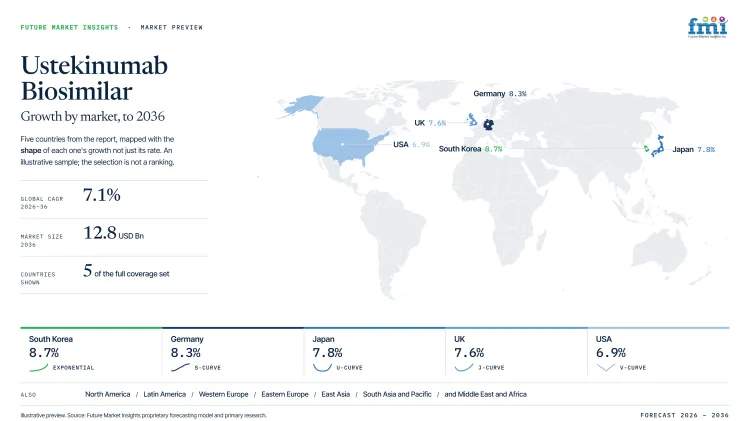
| Country or Market | CAGR |
|---|---|
| South Korea | 8.7% |
| Germany | 8.3% |
| Japan | 7.8% |
| UK | 7.6% |
| USA | 6.9% |
Source: Future Market Insights analysis, 2026.
How do country-level CAGRs compare in Ustekinumab Biosimilar Market?
The country comparison shows a gradual step-down in growth across the markets covered. South Korea sits at the upper end of the range, while Germany follows at a limited distance. Japan and the United Kingdom form a closely grouped middle tier. The United States completes the comparison with an established biosimilar approval base. The six-point spread shows that these markets share a strong growth outlook, although their relative positions indicate different levels of market momentum. These national rates represent the profiled markets and should not be interpreted as a universal ranking.
- South Korea leads the comparison and establishes East Asia as the notable development cluster among the markets shown.
- Germany follows South Korea and maintains a relatively limited gap from the leading position.
- Japan and the United Kingdom form the next growth band through specialist-led biosimilar adoption systems.
- The United States completes the disclosed comparison through extensive payer and pharmacy participation.
- The pattern resembles a gradual downward slope rather than a sharp separation among the profiled national markets.
Markets with broadly similar CAGRs are still able to present different entry conditions due to approval coverage and medicine-transition readiness. The full report provides country-level analysis across North America, Latin America, Europe, East Asia, South Asia, Oceania and the Middle East and Africa.
Country-wise Analysis
- Sector in South Korea is anticipated to rise at 8.7% CAGR during the study period, guided by domestic development experience and global regulatory activity. Local manufacturers possess extensive biologic production knowledge and established international partnerships. Celltrion reported in June 2025 stating Steqeyma gained a presentation intended for patients aged 6 to 17 years. Pediatric formulation development supports additional treatment pathways.
- European Medicines Agency stated in November 2025 highlighting Usgena following a 12-week maintenance interval for plaque psoriasis following initial dosing. Predictable scheduling supports treatment planning across German specialist services. Pharmacy and insurer processes support structured comparison among authorised medicines. Industry in Germany is projected to scale at 8.3% CAGR over 2026 to 2036, aided by product availability and regulated selection procedures.
- Specialist concentration and cautious medicine transitions influence Japanese adoption across dermatology and rheumatology services. Ustekinumab biosimilar activity in Japan is forecast to grow at 7.8% CAGR during the assessment period, driven by expanding approval coverage and physician-led review. Pharmaceuticals and Medical Devices Agency listed 3 ustekinumab biosimilar approvals dated from December 2024 to December 2025 in its March 2026 list. Product entries increase local choice across specialist services.
- NHS England reported in April 2025 a national switching priority for 5 biological medicines. Ustekinumab coverage includes Crohn's disease and psoriatic arthritis with ulcerative colitis. Coordinated implementation guidance supports pharmacy and clinical planning across funded services. Market in the United Kingdom is predicted to grow at 7.6% CAGR between 2026 and 2036, backed by nationally organized best-value medicine programs.
- United States uptake reflects formulary decisions and specialty pharmacy access across closely timed product introductions. Sales in the United States are expected to record 6.9% CAGR by 2036, influenced by expanding approved-product choice and patient-support arrangements. United States Food and Drug Administration Purple Book records from April 2024 listed 4 Selarsdi presentations, promoting subcutaneous and intravenous treatment across approved indications.
Who are notable companies in Ustekinumab Biosimilar Market?
Amgen, Celltrion, Alvotech, Samsung Bioepis, Fresenius Kabi, Biocon Biologics, Accord BioPharma, Bio-Thera Solutions, and Hikma Pharmaceuticals are the notable companies shaping this market.
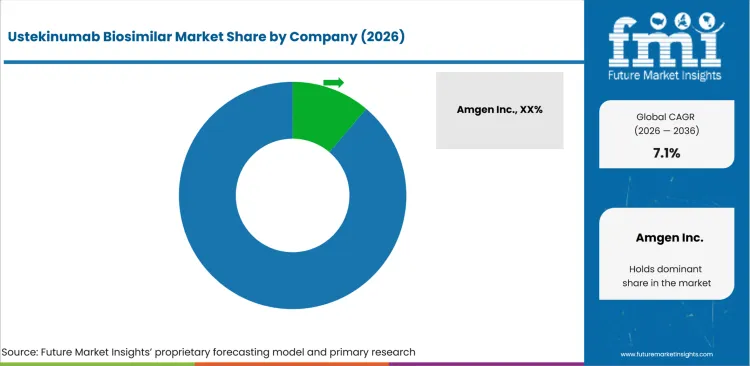
Competition in ustekinumab biosimilars is anticipated to center on formulation coverage and medicine availability. Hospital teams are likely to compare companies led by clinical documentation and patient-transition support prior to formulary selection. Amgen is expected to receive attention due to established biologic supply capacity. Celltrion is projected to add immunology experience across regional services. Alvotech and Samsung Bioepis are estimated to support review driven by international partnerships. Formycon and Biocon Biologics are anticipated to compete across hospital and specialty pharmacy channels.
- Amgen and Celltrion are expected to gain review attention based on established ustekinumab biosimilar portfolios. Clinical teams are likely to assess formulation continuity and transition resources across complete treatment pathways.
- Alvotech and Samsung Bioepis are anticipated to compete driven by development experience and regional commercial alliances. Pharmacy services are projected to compare product availability and local support across approved indications.
- Formycon with Fresenius Kabi is forecast to support multispecialty evaluation led by subcutaneous and intravenous Otulfi presentations. Billing support and patient services are expected to influence hospital review.
- Biocon Biologics and Accord BioPharma are likely to receive specialist interest depending on approved United States products. Bio-Thera Solutions is anticipated to advance through formulation range and payer access.
Competitive Benchmarking: Ustekinumab Biosimilar Market
| Company | Portfolio Depth | Clinical Match | Service Support | Service Reach |
|---|---|---|---|---|
| Amgen Inc. | High | High | High | United States and selected global regions |
| Celltrion, Inc. | High | High | High | United States, Europe, and Asia |
| Alvotech with Teva and JAMP Pharma | Medium | High | Medium | North America and Europe |
| Samsung Bioepis Co., Ltd. with Sandoz Group AG | High | High | High | United States, Europe, and selected Asian regions |
Source: Future Market Insights competitive analysis, 2026.
Key Developments in Ustekinumab Biosimilar Market
- In February 2025, Samsung Bioepis announced United States availability of PYZCHIVA under its Sandoz commercialization agreement. Product access covered pre-filled syringes and an intravenous vial across approved inflammatory disease treatments.
- In March 2025, Celltrion added STEQEYMA to the Costco Member Prescription Program. Availability from April 2025 expanded specialty-pharmacy access for eligible members and participating employer plans.
- In May 2025, Teva and Alvotech confirmed FDA approval of SELARSDI interchangeability across every reference-matched presentation. Effective interchangeability from April 2025 expanded substitution options under applicable state pharmacy rules.
Key Companies in Ustekinumab Biosimilar Market
Established ustekinumab biosimilar companies
- Amgen Inc.
- Celltrion, Inc.
- Samsung Bioepis Co., Ltd.
- Sandoz Group AG
Development and commercialization partners
- Alvotech
- Teva Pharmaceuticals USA, Inc.
- JAMP Pharma Corporation
- Formycon AG
- Fresenius Kabi
Additional approved-product participants
- Biocon Biologics Ltd.
- Accord BioPharma, Inc.
- Bio-Thera Solutions, Ltd.
- Hikma Pharmaceuticals PLC
Ustekinumab Biosimilar Market Report Scope
| Coverage field | Report scope |
|---|---|
| Market breakdown | Ustekinumab Biosimilar Market breakdown by indication, product, manufacturer, distribution channel, and region |
| Quantitative Units | Revenue in USD Million, CAGR in %. |
| Market Definition | Ustekinumab biosimilars include approved biological medicines demonstrating biosimilarity to reference ustekinumab across authorised inflammatory-disease indications. |
| Regions Covered | North America, Latin America, Western Europe, Eastern Europe, East Asia, South Asia and Pacific, and Middle East and Africa |
| Countries Covered | South Korea, Germany, Japan, UK, and USA with additional countries assessed across regional coverage |
| Key Companies Profiled | Amgen, Celltrion, Alvotech, Samsung Bioepis, Sandoz, Formycon, Fresenius Kabi, Biocon Biologics, Accord BioPharma, Bio-Thera Solutions, and Hikma Pharmaceuticals |
| Forecast Period | 2026 to 2036 |
| Approach | Hybrid bottom-up and top-down methodology using segment shares, country CAGRs, regulatory activity, product availability, company participation, and distribution coverage |
Source: Future Market Insights analysis, 2026.
Ustekinumab Biosimilar Market - Research Methodology
| Method | Approach |
|---|---|
| Primary Research | FMI analysts gathered input from manufacturers, service providers, technology developers, distributors, end users, sourcing teams, and subject-matter experts. Interviews examined purchasing decisions, product or service evaluation, adoption barriers, approval requirements, pricing considerations, and expectations for technical or commercial support. Respondents were also asked what evidence is required before a trial, pilot, or initial order develops into regular purchasing. |
| Desk Research | Desk research covered government statistics, regulatory publications, trade data, industry associations, technical literature, standards, company filings, product information, and official corporate announcements. Sources were reviewed for relevance, publication date, geographic coverage, and consistency with the defined market scope. Claims relating to performance, applications, approvals, capacity, investment, and commercial activity were retained only when supported by credible public evidence. |
| Market Sizing and Forecasting | The market model combined the baseline value with historical performance, segment structure, pricing and volume indicators, adoption levels, company participation, and country-level demand conditions. Forecast assumptions considered economic activity, investment trends, regulatory developments, technology adoption, purchasing cycles, supply availability, and barriers to wider market use. Segment and regional estimates were reconciled before the final market total was calculated. |
| Data Validation | Estimates were checked against multiple independent indicators, including public data, company activity, trade patterns, industry developments, and findings from primary interviews. Validation also tested whether products, services, applications, and company revenues fell within the defined market boundaries. Adjacent categories, unsupported claims, overlapping revenues, and activities without direct market relevance were excluded to reduce double counting and maintain consistency across segments and countries. |
Source: Future Market Insights analysis, 2026.
Ustekinumab Biosimilar Market by Segments
Ustekinumab Biosimilar Market segmented by Indication:
- Plaque Psoriasis
- Psoriatic Arthritis
- Crohn's Disease
- Ulcerative Colitis
Ustekinumab Biosimilar Market segmented by Product:
- Pre-filled Syringe
- Intravenous Infusion
- Autoinjector
Ustekinumab Biosimilar Market segmented by Manufacturer:
- Amgen (Wezlana)
- Celltrion (Steqeyma)
- Alvotech with Teva and JAMP Pharma (Selarsdi, Uzpruvo, and Jamteki)
- Samsung Bioepis with Sandoz (Pyzchiva)
- Formycon with Fresenius Kabi (Otulfi)
- Biocon Biologics (Yesintek)
- Accord BioPharma (Imuldosa)
- Bio-Thera Solutions with Hikma Pharmaceuticals (Starjemza)
Ustekinumab Biosimilar Market segmented by Distribution Channel:
- Hospital Pharmacies
- Specialty Pharmacies
- Retail Pharmacies
Ustekinumab Biosimilar Market segmented by Region:
- North America
- United States
- Canada
- Latin America
- Brazil
- Mexico
- Argentina
- Chile
- Western Europe
- Germany
- France
- United Kingdom
- Italy
- Spain
- Benelux
- Nordics
- Eastern Europe
- Poland
- Czech Republic
- Romania
- Hungary
- East Asia
- China
- Japan
- South Korea
- South Asia and Pacific
- India
- ASEAN
- Australia and New Zealand
- Middle East and Africa
- GCC Countries
- South Africa
- Türkiye
- Israel
Research Sources and Bibliography
- Amgen Inc. (2025, May 1). First-quarter 2025 earnings release (Exhibit 99.1 to Form 8-K). USA Securities and Exchange Commission.
- Bio-Thera Solutions, Ltd., & Hikma Pharmaceuticals PLC. (2025, May 27). Bio-Thera Solutions and Hikma Pharmaceuticals announce FDA approval of Starjemza® injection.
- Biocon Biologics Ltd. (2025, February 24). Biocon Biologics launches Yesintek™ biosimilar to Stelara® in the United States.
- Biocon Biologics Ltd. (2025, May 5). Biocon Biologics secures strong market access coverage for Yesintek™ in the United States covering 100+ million lives.
- Celltrion, Inc. (2025, March 13). Steqeyma® biosimilar to Stelara® now available in the United States.
- Celltrion, Inc. (2025, June 16). Celltrion announces United States FDA approval of an additional Steqeyma® presentation for pediatric patients.
- European Medicines Agency. (2025, November 21). Usgena: EPAR medicine overview.
- Fresenius Kabi. (2025, March 3). Fresenius continues growth of biosimilars portfolio with United States availability of Otulfi®.
- Fresenius Kabi. (2025, April 28). CMS grants Fresenius Kabi permanent product-specific Q-code for Otulfi®.
- Mehta, S., & Sathe, N. C. (2025, September 14). Plaque psoriasis. StatPearls Publishing.
- NHS England. (2024, April 24). 2024/25 priorities and operational planning guidance.
- NHS England. (2025, April 9). Commissioning framework for best value biological medicines.
- Pharmaceuticals and Medical Devices Agency. (2026, March). PMDA approved biosimilars.
- USA Food and Drug Administration. (2024, April 16). Purple Book product details for Selarsdi.
- USA Food and Drug Administration. (2024, April 26). FDA roundup: April 26, 2024.
- USA Food and Drug Administration. (2024, June 28). Purple Book product details for Pyzchiva.
- USA Food and Drug Administration. (2024, September 27). Purple Book product details for Otulfi.
- USA Food and Drug Administration. (2024, October 10). Purple Book product details for Imuldosa.
- USA Food and Drug Administration. (2025, October 29). FDA moves to accelerate biosimilar development and lower drug costs.
- Samsung Bioepis Co., Ltd. (2025, February 24). Samsung Bioepis announces USA launch of PYZCHIVA (ustekinumab-ttwe), biosimilar to Stelara.
- Celltrion, Inc. (2025, March 27). Celltrion’s STEQEYMA (ustekinumab-stba), now added to the Costco Member Prescription Program.
- Teva Pharmaceutical Industries Ltd. (2025, May 7). Quarterly report for the period ended March 31, 2025 [Form 10-Q]. USA Securities and Exchange Commission.
This bibliography is provided for reader reference and is not exhaustive. The full report contains the complete reference list and detailed citations.
This Report Answers
- What segments influence demand across indication, product, manufacturer, and distribution channel?
- How do specialist teams evaluate ustekinumab biosimilars prior to routine clinical use?
- How do country CAGRs differ across profiled markets with distinct approval coverage and medicine-transition practices?
- What companies compete through product depth and dependable regional support across treatment networks?
- How are forecasts validated through hybrid bottom-up and top-down analysis using independent indicators and company evidence?
- What evidence do pharmacy committees examine prior to multi-site biosimilar adoption?
- How do formulation coverage and patient support influence product selection across specialist services?
- What limits return on investment for healthcare systems adopting ustekinumab biosimilars?
- How do education records and specialist guidance influence medicine approval across clinical teams?
- What company capabilities improve long-term confidence and continuing product use across treatment networks?
Frequently Asked Questions
How big is the Ustekinumab Biosimilar Market in 2026?
The ustekinumab biosimilar market is valued at USD 6.4 billion in 2026 and is forecast to reach USD 12.8 billion by 2036.
What is the CAGR of the Ustekinumab Biosimilar Market from 2026 to 2036?
The ustekinumab biosimilar market is projected to grow at a CAGR of 7.1% between 2026 and 2036, supported by expanding biosimilar approvals and broader treatment access.
Which product leads the Ustekinumab Biosimilar Market?
Pre-filled syringes account for 52.4% of the ustekinumab biosimilar market by product in 2026, driven by measured subcutaneous dosing and simplified administration.
Which country is growing fastest in the Ustekinumab Biosimilar Market?
South Korea is the fastest-growing profiled market for ustekinumab biosimilars, expanding at an 8.7% CAGR through 2036, ahead of the global market average of 7.1%.
Who are the leading companies in the Ustekinumab Biosimilar Market?
Leading companies in the ustekinumab biosimilar market include Amgen, Celltrion, Alvotech, Samsung Bioepis, and Formycon, competing across approved-product portfolios, formulation coverage, and regional market access.
Preview the report firsthand - request a free sample
Get SampleGet the brochure for pricing and purchase details.
Get PDFTable of Content
- Key Takeaways
- Market Size and CAGR
- Top Growth Driver
- Fastest Growing Segment
- Leading Region
- Key Companies
- Emerging Opportunities
- Executive Summary
- Global Market Outlook
- Demand-side Trends
- Supply-side Trends
- Technology Roadmap Analysis
- Analysis and Recommendations
- Analyst Perspective (What is happening? Why now? What should investors know?)
- Key Questions Answered
- How large is the market?
- What is the CAGR?
- What are key trends?
- Which region dominates?
- Who are the leaders?
- Market Overview
- Market Coverage / Taxonomy
- Market Definition / Scope / Limitations
- Research Methodology
- Chapter Orientation
- Analytical Lens and Working Hypotheses
- Market Structure, Signals, and Trend Drivers
- Benchmarking and Cross-market Comparability
- Market Sizing, Forecasting, and Opportunity Mapping
- Research Design and Evidence Framework
- Desk Research Programme (Secondary Evidence)
- Expert Input and Fieldwork (Primary Evidence)
- Tooling, Models, and Reference Databases
- Data Engineering and Model Build
- Quality Assurance and Audit Trail
- Market Background
- Market Dynamics (Drivers, Restraints, Opportunity, Trends)
- Scenario Forecast (Optimistic, Likely, Conservative)
- Impact Analysis
- AI Impact
- Sustainability Impact
- Regulatory Impact
- Technology Impact
- Consumer / Buyer Analysis
- Purchase Drivers
- Adoption Barriers
- Buyer Journey
- Opportunity Map Analysis
- Product Life Cycle Analysis
- Supply Chain Analysis
- Investment Feasibility Matrix
- Value Chain Analysis
- PESTLE and Porter's Analysis
- Regulatory Landscape
- Regional Parent Market Outlook
- Production and Consumption Statistics
- Import and Export Statistics
- Global Market Analysis and Forecast, 2021 to 2036
- Historical Market Size Value (USD Billion) Analysis, 2021 to 2025
- Current and Future Market Size Value (USD Billion) Projections, 2026 to 2036
- Y-o-Y Growth Trend Analysis
- Absolute $ Opportunity Analysis
- Global Market Pricing Analysis, 2021 to 2036
- Global Market Analysis and Forecast, By Indication, 2021 to 2036
- Introduction / Key Findings
- Historical Market Size Value (USD Billion) Analysis By Indication, 2021 to 2025
- Current and Future Market Size Value (USD Billion) Analysis and Forecast By Indication, 2026 to 2036
- Plaque Psoriasis
- Psoriatic Arthritis
- Crohn's Disease
- Ulcerative Colitis
- Plaque Psoriasis
- Y-o-Y Growth Trend Analysis By Indication, 2021 to 2025
- Absolute $ Opportunity Analysis By Indication, 2026 to 2036
- Global Market Analysis and Forecast, By Product, 2021 to 2036
- Introduction / Key Findings
- Historical Market Size Value (USD Billion) Analysis By Product, 2021 to 2025
- Current and Future Market Size Value (USD Billion) Analysis and Forecast By Product, 2026 to 2036
- Pre-filled Syringe
- Intravenous Infusion
- Autoinjector
- Pre-filled Syringe
- Y-o-Y Growth Trend Analysis By Product, 2021 to 2025
- Absolute $ Opportunity Analysis By Product, 2026 to 2036
- Global Market Analysis and Forecast, By Manufacturer, 2021 to 2036
- Introduction / Key Findings
- Historical Market Size Value (USD Billion) Analysis By Manufacturer, 2021 to 2025
- Current and Future Market Size Value (USD Billion) Analysis and Forecast By Manufacturer, 2026 to 2036
- Amgen (Wezlana)
- Celltrion (Steqeyma)
- JAMP Pharma/Alvotech (Jamteki)
- Samsung Bioepis (Pyzchiva)
- Formycon/Fresenius Kabi (Otulfi)
- Amgen (Wezlana)
- Y-o-Y Growth Trend Analysis By Manufacturer, 2021 to 2025
- Absolute $ Opportunity Analysis By Manufacturer, 2026 to 2036
- Global Market Analysis and Forecast, By Distribution Channel, 2021 to 2036
- Introduction / Key Findings
- Historical Market Size Value (USD Billion) Analysis By Distribution Channel, 2021 to 2025
- Current and Future Market Size Value (USD Billion) Analysis and Forecast By Distribution Channel, 2026 to 2036
- Hospital Pharmacies
- Specialty Pharmacies
- Retail Pharmacies
- Hospital Pharmacies
- Y-o-Y Growth Trend Analysis By Distribution Channel, 2021 to 2025
- Absolute $ Opportunity Analysis By Distribution Channel, 2026 to 2036
- Global Market Analysis and Forecast, By Region, 2021 to 2036
- Introduction
- Historical Market Size Value (USD Billion) Analysis By Region, 2021 to 2025
- Current Market Size Value (USD Billion) Analysis and Forecast By Region, 2026 to 2036
- North America
- Latin America
- Western Europe
- Eastern Europe
- East Asia
- South Asia and Pacific
- Middle East & Africa
- Market Attractiveness Analysis By Region
- North America Market Analysis and Forecast, By Country, 2021 to 2036
- Historical Market Size Value (USD Billion) Trend Analysis By Market Taxonomy, 2021 to 2025
- Market Size Value (USD Billion) Forecast By Market Taxonomy, 2026 to 2036
- By Country
- USA
- Canada
- By Indication
- By Product
- By Manufacturer
- By Distribution Channel
- By Country
- Market Attractiveness Analysis
- By Country
- By Indication
- By Product
- By Manufacturer
- By Distribution Channel
- Key Takeaways
- Latin America Market Analysis and Forecast, By Country
- Historical Market Size Value (USD Billion) Trend Analysis By Market Taxonomy, 2021 to 2025
- Market Size Value (USD Billion) Forecast By Market Taxonomy, 2026 to 2036
- By Country
- Brazil
- Mexico
- Chile
- Rest of Latin America
- By Indication
- By Product
- By Manufacturer
- By Distribution Channel
- By Country
- Market Attractiveness Analysis
- By Country
- By Indication
- By Product
- By Manufacturer
- By Distribution Channel
- Key Takeaways
- Western Europe Market Analysis and Forecast, By Country
- Historical Market Size Value (USD Billion) Trend Analysis By Market Taxonomy, 2021 to 2025
- Market Size Value (USD Billion) Forecast By Market Taxonomy, 2026 to 2036
- By Country
- Germany
- UK
- Italy
- Spain
- France
- Nordic
- BENELUX
- Rest of Western Europe
- By Indication
- By Product
- By Manufacturer
- By Distribution Channel
- By Country
- Market Attractiveness Analysis
- By Country
- By Indication
- By Product
- By Manufacturer
- By Distribution Channel
- Key Takeaways
- Eastern Europe Market Analysis and Forecast, By Country
- Historical Market Size Value (USD Billion) Trend Analysis By Market Taxonomy, 2021 to 2025
- Market Size Value (USD Billion) Forecast By Market Taxonomy, 2026 to 2036
- By Country
- Russia
- Poland
- Hungary
- Balkan & Baltic
- Rest of Eastern Europe
- By Indication
- By Product
- By Manufacturer
- By Distribution Channel
- By Country
- Market Attractiveness Analysis
- By Country
- By Indication
- By Product
- By Manufacturer
- By Distribution Channel
- Key Takeaways
- East Asia Market Analysis and Forecast, By Country
- Historical Market Size Value (USD Billion) Trend Analysis By Market Taxonomy, 2021 to 2025
- Market Size Value (USD Billion) Forecast By Market Taxonomy, 2026 to 2036
- By Country
- China
- Japan
- South Korea
- By Indication
- By Product
- By Manufacturer
- By Distribution Channel
- By Country
- Market Attractiveness Analysis
- By Country
- By Indication
- By Product
- By Manufacturer
- By Distribution Channel
- Key Takeaways
- South Asia and Pacific Market Analysis and Forecast, By Country
- Historical Market Size Value (USD Billion) Trend Analysis By Market Taxonomy, 2021 to 2025
- Market Size Value (USD Billion) Forecast By Market Taxonomy, 2026 to 2036
- By Country
- India
- ASEAN
- Australia & New Zealand
- Rest of South Asia and Pacific
- By Indication
- By Product
- By Manufacturer
- By Distribution Channel
- By Country
- Market Attractiveness Analysis
- By Country
- By Indication
- By Product
- By Manufacturer
- By Distribution Channel
- Key Takeaways
- Middle East & Africa Market Analysis and Forecast, By Country
- Historical Market Size Value (USD Billion) Trend Analysis By Market Taxonomy, 2021 to 2025
- Market Size Value (USD Billion) Forecast By Market Taxonomy, 2026 to 2036
- By Country
- Kingdom of Saudi Arabia
- Other GCC Countries
- Türkiye
- South Africa
- Other African Union
- Rest of Middle East & Africa
- By Indication
- By Product
- By Manufacturer
- By Distribution Channel
- By Country
- Market Attractiveness Analysis
- By Country
- By Indication
- By Product
- By Manufacturer
- By Distribution Channel
- Key Takeaways
- Key Countries Market Analysis
- USA
- Pricing Analysis
- Market Share Analysis, 2025
- By Indication
- By Product
- By Manufacturer
- By Distribution Channel
- Canada
- Pricing Analysis
- Market Share Analysis, 2025
- By Indication
- By Product
- By Manufacturer
- By Distribution Channel
- Mexico
- Pricing Analysis
- Market Share Analysis, 2025
- By Indication
- By Product
- By Manufacturer
- By Distribution Channel
- Brazil
- Pricing Analysis
- Market Share Analysis, 2025
- By Indication
- By Product
- By Manufacturer
- By Distribution Channel
- Chile
- Pricing Analysis
- Market Share Analysis, 2025
- By Indication
- By Product
- By Manufacturer
- By Distribution Channel
- Germany
- Pricing Analysis
- Market Share Analysis, 2025
- By Indication
- By Product
- By Manufacturer
- By Distribution Channel
- UK
- Pricing Analysis
- Market Share Analysis, 2025
- By Indication
- By Product
- By Manufacturer
- By Distribution Channel
- Italy
- Pricing Analysis
- Market Share Analysis, 2025
- By Indication
- By Product
- By Manufacturer
- By Distribution Channel
- Spain
- Pricing Analysis
- Market Share Analysis, 2025
- By Indication
- By Product
- By Manufacturer
- By Distribution Channel
- France
- Pricing Analysis
- Market Share Analysis, 2025
- By Indication
- By Product
- By Manufacturer
- By Distribution Channel
- India
- Pricing Analysis
- Market Share Analysis, 2025
- By Indication
- By Product
- By Manufacturer
- By Distribution Channel
- ASEAN
- Pricing Analysis
- Market Share Analysis, 2025
- By Indication
- By Product
- By Manufacturer
- By Distribution Channel
- Australia & New Zealand
- Pricing Analysis
- Market Share Analysis, 2025
- By Indication
- By Product
- By Manufacturer
- By Distribution Channel
- China
- Pricing Analysis
- Market Share Analysis, 2025
- By Indication
- By Product
- By Manufacturer
- By Distribution Channel
- Japan
- Pricing Analysis
- Market Share Analysis, 2025
- By Indication
- By Product
- By Manufacturer
- By Distribution Channel
- South Korea
- Pricing Analysis
- Market Share Analysis, 2025
- By Indication
- By Product
- By Manufacturer
- By Distribution Channel
- Russia
- Pricing Analysis
- Market Share Analysis, 2025
- By Indication
- By Product
- By Manufacturer
- By Distribution Channel
- Poland
- Pricing Analysis
- Market Share Analysis, 2025
- By Indication
- By Product
- By Manufacturer
- By Distribution Channel
- Hungary
- Pricing Analysis
- Market Share Analysis, 2025
- By Indication
- By Product
- By Manufacturer
- By Distribution Channel
- Kingdom of Saudi Arabia
- Pricing Analysis
- Market Share Analysis, 2025
- By Indication
- By Product
- By Manufacturer
- By Distribution Channel
- Türkiye
- Pricing Analysis
- Market Share Analysis, 2025
- By Indication
- By Product
- By Manufacturer
- By Distribution Channel
- South Africa
- Pricing Analysis
- Market Share Analysis, 2025
- By Indication
- By Product
- By Manufacturer
- By Distribution Channel
- USA
- Market Structure Analysis
- Competition Dashboard
- Competition Benchmarking
- Market Share Analysis of Top Players
- By Regional
- By Indication
- By Product
- By Manufacturer
- By Distribution Channel
- Emerging Startups
- Innovation Benchmarking
- Competition Analysis
- Competition Deep Dive
- Amgen Inc.
- Overview
- Product Portfolio
- Profitability by Market Segments
- Sales Footprint
- Strategy Overview
- Marketing Strategy
- Product Strategy
- Channel Strategy
- Celltrion Healthcare Canada
- JAMP Pharma Group
- Alvotech
- Samsung Bioepis
- Fresenius Kabi Canada
- Formycon AG
- Johnson & Johnson Innovative Medicine Canada
- Sandoz Canada
- Biocon Biologics
- Amgen Inc.
- Case Studies
- Success Stories
- Recent Developments
- Competition Deep Dive
- Assumptions & Acronyms Used


