
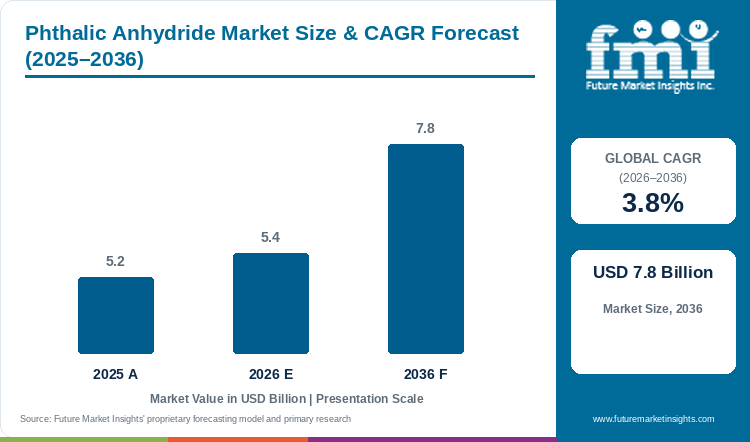
- Market Size (2026)
- USD 5.4 Bn
- Forecast (2036)
- USD 7.8 Bn
- CAGR (2026 to 2036)
- 3.8%
How big is the Phthalic Anhydride Market in 2026?
The Phthalic Anhydride Market is projected to reach USD 7.8 billion by 2036, growing at a 3.8% CAGR from 2026 to 2036. The market is estimated at USD 5.4 billion in 2026. The market was valued at USD 5.2 billion in 2025. North American resin and plasticizer producers give the nearest demand signal. On 28 October 2026, Stepan reported double digit volume growth in the third quarter for its North American Rigid, Spray Foam and Phthalic Anhydride businesses [3]. Nan Ya Plastics estimates its 2025 phthalic anhydride sales at 141,220 tonnes, counting consolidated subsidiaries and inter-company turnover [8].
Price movements in April to June 2026 followed the aromatics chain. Thirumalai Chemicals said in its 7 August 2026 presentation that ortho-xylene, the key feedstock, tracked crude closely. It firmed through April, when the company said the Strait of Hormuz was still shut and Brent was above USD 110 a barrel [1]. It eased from mid-May, after crude fell almost 19% [1]. The company expects about 510 KTA of Chinese ortho-xylene capacity under planned shutdown to keep prices firm near term [1]. It also described Chinese phthalic anhydride overcapacity above 3.0 million tonnes as a structural pressure [1].
Key Market Trends & Insights
- On 28 October 2026, Stepan reported double digit third-quarter volume growth in its North American phthalic anhydride business [3]. Its Polymers segment sold 8% more volume in 2025, but net sales held flat at USD 584.5 million on lower selling prices [4].
- Koppers has stopped phthalic anhydride production in the US. It announced on 11 December 2024 that production at Stickney, Illinois would end in mid-2025 [6]. Its 6 August 2026 results still cite operating cost savings from discontinuing the product [5].
- India's trade regulator has recommended keeping trade defence in place. Thirumalai Chemicals said in August 2026 that the DGTR's May 2026 sunset review recommended extending anti-dumping duties on Chinese and Korean phthalic anhydride imports for five more years [1].
Regional Highlights
- North America: Stepan manufactures phthalic anhydride at its Millsdale site [4]. The United States reported exports of 9,993 tonnes in 2025. Of these, 5,402 tonnes went to Mexico and 3,762 tonnes to Canada [22].
- Europe: Italy reported imports of 47,637 tonnes and exports of 22,139 tonnes of phthalic anhydride in 2025 [22]. Germany reported 27,697 tonnes of imports and 28,263 tonnes of exports [22]. DEZA lists phthalic anhydride as flakes or molten product [13].
- Asian supply into the West: Nan Ya Plastics lists phthalic anhydride among the chemicals made with its Sixth Naphtha Cracking Plant in Mailiao [8]. IG Petrochemicals lists about 275,000 tonnes a year of capacity at Taloja [15]. Thirumalai Chemicals lists 165 KTPA at Ranipet [1].
Phthalic Anhydride Market Size and Forecast
Table 1: Phthalic Anhydride Market Size and Forecast
| Market size and forecast | Value |
|---|---|
| Market size in 2025 | USD 5.2 billion |
| Estimated market size in 2026 | USD 5.4 billion |
| Projected market size by 2036 | USD 7.8 billion |
| CAGR from 2026 to 2036 | 3.8% |
Source: Future Market Insights analysis of the phthalic anhydride market, 2026.
Analyst Perspective
“Phthalic anhydride is a derivative business with two drivers. Feedstock runs on ortho-xylene and crude. Demand runs on plasticizers, polyester resins and alkyds. Buyers who watch only one will misread price. The more useful signals are Chinese operating rates, the fate of regional anti-dumping protection and how quickly customers move from DEHP to other plasticizers. Contracts that name the feedstock index and a back-up plant hold up better than spot buying.”
- Nikhil Kaitwade, Principal Consultant, FMI
How is the Phthalic Anhydride Market segmented?
- By technology: O-Xylene Catalytic Oxidation and Naphthalene Catalytic Oxidation
- By application: Phthalate Plasticizers, Unsaturated Polyester Resins (UPRs), Alkyd Resins and Other Applications
- By end-use: Automotive, Electrical & Electronics, Paints & Coatings and Others
- By region: North America and Europe
Why does O-Xylene Catalytic Oxidation lead by Technology in the Phthalic Anhydride Market in 2026?
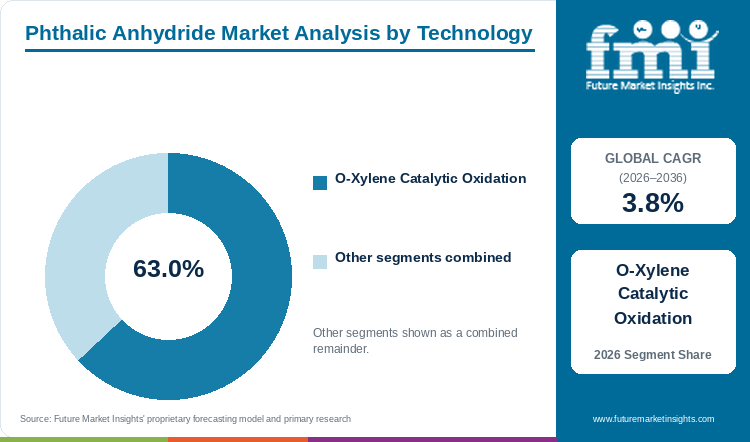
O-Xylene Catalytic Oxidation is estimated to account for 63.0% of the Phthalic Anhydride Market by technology in 2026. Nan Ya Plastics, UPC Technology and Polynt each describe their phthalic anhydride as made by oxidising ortho-xylene [7][9][11]. Polynt adds that its POLYCAT-PA catalyst is used for this step in fixed-bed reactors [11]. Ortho-xylene suppliers list phthalic anhydride as a principal application of the liquid [20]. The route stays tied to aromatics pricing. Thirumalai Chemicals says it follows a diversified ortho-xylene sourcing strategy to protect supply [1]. Naphthalene keeps a minority position. DEZA lists naphthalene among its own product lines, next to tar oils and aromatic solvents. It describes phthalic anhydride as produced by oxidation of naphthalene and o-xylene [13][14].
Table 2: Technology, 2026 Share
| Leading Share | 2026 market share |
|---|---|
| O-Xylene Catalytic Oxidation | 63.0% |
| All Other Segments Combined Share | 37.0% |
Source: Future Market Insights analysis of the phthalic anhydride market, 2026.
Why does Phthalate Plasticizers lead by Application in the Phthalic Anhydride Market in 2026?
Phthalate Plasticizers is estimated to account for 42.0% of the Phthalic Anhydride Market by application in 2026. Nan Ya Plastics states that phthalic anhydride is widely used to make phthalate ester plasticizers for PVC processing [7]. Polynt names DINP, DPHP and DOP/MG among the standard plasticizers made by reacting it with branched alcohols [11]. DEZA concentrates on high-molecular-weight plasticizers, particularly diisononyl phthalate and dipropylheptyl phthalate [13]. Nan Ya's volumes show the scale of this outlet. Its annual report estimates 2025 sales of 141,220 tonnes of phthalic anhydride and 250,487 tonnes of plasticizers and THPA [8]. The same report says use of the phthalate plasticizer DEHP declines year by year. It also says demand for its DOTP and hydrogenated plasticizers is growing faster than demand for phthalate plasticizers [8]. This lead faces substitution.
Table 3: Application, 2026 Share
| Leading Share | 2026 market share |
|---|---|
| Phthalate Plasticizers | 42.0% |
| All Other Segments Combined Share | 58.0% |
Source: Future Market Insights analysis of the phthalic anhydride market, 2026.
Why does Automotive lead by End-use in the Phthalic Anhydride Market in 2026?
Automotive is estimated to account for 42.0% of the Phthalic Anhydride Market by end-use in 2026. Stepan states that phthalic anhydride is used in polyester resins, alkyd resins and plasticizers for construction materials [4]. It also says these feed components for automotive, boating and other consumer products [4]. Nan Ya Plastics sells special plasticizers aimed at electric vehicle peripherals and special cables [8]. This ties the vehicle to the wire and cable chain as well as to moulded parts. Coatings follow behind. UPC lists paint among the uses of its phthalic anhydride [9]. Thirumalai Chemicals calls paint, unsaturated polyester resin and copper phthalocyanine key growth drivers in India [1]. Alkyd and polyester binders for coating resins are where that demand lands. UPC's unsaturated polyester resin grades cover general-purpose FRP, boat and yacht, casting and artificial stone uses [10].
Table 4: End-use, 2026 Share
| Leading Share | 2026 market share |
|---|---|
| Automotive | 42.0% |
| All Other Segments Combined Share | 58.0% |
Source: Future Market Insights analysis of the phthalic anhydride market, 2026.
What are the key drivers, restraints and opportunities?
Driver
Resin and plasticizer pull. Phthalic anhydride volumes follow the plastics and resin chains it feeds. Stepan reported 8% higher Polymers sales volume in 2025 [4]. It also reported double digit North American phthalic anhydride volume growth in the third quarter of 2026 [3]. Thirumalai Chemicals expects paint, unsaturated polyester resin and copper phthalocyanine customers to remain growth drivers [1].
Supply discipline and feedstock. When Chinese ortho-xylene capacity is shut for planned work and crude is volatile, phthalic anhydride sellers hold firmer prices. Thirumalai Chemicals expects the roughly 510 KTA of planned Chinese ortho-xylene shutdowns to support healthy realisations, alongside crude volatility and Middle East freight disruption [1]. Koppers' exit also removed a US producer from the supply base [5][6].
Restraint
Import competition and overcapacity. Thirumalai Chemicals cites Chinese overcapacity above 3.0 million tonnes [1]. It says its export markets in the Middle East, Africa and Europe faced intensified competition and logistics disruption in April to June 2026 [1]. Nan Ya Plastics projects global plasticizer capacity rising by an average of 700,000 tons a year between 2024 and 2028 [8]. Demand growth is 192,000 tons a year, and the company expects intense competition [8].
Regulatory pressure on ortho-phthalates. In December 2025, the US EPA released its final TSCA risk evaluation for DEHP. It found unreasonable risk to workers under 10 conditions of use and to the environment under 20, with none identified for consumers or the general population [16]. For DINP, finalised on 14 January 2025, the finding rests on workers spraying adhesives, sealants, paints or coatings. It covers four conditions of use, which account for roughly three percent of US output [17]. Under a consent decree, EPA's schedule set final evaluations for DCHP, DIBP, DBP, BBP and DEHP for December 2025, after DIDP was finalised on 3 January 2025 [18]. Canada limits six phthalates in toys and child care articles [19].
Opportunity
Higher-molecular-weight and specialty plasticizers. DEZA focuses on DINP and DPHP [13]. Nan Ya Plastics is steering bulk sales toward special plasticizers for electric vehicle peripherals, special cables, toys and medical materials [8]. EPA identified no risk of injury to consumers or the general population from DINP [17].
Derivatives beyond plasticizers. Polynt notes that the low-molecular-weight esters DEP and DMP are used in eyewear, fragrances and flavours, peroxide manufacture and pharmaceuticals [11]. Thirumalai Chemicals lists diethyl phthalate and derivatives among its Ranipet products, with 34 KTPA of derivatives and downstream capacity [1]. Stepan uses phthalic anhydride internally to make polyols. Its Polymers segment recorded USD 584.5 million of net sales in 2025 [4]. UPC sells unsaturated polyester resins and polyester polyols [10].
Phthalic Anhydride Market by Country (2026 to 2036)
Table 5: Phthalic Anhydride Market Country Growth Forecast
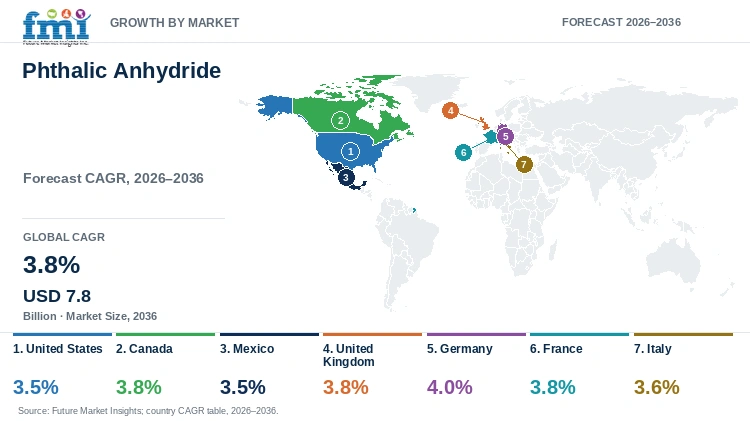
| Country | CAGR, 2026 to 2036 |
|---|---|
| United States | 3.5% |
| Canada | 3.8% |
| Mexico | 3.5% |
| United Kingdom | 3.8% |
| Germany | 4.0% |
| France | 3.8% |
| Italy | 3.6% |
Source: Future Market Insights analysis of the phthalic anhydride market, 2026.
United States
Stepan manufactures phthalic anhydride at its Millsdale site. It uses the product in polyester resins, alkyd resins and plasticizers, and internally in polyols [4]. On 28 October 2026, Stepan said its North American phthalic anhydride business delivered double digit third-quarter volume growth [3]. In the same quarter, Polymer net sales were USD 178.7 million, up 24% on the year, and Polymer sales volume rose 3% [3]. The 10-K adds that Polymers sales volume rose 8% in 2025, but lower average selling prices offset the gain [4].
Koppers is no longer a source. It announced on 11 December 2024 that production at Stickney, Illinois would end in mid-2025, with inventory built to supply contracts through 2025 [6]. Its 6 August 2026 results refer to savings from discontinuing the product [5]. Koppers cited portfolio optimisation and capital spending that could not be economically justified [6]. Coal tar distillation at the site continues [6]. The United States reported imports valued at USD 44.6 million in 2025, and exports of 9,993 tonnes valued at USD 13.1 million [22].
Regulation targets the downstream plasticizers. EPA finalised the DINP evaluation on 14 January 2025 and the DEHP evaluation in December 2025. In both cases, it found worker risk under specified conditions of use, not risk to consumers [16][17]. Plasticizer buyers should expect customers to ask about formulation changes before they ask about price.
Canada
Canada reported imports of 9,791 tonnes of phthalic anhydride in 2025, valued at USD 13.1 million, and exports of only 321 tonnes [22]. United States customs data show 3,762 tonnes shipped to Canada. That is close to two fifths of the reported imports [22].
Canada's Phthalates Regulations, registered on 22 June 2016, limit DEHP, DBP and BBP in the vinyl of toys and child care articles to 1,000 mg/kg each [19]. They also limit DINP, DIDP and DNOP in parts that children under four can put in the mouth [19]. These limits cover finished products for children. They do not cover the industrial use of phthalic anhydride or its resins.
Canadian exports are small, so buyers depend on imports. Canadian buyers should check freight terms and the origin plant on each contract, especially now that Koppers' Stickney supply is gone [5][6].
Mexico
United States customs data show 5,402 tonnes of phthalic anhydride exported to Mexico in 2025, valued at USD 5.8 million [22]. That is more than half of all US exports of the product. Mexico is a major destination for US exports.
Polynt announced in July 2022 a new esterification plant at Atlacomulco for special plasticizers, primarily trimellitates [24]. Start-up was then scheduled for the first quarter of 2024 [24]. Trimellitates are specialty products. The plant therefore signals plasticizer conversion capacity in Mexico more than new phthalic anhydride demand.
Buyers in Mexico depend heavily on cross-border shipments. Contracts should name the supplying plant and a back-up source, especially after Koppers ended production at Stickney [5][6].
United Kingdom
The United Kingdom reported imports of 7,539 tonnes of phthalic anhydride in 2025, valued at USD 10.8 million, against USD 11.0 million in 2024 [22]. It reported exports of 159 tonnes [22]. Imports supply the market almost entirely.
UK suppliers and buyers operate under UK REACH. The Health and Safety Executive describes its restrictions as measures that limit, ban or set conditions on the manufacture, placing on the market or use of substances [23]. Asian producers such as Nan Ya Plastics publish a REACH certificate, ISO certificates and a technical specification for their phthalic anhydride [7].
Because supply is imported, delivered cost depends on freight and on Asian and Indian offer prices. Thirumalai Chemicals reported stronger competition in Europe in the April to June 2026 quarter [1]. UK resin makers can use that competition to negotiate. They should still keep a second origin qualified.
Germany
Germany reported imports of 27,697 tonnes of phthalic anhydride in 2025, valued at USD 28.6 million. Exports were 28,263 tonnes, valued at USD 34.2 million [22]. Flows of that size mean Germany both buys and sells in volume.
The Verband der Chemischen Industrie said in its second-quarter 2026 report of 3 September 2026 that production and turnover were rising. It added that the upturn remained fragile and cost pressure was high [21]. Stepan's 28 October 2026 results release said the third quarter included regulatory-mandated maintenance turnaround costs at its Germany site [3]. Such turnarounds occur every five years [3].
Thirumalai Chemicals states that the India-EU free trade agreement, concluded in January 2026, is expected to open zero-duty chemical access from 2027. Prior duties were up to 26% [1]. If implemented as described, it would ease market access for Indian suppliers selling to German buyers.
France
France reported imports of 10,617 tonnes of phthalic anhydride in 2025, valued at USD 13.8 million. It reported exports of only 31 tonnes [22]. Demand is met overwhelmingly by imports.
French resin and paint makers draw on the same alkyd and polyester chain as other European buyers. Polynt lists unsaturated polyester and alkyd resins, plus plasticizers, as the main uses of phthalic anhydride [11]. UPC lists paint and hardeners among applications [9]. These feed decorative paints and industrial coatings alike.
French buyers can ask suppliers for form and documentation. DEZA offers flakes or molten product [13], IG Petrochemicals states a purity of at least 99.8% [15], and Nan Ya Plastics lists a REACH certificate for its product [7]. UPC adds that its anhydrides and acids are for industrial application only and must not be used as food additives [9].
Italy
Italy reported the largest phthalic anhydride imports of the seven profiled countries. It imported 47,637 tonnes worth USD 60.4 million in 2025. Exports were 22,139 tonnes, worth USD 31.8 million [22]. Both flows are large by regional standards.
Polynt is headquartered at Scanzorosciate in the province of Bergamo [12]. Its phthalic anhydride page names DINP, DPHP and DOP/MG plasticizers as derivatives, along with the lighter esters DEP and DMP [11].
Italian buyers can weigh local supply against Asian and Indian phthalic anhydride offers. Thirumalai Chemicals said Europe was among the export markets where competition intensified in April to June 2026 [1]. That should keep delivered prices competitive. Polynt's POLYCAT-PA catalyst is used to make the product from ortho-xylene in fixed-bed reactors [11]. It gives Polynt a technology link to producers elsewhere, as well as to its own product.
Who are the notable companies in the Phthalic Anhydride Market?
Notable companies in the Phthalic Anhydride Market include Nan Ya Plastics Corporation, UPC Technology Corporation, Thirumalai Chemicals Limited, Polynt S.p.A., Stepan Company, IG Petrochemicals Limited and DEZA.
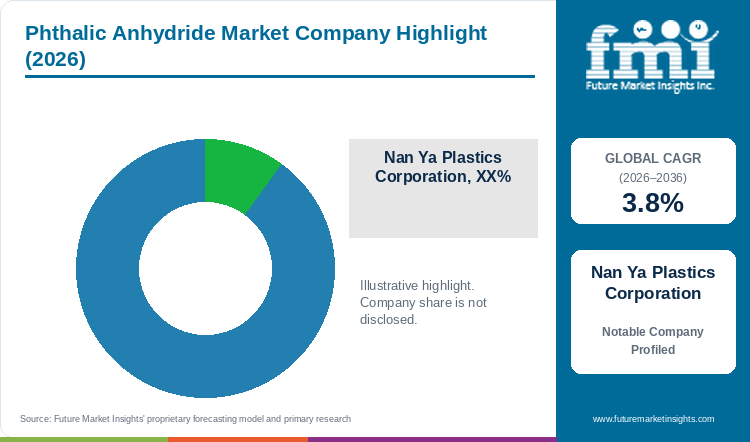
Integration with derivatives and feedstock decides who competes on cost. Nan Ya Plastics, estimated at 11.5% of the market, makes phthalic anhydride in the same chemical lineup as plasticizers and 2-ethylhexanol at its Mailiao complex [8]. Stepan, at an estimated 4.7%, makes it at Millsdale and consumes part of it internally in polyols [4]. UPC Technology, at an estimated 7.8%, sells phthalic anhydride next to plasticizers, unsaturated polyester resins and polyester polyols [10]. Producers that consume their own output are less exposed to merchant pricing.
Independent sellers compete on feedstock access and trade protection. Thirumalai Chemicals, estimated at 6.9%, lists 165 KTPA at Ranipet and describes a diversified ortho-xylene sourcing strategy [1]. In the quarter to 30 June 2026, its standalone revenue from operations was INR 330.7 crore, down from INR 445.5 crore a year earlier [2]. Its group reported a net loss of INR 43.7 crore on consolidated revenue of INR 546.7 crore, up from INR 450.1 crore [2]. The company describes itself as among the top three global manufacturers of phthalic anhydride [1]. Raw material shortages at Dahej, caused by working capital constraints, cut production [1]. IG Petrochemicals lists about 275,000 tonnes a year at Taloja [15]. Thirumalai also makes maleic anhydride [1].
Product form, purity statements and technology support separate the offers. DEZA lists flakes and molten product [13]. IG Petrochemicals states at least 99.8% purity [15]. Polynt offers a catalyst for the ortho-xylene route alongside the product [11]. Polynt is estimated at 5.3% of the market. UPC and Nan Ya publish product pages with uses, and Nan Ya adds REACH and ISO certificates [7][9].
Key Developments in the Phthalic Anhydride Market
- On 28 October 2026, Stepan reported third-quarter 2026 results and said its North American Rigid, Spray Foam and Phthalic Anhydride businesses delivered double digit volume growth [3].
- On 7 August 2026, Thirumalai Chemicals published its quarterly presentation. It stated that the DGTR's May 2026 sunset review recommended extending anti-dumping duties on Chinese and Korean phthalic anhydride for five more years [1]. The presentation also said raw material shortages hit production at Dahej [1].
- On 6 August 2026, Koppers reported second-quarter 2026 results that cite operating cost savings from discontinuing phthalic anhydride production at Stickney, Illinois, a plan announced on 11 December 2024 [5][6].
- In December 2025, the US EPA released its final TSCA risk evaluation for DEHP. It found unreasonable risk to workers under 10 conditions of use and to the environment under 20 [16]. It found none for consumers or the general population [16].
Key Players in the Phthalic Anhydride Market
- Nan Ya Plastics Corporation
- UPC Technology Corporation
- Thirumalai Chemicals Limited
- Polynt S.p.A.
- Stepan Company
- IG Petrochemicals Limited
- DEZA
Phthalic Anhydride Market Report Scope
Table 6: Phthalic Anhydride Market Report Scope
| Coverage field | Report scope |
|---|---|
| Market definition | Phthalic anhydride (CAS 85-44-9), measured by value of sales to downstream uses |
| Technology | O-Xylene Catalytic Oxidation, Naphthalene Catalytic Oxidation |
| Application | Phthalate Plasticizers, Unsaturated Polyester Resins (UPRs), Alkyd Resins, Other Applications |
| End-use | Automotive, Electrical & Electronics, Paints & Coatings, Others |
| Regions and profiled countries | North America and Europe. Profiled countries: United States, Canada, Mexico, United Kingdom, Germany, France and Italy |
| Companies covered | Nan Ya Plastics Corporation, UPC Technology Corporation, Thirumalai Chemicals Limited, Polynt S.p.A., Stepan Company, IG Petrochemicals Limited, DEZA |
| Forecast period | 2026 to 2036, with 2025 as the historical base year |
| Quantitative Units | USD billion |
Source: Future Market Insights analysis of the phthalic anhydride market, 2026.
Phthalic Anhydride Market by Segments
Phthalic Anhydride Market segmented by Technology:
- O-Xylene Catalytic Oxidation
- Naphthalene Catalytic Oxidation
Phthalic Anhydride Market segmented by Application:
- Phthalate Plasticizers
- Unsaturated Polyester Resins (UPRs)
- Alkyd Resins
- Other Applications
Phthalic Anhydride Market segmented by End-use:
- Automotive
- Electrical & Electronics
- Paints & Coatings
- Others
Phthalic Anhydride Market by Region
- North America
- Europe
- United States
- Canada
- Mexico
- United Kingdom
- Germany
- France
- Italy
Research Sources and Bibliography
- [1] Thirumalai Chemicals Limited. (2026, August 7). Corporate Presentation, Q1 FY27. https://thirumalaichemicals.com/wp-content/uploads/2026/08/Corporate-Presentation-August-07-2026.pdf
- [2] Thirumalai Chemicals Limited. (2026, August 4). Statement of Standalone and Consolidated Unaudited Financial Results for the quarter ended 30 June 2026. https://thirumalaichemicals.com/wp-content/uploads/2026/09/Financial-Results_30.06.2026.pdf
- [3] Stepan Company. (2026, October 28). Stepan Reports Third Quarter 2026 Results. https://finviz.com/news/409801/stepan-reports-third-quarter-2026-results
- [4] Stepan Company. (2026, February 26). Annual Report on Form 10-K for the fiscal year ended 31 December 2025. https://www.sec.gov/Archives/edgar/data/94049/000119312526074976/scl-20251231.htm
- [5] Koppers Holdings Inc. (2026, August 6). Koppers Reports Second Quarter 2026 Results (Form 8-K, Exhibit 99.1). https://www.sec.gov/Archives/edgar/data/0001315257/000131525726000046/a2026q28-kearningsrelease.htm
- [6] Pittsburgh Business Times / Penn Biz Report. (2024, December 11). Koppers announces end of phthalic anhydride operations. https://pennbizreport.com/?p=29838
- [7] Nan Ya Plastics Corporation. (n.d.). Phthalic Anhydride (PA). https://www.npc.com.tw/j2npc/enus/prod/Chemicals/Phthalic-Anhydride(PA)/Phthalic%20Anhydride(PA)
- [8] Nan Ya Plastics Corporation. (2025). 2024 Annual Report (security code 1303). https://www.npc.com.tw/npcfile/public/report/year/20250630102301778.pdf
- [9] UPC Technology Corporation. (n.d.). Anhydrides & Acids: Phthalic Anhydride (PA). https://www.upc.com.tw/en/Product/products/Detail/Anhydrides_and_Acids/PA
- [10] UPC Technology Corporation. (n.d.). Products. https://www.upc.com.tw/en/Product/products
- [11] Polynt S.p.A. (n.d.). Specialty Additives & Building Blocks: Phthalic Anhydride. https://www.polynt.com/en/products/specialty-additives-building-blocks/
- [12] Polynt S.p.A. (2025, May 9). From Scanzorosciate to the World, with 70 Years of Innovation. https://www.polynt.com/en/news/from-scanzorosciate-to-the-world-with-70-years-of-innovation/
- [13] DEZA. (n.d.). Esters (Plasticizers). https://www.deza.cz/en/node/78086
- [14] DEZA. (n.d.). Products. https://www.deza.cz/en/
- [15] IG Petrochemicals Limited. (n.d.). Products: Phthalic Anhydride. https://www.igpetro.com/products
- [16] U.S. Environmental Protection Agency. (2025, December). Risk Evaluation for Di-ethylhexyl phthalate (DEHP). https://www.epa.gov/assessing-and-managing-chemicals-under-tsca/risk-evaluation-di-ethylhexyl-phthalate-12-benzene
- [17] U.S. Environmental Protection Agency. (2025, January 14). EPA Finalizes TSCA Risk Evaluation for Diisononyl Phthalate (DINP). https://www.epa.gov/chemicals-under-tsca/epa-finalizes-tsca-risk-evaluation-diisononyl-phthalate-dinp
- [18] U.S. Environmental Protection Agency. (2024, December 10). EPA Announces Schedule for TSCA Risk Evaluations of Phthalates. https://www.epa.gov/chemicals-under-tsca/epa-announces-schedule-tsca-risk-evaluations-phthalates
- [19] Government of Canada. (2016, June 22). Phthalates Regulations, SOR/2016-188. https://laws-lois.justice.gc.ca/eng/regulations/SOR-2016-188/FullText.html
- [20] Mitsubishi Gas Chemical Company, Inc. (n.d.). Ortho-xylene. https://www.mgc.co.jp/eng/products/ac/ortho-xylene.html
- [21] Verband der Chemischen Industrie. (2026, September 3). Quartalsbericht 2/2026: Wirtschaftliche Lage. https://www.vci.de/die-branche/wirtschaftliche-lage/listenseite.jsp
- [22] United Nations Statistics Division. (n.d.). UN Comtrade database, HS 291735 (phthalic anhydride), annual trade for 2024 and 2025 as reported by the United States, Canada, Mexico, the United Kingdom, Germany, France and Italy. https://comtradeplus.un.org/
- [23] Health and Safety Executive. (2025, September 2). REACH restrictions. https://www.hse.gov.uk/reach/restrictions.htm
- [24] Polynt S.p.A. (2022, July). New Special Plasticizers Plant in Atlacomulco. https://www.polynt.com/en/news/new-special-plasticizers-plant-in-atlacomulco/
Table of Content
Table of Content
- Key Takeaways
- Market Size and CAGR
- Top Growth Driver
- Fastest Growing Segment
- Leading Region
- Key Companies
- Emerging Opportunities
- Executive Summary
- Global Market Outlook
- Demand-side Trends
- Supply-side Trends
- Technology Roadmap Analysis
- Analysis and Recommendations
- Analyst Perspective (What is happening? Why now? What should investors know?)
- Key Questions Answered
- How large is the market?
- What is the CAGR?
- What are key trends?
- Which region dominates?
- Who are the leaders?
Read More...
- Market Overview
- Market Coverage / Taxonomy
- Market Definition / Scope / Limitations
- Research Methodology
- Chapter Orientation
- Analytical Lens and Working Hypotheses
- Market Structure, Signals, and Trend Drivers
- Benchmarking and Cross-market Comparability
- Market Sizing, Forecasting, and Opportunity Mapping
- Research Design and Evidence Framework
- Desk Research Programme (Secondary Evidence)
- Expert Input and Fieldwork (Primary Evidence)
- Tooling, Models, and Reference Databases
- Data Engineering and Model Build
- Quality Assurance and Audit Trail
- Market Background
- Market Dynamics (Drivers, Restraints, Opportunity, Trends)
- Scenario Forecast (Optimistic, Likely, Conservative)
- Impact Analysis
- AI Impact
- Sustainability Impact
- Regulatory Impact
- Technology Impact
- Consumer / Buyer Analysis
- Purchase Drivers
- Adoption Barriers
- Buyer Journey
- Opportunity Map Analysis
- Product Life Cycle Analysis
- Supply Chain Analysis
- Investment Feasibility Matrix
- Value Chain Analysis
- PESTLE and Porter's Analysis
- Regulatory Landscape
- Regional Parent Market Outlook
- Production and Consumption Statistics
- Import and Export Statistics
- Global Market Analysis and Forecast, 2021 to 2036
- Historical Market Size Value (USD Billion) Analysis, 2021 to 2025
- Current and Future Market Size Value (USD Billion) Projections, 2026 to 2036
- Y-o-Y Growth Trend Analysis
- Absolute $ Opportunity Analysis
- Global Market Pricing Analysis, 2021 to 2036
- Global Market Analysis and Forecast, By Technology, 2021 to 2036
- Introduction / Key Findings
- Historical Market Size Value (USD Billion) Analysis By Technology, 2021 to 2025
- Current and Future Market Size Value (USD Billion) Analysis and Forecast By Technology, 2026 to 2036
- O-Xylene Catalytic Oxidation
- Naphthalene Catalytic Oxidation
- Y-o-Y Growth Trend Analysis By Technology, 2021 to 2025
- Absolute $ Opportunity Analysis By Technology, 2026 to 2036
- Global Market Analysis and Forecast, By Application, 2021 to 2036
- Introduction / Key Findings
- Historical Market Size Value (USD Billion) Analysis By Application, 2021 to 2025
- Current and Future Market Size Value (USD Billion) Analysis and Forecast By Application, 2026 to 2036
- Phthalate Plasticizers
- Unsaturated Polyester Resins (UPRs)
- Alkyd Resins
- Other Applications
- Y-o-Y Growth Trend Analysis By Application, 2021 to 2025
- Absolute $ Opportunity Analysis By Application, 2026 to 2036
- Global Market Analysis and Forecast, By End-use, 2021 to 2036
- Introduction / Key Findings
- Historical Market Size Value (USD Billion) Analysis By End-use, 2021 to 2025
- Current and Future Market Size Value (USD Billion) Analysis and Forecast By End-use, 2026 to 2036
- Automotive
- Electrical & Electronics
- Paints & Coatings
- Others
- Y-o-Y Growth Trend Analysis By End-use, 2021 to 2025
- Absolute $ Opportunity Analysis By End-use, 2026 to 2036
- Global Market Analysis and Forecast, By Region, 2021 to 2036
- Introduction
- Historical Market Size Value (USD Billion) Analysis By Region, 2021 to 2025
- Current Market Size Value (USD Billion) Analysis and Forecast By Region, 2026 to 2036
- North America
- Europe
- Market Attractiveness Analysis By Region
- North America Market Analysis and Forecast, By Country, 2021 to 2036
- Historical Market Size Value (USD Billion) Trend Analysis By Market Taxonomy, 2021 to 2025
- Market Size Value (USD Billion) Forecast By Market Taxonomy, 2026 to 2036
- By Country
- By Technology
- By Application
- By End-use
- Market Attractiveness Analysis
- By Country
- By Technology
- By Application
- By End-use
- Key Takeaways
- Europe Market Analysis and Forecast, By Country
- Historical Market Size Value (USD Billion) Trend Analysis By Market Taxonomy, 2021 to 2025
- Market Size Value (USD Billion) Forecast By Market Taxonomy, 2026 to 2036
- By Country
- United States
- Canada
- Mexico
- United Kingdom
- Germany
- France
- Italy
- By Technology
- By Application
- By End-use
- By Country
- Market Attractiveness Analysis
- By Country
- By Technology
- By Application
- By End-use
- Key Takeaways
- Key Countries Market Analysis
- United States
- Pricing Analysis
- Market Share Analysis, 2025
- By Technology
- By Application
- By End-use
- Canada
- Pricing Analysis
- Market Share Analysis, 2025
- By Technology
- By Application
- By End-use
- Mexico
- Pricing Analysis
- Market Share Analysis, 2025
- By Technology
- By Application
- By End-use
- Germany
- Pricing Analysis
- Market Share Analysis, 2025
- By Technology
- By Application
- By End-use
- United Kingdom
- Pricing Analysis
- Market Share Analysis, 2025
- By Technology
- By Application
- By End-use
- Italy
- Pricing Analysis
- Market Share Analysis, 2025
- By Technology
- By Application
- By End-use
- France
- Pricing Analysis
- Market Share Analysis, 2025
- By Technology
- By Application
- By End-use
- United States
- Market Structure Analysis
- Competition Dashboard
- Competition Benchmarking
- Market Share Analysis of Top Players
- By Regional
- By Technology
- By Application
- By End-use
- Emerging Startups
- Innovation Benchmarking
- Competition Analysis
- Competition Deep Dive
- Nan Ya Plastics Corporation
- Overview
- Product Portfolio
- Profitability by Market Segments
- Sales Footprint
- Strategy Overview
- Marketing Strategy
- Product Strategy
- Channel Strategy
- UPC Technology Corporation
- Thirumalai Chemicals Limited
- Polynt S.p.A.
- Stepan Company
- IG Petrochemicals Limited
- DEZA
- Nan Ya Plastics Corporation
- Case Studies
- Success Stories
- Recent Developments
- Competition Deep Dive
- Assumptions & Acronyms Used
List of Tables
- Table 1: Global Market Value (USD Billion) Forecast by Region, 2021 to 2036
- Table 2: Global Market Value (USD Billion) Forecast by Technology, 2021 to 2036
- Table 3: Global Market Value (USD Billion) Forecast by Application, 2021 to 2036
- Table 4: Global Market Value (USD Billion) Forecast by End-use, 2021 to 2036
- Table 5: North America Market Value (USD Billion) Forecast by Country, 2021 to 2036
- Table 6: North America Market Value (USD Billion) Forecast by Technology, 2021 to 2036
- Table 7: North America Market Value (USD Billion) Forecast by Application, 2021 to 2036
- Table 8: North America Market Value (USD Billion) Forecast by End-use, 2021 to 2036
- Table 9: Europe Market Value (USD Billion) Forecast by Country, 2021 to 2036
- Table 10: Europe Market Value (USD Billion) Forecast by Technology, 2021 to 2036
- Table 11: Europe Market Value (USD Billion) Forecast by Application, 2021 to 2036
- Table 12: Europe Market Value (USD Billion) Forecast by End-use, 2021 to 2036
List of Figures
- Figure 1: Global Market Pricing Analysis
- Figure 2: Global Market Value (USD Billion) Forecast 2021-2036
- Figure 3: Global Market Value Share and BPS Analysis by Technology, 2026 and 2036
- Figure 4: Global Market Y-o-Y Growth Comparison by Technology, 2026-2036
- Figure 5: Global Market Attractiveness Analysis by Technology
- Figure 6: Global Market Value Share and BPS Analysis by Application, 2026 and 2036
- Figure 7: Global Market Y-o-Y Growth Comparison by Application, 2026-2036
- Figure 8: Global Market Attractiveness Analysis by Application
- Figure 9: Global Market Value Share and BPS Analysis by End-use, 2026 and 2036
- Figure 10: Global Market Y-o-Y Growth Comparison by End-use, 2026-2036
- Figure 11: Global Market Attractiveness Analysis by End-use
- Figure 12: Global Market Value (USD Billion) Share and BPS Analysis by Region, 2026 and 2036
- Figure 13: Global Market Y-o-Y Growth Comparison by Region, 2026-2036
- Figure 14: Global Market Attractiveness Analysis by Region
- Figure 15: North America Market Incremental Dollar Opportunity, 2026-2036
- Figure 16: Europe Market Incremental Dollar Opportunity, 2026-2036
- Figure 17: North America Market Value Share and BPS Analysis by Country, 2026 and 2036
- Figure 18: North America Market Value Share and BPS Analysis by Technology, 2026 and 2036
- Figure 19: North America Market Y-o-Y Growth Comparison by Technology, 2026-2036
- Figure 20: North America Market Attractiveness Analysis by Technology
- Figure 21: North America Market Value Share and BPS Analysis by Application, 2026 and 2036
- Figure 22: North America Market Y-o-Y Growth Comparison by Application, 2026-2036
- Figure 23: North America Market Attractiveness Analysis by Application
- Figure 24: North America Market Value Share and BPS Analysis by End-use, 2026 and 2036
- Figure 25: North America Market Y-o-Y Growth Comparison by End-use, 2026-2036
- Figure 26: North America Market Attractiveness Analysis by End-use
- Figure 27: Europe Market Value Share and BPS Analysis by Country, 2026 and 2036
- Figure 28: Europe Market Value Share and BPS Analysis by Technology, 2026 and 2036
- Figure 29: Europe Market Y-o-Y Growth Comparison by Technology, 2026-2036
- Figure 30: Europe Market Attractiveness Analysis by Technology
- Figure 31: Europe Market Value Share and BPS Analysis by Application, 2026 and 2036
- Figure 32: Europe Market Y-o-Y Growth Comparison by Application, 2026-2036
- Figure 33: Europe Market Attractiveness Analysis by Application
- Figure 34: Europe Market Value Share and BPS Analysis by End-use, 2026 and 2036
- Figure 35: Europe Market Y-o-Y Growth Comparison by End-use, 2026-2036
- Figure 36: Europe Market Attractiveness Analysis by End-use
- Figure 37: Global Market - Tier Structure Analysis
- Figure 38: Global Market - Company Share Analysis
Frequently Asked Questions
How big is the phthalic anhydride market in 2026?
The Phthalic Anhydride Market is estimated at USD 5.4 billion in 2026, up from USD 5.2 billion in 2025. It is projected to reach USD 7.8 billion by 2036, a 3.8% CAGR from 2026 to 2036. Stepan reported double digit North American phthalic anhydride volume growth in the third quarter of 2026, which supports near-term demand [3].
Which segments lead the phthalic anhydride market?
O-Xylene Catalytic Oxidation leads by technology with 63.0% in 2026, Phthalate Plasticizers lead by application with 42.0%, and Automotive leads by end-use with 42.0%. Nan Ya Plastics, UPC Technology and Polynt describe their product as made by ortho-xylene oxidation [7][9][11], and Nan Ya notes that phthalic anhydride is widely used to make PVC plasticizers [7].
Which other segments matter?
Naphthalene Catalytic Oxidation holds 37.0% of technology. Unsaturated Polyester Resins hold 25.0% of applications, Alkyd Resins 18.0% and Other Applications 15.0%. Electrical & Electronics holds 25.0% of end-use, Paints & Coatings 18.0% and Others 15.0%. Stepan lists polyester resins, alkyd resins and plasticizers as uses [4]. UPC's unsaturated polyester resin grades range from general-purpose FRP to boat and yacht and artificial stone [10].
Which profiled country is forecast to grow fastest?
Germany has the highest forecast CAGR of the seven profiled countries at 4.0% from 2026 to 2036, ahead of Canada, the United Kingdom and France at 3.8% each. Germany reported 27,697 tonnes of imports and 28,263 tonnes of exports of phthalic anhydride in 2025, while Italy reported the largest imports of the seven at 47,637 tonnes [22].
Which regulations affect phthalic anhydride demand?
Rules act mainly on the plasticizers made from it. In December 2025 the US EPA released its final TSCA risk evaluation for DEHP, with unreasonable risk to workers and the environment under specified conditions of use [16]. Canada's Phthalates Regulations of 22 June 2016 limit six phthalates in toys and child care articles to 1,000 mg/kg [19]. India's DGTR recommended extending anti-dumping duties on Chinese and Korean imports in May 2026, according to Thirumalai Chemicals [1].
What should a buyer check when choosing a phthalic anhydride supplier?
Check form, purity and documentation first. DEZA lists flakes and molten product [13]. IG Petrochemicals states a purity of at least 99.8% [15]. Nan Ya Plastics lists a REACH certificate and a technical specification [7]. Then confirm the supply plant and its back-up, because Koppers has discontinued production at Stickney [5][6].
Preview the report firsthand - request a free sample
Get SampleGet the brochure for pricing and purchase details.
Get PDF
