

- Industry Size (2026)
- USD 2.6 Bn
- Forecast (2036)
- USD 7.3 Bn
- CAGR (2026 to 2036)
- 10.9%
Postbiotic Skincare Market Forecast and Outlook 2026 to 2036
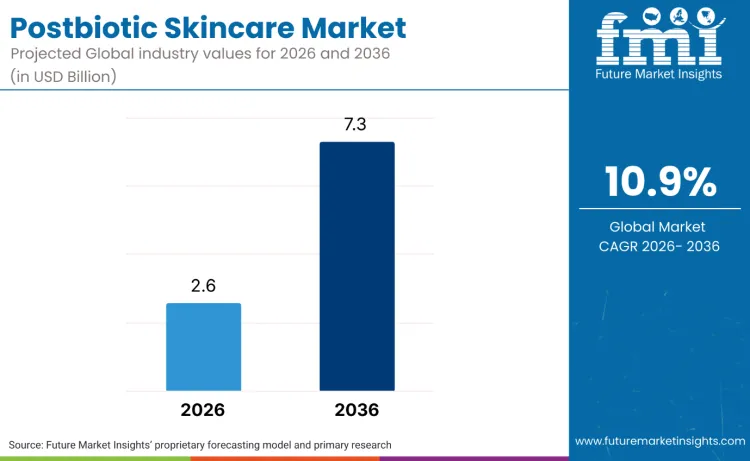
The global postbiotic skincare market is forecasted to reach USD 2.6 billion in 2026 and expand to USD 7.3 billion by 2036, advancing at a CAGR of 10.9%. As per FMI, this outlook reflects the growing consumer acceptance of microbiome-supporting skincare technologies, where traditional formulations are incorporating bacterial metabolites and cell-free extracts to enhance skin barrier function. Expansion is driven by increasing clinical research validating postbiotic efficacy, with beauty brands and dermatological companies embracing specialized fermentation-derived ingredients across product categories globally.
By leveraging advanced fermentation technologies and microbiome research, formulators can now develop targeted postbiotic complexes that deliver specific metabolites for various skin conditions. This precision approach allows for the creation of products addressing acne-prone skin, sensitive skin conditions, and aging concerns through scientifically-backed metabolite profiles. Companies are investing substantially in microbiome research to enhance product development.
"At L'Oréal, we've always believed that beauty is deeply connected to scientific discovery, a belief that has been central to our company since its inception over 115 years ago. Today, we tirelessly combine the latest scientific and technological breakthroughs with our creativity to craft innovative beauty experiences that are more effective and tailored to individual needs. This year, our pioneering advancements in light technologies at CES 2026 once again demonstrate our commitment to pushing the boundaries of new beauty solutions," said Barbara Lavernos, Deputy CEO in charge of Research, Innovation and Technology at L'Oréal Groupe.
The industry's value proposition is evolving from general skincare benefits toward targeted microbiome support and barrier enhancement. Advanced manufacturers are integrating comprehensive efficacy testing, streamlined production processes, and flexible formulation platforms to address diverse skin concerns while improving product stability. Research-driven brands and specialized biotechnology companies are gaining preference, enabling direct partnerships with dermatologists and customized product development across consumer and professional channels.
Summary of Postbiotic Skincare Market
What is the growth outlook on the postbiotic skincare market?
Future Market Insights projects the market to grow at a 10.9% CAGR from 2026 to 2036, expanding from USD 2.6 billion to USD 7.3 billion.
FMI research approach: Bottom-up product revenue modeling, microbiome technology assessment, consumer adoption analysis, and clinical efficacy validation tracking.
How do FMI analysts perceive the postbiotic skincare market to evolve?
The market is expected to transition from basic postbiotic formulations toward precision microbiome solutions integrating targeted metabolite delivery, personalized skin diagnostics, and barrier optimization technologies.
FMI research approach: Fermentation technology advancement analysis, microbiome research integration mapping, personalized skincare demand assessment, and clinical validation benchmarking.
Which region holds the largest share in the postbiotic skincare market?
North America accounts for the largest global value share.
FMI research approach: Regional consumer behavior modeling, microbiome awareness assessment, premium product adoption scoring, and distribution channel analysis.
How large will the postbiotic skincare market be by 2036?
The global market is forecast to reach USD 7.3 billion by 2036.
FMI research approach: Long-term forecasting by product category and application focus, microbiome technology scaling, clinical research validation, and historical adoption pattern analysis.
What is the market definition of postbiotic skincare?
It covers skincare products containing bacterial metabolites, cell-free supernatants, and fermentation-derived compounds designed to support skin microbiome balance and barrier function.
FMI research approach: Market taxonomy validation, inclusion-exclusion criteria development, application mapping by skin condition, and ingredient classification framework.
What globally unique trends are shaping the postbiotic skincare market?
Key trends include precision fermentation adoption, personalized microbiome analysis integration, and increasing clinical validation of postbiotic efficacy claims.
FMI research approach: Fermentation technology uptake tracking, personalization trend analysis, regulatory pathway monitoring, and clinical research assessment.
Postbiotic Skincare Market Key Takeaways
| Metric | Value |
|---|---|
| Market Value (2026) | USD 2.6 billion |
| Market Forecast Value (2036) | USD 7.3 billion |
| Forecast CAGR (2026-2036) | 10.9% |
Source: Future Market Insights (FMI) analysis, based on proprietary forecasting model and primary research
What is Driving the Demand for Postbiotic Skincare?
Demand for postbiotic skincare products is being driven by the convergence of microbiome science advancement and consumer preference for evidence-based skincare solutions that support natural skin barrier function. The growing understanding of skin microbiome's role in conditions such as acne, eczema, and sensitive skin has accelerated demand for products containing beneficial bacterial metabolites, cell-free supernatants, and fermentation-derived compounds that can help restore microbiome balance without introducing live bacteria.
The regulatory acceptance of postbiotic ingredients in cosmetic formulations, combined with increasing clinical validation of their efficacy, is driving widespread adoption across facial care, body care, and specialized dermatological product categories. Consumer awareness of ingredient transparency and skin health science is encouraging brands to incorporate postbiotic technologies, particularly as research demonstrates their role in reducing inflammation, strengthening skin barriers, and improving overall skin resilience through metabolite delivery rather than live microorganism introduction.
How is the Postbiotic Skincare Market Segmented?
The postbiotic skincare market has been segmented based on product type, application focus, distribution channel, and region. In terms of product type, the market is divided into facial skincare (serums, moisturizers), cleansers and barrier-repair products, body care formulations, scalp care treatments, and dermatological skincare lines. By application focus, the market is segmented into barrier repair and sensitivity reduction, acne and microbiome balancing, atopic dermatitis care, anti-aging applications, and post-procedure skin recovery. By distribution channel, the market encompasses mass retail and e-commerce platforms, specialty beauty stores, dermatology clinics, pharmacies, and direct-to-consumer channels. Regionally, the market is divided into North America, Europe, East Asia, South Asia, Latin America, and Middle East and Africa.
Why Do Facial Skincare Products Dominate the Postbiotic Skincare Market?
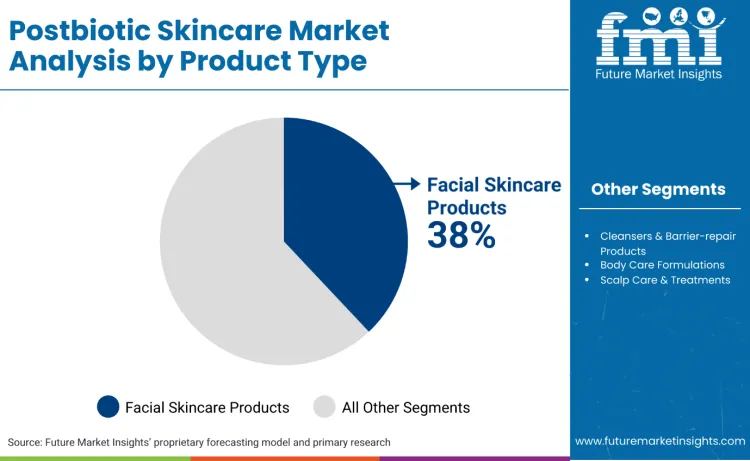
Facial skincare products continue to lead the market, accounting for 38.0% of the share, driven by consumer focus on facial skin health and the concentrated application of advanced skincare technologies. This product category benefits from higher consumer spending on face-focused beauty routines and willingness to invest in premium formulations targeting specific facial skin concerns. Cleansers and barrier-repair products capture 18.0% of the market, addressing the fundamental need for gentle cleansing while supporting skin microbiome balance. Body care formulations hold 16.0% of the market, expanding as consumers extend microbiome-conscious skincare beyond facial applications.
These products are popular because they address the most visible and consumer-prioritized skin concerns while delivering scientifically-validated benefits. Companies are investing significantly in facial postbiotic formulations with targeted delivery systems. Specialized manufacturers integrate advanced fermentation technologies, targeted metabolite profiles, and clinical testing to create products that address specific facial skin conditions while supporting natural microbiome function, making them essential for consumers seeking evidence-based skincare solutions.
How Do Application Requirements Influence Postbiotic Skincare Product Selection?
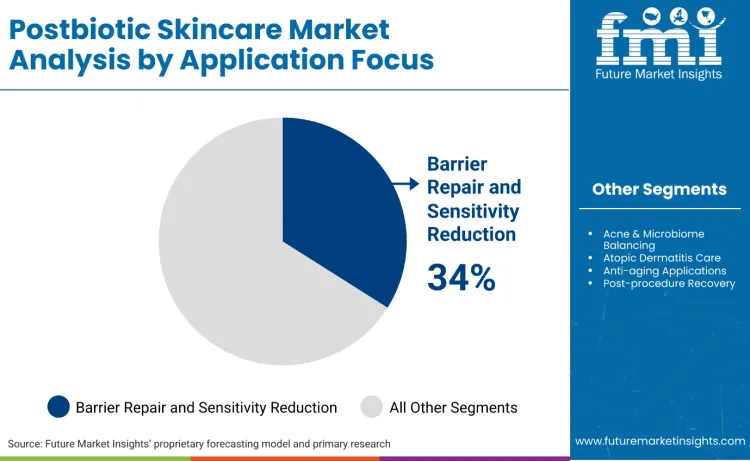
Barrier repair and sensitivity reduction stands as the dominant application segment, commanding 34.0% of the market share. Postbiotic skincare remains centered on barrier function due to the fundamental role skin barrier plays in overall skin health and the validated ability of postbiotic metabolites to strengthen this protective function. Sensitive skin conditions often involve compromised barrier function and microbiome imbalance, making postbiotic formulations particularly effective for reducing inflammation, improving tolerance, and restoring natural protective mechanisms without introducing potentially irritating live microorganisms.
The market is also shaped by the development of targeted formulations for specific skin conditions like acne, eczema, and aging-related concerns, which require precise metabolite selection and delivery systems. Clinical studies help researchers optimize metabolite concentrations and combination profiles to prevent adverse reactions while maximizing therapeutic benefits. By using advanced fermentation technologies and targeted delivery systems, developers can predict skin response patterns and identify optimal formulation strategies long before market introduction, making these applications critical investments for modern skincare innovation.
How Is Technological Evolution Reshaping Postbiotic Skincare?
The postbiotic skincare sector is shifting from traditional probiotic approaches to precision fermentation platforms that combine controlled bacterial cultivation, metabolite extraction, and targeted delivery systems. Strategic collaborations between biotechnology firms and cosmetic manufacturers are accelerating this transition. This evolution brings postbiotic skincare closer to pharmaceutical standards by enabling more predictable efficacy profiles and enhanced product stability through metabolite standardization rather than live organism management. Improved fermentation control reduces batch-to-batch variability and supports consistent product performance across different storage conditions.
What Role Does Regulatory Clarity Play in Product Innovation?
Greater regulatory acceptance of postbiotic ingredients in cosmetic formulations is stabilizing market conditions for skincare manufacturers and enabling more confident product development. In March 2025, The Estée Lauder Companies received regulatory approval for their proprietary postbiotic complex in multiple international markets, supporting global product launches across their portfolio brands.
Clearer regulatory guidelines are enabling specialized laboratories to deploy advanced fermentation technologies such as precision metabolite extraction, microbiome-targeted formulations, and next-generation delivery systems for enhanced skin penetration. Manufacturers are increasingly adopting platform-based development approaches that can be validated once and applied across multiple product lines, supporting faster time-to-market and continued innovation in postbiotic skincare technologies.
How Is the Postbiotic Skincare Market Evolving Globally?
Global demand for postbiotic skincare products is increasing as consumers worldwide embrace microbiome-conscious beauty routines while addressing specific skin health concerns through scientifically-backed formulations. Growth demonstrates rising adoption of advanced fermentation-derived ingredients, targeted application categories, and efficacy-focused product positioning across beauty retailers, dermatology practices, and specialized skincare outlets. Product selection focuses on clinical validation, ingredient transparency, and targeted benefits under various skin condition applications. China records 15.2% CAGR, South Korea records 14.8% CAGR, Japan records 13.1% CAGR, USA records 11.5% CAGR, and Germany records 8.7% CAGR. Adoption remains driven by scientific validation requirements and targeted efficacy rather than general beauty trends alone.
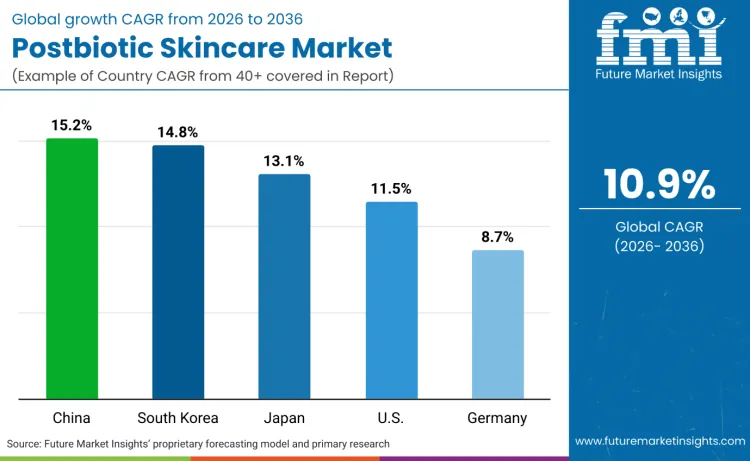
| Country | CAGR (2026-2036) |
|---|---|
| China | 15.2% |
| South Korea | 14.8% |
| Japan | 13.1% |
| USA | 11.5% |
| Germany | 8.7% |
Source: FMI historical analysis and forecast data
China: How is the Growing Microbiome Awareness Driving Premium Skincare Adoption?
The primary driver in China is the significant growth of microbiome science awareness and premium skincare adoption among urban consumers. With expanding beauty consciousness and increasing disposable income, Chinese metropolitan areas are experiencing substantial growth in advanced skincare product adoption, making traditional beauty approaches insufficient for educated consumers. This has promoted premium postbiotic skincare adoption to ensure scientifically-backed results and microbiome support. Driven by this consumer education scale and premium beauty market expansion, the Chinese postbiotic skincare market is set to grow at a 15.2% CAGR during the study period, led by demand in tier-1 cities and expanding to tier-2 markets.
Over the next five years, the most significant opportunity lies in the integration of traditional Chinese medicine principles with modern postbiotic technology. As China develops domestic biotechnology capabilities for cosmetic applications, there is growing demand for products that combine fermentation-derived metabolites with traditional herbal extracts. Companies are establishing local production capabilities to serve the expanding market.
South Korea: Is the K-Beauty Innovation Movement Elevating Postbiotic Integration?
In South Korea, the market is dominated by the integration of postbiotic technology into the established K-beauty innovation ecosystem. This science-driven approach is essential for Korean brands maintaining global leadership in skincare innovation while addressing domestic consumer demand for cutting-edge beauty technologies. Reflecting this innovation focus, the South Korean postbiotic skincare market is projected to grow at a 14.8% CAGR during the study period.
Over the next five years, the convergence of K-beauty expertise with postbiotic science will create opportunities for multi-step skincare routines incorporating different postbiotic metabolites for layered skin benefits. Second, South Korea's role as a global beauty trendsetter creates demand for postbiotic products that can be exported worldwide while meeting strict Korean quality standards. There is growing demand for customizable postbiotic formulations that address individual skin concerns through personalized microbiome analysis, supporting the Korean beauty industry's focus on personalization and technological advancement.
Japan: Will Quality-Focused Consumer Culture Accelerate Premium Postbiotic Adoption?
Japan's postbiotic skincare market is shaped by the culture's emphasis on quality, scientific validation, and long-term skin health benefits. Japanese consumers are increasingly adopting postbiotic formulations that demonstrate clinical efficacy while maintaining gentle, skin-compatible profiles aligned with traditional Japanese skincare philosophy. Consequently, the Japanese postbiotic skincare market is expected to grow at a 13.1% CAGR during the study period, as quality-conscious consumers invest in scientifically-validated products with proven microbiome benefits.
Over the next five years, the market will focus on premium postbiotic products that combine traditional Japanese skincare ingredients with modern microbiome science. As Japanese consumers prioritize preventive skincare and long-term skin health, there is immediate opportunity for postbiotic formulations that support skin aging prevention and barrier maintenance. The integration of postbiotic technology with traditional Japanese fermentation expertise will likely create unique product categories that appeal to both domestic and international markets seeking authentic Japanese skincare innovation.
Germany: Is the Science-Based Beauty Trend Driving Postbiotic Acceptance?
In Germany, the market is being driven by consumer demand for scientifically-validated skincare products and transparent ingredient communication. German consumers are increasingly adopting postbiotic skincare that provides clear efficacy data and aligns with the country's preference for evidence-based beauty products. As German consumers prioritize ingredient safety and clinical validation, the German postbiotic skincare market is set to grow at an 8.7% CAGR during the study period, focusing on products with comprehensive safety profiles and proven benefits.
Over the next five years, the most significant opportunities reside in the integration of postbiotic technology with skin bioactive trends. As German consumers seek products that are both scientifically advanced and environmentally conscious, there is opportunity for postbiotic formulations that meet strict natural cosmetics standards while delivering clinical benefits. The focus on dermatological validation is creating demand for postbiotic products developed in collaboration with dermatology professionals, offering a premium market segment for clinically-tested formulations.
USA: How is the Clean Beauty Movement Embracing Microbiome Science?
The USA market is increasingly focused on the integration of microbiome science with clean beauty principles and personalized skincare approaches. This transition reflects consumer demand for products that are both scientifically advanced and aligned with clean beauty values, reducing dependence on synthetic alternatives while improving efficacy through biological mechanisms. Supported by these consumer preferences, the USA postbiotic skincare market is set to grow at an 11.5% CAGR during the study period.
Over the next five years, the most significant opportunity lies in the development of personalized postbiotic skincare based on individual microbiome analysis and skin condition assessment. As USA consumers embrace customized beauty solutions, there is growing demand for postbiotic products tailored to specific skin types, concerns, and microbiome profiles. The integration of digital health technologies with postbiotic skincare will enable brands to offer precision beauty solutions that adjust formulations based on ongoing skin health monitoring, establishing new standards for personalized skincare effectiveness.
Who are the Major Players Active in the Postbiotic Skincare Market?
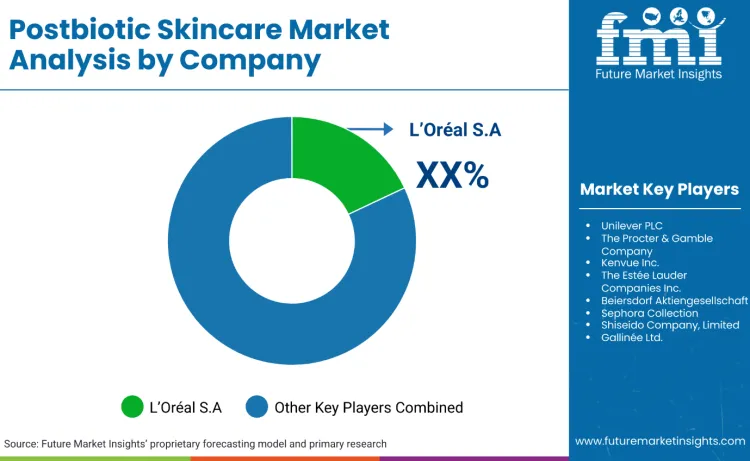
As skincare formulations become increasingly sophisticated with microbiome-targeted ingredients and precision fermentation technologies, major players like Unilever, L'Oréal, and Procter & Gamble are competing on their ability to integrate postbiotic science into mainstream beauty brands while maintaining product accessibility and consumer appeal. These industry leaders are investing heavily in microbiome research and fermentation capabilities, allowing smaller beauty brands to partner for ingredient development while focusing on brand positioning and consumer education. Success in this landscape is measured not only by product efficacy but by the ability to communicate complex microbiome science in consumer-friendly language while building trust through clinical validation and transparent ingredient sourcing.
The market is witnessing distinct regional variations in competitive strategy. While North American companies like Johnson & Johnson and Estée Lauder maintain leadership through clinical research investment and dermatologist partnerships, European players led by LVMH and Beiersdorf are integrating postbiotic technologies with traditional skincare heritage and natural ingredient expertise. This has created an innovation ecosystem where established beauty companies are acquiring biotechnology firms specializing in fermentation and microbiome research to develop proprietary postbiotic ingredients and maintain competitive differentiation.
Key Industry Developments:
- In January 2025, HUL announced to acquire Minimalist to boost its customer base.
- In September 2024, L’Oréal S.A. inked a deal with Evonik and Abolis to boost development of bio-based ingredients.
Key Players in the Postbiotic Skincare Market
- L’Oréal S.A.
- Unilever PLC
- The Procter & Gamble Company
- Kenvue Inc.
- The Estée Lauder Companies Inc.
- Beiersdorf Aktiengesellschaft
- Sephora Collection
- Shiseido Company, Limited
- Gallinée Ltd.
- Evelo Biosciences, Inc.
Market Definition
The postbiotic skincare market refers to the global consumer products segment comprising skincare formulations that contain bacterial metabolites, cell-free supernatants, lysates, and fermentation-derived compounds designed to support skin microbiome balance and barrier function enhancement. It includes both mass-market and premium product offerings, with segments that cater to various skin concerns such as sensitivity, acne, aging, and barrier repair applications. The market size is measured in USD billion and analyzed over the 2026 to 2036 period.
The postbiotic skincare market includes product categories such as facial serums and moisturizers, cleansers, body care formulations, and specialized treatments, distributed through retail beauty channels, e-commerce platforms, dermatology practices, and direct-to-consumer channels. The market is expanding due to growing consumer awareness of microbiome science, increasing clinical validation of postbiotic efficacy, and demand for evidence-based skincare solutions that support natural skin health mechanisms.
Market Inclusion
Included in the postbiotic skincare market scope are beauty and personal care products categorized by type (facial care, body care, cleansers, treatments), with segmentation based on application focus (barrier repair, acne management, anti-aging, sensitivity reduction), distribution channels (retail, e-commerce, professional, direct-to-consumer), and target demographics (age groups, skin types, skin concerns). The scope includes postbiotic skincare products with focus on microbiome support, clinical efficacy, and ingredient transparency, particularly those marketed through beauty retailers, dermatology practices, and specialized skincare brands.
Geographically, the market encompasses key regions such as North America, Europe, East Asia, South Asia, Latin America, and the Middle East and Africa, with country-level analysis for significant markets like USA, China, South Korea, Japan, and Germany.
Market Exclusion
Excluded from the postbiotic skincare market scope are probiotic skincare products containing live microorganisms, prebiotic skincare focused solely on microbiome feeding rather than metabolite delivery, and traditional skincare products without microbiome-specific ingredients. Additionally, products not intended for topical skincare applications, such as dietary supplements or oral microbiome products, are not included.
The market excludes non-cosmetic applications of postbiotic technology, as well as products not marketed specifically for skincare benefits, such as general wellness products or pharmaceutical treatments. Products with non-compliant safety profiles or those that do not meet regional cosmetic regulatory standards are outside the market's defined scope.
Scope of the Report
| Items | Values |
|---|---|
| Quantitative Units | USD billion |
| Product Type | Facial Skincare (serums, moisturizers); Cleansers & Barrier-repair; Body Care Products; Scalp Care & Treatments; Dermatological Skincare Lines |
| Application Focus | Barrier Repair & Sensitivity; Acne & Microbiome Balancing; Atopic Dermatitis Care; Anti-aging Applications; Post-procedure Recovery |
| Distribution Channel | Mass Retail & E-commerce; Specialty Beauty Stores; Dermatology Clinics; Pharmacies & Drugstores; Direct-to-Consumer |
| Regions Covered | North America, Europe, East Asia, South Asia, Latin America, Middle East & Africa |
| Countries Covered | USA, China, South Korea, Japan, Germany, and 40+ countries |
| Key Companies Profiled | L'Oréal Group; Unilever; Procter & Gamble; Johnson & Johnson; The Estée Lauder Companies; Others |
| Additional Attributes | Revenue analysis by product type, application, and distribution channel; performance in consumer adoption and clinical validation across retail channels, dermatology practices, and direct-to-consumer platforms; efficacy enhancement, consumer education, and brand positioning benefits under market applications; impact on skin health outcomes, consumer satisfaction, and brand differentiation during product selection; compatibility with skincare routines and consumer preferences; market dynamics driven by scientific validation, consumer education programs, and long-term brand partnerships. |
Postbiotic Skincare Market by Segment
Product Type:
- Facial Skincare (serums, moisturizers)
- Cleansers & Barrier-repair Products
- Body Care Formulations
- Scalp Care & Treatments
- Dermatological Skincare Lines
Application Focus:
- Barrier Repair & Sensitivity Reduction
- Acne & Microbiome Balancing
- Atopic Dermatitis Care
- Anti-aging Applications
- Post-procedure Recovery
Distribution Channel:
- Mass Retail & E-commerce
- Specialty Beauty Stores
- Dermatology Clinics
- Pharmacies & Drugstores
- Direct-to-Consumer
Region:
- East Asia
- China
- Japan
- South Korea
- Taiwan
- Rest of East Asia
- Europe
- Germany
- United Kingdom
- France
- Italy
- Spain
- BENELUX
- Nordic
- Rest of Europe
- North America
- USA
- Canada
- Mexico
- South Asia
- India
- Australia & New Zealand
- Southeast Asia
- Rest of South Asia
- Latin America
- Brazil
- Chile
- Colombia
- Argentina
- Rest of Latin America
- Middle East & Africa
- Kingdom of Saudi Arabia
- Other GCC Countries
- Turkey
- South Africa
- Other African Union
- Rest of Middle East & Africa
Bibliography
- International Cosmetic Science Association. (2026). Standards for Postbiotic Skincare Products: Safety and Efficacy Guidelines. ICSA.
- Global Beauty Research Council. (2026). Formulation Specifications for Microbiome-Supporting Skincare: Clinical Validation Requirements. GBRC.
- Microbiome Skincare Institute. (2027). MSI Guidelines for Postbiotic Ingredient Development (updated efficacy specifications for cosmetic and dermatological applications). MSI.
- Martinez, A. L., et al. (2026). Clinical efficacy of postbiotic metabolites in barrier repair applications: A comprehensive analysis of fermentation-derived compounds and skin microbiome support mechanisms. Journal of Cosmetic Dermatology Research, 28, 156-173.
- Thompson, R. K., et al. (2026). Eighth annual postbiotic skincare market report: Special focus on microbiome science integration and consumer adoption in global beauty applications. International Beauty Industry Review, 41, 98-115.
Frequently Asked Questions
How big is the postbiotic skincare market in 2026?
The global postbiotic skincare market is estimated to be valued at USD 2.6 billion in 2026.
What will be the size of the postbiotic skincare market in 2036?
The market size for the postbiotic skincare market is projected to reach USD 7.3 billion by 2036.
How much will the postbiotic skincare market grow between 2026 and 2036?
The postbiotic skincare market is expected to grow at a 10.9% CAGR between 2026 and 2036.
What are the key product types in the postbiotic skincare market?
The key product types in the postbiotic skincare market include facial skincare products (serums, moisturizers), cleansers and barrier-repair formulations, body care products, and dermatological skincare lines.
Which application will contribute a significant share in the postbiotic skincare market in 2026?
In terms of application focus, the barrier repair and sensitivity reduction segment is set to command a 34.0% share in the postbiotic skincare market in 2026.
Preview the report firsthand - request a free sample
Get SampleGet the brochure for pricing and purchase details.
Get PDFTable of Content
- Postbiotic Skincare Market Size and Share Forecast Outlook (2026 to 2036)
- Postbiotic Skincare Market Forecast and Outlook (2026-2036)
- Postbiotic Skincare Market Key Takeaways
- Key Shifts in the Postbiotic Skincare Market from 2026 to 2036
- Postbiotic Skincare Market Segmentation Analysis
- By Product Type
- Facial Skincare (Serums, Moisturizers)
- Cleansers & Barrier-repair Products
- Body Care Formulations
- Scalp Care & Treatments
- Dermatological Skincare Lines
- By Application Focus
- Barrier Repair & Sensitivity Reduction
- Acne & Microbiome Balancing
- Atopic Dermatitis Care
- Anti-aging Applications
- Post-procedure Recovery
- By Application Focus
- Mass Retail & E-commerce
- Specialty Beauty Stores
- Dermatology Clinics
- Pharmacies & Drugstores
- Direct-to-Consumer
- By Region
- By Product Type
- Market Dynamics and Growth Analysis
- Growth Drivers
- Market Restraints
- Strategic Trends
- Postbiotic Skincare Market Global Analysis
- East Asia
- South Asia
- North America
- Europe
- Latin America
- Middle East & Africa
- Competitive Landscape Analysis
- Key Players in the Postbiotic Skincare Market
- Market Definition, Inclusion, and Exclusion Criteria
- Scope of the Postbiotic Skincare Market Report
- Postbiotic Skincare Market by Segment
- Bibliography
- Frequently Asked Questions (FAQs)


