

- Market Size (2026)
- USD 4.0 Bn
- Forecast (2036)
- USD 8.5 Bn
- CAGR (2026 to 2036)
- 8.0%
How big is Preservatives Market in 2026?
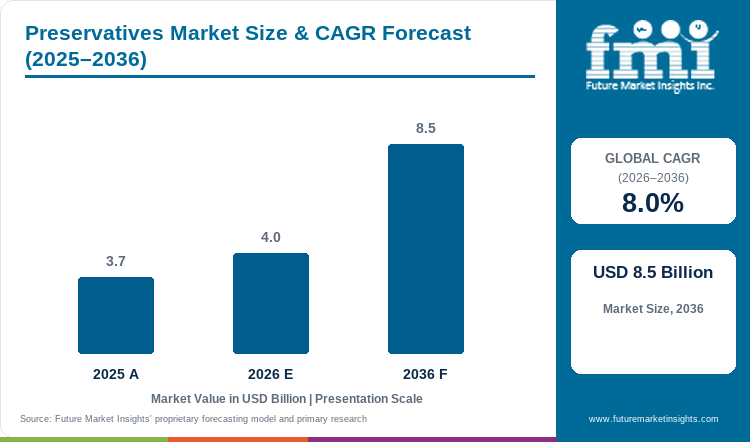
USD 4.0 Billion in 2026 and USD 8.5 Billion by 2036 at a 8.0% CAGR.
The Preservatives Market is valued at USD 4.0 Billion in 2026 and is forecast to reach USD 8.5 Billion by 2036 at an 8.0% CAGR. A preservative earns its place when it slows the spoilage or oxidation that would otherwise end a product's saleable life. The FDA distinguishes antimicrobial and antioxidant functions. For a food maker, the decisive result comes from testing the candidate in its own recipe, pack and storage conditions. A longer shelf life on a supplier sheet is not enough. The 2025 base is estimated at USD 3.7 Billion.
The intended application decides the regulatory route. Spain and Japan combine faster projected growth with active food-waste reduction agendas, while the USA and Canada have large mature processing bases and tighter incremental growth. Europe uses positive-list authorization with conditions of use, and Great Britain now maintains its own official electronic register. These differences make regulatory fit and application validation as important as ingredient availability. Suppliers that can document both tend to shorten the path from formulation trial to repeat purchase.
Key Takeaways
- Shelf-life extension is the core demand mechanism because antimicrobial control and oxidation management can protect saleable product life and reduce spoilage-related losses.
- Powder leads the Form axis in 2026 because dry ingredients fit high-throughput blending, premix handling and solid-dose workflows without requiring a liquid carrier.
- Food and Beverage leads the Application axis in 2026 as processors must manage microbial, oxidative and sensory deterioration across many product categories.
- Polylysine leads the Product Type axis in 2026 because it offers a defined antimicrobial function with established food-use pathways in major markets.
- The principal friction is qualification: permitted uses, dosage limits and technical-effect evidence can differ by jurisdiction and application.
- Profiled market participants are Cargill, Incorporated; DSM-Firmenich; Archer Daniels Midland Company; Kerry Group plc; Kemin Industries, Inc.; BASF SE; Tate & Lyle PLC; Corbion N.V.; Galactic S.A.; and Celanese Corporation.
Analyst Perspective
A formulator needs to show that a preservative is permitted in the intended product and works in the actual recipe without damaging taste or appearance. A broad “natural” label does not answer either question.
- Nandini Roy Choudhury, Principal Consultant, Future Market Insights
How is the preservatives market segmented?
The market is segmented by Form, Application and Product Type.
Form covers Powder and Liquid. Application covers Food and Beverage, Cosmetics & Personal Care, Pharmaceuticals, Nutraceuticals, Animal Feed and Pet Food. Product Type covers Polylysine, Hydroxytyrosol, Tocopherol (vitamin E), Anthocyanins (Flavonoid), Ascorbic acid (vitamin C), Rosemary Extract, Citric acid, Nisin, Rosmarinic Acid and Carnosic Acid.
Why does Food and Beverage lead the Application category?
Within food preservatives, processors face problems across microbial safety, mold control; oxidation and sensory stability. The buying decision therefore extends beyond ingredient price to the expected shelf-life gain in a defined recipe. Large processor populations also create many formulation points where a preservation ingredient can be specified. This breadth is not present to the same degree in narrower end-use categories.
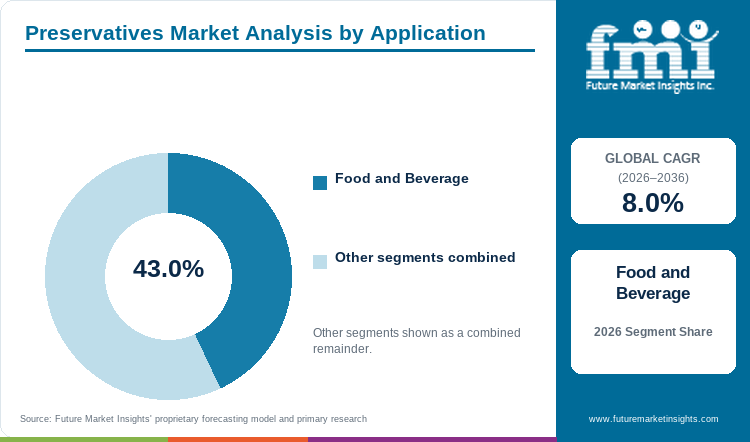
- Food and Beverage represents 43.0% of Application demand in 2026 because a bakery’s mold-control test differs from a beverage’s oxidation-control test, giving suppliers multiple formulation points.
- The breadth of processed-food applications gives preservative suppliers many potential qualification points. Bakery, dairy, beverages and prepared foods expose ingredients to different acidity; moisture; fat and packaging conditions. A supplier cannot assume that a dosage validated in one matrix will work in another. Technical support and test design are therefore part of the sale. Suppliers of clean label preservatives must prove shelf-life performance in the intended food.
What makes Powder central to the Form category?
Powder fits procurement systems that favor standardized dosing and dry blending. It can move through premix, nutraceutical, feed and solid-food operations without a separate liquid-handling step. That matters when buyers want consistent addition rates across multiple production lines. The format also suits ingredients such as dry vitamin E and plant-extract systems that must be dispersed into dry matrices before downstream processing.
- Powder holds 85.0% of the Form axis in 2026 because premix and solid-form lines can meter an ingredient without adding a liquid carrier or a separate liquid-handling step.
- In April 2025, Corbion introduced Verdad Essence WH100 for mold inhibition in bakery products. It paired the cultured-wheat ingredient with an updated predictive model. That combination lets a baker narrow the candidates for an actual shelf-life trial.
What supports Polylysine leadership in the Product Type category?
Polylysine combines a defined antimicrobial role with regulatory precedent in major food markets. Its commercial value comes from inhibition rather than antioxidant action, so the ingredient is evaluated against microbial targets and use conditions. The product can therefore occupy a distinct specification line in preservation systems instead of competing only as a general-purpose acidulant or nutrient ingredient.
- Polylysine accounts for 29.0% of the Product Type axis in 2026 as a targeted antimicrobial; tocopherols and rosemary extracts address oxidation, so the buyer’s validation test differs by preservative function.
- FDA GRAS Notice 336 records ε-Polylysine as an antimicrobial agent for a wide variety of food categories at up to 0.025% by weight. The FDA inventory page was updated in September 2026, providing a current reference point for U.S. formulators.
What are the drivers, restraints and opportunities in the preservatives market?
Shelf-life and spoilage control support preservative demand, while application-specific authorization and validation slow conversion, and label-friendly natural systems create room for higher-value formulation support.
- Driver: Food manufacturers need measurable microbial and oxidation control to protect shelf life and reduce spoilage exposure.
- Restraint: Ingredient authorization, permitted-use conditions and technical-effect validation can delay qualification across countries and applications.
- Opportunity: Natural antioxidant and antimicrobial systems can capture demand when suppliers pair familiar ingredient positioning with validated performance.
Spoilage becomes expensive when it removes a product from the shelf before the intended date. A preservative may help, but only if it controls the relevant mold, bacterium or oxidation route without damaging taste. Corbion's 2025 bakery launch paired a cultured-wheat ingredient with a mold-inhibition model; showing how suppliers can help customers choose a trial. The result must still be measured in the customer's own formulation and packaging.
Qualification remains the main brake on fast adoption. FDA guidance asks submitters to provide data showing that an antimicrobial achieves its intended technical effect. EU additives must be authorized and listed with conditions of use, while Canada publishes permitted foods and maximum-use conditions. Great Britain has used its electronic regulated-products register as the official public list since April 2025. A preservative that works technically can still miss a launch window if its regulatory status, dosage or labeling pathway does not match the target formulation. Health Canada’s October 2025 permitted-preservatives list sets out authorized foods and conditions of use substance by substance; permission for one food does not transfer to another application.
Natural food preservatives still have to do the work. Kemin sells tocopherols, rosemary and olive-derived systems for oxidation control; Kerry offers plant extracts and fermentation-derived options. The buyer will test the candidate in its own food for shelf life, taste and color. Ingredient origin may help the label but it cannot compensate for a shorter saleable life or an unwanted flavor.
Which country CAGRs are profiled in the preservatives market?
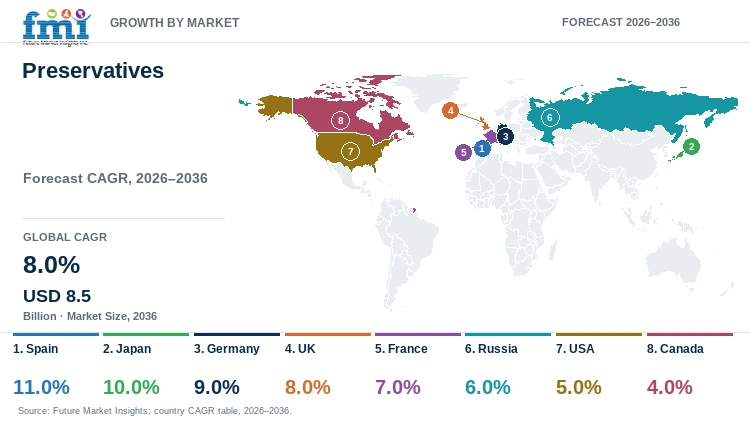
| Country | CAGR |
|---|---|
| Spain | 11.0% |
| Japan | 10.0% |
| Germany | 9.0% |
| UK | 8.0% |
| France | 7.0% |
| Russia | 6.0% |
| USA | 5.0% |
| Canada | 4.0% |
How do country-level CAGRs compare in the preservatives market?
The country set separates into three growth bands. Spain, Japan and Germany form the 9.0% to 11.0% high-growth band. The UK, France and Russia sit between 6.0% and 8.0% while the USA and Canada are profiled at 4.0% to 5.0%. The difference between the highest and lowest rates is 7.0 percentage points. These are growth rates rather than measures of country market size so a slower profile can still represent a substantial purchasing base.
- Spain: Food processing scale and the 2025 national food-loss law strengthen the case for shelf-life tools that can be deployed within EU additive rules.
- Japan: A revised food-waste target and established recognition of ε-Polylysine support focused adoption of preservation technologies.
- Germany: National food-waste reduction policy increases attention to shelf life, while EU authorization requirements keep formulation discipline high.
- UK: A large food and drink manufacturing base now operates with a distinct Great Britain authorization register for regulated food products.
- France: A large agri-food production base supports recurring preservative qualification, though EU use conditions constrain formulation choices.
- Russia: Food manufacturers operate within a technically regulated EAEU environment where market access depends on documented safety and compliance.
- USA: A very large processor population sustains broad demand, but mature sourcing structures and established qualification pathways temper the growth rate.
- Canada: Food manufacturing scale remains substantial, while permitted-use lists and maximum levels favor qualified formulations over rapid ingredient substitution.
Food-processing scale, preservative rules and product-qualification requirements vary across Spain, Japan; Germany; the UK; France; Russia; the USA and Canada.
Country-wise Analysis
- Spain has the fastest profiled rate, at 11.0% CAGR from 2026 to 2036. Law 1/2025 addresses food loss and waste across production, transformation and distribution. It gives processors another reason to examine where usable shelf life is lost. A preservative supplier still has to stay within EU additive rules and prove that the proposed ingredient works without harming taste or labeling. That is a formulation decision not simply a response to policy.
- Japan is profiled at 10.0% CAGR from 2026 to 2036. Its food-additive framework includes specified permitted ingredients, including ε-polylysine. A manufacturer facing waste from microbial spoilage needs to check both the applicable food category and the technical effect in its own product. Suppliers can help by providing local documentation and application trials. A national waste target, by itself; does not validate an ingredient or a shelf-life claim.
- Germany carries a 9.0% CAGR in the 2026 to 2036 outlook. Federal policy aims to reduce food waste by 2030 and processors have a direct cost reason to keep products saleable through distribution. EU positive-list conditions set the boundary for any additive use. Within that boundary, a supplier can compete by showing how its system controls a specific failure, such as mold or oxidation; without changing the product consumers expect.
- The UK is profiled at 8.0% CAGR from 2026 to 2036. Great Britain has used an electronic register for authorized regulated products since April 2025, including food additives. That gives formulators a current place to check status before a new preservation trial. The next questions are practical: does the ingredient fit the process, what dose is allowed and does the finished food retain the intended taste and shelf life?
- France has a 7.0% CAGR in the 2026 to 2036 profile. Its food and beverage processors work across many recipes, each with a different spoilage or oxidation risk. EU authorization and category conditions are the first screen for an additive. A supplier then has to show an appropriate dose and reliable effect in the actual product. The stronger offer is a usable test plan and a consistent ingredient, not an undifferentiated promise of longer freshness.
- Russia is profiled at 6.0% CAGR from 2026 to 2036. The Eurasian Economic Commission emphasized in June 2025 that harmonized sanitary measures and technical regulation are central to food safety and market access within the Eurasian Economic Union. Rosstat continues to track food and beverage manufacturing as distinct industrial activities, reflecting an established processing base. For preservative suppliers, technical efficacy alone is insufficient. Documentation has to fit the applicable EAEU framework and the buyer’s manufacturing specification. Commercial progress therefore depends on qualified local routes to market and reliable supply as much as on ingredient performance.
- The USA is profiled at 5.0% CAGR from 2026 to 2036. FDA food-additive and GRAS pathways provide defined routes for specified uses; ε-polylysine has a GRAS notice for antimicrobial use in certain foods. That does not let a supplier skip the customer's qualification work. A processor switching systems will want regulatory documentation, a stable specification and side-by-side shelf-life and sensory results before changing a familiar recipe.
- Canada has the lowest profiled rate, at 4.0% CAGR from 2026 to 2036. Health Canada's permitted-preservatives list identifies foods and conditions of use, including entries for ascorbic acid and nisin. A supplier seeking a new account needs to check that authorization against the product and then demonstrate a worthwhile effect at the permitted dose. Reformulation and application expansion offer opportunities but neither removes the need for consistent quality and a defensible label.
Who are the notable companies in the preservatives market?
Cargill, Incorporated; DSM-Firmenich; Archer Daniels Midland Company; Kerry Group plc; Kemin Industries, Inc.; BASF SE; Tate & Lyle PLC; Corbion N.V.; Galactic S.A. and Celanese Corporation are the notable companies profiled in this market.
Competition spans three distinct positions. Direct food-preservation specialists compete through antimicrobial systems, shelf-life modeling and application laboratories. Antioxidant and nutrition-ingredient suppliers compete through tocopherols, vitamin E and plant-derived oxidation control that can move across food; feed or nutrition uses. Broad ingredient companies compete through formulation access and customer relationships. This means buyer shortlists depend on the preservation problem being solved. A supplier strong in microbial control may be a weaker choice when lipid oxidation is the main cause of shelf-life loss.
- Direct food-preservation platforms: Kerry Group plc; Kemin Industries, Inc.; Corbion N.V.; Galactic S.A.; Celanese Corporation.
- Antioxidant and nutrition-ingredient platforms: DSM-Firmenich; Archer Daniels Midland Company; BASF SE.
- Broad ingredient and formulation platforms: Cargill, Incorporated; Tate & Lyle PLC.
Competitive Benchmarking: Preservatives Market
| Company | Natural Antioxidant Capability | Microbial Shelf-Life Capability | Cross-Application Support | Geographic Reach |
|---|---|---|---|---|
| Cargill, Incorporated | Low | Low | Medium | North America evidence; broader global ingredient operations |
| DSM-Firmenich | High | Medium | High | Major regions; global food and beverage support |
| Archer Daniels Midland Company | High | Low | Medium | Global nutrition ingredient operations |
| Kerry Group plc | Medium | High | High | Global food-protection customer support |
| Kemin Industries, Inc. | High | High | High | North America and EMEA; wider international network |
| BASF SE | High | Low | High | Europe, North America and Asia-Pacific |
| Tate & Lyle PLC | Low | Low | Medium | Global food and beverage ingredient network |
| Corbion N.V. | Low | High | High | Worldwide sales network and multi-region manufacturing |
| Galactic S.A. | Low | High | Medium | Global food-manufacturer support |
| Celanese Corporation | Low | High | High | Worldwide Nutrinova preservative support |
Scoring basis: Natural Antioxidant Capability is High when public materials document named antioxidant ingredients that align closely with the report taxonomy, Medium when evidence is broader or partial. Microbial Shelf-Life Capability rates documented antimicrobial or mold-control systems using the same High or Medium depth test. Cross-Application Support reflects documented ability to formulate across multiple listed end uses. Low denotes a documented limitation.
Key Developments in the Preservatives Market
- In April 2025, Corbion N.V. launched Verdad Essence WH100, a cultured-wheat mold-inhibition solution for bakery applications. Corbion paired the product with an enhanced predictive mold-inhibition model. The development shows how suppliers are combining preservation ingredients with application tools that can reduce formulation trial-and-error.
- In September 2025, DSM-Firmenich launched four next-generation Dairy Safe culture rotations for semi-hard, hard and continental-style cheeses. The company positioned the systems around label-friendly spoilage protection and greater process robustness. This expands the set of preservation approaches competing for food-manufacturer shelf-life budgets.
- BASF reported in its 2025 annual materials that production of affected vitamin ingredients had largely normalized by the end of 2025. For customers buying antioxidant grades, that update is a supply-continuity signal. It does not substitute for checking the specification or qualifying the ingredient in a particular food.
Key Players in the Preservatives Market
Direct Food Preservation Platforms
- Kerry Group plc
- Kemin Industries, Inc.
- Corbion N.V.
- Galactic S.A.
- Celanese Corporation
Antioxidant and Nutrition Ingredient Platforms
- DSM-Firmenich
- Archer Daniels Midland Company
- BASF SE
Broad Ingredient and Formulation Platforms
- Cargill, Incorporated
- Tate & Lyle PLC
Preservatives Market - Report Scope
| Coverage field | Report scope |
|---|---|
| Market breakdown | Form, Application, Product Type |
| Quantitative Units | USD Billion |
| Market Definition | Revenue includes the listed preservative and antioxidant actives sold in Powder or Liquid form across the listed applications. Finished-product revenue, packaging or non-chemical preservation technologies, and preservative actives outside the listed Product Type taxonomy are excluded. For blends, only separately attributable in-scope ingredient value is included. |
| Regions Covered | North America; Latin America; Western Europe; Eastern Europe; East Asia; South Asia and Pacific; Middle East and Africa |
| Countries Covered | USA; UK; Germany; Russia; Canada; Japan; France; Spain |
| Key Companies Profiled | Cargill, Incorporated; DSM-Firmenich; Archer Daniels Midland Company; Kerry Group plc; Kemin Industries, Inc.; BASF SE; Tate & Lyle PLC; Corbion N.V.; Galactic S.A.; Celanese Corporation |
| Forecast Period | 2026 to 2036 |
| Approach | Current additive rules and application evidence reviewed against the FMI market outlook. |
Preservatives Market - Research Methodology
| Method | Approach |
|---|---|
| Market Scope | Preservation is discussed by the failure it addresses: microbial growth, mold or oxidation. Allowed use and the finished food matrix determine whether an ingredient is relevant. |
| Public Evidence | Current additive lists and registers, a 2025 bakery-preservation launch and supplier production updates are the main public references. Waste goals are context, not proof of ingredient efficacy. |
| Forecast Interpretation | The 2026 base value, 2036 forecast and country CAGRs are FMI estimates. Manufacturing activity and public policy are not used as direct measures of preservative sales. |
| Source Checks | Regulatory status was checked by jurisdiction and food category. Technical effect is described as requiring a product-specific shelf-life and sensory trial. |
Preservatives Market by Segments
Preservatives Market segmented by Form:
- Powder
- Liquid
Preservatives Market segmented by Application:
- Food and Beverage
- Cosmetics & Personal Care
- Pharmaceuticals
- Nutraceuticals
- Animal Feed
- Pet Food
Preservatives Market segmented by Product Type:
- Polylysine
- Hydroxytyrosol
- Tocopherol (vitamin E)
- Anthocyanins (Flavonoid)
- Ascorbic acid (vitamin C)
- Rosemary Extract
- Citric acid
- Nisin
- Rosmarinic Acid
- Carnosic Acid
Preservatives Market by Region:
- North America
- United States
- Canada
- Latin America
- Brazil
- Mexico
- Argentina
- Chile
- Western Europe
- Germany
- France
- United Kingdom
- Italy
- Spain
- Benelux
- Nordics
- Eastern Europe
- Poland
- Czech Republic
- Romania
- Hungary
- East Asia
- China
- Japan
- South Korea
- South Asia and Pacific
- India
- ASEAN
- Australia and New Zealand
- Middle East and Africa
- GCC Countries
- South Africa
- Türkiye
- Israel
Research Sources and Bibliography
- U.S. Food and Drug Administration (n.d.). Types of Food Ingredients.
- U.S. Food and Drug Administration (2026, September 2). GRN No. 336: ε-Polylysine (polylysine).
- European Commission (n.d.). EU Rules - food additives.
- Food Standards Agency (2025, April 1). Reforms to the market authorisation process for regulated products come into force.
- Department for Environment, Food & Rural Affairs (2026, September 3). Chapter 14: The food chain.
- Health Canada (2025, October 20). 11. List of Permitted Preservatives.
- Japan Food Chemical Research Foundation (2025, August 25). List of Existing Food Additives.
- Federal Ministry of Food and Agriculture of Germany (2025, May 16). National Strategy for Food Waste Reduction.
- INSEE (2026, July 21). Indicateurs macroéconomiques de l’industrie agroalimentaire.
- Agencia Estatal Boletín Oficial del Estado (2025, April 2). Ley 1/2025, de 1 de abril; de prevención de las pérdidas y el desperdicio alimentario.
- Eurasian Economic Commission (2025, June 27). Valentin Tataritsky: Food safety in the EAEU is a guarantee of public welfare.
- Federal State Statistics Service of Russia (n.d.). Промышленное производство в России. 2025.
- Corbion N.V. (2025, April 21). Corbion Unveils Verdad Essence WH100: Redefining Natural Mold Inhibition for Bakers.
- Corbion N.V. (2025, August 25). Corbion and BRAIN Biotech Collaborate to Advance Biobased Antimicrobial Solutions.
- Corbion N.V. (n.d.). Our global presence.
- DSM-Firmenich (2025, September 4). dsm-firmenich launches next generation of Dairy Safe all-in-one cultures for semi-hard, hard and continental-style cheese varieties.
- DSM-Firmenich (n.d.). Technical antioxidants.
- Archer Daniels Midland Company (n.d.). Specialty Health Solutions.
- Kemin Industries, Inc. (n.d.). Food Technologies.
- Kemin Industries, Inc. (n.d.). FORTIUM MT - Mixed Tocopherols.
- Kerry Group plc (2026, July 17). Kerry Brought Food Protection Innovation to the Forefront at IFT FIRST.
- Kerry Group plc (n.d.). Clean Label Preservation.
- BASF SE (n.d.). Vitamin E for feedstuff - reliable performance and quality.
- Galactic S.A. (2025, March 4). Traditional antimicrobials: a choice of effectiveness.
- Galactic S.A. (n.d.). Preservation & shelf-life extension.
- Celanese Corporation (n.d.). Preservatives and Food Additives.
- Cargill, Incorporated (n.d.). Food Processing Salt Functionality Beyond Flavor.
- Health Canada (2025, October 20). List of Permitted Preservatives.
- Corbion, April 2025 Verdad Essence WH100 release
- BASF, 2025 annual report on vitamin production
This Report Answers
- How large is the Preservatives Market in 2026, and what value is forecast for 2036?
- Which industry pressures are supporting demand for preservatives?
- Why does Powder hold the leading position in the Form axis?
- Why does Food and Beverage hold the leading position in the Application axis?
- How do the profiled country growth rates differ from 2026 to 2036?
- Which profiled companies supply relevant preservation, antioxidant or formulation capabilities?
- What limits adoption or supplier switching in preservatives purchasing?
- What should buyers evaluate before purchasing a preservative ingredient or system?
Frequently Asked Questions
How big is the Preservatives Market in 2026, and what is forecast for 2036?
The market is USD 4.0 Billion in 2026 and is forecast to reach USD 8.5 Billion by 2036. The expansion reflects continuing demand for microbial control, oxidation management and shelf-life extension across the listed application set.
What is the CAGR of the Preservatives Market from 2026 to 2036?
The market is forecast to expand at 8.0% CAGR from 2026 to 2036. The rate reflects growing use of preservation ingredients, but supplier revenue still depends on application qualification and regulatory fit.
Which segment leads the Form axis in the Preservatives Market?
Powder leads Form in 2026. Dry handling supports standardized dosing and broad use in premix or solid-product manufacturing.
Which segment leads the Application axis in the Preservatives Market?
Food and Beverage leads Application in 2026. Processors repeatedly use preservation ingredients to manage spoilage, oxidation and sensory stability across diverse product categories.
Which profiled countries have the highest growth rates in the Preservatives Market?
Spain has the highest profiled CAGR at 11.0%, followed by Japan at 10.0% and Germany at 9.0% from 2026 to 2036.
Which companies are active in the Preservatives Market?
The profiled companies are Cargill, Incorporated; DSM-Firmenich; Archer Daniels Midland Company; Kerry Group plc; Kemin Industries, Inc.; BASF SE; Tate & Lyle PLC; Corbion N.V.; Galactic S.A.; and Celanese Corporation.
Preview the report firsthand - request a free sample
Get SampleGet the brochure for pricing and purchase details.
Get PDFTable of Content
- Key Takeaways
- Market Size and CAGR
- Top Growth Driver
- Fastest Growing Segment
- Leading Region
- Key Companies
- Emerging Opportunities
- Executive Summary
- Global Market Outlook
- Demand-side Trends
- Supply-side Trends
- Technology Roadmap Analysis
- Analysis and Recommendations
- Analyst Perspective (What is happening? Why now? What should investors know?)
- Key Questions Answered
- How large is the market?
- What is the CAGR?
- What are key trends?
- Which region dominates?
- Who are the leaders?
- Market Overview
- Market Coverage / Taxonomy
- Market Definition / Scope / Limitations
- Research Methodology
- Chapter Orientation
- Analytical Lens and Working Hypotheses
- Market Structure, Signals, and Trend Drivers
- Benchmarking and Cross-market Comparability
- Market Sizing, Forecasting, and Opportunity Mapping
- Research Design and Evidence Framework
- Desk Research Programme (Secondary Evidence)
- Expert Input and Fieldwork (Primary Evidence)
- Tooling, Models, and Reference Databases
- Data Engineering and Model Build
- Quality Assurance and Audit Trail
- Market Background
- Market Dynamics (Drivers, Restraints, Opportunity, Trends)
- Scenario Forecast (Optimistic, Likely, Conservative)
- Impact Analysis
- AI Impact
- Sustainability Impact
- Regulatory Impact
- Technology Impact
- Consumer / Buyer Analysis
- Purchase Drivers
- Adoption Barriers
- Buyer Journey
- Opportunity Map Analysis
- Product Life Cycle Analysis
- Supply Chain Analysis
- Investment Feasibility Matrix
- Value Chain Analysis
- PESTLE and Porter's Analysis
- Regulatory Landscape
- Regional Parent Market Outlook
- Production and Consumption Statistics
- Import and Export Statistics
- Global Market Analysis and Forecast, 2021 to 2036
- Historical Market Size Value (USD Billion) Analysis, 2021 to 2025
- Current and Future Market Size Value (USD Billion) Projections, 2026 to 2036
- Y-o-Y Growth Trend Analysis
- Absolute $ Opportunity Analysis
- Global Market Pricing Analysis, 2021 to 2036
- Global Market Analysis and Forecast, By Form, 2021 to 2036
- Introduction / Key Findings
- Historical Market Size Value (USD Billion) Analysis By Form, 2021 to 2025
- Current and Future Market Size Value (USD Billion) Analysis and Forecast By Form, 2026 to 2036
- Powder
- Liquid
- Y-o-Y Growth Trend Analysis By Form, 2021 to 2025
- Absolute $ Opportunity Analysis By Form, 2026 to 2036
- Global Market Analysis and Forecast, By Application, 2021 to 2036
- Introduction / Key Findings
- Historical Market Size Value (USD Billion) Analysis By Application, 2021 to 2025
- Current and Future Market Size Value (USD Billion) Analysis and Forecast By Application, 2026 to 2036
- Food and Beverage
- Cosmetics & Personal Care
- Pharmaceuticals
- Nutraceuticals
- Animal Feed
- Pet Food
- Y-o-Y Growth Trend Analysis By Application, 2021 to 2025
- Absolute $ Opportunity Analysis By Application, 2026 to 2036
- Global Market Analysis and Forecast, By Product Type, 2021 to 2036
- Introduction / Key Findings
- Historical Market Size Value (USD Billion) Analysis By Product Type, 2021 to 2025
- Current and Future Market Size Value (USD Billion) Analysis and Forecast By Product Type, 2026 to 2036
- Polylysine
- Hydroxytyrosol
- Tocopherol (vitamin E)
- Anthocyanins (Flavonoid)
- Ascorbic acid (vitamin C)
- Rosemary Extract
- Citric acid
- Nisin
- Rosmarinic Acid
- Carnosic Acid
- Y-o-Y Growth Trend Analysis By Product Type, 2021 to 2025
- Absolute $ Opportunity Analysis By Product Type, 2026 to 2036
- Global Market Analysis and Forecast, By Region, 2021 to 2036
- Introduction
- Historical Market Size Value (USD Billion) Analysis By Region, 2021 to 2025
- Current Market Size Value (USD Billion) Analysis and Forecast By Region, 2026 to 2036
- North America
- Latin America
- Western Europe
- Eastern Europe
- East Asia
- South Asia and Pacific
- Middle East and Africa
- Market Attractiveness Analysis By Region
- North America Market Analysis and Forecast, By Country, 2021 to 2036
- Historical Market Size Value (USD Billion) Trend Analysis By Market Taxonomy, 2021 to 2025
- Market Size Value (USD Billion) Forecast By Market Taxonomy, 2026 to 2036
- By Country
- United States
- Canada
- By Form
- By Application
- By Product Type
- By Country
- Market Attractiveness Analysis
- By Country
- By Form
- By Application
- By Product Type
- Key Takeaways
- Latin America Market Analysis and Forecast, By Country
- Historical Market Size Value (USD Billion) Trend Analysis By Market Taxonomy, 2021 to 2025
- Market Size Value (USD Billion) Forecast By Market Taxonomy, 2026 to 2036
- By Country
- Brazil
- Mexico
- Argentina
- Chile
- By Form
- By Application
- By Product Type
- By Country
- Market Attractiveness Analysis
- By Country
- By Form
- By Application
- By Product Type
- Key Takeaways
- Western Europe Market Analysis and Forecast, By Country
- Historical Market Size Value (USD Billion) Trend Analysis By Market Taxonomy, 2021 to 2025
- Market Size Value (USD Billion) Forecast By Market Taxonomy, 2026 to 2036
- By Country
- Germany
- France
- United Kingdom
- Italy
- Spain
- Benelux
- Nordics
- By Form
- By Application
- By Product Type
- By Country
- Market Attractiveness Analysis
- By Country
- By Form
- By Application
- By Product Type
- Key Takeaways
- Eastern Europe Market Analysis and Forecast, By Country
- Historical Market Size Value (USD Billion) Trend Analysis By Market Taxonomy, 2021 to 2025
- Market Size Value (USD Billion) Forecast By Market Taxonomy, 2026 to 2036
- By Country
- Poland
- Czech Republic
- Romania
- Hungary
- By Form
- By Application
- By Product Type
- By Country
- Market Attractiveness Analysis
- By Country
- By Form
- By Application
- By Product Type
- Key Takeaways
- East Asia Market Analysis and Forecast, By Country
- Historical Market Size Value (USD Billion) Trend Analysis By Market Taxonomy, 2021 to 2025
- Market Size Value (USD Billion) Forecast By Market Taxonomy, 2026 to 2036
- By Country
- China
- Japan
- South Korea
- By Form
- By Application
- By Product Type
- By Country
- Market Attractiveness Analysis
- By Country
- By Form
- By Application
- By Product Type
- Key Takeaways
- South Asia and Pacific Market Analysis and Forecast, By Country
- Historical Market Size Value (USD Billion) Trend Analysis By Market Taxonomy, 2021 to 2025
- Market Size Value (USD Billion) Forecast By Market Taxonomy, 2026 to 2036
- By Country
- India
- ASEAN
- Australia and New Zealand
- By Form
- By Application
- By Product Type
- By Country
- Market Attractiveness Analysis
- By Country
- By Form
- By Application
- By Product Type
- Key Takeaways
- Middle East and Africa Market Analysis and Forecast, By Country
- Historical Market Size Value (USD Billion) Trend Analysis By Market Taxonomy, 2021 to 2025
- Market Size Value (USD Billion) Forecast By Market Taxonomy, 2026 to 2036
- By Country
- GCC Countries
- South Africa
- Türkiye
- Israel
- By Form
- By Application
- By Product Type
- By Country
- Market Attractiveness Analysis
- By Country
- By Form
- By Application
- By Product Type
- Key Takeaways
- Key Countries Market Analysis
- United States
- Pricing Analysis
- Market Share Analysis, 2025
- By Form
- By Application
- By Product Type
- Canada
- Pricing Analysis
- Market Share Analysis, 2025
- By Form
- By Application
- By Product Type
- Mexico
- Pricing Analysis
- Market Share Analysis, 2025
- By Form
- By Application
- By Product Type
- Brazil
- Pricing Analysis
- Market Share Analysis, 2025
- By Form
- By Application
- By Product Type
- Chile
- Pricing Analysis
- Market Share Analysis, 2025
- By Form
- By Application
- By Product Type
- Germany
- Pricing Analysis
- Market Share Analysis, 2025
- By Form
- By Application
- By Product Type
- United Kingdom
- Pricing Analysis
- Market Share Analysis, 2025
- By Form
- By Application
- By Product Type
- Italy
- Pricing Analysis
- Market Share Analysis, 2025
- By Form
- By Application
- By Product Type
- Spain
- Pricing Analysis
- Market Share Analysis, 2025
- By Form
- By Application
- By Product Type
- France
- Pricing Analysis
- Market Share Analysis, 2025
- By Form
- By Application
- By Product Type
- India
- Pricing Analysis
- Market Share Analysis, 2025
- By Form
- By Application
- By Product Type
- ASEAN
- Pricing Analysis
- Market Share Analysis, 2025
- By Form
- By Application
- By Product Type
- Australia and New Zealand
- Pricing Analysis
- Market Share Analysis, 2025
- By Form
- By Application
- By Product Type
- China
- Pricing Analysis
- Market Share Analysis, 2025
- By Form
- By Application
- By Product Type
- Japan
- Pricing Analysis
- Market Share Analysis, 2025
- By Form
- By Application
- By Product Type
- South Korea
- Pricing Analysis
- Market Share Analysis, 2025
- By Form
- By Application
- By Product Type
- Poland
- Pricing Analysis
- Market Share Analysis, 2025
- By Form
- By Application
- By Product Type
- Hungary
- Pricing Analysis
- Market Share Analysis, 2025
- By Form
- By Application
- By Product Type
- Türkiye
- Pricing Analysis
- Market Share Analysis, 2025
- By Form
- By Application
- By Product Type
- South Africa
- Pricing Analysis
- Market Share Analysis, 2025
- By Form
- By Application
- By Product Type
- Russia
- Pricing Analysis
- Market Share Analysis, 2025
- By Form
- By Application
- By Product Type
- United States
- Market Structure Analysis
- Competition Dashboard
- Competition Benchmarking
- Market Share Analysis of Top Players
- By Regional
- By Form
- By Application
- By Product Type
- Emerging Startups
- Innovation Benchmarking
- Competition Analysis
- Competition Deep Dive
- Cargill, Incorporated
- Overview
- Product Portfolio
- Profitability by Market Segments
- Sales Footprint
- Strategy Overview
- Marketing Strategy
- Product Strategy
- Channel Strategy
- DSM-Firmenich
- Archer Daniels Midland Company
- Kerry Group plc
- Kemin Industries, Inc.
- BASF SE
- Tate & Lyle PLC
- Corbion N.V.
- Galactic S.A.
- Celanese Corporation
- Cargill, Incorporated
- Case Studies
- Success Stories
- Recent Developments
- Competition Deep Dive
- Assumptions & Acronyms Used


