

- Market Size (2026)
- USD 49.8 Bn
- Forecast (2036)
- USD 101.7 Bn
- CAGR (2026 to 2036)
- 7.4%
How big is the Probiotic Drinks & Fermented Beverage Market in 2026?
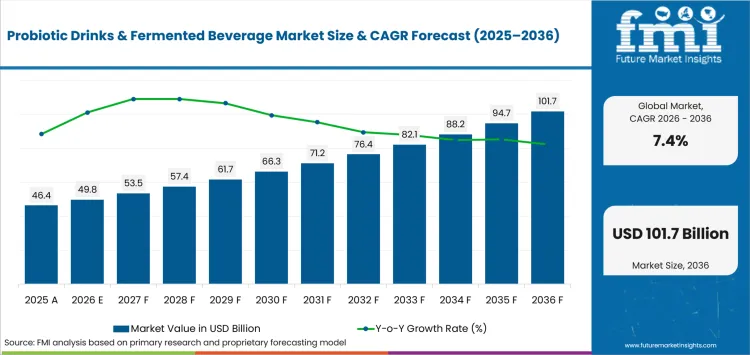
USD 49.8 billion in 2026 and USD 101.7 billion by 2036 at a 7.4% CAGR.
Sales of probiotic drinks and fermented beverages are projected to expand at 7.4% CAGR from 2026 to 2036. The industry valuation is estimated at USD 49.8 billion in 2026 and is projected to reach USD 101.7 billion by 2036. Beverage companies are expected to focus on products that protect live cultures during filling and chilled storage. Commercial value is expected to depend on stable taste and documented culture counts after normal distribution.
Country plans need a clear compliance route before broader launch. Health-claim review and fermentation control can change the cost of bringing one formula into several countries. These rules make label review and process control part of the purchase decision.
Key Takeaways of Probiotic Drinks & Fermented Beverage Market
- The probiotic drinks and fermented beverage market is advancing where manufacturers can sustain live culture counts through filling, chilled distribution, and retail handling, with shelf-life evidence and taste stability carrying more retail weight than broad wellness positioning.
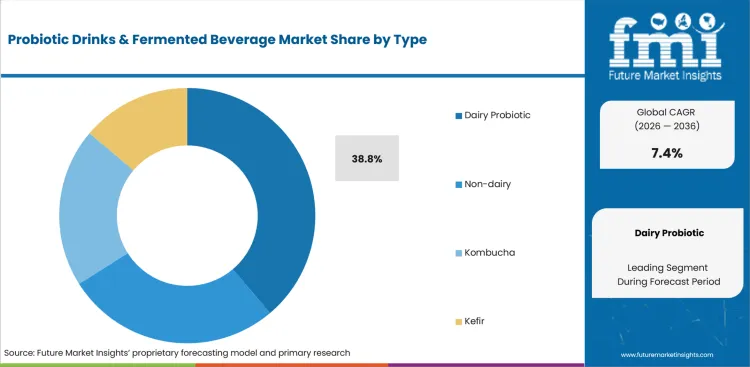
- By type, Dairy Probiotic is projected to hold 38.8% share in 2026 on familiar cultured milk habits; by strain, Lactobacillus is forecast at 48.7% share in 2026 due to its wide application across dairy probiotic formats and functional shots.
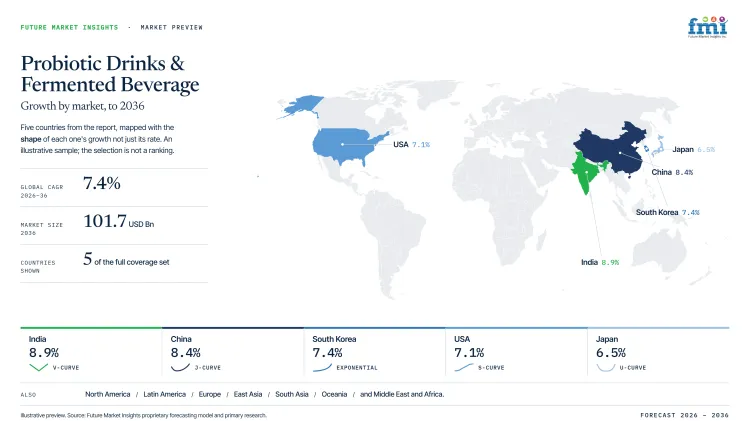
- India leads growth at 8.9% CAGR through 2036, followed by China at 8.4% and South Korea at 7.4%, each supported by dairy scale, digital grocery access, and compact chilled formats.
- Shots are estimated at 62.6% share in 2026 as single-serve packs lower trial barriers and support controlled daily use alongside clear date coding and shelf-life validation.
- Yakult, Lifeway, Danone, Nestlé, PepsiCo via KeVita, and Novonesis compete through fermented-drink expertise, dairy scale, strain documentation, and established cold-chain distribution.
- Contracts should clearly assign responsibility for culture survival measurement, temperature control, and label compliance, as regulatory strain documentation is a commercial requirement — not solely a research obligation.
Analyst Perspective
"The probiotic drinks & fermented beverage market is increasingly shaped by viable culture stability and consumer acceptance through the full product lifecycle. Beverage manufacturers are evaluating probiotic survival, taste, shelf life, and temperature tolerance as distinct performance measures. Suppliers that demonstrate consistent culture viability, sensory quality, and reliable compliance support will be better positioned to secure repeat commercial adoption."
— Nandini Roy Choudhury, Principal Analyst, Food & Beverage
Source: FMI's proprietary forecasting model and primary research
How is the Probiotic Drinks & Fermented Beverage Market segmented?
The probiotic drinks and fermented beverages industry is segmented by type, strain, format, and region.
Type analysis separates dairy probiotic drinks from non-dairy products and fermented formats such as kombucha and kefir. Strain analysis covers Lactobacillus and Bifidobacterium together with Bacillus and yeast-based cultures. Format analysis compares shots with RTD packs because the purchase decision changes with serving size and storage route. The probiotic drink gives a nearby view of product type and distribution changes. Regional analysis shows how regulation and cold-chain reach affect launch speed across countries.
What supports demand for Dairy Probiotic within the Type category?
Dairy probiotic drinks benefit from familiar yogurt and cultured milk habits. The format gives manufacturers a known base for taste and texture work before they add strain claims. USDA NASS reported in April 2026 that USA plain and flavored yogurt production reached 5.288 billion pounds in 2025. That base shows why cultured dairy knowledge remains useful for drinkable probiotic formats. The yogurt and probiotic drink offers a related view of drinkable yogurt demand.
- With 38.8% share in 2026, Dairy Probiotic is anticipated to lead Type revenue because brands can build around familiar fermented dairy formats. Proof of live-culture stability is expected to decide repeat orders more than flavor range alone.
- Manufacturers should test dairy probiotic drinks under planned filling and storage conditions. A product that performs in the plant but loses culture count during delivery is expected to face slower retail approval.
How does Lactobacillus shape demand within the Strain category?
Lactobacillus is widely used in fermented dairy and drinkable probiotic products. Its commercial appeal comes from familiarity and the ability to build a clear strain story. EFSA states that health-claim applications require scientific evidence before claims can be made to consumers in the European Union. This makes strain documentation part of the sale and not only part of research.
- By strain, Lactobacillus is expected to lead with 48.7% share in 2026 because it fits many dairy probiotic drinks and small functional shots. Manufacturers still need clear evidence for each proposed claim.
- Strain choice is expected to depend on taste fit and stability during storage. A culture that requires narrow handling conditions can raise the cost of chilled distribution.
Why are Shots central to the Format category?
Shots offer a small serving size that supports trial without asking consumers to replace a full drink routine. The format gives brands room to price around measured benefits and controlled daily use. Retailers can place shots near yogurt and chilled functional drinks. This helps companies test repeat buying before expanding into larger packs.
- A 62.6% share is estimated for Shots in 2026 because single-serve packs reduce the trial barrier. The format is expected to favor products that carry simple label language and consistent taste.
- Chilled shots require clear date coding and shelf-life proof. The heat-stable probiotic comparison shows why manufacturers test cultures that tolerate wider processing conditions.
What are the drivers, restraints, and opportunities in the Probiotic Drinks & Fermented Beverage Market?
Demand is expected to be driven by chilled product performance and clear evidence for claimed benefits. The main restraint is the cost of keeping live cultures stable across production and retail handling. Opportunity is concentrated in formats that make probiotics easier to buy and easier to explain.
- Driver: Chilled probiotic drinks need repeatable culture performance from filling to retail shelf.
- Restraint: Claim rules and alcohol-control thresholds add review work before commercial launch.
- Opportunity: Smaller packs and improved culture protection are expected to widen trial without large packaging changes.
The demand case is expected to start with product reliability. China's National Bureau of Statistics reported in January 2026 that online retail sales of food rose 14.5% in 2025. The figure supports digital discovery for chilled beverage packs but does not by itself prove probiotic adoption. It matters for this market because repeat sales depend on products arriving with stable taste and credible shelf-life evidence.
Regulation is expected to slow launches when claim language or fermentation control is not settled early. TTB states that kombucha falls under alcohol rules if alcohol content reaches 0.5% by volume during production or after bottling. That threshold makes temperature control and alcohol testing part of the business case for non-alcoholic kombucha. Companies that do not assign testing responsibility risk delays and relabeling cost after the product enters distribution.
The primary opportunity is expected to come from products that stay simple for consumers and stable for retailers. Lifeway Foods announced in October 2025 that Joe & The Juice launched the Trust Your Gut smoothie with Lifeway kefir. The release shows how kefir can move beyond grocery shelves through foodservice. Companies can use this route to test fermented milk drink extensions with less consumer education.
Which country CAGRs are profiled in the Probiotic Drinks & Fermented Beverage Market?
| Country | CAGR |
|---|---|
| Japan | 6.5% |
| China | 8.4% |
| USA | 7.1% |
| India | 8.9% |
| South Korea | 7.4% |
How do country-level CAGRs compare in the Probiotic Drinks & Fermented Beverage Market?
The country comparison shows India at the top of the profiled group with an 8.9% CAGR. China follows at 8.4% as online food retail supports new chilled beverage tests. South Korea and the USA form the middle band. Japan records the lowest profiled rate at 6.5%. The 2.4-point spread shows different entry speeds and does not rank demand size.
- India leads the comparison and reflects the value of a large dairy base for probiotic drink formats.
- China follows closely because online food retail gives brands more room to test chilled packs.
- South Korea and the USA remain in the middle of the range with different retail conditions.
- Japan grows at a slower rate but offers a structured route for evidence-led products.
Markets with similar CAGRs can still present different entry conditions due to local regulation and channel economics. The full report provides country-level analysis across North America, Latin America, Europe, East Asia, South Asia, Oceania and the Middle East and Africa.
Country-wise Analysis
- Japan combines strict claim review with a mature chilled dairy aisle. Probiotic drink demand in Japan is forecast to expand at 6.5% CAGR from 2026 to 2036 due to functional-food familiarity and compact retail formats. METI reported in August 2025 that food, drinks and liquor B2C e-commerce reached 3.1163 trillion yen in 2024. The figure gives probiotic shots and drinkable yogurt a larger digital trial route before wider chilled placement. Companies need local evidence that supports claim wording and shelf-life stability under Japanese retail conditions. Investment plans should prioritize clear labels and steady cold-chain performance.
- China combines large online food channels with a broad dairy production base. Sales in China are projected to rise at 8.4% CAGR through 2036 as chilled beverages gain better digital discovery. NBS reported in February 2026 that milk output reached 40.91 million tons in 2025. The figure supports dairy probiotic drink trials where processors already handle chilled milk products. Dairy processors still need proof that cultures remain stable after filling and transport. Launch teams should adjust claims to local food safety and labeling requirements.
- United States retail channels offer broad reach for kefir and probiotic shots. Demand in the USA is forecast to advance at 7.1% CAGR from 2026 to 2036 as national brands test chilled functional drinks. The USA Census Bureau reported in May 2026 that e-commerce reached USD 326.7 billion in the first quarter of 2026. The scale gives probiotic drink brands a route for trial packs and repeat orders outside store-only discovery. Companies need testing plans that separate live-culture performance from delivery risk. Commercial contracts should define who controls temperature and label review.
- India combines high milk output with familiar fermented dairy habits across curd and lassi. Probiotic drink demand in India is projected to advance at 8.9% CAGR through 2036 because dairy-based products can start from known consumption habits. PIB reported in November 2025 that milk production reached 247.87 million tonnes in 2024-25. The production base supports dairy probiotic drinks when companies can keep price and cold-chain cost under control. Digital grocery and quick-commerce channels are expected to help small packs reach urban consumers. Expansion should begin in cities where chilled movement and repeat purchase can be measured.
- South Korea combines dense digital shopping with small-store retail and frequent chilled replenishment. Sales in South Korea are estimated to rise at 7.4% CAGR through 2036 due to compact packs and online grocery discovery. MODS reported in February 2026 that online shopping transaction value reached 24.2904 trillion won in December 2025. The digital channel gives probiotic shots a clear route for promotion and repeat orders. Companies still need strain evidence and label discipline before using digestive claims. Product plans should favor formats that move quickly through chilled convenience channels.
Who are the notable companies in the Probiotic Drinks & Fermented Beverage Market?
The notable company set includes Yakult and Danone alongside Nestlé and Lifeway. PepsiCo through KeVita appears with Chobani and Bio-K+. Novonesis completes the group.
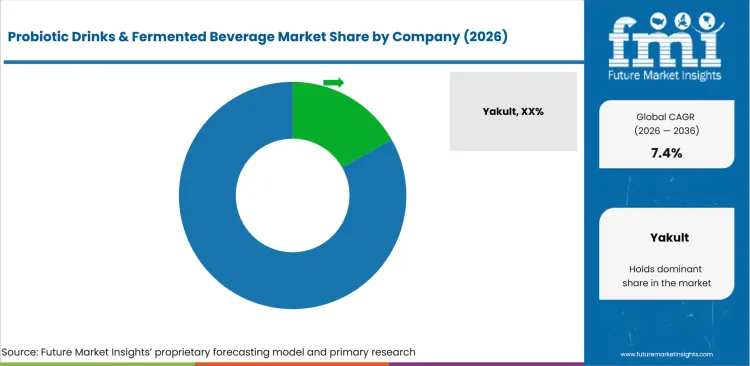
The competitive outlook combines probiotic drink brands with dairy groups and culture developers. Beverage brands compete through taste consistency and chilled retail access. Culture developers compete through strain documentation and support for manufacturers. Commercial success depends on clear ownership of shelf-life evidence before a product reaches larger retail programs.
- Yakult and Lifeway compete through fermented-drink know-how and repeat consumer use. Bio-K+ adds specialist probiotic positioning with a narrower beverage focus.
- Danone, Nestlé and Chobani compete through dairy scale and brand reach. These companies can test probiotic beverages through established chilled channels.
- PepsiCo uses KeVita as a kombucha platform and Novonesis supports culture selection for food and beverage manufacturers. Each company serves a different part of the launch path.
Competitive Benchmarking: Probiotic Drinks & Fermented Beverage Market
| Company | Beverage Brand Strength | Culture and Strain Capability | Format Reach | Geographic Reach |
|---|---|---|---|---|
| Yakult | High | High | Medium | Global |
| Danone | High | High | High | Global |
| Nestlé | Medium | Medium | Medium | Global |
| Lifeway | High | Medium | Medium | United States and selected export markets |
| PepsiCo (KeVita) | Medium | Low | Medium | United States |
| Chobani | Medium | Low | Medium | United States |
| Bio-K+ | Medium | High | Low | North America |
| Novonesis | Low | High | Low | Global |
Scoring basis: High indicates a direct offering in probiotic drinks or culture support. Medium indicates adjacent dairy or beverage capability. Low indicates limited direct evidence in the named workflow.
Key Developments in the Probiotic Drinks & Fermented Beverage Market
- In September 2025, Lifeway Foods announced the Waukesha expansion as part of its kefir capacity program. The project supports higher output for cultured dairy drinks. The release gives the company more room to serve retail and foodservice accounts.
- In February 2026, Novonesis reported 33 product launches during 2025. It stated that Food & Health organic sales grew 8.0% during the year. The update shows active development capacity behind cultures and food biosolutions used by beverage manufacturers.
- In October 2025, Yakult said the Yakult brand received Guinness World Records recognition as the largest lactic acid beverage brand by latest annual sales. The recognition reinforces the company’s position in small fermented milk drinks.
Key Players in the Probiotic Drinks & Fermented Beverage Market
Core Technology and Ingredient Developers
- Yakult
- Lifeway
- Bio-K+
Scaled Manufacturing and Supply Groups
- Danone
- PepsiCo (KeVita)
- Novonesis (strains)
Application and Commercialization Specialists
- Nestlé
- Chobani
Probiotic Drinks & Fermented Beverage Market - Report Scope
| Coverage field | Report scope |
|---|---|
| Market breakdown | Type, strain, format, and region. |
| Quantitative Units | Revenue in USD Billion, CAGR in %. |
| Market Definition | Packaged beverages made through probiotic culture addition or fermentation. The scope covers drinkable dairy formats, non-dairy probiotic drinks, kombucha and kefir sold for consumer use. |
| Regions Covered | North America, Latin America, Europe, East Asia, South Asia, Oceania, and Middle East and Africa. |
| Countries Covered | Japan, China, USA, India and South Korea in the country comparison. Full report covers 30+ countries. |
| Key Companies Profiled | Yakult, Danone, Nestlé, Lifeway, PepsiCo (KeVita), Chobani, Bio-K+ and Novonesis. |
| Forecast Period | 2026 to 2036. |
| Approach | Hybrid bottom-up and top-down market sizing supported by primary interviews and official desk research. |
Probiotic Drinks & Fermented Beverage Market - Research Methodology
| Method | Approach |
|---|---|
| Primary Research | FMI analysts gathered input from manufacturers, service providers, technology developers, distributors, end users, procurement teams, and subject-matter experts. Interviews examined purchasing decisions, product or service evaluation, adoption barriers, approval requirements, pricing considerations, and expectations for technical or commercial support. Respondents were asked what evidence is required before a trial, pilot, or initial order develops into regular purchasing. |
| Desk Research | Desk research covered government statistics, regulatory publications, trade data, industry associations, technical literature, standards, company filings, product information, and official corporate announcements. Sources were reviewed for relevance, publication date, geographic coverage, and consistency with the defined market scope. Claims relating to performance, applications, approvals, capacity, investment, and commercial activity were retained only when supported by credible public evidence. |
| Market Sizing and Forecasting | The market model combined the baseline value with historical performance, segment structure, pricing and volume indicators, adoption levels, company participation, and country-level demand conditions. Forecast assumptions considered economic activity, investment trends, regulatory developments, technology adoption, purchasing cycles, supply availability, and barriers to wider market use. Segment and regional estimates were reconciled before the final market total was calculated. |
| Data Validation | Estimates were checked against multiple independent indicators, including public data, company activity, trade patterns, industry developments, and findings from primary interviews. Validation tested whether products, services, applications, and company revenues fell within the defined market boundaries. Adjacent categories, unsupported claims, overlapping revenues, and activities without direct market relevance were excluded to reduce double counting and maintain consistency across segments and countries. |
Probiotic Drinks & Fermented Beverage Market by Segments
Probiotic Drinks & Fermented Beverage Market segmented by Type:
- Dairy Probiotic
- Non-dairy
- Kombucha
- Kefir
Probiotic Drinks & Fermented Beverage Market segmented by Strain:
- Lactobacillus
- Bifidobacterium
- Bacillus
- Yeast-Based
Probiotic Drinks & Fermented Beverage Market segmented by Format:
- Shots
- RTD
Probiotic Drinks & Fermented Beverage Market by Region:
- North America
- United States
- Canada
- Latin America
- Brazil
- Mexico
- Argentina
- Chile
- Western Europe
- Germany
- France
- United Kingdom
- Italy
- Spain
- Benelux
- Nordics
- Eastern Europe
- Poland
- Czech Republic
- Romania
- Hungary
- East Asia
- China
- Japan
- South Korea
- South Asia and Pacific
- India
- ASEAN
- Australia and New Zealand
- Middle East and Africa
- GCC Countries
- South Africa
- Türkiye
- Israel
Research Sources and Bibliography
- Danone. (2026, January). Activia erweitert sein Sortiment: Cremig-milder Kefir für ein gutes Bauchgefühl.
- European Food Safety Authority. (2026, May 6). Health claim application procedure.
- Lifeway Foods. (2025, September 12). Lifeway Foods Supercharges Growth with Strategic Waukesha Expansion - A High-Impact Move from America’s Probiotic Kefir Leader.
- Lifeway Foods. (2025, October 27). Lifeway Foods Partners with Joe & The Juice to Launch Limited-Edition 'Trust Your Gut' Functional Smoothie.
- Ministry of Economy, Trade and Industry. (2025, August 26). Results of FY2024 E-Commerce Market Survey Compiled.
- National Bureau of Statistics of China. (2026, January 20). Total Retail Sales of Consumer Goods in December 2025.
- National Bureau of Statistics of China. (2026, February 28). Statistical Communiqué of the People's Republic of China on the 2025 National Economic and Social Development.
- Novonesis. (2026, February 25). Novonesis delivered strong organic sales growth of 7% in 2025.
- Press Information Bureau. (2025, November 26). Release of Basic Animal Husbandry Statistics 2025 on the Occasion of National Milk Day 2025.
- USA Census Bureau. (2026, May 18). Quarterly Retail E-Commerce Sales Report.
This bibliography is provided for reader reference and is not exhaustive. The full report contains the complete reference list and detailed citations.
This Report Answers
- How large is the probiotic drinks and fermented beverages market in 2026 and 2036?
- Which product and strain segments lead current demand?
- Why do dairy probiotic drinks and Lactobacillus hold leading shares?
- How do shots compare with RTD formats for commercial launch?
- Which countries show the fastest forecast growth?
- How do claim rules and alcohol thresholds affect market entry?
- Which companies are profiled in the competitive view?
Frequently Asked Questions
How big is the Probiotic Drinks and Fermented Beverage Market in 2026?
The probiotic drinks and fermented beverage market is valued at USD 49.8 billion in 2026 and is forecast to reach USD 101.7 billion by 2036, reflecting growing demand for products that protect live cultures during filling and chilled distribution while delivering stable taste and documented culture counts at the retail shelf.
What is the CAGR of the Probiotic Drinks and Fermented Beverage Market from 2026 to 2036?
The probiotic drinks and fermented beverage market is projected to grow at a CAGR of 7.4% between 2026 and 2036, supported by chilled product reliability and shelf-life evidence that drives repeat purchasing across dairy probiotic drinks, kombucha, and kefir formats through retail and foodservice channels.
Which type leads the Probiotic Drinks and Fermented Beverage Market?
Dairy probiotic drinks account for 38.8% of the probiotic drinks and fermented beverage market by type in 2026, driven by familiar yogurt and cultured milk consumption habits that give manufacturers an established sensory baseline for building live-culture stability and taste performance in drinkable formats.
Which country is growing fastest in the Probiotic Drinks and Fermented Beverage Market?
The probiotic drinks and fermented beverage market in India is projected to expand at a CAGR of 8.9% through 2036, ahead of China at 8.4%, South Korea at 7.4%, the USA at 7.1%, and Japan at 6.5%, reflecting high milk production and familiar fermented dairy consumption habits that provide a strong commercial base for drinkable probiotic formats.
Who are the leading companies in the Probiotic Drinks and Fermented Beverage Market?
Leading companies in the probiotic drinks and fermented beverage market include Yakult, Danone, Nestlé, Lifeway, PepsiCo through KeVita, Chobani, Bio-K+, and Novonesis, spanning fermented-drink expertise, dairy scale and chilled distribution networks, kombucha platforms, and culture strain selection support for beverage manufacturers globally.
Preview the report firsthand - request a free sample
Get SampleGet the brochure for pricing and purchase details.
Get PDFTable of Content
- Key Takeaways
- Market Size and CAGR
- Top Growth Driver
- Fastest Growing Segment
- Leading Region
- Key Companies
- Emerging Opportunities
- Executive Summary
- Global Market Outlook
- Demand-side Trends
- Supply-side Trends
- Technology Roadmap Analysis
- Analysis and Recommendations
- Analyst Perspective (What is happening? Why now? What should investors know?)
- Key Questions Answered
- How large is the market?
- What is the CAGR?
- What are key trends?
- Which region dominates?
- Who are the leaders?
- Market Overview
- Market Coverage / Taxonomy
- Market Definition / Scope / Limitations
- Research Methodology
- Chapter Orientation
- Analytical Lens and Working Hypotheses
- Market Structure, Signals, and Trend Drivers
- Benchmarking and Cross-market Comparability
- Market Sizing, Forecasting, and Opportunity Mapping
- Research Design and Evidence Framework
- Desk Research Programme (Secondary Evidence)
- Expert Input and Fieldwork (Primary Evidence)
- Tooling, Models, and Reference Databases
- Data Engineering and Model Build
- Quality Assurance and Audit Trail
- Market Background
- Market Dynamics (Drivers, Restraints, Opportunity, Trends)
- Scenario Forecast (Optimistic, Likely, Conservative)
- Impact Analysis
- AI Impact
- Sustainability Impact
- Regulatory Impact
- Technology Impact
- Consumer / Buyer Analysis
- Purchase Drivers
- Adoption Barriers
- Buyer Journey
- Opportunity Map Analysis
- Product Life Cycle Analysis
- Supply Chain Analysis
- Investment Feasibility Matrix
- Value Chain Analysis
- PESTLE and Porter's Analysis
- Regulatory Landscape
- Regional Parent Market Outlook
- Production and Consumption Statistics
- Import and Export Statistics
- Global Market Analysis and Forecast, 2021 to 2036
- Historical Market Size Value (USD Billion) Analysis, 2021 to 2025
- Current and Future Market Size Value (USD Billion) Projections, 2026 to 2036
- Y-o-Y Growth Trend Analysis
- Absolute $ Opportunity Analysis
- Global Market Pricing Analysis, 2021 to 2036
- Global Market Analysis and Forecast, By Type, 2021 to 2036
- Introduction / Key Findings
- Historical Market Size Value (USD Billion) Analysis By Type, 2021 to 2025
- Current and Future Market Size Value (USD Billion) Analysis and Forecast By Type, 2026 to 2036
- Dairy Probiotic
- Non-dairy
- Kombucha
- Kefir
- Dairy Probiotic
- Y-o-Y Growth Trend Analysis By Type, 2021 to 2025
- Absolute $ Opportunity Analysis By Type, 2026 to 2036
- Global Market Analysis and Forecast, By Strain, 2021 to 2036
- Introduction / Key Findings
- Historical Market Size Value (USD Billion) Analysis By Strain, 2021 to 2025
- Current and Future Market Size Value (USD Billion) Analysis and Forecast By Strain, 2026 to 2036
- Lactobacillus
- Bifidobacterium
- Bacillus
- Yeast-Based
- Lactobacillus
- Y-o-Y Growth Trend Analysis By Strain, 2021 to 2025
- Absolute $ Opportunity Analysis By Strain, 2026 to 2036
- Global Market Analysis and Forecast, By Format, 2021 to 2036
- Introduction / Key Findings
- Historical Market Size Value (USD Billion) Analysis By Format, 2021 to 2025
- Current and Future Market Size Value (USD Billion) Analysis and Forecast By Format, 2026 to 2036
- Shots
- RTD
- Shots
- Y-o-Y Growth Trend Analysis By Format, 2021 to 2025
- Absolute $ Opportunity Analysis By Format, 2026 to 2036
- Global Market Analysis and Forecast, By Region, 2021 to 2036
- Introduction
- Historical Market Size Value (USD Billion) Analysis By Region, 2021 to 2025
- Current Market Size Value (USD Billion) Analysis and Forecast By Region, 2026 to 2036
- North America
- Latin America
- Western Europe
- Eastern Europe
- East Asia
- South Asia and Pacific
- Middle East & Africa
- Market Attractiveness Analysis By Region
- North America Market Analysis and Forecast, By Country, 2021 to 2036
- Historical Market Size Value (USD Billion) Trend Analysis By Market Taxonomy, 2021 to 2025
- Market Size Value (USD Billion) Forecast By Market Taxonomy, 2026 to 2036
- By Country
- USA
- Canada
- By Type
- By Strain
- By Format
- By Country
- Market Attractiveness Analysis
- By Country
- By Type
- By Strain
- By Format
- Key Takeaways
- Latin America Market Analysis and Forecast, By Country
- Historical Market Size Value (USD Billion) Trend Analysis By Market Taxonomy, 2021 to 2025
- Market Size Value (USD Billion) Forecast By Market Taxonomy, 2026 to 2036
- By Country
- Brazil
- Mexico
- Chile
- Rest of Latin America
- By Type
- By Strain
- By Format
- By Country
- Market Attractiveness Analysis
- By Country
- By Type
- By Strain
- By Format
- Key Takeaways
- Western Europe Market Analysis and Forecast, By Country
- Historical Market Size Value (USD Billion) Trend Analysis By Market Taxonomy, 2021 to 2025
- Market Size Value (USD Billion) Forecast By Market Taxonomy, 2026 to 2036
- By Country
- Germany
- UK
- Italy
- Spain
- France
- Nordic
- BENELUX
- Rest of Western Europe
- By Type
- By Strain
- By Format
- By Country
- Market Attractiveness Analysis
- By Country
- By Type
- By Strain
- By Format
- Key Takeaways
- Eastern Europe Market Analysis and Forecast, By Country
- Historical Market Size Value (USD Billion) Trend Analysis By Market Taxonomy, 2021 to 2025
- Market Size Value (USD Billion) Forecast By Market Taxonomy, 2026 to 2036
- By Country
- Russia
- Poland
- Hungary
- Balkan & Baltic
- Rest of Eastern Europe
- By Type
- By Strain
- By Format
- By Country
- Market Attractiveness Analysis
- By Country
- By Type
- By Strain
- By Format
- Key Takeaways
- East Asia Market Analysis and Forecast, By Country
- Historical Market Size Value (USD Billion) Trend Analysis By Market Taxonomy, 2021 to 2025
- Market Size Value (USD Billion) Forecast By Market Taxonomy, 2026 to 2036
- By Country
- China
- Japan
- South Korea
- By Type
- By Strain
- By Format
- By Country
- Market Attractiveness Analysis
- By Country
- By Type
- By Strain
- By Format
- Key Takeaways
- South Asia and Pacific Market Analysis and Forecast, By Country
- Historical Market Size Value (USD Billion) Trend Analysis By Market Taxonomy, 2021 to 2025
- Market Size Value (USD Billion) Forecast By Market Taxonomy, 2026 to 2036
- By Country
- India
- ASEAN
- Australia & New Zealand
- Rest of South Asia and Pacific
- By Type
- By Strain
- By Format
- By Country
- Market Attractiveness Analysis
- By Country
- By Type
- By Strain
- By Format
- Key Takeaways
- Middle East & Africa Market Analysis and Forecast, By Country
- Historical Market Size Value (USD Billion) Trend Analysis By Market Taxonomy, 2021 to 2025
- Market Size Value (USD Billion) Forecast By Market Taxonomy, 2026 to 2036
- By Country
- Kingdom of Saudi Arabia
- Other GCC Countries
- Türkiye
- South Africa
- Other African Union
- Rest of Middle East & Africa
- By Type
- By Strain
- By Format
- By Country
- Market Attractiveness Analysis
- By Country
- By Type
- By Strain
- By Format
- Key Takeaways
- Key Countries Market Analysis
- USA
- Pricing Analysis
- Market Share Analysis, 2025
- By Type
- By Strain
- By Format
- Canada
- Pricing Analysis
- Market Share Analysis, 2025
- By Type
- By Strain
- By Format
- Mexico
- Pricing Analysis
- Market Share Analysis, 2025
- By Type
- By Strain
- By Format
- Brazil
- Pricing Analysis
- Market Share Analysis, 2025
- By Type
- By Strain
- By Format
- Chile
- Pricing Analysis
- Market Share Analysis, 2025
- By Type
- By Strain
- By Format
- Germany
- Pricing Analysis
- Market Share Analysis, 2025
- By Type
- By Strain
- By Format
- UK
- Pricing Analysis
- Market Share Analysis, 2025
- By Type
- By Strain
- By Format
- Italy
- Pricing Analysis
- Market Share Analysis, 2025
- By Type
- By Strain
- By Format
- Spain
- Pricing Analysis
- Market Share Analysis, 2025
- By Type
- By Strain
- By Format
- France
- Pricing Analysis
- Market Share Analysis, 2025
- By Type
- By Strain
- By Format
- India
- Pricing Analysis
- Market Share Analysis, 2025
- By Type
- By Strain
- By Format
- ASEAN
- Pricing Analysis
- Market Share Analysis, 2025
- By Type
- By Strain
- By Format
- Australia & New Zealand
- Pricing Analysis
- Market Share Analysis, 2025
- By Type
- By Strain
- By Format
- China
- Pricing Analysis
- Market Share Analysis, 2025
- By Type
- By Strain
- By Format
- Japan
- Pricing Analysis
- Market Share Analysis, 2025
- By Type
- By Strain
- By Format
- South Korea
- Pricing Analysis
- Market Share Analysis, 2025
- By Type
- By Strain
- By Format
- Russia
- Pricing Analysis
- Market Share Analysis, 2025
- By Type
- By Strain
- By Format
- Poland
- Pricing Analysis
- Market Share Analysis, 2025
- By Type
- By Strain
- By Format
- Hungary
- Pricing Analysis
- Market Share Analysis, 2025
- By Type
- By Strain
- By Format
- Kingdom of Saudi Arabia
- Pricing Analysis
- Market Share Analysis, 2025
- By Type
- By Strain
- By Format
- Türkiye
- Pricing Analysis
- Market Share Analysis, 2025
- By Type
- By Strain
- By Format
- South Africa
- Pricing Analysis
- Market Share Analysis, 2025
- By Type
- By Strain
- By Format
- USA
- Market Structure Analysis
- Competition Dashboard
- Competition Benchmarking
- Market Share Analysis of Top Players
- By Regional
- By Type
- By Strain
- By Format
- Emerging Startups
- Innovation Benchmarking
- Competition Analysis
- Competition Deep Dive
- Yakult
- Overview
- Product Portfolio
- Profitability by Market Segments
- Sales Footprint
- Strategy Overview
- Marketing Strategy
- Product Strategy
- Channel Strategy
- Danone
- Nestlé
- Lifeway
- PepsiCo (KeVita)
- Chobani
- Bio-K+
- Novonesis (strains)
- Yakult
- Case Studies
- Success Stories
- Recent Developments
- Competition Deep Dive
- Assumptions & Acronyms Used


