

- Market Size (2026)
- : USD 30.0674 Mn
- Forecast (2036)
- USD 51.6142 Mn
- CAGR (2026 to 2036)
- 5.5%
How big is the Procaine Market?
The Procaine Market is projected to grow from USD 30.0674 million in 2026 to USD 51.6142 million by 2036, at a CAGR of 5.5522%.
The Procaine Market was valued at USD 28.3677 million in 2025. It is expected to reach USD 30.0674 million in 2026 and USD 51.6142 million by 2036. The market is projected to grow at a CAGR of 5.5522% from 2026 to 2036.
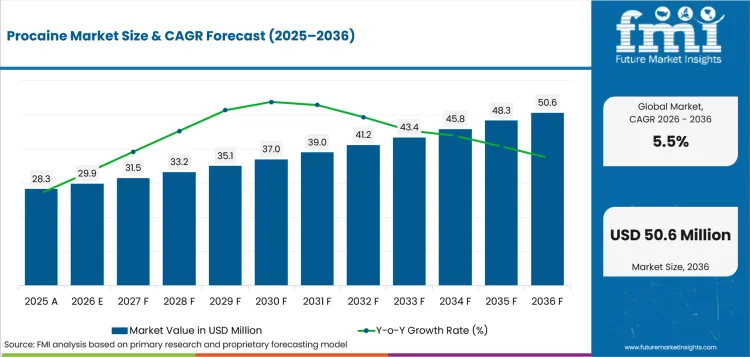
| Metric | Value |
|---|---|
| 2025 Market Size | USD 28.3677 million. |
| 2026 Market Size | USD 30.0674 million. |
| 2036 Market Size | USD 51.6142 million. |
| Forecast CAGR | 5.5522% from 2026 to 2036. |
| Featured Form | Procaine Hydrochloride (HCl). |
| Procaine Hydrochloride (HCl) Share in 2026 | 52.4%. |
| Featured Formulation | Injectable Solution. |
| Injectable Solution Share in 2026 | 46.8%. |
| Country CAGR Highlight | China. |
| China CAGR | 6.4% by 2036. |
Summary of the Procaine Market
| Market Signal | Commercial Impact |
|---|---|
| Demand and Growth Drivers | Clinical and veterinary applications continue to sustain demand for procaine-based formulations.
|
| Product and Segment View | Procaine Hydrochloride (HCl), injectable formulations, and dental anesthesia remain the leading market segments.
|
| Geography and Competitive Outlook | East Asia, Europe, and North America remain key regional markets for procaine products.
|
| Analyst Perspective | Procaine remains a niche pharmaceutical market where quality, regulatory compliance, and supply reliability outweigh volume growth.
— Anurag Sharma, Principal Consultant, Healthcare Domain, Future Market Insights |
In February 2025, PMDA listed Procanin 0.5% and 1% procaine hydrochloride injections from Hikari Pharmaceutical. This supports Japan’s current human injection evidence. In March 2026, the UK VMD revised product information for procaine benzylpenicillin dosing. This supports controlled veterinary demand in the United Kingdom.
The same database lists animal products containing penicillin G procaine and procaine benzylpenicillin.
Why is the Procaine Market growing?
Procaine hydrochloride keeps a clinical role in local infiltration and peripheral nerve block where labeled injectable solutions remain listed. Veterinary procaine benzylpenicillin demand supports repeat buying as livestock products require controlled prescription supply.
- Procaine hydrochloride keeps a clinical role in local infiltration and peripheral nerve block where labeled injectable solutions remain listed.
- Veterinary procaine benzylpenicillin demand supports repeat buying as livestock products require controlled prescription supply.
- Dental and minor surgical use sustains niche demand as clinicians retain familiar short-duration anesthetic options.
Clinical demand behaves like a niche replacement cycle. DailyMed states that Novocain sterile solutions are available in 1% and 2% concentrations for local infiltration and peripheral nerve block. This shows that demand is anchored in regulated injectable use rather than general wellness or OTC positioning. The practical result is a market where buyers care about sterility, stability, and label alignment more than marketing claims. Suppliers that can provide consistent documentation and ready regulatory files have a clearer route to hospital and clinic buyers. Veterinary use gives procaine a second demand channel with different buying behavior. DailyMed lists products such as Norocillin, PenOne Pro, Quartermaster, and Bactracillin G under penicillin G procaine or related animal drug labels.
How is the Procaine Market segmented?
The Procaine Market is segmented by form, formulation, therapeutic application, sales channel, and region.
- With an estimated 52.4% share in 2026, Procaine Hydrochloride (HCl) is expected to support By Form due to injectable formulation compatibility.
- Injectable Solution is projected to represent 46.8% of By Formulation demand in 2026 as sterile liquid formats suit clinical administration.
- Dental Anesthesia buyers are expected to push the By Therapeutic Application share to 38.5% in 2026 due to procedure-linked use.
How does Procaine Hydrochloride (HCl) contribute to the form category?
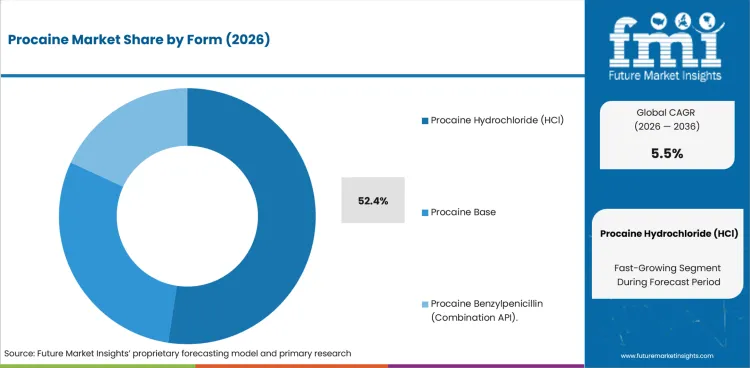
- Procaine Hydrochloride (HCl) is projected to account for 52.4% of By Form demand in 2026 since the salt form supports sterile injection preparation and label-defined dosing.
- Buyers compare the HCl form on assay, impurity limits, and injectable compatibility. This makes pharmacopeial documentation a larger purchase factor than bulk price alone.
What supports demand for Injectable Solution?
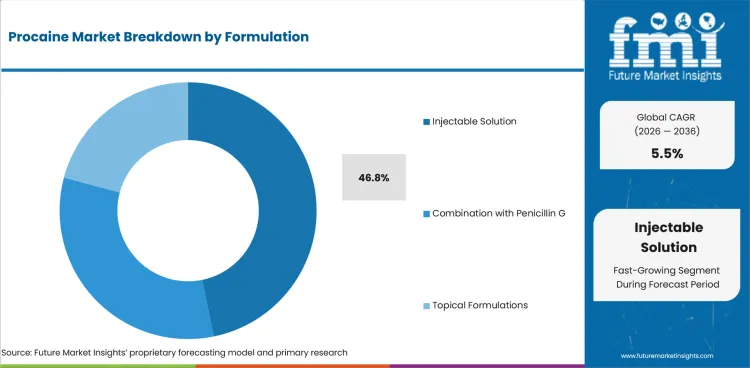
- Injectable Solution is estimated to hold 46.8% of By Formulation demand in 2026 as clinics and hospital pharmacies favor controlled sterile packaging.
- Ready injectable formats reduce compounding risk for small-volume use. They also keep suppliers tied to drug-device packaging and cold-chain handling rules.
How do buyers evaluate Dental Anesthesia within the therapeutic application category?
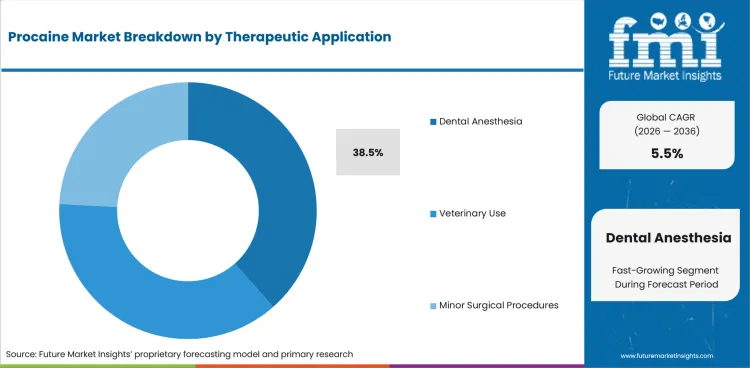
- Dental Anesthesia is anticipated to represent 38.5% of By Therapeutic Application demand in 2026 as legacy use persists in selected procedures.
- Procaine’s short duration creates a narrow fit for procedure-linked numbness. It loses share where longer-acting amide anesthetics better match chair-time economics.
What market factors influence demand for Hospital Pharmacies?
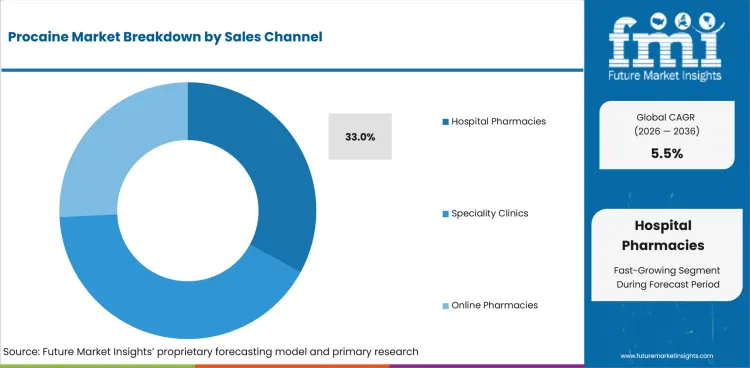
- Hospital Pharmacies are expected to account for 33.0% of By Sales Channel demand in 2026 due to prescription control and injectable stock governance.
- Stocking decisions often follow formulary status and supplier continuity. Shortage risk matters because low-volume injectable products can lose supplier attention faster than high-volume drugs.
How does East Asia affect the regional outlook?
- East Asia is projected to account for 30.0% of By Region demand in 2026 as China and Japan support active product listings and API supply.
- Japan keeps procaine hydrochloride injections visible through PMDA listings. China shows approval activity for procaine hydrochloride injection through NMPA delivery records.
What drives and restrains the market?
The market reflects a balance between the identified demand driver, adoption constraints, and the supplier opportunity outlined below.
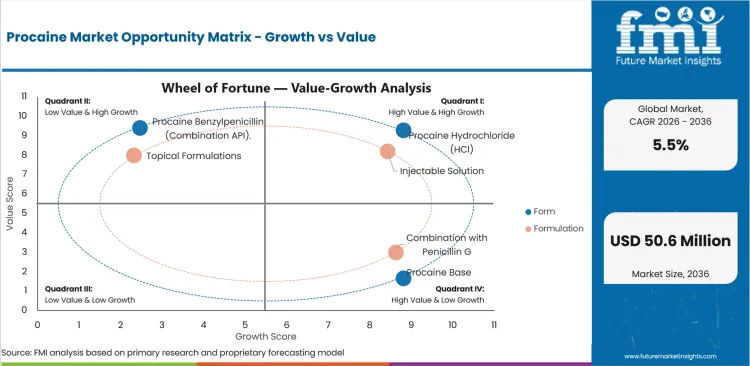
Driver: Injectable label continuity supports demand where procaine hydrochloride remains listed for infiltration and nerve block; restraint: Amide anesthetic substitution restrains growth as lidocaine and related drugs dominate many routine clinical procedures; opportunity: pharmacopeial quality control creates an opportunity for API suppliers with impurity and sterile documentation strength.
- Driver: Injectable label continuity supports demand where procaine hydrochloride remains listed for infiltration and nerve block.
- Restraint: Amide anesthetic substitution restrains growth as lidocaine and related drugs dominate many routine clinical procedures.
- Opportunity: pharmacopeial quality control creates an opportunity for API suppliers with impurity and sterile documentation strength.
Injectable Label Continuity Regulated labels keep procaine demand visible even when the molecule is no longer the default local anesthetic in many settings. DailyMed states that Novocain is indicated for local or regional analgesia and anesthesia by local infiltration and peripheral nerve block techniques. This keeps the product relevant for specific clinical workflows. The mechanism is simple: if a medicine remains listed and stocked, buyers need compatible API supply and finished injectable formats. This supports a stable forecast even though routine anesthesia often uses substitutes.
Veterinary Penicillin Pairing: Veterinary demand is not just anesthesia use. EMA states that injectable veterinary medicines containing procaine benzylpenicillin have been marketed in many EU Member States and should be used prudently. This creates a controlled demand channel shaped by veterinarian prescription and antimicrobial policy. Suppliers must understand that growth comes from compliant treatment use, not broad antibiotic expansion. This favors companies with product information alignment and distributors that can serve livestock channels under strict rules. Substitute Anesthetic Pressure: The substantial restraint is the strong position of amide local anesthetics.
Which factors support expansion?
- Commercial expansion is reinforced by the value, workflow, and recurring-demand factors below.
- The market value is rising as sterile injectable buyers continue to need procaine hydrochloride for defined local anesthesia uses.
- Veterinary combinations support recurring demand as procaine benzylpenicillin products serve livestock infection treatment under prescription channels.
- API buyers give weight to pharmacopeial grades as procaine hydrochloride quality affects injectable stability and release documentation.
Which country markets are included in the CAGR comparison?
The selected CAGR comparison covers China (6.4%), India (6.1%), South Korea (5.8%), Japan (5.4%), and Germany (5.3%) through 2036.
.webp "Top Country Growth Comparison Procaine Market Cagr (2026 2036)")
| Country | CAGR |
|---|---|
| China | 6.4% |
| India | 6.1% |
| South Korea | 5.8% |
| Japan | 5.4% |
| Germany | 5.3% |
Source: Future Market Insights analysis based on the supplied country forecast table.
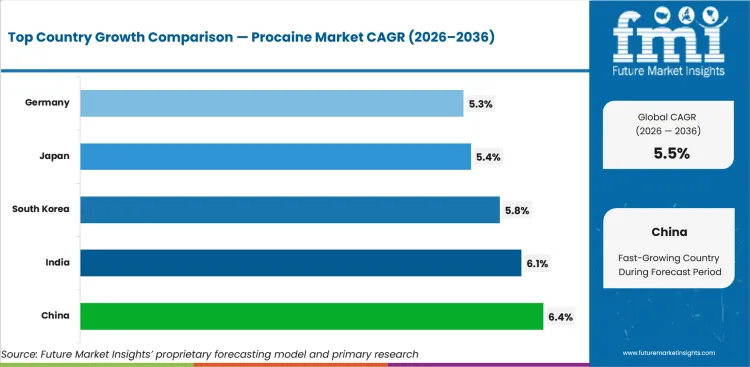
How do country-level CAGRs compare?
- China (CAGR: 6.4%): Product instructions cover procaine hydrochloride injection for local anesthesia use.
- India (CAGR: 6.1%): India is a documentation and price-sensitive market.
- South Korea (CAGR: 5.8%): South Korea is a smaller but quality-sensitive procaine market.
- Japan (CAGR: 5.4%): Japan has one of the clearer human clinical signals among the selected countries.
- Germany (CAGR: 5.3%): Germany is a compliance-heavy procaine market.
The global Procaine Market is forecast to record a CAGR of 5.5522% from 2026 to 2036. The supplied study covers 8 named country forecasts across the report regions.
How is the Procaine Market developing in China?
China is projected to record a CAGR of 6.4% through 2036. The country outlook identifies this demand signal: Product instructions cover procaine hydrochloride injection for local anesthesia use.
Country Market Snapshot
| Country | China |
|---|---|
| Forecast CAGR | 6.4% |
| Regulatory proof | NMPA records show procaine hydrochloride injection approval document delivery information in June 2026. |
| API signal | NMPA historical records mention sterile API lines for procaine penicillin. |
| Demand anchor | Product instructions cover procaine hydrochloride injection for local anesthesia use. |
| Supply role | China is a supply-side center for procaine and procaine combination intermediates. |
| Buyer behavior | Domestic formulation buyers prioritize approval status and manufacturing compliance. |
| Restraint | Public evidence on active exporters varies by company and should be checked buyer by buyer. |
| Primary demand signal | Product instructions cover procaine hydrochloride injection for local anesthesia use. |
Market Outlook
China is both a demand market and a supply-side market for procaine. NMPA records show product instructions and approval document activity for procaine hydrochloride injection. This makes China the notable growth case among the selected countries. The market benefits from domestic regulatory visibility and upstream manufacturing depth. China is expected to record a CAGR of 6.4% through 2036 as approvals and API capacity support wider commercial availability. NMPA’s June 2026 delivery information lists procaine hydrochloride injection under approval document delivery.
Key Growth Drivers
- NMPA approval activity supports current product continuity.
- Domestic API manufacturing capacity supports supply-side competitiveness.
- Hospital and clinic demand benefits from local labeled injection availability.
- Product instructions cover procaine hydrochloride injection for local anesthesia use.
Key Restraints
- Supplier evidence must be checked carefully due to varied public documentation quality.
- Domestic price competition can compress margins for commodity-grade API sellers.
- Public evidence on active exporters varies by company and should be checked buyer by buyer.
Country Market FAQs
Why should executives monitor Procaine Market demand in China?
Executives should monitor China because local buyer readiness, product instructions cover procaine hydrochloride injection for local anesthesia use, and service capacity can influence account timing and market-entry priorities.
What should suppliers localize for China?
Suppliers should localize proof points, pricing logic, partner coverage, and training support around buyer access and account ownership and local support coverage.
What adoption risk needs attention in China?
Executive teams should watch adoption risk because supplier evidence must be checked carefully due to varied public documentation quality can delay conversion from evaluation to commercial deployment.
How is the Procaine Market developing in India?
India is projected to record a CAGR of 6.1% through 2036. The country outlook identifies this demand signal: IP monographs support quality specifications for buyers and manufacturers.
Country Market Snapshot
| Country | India |
|---|---|
| Forecast CAGR | 6.1% |
| Regulatory proof | CDSCO veterinary approved drug material lists Procaine Benzyl Penicillin IP and Procaine Penicillin IP. |
| Pharmacopoeial proof | Indian Pharmacopoeia material lists procaine hydrochloride and procaine penicillin monographs. |
| FDC signal | CDSCO public notices include sodium fluoride with procaine hydrochloride injection for a narrow indication. |
| Buyer behavior | Price-sensitive procurement favors IP-grade documentation and stable domestic supply. |
| Supply route | API traders and pharmaceutical manufacturers serve hospital and veterinary buyers. |
| Restraint | Modern local anesthetics reduce mainstream procedure reliance on procaine. |
| Primary demand signal | India is a documentation and price-sensitive market. |
Market Outlook
India is a documentation and price-sensitive market. Procaine demand appears through pharmacopoeial monographs, veterinary drug lists, and selected fixed-dose combination references. The market is less visible through branded national product labels. Buyers therefore depend on IP compliance and supplier credibility. India is projected to record a CAGR of 6.1% through 2036 as domestic pharmaceutical manufacturing and veterinary demand support steady growth. CDSCO’s veterinary approved drug list includes Procaine Benzyl Penicillin IP and Procaine Penicillin IP.
Key Growth Drivers
- IP monographs support quality specifications for buyers and manufacturers.
- Veterinary drug references support procaine penicillin use in animal health.
- Domestic API sourcing channels support price-sensitive procurement.
- India combines price-sensitive procurement with strong pharmacopoeial anchors for procaine hydrochloride and procaine penicillin.
Key Restraints
- Public evidence for named procaine API manufacturers is mixed and often commercial.
- Lidocaine-based products limit procaine use in routine clinical anesthesia.
- Modern local anesthetics reduce mainstream procedure reliance on procaine.
Country Market FAQs
Why should executives monitor Procaine Market demand in India?
Executives should monitor India because local buyer readiness, local use-case priorities, and service capacity can influence account timing and market-entry priorities.
What should suppliers localize for India?
Suppliers should localize proof points, pricing logic, partner coverage, and training support around api traders and pharmaceutical manufacturers serve hospital and veterinary buyers and local support coverage.
What adoption risk needs attention in India?
Executive teams should watch adoption risk because public evidence for named procaine api manufacturers is mixed and often commercial can delay conversion from evaluation to commercial deployment.
How is the Procaine Market developing in South Korea?
South Korea is projected to record a CAGR of 5.8% through 2036. The country outlook identifies this demand signal: Regulated medicine control supports quality-screened sourcing.
Country Market Snapshot
| Country | South Korea |
|---|---|
| Forecast CAGR | 5.8% |
| Regulatory context | Korea’s Ministry of Food and Drug Safety provides pharmacopoeial and medicine control frameworks. |
| Veterinary reference | MFDS material includes procaine in animal-related regulatory lists. |
| Clinical demand | Direct public evidence for human procaine products is weaker than Japan or China. |
| Buyer behavior | Hospitals and clinics generally favor better documented local anesthetic alternatives. |
| Supply route | Importers and regulated wholesalers are likely to shape procaine availability. |
| Restraint | Limited public product visibility raises evidence uncertainty. |
| Primary demand signal | South Korea is a smaller but quality-sensitive procaine market. |
Market Outlook
South Korea is a smaller but quality-sensitive procaine market. Demand is likely tied to regulated medicine supply and veterinary control rather than broad clinical expansion. Public evidence is not as direct as PMDA or NMPA evidence. That makes cautious supplier positioning important. South Korea is forecast to grow at a CAGR of 5.8% through 2036 due to broader regional API access and regulated medicine demand. MFDS material includes procaine in animal-related regulatory content, which supports a limited veterinary relevance signal.
Key Growth Drivers
- Regulated medicine control supports quality-screened sourcing.
- Veterinary references create a limited but real product relevance signal.
- Regional access to East Asian API supply improves sourcing flexibility.
- South Korea’s role is a controlled access market where documentation strength matters more than public product breadth.
Key Restraints
- Direct public product evidence is thinner than in Japan or China.
- Substitute anesthetics limit broad clinical pull in hospital purchasing.
- Limited public product visibility raises evidence uncertainty.
Country Market FAQs
Why should executives monitor Procaine Market demand in South Korea?
Executives should monitor South Korea because local buyer readiness, local use-case priorities, and service capacity can influence account timing and market-entry priorities.
What should suppliers localize for South Korea?
Suppliers should localize proof points, pricing logic, partner coverage, and training support around importers and regulated wholesalers are likely to shape procaine availability and local support coverage.
What adoption risk needs attention in South Korea?
Executive teams should watch adoption risk because direct public product evidence is thinner than in japan or china can delay conversion from evaluation to commercial deployment.
How is the Procaine Market developing in Japan?
Japan is projected to record a CAGR of 5.4% through 2036. The country outlook identifies this demand signal: PMDA listings confirm active human procaine hydrochloride injection products.
Country Market Snapshot
| Country | Japan |
|---|---|
| Forecast CAGR | 5.4% |
| Regulatory proof | PMDA lists procaine hydrochloride injection products in Japanese medical drug information. |
| Company signal | PMDA identifies Hikari Pharmaceutical as a manufacturer for Procanin 0.5% and 1% injections. |
| Dose range | PMDA labeling describes usual adult dosing of 10 mg to 400 mg for conduction anesthesia. |
| Use profile | Japan retains visible clinical procaine hydrochloride injections. |
| Buyer behavior | Hospital and clinic procurement depends on domestic labeling and manufacturer reliability. |
| Restraint | Newer anesthetics limit broad replacement demand. |
| Primary demand signal | Japan has one of the clearer human clinical signals among the selected countries. |
Market Outlook
Japan has one of the clearer human clinical signals among the selected countries. PMDA records list procaine hydrochloride injections and identify domestic manufacturers. This supports a regulated hospital and clinic channel. The market does not rely only on imports or veterinary combinations. Japan is projected to grow at a CAGR of 5.4% through 2036 as local listings keep procaine clinically visible.
Key Growth Drivers
- PMDA listings confirm active human procaine hydrochloride injection products.
- Domestic manufacturer visibility supports confidence in supply continuity.
- Procedure-specific dosing supports controlled clinical use.
- Hospital pharmacy tenders.
Key Restraints
- Routine dental and surgical practice often favors newer local anesthetics.
- Japan’s strict documentation expectations raise market entry friction for API suppliers.
- Newer anesthetics limit broad replacement demand.
Country Market FAQs
Why should executives monitor Procaine Market demand in Japan?
Executives should monitor Japan because local buyer readiness, local use-case priorities, and service capacity can influence account timing and market-entry priorities.
What should suppliers localize for Japan?
Suppliers should localize proof points, pricing logic, partner coverage, and training support around buyer access and account ownership and local support coverage.
What adoption risk needs attention in Japan?
Executive teams should watch adoption risk because routine dental and surgical practice often favors newer local anesthetics can delay conversion from evaluation to commercial deployment.
How is the Procaine Market developing in Germany?
Germany is projected to record a CAGR of 5.3% through 2036. The country outlook identifies this demand signal: EU pharmacopoeial alignment supports quality-led purchasing.
Country Market Snapshot
| Country | Germany |
|---|---|
| Forecast CAGR | 5.3% |
| Regulatory frame | Germany operates inside the European pharmacopoeial and EMA veterinary medicine environment. |
| Quality anchor | European Pharmacopoeia index listings include benzylpenicillin procaine and related monographs. |
| Clinical profile | Procaine is used in selected local anesthesia and neural therapy settings. |
| Supply route | Pharmacies and clinics require compliant API and sterile formulation documentation. |
| Competitive restraint | Amide anesthetics dominate routine procedure use in mainstream care. |
| Buyer behavior | Procurement favors suppliers with EU-standard documentation and batch traceability. |
| Primary demand signal | Germany is a compliance-heavy procaine market. |
Market Outlook
Germany is a compliance-heavy procaine market. Buyers give high weight to pharmacopeial alignment, batch records, and injectable quality documents. Demand is not driven by mass procedure growth. It comes from selected local anesthetic use, compounded practice needs, and veterinary procaine benzylpenicillin exposure through the wider European system. Germany is forecast to grow at a CAGR of 5.3% through 2036 as EU quality frameworks support higher-value supply. The European Pharmacopoeia index includes benzylpenicillin procaine, which anchors specifications for regulated buyers.
Key Growth Drivers
- EU pharmacopoeial alignment supports quality-led purchasing.
- German clinics favor documented sterile injectable supply over weak trader channels.
- Veterinary and specialty clinic demand supports repeat but selective buying.
- Germany’s distinct role is quality-sensitive procurement through EU standards and strict clinical supply expectations.
Key Restraints
- Lidocaine and other amide anesthetics limit mainstream clinical share.
- Country-specific public company evidence is limited outside broader EU and product references.
- Amide anesthetics dominate routine procedure use in mainstream care.
Country Market FAQs
Why should executives monitor Procaine Market demand in Germany?
Executives should monitor Germany because local buyer readiness, local use-case priorities, and service capacity can influence account timing and market-entry priorities.
What should suppliers localize for Germany?
Suppliers should localize proof points, pricing logic, partner coverage, and training support around pharmacies and clinics require compliant api and sterile formulation documentation and local support coverage.
What adoption risk needs attention in Germany?
Executive teams should watch adoption risk because lidocaine and other amide anesthetics limit mainstream clinical share can delay conversion from evaluation to commercial deployment.
Which companies are discussed in the Procaine Market?
The preview discusses Pfizer, Hospira, Norbrook Laboratories, Zoetis, and MWI Veterinary Supply among the companies active in this market.
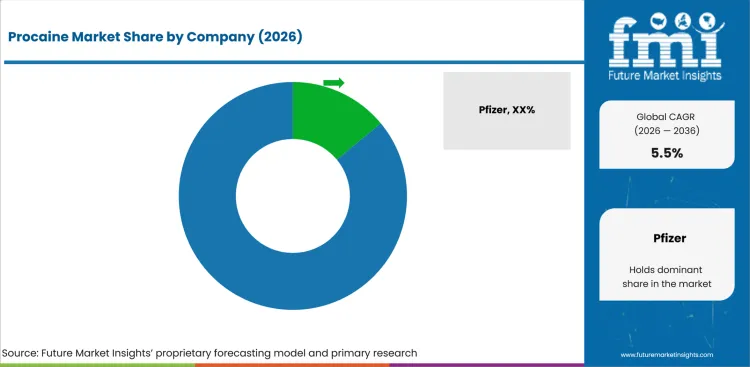
The market is moderately fragmented because human injection, veterinary products, and API supply follow different buying routes. Pfizer and Hospira hold visible positions in USA label evidence through Bicillin C-R and Novocain listings. Veterinary players compete through product registration coverage and distributor access in livestock medicine channels.
Smaller API suppliers can win by offering pharmacopeial files and stable batch documentation. Entry barriers include sterile injectable compliance, impurity control, and country-specific product authorization. Company competition in procaine is shaped by evidence quality and channel fit. Hospira appears in DailyMed listings for procaine hydrochloride injection.
How is competition structured?
Competition reflects differences in specialization, portfolio scope, geographic reach, evidence, and customer access.
The market includes human injectable packagers, veterinary medicine suppliers, and API or powder suppliers with product evidence.
- Human Injectable Participants: Hospira and Pfizer hold the notable visible USA human product evidence. Hospira appears in DailyMed listings for Novocain procaine hydrochloride injection. Pfizer appears in Bicillin C-R listings containing penicillin G benzathine and penicillin G procaine.
- Veterinary Product Participants: Norbrook Laboratories, Zoetis, Aspen Veterinary Resources, MWI Veterinary Supply, and US Vet Inc. appear across DailyMed animal drug labels. Their role is tied to penicillin G procaine suspensions and intramammary or injectable veterinary products.
- API and Powder Participants: BlueBay Shandong appears in DailyMed search results for Procaine HCl powder. China-based API suppliers are important to the supply side, but company-level public evidence varies.
How do selected companies compare?
The selected companies differ in portfolio focus, geographic reach, evidence depth, and channel strength.
| Company | Competitive position |
|---|---|
| Pfizer | Pfizer appears in Bicillin C-R listings containing penicillin G benzathine and penicillin G procaine. |
| Hospira | Hospira appears in DailyMed listings for procaine hydrochloride injection. |
| Norbrook Laboratories | Veterinary Product Participants: Norbrook Laboratories, Zoetis, Aspen Veterinary Resources, MWI Veterinary Supply, and US Vet Inc. appear across DailyMed animal drug labels. |
| Zoetis | Veterinary Product Participants: Norbrook Laboratories, Zoetis, Aspen Veterinary Resources, MWI Veterinary Supply, and US Vet Inc. appear across DailyMed animal drug labels. |
| MWI Veterinary Supply | Veterinary Product Participants: Norbrook Laboratories, Zoetis, Aspen Veterinary Resources, MWI Veterinary Supply, and US Vet Inc. appear across DailyMed animal drug labels. |
What are the key developments in the Procaine Market?
- In February 2025, PMDA listed Procanin 0.5% and 1% procaine hydrochloride injections from Hikari Pharmaceutical. This supports Japan’s current human injection evidence.
- In March 2026, the UK VMD revised product information for procaine benzylpenicillin dosing. This supports controlled veterinary demand in the United Kingdom.
- In June 2026, NMPA listed delivery information for procaine hydrochloride injection approval documents. This supports current Chinese regulatory activity.
Selected Companies in the Procaine Market
- Companies referenced in this preview
- Pfizer.
- Hospira.
- Norbrook Laboratories.
- Zoetis.
- MWI Veterinary Supply.
- Aspen Veterinary Resources.
- US Vet Inc.
- BlueBay Shandong.
Market Scope & Definition
| Market definition | The Procaine Market covers procaine base, procaine hydrochloride, and procaine benzylpenicillin used as pharmaceutical active ingredients or formulation inputs. It includes injectable local anesthetic solutions, penicillin G combination products, topical formulations, and veterinary procaine products. |
|---|---|
| Functions covered | Procaine Base, Procaine Hydrochloride (HCl), Procaine Benzylpenicillin (Combination API) |
| Applications covered | Dental Anesthesia, Veterinary Use, Minor Surgical Procedures, Others |
| End-use industries | Pharmaceutical manufacturers, generic formulation companies, hospital procurement channels, and regulated distributors |
| Inclusions | Market scope covers Procaine Base, Procaine Hydrochloride (HCl), Procaine Benzylpenicillin (Combination API), Injectable Solution, Combination with Penicillin G, Topical Formulations, Dental Anesthesia, Veterinary Use, Minor Surgical Procedures, Others, Hospital Pharmacies, Speciality Clinics, Retail Pharmacy Chains, Online Pharmacies, Veterinary Clinics, North America, Latin America, East Asia, South Asia & Pacific, Europe, and Middle East & Africa. |
| Exclusions | Market scope excludes lidocaine, tetracaine, benzocaine, chloroprocaine, bupivacaine, ropivacaine, general anesthesia drugs, injectable device revenue, and veterinary antibiotics that do not contain procaine or procaine benzylpenicillin. |
Research Methodology
| Primary Research | FMI analysts reviewed inputs from API buyers, injectable formulation specialists, hospital pharmacy stakeholders, veterinary medicine distributors, and dental clinic supply channels. These inputs helped define the difference between molecule demand and broader local anesthetic demand. |
|---|---|
| Desk Research | used drug labels, medicine databases, pharmacopoeial references, veterinary product listings, and official regulator sources. These references helped define the product pool and avoid counting adjacent anesthetic APIs. |
| Market Sizing and Forecasting | The model combined supplied market anchors, formulation mix, country-level access signals, estimated API use rates, and channel structure. Forecast growth reflects replacement demand, veterinary combination use, and China-centered supply availability. |
| Data Validation | Forecasts were checked against local anesthetic substitutes, veterinary antibiotic labels, and procaine-containing product records. Company inclusion was limited to entities with direct evidence of procaine or procaine combination participation. |
What does the report cover?
The report covers form, formulation, therapeutic application, sales channel, and region across the 2026-2036 forecast period in 30+ countries.
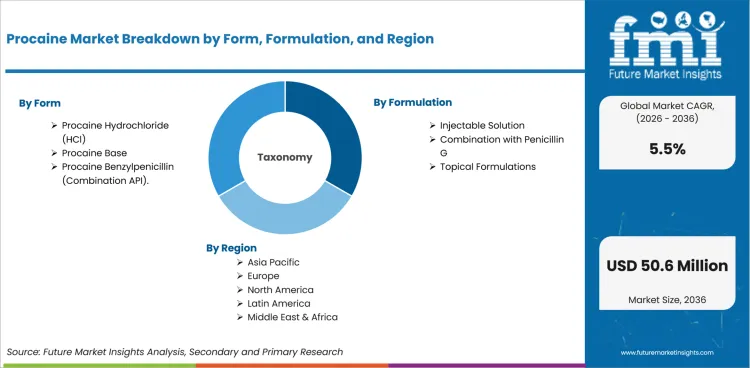
| Periods | Base year 2025; estimated year 2026; forecast period 2026-2036 |
|---|---|
| Quantitative units | USD 30.0674 million in 2026 to USD 51.6142 million by 2036, at a CAGR of 5.5522% |
| Segment axes | form, formulation, therapeutic application, sales channel, and region |
| Regions | North America, Latin America, Europe, East Asia, South Asia and Pacific, Middle East and Africa |
| Countries | United States, United Kingdom, Germany, France, Japan, China, South Korea, India and 30+ |
| Companies | Pfizer, Hospira, Norbrook Laboratories, Zoetis, MWI Veterinary Supply, Aspen Veterinary Resources, US Vet Inc., BlueBay Shandong |
| Approach | Hybrid bottom-up and selected-down methodology starting with verified product evidence, formulation use, channel demand, and country-level availability signals. |
Market Segmentation Analysis
Segmented by Form
- Procaine Base.
- Procaine Hydrochloride (HCl).
- Procaine Benzylpenicillin (Combination API).
Segmented by Formulation
- Injectable Solution.
- Combination with Penicillin G.
- Topical Formulations.
Segmented by Therapeutic Application
- Dental Anesthesia.
- Veterinary Use.
- Minor Surgical Procedures.
- Others.
Segmented by Sales Channel
- Hospital Pharmacies.
- Speciality Clinics.
- Retail Pharmacy Chains.
- Online Pharmacies.
- Veterinary Clinics.
Research Sources and Bibliography
- 1. DailyMed. (2026). Novocain- Procaine Hydrochloride injection, solution. National Library of Medicine. https://dailymed.nlm.nih.gov/dailymed/drugInfo.cfm? setid=c80c810a-60e0-49bd-139c-95aec3a286fc
- 2. DailyMed. (2026). Search Results for Penicillin G Procaine. National Library of Medicine. https://dailymed.nlm.nih.gov/dailymed/search.cfm? labeltype=all&query=PENICILLIN+G+PROCAINE
- 3. MedlinePlus. (2026, March 15). Penicillin G Procaine Injection. National Library of Medicine. https://medlineplus.gov/druginfo/meds/a615052.html
- 4. European Medicines Agency. (2022, February 23). Procaine benzylpenicillin referral. European Medicines Agency. https://www.ema.europa.eu/en/medicines/veterinary/referrals/procaine-benzylpenicillin
- 5. Veterinary Medicines Directorate. (2026, March). Summary of Product Characteristics: Procaine Benzylpenicillin. UK Government. https://www.vmd.defra.gov.uk/productinformationdatabase/files/SPCDocuments/SPC2124178.PDF
- 6. Veterinary Medicines Directorate. (2025, December). Procanest 40 mg/ml + 0.036 mg/ml solution for injection. UK Government. https://www.vmd.defra.gov.uk/productinformationdatabase/files/QRDDocuments/QRD-Auth2242198.PDF
- 7. ANSES. (2026). PROCAPEN INJECTOR suspension intramammaire pour bovins. Agence nationale du médicament vétérinaire. https://www.ircp.anmv.anses.fr/rcp.aspx? NomMedicament=PROCAPEN+INJECTOR+SUSPENSION+INTRAMAMMAIRE+POUR+BOVINS
- 8. Pharmaceuticals and Medical Devices Agency. (2025, February 17). Procanin injection 0.5% and 1%. PMDA. https://www.pmda.go.jp/PmdaSearch/rdSearch/02/1211401A3044
- 9. National Medical Products Administration. (2026, June 8). Drug approval document delivery information. NMPA. https://www.nmpa.gov.cn/zwfw/sdxx/sdxxyp/yppjfb/20260608163307141.html
- 10. Central Drugs Standard Control Organization. (2014, August 22). List of veterinary drugs approved. CDSCO. https://cdsco.gov.in/opencms/resources/UploadCDSCOWeb/2018/Bio_sop/Final%20List%20of%20Veterinary%20approved%20drugs.pdf
- 11. Indian Pharmacopoeia Commission. (2019). Addendum 2019 to Indian Pharmacopoeia 2018. IPC. https://www.ipc.gov.in/images/IPAddendum2019toIP_2018.pdf
- 12. World Health Organization. (2025, March 17). Oral health. WHO. https://www.who.int/news-room/fact-sheets/detail/oral-health
The bibliography is provided for reader reference, and all listed sources are government, regulatory, official health body, or official medicine database publications.
This Report Answers
- What is the projected value of the Procaine Market in 2026?
- What value is forecast for the Procaine Market by 2036?
- What CAGR is forecast for the Procaine Market from 2026 to 2036?
- What 2026 share is projected for Procaine Hydrochloride (HCl) within the form category?
- What 2026 share is projected for Injectable Solution within the formulation category?
- Which demand factors support the Procaine Market outlook?
- Which restraints and opportunities affect adoption in the Procaine Market?
- How are country CAGR outlooks, including China at 6.4%, compared?
- Which companies and product developments are covered in the competitive analysis?
- What is included in the market scope, and how is the forecast validated?
Frequently Asked Questions
Why should executives track the Procaine Market?
Executives should track this market because it can affect capital allocation, supplier strategy, operating risk, and competitive positioning across applications.
What business problem does the Procaine Market address?
It helps executive teams judge where customer pain, supplier capability, compliance exposure, and implementation economics justify investment, procurement, or market-entry decisions.
What should procurement leaders evaluate before selecting suppliers?
Procurement leaders should assess evidence quality, integration fit, service coverage, compliance readiness, total cost of ownership, and supplier execution capability.
What can limit return on investment for buyers?
Return on investment can be limited by low utilization, integration delays, training gaps, unclear ownership, pricing pressure, or weak fit with existing workflows.
How can suppliers build executive confidence?
Suppliers can build confidence by proving implementation speed, risk reduction, support depth, reference use cases, and measurable outcomes for budget owners.
Preview the report firsthand - request a free sample
Get SampleGet the brochure for pricing and purchase details.
Get PDFTable of Content
- Key Takeaways
- Market Size and CAGR
- Top Growth Driver
- Fastest Growing Segment
- Leading Region
- Key Companies
- Emerging Opportunities
- Executive Summary
- Global Market Outlook
- Demand-side Trends
- Supply-side Trends
- Technology Roadmap Analysis
- Analysis and Recommendations
- Analyst Perspective (What is happening? Why now? What should investors know?)
- Key Questions Answered
- How large is the market?
- What is the CAGR?
- What are key trends?
- Which region dominates?
- Who are the leaders?
- Market Overview
- Market Coverage / Taxonomy
- Market Definition / Scope / Limitations
- Research Methodology
- Chapter Orientation
- Analytical Lens and Working Hypotheses
- Market Structure, Signals, and Trend Drivers
- Benchmarking and Cross-market Comparability
- Market Sizing, Forecasting, and Opportunity Mapping
- Research Design and Evidence Framework
- Desk Research Programme (Secondary Evidence)
- Expert Input and Fieldwork (Primary Evidence)
- Tooling, Models, and Reference Databases
- Data Engineering and Model Build
- Quality Assurance and Audit Trail
- Market Background
- Market Dynamics (Drivers, Restraints, Opportunity, Trends)
- Scenario Forecast (Optimistic, Likely, Conservative)
- Impact Analysis
- AI Impact
- Sustainability Impact
- Regulatory Impact
- Technology Impact
- Consumer / Buyer Analysis
- Purchase Drivers
- Adoption Barriers
- Buyer Journey
- Opportunity Map Analysis
- Product Life Cycle Analysis
- Supply Chain Analysis
- Investment Feasibility Matrix
- Value Chain Analysis
- PESTLE and Porter's Analysis
- Regulatory Landscape
- Regional Parent Market Outlook
- Production and Consumption Statistics
- Import and Export Statistics
- Global Market Analysis and Forecast, 2021 to 2036
- Historical Market Size Value (USD Million) Analysis, 2021 to 2025
- Current and Future Market Size Value (USD Million) Projections, 2026 to 2036
- Y-o-Y Growth Trend Analysis
- Absolute $ Opportunity Analysis
- Global Market Pricing Analysis, 2021 to 2036
- Global Market Analysis and Forecast, By Form, 2021 to 2036
- Introduction / Key Findings
- Historical Market Size Value (USD Million) Analysis By Form, 2021 to 2025
- Current and Future Market Size Value (USD Million) Analysis and Forecast By Form, 2026 to 2036
- Procaine Hydrochloride (HCl)
- Procaine Base
- Procaine Benzylpenicillin (Combination API).
- Procaine Hydrochloride (HCl)
- Y-o-Y Growth Trend Analysis By Form, 2021 to 2025
- Absolute $ Opportunity Analysis By Form, 2026 to 2036
- Global Market Analysis and Forecast, By Formulation, 2021 to 2036
- Introduction / Key Findings
- Historical Market Size Value (USD Million) Analysis By Formulation, 2021 to 2025
- Current and Future Market Size Value (USD Million) Analysis and Forecast By Formulation, 2026 to 2036
- Injectable Solution
- Combination with Penicillin G
- Topical Formulations
- Injectable Solution
- Y-o-Y Growth Trend Analysis By Formulation, 2021 to 2025
- Absolute $ Opportunity Analysis By Formulation, 2026 to 2036
- Global Market Analysis and Forecast, By Therapeutic Application, 2021 to 2036
- Introduction / Key Findings
- Historical Market Size Value (USD Million) Analysis By Therapeutic Application, 2021 to 2025
- Current and Future Market Size Value (USD Million) Analysis and Forecast By Therapeutic Application, 2026 to 2036
- Dental Anesthesia
- Veterinary Use
- Minor Surgical Procedures
- Dental Anesthesia
- Y-o-Y Growth Trend Analysis By Therapeutic Application, 2021 to 2025
- Absolute $ Opportunity Analysis By Therapeutic Application, 2026 to 2036
- Global Market Analysis and Forecast, By Sales Channel, 2021 to 2036
- Introduction / Key Findings
- Historical Market Size Value (USD Million) Analysis By Sales Channel, 2021 to 2025
- Current and Future Market Size Value (USD Million) Analysis and Forecast By Sales Channel, 2026 to 2036
- Hospital Pharmacies
- Speciality Clinics
- Online Pharmacies
- Hospital Pharmacies
- Y-o-Y Growth Trend Analysis By Sales Channel, 2021 to 2025
- Absolute $ Opportunity Analysis By Sales Channel, 2026 to 2036
- Global Market Analysis and Forecast, By Region, 2021 to 2036
- Introduction
- Historical Market Size Value (USD Million) Analysis By Region, 2021 to 2025
- Current Market Size Value (USD Million) Analysis and Forecast By Region, 2026 to 2036
- North America
- Latin America
- Western Europe
- Eastern Europe
- East Asia
- South Asia and Pacific
- Middle East & Africa
- Market Attractiveness Analysis By Region
- North America Market Analysis and Forecast, By Country, 2021 to 2036
- Historical Market Size Value (USD Million) Trend Analysis By Market Taxonomy, 2021 to 2025
- Market Size Value (USD Million) Forecast By Market Taxonomy, 2026 to 2036
- By Country
- USA
- Canada
- Mexico
- By Form
- By Formulation
- By Therapeutic Application
- By Sales Channel
- By Country
- Market Attractiveness Analysis
- By Country
- By Form
- By Formulation
- By Therapeutic Application
- By Sales Channel
- Key Takeaways
- Latin America Market Analysis and Forecast, By Country
- Historical Market Size Value (USD Million) Trend Analysis By Market Taxonomy, 2021 to 2025
- Market Size Value (USD Million) Forecast By Market Taxonomy, 2026 to 2036
- By Country
- Brazil
- Chile
- Rest of Latin America
- By Form
- By Formulation
- By Therapeutic Application
- By Sales Channel
- By Country
- Market Attractiveness Analysis
- By Country
- By Form
- By Formulation
- By Therapeutic Application
- By Sales Channel
- Key Takeaways
- Western Europe Market Analysis and Forecast, By Country
- Historical Market Size Value (USD Million) Trend Analysis By Market Taxonomy, 2021 to 2025
- Market Size Value (USD Million) Forecast By Market Taxonomy, 2026 to 2036
- By Country
- Germany
- UK
- Italy
- Spain
- France
- Nordic
- BENELUX
- Rest of Western Europe
- By Form
- By Formulation
- By Therapeutic Application
- By Sales Channel
- By Country
- Market Attractiveness Analysis
- By Country
- By Form
- By Formulation
- By Therapeutic Application
- By Sales Channel
- Key Takeaways
- Eastern Europe Market Analysis and Forecast, By Country
- Historical Market Size Value (USD Million) Trend Analysis By Market Taxonomy, 2021 to 2025
- Market Size Value (USD Million) Forecast By Market Taxonomy, 2026 to 2036
- By Country
- Russia
- Poland
- Hungary
- Balkan & Baltic
- Rest of Eastern Europe
- By Form
- By Formulation
- By Therapeutic Application
- By Sales Channel
- By Country
- Market Attractiveness Analysis
- By Country
- By Form
- By Formulation
- By Therapeutic Application
- By Sales Channel
- Key Takeaways
- East Asia Market Analysis and Forecast, By Country
- Historical Market Size Value (USD Million) Trend Analysis By Market Taxonomy, 2021 to 2025
- Market Size Value (USD Million) Forecast By Market Taxonomy, 2026 to 2036
- By Country
- China
- Japan
- South Korea
- By Form
- By Formulation
- By Therapeutic Application
- By Sales Channel
- By Country
- Market Attractiveness Analysis
- By Country
- By Form
- By Formulation
- By Therapeutic Application
- By Sales Channel
- Key Takeaways
- South Asia and Pacific Market Analysis and Forecast, By Country
- Historical Market Size Value (USD Million) Trend Analysis By Market Taxonomy, 2021 to 2025
- Market Size Value (USD Million) Forecast By Market Taxonomy, 2026 to 2036
- By Country
- India
- ASEAN
- Australia & New Zealand
- Rest of South Asia and Pacific
- By Form
- By Formulation
- By Therapeutic Application
- By Sales Channel
- By Country
- Market Attractiveness Analysis
- By Country
- By Form
- By Formulation
- By Therapeutic Application
- By Sales Channel
- Key Takeaways
- Middle East & Africa Market Analysis and Forecast, By Country
- Historical Market Size Value (USD Million) Trend Analysis By Market Taxonomy, 2021 to 2025
- Market Size Value (USD Million) Forecast By Market Taxonomy, 2026 to 2036
- By Country
- Kingdom of Saudi Arabia
- Other GCC Countries
- Türkiye
- South Africa
- Other African Union
- Rest of Middle East & Africa
- By Form
- By Formulation
- By Therapeutic Application
- By Sales Channel
- By Country
- Market Attractiveness Analysis
- By Country
- By Form
- By Formulation
- By Therapeutic Application
- By Sales Channel
- Key Takeaways
- Key Countries Market Analysis
- USA
- Pricing Analysis
- Market Share Analysis, 2025
- By Form
- By Formulation
- By Therapeutic Application
- By Sales Channel
- Canada
- Pricing Analysis
- Market Share Analysis, 2025
- By Form
- By Formulation
- By Therapeutic Application
- By Sales Channel
- Mexico
- Pricing Analysis
- Market Share Analysis, 2025
- By Form
- By Formulation
- By Therapeutic Application
- By Sales Channel
- Brazil
- Pricing Analysis
- Market Share Analysis, 2025
- By Form
- By Formulation
- By Therapeutic Application
- By Sales Channel
- Chile
- Pricing Analysis
- Market Share Analysis, 2025
- By Form
- By Formulation
- By Therapeutic Application
- By Sales Channel
- Germany
- Pricing Analysis
- Market Share Analysis, 2025
- By Form
- By Formulation
- By Therapeutic Application
- By Sales Channel
- UK
- Pricing Analysis
- Market Share Analysis, 2025
- By Form
- By Formulation
- By Therapeutic Application
- By Sales Channel
- Italy
- Pricing Analysis
- Market Share Analysis, 2025
- By Form
- By Formulation
- By Therapeutic Application
- By Sales Channel
- Spain
- Pricing Analysis
- Market Share Analysis, 2025
- By Form
- By Formulation
- By Therapeutic Application
- By Sales Channel
- France
- Pricing Analysis
- Market Share Analysis, 2025
- By Form
- By Formulation
- By Therapeutic Application
- By Sales Channel
- India
- Pricing Analysis
- Market Share Analysis, 2025
- By Form
- By Formulation
- By Therapeutic Application
- By Sales Channel
- ASEAN
- Pricing Analysis
- Market Share Analysis, 2025
- By Form
- By Formulation
- By Therapeutic Application
- By Sales Channel
- Australia & New Zealand
- Pricing Analysis
- Market Share Analysis, 2025
- By Form
- By Formulation
- By Therapeutic Application
- By Sales Channel
- China
- Pricing Analysis
- Market Share Analysis, 2025
- By Form
- By Formulation
- By Therapeutic Application
- By Sales Channel
- Japan
- Pricing Analysis
- Market Share Analysis, 2025
- By Form
- By Formulation
- By Therapeutic Application
- By Sales Channel
- South Korea
- Pricing Analysis
- Market Share Analysis, 2025
- By Form
- By Formulation
- By Therapeutic Application
- By Sales Channel
- Russia
- Pricing Analysis
- Market Share Analysis, 2025
- By Form
- By Formulation
- By Therapeutic Application
- By Sales Channel
- Poland
- Pricing Analysis
- Market Share Analysis, 2025
- By Form
- By Formulation
- By Therapeutic Application
- By Sales Channel
- Hungary
- Pricing Analysis
- Market Share Analysis, 2025
- By Form
- By Formulation
- By Therapeutic Application
- By Sales Channel
- Kingdom of Saudi Arabia
- Pricing Analysis
- Market Share Analysis, 2025
- By Form
- By Formulation
- By Therapeutic Application
- By Sales Channel
- Türkiye
- Pricing Analysis
- Market Share Analysis, 2025
- By Form
- By Formulation
- By Therapeutic Application
- By Sales Channel
- South Africa
- Pricing Analysis
- Market Share Analysis, 2025
- By Form
- By Formulation
- By Therapeutic Application
- By Sales Channel
- USA
- Market Structure Analysis
- Competition Dashboard
- Competition Benchmarking
- Market Share Analysis of Top Players
- By Regional
- By Form
- By Formulation
- By Therapeutic Application
- By Sales Channel
- Emerging Startups
- Innovation Benchmarking
- Competition Analysis
- Competition Deep Dive
- Pfizer
- Overview
- Product Portfolio
- Profitability by Market Segments (Product/Region/Sales Channel)
- Sales Footprint
- Strategy Overview
- Marketing Strategy
- Product Strategy
- Channel Strategy
- Hospira
- Norbrook Laboratories.
- Zoetis.
- MWI Veterinary Supply.
- Aspen Veterinary Resources.
- US Vet Inc.
- BlueBay Shandong.
- Pfizer
- Case Studies
- Success Stories
- Recent Developments
- Competition Deep Dive
- Assumptions & Acronyms Used


