

- Market Size (2026)
- USD 580.9 Mn
- Forecast (2036)
- USD 923.4 Mn
- CAGR (2026 to 2036)
- 4.7%
How big is the ivacaftor market in 2026?
USD 580.9 million in 2026 and USD 923.4 million by 2036 at a 4.7% CAGR.
The ivacaftor market is projected to grow from USD 552.1 million in 2025 to USD 923.4 million by 2036. Tablets are projected to account for 74.0% of the market in 2026, supported by the strong adoption of oral solid dosage forms that form the backbone of commercial supply. The ≥99.5% purity grade is anticipated to capture a 62.0% share in 2026, underscoring buyer preference for stringent impurity control and high‑quality standards.
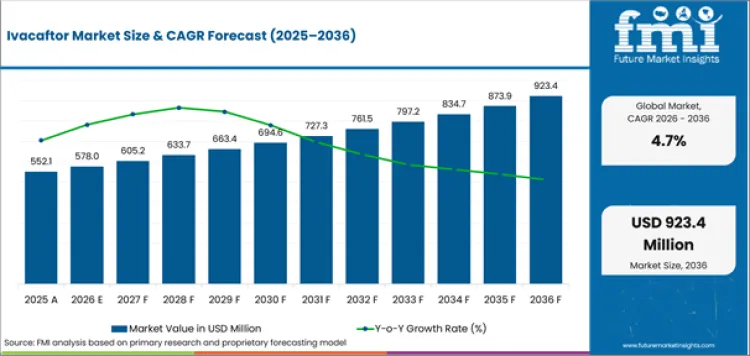
| Metric | Value |
|---|---|
| 2026 Market Size | USD 580.9 million |
| 2036 Market Size | USD 923.4 million |
| Forecast CAGR | 4.7% from 2026 to 2036 |
| Leading Form | Tablets |
| Tablets Share in 2026 | 74.0% |
| Leading Purity Grade | ≥99.5% |
| ≥99.5% Purity Grade Share in 2026 | 62.0% |
| Fastest-growing Country | China |
| China CAGR | 5.3% by 2036 |
Summary of the Ivacaftor Market
| Market Signal | Commercial Impact |
|---|---|
| Demand and Growth Drivers | Ivacaftor API demand is supported by genotype-based therapy and regulated pharmaceutical supply.
|
| Product and Segment View | Tablets, high-purity APIs, and direct manufacturer sales dominate the market.
|
| Geography and Growth Outlook | China and India continue to strengthen their positions as specialty API manufacturing hubs.
|
| Competitive Landscape | Competition centers on regulatory quality, synthesis expertise, and commercial supply reliability.
|
| Analyst Perspective | Ivacaftor API remains a highly regulated specialty market where quality and documentation outweigh pricing considerations.
— Anurag Sharma, Principal Consultant, Healthcare, Future Market Insights |
Demand is driven by mutation-defined cystic fibrosis treatment and high-purity API supply. DailyMed lists Kalydeco for patients aged 1 month and older with responsive CFTR mutations. EMA coverage for Kalydeco and Alyftrek keeps ivacaftor chemistry active across approved European therapy routes. Commercial planning follows finished-dose lifecycle changes and small patient pools. Vertex received USA FDA approval for ALYFTREK in December 2024 and reported full-year 2025 revenue of USD 12.0 billion.
These updates keep buyer attention on validated CFTR modulator chemistry. Suppliers compare route stability and impurity control against broader cystic fibrosis therapeutics procurement signals.The ivacaftor market is expected to record measured expansion through 2036. Demand depends on CFTR mutation eligibility, regulated labels and repeat finished-dose supply planning.
Which factors support expansion in the ivacaftor market?
Approved CFTR labels and high-purity API requirements support market value across regulated specialty pharma channels.
- Market value is supported by genotype-defined treatment use before wider respiratory prescribing affects volume.
- Supplier pricing reflects impurity control and regulatory file support before batch scale affects negotiation.
- Revenue improves through combination regimens that keep ivacaftor chemistry inside broader CFTR portfolios.
- Direct buyer trust rises with repeatable route chemistry and clean change-control documentation.
Why is the ivacaftor market growing?
Ivacaftor market growth is expected to be driven by its targeted use in cystic fibrosis treatment
Ivacaftor demand is projected to expand with label-defined cystic fibrosis treatment. DailyMed states that Kalydeco treats patients aged 1 month and older with responsive CFTR mutations. This keeps demand connected to confirmed genetic eligibility and clinician-led therapy selection. API suppliers serve a smaller buyer pool than the broader small molecule API market.
Combination therapy is expected to protect the molecule’s commercial role. EMA lists Kalydeco for monotherapy and combination use across selected mutation groups. Alyftrek received EU marketing authorization in June 2025. Portfolio renewal can change lot timing. It also keeps demand near pharmaceutical intermediates and specialty synthesis suppliers that can support regulated files.
How is the ivacaftor market segmented?
The ivacaftor industry is segmented by form, purity grade, and sales channel.
- Tablets are projected to secure 74.0% share in 2026 with oral solid products anchoring adult and adolescent therapy supply.
- Granules are anticipated to account for 19.0% share in 2026 with pediatric dose needs supporting smaller batches.
- The ≥99.5% purity grade is forecast to hold 62.0% share in 2026 with regulated filings requiring tighter impurity control.
- Direct Sales (Manufacturer to Pharma) are projected to represent 68.0% share in 2026 with commercial programs preferring audited suppliers.
Which form category holds a notable share in the ivacaftor market?
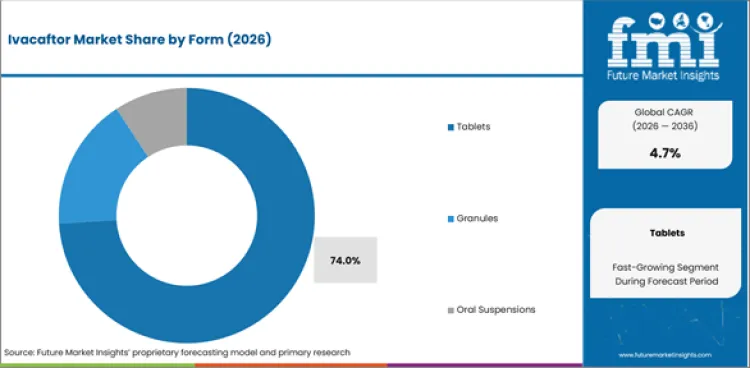
- Tablets are projected to account for 74.0% share in 2026 with fixed oral dosing supporting commercial batch planning.
- Granules retain pediatric relevance with weight-based administration needing smaller and more controlled formulation runs.
How does the purity grade segment perform in the ivacaftor market?
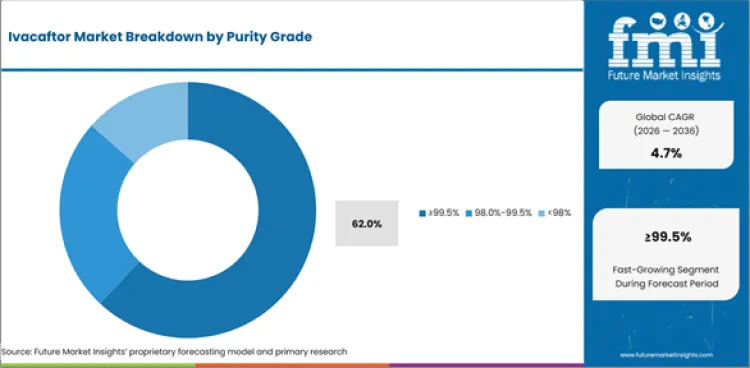
- The ≥99.5% grade is estimated to hold 62.0% share in 2026 with impurity thresholds shaping regulated buyer approval.
- Lower-purity material is used mainly for development work and early validation before commercial specifications tighten.
What drives demand across sales channel options in the ivacaftor market?
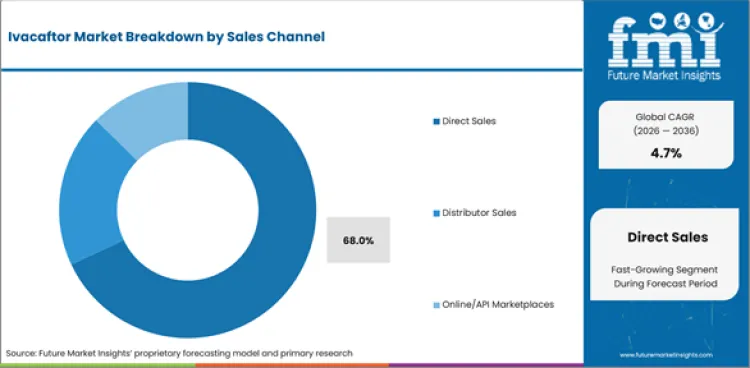
- Direct Sales (Manufacturer to Pharma) are forecast to represent 68.0% share in 2026 with audited contracts guiding commercial supply.
- Distributor sales support sample lots and early development needs before buyers qualify a direct API source.
What are the driver, restraints, and opportunities in the ivacaftor market?
Mutation-defined care supports demand, small patient pools limit scale and second-source qualification creates supplier openings.
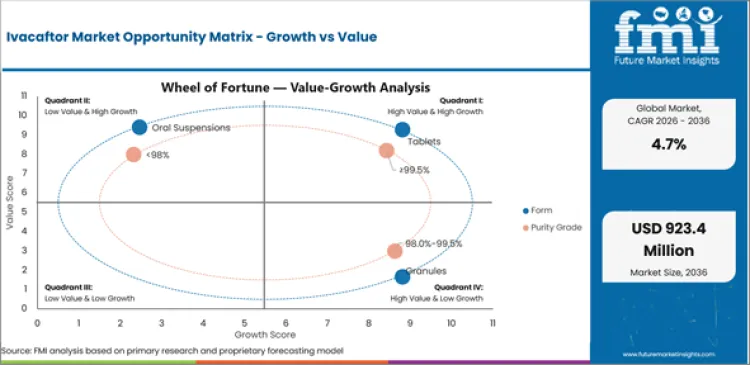
- Driver: CFTR mutation labels keep API demand anchored in confirmed treatment eligibility and repeat therapy use.
- Restraint: Small genotype-defined patient pools limit volume leverage and raise batch-cost pressure.
- Opportunity: Qualified second-source programs create openings for suppliers with clean impurity control and dossier support.
Ivacaftor API Demand Outlook
Kalydeco demand is expected to follow confirmed mutation eligibility instead of broad respiratory prescribing. DailyMed lists the product for patients aged 1 month and older with responsive CFTR mutations. This supports dependable but narrow API purchasing. Suppliers need documentation that can satisfy finished-dose filings and buyer audits.
CFTR Portfolio and Procurement Planning
Portfolio renewal is expected to change procurement timing across CFTR therapies. EMA records Alyftrek marketing authorization across the EU in June 2025. This supports continuing demand for validated CFTR chemistry and creates planning pressure for pharmaceutical solvents used in controlled synthesis routes.
Purity Control and Supplier Qualification
Commercial buyers are expected to place impurity documentation ahead of catalog price. The ≥99.5% grade accounts for 62.0% projected share in 2026. This makes analytical consistency central to supplier selection in fine chemicals procurement and specialty API audits. Validated equipment records make pharmaceutical manufacturing equipment qualification part of the supplier audit.
What is the Country-Level Outlook in the Ivacaftor Market?
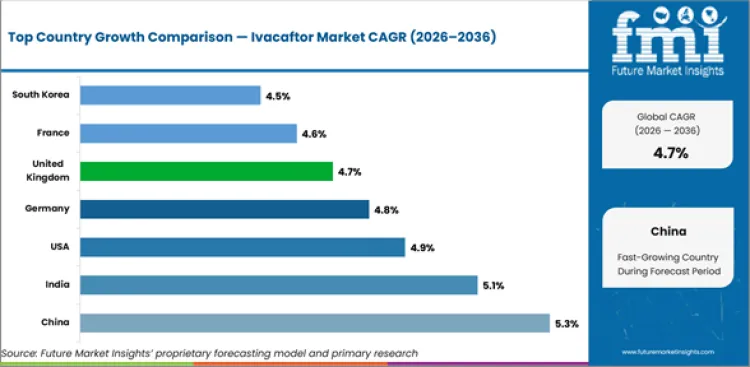
China 5.3% CAGR, India 5.1% CAGR, United States 4.9% CAGR, Germany 4.8% CAGR, United Kingdom 4.7% CAGR, France 4.6% CAGR, South Korea 4.5% CAGR, and Japan 4.3% CAGR through 2036.
.webp "Top Country Growth Comparison Ivacaftor Market Cagr (2026 2036)")
| Country | CAGR 2026 to 2036 |
|---|---|
| China | 5.3% |
| India | 5.1% |
| United States | 4.9% |
| Germany | 4.8% |
| United Kingdom | 4.7% |
| France | 4.6% |
| South Korea | 4.5% |
| Japan | 4.3% |
Source: Future Market Insights, 2026.
What is the ivacaftor market outlook in China?
China is forecast to record a 5.3% CAGR through 2036. Growth is expected to be supported by specialty API capacity and export-oriented supplier qualification.
Country Market Snapshot
| Parameter | Value |
|---|---|
| Market Size in 2025 | USD 30.4 million |
| Market Size in 2026 | USD 32.0 million |
| Market Forecast in 2036 | USD 53.6 million |
| CAGR 2026 to 2036 | 5.3% |
| Years Considered | 2021 to 2036 |
| Base Year | 2025 |
| Forecast Period | 2026 to 2036 |
| Units Considered | Value in USD million |
| Leading Sub-Region | Yangtze River Delta API clusters |
China Ivacaftor Market Outlook
- China’s ivacaftor market is expected to remain more supply-led than patient-led. Local cystic fibrosis treatment demand remains narrow. Specialty small-molecule synthesis capacity still supports development batches and export programs.
- Buyers are expected to assess Chinese suppliers on route control and documentation depth. The growth rate reflects supplier capability from a smaller base.
Key Growth Drivers
- China’s export API role is supported by stronger innovative-drug activity, with NMPA-related research reporting 46 Class 1 or 1.1 new drug approvals in 2024.
- Clinical development planning is expected to improve as NMPA created a faster pathway, with eligible innovative drug INDs receiving a 30 working day review route.
- Export-oriented suppliers can support finished-dose customers outside China through qualified API programs and validation lots.
- Domestic synthesis clusters give API buyers more options for route development and controlled batch scale-up.
Key Restraints
- Domestic finished-dose demand remains limited by a small treated CF base, with only 7 imported drugs included in the 2024 Class 1 or 1.1 approval group.
- Low diagnosed cystic fibrosis prevalence restricts local pull for commercial ivacaftor products.
- Public evidence for ivacaftor-specific local suppliers remains limited across open sources.
What makes China unique?
China is unique because export supply potential is stronger than local finished-dose demand.
Key Companies
- WuXi STA
- Asymchem Laboratories Tianjin
- Porton Pharma Solutions
- Pharmaron Beijing
- Zhejiang Huahai Pharmaceutical
- Zhejiang Hisun Pharmaceutical
- CSPC Pharmaceutical Group
Sales & Marketing Channels
- Export API channels
- Direct pharma sourcing
- CDMO partnerships
- Regulatory dossier support
- Development sample distributors
- API marketplace discovery
Country Segment Breakdown
| Segment | Sub-Segments |
|---|---|
| By Form | Tablets · Granules · Oral Suspensions |
| By Purity Grade | ≥99.5% · 98.0% to 99.5% · <98% |
| By Sales Channel | Direct Sales · Distributor Sales · Online/API Marketplaces · Others |
| Key Sub-Regions Covered | Yangtze River Delta API clusters · National specialty centers · Export-linked corridors |
Frequently Asked Questions
How fast is China ivacaftor market growing?
China is projected to grow at a 5.3% CAGR through 2036 due to specialty API capability.
Who leads China ivacaftor market?
WuXi STA, Asymchem Laboratories Tianjin and Porton Pharma Solutions are the main China companies profiled here.
What is driving adoption in China ivacaftor market?
Export-oriented API programs and route-development capability support adoption in China.
What is the ivacaftor market outlook in India?
India is forecast to record a 5.1% CAGR through 2036. Growth is expected to be supported by specialty API exports and regulated-market documentation capability.
Country Market Snapshot
| Parameter | Value |
|---|---|
| Market Size in 2025 | USD 23.6 million |
| Market Size in 2026 | USD 24.8 million |
| Market Forecast in 2036 | USD 40.8 million |
| CAGR 2026 to 2036 | 5.1% |
| Years Considered | 2021 to 2036 |
| Base Year | 2025 |
| Forecast Period | 2026 to 2036 |
| Units Considered | Value in USD million |
| Leading Sub-Region | Hyderabad and Visakhapatnam API clusters |
India Ivacaftor Market Outlook
- India’s ivacaftor market is expected to be shaped by API supply capability more than local therapy volume. Export programs and regulated-market relationships define the commercial path.
- Suppliers with validated chemistry and clean documentation can support second-source planning. India’s role is strongest in supplier qualification and development support.
Key Growth Drivers
- India’s API opportunity is supported by a broad pharmaceutical base, with PIB reporting more than 3000 pharmaceutical companies in the country.
- Specialty supply depth is supported by domestic production capacity, with PIB reporting 10500 pharmaceutical manufacturing units in India.
- Established export filing teams help suppliers support regulated pharma buyers that need dossier-ready API records.
- Hyderabad and Visakhapatnam API clusters improve access to development lots and validation support.
Key Restraints
- Supplier conversion remains selective because bulk-drug capacity is still being built, with 34 commissioned projects reported under the API production program.
- Regulated-market audits can delay supplier movement from development lots to commercial supply.
- Local finished-dose demand remains smaller than the export-side API opportunity.
What makes India unique?
India is unique because export-oriented API capability is supported by regulated-market documentation experience.
Key Companies
- Laurus Labs
- Hetero Drugs
- MSN Laboratories
- Metrochem API
- Maithri Drugs
- Alembic Pharmaceuticals
- Alivus Life Sciences
Sales & Marketing Channels
- Direct export contracts
- Regulated API supply
- CDMO partnerships
- Distributor sample supply
- Dossier support partnerships
- API marketplace discovery
Country Segment Breakdown
| Segment | Sub-Segments |
|---|---|
| By Form | Tablets · Granules · Oral Suspensions |
| By Purity Grade | ≥99.5% · 98.0% to 99.5% · <98% |
| By Sales Channel | Direct Sales · Distributor Sales · Online/API Marketplaces · Others |
| Key Sub-Regions Covered | Hyderabad and Visakhapatnam API clusters · National specialty centers · Export-linked corridors |
Frequently Asked Questions
How fast is India ivacaftor market growing?
India is projected to grow at a 5.1% CAGR through 2036 due to export API programs.
Who leads India ivacaftor market?
Laurus Labs, Hetero Drugs and MSN Laboratories are the main India companies profiled here.
What is driving adoption in India ivacaftor market?
Export filing experience and specialty synthesis depth support adoption in India.
How fast is the ivacaftor market growing in the United States?
The United States is forecast to record a 4.9% CAGR through 2036. Demand is supported by approved CFTR therapies and strict buyer expectations for quality documentation.
Country Market Snapshot
| Parameter | Value |
|---|---|
| Market Size in 2025 | USD 204.9 million |
| Market Size in 2026 | USD 214.9 million |
| Market Forecast in 2036 | USD 346.7 million |
| CAGR 2026 to 2036 | 4.9% |
| Years Considered | 2021 to 2036 |
| Base Year | 2025 |
| Forecast Period | 2026 to 2036 |
| Units Considered | Value in USD million |
| Leading Sub-Region | Northeast and specialty care corridors |
United States Ivacaftor Market Outlook
- United States demand is anchored in approved CFTR therapies and specialist cystic fibrosis care. API suppliers benefit through finished-dose buyers that need validated purity records and stable supply files.
- Buyer selection is expected to favor audited suppliers with strong impurity data and change-control discipline. USA therapy access also shapes global expectations for ivacaftor quality documentation.
Key Growth Drivers
- USA demand is supported by genotype-based treatment eligibility, with DailyMed listing Kalydeco for patients aged 1 month and older with responsive CFTR mutations.
- Ivacaftor chemistry remains relevant as CFTR portfolios expand, with Vertex stating that 2026 label extensions made about 95% of USA people with CF eligible for a CFTR modulator.
- Specialist CF care centers support recurring therapy use across eligible patients and keep prescribing tied to clinical follow-up.
- High documentation expectations support audited direct supply routes for qualified API suppliers.
Key Restraints
- Volume leverage remains limited because cystic fibrosis is rare, with the Cystic Fibrosis Foundation reporting close to 40000 people living with CF in the United States.
- Commercial API buyers face high documentation costs before any volume discount can matter.
- Portfolio shifts toward once-daily CFTR combinations can reduce standalone ivacaftor planning visibility.
What makes United States unique?
The United States is unique because FDA labels and CF care networks set the strongest quality benchmark.
Key Companies
- Vertex Pharmaceuticals
- Thermo Fisher Scientific
- Cambrex
- Curia Global
- Alcami
- Catalent
- PCI Pharma Services
Sales & Marketing Channels
- Specialty pharmacy networks
- Direct manufacturer contracts
- Hospital pharmacy systems
- CF care centers
- Qualified CDMO sourcing
- Regulated distributor networks
Country Segment Breakdown
| Segment | Sub-Segments |
|---|---|
| By Form | Tablets · Granules · Oral Suspensions |
| By Purity Grade | ≥99.5% · 98.0% to 99.5% · <98% |
| By Sales Channel | Direct Sales · Distributor Sales · Online/API Marketplaces · Others |
| Key Sub-Regions Covered | Northeast and specialty care corridors · National specialty centers · Export-linked corridors |
Frequently Asked Questions
How fast is United States ivacaftor market growing?
The United States is expected to grow at a 4.9% CAGR through 2036 due to regulated therapy access.
Who leads United States ivacaftor market?
Vertex Pharmaceuticals and Thermo Fisher Scientific lead the United States company list.
What is driving adoption in United States ivacaftor market?
FDA-recognized labels and specialist CF care support demand for qualified ivacaftor supply.
How is the ivacaftor market performing in Germany?
Germany is forecast to record a 4.8% CAGR through 2036. Demand is supported by European authorization routes and a quality-sensitive reimbursement environment.
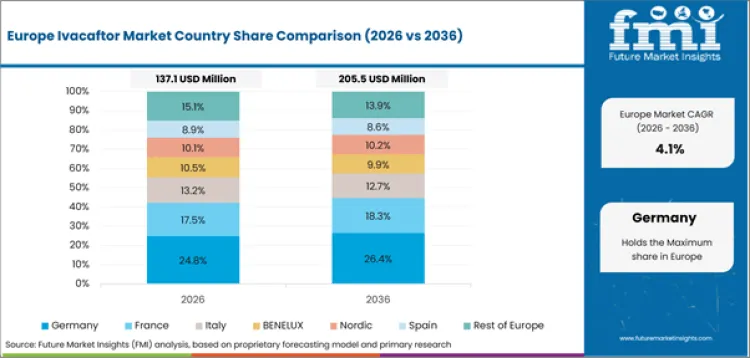
Country Market Snapshot
| Parameter | Value |
|---|---|
| Market Size in 2025 | USD 49.9 million |
| Market Size in 2026 | USD 52.3 million |
| Market Forecast in 2036 | USD 83.6 million |
| CAGR 2026 to 2036 | 4.8% |
| Years Considered | 2021 to 2036 |
| Base Year | 2025 |
| Forecast Period | 2026 to 2036 |
| Units Considered | Value in USD million |
| Leading Sub-Region | North Rhine-Westphalia and Bavaria |
Germany Ivacaftor Market Outlook
- Germany is expected to remain a quality-and-reimbursement filter for European CFTR therapy value. Demand is led by specialist access and finished-dose purchasing.
- API sellers usually reach Germany through global finished-dose customers. Supplier relevance depends on impurity control and audit-ready documentation.
Key Growth Drivers
- German demand benefits from a wider European evidence base, with the ECFSPR database covering more than 57000 people with cystic fibrosis.
- European authorization supports finished-dose access, with Alyftrek approved for people aged 6 years and older with eligible CFTR mutation profiles.
- Specialist care centers support repeat treatment monitoring across eligible patients.
- European authorization routes create consistent quality expectations for finished-dose customers.
Key Restraints
- Reimbursement pressure can slow wider uptake of newer CFTR regimens, with Germany devoting 12.3% of GDP to health spending in the 2025 health profile.
- Public evidence for direct country-level ivacaftor API sourcing remains limited.
- Documentation burden can slow supplier onboarding in a low-volume specialty API market.
What makes Germany unique?
Germany is unique because reimbursement discipline and quality expectations strongly shape supplier selection.
Key Companies
- Vertex Pharmaceuticals GmbH
- CordenPharma
- Evonik Health Care
- Merck KGaA
- Boehringer Ingelheim
- Vetter Pharma
- Aenova Group
Sales & Marketing Channels
- Hospital pharmacy routes
- Specialist respiratory centers
- Direct manufacturer access
- Reimbursement-led supply
- European distribution channels
- Qualified CDMO contracts
Country Segment Breakdown
| Segment | Sub-Segments |
|---|---|
| By Form | Tablets · Granules · Oral Suspensions |
| By Purity Grade | ≥99.5% · 98.0% to 99.5% · <98% |
| By Sales Channel | Direct Sales · Distributor Sales · Online/API Marketplaces · Others |
| Key Sub-Regions Covered | North Rhine-Westphalia and Bavaria · National specialty centers · Export-linked corridors |
Frequently Asked Questions
How fast is Germany ivacaftor market growing?
Germany is projected to grow at a 4.8% CAGR through 2036 due to European authorization and specialist access.
Who leads Germany ivacaftor market?
Vertex Pharmaceuticals GmbH and CordenPharma are some key players.
What is driving adoption in Germany ivacaftor market?
Specialist care and reimbursement discipline guide adoption in Germany.
What is the ivacaftor market outlook in the United Kingdom?
The United Kingdom is forecast to record a 4.7% CAGR through 2036. Growth is expected to be supported by NHS access and MHRA-approved CFTR therapy use.
Country Market Snapshot
| Parameter | Value |
|---|---|
| Market Size in 2025 | USD 46.6 million |
| Market Size in 2026 | USD 48.8 million |
| Market Forecast in 2036 | USD 77.2 million |
| CAGR 2026 to 2036 | 4.7% |
| Years Considered | 2021 to 2036 |
| Base Year | 2025 |
| Forecast Period | 2026 to 2036 |
| Units Considered | Value in USD million |
| Leading Sub-Region | England specialist CF centers |
United Kingdom Ivacaftor Market Outlook
- The United Kingdom is expected to remain a reimbursement-led access market for CFTR therapies. API demand follows finished-dose availability and specialist treatment continuity.
- The NHS route keeps buyer attention on outcomes and budget impact. Suppliers need documentation that supports access decisions and finished-dose quality files.
Key Growth Drivers
- UK demand is supported by adult treatment continuity, with the UK CF Registry reporting that 65% of registered people were aged 16 or older in 2024.
- Therapy access expanded through national regulatory approval, with Vertex stating that MHRA approved Alyftrek for patients aged 6 years and older.
- NHS England confirmed access to vanzacaftor-tezacaftor-deutivacaftor in July 2025.
- Specialist CF centers help keep genotype-based prescribing consistent across eligible patients.
Key Restraints
- Longer survival increases lifetime treatment planning pressure, with the UK CF Registry projecting median survival at 66 years for people born in 2024.
- Reimbursement review can slow wider uptake before procurement expands.
- Country-specific ivacaftor API supplier evidence remains limited in public sources.
What makes United Kingdom unique?
The United Kingdom is unique because NHS reimbursement decisions closely shape CFTR therapy access.
Key Companies
- Vertex Pharmaceuticals Europe Limited
- Almac Sciences
- Sterling Pharma Solutions
- Pharmaron UK
- Quotient Sciences
- AstraZeneca
- GSK
Sales & Marketing Channels
- NHS specialty procurement
- Hospital pharmacy supply
- Direct manufacturer access
- Specialist respiratory centers
- Clinical trial networks
- Qualified CDMO contracts
Country Segment Breakdown
| Segment | Sub-Segments |
|---|---|
| By Form | Tablets · Granules · Oral Suspensions |
| By Purity Grade | ≥99.5% · 98.0% to 99.5% · <98% |
| By Sales Channel | Direct Sales · Distributor Sales · Online/API Marketplaces · Others |
| Key Sub-Regions Covered | England specialist CF centers · National specialty centers · Export-linked corridors |
Frequently Asked Questions
How fast is United Kingdom ivacaftor market growing?
The United Kingdom is forecast to grow at a 4.7% CAGR through 2036 due to NHS access.
Who leads United Kingdom ivacaftor market?
Vertex Pharmaceuticals Europe Limited and Almac Sciences lead the United Kingdom company list.
What is driving adoption in United Kingdom ivacaftor market?
NHS reimbursement and specialist CF care support controlled adoption in eligible patients.
How is the ivacaftor market advancing in France?
France is forecast to record a 4.6% CAGR through 2036. Demand is expected to be supported by reimbursed specialist care and European authorization coverage.
Country Market Snapshot
| Parameter | Value |
|---|---|
| Market Size in 2025 | USD 38.9 million |
| Market Size in 2026 | USD 40.7 million |
| Market Forecast in 2036 | USD 63.8 million |
| CAGR 2026 to 2036 | 4.6% |
| Years Considered | 2021 to 2036 |
| Base Year | 2025 |
| Forecast Period | 2026 to 2036 |
| Units Considered | Value in USD million |
| Leading Sub-Region | Ile-de-France and Auvergne-Rhone-Alpes |
France Ivacaftor Market Outlook
- France is expected to remain a clinical-access market where ivacaftor demand follows specialist treatment decisions. EMA authorizations provide the common European label frame for eligible patients.
- Hospital and reimbursed pharmacy channels guide use more than open API availability. Supplier relevance depends on documentation accepted by finished-dose customers.
Key Growth Drivers
- France benefits from European registry data for CF care planning, with the ECFSPR database covering more than 57000 individuals with cystic fibrosis.
- EU-level authorization supports therapy access, with Alyftrek approved for people aged 6 years and older with eligible CFTR mutation profiles.
- Specialist clinical routes support repeat treatment monitoring for eligible patients.
- Reimbursed pharmacy channels support controlled uptake after clinical review.
Key Restraints
- Reimbursement boundaries can narrow uptake of newer CFTR combinations, with France recording 4.5% unmet medical needs in the 2025 country health profile.
- Small mutation-defined cohorts reduce the appeal of France-only API strategies.
- Clinical benefit assessment can delay wider adoption before procurement expands.
What makes France unique?
France is unique because clinical benefit review and reimbursement design shape demand more than supplier availability.
Key Companies
- Vertex Pharmaceuticals France
- EuroAPI
- Seqens
- Sanofi
- Servier
- Delpharm
- Fareva
Sales & Marketing Channels
- Hospital specialty procurement
- Reimbursed pharmacy channels
- Direct manufacturer supply
- European regulatory channels
- Clinical specialist networks
- CDMO development routes
Country Segment Breakdown
| Segment | Sub-Segments |
|---|---|
| By Form | Tablets · Granules · Oral Suspensions |
| By Purity Grade | ≥99.5% · 98.0% to 99.5% · <98% |
| By Sales Channel | Direct Sales · Distributor Sales · Online/API Marketplaces · Others |
| Key Sub-Regions Covered | Ile-de-France and Auvergne-Rhone-Alpes · National specialty centers · Export-linked corridors |
Frequently Asked Questions
How fast is France ivacaftor market growing?
France is expected to grow at a 4.6% CAGR through 2036 due to reimbursed specialist channels.
Who leads France ivacaftor market?
Vertex Pharmaceuticals France and EuroAPI lead the France company list.
What is driving adoption in France ivacaftor market?
EMA authorization and reimbursement design guide adoption across eligible patients.
How is the ivacaftor market performing in South Korea?
South Korea is forecast to record a 4.5% CAGR through 2036. Demand is expected to be shaped by specialist-led access and a narrow rare-disease patient base.
Country Market Snapshot
| Parameter | Value |
|---|---|
| Market Size in 2025 | USD 19.5 million |
| Market Size in 2026 | USD 20.4 million |
| Market Forecast in 2036 | USD 31.7 million |
| CAGR 2026 to 2036 | 4.5% |
| Years Considered | 2021 to 2036 |
| Base Year | 2025 |
| Forecast Period | 2026 to 2036 |
| Units Considered | Value in USD million |
| Leading Sub-Region | Seoul capital region and Gyeonggi |
South Korea Ivacaftor Market Outlook
- South Korea is expected to remain a small access market with high regulatory discipline. Demand for ivacaftor products is shaped by specialist diagnosis and reimbursement routes.
- The country has strong pharmaceutical capability, but public ivacaftor-specific evidence remains limited. Supplier relevance depends on quality systems and global customer relationships.
Key Growth Drivers
- South Korea’s access environment is supported by regulatory review reform, with MFDS announcing a 240 day approval and review target in May 2026.
- Supplier planning is supported by clearer review timing, with the new expedited process taking effect on June 1 for new drugs and biosimilars.
- Specialist hospitals support rare-disease treatment routing for eligible patients.
- Local pharmaceutical capability can support specialty API partnership options.
Key Restraints
- Approval timing remains a planning risk for buyers, even after MFDS set the target at 240 days.
- Low diagnosed cystic fibrosis prevalence limits scale for country-specific commercial API programs.
- Public evidence for ivacaftor-specific local supply remains limited.
What makes South Korea unique?
South Korea is unique because approval discipline is strong while local demand volume remains limited.
Key Companies
- Yuhan Corporation
- Hanmi Pharmaceutical
- Samsung Biologics
- Celltrion
- SK Biopharmaceuticals
- HK inno.N
- Chong Kun Dang
Sales & Marketing Channels
- Hospital specialty procurement
- Regulated import channels
- Direct manufacturer supply
- Specialist respiratory centers
- Reimbursement access routes
- Distributor partnerships
Country Segment Breakdown
| Segment | Sub-Segments |
|---|---|
| By Form | Tablets · Granules · Oral Suspensions |
| By Purity Grade | ≥99.5% · 98.0% to 99.5% · <98% |
| By Sales Channel | Direct Sales · Distributor Sales · Online/API Marketplaces · Others |
| Key Sub-Regions Covered | Seoul capital region and Gyeonggi · National specialty centers · Export-linked corridors |
Frequently Asked Questions
How fast is South Korea ivacaftor market growing?
South Korea is projected to grow at a 4.5% CAGR through 2036 due to specialist-led access.
Who leads South Korea ivacaftor market?
Yuhan Corporation and Hanmi Pharmaceutical lead the South Korea company list.
What is driving adoption in South Korea ivacaftor market?
Regulated approval pathways and rare-disease specialist networks guide adoption.
What is the ivacaftor market forecast for Japan?
Japan is forecast to record a 4.3% CAGR through 2036. Demand is expected to remain limited by low patient volume and strict documentation expectations.
Country Market Snapshot
| Parameter | Value |
|---|---|
| Market Size in 2025 | USD 27.3 million |
| Market Size in 2026 | USD 28.5 million |
| Market Forecast in 2036 | USD 43.4 million |
| CAGR 2026 to 2036 | 4.3% |
| Years Considered | 2021 to 2036 |
| Base Year | 2025 |
| Forecast Period | 2026 to 2036 |
| Units Considered | Value in USD million |
| Leading Sub-Region | Kanto and Kansai hospital networks |
Japan Ivacaftor Market Outlook
- Japan is expected to remain a small but quality-sensitive market for ivacaftor therapies. Demand is usually indirect through imported finished-dose routes and specialist hospitals.
- Suppliers seeking Japan-related business need strong impurity data and stable dossiers. PMDA expectations keep qualification cost high for low-volume programs.
Key Growth Drivers
- Japan’s access environment is supported by defined PMDA review targets, with priority review products carrying a 9 month total review time.
- Supplier planning is supported by a clear standard review benchmark, with standard new drug applications carrying a 12 month total review time.
- Specialist hospitals support accurate diagnosis and therapy routing for eligible patients.
- Quality expectations favor suppliers with clean analytical records and stability data.
Key Restraints
- PMDA performance expectations keep documentation discipline high, with target achievement of 80% or higher reported in FY 2023.
- Low diagnosed cystic fibrosis prevalence limits domestic volume for finished-dose buyers.
- Local evidence needs can raise the cost of supplier qualification.
What makes Japan unique?
Japan is unique because low demand volume is combined with strict quality expectations.
Key Companies
- Vertex Pharmaceuticals Japan
- Takeda Pharmaceutical
- Astellas Pharma
- Shionogi
- CMIC Group
- Fujifilm Toyama Chemical
- Nipro Pharma
Sales & Marketing Channels
- Specialist hospital procurement
- Imported finished-dose channels
- Regulated distributor partnerships
- Direct manufacturer supply
- Quality-dossier support routes
- Hospital pharmacy systems
Country Segment Breakdown
| Segment | Sub-Segments |
|---|---|
| By Form | Tablets · Granules · Oral Suspensions |
| By Purity Grade | ≥99.5% · 98.0% to 99.5% · <98% |
| By Sales Channel | Direct Sales · Distributor Sales · Online/API Marketplaces · Others |
| Key Sub-Regions Covered | Kanto and Kansai hospital networks · National specialty centers · Export-linked corridors |
Frequently Asked Questions
How fast is Japan ivacaftor market growing?
Japan is expected to grow at a 4.3% CAGR through 2036 due to controlled specialist access.
Who leads Japan ivacaftor market?
Vertex Pharmaceuticals Japan and Takeda Pharmaceutical lead the Japan company list.
What is driving adoption in Japan ivacaftor market?
Specialist hospitals and PMDA review expectations shape adoption.
Who are the leading companies in the ivacaftor market?
The profiled companies include Vertex Pharmaceuticals and several specialty API suppliers, such as Hetero Drugs, MSN Laboratories, Laurus Labs, Metrochem API, Maithri Drugs, Alembic Pharmaceuticals, and Alivus Life Sciences.
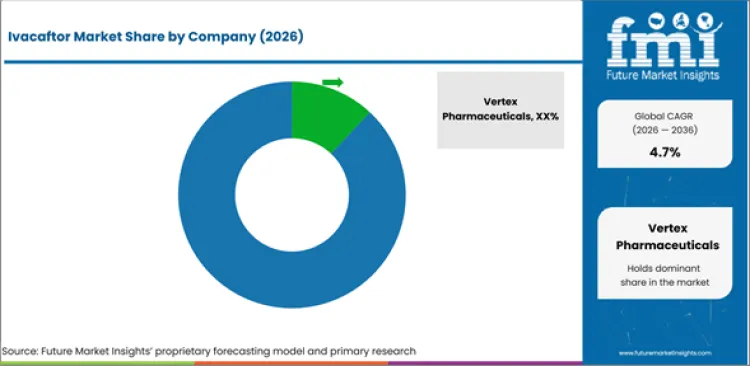
- Competition is based on CFTR therapy control and regulated-market documentation.
- Finished-dose control remains concentrated with Vertex Pharmaceuticals through approved CFTR therapies.
- API-side competition depends on impurity control and validated customer support.
- Second-source opportunities favor suppliers that can support dossiers without adding change-control risk.
The ivacaftor market remains highly concentrated. Competition among API suppliers is closely tied to the requirements of the finished-dose manufacturer, making the market more specialized than the broader small molecule CDMO space.
API suppliers compete on synthesis route stability and documentation quality. Purity above 99.5% decides commercial qualification. Residual solvent control and validated change records also matter. These requirements keep ivacaftor close to small molecule CMO/CDMO service models.
Companies with proven regulated-market filing support are better positioned than catalog-only sellers. Indian and Chinese firms can support development lots. Commercial wins still require buyer audits and stable impurity data. That separates ivacaftor from broader small molecule innovator CDMO procurement patterns.
How do top ivacaftor companies compare?
Vertex has the clearest therapy-control position while specialty API firms compete on route chemistry and documentation support.
| Company | Relevance to Market Title | CFTR Therapy Control | Ivacaftor Chemistry Evidence | Regulated-Market Documentation | Channel Reach | Geographic Footprint |
|---|---|---|---|---|---|---|
| Vertex Pharmaceuticals | Very High | Very Strong | Very Strong | Very Strong | Very Strong | Global |
| Hetero Drugs | High | Low | Strong | Strong | Strong | India and export markets |
| MSN Laboratories | High | Low | Strong | Strong | Strong | India and export markets |
| Laurus Labs | High | Low | Strong | Strong | Strong | India and export markets |
| Metrochem API | Medium | Low | Medium | Medium | Medium | India and export markets |
| Maithri Drugs | Medium | Low | Strong | Strong | Medium | India and export markets |
| Alembic Pharmaceuticals | Medium | Low | Strong | Strong | Medium | India and export markets |
| Alivus Life Sciences | Medium | Low | Strong | Strong | Medium | India and export markets |
Source: Future Market Insights competitive analysis, 2026.
Who are the key players in the ivacaftor market?
The market includes one finished-dose portfolio leader and a smaller set of specialty API or route-chemistry suppliers.
Key global companies leading the ivacaftor market include:
- Vertex Pharmaceuticals
- Hetero Drugs
- MSN Laboratories
- Laurus Labs
- Metrochem API
- Maithri Drugs
- Alembic Pharmaceuticals
- Alivus Life Sciences
Key Developments in Ivacaftor Market
- In January 2026, Beximco Pharmaceuticals’ affordable cystic fibrosis treatment plan gained market attention as Triko was positioned for spring 2026 supply.
- In April 2026, Vertex received USA FDA label extensions for ALYFTREK and TRIKAFTA that broadened eligibility to about 95% of people with CF in the United States.
Ivacaftor Market - Scope & Definition
| Attribute | Detail |
|---|---|
| Market Definition | Commercially supplied ivacaftor active pharmaceutical ingredient used in approved or development-stage cystic fibrosis therapies |
| Functions Covered | CFTR potentiator API supply, impurity-controlled synthesis, dossier support, commercial and development batch supply |
| Applications Covered | Tablets, granules, and oral suspension formats used in cystic fibrosis treatment programs |
| End-Use Industries | Specialty pharmaceuticals, cystic fibrosis therapeutics, API manufacturing, contract development and manufacturing |
| Grades Covered | ≥99.5%, 98.0%-99.5%, and <98% purity grades |
| Inclusions | Ivacaftor API supplied for tablets, granules, oral suspensions, development batches, validation lots, and qualified commercial supply |
| Exclusions | Finished branded drug revenue, non-ivacaftor CFTR APIs, excipients, packaging, diagnostics, hospital care services, and broad respiratory drugs |
Ivacaftor Market - Research Methodology
| Method | Description |
|---|---|
| Primary Research | FMI analyst interviews with API sourcing teams, specialty pharma manufacturers, formulation developers, quality heads, and regulatory affairs teams across selected markets |
| Desk Research | Review of drug labels, EMA product pages, FDA records, registry sources, company disclosures, and government publications related to CFTR therapy and API supply |
| Market Sizing & Forecasting | Hybrid bottom-up model using therapy eligibility signals, API purity requirements, country supply roles, sales channel behavior, and locked FMI value assumptions |
| Data Validation | Cross-verification using regulatory approvals, CF registry evidence, official health-system sources, company updates, and supplier relevance checks |
Ivacaftor Market - Report Scope
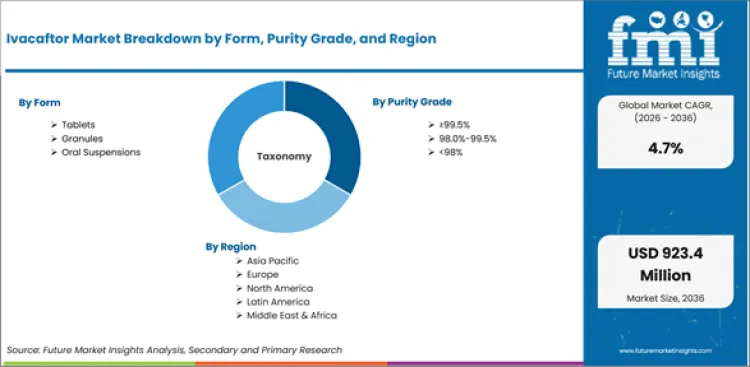
| Parameter | Details |
|---|---|
| Forecast period | 2026 to 2036 |
| Historical period | 2021 to 2025 |
| Quantitative unit | Revenue in USD million |
| By form | Tablets, granules, oral suspensions |
| By purity grade | ≥99.5%, 98.0%-99.5%, <98% |
| By sales channel | Direct Sales (Manufacturer to Pharma), Distributor Sales, Online/API Marketplaces, Others |
| Regions covered | North America, Latin America, East Asia, South Asia & Pacific, Europe, Middle East & Africa |
| Countries covered | United States, United Kingdom, Germany, France, Japan, China, South Korea, India |
| Key companies profiled | Vertex Pharmaceuticals, Hetero Drugs, MSN Laboratories, Laurus Labs, Metrochem API, Maithri Drugs, Alembic Pharmaceuticals, Alivus Life Sciences |
| Approach | Hybrid bottom-up and top-down methodology using therapy signals, API supply evidence, purity requirements, and country-level market behavior |
Source: Future Market Insights, 2026.
Ivacaftor Market Breakdown by Form, Purity Grade, Sales Channel, and Region
Ivacaftor Market Segmented by Form
- Tablets
- Granules
- Oral Suspensions
Ivacaftor Market Segmented by Purity Grade
- ≥99.5%
- 98.0%-99.5%
- <98%
Ivacaftor Market Segmented by Sales Channel
- Direct Sales (Manufacturer to Pharma)
- Distributor Sales
- Online/API Marketplaces
- Others
Ivacaftor Market by Region
- North America
- United States
- Canada
- Europe
- Germany
- United Kingdom
- France
- Italy
- Spain
- Asia Pacific
- China
- Japan
- South Korea
- Taiwan
- Singapore
- Latin America
- Brazil
- Mexico
- Argentina
- Middle East & Africa
- GCC Countries
- South Africa
- Israel
Research Sources and Bibliography
- National Library of Medicine. (2026, May). DailyMed: KALYDECO ivacaftor tablet and granule prescribing information.
- European Medicines Agency. (2025, September). Kalydeco: European public assessment report.
- European Commission. (2026, May). Union Register of medicinal products for human use: Alyftrek.
- Vertex Pharmaceuticals. (2024, December). Vertex announces USA FDA approval of ALYFTREK.
- Vertex Pharmaceuticals. (2025, March). Vertex announces UK MHRA approval of ALYFTREK.
- Vertex Pharmaceuticals. (2026, April). Vertex announces USA FDA approval for label extensions of ALYFTREK and TRIKAFTA.
- Vertex Pharmaceuticals. (2026, February). Vertex reports fourth quarter and full year 2025 financial results.
- Cystic Fibrosis Foundation. (2025, June). 2024 patient registry highlights.
- Cystic Fibrosis Trust. (2025, October). UK Cystic Fibrosis Registry 2024 annual data report.
- National Institute for Health and Care Excellence. (2024, June). NICE approves permanent access to cystic fibrosis drugs.
- NHS England. (2025, July). Arrangements for access to CFTR modulators for licensed and off-label use.
- European Cystic Fibrosis Society Patient Registry. (2026, February). ECFSPR annual report 2024 and data platform.
- OECD and European Observatory on Health Systems and Policies. (2025, December). Germany: Country Health Profile 2025.
- OECD and European Observatory on Health Systems and Policies. (2025, December). France: Country Health Profile 2025.
- Pharmaceuticals and Medical Devices Agency. (2025, July). PMDA updates 2025.
- National Medical Products Administration. (2025, October). Announcement on optimizing the review and approval of clinical trials for innovative drugs.
- Zhao, X., Li, J., & Zhang, L. (2025, April). New drugs approved by the NMPA in 2024. National Library of Medicine.
- Ministry of Food and Drug Safety. (2026, May). MFDS opens a new era of innovation in medical product approval and review.
- Press Information Bureau, Government of India. (2026, March). India’s pharmaceuticals in global healthcare.
- Department of Pharmaceuticals, Government of India. (2026, April). Annual report 2025-26.
- Beximco Pharmaceuticals Limited. October 23, 2025. Affordable treatment option for cystic fibrosis. London Stock Exchange.
- Press Information Bureau, Government of India. (2025, April). Pharmaceutical ingredients production program update.
This Report Answers
- What is the global Ivacaftor Market size in 2026 and what value is forecast by 2036?
- What CAGR is expected for the Ivacaftor Market from 2026 to 2036?
- Which form segment is expected to lead ivacaftor API demand in 2026?
- Why does ≥99.5% purity matter for commercial ivacaftor API buyers?
- How do CFTR mutation labels shape demand for ivacaftor API supply?
- Which countries show a notable growth outlook for ivacaftor API through 2036?
- How do direct pharma contracts differ from distributor-led API sales?
- Which companies are relevant to ivacaftor demand and supply?
- What is included and excluded in the Ivacaftor Market definition?
- How was the Ivacaftor Market forecast built and validated?
Frequently Asked Questions
How large is the Ivacaftor Market expected to be in the near term?
The market is expanding steadily as ivacaftor remains a core therapy for mutation defined cystic fibrosis treatment.
What is the long term outlook for the Ivacaftor Market?
The outlook remains measured as demand follows regulated labels, small patient pools, and lifecycle planning of CFTR modulator portfolios.
How fast is the Ivacaftor Market expected to grow?
Growth is driven by continued use in eligible cystic fibrosis patients and its role within combination CFTR therapies.
Which form segment leads the ivacaftor market?
Tablets are projected to lead By Form with 74.0% share in 2026 as oral solid CFTR therapy remains the main format.
Tablets are projected to lead By Form with 74.0% share in 2026 as oral solid CFTR therapy remains the main format.
Direct Sales (Manufacturer to Pharma) is projected to lead with 68.0% share in 2026 due to audited supplier qualification needs.
Which country is expected to grow fastest in this market?
China is projected to record a 5.3% CAGR through 2036 as specialty API capability grows from a smaller starting point.
The market includes ivacaftor active pharmaceutical ingredient supplied for tablets and granules. Oral suspensions used in cystic fibrosis therapies are included.?
The market includes ivacaftor active pharmaceutical ingredient supplied for tablets and granules. Oral suspensions used in cystic fibrosis therapies are included.
How was the ivacaftor market forecast prepared?
The forecast used FMI market values and regulator-approved therapy signals. Purity-grade assumptions and country-level supply roles were used for validation.
Preview the report firsthand - request a free sample
Get SampleGet the brochure for pricing and purchase details.
Get PDFTable of Content
- Key Takeaways
- Market Size and CAGR
- Top Growth Driver
- Fastest Growing Segment
- Leading Region
- Key Companies
- Emerging Opportunities
- Executive Summary
- Global Market Outlook
- Demand-side Trends
- Supply-side Trends
- Technology Roadmap Analysis
- Analysis and Recommendations
- Analyst Perspective (What is happening? Why now? What should investors know?)
- Key Questions Answered
- How large is the market?
- What is the CAGR?
- What are key trends?
- Which region dominates?
- Who are the leaders?
- Market Overview
- Market Coverage / Taxonomy
- Market Definition / Scope / Limitations
- Research Methodology
- Chapter Orientation
- Analytical Lens and Working Hypotheses
- Market Structure, Signals, and Trend Drivers
- Benchmarking and Cross-market Comparability
- Market Sizing, Forecasting, and Opportunity Mapping
- Research Design and Evidence Framework
- Desk Research Programme (Secondary Evidence)
- Expert Input and Fieldwork (Primary Evidence)
- Tooling, Models, and Reference Databases
- Data Engineering and Model Build
- Quality Assurance and Audit Trail
- Market Background
- Market Dynamics (Drivers, Restraints, Opportunity, Trends)
- Scenario Forecast (Optimistic, Likely, Conservative)
- Impact Analysis
- AI Impact
- Sustainability Impact
- Regulatory Impact
- Technology Impact
- Consumer / Buyer Analysis
- Purchase Drivers
- Adoption Barriers
- Buyer Journey
- Opportunity Map Analysis
- Product Life Cycle Analysis
- Supply Chain Analysis
- Investment Feasibility Matrix
- Value Chain Analysis
- PESTLE and Porter's Analysis
- Regulatory Landscape
- Regional Parent Market Outlook
- Production and Consumption Statistics
- Import and Export Statistics
- Global Market Analysis and Forecast, 2021 to 2036
- Historical Market Size Value (USD Million) & Volume (Unit) Analysis, 2021 to 2025
- Current and Future Market Size Value (USD Million) & Volume (Unit) Projections, 2026 to 2036
- Y-o-Y Growth Trend Analysis
- Absolute $ Opportunity Analysis
- Global Market Pricing Analysis, 2021 to 2036
- Global Market Analysis and Forecast, By Form, 2021 to 2036
- Introduction / Key Findings
- Historical Market Size Value (USD Million) & Volume (Unit) Analysis By Form, 2021 to 2025
- Current and Future Market Size Value (USD Million) & Volume (Unit) Analysis and Forecast By Form, 2026 to 2036
- Tablets
- Granules
- Oral Suspensions
- Tablets
- Y-o-Y Growth Trend Analysis By Form, 2021 to 2025
- Absolute $ Opportunity Analysis By Form, 2026 to 2036
- Global Market Analysis and Forecast, By Purity Grade, 2021 to 2036
- Introduction / Key Findings
- Historical Market Size Value (USD Million) & Volume (Unit) Analysis By Purity Grade, 2021 to 2025
- Current and Future Market Size Value (USD Million) & Volume (Unit) Analysis and Forecast By Purity Grade, 2026 to 2036
- ≥99.5%
- 98.0%-99.5%
- <98%
- ≥99.5%
- Y-o-Y Growth Trend Analysis By Purity Grade, 2021 to 2025
- Absolute $ Opportunity Analysis By Purity Grade, 2026 to 2036
- Global Market Analysis and Forecast, By Sales Channel, 2021 to 2036
- Introduction / Key Findings
- Historical Market Size Value (USD Million) & Volume (Unit) Analysis By Sales Channel, 2021 to 2025
- Current and Future Market Size Value (USD Million) & Volume (Unit) Analysis and Forecast By Sales Channel, 2026 to 2036
- Direct Sales
- Distributor Sales
- Online/API Marketplaces
- Direct Sales
- Y-o-Y Growth Trend Analysis By Sales Channel, 2021 to 2025
- Absolute $ Opportunity Analysis By Sales Channel, 2026 to 2036
- Global Market Analysis and Forecast, By Region, 2021 to 2036
- Introduction
- Historical Market Size Value (USD Million) & Volume (Unit) Analysis By Region, 2021 to 2025
- Current Market Size Value (USD Million) & Volume (Unit) Analysis and Forecast By Region, 2026 to 2036
- North America
- Latin America
- Western Europe
- Eastern Europe
- East Asia
- South Asia and Pacific
- Middle East & Africa
- Market Attractiveness Analysis By Region
- North America Market Analysis and Forecast, By Country, 2021 to 2036
- Historical Market Size Value (USD Million) & Volume (Unit) Trend Analysis By Market Taxonomy, 2021 to 2025
- Market Size Value (USD Million) & Volume (Unit) Forecast By Market Taxonomy, 2026 to 2036
- By Country
- USA
- Canada
- Mexico
- By Form
- By Purity Grade
- By Sales Channel
- By Country
- Market Attractiveness Analysis
- By Country
- By Form
- By Purity Grade
- By Sales Channel
- Key Takeaways
- Latin America Market Analysis and Forecast, By Country
- Historical Market Size Value (USD Million) & Volume (Unit) Trend Analysis By Market Taxonomy, 2021 to 2025
- Market Size Value (USD Million) & Volume (Unit) Forecast By Market Taxonomy, 2026 to 2036
- By Country
- Brazil
- Chile
- Rest of Latin America
- By Form
- By Purity Grade
- By Sales Channel
- By Country
- Market Attractiveness Analysis
- By Country
- By Form
- By Purity Grade
- By Sales Channel
- Key Takeaways
- Western Europe Market Analysis and Forecast, By Country
- Historical Market Size Value (USD Million) & Volume (Unit) Trend Analysis By Market Taxonomy, 2021 to 2025
- Market Size Value (USD Million) & Volume (Unit) Forecast By Market Taxonomy, 2026 to 2036
- By Country
- Germany
- UK
- Italy
- Spain
- France
- Nordic
- BENELUX
- Rest of Western Europe
- By Form
- By Purity Grade
- By Sales Channel
- By Country
- Market Attractiveness Analysis
- By Country
- By Form
- By Purity Grade
- By Sales Channel
- Key Takeaways
- Eastern Europe Market Analysis and Forecast, By Country
- Historical Market Size Value (USD Million) & Volume (Unit) Trend Analysis By Market Taxonomy, 2021 to 2025
- Market Size Value (USD Million) & Volume (Unit) Forecast By Market Taxonomy, 2026 to 2036
- By Country
- Russia
- Poland
- Hungary
- Balkan & Baltic
- Rest of Eastern Europe
- By Form
- By Purity Grade
- By Sales Channel
- By Country
- Market Attractiveness Analysis
- By Country
- By Form
- By Purity Grade
- By Sales Channel
- Key Takeaways
- East Asia Market Analysis and Forecast, By Country
- Historical Market Size Value (USD Million) & Volume (Unit) Trend Analysis By Market Taxonomy, 2021 to 2025
- Market Size Value (USD Million) & Volume (Unit) Forecast By Market Taxonomy, 2026 to 2036
- By Country
- China
- Japan
- South Korea
- By Form
- By Purity Grade
- By Sales Channel
- By Country
- Market Attractiveness Analysis
- By Country
- By Form
- By Purity Grade
- By Sales Channel
- Key Takeaways
- South Asia and Pacific Market Analysis and Forecast, By Country
- Historical Market Size Value (USD Million) & Volume (Unit) Trend Analysis By Market Taxonomy, 2021 to 2025
- Market Size Value (USD Million) & Volume (Unit) Forecast By Market Taxonomy, 2026 to 2036
- By Country
- India
- ASEAN
- Australia & New Zealand
- Rest of South Asia and Pacific
- By Form
- By Purity Grade
- By Sales Channel
- By Country
- Market Attractiveness Analysis
- By Country
- By Form
- By Purity Grade
- By Sales Channel
- Key Takeaways
- Middle East & Africa Market Analysis and Forecast, By Country
- Historical Market Size Value (USD Million) & Volume (Unit) Trend Analysis By Market Taxonomy, 2021 to 2025
- Market Size Value (USD Million) & Volume (Unit) Forecast By Market Taxonomy, 2026 to 2036
- By Country
- Kingdom of Saudi Arabia
- Other GCC Countries
- Türkiye
- South Africa
- Other African Union
- Rest of Middle East & Africa
- By Form
- By Purity Grade
- By Sales Channel
- By Country
- Market Attractiveness Analysis
- By Country
- By Form
- By Purity Grade
- By Sales Channel
- Key Takeaways
- Key Countries Market Analysis
- USA
- Pricing Analysis
- Market Share Analysis, 2025
- By Form
- By Purity Grade
- By Sales Channel
- Canada
- Pricing Analysis
- Market Share Analysis, 2025
- By Form
- By Purity Grade
- By Sales Channel
- Mexico
- Pricing Analysis
- Market Share Analysis, 2025
- By Form
- By Purity Grade
- By Sales Channel
- Brazil
- Pricing Analysis
- Market Share Analysis, 2025
- By Form
- By Purity Grade
- By Sales Channel
- Chile
- Pricing Analysis
- Market Share Analysis, 2025
- By Form
- By Purity Grade
- By Sales Channel
- Germany
- Pricing Analysis
- Market Share Analysis, 2025
- By Form
- By Purity Grade
- By Sales Channel
- UK
- Pricing Analysis
- Market Share Analysis, 2025
- By Form
- By Purity Grade
- By Sales Channel
- Italy
- Pricing Analysis
- Market Share Analysis, 2025
- By Form
- By Purity Grade
- By Sales Channel
- Spain
- Pricing Analysis
- Market Share Analysis, 2025
- By Form
- By Purity Grade
- By Sales Channel
- France
- Pricing Analysis
- Market Share Analysis, 2025
- By Form
- By Purity Grade
- By Sales Channel
- India
- Pricing Analysis
- Market Share Analysis, 2025
- By Form
- By Purity Grade
- By Sales Channel
- ASEAN
- Pricing Analysis
- Market Share Analysis, 2025
- By Form
- By Purity Grade
- By Sales Channel
- Australia & New Zealand
- Pricing Analysis
- Market Share Analysis, 2025
- By Form
- By Purity Grade
- By Sales Channel
- China
- Pricing Analysis
- Market Share Analysis, 2025
- By Form
- By Purity Grade
- By Sales Channel
- Japan
- Pricing Analysis
- Market Share Analysis, 2025
- By Form
- By Purity Grade
- By Sales Channel
- South Korea
- Pricing Analysis
- Market Share Analysis, 2025
- By Form
- By Purity Grade
- By Sales Channel
- Russia
- Pricing Analysis
- Market Share Analysis, 2025
- By Form
- By Purity Grade
- By Sales Channel
- Poland
- Pricing Analysis
- Market Share Analysis, 2025
- By Form
- By Purity Grade
- By Sales Channel
- Hungary
- Pricing Analysis
- Market Share Analysis, 2025
- By Form
- By Purity Grade
- By Sales Channel
- Kingdom of Saudi Arabia
- Pricing Analysis
- Market Share Analysis, 2025
- By Form
- By Purity Grade
- By Sales Channel
- Türkiye
- Pricing Analysis
- Market Share Analysis, 2025
- By Form
- By Purity Grade
- By Sales Channel
- South Africa
- Pricing Analysis
- Market Share Analysis, 2025
- By Form
- By Purity Grade
- By Sales Channel
- USA
- Market Structure Analysis
- Competition Dashboard
- Competition Benchmarking
- Market Share Analysis of Top Players
- By Regional
- By Form
- By Purity Grade
- By Sales Channel
- Emerging Startups
- Innovation Benchmarking
- Competition Analysis
- Competition Deep Dive
- Vertex Pharmaceuticals
- Overview
- Product Portfolio
- Profitability by Market Segments (Product/Region/Sales Channel)
- Sales Footprint
- Strategy Overview
- Marketing Strategy
- Product Strategy
- Channel Strategy
- Hetero Drugs
- MSN Laboratories
- Laurus Labs
- Metrochem API
- Maithri Drugs
- Vertex Pharmaceuticals
- Case Studies
- Success Stories
- Recent Developments
- Competition Deep Dive
- Assumptions & Acronyms Used


