

- Industry Size (2025)
- USD 744.1 Mn
- Forecast (2035)
- USD 1337.3 Mn
- CAGR (2025 to 2035)
- 6.0%
Wound Antifungals Market Forecast and Outlook 2025 to 2035
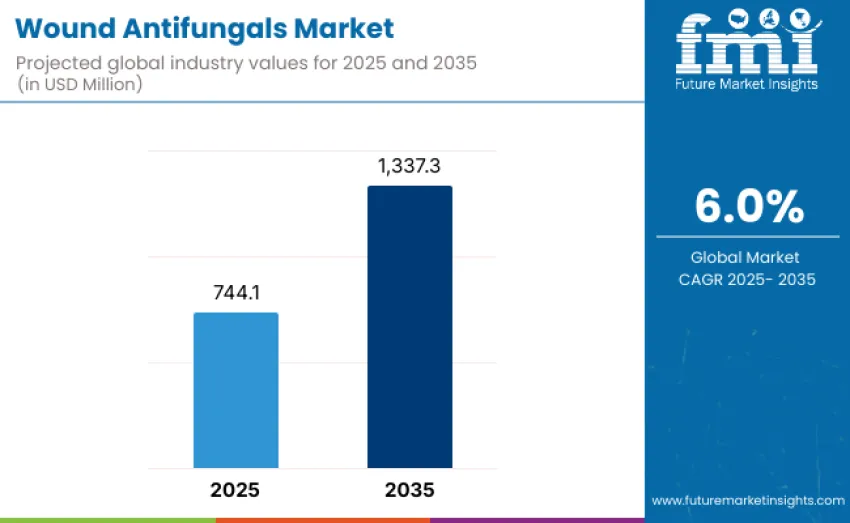
The global wound antifungals market is expected to reach USD 1,337.3 million by 2035, recording an absolute increase of USD 593.2 million over the forecast period. This market is valued at USD 744.1 million in 2025 and is projected to grow at a CAGR of 6.0% over the assessment period. Growth is supported by the increasing incidence of chronic and acute wounds that are prone to fungal infections, particularly among diabetic, immunocompromised, and elderly populations. Rising awareness about infection-related complications in wound management drives consistent demand for antifungal wound care products.
Technological advancements in topical antifungal formulations, including creams, gels, sprays, and dressings with enhanced bioavailability and faster healing properties, are reshaping the wound antifungals landscape. Modern systems incorporate advanced delivery mechanisms that ensure targeted therapeutic effects while minimizing systemic exposure. Integration with antimicrobial dressings and bioactive wound care materials allows comprehensive infection management across professional applications. Advanced formulation technologies enable natural healing processes that replicate optimal therapeutic environments, supporting clinical outcomes.
Quick Stats for Wound Antifungals Market
- Wound Antifungals Market Value (2025): USD 744.1 million
- Wound Antifungals Market Forecast Value (2035): USD 1,337.3 million
- Wound Antifungals Market Forecast CAGR: 6.0%
- Leading Product Type in Wound Antifungals Market: Topical Azole leads (34.5% share)
- Key Growth Regions in Wound Antifungals Market: North America, Europe, East Asia, South Asia & Pacific, Latin America, Middle East & Africa
- Top Players in Wound Antifungals Market: Bayer Consumer Health, Haleon (ex-GSK Consumer), Pfizer (Hospital/Systemic Antifungals), Sun Pharmaceutical, Teva/Actavis Generics, Perrigo Company, Bausch Health, Smith+Nephew (Adj. Antimicrobial Dressings), 3M (Advanced Dressings portfolio)
Government healthcare initiatives promoting advanced wound care practices, coupled with expanding availability of over-the-counter antifungal products, accelerate growth. Healthcare institutions worldwide invest in wound care infrastructure to prepare clinicians for complex wound management challenges. Clinical training programs for healthcare teams and wound care specialists drive demand for professional antifungal products that enable comprehensive infection control capabilities. Industry adoption of evidence-based protocols creates sustained investment in wound care products that will allow healthcare professionals to maintain treatment efficacy.
Wound Antifungals Market Year-over-Year Forecast 2025 to 2035
Between 2025 and 2030, the wound antifungals market is projected to expand from USD 744.1 million to USD 996.6 million, representing a 42.6% share of the total forecast growth for the decade. This phase will be shaped by rising demand for professional wound care solutions and advanced antifungal treatment protocols, product innovation in topical formulations and delivery system optimization, as well as expanding integration with comprehensive wound management programs. Companies are establishing competitive positions through investment in advanced antifungal technologies.
From 2030 to 2035, growth is forecast from USD 996.6 million to USD 1,337.3 million, adding USD 340.7 million, constituting 57.4% of overall ten-year expansion. This period is expected to be characterized by expansion of specialized antifungal dressings, including combination therapies and integrated wound care systems tailored for specific clinical applications, strategic collaborations between pharmaceutical manufacturers and healthcare providers, and enhanced focus on evidence-based treatment protocols and patient outcome optimization. Growing emphasis on chronic wound management will drive demand for advanced antifungal solutions.
Wound Antifungals Market Key Takeaways
| Metric | Value |
|---|---|
| Market Value (2025) | USD 744.1 million |
| Market Forecast Value (2035) | USD 1,337.3 million |
| Forecast CAGR (2025 to 2035) | 6.0% |
Why Is the Wound Antifungals Market Growing Worldwide?
The wound antifungals market grows worldwide due to increasing incidence of chronic and acute wounds that are prone to fungal infections, particularly among diabetic, immunocompromised, and elderly populations. Rising awareness about infection-related complications in wound management and growing emphasis on preventing hospital-acquired infections drive consistent demand for antifungal wound care products. Advancements in topical antifungal formulations, including creams, gels, sprays, and dressings with enhanced bioavailability and faster healing properties, expand clinical adoption across hospitals, outpatient settings, and home care environments.
The rising prevalence of diabetic foot ulcers, surgical site infections, and burns intensifies the need for targeted antifungal interventions to reduce healing time and prevent secondary bacterial infections. Government healthcare initiatives promoting advanced wound care practices, coupled with expanding availability of over-the-counter antifungal products, propel penetration in both developed and emerging economies. Growing integration of antifungal agents into antimicrobial dressings and bioactive wound care materials reshapes treatment protocols toward combination therapies that enhance patient outcomes.
How Are the Wound Antifungals Market Segmented by Product Type, Application, and Region?
The wound antifungals market is segmented by product type, application, and region. By product type, division includes topical azoles, polyenes, allylamine, antifungal impregnated dressings/films, antimicrobial combo gels/ointments, and others & compounded preparations. Based on application, categorization covers diabetic foot ulcers, surgical site infections, pressure ulcers, burns & traumatic wounds, chronic venous leg ulcers, and others. Regionally, segmentation spans Asia Pacific, Europe, North America, Latin America, and Middle East & Africa.
By Product Type, Topical Azoles Account for Dominant Share
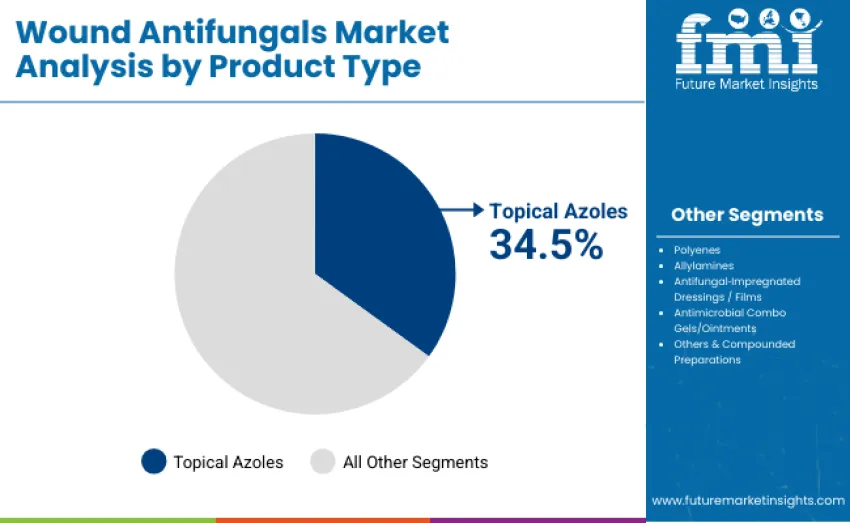
The topical azoles segment represents the dominant force, capturing 34.5% of total revenue in 2025. This category includes clotrimazole and miconazole formulations, widely recognized for their broad-spectrum antifungal efficacy, ease of application, and strong clinical adoption across hospitals, outpatient clinics, and home care settings. Leadership stems from critical role in standard wound care protocols, providing effective management of fungal infections in acute and chronic wounds and promoting faster healing outcomes.
Key advantages driving the Topical Azoles segment include:
- Broad-spectrum antifungal efficacy effective against common wound pathogens, providing reliable treatment for acute and chronic wounds
- Versatile formulations in creams, gels, and ointments enabling easy and targeted application across different wound types
- Strong clinical acceptance and inclusion in standard wound care guidelines, supporting consistent use in hospitals, clinics, and home care
By Application, Diabetic Foot Ulcers Lead
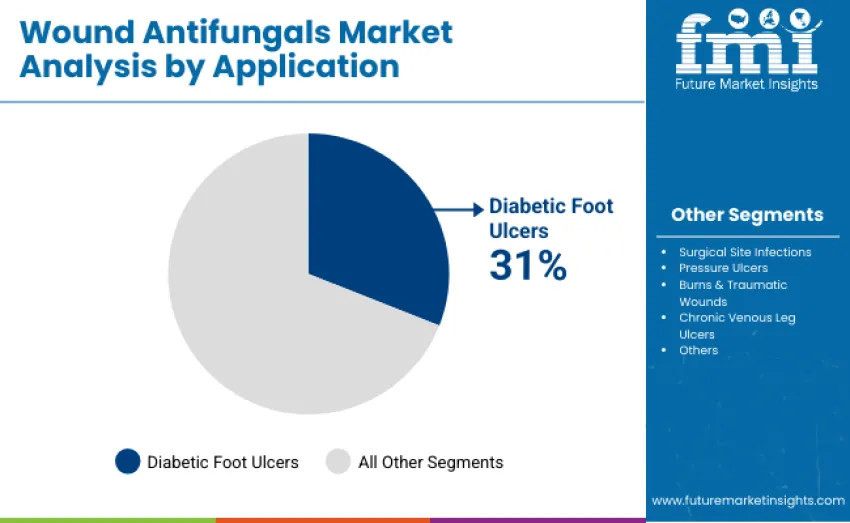
The diabetic foot ulcers segment represents the leading application with 31% of total revenue in 2025. Leadership is driven by rising global prevalence of diabetes and increased susceptibility of diabetic wounds to fungal infections, making targeted antifungal treatments critical for preventing complications and promoting faster healing. Surgical site infections account for 19%, reflecting the need for infection control in postoperative care, while pressure ulcers serve hospital and long-term care settings.
Key market dynamics supporting application preferences include:
- High prevalence of diabetic foot ulcers and chronic wounds driving consistent demand for antifungal interventions
- Clinical protocols emphasizing early antifungal treatment to reduce infection risk and accelerate healing
- Integration of advanced antifungal dressings and topical formulations into standard wound care across hospitals and home care
What Are the Major Drivers, Restraints, and Emerging Trends Influencing the Wound Antifungals Market?
The wound antifungals market is driven by several key factors reflecting growing clinical demand and evolving healthcare practices. Rising prevalence of chronic and acute wounds, including diabetic foot ulcers, pressure ulcers, and surgical site infections, increases the need for effective antifungal treatments to prevent complications and promote faster healing. Expanding diabetic and immunocompromised patient populations worldwide are particularly susceptible to fungal wound infections, driving consistent adoption of targeted antifungal therapies in hospitals, clinics, and home care settings.
What Factors Are Contributing to the Growing Adoption of Wound Antifungals?
Growing awareness among healthcare providers and patients regarding infection prevention and advanced wound care protocols supports integration of topical azoles, antifungal dressings, and combination therapies into standard wound management practices. Restraints include high product costs, which can limit access in low- and middle-income regions, and risk of antifungal resistance that may reduce treatment effectiveness over time. Limited availability of advanced antifungal formulations and specialized dressings in certain markets can moderate growth.
What Emerging Trends Are Shaping the Wound Antifungals Market?
Key emerging trends include development of combination therapies that integrate antifungal and antibacterial agents, increasing use of antifungal-impregnated dressings for chronic and hard-to-heal wounds, and adoption of innovative topical formulations with enhanced bioavailability and faster healing properties. Regional growth is particularly notable in Asia-Pacific, where government healthcare initiatives, rising diabetic populations, and expanding access to advanced wound care products drive expansion. Research into next-generation antifungal therapies, including bioactive dressings and sustained-release formulations, shapes product innovation.
Section 6How Are Leading Countries Driving Growth in the Wound Antifungals Market?
| Country | CAGR (2025 to 2035) |
|---|---|
| United States | 5.8 % |
| Brazil | 6.5 % |
| China | 7.6 % |
| India | 7.9 % |
| Europe | 5.6 % |
| Germany | 5.4 % |
| United Kingdom | 5.2 % |
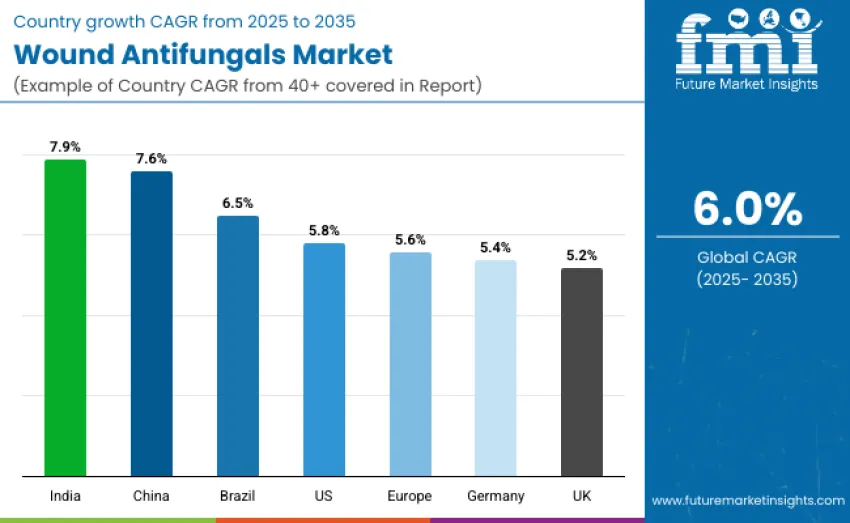
The wound antifungals market is experiencing global growth, with India leading at a CAGR of 7.9%, driven by rising chronic wounds and government-backed initiatives. China follows at 7.6%, benefiting from healthcare investments and diabetes management programs. Brazil shows strong growth at 6.5%, spurred by rising chronic wound awareness. The USA has a steady growth rate of 5.8%, supported by its mature healthcare system. Germany leads Europe at 5.4%, the U.K. show consistent progress at 5.3% and 5.2%, respectively. Overall, Europe grows at 5.6%, with established markets providing stability.
The report covers an in-depth analysis of 40+ countries top-performing countries are highlighted below.
How Are Advanced Wound Care Programs Driving Adoption in India?
In India, the wound antifungals market is projected to grow at a CAGR of 7.9% through 2035. Growth is driven by technological advancements in antifungal formulations, topical therapies, and impregnated dressings that enhance treatment efficacy. Healthcare professionals are implementing standardized wound antifungal protocols and advanced dressing workflows to improve patient outcomes while meeting clinical efficacy standards required in modern wound management. National and regional healthcare programs promoting chronic wound care and infection control sustain demand for antifungal wound products.
Key market factors:
- Expansion of professional creative industries drives adoption of advanced technology, indirectly supporting efficient healthcare product marketing and distribution.
- Cultural and creative sector subsidies and training incentives promote technology adoption, improving infrastructure for awareness and distribution of wound antifungals.
- Established marketplaces and direct-to-consumer sales ensure rapid deployment of products to hospitals, pharmacies, and professional users.
How Is Healthcare Infrastructure Accelerating Growth in China?
China demonstrates the strongest growth potential with a CAGR of 7.6% through 2035. Leadership is supported by advanced healthcare infrastructure, which strengthens product awareness, distribution efficiency, and adoption across professional and institutional channels. Growth concentrates in major urban clusters, including Beijing, Shanghai, Shenzhen, and Hangzhou, where technology-driven industries and healthcare ecosystems create enabling environments for wound antifungal deployment. Distribution channels through hospitals, specialty clinics, and pharmaceutical networks facilitate rapid availability.
Key market factors:
- Increasing incidence of chronic wounds such as diabetic foot ulcers, pressure ulcers, burns, and surgical site infections.
- Advancements in antifungal formulations, topical therapies, and impregnated dressings that improve treatment outcomes.
- Expansion of healthcare infrastructure and improved access, particularly in emerging markets, facilitating wider adoption of wound antifungal products.
How Do Advanced Wound Care Programs Sustain Leadership in Germany?
Germany's wound antifungals market demonstrates structured adoption across hospitals, clinics, and home care settings, with documented case studies showing improvements in patient outcomes and infection control through standardized antifungal treatment protocols. Leading healthcare centers and chronic wound management programs showcase integration of antifungal dressings, topical therapies, and advanced treatment workflows, leveraging clinical expertise and strong healthcare infrastructure. Healthcare professionals emphasize treatment efficacy, safety, and patient adherence, creating demand for high-quality antifungal solutions. Growth maintains steady progress with a CAGR of 5.4% through 2035.
Key development areas:
- Hospitals and clinics implementing standardized wound antifungal protocols with comprehensive staff training programs achieving high adherence and compliance rates.
- Technical education and awareness programs providing clinicians and caregivers access to best practices in chronic wound care.
- Strategic partnerships between pharmaceutical manufacturers and distributors ensuring reliable product availability, clinical support, and quality assurance.
How Is Expanding Chronic Wound Care Infrastructure Driving Demand in Brazil?
The Brazilian wound antifungals market demonstrates structured adoption across hospitals, clinics, and home care settings, with documented case studies showing improvements in patient outcomes and infection control through standardized antifungal treatment protocols. Major healthcare centers and chronic wound management programs showcase integration of antifungal dressings, topical therapies, and advanced treatment workflows, leveraging clinical expertise and local healthcare infrastructure. Healthcare professionals emphasize treatment efficacy, safety, and patient adherence, driving demand for high-quality antifungal solutions. Growth demonstrates strong momentum with a CAGR of 6.5% through 2035.
Key development areas:
- Hospitals and clinics implementing standardized wound antifungal protocols with comprehensive staff training programs achieving high adherence and compliance rates.
- Technical education and awareness programs providing clinicians and caregivers access to best practices in chronic wound care.
- Strategic partnerships between pharmaceutical manufacturers and healthcare distributors ensuring reliable product availability, clinical support, and quality assurance.
How Do Advanced Wound Care Programs Strengthen Performance in the United States?
The USA wound antifungals market demonstrates mature adoption across hospitals, clinics, and home care settings, with documented integration into established chronic wound management programs and home care initiatives. Major healthcare networks and specialized wound care centers showcase the use of antifungal dressings, topical therapies, and advanced treatment protocols, leveraging clinical expertise and strong healthcare infrastructure. Growth maintains steady progress with a CAGR of 5.8% through 2035, driven by high patient volumes, well-developed chronic wound care programs, and mature healthcare ecosystem supporting widespread clinician adoption.
Key market characteristics:
- Hospitals and wound care centers implementing standardized antifungal protocols with uniform clinical procedures to ensure treatment consistency and efficacy.
- Established distribution infrastructure through pharmaceutical distributors, hospital supply chains, and online medical marketplaces providing product availability and technical support.
- Collaboration between healthcare associations and manufacturers facilitating product testing, professional feedback integration, and development of next-generation antifungal solutions.
How Is Chronic Wound Care Expansion Supporting Growth in the United Kingdom?
In the United Kingdom, adoption of wound antifungal treatments accelerates across hospitals, clinics, and home care settings in London, Manchester, Bristol, and Edinburgh, with documented case studies showing improvements in patient outcomes and infection control through standardized antifungal protocols. Growth demonstrates solid potential with a CAGR of 5.2% through 2035, driven by expanding chronic wound care infrastructure, increased awareness of advanced wound management practices, and government healthcare initiatives supporting community and outpatient care programs. Healthcare professionals implement antifungal dressings, topical therapies, and integrated treatment workflows.
Market development factors:
- Hospitals and clinics adopting standardized wound antifungal protocols with comprehensive staff training and adherence monitoring programs.
- Partnerships between healthcare educational institutions and manufacturers providing clinicians access to best practices, training modules, and professional development resources.
- Strategic collaborations between healthcare associations and pharmaceutical suppliers enabling product testing, professional feedback integration, and development of next-generation antifungal solutions.
How Are Healthcare Investments Driving Growth Across Europe?
The wound antifungals market in Europe is projected to grow from USD 208.3 million in 2025 to USD 361.1 million by 2035, registering a CAGR of 5.6% over the forecast period, witnessing steady growth driven by expanding chronic wound care programs and improved healthcare infrastructure. Germany shows a CAGR of 5.4%, supported by advanced healthcare facilities and structured chronic wound management initiatives.
The United Kingdom records a CAGR of 5.2%, reflecting expansion of community healthcare programs and chronic wound management initiatives. Italy maintains steady growth through hospital-based wound care programs and specialized treatment centers. Spain demonstrates consistent progress through healthcare modernization and chronic disease management programs. The Netherlands shows stable advancement through advanced healthcare infrastructure and clinical protocol standardization. Nordic countries record moderate growth through comprehensive healthcare systems and wound care specialization programs.
Precision and Clinical Quality Drive Market Maturity in Japan
The Japanese Wound Antifungals Market is characterized by a mature, quality-focused landscape, where standardized antifungal treatment protocols are widely adopted across hospitals, clinics, and home care settings. Japan’s commitment to clinical precision and treatment efficacy drives demand for high-quality antifungal products, essential for chronic wound management. Strong partnerships between pharmaceutical manufacturers, healthcare providers, and clinical associations ensure antifungal solutions are integrated into established care workflows, optimizing infection control and patient outcomes. Healthcare professionals in Japan prioritize advanced wound management practices to maintain rigorous standards and ensure consistent results in wound care.
International Partnerships Strengthen Wound Antifungal Services in South Korea
The South Korean Wound Antifungals Market is marked by a growing presence of international pharmaceutical providers. Companies maintain strong positions by offering comprehensive product support, clinical guidance, and technical services. Emphasis is placed on advanced chronic wound care, with hospitals, clinics, and home care providers demanding antifungal solutions that align with national healthcare programs. Regional distributors and healthcare networks expand market share through partnerships with international suppliers, offering specialized services such as Korean-language clinical guidance and tailored support. Collaborations between multinational manufacturers and Korean clinical associations improve service models, merging global product quality with local expertise.
How Competitive Is the Global Wound Antifungals Market and What Defines Its Structure?
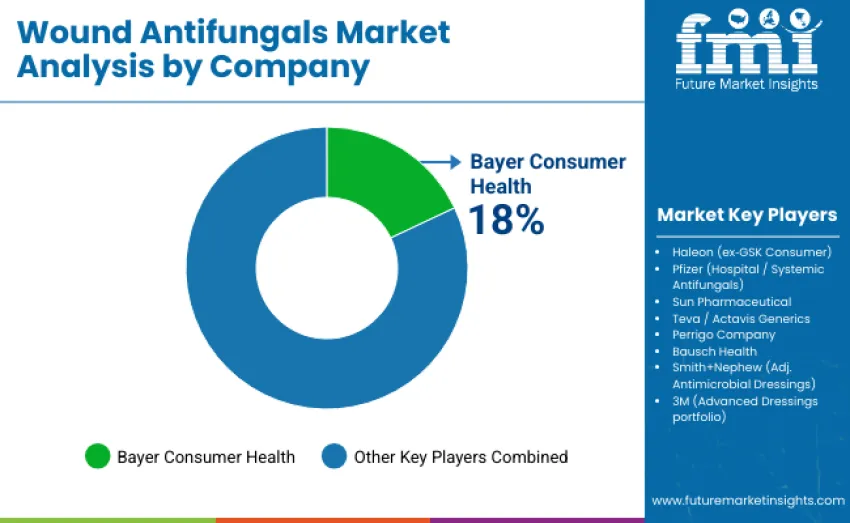
The global wound antifungals market is moderately concentrated, with 12–15 players. The top three companies, Bayer Consumer Health (18%), Haleon (formerly GSK Consumer), and Pfizer (Hospital/Systemic Antifungals), collectively control around 55–60% of the global market share. Their dominance stems from established brand recognition, extensive clinical validation, and comprehensive product portfolios. These companies lead the competition with formulation efficacy, a wide spectrum of antifungal activity, ease of application, and seamless integration with wound management protocols, rather than competing solely on price.
Other major players, including Sun Pharmaceutical, Teva/Actavis Generics, Perrigo Company, Bausch Health, Smith+Nephew (Advanced Antimicrobial Dressings), and 3M (Advanced Dressings Portfolio), sustain competitive advantages through robust research pipelines, broad distribution networks, and proven clinical performance. These companies continue to invest in novel topical formulations, impregnated dressing technologies, and delivery systems, defending their positions and expanding into hospital, clinic, and home care markets globally.
Product specialists target niche segments like diabetic foot ulcer care, chronic wound management, and burn-related infections, providing differentiated capabilities in specialized dressings, combination therapies, or portable treatment solutions. Emerging manufacturers add competitive pressure through rapid innovation, novel formulations, and cost-effective alternatives.
Key Players in the Wound Antifungals Market
- Bayer Consumer Health
- Haleon (exGSK Consumer)
- Pfizer (Hospital / Systemic Antifungals)
- Sun Pharmaceutical
- Teva / Actavis Generics
- Perrigo Company
- Bausch Health
- Smith+Nephew (Adj. Antimicrobial Dressings)
- 3M (Advanced Dressings portfolio)
Scope of the Report
| Item | Value |
|---|---|
| Quantitative Units | USD 744.1 million |
| Product Type | Topical Azoles, Polyenes, Allylamine, Antifungal Impregnated Dressings/Films, Antimicrobial Combo Gels/Ointments, Others & Compounded Preparations |
| Application | Diabetic Foot Ulcers, Surgical Site Infections, Pressure Ulcers, Burns & Traumatic Wounds, Chronic Venous Leg Ulcers, Others |
| Regions Covered | Asia Pacific, Europe, North America, Latin America, Middle East & Africa |
| Country Covered | China, India, Germany, Brazil, USA, UK, and 40+ countries |
| Key Companies Profiled | Bayer Consumer Health, Haleon (ex GSK Consumer), Pfizer (Hospital/Systemic Antifungals), Sun Pharmaceutical, Teva/Actavis Generics, Perrigo Company, Bausch Health, Smith+Nephew (Adj. Antimicrobial Dressings), 3M (Advanced Dressings portfolio) and Others |
| Additional Attributes | Dollar sales in the wound antifungals market are driven by product type, application categories, and regional trends across North America, Europe, Asia-Pacific, and Latin America. Key factors include competitive dynamics, distribution networks, technical specifications, clinical integration, and innovative antifungal delivery systems |
Wound Antifungals Market by Segments
By Product:
- Topical Azoles
- Polyenes
- Allylamines
- AntifungalImpregnated Dressings / Films
- Antimicrobial Combo Gels/Ointments
- Others & Compounded Preparations
By Application:
- Diabetic Foot Ulcers (DFU)
- Surgical Site Infections
- Pressure Ulcers
- Burns & Traumatic Wounds
- Chronic Venous Leg Ulcers
- Others
By Region:
- Asia Pacific
- China
- India
- Japan
- South Korea
- Vietnam
- Australia & New Zealand
- ASEAN
- Rest of Asia Pacific
- Europe
- Germany
- United Kingdom
- France
- Italy
- Spain
- Netherlands
- Nordic
- BENELUX
- Rest of Europe
- North America
- United States
- Canada
- Mexico
- Latin America
- Brazil
- Argentina
- Rest of Latin America
- Middle East & Africa
- Kingdom of Saudi Arabia
- Other GCC Countries
- Turkey
- South Africa
- Other African Union
- Rest of Middle East & Africa
Frequently Asked Questions
How big is the wound antifungals market in 2025?
The global wound antifungals market is valued at USD 744.1 million in 2025.
What will be the size of the wound antifungals market in 2035?
The market is projected to reach USD 1,337.3 million by 2035.
How fast will the wound antifungals market grow between 2025 and 2035?
The market will grow at a CAGR of 6.0% from 2025 to 2035.
Which product leads the wound antifungals market in 2025?
Topical Azoles lead the market with a 34.5% share in 2025.
Who are the major players in the wound antifungals market?
Key players include Bayer Consumer Health, Haleon (ex-GSK Consumer), Pfizer (Hospital/Systemic Antifungals), Sun Pharmaceutical, and Teva/Actavis Generics.
Preview the report firsthand - request a free sample
Get SampleGet the brochure for pricing and purchase details.
Get PDFTable of Content
- Executive Summary
- Regional Level Market Outlook
- Demand-side Trends
- Supply-side Trends
- Technology Roadmap Analysis
- Analysis and Recommendations
- Market Overview
- Market Coverage / Taxonomy
- Market Definition / Scope / Limitations
- Market Background
- Market Dynamics
- Drivers
- Restraints
- Opportunity
- Trends
- Scenario Forecast
- Demand in Optimistic Scenario
- Demand in Likely Scenario
- Demand in Conservative Scenario
- Opportunity Assessment
- Products Market Assessment
- Value Chain Analysis
- Participants and their Roles
- Raw Material Suppliers
- Manufacturers
- Mid-Level Participants
- Wholesalers and Distributors
- Profit Margin Analysis
- Operating Margins By Region
- Notes on Value Added at Each Node in the Value Chain
- Participants and their Roles
- Strategic Divestments/ Investments
- Market Trade Assessment
- Import-Export Analysis
- Supply Demand Gap Assessment
- White –Space Opportunity Assessment and Mapping
- PESTLE and Porter’s Analysis
- Regulatory Landscape
- By Key Regions
- By Key Countries
- Regional Parent Market Outlook
- Product Launches & Development
- Technology Innovation
- Joint Ventures, M&A, Licensing & Partnerships
- Market Dynamics
- Regional Level Market Analysis 2020 to 2024 and Forecast, 2025 to 2035
- Historical Market Size USD Million Analysis, 2020 to 2024
- Current and Future Market Size USD Million Projections, 2025 to 2035
- Y-o-Y Growth Trend Analysis
- Absolute $ Opportunity Analysis
- Regional Level Market Analysis 2020 to 2024 and Forecast 2025 to 2035, By Product
- Introduction / Key Findings
- Historical Market Size USD Million Analysis By Product, 2020 to 2024
- Current and Future Market Size USD Million Analysis and Forecast By Product, 2025 to 2035
- Topical Azoles (Clotrimazole, Miconazole)
- Polyenes (Nystatin)
- Allylamines (Terbinafine)
- Antifungal Impregnated Dressings / Films
- Antimicrobial Combo Gels/Ointments (Fungal+Antibacterial)
- Others & Compounded Preparations
- Y-o-Y Growth Trend Analysis By Product, 2020 to 2024
- Absolute $ Opportunity Analysis By Product, 2025 to 2035
- Regional Level Market Analysis 2020 to 2024 and Forecast 2025 to 2035, By Application
- Introduction / Key Findings
- Historical Market Size USD Million Analysis By Application, 2020 to 2024
- Current and Future Market Size USD Million Analysis and Forecast By Application, 2025 to 2035
- Diabetic Foot Ulcers (DFU)
- Surgical Site Infections (Fungal)
- Pressure Ulcers
- Burns & Traumatic Wounds
- Chronic Venous Leg Ulcers
- Others (Oncology/Immunocompromised)
- Y-o-Y Growth Trend Analysis By Application, 2020 to 2024
- Absolute $ Opportunity Analysis By Application, 2025 to 2035
- Regional Level Market Analysis 2020 to 2024 and Forecast 2025 to 2035, By Form or Technology
- Introduction / Key Findings
- Historical Market Size USD Million Analysis By Form or Technology, 2020 to 2024
- Current and Future Market Size USD Million Analysis and Forecast By Form or Technology, 2025 to 2035
- Creams / Ointments / Gels
- Powders & Sprays
- Flim Dressings
- Lavage Solutions
- Systemic Adjuncts
- Y-o-Y Growth Trend Analysis By Form or Technology, 2020 to 2024
- Absolute $ Opportunity Analysis By Form or Technology, 2025 to 2035
- Regional Level Market Analysis 2020 to 2024 and Forecast 2025 to 2035, By End User
- Introduction / Key Findings
- Historical Market Size USD Million Analysis By End User, 2020 to 2024
- Current and Future Market Size USD Million Analysis and Forecast By End User, 2025 to 2035
- Hospitals
- Specialty Wound Care Clinics
- Home Care Settings
- Long Term Care & Nursing Homes
- Others (Military, Emergency)
- Y-o-Y Growth Trend Analysis By End User, 2020 to 2024
- Absolute $ Opportunity Analysis By End User, 2025 to 2035
- Regional Level Market Analysis 2020 to 2024 and Forecast 2025 to 2035, By Region
- Introduction
- Historical Market Size USD Million Analysis By Region, 2020 to 2024
- Current Market Size USD Million Analysis and Forecast By Region, 2025 to 2035
- North America
- Latin America
- East Asia
- South Asia
- Western Europe
- Eastern Europe
- Middle East & Africa
- Market Attractiveness Analysis By Region
- North America Market Analysis 2020 to 2024 and Forecast 2025 to 2035, By Country
- Historical Market Size USD Million Trend Analysis By Market Taxonomy, 2020 to 2024
- Market Size USD Million Forecast By Market Taxonomy, 2025 to 2035
- By Country
- USA
- Canada
- Mexico
- By Product
- By Application
- By Form or Technology
- By End User
- By Country
- Market Attractiveness Analysis
- By Country
- By Product
- By Application
- By Form or Technology
- By End User
- Key Takeaways
- Latin America Market Analysis 2020 to 2024 and Forecast 2025 to 2035, By Country
- Historical Market Size USD Million Trend Analysis By Market Taxonomy, 2020 to 2024
- Market Size USD Million Forecast By Market Taxonomy, 2025 to 2035
- By Country
- Brazil
- Argentina
- Rest of Latin America
- By Product
- By Application
- By Form or Technology
- By End User
- By Country
- Market Attractiveness Analysis
- By Country
- By Product
- By Application
- By Form or Technology
- By End User
- Key Takeaways
- East Asia Market Analysis 2020 to 2024 and Forecast 2025 to 2035, By Country
- Historical Market Size USD Million Trend Analysis By Market Taxonomy, 2020 to 2024
- Market Size USD Million Forecast By Market Taxonomy, 2025 to 2035
- By Country
- China
- Japan
- South Korea
- By Product
- By Application
- By Form or Technology
- By End User
- By Country
- Market Attractiveness Analysis
- By Country
- By Product
- By Application
- By Form or Technology
- By End User
- Key Takeaways
- South Asia Market Analysis 2020 to 2024 and Forecast 2025 to 2035, By Country
- Historical Market Size USD Million Trend Analysis By Market Taxonomy, 2020 to 2024
- Market Size USD Million Forecast By Market Taxonomy, 2025 to 2035
- By Country
- India
- ASEAN Countries
- Australia & New Zealand
- Rest of South Asia
- By Product
- By Application
- By Form or Technology
- By End User
- By Country
- Market Attractiveness Analysis
- By Country
- By Product
- By Application
- By Form or Technology
- By End User
- Key Takeaways
- Western Europe Market Analysis 2020 to 2024 and Forecast 2025 to 2035, By Country
- Historical Market Size USD Million Trend Analysis By Market Taxonomy, 2020 to 2024
- Market Size USD Million Forecast By Market Taxonomy, 2025 to 2035
- By Country
- Germany
- UK
- France
- Italy
- Spain
- BENELUX
- Nordic Countries
- Rest of Western Europe
- By Product
- By Application
- By Form or Technology
- By End User
- By Country
- Market Attractiveness Analysis
- By Country
- By Product
- By Application
- By Form or Technology
- By End User
- Key Takeaways
- Eastern Europe Market Analysis 2020 to 2024 and Forecast 2025 to 2035, By Country
- Historical Market Size USD Million Trend Analysis By Market Taxonomy, 2020 to 2024
- Market Size USD Million Forecast By Market Taxonomy, 2025 to 2035
- By Country
- Russia
- Hungary
- Poland
- Rest of Eastern Europe
- By Product
- By Application
- By Form or Technology
- By End User
- By Country
- Market Attractiveness Analysis
- By Country
- By Product
- By Application
- By Form or Technology
- By End User
- Key Takeaways
- Middle East & Africa Market Analysis 2020 to 2024 and Forecast 2025 to 2035, By Country
- Historical Market Size USD Million Trend Analysis By Market Taxonomy, 2020 to 2024
- Market Size USD Million Forecast By Market Taxonomy, 2025 to 2035
- By Country
- Saudi Arabia
- Other GCC Countries
- Türkiye
- South Africa
- Rest of MEA
- By Product
- By Application
- By Form or Technology
- By End User
- By Country
- Market Attractiveness Analysis
- By Country
- By Product
- By Application
- By Form or Technology
- By End User
- Key Takeaways
- Market Structure Analysis
- Competition Dashboard
- Competition Benchmarking
- Market Share Analysis of Top Players
- By Regional
- By Product
- By Application
- By Form or Technology
- By End User
- Competition Analysis
- Competition Deep Dive
- Bayer Consumer Health
- Overview
- Product Portfolio
- Key Financials
- Key Developments
- Global/Regional Footprint
- Strategy Overview
- Marketing Strategy
- SWOT
- Analyst Comment
- Haleon (ex GSK Consumer)
- Overview
- Product Portfolio
- Key Financials
- Key Developments
- Global/Regional Footprint
- Strategy Overview
- Marketing Strategy
- SWOT
- Analyst Comment
- Pfizer (Hospital / Systemic Antifungals)
- Overview
- Product Portfolio
- Key Financials
- Key Developments
- Global/Regional Footprint
- Strategy Overview
- Marketing Strategy
- SWOT
- Analyst Comment
- Sun Pharmaceutical
- Overview
- Product Portfolio
- Key Financials
- Key Developments
- Global/Regional Footprint
- Strategy Overview
- Marketing Strategy
- SWOT
- Analyst Comment
- Teva / Actavis Generics
- Overview
- Product Portfolio
- Key Financials
- Key Developments
- Global/Regional Footprint
- Strategy Overview
- Marketing Strategy
- SWOT
- Analyst Comment
- Perrigo Company
- Overview
- Product Portfolio
- Key Financials
- Key Developments
- Global/Regional Footprint
- Strategy Overview
- Marketing Strategy
- SWOT
- Analyst Comment
- Bausch Health
- Overview
- Product Portfolio
- Key Financials
- Key Developments
- Global/Regional Footprint
- Strategy Overview
- Marketing Strategy
- SWOT
- Analyst Comment
- Smith+Nephew (Adj. Antimicrobial Dressings)
- Overview
- Product Portfolio
- Key Financials
- Key Developments
- Global/Regional Footprint
- Strategy Overview
- Marketing Strategy
- SWOT
- Analyst Comment
- 3M (Advanced Dressings portfolio)
- Overview
- Product Portfolio
- Key Financials
- Key Developments
- Global/Regional Footprint
- Strategy Overview
- Marketing Strategy
- SWOT
- Analyst Comment
- Bayer Consumer Health
- Competition Deep Dive
- Assumptions & Acronyms Used
- Research Methodology


