

- Market Size (2026)
- USD 483.3 Mn
- Forecast (2036)
- USD 1347.8 Mn
- CAGR (2026 to 2036)
- 10.8%
How big is the proofers & retarder-proofers market in 2026?
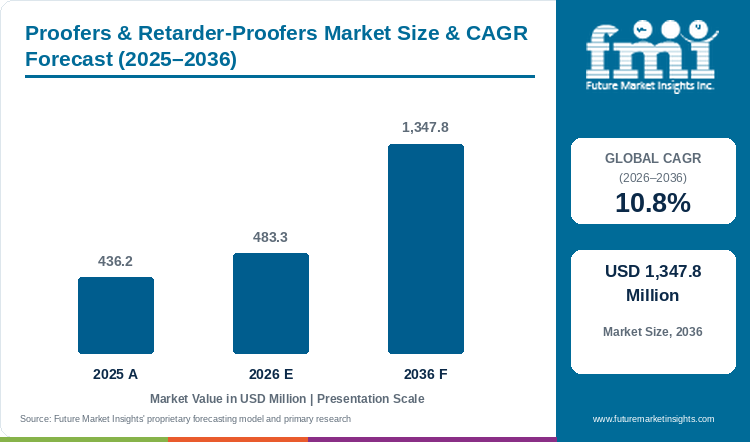
The market was valued at USD 436.2 million in 2025 and is expected to reach USD 483.3 million in 2026. It is projected to reach USD 1,347.8 million by 2036 at a CAGR of 10.8% from 2026 to 2036.
The proofers and retarder-proofers market was valued at USD 436.2 million in 2025 and is estimated at USD 483.3 million in 2026. Revenue is projected to reach USD 1,347.8 million by 2036 at a CAGR of 10.8%, with rack proofers representing 32.0% of equipment type demand in 2026. Capital spending in food equipment can be uneven: Bühler's Consumer Foods business recorded an 8.8% decline in orders in 2025.[5] A proofer purchase nevertheless has a specific operating case when controlled fermentation prevents lost batches, supports overnight scheduling or removes a bottleneck in an existing bakery. These benefits can justify replacement even when construction of new plants is subdued, provided the equipment fits the site's product mix, refrigeration needs and daily loading pattern. A retarder-proofer adds scheduling flexibility only when temperature and humidity remain stable across the load and maintenance teams can service it without disrupting the next production cycle.
Key Market Trends & Insights
- By equipment type: Rack Proofers represented 32.0% of 2026 equipment type demand. Racks lead because separate loads can follow different proofing programmes when the day's products change. The test is full loading, where the positions nearest and furthest from the air supply still have to give comparable dough.
- By capacity: 500-2,000 kg/hr accounted for 43.0% of 2026 capacity demand. This band leads, but output per hour doesn't say how much dough the chamber has to hold. Residence time and piece size set the space, so sizing starts with the recipe, not the rate.
- By automation level: Fully Automatic / Robotic held 44.0% of 2026 automation level demand. This is the top automation level because programmed climate and carrier movement run together. It's tested when the oven slows, since dough already inside keeps fermenting.
Regional Highlights
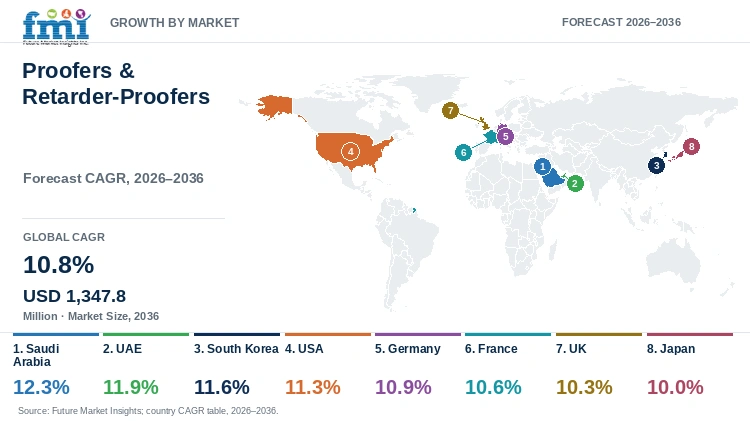
- Saudi Arabia's 12.3% projected CAGR puts it ahead of the other seven proofer and retarder-proofer country profiles for 2026 to 2036, emphasizing the value of dependable fermentation capacity.
- The UAE follows at 11.9%, South Korea at 11.6% and the USA at 11.3%; Japan's 10.0% forecast is lower but still supports replacement where scheduling or temperature control is constraining output.
Market Size & Forecast
Table 1: Proofers & Retarder-Proofers Market Size and Forecast (USD million), 2025 to 2036
| Market size and forecast | Value |
|---|---|
| 2025 Value (actual) | USD 436.2 million |
| Estimated market size in 2026 | USD 483.3 million |
| Projected market size by 2036 | USD 1,347.8 million |
| CAGR (2026-2036) | 10.8% |
The practical opportunity depends on what the chamber lets the bakery do with its oven window. MIWE’s GVA e+ combines a temperature range of −20°C to +40°C with controlled humidity of up to 98.0% RH, which allows preparation and baking to take place at different times.[4] Mecatherm described pan-based conveying that keeps delicate products supported through proofing in January 2026, and Royal Kaak presented dough-ball production and proofing together at Pizza Expo in March 2026.[2][3] Both connect climate control with the movement of individual products, although an announcement cannot show that customers will keep a new chamber in regular service. FDA manufacturing requirements for equipment and sanitary operations add maintenance and cleaning needs to every installation.[1] Consequently, actual demand will depend on whether a chamber frees a baking window or shifts preparation without adding refrigeration, drainage or downtime costs that offset the gain.
Proofers & Retarder-Proofers Market is segmented by Equipment Type, Capacity, Automation Level, End User, Sales Channel and Region. The forecast period runs from 2026 to 2036.
Fermentation occupies both time and floor space within a dough processing system. A longer proof keeps more dough inside the chamber at a given production rate, while larger pieces need room to expand without contact. This makes the bakery’s actual product schedule central to equipment selection. A plant alternating rolls and large loaves may need flexibility in carrier spacing and unloading as much as additional enclosure volume. Retardation adds another option by moving preparation earlier, provided the subsequent warming and proofing sequence restores the condition required for baking. These choices determine how much of the existing oven capacity the bakery can use.
On an industrial line, the carrier is part of the fermentation system. Mecatherm’s January 2026 pan-based conveying description keeps delicate products supported through proofing and other processing stages.[2] Royal Kaak presented dough-ball production and proofing technology together at Pizza Expo in March 2026.[3] These offers connect climate control with the movement of individual products. Pan pitch, expansion space and the discharge arrangement affect the amount of dough held inside a chamber and the condition in which it reaches baking. Investment in conveying can therefore accompany a proofer order even when the enclosure itself has sufficient space. It addresses damage, manual transfers or interrupted oven loading that another chamber alone would leave unresolved.
Operating flexibility also carries a utility and maintenance requirement. A retarder-proofer alternates between cold storage conditions and warm, humid processing, so the bakery needs suitable refrigeration, drainage, air distribution and access around the installation. MIWE’s stated operating envelope illustrates the range of conditions available from one equipment family.[4] The customer still has to choose the sequence suited to the recipe and its production day. FDA manufacturing requirements for equipment and sanitary operations reinforce the need to maintain those conditions during routine use.[1] A retrofit therefore competes for both capital and a workable installation window, especially where the existing proofing stage cannot be taken out of service for long.
Table 2: Supporting Industry Indicators for the Proofers & Retarder-Proofers Market, 2025 to 2026 and current product specifications
| Indicator | Data point | Why it matters | Source |
|---|---|---|---|
| Wider equipment orders | Bühler Consumer Foods order intake declined 8.8% in 2025. | Fermentation projects compete for capital within a weaker wider order cycle. | [5] |
| Combined operating range | MIWE lists −20°C to +40°C for GVA e+. | One equipment family can support chilled holding and warm proofing schedules. | [4] |
| Humidity control | MIWE specifies active humidity control up to 98.0% RH. | The selected climate must match the dough surface and fermentation requirement. | [4] |
| Supported processing | Mecatherm described pan-based conveying in January 2026. | Keeping delicate products supported changes transfer and carrier requirements. | [2] |
| Connected dough-ball preparation | Royal Kaak presented proofing and dough-ball technology at Pizza Expo 2026. | Dough-ball handling and fermentation form one equipment requirement. | [3] |
| Installed equipment responsibilities | FDA CGMP requirements include equipment and sanitary operations. | Maintenance access and cleaning remain part of a usable installation. | [1] |
Demand Intensity Analysis
The proofers & retarder-proofers market is forecast to generate an additional USD 864.5 million in annual revenue between 2026 and 2036, growing at a 10.8% value CAGR. Replacement chambers, programmable retarding and integrated handling create different opportunities for equipment sales. Bühler’s recent broader order decline provides a cautious backdrop for capital projects.[5] A fermentation investment may offer another baking window, less preparation during an early shift or fewer interrupted loads. Energy use and installation downtime can offset the gain where an old building needs substantial refrigeration or drainage work. Orders follow when the scheduling benefit is large enough to cover those continuing and initial costs.
The 500-2,000 kg/hr category accounts for USD 207.8 million in 2026. Chamber occupancy changes with proof time and piece spacing, even when hourly dough tonnage is unchanged. A move from smaller rolls to larger loaves can therefore require more fermentation space without an increase in overall output. Rack-based systems offer separate loads that can follow different programmes; continuous systems coordinate residence time with conveyor movement. The choice affects floor area and the ease of fitting another product into the day. Spare enclosure volume has limited value when the baking schedule has no room for the extra dough.
Fully automatic / robotic equipment contributes USD 212.7 million in 2026. The investment combines programmed climate control with the labour required to load and release dough. Its value becomes particularly visible when an oven slows or stops: dough already fermenting continues to change, so the installation needs a workable holding and recovery response. During ordinary operation, timed release can reduce waiting at the oven entrance and repeated manual movement. Refrigeration service, sensor condition and reliable controls consequently influence the economics throughout the equipment’s life. They protect dough already committed to production as well as the next batch entering the chamber.
Industrial bakeries represent USD 222.3 million of demand in 2026. Their investment divides into three different needs: enough space for the fermentation interval, freedom to separate preparation from baking, and dependable movement between stages. A larger chamber answers the first need; controlled cold holding answers the second; mechanised loading and discharge answer the third. Each can support an order within an existing plant. This broadens demand beyond new bakery construction, because a factory may have sufficient mixing and oven capacity yet still lose productive time at the proofing stage. The revenue opportunity follows the particular source of that lost time. Long-term sales are ultimately determined by whether the installation recovers the time the bakery was losing before the purchase.
Table 3: Demand Intensity Metrics for the Proofers & Retarder-Proofers Market, 2026 to 2036 with relevant industry comparisons
| Demand intensity metric | Value | Basis |
|---|---|---|
| Proofers & retarder-proofers value CAGR | 10.8% | Global market value growth, 2026 to 2036. |
| Broader equipment order change | −8.8% | Bühler Consumer Foods, full year 2025; company business-area orders.[5] |
| Industrial-bakery revenue, 2026 | USD 222.3 million | End User category in the proofing-equipment market. |
| 500-2,000 kg/hr revenue, 2026 | USD 207.8 million | Capacity category; installed requirements depend on residence time. |
| Fully automatic / robotic revenue, 2026 | USD 212.7 million | Automation Level category. |
| Combined temperature range | −20°C to +40°C | Current MIWE GVA e+ manufacturer specification.[4] |
| Added revenue through 2036 | USD 864.5 million | Increase in market revenue from 2026 to 2036. |
Analyst Perspective
Proofing equipment earns a lasting place when it frees a baking window without disrupting dough already in process. Suppliers that keep climate and carrier movement steady retain the installation, while a chamber that cannot recover from an oven delay loses it.
- Nandini Roy Choudhury, Principal Analyst at Future Market Insights
How is the proofers & retarder-proofers market segmented?
The proofers & retarder-proofers market is segmented by Equipment Type (Rack proofers, Tunnel proofers, Retarder-proofers, Modular cabinets), Capacity (500-2,000 kg/hr, Below 500 kg/hr, Above 2,000 kg/hr), Automation Level (Fully automatic / robotic, Semi-automatic, Manual), End User (Industrial bakeries, In-store & retail bakeries, Artisan bakeries, Foodservice / QSR central kitchens), and Sales Channel (Direct OEM sales, Dealers & distributors, Aftermarket & refurbished). Regionally, the market is segmented into North America, Latin America, Western Europe, Eastern Europe, East Asia, South Asia and Pacific, and Middle East and Africa.
Why do Rack proofers lead Equipment Type?
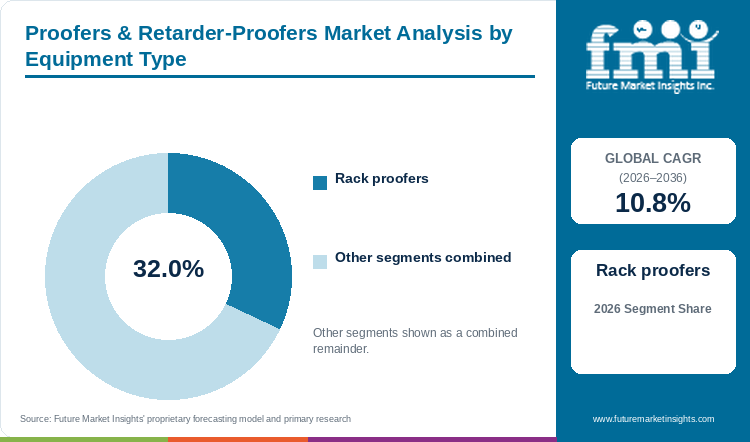
Rack proofers lead with 32.0% of Equipment Type revenue in 2026.
Rack proofers accommodate separate batches without assigning a continuous tunnel to one recipe. Uniform conditions remain essential: airflow between racks and humidity recovery after a door opens determine whether the full load ferments evenly. At full loading, the positions closest to and furthest from the air supply must still deliver dough that reaches the oven in comparable condition.
- Rack proofers’ 32.0% share reflects the usefulness of separate loads when products need different proofing programmes.
- Acceptance trials need to run a full rack load, because a partial load can hide airflow differences.
What sustains 500-2,000 kg/hr leadership in Capacity?
500-2,000 kg/hr leads with 43.0% of Capacity revenue in 2026.
Output per hour does not describe how much dough a proofer must contain. A recipe with a longer residence time needs more space at the same incoming rate, and larger pieces need more room between carriers. Shortening the fermentation interval to clear a queue changes the process on which the finished product depends.
- The 500-2,000 kg/hr band leads Capacity with 43.0%; fermentation time determines the space needed to deliver that rate.
- Chamber sizing needs to account for residence time, piece weight and expansion space.
How does Fully automatic / robotic equipment secure Automation Level leadership?
Fully automatic / robotic leads with 44.0% of Automation Level revenue in 2026.
Much of the work assigned to automation happens at the chamber entrance and exit. Mecatherm’s vertical handling arrangement keeps products on their supports through the proofing stage.[2] The same coordination becomes more difficult when the oven slows, because dough already inside continues to ferment. A usable automated sequence therefore includes a response to interruptions as well as the normal cycle.
- Fully automatic / robotic represents 44.0% of Automation Level in 2026, covering programmed conditions and coordinated carrier movement.
- The sequence must include a defined response when an oven interruption leaves dough fermenting in the chamber.
Why do Industrial bakeries dominate End User demand?
Industrial bakeries hold 46.0% of End User revenue in 2026.
A missed proofing window can disrupt forming and baking simultaneously. Dough continues to ferment while an oven is delayed, leaving the bakery with a more time-sensitive interruption than a simple conveyor stop. Industrial buyers therefore place value on controlled release and on a response for product already inside the chamber.
- Industrial bakeries account for 46.0% of End User in 2026, where proofing performance governs the flow between forming lines and ovens.
- Separate programmes need to handle the overlap when the previous load is still proofing.
What underpins Direct OEM sales in Sales Channel?
Direct OEM sales hold 58.0% of Sales Channel revenue in 2026.
Custom proofing installations bring together decisions about the building, utilities, pan pitch and controls. Direct contact with the manufacturer allows these interfaces to be settled in the same engineering discussion as chamber dimensions. The supply agreement can then describe the recipes, loading pattern and cycle to be used at acceptance.
- Direct OEM sales holds 58.0% of Sales Channel in 2026, with manufacturers coordinating chamber design and the connected equipment.
- The installation agreement needs a defined operating cycle and clear responsibility for equipment interfaces.
What are the drivers, restraints and opportunities in the proofers & retarder-proofers market?
Fermentation scheduling creates value beyond chamber capacity
Retarding changes the relationship between labour and the oven schedule. MIWE’s GVA e+ illustrates the combination of cold and warm conditions in one equipment family.[4] The financial benefit comes from the hours made available for other work and the reliability of the first bake. A supplier gains the order when the chamber returns dough to baking condition on every cycle.
Building constraints and cleaning needs complicate replacement projects
The footprint of an old proofer can conceal the difficulty of replacing it. A new enclosure still needs access for carriers, air circulation, drainage and, where applicable, refrigeration. FDA good manufacturing practice includes equipment and sanitary operations, so cleaning access belongs in the specification.[1] A phased retrofit that preserves some production during the work gives the supplier an advantage where the bakery cannot stop for long.
Gentle carrier handling opens more demanding product applications
Keeping delicate dough on a supporting pan reduces the number of transfers made before it is structurally firm. Mecatherm’s January 2026 conveying development and Royal Kaak’s Pizza Expo presentation both address that requirement.[2][3] The relationship continues after baking, when bakery depanning equipment must handle the same pan format. A supplier gains where a consistent carrier arrangement removes a transfer that would damage the product or need manual intervention.
Which country CAGRs are profiled in the proofers & retarder-proofers market?
Table 4: Country growth outlook for the proofers & retarder-proofers market
| Country | CAGR, 2026 to 2036 |
|---|---|
| Saudi Arabia | 12.3% |
| UAE | 11.9% |
| South Korea | 11.6% |
| USA | 11.3% |
| Germany | 10.9% |
| France | 10.6% |
| UK | 10.3% |
| Japan | 10.0% |
Saudi Arabia
Saudi Arabia has the highest profiled CAGR at 12.3% between 2026 and 2036. The Ministry of Tourism reported about 122 million domestic and international visits in 2025, 5.0% above the previous year in preliminary estimates. A larger visitor base supports hotel kitchens and bakeries supplying early dispatches, but the count says little about how many of them will add proofing capacity. For these bakeries, retarding separates dough preparation from the first oven load, and the investment includes refrigeration, programmed warming and space for overnight batches. However, a cabinet added to an existing bakery and chambers engineered into a new line serve different budgets. Demand will depend on how many operators move to a fixed overnight schedule.
UAE
The UAE market is projected to grow at 11.9% CAGR from 2026 to 2036, above the global rate of 10.8%. Dubai’s Department of Economy and Tourism reported 19.59 million international overnight visitors in 2025, up from 18.72 million in 2024. Visitor numbers show the size of the hospitality market, not how many kitchens will buy proofing equipment. A pastry kitchen handling separate racks and a wholesale bakery feeding a continuous oven create different equipment needs, since the former gains from independently timed loads and the latter depends on coordination with conveyors. However, refrigeration, drainage and staff access add to the installed cost of either arrangement. Demand will depend on how many operators settle on one production model.
South Korea
South Korea’s forecast CAGR is 11.6%, above the global rate of 10.8%. Korea Electric Power Corporation announced on 21 September 2026 that electricity rates would stay frozen in the fourth quarter, with the fuel cost adjustment held at 5 won per kWh against a calculated 7.3 won. The freeze steadies the running cost of a cabinet that alternates between cold holding and warm, humid proofing, but the gap shows pressure that remains. Larger pieces need room to expand and longer proof times raise the quantity held, so carrier geometry shapes a new installation. However, a recipe programme adds value only when the carriers can support the loading arrangement it governs. Demand will depend on how many bakeries adapt an installation to a new product size.
USA
The USA is forecast at 11.3% CAGR from 2026 to 2036, above the global rate of 10.8%. The USDA Economic Research Service’s October 2026 outlook projects prices for cereal and bakery products to grow more slowly than their 20-year average in 2026, while food-away-from-home prices are forecast up 3.5%. Slower bakery pricing limits how far equipment cost can pass into shelf prices, although the outlook says nothing about capital budgets. Replacement projects involve existing pans, conveyors and ovens, and FDA manufacturing requirements keep equipment condition and sanitation in the operating requirements.[1] However, a change in pan geometry can turn a chamber replacement into a wider handling project. Orders will depend on whether the scheduling gain covers the added shutdown and commissioning.
Germany
Germany is projected at 10.9% CAGR through 2036, slightly above the global rate of 10.8%. Destatis reported that non-household customers paid an average of 19.22 cents per kilowatt-hour for electricity in the second half of 2025, excluding VAT, which was 6.5% less than a year earlier. Lower prices ease the running cost of a cabinet that moves between cold holding and warm, humid proofing, but loading pattern and door openings still set its duty. A replacement that keeps familiar dough programmes while improving access for refrigeration service and cleaning can have value even at stable batch sizes. However, the saving has to cover the installation work in an operating bakery. Demand will depend on how many bakeries find that saving at their own loading pattern.
France
France is forecast to record 10.6% CAGR from 2026 to 2036, below the global rate of 10.8%. INSEE reported that prices of bread and cereals rose 0.9% over the year to December 2025. Slow price growth leaves bakeries little room to pass equipment cost into the loaf, so a proofing investment has to pay back through scheduling and labour. Retarder-proofers serving the first morning bake address a different demand from continuous proofers in industrial bread production, with overnight holding focused on the move from cold dough to baking readiness. In both cases the result appears in the baked loaf, including volume and surface condition. Demand will depend on how many bakeries find that a compact climate-controlled cabinet shortens the early shift without changing the loaf.
UK
The UK outlook is 10.3% CAGR over 2026 to 2036, below the global rate of 10.8%. The Department for Energy Security and Net Zero reported an average non-domestic electricity price of 24.51 pence per kWh in the second quarter of 2026, 2.0% above a year earlier. A rise of that size adds to the running cost of refrigerated proofing, though it does not decide which chamber is bought. Within bakery processing equipment, proofing projects can be constrained by the space needed to hold product, since racks need turning room and continuous systems need carrier access. However, modular chambers help only if loading, cleaning and service fit within the building. Demand will depend on how many sites can add capacity without extending the footprint.
Japan
Japan has the lowest profiled CAGR at 10.0%, below the global rate of 10.8%. The Statistics Bureau of Japan’s retail price survey recorded Tokyo white bread at 548 yen in January 2026, 3.6% above a year earlier. Higher bread prices can lift bakery revenue but do not show how many bakeries will invest in proofing equipment. In a Japanese bakery with limited preparation space, the investment competes with other food processing equipment for both room and capital. A compact chamber can still demand substantial access for loading and refrigeration maintenance. However, separate loads and clear programme selection can let one area serve several products, provided piece expansion suits the carriers. Demand will depend on how many bakeries reach usable chamber occupancy within the space they have.
Who are the notable companies in the proofers & retarder-proofers market?
AMF Bakery Systems; Mecatherm; Royal Kaak; Stewart Systems; MIWE
AMF, Mecatherm, Royal Kaak and Stewart Systems address mechanised proofing and product movement within bakery lines. MIWE’s offer connects refrigeration with preparation and baking schedules. The distinction matters commercially: continuous installations depend on the surrounding conveyors and ovens, while cabinet systems can add controlled holding to an existing workroom. Both serve fermentation, but the engineering scope and scale of the purchase differ.
Service has particular value when the equipment contains dough that cannot wait indefinitely. A refrigeration fault, inaccurate sensor or interrupted carrier return can threaten an entire load before the repair is complete. Technical support therefore protects work in progress as well as the machine itself, creating an ongoing relationship between the bakery and the equipment supplier.
Competitive Benchmarking: Proofers & Retarder-Proofers Market
Table 5: Company capabilities in the proofers & retarder-proofers market
| Company | Relevant offer | Commercial capability |
|---|---|---|
| AMF Bakery Systems | Rack, step and continuous proofing systems | Proofing integrated with commercial baking lines |
| Mecatherm | M-UB and M-VS proofing systems | Vertical mechanisation for supported products |
| Royal Kaak | First and final proofers | Proofing linked with dough production |
| Stewart Systems | Conveyorised proofers | Temperature and humidity control with mechanised conveying |
| MIWE | GVA proofing and retarding systems | Programmed refrigeration and fermentation functions |
Key Developments in the Proofers & Retarder-Proofers Market
- Mecatherm described a pan-based conveying configuration with M-UB vertical handling in January 2026. The arrangement keeps delicate products on their supports through proofing and other controlled stages.[2]
- At Pizza Expo in March 2026, Royal Kaak presented dough-ball production and controlled proofing technologies as coordinated equipment for repeatable pizza production.[3]
Key Players in the Proofers & Retarder-Proofers Market
- AMF Bakery Systems
- Mecatherm
- Royal Kaak
- Stewart Systems
- MIWE
Proofers & Retarder-Proofers Market - Report Scope
Table 6: Report scope for the proofers & retarder-proofers market
| Coverage field | Report scope |
|---|---|
| Market breakdown | Equipment Type; Capacity; Automation Level; End User; Sales Channel |
| Quantitative Units | USD Million |
| Market Definition | Revenue from proofers, retarder-proofers and identifiable proofing/retarding modules sold within the stated equipment categories. For bundled lines, only the attributable proofing equipment element is within scope. Excludes finished bakery products, ovens, forming machinery and unrelated handling systems; stand-alone service and spare-parts revenue is excluded unless part of the equipment transaction. Aftermarket & refurbished covers equipment resale. |
| Regions Covered | North America, Latin America, Western Europe, Eastern Europe, East Asia, South Asia and Pacific, Middle East and Africa |
| Countries Covered | Saudi Arabia; UAE; South Korea; USA; Germany; France; UK; Japan |
| Key Companies Profiled | AMF Bakery Systems; Mecatherm; Royal Kaak; Stewart Systems; MIWE |
| Forecast Period | 2026 to 2036 |
| Approach | Market assessment supported by official technical and regulatory publications, company product information and country operating conditions. |
Proofers & Retarder-Proofers Market - Research Methodology
Table 7: Research approach for the proofers & retarder-proofers market
| Method | Approach |
|---|---|
| Market coverage | The assessment follows the equipment sold, its bakery application and the revenue boundaries stated in the market definition. |
| Secondary evidence | Government and technical publications are considered alongside first-party product information and dated corporate announcements. |
| Commercial analysis | Purchasing requirements, operating constraints, service needs and country-specific routes to market inform the interpretation of demand. |
| Forecast presentation | Global values, leading segment shares and country growth rates are stated for the 2026 to 2036 forecast period. |
Proofers & Retarder-Proofers Market by Segments
Equipment Type
- Rack proofers
- Tunnel proofers
- Retarder-proofers
- Modular cabinets
Capacity
- 500-2,000 kg/hr
- Below 500 kg/hr
- Above 2,000 kg/hr
Automation Level
- Fully automatic / robotic
- Semi-automatic
- Manual
End User
- Industrial bakeries
- In-store & retail bakeries
- Artisan bakeries
- Foodservice / QSR central kitchens
Sales Channel
- Direct OEM sales
- Dealers & distributors
- Aftermarket & refurbished
Proofers & Retarder-Proofers Market by Region
- North America
- United States
- Canada
- Latin America
- Brazil
- Mexico
- Argentina
- Chile
- Western Europe
- Germany
- France
- United Kingdom
- Italy
- Spain
- Benelux
- Nordics
- Eastern Europe
- Poland
- Czech Republic
- Romania
- Hungary
- East Asia
- China
- Japan
- South Korea
- South Asia and Pacific
- India
- ASEAN
- Australia and New Zealand
- Middle East and Africa
- GCC Countries
- South Africa
- Türkiye
- Israel
Research Sources and Bibliography
- [1] U.S. Food and Drug Administration. (n.d.). Current Good Manufacturing Practices (CGMPs) for Food and Dietary Supplements.
- [2] Mecatherm. (2026, January 27). A pan based conveying system designed for delicate products and diverse formats.
- [3] Royal Kaak. (2026, March 30). Royal Kaak at Pizza Expo 2026.
- [4] MIWE. (n.d.). MIWE GVA e+: Fully automatic proving machine.
- [5] Bühler Group. (2026, February 16). Bühler strengthens its market position.
This Report Answers
- How large is the proofers & retarder-proofers market in 2026 and what is its 2036 outlook?
- Which operating pressures motivate bakeries to install controlled proofing equipment?
- Why are Rack proofers the largest Equipment Type category?
- Why does the 500-2,000 kg/hr Capacity category lead?
- How do projected growth rates differ across the eight profiled countries?
- Which companies document proofing equipment or related integration capabilities?
Frequently Asked Questions
How big is the proofers & retarder-proofers market in 2026, and what is forecast for 2036?
The market is valued at USD 483.3 Million in 2026 and forecast at USD 1,347.8 Million by 2036.
What is the proofers & retarder-proofers market CAGR from 2026 to 2036?
The market is forecast to grow at a 10.8% CAGR from 2026 to 2036.
Which Equipment Type segment leads the market?
Rack proofers lead with 32.0% in 2026. Their batch handling and adaptable loading can serve bakeries with multiple tray and product formats.
Which Capacity segment leads the market?
The 500-2,000 kg/hr segment leads Capacity with a 43.0% share in 2026. The chamber space required within that band varies with proof time, piece size and loading density.
Which profiled countries show the highest growth rates?
Saudi Arabia has the highest profiled CAGR at 12.3%, followed by the UAE at 11.9% and South Korea at 11.6% from 2026 to 2036.
Which companies participate in the proofers & retarder-proofers market?
Relevant participants include AMF Bakery Systems, Mecatherm, Royal Kaak, Stewart Systems and MIWE.
Preview the report firsthand - request a free sample
Get SampleGet the brochure for pricing and purchase details.
Get PDFTable of Content
- Key Takeaways
- Market Size and CAGR
- Top Growth Driver
- Fastest Growing Segment
- Leading Region
- Key Companies
- Emerging Opportunities
- Executive Summary
- Global Market Outlook
- Demand-side Trends
- Supply-side Trends
- Technology Roadmap Analysis
- Analysis and Recommendations
- Analyst Perspective (What is happening? Why now? What should investors know?)
- Key Questions Answered
- How large is the market?
- What is the CAGR?
- What are key trends?
- Which region dominates?
- Who are the leaders?
- Market Overview
- Market Coverage / Taxonomy
- Market Definition / Scope / Limitations
- Research Methodology
- Chapter Orientation
- Analytical Lens and Working Hypotheses
- Market Structure, Signals, and Trend Drivers
- Benchmarking and Cross-market Comparability
- Market Sizing, Forecasting, and Opportunity Mapping
- Research Design and Evidence Framework
- Desk Research Programme (Secondary Evidence)
- Expert Input and Fieldwork (Primary Evidence)
- Tooling, Models, and Reference Databases
- Data Engineering and Model Build
- Quality Assurance and Audit Trail
- Market Background
- Market Dynamics (Drivers, Restraints, Opportunity, Trends)
- Scenario Forecast (Optimistic, Likely, Conservative)
- Impact Analysis
- AI Impact
- Sustainability Impact
- Regulatory Impact
- Technology Impact
- Consumer / Buyer Analysis
- Purchase Drivers
- Adoption Barriers
- Buyer Journey
- Opportunity Map Analysis
- Product Life Cycle Analysis
- Supply Chain Analysis
- Investment Feasibility Matrix
- Value Chain Analysis
- PESTLE and Porter's Analysis
- Regulatory Landscape
- Regional Parent Market Outlook
- Production and Consumption Statistics
- Import and Export Statistics
- Global Market Analysis and Forecast, 2021 to 2036
- Historical Market Size Value (USD Million) Analysis, 2021 to 2025
- Current and Future Market Size Value (USD Million) Projections, 2026 to 2036
- Y-o-Y Growth Trend Analysis
- Absolute $ Opportunity Analysis
- Global Market Pricing Analysis, 2021 to 2036
- Global Market Analysis and Forecast, By Equipment Type, 2021 to 2036
- Introduction / Key Findings
- Historical Market Size Value (USD Million) Analysis By Equipment Type, 2021 to 2025
- Current and Future Market Size Value (USD Million) Analysis and Forecast By Equipment Type, 2026 to 2036
- Rack proofers
- Tunnel proofers
- Retarder-proofers
- Modular cabinets
- Y-o-Y Growth Trend Analysis By Equipment Type, 2021 to 2025
- Absolute $ Opportunity Analysis By Equipment Type, 2026 to 2036
- Global Market Analysis and Forecast, By Capacity, 2021 to 2036
- Introduction / Key Findings
- Historical Market Size Value (USD Million) Analysis By Capacity, 2021 to 2025
- Current and Future Market Size Value (USD Million) Analysis and Forecast By Capacity, 2026 to 2036
- 500-2,000 kg/hr
- Below 500 kg/hr
- Above 2,000 kg/hr
- Y-o-Y Growth Trend Analysis By Capacity, 2021 to 2025
- Absolute $ Opportunity Analysis By Capacity, 2026 to 2036
- Global Market Analysis and Forecast, By Automation Level, 2021 to 2036
- Introduction / Key Findings
- Historical Market Size Value (USD Million) Analysis By Automation Level, 2021 to 2025
- Current and Future Market Size Value (USD Million) Analysis and Forecast By Automation Level, 2026 to 2036
- Fully automatic / robotic
- Semi-automatic
- Manual
- Y-o-Y Growth Trend Analysis By Automation Level, 2021 to 2025
- Absolute $ Opportunity Analysis By Automation Level, 2026 to 2036
- Global Market Analysis and Forecast, By End User, 2021 to 2036
- Introduction / Key Findings
- Historical Market Size Value (USD Million) Analysis By End User, 2021 to 2025
- Current and Future Market Size Value (USD Million) Analysis and Forecast By End User, 2026 to 2036
- Industrial bakeries
- In-store & retail bakeries
- Artisan bakeries
- Foodservice / QSR central kitchens
- Y-o-Y Growth Trend Analysis By End User, 2021 to 2025
- Absolute $ Opportunity Analysis By End User, 2026 to 2036
- Global Market Analysis and Forecast, By Sales Channel, 2021 to 2036
- Introduction / Key Findings
- Historical Market Size Value (USD Million) Analysis By Sales Channel, 2021 to 2025
- Current and Future Market Size Value (USD Million) Analysis and Forecast By Sales Channel, 2026 to 2036
- Direct OEM sales
- Dealers & distributors
- Aftermarket & refurbished
- Y-o-Y Growth Trend Analysis By Sales Channel, 2021 to 2025
- Absolute $ Opportunity Analysis By Sales Channel, 2026 to 2036
- Global Market Analysis and Forecast, By Region, 2021 to 2036
- Introduction
- Historical Market Size Value (USD Million) Analysis By Region, 2021 to 2025
- Current Market Size Value (USD Million) Analysis and Forecast By Region, 2026 to 2036
- North America
- Latin America
- Western Europe
- Eastern Europe
- East Asia
- South Asia and Pacific
- Middle East and Africa
- Market Attractiveness Analysis By Region
- North America Market Analysis and Forecast, By Country, 2021 to 2036
- Historical Market Size Value (USD Million) Trend Analysis By Market Taxonomy, 2021 to 2025
- Market Size Value (USD Million) Forecast By Market Taxonomy, 2026 to 2036
- By Country
- United States
- Canada
- By Equipment Type
- By Capacity
- By Automation Level
- By End User
- By Sales Channel
- By Country
- Market Attractiveness Analysis
- By Country
- By Equipment Type
- By Capacity
- By Automation Level
- By End User
- By Sales Channel
- Key Takeaways
- Latin America Market Analysis and Forecast, By Country
- Historical Market Size Value (USD Million) Trend Analysis By Market Taxonomy, 2021 to 2025
- Market Size Value (USD Million) Forecast By Market Taxonomy, 2026 to 2036
- By Country
- Brazil
- Mexico
- Argentina
- Chile
- By Equipment Type
- By Capacity
- By Automation Level
- By End User
- By Sales Channel
- By Country
- Market Attractiveness Analysis
- By Country
- By Equipment Type
- By Capacity
- By Automation Level
- By End User
- By Sales Channel
- Key Takeaways
- Western Europe Market Analysis and Forecast, By Country
- Historical Market Size Value (USD Million) Trend Analysis By Market Taxonomy, 2021 to 2025
- Market Size Value (USD Million) Forecast By Market Taxonomy, 2026 to 2036
- By Country
- Germany
- France
- United Kingdom
- Italy
- Spain
- Benelux
- Nordics
- By Equipment Type
- By Capacity
- By Automation Level
- By End User
- By Sales Channel
- By Country
- Market Attractiveness Analysis
- By Country
- By Equipment Type
- By Capacity
- By Automation Level
- By End User
- By Sales Channel
- Key Takeaways
- Eastern Europe Market Analysis and Forecast, By Country
- Historical Market Size Value (USD Million) Trend Analysis By Market Taxonomy, 2021 to 2025
- Market Size Value (USD Million) Forecast By Market Taxonomy, 2026 to 2036
- By Country
- Poland
- Czech Republic
- Romania
- Hungary
- By Equipment Type
- By Capacity
- By Automation Level
- By End User
- By Sales Channel
- By Country
- Market Attractiveness Analysis
- By Country
- By Equipment Type
- By Capacity
- By Automation Level
- By End User
- By Sales Channel
- Key Takeaways
- East Asia Market Analysis and Forecast, By Country
- Historical Market Size Value (USD Million) Trend Analysis By Market Taxonomy, 2021 to 2025
- Market Size Value (USD Million) Forecast By Market Taxonomy, 2026 to 2036
- By Country
- China
- Japan
- South Korea
- By Equipment Type
- By Capacity
- By Automation Level
- By End User
- By Sales Channel
- By Country
- Market Attractiveness Analysis
- By Country
- By Equipment Type
- By Capacity
- By Automation Level
- By End User
- By Sales Channel
- Key Takeaways
- South Asia and Pacific Market Analysis and Forecast, By Country
- Historical Market Size Value (USD Million) Trend Analysis By Market Taxonomy, 2021 to 2025
- Market Size Value (USD Million) Forecast By Market Taxonomy, 2026 to 2036
- By Country
- India
- ASEAN
- Australia and New Zealand
- By Equipment Type
- By Capacity
- By Automation Level
- By End User
- By Sales Channel
- By Country
- Market Attractiveness Analysis
- By Country
- By Equipment Type
- By Capacity
- By Automation Level
- By End User
- By Sales Channel
- Key Takeaways
- Middle East and Africa Market Analysis and Forecast, By Country
- Historical Market Size Value (USD Million) Trend Analysis By Market Taxonomy, 2021 to 2025
- Market Size Value (USD Million) Forecast By Market Taxonomy, 2026 to 2036
- By Country
- GCC Countries
- South Africa
- Türkiye
- Israel
- By Equipment Type
- By Capacity
- By Automation Level
- By End User
- By Sales Channel
- By Country
- Market Attractiveness Analysis
- By Country
- By Equipment Type
- By Capacity
- By Automation Level
- By End User
- By Sales Channel
- Key Takeaways
- Key Countries Market Analysis
- United States
- Pricing Analysis
- Market Share Analysis, 2025
- By Equipment Type
- By Capacity
- By Automation Level
- By End User
- By Sales Channel
- Canada
- Pricing Analysis
- Market Share Analysis, 2025
- By Equipment Type
- By Capacity
- By Automation Level
- By End User
- By Sales Channel
- Mexico
- Pricing Analysis
- Market Share Analysis, 2025
- By Equipment Type
- By Capacity
- By Automation Level
- By End User
- By Sales Channel
- Brazil
- Pricing Analysis
- Market Share Analysis, 2025
- By Equipment Type
- By Capacity
- By Automation Level
- By End User
- By Sales Channel
- Chile
- Pricing Analysis
- Market Share Analysis, 2025
- By Equipment Type
- By Capacity
- By Automation Level
- By End User
- By Sales Channel
- Germany
- Pricing Analysis
- Market Share Analysis, 2025
- By Equipment Type
- By Capacity
- By Automation Level
- By End User
- By Sales Channel
- United Kingdom
- Pricing Analysis
- Market Share Analysis, 2025
- By Equipment Type
- By Capacity
- By Automation Level
- By End User
- By Sales Channel
- Italy
- Pricing Analysis
- Market Share Analysis, 2025
- By Equipment Type
- By Capacity
- By Automation Level
- By End User
- By Sales Channel
- Spain
- Pricing Analysis
- Market Share Analysis, 2025
- By Equipment Type
- By Capacity
- By Automation Level
- By End User
- By Sales Channel
- France
- Pricing Analysis
- Market Share Analysis, 2025
- By Equipment Type
- By Capacity
- By Automation Level
- By End User
- By Sales Channel
- India
- Pricing Analysis
- Market Share Analysis, 2025
- By Equipment Type
- By Capacity
- By Automation Level
- By End User
- By Sales Channel
- ASEAN
- Pricing Analysis
- Market Share Analysis, 2025
- By Equipment Type
- By Capacity
- By Automation Level
- By End User
- By Sales Channel
- Australia and New Zealand
- Pricing Analysis
- Market Share Analysis, 2025
- By Equipment Type
- By Capacity
- By Automation Level
- By End User
- By Sales Channel
- China
- Pricing Analysis
- Market Share Analysis, 2025
- By Equipment Type
- By Capacity
- By Automation Level
- By End User
- By Sales Channel
- Japan
- Pricing Analysis
- Market Share Analysis, 2025
- By Equipment Type
- By Capacity
- By Automation Level
- By End User
- By Sales Channel
- South Korea
- Pricing Analysis
- Market Share Analysis, 2025
- By Equipment Type
- By Capacity
- By Automation Level
- By End User
- By Sales Channel
- Poland
- Pricing Analysis
- Market Share Analysis, 2025
- By Equipment Type
- By Capacity
- By Automation Level
- By End User
- By Sales Channel
- Hungary
- Pricing Analysis
- Market Share Analysis, 2025
- By Equipment Type
- By Capacity
- By Automation Level
- By End User
- By Sales Channel
- Türkiye
- Pricing Analysis
- Market Share Analysis, 2025
- By Equipment Type
- By Capacity
- By Automation Level
- By End User
- By Sales Channel
- South Africa
- Pricing Analysis
- Market Share Analysis, 2025
- By Equipment Type
- By Capacity
- By Automation Level
- By End User
- By Sales Channel
- Saudi Arabia
- Pricing Analysis
- Market Share Analysis, 2025
- By Equipment Type
- By Capacity
- By Automation Level
- By End User
- By Sales Channel
- UAE
- Pricing Analysis
- Market Share Analysis, 2025
- By Equipment Type
- By Capacity
- By Automation Level
- By End User
- By Sales Channel
- United States
- Market Structure Analysis
- Competition Dashboard
- Competition Benchmarking
- Market Share Analysis of Top Players
- By Regional
- By Equipment Type
- By Capacity
- By Automation Level
- By End User
- By Sales Channel
- Emerging Startups
- Innovation Benchmarking
- Competition Analysis
- Competition Deep Dive
- AMF Bakery Systems
- Overview
- Product Portfolio
- Profitability by Market Segments
- Sales Footprint
- Strategy Overview
- Marketing Strategy
- Product Strategy
- Channel Strategy
- Mecatherm
- Royal Kaak
- Stewart Systems
- MIWE
- AMF Bakery Systems
- Case Studies
- Success Stories
- Recent Developments
- Competition Deep Dive
- Assumptions & Acronyms Used


