

- Market Size (2026)
- USD 107.5 Mn
- Forecast (2036)
- USD 215.5 Mn
- CAGR (2026 to 2036)
- 7.2%
How big is Protein-Free Nutrition Module Market in 2026?
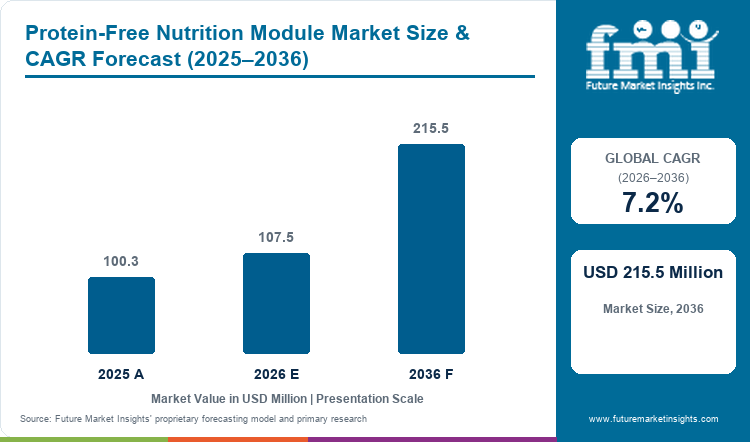
USD 107.5 million in 2026 and USD 215.5 million by 2036 at a 7.2% CAGR.
Demand for protein-free nutrition modules is projected to expand at a 7.2% CAGR between 2026 and 2036, increasing valuation from USD 107.5 million in 2026 to USD 215.5 million by 2036. Growth is influenced by diagnosed patients needing extra energy without raising prescribed protein exposure. FDA's current 2026 exempt-formula list identifies Abbott Pro-Phree as a protein-free energy module for infants with unusual medical or dietary needs. The listing places a defined protein-free product inside the regulated metabolic-formula pathway used by specialist teams.
National screening coverage changes how quickly diagnosed infants enter specialist dietary care, but payment rules still decide whether a prescribed module becomes repeat supply. England recorded 97.7% newborn blood spot screening coverage in the fourth quarter of 2024/25 according to a January 2026 GOV.UK screening update. Screening coverage at that level can move eligible infants toward specialist assessment early enough for diet therapy to begin before growth falters. United States reimbursement remains less uniform after diagnosis because benefit definitions vary among insurers and state programs.
Key Takeaways of Protein-Free Nutrition Module Market
- Demand for protein-free nutrition modules rises when specialist teams must increase calories without increasing the patient's prescribed protein or amino-acid exposure.
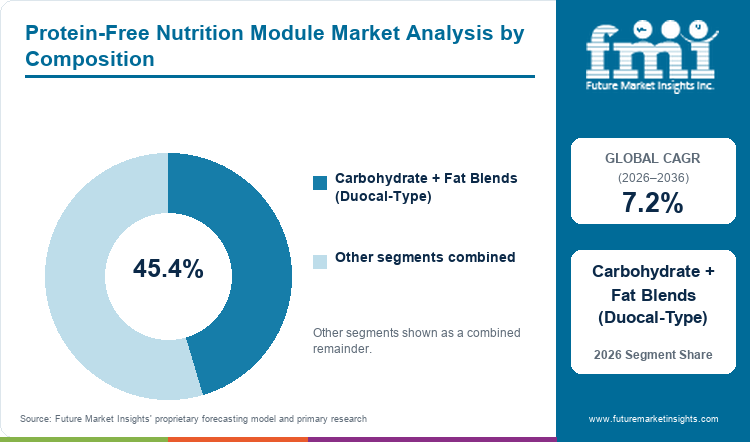
- By composition, carbohydrate + fat blends are estimated to hold 45.4% in 2026 owing to flexible calorie fortification within protein-restricted diets.
- The inherited metabolic disorders segment is likely to capture 45.6% share in 2026 attributable to continuing amino-acid and protein limits after diagnosis.
- Powders are projected to hold 51.8% share in 2026 owing to measured dosing and lower storage volume than ready-to-use alternatives.
- Coverage restrictions and fragmented specialist distribution can interrupt repeat supply even if the prescribed nutritional requirement remains unchanged over time.
- Some of the key players in this market include Danone Nutricia (Duocal), Vitaflo / Nestle Health Science, Abbott, Solace Nutrition, Ajinomoto Cambrooke, Mead Johnson / Reckitt, Medtrition, and Global Health Products.
Analyst Perspective
"Protein-free modules should be evaluated against the prescribed energy gap and the pathway that keeps refills available after specialist initiation. Commercial value is earned where dose flexibility and documented access protect continuity without widening the patient's protein exposure."
- Anurag Sharma, Principal Consultant, Future Market Insights
How is the Protein-Free Nutrition Module Market segmented?
The protein-free nutrition module market is segmented by composition, indication, product form, age group, sales channel and region.
Composition covers carbohydrate + fat blends (Duocal-Type), glucose polymer-only products, fat-only energy modules and others. Indications include inherited metabolic disorders, renal protein restriction, faltering growth and other uses. Product forms include powders, liquid emulsions and others. Age groups cover pediatric and adult patients. Sales channels include hospital pharmacy, retail pharmacy, online, institutional tender and others.
What supports carbohydrate + fat blends within the composition category?
Clinical teams use carbohydrate and fat together when a restricted diet needs additional energy without a parallel increase in amino acids. This use is narrower than general calorie supplements because the module must fit a disease-specific protein ceiling. Gwanak District updated its congenital-metabolic support page in August 2025 and permits physician-ordered Protein-Free formula for protein-restricted patients within defined monthly support limits.
- By composition, carbohydrate + fat blends are estimated to hold 45.4% in 2026 owing to flexible calorie density within protein-restricted regimens.
- Dietitians can alter non-protein calories without replacing the complete prescription, which preserves separate control over natural protein and disease-specific amino-acid mixtures.
What supports inherited metabolic disorders within the indication category?
Treatment for inherited metabolic disorders often keeps natural protein within a narrow allowance even as calories change with growth or illness. That diet design makes medical foods and modular energy products complementary instead of interchangeable. Japan's Ministry of Health applied revised pediatric chronic-disease medical opinion forms from April 2025 for congenital metabolic disorders, formalizing disease-specific treatment documentation in the national support pathway.
- The inherited metabolic disorders segment is likely to capture 45.6% share in 2026 attributable to long-duration dietary control after diagnosis.
- Metabolic dietitians reassess calorie and protein tolerance separately, so modular energy can change without replacing every disease-specific component in the prescribed regimen.
How do metabolic dietitians use powders within the product form category?
Powders give metabolic dietitians a practical way to change module quantity without changing the rest of a prescribed feeding plan. The format also reduces shipped water compared with ready-to-use products and fits familiar infant formula preparation. FDA's June 2026 marketed-formula list identifies Pro-Phree as a protein-free energy module in powder form.
- Powders are projected to hold 51.8% share in 2026 owing to dry dosing that supports small calorie adjustments and compact storage.
- Caregivers can measure a prescribed amount into food or formula, but handling instructions remain important because repeated home preparation introduces dosing and hygiene variation.
What supports pediatric use within the age group category?
Pediatric demand begins with diagnosis early enough for diet therapy to shape growth management instead of responding to later nutritional decline. HRSA's Hawaii newborn-screening page was reviewed in June 2026 and lists phenylketonuria plus maple syrup urine disease among screened conditions. Those diagnoses keep pediatric nutrition under specialist review as weight and protein tolerance change.
- The pediatric segment is set to lead the age group with 60.5% share in 2026 due to early diagnosis and prolonged specialist dietary management.
- Families often need repeated dose changes as children grow, which makes measured energy modules useful for preserving a separate protein prescription during follow-up.
Why does hospital pharmacy remain central within the sales channel category?
Hospital pharmacy control is concentrated during initiation because specialist teams confirm suitability before home dispensing arrangements are stable. The May 2026 NHS Drug Tariff continued to list Duocal Super Soluble among products recognized for prescription payment. That reimbursement status supports clinical nutrition ordering after the initial hospital decision even though local formularies still determine transfer into community supply.
- Based on sales channel, hospital pharmacy is projected to account for 41.6% in 2026 due to specialist initiation and documentation requirements for medical nutrition.
- Repeat volume gradually shifts toward community or home-supply routes after the clinical team and payer accept the ongoing prescription pathway.
What are the drivers, restraints and opportunities in the Protein-Free Nutrition Module Market?
Earlier diagnosis expands the treated population, reimbursement classification can restrict access and specialty distribution gives manufacturers a practical route to repeat home supply.
- Driver: Newborn screening moves protein-restricted disorders into specialist care early enough for long-duration dietary adjustment.
- Restraint: Reimbursement rules can exclude carbohydrate-only or fat-only products unless the indication fits a covered medical-necessity category.
- Opportunity: Specialty DME and home-delivery partnerships can reduce refill friction for prescribed nutrition that does not fit ordinary retail channels.
Earlier diagnosis extends the period of supervised nutrition management
Newborn screening moves protein-restricted disorders into specialist care before nutritional decline becomes the reason for referral. HRSA stated in August 2026 that US states and territories screen more than 3.6 million newborns each year. The screening base extends the period during which specialized nutrition can be adjusted as growth changes calorie requirements. Module orders follow only after metabolic teams convert diagnosis into a supervised protein-restricted regimen.
Reimbursement classification can block clinically suitable energy modules
German reimbursement rules show why clinical need does not guarantee funded access for every energy module. The G-BA's February 2026 directive states that products containing only carbohydrates or fats generally fall outside covered enteral-diet groups except specified medically necessary rare-disease uses. Manufacturers must document the exact legal product category before expecting national reimbursement for enteral-diet coverage. The restriction can shift clinically suitable modules into narrower payer routes or self-funded access.
Specialty distribution can convert a prescription into repeat home supply
Specialty distribution can reduce the gap between a prescription and repeat home delivery without changing the nutrient formulation itself. Solace Nutrition entered an exclusive DME distribution partnership with Hearts Enteral on February 24, 2026 for Encala as more insurers moved nutrition fulfillment toward DME channels. A similar route can protect refill continuity for modules that require benefit verification before shipment. Revenue depends on execution inside the defined protein-free category without extending claims into adjacent formulas or complete diets.
Which country CAGRs are profiled in the Protein-Free Nutrition Module Market?
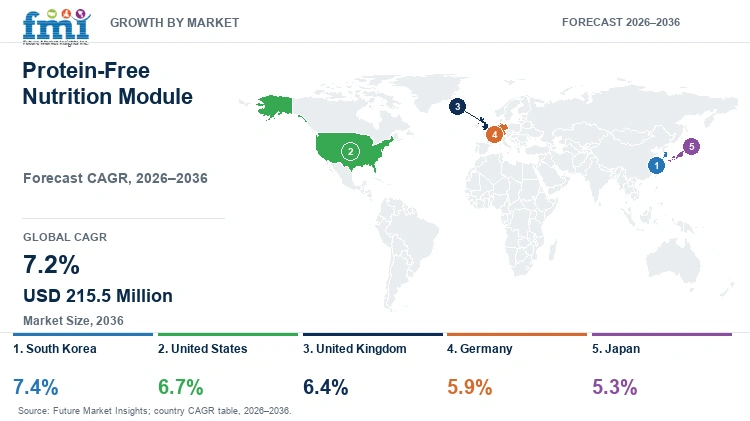
| Country | CAGR |
|---|---|
| South Korea | 7.4% |
| United States | 6.7% |
| United Kingdom | 6.4% |
| Germany | 5.9% |
| Japan | 5.3% |
How do country-level CAGRs compare in the Protein-Free Nutrition Module Market?
South Korea at CAGR of 7.4% shows a 2.1 percentage-point forecast range, with the United States and United Kingdom forming a middle band at 6.7% and 6.4%. Germany at 5.9% and Japan at 5.3% form the lower pair, reflecting funded-care differences and specialist access instead of current market size in these markets.
- South Korea gains pace from early specialist referral after congenital metabolic disorders are clinically confirmed.
- United States growth reflects product availability from several specialist clinical nutrition manufacturers and distributors.
- United Kingdom metabolic services use dietitian networks that support long-term prescription adjustment after diagnosis.
- German specialist care keeps dietary therapy supervised through hospital and outpatient clinical nutrition services.
- Japan shows a mature specialist formula pathway with fewer untreated access gaps than faster markets.
Comparable CAGRs produce refill economics because payment routes and specialist handoffs vary by country. The full report provides country-level CAGR analysis across North America, Latin America, Western Europe, Eastern Europe, East Asia, South Asia and Pacific, and the Middle East and Africa.
Country-wise Analysis
- South Korean metabolic clinics can route prescribed special formula through municipal enteral nutrition support after congenital metabolic disease eligibility is documented. Protein-free nutrition module demand in South Korea is predicted to advance at 7.4% CAGR through 2036 because public pediatric support can reduce family out-of-pocket exposure. Busan updated its congenital metabolic patient program in August 2026 and continues to cover special formulated formula plus low-protein rice for eligible patients younger than nineteen. Physician documentation and municipal eligibility rules limit automatic access even after a metabolic specialist recommends a restricted diet. Local distributors need inventory and claim paperwork that match public assistance procedures without leaving families between hospital discharge and home supply.
- US metabolic care often shifts into specialty oral clinical nutrition services after newborn screening identifies a protein-restricted disorder. HRSA's Delaware screening panel was reviewed in June 2026 and includes phenylketonuria plus maple syrup urine disease among state-screened conditions. Protein-free nutrition module demand in the United States is forecast to rise at 6.7% CAGR over the forecast period because specialist services expand the treated patient base. Private insurers and state programs apply different benefit definitions, which can interrupt the route from medical necessity to funded refills. Specialty distributors gain repeat volume by keeping medical-necessity records current and maintaining stock after patients leave the initiating center.
- UK specialist metabolic dietitians work within national prescribing structures that give clinical nutrition supplements a recognized route into pharmacy dispensing. The United Kingdom protein-free nutrition module sector is projected to record 6.4% CAGR during the assessment period because specialist pathways carry prescriptions into community supply. Community dispensing works only after the prescribed product and reimbursement route are accepted by the local specialist service. The April 2026 NHS Drug Tariff lists Duocal as a prescribed fat-and-carbohydrate source used for nutritional support. Local formularies can still differ between health systems, so companies need home delivery and documentation closely aligned with dietitian instructions.
- German metabolic care can reimburse medically necessary balanced diets through statutory insurance, provided each product meets the applicable medical-food classification. The G-BA stated in January 2026 that statutory coverage applies to medically necessary balanced diets and a national provision review was underway. The ongoing review may alter evidence expectations for continued reimbursement, especially for carbohydrate-only or fat-only products outside permitted groups. Germany is estimated to post 5.9% CAGR over the forecast period because specialist reimbursement recognizes defined dietary uses within regulated categories. Companies entering Germany need clear medical-purpose positioning and evidence that fits reimbursable oral nutrition products without overstating broader nutrition claims.
- Japanese pediatric metabolic care relies on hospital-linked specialists and disease-specific medical documentation instead of broad retail nutrition channels. Specialist programs maintain therapeutic formula use for qualifying disorders and require disease-specific records during continued pediatric care. Adoption of protein-free nutrition modules in Japan is estimated to expand at 5.3% CAGR through 2036 because therapeutic formula remains embedded in specialist dietary management. MHLW's 2025 phenylketonuria continuation form records therapeutic special milk and natural protein restriction within the pediatric chronic-disease nutrition pathway. Distributors serving these centers need stable small-volume inventory and rapid replenishment because missed shipments can disrupt tightly controlled dietary regimens.
Who are the notable companies in the Protein-Free Nutrition Module Market?
Danone Nutricia (Duocal), Vitaflo / Nestle Health Science, Abbott, Solace Nutrition, Ajinomoto Cambrooke, Mead Johnson / Reckitt, Medtrition, and Global Health Products are the notable companies serving this market.
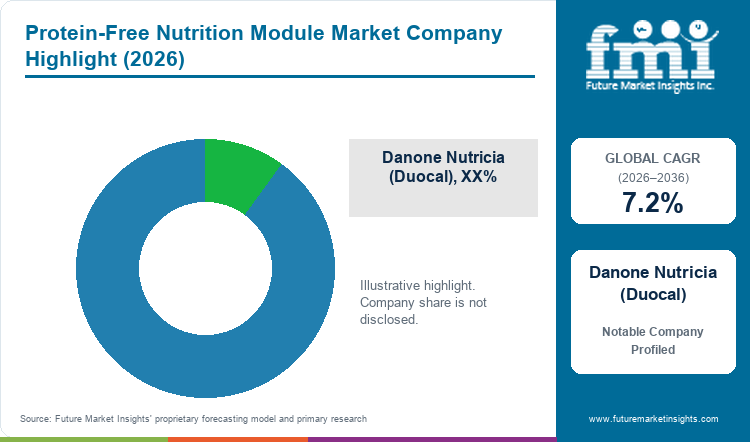
Competition separates direct protein-free calorie modules from broader metabolic and institutional nutrition portfolios used by the same specialist clinical teams. Manufacturers must support narrow indications and repeat supply after specialist prescription because corporate scale does not protect refill continuity. Danone Nutricia and Abbott supply direct protein-free energy modules that fit specialist metabolic and pediatric nutrition pathways. Vitaflo and Ajinomoto Cambrooke focus on inherited-metabolic nutrition while institutional specialists compete through modular clinical products.
- Danone Nutricia (Duocal), Vitaflo / Nestle Health Science and Abbott cover direct modules or closely aligned inherited-metabolic nutrition systems.
- Solace Nutrition, Ajinomoto Cambrooke and Mead Johnson / Reckitt serve specialist medical nutrition through disease-specific formulas or modular products.
- Medtrition and Global Health Products compete from the adjacent institutional modular-nutrition category, where concentrated supplements and clinical distribution are established.
Competitive Benchmarking: Protein-Free Nutrition Module Market
| Company | Direct Protein-Free Module Coverage | Metabolic Diet Integration | Clinical Access Support | Geographic Reach |
|---|---|---|---|---|
| Danone Nutricia (Duocal) | High | High | High | Global |
| Vitaflo / Nestle Health Science | High | High | High | North America and Western Europe |
| Abbott | High | High | High | Global |
| Solace Nutrition | Medium | Medium | High | North America |
| Ajinomoto Cambrooke | Low | High | Medium | North America and Western Europe |
| Mead Johnson / Reckitt | Low | High | Medium | North America and international markets |
| Medtrition | Low | Low | Medium | North America and selected international markets |
| Global Health Products | Low | Low | High | North America |
Scoring basis: High direct-module coverage requires a current in-scope product with documented specialist availability. Medium identifies narrower direct or near-direct coverage and Low identifies an adjacent role without a verified protein-free calorie module. High metabolic integration requires multiple inherited-metabolic programs while Medium requires a narrower disease-specific route. High access support requires documented reimbursement or distribution programs while Medium reflects a narrower ordering route and Low indicates documented access limitations.
Key Developments in the Protein-Free Nutrition Module Market
- In April 2026, Mead Johnson Nutrition and Mass General Brigham announced expansion of their scientific partnership for funded pediatric and lifespan nutrition research.
- In May 2025, Global Health Products joined the HPS GPO network under Contract 1087 to widen institutional ordering access for clinical nutrition products.
- In February 2025, Danone Nutricia launched Fortimel Plantbased Protein in Spain as a plant-based oral medical nutrition product for disease-related malnutrition.
Key Players in the Protein-Free Nutrition Module Market
Direct and Metabolic Nutrition Platforms
- Danone Nutricia (Duocal)
- Vitaflo / Nestle Health Science
- Abbott
Specialist Medical Nutrition Companies
- Solace Nutrition
- Ajinomoto Cambrooke
- Mead Johnson / Reckitt
Institutional Modular Nutrition Companies
- Medtrition
- Global Health Products
Protein-Free Nutrition Module Market - Report Scope
| Coverage field | Report scope |
|---|---|
| Market breakdown | By composition, indication, product form, age group, sales channel and region. |
| Quantitative Units | USD million. |
| Market Definition | Commercial stand-alone protein-free nutrition modules supplying carbohydrate energy, fat energy or both for supervised protein-restricted dietary management. |
| Regions Covered | North America, Latin America, Western Europe, Eastern Europe, East Asia, South Asia and Pacific, and Middle East and Africa. |
| Countries Covered | South Korea, United States, United Kingdom, Germany, Japan, and 20+ countries included in the full report. |
| Key Companies Profiled | Danone Nutricia (Duocal), Vitaflo / Nestle Health Science, Abbott, Solace Nutrition, Ajinomoto Cambrooke, Mead Johnson / Reckitt, Medtrition, Global Health Products. |
| Forecast Period | 2026 to 2036. |
| Approach | Primary and secondary research with market triangulation. |
Protein-Free Nutrition Module Market - Research Methodology
| Method | Approach |
|---|---|
| Primary Research | FMI analysts gathered input from manufacturers, service providers, technology developers, distributors, end users, procurement teams, and subject-matter experts. Interviews examined purchasing decisions, product or service evaluation, adoption barriers, approval requirements, pricing considerations, and expectations for technical or commercial support. Respondents were also asked what evidence is required before a trial, pilot, or initial order develops into regular purchasing. |
| Desk Research | Desk research covered government statistics, regulatory publications, trade data, industry associations, technical literature, standards, company filings, product information, and official corporate announcements. Sources were reviewed for relevance, publication date, geographic coverage, and consistency with the defined market scope. Claims relating to performance, applications, approvals, capacity, investment, and commercial activity were retained only when supported by credible public evidence. |
| Market Sizing and Forecasting | The market model combined the baseline value with historical performance, segment structure, pricing and volume indicators, adoption levels, company participation, and country-level demand conditions. Forecast assumptions considered economic activity, investment trends, regulatory developments, technology adoption, purchasing cycles, supply availability, and barriers to wider market use. Segment and regional estimates were reconciled before the final market total was calculated. |
| Data Validation | Estimates were checked against multiple independent indicators, including public data, company activity, trade patterns, industry developments, and findings from primary interviews. Validation also tested whether products, services, applications, and company revenues fell within the defined market boundaries. Adjacent categories, unsupported claims, overlapping revenues, and activities without direct market relevance were excluded to reduce double counting and maintain consistency across segments and countries. |
Protein-Free Nutrition Module Market by Segments
Protein-Free Nutrition Module Market segmented by Composition:
- Carbohydrate + Fat Blends (Duocal-Type)
- Glucose Polymer-Only
- Fat-Only Energy Modules
- Others
Protein-Free Nutrition Module Market segmented by Indication:
- Inherited Metabolic Disorders
- Renal (Protein-Restricted)
- Faltering Growth (Energy Boost)
- Others
Protein-Free Nutrition Module Market segmented by Product Form:
- Powders
- Liquid Emulsions
- Others
Protein-Free Nutrition Module Market segmented by Age Group:
- Pediatric
- Adult
Protein-Free Nutrition Module Market segmented by Sales Channel:
- Hospital Pharmacy
- Retail Pharmacy
- Online
- Institutional Tender
- Others
Protein-Free Nutrition Module Market by Region:
- North America
- United States
- Canada
- Latin America
- Brazil
- Mexico
- Argentina
- Chile
- Western Europe
- Germany
- France
- United Kingdom
- Italy
- Spain
- Benelux
- Nordics
- Eastern Europe
- Poland
- Czech Republic
- Romania
- Hungary
- East Asia
- China
- Japan
- South Korea
- South Asia and Pacific
- India
- ASEAN
- Australia and New Zealand
- Middle East and Africa
- GCC Countries
- South Africa
- Türkiye
- Israel
Research Sources and Bibliography
- U.S. Food and Drug Administration. (2026). Exempt Infant Formulas Marketed in the United States By Manufacturer and Category
- Department of Health and Social Care. (2026, January 23). Antenatal and newborn screening KPI data: Q4 summary factsheets, 1 January to 31 March 2025
- Gwanak District Public Health Center. (2025, August 8).
- Ministry of Health, Labour and Welfare, Japan. (2025, April 1).
- U.S. Food and Drug Administration. (2026, June 13). Infant Formulas Marketed in the U.S.
- Health Resources and Services Administration. (2026, June). Hawaii - State Newborn Screening Panel
- NHS Business Services Authority. (2026, May 1). Drug Tariff Part II May 2026
- Health Resources and Services Administration. (2026, August 11). HRSA Modernizes National Newborn Screening Review Process to Speed Up Evaluation of Emerging Conditions
- Gemeinsamer Bundesausschuss. (2026, February 19). Richtlinie über die Verordnung von Arzneimitteln in der vertragsärztlichen Versorgung
- Solace Nutrition. (2026, March 18). Solace Nutrition Announces Exclusive DME Distribution Partnership with Hearts Enteral for Encala®
- Busan Metropolitan City. (2026, August 18).
- Health Resources and Services Administration. (2026, June). Delaware - State Newborn Screening Panel
- NHS Business Services Authority. (2026, April 1). Drug Tariff April 2026
- Gemeinsamer Bundesausschuss. (2026, January 20). Gemeinsamer Bundesausschuss und Innovationsausschuss: Auswahl wichtiger Arbeitsthemen im Jahr 2026
- Ministry of Health, Labour and Welfare, Japan. (2025, April 1).
- Reckitt. (2026, April 15). Mead Johnson Nutrition and Mass General Brigham Expand Research Program with 5-Year Commitment to Advancing Pediatric and Lifespan Nutrition
- Global Health Products. (2025, May 19). Strategic Partnership with HPS GPO Expands Our Reach
- Danone Nutricia. (2025, February 25). Nutricia lanza Fortimel Plantbased Protein®, un nuevo suplemento nutricional oral hiperproteico completamente vegetal para el manejo de la DRE
- Nestlé Health Science. (2025, October 15). Nestlé Health Science and University of California, Davis Innovation Institute for Food & Health Announce Strategic Partnership to Accelerate Innovation in Nutrition and Health Science
- Global Health Products. (2026, March 27). Beyond the Dialysis Chair: Introducing LiquaCel® Protein Gummies
- Global Health Products. (2026, April 21). Introducing LiquaCel® TF: A New Standard in Enteral Protein Nutrition
- Nestlé Health Science. (2025, October 17). Nestlé Health Science and the Food & Nutrition Innovation Institute at the Friedman School at Tufts University Expand Opportunities to Advance Nutrition Science and Innovation
- Solace Nutrition. (2026, January 27). Solace Nutrition Announces Clinical and Scientific Updates for Encala®
- Danone Nutricia. (2025, September 22). Fortimel® Plantbased Protein: innovación con el primer suplemento oral nutricional vegetal con sabor salado para pacientes con desnutrición que rompe con la monotonía
- Danone. (2025, July 1). Danone completes the acquisition of Kate Farms, enhancing its U.S. specialized nutrition offerings
- Nestlé Health Science. (2026, March 30). Nestlé introduces an innovative complete nutritional solution for children with special medical nutrition needs
- Abbott. (2025, November 13). Abbott Launches New And Advanced Ensure Diabetes Care, A Clinically Proven Formula To Help Manage Blood Sugar
- Solace Nutrition. (2025, February 7). Encala Returns
- Ajinomoto Co., Inc.. (2025, March 24). Ajinomoto Co., Inc. Invests in Surgical Nutrition Startup Enhanced Medical Nutrition Inc.
- Reckitt. (2025, November 13). Supporting Families During Difficult Times
- Medtrition, Inc.. (2025, March 25). Medtrition, Inc. Launches the ProSource® Cup Portfolio
- Global Health Products. (2026, January 26). Gordon Food Service Now Stocking Select Products
This bibliography is provided for reader reference and is not exhaustive. The full report contains the complete reference list and detailed citations
This Report Answers
- How large is the protein-free nutrition module market in 2026 and 2036?
- What keeps demand tied to specialist metabolic nutrition and separate from general calorie supplementation?
- Which composition segment accounts for 45.4% of demand in 2026?
- Which indication accounts for 45.6% of demand in 2026?
- Why do powders represent 51.8% of product-form demand in 2026?
- How do country growth rates differ among the profiled markets?
- What access conditions limit repeat supply after specialist initiation?
- Which companies serve direct protein-free modules and adjacent metabolic nutrition?
- How do reimbursement and distribution models change commercial access?
Frequently Asked Questions
How big is the Protein-Free Nutrition Module Market in 2026?
The protein-free nutrition module market is valued at USD 107.5 million in 2026 and is projected to reach USD 215.5 million by 2036. Specialist metabolic teams use these modules to raise calorie intake without increasing prescribed protein or amino-acid exposure.
What is the CAGR of the Protein-Free Nutrition Module Market from 2026 to 2036?
The protein-free nutrition module market is projected to grow at a CAGR of 7.2% between 2026 and 2036. Earlier diagnosis and repeated dietary adjustment extend the period during which patients may need supervised non-protein energy supplementation.
Which composition leads the Protein-Free Nutrition Module Market?
The carbohydrate + fat blends segment is expected to hold 45.4% of the protein-free nutrition module market in 2026 because it provides two non-protein energy sources. Dietitians can adjust calories without changing the prescribed protein allowance or every disease-specific formula component.
Which product form leads the Protein-Free Nutrition Module Market?
The powders segment is expected to hold 51.8% of the protein-free nutrition module market in 2026 because dry dosing supports small calorie adjustments. Caregivers can measure prescribed quantities without replacing the rest of the supervised nutrition plan.
Which companies are active in the Protein-Free Nutrition Module Market?
Key companies operating in the protein-free nutrition module market include Danone Nutricia (Duocal), Vitaflo / Nestle Health Science, Abbott, Solace Nutrition, Ajinomoto Cambrooke, Mead Johnson / Reckitt, Medtrition, and Global Health Products. The group spans direct protein-free modules and inherited-metabolic nutrition together with institutional modular clinical products.
Preview the report firsthand - request a free sample
Get SampleGet the brochure for pricing and purchase details.
Get PDFTable of Content
- Key Takeaways
- Market Size and CAGR
- Top Growth Driver
- Fastest Growing Segment
- Leading Region
- Key Companies
- Emerging Opportunities
- Executive Summary
- Global Market Outlook
- Demand-side Trends
- Supply-side Trends
- Technology Roadmap Analysis
- Analysis and Recommendations
- Analyst Perspective (What is happening? Why now? What should investors know?)
- Key Questions Answered
- How large is the market?
- What is the CAGR?
- What are key trends?
- Which region dominates?
- Who are the leaders?
- Market Overview
- Market Coverage / Taxonomy
- Market Definition / Scope / Limitations
- Research Methodology
- Chapter Orientation
- Analytical Lens and Working Hypotheses
- Market Structure, Signals, and Trend Drivers
- Benchmarking and Cross-market Comparability
- Market Sizing, Forecasting, and Opportunity Mapping
- Research Design and Evidence Framework
- Desk Research Programme (Secondary Evidence)
- Expert Input and Fieldwork (Primary Evidence)
- Tooling, Models, and Reference Databases
- Data Engineering and Model Build
- Quality Assurance and Audit Trail
- Market Background
- Market Dynamics (Drivers, Restraints, Opportunity, Trends)
- Scenario Forecast (Optimistic, Likely, Conservative)
- Impact Analysis
- AI Impact
- Sustainability Impact
- Regulatory Impact
- Technology Impact
- Consumer / Buyer Analysis
- Purchase Drivers
- Adoption Barriers
- Buyer Journey
- Opportunity Map Analysis
- Product Life Cycle Analysis
- Supply Chain Analysis
- Investment Feasibility Matrix
- Value Chain Analysis
- PESTLE and Porter's Analysis
- Regulatory Landscape
- Regional Parent Market Outlook
- Production and Consumption Statistics
- Import and Export Statistics
- Global Market Analysis and Forecast, 2021 to 2036
- Historical Market Size Value (USD Million) Analysis, 2021 to 2025
- Current and Future Market Size Value (USD Million) Projections, 2026 to 2036
- Y-o-Y Growth Trend Analysis
- Absolute $ Opportunity Analysis
- Global Market Pricing Analysis, 2021 to 2036
- Global Market Analysis and Forecast, By Composition, 2021 to 2036
- Introduction / Key Findings
- Historical Market Size Value (USD Million) Analysis By Composition, 2021 to 2025
- Current and Future Market Size Value (USD Million) Analysis and Forecast By Composition, 2026 to 2036
- Carbohydrate + Fat Blends (Duocal-Type)
- Glucose Polymer-Only
- Fat-Only Energy Modules
- Others
- Y-o-Y Growth Trend Analysis By Composition, 2021 to 2025
- Absolute $ Opportunity Analysis By Composition, 2026 to 2036
- Global Market Analysis and Forecast, By Indication, 2021 to 2036
- Introduction / Key Findings
- Historical Market Size Value (USD Million) Analysis By Indication, 2021 to 2025
- Current and Future Market Size Value (USD Million) Analysis and Forecast By Indication, 2026 to 2036
- Inherited Metabolic Disorders
- Renal (Protein-Restricted)
- Faltering Growth (Energy Boost)
- Others
- Y-o-Y Growth Trend Analysis By Indication, 2021 to 2025
- Absolute $ Opportunity Analysis By Indication, 2026 to 2036
- Global Market Analysis and Forecast, By Product Form, 2021 to 2036
- Introduction / Key Findings
- Historical Market Size Value (USD Million) Analysis By Product Form, 2021 to 2025
- Current and Future Market Size Value (USD Million) Analysis and Forecast By Product Form, 2026 to 2036
- Powders
- Liquid Emulsions
- Others
- Y-o-Y Growth Trend Analysis By Product Form, 2021 to 2025
- Absolute $ Opportunity Analysis By Product Form, 2026 to 2036
- Global Market Analysis and Forecast, By Age Group, 2021 to 2036
- Introduction / Key Findings
- Historical Market Size Value (USD Million) Analysis By Age Group, 2021 to 2025
- Current and Future Market Size Value (USD Million) Analysis and Forecast By Age Group, 2026 to 2036
- Pediatric
- Adult
- Y-o-Y Growth Trend Analysis By Age Group, 2021 to 2025
- Absolute $ Opportunity Analysis By Age Group, 2026 to 2036
- Global Market Analysis and Forecast, By Sales Channel, 2021 to 2036
- Introduction / Key Findings
- Historical Market Size Value (USD Million) Analysis By Sales Channel, 2021 to 2025
- Current and Future Market Size Value (USD Million) Analysis and Forecast By Sales Channel, 2026 to 2036
- Hospital Pharmacy
- Retail Pharmacy
- Online
- Institutional Tender
- Others
- Y-o-Y Growth Trend Analysis By Sales Channel, 2021 to 2025
- Absolute $ Opportunity Analysis By Sales Channel, 2026 to 2036
- Global Market Analysis and Forecast, By Region, 2021 to 2036
- Introduction
- Historical Market Size Value (USD Million) Analysis By Region, 2021 to 2025
- Current Market Size Value (USD Million) Analysis and Forecast By Region, 2026 to 2036
- North America
- Latin America
- Western Europe
- Eastern Europe
- East Asia
- South Asia and Pacific
- Middle East and Africa
- Market Attractiveness Analysis By Region
- North America Market Analysis and Forecast, By Country, 2021 to 2036
- Historical Market Size Value (USD Million) Trend Analysis By Market Taxonomy, 2021 to 2025
- Market Size Value (USD Million) Forecast By Market Taxonomy, 2026 to 2036
- By Country
- United States
- Canada
- By Composition
- By Indication
- By Product Form
- By Age Group
- By Sales Channel
- By Country
- Market Attractiveness Analysis
- By Country
- By Composition
- By Indication
- By Product Form
- By Age Group
- By Sales Channel
- Key Takeaways
- Latin America Market Analysis and Forecast, By Country
- Historical Market Size Value (USD Million) Trend Analysis By Market Taxonomy, 2021 to 2025
- Market Size Value (USD Million) Forecast By Market Taxonomy, 2026 to 2036
- By Country
- Brazil
- Mexico
- Argentina
- Chile
- By Composition
- By Indication
- By Product Form
- By Age Group
- By Sales Channel
- By Country
- Market Attractiveness Analysis
- By Country
- By Composition
- By Indication
- By Product Form
- By Age Group
- By Sales Channel
- Key Takeaways
- Western Europe Market Analysis and Forecast, By Country
- Historical Market Size Value (USD Million) Trend Analysis By Market Taxonomy, 2021 to 2025
- Market Size Value (USD Million) Forecast By Market Taxonomy, 2026 to 2036
- By Country
- Germany
- France
- United Kingdom
- Italy
- Spain
- Benelux
- Nordics
- By Composition
- By Indication
- By Product Form
- By Age Group
- By Sales Channel
- By Country
- Market Attractiveness Analysis
- By Country
- By Composition
- By Indication
- By Product Form
- By Age Group
- By Sales Channel
- Key Takeaways
- Eastern Europe Market Analysis and Forecast, By Country
- Historical Market Size Value (USD Million) Trend Analysis By Market Taxonomy, 2021 to 2025
- Market Size Value (USD Million) Forecast By Market Taxonomy, 2026 to 2036
- By Country
- Poland
- Czech Republic
- Romania
- Hungary
- By Composition
- By Indication
- By Product Form
- By Age Group
- By Sales Channel
- By Country
- Market Attractiveness Analysis
- By Country
- By Composition
- By Indication
- By Product Form
- By Age Group
- By Sales Channel
- Key Takeaways
- East Asia Market Analysis and Forecast, By Country
- Historical Market Size Value (USD Million) Trend Analysis By Market Taxonomy, 2021 to 2025
- Market Size Value (USD Million) Forecast By Market Taxonomy, 2026 to 2036
- By Country
- China
- Japan
- South Korea
- By Composition
- By Indication
- By Product Form
- By Age Group
- By Sales Channel
- By Country
- Market Attractiveness Analysis
- By Country
- By Composition
- By Indication
- By Product Form
- By Age Group
- By Sales Channel
- Key Takeaways
- South Asia and Pacific Market Analysis and Forecast, By Country
- Historical Market Size Value (USD Million) Trend Analysis By Market Taxonomy, 2021 to 2025
- Market Size Value (USD Million) Forecast By Market Taxonomy, 2026 to 2036
- By Country
- India
- ASEAN
- Australia and New Zealand
- By Composition
- By Indication
- By Product Form
- By Age Group
- By Sales Channel
- By Country
- Market Attractiveness Analysis
- By Country
- By Composition
- By Indication
- By Product Form
- By Age Group
- By Sales Channel
- Key Takeaways
- Middle East and Africa Market Analysis and Forecast, By Country
- Historical Market Size Value (USD Million) Trend Analysis By Market Taxonomy, 2021 to 2025
- Market Size Value (USD Million) Forecast By Market Taxonomy, 2026 to 2036
- By Country
- GCC Countries
- South Africa
- Türkiye
- Israel
- By Composition
- By Indication
- By Product Form
- By Age Group
- By Sales Channel
- By Country
- Market Attractiveness Analysis
- By Country
- By Composition
- By Indication
- By Product Form
- By Age Group
- By Sales Channel
- Key Takeaways
- Key Countries Market Analysis
- United States
- Pricing Analysis
- Market Share Analysis, 2025
- By Composition
- By Indication
- By Product Form
- By Age Group
- By Sales Channel
- Canada
- Pricing Analysis
- Market Share Analysis, 2025
- By Composition
- By Indication
- By Product Form
- By Age Group
- By Sales Channel
- Mexico
- Pricing Analysis
- Market Share Analysis, 2025
- By Composition
- By Indication
- By Product Form
- By Age Group
- By Sales Channel
- Brazil
- Pricing Analysis
- Market Share Analysis, 2025
- By Composition
- By Indication
- By Product Form
- By Age Group
- By Sales Channel
- Chile
- Pricing Analysis
- Market Share Analysis, 2025
- By Composition
- By Indication
- By Product Form
- By Age Group
- By Sales Channel
- Germany
- Pricing Analysis
- Market Share Analysis, 2025
- By Composition
- By Indication
- By Product Form
- By Age Group
- By Sales Channel
- United Kingdom
- Pricing Analysis
- Market Share Analysis, 2025
- By Composition
- By Indication
- By Product Form
- By Age Group
- By Sales Channel
- Italy
- Pricing Analysis
- Market Share Analysis, 2025
- By Composition
- By Indication
- By Product Form
- By Age Group
- By Sales Channel
- Spain
- Pricing Analysis
- Market Share Analysis, 2025
- By Composition
- By Indication
- By Product Form
- By Age Group
- By Sales Channel
- France
- Pricing Analysis
- Market Share Analysis, 2025
- By Composition
- By Indication
- By Product Form
- By Age Group
- By Sales Channel
- India
- Pricing Analysis
- Market Share Analysis, 2025
- By Composition
- By Indication
- By Product Form
- By Age Group
- By Sales Channel
- ASEAN
- Pricing Analysis
- Market Share Analysis, 2025
- By Composition
- By Indication
- By Product Form
- By Age Group
- By Sales Channel
- Australia and New Zealand
- Pricing Analysis
- Market Share Analysis, 2025
- By Composition
- By Indication
- By Product Form
- By Age Group
- By Sales Channel
- China
- Pricing Analysis
- Market Share Analysis, 2025
- By Composition
- By Indication
- By Product Form
- By Age Group
- By Sales Channel
- Japan
- Pricing Analysis
- Market Share Analysis, 2025
- By Composition
- By Indication
- By Product Form
- By Age Group
- By Sales Channel
- South Korea
- Pricing Analysis
- Market Share Analysis, 2025
- By Composition
- By Indication
- By Product Form
- By Age Group
- By Sales Channel
- Poland
- Pricing Analysis
- Market Share Analysis, 2025
- By Composition
- By Indication
- By Product Form
- By Age Group
- By Sales Channel
- Hungary
- Pricing Analysis
- Market Share Analysis, 2025
- By Composition
- By Indication
- By Product Form
- By Age Group
- By Sales Channel
- Türkiye
- Pricing Analysis
- Market Share Analysis, 2025
- By Composition
- By Indication
- By Product Form
- By Age Group
- By Sales Channel
- South Africa
- Pricing Analysis
- Market Share Analysis, 2025
- By Composition
- By Indication
- By Product Form
- By Age Group
- By Sales Channel
- United States
- Market Structure Analysis
- Competition Dashboard
- Competition Benchmarking
- Market Share Analysis of Top Players
- By Regional
- By Composition
- By Indication
- By Product Form
- By Age Group
- By Sales Channel
- Emerging Startups
- Innovation Benchmarking
- Competition Analysis
- Competition Deep Dive
- Danone Nutricia (Duocal)
- Overview
- Product Portfolio
- Profitability by Market Segments
- Sales Footprint
- Strategy Overview
- Marketing Strategy
- Product Strategy
- Channel Strategy
- Vitaflo / Nestle Health Science
- Abbott
- Solace Nutrition
- Ajinomoto Cambrooke
- Mead Johnson / Reckitt
- Medtrition
- Global Health Products
- Danone Nutricia (Duocal)
- Case Studies
- Success Stories
- Recent Developments
- Competition Deep Dive
- Assumptions & Acronyms Used


