

- Market Size (2026)
- USD 185.4 Mn
- Forecast (2036)
- USD 430.9 Mn
- CAGR (2026 to 2036)
- 8.8%
How big is the Pulmonary Rehabilitation Nutrition Market in 2026?
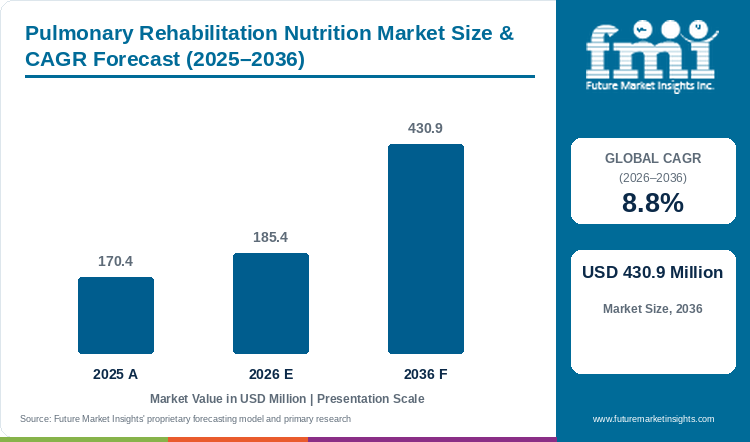
USD 185.4 Million in 2026 and USD 430.9 Million by 2036 at an 8.8% CAGR.
The pulmonary rehabilitation nutrition market stands at USD 185.4 Million in 2026 and is projected to reach USD 430.9 Million by 2036, growing at an 8.8% CAGR. Market demand is fundamentally tied to rehabilitation pathways that treat exercise training and nutrition as deeply linked components of recovery. In 2023, the American Thoracic Society strongly recommended pulmonary rehabilitation for stable COPD, post-COPD hospitalization, and interstitial lung disease. When routine nutrition screening identifies low intake or muscle loss, rehabilitation teams have a highly defined, clinical reason to add medical oral nutrition rather than leaving dietary support outside the core program.[1]
Operating conditions differ significantly by country. U.S. CDC data published in April 2026 revealed that COPD prevalence among adults aged 45 and older was highest in nonmetropolitan areas, drastically increasing the importance of home delivery and remote follow-up. UK and German pathways formalize referral and rehabilitation access much more directly. South Korea presents a different constraint: while reimbursement successfully expanded pulmonary rehabilitation, national evidence found that service delivery remained heavily concentrated in tertiary hospitals. Consequently, revenue depends entirely on active referral and dietetic assessment. Product access and repeat use matter just as much as the underlying disease burden.[2][4][6][10]
Market Size and Forecast
Table 1: Market Size and Forecast for the Pulmonary Rehabilitation Nutrition Market (USD Million), 2025 to 2036
| Metric | Value |
|---|---|
| Estimated Market Size in 2025 | USD 170.4 Million |
| Estimated Market Size in 2026 | USD 185.4 Million |
| Projected Market Size by 2036 | USD 430.9 Million |
| CAGR, 2026 to 2036 | 8.8% |
Key Takeaways
- Pulmonary rehabilitation creates the primary demand pathway because exercise actively raises energy and protein needs at the exact same time that dyspnea, poor appetite, and post-hospital deconditioning severely constrain intake.
- High-Fat Low-CHO Pulmonary ONS leads Product Type with a 40.0% share in 2026 because pulmonary-specific formulations give clinicians a familiar, targeted option when carbon-dioxide production and calorie density are critical considerations.
- COPD leads the Condition segment with a 46.7% share in 2026 because it possesses the deepest rehabilitation evidence base and explicit guideline pathways for both stable disease and post-exacerbation recovery.
- Outpatient Pulmonary Rehab leads Program Setting with a 50.3% share in 2026 because repeated, supervised visits actively support nutrition screening, supplement initiation, and ongoing adjustment alongside progressive exercise.
- The main purchasing friction is clinical heterogeneity. While nutritional supplementation can improve weight or selected outcomes, systematic-review evidence does not support a single, universal formula strategy for every rehabilitation patient.
Profiled companies include Abbott (Pulmocare), Nestle Health Science (Nutren Pulmonary), Danone Nutricia (Respifor), Fresenius Kabi, Meiji Holdings, Medtrition, Victus, and B. Braun.
Analyst Perspective
Demand reliably converts to repeat revenue only when the rehabilitation team can identify a measurable nutrition problem, match the formula to the patient's tolerance and respiratory needs, and maintain use after discharge or between supervised sessions.
- Anurag Sharma, Future Market Insights
How is the pulmonary rehabilitation nutrition market segmented?
The market is segmented by Product Type, Condition, Program Setting, End User and Sales Channel.
Product Type comprises High-Fat Low-CHO Pulmonary ONS, High-Protein Rehab Formulas, Compact Energy-Dense ONS (Dyspnea-Adapted), and Others. Condition covers COPD, Post-Pneumonia & ARDS Recovery, Interstitial Lung Disease, and Others. Program Setting comprises Outpatient Pulmonary Rehab, Inpatient Rehab, and Home-Based Programs. End User includes Rehab Centers, Homecare, Hospitals, and Others. Sales Channel comprises Hospital Pharmacy, Retail Pharmacy, Online, Institutional Tender, and Others.
Why do High-Fat Low-CHO Pulmonary ONS lead the Product Type category?
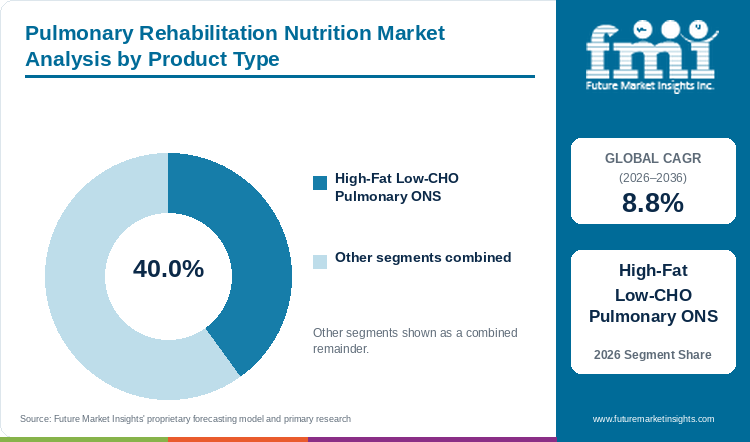
High-Fat Low-CHO Pulmonary ONS hold 40.0% of Product Type in 2026.
Pulmonary-specific high-fat, lower-carbohydrate formulas address a respiratory concern that is entirely distinct from general high-calorie supplementation: carbohydrate oxidation generates significantly more carbon dioxide per unit of oxygen consumed than fat oxidation. While this doesn't make the format universally superior, it provides clinicians with a highly targeted option for selected patients with limited ventilatory reserve. Abbott and Nestle Health Science both document pulmonary formulas built specifically around this metabolic profile, which sustains strong category recognition within respiratory care. High-Fat Low-CHO Pulmonary ONS holds 40.0% of Product Type revenue in 2026.[12][13][14]
- High-Fat Low-CHO Pulmonary ONS account for 40.0% of Product Type in 2026.
- Targeted Metabolic Rationale: The segment's leadership is driven by the physiological need to reduce carbon dioxide production in patients with severe respiratory compromise, making lower-carbohydrate, higher-fat profiles a targeted option for selected patients.[12][13][14]
- Established Clinical Familiarity: Decades of use and foundational clinical trials (such as a landmark 2003 study showing favorable respiratory-function changes in low-body-weight COPD patients) have cemented these specific formulations as a standard, recognizable option for respiratory dietitians.[12]
What keeps COPD at the center of the Condition category?
COPD holds 46.7% of Condition in 2026.
COPD uniquely combines high rehabilitation eligibility with frequent, severe nutritional risk. Breathlessness can drastically reduce meal size, while systemic disease and rigorous exercise rehabilitation simultaneously increase the need to preserve body mass and muscle function. The clinical pathway is also unusually explicit. The American Thoracic Society guideline covers both stable and post-hospitalization COPD, while NICE embeds diet advice and nutritional assessment directly within COPD rehabilitation protocols. This combination gives respiratory nutrition a much clearer prescribing context than less standardized recovery pathways. COPD holds 46.7% of Condition revenue in 2026.[1][4]
- COPD accounts for 46.7% of Condition in 2026.
- Explicit Guideline Pathways: The segment dominates because NICE guidance includes diet advice and nutritional assessment within COPD rehabilitation, transforming dietary intervention from an optional add-on into a standard of care.[4]
- Recurring Need for Muscle Preservation: The systemic nature of COPD, combined with the physical demands of rehab, creates a continuous, measurable need to manage weight loss, muscle depletion, and inadequate intake throughout the functional recovery process.
Why is Outpatient Pulmonary Rehab the leading Program Setting?
Outpatient Pulmonary Rehab holds 50.3% of Program Setting in 2026.
Outpatient programs create highly valuable, repeated decision points. Clinicians can closely observe exercise tolerance and weight trajectory over several weeks, allowing them to monitor appetite and adherence in real time rather than relying on a single, static discharge recommendation. This environment perfectly supports the trial-and-adjust use of oral supplements. The setting also perfectly fits patients who are medically stable enough for structured rehabilitation but still require supervised progression. While home programs improve geographic reach and inpatient rehab remains vital after severe illness, outpatient care retains the broadest intersection between active clinical oversight and repeat consumption. Outpatient Pulmonary Rehab represents 50.3% of Program Setting revenue in 2026.[1][4][5]
- Outpatient Pulmonary Rehab accounts for 50.3% of Program Setting in 2026.
- Continuous Monitoring and Adjustment: The leading position is driven by the ability of outpatient teams to continuously monitor a patient's tolerance, appetite, and functional progress, allowing them to dynamically adjust nutritional prescriptions over multi-week programs.
- Bridge Between Acute Care and Home: Outpatient settings capture patients who are stable enough to leave the hospital but still require the multidisciplinary supervision necessary to properly initiate and validate specialized medical nutrition.
Why do Rehab Centers lead the End User category?
Rehab Centers hold 47.0% of End User in 2026.
Rehab Centers serve as the exact point where nutrition can be seamlessly integrated with exercise progression, rather than being managed as an isolated retail decision. Multidisciplinary teams can actively identify low BMI, recent weight loss, swallowing difficulties, poor appetite, or exercise-related fatigue. They can then immediately route the patient to a dietitian or prescribe a medical nutrition product while actively monitoring tolerance. Hospitals remain critical around acute exacerbations, and homecare becomes vital after transition, but the rehabilitation center is where specification and follow-up are most naturally connected. Rehab Centers hold 47.0% of End User revenue in 2026.[4][5]
- Rehab Centers account for 47.0% of End User in 2026.
- Multidisciplinary Care Integration: Rehab centers dominate because they house the dietitians, respiratory therapists, and physicians necessary to comprehensively assess a patient's nutritional deficits and prescribe targeted formulas within the context of their physical therapy.
- Institutional Infrastructure: As highlighted by national analyses in markets like South Korea, the expansion of pulmonary rehab relies heavily on the institutional infrastructure of hospitals and specialized centers to coordinate this complex, multidisciplinary care.[10]
Why does Hospital Pharmacy lead the Sales Channel category?
Hospital Pharmacy holds 50.2% of Sales Channel in 2026.
Hospital Pharmacy benefits heavily from the strict clinical status of many products in this market. Foods for special medical purposes and medical oral nutrition are typically introduced following a formal physician or dietitian assessment. Initiation is especially relevant around acute exacerbations or the start of structured rehabilitation. Hospital formulary access drastically reduces uncertainty over product suitability and creates a vital bridge into post-discharge purchasing. While retail and online channels matter once a patient is established on a product, and institutional tenders drive bulk purchasing, the hospital pharmacy remains the primary gateway for clinical initiation. Hospital Pharmacy accounts for 50.2% of Sales Channel revenue in 2026.[13][14][15][16][20]
- Hospital Pharmacy accounts for 50.2% of Sales Channel in 2026.
- Gatekeepers of Clinical Initiation: The channel leads because specialized pulmonary formulas require professional assessment and medical supervision, making the hospital pharmacy the natural and most trusted point of entry for new patients.[13][14][15][16]
- Formulary Oversight and Discharge Planning: Hospital pharmacies ensure that the selected product aligns with medical supervision and formulary standards, actively facilitating the transition from inpatient initiation to post-discharge home use.
What are the drivers, restraints and opportunities in the pulmonary rehabilitation nutrition market?
Demand rises as pulmonary rehabilitation becomes embedded in chronic respiratory care, while variable response and access constrain routine supplementation, and compact high-protein formats create an opening for better adherence across outpatient and home programs.
- Driver: Formal pulmonary rehabilitation pathways create recurring, structured points for nutrition screening and medical ONS initiation.
- Restraint: Heterogeneous trial results and individual patient tolerance make routine, one-size-fits-all formula selection much more difficult than the guideline referral to rehabilitation itself.
- Opportunity: Compact, protein-dense, and home-compatible formats can extend vital nutrition support beyond supervised sessions without increasing the physical burden of eating for dyspneic patients.
The central driver is the ongoing normalization of pulmonary rehabilitation as standard chronic respiratory care. ATS recommendations actively cover stable COPD, post-hospitalization COPD, interstitial lung disease, and telerehabilitation. Similarly, NICE describes nutrition as a core component of multidisciplinary COPD rehabilitation. These pathways turn malnutrition risk from a general wellness concern into a heavily monitored clinical issue. For suppliers, the demand mechanism is strongest when dietitians and rehabilitation teams actively screen for weight change or low intake during a program, creating a clear specification point for pulmonary-specific ONS, high-protein supplements, or compact energy-dense formats.[1][4]
The main restraint is evidence heterogeneity. A 2020 systematic review of 22 studies involving 917 participants found that while nutritional supplementation during pulmonary rehabilitation could improve weight or selected outcomes, most studies failed to show a consistent, additional exercise-capacity benefit. The review also highlighted massive variation in supplements and rehabilitation protocols across different patient groups. Consequently, buyers cannot treat all products as interchangeable or assume that every patient will gain the exact same functional benefit. Programs must rigorously assess individual nutrition status and tolerance before standardizing repeat purchasing.[11]
The clearest opportunity lies in reducing the physical consumption burden while still supporting vital protein and energy targets between rehabilitation encounters. Medtrition introduced a 2-ounce protein cup in 2025, while Meiji documented 100 ml products delivering 200 kcal. Nutricia Respifor utilizes a 125 ml format specifically for COPD-related malnutrition. These examples perfectly illustrate how suppliers can compete on smaller serving sizes rather than simply adding bulk calories. Furthermore, home-based and telerehabilitation models drastically increase the value of shelf-stable, easy-to-administer formats because patients desperately need products that remain practical when the clinical team is not physically present.[15][17][18]
Which country CAGRs are profiled in the pulmonary rehabilitation nutrition market?
The following country CAGRs cover the 2026 to 2036 forecast period.
Table 2: Country CAGRs for the Pulmonary Rehabilitation Nutrition Market (CAGR, %), 2026 to 2036
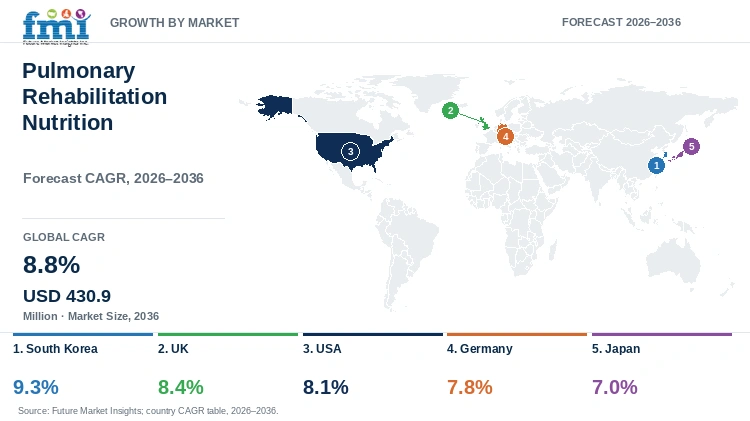
| Country | CAGR |
|---|---|
| South Korea | 9.3% |
| UK | 8.4% |
| USA | 8.1% |
| Germany | 7.8% |
| Japan | 7.0% |
Country-wise Analysis
- South Korea: South Korea records the highest profiled CAGR at 9.3% from 2026 to 2036. The Korea Disease Control and Prevention Agency updated its COPD information in June 2026, stating that roughly 13% of adults aged 40 and older have COPD, with diagnosis and treatment rates remaining concerningly low. Reimbursement can actively translate that disease burden into rehabilitation demand: a national HIRA analysis found that pulmonary rehabilitation use rose significantly after insurance coverage began in 2017. However, the same study found that roughly 70% of patients were treated at tertiary hospitals. Suppliers therefore face a high-growth market characterized by clear institutional concentration and persistent access gaps outside major urban centers.[9][10]
- UK: The UK is profiled at an 8.4% CAGR from 2026 to 2036. NICE updated its COPD quality standard in September 2023, explicitly calling for eligible stable patients with exercise limitation to be referred to pulmonary rehabilitation. Crucially, the same standard describes diet advice and support as a mandatory part of the program according to individual need. This formal pathway gives ONS purchasing a highly defined clinical context. However, demand is not automatic, as supplementation still depends on individual nutritional assessment and tolerance. Suppliers that seamlessly fit into dietitian workflows and support continuity after the usual multi-week rehabilitation program are vastly better positioned than products sold merely as general wellness nutrition.[4][5]
- USA: In the USA, the market is profiled to expand at an 8.1% CAGR from 2026 to 2036. CDC data released in April 2026 found that COPD prevalence among adults aged 45 and older was 7.0% in 2024, rising to a stark 10.6% in nonmetropolitan areas. The American Thoracic Society also recommends offering eligible patients a choice between center-based pulmonary rehabilitation and telerehabilitation. These conditions create two distinct purchasing needs: institutionally specified medical nutrition for supervised programs, and highly practical home formats for geographically dispersed patients. Commercial success therefore depends on broad distribution reach, remote adherence support, and strict product fit with dietitian-led care rather than prevalence alone.[1][2]
- Germany: Germany carries a 7.8% CAGR from 2026 to 2036. The federal health portal describes pneumological rehabilitation as a vital part of the COPD disease-management program, noting that patients may utilize either outpatient or inpatient rehabilitation. The portal also explicitly lists dietary changes among helpful non-pharmaceutical measures. This supports a highly structured care environment where nutrition is naturally considered within the broader rehabilitation framework. The market opportunity is therefore less about creating basic awareness of rehabilitation and much more about earning deep clinical acceptance within established pathways. Suppliers must demonstrate clear medical-nutrition positioning and practical administration while navigating reimbursement and institutional purchasing.[6]
- Japan: Japan is profiled at a 7.0% CAGR from 2026 to 2036. The Japanese Respiratory Society's 2026 COPD guideline explicitly includes nutrition assessment and nutrition management alongside pulmonary rehabilitation within non-pharmacologic care. Furthermore, a Japanese clinical-trial registry entry updated on September 4, 2026, documented a feasibility study combining inspiratory-muscle training with targeted nutrition therapy in COPD patients. The study demonstrates active, ongoing interest in pairing rehabilitation with targeted intake. Commercial uptake is likely to remain highly evidence-sensitive, favoring products that can precisely fit measured nutritional deficits and accommodate small-volume consumption rather than broad, untargeted supplementation.[7][8]
Who are the notable companies in the pulmonary rehabilitation nutrition market?
Abbott (Pulmocare), Nestle Health Science (Nutren Pulmonary), Danone Nutricia (Respifor), Fresenius Kabi, Meiji Holdings, Medtrition, Victus, and B. Braun are the notable companies profiled in this market.
Competition cleanly separates into three practical positions. Abbott, Nestle Health Science, and Danone Nutricia document highly specific pulmonary formulas utilizing different macronutrient strategies. Fresenius Kabi, Meiji Holdings, and B. Braun compete heavily through high-energy, high-protein, or compact clinical nutrition that can easily fit malnutrition and rehabilitation needs without being exclusively pulmonary. Medtrition concentrates intensely on modular protein delivery and very small serving formats. Victus offers broader complete and specialized nutrition across U.S. and Latin American channels. This structure matters immensely because buyers may choose a disease-specific formula for selected COPD patients, but general high-protein or compact ONS might be strongly preferred when volume tolerance or pure muscle preservation is the overriding requirement.[13][14][15][16][17][18][19][20]
- Pulmonary-specific formula position: Abbott (Pulmocare), Nestle Health Science (Nutren Pulmonary), and Danone Nutricia (Respifor).[13][14][15]
- Broad clinical ONS and compact nutrition position: Fresenius Kabi, Meiji Holdings, and B. Braun.[16][17][20]
- Modular and broader specialized nutrition position: Medtrition and Victus, with protein and complete-nutrition portfolios.[18][19]
Competitive Benchmarking: Pulmonary Rehabilitation Nutrition Market
Table 3: Competitive Benchmarking for the Pulmonary Rehabilitation Nutrition Market
| Company | Pulmonary-Specific Formula | Compact Energy / Protein Format | Clinical ONS Breadth | Geographic Reach |
|---|---|---|---|---|
| Abbott (Pulmocare) | High | Medium | High | Pulmocare documented in Singapore; broader Abbott medical-nutrition portfolio spans multiple markets. |
| Nestle Health Science (Nutren Pulmonary) | High | Medium | High | Nutren Pulmonary documented in Middle East channels; broader Nestle Health Science presence is multinational. |
| Danone Nutricia (Respifor) | High | High | High | Nutricia product network plus documented medical-nutrition activity in Europe, USA, and China. |
| Fresenius Kabi | Medium | High | High | Fresubin portfolio documented across Europe, MENA, and other Fresenius Kabi markets. |
| Meiji Holdings | Not specified | High | Medium | Japan-centered clinical nutrition with selected Asian activity documented by Meiji. |
| Medtrition | Not specified | High | Medium | United States base; company states use in more than 50 countries. |
| Victus | Not specified | Not specified | Medium | United States and Latin American product channels are documented. |
| B. Braun | Not specified | Medium | High | Global B. Braun network; product availability varies by country. |
Scoring basis: Pulmonary-Specific Formula measures whether a named product is explicitly formulated for COPD or chronic pulmonary disease. Compact Energy / Protein Format measures documented ability to deliver meaningful energy or protein in a reduced serving volume. Clinical ONS Breadth measures the range of medically supervised oral or sip-feed formats relevant to malnutrition and rehabilitation. High indicates broad or deep documented capability, while Medium indicates credible but narrower capability.
Key Developments in the Pulmonary Rehabilitation Nutrition Market
- In March 2025, Medtrition launched the ProSource Cup portfolio. The standard cup provides 20 g of complete protein in a highly concentrated 2-ounce serving, designed specifically for oral or enteral administration. This low-volume format is directly relevant to rehabilitation patients who struggle with meal volume or need concentrated protein between exercise sessions.[18]
- In March 2025, Meiji Holdings launched the Mei Balance Gyutto Soft Jelly series in Japan. Meiji reports that the product supplies 200 kcal in just 100 ml. This launch significantly expands the range of compact nutrition formats available to support patients who need meaningful energy in a very small serving during recovery.[17]
- In July 2025, Danone completed the acquisition of a majority stake in Kate Farms, combining it with its North American medical-nutrition platform. Danone stated the portfolio would improve access across hospitals and home settings, citing online and retail channels. While broader than pulmonary-specific products, the transaction vastly strengthens route-to-market capacity for specialized nutrition.[22]
Key Players in the Pulmonary Rehabilitation Nutrition Market
- Pulmonary-Specific Respiratory Nutrition
- Abbott (Pulmocare)
- Nestle Health Science (Nutren Pulmonary)
- Danone Nutricia (Respifor)
- High-Energy and High-Protein Clinical ONS
- Fresenius Kabi
- Meiji Holdings
- B. Braun
- Modular and Broader Specialized Nutrition
- Medtrition
- Victus
Pulmonary Rehabilitation Nutrition Market - Report Scope
Table 4: Report scope for the Pulmonary Rehabilitation Nutrition Market (USD Million), 2026 to 2036
| Coverage field | Report scope |
|---|---|
| Market breakdown | Product Type; Condition; Program Setting; End User; Sales Channel |
| Quantitative Units | USD Million |
| Market Definition | Revenue from medically supervised pulmonary rehabilitation nutrition sold within the stated segmentation universe. It includes pulmonary-specific oral nutrition, high-protein rehabilitation formulas, and compact energy-dense ONS when sold for pulmonary rehabilitation use. It excludes pulmonary rehabilitation service fees, respiratory drugs and devices, tube-feed-only revenue outside this use case, general wellness supplements, and adjacent disease-specific nutrition. |
| Regions Covered | North America; Latin America; Western Europe; Eastern Europe; East Asia; South Asia and Pacific; Middle East and Africa |
| Countries Covered | USA; UK; Germany; Japan; South Korea |
| Key Companies Profiled | Abbott (Pulmocare); Nestle Health Science (Nutren Pulmonary); Danone Nutricia (Respifor); Fresenius Kabi; Meiji Holdings; Medtrition; Victus; B. Braun |
| Forecast Period | 2026 to 2036 |
| Approach | Primary and secondary research with market triangulation. |
Pulmonary Rehabilitation Nutrition Market - Research Methodology
Table 5: Research methodology for the Pulmonary Rehabilitation Nutrition Market (USD Million), 2026 to 2036
| Method | Approach |
|---|---|
| Primary Research | FMI analysts gathered input from manufacturers, service providers, technology developers, distributors, end users, procurement teams and subject-matter experts. Interviews examined purchasing decisions, product evaluation, adoption barriers, approval requirements, pricing considerations and expectations for technical support. |
| Desk Research | Desk research covered government statistics, regulatory publications, trade data, industry associations, technical literature, standards, company filings and official corporate announcements. Claims relating to performance, applications, approvals and commercial activity were retained only when supported by credible public evidence. |
| Market Sizing and Forecasting | The market model combined the baseline value with historical performance, segment structure, pricing and volume indicators, adoption levels, company participation and country-level demand conditions. Forecast assumptions considered economic activity, regulatory developments, technology adoption and purchasing cycles. |
| Data Validation | Estimates were checked against multiple independent indicators, including public data, company activity, trade patterns and findings from primary interviews. Adjacent categories, unsupported claims and overlapping revenues were excluded to reduce double counting and maintain consistency. |
Pulmonary Rehabilitation Nutrition Market by Segments
Pulmonary Rehabilitation Nutrition Market segmented by Product Type:
- High-Fat Low-CHO Pulmonary ONS
- High-Protein Rehab Formulas
- Compact Energy-Dense ONS (Dyspnea-Adapted)
- Others
Pulmonary Rehabilitation Nutrition Market segmented by Condition:
- COPD
- Post-Pneumonia & ARDS Recovery
- Interstitial Lung Disease
- Others
Pulmonary Rehabilitation Nutrition Market segmented by Program Setting:
- Outpatient Pulmonary Rehab
- Inpatient Rehab
- Home-Based Programs
Pulmonary Rehabilitation Nutrition Market segmented by End User:
- Rehab Centers
- Homecare
- Hospitals
- Others
Pulmonary Rehabilitation Nutrition Market segmented by Sales Channel:
- Hospital Pharmacy
- Retail Pharmacy
- Online
- Institutional Tender
- Others
Pulmonary Rehabilitation Nutrition Market by Region:
- North America
- United States
- Canada
- Latin America
- Brazil
- Mexico
- Argentina
- Chile
- Western Europe
- Germany
- France
- United Kingdom
- Italy
- Spain
- Benelux
- Nordics
- Eastern Europe
- Poland
- Czech Republic
- Romania
- Hungary
- East Asia
- China
- Japan
- South Korea
- South Asia and Pacific
- India
- ASEAN
- Australia and New Zealand
- Middle East and Africa
- GCC Countries
- South Africa
- Türkiye
- Israel
Research Sources and Bibliography
- [1] American Thoracic Society (2023, August 15). Pulmonary Rehabilitation for Adults with Chronic Respiratory Disease: An Official American Thoracic Society Clinical Practice Guideline.
- [2] National Center for Health Statistics (2026, April 15). Prevalence of Selected Chronic Conditions Among Adults Age 45 and Older, by Age and Urbanization Level: United States, 2024. https://www.cdc.gov/nchs/products/databriefs/db557.htm
- [3] National Center for Health Statistics (2025, May 22). Chronic Obstructive Pulmonary Disease in Adults Age 18 and Older: United States, 2023.
- [4] NICE (2023, September 19). Quality statement 4: Pulmonary rehabilitation for stable COPD and exercise limitation.
- [5] NHS England (n.d.). Pulmonary rehabilitation.
- [6] Federal Ministry of Health, Germany (2023, March 17). Chronic obstructive pulmonary disease (COPD).
- [7] Japanese Respiratory Society (2026). COPD Diagnosis and Treatment Guideline 2026, 7th Edition.
- [8] Ministry of Health, Labour and Welfare, Japan (2026, September 4). Effect of inspiratory muscle training and nutritional intervention in patients with chronic obstructive pulmonary disease: Randomized feasibility trial.
- [9] Korea Disease Control and Prevention Agency (2026, June 1). Chronic Obstructive Pulmonary Disease.
- [10] Kim et al. (2022, October 14). Current status and trends of pulmonary rehabilitation in South Korea: National level data analysis using HIRA database from 2016 to 2018.
- [11] Aldhahir et al. (2020, February 13). Nutritional supplementation during pulmonary rehabilitation in COPD: A systematic review. https://pmc.ncbi.nlm.nih.gov/articles/PMC7019390/
- [12] Cai et al. (2003, March). Effect of supplementing a high-fat, low-carbohydrate enteral formula in COPD patients.
- [13] Abbott (n.d.). Pulmocare.
- [14] Nestle Health Science (n.d.). NUTREN Pulmonary Vanilla.
- [15] Nutricia (n.d.). Respifor.
- [16] Fresenius Kabi (n.d.). Fresubin 2 kcal / 2 kcal FIBRE Drink.
- [17] Meiji Holdings Co., Ltd. (2025, June 26). Annual Securities Report for the Fiscal Year Ended March 31, 2025.
- [18] Medtrition, Inc. (2025, March 25). Medtrition, Inc. Launches the ProSource Cup Portfolio. https://www.medtrition.com/wp-content/uploads/2025/03/ProSource-Cup-Press-Release-March-2025.pdf
- [19] Victus (n.d.). Enterex Total.
- [20] B. Braun (n.d.). Sip Feeds.
- [21] B. Braun (2026, June 3). Nutricomp Soup.
- [22] Danone (2025, July 1). Danone completes the acquisition of Kate Farms, enhancing its U.S. specialized nutrition offerings. https://www.danone.com/newsroom/press-releases/kate-farms-acquisition.html
- [23] Danone (2024, May 1). Danone acquires Functional Formularies.
- [24] Danone (2023, November 6). Danone enters new adult medical nutrition category in China.
- [25] Danone (2023, September 13). Danone reinforces European medical nutrition manufacturing footprint with EUR 50 million line expansion in Poland.
- [26] Fresenius Kabi (2024, September 26). Advancing Medical Nutrition: Fresenius Kabi at ESPEN 2024.
This Report Answers
- How large is the Pulmonary Rehabilitation Nutrition Market in 2026, and what value is forecast for 2036?
- Which clinical and operating pressures support demand for pulmonary rehabilitation nutrition?
- Why does High-Fat Low-CHO Pulmonary ONS lead the Product Type category?
- Why does COPD lead the Condition category?
- How do the profiled country growth rates differ across South Korea, UK, USA, Germany, and Japan?
- Which profiled companies supply pulmonary-specific, compact, high-protein, or broader clinical nutrition formats?
- What limits adoption, repeat use, or switching between pulmonary rehabilitation nutrition products?
- What should rehabilitation teams and procurement buyers evaluate before purchasing or standardizing a product?
Frequently Asked Questions
How big is the Pulmonary Rehabilitation Nutrition Market in 2026, and what is forecast for 2036?
The market is valued at USD 185.4 Million in 2026 and is forecast to reach USD 430.9 Million by 2036. The increase reflects the wider use of medically supervised nutrition alongside pulmonary rehabilitation and the critical need for continued care after discharge.
What is the CAGR for the Pulmonary Rehabilitation Nutrition Market from 2026 to 2036?
The market is forecast to grow at an 8.8% CAGR from 2026 to 2036. Growth heavily depends on rehabilitation referral and active nutrition screening. Product access and sustained use also matter far more than respiratory disease prevalence alone.
Which Product Type leads the Pulmonary Rehabilitation Nutrition Market?
High-Fat Low-CHO Pulmonary ONS leads Product Type with a 40.0% share in 2026. Its position reflects the established respiratory rationale for lowering carbohydrate exposure in selected patients while maintaining vital calorie density.
Which Condition leads the Pulmonary Rehabilitation Nutrition Market?
COPD leads the Condition segment with a 46.7% share in 2026. It possesses the most mature pulmonary-rehabilitation pathways and a well-established clinical need to manage weight, muscle status, and intake during recovery.
Which profiled countries have the highest growth rates in the Pulmonary Rehabilitation Nutrition Market?
South Korea is highest at 9.3%, followed by the UK at 8.4% and the USA at 8.1% from 2026 to 2036. Germany and Japan are also profiled.
Which companies are active in the Pulmonary Rehabilitation Nutrition Market?
Profiled companies are Abbott (Pulmocare), Nestle Health Science (Nutren Pulmonary), Danone Nutricia (Respifor), Fresenius Kabi, Meiji Holdings, Medtrition, Victus, and B. Braun. Their roles range from pulmonary-specific formulas to compact ONS, broader clinical nutrition, and modular protein products.
Preview the report firsthand - request a free sample
Get SampleGet the brochure for pricing and purchase details.
Get PDFTable of Content
- Key Takeaways
- Market Size and CAGR
- Top Growth Driver
- Fastest Growing Segment
- Leading Region
- Key Companies
- Emerging Opportunities
- Executive Summary
- Global Market Outlook
- Demand-side Trends
- Supply-side Trends
- Technology Roadmap Analysis
- Analysis and Recommendations
- Analyst Perspective (What is happening? Why now? What should investors know?)
- Key Questions Answered
- How large is the market?
- What is the CAGR?
- What are key trends?
- Which region dominates?
- Who are the leaders?
- Market Overview
- Market Coverage / Taxonomy
- Market Definition / Scope / Limitations
- Research Methodology
- Chapter Orientation
- Analytical Lens and Working Hypotheses
- Market Structure, Signals, and Trend Drivers
- Benchmarking and Cross-market Comparability
- Market Sizing, Forecasting, and Opportunity Mapping
- Research Design and Evidence Framework
- Desk Research Programme (Secondary Evidence)
- Expert Input and Fieldwork (Primary Evidence)
- Tooling, Models, and Reference Databases
- Data Engineering and Model Build
- Quality Assurance and Audit Trail
- Market Background
- Market Dynamics (Drivers, Restraints, Opportunity, Trends)
- Scenario Forecast (Optimistic, Likely, Conservative)
- Impact Analysis
- AI Impact
- Sustainability Impact
- Regulatory Impact
- Technology Impact
- Consumer / Buyer Analysis
- Purchase Drivers
- Adoption Barriers
- Buyer Journey
- Opportunity Map Analysis
- Product Life Cycle Analysis
- Supply Chain Analysis
- Investment Feasibility Matrix
- Value Chain Analysis
- PESTLE and Porter's Analysis
- Regulatory Landscape
- Regional Parent Market Outlook
- Production and Consumption Statistics
- Import and Export Statistics
- Global Market Analysis and Forecast, 2021 to 2036
- Historical Market Size Value (USD Million) Analysis, 2021 to 2025
- Current and Future Market Size Value (USD Million) Projections, 2026 to 2036
- Y-o-Y Growth Trend Analysis
- Absolute $ Opportunity Analysis
- Global Market Pricing Analysis, 2021 to 2036
- Global Market Analysis and Forecast, By Product Type, 2021 to 2036
- Introduction / Key Findings
- Historical Market Size Value (USD Million) Analysis By Product Type, 2021 to 2025
- Current and Future Market Size Value (USD Million) Analysis and Forecast By Product Type, 2026 to 2036
- High-Fat Low-CHO Pulmonary ONS
- High-Protein Rehab Formulas
- Compact Energy-Dense ONS (Dyspnea-Adapted)
- Others
- Y-o-Y Growth Trend Analysis By Product Type, 2021 to 2025
- Absolute $ Opportunity Analysis By Product Type, 2026 to 2036
- Global Market Analysis and Forecast, By Condition, 2021 to 2036
- Introduction / Key Findings
- Historical Market Size Value (USD Million) Analysis By Condition, 2021 to 2025
- Current and Future Market Size Value (USD Million) Analysis and Forecast By Condition, 2026 to 2036
- COPD
- Post-Pneumonia & ARDS Recovery
- Interstitial Lung Disease
- Others
- Y-o-Y Growth Trend Analysis By Condition, 2021 to 2025
- Absolute $ Opportunity Analysis By Condition, 2026 to 2036
- Global Market Analysis and Forecast, By Program Setting, 2021 to 2036
- Introduction / Key Findings
- Historical Market Size Value (USD Million) Analysis By Program Setting, 2021 to 2025
- Current and Future Market Size Value (USD Million) Analysis and Forecast By Program Setting, 2026 to 2036
- Outpatient Pulmonary Rehab
- Inpatient Rehab
- Home-Based Programs
- Y-o-Y Growth Trend Analysis By Program Setting, 2021 to 2025
- Absolute $ Opportunity Analysis By Program Setting, 2026 to 2036
- Global Market Analysis and Forecast, By End User, 2021 to 2036
- Introduction / Key Findings
- Historical Market Size Value (USD Million) Analysis By End User, 2021 to 2025
- Current and Future Market Size Value (USD Million) Analysis and Forecast By End User, 2026 to 2036
- Rehab Centers
- Homecare
- Hospitals
- Others
- Y-o-Y Growth Trend Analysis By End User, 2021 to 2025
- Absolute $ Opportunity Analysis By End User, 2026 to 2036
- Global Market Analysis and Forecast, By Sales Channel, 2021 to 2036
- Introduction / Key Findings
- Historical Market Size Value (USD Million) Analysis By Sales Channel, 2021 to 2025
- Current and Future Market Size Value (USD Million) Analysis and Forecast By Sales Channel, 2026 to 2036
- Hospital Pharmacy
- Retail Pharmacy
- Online
- Institutional Tender
- Others
- Y-o-Y Growth Trend Analysis By Sales Channel, 2021 to 2025
- Absolute $ Opportunity Analysis By Sales Channel, 2026 to 2036
- Global Market Analysis and Forecast, By Region, 2021 to 2036
- Introduction
- Historical Market Size Value (USD Million) Analysis By Region, 2021 to 2025
- Current Market Size Value (USD Million) Analysis and Forecast By Region, 2026 to 2036
- North America
- Latin America
- Western Europe
- Eastern Europe
- East Asia
- South Asia and Pacific
- Middle East and Africa
- Market Attractiveness Analysis By Region
- North America Market Analysis and Forecast, By Country, 2021 to 2036
- Historical Market Size Value (USD Million) Trend Analysis By Market Taxonomy, 2021 to 2025
- Market Size Value (USD Million) Forecast By Market Taxonomy, 2026 to 2036
- By Country
- United States
- Canada
- By Product Type
- By Condition
- By Program Setting
- By End User
- By Sales Channel
- By Country
- Market Attractiveness Analysis
- By Country
- By Product Type
- By Condition
- By Program Setting
- By End User
- By Sales Channel
- Key Takeaways
- Latin America Market Analysis and Forecast, By Country
- Historical Market Size Value (USD Million) Trend Analysis By Market Taxonomy, 2021 to 2025
- Market Size Value (USD Million) Forecast By Market Taxonomy, 2026 to 2036
- By Country
- Brazil
- Mexico
- Argentina
- Chile
- By Product Type
- By Condition
- By Program Setting
- By End User
- By Sales Channel
- By Country
- Market Attractiveness Analysis
- By Country
- By Product Type
- By Condition
- By Program Setting
- By End User
- By Sales Channel
- Key Takeaways
- Western Europe Market Analysis and Forecast, By Country
- Historical Market Size Value (USD Million) Trend Analysis By Market Taxonomy, 2021 to 2025
- Market Size Value (USD Million) Forecast By Market Taxonomy, 2026 to 2036
- By Country
- Germany
- France
- United Kingdom
- Italy
- Spain
- Benelux
- Nordics
- By Product Type
- By Condition
- By Program Setting
- By End User
- By Sales Channel
- By Country
- Market Attractiveness Analysis
- By Country
- By Product Type
- By Condition
- By Program Setting
- By End User
- By Sales Channel
- Key Takeaways
- Eastern Europe Market Analysis and Forecast, By Country
- Historical Market Size Value (USD Million) Trend Analysis By Market Taxonomy, 2021 to 2025
- Market Size Value (USD Million) Forecast By Market Taxonomy, 2026 to 2036
- By Country
- Poland
- Czech Republic
- Romania
- Hungary
- By Product Type
- By Condition
- By Program Setting
- By End User
- By Sales Channel
- By Country
- Market Attractiveness Analysis
- By Country
- By Product Type
- By Condition
- By Program Setting
- By End User
- By Sales Channel
- Key Takeaways
- East Asia Market Analysis and Forecast, By Country
- Historical Market Size Value (USD Million) Trend Analysis By Market Taxonomy, 2021 to 2025
- Market Size Value (USD Million) Forecast By Market Taxonomy, 2026 to 2036
- By Country
- China
- Japan
- South Korea
- By Product Type
- By Condition
- By Program Setting
- By End User
- By Sales Channel
- By Country
- Market Attractiveness Analysis
- By Country
- By Product Type
- By Condition
- By Program Setting
- By End User
- By Sales Channel
- Key Takeaways
- South Asia and Pacific Market Analysis and Forecast, By Country
- Historical Market Size Value (USD Million) Trend Analysis By Market Taxonomy, 2021 to 2025
- Market Size Value (USD Million) Forecast By Market Taxonomy, 2026 to 2036
- By Country
- India
- ASEAN
- Australia and New Zealand
- By Product Type
- By Condition
- By Program Setting
- By End User
- By Sales Channel
- By Country
- Market Attractiveness Analysis
- By Country
- By Product Type
- By Condition
- By Program Setting
- By End User
- By Sales Channel
- Key Takeaways
- Middle East and Africa Market Analysis and Forecast, By Country
- Historical Market Size Value (USD Million) Trend Analysis By Market Taxonomy, 2021 to 2025
- Market Size Value (USD Million) Forecast By Market Taxonomy, 2026 to 2036
- By Country
- GCC Countries
- South Africa
- Türkiye
- Israel
- By Product Type
- By Condition
- By Program Setting
- By End User
- By Sales Channel
- By Country
- Market Attractiveness Analysis
- By Country
- By Product Type
- By Condition
- By Program Setting
- By End User
- By Sales Channel
- Key Takeaways
- Key Countries Market Analysis
- United States
- Pricing Analysis
- Market Share Analysis, 2025
- By Product Type
- By Condition
- By Program Setting
- By End User
- By Sales Channel
- Canada
- Pricing Analysis
- Market Share Analysis, 2025
- By Product Type
- By Condition
- By Program Setting
- By End User
- By Sales Channel
- Mexico
- Pricing Analysis
- Market Share Analysis, 2025
- By Product Type
- By Condition
- By Program Setting
- By End User
- By Sales Channel
- Brazil
- Pricing Analysis
- Market Share Analysis, 2025
- By Product Type
- By Condition
- By Program Setting
- By End User
- By Sales Channel
- Chile
- Pricing Analysis
- Market Share Analysis, 2025
- By Product Type
- By Condition
- By Program Setting
- By End User
- By Sales Channel
- Germany
- Pricing Analysis
- Market Share Analysis, 2025
- By Product Type
- By Condition
- By Program Setting
- By End User
- By Sales Channel
- United Kingdom
- Pricing Analysis
- Market Share Analysis, 2025
- By Product Type
- By Condition
- By Program Setting
- By End User
- By Sales Channel
- Italy
- Pricing Analysis
- Market Share Analysis, 2025
- By Product Type
- By Condition
- By Program Setting
- By End User
- By Sales Channel
- Spain
- Pricing Analysis
- Market Share Analysis, 2025
- By Product Type
- By Condition
- By Program Setting
- By End User
- By Sales Channel
- France
- Pricing Analysis
- Market Share Analysis, 2025
- By Product Type
- By Condition
- By Program Setting
- By End User
- By Sales Channel
- India
- Pricing Analysis
- Market Share Analysis, 2025
- By Product Type
- By Condition
- By Program Setting
- By End User
- By Sales Channel
- ASEAN
- Pricing Analysis
- Market Share Analysis, 2025
- By Product Type
- By Condition
- By Program Setting
- By End User
- By Sales Channel
- Australia and New Zealand
- Pricing Analysis
- Market Share Analysis, 2025
- By Product Type
- By Condition
- By Program Setting
- By End User
- By Sales Channel
- China
- Pricing Analysis
- Market Share Analysis, 2025
- By Product Type
- By Condition
- By Program Setting
- By End User
- By Sales Channel
- Japan
- Pricing Analysis
- Market Share Analysis, 2025
- By Product Type
- By Condition
- By Program Setting
- By End User
- By Sales Channel
- South Korea
- Pricing Analysis
- Market Share Analysis, 2025
- By Product Type
- By Condition
- By Program Setting
- By End User
- By Sales Channel
- Poland
- Pricing Analysis
- Market Share Analysis, 2025
- By Product Type
- By Condition
- By Program Setting
- By End User
- By Sales Channel
- Hungary
- Pricing Analysis
- Market Share Analysis, 2025
- By Product Type
- By Condition
- By Program Setting
- By End User
- By Sales Channel
- Türkiye
- Pricing Analysis
- Market Share Analysis, 2025
- By Product Type
- By Condition
- By Program Setting
- By End User
- By Sales Channel
- South Africa
- Pricing Analysis
- Market Share Analysis, 2025
- By Product Type
- By Condition
- By Program Setting
- By End User
- By Sales Channel
- United States
- Market Structure Analysis
- Competition Dashboard
- Competition Benchmarking
- Market Share Analysis of Top Players
- By Regional
- By Product Type
- By Condition
- By Program Setting
- By End User
- By Sales Channel
- Emerging Startups
- Innovation Benchmarking
- Competition Analysis
- Competition Deep Dive
- Abbott (Pulmocare)
- Overview
- Product Portfolio
- Profitability by Market Segments
- Sales Footprint
- Strategy Overview
- Marketing Strategy
- Product Strategy
- Channel Strategy
- Nestle Health Science (Nutren Pulmonary)
- Danone Nutricia (Respifor)
- Fresenius Kabi
- Meiji Holdings
- Medtrition
- Victus
- B. Braun
- Pulmonary-Specific Respiratory Nutrition
- High-Energy and High-Protein Clinical ONS
- Modular and Broader Specialized Nutrition
- Abbott (Pulmocare)
- Case Studies
- Success Stories
- Recent Developments
- Competition Deep Dive
- Assumptions & Acronyms Used


