

- Industry Size (2025)
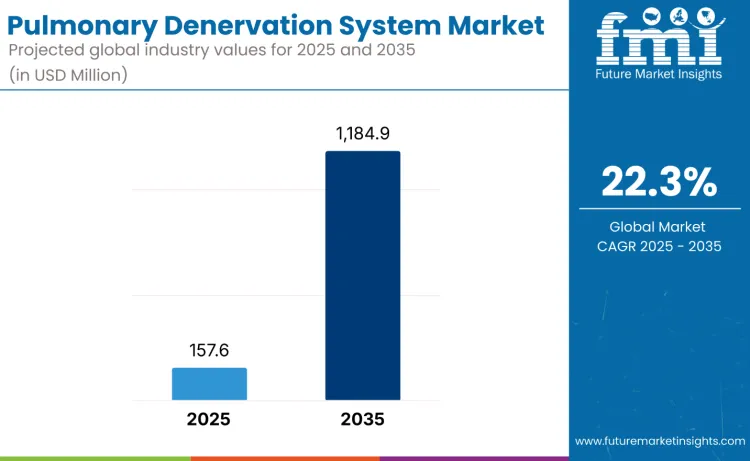
- USD 157.6 Mn
- Forecast (2035)
- USD 1184.9 Mn
- CAGR (2025 to 2035)
- 22.3%
Pulmonary Denervation System Market Forecast and Outlook 2025 to 2035
The global pulmonary denervation system landscape is set to expand rapidly, reaching USD 1,184.9 million by 2035 from USD 157.6 million in 2025 and reflecting a CAGR of 22.3%. Growth is driven by the increasing prevalence of advanced pulmonary hypertension and severe obstructive airway disease, where conventional drug therapy often fails to deliver durable symptom relief. Catheter-based neuromodulation approaches are gaining clinical attention for their ability to address autonomic imbalance and pulmonary vascular dysfunction. Adoption remains moderated by high procedural costs, limited availability of trained interventional specialists, and cautious reimbursement policies influenced by the need for longer-term clinical evidence.
Pulmonary denervation systems are becoming established as adjunctive interventional options within specialized cardiopulmonary care pathways. Advanced pulmonary arterial hypertension and chronic airway disease centers increasingly evaluate these systems for patients who remain symptomatic despite optimized pharmacological management. Clinical experience highlights potential benefits in reducing pulmonary vascular tone, stabilizing sympathetic nerve activity, and improving exercise tolerance and functional capacity. Growing physician familiarity with bronchial and pulmonary nerve modulation supports broader clinical evaluation and more consistent procedural utilization in high-acuity treatment settings.
Quick Stats for Pulmonary Denervation System Market
- Pulmonary Denervation System Market Value (2025): USD 157.6 million
- Pulmonary Denervation System Market Forecast Value (2035): USD 1,184.9 million
- Pulmonary Denervation System Market Forecast CAGR (2025 to 2035): 22.3%
- Leading Product Segment: Radiofrequency denervation systems (46.8%)
- Key Growth Regions in Pulmonary Denervation System Market: Asia Pacific, Europe, and North America
- Top Players in Pulmonary Denervation System Market: Galvanize Therapeutics, ReCor Medical, Boston Scientific, Medtronic, Biosense Webster (J&J)
Technology evolution continues to strengthen system performance and procedural confidence. New catheter platforms feature refined nerve mapping accuracy, controlled radiofrequency energy delivery, and integrated safety mechanisms designed to limit off-target tissue effects. Compatibility with cath-lab workflows and invasive hemodynamic monitoring supports efficient procedural execution. Expansion of clinical research programs, academic partnerships, and operator training initiatives is improving adoption readiness. Tertiary hospitals increasingly implement structured patient selection frameworks and outcome registries, reinforcing long-term confidence in pulmonary denervation across global cardiopulmonary networks.
Pulmonary Denervation System Market Year-over-Year Forecast (2025 to 2035)
Between 2025 and 2030, the pulmonary denervation system market is expected to grow from USD 157.6 million to USD 432.1 million, adding USD 274.5 million and accounting for 26.7% of total decade expansion. Growth is driven by rising use of neuromodulation in treatment-resistant pulmonary hypertension, expanding clinical evidence, and closer integration of interventional respiratory care within tertiary cardiovascular programs. Manufacturers focus on catheter refinement, precise lesion-creation systems, advanced hemodynamic monitoring, and structured physician training within high-volume specialty centers.
From 2030 to 2035, the market is projected to expand from USD 432.1 million to USD 1,184.9 million, adding USD 752.8 million and contributing 73.3% of overall growth. Wider clinical guideline consideration, improving reimbursement clarity, expanded patient eligibility, and stronger academic-industry collaboration are expected to accelerate adoption across advanced cardiopulmonary care networks.
Pulmonary Denervation System Market Key Takeaways
| Metric | Value |
|---|---|
| Market Value (2025) | USD 157.6 million |
| Market Forecast Value (2035) | USD 1,184.9 million |
| Forecast CAGR (2025 to 2035) | 22.3% |
Why Is the Pulmonary Denervation System Market Growing Worldwide?
The pulmonary denervation system market is gaining momentum as clinicians increasingly adopt catheter-based autonomic modulation to address persistent symptoms in advanced pulmonary hypertension and refractory airway disease. When pharmacologic regimens fail to adequately improve pulmonary vascular resistance or exercise capacity, pulmonary denervation offers supportive hemodynamic benefit by reducing sympathetic drive and pulmonary arterial pressures. Clinical focus on improving functional class, quality of life, and six-minute walk distance continues to encourage evaluation of this intervention within advanced cardiopulmonary care pathways.
Adoption is further supported by regulatory openness to minimally invasive innovation, expansion of tertiary pulmonary hypertension programs, and stronger academic-industry collaboration. Investment in neuromodulation-ready cath labs, physician training, and outcome registries is increasing, though high device costs, procedural learning curves, and evolving reimbursement frameworks may limit early access in resource-constrained settings.
How Is the Pulmonary Denervation System Market Segmented by Technology, Application, End User, and Region?
The market is segmented by technology, application, and end user. By technology, the market is divided into radiofrequency denervation systems, ultrasound-based denervation systems, cryothermal systems, and chemical/pharmacologic denervation systems. Based on application, the market is categorized into pulmonary hypertension, COPD/chronic bronchitis, HFpEF/cardiopulmonary dysautonomia, and other autonomic dysregulation indications. By end user, the market is segmented into hospitals & specialty cardio-pulmonary centers, ambulatory surgical centers, and research institutions. Regionally, the market is divided into Asia Pacific, Europe, North America, Latin America, and Middle East & Africa.
By Technology, the Radiofrequency Denervation Segment Accounts for a Dominant Market Share
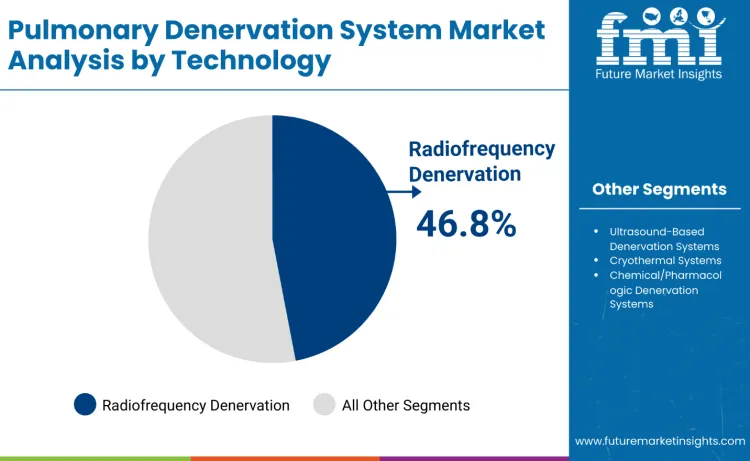
Radiofrequency denervation leads the pulmonary denervation system landscape in 2025, accounting for 46.8% of total share, supported by catheter-based platforms that deliver precise thermal ablation of peribronchial sympathetic fibers. Strong adoption reflects procedural familiarity among interventional cardiologists and electrophysiologists, along with growing clinical evidence showing hemodynamic improvement in treatment-refractory pulmonary hypertension.
Ultrasound-based systems hold 28.6% share, benefiting from non-thermal nerve disruption and expanding research interest. Cryothermal technologies contribute 13.7%, while chemical and pharmacologic approaches represent 10.9% in adjunctive use. Radiofrequency leadership is reinforced by precise lesion control, reproducible outcomes, multicenter trial validation, and compatibility with advanced mapping and imaging systems.
By Application, the Pulmonary Hypertension Segment Accounts for the Largest Market Share
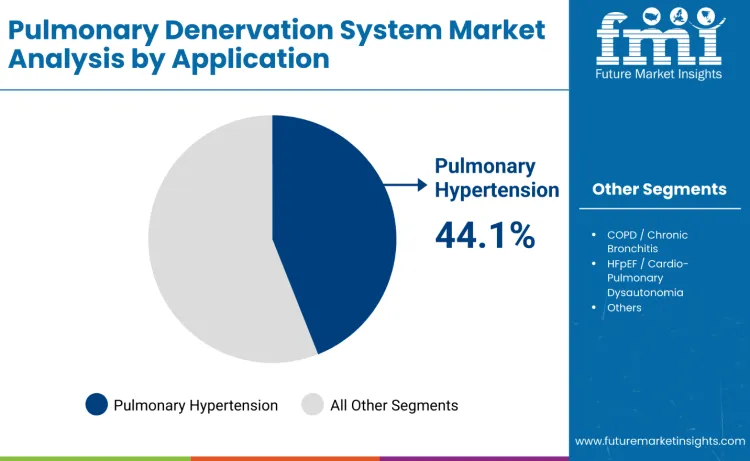
Pulmonary hypertension leads the pulmonary denervation system market in 2025 with a 44.1% share, reflecting rising adoption among patients who remain symptomatic despite optimized vasodilator therapy. Segment strength is driven by growing disease burden, persistent unmet need in advanced cases, and increasing clinical interest in neuromodulation to reduce sympathetic tone and improve pulmonary vascular mechanics.
Tertiary pulmonary hypertension centers are integrating denervation into investigational and adjunctive care pathways. COPD and chronic bronchitis account for 27.9% through bronchial nerve modulation, while HFpEF and cardiopulmonary dysautonomia represent 18.6% as autonomic dysfunction gains recognition. Other conditions contribute 9.4%. Leadership is reinforced by refractory case prevalence, expanding trials, evolving guidelines, and academic-industry collaboration.
By End User, Hospitals & Specialty Cardio-Pulmonary Centers Hold the Largest Market Share
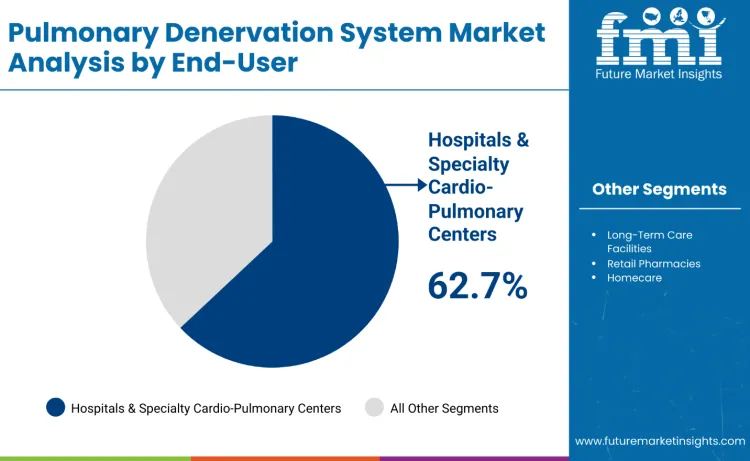
Hospitals and specialty cardiopulmonary centers dominate pulmonary denervation system utilization in 2025 with a 62.7% share, supported by their role in managing high-acuity pulmonary hypertension cases. These settings concentrate electrophysiology and interventional cardiology expertise, advanced imaging, and multidisciplinary heart-lung teams capable of performing neuromodulation procedures.
Academic centers and referral units lead adoption through structured research programs, standardized evaluation pathways, and comprehensive post-procedure monitoring. Ambulatory surgical centers account for 21.4% as minimally invasive pulmonary interventions expand with improving training and technology standardization. Research institutions represent 15.9%, driven by clinical evidence generation and protocol refinement. Hospital dominance is reinforced by the need for advanced hemodynamic assessment, specialist expertise, integrated monitoring, and active participation in clinical trials.
What Are the Major Drivers, Restraints, and Emerging Trends Influencing the Pulmonary Denervation System Market?
The pulmonary denervation system market is driven by rising prevalence of advanced pulmonary hypertension and refractory cardiopulmonary disorders with limited response to pharmacotherapy. Increasing clinical focus on neuromodulation as an adjunctive intervention supports demand, particularly as global PH cases continue to rise. Adoption of catheter-based autonomic modulation in tertiary cardiopulmonary centers is expanding through structured physician training and program development. Momentum is reinforced by encouraging early clinical trial outcomes demonstrating reductions in pulmonary vascular resistance and functional improvement, prompting high-volume hospitals to invest in advanced cath-lab infrastructure.
What Are the Major Restraints Limiting Adoption of Pulmonary Denervation Systems?
Market restraints include high device and procedural costs, as specialized neuromodulation catheters and supporting cath-lab infrastructure require substantial capital investment compared with drug-based therapies. Limited long-term clinical evidence and evolving regulatory pathways encourage cautious adoption. Integration complexity further slows uptake, as multidisciplinary coordination among interventional cardiology, pulmonology, and critical care teams is required for patient selection and follow-up. Reimbursement uncertainty and gradual payer alignment add financial risk, making some institutions hesitant to initiate pulmonary denervation programs despite unmet clinical need.
What Emerging Trends Are Shaping the Future of the Pulmonary Denervation System Market?
Key trends indicate accelerating adoption across North America, Europe, and Asia, driven by policy focus on reducing cardiopulmonary hospitalization burden through minimally invasive interventions. Technology development is advancing toward precision-controlled energy delivery, real-time hemodynamic mapping, and integrated safety feedback systems to improve procedural consistency. Strategic collaborations with pulmonary hypertension consortia, academic centers, and interventional societies are expanding clinical evidence and standardizing training pathways. Long-term dynamics may evolve as alternative neuromodulation strategies and emerging biologic or gene-modifying therapies enter the refractory pulmonary disease treatment landscape.
How Are Leading Countries Driving Growth in the Pulmonary Denervation System Market?
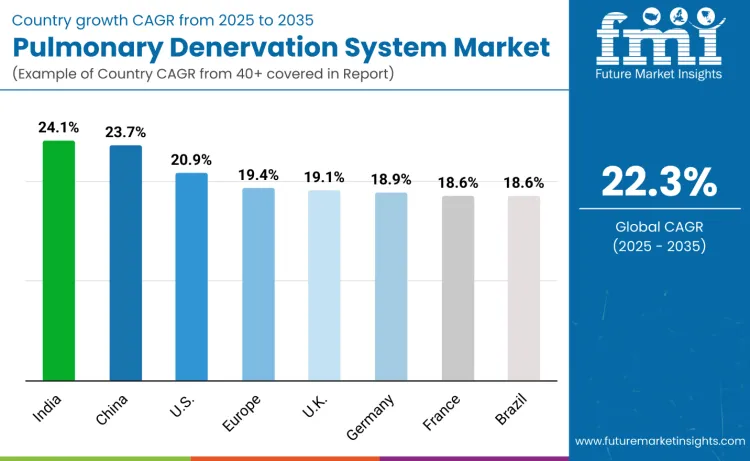
| Country | CAGR (2025 to 2035) |
|---|---|
| USA | 20.9% |
| Brazil | 18.6% |
| China | 23.7% |
| India | 24.1% |
| Europe | 19.4% |
| Germany | 18.9% |
| France | 18.6% |
| UK | 19.1% |
The pulmonary denervation system market shows strong global momentum, led by India with a 24.1% CAGR, supported by rising pulmonary hypertension prevalence and expanding tertiary cardiology infrastructure. China follows at 23.7%, driven by hospital modernization and growing interventional capacity. The United States records 20.9% growth through established specialty networks and academic heart-lung centers. Europe advances at 19.4%, with Germany at 18.9%, the UK at 19.1%, and France at 18.6%, supported by structured research and training programs. Brazil posts 18.6% growth, reflecting improving access to minimally invasive cardiology services.
The report covers an in-depth analysis of 40+ countries top-performing countries are highlighted below.
How Is Cardiovascular Innovation Infrastructure Accelerating Market Growth in China?
China demonstrates one of the strongest growth trajectories in the pulmonary denervation system market, advancing at a CAGR of 23.7% through 2035. Expansion is driven by rapid growth in advanced cardiopulmonary care capacity, rising pulmonary hypertension prevalence linked to aging and environmental factors, and strong national focus on minimally invasive cardiovascular technologies.
Adoption is concentrated in Beijing, Shanghai, Guangzhou, and Chengdu, where tertiary hospitals and university medical centers expand interventional cardiology programs and neuromodulation capabilities. Healthcare modernization strategies and accelerated device approvals support innovation. Growth is further reinforced by expanding cath-lab infrastructure, high disease burden, government-backed innovation incentives, and strong academic-industry collaboration supporting clinical trials and early technology evaluation.
Why Are Cardiovascular Infrastructure & Specialist Training Programs Enhancing Market Adoption in India?
India is witnessing rapid adoption of pulmonary denervation systems across tertiary cardiac hospitals, academic medical institutes, and specialized pulmonary hypertension programs, supported by expanding cardiovascular infrastructure and national capacity-building initiatives. The market grows at a CAGR of 24.1% through 2035, driven by rising severe pulmonary hypertension prevalence and large-scale cath-lab modernization across public and private healthcare systems.
Ayushman Bharat and digital health initiatives strengthen referral pathways and procedural coordination. Leading cardiac hubs in Delhi NCR, Mumbai, Hyderabad, Chennai, and Bengaluru are implementing catheter-based neuromodulation workflows supported by multidisciplinary care teams. Government-backed centers of excellence, specialist fellowship programs, and growing participation in global clinical trials sustain demand for advanced neuromodulation platforms.
How Do Clinical Excellence and Advanced Cardiology Networks Sustain Market Leadership in Germany?
Germany sustains strong pulmonary denervation adoption through its advanced cardiovascular ecosystem, growing at a CAGR of 18.9% through 2035. Tertiary heart-lung centers across Berlin, Munich, Hamburg, and Frankfurt integrate neuromodulation into structured cardiopulmonary intervention pathways for refractory pulmonary hypertension.
German clinicians emphasize procedural precision, device reliability, and rigorous safety monitoring, favoring premium platforms aligned with strict technical standards. University hospitals play a central role by embedding neuromodulation exposure into interventional cardiology training and research programs. Strong collaboration between European distributors and device manufacturers ensures reliable access, clinical support, and service continuity. Integration with invasive hemodynamic monitoring and imaging systems reinforces Germany’s leadership in evidence-based, high-acuity cardiopulmonary interventions.
Why Is Expanding Advanced Cardiac Care Capacity Fueling Market Demand in Brazil?
Brazil leads Latin America in pulmonary denervation adoption, supported by expanding advanced cardiac care capacity and a CAGR of 18.6% through 2035. Growth centers on São Paulo, Rio de Janeiro, Brasília, and Porto Alegre, where tertiary cardiovascular hospitals and university-affiliated centers treat rising pulmonary hypertension burden. Interventional cardiologists increasingly incorporate catheter-based neuromodulation into care pathways for patients unresponsive to pharmacotherapy.
Market access is supported by structured device import channels, distributor partnerships, and growing electrophysiology-ready cath-lab infrastructure. Physician training initiatives led by cardiology associations and academic institutions accelerate procedural proficiency. Private-sector investment and medical tourism further strengthen demand for advanced minimally invasive cardiopulmonary therapies.
How Do Established Cardiovascular Centers Strengthen Market Performance in the United States?
The United States demonstrates strong pulmonary denervation adoption with a CAGR of 20.9% through 2035, driven by mature pulmonary hypertension referral networks and advanced interventional cardiology programs. Major academic heart-lung centers across California, Texas, New York, and Massachusetts lead early adoption through clinical trials and structured implementation.
A large, diagnosed patient population, robust reimbursement environment, and expansion of minimally invasive cardiovascular service lines support steady uptake. Medical societies, academic hospitals, and device manufacturers collaborate closely on physician training, evidence generation, and real-world data development. Strong distribution and technical support infrastructure enables efficient deployment, while clinical focus on precision, patient selection, and integrated care favors advanced neuromodulation platforms.
How Is Advanced Cardiopulmonary Care Expansion Supporting Market Growth in the United Kingdom?
The United Kingdom shows solid pulmonary denervation growth with a CAGR of 19.1% through 2035, supported by expansion of advanced cardiopulmonary care across London, Manchester, Birmingham, and Edinburgh. NHS investment in tertiary cardiology infrastructure and specialist pulmonary hypertension clinics enables adoption of catheter-based neuromodulation for treatment-resistant cases.
Academic hospitals collaborate with device developers to evaluate procedural feasibility and functional outcomes, strengthening clinical confidence. British clinicians integrate neuromodulation into multidisciplinary care pathways aligned with global interventional standards. Professional societies support physician education and standardized protocols, while focus on long-term outcomes and care efficiency drives interest in minimally invasive solutions that reduce disease burden and hospitalization frequency.
How Competitive Is the Global Pulmonary Denervation System Market and What Defines Its Structure?
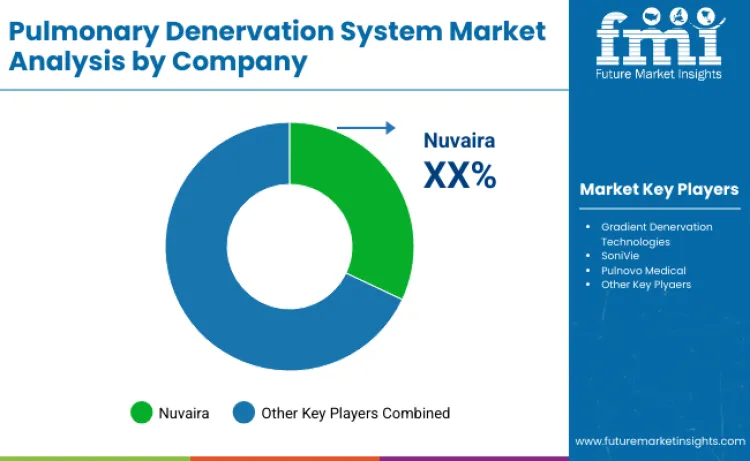
The pulmonary denervation system landscape shows a moderately concentrated competitive structure shaped by a focused group of interventional cardiology and neuromodulation innovators. Leading participants maintain advantage through early clinical validation, depth in catheter-based technologies, and seamless integration within advanced cardiovascular procedural ecosystems. Competition emphasizes energy delivery precision, catheter stability, safety monitoring intelligence, and compatibility with cath-lab imaging and hemodynamic systems rather than price positioning. Front-runner platforms sustain momentum through structured clinical research programs, comprehensive physician training infrastructure, and close collaboration with high-volume tertiary cardiac centers and pulmonary hypertension referral networks.
Market leaders advance ultrasound, radiofrequency, and chemical neuromodulation platforms supported by proprietary delivery systems and expanding evidence pipelines. Strong electrophysiology and interventional cardiology heritage, combined with global academic partnerships, reinforces their leadership across early-adopter hospitals worldwide. Challenger companies emerge through agile innovation, simplified procedural concepts, and focused clinical alliances, while regional innovators and academic spinouts add diversity through feasibility-stage platforms. Competitive dynamics favor companies with scalable training networks, reliable post-procedure support, and proven safety frameworks enabling confident adoption in complex cardiopulmonary care settings.
Key Players in the Pulmonary Denervation System Market
- Galvanize Therapeutics
- ReCor Medical
- Boston Scientific
- Medtronic
- Biosense Webster (J&J)
- Ablative Solutions
- Cordis
- NXT Biomedical / Verve Medical
- TherOx / ZOLL
- Academic & Early-Stage Spinouts (Agg.)
Scope of the Report
| Items | Values |
|---|---|
| Quantitative Units | USD 157.6 million |
| Technology | Radiofrequency Denervation Systems, Ultrasound-Based Denervation Systems, Cryothermal Systems, Chemical/Pharmacologic Denervation Systems |
| Application | Pulmonary Hypertension, COPD / Chronic Bronchitis, HFpEF / Cardio-Pulmonary Dysautonomia, Other Autonomic Dysregulation |
| End User | Hospitals & Specialty Cardio-Pulmonary Center, Ambulatory Surgical Centers, Research Institutions |
| Regions Covered | Asia Pacific, Europe, North America, Latin America, Middle East & Africa |
| Country Covered | China, India, Germany, Brazil, USA, UK, Japan, and 40+ countries |
| Key Companies Profiled | Galvanize Therapeutics, ReCor Medical, Boston Scientific, Medtronic, Biosense Webster (J&J), Ablative Solutions, Cordis, NXT Biomedical / Verve Medical, TherOx / ZOLL, Academic & Early-Stage Spinouts (Agg.), Others |
| Additional Attributes | Dollar spend by technology and clinical application, regional adoption across North America, Europe, and Asia Pacific, competitive landscape of interventional cardiology and neuromodulation players, procedural benchmarks, cath-lab workflow integration, advances in energy delivery and navigation, and next-generation pulmonary denervation platforms with enhanced safety and real-time feedback. |
Pulmonary Denervation System Market by Segments
Technology:
- Radiofrequency Denervation Systems
- Ultrasound-Based Denervation Systems
- Cryothermal Systems
- Chemical/Pharmacologic Denervation Systems
Application:
- Pulmonary Hypertension
- COPD / Chronic Bronchitis
- HFpEF / Cardio-Pulmonary Dysautonomia
- Other Autonomic Dysregulation
End User:
- Hospitals & Specialty Cardio-Pulmonary Centers
- Ambulatory Surgical Centers
- Research Institutions
Region:
- Asia Pacific
- China
- India
- Japan
- South Korea
- Vietnam
- Australia & New Zealand
- ASEAN
- Rest of Asia Pacific
- Europe
- Germany
- United Kingdom
- France
- Italy
- Spain
- Netherlands
- Nordic
- BENELUX
- Rest of Europe
- North America
- United States
- Canada
- Mexico
- Latin America
- Brazil
- Argentina
- Rest of Latin America
- Middle East & Africa
- Kingdom of Saudi Arabia
- Other GCC Countries
- Turkey
- South Africa
- Other African Union
- Rest of Middle East & Africa
Frequently Asked Questions
How big is the pulmonary denervation system market in 2025?
The global pulmonary denervation system market is valued at USD 157.6 million in 2025.
What will be the size of the pulmonary denervation system market in 2035?
The pulmonary denervation system market is projected to reach USD 1,184.9 million by 2035.
How much will the pulmonary denervation system market grow between 2025 and 2035?
The pulmonary denervation system market is expected to grow at a 22.3% CAGR between 2025 and 2035.
Which technology segment holds the largest share in the pulmonary denervation system market in 2025?
Radiofrequency denervation systems lead the market with an estimated 46.8% share in 2025.
Which application segment is expected to contribute significant share in the pulmonary denervation system market in 2025?
Pulmonary hypertension is set to command the largest share, accounting for 44.1% of total demand in 2025.
Preview the report firsthand - request a free sample
Get SampleGet the brochure for pricing and purchase details.
Get PDFTable of Content
- Executive Summary
- Regional Level Market Outlook
- Demand-side Trends
- Supply-side Trends
- Technology Roadmap Analysis
- Analysis and Recommendations
- Market Overview
- Market Coverage / Taxonomy
- Market Definition / Scope / Limitations
- Market Background
- Market Dynamics
- Drivers
- Restraints
- Opportunity
- Trends
- Scenario Forecast
- Demand in Optimistic Scenario
- Demand in Likely Scenario
- Demand in Conservative Scenario
- Opportunity Assessment
- Investment Feasibility Matrix
- PESTLE and Porter’s Analysis
- Regulatory Landscape
- By Key Regions
- By Key Countries
- Regional Parent Market Outlook
- Technological Innovation
- Market Dynamics
- Regional Level Market Analysis 2020 to 2024 and Forecast, 2025 to 2035
- Historical Market Size USD Million Analysis, 2020 to 2024
- Current and Future Market Size USD Million Projections, 2025 to 2035
- Y-o-Y Growth Trend Analysis
- Absolute $ Opportunity Analysis
- Regional Level Market Analysis 2020 to 2024 and Forecast 2025 to 2035, By Technology
- Introduction / Key Findings
- Historical Market Size USD Million Analysis By Technology, 2020 to 2024
- Current and Future Market Size USD Million Analysis and Forecast By Technology, 2025 to 2035
- Radiofrequency Denervation Systems
- Ultrasound-Based Denervation Systems
- Cryothermal Systems
- Chemical/Pharmacologic Denervation Systems
- Y-o-Y Growth Trend Analysis By Technology, 2020 to 2024
- Absolute $ Opportunity Analysis By Technology, 2025 to 2035
- Regional Level Market Analysis 2020 to 2024 and Forecast 2025 to 2035, By Application
- Introduction / Key Findings
- Historical Market Size USD Million Analysis By Application, 2020 to 2024
- Current and Future Market Size USD Million Analysis and Forecast By Application, 2025 to 2035
- Pulmonary Hypertension
- COPD / Chronic Bronchitis
- HFpEF / Cardio-Pulmonary Dysautonomia
- Other Autonomic Dysregulation
- Y-o-Y Growth Trend Analysis By Application, 2020 to 2024
- Absolute $ Opportunity Analysis By Application, 2025 to 2035
- Regional Level Market Analysis 2020 to 2024 and Forecast 2025 to 2035, By End User
- Introduction / Key Findings
- Historical Market Size USD Million Analysis By End User, 2020 to 2024
- Current and Future Market Size USD Million Analysis and Forecast By End User, 2025 to 2035
- Hospitals & Specialty Cardio-Pulmonary Centers
- Ambulatory Surgical Centers
- Research Institutions
- Y-o-Y Growth Trend Analysis By End User, 2020 to 2024
- Absolute $ Opportunity Analysis By End User, 2025 to 2035
- Regional Level Market Analysis 2020 to 2024 and Forecast 2025 to 2035, By Region
- Introduction
- Historical Market Size USD Million Analysis By Region, 2020 to 2024
- Current Market Size USD Million Analysis and Forecast By Region, 2025 to 2035
- North America
- Latin America
- East Asia
- South Asia
- Western Europe
- Eastern Europe
- Middle East & Africa
- Market Attractiveness Analysis By Region
- North America Market Analysis 2020 to 2024 and Forecast 2025 to 2035, By Country
- Historical Market Size USD Million Trend Analysis By Market Taxonomy, 2020 to 2024
- Market Size USD Million Forecast By Market Taxonomy, 2025 to 2035
- By Country
- USA
- Canada
- Mexico
- By Technology
- By Application
- By End User
- By Country
- Market Attractiveness Analysis
- By Country
- By Technology
- By Application
- By End User
- Key Takeaways
- Latin America Market Analysis 2020 to 2024 and Forecast 2025 to 2035, By Country
- Historical Market Size USD Million Trend Analysis By Market Taxonomy, 2020 to 2024
- Market Size USD Million Forecast By Market Taxonomy, 2025 to 2035
- By Country
- Brazil
- Argentina
- Rest of Latin America
- By Technology
- By Application
- By End User
- By Country
- Market Attractiveness Analysis
- By Country
- By Technology
- By Application
- By End User
- Key Takeaways
- East Asia Market Analysis 2020 to 2024 and Forecast 2025 to 2035, By Country
- Historical Market Size USD Million Trend Analysis By Market Taxonomy, 2020 to 2024
- Market Size USD Million Forecast By Market Taxonomy, 2025 to 2035
- By Country
- China
- Japan
- South Korea
- By Technology
- By Application
- By End User
- By Country
- Market Attractiveness Analysis
- By Country
- By Technology
- By Application
- By End User
- Key Takeaways
- South Asia Market Analysis 2020 to 2024 and Forecast 2025 to 2035, By Country
- Historical Market Size USD Million Trend Analysis By Market Taxonomy, 2020 to 2024
- Market Size USD Million Forecast By Market Taxonomy, 2025 to 2035
- By Country
- India
- ASEAN Countries
- Australia & New Zealand
- Rest of South Asia
- By Technology
- By Application
- By End User
- By Country
- Market Attractiveness Analysis
- By Country
- By Technology
- By Application
- By End User
- Key Takeaways
- Western Europe Market Analysis 2020 to 2024 and Forecast 2025 to 2035, By Country
- Historical Market Size USD Million Trend Analysis By Market Taxonomy, 2020 to 2024
- Market Size USD Million Forecast By Market Taxonomy, 2025 to 2035
- By Country
- Germany
- UK
- France
- Italy
- Spain
- BENELUX
- Nordic Countries
- Rest of Western Europe
- By Technology
- By Application
- By End User
- By Country
- Market Attractiveness Analysis
- By Country
- By Technology
- By Application
- By End User
- Key Takeaways
- Eastern Europe Market Analysis 2020 to 2024 and Forecast 2025 to 2035, By Country
- Historical Market Size USD Million Trend Analysis By Market Taxonomy, 2020 to 2024
- Market Size USD Million Forecast By Market Taxonomy, 2025 to 2035
- By Country
- Russia
- Hungary
- Poland
- Rest of Eastern Europe
- By Technology
- By Application
- By End User
- By Country
- Market Attractiveness Analysis
- By Country
- By Technology
- By Application
- By End User
- Key Takeaways
- Middle East & Africa Market Analysis 2020 to 2024 and Forecast 2025 to 2035, By Country
- Historical Market Size USD Million Trend Analysis By Market Taxonomy, 2020 to 2024
- Market Size USD Million Forecast By Market Taxonomy, 2025 to 2035
- By Country
- Saudi Arabia
- Other GCC Countries
- Türkiye
- South Africa
- Rest of MEA
- By Technology
- By Application
- By End User
- By Country
- Market Attractiveness Analysis
- By Country
- By Technology
- By Application
- By End User
- Key Takeaways
- Market Structure Analysis
- Competition Dashboard
- Competition Benchmarking
- Market Share Analysis of Top Players
- By Regional
- By Technology
- By Application
- By End User
- Competition Analysis
- Competition Deep Dive
- Galvanize Therapeutics
- Overview
- Key Financials
- Key Developments
- Global/Regional Footprint
- Strategy Overview
- Marketing Strategy
- SWOT
- Analyst Comment
- ReCor Medical
- Overview
- Key Financials
- Key Developments
- Global/Regional Footprint
- Boston Scientific
- Overview
- Key Financials
- Key Developments
- Global/Regional Footprint
- Medtronic
- Overview
- Key Financials
- Key Developments
- Global/Regional Footprint
- Biosense Webster (J&J)
- Overview
- Key Financials
- Key Developments
- Global/Regional Footprint
- Ablative Solutions
- Overview
- Key Financials
- Key Developments
- Global/Regional Footprint
- Cordis
- Overview
- Key Financials
- Key Developments
- Global/Regional Footprint
- NXT Biomedical / Verve Medical
- Overview
- Key Financials
- Key Developments
- Global/Regional Footprint
- TherOx / ZOLL
- Overview
- Key Financials
- Key Developments
- Global/Regional Footprint
- Academic & Early-Stage Spinouts (Agg.)
- Overview
- Key Financials
- Key Developments
- Global/Regional Footprint
- Galvanize Therapeutics
- Competition Deep Dive
- Assumptions & Acronyms Used
- Research Methodology


