

- Market Size (2026)
- USD 196.1 Mn
- Forecast (2036)
- USD 468.4 Mn
- CAGR (2026 to 2036)
- 9.1%
How big is Neurorehabilitation Nutrition Market in 2026?
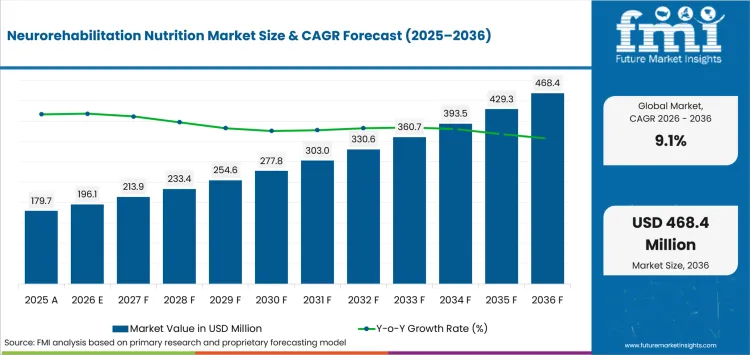
USD 196.1 million in 2026 and USD 468.4 million by 2036 at a 9.1% CAGR.
Sales in the neurorehabilitation nutrition market are projected to grow at 9.1% CAGR through 2036, driving valuation to USD 468.4 million by 2036 from USD 196.1 million in 2026. Stroke-related swallowing problems can reduce intake just as rehabilitation increases the need to protect muscle and energy intake. The World Health Organization's December 2025 stroke fact sheet estimated 93.8 million people were living with stroke in 2021 and lists dysphagia among acute complications. The stroke burden can lead clinicians to use clinical nutrition during rehabilitation, including oral supplements, texture-adapted products, or enteral feeding.
Country performance depends on how much rehabilitation occurs inside organized facilities and how reliably nutrition continues after discharge. Destatis recorded 83.8% bed occupancy in Germany's preventive and rehabilitation facilities during 2024 in data released in September 2025. Germany's 8.2% CAGR is below South Korea's 9.2% and the UK's 8.9%. Faster care-transition demand gives oral clinical nutrition and enteral products more room to grow in those two markets.
Key Takeaways
- Neurological rehabilitation requires medical nutrition for patients whose dysphagia, reduced intake, or muscle loss interferes with functional recovery.
- Based on product type, high-protein recovery ONS is projected to account for 41.8% in 2026 due to compact protein delivery during active oral recovery.
- By condition, post-stroke is estimated to hold 48.8% in 2026 owing to frequent swallowing and intake problems during recovery.
- In 2026, inpatient rehab facilities are expected to lead care setting with 50.4% share because dietetic, swallowing, and therapy decisions are coordinated in one setting.
- Adoption slows if texture, tolerance, formulary, or reimbursement requirements prevent the nutrition regimen from following the patient beyond the initial facility.
- Some of the key players in this market include Danone Nutricia, Abbott, Nestlé Health Science, Fresenius Kabi, Kate Farms, Otsuka Pharmaceutical Factory, Nutrisens, and Meiji Co., Ltd.
Analyst Perspective
"Neurorehabilitation nutrition is difficult to standardize because feeding route, swallowing safety, and protein needs can change during the same rehabilitation episode. Strong portfolios give dietitians oral, texture-adapted, and enteral options that can continue after discharge without forcing a new feeding routine."
- Nandini Roy Choudhury, Principal Consultant, Future Market Insights
How is the neurorehabilitation nutrition market segmented?
The neurorehabilitation nutrition market is segmented by product type, condition, care setting, end user, and sales channel.
Product type covers high-protein recovery ONS, dysphagia-adapted nutrition, long-term enteral feeds, cognition-support beverages, and other formats. Condition includes post-stroke, traumatic brain injury and spinal cord injury, neurodegenerative rehabilitation, and other neurological recovery needs. Care setting spans inpatient, outpatient, and home-based rehabilitation. End users include rehab hospitals, long-term care, homecare, and other purchasers. Sales channels include hospital pharmacy, retail pharmacy, online supply, institutional tender, and other routes.
How do inpatient rehab facilities shape the care setting category?
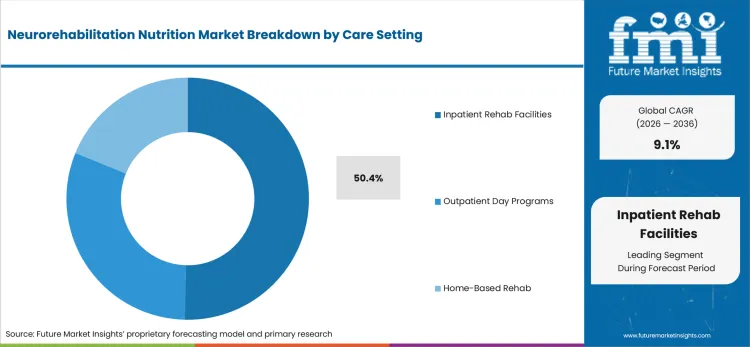
Inpatient rehabilitation concentrates therapy, swallowing assessment, and nutrition management within a short planning window. CMS finalized in July 2026 that all therapies in US inpatient rehabilitation facilities must begin within 36 hours of admission. The rule compresses initial care planning, so enteral nutrition or oral regimens need to be available quickly and remain adjustable as swallowing and functional status change.
- Inpatient rehab facilities are set to lead the care setting category with 50.4% share in 2026 due to multidisciplinary control over feeding route and protein goals.
- Facilities provide a controlled period to monitor tolerance before discharge to outpatient rehabilitation or home-based care.
What makes high-protein recovery ONS central to the product type category?
High-protein recovery ONS serves patients who can consume nutrition orally but struggle to reach protein targets with regular meals. In July 2025, Kate Farms launched a high-protein nutrition shake with 25 grams of plant protein per serving. The concentrated format gives protein supplementation a practical role during fatigue, poor appetite, limited meal tolerance, and short rehabilitation meals.
- By product type, high-protein recovery ONS is estimated to hold 41.8% in 2026 owing to concentrated protein delivery in smaller oral volumes.
- Dietitians can adjust dose frequency as intake improves. Dysphagia-adapted or enteral products serve patients whose swallowing safety changes.
Why does post-stroke lead the condition category?
Post-stroke care concentrates nutrition decisions because swallowing, self-feeding, mobility, and appetite can deteriorate during the recovery episode. A 2025 study of older stroke patients with dysphagia found that a fortified texture-modified diet increased daily energy intake by about 200 kcal without increasing meal volume. The evidence supports a nutrition role during neurological recovery without treating nutrition as proof of the modelled share.
- In 2026, post-stroke is expected to lead the condition category with 48.8% share because dysphagia often requires nutrition support during functional recovery.
- The commercial requirement changes with swallowing status. Product breadth carries more value than a formula limited to one stage of recovery.
What supports rehab hospitals in the end user category?
Rehab hospitals repeatedly manage patients whose nutrition plan changes during functional recovery, which gives them more direct control over protocol selection than household purchasers. Germany recorded 1.93 million cases in preventive or rehabilitation facilities during 2024, according to Destatis data published in September 2025. That case volume gives rehabilitation facilities repeated opportunities to standardize nutrition pathways without establishing the modelled end-user share.
- By end user, rehab hospitals are forecast to represent 43.2% in 2026 driven by direct coordination between dietitians, rehabilitation clinicians, and discharge teams.
- Long-term care and homecare use grows after discharge, but these settings depend more heavily on caregiver execution and continued product availability.
What are the drivers, restraints and opportunities in the Neurorehabilitation Nutrition Market?
Nutrition risk during neurological recovery supports demand. Dysphagia protocols and inconsistent guidance constrain product substitution, and community rehabilitation expands continuity opportunities.
- Driver: Stroke-related dysphagia and reduced intake increase the need for nutrition formats that can match changing swallowing ability during rehabilitation.
- Restraint: Clinical teams must reconcile texture safety, nutrition targets, local formulary rules, and caregiver execution before changing a current regimen.
- Opportunity: Products that remain available after discharge can extend a facility-started regimen into community and home-based rehabilitation.
Swallowing safety and food intake often change together during neurological recovery, so clinicians must match food texture and nutrient density to the same swallowing assessment. A January 2025 meta-analysis of 1,812 adults with dysphagia found higher energy and protein intake with texture-modified diets and lower aspiration risk with thickened fluids. The findings make swallowing status a direct product-selection constraint for oral supplements and texture-adapted nutrition during rehabilitation.
Clinical teams cannot substitute formulas freely because local protocols differ on nutrition support, texture, and swallowing management. An April 2025 systematic review found that 13 stroke-care guidelines treated nutrition support and supplementation inconsistently even though dysphagia screening received stronger agreement. Hospitals therefore need evidence on viscosity, preparation, tolerance, and caregiver instructions before replacing a current regimen.
Post-discharge rehabilitation extends the nutrition decision beyond specialist care because patients may continue the same oral or enteral regimen in the community. The 2025 SSNAP report found that 66.6% of stroke patients were discharged to stroke- or neurology-specific community rehabilitation in 2024/25, up from 63.4% a year earlier. Home healthcare, retail, and community supply therefore determine whether a facility-started regimen stays available after discharge.
Which country CAGRs are profiled in the Neurorehabilitation Nutrition Market?
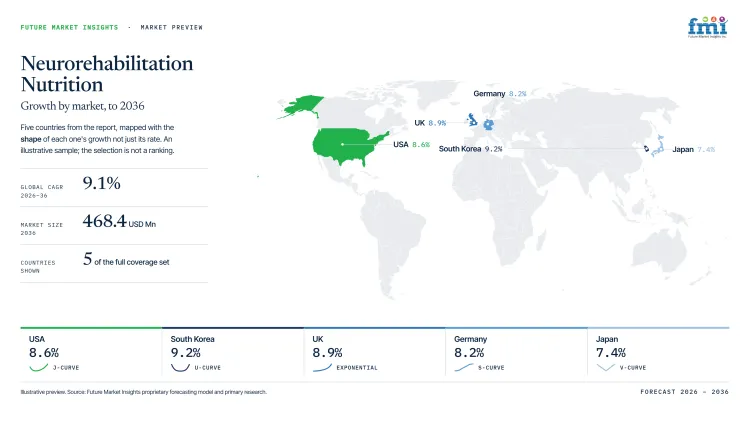
| Country | CAGR |
|---|---|
| South Korea | 9.2% |
| UK | 8.9% |
| USA | 8.6% |
| Germany | 8.2% |
| Japan | 7.4% |
How do country-level CAGRs compare in the Neurorehabilitation Nutrition Market?
The CAGRs span 1.8 percentage points, from South Korea at 9.2% to Japan at 7.4%. South Korea and the UK form the upper pair, the USA and Germany sit in the middle, and Japan is slower. The spread reflects how stroke rehabilitation, community follow-up, and purchasing structures differ rather than present market size.
- South Korea's compact oral formats fit dense urban outpatient follow-up after discharge.
- UK standardized texture language lets clinical teams compare dysphagia products more consistently.
- USA retail availability widens resupply options once patients leave inpatient rehabilitation facilities.
- Germany's clinical distributors give rehabilitation hospitals several established routes for nutrition supply.
- Japan's jelly and small-volume formats suit patients who struggle with full meals.
Similar CAGRs translate into different account economics and continuity needs. The full report provides country-level CAGR analysis across North America, Latin America, Europe, East Asia, South Asia, Oceania and the Middle East and Africa.
Country-wise Analysis
- Medicare's inpatient rehabilitation payment rules make hospital protocols and discharge planning part of the nutrition purchasing decision from the first days of care, especially where dietitians align swallowing safety with therapy schedules. CMS's August 2025 FY 2026 rate-setting files covered 1,170 inpatient rehabilitation facilities, and the USA is forecast to expand at 8.6% CAGR over the assessment period, tied to a large institutional base with formal payment pathways. Formulary and reimbursement differences can delay substitutions, so companies need protocol-level evidence plus retail or home-supply coverage and caregiver guidance that keeps the selected oral or enteral regimen available after discharge.
- Stroke nutrition is managed within an NHS pathway that links acute units with specialist community rehabilitation, although local formularies still control routine access to individual oral and enteral products. The 2025 SSNAP report covered 92,414 stroke admissions in 250 hospitals, 195 community services, and 184 six-month follow-up providers, giving nutrition companies a large clinical pathway that still requires local qualification and budget approval. Neurorehabilitation nutrition demand in the UK is projected to advance at 8.9% CAGR through 2036, owing to stronger hospital-to-community continuity that keeps prescribed formats available during community follow-up despite local purchasing controls for returning stroke patients.
- Rehabilitation purchasing is spread among public/ nonprofit and private providers, which gives medical-nutrition companies institutional volume without a single national route for changing facility protocols. Destatis counted 1,067 preventive or rehabilitation facilities in 2024, and Germany is estimated to post 8.2% CAGR over the forecast period, helped by this broad provider base and structured rehabilitation use. Existing formularies can slow switching during repeated facility-level reviews, so companies that document swallowing suitability and maintain the same regimen during follow-on care and caregiver handoffs have an advantage after discharge, particularly where therapy teams want familiar preparation steps during short rehabilitation stays.
- Recovery rehabilitation uses a large dedicated bed base, whereas clinical teams coordinate swallowing, diet and functional goals inside mature institutional routines. Ministry of Health, Labour and Welfare data list 1,625 reporting institutions and 95,710 recovery-rehabilitation beds in 2024 at roughly 1.3 times the bed count ten years earlier, with product substitution still dependent on taste, texture, and fit with existing practice. Japan is projected to record 7.4% CAGR over the forecast period, reflecting a mature care setting where localized formulations and reliable community access carry more weight than rapid national channel expansion after specialist rehabilitation ends for many patients.
- South Korea: Designated recovery-rehabilitation hospitals give nutrition companies a defined institutional route for patients moving from intensive therapy back to daily life and community care. Neurorehabilitation nutrition sales in South Korea are forecast to expand at 9.2% CAGR by 2036, propelled by formal rehabilitation capacity and the need to continue oral or enteral regimens after admission ends. The Ministry of Health and Welfare listed 53 institutions in the second designation cohort as of December 18, 2025, but hospital listing alone is insufficient because continued use depends on clear caregiver instructions, local retail availability, and reliable home delivery beyond hospital-based rehabilitation programs.
Who are the notable companies in the Neurorehabilitation Nutrition Market?
Danone Nutricia, Abbott, Nestlé Health Science, Fresenius Kabi, Kate Farms, Otsuka Pharmaceutical Factory, Nutrisens, and Meiji Co., Ltd. are the notable companies profiled in this market.
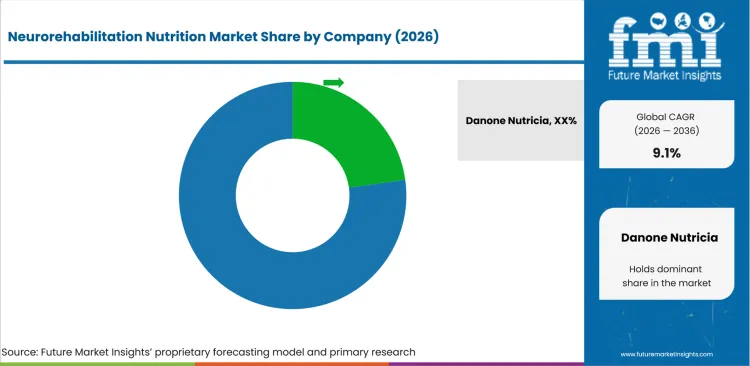
Competition separates medical-nutrition groups from specialists in oral, enteral, plant-based, or dysphagia formats. Danone Nutricia, Abbott, Nestlé Health Science, and Fresenius Kabi have the widest coverage in the profiled set. Kate Farms focuses on plant-based formulas. Otsuka Pharmaceutical Factory and Meiji cover Japanese medical foods. Nutrisens concentrates on dysphagia-adapted clinical nutrition. Companies seeking new rehabilitation accounts need clinical acceptance for enteral formulas, distribution continuity, and protocol evidence before trial orders become repeat purchases.
- Broad oral and medical nutrition platforms: Danone Nutricia, Abbott, Nestlé Health Science, and Fresenius Kabi cover multiple clinical settings and international markets.
- Specialized and regional clinical nutrition platforms: Kate Farms, Otsuka Pharmaceutical Factory, Nutrisens, and Meiji Co., Ltd. compete with plant-based, enteral, dysphagia, or high-nutrition formats.
Competitive Benchmarking: Neurorehabilitation Nutrition Market
| Company | Oral Recovery Nutrition Depth | Enteral Feeding Breadth | Care-Transition Support | Geographic Reach |
|---|---|---|---|---|
| Danone Nutricia | High | High | High | Global |
| Abbott | High | High | Medium | Global |
| Nestlé Health Science | High | High | High | Global |
| Fresenius Kabi | High | High | High | Global |
| Kate Farms | High | Medium | High | North America |
| Otsuka Pharmaceutical Factory | Medium | High | Medium | Japan and selected international markets |
| Nutrisens | High | Medium | Medium | Europe and Latin America |
| Meiji Co., Ltd. | High | High | Medium | Japan and selected Asian markets |
Scoring basis: For oral recovery depth, High means at least three documented formats, Medium two, and Low one. For enteral breadth, High means at least three tube-feeding or semi-solid routes, Medium two, and Low one. For care-transition support, High requires hospital plus home, retail, or community access, Medium two verified channels, and Low one. Geographic reach is descriptive and does not affect the ratings.
Key Developments in the Neurorehabilitation Nutrition Market
- In July 2025, Danone completed the acquisition of a majority stake in Kate Farms, extending its US specialized-nutrition business into plant-based products and wider hospital-to-home access.
- In June 2025, Fresenius Kabi opened its expanded enteral nutrition R&D center in Gurugram, adding laboratory and development capacity to its global nutrition network.
- In January 2025, Otsuka Pharmaceutical Factory launched ENOSOLID Semi Solid for Enteral Use in Japan, extending its enteral portfolio with a semi-solid administration route.
Key Players in the Neurorehabilitation Nutrition Market
Global clinical nutrition platforms
- Danone Nutricia
- Abbott
- Nestlé Health Science
- Fresenius Kabi
Specialized and regional medical nutrition companies
- Kate Farms
- Otsuka Pharmaceutical Factory
- Nutrisens
- Meiji Co., Ltd.
Neurorehabilitation Nutrition Market - Report Scope
| Coverage field | Report scope |
|---|---|
| Market breakdown | By product type, condition, care setting, end user, sales channel, and region. |
| Quantitative Units | USD million. |
| Market Definition | Commercial oral, dysphagia-adapted, and enteral nutrition used to support patients during neurological rehabilitation and recovery. |
| Regions Covered | North America, Latin America, Western Europe, Eastern Europe, East Asia, South Asia and Pacific, and Middle East and Africa. |
| Countries Covered | USA, UK, Germany, Japan, South Korea, and 20+ countries included in the full report. |
| Key Companies Profiled | Danone Nutricia, Abbott, Nestlé Health Science, Fresenius Kabi, Kate Farms, Otsuka Pharmaceutical Factory, Nutrisens, Meiji Co., Ltd. |
| Forecast Period | 2026 to 2036. |
| Approach | Primary and secondary research with market triangulation. |
Neurorehabilitation Nutrition Market - Research Methodology
| Method | Approach |
|---|---|
| Primary Research | FMI analysts gathered input from manufacturers, service providers, technology developers, distributors, end users, procurement teams, and subject-matter experts. Interviews examined purchasing decisions, product or service evaluation, adoption barriers, approval requirements, pricing considerations, and expectations for technical or commercial support. Respondents were also asked what evidence is required before a trial, pilot, or initial order develops into regular purchasing. |
| Desk Research | Desk research covered government statistics, regulatory publications, trade data, industry associations, technical literature, standards, company filings, product information, and official corporate announcements. Sources were reviewed for relevance, publication date, geographic coverage, and consistency with the defined market scope. Claims relating to performance, applications, approvals, capacity, investment, and commercial activity were retained only when supported by credible public evidence. |
| Market Sizing and Forecasting | The market model combined the baseline value with historical performance, segment structure, pricing and volume indicators, adoption levels, company participation, and country-level demand conditions. Forecast assumptions considered economic activity, investment trends, regulatory developments, technology adoption, purchasing cycles, supply availability, and barriers to wider market use. Segment and regional estimates were reconciled before the final market total was calculated. |
| Data Validation | Estimates were checked against multiple independent indicators, including public data, company activity, trade patterns, industry developments, and findings from primary interviews. Validation also tested whether products, services, applications, and company revenues fell within the defined market boundaries. Adjacent categories, unsupported claims, overlapping revenues, and activities without direct market relevance were excluded to reduce double counting and maintain consistency across segments and countries. |
Neurorehabilitation Nutrition Market by Segments
Neurorehabilitation Nutrition Market segmented by Product Type:
- High-Protein Recovery ONS
- Dysphagia-Adapted Nutrition
- Enteral Feeds (Neuro Long-Term)
- Cognition-Support Beverages
- Others
Neurorehabilitation Nutrition Market segmented by Condition:
- Post-Stroke
- TBI & Spinal Cord Injury
- Neurodegenerative Disease Rehab
- Others
Neurorehabilitation Nutrition Market segmented by Care Setting:
- Inpatient Rehab Facilities
- Outpatient Day Programs
- Home-Based Rehab
Neurorehabilitation Nutrition Market segmented by End User:
- Rehab Hospitals
- Long-Term Care
- Homecare
- Others
Neurorehabilitation Nutrition Market segmented by Sales Channel:
- Hospital Pharmacy
- Retail Pharmacy
- Online
- Institutional Tender
- Others
Neurorehabilitation Nutrition Market by Region:
- North America
- United States
- Canada
- Latin America
- Brazil
- Mexico
- Argentina
- Chile
- Rest of Latin America
- Western Europe
- Germany
- France
- United Kingdom
- Italy
- Spain
- Benelux
- Nordics
- Rest of Western Europe
- Eastern Europe
- Poland
- Czech Republic
- Romania
- Hungary
- Balkan and Baltic States
- Rest of Eastern Europe
- East Asia
- China
- Japan
- South Korea
- South Asia and Pacific
- India
- ASEAN
- Australia and New Zealand
- Rest of South Asia and Pacific
- Middle East and Africa
- Kingdom of Saudi Arabia
- Other GCC Countries
- Türkiye
- South Africa
- Other African Union Countries
- Rest of Middle East and Africa
Research Sources and Bibliography
- World Health Organization. (2025, December 19). Stroke.
- Statistisches Bundesamt. (2025, September 10). Vorsorge- oder Rehabilitationseinrichtungen 2024 nach Trägern und Bundesländern.
- Kate Farms. (2025, July 8). Kate Farms unveils new High Protein Nutrition Shake.
- Ueshima, J., Maeda, K., Miyoshi, F., et al. (2025, April 11). Nutrition-Fortified Texture-Modified Diet Enhances Recovery in Older Adult Patients With Dysphagia.
- Centers for Medicare & Medicaid Services. (2026, July 30). FY 2027 Inpatient Rehabilitation Facilities (IRF) Prospective Payment System (PPS) Final Rule (CMS-1845-F).
- Chu, Y.-H., & Chao, J. C.-J. (2025, January 15). Effectiveness of diet modification on dietary nutrient intake, aspiration, and fluid intake for adults with dysphagia: A meta-analysis of randomized controlled trials.
- Siewers, K., Svaerke, K., Rosenørn, A. E., & Christensen, H. (2025, April 10). Nutritional care in rehabilitation and acute care of stroke patients: A systematic review of clinical practice guidelines.
- Healthcare Quality Improvement Partnership. (2025, November 13). State of the Nation Report 2025: Stroke care received between April 2024 to March 2025.
- Centers for Medicare & Medicaid Services. (2025, August 5). Medicare Program: Inpatient Rehabilitation Facility Prospective Payment System for Federal Fiscal Year 2026 and Updates to the IRF Quality Reporting Program.
- Ministry of Health, Labour and Welfare, Japan. (2025, November 14).
- Ministry of Health and Welfare, Republic of Korea. (2025, December 18).
- Danone. (2025, July 1). Danone completes the acquisition of Kate Farms, enhancing its USA specialized nutrition offerings.
- Fresenius Kabi. (2025, June 26). New R&D center in India strengthens Fresenius Kabi's innovation network.
- Otsuka Pharmaceutical Factory. (2025, January 17). Otsuka Pharmaceutical Factory launches ENOSOLID Semi Solid for Enteral Use.
- Danone. (2025, February 25). Nutricia lanza Fortimel Plantbased Protein, un nuevo suplemento nutricional oral hiperproteico completamente vegetal para el manejo de la DRE.
- Nestlé Health Science. (2025, October 15). Nestlé Health Science and University of California, Davis Innovation Institute for Food & Health announce strategic partnership.
- Nutricia. (2025, October 1). Nutricia's new savory plant-based medical nutrition proven to improve patient adherence.
- Abbott. (2025, November 13). Abbott launches new and advanced Ensure Diabetes Care, a clinically proven formula to help manage blood sugar.
- Meiji Holdings Co., Ltd. (2025, June 26). Annual Securities Report (The 16th Fiscal Year) (Translation).
- Consumer Affairs Agency, Japan. (2026, August 10).
- Nutricia, Danone Deutschland GmbH. (2025, February). NEU ab April 2025: Nutrison® 2 kcal HP MF PlantBased.
- Abbott. (2026, May 13). Abbott launches Ensure Strength Pro in India to support healthy ageing.
- Nestlé Health Science. (2025, October 17). Nestlé Health Science and the Food & Nutrition Innovation Institute at the Friedman School at Tufts University expand opportunities to advance nutrition science and innovation.
- Fresenius Kabi. (2026, March 18). Innovating in PLANT-BASED Nutrition.
- Kate Farms. (2025, November 10). Kate Farms expands access with launch of High Protein Nutrition Shakes at select Walmart stores.
- Otsuka Pharmaceutical Factory. (2025, May 19). Otsuka Pharmaceutical Factory launches HINEX Jelly Aqua, a concentrated liquid diet product to assist hydration.
- Nutrisens. (2025, March 14). Nutrisens annonce l'acquisition de Prodiet Medical Nutrition.
This Report Answers
- What is the neurorehabilitation nutrition market size in 2026 and what value is forecast for 2036?
- What clinical conditions support demand for specialized nutrition during neurological rehabilitation?
- Why does high-protein recovery ONS lead the product type category?
- Why does post-stroke account for the largest condition share in 2026?
- How do inpatient rehab facilities influence nutrition selection and care-transition planning?
- How do the profiled country CAGRs differ between South Korea, the UK, the USA, Germany, and Japan?
- Which companies compete in oral, enteral, plant-based, and dysphagia-related neurorehabilitation nutrition?
- What factors can interrupt nutrition continuity after discharge?
Frequently Asked Questions
How big is the neurorehabilitation nutrition market in 2026?
The neurorehabilitation nutrition market is valued at USD 196.1 million in 2026 and is projected to reach USD 468.4 million by 2036. Growth follows the need to maintain nutrition during dysphagia, reduced intake, and functional recovery.
What is the CAGR of the neurorehabilitation nutrition market from 2026 to 2036?
The neurorehabilitation nutrition market is projected to grow at a CAGR of 9.1% between 2026 and 2036. Expansion follows structured rehabilitation pathways and continued nutrition use after neurological injury.
Which product type leads the neurorehabilitation nutrition market?
The high-protein recovery ONS segment is expected to hold 41.8% of the neurorehabilitation nutrition market by product type in 2026, driven by concentrated protein delivery during oral recovery. Smaller serving volumes fit patients with poor appetite or limited meal tolerance.
How much value will the neurorehabilitation nutrition market add between 2026 and 2036?
The market is expected to add USD 272.3 million in value between 2026 and 2036. The increase reflects structured rehabilitation use and continued nutrition supply after discharge.
Which companies are active in the neurorehabilitation nutrition market?
Key companies in the neurorehabilitation nutrition market include Danone Nutricia, Abbott, Nestlé Health Science, Fresenius Kabi, Kate Farms, Otsuka Pharmaceutical Factory, Nutrisens, and Meiji Co., Ltd. They differ in portfolio breadth, clinical fit, and distribution continuity.
Preview the report firsthand - request a free sample
Get SampleGet the brochure for pricing and purchase details.
Get PDFTable of Content
- Key Takeaways
- Market Size and CAGR
- Top Growth Driver
- Fastest Growing Segment
- Leading Region
- Key Companies
- Emerging Opportunities
- Executive Summary
- Global Market Outlook
- Demand-side Trends
- Supply-side Trends
- Technology Roadmap Analysis
- Analysis and Recommendations
- Analyst Perspective (What is happening? Why now? What should investors know?)
- Key Questions Answered
- How large is the market?
- What is the CAGR?
- What are key trends?
- Which region dominates?
- Who are the leaders?
- Market Overview
- Market Coverage / Taxonomy
- Market Definition / Scope / Limitations
- Research Methodology
- Chapter Orientation
- Analytical Lens and Working Hypotheses
- Market Structure, Signals, and Trend Drivers
- Benchmarking and Cross-market Comparability
- Market Sizing, Forecasting, and Opportunity Mapping
- Research Design and Evidence Framework
- Desk Research Programme (Secondary Evidence)
- Expert Input and Fieldwork (Primary Evidence)
- Tooling, Models, and Reference Databases
- Data Engineering and Model Build
- Quality Assurance and Audit Trail
- Market Background
- Market Dynamics (Drivers, Restraints, Opportunity, Trends)
- Scenario Forecast (Optimistic, Likely, Conservative)
- Impact Analysis
- AI Impact
- Sustainability Impact
- Regulatory Impact
- Technology Impact
- Consumer / Buyer Analysis
- Purchase Drivers
- Adoption Barriers
- Buyer Journey
- Opportunity Map Analysis
- Product Life Cycle Analysis
- Supply Chain Analysis
- Investment Feasibility Matrix
- Value Chain Analysis
- PESTLE and Porter's Analysis
- Regulatory Landscape
- Regional Parent Market Outlook
- Production and Consumption Statistics
- Import and Export Statistics
- Global Market Analysis and Forecast, 2021 to 2036
- Historical Market Size Value (USD Million) Analysis, 2021 to 2025
- Current and Future Market Size Value (USD Million) Projections, 2026 to 2036
- Y-o-Y Growth Trend Analysis
- Absolute $ Opportunity Analysis
- Global Market Pricing Analysis, 2021 to 2036
- Global Market Analysis and Forecast, By Product Type, 2021 to 2036
- Introduction / Key Findings
- Historical Market Size Value (USD Million) Analysis By Product Type, 2021 to 2025
- Current and Future Market Size Value (USD Million) Analysis and Forecast By Product Type, 2026 to 2036
- High-Protein Recovery ONS
- Dysphagia-Adapted Nutrition
- Enteral Feeds (Neuro Long-Term)
- Cognition-Support Beverages
- Others
- High-Protein Recovery ONS
- Y-o-Y Growth Trend Analysis By Product Type, 2021 to 2025
- Absolute $ Opportunity Analysis By Product Type, 2026 to 2036
- Global Market Analysis and Forecast, By Condition, 2021 to 2036
- Introduction / Key Findings
- Historical Market Size Value (USD Million) Analysis By Condition, 2021 to 2025
- Current and Future Market Size Value (USD Million) Analysis and Forecast By Condition, 2026 to 2036
- Post-Stroke
- TBI & Spinal Cord Injury
- Neurodegenerative Disease Rehab
- Others
- Post-Stroke
- Y-o-Y Growth Trend Analysis By Condition, 2021 to 2025
- Absolute $ Opportunity Analysis By Condition, 2026 to 2036
- Global Market Analysis and Forecast, By Care Setting, 2021 to 2036
- Introduction / Key Findings
- Historical Market Size Value (USD Million) Analysis By Care Setting, 2021 to 2025
- Current and Future Market Size Value (USD Million) Analysis and Forecast By Care Setting, 2026 to 2036
- Inpatient Rehab Facilities
- Outpatient Day Programs
- Home-Based Rehab
- Inpatient Rehab Facilities
- Y-o-Y Growth Trend Analysis By Care Setting, 2021 to 2025
- Absolute $ Opportunity Analysis By Care Setting, 2026 to 2036
- Global Market Analysis and Forecast, By End User, 2021 to 2036
- Introduction / Key Findings
- Historical Market Size Value (USD Million) Analysis By End User, 2021 to 2025
- Current and Future Market Size Value (USD Million) Analysis and Forecast By End User, 2026 to 2036
- Rehab Hospitals
- Long-Term Care
- Homecare
- Others
- Rehab Hospitals
- Y-o-Y Growth Trend Analysis By End User, 2021 to 2025
- Absolute $ Opportunity Analysis By End User, 2026 to 2036
- Global Market Analysis and Forecast, By Sales Channel, 2021 to 2036
- Introduction / Key Findings
- Historical Market Size Value (USD Million) Analysis By Sales Channel, 2021 to 2025
- Current and Future Market Size Value (USD Million) Analysis and Forecast By Sales Channel, 2026 to 2036
- Hospital Pharmacy
- Retail Pharmacy
- Online
- Institutional Tender
- Others
- Hospital Pharmacy
- Y-o-Y Growth Trend Analysis By Sales Channel, 2021 to 2025
- Absolute $ Opportunity Analysis By Sales Channel, 2026 to 2036
- Global Market Analysis and Forecast, By Region, 2021 to 2036
- Introduction
- Historical Market Size Value (USD Million) Analysis By Region, 2021 to 2025
- Current Market Size Value (USD Million) Analysis and Forecast By Region, 2026 to 2036
- North America
- Latin America
- Western Europe
- Eastern Europe
- East Asia
- South Asia and Pacific
- Middle East & Africa
- Market Attractiveness Analysis By Region
- North America Market Analysis and Forecast, By Country, 2021 to 2036
- Historical Market Size Value (USD Million) Trend Analysis By Market Taxonomy, 2021 to 2025
- Market Size Value (USD Million) Forecast By Market Taxonomy, 2026 to 2036
- By Country
- USA
- Canada
- By Product Type
- By Condition
- By Care Setting
- By End User
- By Sales Channel
- By Country
- Market Attractiveness Analysis
- By Country
- By Product Type
- By Condition
- By Care Setting
- By End User
- By Sales Channel
- Key Takeaways
- Latin America Market Analysis and Forecast, By Country
- Historical Market Size Value (USD Million) Trend Analysis By Market Taxonomy, 2021 to 2025
- Market Size Value (USD Million) Forecast By Market Taxonomy, 2026 to 2036
- By Country
- Brazil
- Mexico
- Chile
- Rest of Latin America
- By Product Type
- By Condition
- By Care Setting
- By End User
- By Sales Channel
- By Country
- Market Attractiveness Analysis
- By Country
- By Product Type
- By Condition
- By Care Setting
- By End User
- By Sales Channel
- Key Takeaways
- Western Europe Market Analysis and Forecast, By Country
- Historical Market Size Value (USD Million) Trend Analysis By Market Taxonomy, 2021 to 2025
- Market Size Value (USD Million) Forecast By Market Taxonomy, 2026 to 2036
- By Country
- Germany
- UK
- Italy
- Spain
- France
- Nordic
- BENELUX
- Rest of Western Europe
- By Product Type
- By Condition
- By Care Setting
- By End User
- By Sales Channel
- By Country
- Market Attractiveness Analysis
- By Country
- By Product Type
- By Condition
- By Care Setting
- By End User
- By Sales Channel
- Key Takeaways
- Eastern Europe Market Analysis and Forecast, By Country
- Historical Market Size Value (USD Million) Trend Analysis By Market Taxonomy, 2021 to 2025
- Market Size Value (USD Million) Forecast By Market Taxonomy, 2026 to 2036
- By Country
- Russia
- Poland
- Hungary
- Balkan & Baltic
- Rest of Eastern Europe
- By Product Type
- By Condition
- By Care Setting
- By End User
- By Sales Channel
- By Country
- Market Attractiveness Analysis
- By Country
- By Product Type
- By Condition
- By Care Setting
- By End User
- By Sales Channel
- Key Takeaways
- East Asia Market Analysis and Forecast, By Country
- Historical Market Size Value (USD Million) Trend Analysis By Market Taxonomy, 2021 to 2025
- Market Size Value (USD Million) Forecast By Market Taxonomy, 2026 to 2036
- By Country
- China
- Japan
- South Korea
- By Product Type
- By Condition
- By Care Setting
- By End User
- By Sales Channel
- By Country
- Market Attractiveness Analysis
- By Country
- By Product Type
- By Condition
- By Care Setting
- By End User
- By Sales Channel
- Key Takeaways
- South Asia and Pacific Market Analysis and Forecast, By Country
- Historical Market Size Value (USD Million) Trend Analysis By Market Taxonomy, 2021 to 2025
- Market Size Value (USD Million) Forecast By Market Taxonomy, 2026 to 2036
- By Country
- India
- ASEAN
- Australia & New Zealand
- Rest of South Asia and Pacific
- By Product Type
- By Condition
- By Care Setting
- By End User
- By Sales Channel
- By Country
- Market Attractiveness Analysis
- By Country
- By Product Type
- By Condition
- By Care Setting
- By End User
- By Sales Channel
- Key Takeaways
- Middle East & Africa Market Analysis and Forecast, By Country
- Historical Market Size Value (USD Million) Trend Analysis By Market Taxonomy, 2021 to 2025
- Market Size Value (USD Million) Forecast By Market Taxonomy, 2026 to 2036
- By Country
- Kingdom of Saudi Arabia
- Other GCC Countries
- Türkiye
- South Africa
- Other African Union
- Rest of Middle East & Africa
- By Product Type
- By Condition
- By Care Setting
- By End User
- By Sales Channel
- By Country
- Market Attractiveness Analysis
- By Country
- By Product Type
- By Condition
- By Care Setting
- By End User
- By Sales Channel
- Key Takeaways
- Key Countries Market Analysis
- USA
- Pricing Analysis
- Market Share Analysis, 2025
- By Product Type
- By Condition
- By Care Setting
- By End User
- By Sales Channel
- Canada
- Pricing Analysis
- Market Share Analysis, 2025
- By Product Type
- By Condition
- By Care Setting
- By End User
- By Sales Channel
- Mexico
- Pricing Analysis
- Market Share Analysis, 2025
- By Product Type
- By Condition
- By Care Setting
- By End User
- By Sales Channel
- Brazil
- Pricing Analysis
- Market Share Analysis, 2025
- By Product Type
- By Condition
- By Care Setting
- By End User
- By Sales Channel
- Chile
- Pricing Analysis
- Market Share Analysis, 2025
- By Product Type
- By Condition
- By Care Setting
- By End User
- By Sales Channel
- Germany
- Pricing Analysis
- Market Share Analysis, 2025
- By Product Type
- By Condition
- By Care Setting
- By End User
- By Sales Channel
- UK
- Pricing Analysis
- Market Share Analysis, 2025
- By Product Type
- By Condition
- By Care Setting
- By End User
- By Sales Channel
- Italy
- Pricing Analysis
- Market Share Analysis, 2025
- By Product Type
- By Condition
- By Care Setting
- By End User
- By Sales Channel
- Spain
- Pricing Analysis
- Market Share Analysis, 2025
- By Product Type
- By Condition
- By Care Setting
- By End User
- By Sales Channel
- France
- Pricing Analysis
- Market Share Analysis, 2025
- By Product Type
- By Condition
- By Care Setting
- By End User
- By Sales Channel
- India
- Pricing Analysis
- Market Share Analysis, 2025
- By Product Type
- By Condition
- By Care Setting
- By End User
- By Sales Channel
- ASEAN
- Pricing Analysis
- Market Share Analysis, 2025
- By Product Type
- By Condition
- By Care Setting
- By End User
- By Sales Channel
- Australia & New Zealand
- Pricing Analysis
- Market Share Analysis, 2025
- By Product Type
- By Condition
- By Care Setting
- By End User
- By Sales Channel
- China
- Pricing Analysis
- Market Share Analysis, 2025
- By Product Type
- By Condition
- By Care Setting
- By End User
- By Sales Channel
- Japan
- Pricing Analysis
- Market Share Analysis, 2025
- By Product Type
- By Condition
- By Care Setting
- By End User
- By Sales Channel
- South Korea
- Pricing Analysis
- Market Share Analysis, 2025
- By Product Type
- By Condition
- By Care Setting
- By End User
- By Sales Channel
- Russia
- Pricing Analysis
- Market Share Analysis, 2025
- By Product Type
- By Condition
- By Care Setting
- By End User
- By Sales Channel
- Poland
- Pricing Analysis
- Market Share Analysis, 2025
- By Product Type
- By Condition
- By Care Setting
- By End User
- By Sales Channel
- Hungary
- Pricing Analysis
- Market Share Analysis, 2025
- By Product Type
- By Condition
- By Care Setting
- By End User
- By Sales Channel
- Kingdom of Saudi Arabia
- Pricing Analysis
- Market Share Analysis, 2025
- By Product Type
- By Condition
- By Care Setting
- By End User
- By Sales Channel
- Türkiye
- Pricing Analysis
- Market Share Analysis, 2025
- By Product Type
- By Condition
- By Care Setting
- By End User
- By Sales Channel
- South Africa
- Pricing Analysis
- Market Share Analysis, 2025
- By Product Type
- By Condition
- By Care Setting
- By End User
- By Sales Channel
- USA
- Market Structure Analysis
- Competition Dashboard
- Competition Benchmarking
- Market Share Analysis of Top Players
- By Regional
- By Product Type
- By Condition
- By Care Setting
- By End User
- By Sales Channel
- Emerging Startups
- Innovation Benchmarking
- Competition Analysis
- Competition Deep Dive
- Danone Nutricia
- Overview
- Product Portfolio
- Profitability by Market Segments
- Sales Footprint
- Strategy Overview
- Marketing Strategy
- Product Strategy
- Channel Strategy
- Abbott
- Nestle Health Science
- Fresenius Kabi
- Kate Farms
- Hormel Health Labs
- Medtrition
- Victus
- Danone Nutricia
- Case Studies
- Success Stories
- Recent Developments
- Competition Deep Dive
- Assumptions & Acronyms Used


